You are currently viewing a new version of our website. To view the old version click .
Journal of Marine Science and Engineering
  • Article
  • Open Access

5 December 2025

Lagrangian Coherent Structures for Mapping Mesoscale Circulation in the Western Equatorial Atlantic


,
and
Laboratório de Pesquisa em Monitoramento Ambiental Marinho, Instituto de Geociências, Universidade Federal do Pará, Belém 66075-110, Brazil
*
Author to whom correspondence should be addressed.
This article belongs to the Section Physical Oceanography

Abstract

Lagrangian Coherent Structures (LCSs) in the mesoscale circulation of the Western Equatorial Atlantic (WEA), a region governed by the North Brazil Current (NBC) and its retroflection, are analyzed. Observations from 63 surface drifters deployed between 2018 and 2019 were combined with ocean analysis/forecast fields. The Finite-Time Lyapunov Exponent (FTLE) was computed using 15- and 90-day integrations to identify transport barriers and persistent structures. FTLE ridges showed strong seasonal correspondence with drifter trajectories, with 34–74% of drifter positions lying within 0.25° of attracting or repelling LCSs. Characteristic FTLE magnitudes reached ~0.3 d−1, implying particle separation e-folding times of approximately 3.3 days. Spatial agreement between drifter-derived and model-based FTLE fields exhibited similar variability across seasons, with the highest correspondence during periods of intensified frontal activity. These results indicate that a substantial portion of the observed drifter motion follows or remains close to FTLE-defined pathways, supporting the robustness of the Lagrangian structures identified in the WEA. Overall, the study provides the first quantitative LCS-based characterization of mesoscale transport in this region, revealing recurrent eddies, instability zones, and flow boundaries associated with the NBC system and its interaction with the North Equatorial Countercurrent.

1. Introduction

The Western Equatorial Atlantic (WEA) is defined as an energetic, complex environment that plays a key role in the exchange of mass and energy between the hemispheres at low latitudes. The principal physical agent governing mesoscale circulation in the WEA is the North Brazil Current (NBC), a western boundary current that flows northwestward along the South American coast, transporting surface waters along the equator [1,2,3]. The NBC is important for the wind-forced equatorial current gyre, and its retroflection contributes to the zonal transport of mass and volume to the North Equatorial Countercurrent (NECC), which flows eastward north of 5° N [4]. Furthermore, the physical processes occurring in the WEA are essential to global ocean circulation and climate dynamics, as the region facilitates the dispersion of warm, low-salinity, and nutrient-rich waters originating from the Amazon and Pará river discharges, for which historical mean discharges are approximately 1.9 × 10⁵ m3 s−1 and 2.1 × 10⁴ m3 s−1, respectively [5]. Consequently, mesoscale dynamics in the WEA represent a crucial mechanism for transporting mass, energy, and trace elements between the Northern and Southern Hemispheres, playing a significant role in the Atlantic Meridional Overturning Circulation (AMOC). The influence of wind and the AMOC on low-latitude circulation was examined by Fratantoni et al. [6]; the transport of subtropical Southern Hemisphere waters via the NBC system and its role in the surface return of the AMOC were investigated by Silva et al. [7]. The contribution of NBC eddies to the surface closure of the AMOC at low latitudes was estimated by Bueno et al. [8] to be 40–70%.
Mesoscale circulation in the WEA has been investigated using numerous methodologies [9]. In this context, Lagrangian approaches have proven particularly effective. Lagrangian analysis characterizes transport and dispersion processes more directly than purely Eulerian methods by tracking trajectories of real or virtual particles [10]. Consequently, Lagrangian Coherent Structures (LCSs) identified via computation of the Finite-Time Lyapunov Exponent (FTLE) are recognized as a robust tool for revealing dynamic transport barriers, mixing zones, and persistent flow patterns [11,12,13]. LCSs are defined as structures that organize particle motion, delineating regions of convergence, dispersion, or confinement, such as eddies, meanders, and current fronts.
The applicability of these techniques extends beyond physical oceanography, encompassing fields such as marine biology and the cryosphere. Recent studies, for example, demonstrate that FTLE ridges can be used to identify areas of phytoplankton accumulation and trophic enrichment, with direct implications for fisheries and coastal ecology [14]. Similarly, their application in polar regions has revealed boundaries between zones of stability and zones of intense mixing, thereby contributing to the understanding of sea-ice cover variability [15]. Despite this growing use across different ocean basins, a detailed application of these metrics to the WEA has not yet been carried out. Therefore, this study fills this gap by providing the first LCS-based characterization of mesoscale circulation in the Western Equatorial Atlantic, resolving the structure and spatial organization of eddies, transport barriers, and regions of intensified deformation. This framework provides a novel dynamic perspective for the WEA, enabling a mechanistic evaluation of the influence of mesoscale features on transport pathways.
In situ sampling was conducted via twelve monthly deployments of surface drifters, whose Lagrangian data were used to validate the identification of LCSs. In addition to this data, variables derived from analysis/forecast fields were utilized, including potential temperature, salinity, zonal and meridional velocities, and mean sea level height. These modeled data were available throughout the deployment period and the entire course of the experiment. The principal analysis consisted of computing the forward- and backward-time FTLE in temporal integration windows of 15 and 90 days, which allows the characterization of dispersion features in mesoscale circulations. The FTLE was compared with other parameters commonly used in flow analyses, such as the Richardson number (Ri), Eddy Kinetic Energy (EKE), relative vorticity ( ζ ), the Okubo–Weiss parameter (OW), and Sea-Level Anomaly (SLA). In the present study, the FTLE is employed as an indicator of LCSs and of transport barriers in the WEA.
FTLE-based Lagrangian Coherent Structure diagnostics have become an increasingly adopted and relatively recent tool in physical oceanography. Seminal contributions by Shadden and collaborators introduced the practical computation of FTLE fields, laying the groundwork for interpreting FTLE ridges as coherent transport boundaries. Methodological advances by Haller [11,12], together with applications by Beron Vera et al. [16], established a rigorous mathematical basis for identifying material transport barriers and coherent eddies. In recent years, the use of LCSs has expanded considerably, with applications to mesoscale and submesoscale transport in diverse oceanic regimes, including analyses of frontal dynamics, coherent eddies, cross-shelf exchanges, and long-range transport pathways in different basins [10,14,17,18,19,20,21]. These advances underscore the expanding relevance of LCS diagnostics for characterizing transport structures and for supporting Lagrangian validation approaches in the WEA.
This manuscript is structured as follows. The study area, data collection methods (including drifter description and the acquisition of analysis/forecast data), and the calculated parameters are described in Section 2. Section 3 presents the main results derived from the Lagrangian data of the surface drifters and their relationship with the FTLE field, as well as the spatial and temporal identification of LCSs in the WEA. Section 4 discusses the validation and comparison of the LCSs with other physical parameters. Finally, the main conclusions of the study are summarized in Section 5.

2. Methods

2.1. The Western Equatorial Atlantic Ocean

The Atlantic Ocean exhibits a surface system of equatorial currents and countercurrents that play a major role in the distribution of energy and water properties. Geographically, the Atlantic Ocean extends meridionally across the high latitudes of the Northern and Southern Hemispheres, with its longitudinal boundaries set by the American continent to the west and by western Africa and Europe to the east (Figure 1a). Within this larger basin, the Western Equatorial Atlantic (WEA) domain for this study is defined as the region delimited by 60° W to 30° W longitude and 5° S to 15° N latitude.
Figure 1. (a) Map of the Atlantic Ocean indicating the location of the domain shown in panel (b) (black dashed rectangle); (b) schematic representation of the main oceanographic features in the study area, including the NBC, SEC, and NECC (green lines), as well as the mesoscale eddy formation zone (orange shaded rectangle). The black dashed rectangle denotes the extent of the WEA domain; (c) trajectories of all drifters employed in this study, with CODE drifters shown in red and SVP drifters in blue. The locations where the drifters were deployed are indicated by yellow circles.
The WEA is influenced by the strong western boundary current, the NBC, which originates from the central branch of the South Equatorial Current (SEC). Around 34° W and south of 10° S, the SEC enhances surface transport, flowing northwestward [22,23]. This intensified flow creates the NBC, which continuously moves northwestward and eventually connects to the North NECC, flowing eastward north of 5° N (Figure 1b). The North Equatorial Current (NEC) also forms part of the WEA system, flowing westward north of 12° N. Variability in the NBC generates eddies and meanders in the WEA, primarily located between 50° W and 55° W longitude and 7° N and 12° N latitude. These dynamic processes lead to the formation of anticyclonic systems throughout the WEA. Additionally, variability in the NBC retroflection, related to these eddies, causes a flow deflection that contributes to eastward volume transport into the NECC, specifically between 45° W and 30° W longitude and 5° N and 8° N latitude (Figure 1c).
Several studies have examined mesoscale circulation in the WEA and the related physical processes of transport and dispersion. The characterization and formation of the NBC have been thoroughly explored [3,22,23,24]. The structure, formation, and latitudinal variation in these NBC eddies have also been examined in numerous previous studies [25,26,27,28,29]. Direct connection between NBC retroflection variability and the formation of these eddies has been extensively investigated in several studies [2,4,30,31,32]. Recent monitoring efforts have employed Automatic Identification Systems (AIS) and new algorithms to integrate in situ measurements, reanalysis, satellite observations, and numerical models [33,34]. Therefore, although multiple methods and approaches have been employed over the years to study surface mesoscale circulation, calculating FTLE to identify LCSs along the current systems of the WEA remains a scarcely explored approach.

2.2. Surface Drifters

For the observational study of surface currents and the acquisition of Lagrangian data, two types of drifters were used: CODE (Coastal Ocean Drift Experiment) and SVP (Surface Velocity Program), both manufactured by MetOcean Instruments. The CODE drifter [35] has a cylindrical shape (10 cm diameter) with cross-shaped submerged sails. Its dimensions comprise a height of 71 cm (corresponding to the sail depth) and a breadth of 51 cm, with a mass of 8.4 kg. The trajectory of the CODE drifter represents surface currents within the first meter of the water column. The SVP drifter [36] follows the design proposed by Sybrandy and Niiler [37], featuring a drag area ratio of approximately 45:1. Its submerged drogue has a diameter of 60 cm and a length of 6.1 m (centered at a mean depth of 15 m); the surface float is spherical, with a diameter of 40 cm and a mass of 18 kg. Its trajectory is determined by currents integrated over the upper 15 m of the ocean. Further information on advances in the use of surface drifter data can be found in Lumpkin et al. [38].
General information regarding the surface drifter deployments is presented in Table 1. Launches were conducted monthly, except in May 2018, at three locations along the northern coast of Brazil (approximately 20 km apart) between February 2018 and February 2019. The deployment sites ranged from 170 km (DF1, along the 100 m isobath) to 210 km (DF3, along the 2000 m isobath) offshore. The drifters used were equipped with Iridium satellite telemetry communication and Global Positioning System (GPS) tracking, featuring a sampling frequency of 0.5 h for the CODE drifters and 1.0 h for the SVP drifters. The drifter data were initially subjected to the quality control procedure proposed by Hansen and Poulain [39]. The drifter position time series were linearly interpolated at 6-h intervals, and a Gaussian filter with a two-day half-width was applied to suppress inertial and tidal variability. Time series shorter than 15 days, or those from instruments that experienced operational or technical issues, were excluded from the analyses (Table 1).
Table 1. Deployment site coordinates (CODE and SVP drifters), number of instruments employed, sampling frequency, and data transmission duration.

2.3. Global Analysis and Forecast

To complement the drifter data, the global ocean physics analysis and forecast product (global-analysis-forecast-phy-001-024) from the Copernicus Marine Service (CMEMS) was utilized. Hourly oceanographic fields were obtained for the adopted WEA domain for the period between February 2018 and March 2019. Extracted fields include potential temperature (°C), salinity (g kg−1), zonal ( u ) and meridional ( v ) velocities (m s−1), and sea surface height (SSH) (m). The data are available on a global grid at a spatial resolution of 1/12° (~0.083°; ~8 km). The vertical levels used in the analyses correspond to 0.49 m and 15.49 m, which are consistent with the characteristic depths of the CODE and SVP drifters, respectively.
The CMEMS global analysis/forecast product was selected because its spatial and temporal resolution adequately matches the drifter deployment period and support a consistent reconstruction of the large-scale mass and momentum fields in the WEA. This dataset integrates observations through data assimilation, providing dynamically coherent velocity, temperature, and salinity fields that enable the computation of key physical diagnostics, such as EKE, ζ , OW, SLA, and the FTLE fields used in this study. By supplying a continuous and physically balanced representation of the upper-ocean circulation, the CMEMS fields allow a robust Lagrangian analysis of mesoscale structures and their role in transport processes across the region.

2.4. Finite-Time Lyapunov Exponent

The FTLE is a diagnostic widely used for evaluating the dispersion and stretching of fluid particles in non-stationary velocity fields [11,40,41]. These particle trajectories are obtained by solving the advection equation for a given velocity field u ( x , t ) :
d x d t = u ( x , t )
where x ( t ) represents the particle position at time t . The flow map Φ t 0 t 0 +   T is then defined from these trajectories, mapping an initial position x 0 at time t 0 to its final position at time t 0 + T . The gradient of this flow map provides information on the local deformation of the fluid and is defined as:
σ t 0 T x 0 =   1 T l n λ m a x Φ t 0 t 0 + T ( x 0 ) T Φ t 0 t 0 + T ( x 0 )
where lambda is the largest eigenvalue of the Cauchy–Green tensor [11,40]. For this study, time windows of 15 and 90 days are applied. For consistency with the figures in the Results section, sigma is hereafter referred to as the FTLE. In physical oceanography, FTLE computation has been widely applied to identify LCSs, which act as barriers or pathways for the transport of water masses [16,42]. These structures effectively organize mesoscale circulation, including eddies, fronts, and filaments.
Synthetic particles used in the FTLE computation that exited the spatial domain before completing the integration interval were discarded from the flow-map gradient and assigned missing values at their initial locations. This avoids spurious deformation associated with incomplete trajectories. For the drifter validation, only trajectory segments remaining within the FTLE spatial and temporal domain were considered. All FTLE fields were computed in two dimensions. Particle trajectories were integrated independently at each analysis/forecast depth level using only the horizontal velocity components ( u and v ), and no vertical motion was allowed. Accordingly, the FTLE maps at 0.49 m and 13.47 m correspond to independent 2D Lagrangian computations on separate horizontal layers, rather than a fully three-dimensional particle simulation.
It is important to distinguish between forward FTLE (integration with T > 0 ), which quantifies future stretching and identifies ridges that act as repelling structures (repelling LCSs), and backward FTLE (integration with T < 0 ), which quantifies backward-in-time stretching and reveals ridges associated with attracting structures (attracting LCSs). In the present work, both fields were evaluated for T = 15 and 90 days, facilitating the characterization of repelling and attracting pathways and regions within the flow.
The LCSs were identified as ridges of the FTLE field. Initially, a Gaussian smoothing filter was applied to reduce spatial noise. Subsequently, values above a threshold defined by the higher of the 95th percentile or the Otsu method [43] were extracted. Regions above the threshold were subsequently processed using a thinning procedure to generate fine lines representing LCSs. This process enables a clear mapping of transport barriers and zones of strong stretching within the velocity field.
The FTLE fields were computed using a synthetic, uniformly spaced grid of particles covering the entire domain. Trajectories were integrated by solving the advection equation with a fourth-order Runge–Kutta scheme, using bilinear spatial and linear temporal interpolation of the CMEMS velocities. This procedure follows established Lagrangian methodologies for FTLE computation [11,12,13], ensuring that the resulting flow maps and deformation tensors represent transport structures derived solely from the underlying velocity field. Spatial agreement was quantified by comparing each drifter position with the nearest FTLE value from the FTLE field (bilinear interpolation). A drifter point was classified as “LCS-consistent” when its along-track FTLE exceeded the 85th percentile of the analysis/forecast FTLE distribution, or when the point lay within 0.15° of an FTLE ridge. Agreement was then computed as the ratio between the number of LCS-consistent points and the total number of valid drifter positions.
Trajectories and FTLE fields were calculated in a local Cartesian coordinate system obtained by converting longitude and latitude into distances (meters). This method is suitable for our near-equatorial region (5° S–15° N), where the longitudinal scale factor stays close to one (cos 15° ≈ 0.97), causing geometric distortions of only about 3–4%. Within this limited latitudinal range, the flow can be precisely represented on a planar coordinate system. This is a common assumption in regional ocean circulation studies, aligning with the traditional β-plane approach used in equatorial geophysical fluid dynamics [44].
This study is diagnostic in nature: FTLE fields and LCSs are computed from analysis/forecast velocity products to identify transport structures and evaluate their spatial correspondence with drifter observations. No predictive model or forecast-skill assessment is performed; therefore, no forecast error coefficient applies.

2.5. Physical Parameters

The spatial and temporal variability of LCSs in the WEA was compared with physical parameters widely used to investigate ocean circulation. The Richardson number ( R i ) is a dimensionless ratio that compares fluid stabilization (due to density stratification) with the instability generated by current shear, or mixing, and is defined as:
R i =   N 2 u / z 2
where N is the buoyancy frequency and u / z is the vertical shear. In the context of ocean circulation, Ri is used to identify dynamically unstable regions exhibiting vertical mixing, indicating where current shear may overcome stratification and generate instabilities that affect the dispersion of heat, nutrients, and water masses [45].
The E K E quantifies the energy associated with ocean velocity fluctuations relative to the mean, reflecting the intensity of eddies and unstable currents. Mathematically, it is defined as:
E K E =   1 2   u u ¯ 2 + ( v v ¯ ) 2
where u and v are the zonal and meridional velocity components, and u ¯ and v ¯ e v are their respective spatial (or temporal) means. The E K E parameter is widely used to identify regions of eddies, meanders, and instabilities, aiding in the analysis of mass transport and the mixing of physical properties at the mesoscale in ocean circulation [46].
Relative vorticity quantifies the local rotation of the ocean flow and is defined as:
ζ =   v x u y
where u and v are the zonal and meridional velocity components. The vorticity field is used to identify rotational structures (such as eddies and filaments), evaluate current stability, and analyze momentum and kinetic energy exchanges. The O W parameter combines vorticity and strain to differentiate regions dominated by rotation (eddies) from those dominated by shear (filaments), and is defined as:
O W =   s n 2 + s s 2 ζ 2
where s n and s s are the normal and shear strain components. This approach allows mapping coherent structures in ocean circulation by linking flow rotation and deformation [47].
Finally, the Sea-Level Anomaly (SLA) is defined as the difference between the observed sea surface height and a reference mean, thereby indicating dynamic variations in ocean circulation, such as currents and eddies. In circulation studies, SLA allows for the identification of surface elevations and depressions associated with transport patterns and instabilities [48].

3. Results

3.1. Drifter Dispersion

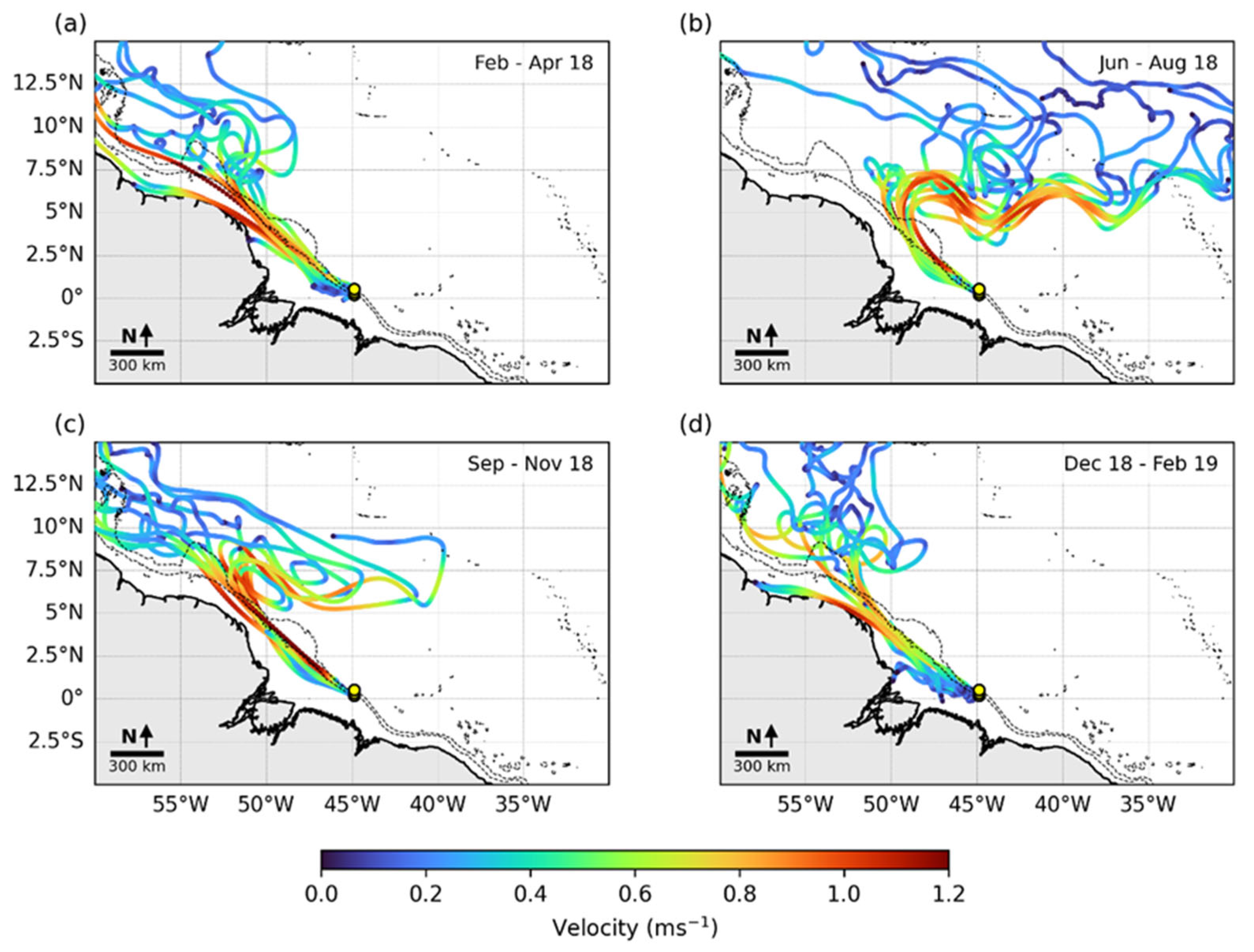
The drifter trajectories and mean velocities, separated into quarterly periods from February 2018 to February 2019, are presented in Figure 2. Surface transport, integrated down to 15 m depth, is observed to be directed northwestward for most of the year, except the June–August quarter (Northern Hemisphere summer). During this quarter, the NBC retroflection was the sole mechanism driving the surface drift of all drifters, with velocities reaching approximately 1.0 m s−1, and there was no northwestward surface transport (Figure 2a). This contrasts sharply with the other quarters, in which NBC retroflection is absent and resultant northwestward drift is present during the boreal winter and spring (see Figure 2a). A marked increase in the formation of eddies and current meanders was observed during the September–November quarter (Northern Hemisphere autumn). This activity was concentrated between 50° W and 55° W longitude and 7° N and 10° N latitude (Figure 2c). During September, NBC flow velocities surpassed 1.2 m s−1 along the continental slope, peaking at 48° W and 3° N.
Figure 2. Drifter trajectories and velocity scatter plots, grouped by quarters relative to deployment. (a) February–April 2018 (Boreal Spring); (b) June–August 2018 (Boreal Summer); (c) September–November 2018 (Boreal Autumn); (d) December 2018–February 2019 (Boreal Winter). Black dashed lines denote the 100 m and 2000 m bathymetric contours. The locations where the drifters were deployed are indicated by yellow circles.
The mean velocities of the CODE drifters were higher than those of the SVP drifters for both velocity components (Table 2). Notably, the February–April 2018 quarter (boreal winter–spring) was an exception, where the mean meridional velocity of the SVP (15 m) (0.23 ± 0.3 m s−1) exceeded that of the CODE (1.0 m) (0.19 ± 0.23 m s−1). This quarter also showed the largest mean velocity, with the zonal component for the CODE at (−0.32 ± 0.27 m s−1). Consistently, northwestward transport was evident across all quarters, indicated by negative zonal and positive meridional components. This pattern appeared in both drifter velocities and the analysis/forecast fields (specifically at 1.0 m and 15 m). Spearman correlation coefficients between the drifter and analysis/forecast velocity components were above 0.5 in nearly all comparisons. The only exception was the correlation between the SVP meridional components and the analysis/forecast (15 m), which was 0.36. The highest coefficient observed was 0.85, found between the zonal components of the CODE and the analysis/forecast at 1.0 m depth.
Table 2. Quarterly mean and standard deviation values for drifter and CMEMS data within the study domain (60° W–30° W/5° S–15° N). Spearman correlation coefficients between drifter and CMEMS velocities are also provided.
The mean temperature and salinity values showed minimal vertical difference between the 1.0 m and 15 m levels, with variations of less than one unit. However, differences between quarters in the surface layer can reach up to 1.3 °C between boreal winter/spring and boreal autumn. Differences between salinity means across quarters and between the vertical levels are small and do not exceed 0.8 g kg−1. SSH variations between quarters are less than 0.1 m, with a seasonal difference of approximately 0.015 m.
To assess whether the different drogue depths of CODE (≈1 m) and SVP (≈15 m) drifters could affect LCS validation, we computed velocity differences for all CODE–SVP pairs launched simultaneously across the 12 campaigns. Velocities were interpolated to a common temporal grid and differences estimated over overlapping periods; the mean differences across collocated samples were ∆ u = −0.02 m s−1, ∆ v = ℡0.04 m s−1, and U = 0.31 m s−1 (RMS ≈ 0.43 m s−1). These values confirm measurable vertical shear in the upper 15 m. Still, LCS maps derived from the large-scale Eulerian fields at 1 m and 15 m show only minor differences, and the signs of ∆u and ∆v vary by campaign and location. Thus, while vertical shear in the WEA is important for many physical processes, for the depths and spatial scales considered here, it does not, within the uncertainty and resolution of our analysis, materially compromise the validation of LCSs using the combined CODE and SVP dataset.

3.2. Seasonality of the Analysis/Forecast Parameters

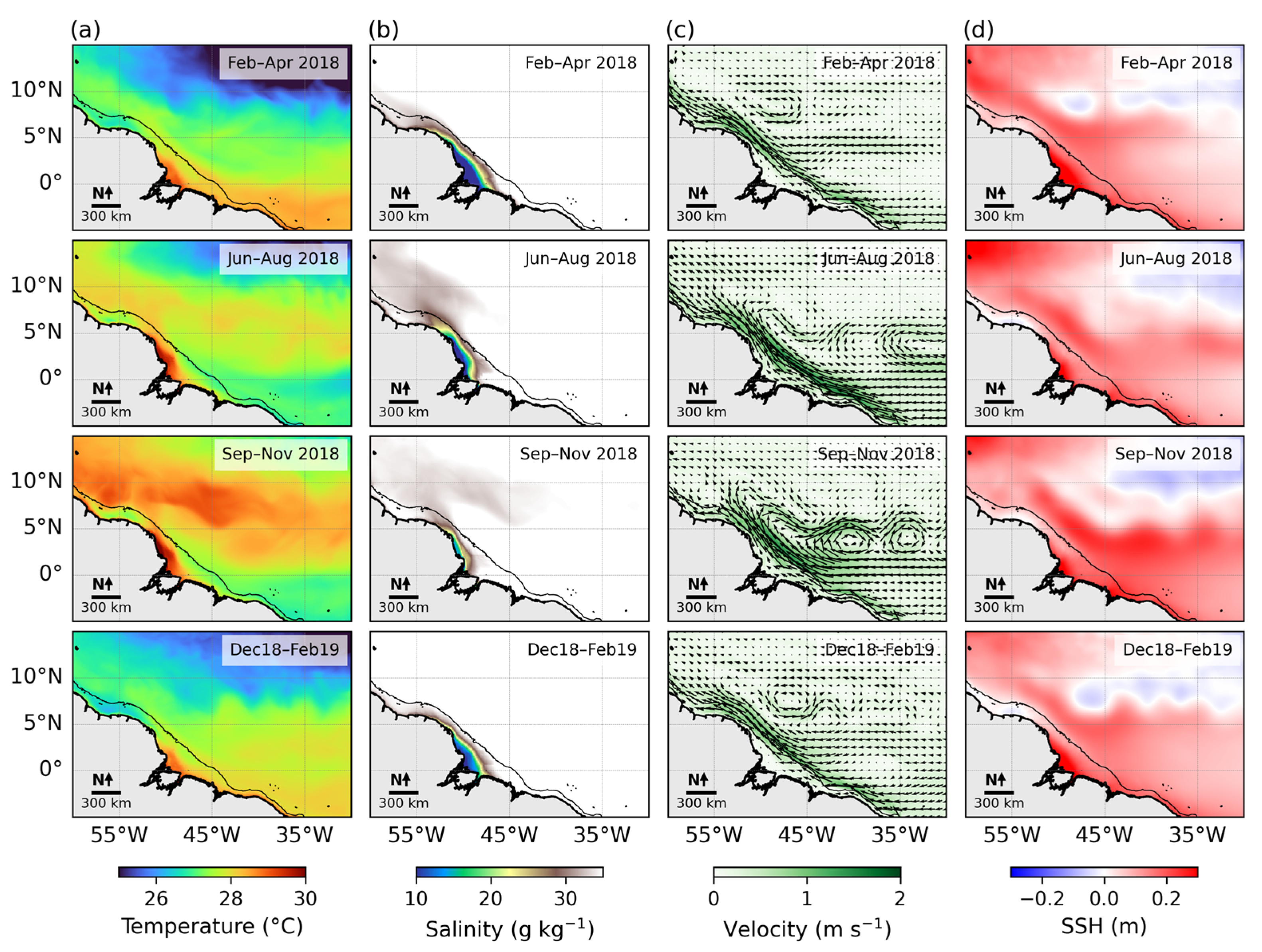
The quarterly averages of potential temperature, salinity, current velocity, and SSH derived from the analysis/forecast dataset are shown in Figure 3. Several circulation patterns observed in the drifter trajectories (Figure 2) are also evident in the spatial distributions of mass, hydrodynamic, and mean sea level elevation fields. It is important to note that the quarterly representation differs between the two datasets: drifter quarters are defined by deployment timing, whereas analysis/forecast quarters correspond to true quarterly averages of the physical parameters, calculated from the first to the last day of each month. This difference must be kept in mind when comparing drifter quarters (based on deployment month) with analysis/forecast quarters (monthly averages).
Figure 3. Quarterly mean fields derived from the CMEMS analysis/forecast dataset (February 2018–February 2019). (a) Potential Temperature (T); (b) Salinity (S); (c) Current Velocity (V); and (d) Sea Surface Height (SSH). Black lines denote the 100 m bathymetric contours.
During the boreal winter–spring of 2018, the continental margin was characterized by warmer and less saline surface waters, while waters with temperatures below 25 °C and salinities exceeding 35 g kg−1 were observed north of 10° N (Figure 3a,b; first and second columns). The NBC flow showed velocities greater than 1.0 m s−1 directed northwestward, with no evidence of retroflection (Figure 3c; third column). Cyclonic eddies were identified north of 6° N, accompanied by several current meanders. The SSH field predominantly displayed positive elevations across the entire WEA domain during the year, though negative heights were locally observed near 8° N (Figure 3d; fourth column). Later, during late spring and throughout the boreal summer (June–August 2018), the NBC retroflection developed near 50° W and 7° N. This process produced eddies and meanders visible in both the temperature and salinity fields, and in the hydrodynamic data. Simultaneously, an SSH increase of up to 0.2 m was observed at the retroflection site.
Greater dispersion was exhibited during the quarterly mean for September to November 2018 (boreal autumn), along with the NBC retroflection and the presence of eddies and meanders. These structures were responsible for transporting warmer and less saline lenses of Amazon and Pará River waters (salinities below 35 g kg−1) far beyond their estuarine mouths [49]. These waters were transported northwestward and eastward via the retroflection, consequently feeding the NECC. The retroflection was slightly displaced southeastward, with a well-defined flow and the formation of two distinct groups of anticyclonic eddies and meanders associated with the NBC retroflection. These groups included: (i) eddies occurring near 50° W and 8° N, which were directed toward the Caribbean Sea, and (ii) two eddies located between 40° W and 30° W longitude and 2° N and 6° N latitude, which were associated with the eastward flow of the NECC following the NBC retroflection. The SSH mean for autumn showed an increase of up to 0.2 m in the retroflection region, alongside negative values of approximately −0.1 m north of 10° N, where the NEC flows. Finally, during the last quarter (boreal winter, December 2018–February 2019), the mass and hydrodynamic fields resembled those recorded in the first quarter, distinguished only by the presence of a cyclonic eddy situated farther north than those observed during summer and autumn.
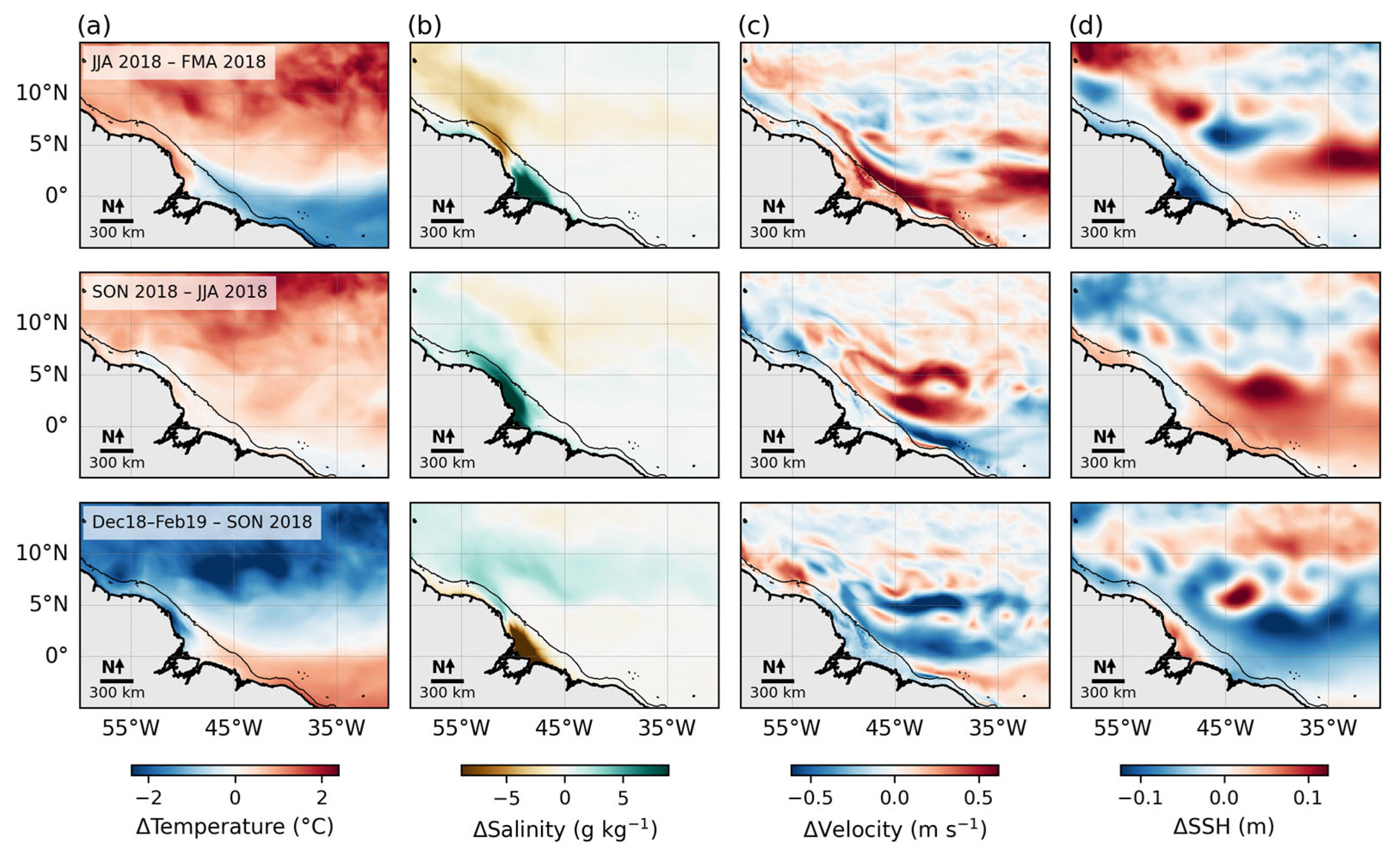
To facilitate the identification of seasonal changes in the distribution of the temperature, salinity, velocity, and SSH fields from the analysis/forecast product, we computed the differences between the quarterly fields (Figure 4), where positive values indicate an increase in the physical parameter and negative values indicate a decrease. The temperature differences were on the order of 2.0 °C (Figure 4a), whereas salinity differences reached about 7.0 g kg−1 (Figure 4b), both displaying clear seasonal variability. Velocity differences were on the order of 0.6 m s−1 (Figure 4c), particularly within the core of the NBC flow and its retroflection. SSH differences between quarters were approximately 0.1 m, especially near the centers of the eddies associated with the NBC and the NECC (Figure 4d).
Figure 4. Quarterly difference maps for the period February 2018–February 2019. The rows represent differences between successive quarterly means: the first row shows JJA 2018 minus FMA 2018, the second row shows SON 2018 minus JJA 2018, and the third row shows December 2018–February 2019 minus SON 2018. Panels show: (a) Δ Temperature, (b) Δ Salinity, (c) Δ Velocity, and (d) Δ SSH. Black lines denote the 100 m bathymetric contours.

3.3. Validation of the FTLE with Surface Drifters

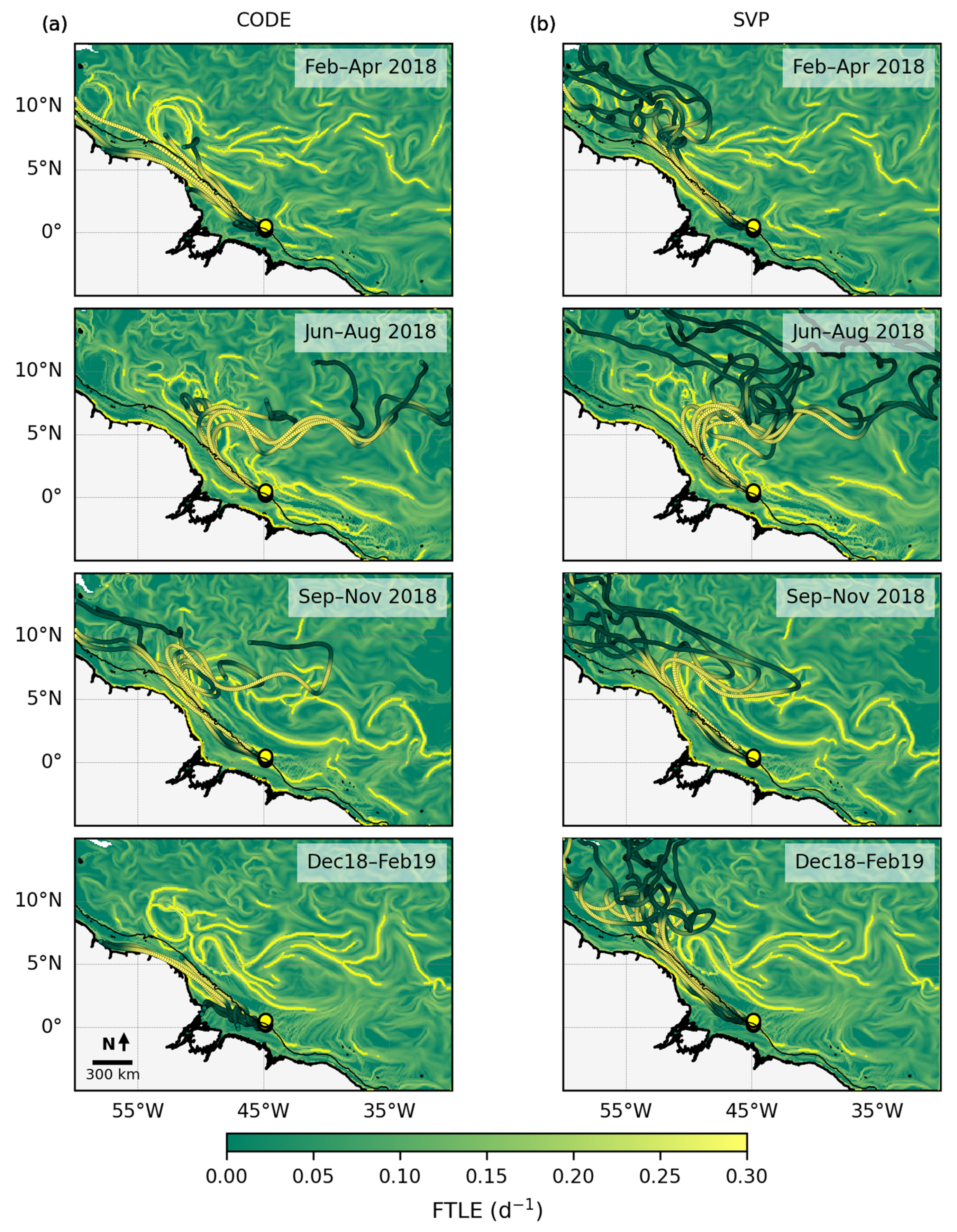
The forward FTLE field was computed over the WEA at two depths: 1.0 m (for comparison with CODE drifters) and 15 m (for comparison with SVP drifters). Following the methodology presented in Section 2.4, the LCSs were defined along the FTLE ridges. The trajectories of the CODE and SVP drifters were subsequently superimposed on the FTLE fields (shown for a time window of T = 15 days in Figure 5). This comparison revealed that a large portion of the FTLE ridge lines (LCSs) spatially coincided with major circulation features in the WEA, including the NBC flow, eddies, current meanders, retroflection, and the NECC flow. This analysis demonstrated that the LCSs not only contribute to the spatial identification of physical processes associated with mesoscale circulation in the WEA but also represent the geometric aspects of flow boundary zones.
Figure 5. Quarterly forward FTLE fields ( T = 15-day integration) superimposed with drifter trajectories: (a) CODE drifters (1.0 m) and (b) SVP drifters (15 m). LCSs appear as yellow lines, while yellow circles indicate where the drifters were deployed. Black lines denote the 100 m bathymetric contours.
Up to 15 m depth in the WEA, the LCSs were found to coincide with the NBC flow and the northwestward transport toward the Caribbean Sea during the boreal winter and spring (February–April 2018 and December 2018–February 2019 quarters). Notably, the trajectories of the CODE drifters were not influenced by NBC eddies during this period, even with the presence of circular LCS patterns between 50° W and 55° W longitude and 5° N and 10° N latitude (Figure 4a). Conversely, the SVP drifters exhibited greater spatial agreement with the LCS locations across all quarters (Figure 5b). The influence of the NBC retroflection and associated eddies was clearly identified from the trajectories of the CODE and SVP drifters superimposed on the LCSs during the boreal summer (June–August 2018) and autumn (September–November 2018).
While the FTLE field between 1.0 m and 15 m depths is similar, the surface circulation inferred from the drifter trajectories down to 15 m depth cannot be fully explained or associated with the LCSs. This is because these structures represent specific flow features associated with particle attraction and repulsion over characteristic time scales, while neglecting high-frequency oscillations and submesoscale processes. In shelf regions, surface drift is influenced by tidal currents, whereas in the open ocean, inertial currents and Stokes drift also affect surface circulation. In all maps shown in Figure 5, LCSs are scarcely observed north of 10° N. A similar scarcity is found over the continental shelf and in open-ocean regions distant from the main current cores of the WEA, such as the area near 1° N and 35° W.
Spatial agreement between the drifter-derived FTLE and the CMEMS FTLE fields showed notable variability across the four quarters analyzed (Figure 5). During February–April 2018, agreement was high for both platforms, reaching 72.7% for CODE and 66.9% for SVP drifters. The lowest correspondence occurred in June–August 2018, with 41.8% (CODE) and 34.0% (SVP), consistent with reduced frontal activity during this period. Agreement increased again in September–November 2018, reaching 56% and 61.5% for CODE and SVP, respectively, and peaked in December 2018–February 2019, when 74.1% of CODE and 52.1% of SVP positions were classified as LCS-consistent. Overall, these results indicate that a large portion of the drifter trajectories occurs within or near FTLE-derived LCSs, although the level of agreement varies by season and slightly differs between shallow (CODE) and deeper (SVP) drifters (Figure 5).

3.4. The FTLE Field

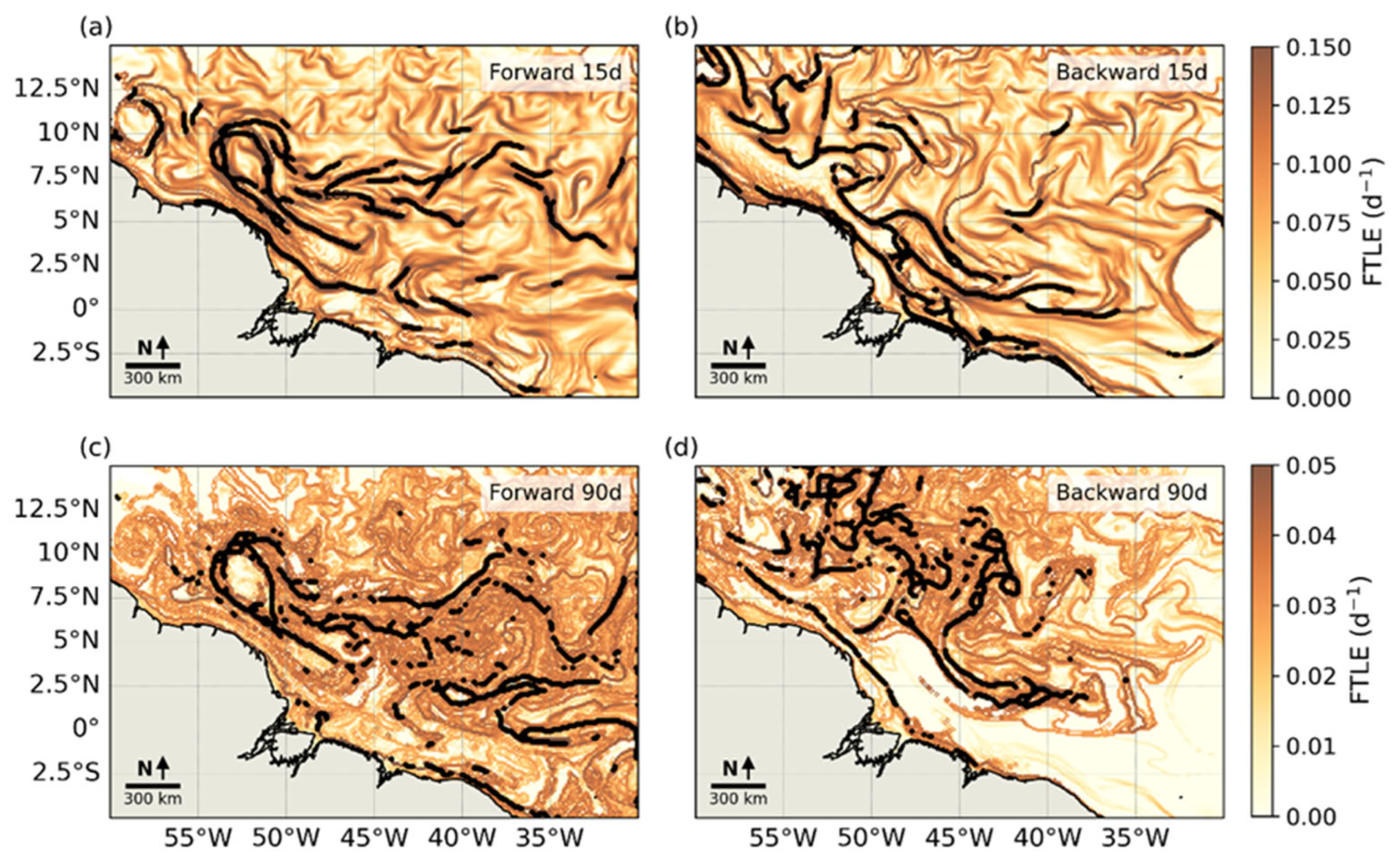
Different temporal integration windows can be applied when performing the FTLE analysis. While it is more common to present only the forward FTLE field (as shown in Figure 5), the backward FTLE was also computed for both 15- and 90-day windows (Figure 6). The comparison between the T = 15 and 90-day windows enables the distinction between transient mesoscale structures and more persistent, synoptic-scale patterns. Consequently, the maps presented in Figure 6 represent the mean forward and backward FTLE fields for the entire experimental period of the present study (February 2018 to February 2019).
Figure 6. FTLE fields and extracted LCS ridges in the WEA, showing forward and backward integrations over 15- and 90-day windows. (a) Forward FTLE integration ( T = 15 days); (b) Backward FTLE integration ( T = 15 days); (c) Forward FTLE integration ( T = 90 days); (d) Backward FTLE integration ( T = 90 days). The LCSs are shown in black lines.
The forward FTLE field for the 15-day window exhibited vortex-shaped LCSs between 50° W and 55° W longitude and 7° N and 10° N latitude. Supported by well-defined and statistically significant LCSs, this region is characterized by persistent anticyclonic eddies (as detailed in Section 2.4). A secondary rotational structure can be identified near 57° W and 10° N (Figure 6a). When analyzed over a 90-day window (Figure 6c), the corresponding LCS vanishes, indicating that the rotating structure lacks consistency and persistence over extended time periods. Only the forward FTLE is found to identify these eddies. The regions of particle attraction, which are represented by the backward FTLE field, occur primarily near the continental margin, with some segmented LCSs extending toward the Caribbean Sea (Figure 6b).
A high spatial granularity is evident in Figure 6a,b. This granularity is caused by locally elevated FTLE values, which manifest as many thin filaments and meanders surrounding the eddies and coastal features. The ridges (dark regions with FTLE ~14 days−1) are narrow and fragmented, reflecting zones of strong stretching/constriction that act as transport corridors or boundaries on weekly timescales. The LCSs located along the NBC and NECC flows, as well as within the eddies and the retroflection region, are observed exclusively in the forward FTLE field, functioning as particle-repelling zones. It is also noted that the apparent FTLE magnitudes are greater in the 15-day maps (Figure 6; top panels). This finding is consistent with the temporal normalization applied in the calculation and thus reveals rapid stretching and transient events.
For T = 90 days (Figure 6c,d), the LCSs become broader and less granular, highlighting patterns of a more synoptic and persistent nature. The 90-day ridges tend to delineate large corridors and long-term retention zones, while small filamentary structures are observed to disappear or merge into more continuous features. Consistent with observations in Figure 5, the backward FTLE field was not detected over the continental shelf, nor in the southeast portion of the WEA domain, near 2° S and 35° W (Figure 6). Bands associated with particle repulsion and filament formation are accentuated by the forward FTLE, whereas regions indicative of convergence and particle retention or attraction are delineated by the backward FTLE. The comparison between 15- and 90-day integration windows clearly demonstrates that short windows capture rapidly evolving meso- and submesoscale processes, while long windows emphasize more persistent circulation structures.
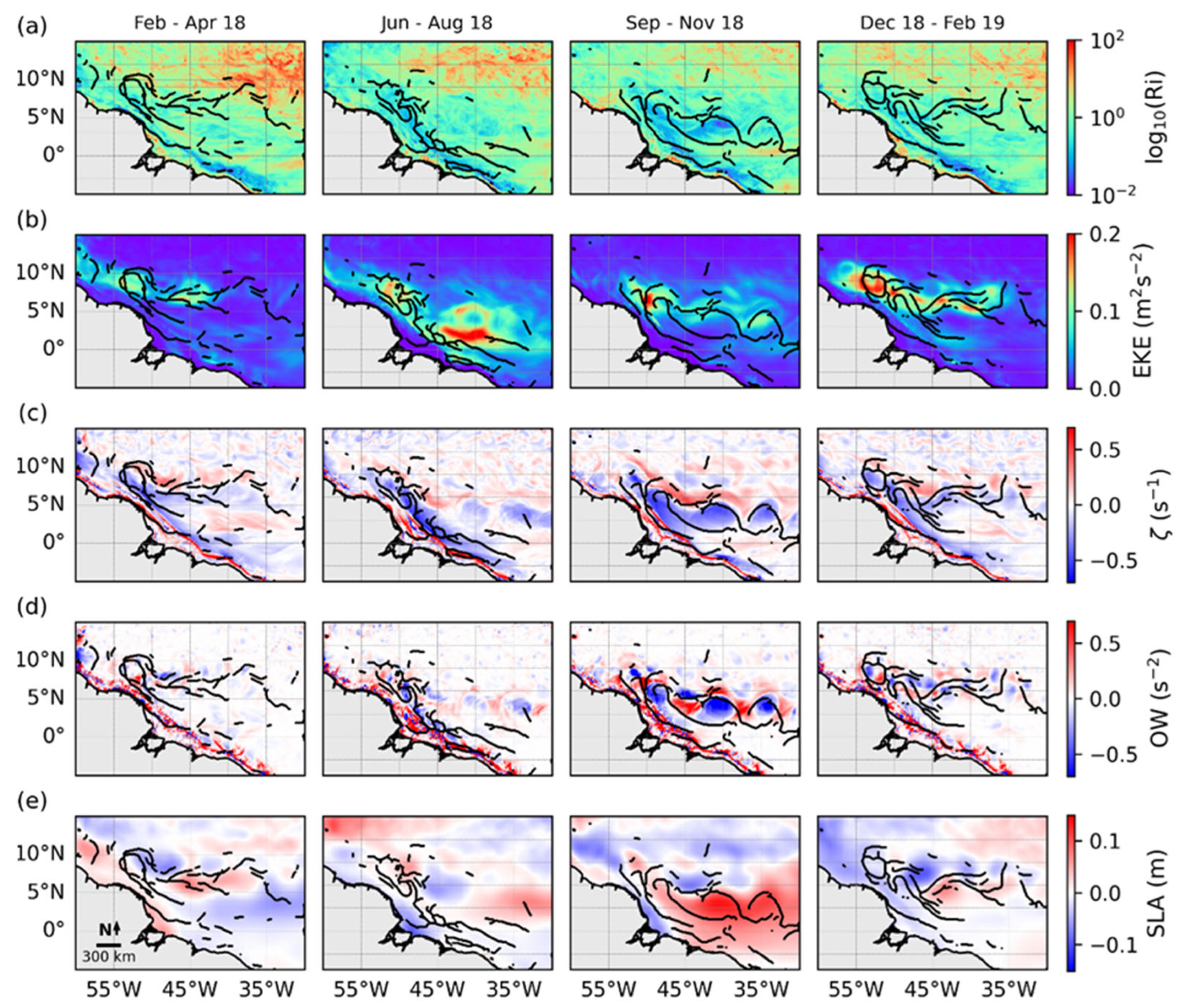
To assess the effectiveness of the FTLE field calculation and the spatial and temporal determination of LCSs in the study of mesoscale circulation in the WEA, quarterly averages were computed for five physical parameters: Ri (expressed in log10), EKE, ζ , OW, and SLA (Figure 7). The quarterly mean LCSs (black lines) utilized here are the same as those used for comparison with the CODE and SVP drifter trajectories in Figure 5. In general, the maps of these physical parameters exhibit spatial variations in surface circulation between quarters that are like the patterns shown in Figure 3 and Figure 4. Whether the flow remains stratified, signifying stable or laminar behavior, or becomes mixed, revealing unstable or turbulent conditions, is determined by the Ri parameter. EKE quantifies the energy associated with fluid activity. The ζ parameter quantifies the rotational motion of the flow, accounting for both its direction (cyclonic or anticyclonic) and magnitude. The OW parameter is related to ζ and separates regions dominated by fluid deformation and rotation. SLA gradients relate to geostrophic currents. By revealing zones of convergence or divergence and areas of elevated or depressed sea level, ocean surface circulation is governed by these currents.
Figure 7. Spatial comparison of quarterly means of physical-dynamic fields superimposed with LCS crests (black lines). Columns denote the following quarters: February–April 2018, June–August 2018, September–November 2018, and December 2018–February 2019. Rows represent the following parameters: (a) log10(Ri) (dimensionless); (b) EKE (m2 s−2); (c) relative Vorticity (ζ) (s−1); (d) Okubo–Weiss (OW) (s−2); and (e) SLA (m).
A consistent spatial coincidence was observed between the LCS crest lines (black lines) and the main gradients or extrema of the physical fields presented in Figure 7. Across all analyzed quarters, the LCSs tended to delineate the boundary between regions of high and low EKE (Figure 7b), to align with filaments and ζ cores (Figure 7c), and to follow areas where the OW parameter changes sign, marking the transitions between rotation-dominated and deformation-dominated regimes (Figure 7d). Furthermore, the crests frequently coincided with prominent SLA contours (Figure 7e) and regions of reduced Richardson number (Figure 7a). This indicates that the LCS effectively maps the boundaries of waters with distinct flow regimes and mixing potential. This spatial patterning was evident in both complex coastal features and more remote oceanic eddies, demonstrating that the LCS captures the edges of mesoscale features (filaments, meanders, and eddies) highlighted by the physical fields computed in this study.
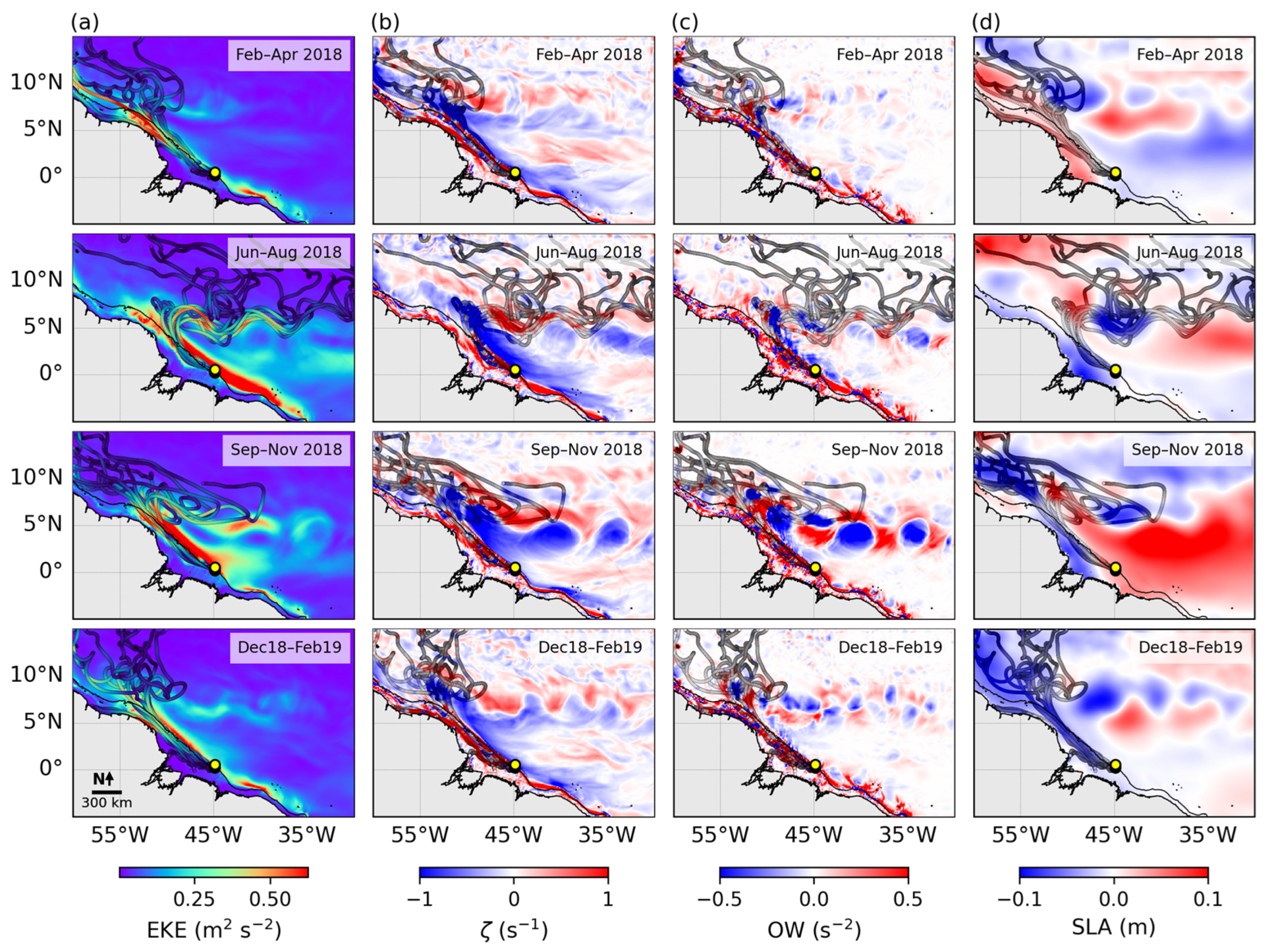
The parameters EKE, ζ, OW, and SLA were also computed along the drifter trajectories and compared with the corresponding large-scale analysis fields (Figure 8). This assessment provides a quantitative complement to the spatial overlays shown earlier, allowing us to evaluate whether the conditions sampled by the drifters are consistent with the domain-wide variability of these parameters. For each campaign, the along-track averages from the CODE and SVP trajectories were contrasted with the spatial means of the corresponding Eulerian fields, revealing that the drifters sampled values representative of the large-scale environment. This analysis strengthens the validation of the LCS results by demonstrating agreement between the Lagrangian sampling and the broader Eulerian context.
Figure 8. Quarterly mean fields of: (a) EKE (m2 s−2); (b) relative Vorticity (ζ) (s−1); (c) Okubo-Weiss (OW) (s−2); and (d) SLA (m). The scatter points represent the along-track values of each parameter from drifter data. Colorbar limits are the same for both the mean fields and the drifter data.
The quarterly mean fields show good spatial agreement between magnitudes estimated along track from drifters and those from the analysis and forecast fields. In EKE (Figure 8a), peaks along the NBC core, the retroflection and the NECC correspond to the highest drifter EKE values. Relative vorticity (Figure 8b) displays matching cyclonic and anticyclonic structures sampled by the drifters. The OW field (Figure 8c) and the SSH anomalies (Figure 8d) likewise agree with the along track values, especially in the retroflection and eddy corridors. As observed for FTLE in Figure 4, this correspondence indicates that drifters sample the main mesoscale regimes and that the analysis and forecast fields capture the dominant dynamical features in the WEA.

3.5. Case Studies: Time Series

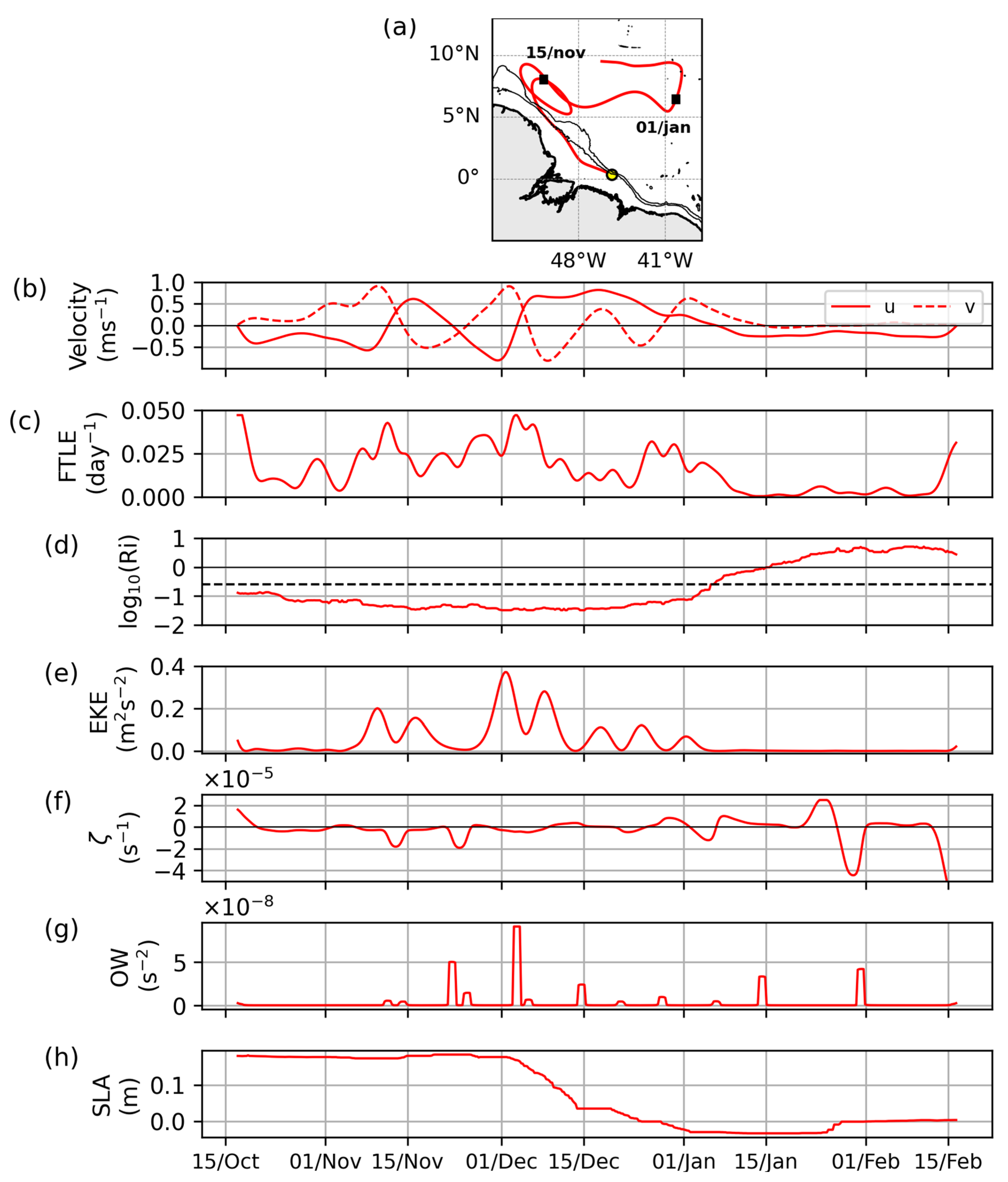
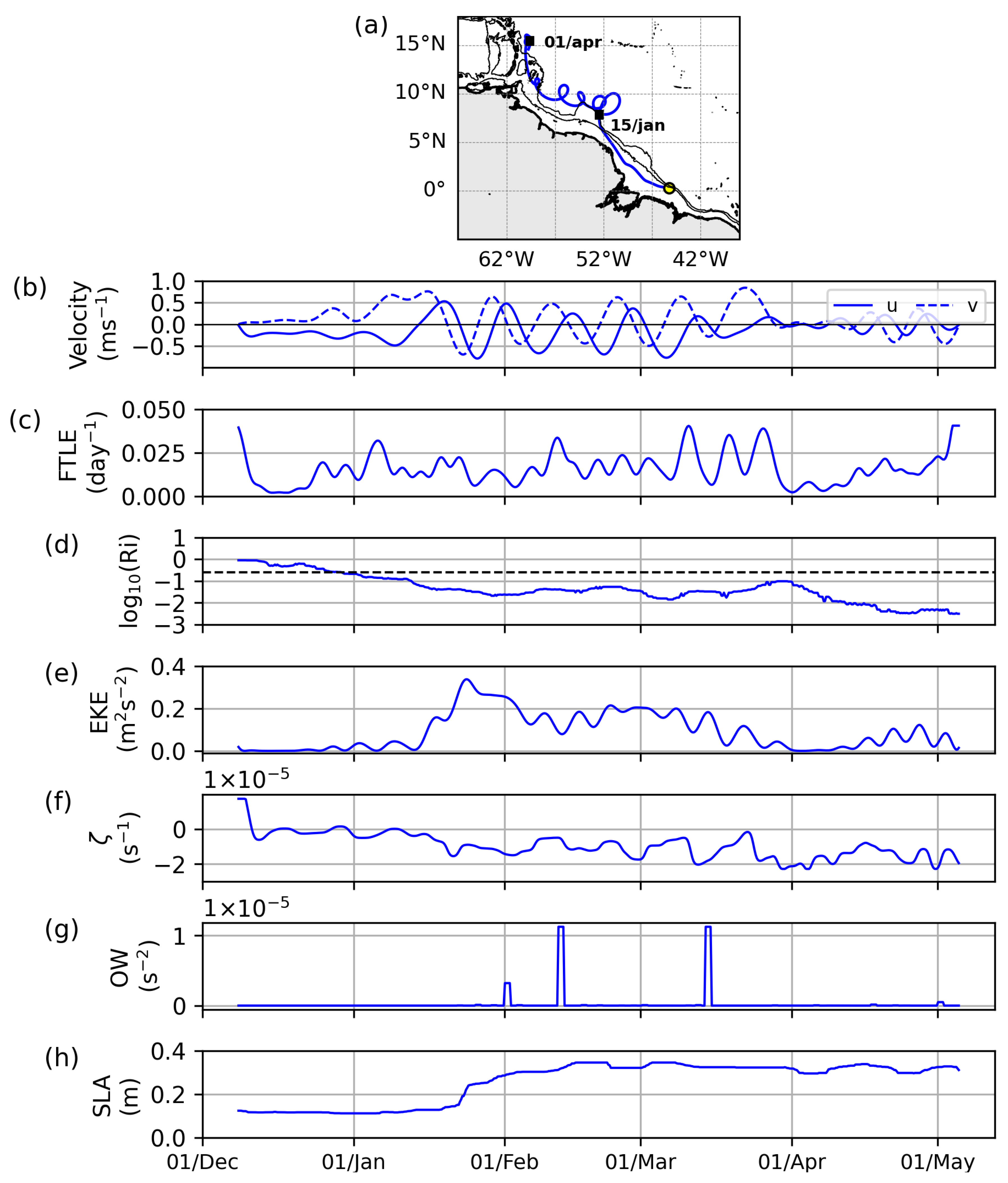
To extend the temporal analysis of FTLE beyond quarterly averages, two time series from CODE and SVP drifters were selected as case studies. According to the CODE drifter trajectory (Figure 9a) and the calculated time series, episodes of elevated stretching activity (FTLE maxima) were found to coincide with sharp increases in EKE (Figure 9e) and with more pronounced oscillations in the velocity components u and v (Figure 9b). Specifically, around mid-November (indicated on the trajectory), the drifter crossed a region where FTLE (Figure 9c) and EKE reached peak values, suggesting the presence of intense stretching and local rotational motions associated with filaments/eddies. Simultaneously, peaks in the OW parameter were also observed, indicating strong deformation events in the velocity field (Figure 9g). These brief episodes of high FTLE are consistent with the spatial depiction of LCSs as boundary crests. During December, eastward retroflection was observed, and subsequently, the drift was predominantly governed by inertial currents until the end of the series.
Figure 9. Time series, accompanied by the trajectory of the CODE drifter deployed on 17 October 2018. (a) Trajectory map with temporal markers (15 November and 01 January) and a yellow circle indicating the deployment location; (b) zonal component u (solid line) and meridional component v (dashed line) of the CODE drifter velocity; (c) FTLE along the trajectory, with T = 15 days; (d) Richardson number, expressed in log10; (e) EKE derived from drifter data; (f) relative vorticity (ζ); (g) OW; and (h) SLA. The dashed black line represents the subcritical threshold for log10(Ri) = –0.6.
An evolution of the dynamic state and stability is observed throughout the time series: the log10(Ri) progressively increases after December 2018, exceeding the subcritical threshold of log10(Ri) = −0.6 (Figure 9d; dashed black line). Except for occasional weak reactivations, FTLE and EKE decline to lower values, indicating increased vertical stability and a reduced likelihood of mixing in the following weeks. In Figure 9h, SLA exhibits a decreasing trend over the period, coinciding with the drifter’s displacement into lower surface areas and potentially reflecting a transition to distinct geostrophic regimes. Relative vorticity (Figure 9f) shows moderate variations, with sign reversals associated with passages through cyclonic cores (related to the CCNE flow) and anticyclonic cores (related to the NBC flow). Collectively, these signals confirm that the CODE drifter initially traversed dynamically active, strongly stretching regions (high FTLE, high EKE, positive OW), subsequently shifting into more quiescent, stable areas (higher Ri, reduced FTLE). This effectively illustrates the utility of time series in linking individual trajectories to local physical–dynamic properties.
Anticyclonic mesoscale motions were primarily observed in the SVP time series (Figure 10a, with highlights on 15 January and 1 April) between February and March. During this interval, pronounced maxima and oscillations in FTLE (Figure 10c) and in the velocity components (Figure 10b) were found to coincide with a clear increase in EKE (Figure 10e), suggesting a sustained interaction with mesoscale eddies. Similarly, the OW parameter exhibited pronounced pulses during the same period (Figure 10g), signaling episodes of strong deformation in the velocity field. Simultaneously, relative vorticity ζ (Figure 10f) displayed variations in sign and intensity consistent with passages through cyclonic and anticyclonic cores (related to the NBC flow). Collectively, these temporal coincidences among FTLE, EKE, and OW suggest that the SVP drifter remained in contact with regions of strong stretching and deformation throughout the observed period.
Figure 10. Time series, accompanied by the trajectory of the SVP drifter deployed on December 8, 2018. (a) Trajectory map with temporal markers (15 January and 1 April) and a yellow circle indicating the launch location; (b) Zonal (u, solid line) and meridional (v, dashed line) velocity components of the SVP drifter; (c) FTLE along the trajectory, with T = 15 days; (d) Richardson Number expressed as log10; (e) EKE derived from drifter data; (f) Relative Vorticity (ζ); (g) Okubo–Weiss (OW); and (h) SLA. The black dashed line represents the subcritical value for log10(Ri) = –0.6.
A decreasing trend in Ri was also observed throughout the time series, with values falling below the subcritical threshold of log10(Ri) = −0.6 (Figure 10d). This represents a relative reduction in vertical stability, which becomes more pronounced concurrently with the period of maximum EKE and FTLE, indicating an increased propensity for shear-induced mixing. In Figure 10h, SLA exhibits a progressive increase until it reaches nearly constant values during the same interval. This suggests that the drifter migrated toward higher sea surface regions associated with distinct geostrophic regimes, potentially contributing to its drift toward the Caribbean Sea. Outside this central period, the values of the variables decline and FTLE oscillations become less frequent, indicating that the SVP alternated between phases of strong mesoscale influence and phases exhibiting greater flow stability.

4. Discussion

4.1. Mesoscale Circulation

It is important to note that the temporal aggregation criteria differ between the drifter data and the analysis/forecast fields. Drifter data are organized based on deployment date, whereas the analysis and forecast fields are grouped by quarter and subsequently temporally averaged over the WEA domain. Consequently, the quarterly mean of the hydrodynamic and physico-chemical fields represents the average conditions during the deployment quarter. Therefore, longer-duration trajectories may be influenced by hydrodynamic conditions occurring after deployment. This difference in how seasonal periods are defined between the drifter observations and the analysis/forecast fields may help explain, for instance, why some drifters do not follow the NECC pathway during September–November 2018 (Figure 5 and Figure 8).
The results for drifter spatial dispersion demonstrated that surface drift in the WEA exhibits pronounced seasonal variability (Figure 2). During the boreal winter and spring, no influence of the NBC retroflection was detected on the drifter trajectories, despite the FTLE field analysis indicating that LCSs occur in the retroflection region during this period (Figure 5). The absence of retroflection in the surface drifter trajectories during winter and spring is partially consistent with prior descriptions of the seasonal variability of the retroflection and of NBC flow intensity [3,4,50].
Distinct seasonal retroflection patterns are directly related to the annual formation of NBC eddies. Disparate mean rates of eddy formation, shedding, and migration have been reported in the literature. For instance, some studies quantified 3–7 eddies/yr [2,26,27,30], whereas others reported 8–9 eddies/yr [51,52]. Consequently, uncertainties remain regarding the interannual variability of the retroflection and the eddy counts, even in long-term analyses [32,53,54]. The seasonal differences observed across studies reflect methodological discrepancies, including variations in observation periods, sensors and instruments, detection criteria, identification thresholds, and temporal/spatial coverage across experiments. Based on the reviewed literature, it is concluded that some degree of uncertainty is inherent in estimating the annual NBC eddy formation rate. In the present study, 14 drifters in total exhibited eddies in their trajectories (5 CODE and 9 SVP). If individual rotations performed by each drifter are counted separately, 25 eddy events/rotations for the period between February 2018 and February 2019 (Figure 2). However, when eddies were counted from the spatial box mean for the trajectories of all drifters that exhibited eddies, six mean eddies were identified for the same period.
The variability of the NBC flow, its retroflection, and subsequent eddy formation are governed by a complex system, composed of the following mechanisms: (i) ocean–atmosphere interaction, specifically the meridional migration of the ITCZ [2,31]; (ii) flow regime, where eddy generation is dependent on the inertia–dissipation/friction balance [25]; (iii) mass field (temperature and salinity), which controls NBC intensity via the AMOC [27,32]; (iv) conservation principles, in which equatorial Rossby waves propagating westward and reflecting at the Brazilian coast can generate eddies that migrate northwestward through the conservation of potential vorticity [29]; and (v) physiographic aspects, where eddy formation is associated with the slope of the South American coast [55]. Therefore, the interquarterly differences identified in the present study, as shown in Figure 2 and Figure 3, do not fully align with those in other works from different periods. Interannual variations appear to be modulated by even more complex mechanisms, involving remote influences and teleconnection effects on the WEA [56,57,58,59].
Eddies observed in the eastward NECC flow region were found to be consistent and to exhibit the largest quarterly mean values of EKE, relative vorticity (ζ), OW, and negative SLA (Figure 7b–e), particularly during autumn. However, the influence of these eddies was not recorded by any of the CODE or SVP drifters (Figure 2), despite this process being clearly displayed by the quarterly mean fields of these hydrodynamic parameters (Figure 7). This finding further underscores the challenge of identifying and quantifying eddies occurring in the WEA. Scientific efforts directed at investigating eddies in the study area have primarily been focused on the NBC northwestward flow and have not encompassed eddies related to the NECC and the equatorial Kelvin wave that propagates eastward between 3° N and 10° N [60,61]. The influence of this oscillation is evident in the drifter trajectories shown in Figure 1c and Figure 2c.
The present study is limited to the surface mesoscale circulation in the WEA, based on Lagrangian data collected from the uppermost meter of the water column to 15 m. The analysis/forecast data were likewise obtained and analyzed exclusively for the surface layer. Consequently, the analyses presented do not encompass equatorial undercurrents, the mixed layer, or the vertical structure of eddies. As discussed above, uncertainties persist regarding the interannual variability of NBC intensity, the location and occurrence of NBC retroflection, and the spatio-temporal identification and quantification of eddies. The quarterly mean analysis/forecast results shown in Figure 7 demonstrate that the region of highest energy in the WEA comprises the area associated with the northwestward NBC flow, the NBC retroflection, and NBC eddies at 50–55° W and 7–12° N, combined with the eastward NECC flow system at 45–35° W and 2–5° N.
It is observed in Figure 2b that all drifters deployed between June and August were initially transported northwestward by the NBC flow with velocities exceeding 1.0 m s−1, until the retroflection occurred. They thereafter propagated eastward, subsequently detaching from these systems and becoming subject to inertial currents with velocities less than 0.2 m s−1. Therefore, although mesoscale circulation in the WEA has been extensively documented over recent decades, long-period interannual oscillations have received insufficient attention in research. This limited focus may account for the subtle variations observed in descriptions of seasonal variability between the years examined.
From early pioneering works on WEA circulation [1,62,63,64,65], through subsequent contributions in the 1990s [2,4,26,66], and culminating in early 21st-century initiatives such as the NBC Ring Experiment [27,30,51], investigations of surface circulation, NBC retroflection, and mesoscale eddies have consistently revealed recurrent patterns while also documenting marked interannual variability. These studies collectively highlight the dynamical complexity of the region, where the intensity, position, and temporal expression of key features such as the NBC, NECC, and associated eddy activity vary from year to year in response to large-scale and regional forcings. Despite these variations, the seasonal patterns reported here align well with the body of work established by these earlier studies. The present analysis captures the variability of surface circulation processes in the WEA, with the drifter trajectories shown in Figure 2 clearly illustrating the seasonal differences discussed above.

4.2. LCSs in the WEA

To validate the identification of LCSs using FTLE ridges, Lagrangian data obtained from the drifters were used. A spatial superposition of the drifter positions (scatters; Figure 4) and of the LCS positions (yellow lines) was observed for the main mesoscale circulation features addressed in the WEA. The FTLE analysis also demonstrated that flow-boundary regions represented by LCS filaments are nearly permanent throughout the year (Figure 6). These regions were found to coincide with the NBC northwestward flow, the retroflection zone, and eddies of both the NBC and NECC (Figure 5 and Figure 8). The presence of LCSs was also observed near the continental slope, specifically in areas of strong bathymetric gradient. Conversely, practically no LCSs were observed north of 10° N. Therefore, the results presented in Figure 4 demonstrate that LCSs computed from the forward FTLE field, when integrated with the CODE and SVP drifter Lagrangian data, constitute robust indicators of particle-repelling/dispersion zones and of transport structures in the WEA. With FTLE values in Figure 4 on the order of 0.3 d−1, a particle separation timescale of approximately 3.3 days is implied.
This alignment corroborates the findings of Shadden et al. [13], which demonstrated that LCSs defined by FTLE are more effective at organizing particle motion and describing drifter dispersion than instantaneous current fields. Although the effect of wind, or “windage,” was not investigated in the present study, the discrepancies observed between CODE and SVP drifter trajectories reinforce the conclusion of Allshouse et al. [67] that external factors can produce deviations from the LCSs. The difference in drogue depth between CODE and SVP drifters, which pertains to the mesoscale of surface circulation, is presented here as a critical element for LCS validation (Figure 5 and Figure 8). It is thus demonstrated that drogue depth is chiefly responsible for variations in the drifters’ response to surface circulation and constitutes a fundamental factor in comparison with LCSs.
The comparative analysis of integrations with durations of 15 and 90 days revealed that distinct processes are captured by the differing integration timescales (Figure 5). The 15-day integrations revealed narrower and more fragmented FTLE ridges, reflecting the transient nature of mesoscale and submesoscale instabilities. In contrast, the 90-day integrations exhibited more continuous transport corridors and persistent patterns, characterizing large-scale connectivity (Figure 6c,d). Highlighting transient flow features, short-term integrations in the Gulf Stream study by Liu et al. [68] contrast with the large-scale connectivity defined by longer temporal windows, a finding consistent with this contrast. In the Red Sea, Zhan et al. [69] reported similar results: short FTLE integrations highlighted highly intermittent submesoscale structures, whereas longer integrations produced a smoother field, unveiling the dominant mesoscale patterns. From a theoretical standpoint, this behavior aligns with the formulation proposed by Haller [11,12] and with discussions presented in reviews on the subject [10]. In these works, the joint interpretation of forward-integrated (repelling/dispersive) and backward-integrated (attracting/accumulating) FTLEs is required for a complete characterization of transport barriers.
Controlling the temporal scale of the structures, the integration window represents one of the most sensitive parameters in FTLE computation. Several previous studies have applied short-period windows (hours to days) to capture mesoscale features and transient submesoscale processes [14,68,69,70]. However, as discussed by Matuszak et al. [71], longer windows can enhance statistical robustness and reduce the influence of uncertainties associated with high-frequency variability and numerical forecasting, allowing only the most persistent ridges to emerge. Considering this evidence, the maximum integration window adopted in the present study was 90 days, consistent with the quarterly separation methodology applied to both drifter and reanalysis data. This choice mitigates temporal mismatches between the quarterly grouping of observations and the analysis/forecast periods, while simultaneously minimizing interannual discrepancies relative to the experiment and the literature. Thus, the 90-day integration provides a more stable and comprehensive characterization of LCSs in the WEA, as illustrated in Figure 6c,d.
The LCSs represent the main transport structures and flow boundaries in the WEA. Using a 15-day window, the forward FTLE field shows that the NBC eddies function as zones of particle divergence, exhibiting an anticyclonic pattern (Figure 6a,b). In this window, the LCSs appear as continuous lines following the NBC flow. They also delineate coherent structures within the NBC eddies at 50–55° W and 7–10° N, as well as a segmented structure in the retroflection region. Conversely, the 15-day backward FTLE field shows that attraction zones coincide with portions of the NBC flow and with certain segments of the repulsive eddies. Within this timescale, the retroflection and the NECC flow do not act as structures that lead to particle aggregation, as clearly demonstrated (Figure 6a,b).
The LCSs computed with a 90-day window, in both the forward and backward FTLE fields, represent the surface mesoscale circulation structure during the period from February 2018 to February 2019. The 90-day forward field confirms the consistency of the NBC eddy region (Figure 6c,d). Coherent LCS filaments are also observed in the retroflection area, within the NECC flow, and along the equatorial Kelvin waves. One of the main differences between the 15- and 90-day windows is that the FTLE lines for the longer window are less fragmented. The main distinction, however, lies in the detection of repulsive structures within the sector spanning 30–45° W and 2–3° N, which the 15-day window failed to reveal.
The integration windows of 15 and 90 days were chosen to target two complementary Lagrangian regimes in the Western Equatorial Atlantic: the 15-day window emphasizes short-term mesoscale stirring and frontal deformation (typical eddy/strain timescales used in many FTLE studies), while the 90-day window highlights the slower organization of coherent eddies and seasonal transport pathways. The FTLE diagnostic is sensitive to the selected integration time, and previous studies indicate that shorter integration times highlight rapidly changing stirring patterns, while longer integration times enhance the visibility of more persistent and coherent transport structures [10,41,44,72]. For these reasons, and following common practice in regional Lagrangian analyses, we selected 15 and 90 days as practical, complementary choices to capture both short-term stirring and longer-term coherent transport in our study domain (Figure 6).
According to the results presented in Figure 7, the identification of LCSs from the FTLE field constitutes a robust indicator of flow boundary zones in the WEA. Transport corridors and confinement zones are clearly delineated by the extracted ridges, demonstrating strong agreement with the independent detection offered through Ri, EKE, ζ, OW, and SLA. These parameters are widely utilized in numerous ocean circulation studies [45,46,47,48]. The ridges stand out as boundaries that frequently enclose regions of elevated EKE, cores and filaments of negative vorticity, zones of OW sign reversal indicating variability in flow deformation, areas of reduced Ri (lower stability), and pronounced SLA gradients (Figure 8). Furthermore, the FTLE ridges delineate not only the locations of rotational motion but also the flow boundaries of the NBC and the retroflection regions that contribute to the NECC flow. The spatial overlap highlights the strong correspondence between the geometry of the LCSs and the main physico-dynamical indicators of mesoscale circulation in the WEA. Therefore, the comparative maps of physical-dynamical variables (Ri, EKE, ζ, OW, and SLA) reinforce that FTLE ridges are reliable indicators of flow boundary zones in the WEA (Figure 7 and Figure 8). This consistency corroborates the findings of the review by Peng et al. [10], which asserts that FTLE objectively delineates vortex and meander boundaries that are only indirectly suggested as transport structures by Eulerian diagnostics.
The time series analysis of CODE and SVP drifter trajectories reinforces the direct correspondence between FTLE peaks and local dynamic events (Figure 9 and Figure 10). Clear coincidences were observed between FTLE maxima and EKE peaks, stronger oscillations of the u and v velocity components, as well as positive OW pulses, negative relative vorticity (ζ), and subcritical Ri values (indicating enhanced shear), reflecting interactions with eddies and filaments. The SLA time series does not capture the periods of higher FTLE values along the drifter trajectories. This indicates that, in time series analyses, this parameter is more closely related to the drifter’s geographic position than to the prevailing flow regime of currents in the WEA. The results demonstrate that maximum FTLE values identify periods of intensified deformation and kinetic energy, serving as reliable indicators not only of particle transport barriers but also of vortex occurrence [41]. Furthermore, for vortex identification in the time series, FTLE proved to be more effective than the OW parameter (Figure 9 and Figure 10), despite the spatial coincidences observed in the OW maps shown in Figure 7 and Figure 8.
The study of LCSs, including tools such as the FTLE field, has become essential for understanding how dispersion and mixing occur in the oceans, revealing a strong connection with tracer fronts such as sea surface temperature and chlorophyll concentration [9]. Facilitating a more precise identification of distinct LCS types through different integration times and the analysis of their geometries, the underlying theory of these structures has undergone substantial progress. This enhanced capability has been fundamental for studies investigating the long-distance transport of water masses through eddies and, more recently, for applications in biogeochemical transport, where FTLE-derived LCSs have been used to interpret pathways of nutrient and biomass redistribution [20]. Despite the effectiveness of these techniques, the scientific community continues to refine them, as FTLE alone cannot always ensure the accurate identification of all structures.

5. Conclusions

This study investigated Lagrangian Coherent Structures in the mesoscale circulation of the WEA using CODE and SVP drifter trajectories together with hydrographic and hydrodynamic fields from analysis and forecast products. Mesoscale circulation exhibited clear seasonal variability, with the most energetic regions located in the NBC retroflection zone (50–55° W, 7–12° N) and in the NECC region (45–35° W, 2–5° N). LCSs extracted from FTLE ridges proved robust as indicators of flow boundaries, showing strong spatial correspondence with EKE, relative vorticity, the OW parameter, and SSH gradients. Short FTLE integrations ( T = 15 d) captured transient and fragmented features, while long integrations ( T = 90 d) revealed more persistent transport corridors and mesoscale connectivity. Peaks in FTLE closely tracked local increases in EKE and eddy signals along drifter trajectories, and FTLE performed better than the OW parameter for temporal identification of eddies. We also observed interannual and methodological variability in the timing and occurrence of NBC retroflection and eddy formation.
The calculation of FTLE fields for the WEA is presented here for the first time. The results confirm that FTLE-based LCS diagnostics provide a reliable tool for mapping surface mesoscale transport structures and support the combined use of CODE and SVP drifters for Lagrangian validation. The current work is limited to the surface layer (≤15 m) and does not incorporate windage effects; these factors should be recognized when generalizing the results.
Future work should extend the analysis to deeper layers, account explicitly for windage, and expand the temporal coverage toward climatological scales. Integrating vertical observations, atmospheric forcing, and uncertainty quantification methods for LCS detection and eddy characterization will further improve understanding of mass and energy exchanges in the WEA.

Author Contributions

Y.O.P.: Conceptualization, Methodology, Data collection, Data curation, Field work, Data analysis, Software, Visualization, Formal analysis, Investigation, Interpretation, Writing—original draft, Writing—review & editing. R.P.R.: Data collection, Field work, Visualization, Formal analysis, Investigation, Interpretation, Writing—review & editing. M.R.: Conceptualization, Data collection, Field work, Visualization, Investigation, Interpretation, Writing—review & editing, Supervision, Project administration, Funding acquisition, Resources. All authors have read and agreed to the published version of the manuscript.

Funding

This research was funded by the Fundação de Amparo e Desenvolvimento da Pesquisa (FADESP). Funding number: 3780.

Data Availability Statement

The data that support the findings of this study, specifically the Global Ocean Physics Reanalysis dataset (Product ID: GLOBAL_MULTIYEAR_PHY_001_030), are publicly and freely available through the Copernicus Marine Service (CMEMS). This resource can be accessed directly via the following Uniform Resource Locator (URL): https://data.marine.copernicus.eu/product/GLOBAL_MULTIYEAR_PHY_001_030/description. Accessed on 15 September 2025.

Acknowledgments

The authors thank the members of the Marine Environmental Monitoring Research Laboratory at the Institute of Geosciences, Federal University of Pará (UFPA), for their invaluable assistance during the fieldwork. We also acknowledge the anonymous reviewers for their insightful comments and suggestions, which greatly improved the quality of this manuscript. Special thanks are extended to the crew of the R/V Guilherme V. for their support and professionalism during the research campaign. We are also grateful to ENAUTA for making this research possible through resources provided via the Brazilian National Agency of Petroleum, Natural Gas and Biofuels (ANP).

Conflicts of Interest

The authors declare no conflicts of interest.

References

  1. Flagg, C.N.; Gordon, R.L.; McDowell, S. Hydrographic and Current Observations on the Continental Slope and Shelf of the Western Equatorial Atlantic. J. Phys. Oceanogr. 1986, 16, 1412–1429. [Google Scholar] [CrossRef]
  2. Johns, W.E.; Lee, T.N.; Schott, F.A.; Zantopp, R.J.; Evans, R.H. The North Brazil Current Retroflection: Seasonal Structure and Eddy Variability. J. Geophys. Res. 1990, 95, 22103–22120. [Google Scholar] [CrossRef]
  3. Johns, W.E.; Lee, T.N.; Beardsley, R.C.; Candela, J.; Limeburner, R.; Castro, B. Annual Cycle and Variability of the North Brazil Current. J. Phys. Oceanogr. 1998, 28, 103–128. [Google Scholar] [CrossRef]
  4. Richardson, P.L.; Hufford, G.E.; Limeburner, R.; Brown, W.S. North Brazil Current Retroflection Eddies. J. Geophys. Res. Oceans 1994, 99, 5081–5093. [Google Scholar] [CrossRef]
  5. Prestes, Y.O.; Borba, T.A.D.C.; Silva, A.C.D.; Rollnic, M. A Discharge Stationary Model for the Pará-Amazon Estuarine System. J. Hydrol. Reg. Stud. 2020, 28, 100668. [Google Scholar] [CrossRef]
  6. Fratantoni, D.M.; Johns, W.E.; Townsend, T.L.; Hurlburt, H.E. Low-Latitude Circulation and Mass Transport Pathways in a Model of the Tropical Atlantic Ocean. J. Phys. Oceanogr. 2000, 30, 1944–1966. [Google Scholar] [CrossRef]
  7. Silva, A.C.; Bourles, B.; Araujo, M. Circulation of the Thermocline Salinity Maximum Waters off the Northern Brazil as Inferred from in Situ Measurements and Numerical Results. Ann. Geophys. 2009, 27, 1861–1873. [Google Scholar] [CrossRef]
  8. Bueno, L.F.; Costa, V.S.; Mill, G.N.; Paiva, A.M. Volume and Heat Transports by North Brazil Current Rings. Front. Mar. Sci. 2022, 9, 831098. [Google Scholar] [CrossRef]
  9. Van Sebille, E.; Griffies, S.M.; Abernathey, R.; Adams, T.P.; Berloff, P.; Biastoch, A.; Blanke, B.; Chassignet, E.P.; Cheng, Y.; Cotter, C.J.; et al. Lagrangian Ocean Analysis: Fundamentals and Practices. Ocean Model. 2018, 121, 49–75. [Google Scholar] [CrossRef]
  10. Peng, Y.; Xu, X.; Shao, Q.; Weng, H.; Niu, H.; Li, Z.; Zhang, C.; Li, P.; Zhong, X.; Yang, J. Applications of Finite-Time Lyapunov Exponent in Detecting Lagrangian Coherent Structures for Coastal Ocean Processes: A Review. Front. Mar. Sci. 2024, 11, 1345260. [Google Scholar] [CrossRef]
  11. Haller, G. Distinguished Material Surfaces and Coherent Structures in Three-Dimensional Fluid Flows. Phys. D Nonlinear Phenom. 2001, 149, 248–277. [Google Scholar] [CrossRef]
  12. Haller, G. Lagrangian Coherent Structures from Approximate Velocity Data. Phys. Fluids 2002, 14, 1851–1861. [Google Scholar] [CrossRef]
  13. Shadden, S.C.; Lekien, F.; Paduan, J.D.; Chavez, F.P.; Marsden, J.E. The Correlation between Surface Drifters and Coherent Structures Based on High-Frequency Radar Data in Monterey Bay. Deep Sea Res. Part II Top. Stud. Oceanogr. 2009, 56, 161–172. [Google Scholar] [CrossRef]
  14. Veatch, J.M.; Kohut, J.T.; Oliver, M.J.; Statscewich, H.; Fredj, E. Quantifying the Role of Submesoscale Lagrangian Transport Features in the Concentration of Phytoplankton in a Coastal System. ICES J. Mar. Sci. 2024, 81, 760–773. [Google Scholar] [CrossRef]
  15. Kumar, A.; Dwivedi, S.; Pandey, A.C. Quantifying Predictability of Sea Ice around the Indian Antarctic Stations Using Coupled Ocean Sea Ice Model with Shelf Ice. Polar Sci. 2018, 18, 83–93. [Google Scholar] [CrossRef]
  16. Beron-Vera, F.J.; Olascoaga, M.J.; Goni, G.J. Oceanic Mesoscale Eddies as Revealed by Lagrangian Coherent Structures. Geophys. Res. Lett. 2008, 35, 2008GL033957. [Google Scholar] [CrossRef]
  17. Xia, Q.; Li, G.; Dong, C. Global Oceanic Mass Transport by Coherent Eddies. J. Phys. Oceanogr. 2022, 52, 1111–1132. [Google Scholar] [CrossRef]
  18. Bruera, R.; Curbelo, J.; García-Sánchez, G.; Mancho, A.M. Mixing and Geometry in the North Atlantic Meridional Overturning Circulation. Geophys. Res. Lett. 2023, 50, e2022GL102244. [Google Scholar] [CrossRef]
  19. Allende-Arandía, M.E.; Duran, R.; Sanvicente-Añorve, L.; Appendini, C.M. Lagrangian Characterization of Surface Transport From the Equatorial Atlantic to the Caribbean Sea Using Climatological Lagrangian Coherent Structures and Self-Organizing Maps. J. Geophys. Res. Ocean. 2023, 128, e2023JC019894. [Google Scholar] [CrossRef]
  20. Rousselet, L.; d’Ovidio, F.; Izard, L.; Penna, A.D.; Petrenko, A.; Barrillon, S.; Nencioli, F.; Doglioli, A. A Software Package for an Adaptive Satellite-Based Sampling for Oceanographic Cruises (SPASSOv2.0): Tracking Fine-Scale Features for Physical and Biogeochemical Studies. J. Atmos. Ocean. Technol. 2025, 42, 979–990. [Google Scholar] [CrossRef]
  21. Veatch, J.M.; Roarty, H.; Oliver, M.J.; Fredj, E.; Kohut, J.T. Attractive Lagrangian Features in the Mid-Atlantic Bight: Using Lagrangian Coherent Structures to Describe Seasonal and Interannual Changes in Circulation. J. Geophys. Res. Ocean. 2025, 130, e2025JC022447. [Google Scholar] [CrossRef]
  22. Schott, F.A.; Fischer, J.; Stramma, L. Transports and Pathways of the Upper-Layer Circulation in the Western Tropical Atlantic. J. Phys. Oceanogr. 1998, 28, 1904–1928. [Google Scholar] [CrossRef]
  23. Schott, F.A.; Brandt, P.; Hamann, M.; Fischer, J.; Stramma, L. On the Boundary Flow off Brazil at 5–10°S and Its Connection to the Interior Tropical Atlantic. Geophys. Res. Lett. 2002, 29, 21-1-21-4. [Google Scholar] [CrossRef]
  24. Bourles, B.; Molinari, R.L.; Johns, E.; Wilson, W.D.; Leaman, K.D. Upper Layer Currents in the Western Tropical North Atlantic (1989–1991). J. Geophys. Res. 1999, 104, 1361–1375. [Google Scholar] [CrossRef]
  25. Barnier, B.; Reynaud, T.; Beckmann, A.; Böning, C.; Molines, J.-M.; Barnard, S.; Jia, Y. On the Seasonal Variability and Eddies in the North Brazil Current: Insights from Model Intercomparison Experiments. Prog. Oceanogr. 2001, 48, 195–230. [Google Scholar] [CrossRef]
  26. Fratantoni, D.M.; Johns, W.E.; Townsend, T.L. Rings of the North Brazil Current: Their Structure and Behavior Inferred from Observations and a Numerical Simulation. J. Geophys. Res. 1995, 100, 10633–10654. [Google Scholar] [CrossRef]
  27. Fratantoni, D.M.; Glickson, D.A. North Brazil Current Ring Generation and Evolution Observed with SeaWiFS. J. Phys. Oceanogr. 2002, 32, 1058–1074. [Google Scholar] [CrossRef]
  28. Fratantoni, D.M.; Richardson, P.L. The Evolution and Demise of North Brazil Current Rings. J. Phys. Oceanogr. 2006, 36, 1241–1264. [Google Scholar] [CrossRef]
  29. Jochum, M.; Malanotte-Rizzoli, P. On the Generation of North Brazil Current Rings. J. Mar. Res. 2003, 61, 147–173. [Google Scholar] [CrossRef]
  30. Garzoli, S.L.; Ffield, A.; Yao, Q. North Brazil Current Rings and the Variability in the Latitude of Retroflection. In Elsevier Oceanography Series; Elsevier: Amsterdam, The Netherlands, 2003; Volume 68, pp. 357–373. [Google Scholar]
  31. Fonseca, C.A.; Goni, G.J.; Johns, W.E.; Campos, E.J.D. Investigation of the North Brazil Current Retroflection and North Equatorial Countercurrent Variability. Geophys. Res. Lett. 2004, 31, 2004GL020054. [Google Scholar] [CrossRef]
  32. Sharma, N.; Anderson, S.P.; Brickley, P.; Nobre, C.; Cadwallader, M.L. Quantifying the Seasonal and Interannual Variability of the Formation and Migration Pattern of North Brazil Current Rings. In Proceedings of the OCEANS 2009, Bremen, Germany, 11–14 May 2009; IEEE: Biloxi, MS, USA, 2009; pp. 1–7. [Google Scholar]
  33. Aroucha, L.C.; Veleda, D.; Lopes, F.S.; Tyaquiçã, P.; Lefèvre, N.; Araujo, M. Intra- and Inter-Annual Variability of North Brazil Current Rings Using Angular Momentum Eddy Detection and Tracking Algorithm: Observations From 1993 to 2016. JGR Oceans 2020, 125, e2019JC015921. [Google Scholar] [CrossRef]
  34. Boussidi, B.; Le Goff, C.; Galard, C.; Carton, X.; Speich, S. The Analysis of North Brazil Current Rings from Automatic Identification System Data and Altimetric Currents. Remote Sens. 2024, 16, 2828. [Google Scholar] [CrossRef]
  35. Davis, R.E. Drifter Observations of Coastal Surface Currents during CODE: The Method and Descriptive View. J. Geophys. Res. 1985, 90, 4741–4755. [Google Scholar] [CrossRef]
  36. Lumpkin, R.; Pazos, M. Measuring Surface Currents with Surface Velocity Program Drifters: The Instrument, Its Data, and Some Recent Results. In Lagrangian Analysis and Prediction of Coastal and Ocean Dynamics; Griffa, A., Kirwan, A.D., Jr., Mariano, A.J., Özgökmen, T., Rossby, H.T., Eds.; Cambridge University Press: Cambridge, UK, 2007; pp. 39–67. ISBN 978-0-521-87018-4. [Google Scholar]
  37. Sybrandy, A.L.; Niiler, P.P. The WOCE/TOGA SVP Lagrangian Drifter Construction Manual; SIO reference; University of California: San Diego, CA, USA, 1991. [Google Scholar]
  38. Lumpkin, R.; Özgökmen, T.; Centurioni, L. Advances in the Application of Surface Drifters. Annu. Rev. Mar. Sci. 2017, 9, 59–81. [Google Scholar] [CrossRef]
  39. Hansen, D.V.; Poulain, P.-M. Quality Control and Interpolations of WOCE-TOGA Drifter Data. J. Atmos. Ocean. Technol. 1996, 13, 900–909. [Google Scholar] [CrossRef]
  40. Shadden, S.C.; Lekien, F.; Marsden, J.E. Definition and Properties of Lagrangian Coherent Structures from Finite-Time Lyapunov Exponents in Two-Dimensional Aperiodic Flows. Phys. D Nonlinear Phenom. 2005, 212, 271–304. [Google Scholar] [CrossRef]
  41. Haller, G. Lagrangian Coherent Structures. Annu. Rev. Fluid Mech. 2015, 47, 137–162. [Google Scholar] [CrossRef]
  42. Boffetta, G.; Lacorata, G.; Redaelli, G.; Vulpiani, A. Detecting Barriers to Transport: A Review of Different Techniques. Phys. D Nonlinear Phenom. 2001, 159, 58–70. [Google Scholar] [CrossRef]
  43. Otsu, N. A Threshold Selection Method from Gray-Level Histograms. IEEE Trans. Syst. Man Cybern. 1979, 9, 62–66. [Google Scholar] [CrossRef]
  44. Gill, A.E. Atmosphere-Ocean Dynamics; Academic Press: Cambridge, MA, USA, 1982; ISBN 978-0-12-283522-3. [Google Scholar]
  45. Zaron, E.D.; Moum, J.N. A New Look at Richardson Number Mixing Schemes for Equatorial Ocean Modeling. J. Phys. Oceanogr. 2009, 39, 2652–2664. [Google Scholar] [CrossRef]
  46. Aguedjou, H.M.A.; Dadou, I.; Chaigneau, A.; Morel, Y.; Alory, G. Eddies in the Tropical Atlantic Ocean and Their Seasonal Variability. Geophys. Res. Lett. 2019, 46, 12156–12164. [Google Scholar] [CrossRef]
  47. Matsuoka, D.; Araki, F.; Inoue, Y.; Sasaki, H. A New Approach to Ocean Eddy Detection, Tracking, and Event Visualization –Application to the Northwest Pacific Ocean. Procedia Comput. Sci. 2016, 80, 1601–1611. [Google Scholar] [CrossRef]
  48. Bunge, L.; Clarke, A.J. Seasonal Propagation of Sea Level along the Equator in the Atlantic. J. Phys. Oceanogr. 2009, 39, 1069–1074. [Google Scholar] [CrossRef]
  49. Prestes, Y.O.; Silva, A.C.D.; Jeandel, C. Amazon Water Lenses and the Influence of the North Brazil Current on the Continental Shelf. Cont. Shelf Res. 2018, 160, 36–48. [Google Scholar] [CrossRef]
  50. Wilson, W.D.; Johns, W.E.; Garzoli, S.L. Velocity Structure of North Brazil Current Rings. Geophys. Res. Lett. 2002, 29, 114-1–114-4. [Google Scholar] [CrossRef]
  51. Garraffo, Z.D.; Johns, W.E.; Chassignet, P.E.; Goni, G.J. North Brazil Current Rings and Transport of Southern Waters in a High Resolution Numerical Simulation of the North Atlantic. In Elsevier Oceanography Series; Elsevier: Amsterdam, The Netherlands, 2003; Volume 68, pp. 375–409. [Google Scholar]
  52. Johns, W.E.; Zantopp, R.J.; Gustavo, G.J. Cross-Gyre Transport by North Brazil Current Rings. In Elsevier Oceanography Series; Elsevier: Amsterdam, The Netherlands, 2003; Volume 68, pp. 411–441. [Google Scholar]
  53. Jochumsen, K.; Rhein, M.; Hüttl-Kabus, S.; Böning, C.W. On the Propagation and Decay of North Brazil Current Rings. J. Geophys. Res. 2010, 115, 2009JC006042. [Google Scholar] [CrossRef]
  54. Assad, L.P.d.F.; Toste, R.; Böck, C.S.; Nehme, D.M.; Sancho, L.; Soares, A.E.; Landau, L. Ocean Climatology at Brazilian Equatorial Margin: A Numerical Approach. J. Comput. Sci. 2020, 44, 101159. [Google Scholar] [CrossRef]
  55. Zharkov, V.; Nof, D. Why Does the North Brazil Current Regularly Shed Rings but the Brazil Current Does Not? J. Phys. Oceanogr. 2010, 40, 354–367. [Google Scholar] [CrossRef]
  56. Biello, J.A.; Majda, A.J. A Multiscale Model for the Modulation and Rectification of the ITCZ. J. Atmos. Sci. 2013, 70, 1053–1070. [Google Scholar] [CrossRef]
  57. Tomaziello, A.C.N.; Carvalho, L.M.V.; Gandu, A.W. Intraseasonal Variability of the Atlantic Intertropical Convergence Zone during Austral Summer and Winter. Clim. Dyn. 2016, 47, 1717–1733. [Google Scholar] [CrossRef]
  58. Prestes, Y.O.; Da Silva, A.C.; Marquez, A.L.; Gomes Junior, G.D.; Hernandez, F. Climate Variability and Atlantic Surface Gravity Wave Variability Based on Reanalysis Data. JMSE 2025, 13, 1536. [Google Scholar] [CrossRef]
  59. Ramotubei, T.S.; Landman, W.A.; Mateyisi, M.J.; Nangombe, S.S.; Beraki, A.F. Response of the Global ITCZ to ENSO and How the ITCZ Determined from Maximum Precipitation Compares with the Surface Tropical Wind Convergence. Environ. Dev. 2025, 55, 101210. [Google Scholar] [CrossRef]
  60. Dutrieux, P.; Menkes, C.E.; Vialard, J.; Flament, P.; Blanke, B. Lagrangian Study of Tropical Instability Vortices in the Atlantic. J. Phys. Oceanogr. 2008, 38, 400–417. [Google Scholar] [CrossRef]
  61. Song, Q.; Aiki, H. Equatorial Wave Diagnosis for the Atlantic Niño in 2019 with an Ocean Reanalysis. Ocean Sci. 2023, 19, 1705–1717. [Google Scholar] [CrossRef]
  62. Metcalf, W.G. Shallow currents along the northeastern coast of South America. J. Mar. Res. 1968, 26, 3. [Google Scholar]
  63. Gibbs, R.J. Currents on the Shelf of North-Eastern South America. Estuar. Coast. Shelf Sci. 1982, 14, 283–299. [Google Scholar] [CrossRef]
  64. Molinari, R.L. Observations of Near-surface Currents and Temperature in the Central and Western Tropical Atlantic Ocean. J. Geophys. Res. 1983, 88, 4433–4438. [Google Scholar] [CrossRef]
  65. Bruce, J.G.; Kerling, J.L.; Beatty, W.H. On the North Brazilian Eddy Field. Prog. Oceanogr. 1985, 14, 57–63. [Google Scholar] [CrossRef]
  66. Didden, N.; Schott, F. Eddies in the North Brazil Current Retroflection Region Observed by Geosat Altimetry. J. Geophys. Res. 1993, 98, 20121–20131. [Google Scholar] [CrossRef]
  67. Allshouse, M.R.; Ivey, G.N.; Lowe, R.J.; Jones, N.L.; Beegle-Krause, C.J.; Xu, J.; Peacock, T. Impact of Windage on Ocean Surface Lagrangian Coherent Structures. Environ. Fluid Mech. 2017, 17, 473–483. [Google Scholar] [CrossRef]
  68. Liu, Y.; Wilson, C.; Green, M.A.; Hughes, C.W. Gulf Stream Transport and Mixing Processes via Coherent Structure Dynamics. JGR Ocean. 2018, 123, 3014–3037. [Google Scholar] [CrossRef]
  69. Zhan, P.; Guo, D.; Krokos, G.; Dong, J.; Duran, R.; Hoteit, I. Submesoscale Processes in the Upper Red Sea. JGR Ocean. 2022, 127, e2021JC018015. [Google Scholar] [CrossRef]
  70. Trinadha Rao, V.; Suneel, V.; Gulakaram, V.S.; Sravani, C.L. Extraction of Persistent Lagrangian Coherent Structures for the Pollutant Transport Prediction in the Bay of Bengal. Sci. Rep. 2024, 14, 8761. [Google Scholar] [CrossRef]
  71. Matuszak, M.; Röhrs, J.; Isachsen, P.E.; Idžanović, M. Uncertainties in the Finite-Time Lyapunov Exponent in an Ocean Ensemble Prediction Model. Ocean Sci. 2025, 21, 401–418. [Google Scholar] [CrossRef]
  72. Sulman, M.H.M.; Huntley, H.S.; Lipphardt, B.L.; Kirwan, A.D. Leaving Flatland: Diagnostics for Lagrangian Coherent Structures in Three-Dimensional Flows. Phys. D Nonlinear Phenom. 2013, 258, 77–92. [Google Scholar] [CrossRef]
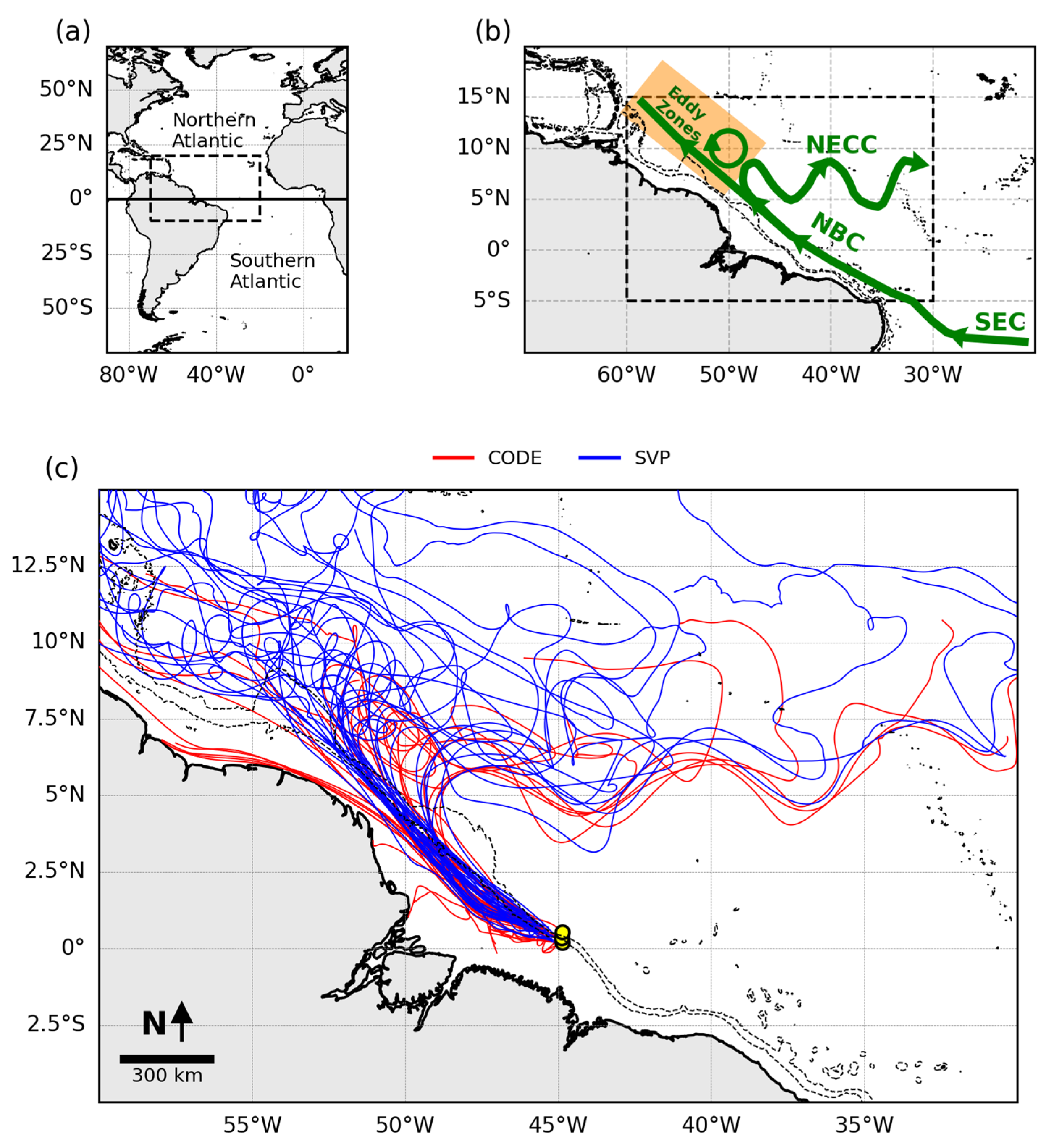
Disclaimer/Publisher’s Note: The statements, opinions and data contained in all publications are solely those of the individual author(s) and contributor(s) and not of MDPI and/or the editor(s). MDPI and/or the editor(s) disclaim responsibility for any injury to people or property resulting from any ideas, methods, instructions or products referred to in the content.

Article Metrics

Citations

Article Access Statistics

Article metric data becomes available approximately 24 hours after publication online.