You are currently viewing a new version of our website. To view the old version click .
Journal of Marine Science and Engineering
  • Article
  • Open Access

4 December 2025

Influence of a Sloped Bottom on a 60-Degree Inclined Dense Jet Discharged into a Stationary Environment: A Large Eddy Simulation Study


and
Department of Civil Engineering, University of Ottawa, 75 Laurier Ave E, Ottawa, ON K1N 6N5, Canada
*
Author to whom correspondence should be addressed.
This article belongs to the Section Physical Oceanography

Abstract

In the present study, numerical simulations were conducted to investigate the behavior of a 60° inclined dense jet discharged onto horizontal (0°) and sloped (5°) bottoms in a stagnant environment. The objective was to evaluate the capability of Large Eddy Simulation (LES) in capturing both the kinematic and mixing characteristics of inclined dense jets interacting with different bottom boundaries. A Reynolds-Averaged Navier–Stokes (RANS) model was also included for comparison. The LES simulations successfully reproduced the key kinematic and mixing characteristics, including the jet trajectory, centerline peak location, impact point, and terminal rise height, and showed strong agreement with the experimental observations. LES also predicted the concentration distributions and variations along both the horizontal and sloped bottoms, whereas the RANS model tended to underestimate both geometrical and dilution properties. A Gaussian fitting function was proposed to estimate the concentration distribution under both bottom conditions. Analysis of the spreading layer indicated that the concentration profiles exhibited self-similarity. Energy spectrum analysis showed that the sloped bottom enhanced shear-induced turbulence, thereby improving the mixing efficiency. Results confirm the reliability of LES for describing jet–bed interactions and emphasize the influence of bed slope on jet dilution and mixing behavior.

1. Introduction

As population growth and climate change increase the risk of drought, the number of desalination plants is steadily growing worldwide to address water scarcity [1]. However, the concentrated brine byproduct generated during desalination has raised significant environmental concerns because its high salinity can be harmful to marine ecosystems if improperly discharged [2,3]. Therefore, it is essential to ensure that outfall designs can enhance brine mixing to achieve optimal dilution and minimize environmental impacts.
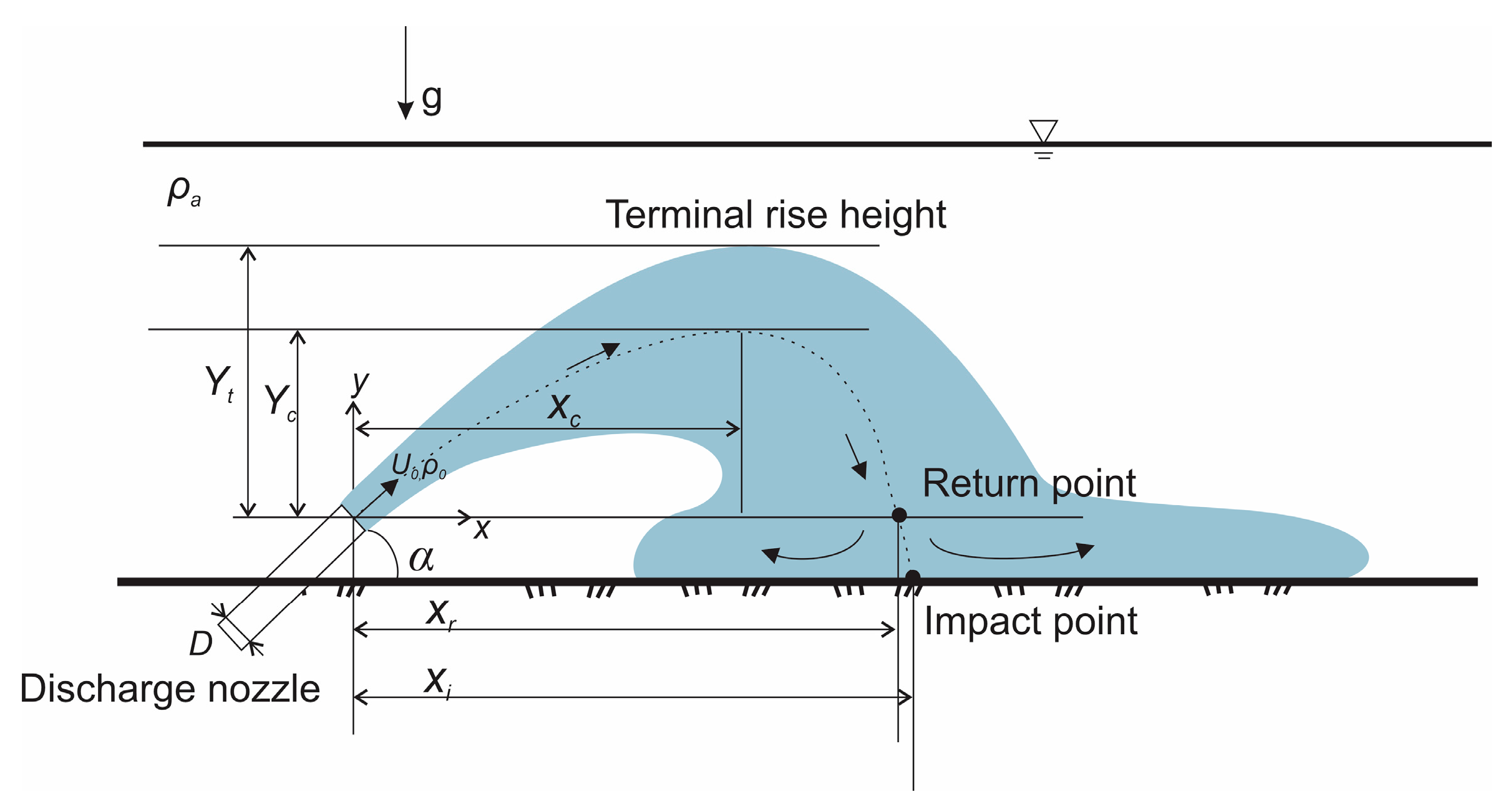
Inclined dense jets (or inclined negatively buoyant jets) are widely adopted in brine discharge systems [4]. In this method, brine is discharged as a turbulent jet through a submerged pipeline and nozzle system, with the nozzle set at an upward inclination angle, as illustrated in Figure 1.
Figure 1. A schematic view of the single inclined dense jet discharged into the stationary ambient water.
The brine jet, with density ρ j e t , is released from the round nozzle of diameter D at velocity U 0 and an inclination angle α . Driven by its initial momentum, the jet ascends along the discharge angle, reaches a maximum height, and then descends towards the seabed [5]. The point at which the jet first touches the seabed is referred to as the impact point. During this process, entrainment and re-entrainment occur continuously [6], leading to the progressive dilution of the brine.
Nondimensional analysis of an inclined dense jet is important for both practical applications and theoretical studies. All jet parameters can be expressed in a dimensionless form [5]. The geometrical properties of the jet can be represented as:
X D F r = C 1
where X represents the horizontal location of a point in the Cartesian coordinate system, and Fr is the densimetric Froude number, given by
F r = U 0 D g 0
where g 0 = g ρ 0 ρ a ρ a . Here, ρ 0   is the density of the brine and ρ a is the density of the receiving water.
Similarly, the concentration of the jet is often described in terms of dilution S , which can also be nondimensionalized as
S F r = C 2
where
S = ρ 0 ρ a ρ ρ a
and ρ is the local density. These parameters are typically correlated with the discharge angle of the jet ( α ). C1 and C2 are empirical coefficients obtained from the numerical or experimental results.
Experimental efforts have been made to investigate the characteristics of single-port inclined dense jets in stationary receiving-water environments. Earlier studies focused on the basic behavior of inclined dense jets. Zeitoun et al. [4] were the first to use photographic methods and point measurements to investigate the geometry and concentration distribution of inclined dense jets at various discharge angles (α = 30, 45, and 60°). They observed that key properties, such as the maximum rise height ( Y t ), centerline peak ( X c ,   Y c ), and return point ( X r ) or impact point ( X i ), were influenced by the discharge angle ( α ). In particular, the 60 ° discharge angle produced the longest jet path and the greatest dilution at the impact point. Later studies expanded the range of discharge angles, improved empirical models, and provided additional experimental data [7,8,9,10,11,12]. Meanwhile, advanced techniques such as Light Attenuation (LA) and Laser-Induced Fluorescence (LIF) have further improved the measurement accuracy [5,13,14,15,16,17,18,19]. These experimental efforts established the fundamental behavior of inclined dense jets and provided valuable measurements. However, laboratory experiments are often constrained by inherent limitations in equipment, scale, and operational control. Computational Fluid Dynamics (CFD) has therefore been widely applied as a powerful and complementary approach in the study of inclined dense jets, owing to its capability to resolve high-resolution flow fields and simulate long-term flow evolution under varying boundary conditions [20].
CFD numerically solves the Navier–Stokes equations using three main approaches: Direct Numerical Simulation (DNS), Reynolds-Averaged Navier–Stokes (RANS), and Large Eddy Simulation (LES) [21]. Among these, RANS and LES are the most commonly used in engineering applications and both have been applied to the study of inclined dense jets [22]. Vafeiadou et al. [23] conducted the first numerical simulations using the k–ε model in ANSYS CFX (version not reported) and reported good agreement with experimental data. Oliver et al. [24] found that the k–ε model could accurately predict the jet trajectory but underestimated the concentration. Gildeh et al. [25] and Wang and Mohammadian [26] highlighted the importance of turbulence model selection when simulating inclined dense jets. Their comparison of common two-equation turbulence model showed that the realizable k–ε model performed better than the RNG (Renormalization Group) k–ε model. The latter study also indicated that RANS models are less effective in accurately predicting concentration results, especially when the discharge angle exceeds 45°. These findings reinforced the growing use of LES, which provides improved and more detailed flow-field characteristics. Zhang et al. [27,28] conducted LES simulations of inclined dense jets discharged at angles of 45° and 60° in a stationary environment. Their results showed that LES accurately captured turbulence structures and performed better in predicting geometrical parameters and concentration distributions, consistent with the experimental observations [5]. Although these numerical studies improved the understanding of turbulence structures, they primarily focused on horizontal bottoms. This leaves limited knowledge about how inclined dense jets behave once they interact with non-horizontal bottoms.
After the jet reaches the seabed, gravitational effects cause brine to spread and accumulate along the bottom, particularly beyond the impact point [29]. Given that desalination outfalls operate continuously for long periods, undiluted brine on the seabed may pose significant environmental risks. Moreover, natural seabeds are often sloped rather than flat, making it essential to investigate how seabed slopes influence jet behavior after impingement.
Several studies have extended the analysis beyond the return point and examined the influence of different sloping bottoms. Oliver et al. [30] investigated the impact point properties of inclined dense jets for different discharge angles (30°, 45°, and 60°) and seabed slopes (0–20°) using CorJet [31] and an extended semi-analytical model based on [13]. Their results showed that both the discharge angle and seabed slope influenced the impact location, with the extended model outperforming CorJet in predicting concentrations at the impact point. However, both models exhibited limitations in capturing the detailed mixing and dilution processes beyond the impact region. Nikiforakis et al. [32] conducted the first experimental study on inclined dense jets over a 5° sloped bottom using conductivity probes for point measurements. Their findings indicated that the dilution increased with the discharge angle, with the 60° jet achieving a 20% higher overall dilution than the 45° jet. However, their reliance on discrete point measurements limited their ability to capture the full spatial and temporal evolution of concentrations within the flow field. Wang and Mohammadian [33] used RANS turbulence models to simulate a 15° inclined dense jet discharged over three sloped bottoms (0°, 3°, and 6°). While the RANS model successfully captured the geometrical characteristics of the jet on different slopes and provided a linear equation for point dilution along the bottom after the impact point, it tended to underestimate dilution. Habibi et al. [34,35] employed LES to investigate the effects of seabed slopes (0–20°) on inclined dense jets and analyzed the key vortex structures. Their study confirmed the utility of LES in accurately capturing the impact point locations and vortex structures. However, previous research has not sufficiently explored how seabed slopes influence the geometrical characteristics of the impact point and the evolution of concentration fields along the bottom after impingement.
To address this gap, Wang et al. [36] conducted comprehensive laboratory experiments using a Laser-Induced Fluorescence (LIF) system to study inclined dense jets discharged over sloped bottoms (0–5°) at discharge angles of 30–60°. Their experiments provided detailed concentration measurements near the impact point and along the seabed, offering valuable insights into the post-impingement spreading behavior. While these experiments significantly advanced the understanding of slope effects, numerical modelling remains essential for resolving the full flow field and examining detailed turbulence processes that are difficult to measure experimentally.
Building on these experimental findings, the present study further investigated the influence of seabed slopes through numerical modelling. Large Eddy Simulation (LES) was employed to examine inclined dense jet behavior at a 60° discharge angle over two seabed slopes (β = 0° and β = 5°) in a stationary environment, focusing on impact-point dynamics and downstream spreading along the seabed. A commonly used two-equation RANS turbulence model (the realizable k–ε model) was also applied to assess the relative performance of different CFD approaches and support the development of predictive tools for outfall design under varying environmental conditions.

2. Methodology

2.1. Large Eddy Simulation

Large Eddy Simulation (LES) is derived from the fundamental Navier–Stokes equations, where the flow field is separated into resolved large scales and unresolved subgrid scales (SGS) using a spatial filter of width [37]. The larger-scale eddies, which are greater than the filtering cutoff, are directly computed by solving the Navier–Stokes equations, while eddies smaller than the cutoff width are modelled as subgrid-scale (SGS) stresses. These SGS stresses can then be obtained using different SGS models [38].
The filtered governing equations for incompressible flow are given as:
u i ¯ x i = 0
ρ u ¯ i t + ρ x j u ¯ i u ¯ j = p ¯ x i + x j μ u i ¯ x j τ i j x j
where τ i j = ρ ( u i u j ¯ ρ u ¯ i u j ¯ ) is the SGS stress, which can be modelled as
τ i j = 2 ρ ν s g s     S i j * ¯ 2 3 ρ k s g s δ i j
S i j * ¯ = 1 2 ( u i ¯ x j + u j ¯ x i )
where u i ,   u j are the velocity in i ,     j directions, p is the pressure, ρ is the fluid density, the bar symbol is the filtered function, and ν s g s is SGS viscosity.
In this study, the K-equation model was adopted, as it is suited for complex geometries with non-uniform grids and has been successfully applied to negative buoyancy turbulent fountains [39]. ν S G S can be calculated as:
ν S G S = C s g s k S G S
where the C s g s = 0.094 and is the filter width determined by the local grid size. The k S G S is the subgrid-scale kinetic energy and is obtained from:
k s g s t + ρ u ¯ j k s g s x j = x j ν + ν s g s σ k k s g s x j + P ρ ε s g s ρ
ε s g s = C ε k s g s 3 / 2 , C ε = 1.048 , σ k = 1.0

2.2. RANS Model

In the Reynolds-averaged Navier–Stokes (RANS) approach, each flow variable is decomposed into a mean component and a fluctuating component, i.e.,
u x , t = u ¯ x + u x , t
By substituting this decomposition into the Navier–Stokes equations, the governing equations for RANS can be expressed as:
u ¯ i x i = 0
u ¯ i t + x j u ¯ ı u ¯ j = 1 ρ p ¯ x i + ν 2 u ¯ i x i x j u i u j ¯ x j
The last term represents the Reynolds stress, which requires closure. By applying the Boussinesq hypothesis [40], the unknown Reynolds stress is modeled using the eddy-viscosity assumption. Equation (14) can be written as
u i t + x j u ¯ i u ¯ j = 1 ρ ( p ¯ + 2 3 ρ k ) x i + x j ν t + ν ( u i x j + u j x i )
Two additional terms, v t (eddy viscosity) and k , need to be determined in the two-equation kε model:
ν t = C μ k 2 ε
where k is the turbulent kinetic energy and ε is the dissipation rate. Both can be solved using the transport equations.
The realizable k–ε model has been widely applied in numerical studies and has shown good performance [25,41]. The transport equations for k and ε in realizable k–ε model are:
k t + k u i ¯ x i = ρ   u i u j ¯ u j x i + x j ν + ν t σ k k x j ε
ε t + u i ¯ ε x i = x j ν + ν t σ ε ε x j + C 1 S ε C 2 ε 2 k + ν ε
The constant C 1 in Equation (18) is
C 1 = m a x 0.43 , η η + 5 , η = S k ε , S = 2 S i j S i j
where C 2 =1.9, σ ε =1.2.
The coefficient C μ in Equation (16) is written as
C μ = 1 A 0 + A s u * k ε
where A 0 = 4.04 , A s = 6 cos ϕ .
The parameter ϕ is defined as
ϕ = 1 3 arccos 6 W , W = S i j S j k S k i S ~ 3 , S ~ = S i j S i j , S i j = 1 2 u i x j + u j x i , u * = S i j S i j + Ω i j Ω i j ,   Ω i j = 1 2 ( u i ¯ x j + u j ¯ x i )
Further details can be found in [42]. The realizable k–ε model has been validated against experimental and numerical results of inclined dense jets [26,43,44]. In this study, the realizable k–ε model was employed for comparison with LES results due to its validated performance.

2.3. Computational Domain and Boundary Conditions

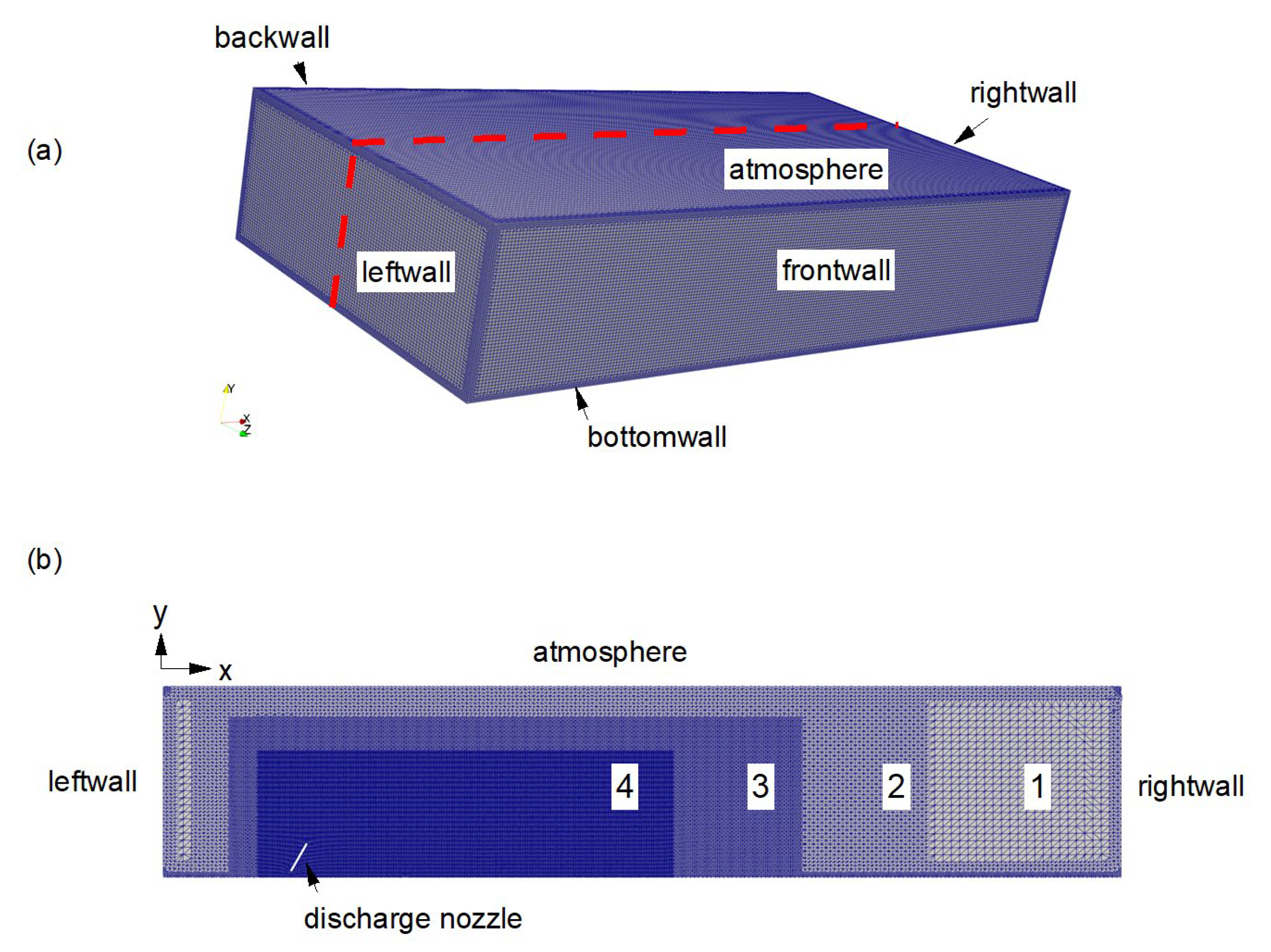
The computational domain was designed to replicate the experimental setup of Wang et al. [36]. It consisted of a rectangular water tank with dimensions of 1.6 m (length) × 0.8 m (width) × 0.35 m (height), as shown in Figure 2a. A cylindrical nozzle with a diameter of 0.0035 m was positioned at the center plane and inclined at 60° to the horizontal bottom surface. In the simulation, the flow was assumed incompressible, and the densities of the jet and ambient water were set to 1052 kg/m3 and 1000 kg/m3, respectively, consistent with the experimental conditions [36]. The corresponding Froude and Reynolds numbers were 17.3 and 2193, respectively.
Figure 2. (a) The computational domain, the red dashed line shows the cross-section for (b); (b) Detailed multiple-level mesh in the center plane with labels “1–4” indicating four refinement levels.
A fixed-value boundary condition with a uniform velocity profile was applied at the jet exit (nozzle inlet). The velocity components were defined as u = U 0 c o s ( α ) , v = U 0 s i n ( α ) , and w = 0 , where U 0 is the discharge velocity and α is the inclination angle of 60°. The scalar concentration at the inlet was fixed at C 0 = 1 , and inlet turbulence quantities were estimated as k = 0.006 U 0 2 and ε = 0.06 U 0 3 / D [25,44,45].
The left wall, bottom wall, front wall, and back wall were assigned no-slip boundary conditions. A symmetry condition was applied at the top boundary. The right wall (outlet) boundary was set to zero-gradient condition. Both the RANS and LES models were implemented in the open-source software OpenFOAM v5.0. In this study, the solver twoLiquidiMixingFoam was specifically applied to simulate the mixing of two incompressible fluids. The solver has been extensively validated in various CFD studies, and its reliability and accuracy have been demonstrated [27,46,47]. All simulations were performed with a timestep of t = 0.005   s . The total simulation time was 120 s, which was sufficient for the jet to reach a quasi-steady state and for the flow characteristics along the bottom after impingement to be fully captured.

2.4. Mesh Generation and Grid Analysis

The computational grid was generated using snappyHexMesh in OpenFOAM. The meshing tool applies an adaptive refinement strategy based on geometric features and flow regions, allowing efficient resolution of complex jet–bottom interactions while maintaining manageable computational cost. In this study, a four-level refinement strategy was applied across the computational domain, as shown in Figure 2b, with finer cells concentrated near the jet trajectory, the impact region, and the sloped bottom.

2.4.1. RANS Mesh

Mesh sensitivity analysis was performed on three meshes. Based on the number of mesh grids, they were categorized as coarse, medium, or fine grids. The grid details are presented in Table 1. For brevity, only the mesh details of the horizontal bottom are included here.
Table 1. Comparison of mesh quality for RANS models.
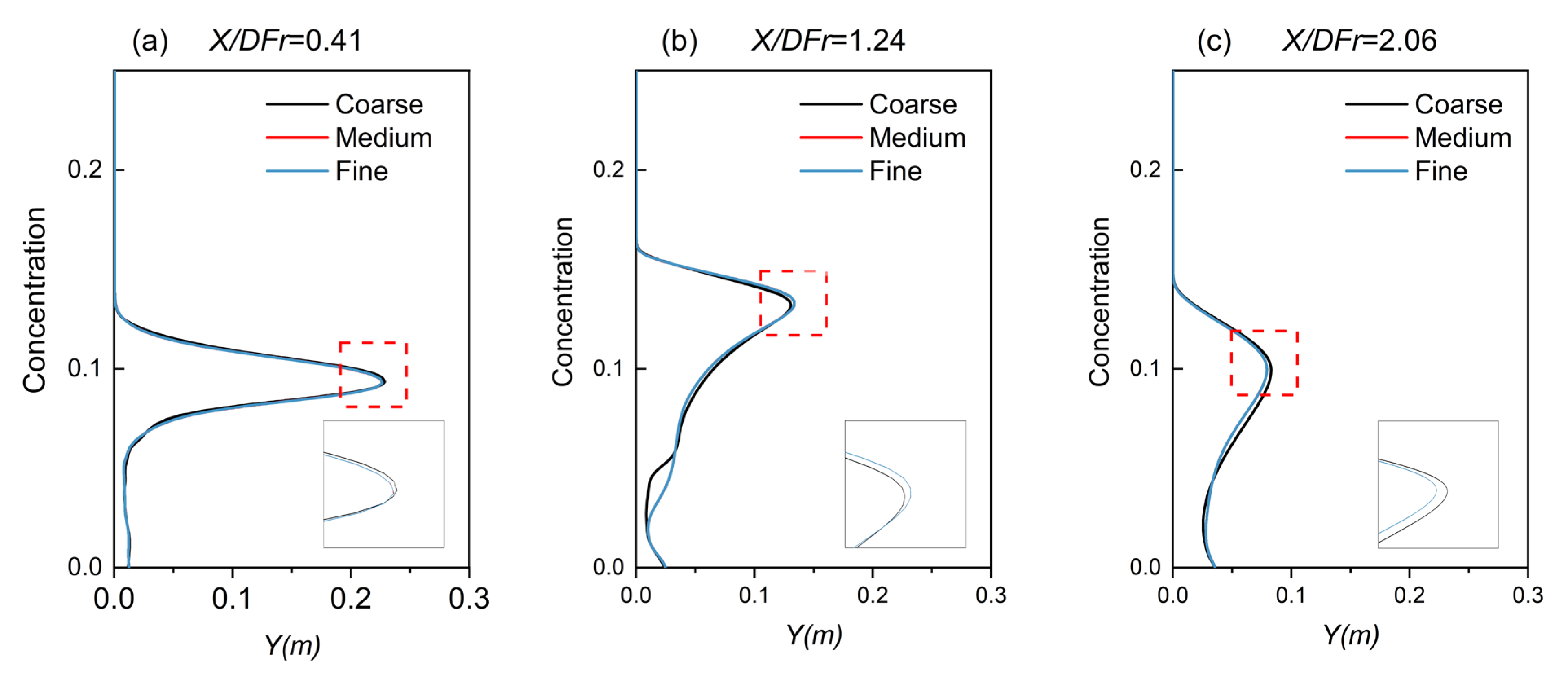
Additionally, comparisons were made by plotting concentrations at various vertical sections (X/DFr = 0.41, 1.24, and 2.06) within the flow region using different mesh configurations.
As shown in Figure 3, the concentration predictions show minimal differences among the three mesh configurations. The enlarged area in the image is highlighted with a red dashed box for further comparison. The medium mesh maintains good agreement with the fine mesh. Furthermore, the dilution at the return point was used as another indicator to assess mesh independence. The discrepancies between the coarse-to-medium and medium-to-fine meshes are 6.01% and 1.6%, respectively. Since only the medium-to-fine difference is below the commonly adopted 2% grid-convergence criterion [25,43], the mesh is considered sufficiently refined and no further refinement is required. Therefore, the medium mesh, which includes 1.8 million cells, was selected for all RANS simulations because it provides a better balance between numerical accuracy and computational efficiency.
Figure 3. Comparison of concentration profiles at three locations in the flow region, extracted using different RANS meshes.

2.4.2. LES Mesh

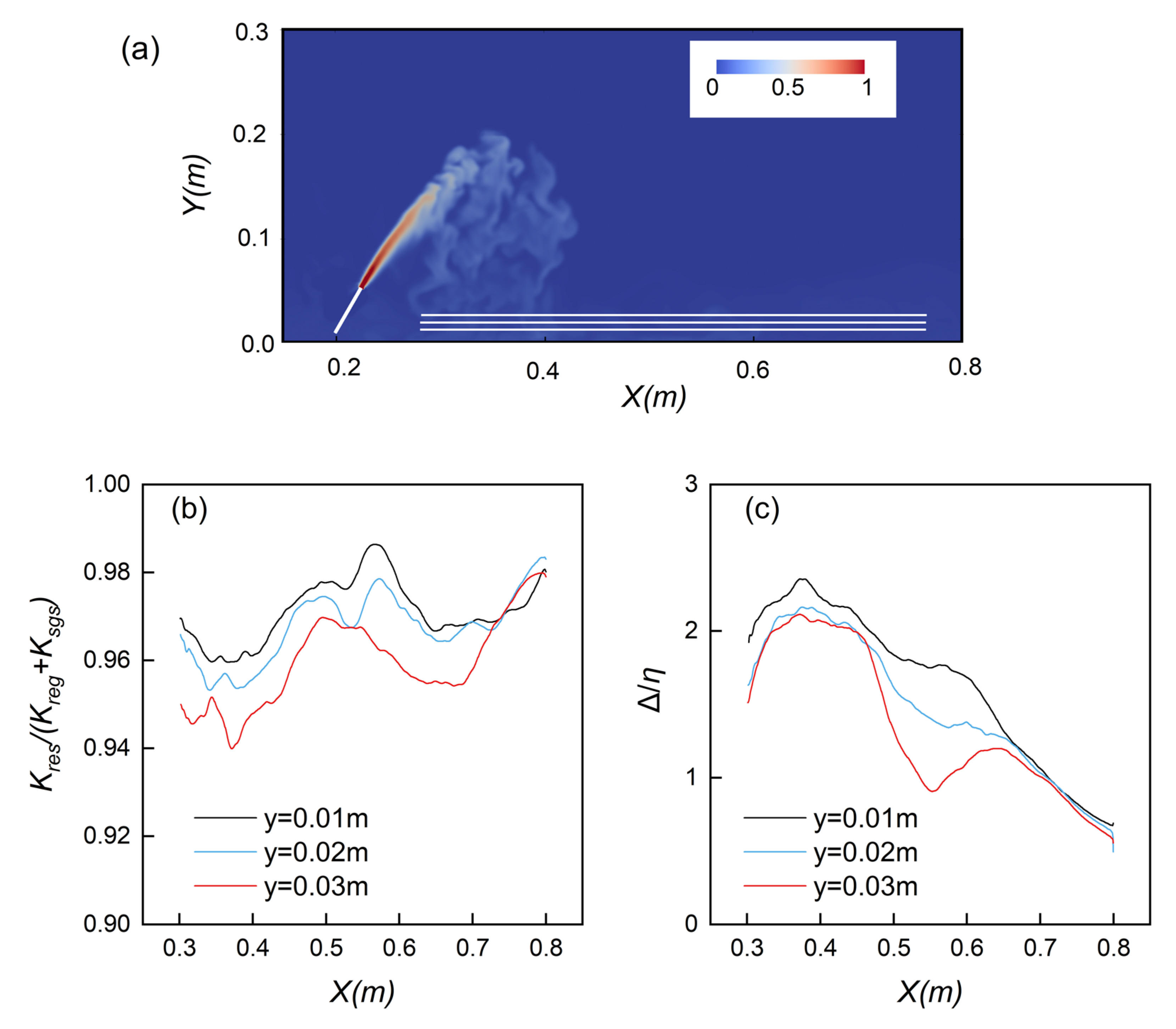
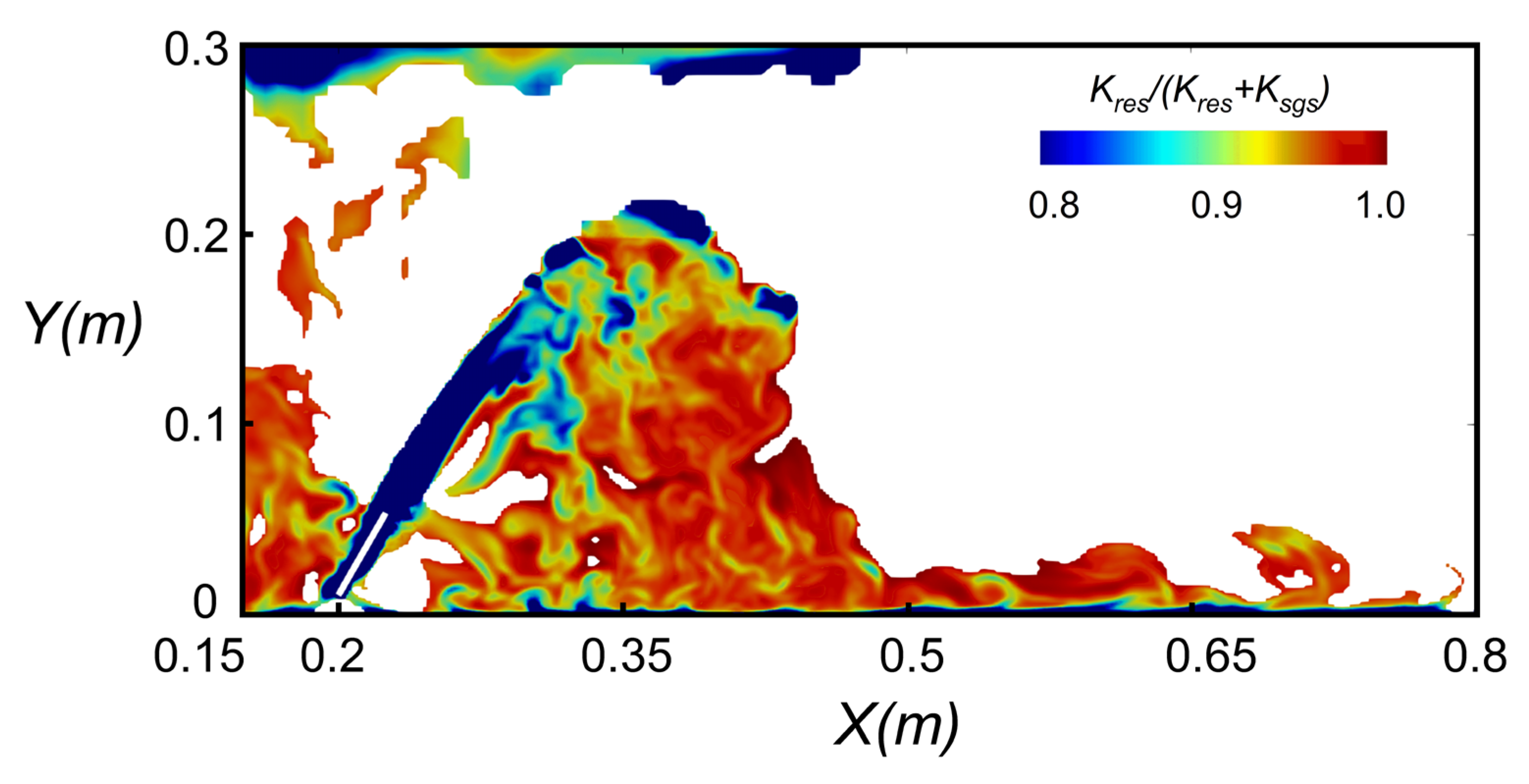
For LES, the mesh size determines the ratio between the resolved large eddies and the subgrid-scale (SGS) stresses. A finer mesh improves accuracy but increases computational cost. In this study, a total of approximately 8.81 million cells were generated with a four-level refinement strategy applied throughout the domain, including the 5° sloped bottom. The adequacy of the LES mesh was evaluated using two complementary criteria: (1) the ratio of resolved to total turbulent kinetic energy (TKE), and (2) the ratio of the LES filter width to the Kolmogorov length scale (Δ/η). These two criteria have also been adopted in previous studies [34,48].
According to Pope [49], a well-resolved LES should capture at least 80% of the total TKE ( k r e s k r e s + k S G S > 0.8 ). As shown in Figure 4, the resolved TKE ratio generally exceeds 0.9 across most of the jet flow region and along the bottom surface. For better visualization and to avoid artificially high values in background regions, a threshold of k S G S > 9 × 10 7 was applied before computing the resolved TKE and its ratio. This ensures that ratio k r e s k r e s + k S G S represents only the active jet region.
Figure 4. Instantaneous turbulent kinetic energy ratio K r e s K r e s + K s g s at the center plane (t = 90 s).
The four-level mesh refinement employed in this study successfully resolved over 80% of the total TKE across most computational regions. In the area near the nozzle, where turbulence is highly intense and small in scale, the resolved TKE ratio falls below 0.8. Capturing these fine structures would require an extremely fine mesh and significantly higher computational cost. However, since this study focuses on the overall jet behavior after the impact point rather than the near-nozzle region, such refinement was not prioritized.
Three horizontal lines near the bottom (y = 0.01, 0.02, and 0.03 m), shown in Figure 5a, were used to examine the local grid resolution around the impact region.
Figure 5. (a) Instantaneous concentration field of the inclined jet on the 0° sloped bottom, with three horizontal lines at y = 0.01 m, 0.02 m, and 0.03 m; (b) ratio of resolved to total turbulent kinetic energy K r e s K r e s + K s g s along these lines; (c) ratio of LES filter width to Kolmogorov length scale ( Δ / η ) along the same sections.
Figure 5b,c show the distributions of the ratio of TKE and Δ/η along the three lines, respectively. The Kolmogorov length scale was estimated as η = ( ν 3 / ε ) 0.25 , where ε is the turbulent dissipation rate computed from the mean field. A commonly used criterion is Δ/η ≤ 12, which is derived from Pope’s [50] estimation and has been adopted in other LES studies [34,51]. In the present study, Δ/η remains below 3 (well below the threshold value of 12) near the impact region, indicating that the mesh resolution is adequate.
Therefore, together the TKE ratio and Kolmogorov-scale criteria confirm that the present grid provides sufficient resolution for a well-resolved LES in the near-bed region.

3. Results and Discussion

3.1. The Instantaneous and Time-Averaged Results

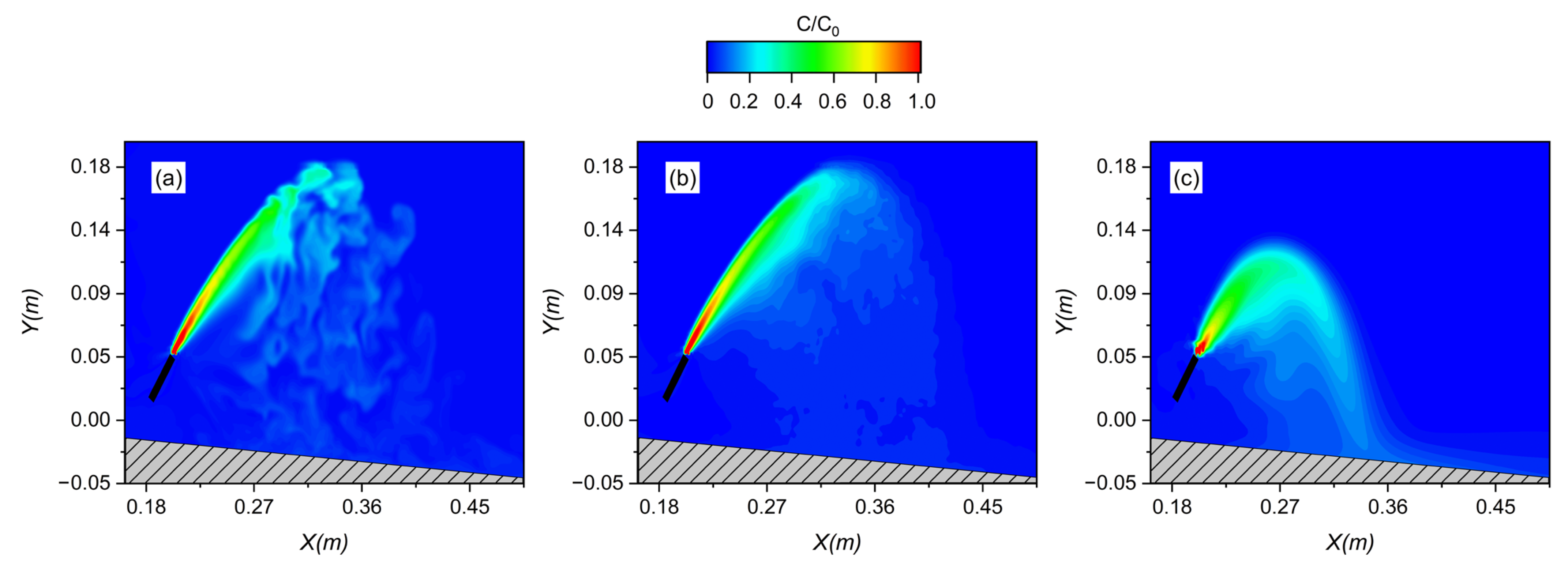
Figure 6 presents the instantaneous and time-averaged concentration contours ( C / C 0 ) of the LES and RANS models on the 5° sloped bottom as an illustration of the simulation results. For the LES, the time-averaged field was obtained by averaging the last 60 s of the simulation, after the jet had impinged on the bottom and moved beyond the region of interest along the slope ( X / D F r > 15 ). For the RANS simulation, the result at t = 80 s is presented, as the flow has fully developed throughout the domain and flow characteristics are stable.
Figure 6. (a) LES instantaneous concentration field; (b) LES time-averaged concentration contour; (c) the realizable k–ε concentration contour.
In the instantaneous LES field (Figure 6a), complex turbulent structures and flow driven jointly by momentum and negative buoyancy can be clearly observed. After exiting the nozzle, the jet rises due to its initial momentum, reaches a maximum height, and then descends as negative buoyancy becomes dominant. During the descending stage, detrainment occurs along the inner side where part of flow peels off from the main jet. This behavior destroys the symmetrical shape of the jet and is commonly referred to as gravitational instability. As the jet continues to discharge, entrainment and re-entrainment along the inner region make the inner boundary blurred. The simulated flow pattern agrees well with the experimental observations [6,15,36]. These instantaneous turbulent features and local instabilities are smoothed out in the time-averaged field (Figure 6b), causing the descending region to appear less distinct than the ascending region. When the discharge angle is relatively large, the descending flow also tends to become more vertical and plume-like [52].
Figure 6c presents the concentration field simulated using the realizable k–ε model. Compared to the LES results, the jet appears smaller, more confined, has a lower maximum rise height, and reaches the impact point at a shorter distance. This difference is likely due to the realizable k–ε model underestimating the initial momentum and turbulent kinetic energy and consequently leading to a higher predicted concentration compared to the LES results. Similar observations were reported by Wang and Mohammadian [26], who found that RANS models generally underperformed when simulating inclined jets at higher discharge angles (60°). Zhang et al. [28] also emphasized that LES has a better performance in complex turbulent jet simulations.
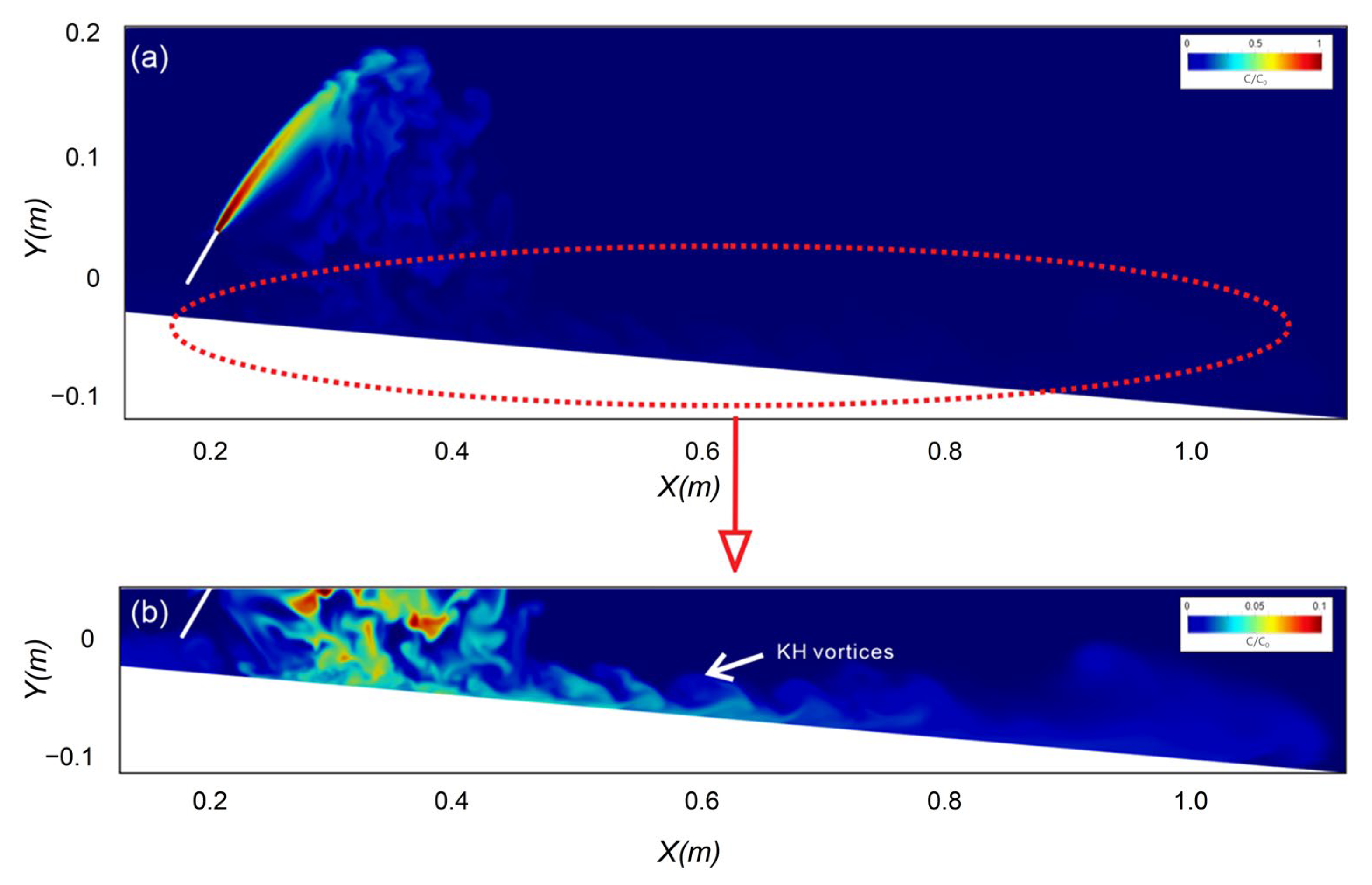
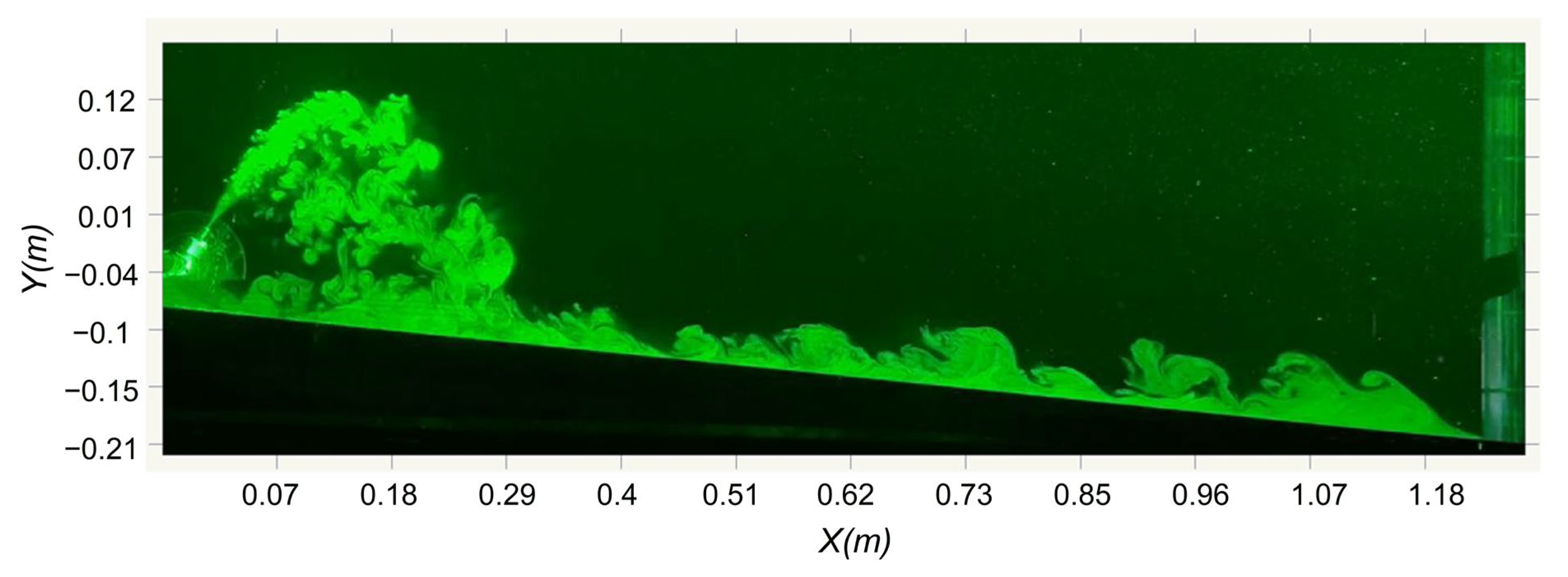
Throughout the jet development, LES captures detailed turbulent structures, particularly around the jet boundary. Shear instability generates a series of vortical structures that evolve, interact, and eventually break down, enhancing entrainment and accelerating mixing of the momentum and mass. A series of Kelvin-Helmholtz (KH) vortices along the bottom after the impact point were also captured in the LES simulation (Figure 7). This phenomenon was also observed in an experimental study by Wang et al. [36] (Figure 8) and in other studies [5,18].
Figure 7. Illustration of the Kelvin–Helmholtz vortices along the bottom from the LES simulation. (a) Concentration field and the region where KH vortices begin to develop after impingement. (b) Enlarged view showing the Kelvin–Helmholtz vortices along the sloped bottom.
Figure 8. An image of the KH vortices along the bottom from LIF experiment [36].

3.2. Jet Trajectory

The trajectory is important for tracking the jet movement and determining the jet-affected area, which is derived from the maximum concentration or velocity along the perpendicular sections of the jet. According to previous studies [14,27,33], the difference between the velocity and concentration of the indicated trajectory was very small. Therefore, to simplify the analysis, the maximum concentration is used to determine the trajectory.
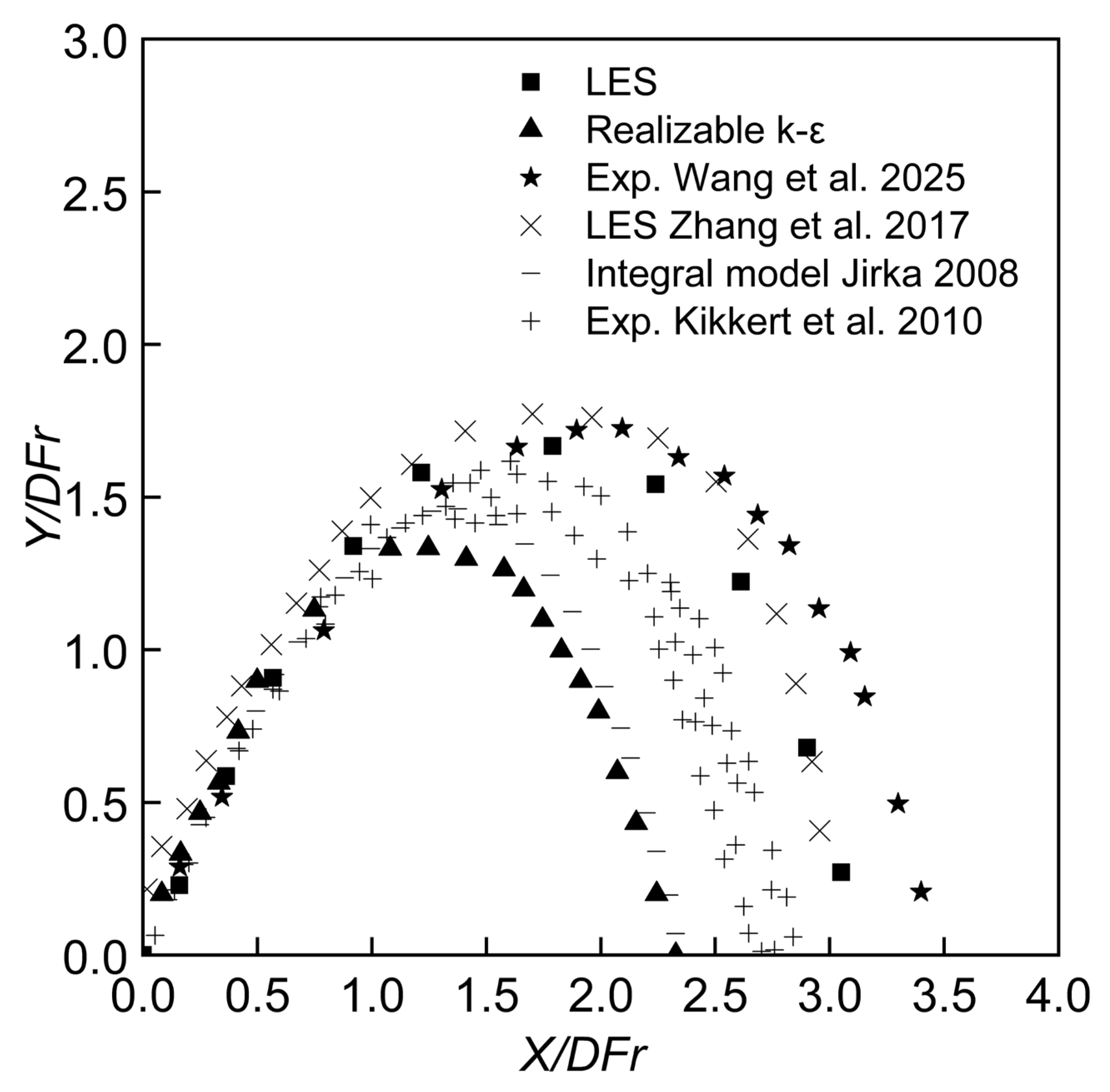
The jet trajectories were normalized using the Froude number (Fr) and nozzle diameter (D), and the results are shown in Figure 9. To facilitate comparison with previous studies, the numerical results under the horizontal bottom condition were first presented.
Figure 9. Trajectory of the inclined dense jet with a 60-degree discharge angle on a horizontal bottom. Comparisons are made with [28,36,53,54].
By comparing the results of LES, realizable k–ε models, and data from related studies [28,36,53,54], it was found that LES results showed good agreement with the experiments [36] and Zhang et al.’s LES simulations [28]. The realizable k–ε model results were consistent with Jirka’s integral model predictions [53], and both methods underestimated the jet trajectory. The trajectory difference between RANS and LES was consistent with Zhang et al. ’s numerical study [28]. Zhang et al. compared the jet trajectories predicted by LES and the k–ε model and concluded that the k–ε model underestimated the jet trajectory. The trajectory results from Kikkert [54], which are based on the light attenuation method, lie between the realizable k–ε and LIF results. This indicates that different measurement methods can lead to different outcomes.

3.3. Overview of Geometrical Information

Some important geometrical information, such as the terminal rise height ( Y t ), centerline peak point ( X c ,   Y c ), and impact point ( X i ), which are relevant to design considerations, are summarized in Table 2 and Table 3. Because research on sloped bottoms is limited, the comparison results in Table 2 with previous studies are primarily based on simulations at horizontal bottoms. In Table 3, only the geometrical and concentration coefficients at the impact point are listed, because the slope mainly affects the jet at this location.
Table 2. Coefficients from the results for the horizontal bottom ( β = 0 ° ) .
Table 3. Coefficients from the results for the sloped bottom ( β = 5 ° ) .
In the following section, relevant geometrical information is compared with results from previous studies. It should be noted that the numerical simulation results presented here were obtained from simulations with a 5° slope bottom. This not only verifies that the sloped bottom has minimal impact on the jet behavior before reaching the bottom but also confirms that the grid modifications caused by the sloped bottom did not significantly affect the overall numerical results, ensuring the reliability of the numerical simulations.

3.4. Terminal Rise Height and Centerline Peak

The location of the terminal rise height is useful for outfall system design because it indicates the maximum level the jet may reach, which helps prevent it from approaching the water surface [55].
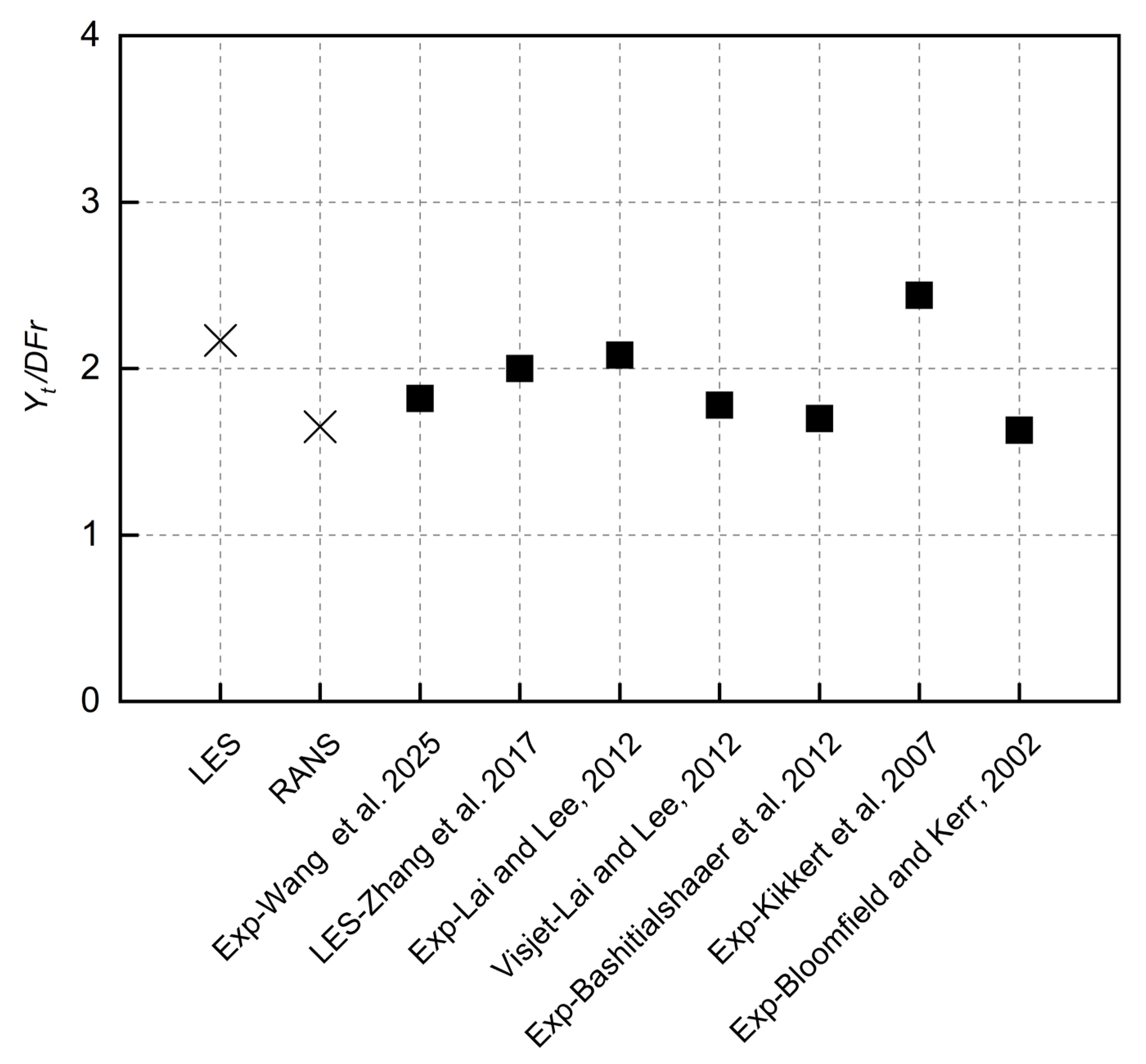
The terminal rise height was determined using a 3% concentration contour ( C / C 0 = 0.03 ) on the jet centerplane, which is commonly used to identify the upper and lower boundary of the jet in previous experimental and numerical studies [14,31,36,43]. Figure 10 presents the normalized terminal rise height (Yt/DFr), plotted for comparison with previous experimental studies [7,9,13,15] and LES results from Zhang et al. [28]. As shown in Figure 10, both the previous experimental data and the numerical results exhibit a certain degree of scatter. This is possibly due to uncertainties in the experimental measurements and numerical modelling approaches. Compared to the LIF experimental results, LES slightly overestimates the terminal rise height, but shows good agreement with [13,15]. The realizable k–ε predictions are closer to the LIF measurements but still tend to be lower. However, the realizable k–ε values were in good agreement with the results of [9].
Figure 10. Normalized terminal rise height ( Y t D F r ) compared with previous studies [7,9,13,15,28,36]. The cross marker (×) represents this study, and the solid square marker (⏹) represents previous studies.
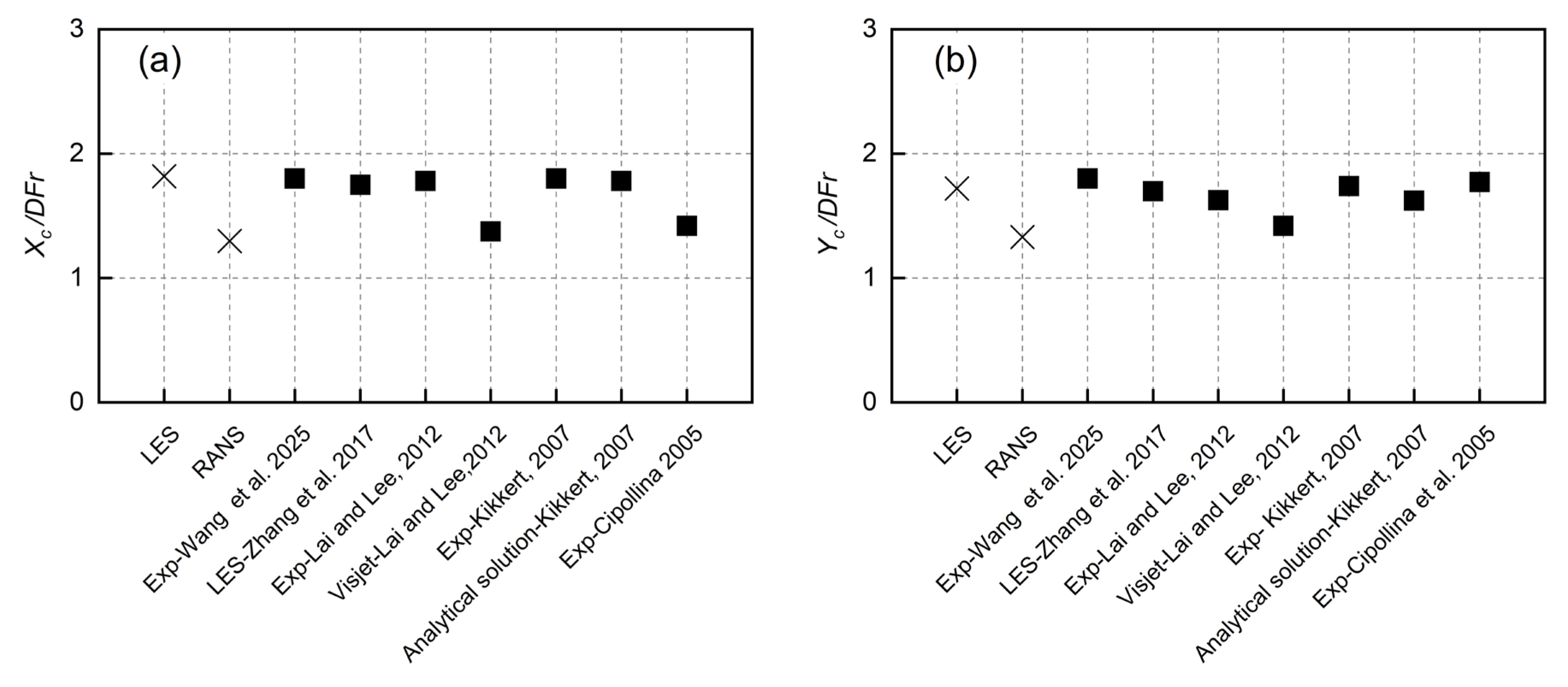
The location of the centerline peak (Xc, Yc) was also normalized by the Froude number (Fr) and nozzle diameter (D) compared with previous studies, as shown in Figure 11. The realizable k–ε results showed good agreement with the integral model Visjet [15] and with the experimental study [8], but all of them underestimated the value relative to other experimental studies. The slightly lower Xc value in Cipollina’s experiment [8] is likely attributed to the use of photographic methods to capture the jet centerline, which may introduce higher measurement uncertainty than advanced technologies such as Laser-Induced Fluorescence (LIF). In contrast, Yc values showed better consistency across different studies. The LES results from this study for both Xc and Yc exhibit improved agreement with previous works, including experimental results [15,55] and LES simulations reported by Zhang et al. [28].
Figure 11. Normalized location of centerline peak compared with previous studies: (a) X c D F r (b) Y c D F r Data from Refs. [8,13,15,28,36]. The cross marker (×) represents this study, and the solid square marker (⏹) represents previous studies.

3.5. The Effect of the Sloped Bottom at Impact Point

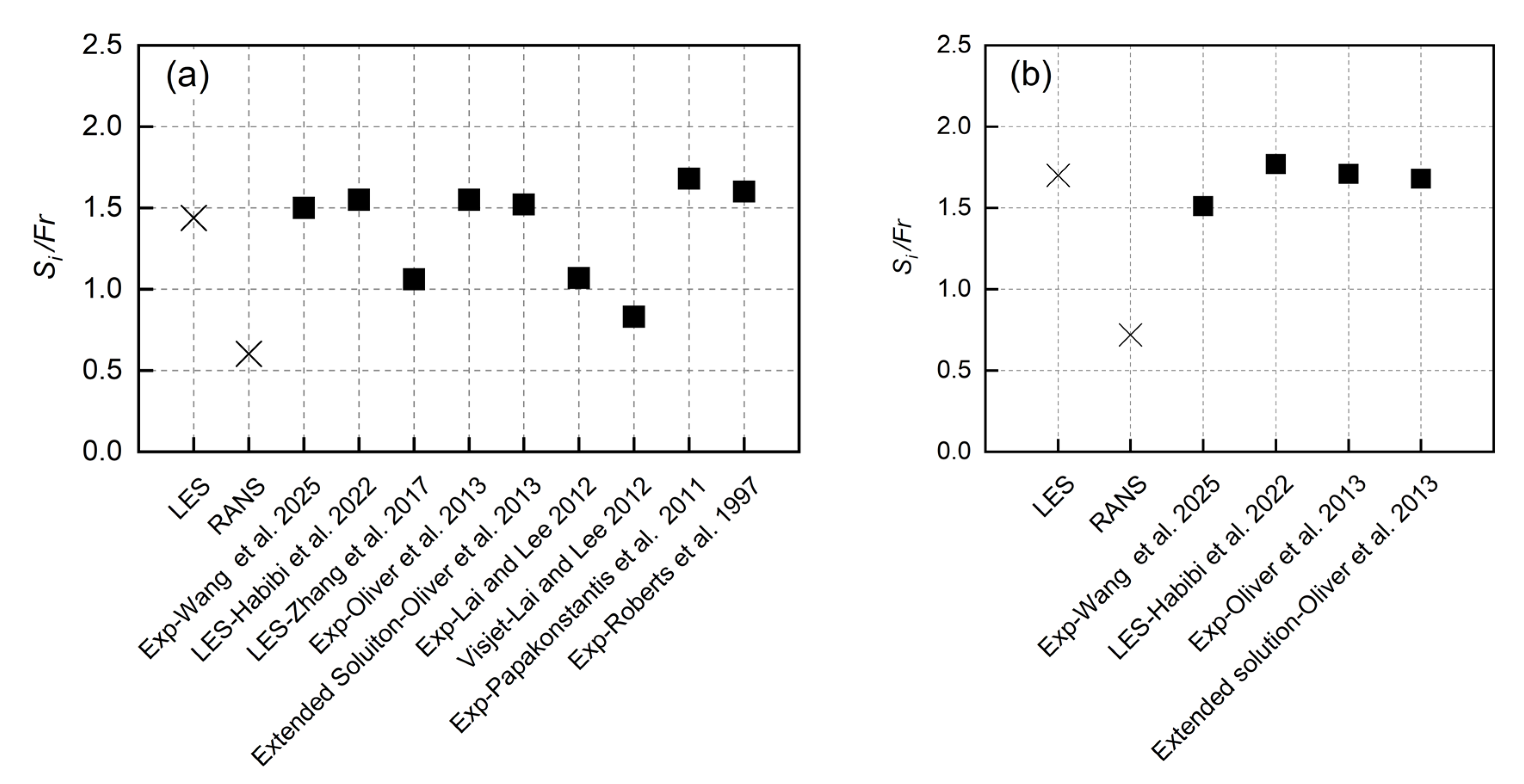
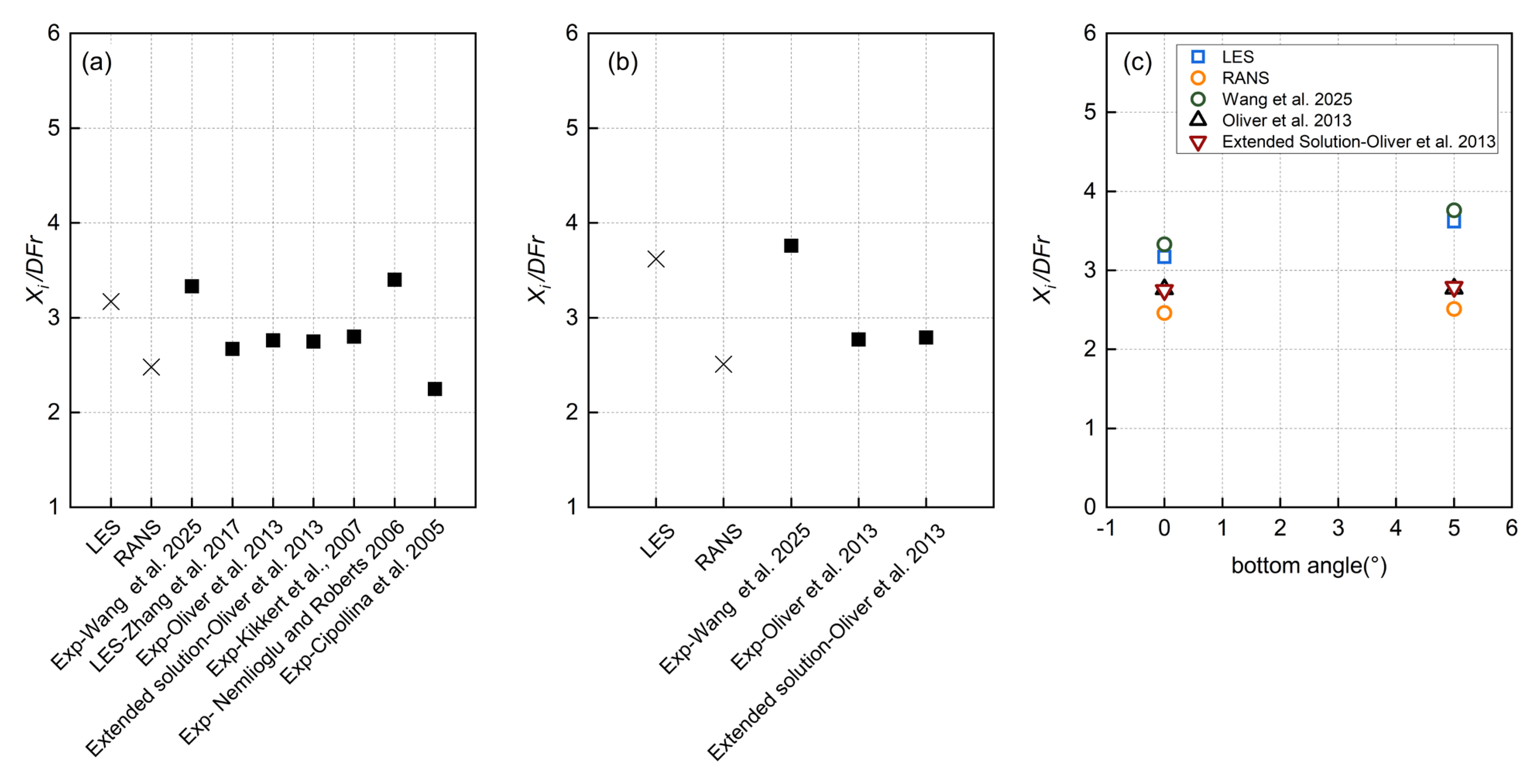
As previously mentioned, the impact point is highly dependent on the bottom condition. When a sloped bottom is present, the impact point becomes distinctly different from that on a horizontal bottom. According to Roberts et al. [5], the impact point can be identified based on concentration variations, as the highest concentration along the bottom corresponds to the impact point. A similar approach was used in this study to determine the impact point location. The normalized impact points for both the horizontal and sloped bottom conditions are presented in Figure 12.
Figure 12. (a) Comparison of present and previous studies of the impact point on the 0° bottom; (b) comparison of present and previous studies of the impact point on the 5° bottom; (c) influence of bottom slope on impact point location ( X i D F r ). Data from Refs. [8,13,28,30,36,56]. In (a,b), the cross marker (×) represents this study, and the solid square marker (⏹) represents previous studies.
The location of the impact point is affected by the sloped bottom, which in turn influences the concentration distribution. The dilution at the impact point from this study on both bottoms is shown in Figure 13.
Figure 13. Dilution at impact point on (a) 0° slope; (b) 5° slope. Data from Refs. [5,11,15,28,30,34,36]. The cross marker (×) represents this study, and the solid square marker (⏹) represents previous studies.
In the first subfigure (0° bottom), the realizable k–ε model slightly underestimates the impact point location but still agrees well with previous studies [8,13,28,30]. The LES model exhibits a better agreement with the experimental results reported by Nemlioglu and Roberts [56] and Wang et al. [36]. The second subfigure (5° slope) shows that the LES prediction is consistent with Wang et al. [36] but slightly higher than the value reported by Oliver et al. [30]. The difference may be attributed to the experimental setup. Oliver et al. [30] conducted their experiments on a nominally sloped bottom without accounting for the physical impingement and accumulation of the jet on the actual bottom surface. As a result, their measurements slightly underestimated the impact point location, whereas the LES results in this study performed better.
The third subfigure shows the impact point locations on both the horizontal and sloped bottoms to study the influence of bottom slope. The jet clearly reaches a longer distance on the sloped bottom, and the results show good agreement with Wang et al. [36]. A similar trend was reported by Oliver et al. [30]. However, although this increasing trend was observed in [30], both the experimental results (2.76 vs. 2.79) and the semi-analytical model show only a very small increase in impact distance. This limited increase can again be attributed to the fact that their experiments were performed on a nominally sloped surface, and their semi-analytical model likewise neglected the physical impingement of the jet on an actual solid boundary. As a result, the sensitivity of the impact point to bottom slope is substantially reduced.
The dilution was normalized by the Froude number for consistency. The results show that the LES model outperformed the RANS model in predicting the mixing behavior of the jet. The realizable k–ε model significantly underestimates the dilution; however, its predictions are closer to those of Visjet, a Lagrangian model [15]. The conservative behavior of the realizable k–ε model in predicting mixing properties has been widely discussed in the previous literature [24,25,26]. The dilution at the impact point on the 5-degree sloped bottom was higher than that on the horizontal bottom, as expected, which is also consistent with the observations in the experiment [30]. The sloped bottom affects the jet and bottom interactions, thereby enhancing the mixing.

3.6. Concentration Distribution near the Impact Point

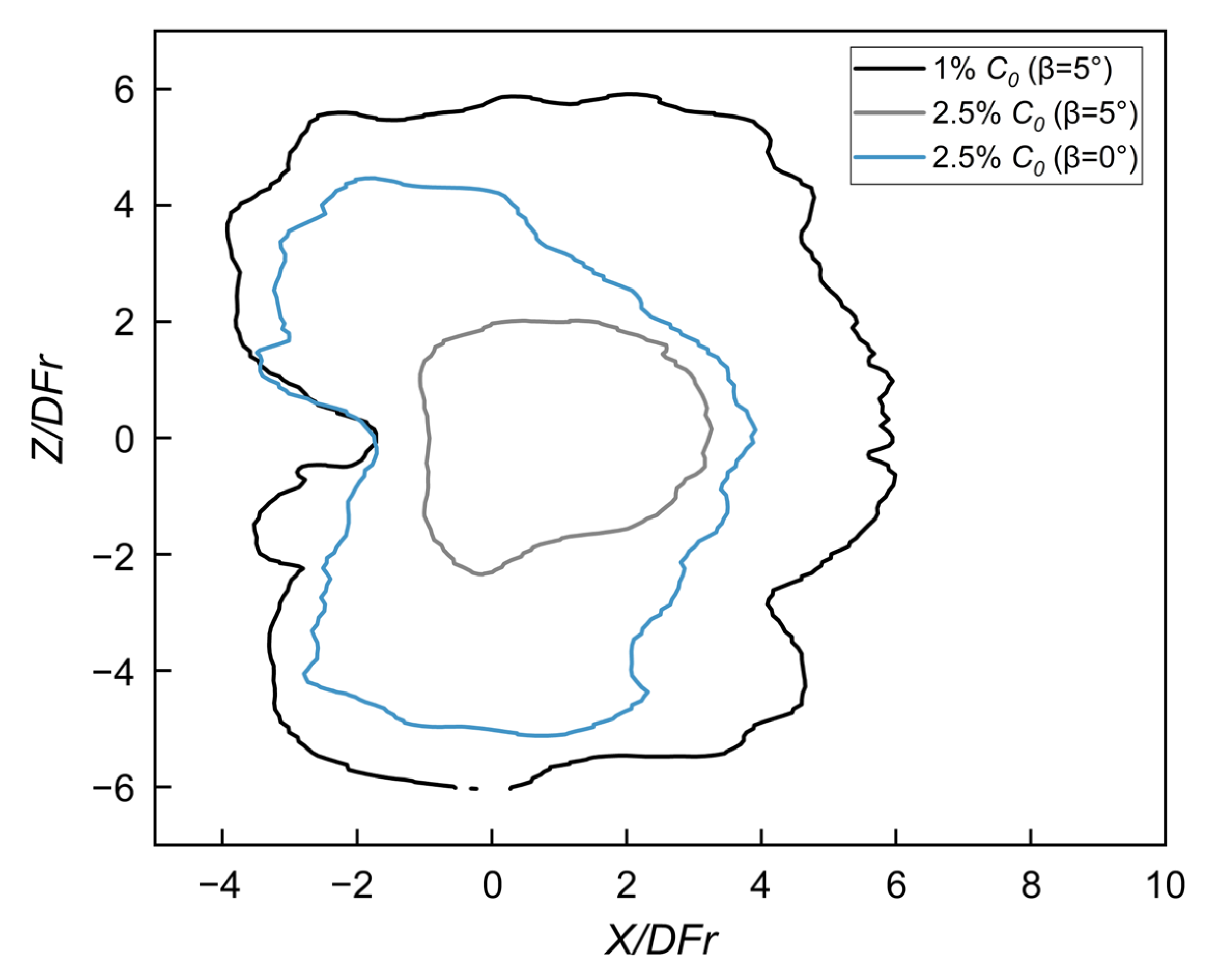
To investigate the concentration distribution at the impact point on different bottom conditions, Figure 14 illustrates the concentration contour lines at the impact point region from the LES numerical simulation. RANS was not analyzed here due to its poor performance in predicting dilution. The figure includes the 2.5% and 1% C0 contour lines for both slopes (C0 is the initial concentration set to 1 in this study). For horizontal case, the 1% C0 contour line was not included, because the flow approached the tank sidewall, limiting the contour extent. The coordinates (0,0) represent the impact point, and all lengths are normalized using the Froude number Fr and nozzle diameter D.
Figure 14. The concentration contour line at the impact point region on the horizontal and sloped bottom.
For the 2.5% C0 contour line (blue and gray), the area is larger on the horizontal bottom (blue) than on the sloped bottom (gray), indicating greater lateral spreading on the horizontal bottom, whereas mixing is enhanced on the sloped bottom. Stronger mixing on the sloped bottom leads to faster dilution of the brine, reducing the lateral spreading near the impact point area. At the same time, the sloped bottom also appears to limit the brine flow moving towards the shoreline, which may help reduce pollution risks. These findings are consistent with experimental observations in [36]. Since the impact point region continuously receives the brine jet, it is important to examine the concentration distribution around this area. To characterize this distribution, a surface fitting approach was applied to characterize the spatial distribution of (C/C0). The Gaussian fitting functions are listed in Table 4.
Table 4. Surface fitting function for the concentration distribution near the impact point area on both slopes.
In these fitting functions, C (x, y) is the local concentration ( C / C 0 , where C 0 = 1 ), x = X D F r ,     y   = z D F r . The origin point (0,0) represents the location of the impact point. The correlation R 2 of both fitting functions was approximately 0.9, indicating good fitting results. A closer examination of the fitted functions reveals that on the sloped bottom, the peak concentration at the horizontal bottom occurs at (x, y) ≈ (0.13, −0.33) with a higher baseline concentration of 0.0137, whereas for the sloped bottom, the peak moves downstream to (x, y) ≈ (0.91, −0.09) with a lower baseline concentration of 0.0032. This indicates that the impact region extends farther along the sloped bottom, where stronger mixing promotes greater dilution and lower near-bottom concentrations.

3.7. Spreading Layer Characteristics—Dilution Along the Bottom

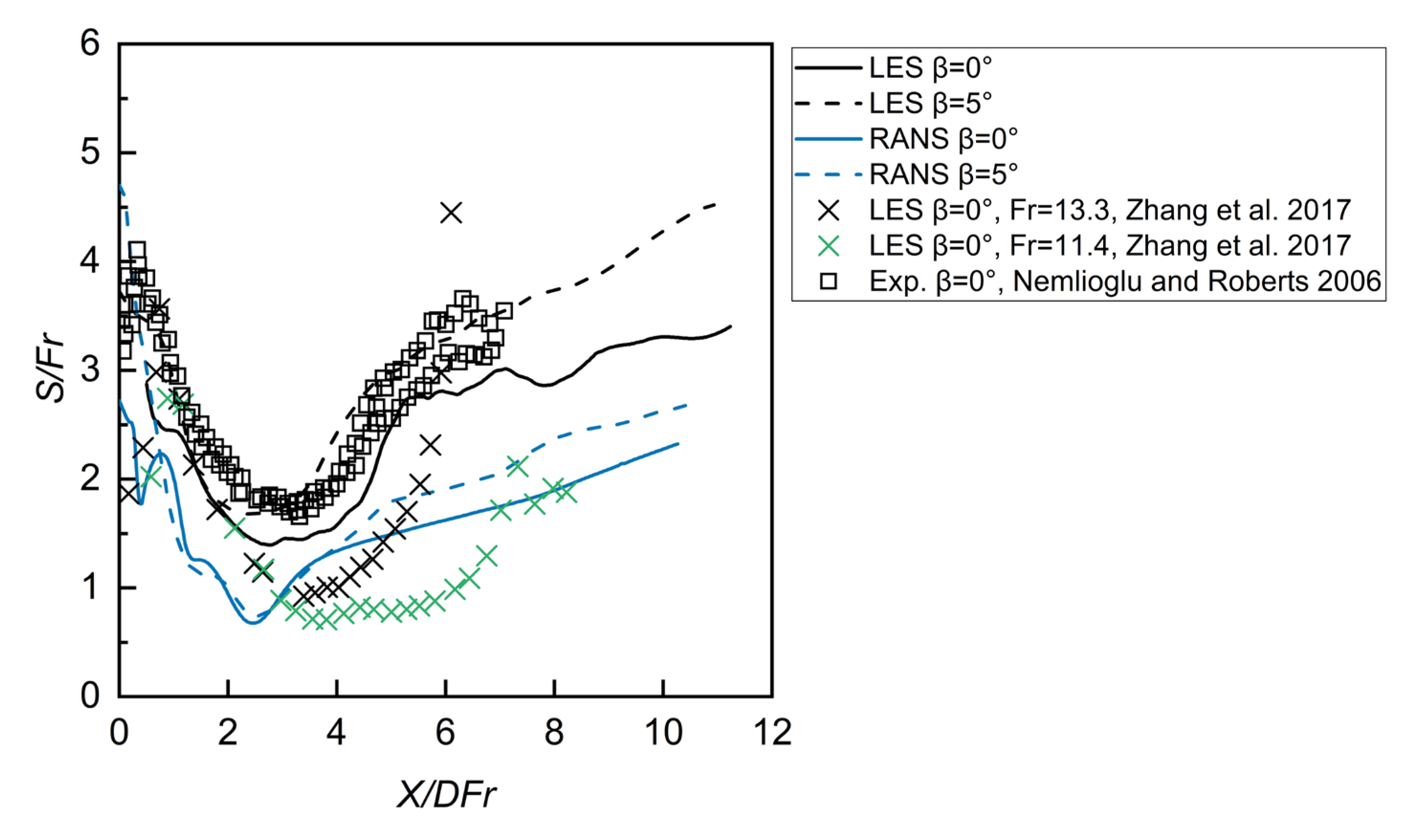
After the jet fell to the bottom, the brine spread in all directions and continued to move downslope along the bottom [29]. At the center plane of the simulation, the result of the normalized dilution (S/Fr) along the bottom is plotted against the bottom location (X/DFr), as shown in Figure 15, including the LES and RANS results and their comparison with previous LES simulations [28] and experimental data [56].
Figure 15. The dilution (S/Fr) along the bottom (X/DFr). Data from Refs. [28,56].
The LES results at the horizontal bottom showed good agreement with experimental data [25]. The dilution was the lowest at the impact point and then increased along the bottom surface. Zhang et al.’s LES results [28] became more scattered as the Froude number (Fr) decreased. Their study tested several values of Fr. Lower Fr values (e.g., Fr = 11.4) indicate weaker jet momentum, which may reduce dilution efficiency. Wang’s experimental study [36] also discussed the effects of different initial Froude numbers on jet mixing. Roberts et al. [5] recommended that the Froude number of inclined dense jets should exceed 20 to achieve sufficient mixing and minimize environmental impact.
Based on the LES and RANS results, the dilution along the sloped bottom (dashed line in Figure 15) was higher than that on the horizontal bottom, which increased the jet’s travel distance and enhanced the downward transport of brine under gravity, which enhanced the mixing. However, the RANS model underestimated the dilution relative to the LES results of this study, but its prediction was closer to the LES results reported by Zhang et al. [28].
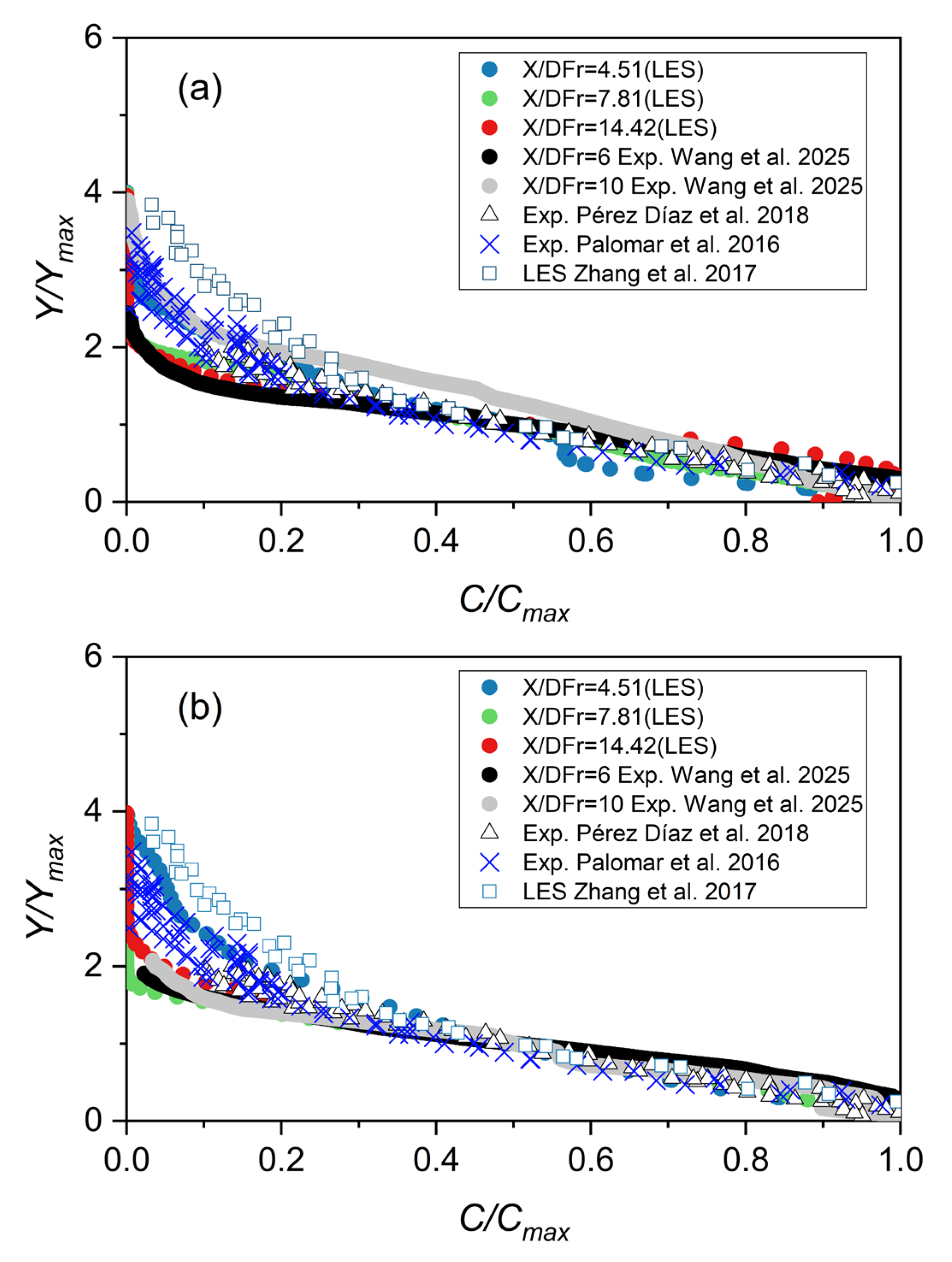
Figure 16 presents the concentration profiles along the streamwise direction from the LES simulation at various downstream locations on the two bottom slopes. Y denotes the vertical distance from the bottom and Cmax is the maximum concentration at each location. These results were compared with those of experimental studies [36,57,58] and LES results [28].
Figure 16. Normalized concentration profiles along the bottom on two bottom slopes: (a) horizontal bottom and (b) 5-degree sloped bottom. Data from Refs. [28,36,57,58].
These results showed good agreement with those reported in the literature. Whether the receiving bottom was horizontal or sloped, the maximum concentration consistently appeared near the bottom. The observed self-similarity of the concentration profiles suggests that the dilution process is governed by a similar mixing mechanism.

3.8. Energy Spectrum Analysis

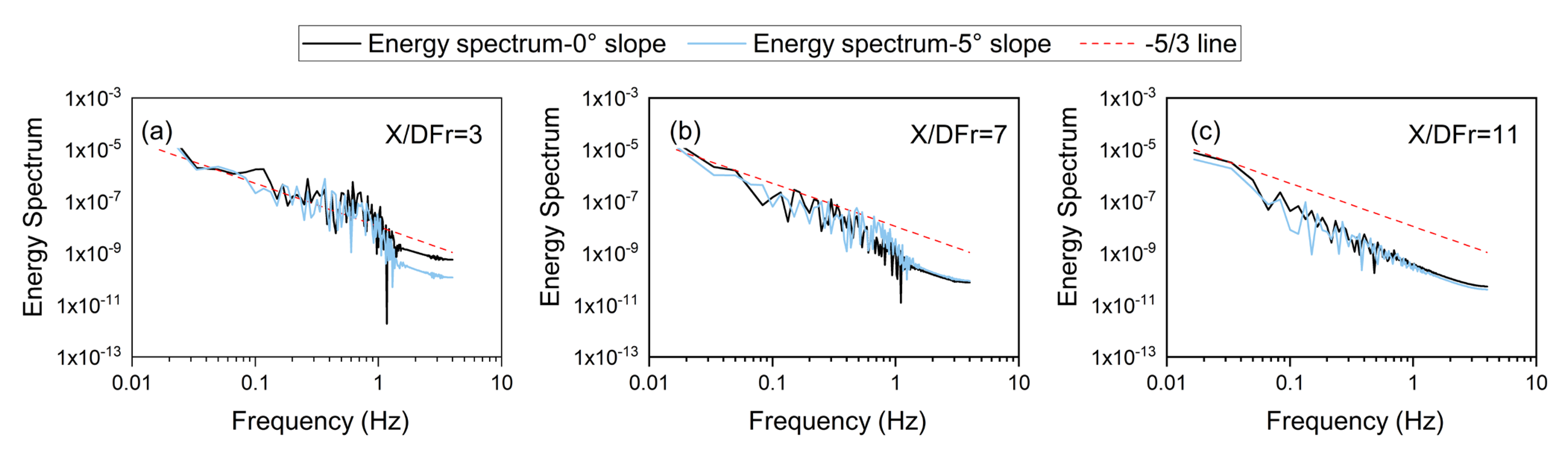
According to Kolmogorov [59], in the inertial subrange of turbulence, the energy spectrum function is expressed as E κ ~ κ ( 5 3 ) , which indicates that large-scale eddies transfer energy to smaller scales through an energy cascade. To examine the turbulent characteristics along the bottom, the energy spectra at different locations downstream of the impact point on various bottom slopes are plotted, as shown in Figure 17. Because only LES can resolve the turbulence structures, only the LES results are presented.
Figure 17. Energy spectrum at different locations along the bottom: (a) X/DFr = 3; (b) X/DFr = 7; (c) X/DFr = 11.
In Figure 17, the black and blue solid lines represent the energy spectra on the horizontal and sloped bottoms, respectively, and the red dashed line indicates the Kolmogorov −5/3 slope. The energy spectra on the two bottoms exhibits distinct patterns. Figure 17a corresponds to the region near the impact point (X/DFr = 3). It can be seen that the energy spectrum on both slopes does not completely follow the Kolmogorov −5/3 slope, indicating that near the impact region, turbulence is still in the early development stage. The flow structure was influenced by wall interference, and an inertial subrange was not formed. As X/DFr increases (Figure 17b,c), the energy spectrum approaches the −5/3 slope, indicating that turbulence is more fully developed and a clearer inertial subrange with a more stable energy cascade emerges. The energy level was significantly higher for the sloped bottom Figure 17b, implying stronger mixing. At X/DFr = 11, the overall energy level is quite low for both cases, which indicates a low turbulent intensity, suggesting that the mixing is significantly reduced and the flow has dissipated.

4. Conclusions

This study confirmed the effectiveness of LES in capturing the behavior of a 60 ° inclined dense jet discharged onto horizontal and 5 ° sloped physical bottom surfaces. The LES accurately predicted the jet trajectory, centerline peak location, impact point position, and dilution properties on both horizontal and sloped bottoms, showing strong agreement with the experimental measurements. The realizable k–ε RANS model underestimated both the geometrical features and the dilution performance compared to the LES predictions. At the impact point, the 5° sloped bottom extended the impact location and increased dilution, while further downstream the sloped bottom led to stronger bottom-layer dilution consistent with experimental observations. The lateral concentration profiles confirmed that the sloped bottom enhanced mixing near the impact point. The concentration distributions exhibited symmetrical behavior, and a Gaussian fitting approach was proposed to characterize the concentration distribution near the impact point for different bottom conditions. Moreover, the concentration profiles along the bottom layer exhibited self-similar behavior over both horizontal and sloped surfaces, aligning with classical jet theory. Energy spectrum analysis showed that the shear generated by the sloped bottom intensified turbulence and consequently enhanced the mixing efficiency.
These findings highlight the capability of LES-based numerical simulations to solve complex jet–bed interactions and offer valuable insights for optimizing discharge system designs and brine management. Future studies are recommended to explore alternative numerical modeling approaches and to investigate a broader range of discharge angles, bottom slopes and Froude number, and extend simulations to stratified ambient environments to better represent real-world ocean conditions. In addition, future research could examine the long-term accumulation of brine along the seabed and its potential impacts on marine plants and organisms, as well as possible ecological feedback effects.

Author Contributions

Conceptualization, X.W. and A.M.; methodology, X.W. and A.M.; formal analysis and investigation, X.W. and A.M.; writing—original draft preparation, X.W.; writing—review and editing, A.M.; supervision and funding acquisition, A.M. All authors have read and agreed to the published version of the manuscript.

Funding

This research was funded by the Natural Sciences and Engineering Research Council of Canada (NSERC): GR001305.

Data Availability Statement

The original contributions presented in this study are included in the article. Due to the large size of the numerical simulation files, further inquiries can be directed to the corresponding author.

Conflicts of Interest

The authors declare no conflicts of interest.

Abbreviations

The following abbreviations are used in this manuscript:
CFDComputational Fluid Dynamics
LESLarge Eddy Simulation
RNGRenormalisation Group
SGSSubgrid Scale
RANSReynold Averaged Navier Stokes Equation
TKETurbulent Kinetic Energy
LIFLaser-Induced Fluorescence
LALight Attenuation
KHKelvin–Helmholtz
FrFroude Number
DDiameter
X,YCoordinates
u ,   v ,   w Velocity Components in x, y, z directions
u   i ¯ ,   u j ¯ , u k ¯ Filtered/Averaged Velocity Components
p ¯ Filtered/Averaged pressure
ρ Fluid density
t Time
x i , x j , x k Spatial Coordinate Components
μ Molecular Dynamic Viscosity
ν Molecular Kinematic Viscosity
τ i j Subgrid-scale (SGS) stress
ν s g s Subgrid-scale (SGS) eddy viscosity
k s g s Subgrid-scale (SGS) turbulent kinetic energy
ε S G S Subgrid-scale (SGS) dissipation rate
S i j * ¯ Corrected Strain Rate Tensor
Filter Width
C s g s Subgrid-scale (SGS) Viscosity Model Constant
C ε Subgrid-scale (SGS) Dissipation Constant
σ k Ksgs Transport Constant
u i u j ¯ Reynolds Stress Tensor
ν t Turbulent Eddy Viscosity
k Turbulent Kinetic Energy
ε Dissipation Rate
C μ , C 1 , C 2 RANS Model Constants
σ ε ε transport equation Constant
S i j Averaged Strain Rate Tensor
η Ratio of Strain to Dissipation
S Modulus of Averaged Strain Rate Tensor
Ω i j Rotation Rate Tensor
ϕ Auxiliary   Angle   for   C μ Calculation
κWavenumber
E(κ)Energy spectrum

References

  1. Sedlak, D. Water for All: Global Solutions for a Changing Climate; Yale University Press: New Haven, CT, USA, 2023; ISBN 978-0-300-25693-2. [Google Scholar]
  2. Meerganz von Medeazza, G.L. “Direct” and Socially-Induced Environmental Impacts of Desalination. Desalination 2005, 185, 57–70. [Google Scholar] [CrossRef]
  3. Elsaid, K.; Kamil, M.; Sayed, E.T.; Abdelkareem, M.A.; Wilberforce, T.; Olabi, A. Environmental Impact of Desalination Technologies: A Review. Sci. Total Environ. 2020, 748, 141528. [Google Scholar] [CrossRef] [PubMed]
  4. Zeitoun, M.A.; McIlhenny, W.F. Conceptual Designs of Outfall Systems for Desalination Plants. In Proceedings of the Offshore Technology Conference, Houston, TX, USA, 18–20 April 1971. [Google Scholar]
  5. Roberts, P.J.; Ferrier, A.; Daviero, G. Mixing in Inclined Dense Jets. J. Hydraul. Eng. 1997, 123, 693–699. [Google Scholar] [CrossRef]
  6. Ferrari, S.; Querzoli, G. Mixing and Re-Entrainment in a Negatively Buoyant Jet. J. Hydraul. Res. 2010, 48, 632–640. [Google Scholar] [CrossRef]
  7. Bloomfield, L.J.; Kerr, R.C. Inclined Turbulent Fountains. J. Fluid Mech. 2002, 451, 283–294. [Google Scholar] [CrossRef]
  8. Cipollina, A.; Brucato, A.; Grisafi, F.; Nicosia, S. Bench-Scale Investigation of Inclined Dense Jets. J. Hydraul. Eng. 2005, 131, 1017–1022. [Google Scholar] [CrossRef]
  9. Bashitialshaaer, R.; Larson, M.; Persson, K.M. An Experimental Investigation on Inclined Negatively Buoyant Jets. Water 2012, 4, 720–738. [Google Scholar] [CrossRef]
  10. Papakonstantis, I.G.; Christodoulou, G.C.; Papanicolaou, P.N. Inclined Negatively Buoyant Jets 1: Geometrical Characteristics. J. Hydraul. Res. 2011, 49, 3–12. [Google Scholar] [CrossRef]
  11. Papakonstantis, I.G. Inclined Negatively Buoyant Jets 2: Concentration Measurements. J. Hydraul. Res. 2011, 49, 13–22. [Google Scholar] [CrossRef]
  12. Yang, L.; Wei, Y.; Law, A.W.-K.; Huai, W. Mixing and Spreading of Inclined Dense Jets with Submerged Aquatic Canopies. Environ. Fluid Mech. 2024, 24, 439–463. [Google Scholar] [CrossRef]
  13. Kikkert, G.A.; Davidson, M.J.; Nokes, R.I. Inclined Negatively Buoyant Discharges. J. Hydraul. Eng. 2007, 133, 545–554. [Google Scholar] [CrossRef]
  14. Shao, D.; Law, A.W.-K. Mixing and Boundary Interactions of 30 and 45 Inclined Dense Jets. Environ. Fluid Mech. 2010, 10, 521–553. [Google Scholar] [CrossRef]
  15. Lai, C.C.; Lee, J.H. Mixing of Inclined Dense Jets in Stationary Ambient. J. Hydro-Environ. Res. 2012, 6, 9–28. [Google Scholar] [CrossRef]
  16. Azizi, M.; Goharikamel, D.; Vafaei, F. Experimental Investigation of Nozzle Angle Effects on the Brine Discharge by Inclined Dense Jets in Stagnant Water Ambient. SN Appl. Sci. 2020, 2, 1490. [Google Scholar] [CrossRef]
  17. Papakonstantis, I.G.; Mylonakou, E.L. Flow Visualization Experiments of Inclined Slot Jets with Negative Buoyancy. Environ. Process. 2021, 8, 1549–1565. [Google Scholar] [CrossRef]
  18. Ferrari, S.; Badas, M.G.; Besalduch, L.A.; Querzoli, G. Experimental Investigation of Inclined Negatively Buoyant Jet. In Proceedings of the Eighth International Symposium on Turbulence and Shear Flow Phenomena, Poitiers, France, 28–30 August 2013; Begel House Inc.: Danbury, CT, USA, 2013. [Google Scholar] [CrossRef]
  19. Jiang, M.; Law, A.W.-K.; Lai, A.C.H. Turbulence Characteristics of 45° Inclined Dense Jets. Environ. Fluid Mech. 2019, 19, 27–54. [Google Scholar] [CrossRef]
  20. Mohammadian, A.; Gildeh, H.K.; Nistor, I. CFD Modeling of Effluent Discharges: A Review of Past Numerical Studies. Water 2020, 12, 856. [Google Scholar] [CrossRef]
  21. Anderson, J.D.; Wendt, J. Computational Fluid Dynamics; Springer: Berlin/Heidelberg, Germany, 1995; Volume 206. [Google Scholar]
  22. Mohammadian, A.; Gildeh, H.K.; Yan, X. Numerical Simulation of Effluent Discharges: Applications with OpenFOAM; CRC Press: Boca Raton, FL, USA, 2023; ISBN 978-1-003-18181-1. [Google Scholar]
  23. Vafeiadou, P.; Papakonstantis, I.; Christodoulou, G. Numerical Simulation of Inclined Negatively Buoyant Jets. In Proceedings of the 9th International Conference on Environmental Science and Technology, Rhodes, Greece, 1–3 September 2005; pp. 1–3. [Google Scholar]
  24. Oliver, C.J.; Davidson, M.J.; Nokes, R.I. K-ε Predictions of the Initial Mixing of Desalination Discharges. Environ. Fluid Mech. 2008, 8, 617–625. [Google Scholar] [CrossRef]
  25. Kheirkhah Gildeh, H.; Mohammadian, A.; Nistor, I.; Qiblawey, H. Numerical Modeling of 30° and 45° Inclined Dense Turbulent Jets in Stationary Ambient. Environ. Fluid Mech. 2015, 15, 537–562. [Google Scholar] [CrossRef]
  26. Wang, X.; Mohammadian, A. A Comparison of k–ε Type Turbulence Models for Prediction of Inclined Dense Jets. In Computational Fluid Dynamics: Novel Numerical and Computational Approaches: Methodology and Numerics; Zeidan, D., Hidalgo, A., Zhang, L.T., Goncalves Da Silva, E., Eds.; Springer Nature: Singapore, 2025; pp. 185–217. ISBN 978-981-97-8152-2. [Google Scholar]
  27. Zhang, S.; Jiang, B.; Law, A.W.-K.; Zhao, B. Large Eddy Simulations of 45 Inclined Dense Jets. Environ. Fluid Mech. 2016, 16, 101–121. [Google Scholar] [CrossRef]
  28. Zhang, S.; Law, A.W.-K.; Jiang, M. Large Eddy Simulations of 45° and 60° Inclined Dense Jets with Bottom Impact. J. Hydro-Environ. Res. 2017, 15, 54–66. [Google Scholar] [CrossRef]
  29. Papakonstantis, I.G.; Christodoulou, G.C. Spreading of Round Dense Jets Impinging on a Horizontal Bottom. J. Hydro-Environ. Res. 2010, 4, 289–300. [Google Scholar] [CrossRef]
  30. Oliver, C.J.; Davidson, M.J.; Nokes, R.I. Behavior of Dense Discharges beyond the Return Point. J. Hydraul. Eng. 2013, 139, 1304–1308. [Google Scholar] [CrossRef]
  31. Jirka, G.H. Integral Model for Turbulent Buoyant Jets in Unbounded Stratified Flows. Part I: Single Round Jet. Environ. Fluid Mech. 2004, 4, 1–56. [Google Scholar] [CrossRef]
  32. Nikiforakis, I.K.; Christodoulou, G.C.; Stamou, A.I. Bottom Concentration Field Due to Impingement of Inclined Dense Jets on a Slope. In Proceedings of the 7th International Symposium of Environmental Hydraulics, Singapore, 7–8 January 2014; pp. 54–57. [Google Scholar]
  33. Wang, X.; Mohammadian, A. Numerical Simulations of 15-Degree Inclined Dense Jets in Stagnate Water Over a Sloped Bottom. In Proceedings of the Canadian Society of Civil Engineering Annual Conference 2021, Niagara Falls, ON, Canada, 26–29 May 2021; Springer: Berlin/Heidelberg, Germany, 2022; pp. 63–74. [Google Scholar] [CrossRef]
  34. Habibi, S.; Azadi, A.; Firoozabadi, B. Large Eddy Simulation of Inclined Negatively Buoyant Jets with Sloped Beds. J. Hydraul. Eng. 2022, 148, 04022023. [Google Scholar] [CrossRef]
  35. Habibi, S.; Azadi, A.; Firoozabadi, B. Identification of Turbulent Structures of Inclined Negatively Buoyant Jets with Bed Effects. Int. J. Heat Mass Transf. 2023, 208, 124040. [Google Scholar] [CrossRef]
  36. Wang, X.; Mohammadian, A.; Ferrari, S.; Roberts, P. Experimental Investigation of the Influence of a Sloped Bottom on the Behavior of Inclined Dense Jets. Environ. Process. 2025. under review. [Google Scholar]
  37. Mason, P.J. Large-eddy Simulation: A Critical Review of the Technique. Q. J. R. Meteorol. Soc. 1994, 120, 1–26. [Google Scholar] [CrossRef]
  38. Smagorinsky, J. General circulation experiments with the primitive equations. Mon. Weather Rev. 1963, 91, 99–164. [Google Scholar] [CrossRef]
  39. Khan, M.A.; Addona, F.; Chiapponi, L.; Merli, N.; Archetti, R. Numerical Simulation of Turbulent Fountains with Negative Buoyancy. Modelling 2025, 6, 10. [Google Scholar] [CrossRef]
  40. Schmitt, F.G. About Boussinesq’s Turbulent Viscosity Hypothesis: Historical Remarks and a Direct Evaluation of Its Validity. Comptes Rendus Mécanique 2007, 335, 617–627. [Google Scholar] [CrossRef]
  41. Alfaifi, H.; Mohammadian, A.; Bonakdari, H. Predicting the Geometrical Characteristics of an Inclined Negatively-Buoyant Jet for Angles from 30° to 60° Using GMDH Neural Network. In Proceedings of the Canadian Society of Civil Engineering Annual Conference 2021: CSCE21 Hydrotechnical and Transportation Track, Niagara Falls, ON, Canada, 26–29 May 2021; Springer: Berlin/Heidelberg, Germany, 2022; pp. 369–377. [Google Scholar] [CrossRef]
  42. Greenshields, C.J. OpenFOAM User Guide, Version 3; OpenFOAM Foundation Ltd.: London, UK, 2015.
  43. Kheirkhah Gildeh, H.; Mohammadian, A.; Nistor, I. Inclined Dense Effluent Discharge Modelling in Shallow Waters. Environ. Fluid Mech. 2021, 21, 955–987. [Google Scholar] [CrossRef]
  44. Saeidi Hosseini, S.A.R.; Mohammadian, A.; Roberts, P.J.; Abessi, O. Numerical Study on the Effect of Port Orientation on Multiple Inclined Dense Jets. J. Mar. Sci. Eng. 2022, 10, 590. [Google Scholar] [CrossRef]
  45. Ramezani, M.; Abessi, O.; Firoozjaee, A.R. Effect of Proximity to Bed on 30° and 45° Inclined Dense Jets: A Numerical Study. Environ. Process. 2021, 8, 1141–1164. [Google Scholar] [CrossRef]
  46. Ghorbani, M.; Giljarhus, K.E.T.; Skadsem, H.J.; Time, R.W. Computational Fluid Dynamics Simulation of Buoyant Mixing of Miscible Fluids in a Tilted Tube; IOP Publishing: Bristol, UK, 2021; Volume 1201, p. 012021. [Google Scholar] [CrossRef]
  47. Gruber, M.F.; Johnson, C.J.; Tang, C.Y.; Jensen, M.; Yde, L.; Hélix-Nielsen, C. Computational Fluid Dynamics Simulations of Flow and Concentration Polarization in Forward Osmosis Membrane Systems. J. Membr. Sci. 2011, 379, 488–495. [Google Scholar] [CrossRef]
  48. Sullivan, P.P.; McWilliams, J.C.; Moeng, C.-H. A Subgrid-Scale Model for Large-Eddy Simulation of Planetary Boundary-Layer Flows. Bound.-Layer Meteorol. 1994, 71, 247–276. [Google Scholar] [CrossRef]
  49. Pope, S.B. Ten Questions Concerning the Large-Eddy Simulation of Turbulent Flows. New J. Phys. 2004, 6, 35. [Google Scholar] [CrossRef]
  50. Pope, S.B. Turbulent Flows; Cambridge University Press: Cambridge, UK, 2000; ISBN 978-0-521-59886-6. [Google Scholar]
  51. Cintolesi, C.; Petronio, A.; Armenio, V. Turbulent Structures of Buoyant Jet in Cross-Flow Studied through Large-Eddy Simulation. Environ. Fluid Mech. 2019, 19, 401–433. [Google Scholar] [CrossRef]
  52. Abessi, O.; Roberts, P.J. Effect of Nozzle Orientation on Dense Jets in Stagnant Environments. J. Hydraul. Eng. 2015, 141, 06015009. [Google Scholar] [CrossRef]
  53. Jirka, G.H. Improved Discharge Configurations for Brine Effluents from Desalination Plants. J. Hydraul. Eng. 2008, 134, 116–120. [Google Scholar] [CrossRef]
  54. Kikkert, G.A.; Davidson, M.J.; Nokes, R.I. Buoyant Jets with Three-Dimensional Trajectories. J. Hydraul. Res. 2010, 48, 292–301. [Google Scholar] [CrossRef]
  55. Jiang, B.; Law, A.W.-K.; Lee, J.H.-W. Mixing of 30° and 45° Inclined Dense Jets in Shallow Coastal Waters. J. Hydraul. Eng. 2014, 140, 241–253. [Google Scholar] [CrossRef]
  56. Nemlioglu, S.; Roberts, P. Experiments on Dense Jets Using Three-Dimensional Laser-Induced Fluorescence (3DLIF). In Proceedings of the 4th International Conference on Marine Waste Water Disposal and Marine Environment & 2nd International Exhibition on Materials Equipment and Services for Coastal WWTP, Outfalls and Sealines, Antalya, Turkey, 6–10 November 2006. [Google Scholar]
  57. Pérez Díaz, B.; Palomar, P.; Castanedo, S.; Álvarez, A. PIV-PLIF Characterization of Nonconfined Saline Density Currents under Different Flow Conditions. J. Hydraul. Eng. 2018, 144, 1511. [Google Scholar] [CrossRef]
  58. Palomar, P.; Lara, J.L.; Losada, I.J. PIV-PLIF Experimental Study of the Spreading Layer Arisen from Brine Jet Discharges. Exp. Fluids 2016. under revision. [Google Scholar]
  59. Frisch, U.; Kolmogorov, A.N. Turbulence: The Legacy of A. N. Kolmogorov; Cambridge University Press: Cambridge, UK, 1995; ISBN 978-0-521-45713-2. [Google Scholar]
Disclaimer/Publisher’s Note: The statements, opinions and data contained in all publications are solely those of the individual author(s) and contributor(s) and not of MDPI and/or the editor(s). MDPI and/or the editor(s) disclaim responsibility for any injury to people or property resulting from any ideas, methods, instructions or products referred to in the content.

Article Metrics

Citations

Article Access Statistics

Multiple requests from the same IP address are counted as one view.