Expanding the Zooplankton Inventory of the Levantine Basin: Novel Taxa and First Records from South Lebanon
 , , ,
, , ,  , , ,
, , ,  and
and 
Abstract
1. Introduction
2. Materials and Methods
3. Results
3.1. Hansenocaris sp.
3.2. Canuella sp.
3.3. Longipedia sp.
4. Discussion
5. Conclusions
Author Contributions
Funding
Data Availability Statement
Acknowledgments
Conflicts of Interest
References
- Mouillot, D.; Albouy, C.; Guilhaumon, F.; Ben Rais Lasram, F.; Coll, M.; Devictor, V.; Meynard, C.N.; Pauly, D.; Tomasini, J.A.; Troussellie, M.; et al. Protected and threatened components of fish biodiversity in the Mediterranean Sea. Curr. Biol. 2021, 21, 1044–1050. [Google Scholar] [CrossRef] [Scilit]
- Coll, M.; Piroddi, C.; Steenbeek, J.; Kaschner, K.; Ben Rais Lasram, F.; Aguzzi, J.; Ballesteros, E.; Bianchi, C.N.; Corbera, J.; Dailianis, T.; et al. The biodiversity of the Mediterranean Sea: Estimates, patterns, and threats. PLoS ONE 2010, 5, e11842. [Google Scholar] [CrossRef] [Scilit]
- Coll, M.; Piroddi, C.; Albouy, C.; Ben Rais Lasram, F.; Cheung, W.W.L.; Christensen, V.; Karpouzi, V.S.; Guilhaumon, F.; Mouillot, D.; Paleczny, M.; et al. The Mediterranean under siege: Spatial overlap between marine biodiversity, cumulative threats and marine reserves. Glob. Ecol. Biogeogr. 2012, 21, 465–481. [Google Scholar] [CrossRef] [Scilit]
- Micheli, F.; Halpern, B.S.; Walbridge, S.; Ciriaco, S.; Ferretti, F.; Fraschetti, S.; Lewison, R.; Nykjaer, L.; Rosenberg, A.A. Cumulative human impacts on Mediterranean and Black Sea marine ecosystems: Assessing current pressures and opportunities. PLoS ONE 2013, 8, e79889. [Google Scholar] [CrossRef] [Scilit] [PubMed]
- Langeneck, J.; Putignano, M.; Dimichele, D.; Giangrande, A.; Bilan, M.; Toso, A.; Musco, L. Non-indigenous polychaetes along the Salento Peninsula: New records and first molecular data. Medit. Mar. Sci. 2024, 25, 184–203. [Google Scholar] [CrossRef] [Scilit]
- Toso, A.; Solca, M.; Trainito, E.; Stifani, M.; Furfaro, G. Arrivals and departures: Exploring sea slug diversity (Mollusca, Gastropoda) in the Salento Peninsula harbours. Mar. Biodiv. 2025, 55, 80. [Google Scholar] [CrossRef] [Scilit]
- Lejeusne, C.; Chevaldonne, P.; Pergent-Martini, C.; Boudouresque, C.F.; Perez, T. Climate change effects on a miniature ocean: The highly diverse, highly impacted Mediterranean Sea. Trends Ecol. Evol. 2010, 25, 250–260. [Google Scholar] [CrossRef] [Scilit]
- Albano, P.G.; Steger, J.; Bošnjak, M.; Dunne, B.; Guifarro, Z.; Turapova, E.; Hua, Q.; Kaufman, D.S.; Rilov, G.; Zuschin, M. Native biodiversity collapse in the eastern Mediterranean. Proc. R. Soc. B 2021, 288, 20202469. [Google Scholar] [CrossRef] [Scilit] [PubMed]
- Zenetos, A.; Gofas, S.; Morri, C.; Rosso, A.; Violanti, D.; García Raso, J.E.; Çinar, M.E.; Almogi-Labin, A.; Ates, A.S.; Azzurro, E.; et al. Alien species in the Mediterranean Sea by 2012. A contribution to the application of European Union’s Marine Strategy Framework Directive (MSFD). Part 2. Introduction trends and pathways. Medit. Mar. Sci. 2012, 13, 328–352. [Google Scholar] [CrossRef] [Scilit]
- Katsanevakis, S.; Zenetos, A.; Belchior, C.; Cardoso, A.C. Invading European Seas: Assessing pathways of introduction of marine aliens. Ocean Coast. Manag. 2013, 76, 64–74. [Google Scholar] [CrossRef] [Scilit]
- Albano, P.G.; Schultz, L.; Wessely, J.; Taviani, M.; Dullinger, S.; Danise, S. The dawn of the tropical Atlantic invasion into the Mediterranean Sea. Proc. Natl. Acad. Sci. USA 2024, 121, e2320687121. [Google Scholar] [CrossRef] [Scilit] [PubMed]
- Halpern, B.S.; Walbridge, S.; Selkoe, K.A.; Kappel, C.V.; Micheli, F.; D’Agrosa, C.; Bruno, J.F.; Casey, K.S.; Ebert, C.; Fox, H.E.; et al. A global map of human impact on marine ecosystems. Science 2008, 319, 948–952. [Google Scholar] [CrossRef] [Scilit] [PubMed]
- Costello, M.J.; Coll, M.; Danovaro, R.; Halpin, P.; Ojaveer, H.; Miloslavich, P. A census of marine biodiversity knowledge, resources and future challenges. PLoS ONE 2010, 5, e12110. [Google Scholar] [CrossRef] [Scilit] [PubMed]
- Toso, A.; Musco, L. The hidden invasion of the alien seagrass Halophila stipulacea (Forsskål) Ascherson along Southeastern Italy. Medit. Mar. Sci. 2023, 24, 96–100. [Google Scholar] [CrossRef] [Scilit]
- Galil, B.S. Taking stock: Inventory of alien species in the Mediterranean Sea. Biol. Invasions 2009, 11, 359–372. [Google Scholar] [CrossRef] [Scilit]
- Por, F.D. Lessepsian Migration: The Influx of the Red Sea Biota into the Mediterranean by Way of the Suez Canal; Springer: Berlin, Germany, 1978; Volume 23, p. 288. [Google Scholar]
- El-Geziry, T.M.; Bryden, I.G. The circulation pattern in the Mediterranean Sea: Issues for modeller consideration. J. Oper. Oceanogr. 2010, 3, 39–46. [Google Scholar] [CrossRef] [Scilit]
- Bariche, M. Field Identification Guide to the Living Marine Resources of the Eastern and Southern Mediterranean; FAO: Rome, Italy, 2012; p. 625. [Google Scholar]
- Sisma-Ventura, G.; Bialik, O.M.; Yam, R.; Herut, B.; Silverman, J. pCO2 variability in the surface waters of the ultra-oligotrophic Levantine Sea: Exploring the air–sea CO2 fluxes in a fast warming region. Mar. Chem. 2017, 196, 13–23. [Google Scholar] [CrossRef] [Scilit]
- Bitar, G.; Ocaña, O.; Ramos-Esplá, A.A. Contribution of the Red Sea alien species to structuring some benthic biocenosis in the Lebanon coast (Eastern Mediterranean). In CIESM Congress Proceedings, No. 38; CIESM: Villa Girasole, Monaco, 2007; p. 437. [Google Scholar]
- Thessalou-Legaki, M.; Aydogan, Ö.; Bekas, P.; Bilge, G.; Boyaci, Y.Ö.; Brunelli, E.; Circosta, V.; Crocetta, F.; Durucan, F.; Erdem, M.; et al. New Mediterranean biodiversity records (December 2012). Medit. Mar. Sci. 2012, 13, 312–327. [Google Scholar] [CrossRef] [Scilit]
- Tzomos, T.; Kitsos, M.S.; Koutsoubas, D.; Koukouras, A. Evolution of the entrance rate and of the spatio-temporal distribution of Lessepsian Mollusca in the Mediterranean Sea. J. Biol. Res.-Thessalon. 2012, 17, 81–96. [Google Scholar]
- Yokeş, M.B.; Dalyan, C.; Karhan, S.Ű.; Demir, V.; Tural, U.; Kalkan, E. Alien opisthobranchs from Turkish coasts: First record of Plocamopherus tilesii Bergh, 1877 from the Mediterranean. Triton 2012, 5, 1–9. [Google Scholar]
- Zenetos, A. Progress in Mediterranean bioinvasions two years after the Suez Canal enlargement. Acta Adriat. 2017, 58, 347–358. [Google Scholar] [CrossRef] [Scilit]
- Galil, B.; Marchini, A.; Occhipinti-Ambrogi, A.; Ojaveer, H. The enlargement of the Suez Canal—Erythraean introductions and management challenges. Manag. Biol. Invasions 2017, 8, 141–152. [Google Scholar] [CrossRef] [Scilit]
- Galil, B.S.; Marchini, A.; Occhipinti-Ambrogi, A. East is east and West is west? Management of marine bioinvasions in the Mediterranean Sea. Estuar. Coast. Shelf Sci. 2018, 201, 7–16. [Google Scholar] [CrossRef] [Scilit]
- Bilecenoğlu, M.; Yokeş, M.B. New data on the occurrence of two lessepsian marine heterobranchs, Plocamopherus ocellatus (Nudibranchia: Polyceridae) and Lamprohaminoea ovalis (Cephalaspidea: Haminoeidae), from the Aegean Sea. Ann. Ser. Hist. Nat. Sci. Res. Center Slov. Rep. 2022, 32, 267–272. [Google Scholar] [CrossRef]
- Shaban, A. Support of space techniques for groundwater exploration in Lebanon. J. Water Resour. Prot. 2010, 2, 469–477. [Google Scholar] [CrossRef]
- Talhouk, S.N.; Itani, M.; Al-Zein, M. Biodiversity in Lebanon. In Global Biodiversity; Pullaiah, T., Ed.; Apple Academic Press: Palm Bay, FL, USA, 2018; pp. 259–306. [Google Scholar] [CrossRef] [Scilit]
- Badreddine, A.; Milazzo, M.; Abboud-Abi Saab, M.; Bitar, G.; Mangialajo, L. Threatened biogenic formations of the Mediterranean: Current status and assessment of the vermetid reefs along the Lebanese coastline (Levant basin). Ocean Coast. Manag. 2019, 169, 137–146. [Google Scholar] [CrossRef] [Scilit]
- Bariche, M.; Sayar, N.; Limam, A.; SPA/RAC–UN Environment/MAP. Ecological Characterization of the Coastal and Marine Habitats in Tyre, Lebanon; SPA/RAC, IMAP-MPA Project: Tunis, Tunisia, 2021; p. 68. [Google Scholar]
- Bitar, G.; Zibrowius, H. Scleractinian corals from Lebanon, Eastern Mediterranean, including a non-lessepsian invading species (Cnidaria: Scleractinia). Sci. Mar. 1997, 61, 227–231. [Google Scholar]
- Zibrowius, H.; Bitar, G. Invertébrés marins exotiques sur la côte du Liban. Leban. Sci. J. 2003, 4, 67–74. [Google Scholar]
- Harmelin-Vivien, M.L.; Bitar, G.; Harmelin, J.G.; Monestiez, P. The littoral fish community of the Lebanese rocky coast (eastern Mediterranean Sea) with emphasis on Red Sea immigrants. Biol. Invasions 2005, 7, 625–637. [Google Scholar] [CrossRef] [Scilit]
- Morri, C.; Puce, S.; Bianchi, C.N.; Bitar, G.; Zibrowius, H.; Bavestrello, G. Hydroids (Cnidaria: Hydrozoa) from the Levant Sea (mainly Lebanon), with emphasis on alien species. J. Mar. Biol. Assoc. UK 2009, 89, 49–62. [Google Scholar] [CrossRef] [Scilit]
- Bariche, M.; Fricke, R. The marine ichthyofauna of Lebanon: An annotated checklist, history, biogeography, and conservation status. Zootaxa 2020, 4775, 001–157. [Google Scholar] [CrossRef] [Scilit]
- Lakkis, S. Le zooplancton des Eaux Marines Libanaises (Méditerranée Orientale): Biodiversité, Biologie, Biogéographie; ARACNE Éditrice: Rome, Italy, 2013. [Google Scholar]
- El-Maghraby, A.M. The seasonal variations in length of some marine planktonic copepods from the eastern Mediterranean at Alexandria. Crustaceana 1965, 8, 37–47. [Google Scholar] [CrossRef] [Scilit]
- Kimor, B.; Bedurgo, V. Cruise to the Eastern Mediterranean. Cyprus 03. plankton reports. Sea Fish. Res. St. Halif. Bull. 1967, 45, 6–12. [Google Scholar]
- Lakkis, S. Considerations on the distribution of pelagic copepods in the Eastern Mediterranean off the coast of Lebanon. Acta Adriat. 1976, 18, 40–51. [Google Scholar]
- Kovalev, A.V.; Kideys, A.E.; Pavlova, E.V.; Shmeleva, A.A.; Skryabin, V.A.; Ostrovskaya, N.A.; Uysal, Z. Composition and abundance of zooplankton of the eastern Mediterranean Sea. In The Eastern Mediterranean as a Laboratory Basin for the Assessment of Contrasting Ecosystems; Springer: Dordrecht, The Netherlands, 1999; pp. 81–95. [Google Scholar]
- Zakaria, H.Y. The zooplankton community in Egyptian Mediterranean waters: A review. Acta Adriat. 2006, 47, 195–206. [Google Scholar]
- Fernandez de Puelles, M.L.; Gras, D.; Hernandez-Leon, S. Annual cycle of zooplankton biomass, abundance and species composition in the neritic area of the Balearic Sea, Western Mediterranean. Mar. Ecol. 2003, 24, 123–139. [Google Scholar] [CrossRef] [Scilit]
- Siokou-Frangou, I.; Christaki, U.; Mazzocchi, M.G.; Montresor, M.; Ribera d’Alcalà, M.; Vaquè, D.; Zingone, A. Plankton in the open Mediterranean Sea: A review. Biogeosciences 2010, 7, 1543–1586. [Google Scholar] [CrossRef] [Scilit]
- Belmonte, G. Mediterranean Sea biodiversity. In Elements of Pelagos Biology; Belmonte, G., Ed.; Springer Nature: Cham, Switzerland, 2025; pp. 97–146. [Google Scholar]
- Belmonte, G. Acartiidae Sars, G.O., 1903. ICES Identif. Leafl. Plankton 2021, 194, 29. [Google Scholar] [CrossRef]
- Furfaro, G.; Fumarola, L.M.; Toso, A.; Toso, Y.; Trainito, E.; Bariche, M.; Piraino, S. A Mediterranean melting pot: Native and non-indigenous sea slugs (Gastropoda, Heterobranchia) from Lebanese waters. BioInvasions Rec. 2024, 14, 197–221. [Google Scholar] [CrossRef] [Scilit]
- Toso, A.; Putignano, M.; Fumarola, L.; Bariche, M.; Giangrande, A.; Musco, L.; Piraino, S.; Langeneck, J. A revised inventory of Annelida in the Lebanese coastal waters with ten new aliens for the Mediterranean Sea. Medit. Mar. Sci. 2024, 25, 715–731. [Google Scholar] [CrossRef] [Scilit]
- Delcour, N.; Garzia, M.; Oliver, P.G.; Berrilli, E.; Toso, A.; Bariche, M.; Albano, P.G.; Mariottini, P.; Salvi, D. High genetic diversity and lack of structure underlie the invasion history of the non-indigenous oyster Dendostrea cf. crenulifera (Mollusca, Ostreida, Ostreidae) spreading in the eastern Mediterranean Sea. NeoBiota 2025, 6, e156780. [Google Scholar] [CrossRef] [Scilit]
- CMEMS 2020–2025. Marine Data Store. Available online: https://marine.copernicus.eu/access-data/ (accessed on 27 July 2025).
- Vives, F.; Shmeleva, A.A. Crustacea, Copépodos marinos I. Calanoida. In Fauna Ibérica; Ramos, M.A., Ed.; Museo Nacional de Ciencias Naturales, CSIC: Madrid, Spain, 2007; Volume 29, p. 1152. [Google Scholar]
- Razouls, C.; Desreumaux, N.; Kouwenberg, J.; de Bovée, F. Biodiversity of Marine Planktonic Copepods (Morphology, Geographical Distribution and Biological Data). Sorbonne University, CNRS. Available online: http://copepodes.obs-banyuls.fr/en (accessed on 4 June 2025).
- Anderson, M.J.; Gorley, R.N.; Clarke, K.R. PERMANOVA+forPRIMER: Guide to Software and Statistical Methods; PRIMER-E: Plymouth, UK, 2008. [Google Scholar]
- Belmonte, G. Y-Nauplii (Crustacea, Thecostraca, Facetotecta) from coastal waters of the Salento Peninsula (south eastern Italy, Mediterranean Sea) with descriptions of four new species. Mar. Biol. Res. 2005, 1, 254–266. [Google Scholar] [CrossRef] [Scilit]
- Grygier, M.J. New records, external and internal anatomy, and systematic position of Hansen’s Y-larvae (Crustacea: Maxillopoda: Facetotecta). Sarsia 1987, 72, 261–278. [Google Scholar] [CrossRef] [Scilit]
- Steuer, A. Über eine neue Cirripedienlarve aus dem Golfe von Triest. Arb. Zool. Inst. Univ. Wien Zool. Staz. Triest 1903, 15, 113–118. [Google Scholar]
- Dreyer, N.; Bernot, J.P.; Olesen, J.; Kolbasov, G.A.; Høeg, J.T.; Machida, R.J.; Chan, B.K. Phylogenomics of enigmatic crustacean y-larvae reveals multiple origins of parasitism in barnacles. Curr. Biol. 2025, 35, 3356–3367. [Google Scholar] [CrossRef] [Scilit]
- Bresciani, J. Nauplius “y” Hansen: Its distribution and relationship with a new cypris larva. Vidensk. Medd. Dan. Naturhist. Foren. 1965, 128, 245–258. [Google Scholar]
- Kolbasov, G.A.; Grygier, M.J.; Ivanenko, V.N.; Vagelli, A.A. A new species of the y-larva genus Hansenocaris Itô, 1985 (Crustacea: Thecostraca: Facetotecta) from Indonesia, with a review of y-cyprids and a key to all their described species. Raffles Bull. Zool. 2007, 55, 343–353. [Google Scholar]
- Grygier, M.J.; Høeg, J.T.; Dreyer, N.; Olesen, J. A new internal structure of nauplius larvae: A “ghostly” support sling for cypris y left within the exuviae of nauplius y after metamorphosis (Crustacea: Thecostraca: Facetotecta). J. Morphol. 2019, 280, 1222–1231. [Google Scholar] [CrossRef] [Scilit] [PubMed]
- Glenner, H.; Høeg, J.T.; Grygier, M.J.; Fujita, Y. Induced metamorphosis in crustacean y-larvae: Towards a solution to a 100-year-old riddle. BMC Biol. 2008, 6, 21. [Google Scholar] [CrossRef] [Scilit] [PubMed]
- Por, F.D. A study of the Levantine and Pontic Harpacticoida (Crustacea, Copepoda). Zool. Verh. 1964, 64, 126. [Google Scholar]
- Sazhina, L.I. Naupliusi Massovik Vidov Pelagiceskik Copepod Mirovogo Oceana; Naukova Dumka: Kyiv, Ukraine, 1985; p. 240. (In Russian) [Google Scholar]
- Bray, J.R.; Curtis, J.T. An Ordination of the Upland Forest Communities of Southern Wisconsin. Ecol. Monogr. 1957, 27, 325–349. [Google Scholar] [CrossRef] [Scilit]
- Hansen, H.J. Die Cladoceren und Cirripeden der Plankton Expedition. Ergeb. Plankton-Exped. Humbold Stift. 1899, 2, 1–58. [Google Scholar]
- Ito, T. Three types of ‘‘nauplius y’’ (Maxillopoda: Facetotecta) from the North Pacific. Publ. Seto Mar. Biol. Lab. 1986, 31, 63–73. [Google Scholar] [CrossRef] [Scilit] [PubMed]
- Watanabe, H.; Takahashi, K.; Toda, T.; Kikuchi, T. Distribution and seasonal occurrence of nauplius y (Crustacea: Maxillopoda: Facetotecta) in Manazuru Port, Sagami Bay, Central Japan. Taxa 2000, 9, 4–12. [Google Scholar]
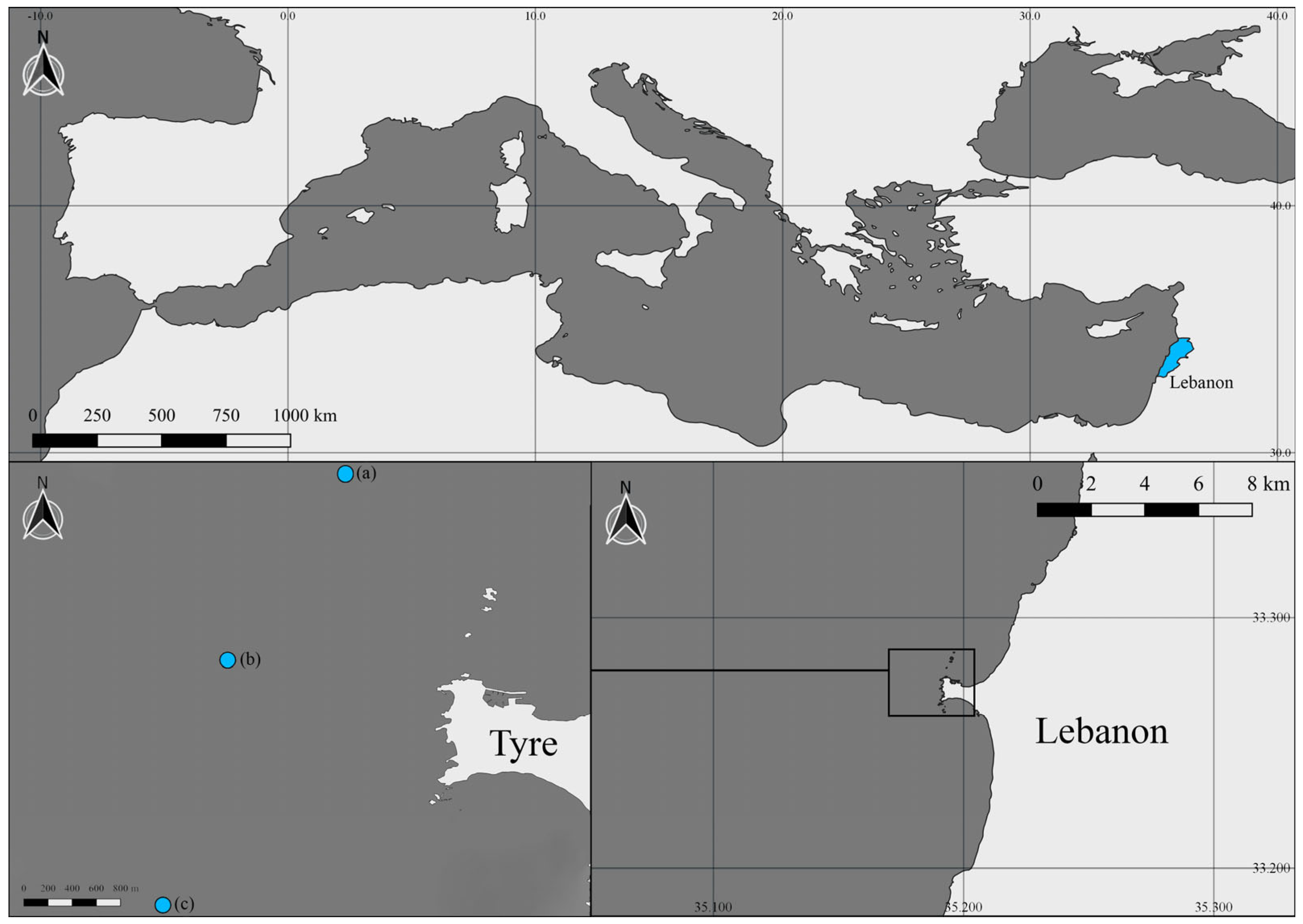


| Nov22A | Nov22B | Nov22C | Jun23A | Jun23B | Jun23C | Apr24A | Apr24B | Apr24C | |
|---|---|---|---|---|---|---|---|---|---|
| Temp (°C) | 23.8 | 23.8 | 23.8 | 24.5 | 24.5 | 24.5 | 22.2 | 22.2 | 22.2 |
| Sal (psu) | 40.0 | 40.0 | 40.0 | 38.4 | 38.4 | 38.4 | 37.7 | 37.7 | 37.7 |
| Chl-a (mg/m3) | 0.1349 | 0.1349 | 0.1330 | 0.0724 | 0.0706 | 0.0852 | 0.1116 | 0.1134 | 0.1191 |
| photoper. (h) | 10.2 | 10.2 | 10.2 | 14.4 | 14.4 | 14.4 | 13 | 13 | 13 |
| moon | 0.0 | 0.0 | 0.0 | 100.0 | 100.0 | 100.0 | 50 | 50 | 50 |
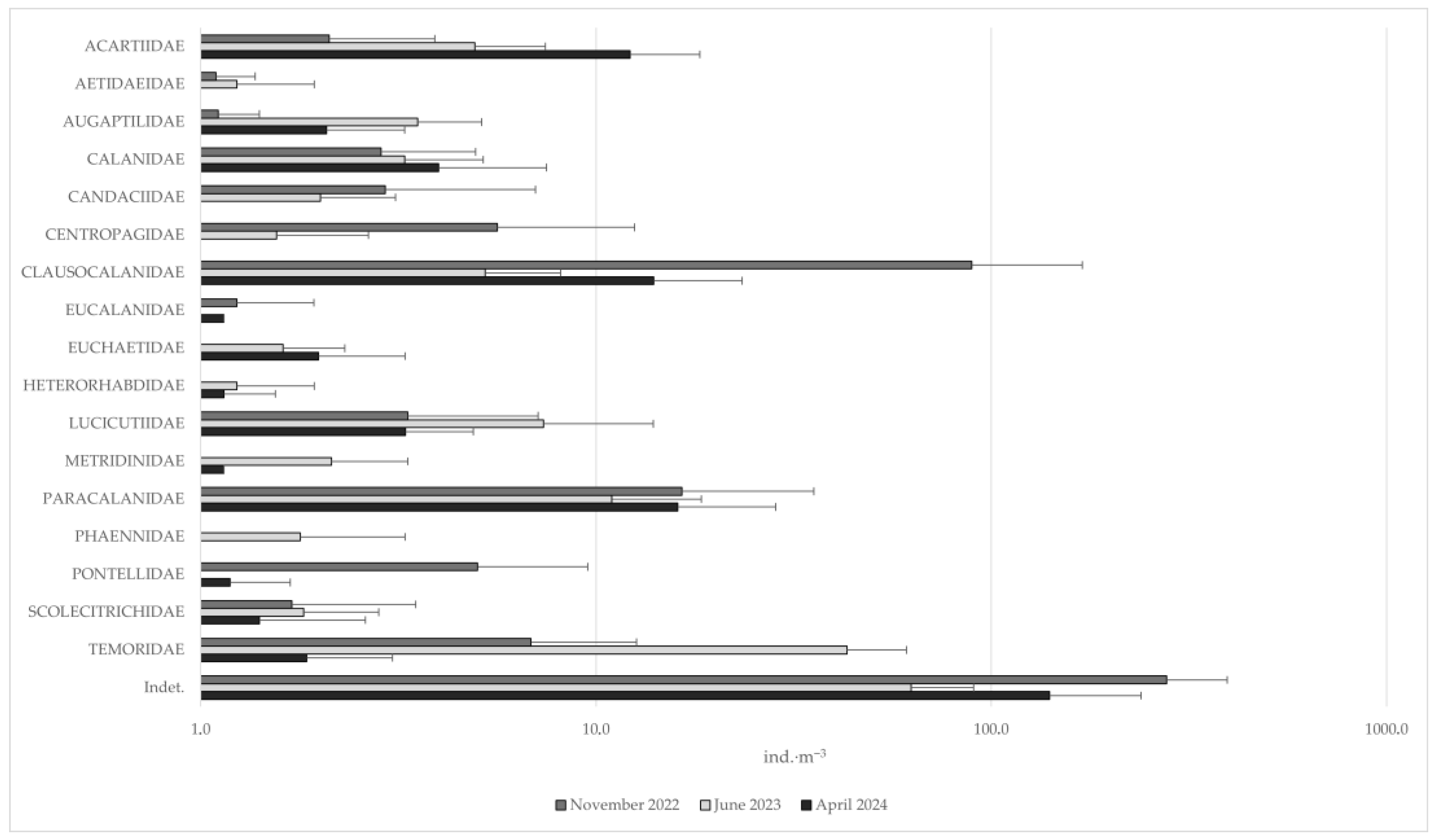
| LPT | Nov-2022 | Jun-2023 | Apr-2024 | |||||
|---|---|---|---|---|---|---|---|---|
| CALANOIDA | indet. | 276.6 | ±117.2 | 61.7 | ±27.5 | 139.3 | ±98.7 | |
| ACARTIIDAE | Acartia clausi Giesbrecht, 1892 | 9.0 | ±6.0 | |||||
| Acartia negligens Dana, 1849–1852 | 1.1 | ±1.8 | 3.9 | ±2.5 | 2.2 | ±2.0 | ||
| AETIDAEIDAE | Aetideus sp. | 0.1 | ±0.3 | 0.2 | ±0.7 | |||
| AUGAPTILIDAE | Haloptilus longicornis (Claus, 1863) | 0.1 | ±0.3 | 2.5 | ±1.6 | 1.1 | ±1.2 | |
| CALANIDAE | Calanus helgolandicus (Claus, 1863) | 0.3 | ±0.5 | |||||
| Mesocalanus tenuicornis (Dana, 1849–1852) | 0.1 | ±0.3 | 0.4 | ±1.1 | 0.5 | ±1.3 | ||
| Nannocalanus minor (Claus, 1863) | 1.8 | ±2.1 | 1.6 | ±1.3 | 2.5 | ±3.1 | ||
| CANDACIIDAE | Candacia bispinosa Claus, 1863 | 0.4 | ±0.8 | |||||
| Candacia simplex (Giesbrecht, 1889) | 1.9 | ±4.1 | 0.6 | ±1.1 | ||||
| CENTROPAGIDAE | Centropages bradyi Wheeler, 1900 | 0.6 | ±0.8 | 0.4 | ±1.1 | |||
| Centropages furcatus (Dana, 1849–1852) | 4.0 | ±7.2 | 0.2 | ±0.8 | ||||
| CLAUSOCALANIDAE | Clausocalanus arcuicornis (Dana, 1849–1852) | 20.3 | ±30.9 | 1.6 | ±2.0 | 1.5 | ±2.8 | |
| Clausocalanus furcatus (Brady, 1883) | 51.9 | ±54.4 | 0.8 | ±0.8 | 1.8 | ±1.9 | ||
| Clausocalanus jobei Frost & Fleminger, 1968 | 0.8 | ±1.1 | ||||||
| Clausocalanus mastigophorus (Claus, 1863) | 5.5 | ±4.9 | 1.1 | ±1.3 | 3.7 | ±4.1 | ||
| Clausocalanus paululus Farran, 1926 | 10.4 | ±16.8 | 6.1 | ±5.9 | ||||
| EUCALANIDAE | Eucalanus sp. | 0.2 | ±0.7 | |||||
| Pareucalanus sp. | 0.1 | ±0.4 | ||||||
| EUCHAETIDAE | Euchaeta marina (Prestandrea, 1833) | 0.6 | ±0.7 | 1.0 | ±1.3 | |||
| HETERORHABDITAE | Heterorhabdus spinifrons (Claus, 1863) | 0.2 | ±0.7 | 0.1 | ±0.4 | |||
| LUCICUTIIDAE | Lucicutia flavicornis (Claus, 1863) | 2.3 | ±3.8 | 6.4 | ±6.6 | 2.3 | ±1.6 | |
| METRIDIIDAE | Metridia sp. | 0.2 | ±0.5 | |||||
| Pleuromamma abdominalis (Lubbock, 1856) | 1.0 | ±1.3 | 0.1 | ±0.4 | ||||
| PARACALANIDAE | Calocalanus sp. | 2.3 | ±4.4 | 2.9 | ±3.4 | 4.6 | ±6.6 | |
| Calocalanus neptunus Shmeleva, 1965 | 0.7 | ±2.1 | ||||||
| Calocalanus pavo (Dana, 1849–1852) | 0.3 | ±0.8 | 2.6 | ±3.8 | 0.1 | ±0.4 | ||
| Calocalanus styliremis Giesbrecht, 1888 | 2.7 | ±8.2 | ||||||
| Mecynocera clausi Thompson I.C., 1888 | 2.3 | ±4.3 | 2.3 | ±2.4 | 1.1 | ±1.3 | ||
| Paracalanus denudatus Sewell, 1929 | 0.1 | ±0.3 | 3.8 | ±6.6 | ||||
| Paracalanus nanus Sars G.O., 1925 | 0.6 | ±1.8 | 0.2 | ±0.7 | 3.2 | ±2.4 | ||
| Paracalanus parvus (Claus, 1863) | 2.2 | ±2.9 | 2.0 | ±2.4 | 2.0 | ±1.8 | ||
| Parvocalanus crassirostris (Dahl F., 1894) | 4.3 | ±8.9 | 0.3 | ±0.7 | ||||
| PHAENNIDAE | Phaenna sp. | 0.4 | ±1.0 | |||||
| Xanthocalanus sp. | 0.4 | ±1.2 | ||||||
| PONTELLIDAE | Calanopia elliptica (Dana, 1849–1852) | 2.6 | ±2.6 | |||||
| Pontella sp. | 1.4 | ±1.4 | 0.2 | ±0.5 | ||||
| SCOLECITRICHIDAE | Pseudoamallothrix profunda * (Brodsky, 1950) | 0.4 | ±1.2 | |||||
| Scolecithricella dentata (Giesbrecht, 1893) | 0.1 | ±0.3 | 0.8 | ±1.0 | ||||
| Scolecithrix bradyi Giesbrecht, 1888 | 0.6 | ±1.8 | ||||||
| TEMORIDAE | Temora stylifera (Dana, 1853–1855) | 5.9 | ±5.8 | 42.2 | ±17.8 | 0.9 | ±1.2 | |
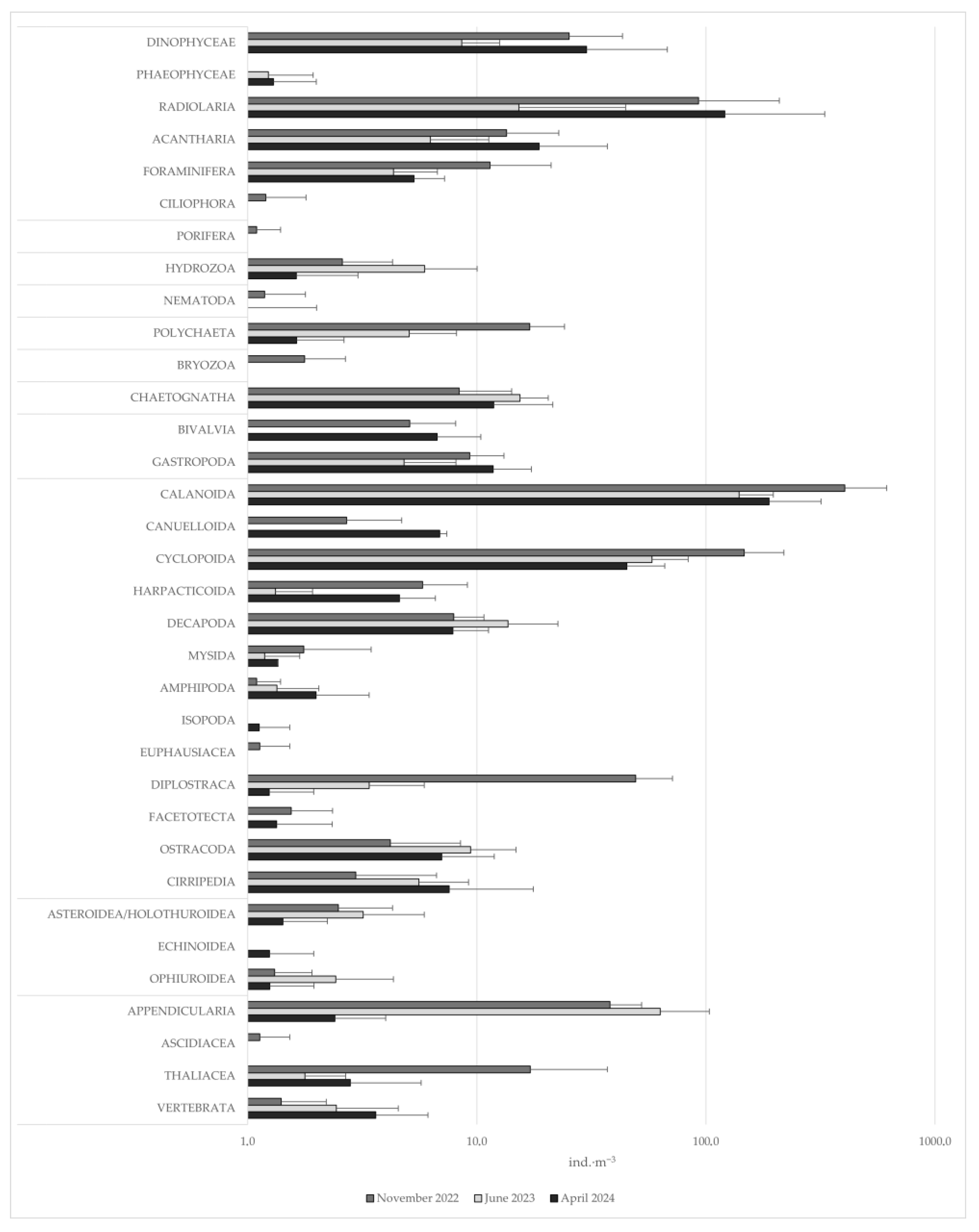
| CANUELLOIDA | CANUELLIDAE | Canuella sp. * | 1.5 | ±2.1 | ||||
| LONGIPEDIIDAE | Longipedia sp. * | 0.2 | ±0.6 | 0.2 | ±0.5 | |||
| CYCLOPOIDA | CORYCAEIDAE | indet. | 21.7 | ±11.5 | 21.0 | ±9.5 | 22.5 | ±13.7 |
| OITHONIDAE | indet. | 108.6 | ±74.8 | 30.9 | ±16.9 | 9.7 | ±9.3 | |
| ONCAEIDAE | indet. | 13.3 | ±7.5 | 1.1 | ±9.5 | 11.8 | ±6.0 | |
| SAPPHIRINIDAE | indet. | 2.0 | ±3.6 | 2.7 | ±3.5 | |||
| Copilia sp. | 0.3 | ±0.7 | 1.4 | ±1.1 | 0.1 | ±0.4 | ||
| HARPACTICOIDA | indet. | 1.4 | ±3.3 | 0.2 | ±0.5 | 0.5 | ±0.7 | |
| CLYTEMNESTRIDAE | indet. | 0.6 | ±1.9 | 1.0 | ±1.5 | |||
| ECTINOSOMATIDAE | Microsetella sp. | 0.2 | ±0.6 | 0.1 | ±0.4 | 0.2 | ±0.4 | |
| MIRACIIDAE | Macrosetella sp. | 0.1 | ±0.4 | 0.1 | ±0.4 | |||
| TACHIDIIDAE | Euterpina sp. | 2.4 | ±1.3 | 2.3 | ±2.0 | |||
| DECAPODA | indet. | larvae | 3.4 | ±1.6 | 8.7 | ±7.9 | 5.9 | ±3.2 |
| BRACHYURA | larvae | 3.5 | ±2.5 | 4.0 | ±3.0 | 1.0 | ±0.9 | |
| LUCIFERIDAE | larvae | 0.4 | ±0.8 | |||||
| MYSIDA | indet. | 0.8 | ±1.7 | 0.2 | ±0.5 | |||
| AMPHIPODA | indet. | 0.1 | ±0.3 | |||||
| CAPRELLIDAE | indet. | 0.2 | ±0.6 | |||||
| HYPERIIDAE | indet. | 0.1 | ±0.4 | 0.8 | ±1.3 | |||
| VIBILIIDAE | indet. | 0.1 | ±0.4 | |||||
| ISOPODA | GNATHIIDAE | Gnathia sp. | 0.1 | ±0.4 | ||||
| EUPHAUSIACEA | larvae | 0.1 | ±0.4 | |||||
| DIPLOSTRACA | Evadne sp. | 48.4 | ±22.0 | 1.3 | ±2.3 | 0.2 | ±0.7 | |
| Penilia avirostris Dana, 1849 | 1.0 | ±1.9 | ||||||
| FACETOTECTA | Hansenocaris sp. * | 0.5 | ±0.8 | 0.3 | ±1.0 | |||
| OSTRACODA | indet. | 3.2 | ±4.3 | 8.4 | ±5.4 | 6.0 | ±4.9 | |
| CIRRIPEDIA | LEPADOMORPHA | larvae | 2.0 | ±3.7 | 4.1 | ±3.7 | 6.3 | ±10.0 |
| BALANOMORPHA | larvae | 0.5 | ±0.9 | 0.2 | ±0.7 | |||
| DINOPHYTA | Ceratium sp. | 22.0 | ±17.5 | 2.0 | ±1.7 | 23.4 | ±33.5 | |
| Noctiluca sp. | 2.3 | ±1.8 | 5.6 | ±3.9 | 5.7 | ±5.1 | ||
| PHAEOPHYCEAE | Sphacelaria sp. | 0.2 | ±0.7 | 0.3 | ±0.7 | |||
| RADIOLARIA | indet. | 52.6 | ±50.8 | 5.0 | ±4.8 | 44.5 | ±27.0 | |
| COLLODARIA | indet. | 38.3 | ±115.0 | 9.3 | ±26.3 | 75.5 | ±197.7 | |
| SPONGODISCIDAE | indet. | 0.8 | ±1.5 | |||||
| ACANTHARIA | indet. | 9.7 | ±7.9 | 5.3 | ±5.0 | 17.7 | ±18.4 | |
| Lithoptera sp. | 0.4 | ±1.3 | ||||||
| PHYLLOSTAURIDAE | indet. | 2.4 | ±2.2 | |||||
| FORAMINIFERA | GLOBIGERINOIDEA | Globigerina sp. | 5.8 | ±5.2 | 2.7 | ±2.3 | 1.5 | ±0.7 |
| GLOBOROTALIOIDEA | indet. | 2.4 | ±3.1 | 0.7 | ±1.6 | 2.1 | ±1.8 | |
| MILIOLIOIDEA | indet. | 1.2 | ±3.3 | 0.2 | ±0.6 | |||
| ROTALIOIDEA | indet. | 0.7 | ±2.2 | 0.5 | ±1.0 | |||
| TEXTULARIOIDEA | indet. | 0.2 | ±0.6 | |||||
| CILIOPHORA | TINTINNINA | indet. | 0.2 | ±0.6 | ||||
| PORIFERA | Alectona sp. | 0.1 | ±0.3 | |||||
| HYDROZOA | medusae and polyps | 0.3 | ±0.7 | 0.5 | ±1.3 | 0.1 | ±0.4 | |
| SIPHONOPHORA | indet. | 1.3 | ±1.7 | 4.4 | ±4.5 | 0.5 | ±1.4 | |
| NEMATODA | indet. | 0.2 | ±0.6 | |||||
| POLYCHAETA | larvae | 15.8 | ±6.9 | 0.4 | ±0.8 | 0.4 | ±0.8 | |
| TOMOPTERIDAE | indet. | 0.2 | ±0.7 | 3.6 | ±2.8 | 0.2 | ±0.4 | |
| BRYOZOA | statoblasts | 0.8 | ±0.9 | |||||
| CHAETOGNATHA | indet. | 7.4 | ±5.8 | 14.4 | ±5.1 | 10.9 | ±9.6 | |
| BIVALVIA | veliger | 4.1 | ±3.0 | 5.7 | ±3.7 | |||
| GASTROPODA | veliger | 7.9 | ±3.6 | 1.4 | ±1.6 | 10.1 | ±5.6 | |
| EUTECHOSOMATA | indet. | 0.5 | ±0.7 | 2.4 | ±2.3 | 0.7 | ±0.6 | |
| ECHINODERMATA | brachiolaria/auricolaria | 1.5 | ±1.8 | 2.2 | ±2.7 | 0.4 | ±0.8 | |
| ophiopluteus | 0.3 | ±0.7 | 1.4 | ±1.9 | 0.2 | ±0.6 | ||
| echinopluteus | 0.2 | ±0.7 | ||||||
| APPENDICULARIA | Oikopleura sp. | 37.1 | ±14.2 | 61.2 | ±39.1 | 1.4 | ±1.7 | |
| Fritillaria sp. | 1.0 | ±2.0 | ||||||
| THALIACEA | indet. | 16.1 | ±20.0 | 0.8 | ±0.9 | 1.8 | ±2.9 | |
| ASCIDIACEA | 0.1 | ±0.4 | ||||||
| VERTEBRATA | OSTEICHTHYES | larvae/eggs | 0.4 | ±0.8 | 1.4 | ±2.1 | 2.6 | ±2.5 |
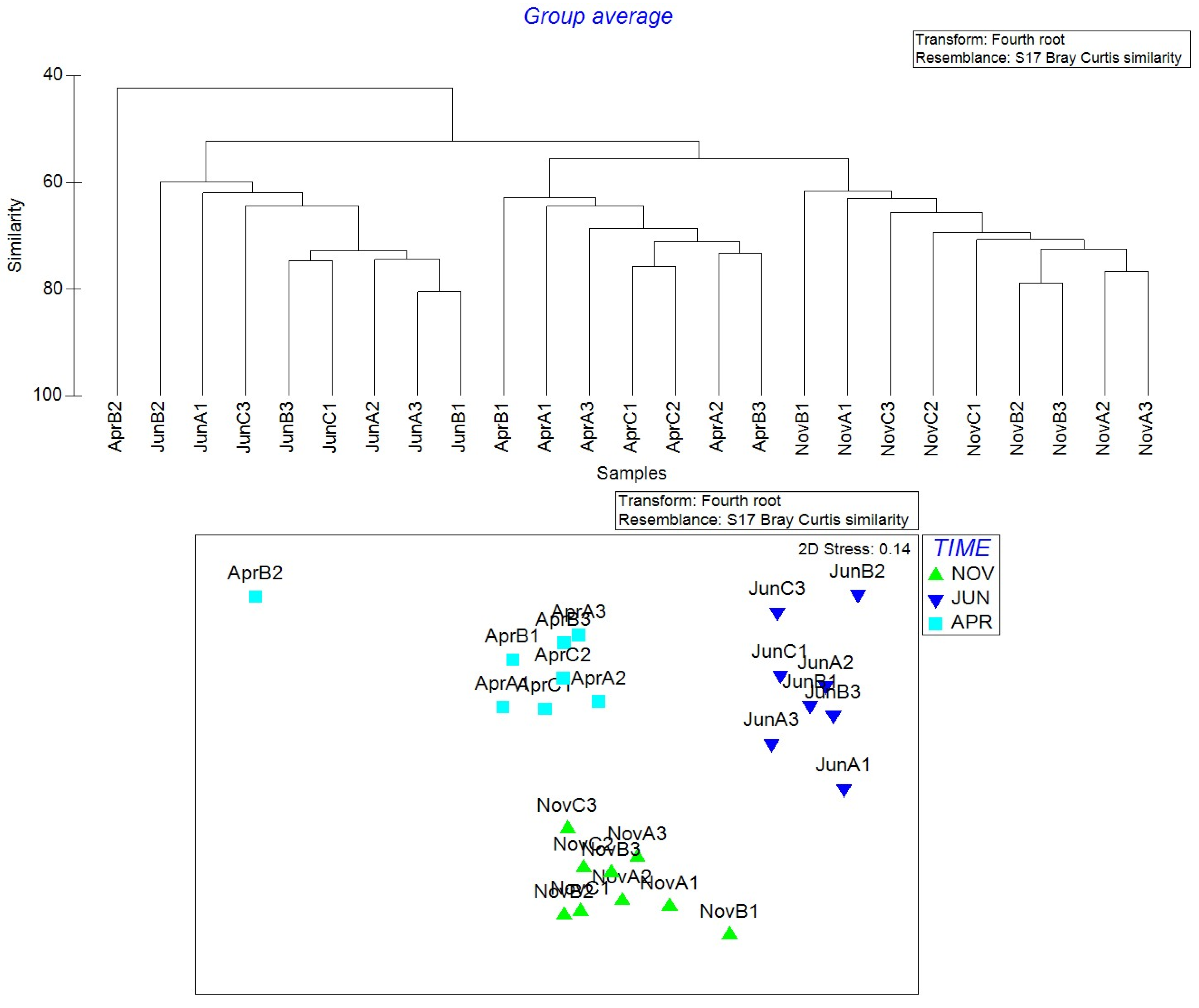
| Group Nov 2022 | |||||
| Average similarity: 70.20 | |||||
| Species | Av. Ab. | Av. Sim. | Sim./SD | Contr.% | Cum. Contr.% |
| CAL | 3.48 | 5.99 | 14.63 | 8.53 | 8.53 |
| OITH | 2.69 | 4.67 | 3.78 | 6.65 | 15.18 |
| EVA | 2.22 | 3.67 | 3.69 | 5.24 | 20.41 |
| OIKO | 2.11 | 3.54 | 9.28 | 5.04 | 25.45 |
| RADIO | 2.15 | 3.30 | 7.83 | 4.71 | 30.16 |
| Group Jun 2023 | |||||
| Average similarity: 66.19 | |||||
| CAL | 2.21 | 4.67 | 8.61 | 7.06 | 7.06 |
| OIKO | 2.17 | 4.56 | 6.42 | 6.89 | 13.95 |
| TES | 2.03 | 4.39 | 17.05 | 6.64 | 20.59 |
| OITH | 1.85 | 3.75 | 9.38 | 5.66 | 26.25 |
| CORY | 1.70 | 3.54 | 11.62 | 5.35 | 31.60 |
| Group Apr 2024 | |||||
| Average similarity: 63.64 | |||||
| CAL | 2.79 | 5.55 | 14.74 | 8.72 | 8.72 |
| CORY | 1.81 | 3.98 | 4.11 | 6.26 | 14.97 |
| RADIO | 1.98 | 3.23 | 1.43 | 5.08 | 20.06 |
| GASTR | 1.49 | 3.18 | 4.01 | 5.00 | 25.06 |
| ONC | 1.47 | 3.03 | 2.28 | 4.76 | 29.82 |
| Groups Nov 2022 and Jun 2023 | ||||||
| Average dissimilarity = 48.96 | ||||||
| Species | Av. Ab. | Av. Ab. | Av. Diss | Diss/SD | Contr.% | Cum. Contr.% |
| EVA | 2.22 | 0.38 | 1.91 | 2.40 | 3.91 | 3.91 |
| CLF | 2.01 | 0.54 | 1.52 | 2.32 | 3.10 | 7.01 |
| POLY | 1.70 | 0.25 | 1.48 | 2.78 | 3.03 | 10.04 |
| CAL | 3.48 | 2.21 | 1.27 | 3.11 | 2.60 | 12.64 |
| RADIO | 2.15 | 0.98 | 1.19 | 1.54 | 2.43 | 15.07 |
| Groups Nov 2022 and Apr 2024 | ||||||
| Average dissimilarity = 45.60 | ||||||
| EVA | 2.22 | 0.13 | 2.13 | 2.96 | 4.68 | 4.68 |
| OIKO | 2.11 | 0.57 | 1.61 | 2.16 | 3.52 | 8.20 |
| CLF | 2.01 | 0.57 | 1.51 | 1.68 | 3.32 | 11.52 |
| POLY | 1.70 | 0.26 | 1.43 | 2.80 | 3.15 | 14.67 |
| OITH | 2.69 | 1.45 | 1.38 | 1.57 | 3.04 | 17.71 |
| Groups Jun 2023 and Apr 2024 | ||||||
| Average dissimilarity = 47.89 | ||||||
| OIKO | 2.17 | 0.57 | 1.95 | 1.89 | 4.07 | 4.07 |
| TES | 2.03 | 0.50 | 1.65 | 2.75 | 3.45 | 7.52 |
| BIVA | 0.00 | 1.28 | 1.47 | 6.27 | 3.06 | 10.58 |
| RADIO | 0.98 | 1.98 | 1.42 | 2.22 | 2.96 | 13.54 |
| ACL | 0.00 | 1.30 | 1.40 | 2.31 | 2.93 | 16.47 |
Disclaimer/Publisher’s Note: The statements, opinions and data contained in all publications are solely those of the individual author(s) and contributor(s) and not of MDPI and/or the editor(s). MDPI and/or the editor(s) disclaim responsibility for any injury to people or property resulting from any ideas, methods, instructions or products referred to in the content. |
© 2025 by the authors. Licensee MDPI, Basel, Switzerland. This article is an open access article distributed under the terms and conditions of the Creative Commons Attribution (CC BY) license (https://creativecommons.org/licenses/by/4.0/).
Share and Cite
Toso, Y.; Fumarola, L.M.; Toso, A.; Anglano, M.; Tahhan, R.; Bariche, M.; Arduini, D.; Piraino, S.; Belmonte, G. Expanding the Zooplankton Inventory of the Levantine Basin: Novel Taxa and First Records from South Lebanon. J. Mar. Sci. Eng. 2025, 13, 2104. https://doi.org/10.3390/jmse13112104
Toso Y, Fumarola LM, Toso A, Anglano M, Tahhan R, Bariche M, Arduini D, Piraino S, Belmonte G. Expanding the Zooplankton Inventory of the Levantine Basin: Novel Taxa and First Records from South Lebanon. Journal of Marine Science and Engineering. 2025; 13(11):2104. https://doi.org/10.3390/jmse13112104
Chicago/Turabian StyleToso, Yann, Lara Marastella Fumarola, Andrea Toso, Marco Anglano, Ranim Tahhan, Michel Bariche, Daniele Arduini, Stefano Piraino, and Genuario Belmonte. 2025. "Expanding the Zooplankton Inventory of the Levantine Basin: Novel Taxa and First Records from South Lebanon" Journal of Marine Science and Engineering 13, no. 11: 2104. https://doi.org/10.3390/jmse13112104
APA StyleToso, Y., Fumarola, L. M., Toso, A., Anglano, M., Tahhan, R., Bariche, M., Arduini, D., Piraino, S., & Belmonte, G. (2025). Expanding the Zooplankton Inventory of the Levantine Basin: Novel Taxa and First Records from South Lebanon. Journal of Marine Science and Engineering, 13(11), 2104. https://doi.org/10.3390/jmse13112104