Abstract
It is widely recognized that benthic sediment plumes generated by deep-sea mining may pose significant potential risks to ecosystems, yet their dispersion behavior remains difficult to predict with accuracy. In this study, we combined laboratory experiments with three-dimensional numerical simulations using the Environmental Fluid Dynamics Code (EFDC) to investigate the dispersion of sediment plumes composed of particles of different sizes. Laboratory experiments were conducted with deep-sea clay samples from the western Pacific under varying conditions for plume dispersion. Experimental data were used to capture horizontal diffusion and vertical entrainment through a Gaussian plume model, and the results served for parameter calibration in large-scale plume simulations. The results show that ambient current velocity and discharge height are the primary factors regulating plume dispersion distance, particularly for fine particles, while discharge rate and sediment concentration mainly control plume duration and the extent of dispersion in the horizontal direction. Although the duration of a single-source release is short, continuous mining activities may sustain broad dispersion and result in thicker sediment deposits, thereby intensifying ecological risks. This study provides the first comprehensive numerical assessment of deep-sea mining plumes across a range of particle sizes with clay from the western Pacific. The findings establish a mechanistic framework for predicting plume behavior under different operational scenarios and contribute to defining threshold values for discharge-induced plumes based on scientific evidence. By integrating experimental, theoretical, and numerical approaches, this work offers quantitative thresholds that can inform environmentally responsible strategies for deep-sea resource exploitation.
1. Introduction
Deep-sea mining has emerged as a promising avenue for sourcing critical minerals such as cobalt, nickel, and rare earth elements from the ocean floor. Exploiting polymetallic nodules and other seabed resources in the Clarion–Clipperton Zone and similar regions has drawn significant attention with the increasing global demand for these materials in green technologies. One of the primary environmental concerns associated with deep-sea mining is the disturbance of seabed sediments and the resulting formation of sediment plumes [1,2]. Specifically, sediment plumes generated by collector vehicles near the seafloor represent a direct hazard to benthic ecosystems. These plumes can spread across large areas and persist for extended periods, leading to habitat smothering and potential long-term ecological disruption [3].
The evolution of sediment plumes generated by deep-sea mining is governed by complex multi-scale and multi-physical mechanisms [4]. The effluent released from the mining vehicle is denser than the surrounding seawater because it contains suspended sediment particles. Initially, the discharge behaves as a pure jet driven by momentum. As the kinetic energy dissipates during the early development stage, buoyancy becomes the dominant force, and the particles subsequently undergo diffusion and settling in the final stage—forming a pure plume, which also persists the longest [5,6]. Consequently, understanding the dispersion characteristics of these plumes is crucial for accurately predicting their ecological impacts.
Morton and Middleton [7] developed a plume-jet model from a pipeline that effectively describes the evolution of effluents from jet-like to plume-like behavior considering discharging factors. In the 1970s, Hess et al. [8] first simulated the discharge of sediments from mining vessels on the ocean surface and dredging by dredgers on the seabed based on the classic advection–diffusion equation and using the measured data of Halpern [9]. To estimate the residence time of sediment plumes generated by deep-sea mining in seawater, Jankowski et al. [10,11] used the measured data provided by Klein et al. [12] and simulated the diffusion range and sedimentation of bottom boundary-layer sediment plumes using the TELEMAC-3D model; they also evaluated the residence time of plumes. In order to assess the environmental impact of seabed disturbances during deep-sea mining activities, Japan developed a three-dimensional numerical finite-difference model for sediment transport and carried out a series of numerical simulations [13,14]. Subsequently, Jankowski et al. [15] took the small-scale Bottom Influence Experiment (BIE) as an example to simulate the diffusion and redeposition of collector plumes under mesoscale conditions. Ouillon et al. [16] examined a moving-source plume by defining the ratio of source velocity to buoyancy velocity, and found that once this ratio exceeded a critical value, plume propagation exhibited supercritical flow behavior. Macpherson and Tunstall [17] successfully captured key aspects of plume mixing and dynamics with a satisfactory accuracy using CFD model, and proposed theoretical parameters for buoyant plumes. Munoz-Royo et al. [18] found that sediment flocculation plays a minor role compared with the turbulent shear and entrainment of the dynamic plume. Meanwhile, Elerian et al. [19] conducted a detailed investigation on the flocculation processes in the near-field discharge of the mining vehicle, and concluded that flocculation may have greater potential impact in the far field. van Smirren et al. [20] conducted a pilot test in monitoring the concentration, movement, and the settling of the plumes, and their data and the monitor strategy provide a solid scientific foundation for research on the ecological impacts of deep-sea mining.
Although many studies have simulated the dispersion of benthic plumes, most have treated sediment as a single category, neglecting the impact of particle size on settlement and transport [21]. However, numerous studies directly point out that the particle size distribution influences the process of plume dispersion and propagation by altering factors such as particle flocculation and settling velocity [6,22,23,24]. Accurately characterizing these particle size-related dynamics is crucial for realistic simulations of plume dispersion and sediment repositioning [25], particularly in simulations of actual mining impacts [26]. For instance, sensitivity analyses demonstrate that varying the particle settling rate can lead to significant differences in simulation results. When the settling velocity increases from 0.08 mm/s to 0.30 mm/s, the maximum redeposition thickness can increase from 4.3 mm to 12.9 mm, and the area of redeposition thickness greater than 0.1 mm can expand from 63 km2 to 98 km2 [27]. Furthermore, research on deep-sea hydrothermal plumes also confirms that the transport distance of plume particles is closely related to their density and size [28]. Therefore, there is a need to conduct numerical studies that explicitly incorporate multiple particle size groups to better understand the evolution and impacts of benthic plumes under realistic conditions.
Fine particles were treated as a kind of diffuse pollutant leading to ecological deterioration in water bodies [29]. Although fine particles in surface water systems were referred to as particles smaller than 2 mm, many studies have been conducted on the biological impacts of fine particles in such aquatic ecological environments [30,31,32,33]. It has also been concluded that environmental stressors impacting organisms inhabiting shallow subtidal to supratidal zones exhibit significant variability in response to sediment grain size distributions [34]. As in the marine environment, there are also similar studies [35,36,37,38]. As for the pelagic abyssal, the grain size of these sediments is considerably finer than that of shallow marine or terrestrial deposits. Specifically, fine particles (<10 µm) can remain suspended for extended periods, enabling long-distance transport, while coarser particles (>100 µm) settle rapidly [39]. More importantly, the particle size of suspended and resettled sediments plays a critical role in determining the degree and nature of impact on benthic organisms, including sponges, corals, polychaetes, bivalves, and meiofauna [40]. Taking sponges—the most abundant organisms in the deep sea—as an example, sponge filter-feeding primarily targets phytoplankton smaller than 2 μm. Meanwhile, the filtration efficiency for phytoplankton smaller than 10 μm decreases. Additionally, the choanocyte chamber openings of sponge species measure approximately 5–10 μm in diameter. Particles with diameters between 10 and 100 μm can enter the sponge’s water circulation system, as the pores of sponges are about 200 μm in diameter [41,42,43,44]. Finally, fine silt and medium silt particles (smaller than 60 μm) exhibit longer suspension times and greater transport distances compared to other particle types.
This research aims to quantify plume behavior and use numerical simulations to investigate the distribution of solid particles through mining plumes, which can ultimately provide essential quantitative benchmarks for establishing ecosystem health evaluation criteria for deep-sea resource exploration. In the current paper, sediment particle size was classified as three categories: (1) <10 µm, (2) 10–30 µm, and (3) >30 µm. By combining these bio-filtration characteristics with the grain size distribution of the marine sediments we collected, we selected the median diameters of the three grain size fractions covered in the marine soil samples to investigate the behavior of particles of different sizes under various classification conditions during the plume dispersion process.
2. Materials and Methods
2.1. Sediment Physical Properties
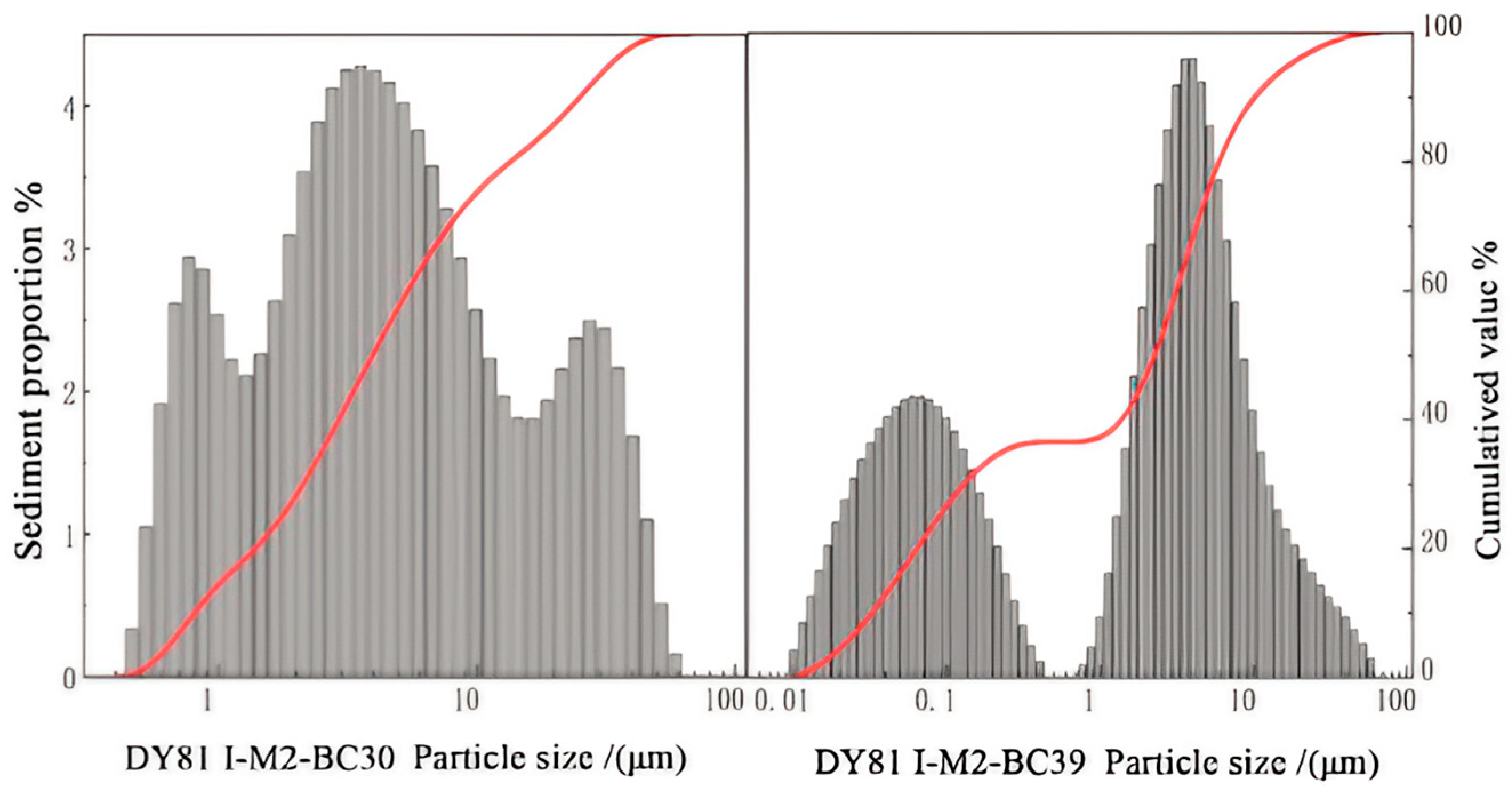
The soil samples were collected from the nodule mining area of the Northwest Pacific Ocean under contract to Beijing Pioneer Polymetallic (Beijing, China). Test materials were obtained from Block M-2 at two stations (DY81I-M2-BC30 and DY81I-M2-BC39) using a Type-50 box sample (the box sampler is a self-developed, square sampling device made of steel with a removeable spade closure for the bottom of the box). The sediments are mainly composed of illite, montmorillonite, chlorite, and kaolinite, with a bulk density of approximately 1340 kg/m3. The particle size distribution frequency and cumulative curves are shown in Figure 1. Overall, the sediments fall within the range of 0–66.89 µm. For station DY81I-M2-BC30, the median particle size (D50) is 4.47 µm, with 91.05% of particles smaller than 30 µm, and the distribution exhibits a unimodal pattern with a dominant mode at 2–6 µm. For station DY81I-M2-BC39, the median particle size (D50) is 2.57 µm, with 94.93% of particles smaller than 30 µm, and the distribution shows an asymmetric bimodal pattern, with the main peak at 2–6.7 µm and a secondary peak at 0.04–0.09 µm (Figure 1).
Figure 1.
Sediment particle size distribution frequency and cumulative curve.
Settling velocity was determined using both experimental measurements and theoretical calculations. A laser particle size analyzer was employed to characterize the settling behavior of particles of different sizes over time. Settling velocities under static water conditions were then obtained from laboratory experiments and from an empirical formula for single particle settling (Table 1). Parameters used in the calculation include kinematic viscosity (γ = 1.146), gravitational acceleration (g = 9.8 m/s2), sediment density (ρS = 1340 kg/m3), and seawater density (ρw = 1025 kg/m3). Results indicate that single particle settling velocities are lower than those measured in suspension, highlighting the importance of selecting appropriate settling velocity values in plume simulations.
Table 1.
Settling velocity in static water and single particle settling velocity for different particle sizes.
2.2. Experimental Setup
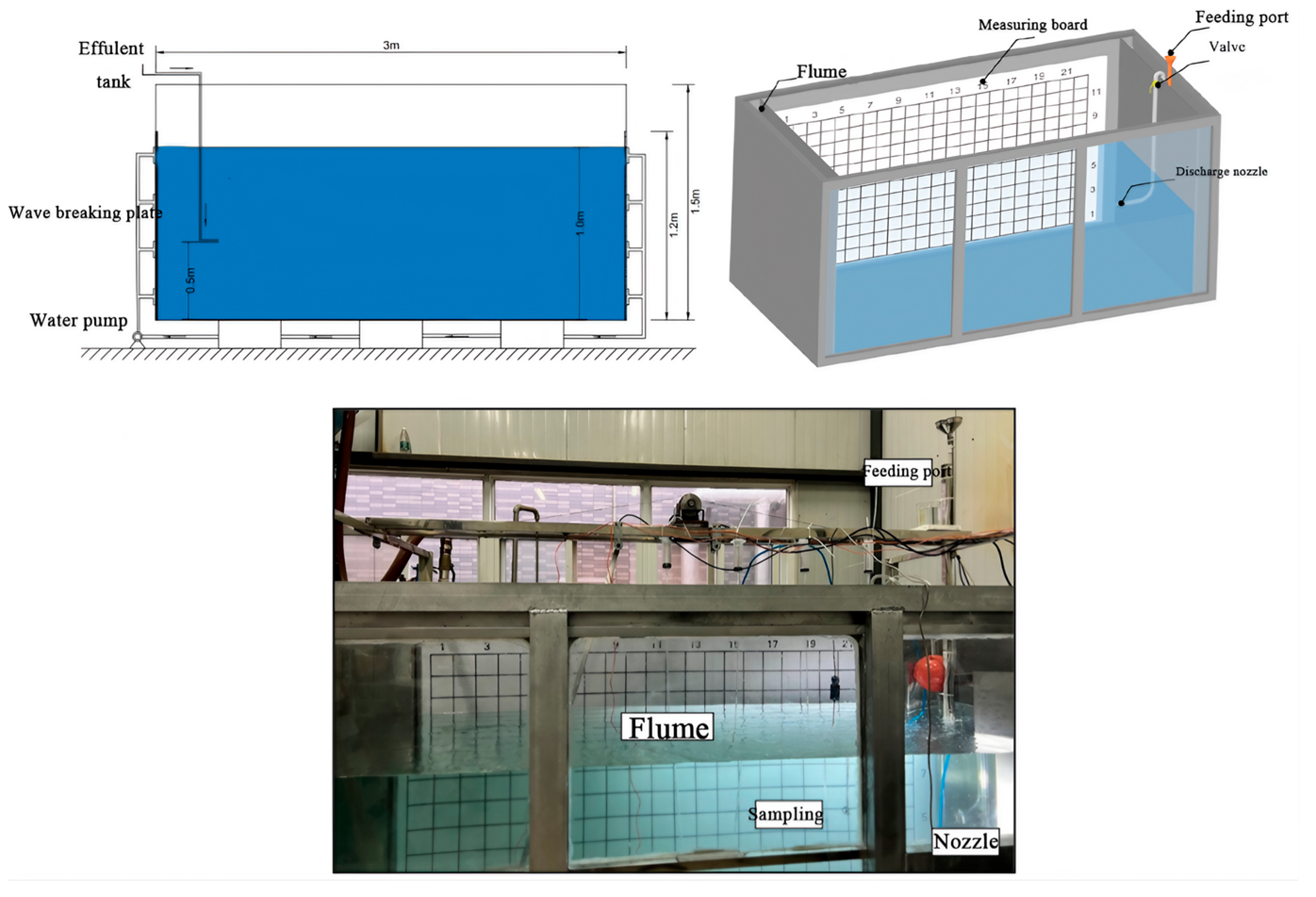
A recirculating tank system was used to simulate the seabed plume distribution under a background current. The main system is mainly composed of a feeding port, a conveying hose, a discharge port, valves, etc. (Figure 2). The sediment mixture is added through the feeding port and discharged into the water tank via the conveying hose. The conveying hose is made of transparent Teflon tube with an inner diameter of 10 mm, an outer diameter of 14 mm, and a length of 1.5 m. The ocean current subsystem consists of a large water tank with dimensions of 3 m in length, 1 m in width, and 1.5 m in height, which is connected to a water pump to create a uniform circulation. The flow velocity which was used to simulate the ocean current was measured by a flow meter. The front wall of the water tank is made of organic glass for a clear view of observation in the diffusion morphology of the plume under different working conditions, while the remaining walls of the tank are 5 mm thick stainless steel plates.
Figure 2.
The experimental setup of the sediment plume dispersion test.
Six scenarios were studied for investigating the sediment dispersion behavior. The initial concentration is varying from10 to 40 g/L, with a discharge flow rate ranging from 50 to 100 cm3/s, and the ambient flow velocities were set to 0, 3, 6 cm/s. As for the plume generation process, during the experiment, the water tank was filled with tap water until the water surface was 50 cm above the discharge nozzle. The sediment mixture was prepared in a 500 mL beaker and continuously stirred until it was well mixed. The mass concentration of the mixture was set to 10, 20, and 40 g/L for different cases. Then, the mixture was poured into the feeding port and discharged into the water tank through the conveying hose. The experiment commenced with the opening of the valve immediately upon the mixture reaching the discharge port. In the experiments, a high-speed camera was employed to continuously record the dispersion radius and the development of the plume, while a flow meter simultaneously monitored the flow velocity. The details of the experimental conditions are presented in Table 2. High-speed imaging and in situ sampling at a set interval from the source allowed measurement of dispersion radius and concentration profiles. Each experiment was repeated three times to ensure the repeatability and reliability of the collected data. In addition, before each experiment began, the entire system was tested to ensure that all components, instruments, and meters were operating correctly, and the measurement accuracy of the instruments could meet the experimental requirements.
Table 2.
Setting parameters of the experiments cases. (Lab tests).
2.3. Sampling and Data Processing
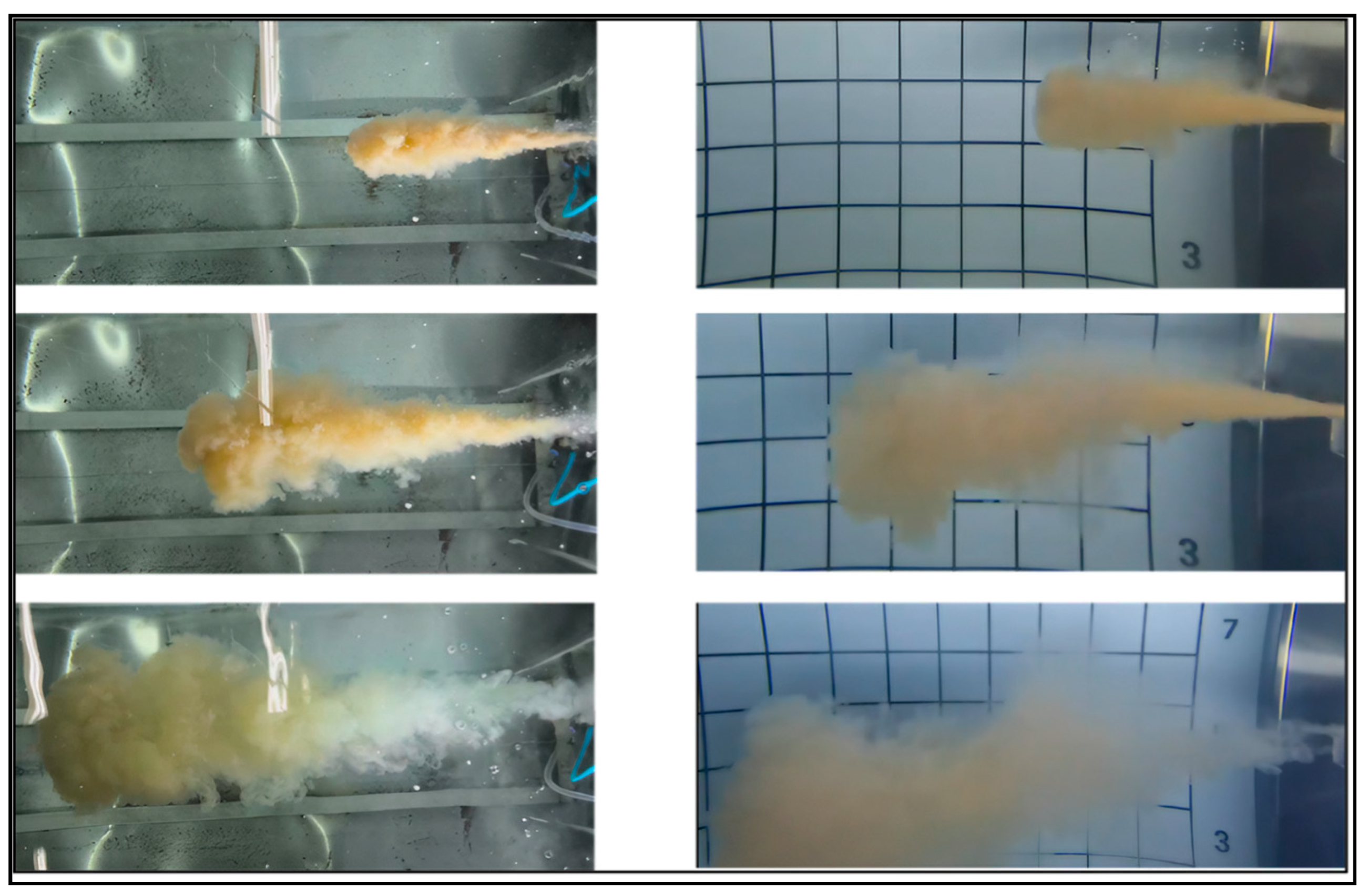
The distribution of the plume was evaluated by calculating the mass concentration of the extracted samples. A custom-designed sampling device—consisting of a syringe connected to a 70 cm long transparent rigid PVC tube with an inner diameter of 7 mm—was used for sample extraction. Plume samples were collected directly along the centerline of the plume trajectory at designated positions within the experimental tank. All seven extractors were mounted on a wooden frame at a uniform height of approximately 50 cm above the water surface, arranged in a horizontal row with 10 cm intervals. Accordingly, the sampling points were located at horizontal distances of 10 cm, 20 cm, 30 cm, 40 cm, 50 cm, 60 cm, 70 cm, and 80 cm from the discharge nozzle. After the mixture is discharged, it rapidly mixes at the outlet. The discharge velocity and initial mass concentration together determine the evolution of the plume. When the initial momentum becomes smaller than the gravitational force, the plume starts to descend. Meanwhile, entrainment and dilution of the plume continuously occur throughout the process. The concentration was determined through mass-based analytical procedures. Specifically, collected samples were directly put into a weighing dish and placed in an oven to evaporate the moisture. Subsequently, a gradient calculation was performed on the coordinates of the sampling points and their corresponding concentration values to obtain the relationship between the attenuation of momentum flux and the concentration decay of the plume in different directions, see Figure 3.
Figure 3.
The time-domain characteristics in the plume discharge phase.
3. Numerical Models
Numerical simulations of the present work were completed using the EFDC (Environmental Fluid Dynamics Code) software (version 8.3). EFDC employs a three-dimensional, finite-difference framework based on the hydrostatic, Boussinesq approximations, and the model solves the Reynolds-averaged Navier–Stokes equations along with conservation equations for temperature, salinity, sediments, and other scalar quantities. The model was first validated using laboratory data presented in the previous chapter and subsequently applied to simulate sediment plumes propagation under real mining conditions.
3.1. Model Equation
To better accommodate the realistic boundary shape in the horizontal direction, the horizontal coordinates in the governing equations are generally expressed in a curvilinear–orthogonal form, while a σ-coordinate system is adopted in the vertical direction to provide uniform resolution. The transform equation can be written as
Based on the hydrostatic pressure assumption in the vertical direction, the momentum and continuity equations are derived using the Boussinesq approximation, together with the transport equations for salinity and temperature, forming the fundamental set of governing equations for hydrodynamics and scalar transport.
The momentum equation in the x-direction is given as
The momentum equation in the y-direction is given as
While in the z-direction the momentum equation is
The continuity equation is given as
where (x, y) is the coordinates in the horizontal direction in a curvilinear–orthogonal form; z is the σ-coordinate system in the vertical direction; (u, v) is the velocity components in (x, y) axis, m/s; H is the total water depth, m; and is the coordinate transformation coefficient, in Cartesian coordinates, where the transformation coefficients are equal to 1; is the atmospheric pressure, Pa; p denotes the additional hydrostatic pressure for the reference density ; b is buoyancy; f is the Coriolis force coefficient which contains grid curvature acceleration; is the momentum diffusion coefficient, m2/s; is the turbulence diffusion coefficient, m2/s; is the vegetation resistance coefficient; is the projected vegetation area intersecting the flow per unit horizontal area; and are the source/sink terms of the momentum equation in the (x, y) direction, m2/s2; is the source/sink term of the mass conservation equation, m3/s; S is the salinity, ng/L; T is the temperature, °C; C is the total suspended inorganic particle concentration, g/m3; U and V are the depth-averaged velocity components in the (x, y) direction, m/s; P and Q are the mass flux components in the (x, y) direction, m2/s.
For dissolved and suspended substances, the complete advection–diffusion transport equation is given as
where is the concentration of the transport substances, g/m3; H is the total water depth, m; (u, v) is the velocity component in the horizontal direction, m/s; is the velocity component in the vertical direction, m/s; is the turbulent diffusion parameter in the horizontal direction, m2/s; is the turbulent diffusion parameter in the vertical direction, m2/s; is the settling velocity (in suspension); is a source term.
The transport equation of suspended sediment in the water column can be derived from Equation (6). Since the upwind numerical scheme introduces very limited internal numerical diffusion, the horizontal diffusion term in Equation (6) can be neglected, leading to Equation (7).
where is the concentration for sediment kind j, g/m3; the source term is classified into external and internal, that is, is the external term which contains point source and non-point source loads; is the internal term which contains reactive decay of organic sediments, flocculation, and breakdown of different types of sediments, etc.; and are the flux.
3.2. Model Validation
Model validation was conducted by comparing the numerical simulation results with experimental data, with particular emphasis on sediment concentration measurements. The mass concentration of the sediment particles in the plume is defined as shown in Equation (8), with the unit of g/L. To more intuitively measure the dilution process of the plume after entraining seawater during the evolution, and to facilitate the comparison of the mass concentration evolution of plume particles under different initial mass concentration conditions, a dimensionless mass concentration () is introduced, as shown in Equation (9).
where αs represents the volume fraction of particles; represents the density of particles, with the unit of kg/m3; represents the initial mass concentration of particles in the injected plume, with the unit of g/L; represents the initial volume fraction of particles in the injected plume.
Before the comparison, a mesh sensitive analysis was conducted by using different meshes with increasing resolution in grids, until it can provide steady results with enough accuracy. The grid-sizes that were used in the mesh-sensitivity analysis were 200 m, 100 m, 50 m, and 40 m. The relative difference between the results from the last two sets of mesh resolutions is smaller than 5%.
There are many ways to evaluate the predictive success of simulation models and experimental models. In this study, various statistical variables, including the Mean Absolute Error (MAE), Relative Error (RE), Root Mean Square Error (RMSE), and Nash–Sutcliffe Efficiency coefficient (NSE) are used to assess model parameters and its performance. The domain of the numerical model refers to the actual size of the physical experiment.
3.3. Field Simulation and Boundary Conditions
Numerical modeling to simulate the actual working conditions of deep-sea polymetallic nodule collection plumes was performed with reference to the environmental assessment report of Pioneer Corporation. The mining area is located in the intermountain basin that has an average water depth of 5550–5600 m, with deep-sea clay as the dominant sediment type. The sediment is predominantly composed of siliceous clastic material (88~98%), and the content of siliceous biogenic debris ranges from 1% to 4%, while volcanic detritus ranges from 1% to 8%. The overall grain size distribution ranges from 0 to 66.9 μm, with the highest proportions corresponding to particles with median grain sizes of 6.73 μm, 23.73 μm, and 37.25 μm, respectively. Given that the grain size distribution of deep-sea sediments often exhibits bimodal or even multimodal characteristics—and that grain size parameters and settling velocities are critical to accurately predicting plume dispersion—we incorporated multiple grain size classes into the simulations for a more comprehensive analysis on the plume impact evaluation in the present study.
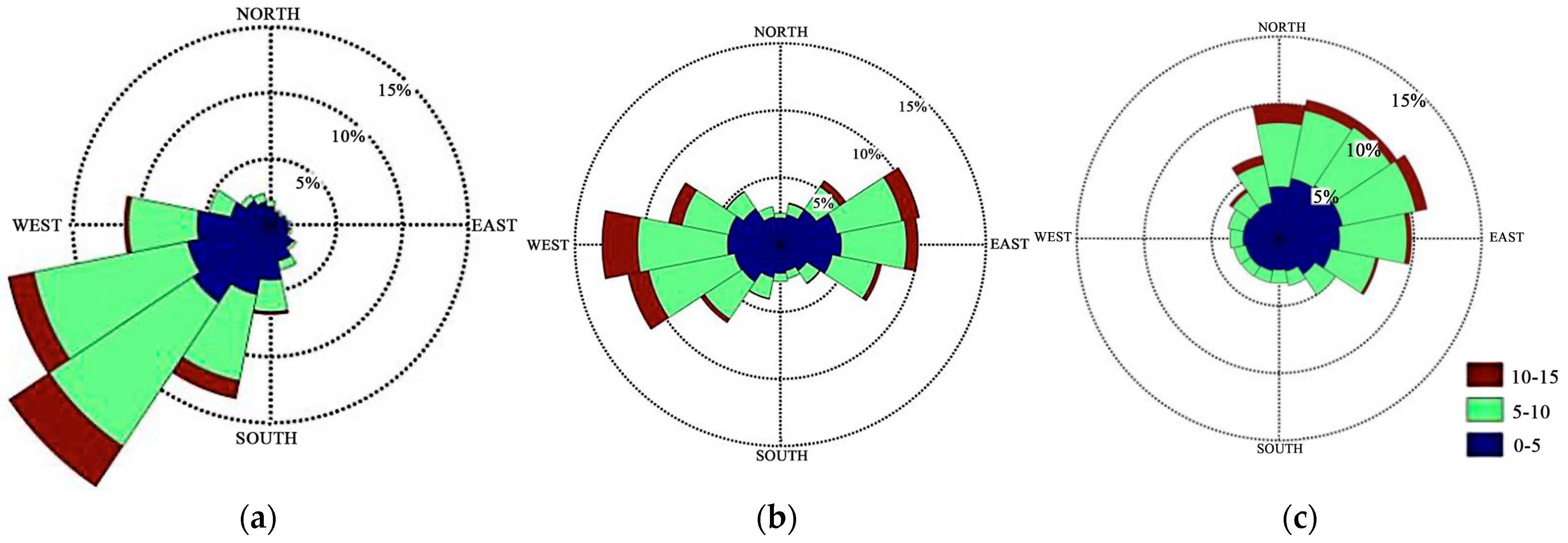
Figure 4 showed the near-bottom current field observations at three stations: DY69-ES06-MX03 (5532 m), DY69-ES03-MX02 (5534 m), and DY66-M2-MX2101 (5660 m). The maximum bottom current velocity is 18.40 cm/s, with an average eastward component of −1.20 cm/s and a northward component of −0.06 cm/s, indicating an average flow direction toward the southwest. The bulk density of the sediment ranges from 1.28 to 1.40 g/cm3, with an average value of 1.34 g/cm3 (from the EIS report of the Beijing Pioneer Company, Beijing, China). The directions of the ocean currents at all three sites are predominantly southwest–northeast, with indications of mesoscale eddies processes or tidal variations. The maximum current velocities range from 16.85 to 18.40 cm/s. Notable differences are observed in the eastward and northward velocity components across different depth layers. These ocean current data will serve as the basis for setting velocity boundaries in numerical simulations. More specifically, two dominant ocean current directions were selected for the simulation, namely a strong northeastward current and a strong southwestward current. The inlet flow was prescribed based on the average flow velocity, and the outflow boundary was treated as an open boundary condition.
Figure 4.
Velocity vector diagram and velocity rose diagram for water layers at different depths: (a) 5532 m, (b) 5534 m, (c) 5560 m.
Assuming a mining collector operates over an area of 500 m × 500 m, the collection proceeds in a north–south direction from east to west. The average travel speed (v) is 0.25 m/s, and the collector is equipped with six collection heads, each with a width (w) of 0.7 m. Based on this configuration, the total time (t) required to complete the collection over the entire trial mining area is estimated to be 66 h. During nodule collection, the disturbance depth (h) of the collector on the sediment is 5 cm. The nodule coverage within the trial area (γ) is 64.7%. Assuming the nodules are spherical and half-buried in the sediment, with a radius (r) of 2.5 cm and sediment density (ρ) of 1340 kg/m3, the source strength of the sediment (Q) is calculated using the following equation:
where V represents the total volume of sediment collected, with units in cubic meters (m3); t denotes the time, with units in hours (h).
The calculation formulas are as follows:
Substitute Equations (11) and (12) into Equation (10), and simplify to obtain
To replicate the sediment grain size distribution characteristics based on experimental samples while accounting for the influence of varying particle sizes on plume diffusion, the sediments were simplified as a mixture of three characteristic particle size groups in the simulation. Additionally, considering the effect of flocculation, the mixed representative grain size of the three sediment groups was set to approximately 10 μm. Specifically, the cohesive particles were categorized into two subgroups with median grain diameters (D50) of 1–8 μm (Q1) and 8–32 μm (Q2), while the non-cohesive particles were defined as having D50 greater than 32 μm (Q3). The proportions of these three groups were set at 80%, 10%, and 10%, respectively. Accordingly, the source strengths for Q1, Q2, and Q3 were calculated to be 46.74 kg/s, 5.84 kg/s, and 5.84 kg/s, respectively. The corresponding settling velocities were 0.089 mm/s, 0.56 mm/s, and 0.83 mm/s. According to the sea trial plan of Beijing Pioneer Company, the sediment plume discharge rate of the “Manta II” collector test machine is 0.437 m3/s. Based on the previously calculated plume emission source strength (58.42 kg/s), the initial concentration of the plume discharge is determined to be 133.7 g/L. The plume simulation was conducted by setting the discharge heights at 4 m and 10 m under different operational conditions to investigate the impact of varying discharge heights on plume migration and diffusion. The specific conditions are detailed in Table 3 below.
Table 3.
Working scenarios of the field tests simulations.
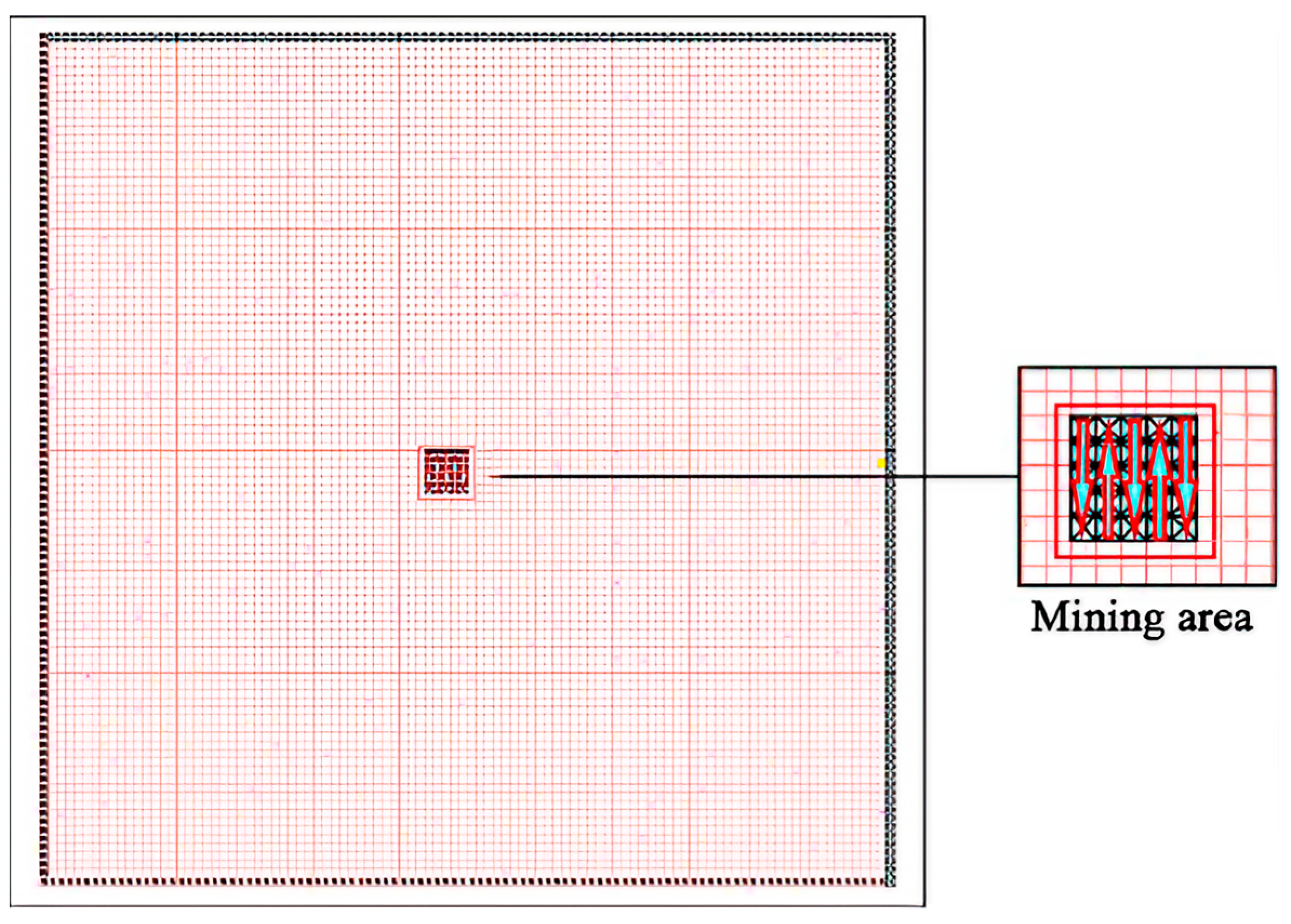
The model domain was set to cover an area of 10 km × 10 km. To ensure flow field stability, a uniform horizontal resolution of 50 m × 50 m was applied (Figure 5). The simulated water depth was 20 m, and a generalized sigma coordinate system was used in the vertical direction. The vertical resolution was set to 1 m, resulting in a total of 20 vertical layers, each comprising 40,000 grid cells. Although ocean current magnitudes vary by direction, the simulation primarily referenced the dominant flow direction. Two prevailing current directions—a strong northeastward flow and a strong southwestward flow—were selected.
Figure 5.
Model domain and boundaries (arrows indicate mining vehicle trajectory).
Parameter calibration was achieved by simulating the physical model of plume diffusion in a laboratory. The boundary conditions for the initial state were determined by specifying the inflow velocity. Examples included a strong northeastward current and a strong southwestward current, where the inlet flow rates were set based on the average velocity. The outflow boundary was treated as an open boundary. The eastern and northern inflow boundaries, each spanning 200 grid cells, were uniformly designated as inflow openings. Due to the gentle and smooth topographic variations within the domain, with slopes less than 5°, the bottom roughness was set to a relatively low value of 0.01. The simulation time step was defined as 5 s, and the total model simulation duration was 20 days. In all simulations, the boundary conditions were set according to the specific data referenced in the report, while certain physically unattainable conditions were simplified to acceptable levels.
4. Results and Discussion
4.1. Comparison with Experiment
EFDC first computes the hydrodynamic field to obtain the spatial and temporal distribution characteristics of a three-dimensional flow field. Based on this, the dynamic evolution of the plume influenced by flocculation and settling is subsequently simulated. In the validation process, we use the R2 value of the line of actual parameter vs. predicted parameter, defined for a general variable, X, compared with predictions of its values, Y. The Nash–Sutcliffe Efficiency coefficient (NSE) is employed to evaluate the performance of the simulation model. An NSE value approaching 1 indicates high model accuracy and strong predictive capability, reflecting a close match between simulated and observed values. When NSE is near 0, the model predictions approximate the mean of the observed data, suggesting that while general trends may be captured, substantial errors exist in reproducing the dynamic behavior of the system. Conversely, a significantly negative NSE implies that the model fails to represent the essential system characteristics, rendering its results unreliable. The statistical metrics are as follows: Mean Absolute Error (MAE) = 0.185, Relative Error (RE) = 0.047, Root Mean Square Error (RMSE) = 0.275, and Nash–Sutcliffe Efficiency coefficient (NSE) = 0.998. These results indicate that the model agreed well with the experimental results, and the default parameters of the sediment module in the EFDC model are reliable. Therefore, these default parameters can be adopted for subsequent plume simulation studies in deep-sea polymetallic nodule mining tests.
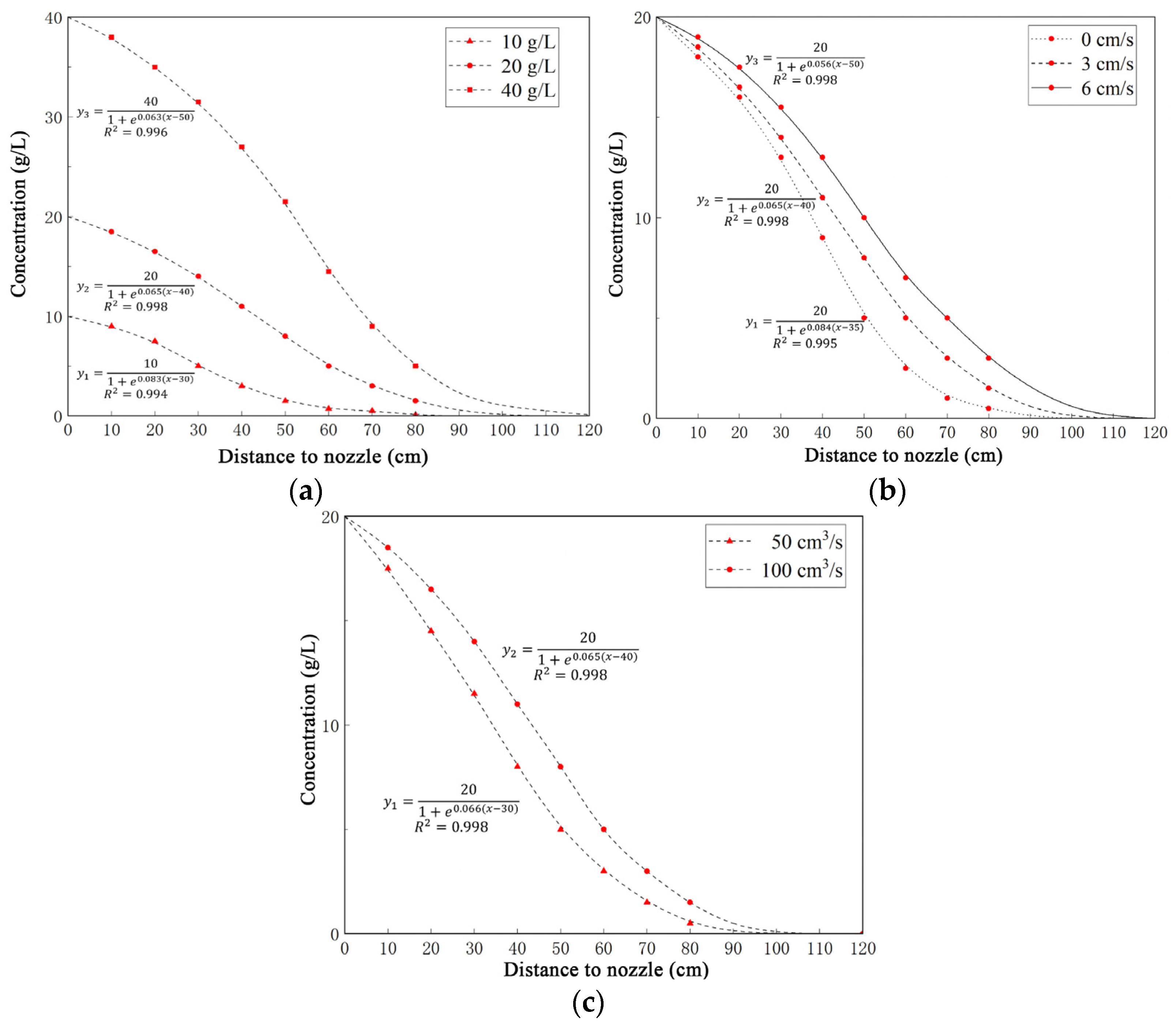
In order to better measure the influence of parameters such as initial mass concentration (), current velocity (v), and discharge flow rate (Q) on plume diffusion, the Gaussian diffusion model is used to fit them with the diffusion distance (L), and the fitted curves are shown in Figure 6. The results indicate that a higher initial mass concentration () accelerates plume settling, promotes the rapid formation of high-concentration accumulation zones, enhances stability, and produces a clearer diffusion boundary. In contrast, a higher discharge flow (Q) reduces the initial incident angle, expands the diffusion range, weakens stability, and results in more complex plume morphology. The relationships between initial mass concentration (), current velocity (v), discharge flow (Q), and plume diffusion distance (L) were fitted using the function . Where is the initial mass concentration, is a characteristic parameter that increases with greater , , and Q, while k is a coefficient that decreases as and v increase. Among these factors, current velocity exerts the strongest influence on , followed by and then Q. Consequently, higher current velocity and greater initial mass concentration both lead to longer plume diffusion distances. During the subsequent negative-buoyancy phase, sedimentation is dominated by the flocculation and settling of suspended particles and colloids. As the plume spreads and substantial sediment is deposited, particle concentration decreases and the plume enters a passive transport stage, where ocean currents become the primary driver of horizontal diffusion. Meanwhile, turbulence promotes vertical mixing, leading to the resuspension of fine particles.
Figure 6.
Gaussian diffusion model fitted curves, (a) with different discharging concentration, (b) with different discharging velocity, (c) with different discharging rate.
4.2. Field Simulation Results
The field-based simulation scenarios were primarily designed to assess the dispersion range of particles with different grain sizes in plume diffusion. Additionally, the effects of discharge height and ocean current velocity on plume behavior were also analyzed. Based on the six scenarios listed in Table 4, we compared the dispersion ranges of various particle sizes under different influencing factors.
Table 4.
The concentration of the mining plumes under different working conditions.
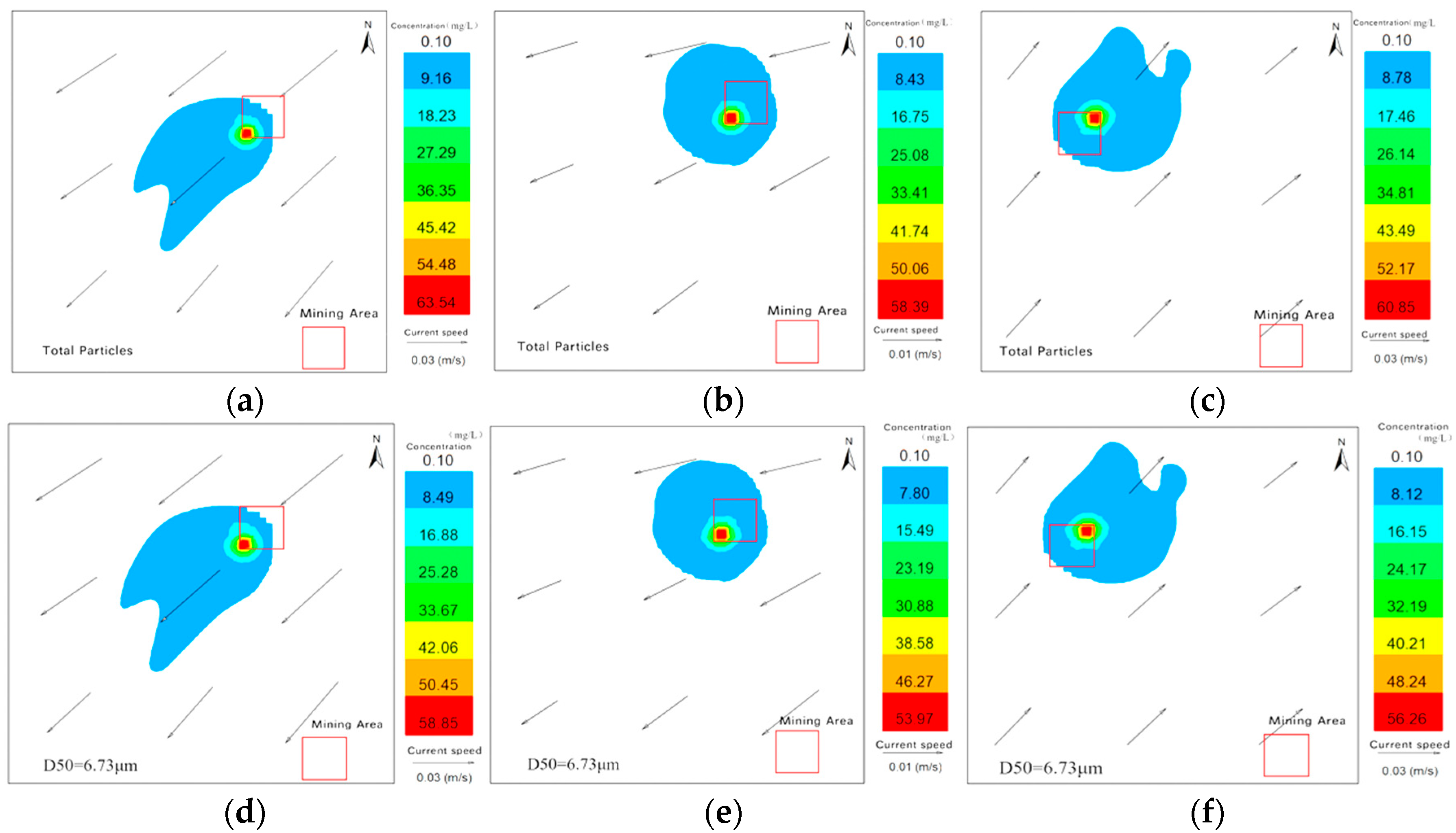
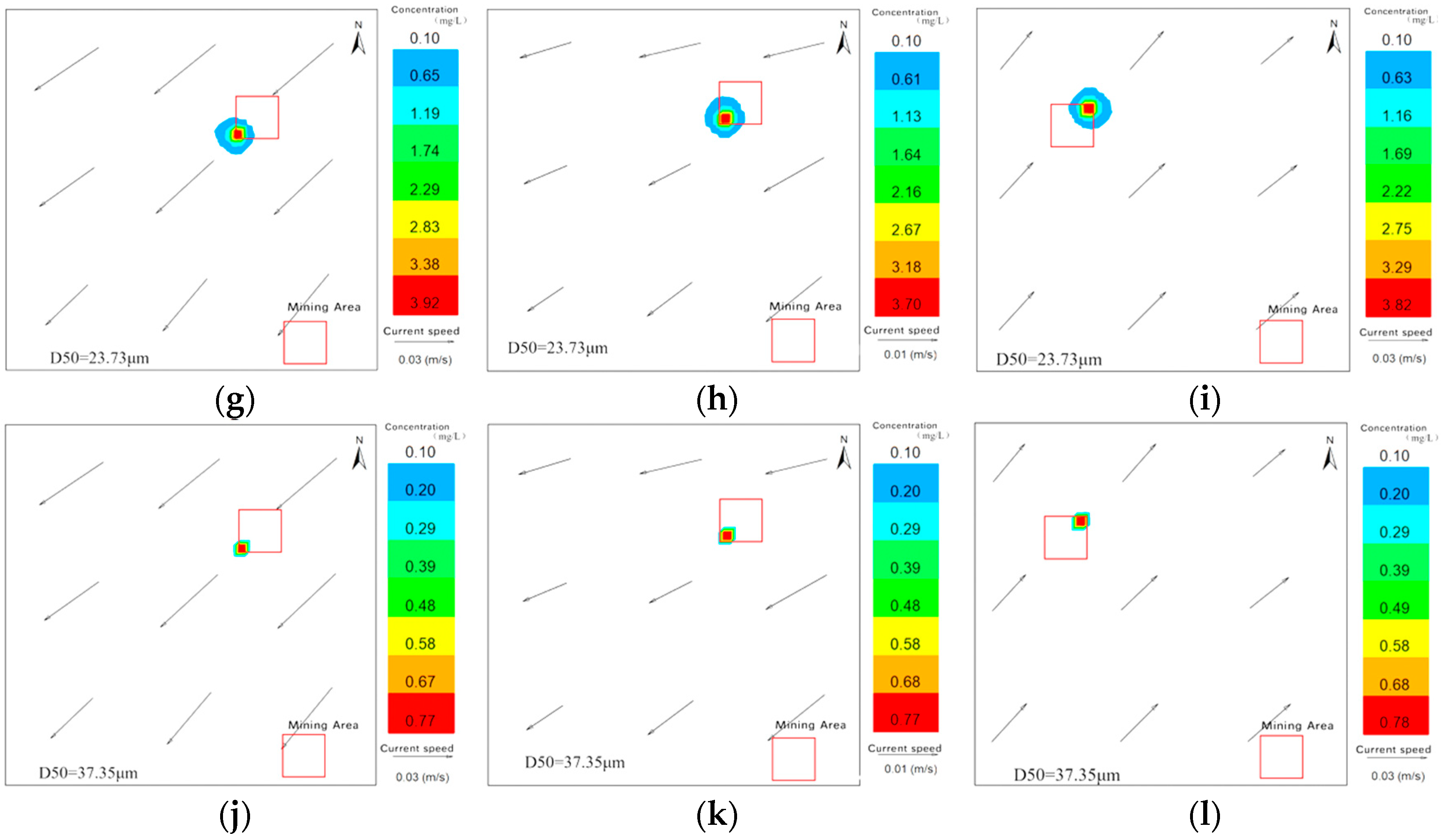
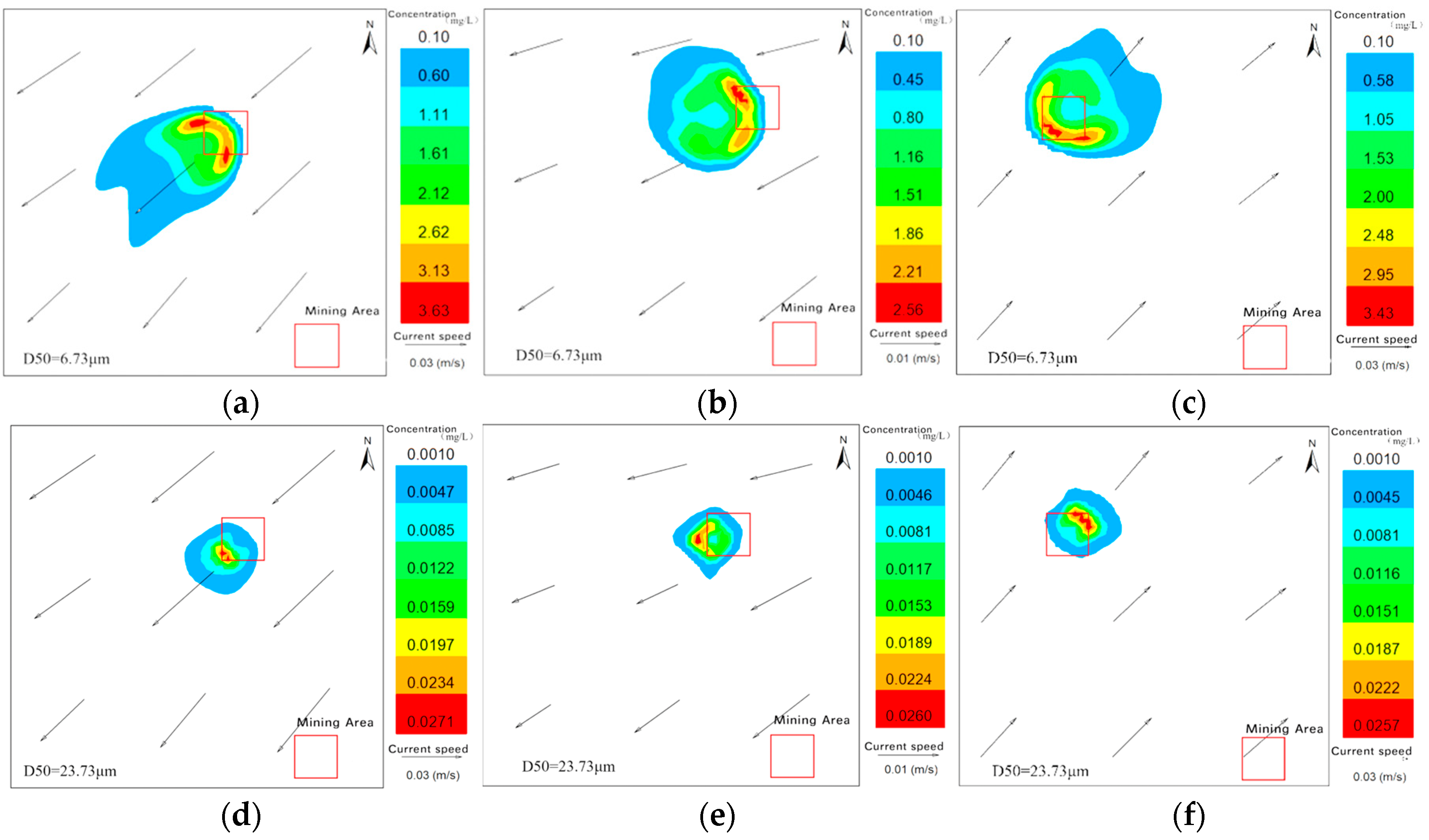
Figure 7 shows a comparison of concentration distribution and its corresponding scale in simulation with different current velocity conditions, which are all discharged at a height of 4 m above the seabed. It should be noted that, due to limitations of the software, only the maximum and minimum values in the legends can be standardized, while the colors corresponding to intermediate value intervals cannot be uniformly defined across different figures. Therefore, all the legends were provided with each figure separately. It can be observed from the figure that flow velocity plays a significant role in determining the direction of plume development regardless of the size of the particles, and the transport behavior of the plume was largely influenced by the finest sediment particles (Figure 7a–f). As expected, larger particles settle more rapidly during transport, resulting in a smaller dispersion range compared to finer particles (Figure 7d,g,j).

Figure 7.
Comparison of plume concentration diffusion under different ambient current velocities at a discharge height of 4 m. From left to right, the columns represent simulation results for Cases 1, 2, and 3, respectively. The top row shows the plume distribution of the mixed particles, while the subsequent rows illustrate the dispersion of particles with different median diameters. Eg, (a) total particles distribution for case 1, (b) total particles distribution for case 2, (c) total particles distribution for case 3; (d–f) particle distribution with a D50 = 6.73 μm class for case 1, 2 and 3, respectively; (g–i) particle distribution with a D50 = 23.73 μm class for case 1, 2 and 3, respectively; (j–l) particle distribution with a D50 = 37.35 μm class for case 1, 2 and 3, respectively.
When the sediment effluents were discharged from a height of 10 m above the seabed, their distribution behavior differed slightly from that observed at the 4 m discharge height. Similarly to the cases with a 4 m discharge height, variations in current velocity primarily affected the propagation direction of the plume despite the particle size. However, discrepancies between the two velocity components exerted a more pronounced influence on the shape of the plume. This phenomenon is also observed in the mid-sized particle group. Fine particles were also a decisive factor determining the impact of plume diffusion concentration. It is noteworthy that a higher discharge height resulted in a broader spatial dispersion of the plume (Figure 7a and Figure 8a). This is likely due to the longer settling distance required by fine particles; in the 4 m discharge scenarios, these particles are released relatively closer to the seabed, limiting their horizontal transport.
Figure 8.
Comparison of plume concentration diffusion under different ambient current velocities at a discharge height of 10 m. From left to right, the columns represent simulation results for Cases 4, 5, and 6, respectively. The top row shows the plume distribution of the mixed particles, while the subsequent rows illustrate the dispersion of particles with different median diameters. Eg, (a) total particles distribution for case 4, (b) total particles distribution for case 5, (c) total particles distribution for case 6; (d–f) particle distribution with a D50 = 6.73 μm class for case 4, 5 and 6, respectively; (g–i) particle distribution with a D50 = 23.73 μm class for case 4, 5 and 6, respectively; (j–l) particle distribution with a D50 = 37.35 μm class for case 4, 5 and 6, respectively.
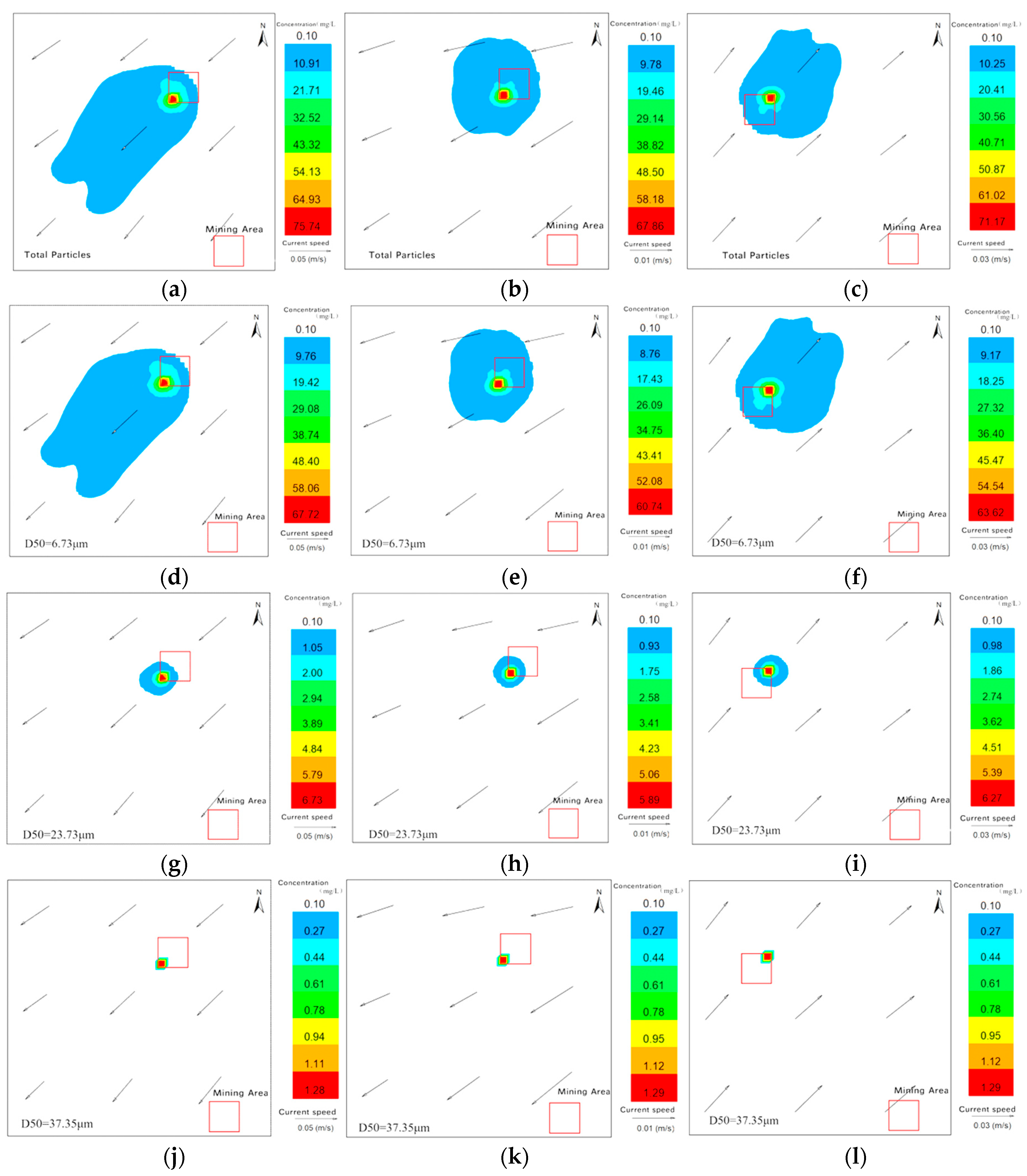
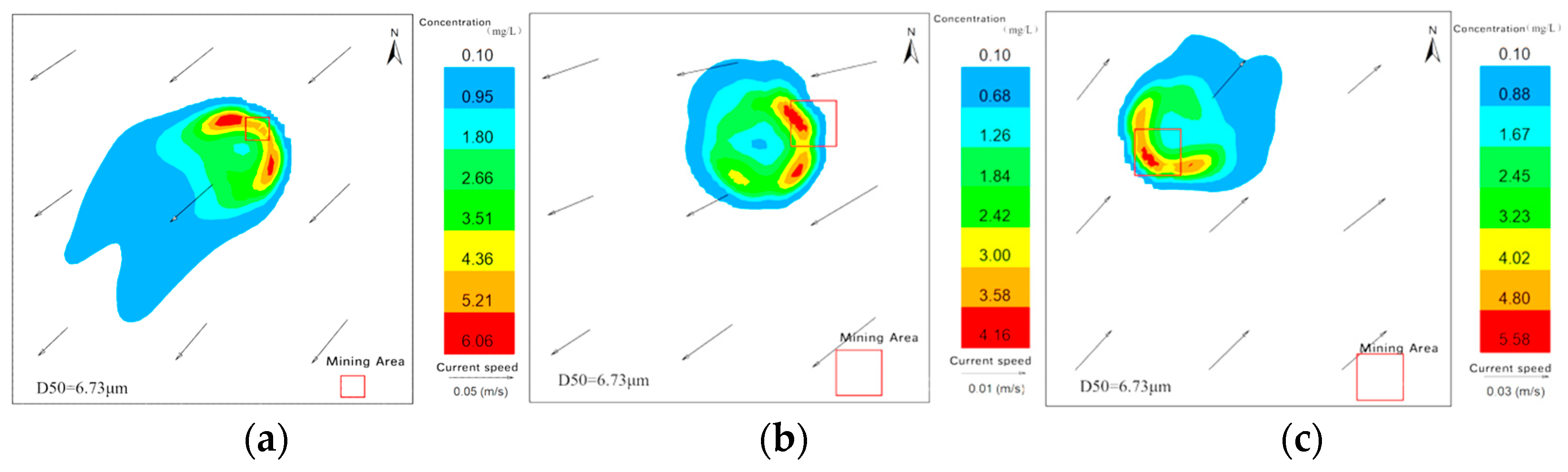
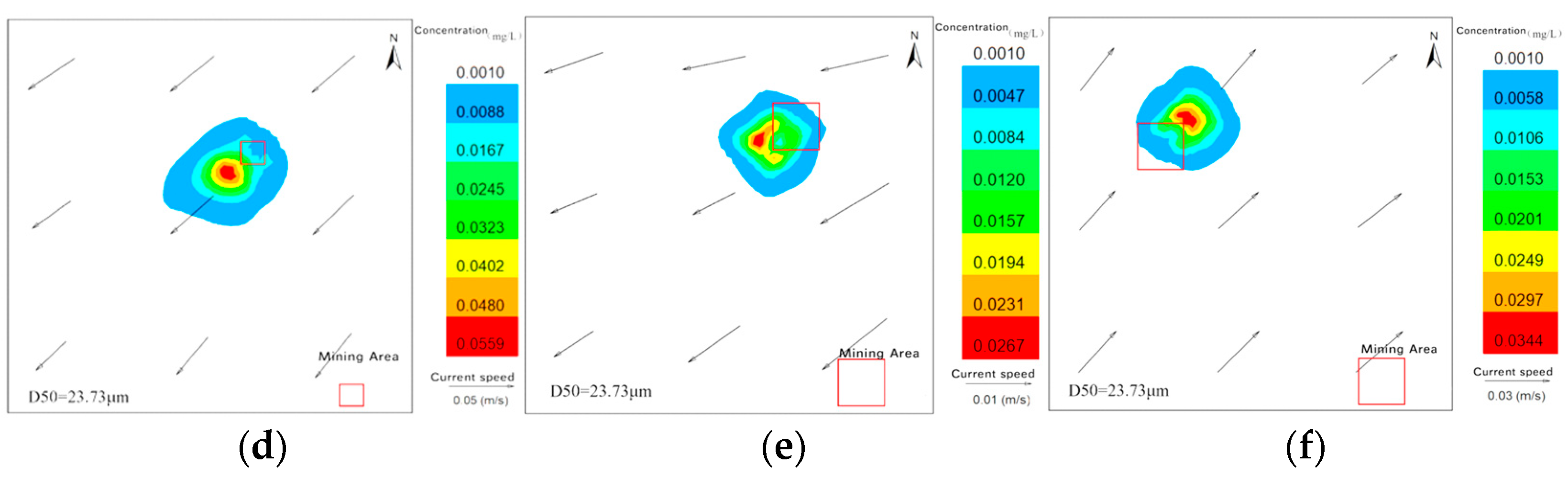
The assessment of plume dispersion effects should consider both the operational period and the post-mining phase, as fine particles may remain suspended in the water column for extended durations. Given larger particles tend to settle within a short time frame, the post-mining phase analysis focused solely on the fine and intermediate particle fractions. As shown in the figures, the plume concentration declined rapidly within one day after the termination of the operation. As the plume dispersed, the region of maximum concentration gradually increased in size.
One day after the cessation of mining operations, the maximum plume dispersion distance from the discharge point was less than 1.5 km under Scenario 1, less than 1 km under Scenario 2, and less than 0.5 km under Scenario 3. One day after mining operations cease, the maximum plume diffusion range is less than 2.5 km, 2 km, and 1.5 km for Case 4, Case 5, and Case 6, respectively. It can be easily seen from Figure 9a and Figure 10a that a higher discharge height can generate a larger area of sediment spreading.
Figure 9.
Comparison of plume concentration diffusion under different ambient current velocities at a discharge height of 4 m one day after mining stopped. From left to right, the columns represent simulation results for Cases 1, 2, and 3, respectively. Eg, (a) particle distribution with a D50 = 6.73 μm class for case 1, (b) particle distribution with a D50 = 6.73 μm class for case 2, (c) particle distribution with a D50 = 6.73 μm class for case 3, (d) particle distribution with a D50 = 23.73 μm class for case 1, (e) particle distribution with a D50 = 23.73 μm class for case 2, (f) particle distribution with a D50 = 23.73 μm class for case 3.

Figure 10.
Comparison of plume concentration diffusion under different ambient current velocities at a discharge height of 4 m one day after mining stopped. From left to right, the columns represent simulation results for Cases 4, 5, and 6, respectively. The top row shows the plume distribution of the mixed particles, while the subsequent rows illustrate the dispersion of particles with median diameters. Eg, (a) particle distribution with a D50 = 6.73 μm class for case 4, (b) particle distribution with a D50 = 6.73 μm class for case 5, (c) particle distribution with a D50 = 6.73 μm class for case 6, (d) particle distribution with a D50 = 23.73 μm class for case 4, (e) particle distribution with a D50 = 23.73 μm class for case 5, (f) particle distribution with a D50 = 23.73 μm class for case 6.
Three days after mining operations ceased, the plume had almost completely dissipated. The maximum plume concentrations for each scenario were as follows: 0.23 mg/L for Scenario 1, 0.26 mg/L for Scenario 2, 0.27 mg/L for Scenario 3, 0.40 mg/L for Scenario 4, 0.26 mg/L for Scenario 5, and 0.27 mg/L for Scenario 6. Due to differences in discharge height and average current velocity, when the discharge height was 10 m above the seabed, the plume settling time was longer, resulting in a wider migration and dispersion range and higher plume concentrations.
The effect of plume particle sedimentation was evaluated by the value of redeposition thickness of the suspended sediments, and the redeposition direction of the sediments is determined by the configured background flow field. Based on the density of plume particulate matter, the maximum redeposition thicknesses under Case 1–3 are all less than 10 cm. At a discharge height of 4 m, the maximum redeposition thickness is the largest under Case 2, reaching 3.4 cm, while the smallest is under Case 1, which is 3.1 cm. At a discharge height of 10 m, the maximum redeposition thickness is the largest under Case 6, amounting to 2.8 cm, and the smallest is under Case 4, being 2.7 cm. This indicates that larger current velocities are associated with thinner sediment redeposition. As the plume settles in the vertical direction, the maximum plume concentration in each scenario gradually decreases with increasing distance from the mining area. During the redeposition process, the plume is continuously affected by horizontal ocean currents. A higher discharge height results in a longer settling time; therefore, in Scenarios 4–6, the maximum plume concentrations at the farthest distance from the mining site remain above 0.30 mg/L, and the migration and dispersion range of the plume increases as the discharge point is positioned closer to the seabed. Increasing current velocity expands the migration and dispersion range of the plume but reduces its maximum concentration. Higher current velocity also enlarges the area where the redeposition thickness exceeds 1 mm, while decreasing the maximum redeposition thickness. With increasing discharge height, the mean current velocity becomes faster and the settling process takes longer, thereby expanding the redeposition impact range while reducing the maximum redeposition thickness.
4.3. Implications for Environmental Thresholds
The sediment plume was evaluated using particle-size classification. When a turbidity current develops, coarse particles typically settle in the near field, whereas fine particles are transported to the far field. Incorporating a multi-grain-size approach allows for a more realistic representation of sediment migration and deposition patterns, avoiding the “averaging” of temporal and spatial distributions that can obscure differences in ecological risks among particle sizes. It can be seen from the results under the scenarios of discharge at a fixed height, as the ocean current velocity increases, the maximum plume concentration increases and the diffusion range also expands. However, the maximum dispersion distance was not change monotonically with increasing current speed. This is because the change in sea flow direction, aligned with the driving direction, can enhance the diffusion effect of the current. The migration and diffusion under various working conditions are shown in Table 4.
The simulation results indicate that fine particles (<10 μm) dominate the suspended sediment composition in all cases, contributing over 85% of the maximum concentration. This high proportion of fine particles enhances plume persistence and facilitates long-distance transport, as their low settling velocity reduces gravitational deposition. Coarser particles (10–30 μm and >30 μm), although representing less than 15% of the suspended load, play a notable role in short-range deposition, particularly in cases with higher maximum dispersion distances. A comparison across cases reveals that the maximum dispersion distance varies from 0.46 km to 2.41 km. The largest dispersion occurs in Case 4, where the flow direction coincides with the travel direction of the disturbance source, strengthening the advective transport and horizontal mixing of the plume. Conversely, the shortest dispersion distance in Case 3 corresponds to a flow pattern opposing the disturbance movement, which promotes localized deposition and limits downstream transport. These findings highlight the critical influence of flow–source alignment on sediment plume extent, particularly for fine particles that remain in suspension over extended periods.
A comparison across cases (Table 5) shows that one day after cessation, dispersion areas for fine particles (<10 μm) remain substantially larger than for coarser particles, with the largest difference observed in Case 4 (3.76 km2 vs. 1.14 km2). By the third day, dispersion areas decrease markedly for all size categories, but fine particles still dominate, reflecting their prolonged suspension.
Table 5.
Dispersed area of the mining plumes under different working conditions.
It can be seen from Table 5, in all cases, the dispersion area for finer particles (<10 μm) is consistently and significantly larger than that for coarser particles (10–30 μm) at both the 1-day and 3-day marks. This strongly suggests that smaller particles have a much lower settling velocity, allowing them to remain suspended and spread over a wider area for a longer time.
For both particle size categories, the dispersion area decreases from day 1 to day 3. This indicates that particles are gradually settling out of the water column, leading to a reduction in the spatial extent of the plume over time. Since the larger particles settled out almost completely within the first three days, leaving a concentration below the detection or modeling threshold. This aligns with the general understanding that larger, coarser grains settle much faster.
As the plume settles vertically, the maximum concentration decreases progressively with distance from the mining site across all scenarios. During resettlement, horizontal sea currents continuously influence the plume. Higher discharge elevations prolong settling time, resulting in maximum plume concentrations above 0.30 mg/L even at the farthest points in scenarios 4–6. Additionally, plume migration and dispersion increase as the plume approaches the seabed. During mining operations, near-bottom plume concentrations range from 58.39 to 75.74 mg/L. Prolonged mining is thus likely to reduce seawater visibility and extend plume influence over several kilometers, exposing nearby benthic and swimming organisms to sustained low-level stress that may affect respiration, feeding, and communication. According to the Environmental Impact Statement by Beijing Pioneer Co., the average daily sedimentation flux in the near-bottom ocean layer is 12.94 mg/m2. Given the maximum plume concentrations, plume migration and dispersion are expected to significantly increase local turbidity. Therefore, future plume concentration thresholds should be established with reference to background sediment levels.
During plume discharge, the migration and dispersion of the plume are influenced by factors such as current velocity, particle size and adsorption characteristics, and the settling behavior of plume particles. Consequently, the thickness and area of resettlement under each scenario are affected by these variables. Based on the density of plume particles, the statistics of plume resettlement thickness for each scenario are presented in Table 6. To analyze the maximum sedimentation distribution area, the sedimentation area with thickness greater than 1 mm is defined as the maximum area, while areas with sedimentation thickness below this threshold are considered negligible.
Table 6.
Re-deposition thickness under different working conditions.
According to Table 6, the area where sediment redeposits with a thickness greater than 1 mm is remarkably consistent across all cases, with a narrow range of 0.261 to 0.282 km2. This parameter likely reflects the immediate and intense deposition zone close to the mining vehicle’s path. The distance from the source to the point of maximum deposition varies from 490 to 560 m. This spread suggests that bottom currents, or operational differences can influence how far the sediment plume travels before its heaviest particles settle out. The maximum redeposition thickness you recorded (27 to 34 mm) aligns with findings from real-world deep-sea tests. One study using millimeter-level seafloor photography measured redeposited sediment layers of approximately 30 mm near mining tracks, with localized erosion of up to 50 mm [45].
Under varying discharge heights and current velocities, both flow speed and discharge elevation significantly influence the maximum resettlement thickness and spatial extent of the sediment plume. As current velocity increases, the maximum resettlement thickness gradually decreases; meanwhile, higher discharge heights lead to a broader coverage area of sediment resettlement. Although the maximum thickness varies slightly with flow velocity, it remains below 4 cm across all cases, with all scenarios exhibiting resettlement thicknesses exceeding 1 mm. This indicates that plume particle settling is widespread and affects a considerable area.
The key environmental impact indicators of mining plumes mainly include redeposition thickness and turbidity. The 2013 Norwegian Oil and Gas report stated that in order to protect cold-water corals, the redeposition thickness should be less than 10 mm [46]. In a subsequent 2019 report [47], the environmental impact of redeposition thickness and its threshold ranges were further classified. Ma et al. conducted numerical simulations to analyze seawater turbidity, redeposition thickness, and other parameters, and discussed and quantified species’ responses to sediment plumes [48]. Hitchin et al. referred to threshold indicators from the oil and gas drilling industry and proposed additional indicators, including noise, light, redeposition thickness, and turbidity [49]. Stenvers et al. investigated the stress responses of jellyfish to sediment disturbance, noting that as midwater organisms, jellyfish are highly sensitive to sediment plumes generated by mining activities; their experimental results can therefore provide a basis for setting turbidity thresholds applicable to deep-sea mining plumes [50]. The Federal Agency for Nature Conservation, in its 2006 assessment of environmental impacts from shallow-water sand extraction, required that water turbidity not exceed 10 mg/L. Current small-scale trial mining results indicate that sediment disturbance can have significant adverse impacts on deep-sea organisms. Therefore, it is recommended that the turbidity thresholds for deep-sea mining plumes should be set lower than those for water bodies affected by shallow-water sand extraction (Table 7).
Table 7.
Environmental impact thresholds for sediment plume turbidity and deposition.
5. Conclusions
This integrated experimental-modeling approach provides a robust method for understanding benthic plume dynamics in deep-sea mining. The findings support cautious threshold development and adaptive environmental management practices.
- Sediments in the western Pacific are primarily composed of cohesive particles with sizes mostly ranging from 0 to 66.89 μm, a median size below 5 μm, and over 90% cohesive particles. The particle size distribution shows both bimodal and unimodal patterns. Sedimentation experiments calculated particle settling velocities ranging from 0.06 to 8.33 mm/s. Analysis revealed that during the first 0–14 min of settling, larger particles (30–66.9 μm) dominate the sediment, settling due to gravity. Smaller particles tend to aggregate via flocculation, forming larger flocs with higher settling velocities.
- During deep-sea nodule collection experiments, sediment was categorized into three groups based on median particle size (D50): cohesive sediments with 1 μm < D50 < 8 μm (80%), 8 μm < D50 < 32 μm (10%), and non-cohesive sediments with D50 > 32 μm (10%). Corresponding discharge source strengths (Q1, Q2, Q3) were calculated as 46.74 kg/s, 5.84 kg/s, and 5.84 kg/s, respectively. Experimental observations showed that the maximum diffusion area of the sediment plume reached 3.8 km2 under six tested scenarios; approximately three days after the discharge ceased, the plume had nearly dissipated completely. An increase in current velocity led to an expansion of the plume’s diffusion range, while simultaneously reducing the plume’s maximum concentration. Additionally, higher current velocity increased the area where the sediment resettlement thickness exceeded 1 mm, but decreased the overall resettlement thickness in those areas. A greater discharge height contributed to a higher average current speed in the surrounding water and prolonged the sediment settling time. This, in turn, expanded the total sediment resettlement area, though it also resulted in a reduction in the maximum resettlement thickness.
- After continuous plume discharge for 3 days, using 0.1 mg/L as the background concentration, the maximum plume diffusion distance exceeded 2.4 km with an area over 3 km2. The plume disappeared 3 days after the experiment ended. The area with resettlement thickness greater than 1 mm ranged from 0.261 to 0.282 km2, slightly larger than the experimental area (0.25 km2), indicating that the 1 mm thick resettlement was mostly confined near the test site.
- Based on simulation results, continuous deep-sea nodule collection over 3 days generates plume concentrations and resettlement thicknesses from suspended collector discharge that impact the deep-sea environment. Mining under the condition of 4 m discharge height and an average current velocity of 1.21 cm/s results in the least environmental impact.
- The plume’s migration, diffusion, and resettlement during deep-sea nodule collection pose potential environmental impacts. Under varying current speeds and discharge heights, near-bottom maximum plume concentrations ranged from 58.39 to 75.74 mg/L with diffusion areas between 1.69 km2 and 3.80 km2. After 3 days, concentrations dropped to 0.23–0.49 mg/L across six scenarios, with affected areas from 0.53 km2 to 2.41 km2. Maximum resettlement thicknesses ranged from 2.7 to 3.4 cm. Prolonged mining activities may cause sustained low-level plume concentrations and sediment resettlement over large areas, increasing impact range and severity—such as wider plume dispersion and resettlement thickness exceeding 5 cm—posing potential risks to marine ecosystems during months-long commercial mining.
- The scope of this study being limited to particle size effects in plume simulation, various other influencing factors were not elaborated. Despite the insights provided, this study has several limitations. The numerical model neglects small-scale turbulence interactions, which may affect the accuracy of simulated sediment plume diffusion in the near field. Moreover, considering the current measurement accuracy of experimental equipment for mass concentration, the observation duration of the physical experiment is relatively limited and therefore insufficient to capture the plume’s motion throughout its entire life cycle. Future research will systematically address flocculation impacts on plume dispersion and develop methodologies for characterizing sediment particle size distribution and determining critical parameters like settling velocity. At the same time, new technologies will be introduced into the experiments to enable more accurate measurements of plume dynamics for the low-concentration samples.
Author Contributions
Conceptualization, X.W. and J.X.; Methodology, X.W.; Software, Z.C.; Validation, X.W. and J.X.; Formal analysis, X.W.; Resources, Z.C.; Writing—original draft, X.W.; Writing—review & editing, X.W.; Supervision, J.X.; Project administration, J.X.; Funding acquisition, J.X. All authors have read and agreed to the published version of the manuscript.
Funding
This work was supported by the Major Program of National Natural Science Foundation of China (NSFC) (Grant No. 52394252); the National Key Research and Development Program of China by the Ministry of Science and Technology of the Peoples’ Republic of China (MOST) (Grant No. 2021YFC2801500), and by the National Natural Science Foundation of China (NSFC) (Key Program, Grant No. 52231012).
Data Availability Statement
Data associated with this research are available and can be obtained by contacting the corresponding authors.
Conflicts of Interest
Author Zekun Chen was employed by the company China Merchants Marine and Offshore Research lnstitute Co., Ltd. The remaining authors declare that the research was conducted in the absence of any commercial or financial relationships that could be construed as a potential conflict of interest.
References
- Jones, D.O.; Simon-Lledó, E.; Amon, D.J.; Bett, B.J.; Caulle, C.; Clement, L.; Huvenne, V.A. Environment, ecology, and potential effectiveness of an area protected from deep-sea mining (Clarion Clipperton Zone, abyssal Pacific). Prog. Oceanogr. 2021, 197, 102653. [Google Scholar] [CrossRef]
- Bai, T.; Zhao, Y.; Zhou, Y.; Huang, K. Numerical simulation and analysis of initial plume discharge of deep-sea mining. Ocean Eng. 2024, 310, 118794. [Google Scholar] [CrossRef]
- Liu, Z.; Zhang, Y.; Li, J.; Wang, H.; Xu, J. A modified drag coefficient model for calculating the terminal settling velocity and horizontal diffusion distance of irregular plume particles in deep-sea mining. Environ. Sci. Pollut. Res. 2024, 31, 33848–33866. [Google Scholar] [CrossRef]
- Peacock, T.; Ouillon, R. The fluid mechanics of deep-sea mining. Annu. Rev. Fluid Mech. 2023, 55, 403–430. [Google Scholar] [CrossRef]
- Kapil, M.; Sutherland, B.R.; Balasubramanian, S. Sediment characterization of bottom propagating reversing buoyancy particle-bearing jets. Phys. Rev. Fluids 2022, 7, 104302. [Google Scholar] [CrossRef]
- Gillard, B.; Purkiani, K.; Chatzievangelou, D.; Vink, A.; Iversen, M.H.; Thomsen, L. Physical and hydrodynamic properties of deep sea mining-generated, abyssal sediment plumes in the Clarion Clipperton Fracture Zone (eastern-central Pacific). Elem. Sci. Anth. 2019, 7, 5. [Google Scholar] [CrossRef]
- Morton, B.R.; Middleton, J. Scale diagrams for forced plumes. J. Fluid Mech. 1973, 58, 165–176. [Google Scholar] [CrossRef]
- Hess, W.N.; Hess, W.C. An Advection-Diffusion Model of the DOMES Turbidity Plumes; National Oceanic and Atmospheric Administration Environmental Research Laboratory, U.S. Department Commerce: Silver Spring, MD, USA, 1976; pp. 1–33. [Google Scholar]
- Halpern, D. Upper ocean circulation studies in the eastern tropical North Pacific during September and October 1975. In Proceedings of the Offshore Technology Conference, Houston, TX, USA, 5–8 May 1976. OTC-2457-MS. [Google Scholar]
- Jankowski, J.A.; Malcherek, A.; Zielke, W. Numerical modeling of sediment transport processes caused by deep sea mining discharges. In Proceedings of the OCEANS’94, Brest, France, 13–16 September 1994; Volume 3, pp. III/269–III/277. [Google Scholar]
- Jankowski, J.A.; Malcherek, A.; Zielke, W. Numerical modeling of suspended sediment due to deep-sea mining. J. Geophys. Res. Oceans 1996, 101, 3545–3560. [Google Scholar] [CrossRef]
- Klein, H. Near-bottom currents in the deep Peru Basin, DISCOL experimental area. Dtsch. Hydrogr. Z. 1993, 45, 31–42. [Google Scholar] [CrossRef]
- Taguchi, K.; Nakata, K.; Aoki, S.; Kubota, M. Environmental study on the deep-sea mining of manganese nodules in the Northeastern Tropical Pacific. In Proceedings of the ISOPE Ocean Mining and Gas Hydrates Symposium, Tsukuba, Japan, 21–22 November 1995. Paper ISOPE-M-95-025. [Google Scholar]
- Doi, T.; Nakata, K.; Kubota, M.; Aoki, S. Environmental study on the deep-sea mining of manganese nodules in the Northeastern Tropical Pacific—Modeling the sediment-laden negative buoyant flow. In Proceedings of the ISOPE Ocean Mining and Gas Hydrates Symposium, Goa, India, 8–10 November 1999. Paper ISOPE-M-99-025. [Google Scholar]
- Jankowski, A.J.; Zielke, W. The mesoscale sediment transport due to technical activities in the deep sea. Deep-Sea Res. Part II 2001, 48, 3487–3521. [Google Scholar] [CrossRef]
- Ouillon, R.; Kakoutas, C.; Meiburg, E.; Peacock, T. Gravity currents from moving sources. J. Fluid Mech. 2021, 924, A43. [Google Scholar] [CrossRef]
- Macpherson, G.; Tunstall, R. CFD validation of buoyancy driven jet spreading, mixing and wall interaction. Nucl. Eng. Des. 2020, 365, 110703. [Google Scholar] [CrossRef]
- Muñoz-Royo, C.; Peacock, T.; Alford, M.H.; Smith, J.A.; Le Boyer, A.; Kulkarni, C.S.; Ju, S.J. Extent of impact of deep-sea nodule mining midwater plumes is influenced by sediment loading, turbulence and thresholds. Commun. Earth Environ. 2021, 2, 148. [Google Scholar] [CrossRef]
- Elerian, M.; Huang, Z.; van Rhee, C.; Helmons, R. Flocculation effect on turbidity flows generated by deep-sea mining: A numerical study. Ocean Eng. 2023, 277, 114250. [Google Scholar] [CrossRef]
- van Smirren, J.; Banks, A.; Foster, T.; Clarke, M.; Marsh, L.; Allen, K. Observing Deep Water Sediment Plumes Using Mobile and Seabed Deployed Instrumentation. In Proceedings of the Offshore Technology Conference, Houston, TX, USA, 6–9 May 2024. Paper D021S023R006. [Google Scholar]
- Huang, K.; Zhao, Y.; Xu, W.; Lu, H.; Bai, T.; Zou, L. Research on numerical simulation of initial process of sediment discharge from deep-sea mining vehicle. Ocean Eng. 2025, 327, 120973. [Google Scholar] [CrossRef]
- Mousadik, S.E.; Ouillon, R.; Muñoz-Royo, C.; Slade, W.; Pottsmith, C.; Leeuw, T.; Peacock, T. In Situ Optical Measurement of Particles in Sediment Plumes Generated by a Pre-Prototype Polymetallic Nodule Collector. Sci. Rep. 2024, 14, 23894. [Google Scholar] [CrossRef]
- Lin, Y.; Weng, Z.; Guo, J.; Lin, X.; Phan-Thien, N.; Zhang, J. Simulation Study on the Sediment Dispersion during Deep-Sea Nodule Harvesting. J. Mar. Sci. Eng. 2023, 11, 10. [Google Scholar] [CrossRef]
- Zhou, Y.Q.; Zhao, Y.; Bai, T.B.; Huang, K. Study on the inhibitory effect of stern deflector on the diffusion of tail plume of deep-sea mining collector. Ocean. Eng. 2025, 43, 37–46. [Google Scholar]
- Liu, S.; Yang, J.; Lu, H.; Lin, Z.; Sun, P.; Zhang, B. Numerical and experimental investigation of the coupling effect of double plume discharge sources in deep-sea mining. Ocean Eng. 2025, 337, 121861. [Google Scholar] [CrossRef]
- Spearman, J.; Taylor, J.; Crossouard, N.; Cooper, A.; Turnbull, M.; Manning, A.; Lee, M.; Murton, B. Measurement and modelling of deep sea sediment plumes and implications for deep sea mining. Sci. Rep. 2020, 10, 5075. [Google Scholar] [CrossRef]
- Kuang, F.F.; Zhang, J.; Jing, C.; Guo, X.; Wang, C. Modelling of sediment plumes generated by deep-sea mining in CCZ. J. Appl. Oceanogr. 2024, 43, 462–472. [Google Scholar] [CrossRef]
- Lou, Y.; He, Z.; Han, X. Transport and deposition patterns of particles laden by rising submarine hydrothermal plumes. Geophys. Res. Lett. 2020, 47, e2020GL089935. [Google Scholar] [CrossRef]
- Barik, S.K.; Chauhan, P.S. Towards sustainable delta ecosystems: Pollution mitigation for achieving SDGs in Indian delta region. In Solid Waste Management in Delta Region for SDGs Fulfillment: Delta Sustainability by Waste Management; Springer Nature: Cham, Switzerland, 2024; pp. 27–46. [Google Scholar]
- Wood, P.J.; Armitage, P.D. Biological effects of fine sediment in the lotic environment. Environ. Manag. 1997, 21, 203–217. [Google Scholar] [CrossRef]
- Kemp, P.; Sear, D.; Collins, A.; Naden, P.; Jones, I. The impacts of fine sediment on riverine fish. Hydrol. Process. 2011, 25, 1800–1821. [Google Scholar] [CrossRef]
- Jones, J.I.; Murphy, J.F.; Collins, A.L.; Sear, D.A.; Naden, P.S.; Armitage, P.D. The impact of fine sediment on macro-invertebrates. River Res. Appl. 2012, 28, 1055–1071. [Google Scholar] [CrossRef]
- Extence, C.; Chadd, R.P.; England, J.; Dunbar, M.J.; Wood, P.J.; Taylor, E.D. The assessment of fine sediment accumulation in rivers using macro-invertebrate community response. River Res. Appl. 2013, 29, 17–55. [Google Scholar] [CrossRef]
- Dashtgard, S.E.; Gingras, M.K.; Pemberton, S.G. Grain-size controls on the occurrence of bioturbation. Palaeogeogr. Palaeoclimatol. Palaeoecol. 2008, 257, 224–243. [Google Scholar] [CrossRef]
- Smit, M.G.D.; Holthaus, K.I.E.; Trannum, H.C.; Neff, J.M.; Kjeilen-Eilertsen, G.; Jak, R.G.; Hendriks, A.J. Species sensitivity distributions for suspended clays, sediment burial, and grain size change in the marine environment. Environ. Toxicol. Chem. 2008, 27, 1006–1012. [Google Scholar] [CrossRef]
- Bradshaw, C.; Tjensvoll, I.; Sköld, M.; Allan, I.J.; Molvaer, J.; Magnusson, J.; Nilsson, H.C. Bottom trawling resuspends sediment and releases bioavailable contaminants in a polluted fjord. Environ. Pollut. 2012, 170, 232–241. [Google Scholar] [CrossRef]
- Pineda, M.C.; Strehlow, B.; Kamp, J.; Duckworth, A.; Jones, R.; Webster, N.S. Effects of combined dredging-related stressors on sponges: A laboratory approach using realistic scenarios. Sci. Rep. 2017, 7, 5155. [Google Scholar] [CrossRef] [PubMed]
- Pinheiro, M.; Oliveira, A.; Barros, S.; Alves, N.; Raimundo, J.; Caetano, M.; Santos, M.M. Functional, biochemical and molecular impact of sediment plumes from deep-sea mining on Mytilus galloprovincialis under hyperbaric conditions. Environ. Res. 2021, 195, 110753. [Google Scholar] [CrossRef]
- Dietrich, W.E.; Kirchner, J.W.; Ikeda, H.; Iseya, F. Sediment supply and the development of the coarse surface layer in gravel-bedded rivers. Nature 1989, 340, 215–217. [Google Scholar] [CrossRef]
- Cahoon, L.B.; Nearhoof, J.E.; Tilton, C.L. Sediment grain size effect on benthic microalgal biomass in shallow aquatic ecosystems. Estuaries 1999, 22, 735–741. [Google Scholar] [CrossRef]
- Bainbridge, Z.T.; Wolanski, E.; Álvarez-Romero, J.G.; Lewis, S.E.; Brodie, J.E. Fine sediment and nutrient dynamics related to particle size and floc formation in a Burdekin River flood plume, Australia. Mar. Pollut. Bull. 2012, 65, 236–248. [Google Scholar] [CrossRef]
- Jones, D.O.; Kaiser, S.; Sweetman, A.K.; Smith, C.R.; Menot, L.; Vink, A.; Clark, M.R. Biological responses to disturbance from simulated deep-sea polymetallic nodule mining. PLoS ONE 2017, 12, e0171750. [Google Scholar] [CrossRef] [PubMed]
- Gupta, L.K.; Pandey, M.; Raj, P.A.; Shukla, A.K. Fine sediment intrusion and its consequences for river ecosystems: A review. J. Hazard. Toxic Radioact. Waste 2023, 27, 04022036. [Google Scholar] [CrossRef]
- Gazis, I.-Z.; de Stigter, H.; Mohrmann, J.; Heger, K.; Diaz, M.; Gillard, B.; Baeye, M.; Veloso-Alarcón, M.E.; Purkiani, K.; Haeckel, M.; et al. Monitoring benthic plumes, sediment redeposition and seafloor imprints caused by deep-sea polymetallic nodule mining. Nat. Commun. 2025, 16, 1229. [Google Scholar] [CrossRef]
- Jones, D.O.; Durden, J.M.; Murphy, K.; Gjerde, K.M.; Gebicka, A.; Colaço, A.; Billett, D.S. Existing environmental management approaches relevant to deep-sea mining. Mar. Policy 2019, 103, 172–181. [Google Scholar] [CrossRef]
- Ulfsnes, A.; Haugland, J.K.; Weltzien, R. Monitoring of drilling activities in areas with presence of cold-water corals. Det Nor. Veritas 2012, 1691, 27. [Google Scholar]
- Offshore Norge. Species and Habitats of Environmental Concern, Mapping, Risk Assessment, Mitigation and Monitoring; The Norwegian Oil and Gas Association: Stavanger, Norway, 2019. [Google Scholar]
- Ma, W.; Schott, D.; van Rhee, C. Numerical calculations of environmental impacts for deep sea mining activities. Sci. Total Environ. 2019, 652, 996–1012. [Google Scholar] [CrossRef] [PubMed]
- Hitchin, B.; Smith, S.; Kröger, K.; Jones, D.; Jaeckel, A.; Mestre, N.; Ardron, J.; Escobar, E.; van der Grient, J.; Amaro, T. Thresholds in deep-seabed mining: A primer for their development. Mar. Policy 2023, 149, 105505. [Google Scholar] [CrossRef]
- Stenvers, V.I.; Hauss, H.; Bayer, T.; Havermans, C.; Hentschel, U.; Schmittmann, L.; Sweetman, A.K.; Hoving, H.-J.T. Experimental mining plumes and ocean warming trigger stress in a deep pelagic jellyfish. Nat. Commun. 2023, 14, 7352. [Google Scholar] [CrossRef] [PubMed]
- Kaikkonen, L.; Helle, I.; Kostamo, K.; Kuikka, S.; Törnroos, A.; Nygård, H.; Venesjärvi, R.; Uusitalo, L. Causal approach to determining the environmental risks of seabed mining. Environ. Sci. Technol. 2021, 55, 8502–8513. [Google Scholar] [CrossRef] [PubMed]
Disclaimer/Publisher’s Note: The statements, opinions and data contained in all publications are solely those of the individual author(s) and contributor(s) and not of MDPI and/or the editor(s). MDPI and/or the editor(s) disclaim responsibility for any injury to people or property resulting from any ideas, methods, instructions or products referred to in the content. |
© 2025 by the authors. Licensee MDPI, Basel, Switzerland. This article is an open access article distributed under the terms and conditions of the Creative Commons Attribution (CC BY) license (https://creativecommons.org/licenses/by/4.0/).