Abstract
This paper considers the problem of tracking a uniform moving source using noisy bearing measurements obtained from a distant observer. Observer trajectory optimization plays a central role in this problem, with the objective to minimize the estimation error of the target state. The Bearing Only Tracking (BOT) of passive targets is mainly focused on the observer maneuver with known trajectories and rarely focused on the future prediction of observer states using adaptive optimization strategies. In this paper, observer paths using one-step ahead optimization based on a performance index are devised which are potentially useful for longer horizon observer trajectory planning in passive tracking. This performance index is the function of source parameters termed as the determinant of Error Covariance Matrix (ECM) which is numerically more efficient than the determinant of Fisher Information Matrix (FIM). The determinant of the FIM requires the calculation of future values for target states and measurements rather than the current values, which is not feasible for Kalman like filters. Therefore, in this paper, the optimization technique is implemented using the state error covariance which is readily available through Kalman filter equations and does require separate numerical calculations. Due to optimal observer maneuver, the performance of the proposed algorithm does not depend on the initial conditions as compared to the conventional tracking methods. The efficiency of the evolutionary algorithm is calculated in terms of range, position and velocity errors and simulation results show 4% fewer estimation errors for ECM based optimization than the determinant of the FIM method.
1. Introduction
In the field of underwater target motion analysis, it is a prerequisite to detect or track an unknown source or target using data received from sonar installed on ships, submarines, UAVs, etc., without revealing their presence [1,2,3,4,5,6]. The aim of this paper is to propose a solution to the underwater Bearing Only Tracking (BOT) problem by estimating the actual states of a target. Due to the non-linear relationship between the unknown target states and bearing measurements, the research in BOT introduces additional difficulty regarding target observability [7,8,9,10]. The widely used methods to resolve these problems are categorized as batch processing and recursive Bayesian algorithms for BOT systems [11,12]. The linearization methods for Kalman Filters (KF), such as Extended Kalman Filter (EKF) and the sigma point class of KF, such as Unscented Kalman Filter (UKF) and Square Root UKF (SR-UKF), are useful in dealing with non-linearity problem in BOT systems. There are other variants of PF, such as Bootstrap Particle Filter (BPF), Rao–Blackwellized Particle Filter (RB-PF), Gauss Hermite Particle Filter (GH-PF) which are studied in recent years for attaining minimum estimation errors. The target state estimation methods along with the adequate observer maneuvering strategies have achieved improved effects on the overall observability of the actual target position in the BOT environment. The observer trajectory planning problem, also known as optimization in the literature, can be cast as a partially observed Markov decision process (POMDP) [13]. The decision process during tracking is carried out by minimizing the cost or maximizing the reward against a measure criterion that is related to the Fisher information or mutual information in [14]. Ghassemi and Krishnamurthy describe a method in [15], where they use a set of orthogonal basis functions to replace the brute force search for N-step planning ahead. Logothetis in [16] proposed an information theoretic approach to sensor scheduling whereas, S. E. Hammel in [17] defined the optimal observer paths for target localization characterized by the range to baseline ratio. Frew in [18], proposed the D-optimality criteria by using an exhaustive search approach and iteratively improved the predefined set of optimal observer courses based on previous measurements. In recent literature, a general framework of quantization and optimal control was established for observer trajectory using a cumulative sum of bearing rates and reward function [19,20,21,22,23]. The single step optimal observer maneuvers that maximize the observability criterion have been derived analytically in [21] for maneuvering targets. Sabet in [22], proposed a novel method which is a hybrid variant of the EKF algorithm and introduced three different swarm based optimization algorithms for finding the optimal values of measurement process noise covariance matrices. However, the optimal path planning for the observer is also done by using a cost function based on minimizing the Fisher Information Matrix (FIM). In [24,25], the observer maneuver optimization was carried out using state-of-the-art performance scalar functions which are the determinant of FIM and Renyi Information Divergence (RID) in the BOT framework. It is concluded that the determinant of FIM is a superior reward function than the RID based optimization. Moreover, the target positioning using a multilayer C-shaped observing sensor nodes are useful in designing suitable observer to target geometries as mentioned in references [26,27,28].
In this paper, we investigate the problem of tracking a constant velocity target via passive measurements using adaptive and optimal observer maneuver. Thus, the tracking error in terms of the estimated target states is a function of observer trajectories. This paper utilizes the Kalman filter based recursive algorithms for estimating target parameters for passive sensing of the target. The observer trajectory optimization is accomplished by maximizing the performance index, i.e., the determinant of Error Covariance Matrix (ECM) which is computationally and numerically better than the determinant or trace of FIM matrix for Kalman like estimators. The determinant of the FIM matrix as mentioned in references [22,24,25] requires the calculation of future values for target states rather than the present measured values. However, the error covariance is readily available through Kalman filter equations and requires calculation by separate equations. Additionally, for non-uniform moving targets, estimation of future states is not feasible to calculate the FIM effectively due to unpredictable target behavior. We compare the performance of the two performance functions, i.e., ECM and FIM for optimizing the tracking process through simulations. The optimization technique is implemented on KF based tracking methods, such as EKF and UKF as they are useful in the noise reduction process, as well as resolving the non-linearity problem in the BOT system.
The paper is organized as follows: the target to observer geometry has been defined through mathematical models in Section 2. The theory and derivation for performance index function based on state error covariance and CRLB are discussed in Section 3. In Section 4, the optimization strategy for optimal observer trajectory has been applied to derive the proposed tracking and estimation algorithm. Section 5, concludes the numerical simulations and results. The summary of research work and future suggestions are mentioned in Section 6.
2. Problem Formulation
In this paper, the underwater bearing only tracking system comprises of single uniform motion target along with single maneuvering observing station; both present in the same two dimensional Cartesian planes with X and Y coordinate axes. The target state vector is defined by its position and velocity coordinates as and similarly, the observer state vector is defined as . The relationship of the target state vector with the observer state is defined by the vector as given below:
The target model in the BOT system is not known exactly and is approximated by some statistical model; whereas, the observer model is predefined initially in the form of observer position and velocity coordinates. The target motion is approximated by a constant velocity (CV) discrete time linear model with state space representation as given below:
where k is the number of adaptation cycles and is the one step transition from the previous target state . The uncertainty in the target model is added through zero mean white process noise defined as below:
If is the time period between each sample of incoming measurements with the assumptions of constant target velocity, we can write in matrix form as below:
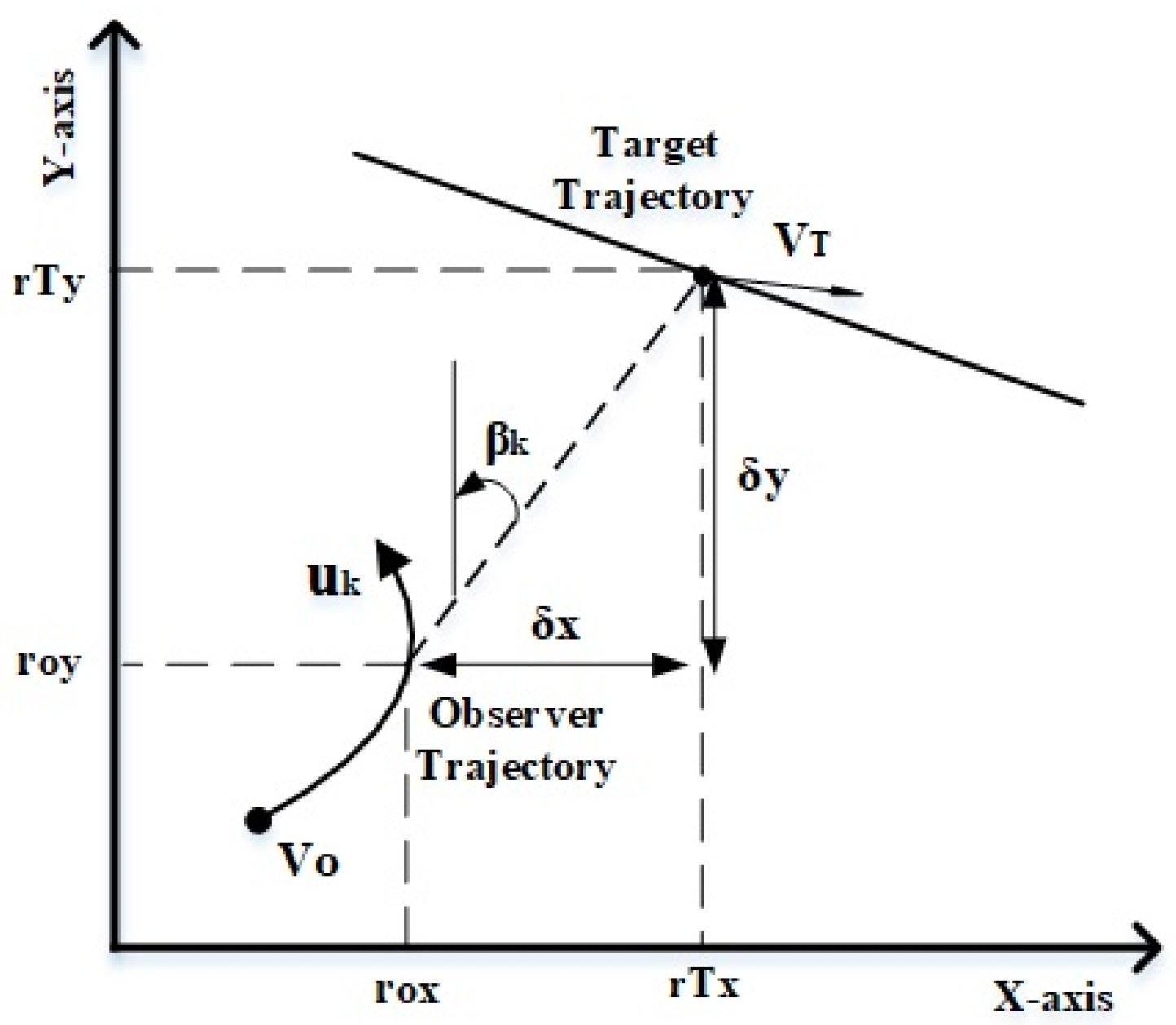
The target and observer are assumed to be in the same 2-D Cartesian plane and the geometry between them is shown in Figure 1.
Figure 1.
Target—Observer Geometry for BOT.
The target model in Equation (2) is dependent on the observer’s position and its maneuver relative to the target trajectory. The observer with position and velocity coordinates is given by the state vector and it is assumed to be moving at a constant speed with its kinematic equations of motion given by:
where is the instantaneous observer course at time step k measured from the X-axis. However, the non-linear observation model for the BOT system with noisy measurements received from the observing station is defined by the measurement matrix and is given as below:
The measurement noise in the above model is zero mean white noise with covariance is given by the expression:
The true bearing measurements are given by the equation:
The variable subscripts are used in the above equation to represent the x and y components for the target and observer state vectors. The measurement model can now be written in the form of noisy bearing measurements as given below:
Considering the utility of Kalman filtering algorithms in this paper, in above equation is considered as white Gaussian noise and noise covariance is initialized at the filter initialization stage. In the next two sections, the Kalman filters are implemented for non-linear estimation and observer optimization for the BOT system.
3. Non-Linear Estimation and Optimization Strategy for Observer in BOT
The single maneuvering observer tracks uniform moving targets using optimal observer trajectories. The target state and measurement models represented in Equations (2) and (10) above are discrete Gauss–Markov models which can be defined in matrix notation as given below:
It should be noted that the above models are developed under the assumptions of constant target velocity with white Gaussian noise assumption and for K adaptation cycles. Since the Kaman filter is basically a minimum mean square estimator, the initial estimated mean and state error covariance matrix and time step can be defined as given below:
In view of the target state model in Equation (2), the predicted state estimate and state transition matrix is defined by Equation:
Similarly, the predicted error covariance matrix is calculated in terms of the process noise covariance and state transition matrix is defined as given below:
We can calculate the measurement vector from Equation (10) as given below:
Since the measurement model in bearing only passive tracking is usually nonlinear; therefore, the nonlinear filtering model based on first-order Taylor expansion is used for linearizing the vector function in terms of ; however, the Kalman gain and the next updated state and covariance matrix are calculated on each iteration as:
The objective of an efficient estimation method is to minimize the target estimation error to the minimum. The Cramer Rao Lower Bound (CRLB) is a lower bound on estimation performance based on the inverse of the Fisher information matrices and is directly proportional to the error covariance of the target state. If we assume a non-random parameter and its estimated value , where Z represents the vector set of measurements, then as per the CRLB theorem, the error covariance matrix P bounded by the FIM matrix is given as below:
In above equation, represents the FIM matrix and the above condition corresponds to an efficient unbiased estimator. For the scalar cases, the FIM matrix is given by:
In the above Equation, is the conditional probability density function of the parameter X and measurement Z.
The estimation error covariance matrix is always a positive semidefinite matrix for an unbiased estimator and its quadratic form defines a hyper ellipsoid describing the distribution of errors. The sizes of the quasi axes of this hyper ellipsoid are defined by the eigenvalues and eigenvectors of the error covariance matrix (ECM). Thus, the one-sigma area of the error ellipse is expressed as:
In view of the above, the observability of the target trajectory is based on the minimization of the area given by , computed using the estimation error covariance matrix. Alternatively, by maximizing the determinant of the FIM matrix , we can design optimal or sub-optimal observer maneuver strategies [16,19]. In the present BOT problem, the FIM can be expressed as:
where the change in observer and target position coordinates is defined as below:
It is noted that the FIM requires the computation of all measurement sets and it is computationally more complex and non-recursive, so we need to use the alternate method which can be applied to only current measurement. On the basis of the above mentioned theory, and for the purpose of achieving the next predicted target state, we have proposed to discretize the current observer states with observer state for devising this sub-optimal strategy as given below:
where is the observer function dependent on the present observer state , recursion number k and is scalar vector function comprising i discrete equal steps for the observer course. The above mentioned discretized observer state model will be used to estimate the unknown target state while optimizing observer motion with data point set and measurements that act as an input to the estimation algorithm.
4. Modified State Estimator with Observer Optimization Strategy
In this paper, the set of discrete control inputs for observer course are calculated at each iteration k for one step ahead optimal observer state. Subsequently, the performance index or optimization criteria is defined by minimizing a scalar function of the estimated error covariance which is realized on each set of discrete observer control inputs to find the next optimized observer state. Practically, the previous observer state data set in the KF framework is represented as and the first element in this set is the error covariance matrix determined by the estimation method, whereas the other two variables are determined by the observer motion. To derive the proposed estimation algorithm, we first initialize the error covariance matrix (ECM) as and the predicted covariance is computed using and vector functions using the standard KF framework of Equation (16) are given as below:
Next, we shall find the predicted one step ahead error covariance by using the observer state and current set of observer courses defined by where the parameter L defines the upper limit of observer course in clockwise and anticlockwise directions. The maximum course is taken as 60 degrees with increments of 10 degrees in this paper and it mostly depends on the observation range of sonar. The performance index or threshold is defined by CRLB and error covariance.
Assuming only the current available measurement in the BOT system; the next observer state is calculated based on minimizing the determinant of ECM as mentioned by the relation:
After determining the covariance matrices with the optimized observer states defined by , we now calculate the predicted error covariance at the iteration k in terms of the course change as given below:
The measurement error is defined by the zero mean white noise vector and the measurement function is comprised of current bearing measurement and target state vector .
Let us assume the matrix function S to simplify Equation (29) by the expression below:
Using the expression in Equation (30), we can rewrite the Equation (29) for the predicted state covariance matrix as given below:
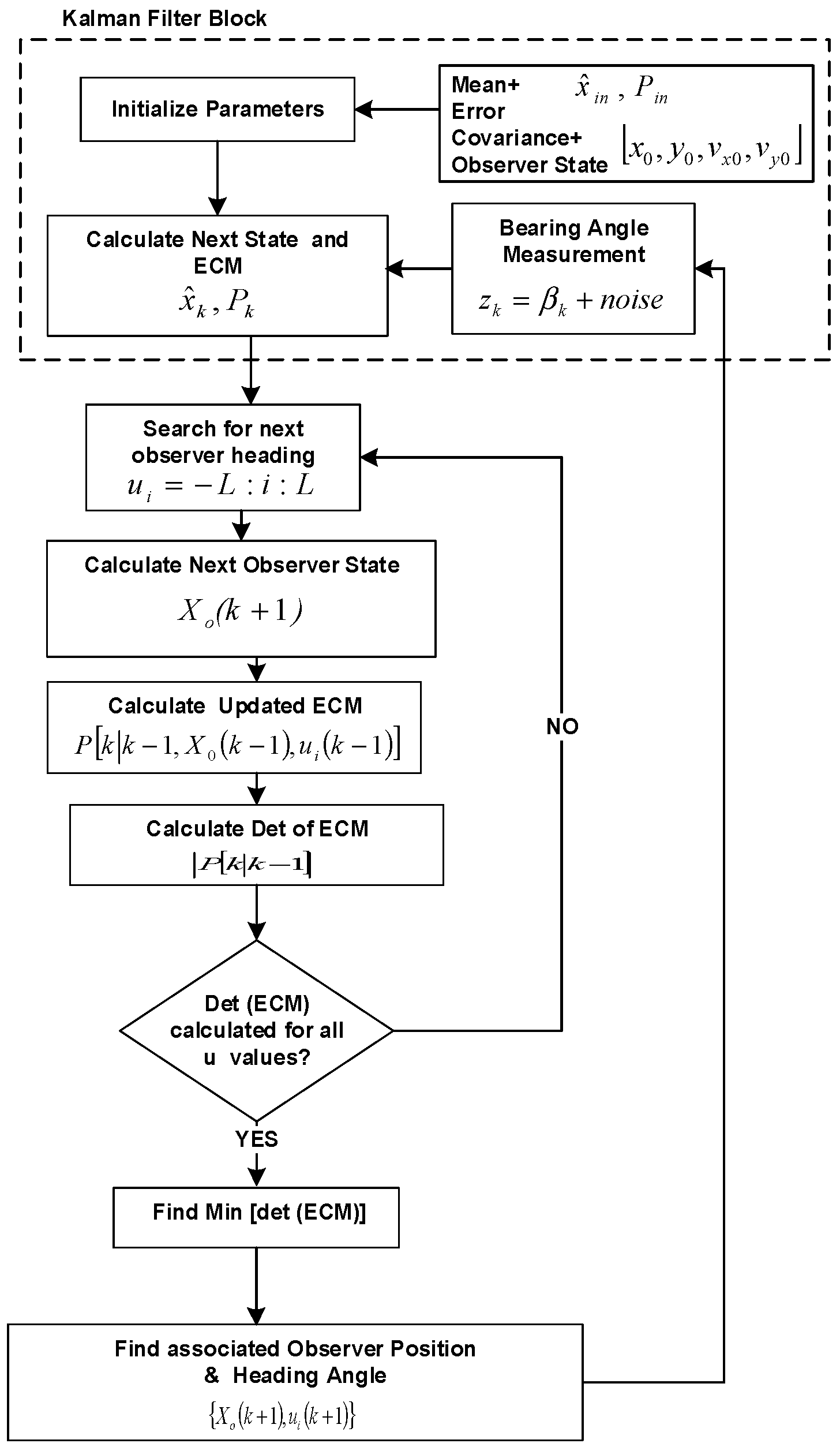
The next step is to find the lowest value in the minimization process of the ECM which is used for calculating the next optimized observer coordinates by using Equations (5) and (6), respectively. Refer to the Flow chart in Figure 2 for the steps in observer trajectory optimization. The optimization criteria using other observer models, such as straight-line Leg by Leg movement, sinusoidal and coordinated turn can be applied to analyze their performance on similar estimation algorithms. These coordinates will also affect the next bearing measurement calculated by Equation (9) incorporating the new optimum observer coordinates. All the above equations are applied in the recursive domain of Bayesian estimation methods which are redefined for optimal observer strategies.
Figure 2.
Flow chart for Sub-Optimal Observer Trajectory.
5. Simulation Results
The simulation results for the proposed scheme are mentioned in this section. For simulation experiments, the target is assumed to be moving with a constant speed of 8 knots at approximately 4000 m range and a heading angle of 110~130 degrees. The simulations have been carried out on 100 Monte Carlo iterations using the EKF algorithm with initialization parameters as mentioned in Table 1.
Table 1.
Simulation Parameters for Single Observer Bearing Only Tracking System.
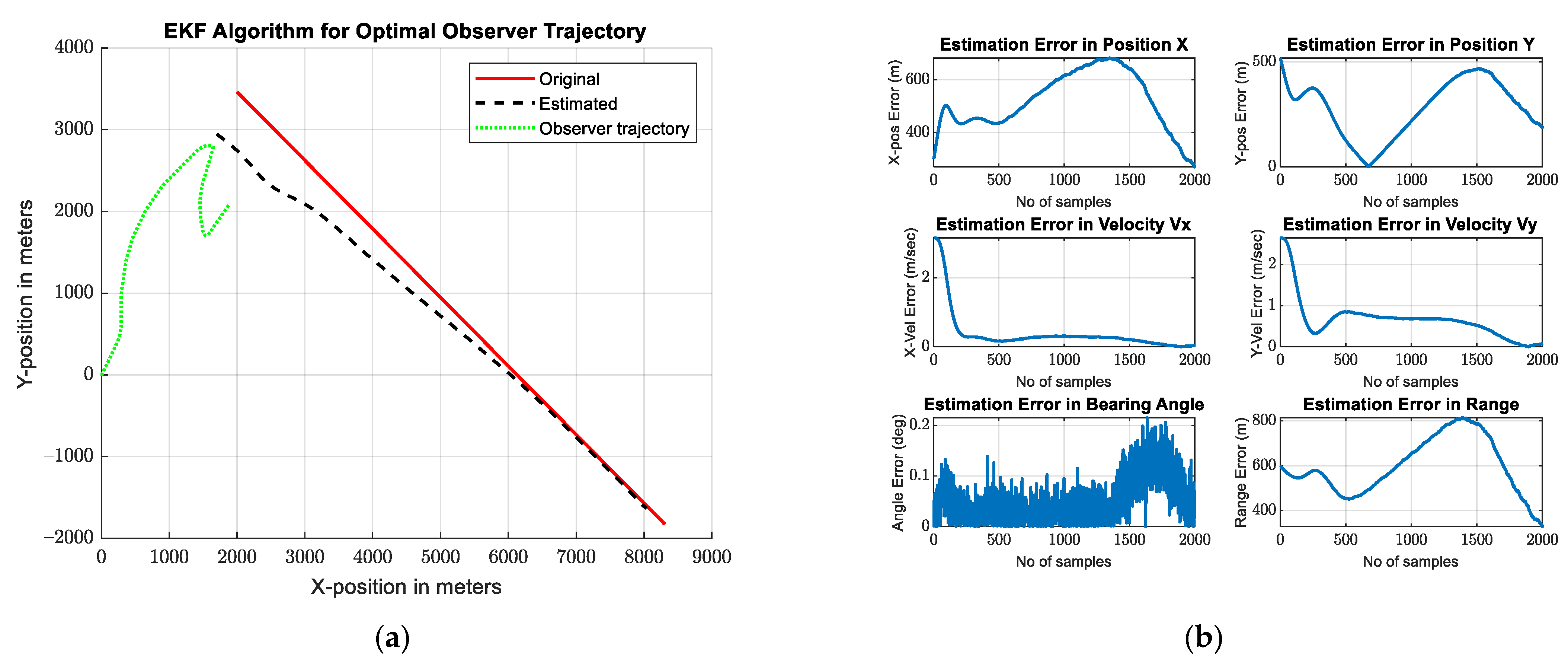
The optimal observer trajectory along with the original and estimated trajectories of a single uniform moving target is shown in Figure 3a. The observer follows the optimal path with a slightly random motion by changing its course on each iteration towards the actual target trajectory. The performance of the estimation algorithm is shown in Figure 3b in the form of estimation errors in position, velocity, range and bearing angles to the minimum values. It can be seen that the initial range error starting from 600 m has been reduced to 36.5 m within 2000 sampling intervals. The bearing angle difference between measured and estimated value is calculated as bearing angle error which remains within the limit of 0.15 degrees whereas position and velocity errors are reduced up to 30.5 m and 0.5 m/s, respectively.
Figure 3.
Simulation Results (a) Estimated Target Trajectory using EKF and; (b) Estimated Errors for Position, Velocity, Range, Bearing Angle for Optimal Observer path.
In order to explain the effect of observer maneuver on estimation performance, we can define the bearing rate as given by:
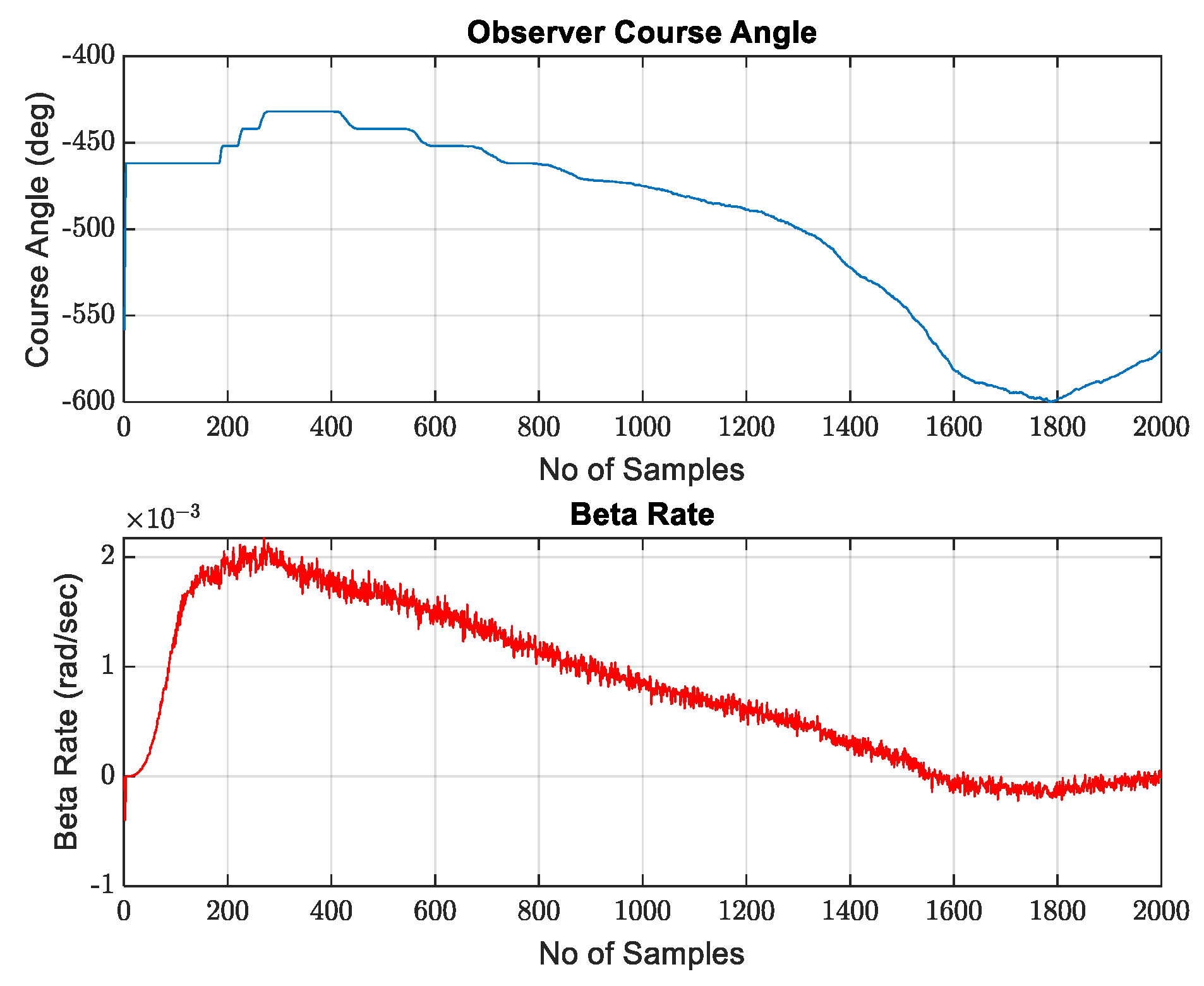
The vector denotes the previously estimated bearing, T is the sampling period and denotes the sampling time. The simulation results for the beta rate are shown in Figure 4.
Figure 4.
Simulation Results for Beta Rate and Course Angles for Optimal Observer Strategy.
Figure 4 also shows different observer course changes in positive and negative directions with discrete steps at each iteration. The variations in bearing or beta rate concluded that with the subsequent reduction in target estimation errors, the bearing rate changes within the constant limit of 0.3 rad/s.
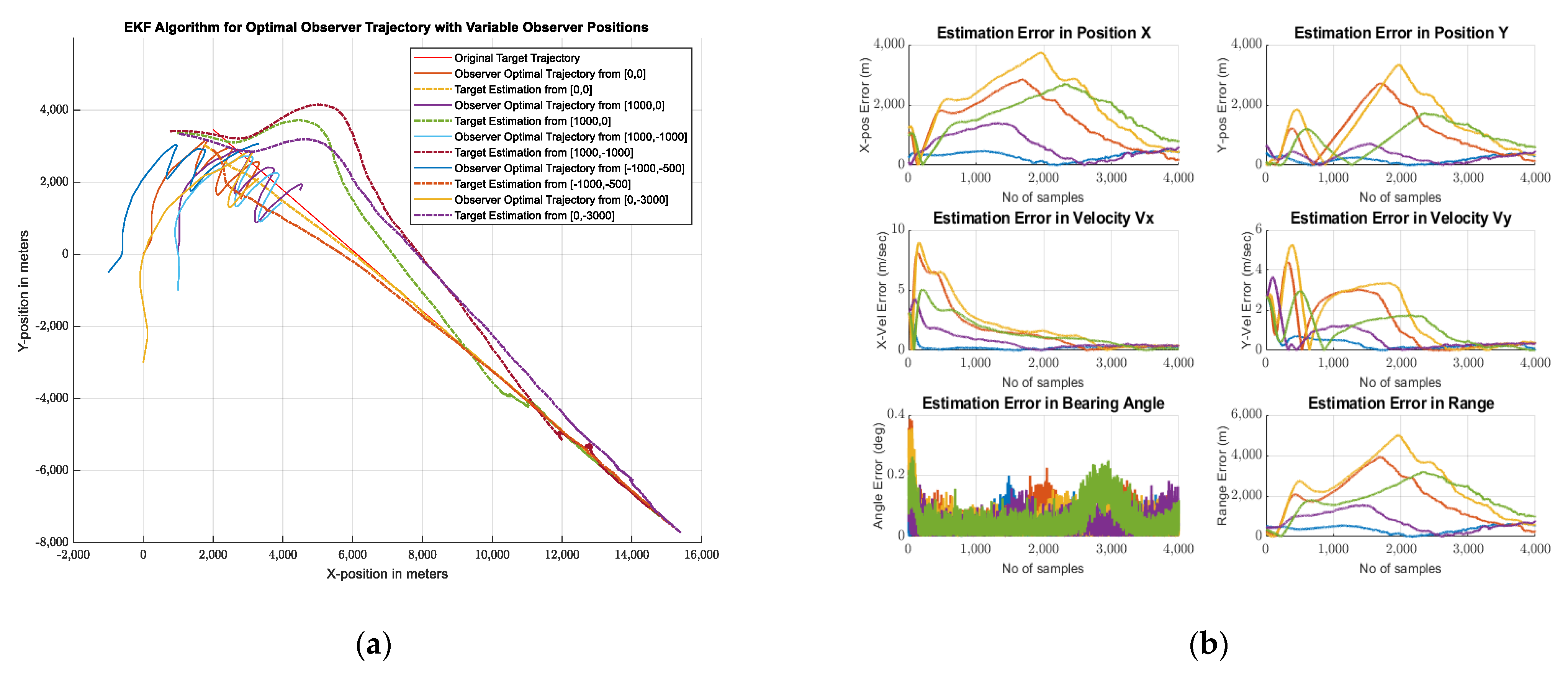
Apart from the above results, the simulations were performed to track uniform motion targets with different observer initial positions as some estimators do not perform well when the observer is placed far from the origin. The simulations have been performed for 4000 sampling intervals as per the parameters mentioned in Table 1 for observer initial positions at (0, 0), (1000, 0), (1000, −1000), (−1000, −500) and (0, −3000) in X and Y axes, respectively. The statistical results averaged over 100 Monte Carlo runs by selecting discrete observer courses as per = using an optimization process by following snake like trajectories towards the target.
The graphical representation for the target and observer trajectories along with results in terms of estimation errors for ECM based estimation is shown in Figure 5. It can be seen that the position and velocity errors are reduced to a near minimum both in X and Y coordinates. The initial range error reduces to a minimum of 192 m and 287 m due to the observer at position coordinates (1000, 0) and (0, −3000), respectively. The results show that all estimated target trajectories plotted on the same graph ultimately converge to the actual uniform target trajectory at the final sampling time.
Figure 5.
(a) Estimated Trajectories for Variable Initial Positions of Observer using EKF and; (b) Estimated Errors for Position, Velocity, Range, Bearing Angle for Optimal Observer path.
The estimation errors for optimal observer maneuver using the ECM matrix alongside the FIM matrix are calculated separately and mentioned in Table 2 for comparison based on an EKF based estimation algorithm. The numerical results for position and velocity estimation errors at final sampling time show 3% less percentage of errors for ECM based optimization as compared with the determinant of the FIM method.
Table 2.
Comparison of EKF based Optimal Observer Maneuver using ECM and FIM method.
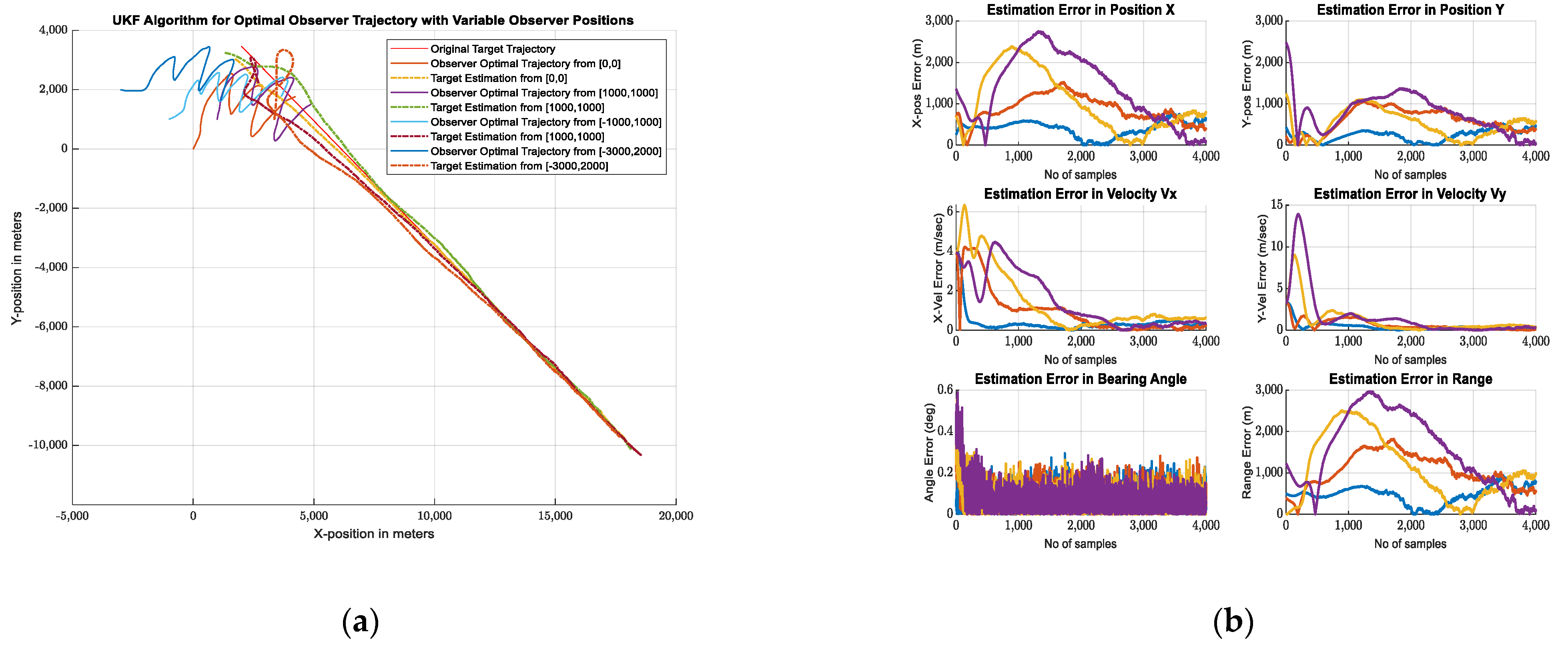
Similarly, the estimated target trajectories using the UKF algorithm are plotted on the same graph to see the effect of using different observer positions at (0, 0), (1000, 1000), (−1000, 1000), (−3000, 2000) in the X and Y axes, respectively. The graphical representation for the target and observer trajectories along with results in terms of estimation errors for the ECM based estimation is shown in Figure 6. All the dotted line graphs represent estimated target trajectories which ultimately converge on the actual trajectory after 4000 sampling intervals. The observer is placed at various initial positions but the observing station gradually moves towards the target with a snake like maneuver by optimizing its trajectory one step ahead at each iteration.
Figure 6.
(a) Estimated Trajectories for Variable Initial Positions of Observer using UKF and; (b) Estimated Errors for Position, Velocity, Range, Bearing Angle for Optimal Observer path.
The estimation errors for optimal observer maneuver using the ECM matrix alongside the FIM matrix are calculated separately and mentioned in Table 3 for comparison based on a UKF based estimation algorithm.
Table 3.
Comparison of UKF based Optimal Observer Maneuver using ECM and FIM method.
The initial range error reduces to a minimum of 233 m due to observer at position coordinates (1000, 1000) and 484 m at observer coordinates (−3000, 2000) within total of 4000 sampling intervals. The numerical results for position and velocity estimation errors at final sampling time show 4% less percentage of errors for the ECM based optimization as compared with the determinant of the FIM method.
6. Conclusions
In this paper, simulations are performed by implementing the sub-optimal observer trajectories by using the maximization of the statistical performance function. We compare the performance of the two important performance functions, i.e., determinant of the ECM and FIM matrices used for optimizing the estimation and tracking process of passive target. The optimization technique is implemented on KF based tracking methods, such as EKF and UKF which are useful in the noise reduction process as well as in resolving the non-linearity problem in the BOT system. Some estimated trajectories for tracking passive targets take a longer time to converge on the original trajectory depending on different observer initial coordinates. Therefore, in this paper, we analyze the performance of the proposed method through MATLAB simulations by changing initial positions for observers in the case of uniform moving targets. The proposed algorithm performs much better than the FIM based optimization in BOT systems as observed through position and velocity errors calculated at the final sampling interval. For future analysis, the observability of the target can also be analyzed using a single observing station in the case of multiple targets and by implementing other robust estimation algorithms. However, for multiple targets, data association schemes will be applicable along with estimation algorithms.
Author Contributions
Conceptualization, A.N.; methodology, A.N.; software, H.Q.; validation, H.Q.; formal analysis, A.N.; investigation, C.C.; resources, Y.L.; data curation, L.X.; writing—original draft preparation, A.N.; writing—review and editing, Y.L.; supervision, Y.L.; funding acquisition, Y.L. All authors have read and agreed to the published version of the manuscript.
Funding
This research was funded by the Guangdong marine economic development project (GDNRC2021-31), and the National Natural Science Foundation of China, Grant No.11874302.
Institutional Review Board Statement
Not Applicable.
Informed Consent Statement
Not Applicable.
Data Availability Statement
Not Applicable.
Conflicts of Interest
The authors declare no conflict of interest.
References
- Bar-Shalom, Y.; Li, R.X.; Kirubarajan, T. Estimation with Applications to Tracking and Navigation: Theory Algorithms and Software; John Wiley & Sons: Hoboken, NJ, USA, 2001. [Google Scholar]
- Zhong, L.; Feng, Z. Bearing-Only Target Motion Analysis; National Defense Industry Press: Beijing, China, 2009. [Google Scholar]
- Stanfield, R.G. Statistical theory of DF Fixing. J. Inst. Electr. Eng. -Part III A Radiocommun. 1947, 94, 762–770. [Google Scholar]
- Ancker, C.J. Airborne Direction Finding—The Theory of Navigation Error. IRE Trans. Aeronaut. Navig. Electron. 1958, 4, 199–210. [Google Scholar] [CrossRef]
- Blachman, N.M. Position Determination from Radio Bearings. IEEE Trans. Aerosp. Electron. Syst. 1969, 3, 558–560. [Google Scholar] [CrossRef]
- Li, X.; Li, Y.; Liu, C.W. Research of New Concept Sonar-cognitive Sonar. J. Mar. Sci. Appl. 2011, 10, 502–509. [Google Scholar] [CrossRef]
- Lindgren, A.G.; Gong, K.F. Position and Velocity Estimations via Bearing Observations. IEEE Trans. Aerosp. Electron. Syst. 1977, 4, 564–577. [Google Scholar]
- Nardone, S.C.; Aidala, V.J. Observability Criteria for Target Motion Analysis. IEEE Trans. Aerosp. Electron. Syst. 1981, AES 17, 162–166. [Google Scholar] [CrossRef]
- Oshman, Y.; Pavel, D. Optimization of Observer Trajectories for Bearings-Only Target Localization. IEEE Trans. Aerosp. Electron. Syst. 1999, 35, 892–902. [Google Scholar] [CrossRef]
- Payne, A.N. Observability Problem for Bearing Only Tracking, Electronics Engineering Department, Lawrence Livermore National Laboratory; University of California: Livermore, CA, USA, 1989. [Google Scholar]
- Nardone, S.C.; Lingren, A.G.; Gong, K.F. Fundamental Properties and Performance of Conventional Bearing only Target Motion Analysis. IEEE Trans. Autom. Control. 1984, 29, 775–787. [Google Scholar] [CrossRef]
- Wasiq, A.; Li, Y.; Javaid, K.; Ahmed, N. Performance Analysis of Gaussian Optimal Filtering for Underwater Passive Target Tracking. Wirel. Pers. Commun. 2020, 115, 61–76. [Google Scholar]
- Cadre, J.-P.L.; Tremois, O. Optimization of the Observer Motion Using Dynamic Programming. In Proceedings of the 1995 International Conference on Acoustics, Speech, and Signal Processing, Detroit, MI, USA, 9–12 May 1995. [Google Scholar]
- Fawcett, J.A. Effect of Course Maneuvers on Bearing Only range estimation. IEEE Trans. Acoust. Speech Signal Process. 1988, 36, 1193–1199. [Google Scholar] [CrossRef]
- Ghassemi, F.; Krishnamurthy, V. A method for constructing the observer trajectory in bearins-only tracking of targets with a Markovian model. In Proceedings of the 2005 IEEE International Conference on Information Acquisition, Hong Kong, China, 27 June–3 July 2005. [Google Scholar]
- Logothetis, A.; Krishnamurthy, V.; Holst, J.; Isaksson, A. Modal State Estimation of a Maneuvering Target in Clutter. In Proceedings of the 36th IEEE Conference on Decision and Control, San Diego, CA, USA, 10–12 December 1997. [Google Scholar]
- Hammel, S.E.; Liu, P.T.; Hilliard, E.J.; Gong, K.F. Optimal Observer motion for Localization with Bearing Measurements. Comput. Math. Appl. 1989, 18, 171–180. [Google Scholar] [CrossRef] [Green Version]
- Frew, E.W. Observer Trajectory Generation for Target-Motion Estimation Using Monocular Vision. Ph.D. Dissertation, Stanford University, Stanford, CA, USA, August 2003. [Google Scholar]
- Zhang, H.; Dufour, F.; Anselmi, J. Piecewise Optimal Trajectories of Observer for Bearings-Only Tracking by Quantization. In Proceedings of the 20th International Conference on Information Fusion, Xi’an, China, 10–13 July 2017. [Google Scholar]
- Wu, H.; Chen, S.; Yang, B.; Luo, X. Range-parameterized orthogonal simplex cubature Kalman filter for bearings-only measurements. IET Sci. Meas. Technol. 2016, 10, 370–374. [Google Scholar] [CrossRef]
- He, S.; Shin, H.; Tsourdos, A. Trajectory Optimisation for Target Localisation with Bearing-Only Measurement. IEEE Trans. Robot. 2019, 35, 653–668. [Google Scholar] [CrossRef] [Green Version]
- Sabet, M.T.; Fathi, A.R. Optimal design of the Own Ship maneuver in the bearing-only target motion analysis problem using a heuristically supervised Extended Kalman Filter. Ocean Eng. 2017, 123, 146–153. [Google Scholar] [CrossRef]
- Hou, X.; Zhou, J.; Yang, Y.; Yang, L.; Qiao, G. Adaptive Two-Step Bearing-Only Underwater Uncooperative Target Tracking with Uncertain Underwater Disturbances. Entropy 2021, 23, 907. [Google Scholar] [CrossRef] [PubMed]
- He, R.; Chen, S.; Wu, H. Optimal Maneuver Strategy of Observer for Bearing-Only Tracking in Threat Environment. Int. J. Aerosp. Eng. 2018, 2018, 7901917. [Google Scholar] [CrossRef] [Green Version]
- Wang, X.; Ristic, B.; Himed, B.; Moran, B. Trajectory Optimization for Cooperative Target Tracking with Passive Mobile Sensors. Signals 2021, 2, 174–188. [Google Scholar] [CrossRef]
- Hashemi, S.H.; Pariz, N. Adaptive Transformed Unscented Simplex Cubature Kalman Filter for Target Tracking. IETE J. Res. 2021, 2021, 1–9. [Google Scholar] [CrossRef]
- Wang, D.; Zhang, H.; Ge, B. Adaptive Unscented Kalman Filter for Target Tacking with Time-Varying Noise Covariance Based on Multi-Sensor Information Fusion. Sensors 2021, 21, 5808. [Google Scholar] [CrossRef] [PubMed]
- Oh, R.; Shi, Y.; Choi, J.W. A Hybrid Newton-Raphson and Particle Swarm Optimization Method for Target Motion Analysis by Batch Processing. Sensors 2021, 21, 2033. [Google Scholar] [CrossRef] [PubMed]
Publisher’s Note: MDPI stays neutral with regard to jurisdictional claims in published maps and institutional affiliations. |
© 2022 by the authors. Licensee MDPI, Basel, Switzerland. This article is an open access article distributed under the terms and conditions of the Creative Commons Attribution (CC BY) license (https://creativecommons.org/licenses/by/4.0/).