Article

Regression Meta-Model for Predicting Temperature-Humidity Index in Mechanically Ventilated Broiler Houses Using Building Energy Simulation in South Korea

1
Department of Agricultural and Rural Engineering, Chungnam National University, Daejeon 34134, Republic of Korea
2
Smart Livestock Environment Division, National Institute of Animal Science, Wanju 55365, Republic of Korea
3
Department of Rural and Bio-Systems Engineering, Chonnam National University, Gwangju 61186, Republic of Korea
4
Department of Agricultural Engineering, Gyeongsang National University, Jinju 52828, Republic of Korea
*
Author to whom correspondence should be addressed.
Agriculture 2026, 16(8), 824; https://doi.org/10.3390/agriculture16080824
Submission received: 21 February 2026 / Revised: 1 April 2026 / Accepted: 3 April 2026 / Published: 8 April 2026

Abstract

Heat stress is a major challenge for broiler production worldwide and is expected to intensify with more frequent heatwaves. This study focuses on mechanically ventilated broiler houses in South Korea, where heatwaves have become increasingly frequent. Three regression meta-models were developed to predict the indoor temperature–humidity index (THI) directly from weather forecast data, using simulated results from a validated building energy simulation (BES) model. A TRNSYS-based BES model was validated against field measurements from four rearing cycles in a commercial broiler house (RMSE 1.31–2.16; MAPE < 2.00%). Using 3072 simulation cases that combined multiple sites, thermal-transmittance levels, cooling conditions, building sizes, and broiler body weights, three regression meta-model approaches were evaluated: a condition-specific regression meta-model for each condition set, a unified regression meta-model with categorical predictors, and a single variable meta-model using only external THI as a predictor. All three showed strong predictive performance, and the unified regression meta-model achieved R2 = 0.978, RMSE = 0.817, and MAPE = 0.829, providing the best balance between accuracy and simplicity. This unified model offers a practical tool to link weather forecasts with broiler-house design and environmental-control decisions for heat-stress risk management.

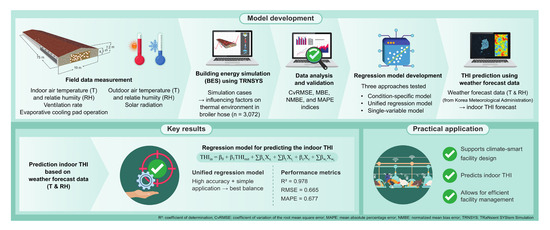
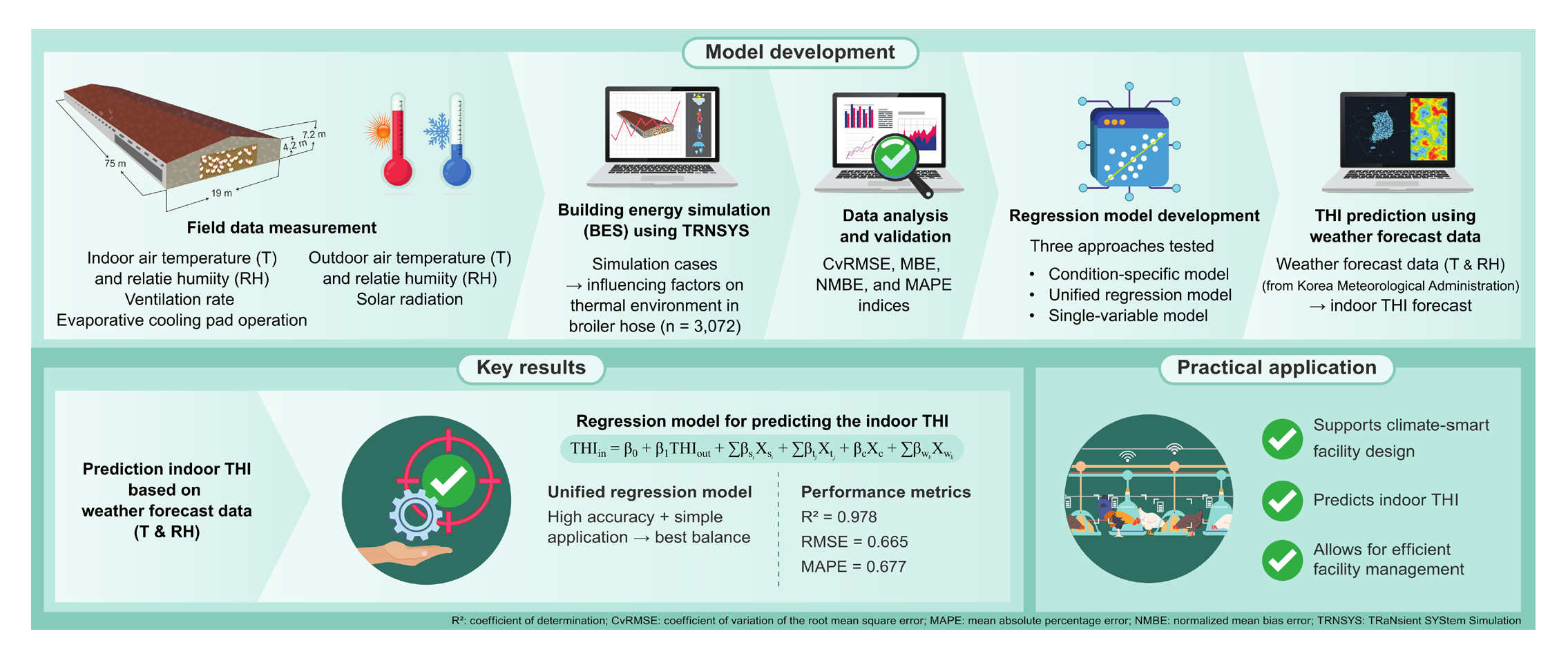
Graphical Abstract

1. Introduction

Climate change has led to a rapid rise in worldwide temperatures. From the pre-industrial era to 2013–2022, the global mean temperature increased by approximately 1.15 °C, while the global land surface temperature rose by around 1.65 °C [1]. In South Korea, the annual average temperature increased by approximately 1.8 °C from 1912 to 2017, exceeding both the global mean and land temperature increases [2].
Future temperature increases are projected to vary depending on greenhouse gas emission levels. According to Lee et al. [1], the best estimates of global warming for the 2081–2100 period are 1.8 °C (1.3–2.4 °C) under the intermediate emissions scenario shared socioeconomic pathway (SSP) 1–2.6, and 4.4 °C (3.3–5.7 °C) under the very-high emissions scenario (SSP5–8.5). In the same period, the average temperature in South Korea is estimated to increase by approximately 2.6 °C (SSP1–2.6) and 6.2 °C (SSP5–8.5) [3]. As global warming intensifies, extreme weather events are expected to occur more frequently, with higher likelihoods of unprecedented intensities, durations, or spatial extents. South Korea experienced heatwaves on average 13.7 days per year between 2000 and 2019. This number is projected to rise to 36.1 days under SSP1–2.6 and up to 97.8 days under SSP5–8.5 by 2081–2100 [4].
Prolonged exposure to elevated temperatures during heatwaves poses a serious threat to livestock health and productivity. When ambient temperature and humidity exceed the animals’ thermoneutral zone, livestock experience heat stress, a physiological condition in which their ability to regulate body temperature is impaired. This response leads to multiple negative outcomes in poultry, including reduced feed intake, decreased body weight gain, impaired feed conversion efficiency, increased mortality, immune suppression, and compromised reproductive performance under long-term exposure [5,6].
Several methods have been developed to assess heat stress in livestock, including physiological, behavioural, and environmental approaches. Physiological indicators, such as rectal temperature, respiration rate, and heart rate, are direct and widely used to assess heat stress in poultry. Under heat-stress conditions, broiler chickens show increased respiration (panting), elevated body temperature, and cardiovascular responses that reflect their effort to dissipate excess heat [7]. Behavioural indicators include reduced feed intake, seeking shade, and postural changes such as spreading or drooping wings, which enhance heat dissipation under high-temperature conditions [8,9,10]. Environmental indices evaluate thermal stress by integrating climatic parameters such as air temperature and humidity. Among these, the temperature–humidity index (THI) is one of the most widely used, with formulations based on either dry-bulb temperature and relative humidity or dry-bulb and wet-bulb temperatures [11,12,13,14]. The temperature–humidity–velocity index, an extension of THI, includes air velocity to better represent convective heat loss under varying ventilation conditions [14]. Other indices, such as the heat load index, additionally consider wind speed and solar radiation to capture more complex environmental influences on heat stress [15].
Physiological and behavioural indicators enable accurate evaluation of heat stress because they involve direct observation of the animals. However, they are not suitable for forecasting, because current animal behaviour is difficult to use for predicting future heat-stress conditions. By contrast, environmental indicators can be combined with weather forecast data to predict heat stress, since they rely on environmental variables.
Numerous studies have employed advanced simulation techniques, such as computational fluid dynamics (CFD) and building energy simulation (BES), to analyse the indoor environments of mechanically ventilated poultry houses. For instance, Cheng et al. [16] used CFD to investigate airflow distribution in tunnel-ventilated hen houses and demonstrated that ceiling-mounted deflectors, particularly their spacing, significantly improved airspeed uniformity in the animal-occupied zone. Blanes-Vidal et al. [17] evaluated several CFD boundary conditions and found that including at least 15 air-velocity measurement points enhanced simulation accuracy at the height of the birds. Expanding on individual-level assessment, Chen et al. [18] introduced hen-scale CFD modelling and emphasised the importance of ventilation design factors such as inlet and fan placement, for ensuring uniform thermal conditions and reducing issues such as floor eggs.
Since its initial development in 1963 at the Royal Institute of Technology in Stockholm, Sweden, to calculate temperature variations within buildings [19], BES technology has been widely used in the pre-construction phase to predict the energy requirements and to establish energy management strategies. Tian et al. [20] described BES as an essential tool in passive-house design, enabling the exploration of a wide range of design alternatives. Rashad et al. [21] emphasised that BES can simulate energy demands according to various building functions and track these fluctuations on daily, monthly, and annual timescales. They further noted that comparative analyses of different design scenarios contribute to optimising energy consumption and improving economic efficiency.
Given its proven effectiveness, BES has recently been applied to livestock housing facilities to evaluate thermal environments and energy efficiency. Costantino [22] conducted a systematic review of BES applications between 1998 and 2023, highlighting the growing use of BES for analysing energy performance and heat stress in livestock housing. Costantino et al. [23] assessed the energy performance of broiler houses by using a primary energy approach, which considered thermal and electrical energy consumption, conversion and transmission losses, and embedded energy in infrastructure.
Previous studies simulated South Korean broiler houses and demonstrated that heat stress in mechanically ventilated facilities can be effectively analysed using BES techniques [24,25]. Cho et al. [26] developed a predictive model that coupled an EnergyPlus (Version 9.5.0, DOE, USA) simulation of a single commercial broiler house with the Land–Atmosphere Modelling Package forecast data to estimate high-temperature stress indices. Despite its high accuracy, this site-specific model had limited flexibility in representing different facility configurations, and dynamic ventilation patterns. More recently, Kwon et al. [27] used BES-based approaches to predict energy requirements in mechanically ventilated broiler houses under diverse climatic and operational conditions, and Kwon et al. [28] estimated heating and cooling demands for a layer house model by varying region, building size, insulation, and flock density. However, these studies mainly targeted energy use over historical periods and did not develop simple, forecast-driven tools for predicting indoor heat stress.
Previous CFD- and BES-based studies have therefore provided valuable insights into airflow patterns, thermal stratification, and energy loads in mechanically ventilated poultry houses. However, most of these studies focused on one or a few specific buildings under limited climatic and operational conditions, and were intended primarily for design analysis rather than large-scale prediction. In particular, CFD models, while highly detailed, are computationally intensive and impractical for repeated simulations driven by frequently updated weather forecasts. BES models are more efficient but still require case-specific configuration and substantial computation when applied to many facilities or scenarios, which limits their direct use in nationwide, forecast-driven heat-stress assessment.
Despite this extensive research, there is still a lack of computationally efficient models that can use routine weather forecasts to predict indoor heat stress across a wide range of mechanically ventilated livestock facilities. This gap poses a growing risk for livestock producers as climate change increases the frequency of extreme heat events, especially for poultry, which lack sweat glands and have limited capacity to dissipate body heat. Therefore, the objective of this study was to develop regression meta-models that approximate the outputs of a validated BES model and predict heat stress in broilers housed in mechanically ventilated broiler houses using weather forecast data from the Korea Meteorological Administration. First, a BES model was validated against field-measured data from a commercial broiler house. The validated model was then used to simulate the indoor thermal environment under a wide range of parameter settings, generating 3072 cases that covered variations in regional climate, building size, insulation level, evaporative cooling operation, broiler body weight, and weather scenario. Finally, the relationships between external and internal environmental variables across these cases were analysed to derive three regression meta-models that approximate the BES outputs. These meta-models can be evaluated almost instantaneously and are suitable for large-scale, forecast-driven prediction of indoor THI.

2. Materials and Methods

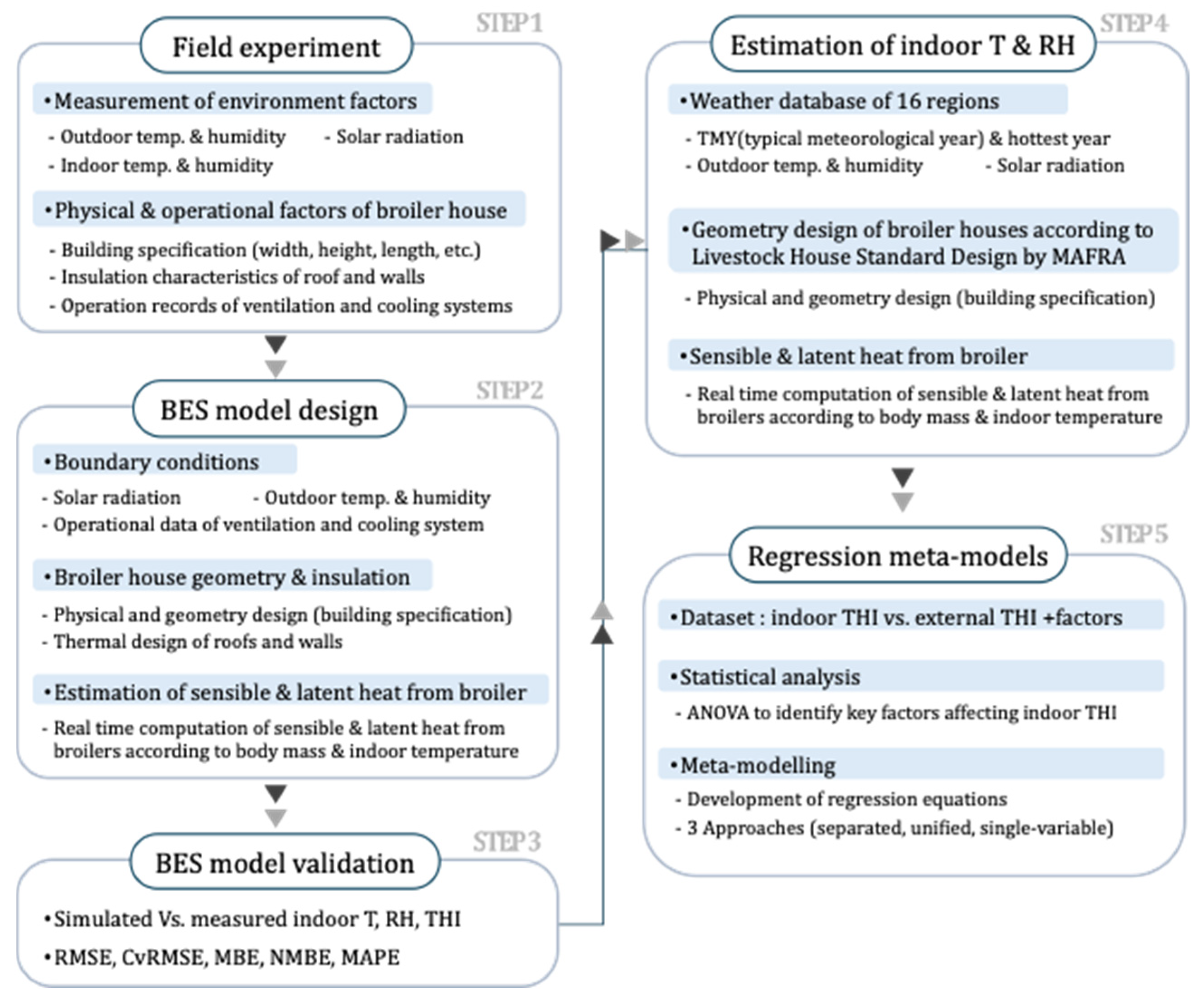
The overall methodology of this study is summarised in Figure 1. First, field experiments were conducted in a commercial mechanically ventilated broiler house in South Korea to collect indoor and outdoor environmental data (air temperature, relative humidity, solar radiation, and wind), and structural and operational data on the facility, including ventilation fans and evaporative cooling pads. Using these data, a TRNSYS-based BES model of the experimental broiler house was developed and validated by comparing simulated indoor air temperature, relative humidity, and THI with measurements from four rearing cycles. After validation, the BES model was applied to 3072 simulation scenarios that combined multiple locations, building sizes, thermal transmittance levels, cooling conditions, broiler body weights, and two types of weather data (typical meteorological year and hottest-year datasets) to generate hourly indoor temperature, humidity, and THI. The resulting dataset of simulated indoor THI and corresponding external conditions was then used for analysis of variance (ANOVA) to identify key influencing factors and for the development of three regression meta-models that predict indoor THI from external THI and facility characteristics using weather forecasts for heat-stress risk assessment in mechanically ventilated broiler houses.

2.1. Experimental Broiler House

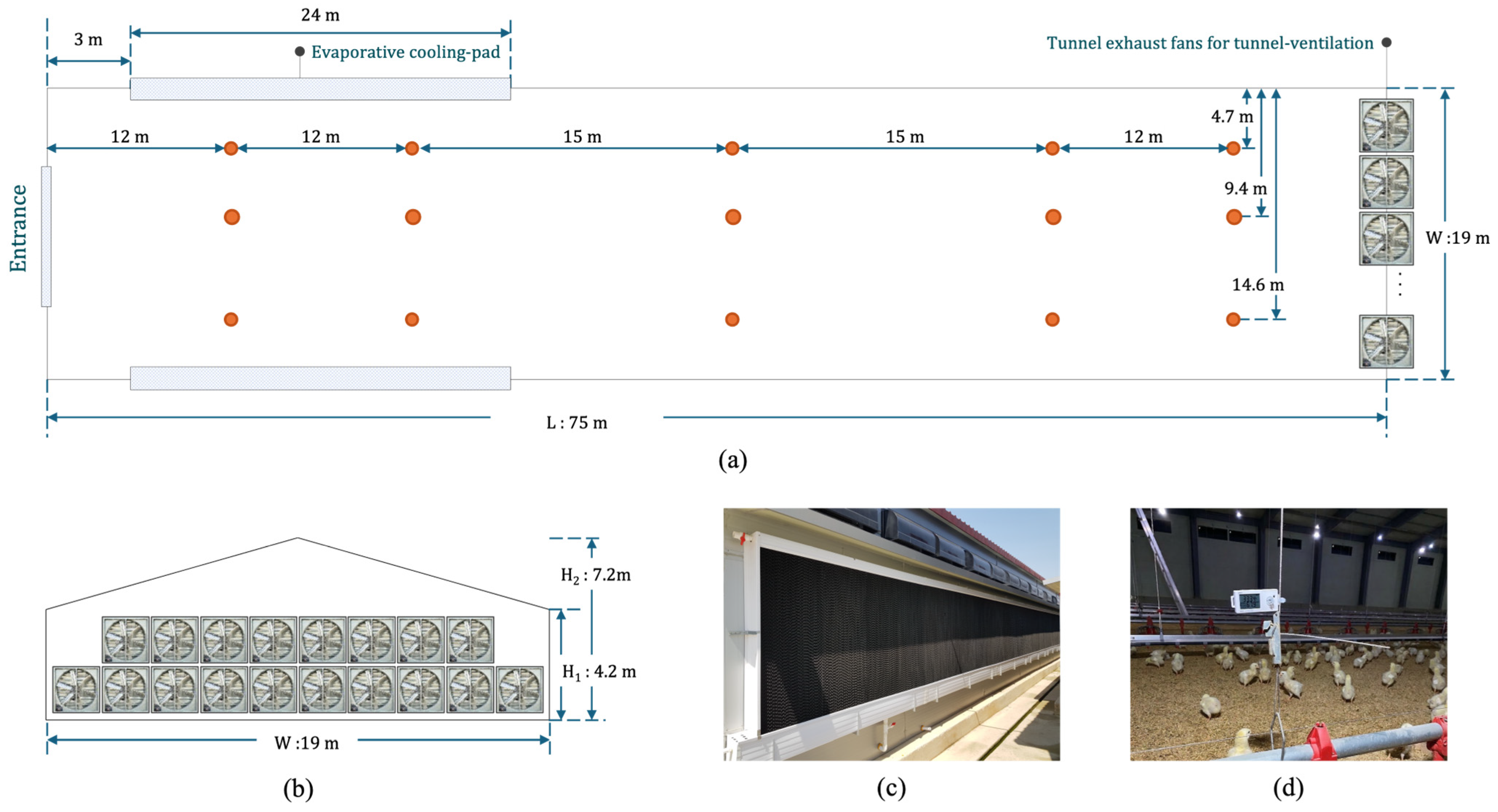
The field experiments were conducted at a commercial mechanically ventilated broiler house located in Jeongeup-si, Jeollabuk-do, South Korea (35.676809° N, 126.803610° E). The facility employed a tunnel ventilation system with 18 50-inch fans, and the ventilation rate was controlled by adjusting the number of operating fans and their operating duration at 5 min intervals. In addition, during the summer season, evaporative cooling pad systems installed on both sidewalls of the broiler house were used to reduce the indoor temperature. The broiler farm consisted of three buildings, each accommodating approximately 35,000 broilers. The broiler house measured 75 m in length (oriented northeast–southwest) and 19 m in width (northwest–southeast), with a ridge height of 7.2 m and an eave height of 4.2 m. The overall layout of the mechanically ventilated broiler house, including the locations of the tunnel exhaust fans, evaporative cooling pads, and 15 air temperature and humidity loggers, is shown in Figure 2. Data on the operational status (on/off) and operating durations of the ventilation and evaporative cooling pad systems were collected, along with indoor air temperature and relative humidity measurements, to support model validation. At the experimental broiler house, field data were collected over four distinct rearing periods conducted between April and September 2024, a period covering the typical summer season in Korea (from June to August), during which broilers are susceptible to heat stress. Each rearing period spanned from chick placement to preshipment: Period 1 (3 April–1 May 2024), Period 2 (30 May–20 June 2024), Period 3 (12 July–6 August 2024), and Period 4 (7 September–1 October 2024). However, owing to a malfunction in the ventilation system’s operation log recorder on 20 September, the operational records of the broiler house after that date could not be monitored. Therefore, only the data from 7 to 19 September during Period 4 were used for model validation. During these experimental periods, 15 air temperature and humidity loggers were strategically placed at regular intervals across both the width and length of the facility. The data collected from these sensors were then compared with the indoor environmental conditions simulated by the BES models to validate their accuracy.
During these experimental periods, 15 air temperature and humidity loggers were strategically placed at regular intervals across both the width and length of the facility. Each logger recorded air temperature and relative humidity at 5 min intervals and stored the measurements in its internal memory throughout each rearing cycle. In addition, the operational data of the tunnel ventilation fans and evaporative cooling pad systems were obtained from the farm’s existing control system, which automatically recorded, at 5 min intervals, the number of operating fans, their cumulative operating duration, and the activation time of the evaporative cooling pads and stored these records in a local computer located in the farm office. At the end of each cycle, the air temperature and humidity loggers were retrieved and replaced, and the stored measurements were downloaded to a laboratory computer, and the locally stored control-system data for fan and cooling-pad operation were likewise downloaded from the farm office computer for subsequent processing. These time-series datasets were then aggregated to hourly values and compared with the indoor air temperature, relative humidity, and THI simulated by the BES model to evaluate its accuracy.

2.2. BES

BES is a physics-based mathematical modelling approach that enables detailed estimation of a building’s energy performance and indoor climate conditions. By incorporating diverse inputs such as weather data, building geometry, material properties, internal loads, heating, ventilation, and air conditioning (HVAC) systems, and operational schedules, BES models simulate the dynamic interactions between building components and environmental factors under defined boundary conditions. According to Costantino [22], EnergyPlus and TRNSYS are among the most widely used simulation tools and are well suited for simulating the indoor environment and energy performance of livestock facilities. Compared with EnergyPlus, TRNSYS provides greater flexibility in implementing complex control algorithms, such as proportional–integral–differential control, real-time logic, and user-defined extensions. It also offers advantages in modelling interactions between system components and capturing non-linear behaviours. In line with the research objective of analysing broiler heat generation under various environmental conditions, this study employed TRNSYS (version 18, Solar Energy Laboratory, University of Wisconsin-Madison, Madison, WI, USA) for building thermal environmental analysis.

2.2.1. TRNSYS for BES

TRNSYS adopts a modular approach in which each subroutine represents a specific component (e.g., weather data processor, building model, HVAC systems, or control algorithm) with its own governing equations, allowing flexible configuration of simulations. In this study, the Type 56 multizone building model was used as the core module to simulate the indoor thermal environment of the broiler house based on energy-balance equations that account for heat conduction, convection, radiation, internal gains, and air exchange. Each thermal zone is treated as having a uniform air temperature, and surface–air heat exchange is represented using a simplified star-network scheme originally proposed by Seem [29], which aggregates radiative and convective effects into a single node to reduce model complexity.
Mathematically, the governing energy balance equation for a thermal zone is expressed as an Equation (1).
C z d T z d t = Q s u r f + Q i n f + Q v e n t + Q g a i n ,
where C z is the thermal capacitance of the zone, T z is the air temperature of zone, Q s u r f indicates the heat gain or loss owing to the transmission process through the walls (kJ·h−1), Q i n f represents the heat gain or loss owing to infiltration (kJ·h−1), Q v e n t represents the heat gain or loss from the ventilation process (kJ·h−1), and Q g a i n signifies the heat gain or loss from an internal heat source or sink (kJ·h−1).

2.2.2. Sensible and Latent Heat Production by Broilers

In South Korea, broilers are typically raised to target body weights that correspond to specific market demands. Broilers marketed at approximately 1.0 kg are classified as young broilers and are primarily used for traditional dishes such as Samgyetang (Korean ginseng chicken soup), which is especially popular during the summer season. Broilers raised to around 1.5 kg are most commonly used for fried chicken, a dominant product in the Korean franchise chicken industry. Larger broilers, reaching 2.0 kg or more, are mainly processed into chicken parts such as breast meat and drumsticks, which are widely distributed in retail markets and the food service sector.
The body weight of broilers can be expressed by a non-linear equation as a function of rearing age. In this study, an empirical quadratic growth equation derived from field data in commercial Korean broiler production was adopted for this purpose, as proposed by Yoo (Equation (2)) [30].
m 1 = 1.1678 × d 2 + 11.137 × d + 35.753 ,
where m 1 represents the weight (g) and d denotes the age (day) of the broiler.
Broilers dissipate energy in the form of sensible and latent heat, and this heat dissipation has been reported to be influenced by ambient air temperature and body weight [31]. According to the CIGR guidelines [31], total heat production of broilers at thermoneutrality is expressed as a power function of body weight, and a linear correction with respect to 20 °C is used to account for ambient temperature effects. Based on these relations, the total and sensible heat gains used in this study were reformulated as Equations (3) and (4), which express heat production directly as functions of broiler body weight and indoor air temperature and were implemented in the BES model.
ϕ t o t a l = 10.62 × m 2 0.75 × 1000 + 20 × 20 t 1000
ϕ s e n s i b l e = 10.62 1000 × m 2 0.75 × 0.61 × 1000 + 20 × 20 T 0.228 × T 2
ϕ l a t e n t = ϕ t o t a l ϕ s e n s i b l e
where ϕ t o t a l represents the total heat gain from the broiler (W), m 2 denotes the body weight of the broiler (kg), calculated using the Equation (2), T is the indoor air temperature of the broiler house (°C), ϕ s e n s i b l e represents the sensible heat dissipated by the broiler (W), and ϕ l a t e n t represents the latent heat generated by the broiler (W).
In the BES modelling process, sensible and latent heat gains from the broilers were calculated at each time step based on the indoor air temperature of the broiler house, and the resulting energy was supplied to the internal environment accordingly.

2.2.3. Boundary Conditions

In commercial broiler houses, the ventilation system is the primary mechanism for controlling the internal environment, and in practice it is operated dynamically by staging fans and adjusting operating time. To simulate the indoor thermal environment or conduct energy analyses under realistic conditions, it would therefore be desirable to modularise the ventilation system to reflect dynamically changing airflow. However, in this study a dynamic ventilation control module was not implemented because the simulations were designed to develop a predictive model for THI based on external weather conditions. In typical Korean broiler production during summer, when outdoor temperatures are high, the ventilation rate is first increased through dynamic control until it reaches (or approaches) the maximum capacity, and if high indoor temperatures still persist, the evaporative cooling system is then activated. To represent this severe heat-stress situation—where indoor air is already being exchanged at (near) the maximum rate but heat stress can still occur—the ventilation rate was prescribed as a boundary condition using the recommended summer maximum ventilation values by broiler body weight from the National Institute of Animal Science of Korea [32], and the cooling condition (evaporative cooling ON/OFF) was analysed separately.
The Livestock House Design Standards recommend the use of sandwich panels for constructing walls and roofs in broiler houses, with the required thermal transmittance determined according to regional specifications set by the Energy-Saving Design Standards for Buildings [33]. According to its enforcement regulations, Korea is categorised into four regions: Central Region 1, Central Region 2, Southern Region, and Jeju Region, and the corresponding thermal transmittance values for wall and roof insulation by region are presented in Table 1.
Two types of weather data were used to simulate the THI inside broiler houses based on external climatic conditions such as air temperature, relative humidity, and solar radiation. First, TMY data, produced in accordance with the ‘National Reference Standard’ by the Korea Institute of Energy Research, were used to represent typical regional weather conditions across South Korea. In addition, to account for extreme weather conditions, historical observational data from the past 30 years (from 1995 to 2024) were analysed, and datasets from the year with the highest recorded annual maximum temperature were selected. Details of both weather datasets are presented in Table 2 and Table 3.
Compared with the TMY data, the hottest-year dataset consistently shows higher average and maximum temperatures across all locations. For example, the average temperature in Seoul increased from 4.9 °C (TMY) to 13.0 °C (hottest year), while the maximum temperature rose from 26.2 °C to 39.4 °C. Although relative humidity varied by region, no clear trend was observed when compared with the hottest-year dataset. Similarly, no consistent trend was evident for solar radiation. However, in regions where maximum solar radiation increased, the maximum daily accumulated solar radiation (MDSR) also increased, whereas in regions where maximum solar radiation decreased, the MDSR likewise declined. These differences highlight the importance of incorporating both typical and extreme weather conditions when developing predictive models for broiler house thermal environments and heat stress assessment.

2.2.4. BES Model to Estimate Indoor Thermal Environment of Broiler Houses

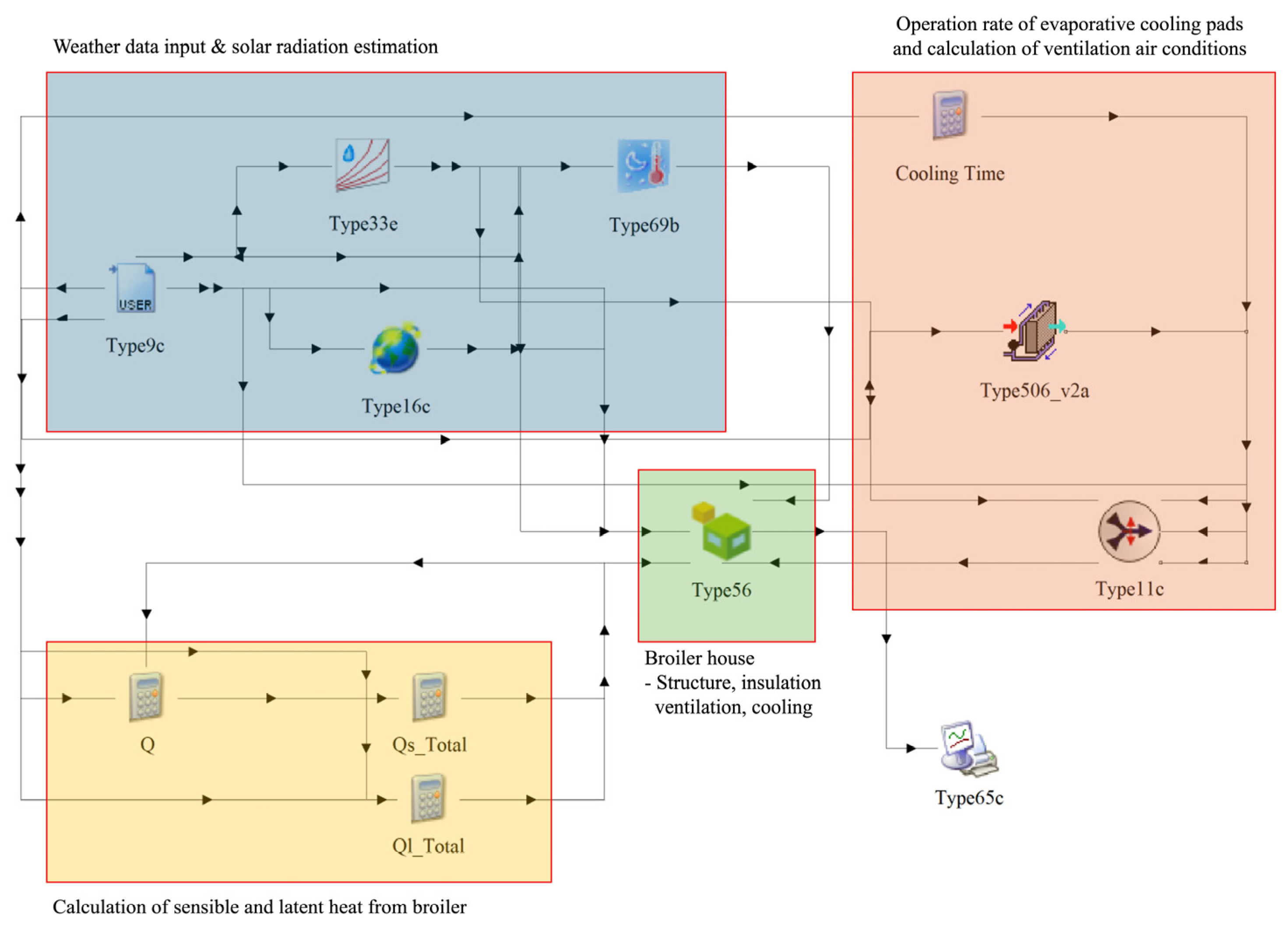
Figure 3 illustrates the BES model developed using TRNSYS to predict the temperature–humidity index (THI) inside a mechanically ventilated broiler house. In this study, THI was calculated from dry-bulb air temperature (T, °C) and relative humidity (RH, %) using the following Equation (6), which is widely applied in livestock heat-stress assessment [12].
T H I = 1.8 × T + 32 0.55 0.0055 × R H × 1.8 × T 26.8
This expression combines the effects of air temperature and humidity into a single environmental index of heat stress for broilers. The model comprises multiple TRNSYS components grouped into four functional categories that represent key processes affecting the indoor thermal environment. The first category includes four components: Type9 (used to import external weather data files), Type16 (used to compute solar radiation incident on surfaces with specified slope and azimuth), Type33 (used to calculate the thermodynamic properties of moist air), and Type69 (used to estimate sky temperature). Together, these components read hourly weather data, including air temperature, relative humidity, and solar radiation, from external files. Based on these inputs, the model calculates the surface radiation incident on each wall of the broiler house and determines the state of moist air in response to varying ambient weather conditions. The second category consists of three TRNSYS components: an equation module (used to calculate the operation rate of the cooling system based on pad activation duration), Type506 (used to simulate the cooling effect of the evaporative cooling pad on incoming air), and Type11 (used to compute the hourly average temperature and relative humidity of the ventilation air). Together, these components simulate the thermal conditioning of ventilation air as it passes through the cooling system. Although the BES model operates on an hourly time step, farm ventilation processes are controlled at 5 min intervals. To reflect this, the model estimates the hourly ventilation rate and the condition of incoming air. The third category involves several calculation modules that estimate the amount of heat dissipated by the broilers and supply it to the internal environment of the broiler house. The total heat dissipation depends on the birds’ body weight and the ambient temperature inside the facility. Accordingly, the equation module receives the indoor air temperature from the broiler house module and calculates the body weight of the broilers at each time step using Equation (2). Based on this, the total heat dissipation is calculated and divided into sensible and latent components using Equations (3)–(5). The latent component is then converted into a humidity generation rate using the latent heat of vaporisation and is reflected as an increase in indoor absolute humidity.
The fourth category is the multizone building module (Type56), which calculates the thermal environment inside the broiler house. This module integrates various heat transfer factors, including surface solar gains, broiler heat dissipation, and ventilation air conditions. It then simulates the indoor air temperature and humidity on an hourly basis, considering building-specific properties such as insulation level, building size, infiltration, and ventilation configuration.
Table 4 presents the experimental parameter settings used in the BES to develop a regression meta-model for predicting the THI in broiler houses. A total of 3072 simulation cases were generated by combining the sub-conditions of six key parameters. First, 16 locations across South Korea were selected to reflect regional climatic variation. These sites were chosen because they are the only locations for which TMY data, constructed from 30 years of historical observations, are officially provided by the Korea Institute of Energy Research. The broiler house dimensions were defined based on the livestock standard design drawings [33]. Four building lengths (36, 66, 96, and 120 m) were selected to cover the minimum and maximum recommended values in the design standards, with two intermediate values included to capture variation. Thermal transmittance values for exterior walls and roofs were adopted from the Energy-Saving Design Standards for Buildings [34], which classify South Korea into four climatic zones: Central Region 1, Central Region 2, Southern Region, and Jeju. Three broiler weights (1.0, 1.5, and 2.0 kg) were used as parameters to reflect typical slaughter weights in Korea for different commercial purposes: 1.0 kg for Samgyetang (ginseng chicken soup), 1.5 kg for fried chicken, and 2.0 kg for partial meat products. The operation of the evaporative cooling pad (ON/OFF) was also included as a parameter to evaluate its effect under varying climatic conditions. For weather input, two scenarios were considered: TMY datasets representing typical conditions at each location and extreme weather data from the hottest year recorded in the past 30 years at each location.

2.3. Statistical Analysis and Regression Meta-Modelling

2.3.1. Analysis of Variance

To identify the key factors influencing heat stress conditions in mechanically ventilated broiler houses, an ANOVA was conducted using the BES simulation results from 3072 experimental cases. Three response variables were considered: (1) the accumulated time exceeding the critical THI threshold for broilers (THI ≥ 78), (2) the annual maximum THI, and (3) hourly THI values across the entire year filtered for outdoor air temperatures above 20.31 °C, which corresponds to the average summer daily minimum temperature in South Korea. The explanatory factors included regional location (site, 16 levels), broiler house size (four levels), wall thermal transmittance (four levels), cooling condition (evaporative pad ON/OFF), and broiler body weight (three levels).
ANOVA models were fitted in R (version 4.4.1, R Foundation for Statistical Computing, Vienna, Austria) to test the statistical significance of each factor, and Duncan’s multiple range tests were used to compare group means for the site factor under each cooling condition. In addition to p-values, effect sizes were quantified using eta-squared ( η 2 ), calculated as the ratio of the sum of squares for each factor to the total sum of squares, to assess the practical importance of each factor. Large η 2 values indicate that a factor explains a substantial proportion of the variance in the response variable, whereas very small η 2 values suggest negligible practical impact even if the p-value is statistically significant. This distinction between statistical and practical significance was used to interpret the influence of building size, wall thermal transmittance, and broiler body weight on THI-based heat stress indicators. Following the conventional benchmarks proposed by Cohen [35] and summarised by Richardson [36], η 2 values of approximately 0.0099, 0.0588, and 0.1379 were interpreted as small, medium, and large effects, respectively. These thresholds were used to distinguish factors that exerted practically meaningful influences on the THI-based heat stress indicators from those whose effects, although sometimes statistically significant, were of negligible magnitude in practical terms.

2.3.2. Regression Meta-Models

In this study, the proposed technique consists of using a validated TRNSYS-based BES model to generate a large ensemble of simulation cases and then developing regression meta-models that approximate indoor THI as a function of external THI and key facility characteristics. Based on the ANOVA results and the BES simulations, regression meta-models were developed using 3072 BES cases, each corresponding to a unique combination of regional location, building size, wall thermal transmittance, cooling condition, broiler body weight, and weather scenario (typical meteorological year or hottest year). Three modelling approaches were considered: (1) condition-specific meta-models, in which separate simple linear regressions of indoor THI on external THI were fitted for each combination of site, wall thermal transmittance, cooling condition, and broiler weight (Approach 1); (2) a unified meta-model, in which external THI was included as a continuous predictor together with categorical predictors for site, wall thermal transmittance, cooling condition, and broiler weight (Approach 2); and (3) a single-variable meta-model using only external THI as the predictor without categorical factors (Approach 3). All regression meta-models were estimated by ordinary least squares using the lm() function in R.
For the unified meta-model (Approach 2), the categorical predictors were coded using dummy variables. In the unified regression meta-model, Gangneung was chosen as the reference site, together with the wall thermal transmittance corresponding to Central Region 1 (sidewall: 0.17 W·m−2·K−1, roof: 0.15 W·m−2·K−1), evaporative cooling pad operation (ON), and a broiler body weight of 1.0 kg, and these levels were used solely as statistical baselines for dummy coding without affecting the overall predictive performance of the meta-model or implying that they are recommended design conditions. Under this parameterisation, the intercept and slope for external THI represent the expected indoor THI for the reference combination, and each coefficient of a dummy variable indicates the approximate change in indoor THI relative to this reference when switching to another region, insulation level, cooling condition, or target body weight under the same external THI.
To evaluate the generalizability of the regression meta-models and to reduce the risk of overfitting, the 3072 simulation cases were split into independent training and test sets at the case level. Each simulation case was identified by a unique Case_ID, and 70% of the cases were randomly assigned to the training set, with the remaining 30% forming the test set. The unified regression meta-model (Approach 2) and the single-variable meta-model (Approach 3) were fitted using only the training data, and their predictive performance was assessed on the independent test set using the coefficient of determination (R2), root mean square error (RMSE), and mean absolute percentage error (MAPE). The condition-specific meta-models (Approach 1) were evaluated using all available data within each condition, and their performance metrics (R2, RMSE, and MAPE) were summarised across all combinations of site, wall thermal transmittance, cooling condition, and broiler body weight.

3. Results

3.1. Validation Results of the Designed BES Model for Broiler House

The performance of the developed BES model was evaluated by comparing simulated and measured data for air temperature and relative humidity throughout each rearing period. To further verify its predictive accuracy for heat stress conditions, the temperature–humidity index (THI) calculated from the simulated values was also compared with that obtained from the measured environmental data.
Table 5 presents the validation results using four statistical indices: RMSE, coefficient of variation of RMSE (CvRMSE), mean bias error (MBE), and MAPE. The acceptance thresholds for these indices were set to 0–30% for CvRMSE, within ±10% for normalised mean bias error (NMBE), and ≤10% for MAPE [37,38].
For temperature validation, all rearing periods exhibited high consistency between simulated and measured data. CvRMSE values ranged from 2.929% to 3.689%, and MAPE values were between 2.199% and 3.165%, indicating that the simulated results were well within acceptable limits. Relative humidity simulations also showed reasonable agreement with experimental data. Although slightly higher deviations were observed in the first and second periods, the CvRMSE and MAPE values remained within or close to the accepted thresholds, with noticeable improvement in later cycles. THI validation displayed particularly strong agreement across all rearing periods. CvRMSE values ranged from 1.557% to 2.545%, and MAPE values remained below 2.003%, confirming robust performance of the BES model in predicting this key index. The normalised mean bias error (NMBE) values were all within ±10%, indicating the absence of systematic bias. Overall, the BES model satisfied established validation criteria for temperature, relative humidity, and THI across the four periods, providing a reliable framework for estimating thermal conditions and heat stress in mechanically ventilated broiler houses under varying environmental conditions.

3.2. Results of Statistical Analysis of Factors Influencing the Thermal Environment in Broiler Houses

To identify key variables influencing heat stress conditions in broiler houses, an analysis of variance (ANOVA) was conducted using simulation results from 3072 experimental cases. Three dependent variables were examined: (1) the accumulated time exceeding the THI threshold for broilers (THI ≥ 78) [39], (2) the annual maximum THI, and (3) hourly THI values across the entire year. The independent variables included regional location (site), broiler house size, thermal transmittance of walls, cooling system operation (evaporative pad ON/OFF), and broiler body weight.
A summary of the ANOVA results for the three THI-based indicators is presented in Table 6, and the full ANOVA tables are provided in the Supplementary Tables S1–S3. For the accumulated time above the THI threshold (THI ≥ 78), only site and cooling condition had p-values below 0.05 and were therefore classified as statistically significant factors, whereas building size, wall thermal transmittance, and broiler body weight were not significant. However, the corresponding eta-squared values ( η 2 ) indicated that the practical importance of these effects was limited: site and cooling condition showed eta-squared values below the conventional benchmark for a medium effect, and the remaining factors all had eta-squared values below 0.0099, which is the conventional threshold for a small effect ( η 2 ≈ 0.0099, 0.0588, and 0.1379 for small, medium, and large effects, respectively). Similar patterns were observed for annual maximum THI and hourly THI, for which site and cooling condition were statistically significant but explained only a modest proportion of the variance, while the contributions of building size, wall thermal transmittance, and broiler body weight remained negligible.
Site-wise differences in the accumulated time above the THI threshold were further examined under non-cooling and cooling conditions (Table 7). Under both conditions, Jeju exhibited the longest accumulated hours above THI ≥ 78 and consistently formed a distinct group, indicating that broiler houses in this region experience the most prolonged exposure to heat stress. In contrast, Wonju showed the lowest accumulated hours under non-cooling conditions, while Incheon showed the lowest values under cooling conditions, with the other sites distributed between these extremes. These regional patterns illustrate that, even though the global effect sizes of site and cooling condition on accumulated hours are modest, spatial variation in climate and the use of evaporative cooling can still lead to noticeable differences in cumulative heat stress exposure at the farm level.
For annual maximum THI and hourly THI, the ANOVA likewise indicated statistically significant but small effects of site and cooling condition, and negligible practical effects of broiler house size, wall thermal transmittance, and broiler body weight. Detailed site-wise and factor-wise mean values for annual maximum THI and hourly THI, including groupings from Duncan’s test, are provided in the Supplementary Tables S4–S7 and were used primarily to guide the structuring of the subsequent regression meta-models.

3.3. Regression Meta-Modelling to Predict Indoor THI in Mechanically Ventilated Broiler Houses

Based on the findings from the ANOVA in Section 3.2, regression meta-models were developed to predict indoor THI in mechanically ventilated broiler houses using external meteorological conditions together with key facility characteristics as predictor variables. The aim of these meta-models was to enable short-term prediction of indoor THI from weather forecast data, thereby supporting heat-stress management under typical and extreme summer conditions. Three modelling approaches were compared, reflecting the significant factors identified in Section 3.2: (1) condition-specific regression meta-models for each condition of site, thermal transmittance, cooling condition, and broiler weight; (2) a unified regression meta-model incorporating these variables as categorical factors; and (3) a single variable meta-model using only external THI as the predictor without distinguishing variable conditions. Using the results from 3072 simulation cases, three sets of regression meta-models were developed corresponding to these approaches, and their predictive performance was then evaluated by analysing the coefficient of determination (R2), RMSE, and MAPE. In Approaches 2 and 3, the cases were randomly split into training and test sets at a 70:30 ratio to evaluate the generalizability of the unified and single-variable meta-models, whereas in Approach 1 all available data within each condition were used without a separate test set because each condition-specific meta-model was fitted to a relatively small subset of cases and was intended primarily for comparison with the more generalizable unified formulation.
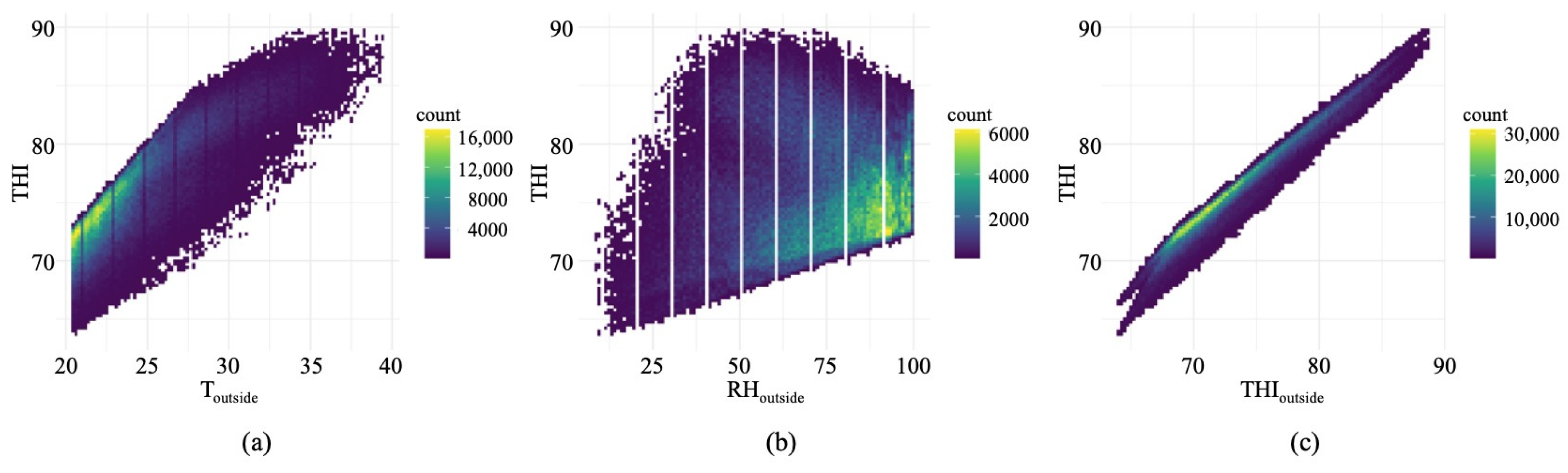
Prior to meta-model development, exploratory analysis examined the relationships between indoor THI and external air temperature, relative humidity, and external THI (Figure 4). The two-dimensional density scatter plot for external air temperature showed that indoor THI tended to increase approximately linearly as outdoor temperature increased, whereas the plot for external relative humidity did not reveal a clear monotonic association with indoor THI. When external THI, calculated from both external temperature and relative humidity, was compared directly with indoor THI, however, the relationship was highly linear, indicating strong predictive potential. Consequently, external THI was selected as the primary predictor variable in the regression modelling process, simplifying the model structure while maintaining explanatory power for predicting indoor THI.
In the first modelling approach (Approach 1), condition specific simple linear regression equations were developed for each combination of the four key factors identified in Section 3.2 (site: 16 levels; thermal transmittance: four levels; cooling condition: two levels; broiler weight: three levels), resulting in 384 equations in total. Table 8 presents a subset of these results for Busan site under cooling conditions, and the complete results are provided in Supplementary Tables S8–S23. Each regression equation took the following form:
T H I i n = β 0 + β 1 × T H I o u t
As an example, for the significant factors (site: Busan; thermal transmittance of side wall and roof: 0.17 and 0.15 W·m−2·K−1, cooling condition: ON; broiler weight: 1.0 kg), the regression equation was expressed
T H I i n = 9.1887 + 0.9049 × T H I o u t
with the associated predictive performance metrics (R2 = 0.9694; RMSE = 0.7059; and MAPE = 0.7401).
In the second approach, a unified regression meta-model was developed by incorporating site, thermal transmittance, cooling condition, and broiler weight as categorical predictor variables together with external THI. The 3072 simulation cases were randomly split into training and test sets at a 70:30 ratio, and the regression coefficients of the unified meta-model were estimated using the training data (Table 9). The general form of the unified meta-model was as follows:
T H I i n = β 0 + β 1 × T H I o u t + i β s i X s i + j β t j X t j + β c X c + k β w k X w k
where X s i , X t j , X c , and X w k are dummy variables for site, thermal transmittance, cooling condition, and broiler weight, respectively.
As an example, for the combination with significant factors (site: Busan; wall thermal transmittance of side wall and roof: 0.32 and 0.18 W·m−2·K−1, cooling condition: OFF; broiler weight: 1.5 kg), the unified regression meta-model can be written as
T H I i n = 8.9839 + 0.9022 × T H I o u t + 0.3247 0.0179 + 0.8636 + 0.0064
In this example, the intercept term (8.9839) and the slope for external THI (0.9022) correspond to the reference combination (Gangneung, wall and roof thermal transmittance of 0.17 and 0.15 W·m−2·K−1, cooling pad ON, 1.0 kg body weight), and the additional terms 0.3247, −0.0179, 0.8636, and 0.0064 represent the deviations associated with changing the site to Busan, increasing the wall and roof thermal transmittance to 0.32 and 0.18 W·m−2·K−1, switching the cooling condition from pad ON to pad OFF, and increasing the broiler weight from 1.0 to 1.5 kg, respectively. Thus, for a given external THI, the unified meta-model predicts that the indoor THI under the Busan, thermal transmittances of wall and roof (0.32 and 0.18 W·m−2·K−1), cooling-OFF, 1.5 kg scenario will be approximately 1.18 (≈0.3247 − 0.0179 + 0.8636 + 0.0064) units higher than in the reference case, which can be interpreted as the combined impact of regional climate, insulation level, cooling operation, and broiler weight on heat-stress risk under otherwise identical meteorological conditions.
Here, the intercept term (9.0102) corresponds to the reference category and 0.3261 represents the deviation associated with Busan site relative to the reference site (Gangneung). Under these conditions, the model achieved R2 = 0.978, adjusted R2 = 0.978, RMSE = 0.665, and MAPE = 0.677.
In the unified regression meta-model (Approach 2), the coefficient of external THI represents the average sensitivity of indoor THI to changes in outdoor conditions. In this model, the estimated slope for external THI was close to 1, indicating that indoor THI increased almost linearly with external THI under the simulated maximum-ventilation conditions. The categorical coefficients for site, wall thermal transmittance, cooling condition, and broiler weight act as intercept shifts that capture systematic differences between groups. For example, negative coefficients for the evaporative cooling “ON” condition indicate a reduction in indoor THI relative to the reference “OFF” condition at the same level of external THI, whereas site-specific coefficients reflect regional climatic differences after accounting for external THI.
The unified meta-model exhibited consistently high predictive accuracy on both the training and test sets, with R2 values of 0.978 for each and RMSE (MAPE) values of 0.668 (0.679) and 0.660 (0.674), respectively. The close agreement between training and test performance indicates that the unified regression meta-model does not show noticeable overfitting and generalises well to unseen combinations of climatic and facility conditions within the simulated range.
In addition, to examine whether prediction errors increase markedly during extreme heatwave conditions, the independent test set was filtered to include only data for periods with outdoor air temperature above 33 °C. For this subset, the unified regression meta-model maintained an R2 of 0.884, with RMSE and MAPE of 0.653 and 0.648, respectively, which are comparable to the errors obtained for the full test set and indicate that the simplified model does not exhibit sharply amplified prediction errors during severe heatwave periods
In the third approach, a single variable regression meta-model was formulated using only external THI as the predictor, without including any categorical factors, to evaluate the predictive performance achievable solely from external meteorological information. As in the unified meta-model, the 3072 simulation cases were randomly divided into 70% training and 30% test sets, and the regression coefficients of the single-variable meta-model were estimated using the training data. The single-variable meta-model achieved an R2 of 0.967, RMSE of 0.817, and MAPE of 0.849 on the training set. On the independent test set, the corresponding values were R2 = 0.968, RMSE = 0.797, and MAPE = 0.829, indicating very similar predictive performance and no evident overfitting.
The fitted equation for the single-variable meta-model was Equation (11) (Table 10).
T H I i n = 9.4248 + 0.9043 × T H I o u t
To further assess the robustness of the single-variable meta-model under extreme heat conditions, the independent test set was additionally filtered to include only data for periods with outdoor air temperature above 33 °C. For this subset, the model yielded an R2 of 0.753, with RMSE and MAPE of 0.951 and 0.827, respectively, indicating somewhat lower accuracy compared with the full test set and suggesting that relying solely on external THI leads to a modest degradation in predictive performance during severe heatwave conditions.
The predictive performances of the three approaches are summarised in Table 11. The condition-specific meta-models (Approach 1) yielded high accuracy, with average R2 and adjusted R2 of 0.977, and average RMSE and MAPE of 0.618 and 0.674, respectively, although performance varied across conditions, with R2 ranging from 0.938 to 0.997, RMSE from 0.251 to 1.032, and MAPE from 0.250 to 1.171. The unified regression meta-model (Approach 2) achieved R2 = 0.978 and adjusted R2 = 0.978, with RMSE = 0.817 and MAPE = 0.849, while the single-variable meta-model (Approach 3) showed relatively lower performance with R2 = 0.967, RMSE = 0.797, and MAPE = 0.829.
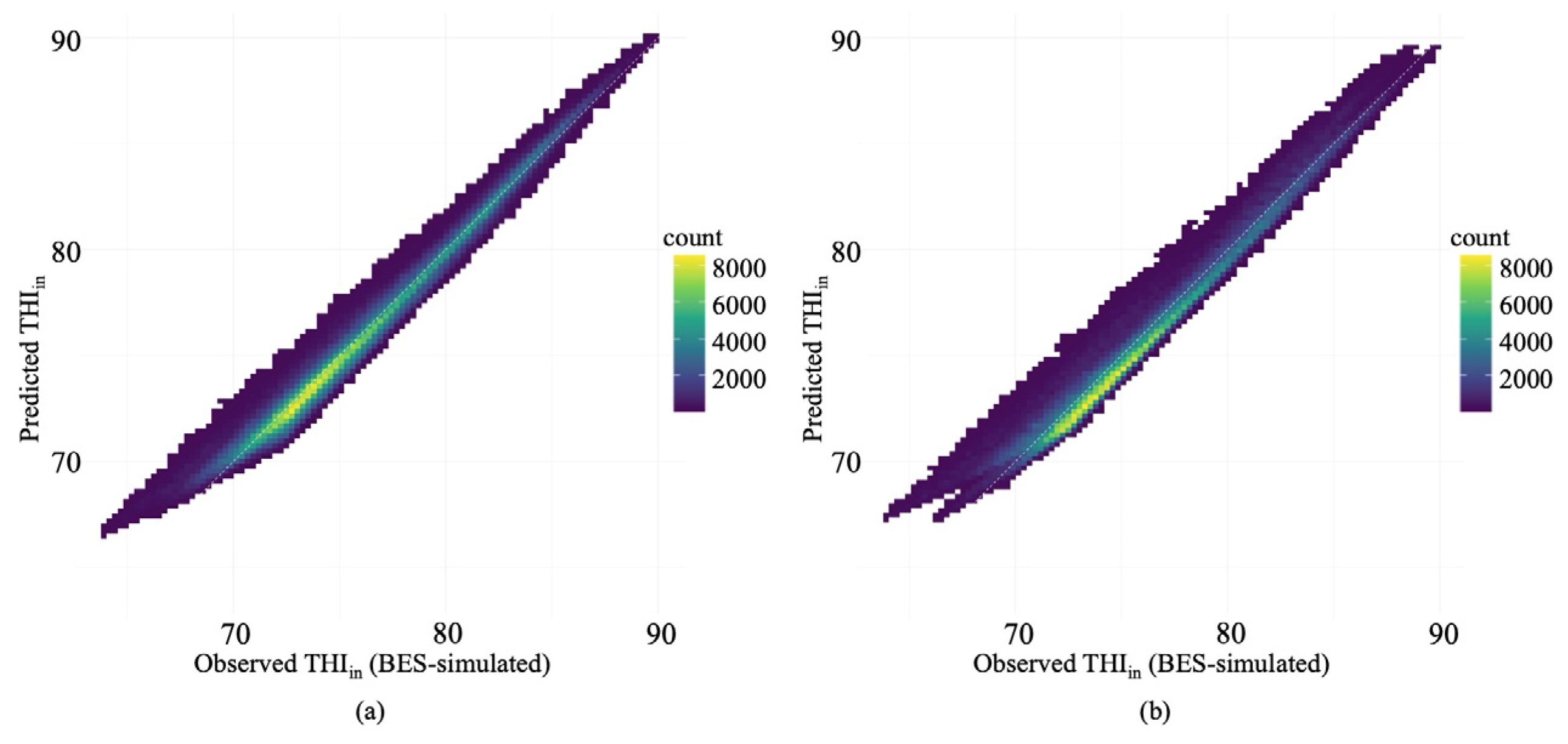
To visualise the predictive performance on the independent test set, Figure 5 presents two-dimensional binned scatter plots of observed versus predicted indoor THI for the unified regression meta-model (Approach 2) and the single-variable meta-model (Approach 3). The data points are tightly clustered around the 1:1 line, indicating that both meta-models reproduce the BES-simulated indoor THI with small bias across the full range of conditions. The unified meta-model shows a slightly narrower spread around the 1:1 line than the single-variable meta-model, which is consistent with its marginally better RMSE and MAPE and which suggests that incorporating site and facility characteristics yields modest but practically meaningful improvements in prediction accuracy.

4. Discussion

4.1. Interpretation of the BES Model Validation for the Broiler House

The validation outcomes confirm that the developed BES model performs within established standards for predictive accuracy. Compared with prior studies, these results highlight the robustness and comprehensiveness of the model validation process. According to a review by Costantino [22], among 21 studies that validated BES models, 19 employed indoor air temperature and only 13 additionally included indoor relative humidity as validation indices. Moreover, 13 of those studies conducted validation for less than one month, with nine limited to less than one week.
In contrast, the present study adopted a comprehensive set of statistical indices (RMSE, CvRMSE, MBE, NMBE, and MAPE) commonly used for BES model evaluation and conducted validation over four complete rearing cycles (approximately 120 days). This longer-term, multi-index validation enhances the robustness of the model assessment, ensuring its applicability under diverse environmental and operational conditions. Consequently, the validated BES model can serve as a dependable tool for estimating the thermal environment and assessing heat stress risks in broiler production systems.

4.2. Interpretation of Statistical Analysis Results for Factors Influencing the Thermal Environment

The ANOVA results highlight that heat-stress conditions in broiler houses, as characterised by the accumulated time above a critical THI threshold and the annual maximum THI, are predominantly influenced by regional location and, to a lesser extent, cooling system operation.
For the accumulated time above THI ≥ 78, only site and cooling condition had statistically significant effects, but the corresponding effect size values indicated that their practical contributions differed. Site had an η 2 of 0.0461, representing a modest effect, whereas cooling condition had an η 2 of 0.0042, which is below the conventional threshold for a small effect. Building size, wall thermal transmittance, and broiler body weight all had η 2 values below 0.0001 and were therefore considered to have negligible practical impact on the accumulated time above the THI threshold. The regional analysis further underscores the importance of location-specific climate. Jeju consistently exhibited the longest accumulated time above THI ≥ 78, forming a distinct group regardless of cooling operation, which indicates a persistently higher heat stress risk compared with other regions. Conversely, regions such as Wonju and Incheon showed substantially shorter times above the threshold, particularly under cooling conditions, revealing a clear stratification of regional heat stress vulnerability. These patterns are consistent with the eta-squared results, which indicate that regional location has a modest but practically meaningful effect on THI-based heat stress indicators, and they imply that mitigation strategies may need to be tailored more aggressively for high-risk regions such as Jeju and, to a lesser extent, Daejeon, Seosan, Chuncheon, and Seoul.
The findings for annual maximum THI indicate that the evaporative cooling system has a statistically significant influence on peak thermal stress; however, the corresponding effect size was small, and the absolute reduction in maximum THI was generally less than 1 at most sites. This limited effect can be attributed primarily to the modelling assumption that the broiler houses operated at maximum ventilation capacity during high-temperature periods, which substantially enhanced heat removal through increased air exchange. In practical broiler production, farmers typically maximise ventilation first and only activate the evaporative cooling system when high indoor temperatures and heat stress remain a concern, and this management strategy was reflected in the simulation setup. Under these conditions, where intensive ventilation already provides substantial cooling by replacing indoor air with outdoor air, the additional contribution of evaporative cooling to lowering peak THI becomes relatively small, even though it can still improve overall thermal conditions and reduce the accumulated hours above the heat stress threshold.
The negligible contributions of building size and wall thermal transmittance to variation in annual maximum and hourly THI imply that, within the typical design ranges considered in this study, adjustments to these parameters offer limited benefit for mitigating heat stress. The extremely small sums of squares observed for these factors in the ANOVA of maximum THI reflects the minimal differences in mean values across categories, reinforcing the notion that the thermal environment in mechanically ventilated broiler houses is dominated by ventilation, cooling operation, and external climate rather than by moderate changes in wall properties. Likewise, although broiler body weight showed statistical significance in the hourly THI analysis, its η 2 was very small and the associated differences in mean THI were minimal, suggesting that metabolic heat production associated with the tested weight range has a relatively minor effect compared with external climate and cooling operation.
Taken together, these results indicate that, within the ranges considered, indoor THI in mechanically ventilated broiler houses is governed primarily by external climatic conditions and cooling operation, with only minor modulation by wall thermal transmittance and broiler body weight. Consequently, the regression modelling in Section 4.3 was designed to predict indoor THI mainly from external meteorological information, using external THI calculated from forecasted air temperature and relative humidity as the primary predictor, and comparing three approaches: Approach 1, which fits separate simple linear regressions of indoor THI on external THI for each combination of site, wall thermal transmittance, cooling condition, and broiler weight; Approach 2, which constructs a unified regression meta-model by adding site and facility characteristics as categorical predictors alongside external THI; and Approach 3, which uses a single regression equation based solely on external THI without any site- or farm-specific variables.

4.3. Interpretation and Practical Implications of Regression Meta-Models for Indoor THI Prediction

Comparison of the three regression approaches reveals a clear trade-off between predictive accuracy, model complexity, and practical applicability. Specifically, Approach 1 uses condition-specific simple linear regressions of indoor THI on external THI for each combination of site, thermal transmittance, cooling condition, and broiler weight, Approach 2 uses a single unified multiple regression with external THI and categorical predictors, and Approach 3 uses only external THI as a single predictor.
The regression analysis confirms that external THI provides a strong basis for predicting indoor THI in mechanically ventilated broiler houses, because it reflects the combined influence of outdoor air temperature and relative humidity on the indoor thermal environment. The exploratory analysis showed that treating external temperature and relative humidity separately leads to non-linear and heteroscedastic relationships with indoor THI, whereas their combination into external THI yields a highly linear association. This finding supports the use of external THI as a primary predictor, offering a conceptually intuitive and statistically efficient way to link meteorological forecasts to indoor heat stress conditions.
The condition-specific meta-models of Approach 1 achieved high accuracy on average but required 384 separate equations to cover all combinations of site, thermal transmittance, cooling condition, and broiler weight, and their performance varied noticeably across conditions. Such a large set of models may be cumbersome to implement in practice, particularly for real-time forecasting or decision-support systems, but they provide a useful upper bound on the achievable accuracy for specific facility configurations and can be valuable for detailed experimental analyses of factor effects. The unified regression meta-model (Approach 2) offered a good balance between predictive accuracy and parsimony, achieving test-set performance comparable to the condition-specific meta-models while being represented by a single equation with dummy variables for categorical factors. This structure retains the ability to account for regional and facility-specific differences, as well as management practices such as cooling operation and broiler weight, without requiring separate calibration for every combination of conditions. From an implementation standpoint, this makes the unified meta-model particularly suitable for integration into decision-support tools that operate across diverse broiler house configurations, for example by using short-term weather forecasts to generate site-specific THI predictions and trigger management actions such as adjusting ventilation, cooling, or stocking strategies. By contrast, the single-variable meta-model using only external THI (Approach 3) demonstrated that reasonably high explanatory power can still be achieved when all categorical factors are ignored and, on average, yielded slightly lower RMSE and MAPE values on the test set than the other approaches. However, this formulation does not explicitly capture site- and facility-related variability, indicating that external THI alone cannot fully represent differences in indoor THI when precise, facility-specific estimates are required for heat stress management. Nevertheless, the simplicity of Approach 3 makes it attractive in contexts where only meteorological data are available and approximate risk screening is sufficient, such as regional-scale early warning systems or preliminary assessments for farms without detailed facility information.
Furthermore, an additional evaluation focusing on periods with outdoor air temperatures above 33 °C showed that the unified regression meta-model maintained error levels comparable to those for the full test set, whereas the single-variable meta-model exhibited somewhat larger errors, confirming that incorporating site and facility characteristics helps stabilise predictive performance during severe heatwave conditions.
Overall, the regression analysis confirmed that external THI is a physically meaningful and statistically efficient predictor for indoor THI in mechanically ventilated broiler houses, providing a direct link between meteorological forecasts and indoor heat stress conditions. Building on this, the unified regression meta-model developed in this study offers a practical surrogate of the TRNSYS-based BES outputs, combining high predictive performance with a single, easy-to-implement equation that accounts for regional climate, building insulation, cooling operation, and broiler weight. In contrast to previous forecast-driven approaches, this unified meta-model is designed for scalable application across diverse facilities, supporting both design evaluation and operational decision-making for heat stress management at the farm and regional levels.
A previous study [26] developed a web-based heat stress forecasting system for mechanically ventilated broiler houses by dynamically simulating the indoor environment of a single commercial facility and directly coupling the validated EnergyPlus-based model with LAMP weather forecast data to display a broiler heat stress index in real time. That approach demonstrated the feasibility of forecast-driven heat stress assessment at the farm level but required detailed, site-specific configuration of building geometry, equipment, and ventilation control for each new facility. In contrast, the present study uses a TRNSYS-based BES model to generate a large ensemble of 3072 simulation cases that systematically span regional climate, building size, insulation level, cooling operation, broiler body weight, and weather scenario, and then derives simple regression meta-models that approximate indoor THI as a function of external THI and key facility characteristics. Rather than running a full dynamic simulation for every farm in real time, the unified regression meta-model proposed here provides an analytically compact surrogate that can be driven directly by routine weather forecasts and a small set of facility descriptors, thereby improving scalability and ease of application for nationwide heat stress risk assessment and design support in broiler production systems.

5. Conclusions

This study developed regression meta-models for predicting indoor THI in mechanically ventilated broiler houses using external THI together with categorical factors representing facility and animal conditions. A BES model was first validated against experimental data and then used to generate simulation outputs under diverse environmental and operational scenarios, from which three regression approaches were derived.
The first approach, which constructed separate regression equations for each factor-level combination, achieved high predictive accuracy but required a large number of models, limiting its practicality for routine applications. The second approach, a unified regression meta-model that incorporated site, thermal transmittance, cooling condition, and broiler weight as categorical predictors alongside external THI, provided a well-balanced performance by combining high accuracy with a compact model structure and the ability to represent site- and facility-specific effects. The third approach, relying solely on external THI as the predictor, offered a useful minimal-data baseline with reasonably high accuracy and slightly lower average error indices on the test set, but without explicitly accounting for differences among facilities and management conditions.
In practical terms, each regression approach can be matched to different decision-making contexts. The condition-specific meta-models (Approach 1) are most appropriate for detailed benchmarking or design optimisation of individual broiler houses, where a dedicated equation can be used for a particular combination of site, insulation level, cooling strategy, and target body weight. The unified regression meta-model (Approach 2) is well suited for farm-level decision-support tools that need to generate site- and facility-specific THI predictions from routine weather forecasts across a wide range of broiler house configurations. By contrast, the single-variable meta-model (Approach 3) is particularly useful as a simple screening tool for regional-scale early warning or preliminary risk assessment in situations where only meteorological information is available and detailed facility data are not known.
Overall, the unified meta-model (Approach 2) is recommended as the standard option for practical prediction of indoor THI in broiler houses, as it achieves a favourable compromise between accuracy, robustness to diverse conditions, and ease of implementation. Although the single-variable meta-model can attain slightly lower average error indices using only meteorological inputs, it lacks explicit representation of site- and facility-related variability; thus, it is best suited as a simple and rapid estimation tool when only weather data are available. The condition-specific meta-models can be applied in experimental or design studies where the effects of individual factors are of particular interest. Consequently, the regression equations developed in this study provide a flexible basis for supporting facility design, environmental control strategies, and heat-stress management decisions in broiler production systems.
This study focused on heat stress during the summer season and did not analyse the effects of winter management practices on indoor temperature and humidity in broiler houses. As a result, the proposed regression models cannot capture potential impacts of low-temperature stress in winter. Moreover, the BES simulations and regression meta-models were configured specifically for Korean climatic conditions and national design standards for mechanically ventilated broiler houses, including typical insulation levels and ventilation practices. Therefore, the unified meta-model cannot be directly applied to other countries or housing systems without recalibration using locally representative climate data, building specifications, and management regimes. Nevertheless, the methodological framework presented here can be transferred to other regions to develop efficient regression meta-models that predict indoor heat-stress indices from weather forecast data in mechanically ventilated livestock houses, by first constructing a locally validated BES model and then deriving region-specific regression meta-models.

Supplementary Materials

The following supporting information can be downloaded at: https://www.mdpi.com/article/10.3390/agriculture16080824/s1.

Author Contributions

Conceptualisation, T.H. and U.-H.Y.; methodology, T.H. and S.-W.H.; software, T.H.; validation, K.K. and T.H.; formal analysis, T.H. and S.-W.H.; investigation, K.K.; resources, K.K.; data curation, K.K.; writing—original draft preparation, T.H.; writing—review and editing, S.-W.H. and U.-H.Y.; visualisation, T.H.; supervision, U.-H.Y.; project administration, U.-H.Y. All authors have read and agreed to the published version of the manuscript.

Funding

This study was conducted with the support of the “Cooperative Research Program for Agriculture Science and Technology Development (Project No. RS-2024-00398327)”, Rural Development Administration, Republic of Korea. This study was also supported by a research fund from Chungnam National University.

Institutional Review Board Statement

Ethical review and approval were waived for this study because it involved only monitoring of routine management practices at a commercial broiler farm without any experimental interventions or procedures beyond standard production activities.

Data Availability Statement

The original contributions presented in this study are included in the article/Supplementary Material. Further inquiries can be directed to the corresponding author.

Conflicts of Interest

The authors declare no conflicts of interest. The funders had no role in the design of the study; in the collection, analyses, or interpretation of the data; in the writing of the manuscript; or in the decision to publish the results.

Abbreviations

The following abbreviations are used in this manuscript:
ANOVAAnalysis of variance
BESBuilding energy simulation
CFDComputational fluid dynamics
CVRMSECoefficient of variation of the root mean square error, %
HVACHeating, ventilation, air-conditioning
MAPEMean absolute percentage error, %
MBEMean bias error
MDSRMaximum daily accumulated solar radiation
NMBENormalised mean bias error, %
RMSERoot mean square error
SEStandard error
SSPShared socioeconomic pathway
THITemperature–humidity index
TMYTypical meteorological year
CzThermal capacitance of the zone, kJ·K−1
dAge of broilers, day
m 1 Weight of broilers, g
m 2 Weight of broilers, kg
Q g a i n Heat gain or loss from an internal heat source or sink, kJ·h−1
Q i n f Heat gain or loss due to infiltration, kJ·h−1
Q s u r f Heat gain or loss due to the transmission process, kJ·h−1
Q v e n t Heat gain or loss from the ventilation process, kJ·h−1
TAir temperature, °C
TzAir temperature of zone, °C
THIinInside temperature–humidity index of the broiler house
THIoutOutside temperature–humidity index of the broiler house
β 0 Intercept (regression coefficient)
β 1 Slope (regression coefficient)
β c Regression coefficient for the cooling condition
β s i Regression coefficient for the ith site
β t j Regression coefficient for the jth thermal transmittance
β w k Regression coefficient for the kth broiler weight
X c Dummy variable for the cooling condition
X s i Dummy variable for the ith site
X t j Dummy variable for the jth thermal transmittance level
X w k Dummy variable for the kth broiler weight category
l a t e n t Latent heat from the broilers, W
s e n s i b l e Sensible heat from the broilers, W
t o t a l Total heat gains from the broilers, W

References

  1. Lee, H.; Calvin, K.; Dasgupta, D.; Krinner, G.; Mukherji, A.; Thorne, P.; Trisos, C.; Romero, J.; Aldunce, P.; Barrett, K.; et al. Climate Change 2023: Synthesis Report; Arias, P., Bustamante, M., Elgizouli, I., Flato, G., Howden, M., Méndez-Vallejo, C., Pereira, J.J., Pichs-Madruga, R., Rose, S.K., Saheb, Y., et al., Eds.; Intergovernmental Panel on Climate Change: Geneva, Switzerland, 2023. [Google Scholar]
  2. An, S.; Dedekorkut-Howes, A. The Heat Is on: How Well Are Densely Populated Korean Cities Adapting to Increased Temperatures and Urban Heat Island Effect? Environments 2025, 12, 87. [Google Scholar] [CrossRef]
  3. Hur, J.; Kim, Y.; Jo, S.; Kim, E.-S.; Kang, M.; Shim, K.-M.; Hong, S.-G. Changes in Mean Temperature and Warmth Index on the Korean Peninsula under SSP-RCP Climate Change Scenarios. Atmos. Korean Meteorol. Soc. 2024, 34, 123–138. [Google Scholar] [CrossRef]
  4. Kim, D.; Kim, Y.; Kim, J.; Kim, T.; Moon, H.; Byun, Y.; Byun, J. Korean Peninsula Climate Change Outlook Report 2020—Climate Change Projections Under SSP1–2.6/SSP5–8.5; Ministry of Environment: Jeju, Republic of Korea, 2020. Available online: https://www.climate.go.kr/home/cc_data/2020/Korean_Climate_Change_Assessment_Report_2020_2_eng_summary.pdf (accessed on 5 September 2025).
  5. Liu, L.; Ren, M.; Ren, K.; Jin, Y.; Yan, M. Heat Stress Impacts on Broiler Performance: A Systematic Review and Meta-Analysis. Poult. Sci. 2020, 99, 6205–6211. [Google Scholar] [CrossRef]
  6. Prates, J.A.M. Heat Stress Effects on Animal Health and Performance in Monogastric Livestock: Physiological Responses, Molecular Mechanisms, and Management Interventions. Vet. Sci. 2025, 12, 429. [Google Scholar] [CrossRef]
  7. Lara, L.J.; Rostagno, M.H. Impact of Heat Stress on Poultry Production. Animals 2013, 3, 356–369. [Google Scholar] [CrossRef]
  8. Branco, T.; de Moura, D.J.; Nääs, I.d.A.; Lima, N.D.d.S.; Klein, D.R.; Oliveira, S.R.d.M. The Sequential Behavior Pattern Analysis of Broiler Chickens Exposed to Heat Stress. AgriEngineering 2021, 3, 447–457. [Google Scholar] [CrossRef]
  9. Khalfi, B.; Buyse, K.; Khan, I.; Carvalho, C.L.; Soster, P.; Antonissen, G.; Tuyttens, F.A.M. Cooled Multifunctional Platforms to Alleviate Heat Stress in Broiler Chickens: Effects on Performance, Carcass and Meat Quality Traits. Animals 2024, 14, 3448. [Google Scholar] [CrossRef]
  10. Renaudeau, D.; Collin, A.; Yahav, S.; De Basilio, V.; Gourdine, J.L.; Collier, R.J. Adaptation to Hot Climate and Strategies to Alleviate Heat Stress in Livestock Production. Animal 2012, 6, 707–728. [Google Scholar] [CrossRef]
  11. Bianca, W. Relative Importance of Dry- and Wet-Bulb Temperatures in Causing Heat Stress in Cattle. Nature 1962, 195, 251–252. [Google Scholar] [CrossRef]
  12. Kelly, C.F.; Bond, T.E.; Kelly, C.K.; Bond, T. A Guide to Environmental Research on Animals; National Academies: Washington, DC, USA, 1971. [Google Scholar]
  13. Mader, T.L.; Davis, M.S.; Brown-Brandl, T. Environmental Factors Influencing Heat Stress in Feedlot Cattle. J. Anim. Sci. 2006, 84, 712–719. [Google Scholar] [CrossRef]
  14. Tao, X.; Xin, H. Temperature-Humidity-Velocity Index for Market-Size Broilers; American Society of Agricultural and Biological Engineers (ASABE): St. Joseph, MI, USA, 2013. [Google Scholar]
  15. Gaughan, J.B.; Mader, T.L.; Holt, S.M.; Lisle, A. A New Heat Load Index for Feedlot Cattle. J. Anim. Sci. 2008, 86, 226–234. [Google Scholar] [CrossRef]
  16. Cheng, Q.; Li, H.; Rong, L.; Feng, X.; Zhang, G.; Li, B. Using CFD to Assess the Influence of Ceiling Deflector Design on Airflow Distribution in Hen House with Tunnel Ventilation. Comput. Electron. Agric. 2018, 151, 165–174. [Google Scholar] [CrossRef]
  17. Blanes-Vidal, V.; Guijarro, E.; Balasch, S.; Torres, A.G. Application of Computational Fluid Dynamics to the Prediction of Airflow in a Mechanically Ventilated Commercial Poultry Building. Biosyst. Eng. 2008, 100, 105–116. [Google Scholar] [CrossRef]
  18. Chen, L.; Fabian-Wheeler, E.E.; Cimbala, J.M.; Hofstetter, D.; Patterson, P. Computational Fluid Dynamics Analysis of Alternative Ventilation Schemes in Cage-Free Poultry Housing. Animals 2021, 11, 2352. [Google Scholar] [CrossRef]
  19. Brown, G. The BRIS Simulation Program for Thermal Design of Buildings and Their Services. Energy Build. 1990, 14, 385–400. [Google Scholar] [CrossRef]
  20. Tian, Z.; Zhang, X.; Jin, X.; Zhou, X.; Si, B.; Shi, X. Towards Adoption of Building Energy Simulation and Optimization for Passive Building Design: A Survey and a Review. Energy Build. 2018, 158, 1306–1316. [Google Scholar] [CrossRef]
  21. Rashad, M.; Żabnieńska-Góra, A.; Norman, L.; Jouhara, H. Analysis of Energy Demand in a Residential Building Using TRNSYS. Energy 2022, 254, 124357. [Google Scholar] [CrossRef]
  22. Costantino, A. Development, Validation, and Application of Building Energy Simulation Models for Livestock Houses: A Systematic Review. Agriculture 2023, 13, 2280. [Google Scholar] [CrossRef]
  23. Costantino, A.; Calvet, S.; Fabrizio, E. Identification of Energy-Efficient Solutions for Broiler House Envelopes through a Primary Energy Approach. J. Clean. Prod. 2021, 312, 127639. [Google Scholar] [CrossRef]
  24. Ha, T.; Kwon, K.; Hong, S.-W.; Choi, H.; Lee, J.; Lee, D.; Woo, S.; Yang, K.; Kim, R.; Yeo, U.; et al. Estimation of THI Index to Evaluate Thermal Stress of Animal-occupied Zone in a Broiler House Using BES Method. J. Korean Soc. Agric. Eng. 2018, 60, 75–84. [Google Scholar] [CrossRef]
  25. Kwon, K.; Ha, T.; Choi, H.; Kim, J.; Lee, J.; Jeon, J.; Yang, K.; Kim, R.; Yeo, U.; Lee, S. Evaluation of thermal stress of poultry according to stocking densities using mumerical BES model. J. Korea Acad.-Ind. Coop. Soc. 2019, 20, 456–463. [Google Scholar] [CrossRef]
  26. Cho, J.H.; Lee, I.B.; Lee, S.Y.; Park, S.J.; Jeong, D.Y.; Decano-Valentin, C.; Kim, J.G.; Choi, Y.B.; Jeong, H.H.; Yeo, U.H.; et al. Development of Heat Stress Forecasting System in Mechanically Ventilated Broiler House Using Dynamic Energy Simulation. Agriculture 2022, 12, 1666. [Google Scholar] [CrossRef]
  27. Kwon, K.S.; Kim, J.B.; Kim, B.; Jang, D.H.; Pann, V.; Kim, J.E.; Ha, T. Predicting Energy Needs in Mechanically Ventilated Broiler Houses in South Korea Using a Building Energy Simulation-Driven Algorithm. Biosyst. Eng. 2026, 261, 104317. [Google Scholar] [CrossRef]
  28. Kwon, K.; Kim, J.; Kim, B.; Jang, D.; Pann, V.; Ha, T. Energy Loads Calculation of Standard Design Models for Laying Hens Using a BES Technique and Development of Regression Model for Energy Loads Prediction. J. Korea Acad.-Ind. 2023, 24, 535–542. [Google Scholar] [CrossRef]
  29. Seem, J.E. Modeling of Heat Transfer in Buildings; The University of Wisconsin-Madison: Madison, WI, USA, 1987; ISBN 9798207161914. [Google Scholar]
  30. Yoo, J.S. New Feeding and Management for the Production of Poultry Farming; Gyeheung Co., Ltd.: Seoul, Republic of Korea, 2009. [Google Scholar]
  31. Pedersen, S.; Sällvik, K. International Commission of Agricultural Engineering, Section II 4th Report of Working Group Climatization of Animal Houses Heat and Moisture Production at Animal and House Levels. 2002. Available online: https://www.cigr.org/sites/default/files/documets/CIGR_4TH_WORK_GR.pdf (accessed on 5 September 2025).
  32. National Institute of Animal Science (NIAS). 100 Questions and Answers by Livestock Species: Ventilation Rate by Broiler Age. Available online: https://www.nias.go.kr/front/qaBoardView.do?cmCode=M120927150306083&boardSeqNum=586&currPage=6&attribute=&columnName=&searchStr= (accessed on 17 July 2025).
  33. Ministry of Agriculture, Food and Rural Affairs; National Agricultural Cooperative Federation. 2024 Livestock Standard Design Drawings; Ministry of Agriculture, Food and Rural Affairs: Sejong, Republic of Korea, 2024.
  34. Ministry of Land Infrastructure and Transport (MOLIT). Energy Saving Design Standards for Buildings. Available online: https://www.law.go.kr/ (accessed on 5 September 2025).
  35. Cohen, J. Statistical Power Analysis for the Behavioral Sciences; Routledge: New York, NY, USA, 2013; pp. 1–567. [Google Scholar] [CrossRef]
  36. Richardson, J.T.E. Eta Squared and Partial Eta Squared as Measures of Effect Size in Educational Research. Educ. Res. Rev. 2011, 6, 135–147. [Google Scholar] [CrossRef]
  37. Ashrae, A. Ashrae Guideline 14: Measurement of Energy and Demand Savings; American Society of Heating, Refrigerating and Air-Conditioning Engineers: Peachtree Corners, GA, USA, 2002; Volume 35, pp. 41–63. [Google Scholar]
  38. Nguyen-Ky, S.; Penttilä, K. Indoor Climate and Energy Model Calibration with Monitored Data of a Naturally Ventilated Dairy Barn in a Cold Climate. Appl. Eng. Agric. 2021, 37, 851–859. [Google Scholar] [CrossRef]
  39. St-Pierre, N.R.; Cobanov, B.; Schnitkey, G. Economic Losses from Heat Stress by US Livestock Industries. J. Dairy Sci. 2003, 86, E52–E77. [Google Scholar] [CrossRef]
Figure 1. A flowchart of this study for developing regression meta-models to predict indoor THI in mechanically ventilated broiler houses.
Agriculture 16 00824 g001
Figure 2. Layout and main components of the experimental ventilated broiler house used for model validation: (a) floor plan showing house dimensions and the locations of 15 air temperature and humidity loggers (orange circles); (b) cross-sectional view showing the width and ridge height of the broiler house and the arrangement of tunnel exhaust fans on the end wall; (c) evaporative cooling pad system installed along the sidewall; and (d) example of an air temperature and humidity logger installed above the broiler-occupied zone.
Agriculture 16 00824 g002
Figure 3. Structure of the TRNSYS BES model for indoor THI prediction in a broiler house, where arrows indicate the data-flow paths between components.
Agriculture 16 00824 g003
Figure 4. Two-dimensional density scatter plots of indoor THI in relation to (a) external air temperature, (b) external relative humidity, and (c) calculated external THI.
Agriculture 16 00824 g004
Figure 5. Two-dimensional density scatter plots of BES-simulated versus predicted indoor THI on the independent test set for (a) the unified regression meta-model (Approach 2) and (b) the single-variable meta-model (Approach 3).
Agriculture 16 00824 g005
Table 1. Regional wall thermal transmittance requirements (W·m−2·K−1) under the Energy-Saving Design Standards for Buildings [33].
Central Region 1Central Region 2Southern RegionJeju Region
External wall0.1700.2400.3200.410
Internal partition wall0.2400.3400.4500.560
Roof0.1500.1500.1800.250
Interior ceiling0.2100.2100.2600.350
Ground floor (heated)0.1500.1700.2200.290
Ground floor (unheated)0.1700.2000.2500.330
Table 2. Regional climatic characteristics based on typical meteorological year (TMY) data in South Korea.
LocationTemperature (°C)Relative Humidity (%)Solar Radiation (kJ·m−2)
Avg.Min.Max.Avg.Min.Max.Max.MDSR *
Chuncheon (37.9 N, 127.74 E)5.4−22.226.269.51298353928,429
Gangneung (37.75 N, 128.89 E)5.7−28.225.861.6799370130,222
Seoul (37.57 N, 126.97 E)4.9−26.626.260.81099366830,006
Incheon (37.48 N, 126.62 E)6.3−21.526.367.115100344228,418
Wonju (37.34 N, 127.95 E)4.7−29.624.363.51199353229,653
Seosan (36.78 N, 126.49 E)7.2−19.027.373.916100379129,596
Cheongju (36.64 N, 127.44 E)5.8−22.625.362.91199375829,066
Daejeon (36.37 N, 127.37 E)6.2−26.527.567.68100375130,218
Pohang (36.03 N, 129.38 E)6.8−26.626.161.810100370130,064
Daegu (35.88 N, 128.65 E)5.1−26.725.857.5899360028,037
Jeonju (35.82 N, 127.16 E)7.4−24.124.567.81199379130,046
Gwangju (35.17 N, 126.89 E)8.0−16.125.467.915101364027,806
Busan (35.1 N, 129.03 E)7.2−25.326.262.11199383030,528
Mokpo (34.82 N, 126.38 E)9.3−13.325.773.918100371229,160
Jeju (33.51 N, 126.53 E)9.6−11.427.366.41098369029,592
Jinju (35.21 N, 128.12 E)7.2−22.626.169.19100357128,537
* MDSR—maximum daily accumulated solar radiation.
Table 3. Regional climatic characteristics based on datasets from the year with the hottest recorded temperature over the past 30 years in South Korea.
LocationYearTemperature (°C)Relative Humidity (%)Solar Radiation (kJ·m−2)
Avg.Min.Max.Avg.Min.Max.Max.MDSR *
Chuncheon (37.9 N, 127.74 E)20185.4−22.226.269.51298353928,429
Gangneung (37.75 N, 128.89 E)20235.7−28.225.861.6799370130,222
Seoul (37.57 N, 126.97 E)20184.9−26.626.260.81099366830,006
Incheon (37.48 N, 126.62 E)20026.3−21.526.367.115100344228,418
Wonju (37.34 N, 127.95 E)20184.7−29.624.363.51199353229,653
Seosan (36.78 N, 126.49 E)20187.2−19.027.373.916100379129,596
Cheongju (36.64 N, 127.44 E)20185.8−22.625.362.91199375829,066
Daejeon (36.37 N, 127.37 E)20186.2−26.527.567.68100375130,218
Pohang (36.03 N, 129.38 E)20186.8−26.626.161.810100370130,064
Daegu (35.88 N, 128.65 E)20185.1−26.725.857.5899360028,037
Jeonju (35.82 N, 127.16 E)20187.4−24.124.567.81199379130,046
Gwangju (35.17 N, 126.89 E)20188.0−16.125.467.915101364027,806
Busan (35.1 N, 129.03 E)20167.2−25.326.262.11199383030,528
Mokpo (34.82 N, 126.38 E)20139.3−13.325.773.918100371229,160
Jeju (33.51 N, 126.53 E)20139.6−11.427.366.41098369029,592
Jinju (35.21 N, 128.12 E)20187.2−22.626.169.19100357128,537
* MDSR—maximum daily accumulated solar radiation.
Table 4. Experimental parameter conditions for BES of the broiler house.
ParameterContentNumber of Sub-Conditions
LocationChuncheon, Gangneung, Seoul, Incheon, Wonju, Seosan, Cheongju, Daejeon,
Pohang, Daegu, Jeonju, Gwangju, Busan, Mokpo, Jeju, and Jinju
16
Size of broiler house (m)
(width × length)
(12 × 36), (12 × 66), (12 × 96), and (12 × 120)4
Thermal transmittance
(W·m−2·K−1)
(sidewall: 0.17, roof: 0.15),
(sidewall: 0.24, roof: 0.15),
(sidewall: 0.32, roof: 0.18),
and (sidewall: 0.41, roof: 0.25)
4
Weight of broiler (kg)1.0 kg, 1.5 kg, and 2.0 kg3
Cooling conditionEvaporative cooling pad (ON/OFF)2
Weather dataTMY and hottest year data2
Table 5. Validation results of the BES model using statistical indices for temperature, relative humidity, and THI across four rearing periods.
Rearing PeriodRMSECvRMSE (%)MBENMBE (%)MAPE (%)
Validation results for temperature
Period 10.8682.9870.9190.9192.347
Period 21.0753.6891.6741.6743.165
Period 30.9032.9290.2050.2052.199
Period 41.1183.526−1.007−1.0072.531
Validation results for humidity
Period 16.4549.320−5.767−5.7677.998
Period 26.3889.7171.9711.9718.189
Period 35.1196.5042.3562.3564.641
Period 44.8456.484−1.541−1.5414.794
Validation results for THI
Period 11.3541.692−0.143−0.1431.254
Period 21.8262.2971.1631.1632.003
Period 31.3081.5570.4980.4981.263
Period 42.1572.545−0.826−0.8261.728
Acceptance threshold-0–30%-≤±10%0–10%
Table 6. Summary of ANOVA results for three THI-based indicators in mechanically ventilated broiler houses.
FactorAccumulated Hours (THI ≥ 78)Maximum THIHourly THI
SourceFp η 2 Fp η 2 Fp η 2
Site9.864<0.0001 ***0.046112.532<0.0001 ***0.05767948.41<0.0001 ***0.0186
Size of building0.0000.9999<0.00010.0011.000<0.00010.7450.525<0.0001
Thermal transmittance0.0040.9996<0.00010.0011.000<0.00017.938<0.0001 ***<0.0001
Cooling condition13.6860.00022 ***0.004224.578<0.0001 ***0.007557,976.72<0.0001 ***0.0090
Weight of broiler0.0170.9829<0.00010.0470.954<0.000151.06<0.0001 ***<0.0001
Note: df, degree of freedom; SS, sum of squares; MS, mean squares, and *** indicates significantly different at significance degree of 0.001.
Table 7. Regional and cooling condition effects on accumulated hours exceeding the THI threshold (THI ≥ 78).
SiteAccumulated Hours Exceeding the THI Threshold (THI ≥ 78)
No-Cooling Condition
(Evaporative Cooling Pad OFF)
Cooling Condition
(Evaporative Cooling Pad ON)
Jeju907.84 ± 71.7 a838.20 ± 68.3 a
Mokpo 825.86 ± 81.5 ab 756.59 ± 70.2 ab
Daejeon 814.77 ± 72.8 abc726.71 ± 57.6 ab
Jeonju 795.23 ± 78.9 abc734.66 ± 75.4 ab
Gwangju 784.33 ± 62.3 abc717.01 ± 73.2 abc
Pohang686.66 ± 65.5 bcd623.91 ± 61.6 bcd
Seosan 659.07 ± 63.1 bcde606.55 ± 46.7 bcd
Cheongju 631.18 ± 50.0 bcde546.82 ± 55.1 cde
Busan 625.17 ± 62.9 cde551.13 ± 51.4 cde
Chuncheon 617.52 ± 57.5 cde533.59 ± 44.9 de
Daegu 614.20 ± 49.4 cde538.72 ± 55.2 de
Gangneung 579.49 ± 56.2 de470.88 ± 47.8 de
Seoul 579.34 ± 58.8 de501.75 ± 50.5 de
Jinju 544.04 ± 49.3 de474.18 ± 45.3 de
Incheon487.84 ± 50.9 de382.31 ± 24.1 e
Wonju480.68 ± 30.6 e401.15 ± 41.2 e
Note: Mean ± standard error (SE) with different letters in the same column are significantly different at p < 0.05.
Table 8. Example regression equations and predictive performance metrics (R2, RMSE, MAPE) for Busan under cooling conditions, for selected combinations of thermal transmittance and broiler weight.
SiteThermal TransmittanceCooling ConditionWeight of Broiler β 0 β 1 R2Adj_R2RMSEMAPE
Busan(Sidewall: 0.17 and Roof: 0.15)ON1.0 kg9.18870.90490.96940.96940.70590.7401
1.5 kg9.12180.90570.97060.97060.69230.7272
2.0 kg9.28460.90400.97010.97010.69690.7313
(Sidewall: 0.24 and Roof: 0.15)ON1.0 kg9.14560.90530.97000.97000.69990.7325
1.5 kg9.08430.90610.97100.97100.68770.7214
2.0 kg9.24570.90450.97060.97060.69200.7251
(Sidewall: 0.32 and Roof: 0.18)ON1.0 kg8.96150.90760.97190.97190.67800.7050
1.5 kg8.92210.90810.97250.97250.67110.7006
2.0 kg9.07550.90660.97220.97220.67400.7026
(Sidewall: 0.41 and Roof: 0.25)ON1.0 kg9.07290.90620.97070.97070.69130.7216
1.5 kg9.02010.90690.97160.97160.68120.7133
2.0 kg9.17920.90530.97120.97120.68500.7162
Table 9. Regional and cooling condition effects on the hourly THI. Regression coefficients of the unified meta-model incorporating external THI and categorical predictors.
SiteEstimateStd. ErrorT Valuep
β 0 8.98390.005051780.560<0.0001
β 1 0.90220.0000713,686.649<0.0001
β s Gwangju0.24950.00178140.195<0.0001
Daegu−0.12630.00180−70.144<0.0001
Daejeon0.18870.00183102.920<0.0001
Mokpo0.51620.00174296.407<0.0001
Busan0.32470.00178182.379<0.0001
Seosan0.28850.00188153.138<0.0001
Seoul−0.04050.00184−21.984<0.0001
Wonju−0.10120.00190−53.277<0.0001
Incheon0.26320.00184142.731<0.0001
Jeonju0.31850.00177180.454<0.0001
Jeju0.29520.00171172.342<0.0001
Jinju0.12060.0018166.808<0.0001
Cheongju−0.09500.00177−53.537<0.0001
Chuncheon0.12530.0018269.013<0.0001
Pohang0.10510.0018257.698<0.0001
β t Sidewall: 0.24, roof: 0.150.00470.000915.218<0.0001
Sidewall: 0.32, roof: 0.18−0.01790.00091−19.744<0.0001
Sidewall: 0.41, roof: 0.25−0.03330.00090−37.186<0.0001
β c No cooling0.86360.000641348.660<0.0001
β w 1.5 kg0.00640.000788.157<0.0001
2.0 kg0.04120.0007852.829<0.0001
Table 10. Regression coefficients and performance statistics of the single-variable regression meta-model incorporating external THI.
VariableEstimateStd. ErrorT Valuep-Value
(Intercept)9.42480.005921591<0.0001
T H I o u t 0.90430.0000811,274<0.0001
Table 11. Comparison of predictive performance among the three regression modelling approaches.
ApproachR2Adj_R2RMSEMAPE
First (condition-specific meta-models)0.9770.9770.6180.674
Second (unified meta-model)0.9780.9780.8170.849
Third (single-variable meta-model)0.9680.9680.7970.829
Note: For the first approach, the values represent the average performance across all factor-level combinations (ranges of R2 = 0.938~0.997, adj_R2 = 0.938~0.997, RMSE = 0.251~1.032, and MAPE = 0.250~1.171). For the second and third approaches, performance metrics are based on the independent test set (30% of cases).
Disclaimer/Publisher’s Note: The statements, opinions and data contained in all publications are solely those of the individual author(s) and contributor(s) and not of MDPI and/or the editor(s). MDPI and/or the editor(s) disclaim responsibility for any injury to people or property resulting from any ideas, methods, instructions or products referred to in the content.