Abstract
Uniform spraying by conventional plant protection drones often results in low herbicide utilization efficiency and environmental contamination, both of which are critical issues in agricultural production. To address these challenges, this study proposed a precision weed management system for maize fields that combines an improved YOLOv11n-OSAW detection model with DJI drones for variable-rate herbicide application. The YOLOv11n-OSAW model was enhanced with Omni-dimensional Dynamic Convolution (OD-Conv), the SEAM attention mechanism, a lightweight ADown module, and the Wise-IoU (WIoU) loss function, aiming to improve the detection accuracy of small and occluded weeds in maize fields. When the model was deployed on an uncrewed aerial vehicle (UAV) operating at 5 m altitude, it achieved mean Average Precision mAP@0.5 values of 97.8% and 97.0% for gramineous and broad-leaved weeds, respectively—representing increases of 2.9 and 1.6 percentage points over the baseline YOLOv11n model. Weed distribution maps generated from the detection results were used to develop site-specific herbicide prescription maps, guiding the drone to implement targeted spraying. Water-sensitive paper analysis verified that the system ensured effective droplet deposition and uniform coverage across different application rate areas. This integrated workflow, covering UAV image acquisition, weed detection, variable-rate application, and effect assessment, reduced herbicide consumption by 20.25% compared with conventional uniform spraying (450 L/ha) while maintaining excellent weed control efficiency and reducing environmental risks. The findings demonstrate that the proposed system provides a practical and sustainable solution for weed management in maize fields.
1. Introduction
Weeds in maize fields compete with crops for essential resources, including light, water, and nutrients, ultimately reducing yield and quality [,]. According to the Food and Agriculture Organization of the United Nations (FAO), global crop production losses from weeds account for up to 10% of total losses from pests and diseases []. In China, chemical control remains the primary method for weed management, as recommended in the “one prevention, one eradication” strategy []. However, uniform herbicide application across different plots often leads to excessive usage, resulting in significant residue accumulation that contaminates soil and water resources, disrupts ecosystem stability, and poses potential risks to human health [].
In this context, precision application technology, such as target-oriented spraying and Variable Rate Technology (VRT), offers a viable approach to balance herbicide use with ecological conservation by enabling accurate pesticide delivery to specific treatment areas []. While machine vision-based systems integrated into ground platforms have shown promise for real-time target spraying, their performance is often limited to environments with ideal conditions. For instance, Li et al. (2022) developed a field real-time target spraying system based on improved YOLOv5, achieving spraying accuracies of 90.80%, 86.20%, and 79.61% at speeds of 2 km/h, 3 km/h, and 4 km/h, respectively, demonstrating that accuracy decreases as operating speed increases []. Similarly, Zhao et al. (2022) employed an improved support vector machine classification algorithm to detect cabbage and weeds, designing a target spray system that achieved an average effective spraying rate of 92.9% []. However, these systems are primarily suitable for environments with large target sizes and wide plant spacing. Under complex field conditions in maize, weeds are often small and densely distributed. A particularly challenging aspect of UAV-based weed detection is detecting small weed targets that are frequently obscured by larger plants within the same-scale imagery, creating a unique detection scenario in which larger crops occlude smaller weeds, a challenge that conventional models struggle to address effectively [,].
The core of this challenge lies in the domain of small-object recognition. Small objects, defined by their limited pixel footprint in an image, suffer from the loss of discriminative features during the down-sampling process of convolutional neural networks. This issue is exacerbated by occlusion, scale variation, and complex backgrounds commonly found in agricultural fields []. Recent advances in object detection for challenging environments demonstrate promising directions. For instance, Guo et al. (2025) developed YOLO-CAM, a lightweight detector that introduces a Combined Attention Mechanism and optimizes the detection head specifically for tiny targets in UAV imagery, achieving significant accuracy improvements while maintaining real-time performance []. Similarly, Gu et al. (2025) proposed the DRF-YOLO framework for degraded environments, which incorporates multi-scale feature enhancement and specialized attention mechanisms to improve detection robustness []. These studies highlight the importance of tailored architectural improvements for handling small objects under various challenging conditions. However, achieving robust detection for small, occluded weeds in dense crop canopies requires further innovation in multi-scale feature representation and attention mechanisms specifically adapted to the unique ‘large-occludes-small’ characteristics of agricultural settings.
To address these challenges, this paper proposes an improved YOLOv11n model, designated YOLOv11n-OSAW, specifically designed to enhance the detection of small and occluded weed targets in maize fields. The model incorporates Omni-dimensional Dynamic Convolution (ODConv) for enhanced multi-scale feature extraction, a Squeeze-and-Excitation Attention Module (SEAM) for handling occlusions, a lightweight ADown module for efficiency, and the Wise-IOU (WIoU) loss function for improved bounding box regression. Furthermore, given the widespread use of DJI agricultural drones in China, we developed a compatible method for generating prescription maps. We established a complete technical workflow from weed identification to variable application and efficacy evaluation, aiming to facilitate the large-scale dissemination of this precision technology.
2. Materials and Methods
2.1. YOLOv11n Network Architecture
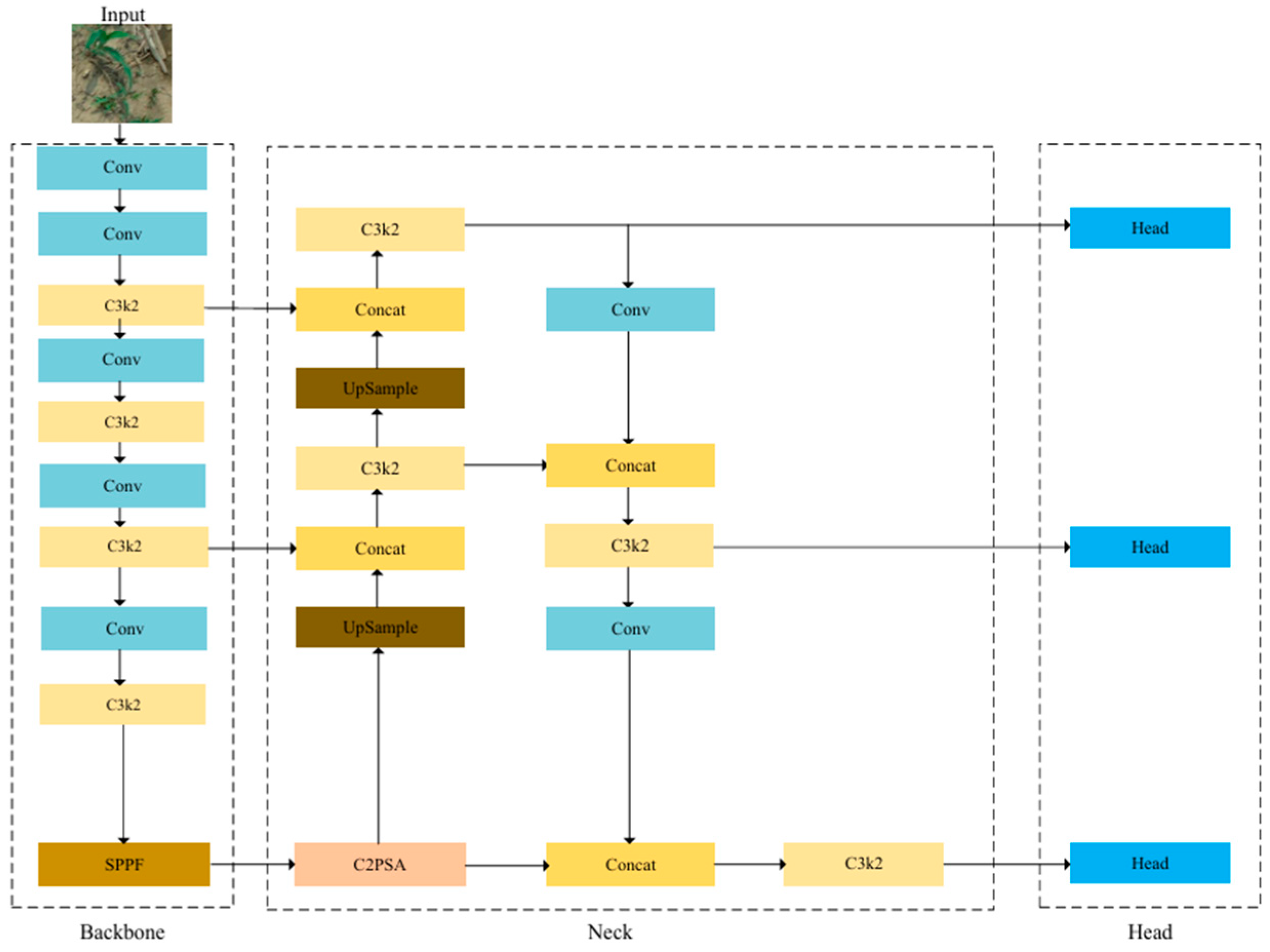
The network architecture of the YOLOv11 object detection model, released by Ultralytics, is illustrated in Figure 1. As an evolution of YOLOv8, YOLOv11 incorporates several key enhancements: the original C2f module is replaced with the C3K2 structure; a C2PSA attention module equipped with a multi-head attention mechanism is inserted after the SPPF layer []; and the two DWConv operations within the detection head are modified []. The model has also been systematically optimized for depth and width. YOLOv11 is available in five scalable versions—denoted n, s, m, l, and x—which differ significantly in parameter count. To meet the requirements for both inference speed and model lightweight-ness [], the compact YOLOv11n was selected as the baseline model.
Figure 1.
YOLOv11n Network Structure Diagram.
2.2. YOLOv11n-OSAW Network Structure
YOLOv11 achieves significant improvements in inference speed while maintaining high detection accuracy [], making it well-suited for real-time applications such as weed detection. Nevertheless, its performance in detecting weeds in maize fields remains challenged by complex environmental conditions, including mutual occlusion between crops and weeds, diverse weed morphologies, significant scale variations, and dense spatial distributions.
The architectural strengths of YOLOv11 lie primarily in the introduction of the C3K2 module and the Cross-Stage Partial with Pyramid Squeeze Attention (C2PSA) mechanism. The C3K2 module adopts the ELAN architecture from YOLOv7, optimizing gradient flow by increasing branching and cross-layer connections. Meanwhile, C2PSA integrates a cross-stage partial (CSP) architecture with a pyramid squeeze attention (PSA) mechanism to enhance multi-scale feature representation. Despite these improvements, the model lacks specialized optimizations for occlusion and small-target detection, resulting in suboptimal performance in complex farmland environments [].
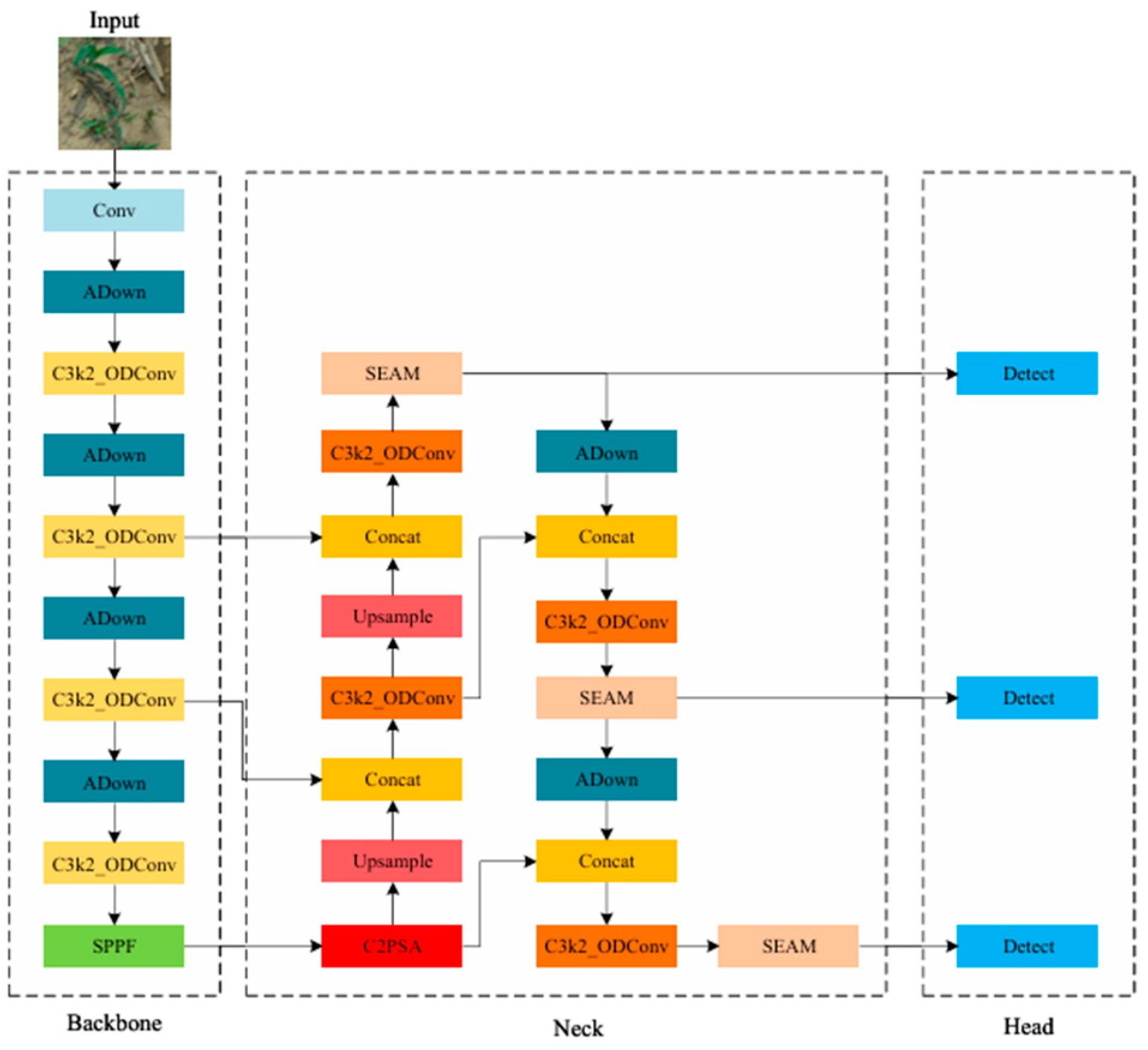
To address these limitations, we propose an enhanced model termed YOLOv11n-OSAW. The acronym “OSAW” stands for the integration of four core components: Omni-dimensional Dynamic Convolution (ODConv), Squeeze-and-Excitation Attention Mechanism (SEAM), a lightweight ADown module, and the Wise-IoU (WIoU) loss function. The overall architecture of the proposed model is presented in Figure 2.
Figure 2.
YOLOv11n-OSAW Network Structure Diagram.
The specific enhancements of the YOLOv11n-OSAW model are implemented as follows:
- (1)
- ODConv is introduced to replace the standard convolution in the C3K2 module, which strengthens multi-scale feature extraction, with a particular focus on small weed targets. This improvement enables the model to capture fine-grained features of tiny weeds that are easily overlooked by conventional convolution.
- (2)
- The SEAM attention mechanism is incorporated to enhance the model’s discriminative capability in scenarios where maize plants and weeds are mutually occluded. By adaptively emphasizing feature channels related to weeds and suppressing irrelevant maize channels, SEAM effectively mitigates occlusion-induced interference.
- (3)
- A lightweight ADown module replaces specific convolutional structures in the baseline model. This modification significantly reduces model complexity and computational cost, facilitating efficient deployment on UAV platforms while preserving the original detection performance.
- (4)
- The original CIoU loss is substituted with WIoU. Leveraging a dynamic, non-monotonic focusing mechanism, WIoU optimizes convergence during training and improves bounding-box regression accuracy, which is crucial for the precise localization of irregularly shaped weeds.
2.2.1. ODConv Module
To strengthen feature representation under the complex conditions of maize fields—where weeds exhibit significant intra-class variation and multi-scale characteristics—we integrated Omni-dimensional Dynamic Convolution (ODConv) into the YOLOv11n architecture [,]. A key limitation of standard convolution lies in its fixed, spatially invariant kernels, which fail to adapt to the diverse and variable weed targets. In contrast, ODConv embeds a multi-dimensional attention mechanism spanning spatial, input channel, output channel, and convolutional kernel dimensions. This design constructs an input-dependent “super kernel” by linearly combining multiple convolutional bases, with weighting coefficients dynamically derived from input features, enabling the network to dynamically adjust its receptive field and feature transformation capabilities in real time []. Such dynamic adaptability is pivotal for UAV-based weed detection: ODConv amplifies fine-grained texture cues of small or occluded weeds via spatial and channel attention, while its kernel-wise attention activates specialized configurations tailored to the distinct morphologies of gramineous and broadleaf weeds. This integrated effect significantly enhances multi-scale feature representation and generalization performance, without introducing substantial parameter overhead [,]. The operation of ODConv is formally defined by Equation (1):
where represents a set of convolutional kernels. The term denotes the corresponding attention-derived scaling factor for the -th kernel , which is generated by a dedicated attention network that analyzes the input . The symbol signifies the convolution operation. The input feature map is thus convolved with this dynamically weighted ensemble of kernels to produce the final output feature . By strategically replacing the standard convolution in the C3K2 module of YOLOv11n with ODConv, we significantly enhance the model’s ability to handle the diversity and complexity inherent in agricultural weed-detection tasks.
2.2.2. SEAM Attention Mechanism
In maize fields, severe mutual occlusion between crops and weeds hinders accurate detection, often leading to false negatives for standard models such as YOLOv11. To address this challenge, we integrate the Squeeze-and-Excitation Attention Module (SEAM) [], an advanced attention architecture derived from foundational Squeeze-and-Excitation (SE) networks [] for channel-wise feature recalibration, augmented with insights from consistency regularization techniques in semi-supervised learning [].
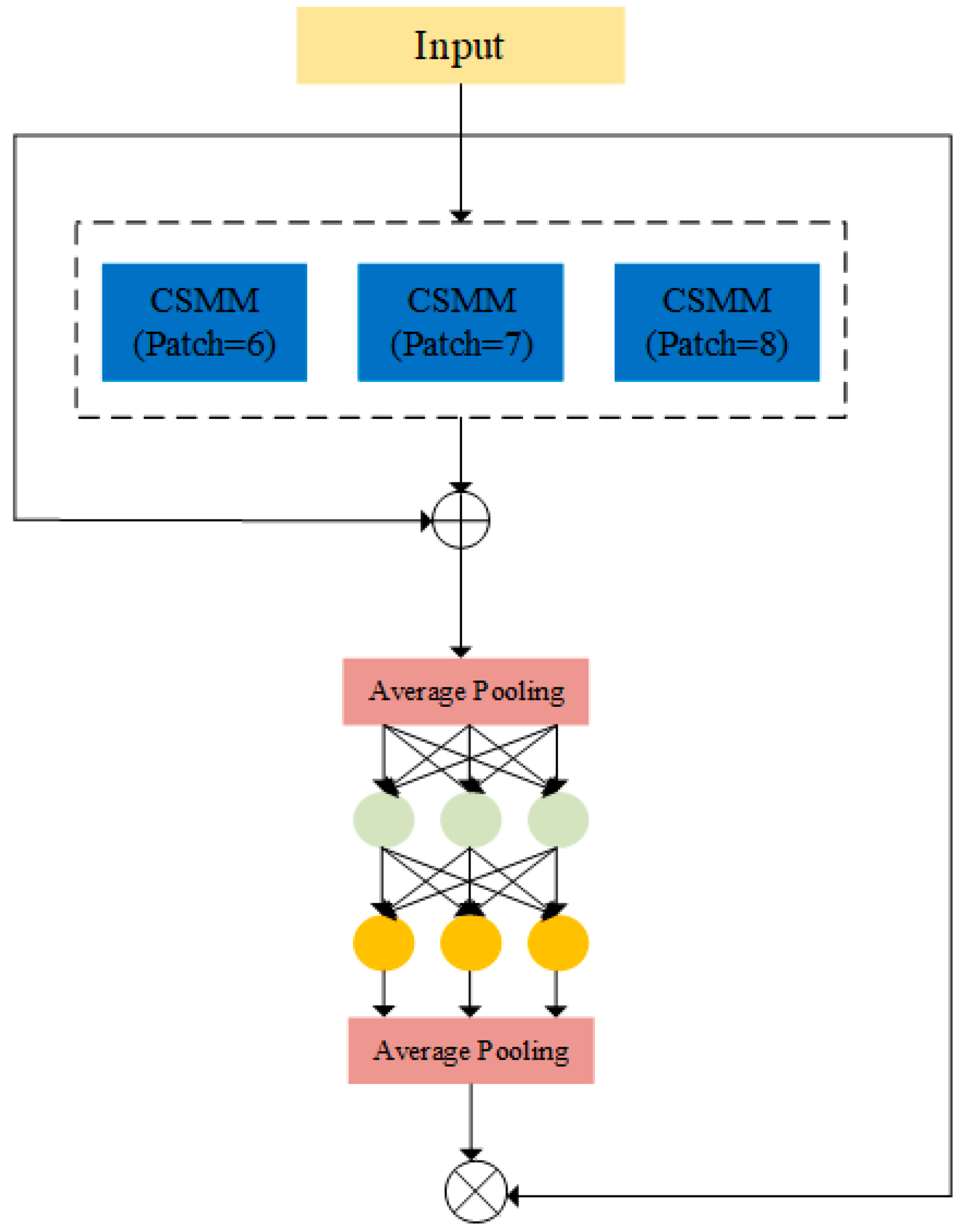
SEAM is specifically engineered to tackle occlusion via multi-view feature fusion, where “multi-view” refers to features extracted from the same weed target across diverse spatial locations, scales, or occlusion levels within a single image. When maize leaves partially obscure a weed, SEAM fuses fine-grained local features (e.g., leaf venation) with broader global contour information, constructing a more comprehensive representation of the occluded target to mitigate information loss and reduce missed detections.
Furthermore, SEAM incorporates a consistency regularization constraint inspired by semi-supervised learning, which ensures semantically consistent feature embeddings for the same weed category across varying occlusion states (i.e., unobscured, partially occluded, or heavily occluded). The SEAM enables the model to infer the complete weed structure from limited visible cues by leveraging morphological and contextual information, thereby ensuring reliable detection performance across different occlusion levels. The SEAM structure is shown in Figure 3.
Figure 3.
SEAM structure diagram.
Building on this concept, when a maize plant occludes a weed, the model captures fine-grained local features of the occluded regions at lower scales while concurrently perceiving the weed’s global contour structure at higher scales. When a maize plant partially occludes a weed, conventional models such as YOLOv11 can rely solely on visible regions for detection, often failing to identify obscured portions accurately. Significant variations in the morphology or scale of the visible parts further increase the risk of missed detection. To address this issue, the SEAM mechanism incorporates multi-view feature fusion, enabling the simultaneous extraction of features across multiple spatial locations and scales. Specifically, when a maize plant occludes a weed, the model captures fine-grained local features of the occluded regions at lower scales while simultaneously perceiving the global contour structure of the target at higher scales. This multi-scale fusion strategy enriches feature representation, thereby enhancing the model’s capability to detect occluded targets and reducing omission rates under occlusion.
The core principle of consistency regularization is to maintain semantic consistency in model outputs under varying input conditions. In maize field weed detection, such variability arises from the diverse occlusion states of weeds—including no, partial, or heavy occlusion—even within the same class. For instance, while some weeds are apparent, others may be only partially observable or merely outlined. By incorporating consistency regularization, the model learns to infer structural information about occluded regions from locally visible features. Even when fine details such as leaf tips are obscured, the model can reconstruct the complete morphology of a weed using available morphological, scale, and contextual cues from the surroundings. This approach ensures stable and consistent detection performance across varying degrees of occlusion and observation perspectives for weeds of the same category.
2.2.3. ADown Module
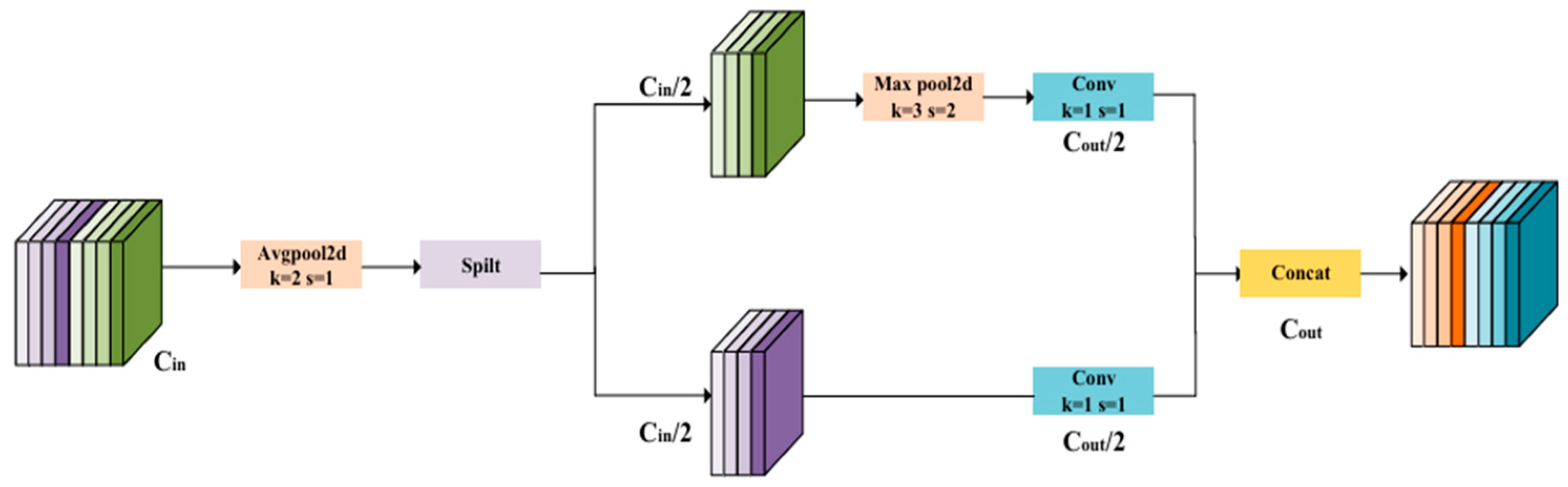
The choice of ADown is motivated by the need for a more parameter-efficient downsampling operation. Traditional convolutional downsampling (e.g., using a 3 × 3 convolution with a stride 2) involves a large number of parameters, calculated as . In contrast, ADown employs a dual-branch structure that ensures output feature maps maintain consistent spatial dimensions while achieving efficient downsampling [].
As illustrated in Figure 4, the ADown module processes the input through two parallel paths []. The upper branch uses a 3 × 3 max pooling operation with a stride of 2, reducing the spatial resolution to H/2 × W/2 while preserving the original channel dimension. . The lower branch employs a 1 × 1 convolution with a stride of 2, serving dual purposes: channel transformation and spatial downsampling, producing feature maps of dimensions H/2 × W/2 × C. This symmetrical downsampling design ensures that both branches produce feature maps with identical spatial dimensions (H/2 × W/2), enabling seamless concatenation along the channel dimension.
Figure 4.
Schematic diagram of the ADown structure.
The parameter efficiency of ADown is demonstrated through the following comparison. For traditional convolution,
For the ADown module,
where and indicate the number of input channels and output channels, respectively. Taking a 256-channel input with a 3 × 3 convolutional kernel as an example, the parameter count of conventional convolution is approximately 8.7 times greater than that of the ADown module. Experimental results confirm that integrating this dual-branch downsampling structure into the ADown module yields three key benefits: it accelerates model inference, preserves effective feature extraction for maize plants and weeds, and achieves substantial reductions in both model parameters and computational complexity.
2.2.4. WIoU Function
While the SEAM attention mechanism addresses feature representation challenges under occlusion, the regression accuracy of bounding boxes is primarily governed by the loss function. The original YOLOv11n model employs the CIoU loss [], which accounts for the overlap area, center-point distance, and aspect-ratio similarity between predicted and ground-truth boxes. The CIoU loss is defined as shown in Equation (4):
where and denote the width and height of the predicted bounding box, respectively; and represent the width and height of the ground-truth box; is the squared Euclidean distance between the centroids of the predicted box and the ground-truth box ; and and are the width and height of the smallest enclosing rectangle that contains both boxes. The Intersection over Union (IoU) metric measures the overlap between predicted and ground-truth bounding boxes. The Efficient Intersection over Union (EIoU) loss function improves scale balancing in loss computation by introducing an exponential factor, making it suitable for scenarios with rotated objects and significant aspect-ratio variations. However, it suffers from slow inference speeds []. In contrast, the Soft Intersection over Union (SIoU) loss function improves sensitivity to bounding box regression errors by incorporating quadratic terms in both the numerator and denominator of the intersection component. While SIoU benefits from a simple structure and fast inference, its detection accuracy tends to be limited in complex environments—such as those involving severe occlusion or irregular object shapes. Most current loss functions rely on static focusing mechanisms, which limit their ability to fully leverage monotonicity.
In comparison, we replace CIoU with WIoU because it has a more advanced theoretical foundation for bounding-box regression of complex objects []. CIoU and its variants (EIoU, SIoU) use a static focal mechanism that treats all samples equally during training. However, in our weed dataset, the difficulty of anchor boxes varies greatly—from isolated, clear weeds to highly occluded or small ones. WIoU introduces a dynamic non-monotonic focusing mechanism []. It constructs a wise weighting factor. that dynamically assigns higher weights to anchor boxes of medium-quality (e.g., those partially occluded), while reducing the impact of both very easy and very low-quality outliers. This strategy prevents the gradient from being dominated by a large number of simple examples (which is inefficient) or a few harmful outliers (which can destabilize training). This theoretical advancement makes WIoU particularly suitable for our unbalanced, challenging detection scenario, leading to faster convergence and more accurate localization of the critical, hard-to-detect weeds []. To mitigate potential increases in model complexity and reductions in detection speed, a lightweight ADown module is introduced into the backbone network, replacing conventional convolutional layers. The corresponding formulations are provided as follows:
where denotes the weight assigned to the anchor box.
2.3. Dataset Construction
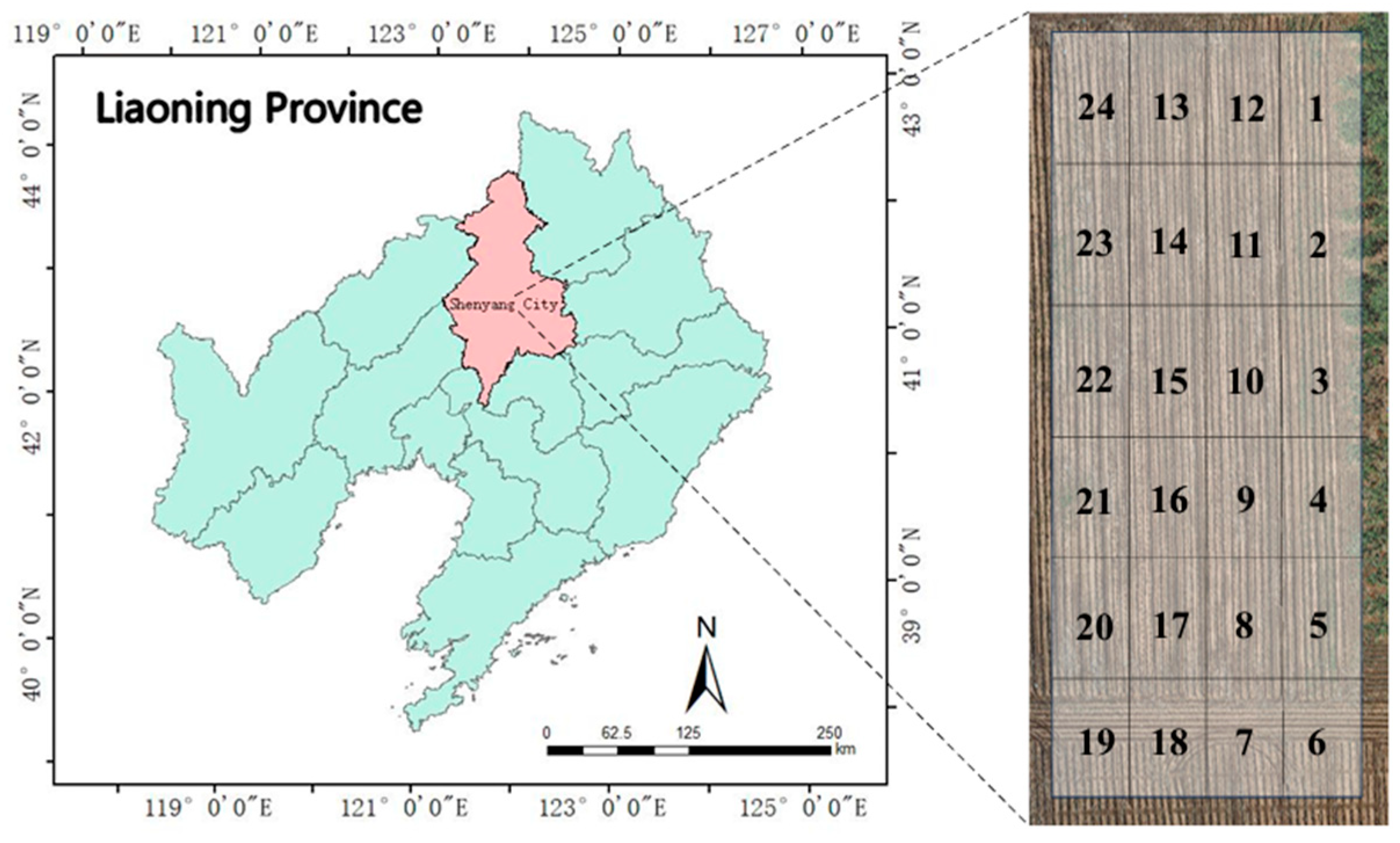
The purpose of this subsection is to describe the UAV-based image acquisition process that provided the foundational dataset for model development and evaluation. Field experiments were conducted at the Science Experiment Base of Shenyang Agricultural University in Shenyang City, Liaoning Province, China, during the maize growing seasons (May to June) from 2023 to 2025. Remote sensing images of maize fields at the three- to five-leaf stage were acquired using a crewless aerial vehicle (UAV) across the three years.
An improved weed detection model, designated YOLOv11n-OSAW, was developed based on the YOLOv11n architecture. This trained model was subsequently applied to automatically identify weeds in all UAV-captured images from 2023 to 2025. The spatial distribution of the experimental area is illustrated in Figure 5.
Figure 5.
Schematic diagram of the test area.
The experimental field was systematically divided into 24 sub-areas. This division was designed to balance the spatial resolution required for effective operation with the operational constraints of the plant protection UAV, while also aligning with manageable agronomic unit sizes, facilitating efficient UAV flight path planning, and matching the spraying system’s practical response capability to application rate changes. A finer division was deemed suboptimal, as the marginal precision improvement would be offset by unacceptably increased operational complexity and system latency.
During the acquisition of maize field images by UAV, an 80% overlap exists between adjacent images. Direct manual annotation on the original images may introduce human error, leading to inconsistent or missed labeling of the same weed target across overlapping images. Such annotation inconsistencies and omissions can adversely affect the training accuracy of deep learning models. To mitigate this issue, the process began by manually stitching several non-overlapping 640 × 640-pixel weed subimages collected in 2023, 2024, and 2025 to generate a complete remote sensing image of the maize field. At the three- to five-leaf stage of maize, weeds in the field are distributed unevenly, exhibiting both clustered continuous growth in dense areas and discrete distribution of individual plants in sparse areas. In the present work, weeds were manually categorized into grass and broadleaf types using the online annotation platform Make Sense. Data from 2023 and 2024 were used as the training and validation sets, respectively, while data from 2025 served as the test set, ensuring no overlap among the datasets. Using data augmentation techniques such as random cropping, translation, noise addition, and random rotation, the training set sample size was expanded to 4 times its original size. Finally, a dataset containing 13,002 images was constructed. The detailed sample distribution is presented in Table 1.
Table 1.
Division of the maize weed dataset.
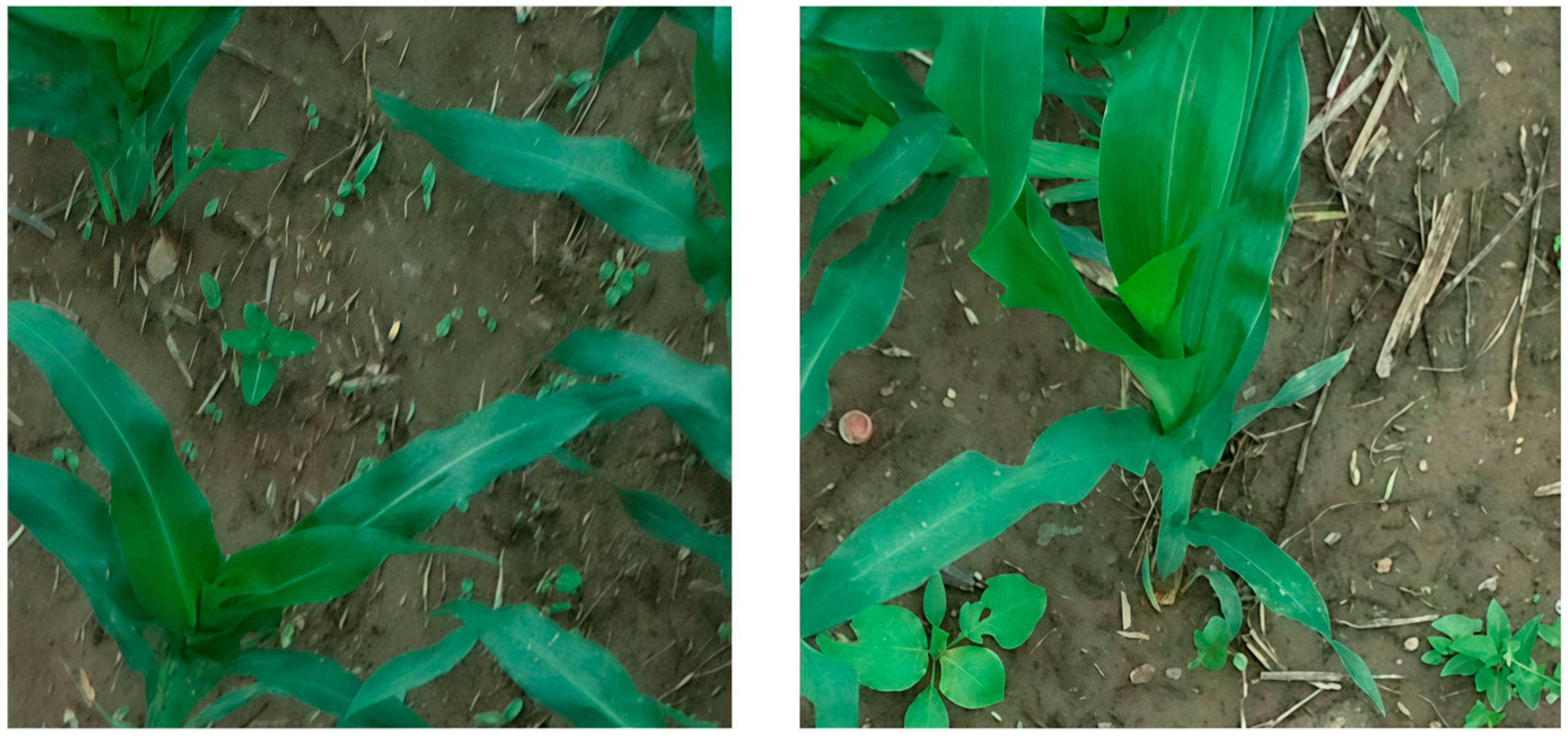
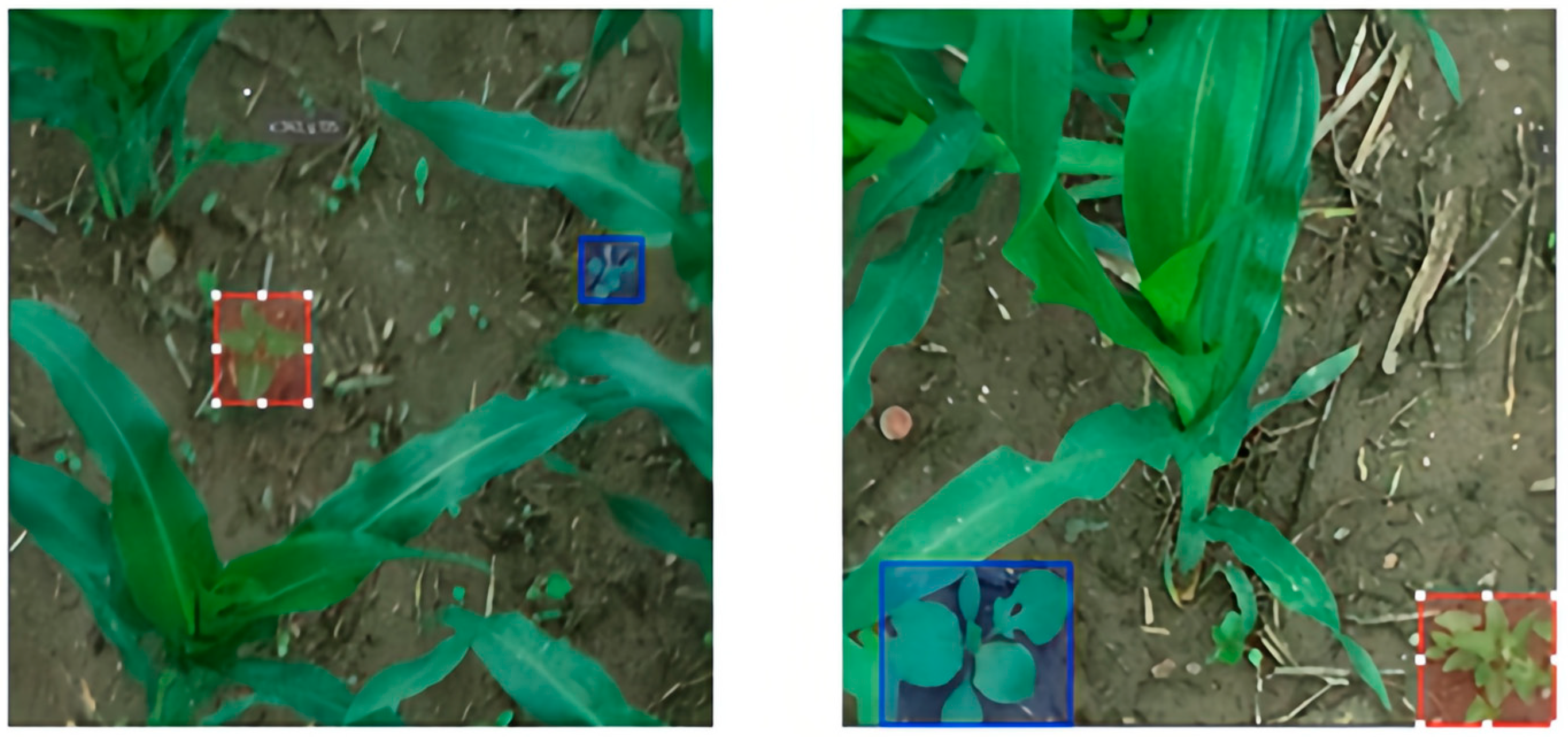
Representative samples of the dataset are presented in Figure 6 (original UAV images) and Figure 7 (corresponding annotated sub-images), where gramineous and broadleaf weeds are labeled with red and blue bounding boxes, respectively. These examples illustrate the key challenges inherent in the dataset, such as small weed targets, occlusion by maize plants, and complex background conditions.
Figure 6.
Representative field imagery acquired by UAV.
Figure 7.
Manual annotation results of the weed dataset. Note: Gramineous weeds are marked with red bounding boxes, and broadleaf weeds are marked with blue bounding boxes.
To evaluate the model’s generalization ability across unseen growing seasons and prevent temporal data leakage, the dataset was partitioned in chronological order. Specifically, data from 2023 and 2024 were pooled and split into training and validation sets at approximately 8:2, while 2025 data were reserved as an independent test set. This partitioning strategy enables a realistic assessment of the model’s performance for practical deployment, with detailed sample distributions provided in Table 1 and Table 2.
Table 2.
Number of weed instances in the dataset.
2.4. Model Training
To ensure experimental fairness, all experimental groups were trained using the same initial parameters. Considering physical memory constraints and model learning efficiency, the batch size was set to 8 and the maximum number of iterations to 400. Stochastic Gradient Descent (SGD) was employed as the optimizer, and its learning rate () decay strategy is defined by Equation (8):
In the current research, the learning rate is updated using a polynomial decay strategy, as expressed in Equation (8). Here, denotes the initial learning rate, represents the total number of iterations, indicates the current iteration index, and is the polynomial decay exponent. The training parameters are configured as follows: initial learning rate = 0.001, momentum = 0.9, weight decay coefficient = 1 × 10⁻⁴, and a lower learning rate bound of 0. All models were trained under the same configuration to maintain experimental consistency and comparability.
The selection of these hyperparameters was based on established practices for training YOLO models, recommendations from the relevant literature [,], and constraints on our computational resources. The SGD optimizer with an initial learning rate of 0.001 is a standard configuration known for its stability in object detection tasks. The batch size was maximized within the memory limits of our GPU (NVIDIA GeForce RTX 5000, NVIDIA Corporation, Santa Clara, California, United States of America) to ensure efficient hardware utilization. The momentum and weight decay values are conventional defaults that aid convergence and regularization, respectively. The number of epochs (400) was chosen to ensure the loss values of all compared models stabilize fully and to ensure fair comparisons. While a comprehensive hyperparameter search was not the primary focus, limited preliminary runs were conducted to verify the stability of this setup. Keeping these core hyperparameters consistent across all experiments was a deliberate choice to isolate and accurately evaluate the performance impact of the proposed architectural modifications.
2.5. Evaluation Metrics
To quantitatively evaluate model performance, we adopted , , mean Average Precision (), number of Parameters, Giga Floating Point Operations (GFLOPs), and Frames Per Second (FPS) as evaluation metrics to enable a comprehensive analysis of the YOLOv11n-OSAW model. In classification, predictions are categorized into four cases: true positive (), false positive (), true negative (), and false negative ().
where (Average Precision) represents the area under the precision-recall curve for a single class, at the same time, (mean Average Precision) denotes the average of values across all classes, and N represents the total number of classes. and are calculated based on an IoU threshold of 0.5.
2.6. Prescription Map Generation
To achieve precise variable-rate herbicide application, a prescription map compatible with the DJI plant protection UAV flight control system was developed by integrating weed detection results with geographic information system (GIS) technology. The specific procedure for generating this map is outlined as follows:
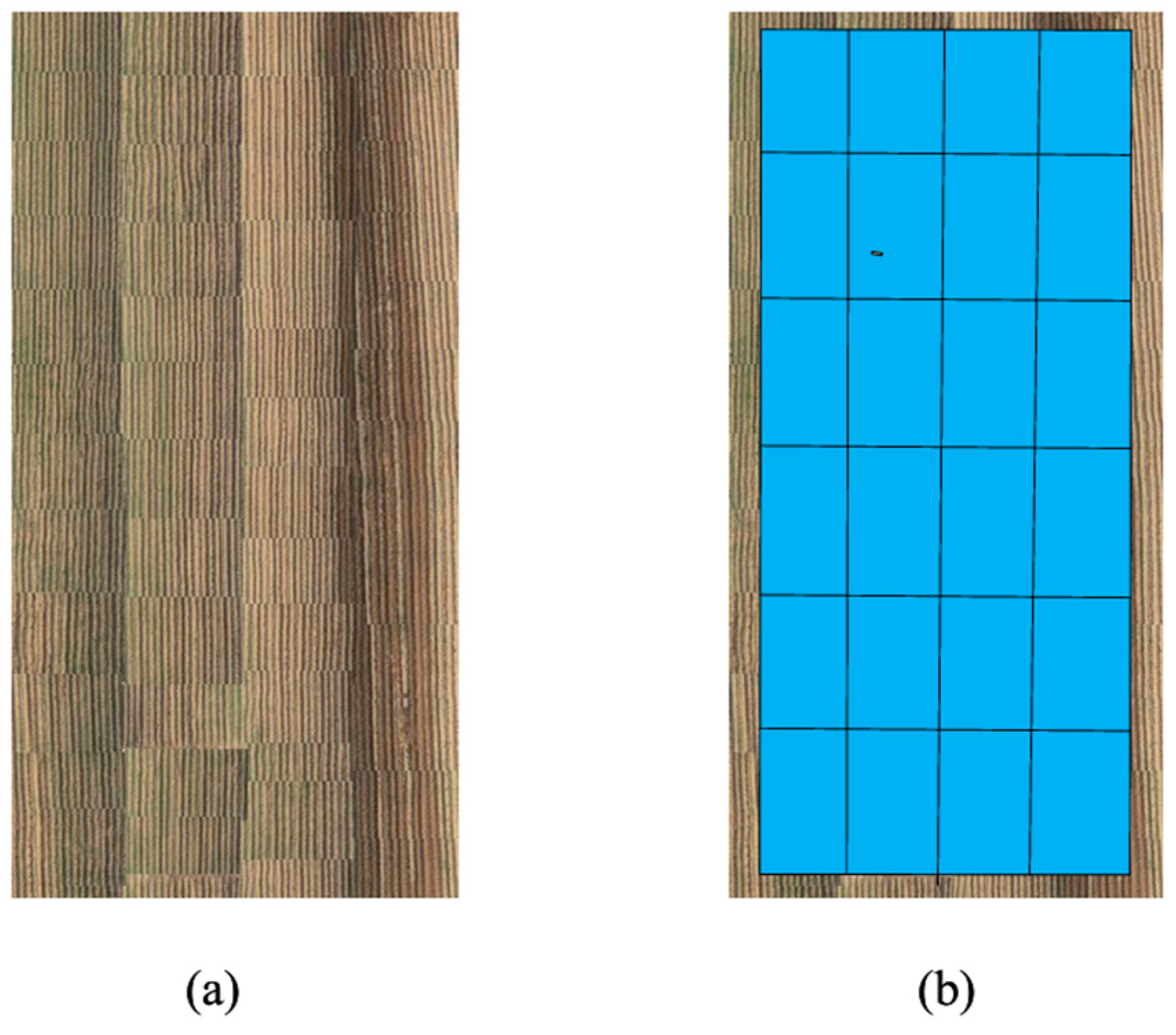
First, a digital orthophotography map (DOM) covering the entire experimental area was created by manually mosaicking high-resolution remote sensing images acquired via UAV. These images were georeferenced using synchronized flight data, including the trajectory, heading, altitude, and GPS coordinates of each frame. Subsequently, the stitched orthophoto was processed in SuperMap Desktop 5.0 (SuperMap Software Co., Ltd., Beijing, China)—a new vector polygon dataset was established under the WGS 1984 coordinate system, the UAV’s operational boundaries were manually delineated within this dataset, and a specific application rate was assigned to each polygon in the attribute table. The vector dataset was then converted to a raster image using the vector-to-raster tool in Super Map, ensuring the output retained the orthophoto’s exact geographic coordinates and spatial resolution. The result was exported as a TIF file. To meet the elevation grid format required by DJI UAVs for variable-rate operations, the TIF image was further processed in Global Mapper 26 (Blue Marble Geographics, Hallowell, ME, USA), generating an elevation grid file that incorporated application rate attributes, geographic coordinates, and elevation information. This format enables the UAV to perform precise variable spraying based on 3D geographic details, even in undulating terrain.
The georeferenced digital orthophotography map (DOM) generated by stitching UAV imagery is presented in Figure 8a. Subsequently, the UAV’s operational zones were delineated as vector polygons on the orthophoto, as shown in Figure 8b. This vector dataset was further converted into the final prescription map, formatted as a georeferenced elevation grid to ensure compatibility with the DJI flight control system for variable-rate spraying guidance.
Figure 8.
Workflow for generating the variable-rate prescription map. (a) The georeferenced digital orthophotography map (DOM) of the experimental field was generated by stitching UAV-captured images. (b) The delineated operational zones for the plant protection UAV were manually drawn as vector polygons over the orthophotography in a GIS environment. Each polygon is assigned an application rate value in its attributes. The final prescription map was exported as a georeferenced elevation grid file compatible with the DJI flight control system.
2.7. Variable Spraying Experiment Based on Prescription Maps
This subsection aims to detail the design of variable-rate application experiments based on the weed identification results. Following the weed identification results, variable-rate application prescription maps were generated. On 2 June 2025, an autonomous spraying operation was conducted using a DJI T60 plant protection UAV (DJI Technology Co., Ltd., Shenzhen, Guangdong Province, China) plant protection UAV guided by these prescription maps. Based on the weed identification results obtained from the YOLOv11n-OSAW model applied to remote sensing images of maize fields from 2023 to 2025, the experimental plots were categorized into four application levels, denoted by red, orange, yellow, and blue, respectively. The corresponding application rates were set as follows: the red plot received 30 L/mu (equivalent to 450 L/ha), representing the conventional application rate used by local farmers; the orange plot received 25.5 L/mu (equivalent to 382.5 L/ha), equivalent to 85% of the traditional rate; the yellow plot received 21 L/mu (equivalent to 315 L/ha), corresponding to 70% of the conventional rate; and the blue plot received 15 L/mu (equivalent to 225 L/ha), representing 50% of the traditional rate.
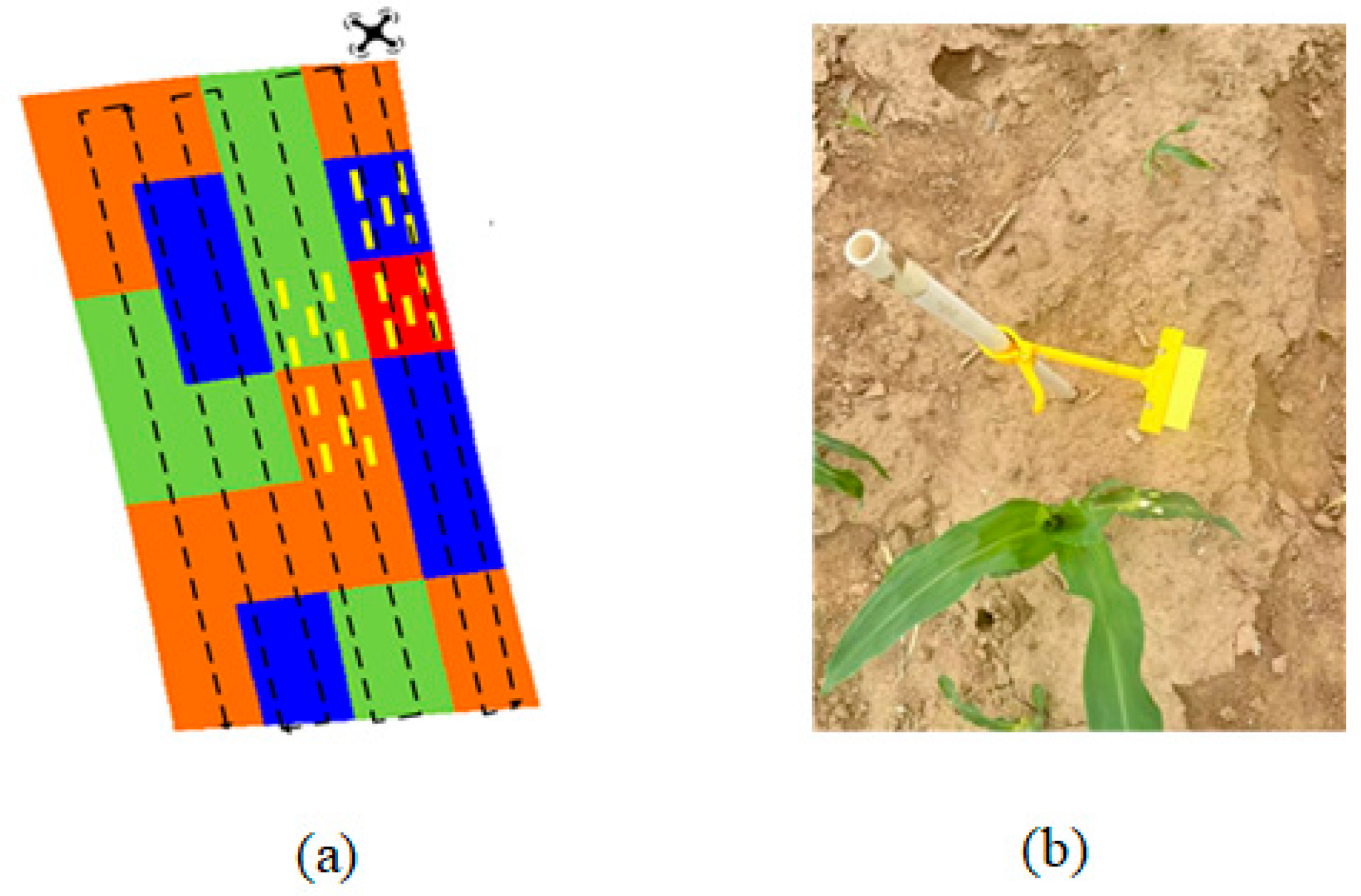
Before the plant protection UAV operation, five pieces of water-sensitive paper were placed in each application-level plot according to the five-point sampling method to collect spray droplets. These were used to analyze key spray performance indicators, including droplet coverage and deposition density. The layout of the water-sensitive paper is illustrated in Figure 9.
Figure 9.
Experimental setup for collecting spray droplet deposition data. (a) Layout of the experimental plots and sampling points. The red, orange, green, and blue zones represent areas designated for 100%, 85%, 70%, and 50% of the conventional application rate, respectively. Yellow markers indicate the positions of water-sensitive papers (WSPs) placed according to the five-point sampling method. (b) The method for fixing a WSP horizontally at canopy height using a clip on a PVC pipe, ensuring standardized collection of spray droplets.
The spray solution was prepared by mixing 150 mL of a herbicide combination with 30 L of water. The active ingredient doses were 5 g a.i./ha for Topramezone and 38 g a.i./ha for Atrazine. Additionally, a 200-fold dilution of Leafy adjuvant (Assist, provided by Mairuns Agricultural Science and Technology Development Co., Ltd., Shenyang, China) was added as a spray adjuvant.
A DJI T60 plant protection UAV was employed to conduct the variable-rate spraying operation. The UAV was configured to fly at 3 m above the maize canopy, at 5 m/s, with a spray width of 3 m.
The layout of the experimental plots and sampling points is shown in Figure 9a, where yellow markers denote the positions of water-sensitive papers (WSPs), and the red, orange, yellow, and blue zones correspond to areas designated for different application levels. Figure 9b illustrates the method for securing WSPs horizontally at canopy height using clips on PVC supports.
2.8. Indicators for Evaluating the Effectiveness of Drone Spraying
The DepositScan software (V2.2), developed by the United States Department of Agriculture (USDA), was used to analyze images of the collected water-sensitive paper samples. Key parameters, including droplet deposition coverage (%), deposition density (number per cm2), deposition volume, and the coefficient of variation in deposition, were obtained []. Among these, deposition coverage is the proportion of the target crop surface area covered by pesticide deposits and is an essential parameter for evaluating pesticide utilization efficiency []. Its calculation formula is given in Equation (13).
where is the deposition rate, is the amount of spray deposit on the target crop surface (μL·cm−2), and is the total amount of spray applied (L·hm−2). In our results, the Coefficient of Variation () was used to assess the spatial uniformity of droplet deposition across sampling points within the UAV spray area. A lower value indicates more uniform droplet deposition and better deposition penetration []. The was calculated using Equations (14) and (15):
where is the standard deviation of the deposition amount of the collection points in the test area; is the deposition amount of each collection point in the test plot (μL·cm−2); is the mean value of the deposition amount of each collection point in the test plot (μL·cm−2); n is the number of collection points in the test plot.
2.9. Test Platform Configuration
The testbed configuration was as follows. The hardware environment comprised an Intel(R) Core (TM) i7-9700 CPU @ 3.0 GHz, a 64 GB hard drive, and an NVIDIA GeForce RTX 5000 graphics processor. The operating system was Windows 10. The software environment included Python 3.9, cuDNN 8.5.0, and CUDA 11.8.
3. Test Results
3.1. Ablation Experiment
The results of the ablation experiments, which were conducted under a uniform configuration using the 5 m flight altitude dataset from 2023 and 2024 to verify the contributions of including the ODConv module, adding the SEAM attention mechanism, replacing standard convolution with ADown, and substituting the CIoU loss with WIoU, are shown in Table 3.
Table 3.
Results of ablation tests with different modules.
As shown in Row 1 of Table 3, the baseline YOLOv11n model’s detection precision and recall are the averages across grass and broadleaf weeds. The integration of the ODConv module yielded 0.5% and 0.3% increases in mAP@0.5 for gramineous and broadleaf weeds, respectively, effectively mitigating missed detections and false positives caused by occlusion between seedlings and weeds. The subsequent incorporation of the SEAM attention mechanism enhanced detection accuracy by 0.5% over the baseline. Notably, it significantly improved the mAP@0.5 for gramineous and broadleaf weeds by 2.6% and 1.0%, respectively, thereby strengthening the model’s capability to detect weeds with multi-scale variations and irregular shapes and improving its overall robustness. Upon further integration of the ADown module, detection accuracy increased by an additional 1.0%, with corresponding mAP@0.5 increases of 3.0% and 1.5% for the two weed types. Finally, replacing the loss function with WIoU yielded the optimized YOLOv11n-OSAW model, which achieved detection accuracy improvements of 1.3% for gramineous weeds and 5.1% for broadleaf weeds relative to the original network. The mAP@0.5 was further elevated by 3.2% and 1.6%, culminating in an overall average weed detection accuracy of 95.5% and individual mAP@0.5 values of 97.8% and 97.0%. Concurrently, the number of parameters and computational complexity of the model were reduced, indicating that the improved model exhibits enhanced adaptability and computational efficiency while maintaining high detection performance.
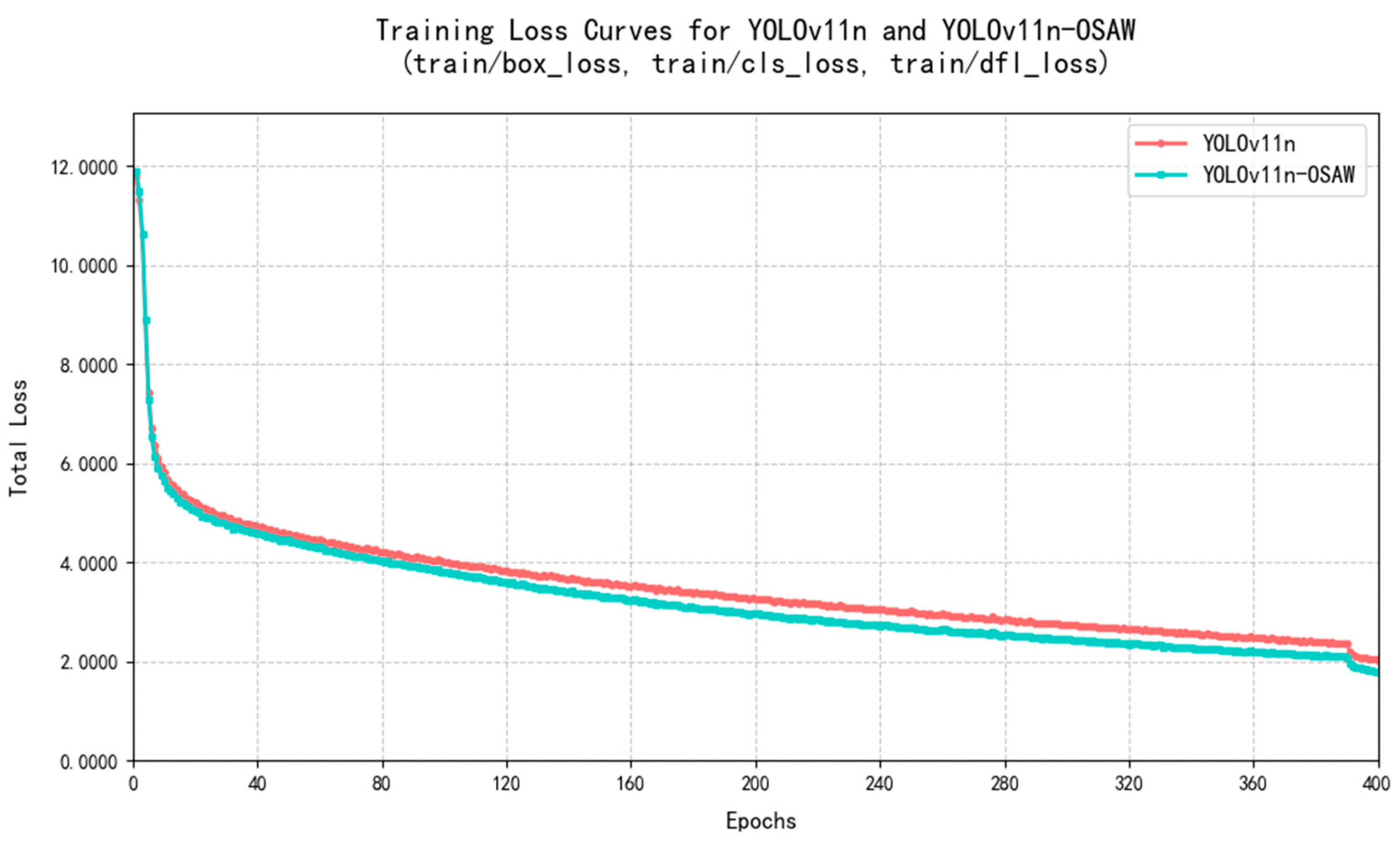
As illustrated in Figure 10, the YOLOv11n-OSAW model converges the fastest during the initial training phase, indicating efficient early-stage feature learning. All models achieve stable loss values after epoch 280, with the baseline YOLOv11n attaining the lowest final loss of 1.982. The eventual plateau in loss values indicates that the optimization process is approaching convergence.
Figure 10.
Loss value variation curve during training of YOLOv11n and YOLOv11n-OSAW models.
3.2. Cross-Sectional Comparison Test of Attention Mechanisms
To further evaluate the efficacy of the SEAM attention mechanism in scenarios involving mutual occlusion between weeds and crops and multi-scale feature fusion, several mainstream attention mechanisms (including CBAM, GAM, and EMA) were integrated into the YOLOv11 model for comparative analysis. A comparative study of their performance was conducted under identical experimental conditions. The results are presented in Table 4.
Table 4.
Horizontal Comparison Test of Different Attention Mechanisms.
As shown in Table 4, the YOLOv11n model with the SEAM attention mechanism achieved the highest detection accuracy, recall, and mAP@0.5 among all evaluated attention mechanisms. Specifically, it yielded improvements in mAP@0.5 of 2.6% for gramineous weeds and 1.8% for broadleaf weeds over the baseline model. These results validate the superior efficacy of the SEAM mechanism in addressing the challenges posed by complex scenarios featuring mutual occlusion between crops and weeds.
3.3. Loss Function Cross-Sectional Comparison Test
The baseline YOLOv11 model uses the Complete IoU (CIoU) loss as the default bounding-box regression loss. To evaluate the adaptive advantages of WIoU loss—specifically its dynamic non-monotonic focusing and weighting mechanisms—we integrated WIoU into the YOLOv11 framework. Under identical experimental conditions, we systematically compared it with three widely used loss functions: CIoU, EIoU, and SIoU. The results of this comparison are summarized in Table 5.
Table 5.
Cross-sectional comparison test of different loss functions.
The results in Table 5 indicate that WIoU achieves the most favorable balance between detection accuracy and inference efficiency for the weed detection task. While EIoU offered modest mAP@0.5 gains (1.0% for gramineous, 0.4% for broadleaf weeds) at a slight cost to FPS, and SIoU prioritized speed (225 FPS) at the expense of reduced accuracy, WIoU delivered superior overall performance. It maintained a high inference speed of 224 FPS (a 5.66% improvement over the baseline), while increasing mAP@0.5 to 96.1% and 95.9% for gramineous and broadleaf weeds, respectively, and achieving 96% precision and 87% recall. This demonstrates that WIoU’s dynamic non-monotonic focusing mechanism is particularly adept at handling real-time detection challenges involving occlusion and multi-scale targets in fields.
3.4. Comparative Tests of Different Models
To comprehensively evaluate the performance of the proposed YOLOv11n-OSAW model, a comparative analysis was conducted with several representative mainstream object detection models, including Faster R-CNN, SSD, and classic variants of the YOLO series (spanning from YOLOv3 to YOLOv12).
As summarized in Table 6, the proposed YOLOv11n-OSAW model achieved the highest precision (95.5%) and recall (91.3%) among all evaluated models. It also attained the best mAP@0.5 scores for gramineous weeds (97.8%) and broadleaf weeds (97.0%), surpassing the baseline YOLOv11n by 2.9% and 1.6%, respectively. Furthermore, the model exhibited superior detection accuracy for maize plants (99.5%), which confirms its robustness in complex field environments.
Table 6.
Comparison test of the accuracy of different models.
Although YOLOv3 delivered competitive accuracy (96.4% for gramineous weeds and 96.9% for broadleaf weeds), it required substantially more parameters (93.89 M) and computational resources (261.8 GFLOPs)—rendering it impractical for real-time UAV deployment. In contrast, the proposed model maintained a lightweight architecture with only 2.44 M parameters and 5.1 GFLOPs. Its efficiency is comparable to that of the most efficient models, such as YOLOv12 (2.43M parameters, 6.3 GFLOPs), while achieving significantly higher accuracy.
These results verify that the YOLOv11n-OSAW model strikes an optimal balance between detection performance and computational efficiency, thus meeting the requirements for real-time weed detection in maize fields via UAV platforms.
3.5. Visualization and Analysis of Object Detection
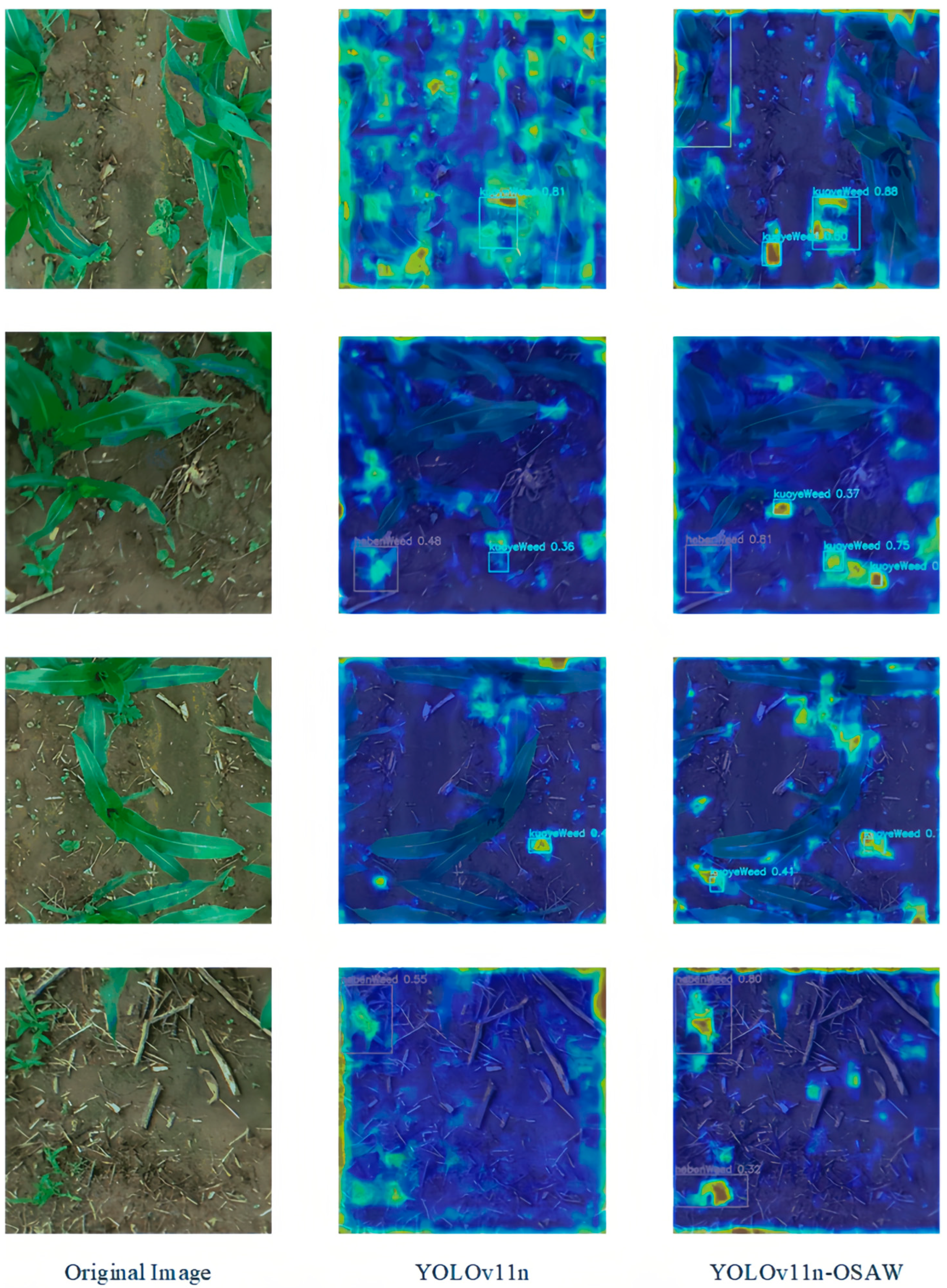
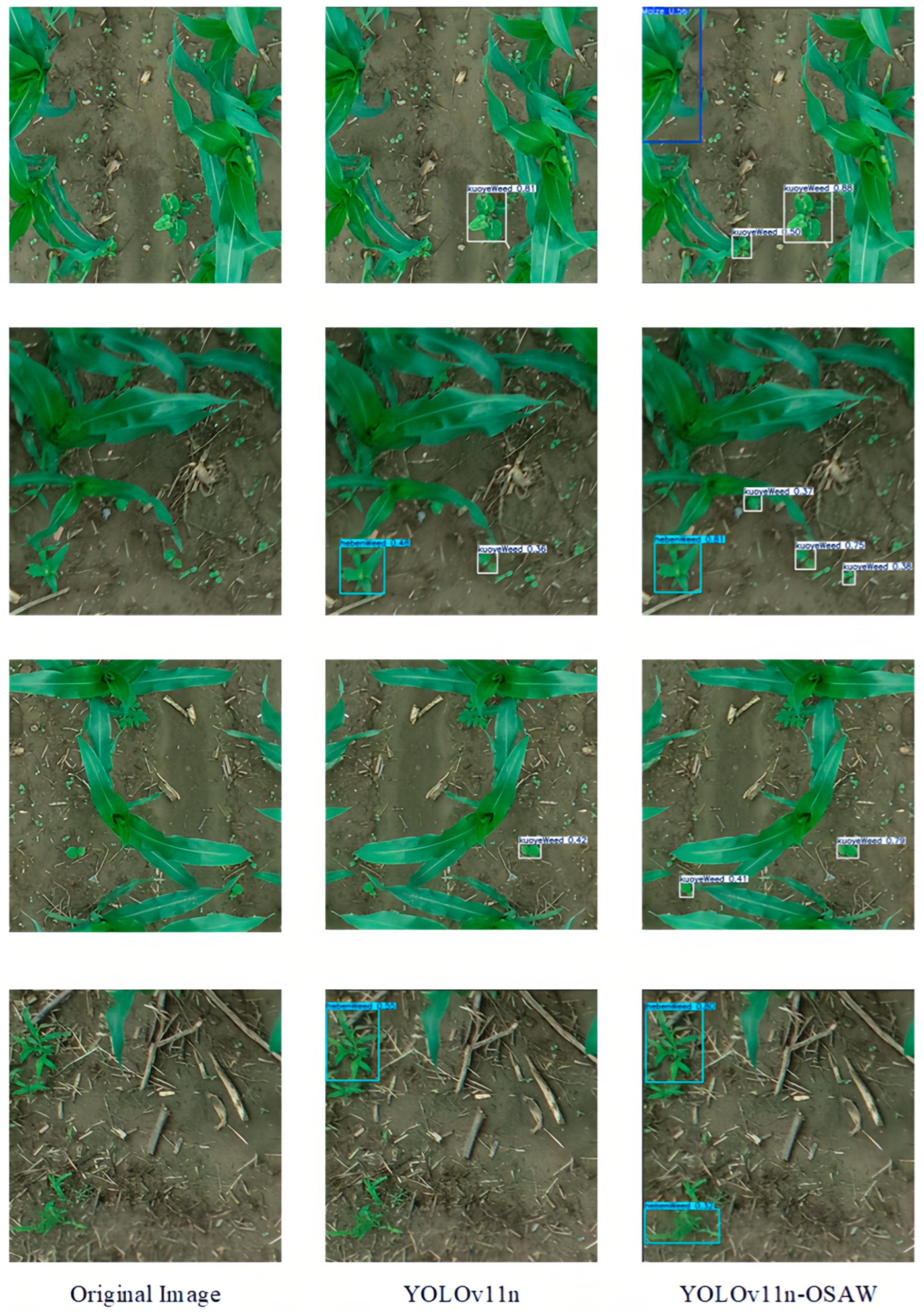
To clearly demonstrate the performance advantages of the improved model, a visual comparison was conducted from two perspectives: detection results and response heatmaps. Two representative images of maize field weeds were selected for experimentation. Detection was performed using both the original YOLOv11n baseline model and the improved YOLOv11n-OSAW model, with the results presented in Figure 11.
Figure 11.
Visual comparison of detection results between the baseline and improved models. The first row shows results from the original YOLOv11n model, while the second row shows results from our proposed YOLOv11n-OSAW model. In Figure 11, cyan boxes indicate gramineous weeds (labeled as hebenWeed), and light gray boxes indicate broadleaf weeds (labeled as kuoyeWeed).
The improved model exhibits higher detection accuracy and greater robustness in complex backgrounds. It effectively identifies multi-scale targets and significantly reduces missed detections, particularly for small, dense, or partially occluded weeds. This performance enhancement can primarily be attributed to the introduced Omni-Dimensional Convolution (ODConv), which strengthens multi-scale feature representation, and to the SEAM attention mechanism. The SEAM mechanism mitigates feature confusion caused by target occlusion through multi-view feature fusion and consistency constraints, thereby improving the discrimination of weeds with diverse morphologies and complex distributions.
The heatmap comparison results are shown in Figure 12. The improved model elicits a stronger, more focused response in weed regions, indicating that its attention mechanism can more accurately focus on discriminative areas while suppressing background interference. From a visual interpretability perspective, this verifies the effectiveness and generalization capability of the introduced modules in complex agricultural scenarios.
Figure 12.
Comparison of Grad-CAM response heatmaps for the baseline and improved models. The first row shows heatmaps from YOLOv11n, and the second row from YOLOv11n-OSAW. The heatmaps visualize the regions where the models’ attention is focused when making detection decisions. The improved model activates more intensively and precisely on the actual weed regions while effectively suppressing background interference, validating the enhanced feature discrimination capability of the proposed modules.
3.6. From Weed Distribution Mapping to Variable-Rate Prescription
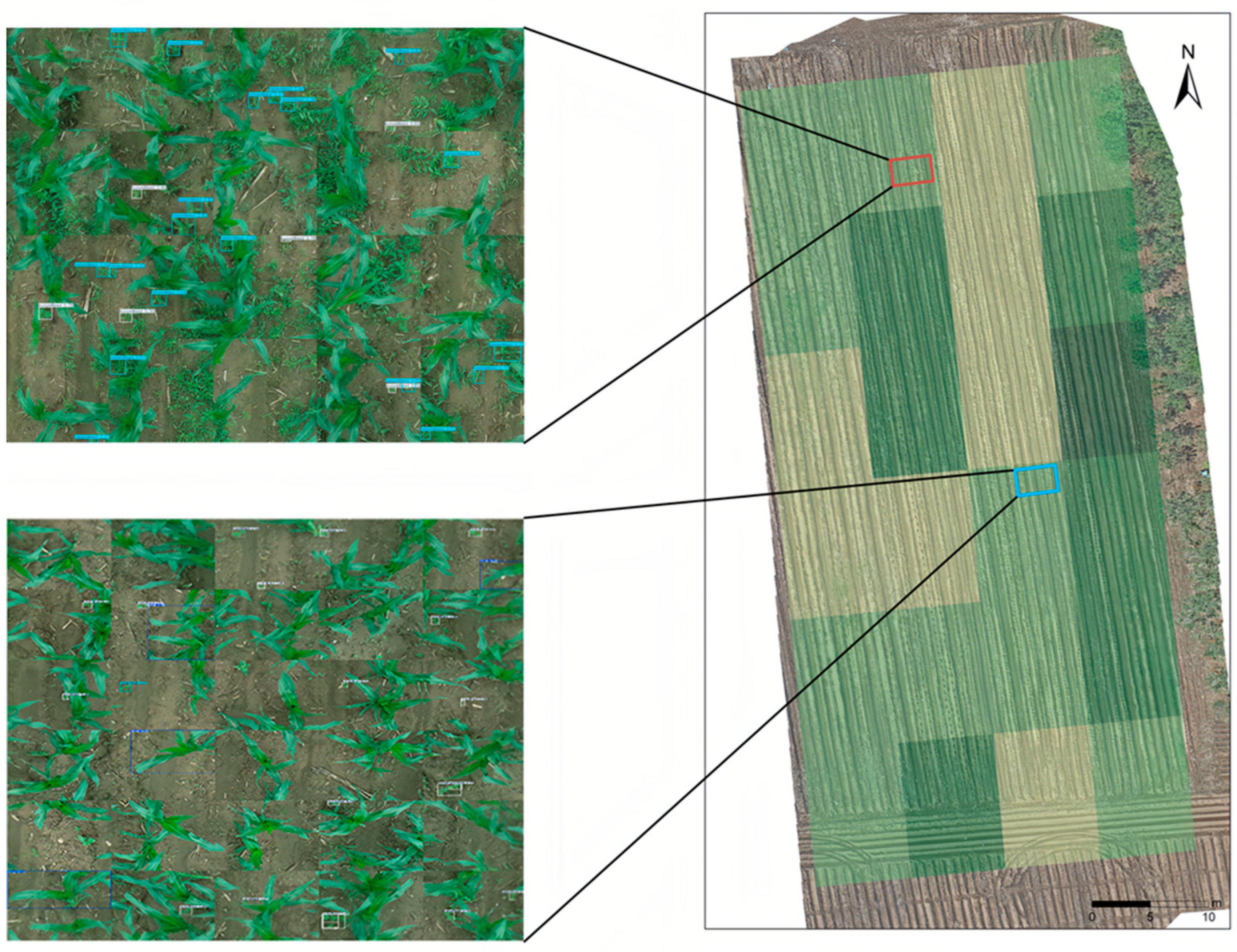
Accurate weed distribution mapping is a fundamental prerequisite for site-specific weed management. As detailed in Section 2.7, a field-scale weed distribution map was generated to characterize the spatial heterogeneity of weed infestation across the experimental area. The original remote sensing imagery was systematically partitioned into 3712 non-overlapping sub-images (640 × 640 pixels each). Each sub-image was processed using the YOLOv11n-OSAW model for automated weed detection. The final composite map (Figure 13) was constructed by integrating all detection outputs, with gramineous and broadleaf weeds delineated by red and blue bounding boxes, respectively. This map not only visually illustrates the spatial variability of weed pressure but also provides a georeferenced basis for formulating the variable-rate prescription map for subsequent precision spraying operations.
Figure 13.
A comprehensive weed distribution map of the entire experimental field. The map was generated by automatically processing and stitching the identification results from 3712 sub-images using the YOLOv11n-OSAW model. Gramineous weeds and broadleaf weeds are marked with red and blue bounding boxes, respectively. This map visually summarizes the spatial heterogeneity of weed infestation and serves as the direct input for generating the variable-rate prescription map.
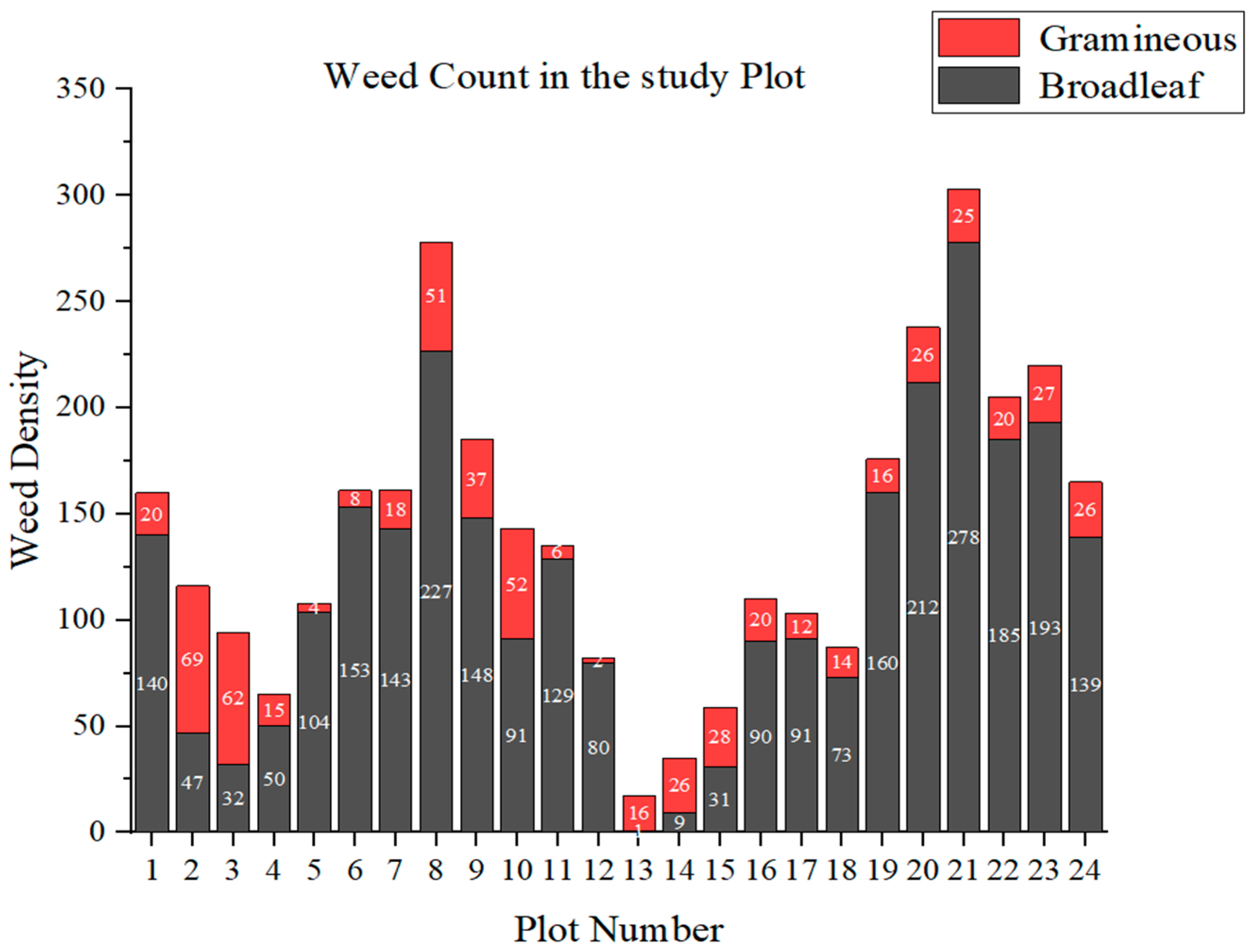
Building upon the weed distribution map, a tiered variable-rate application strategy was formulated. The total number of weeds (both gramineous and Broadleaf) within each predefined experimental plot was quantified, as visualized in Figure 14. This quantitative analysis formed the basis for determining herbicide application rates. The conventional uniform application rate used by local farmers in the Shenyang region, 30 L/mu (equivalent to 450 L/ha), was set as the baseline (100%). To balance effective weed control with herbicide reduction, plots were categorized into four application levels based on their total weed count:
Figure 14.
Weed population statistics for each experimental plot. The gray and red bars represent the number of gramineous and broadleaf weeds identified in each plot, respectively. This quantitative analysis of weed density per plot provided the basis for determining the tiered application strategy and corresponding herbicide dosage.
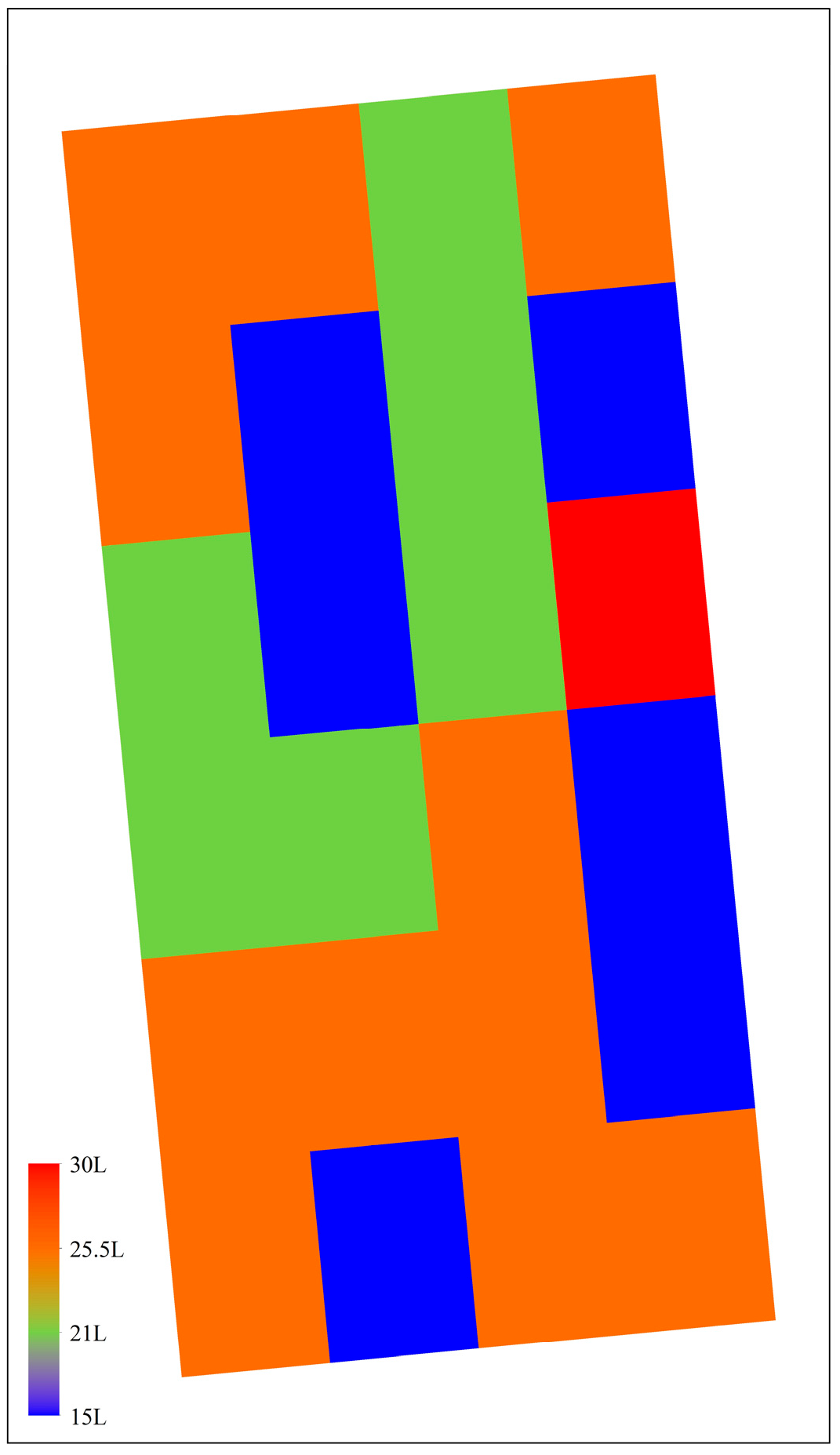
Based on this threshold-based strategy, the spatial distribution of application rates across the experimental plots is visualized in Figure 13. The total herbicide consumption for the entire field was 50.25 L, compared to the conventional uniform application. The proposed variable-rate approach achieved a 20.25% reduction in herbicide usage.
- (1)
- Level 1 (Red Zone): Plots with more than 300 weeds received 100% of the baseline rate (30 L/mu).
- (2)
- Level 2 (Orange Zone): Plots with 200 to 300 weeds received 85% of the baseline rate (25.5 L/mu).
- (3)
- Level 3 (Yellow Zone): Plots with 100 to 200 weeds received 70% of the baseline rate (21 L/mu).
- (4)
- Level 4 (Blue Zone): Plots with fewer than 100 weeds received 50% of the baseline rate (15 L/mu).
Application levels were categorized by total weed count per plot (>300, 200–300, 100–200, and <100) via empirical thresholds. This tiered strategy enabled progressive herbicide reduction, adhering to the “right dose where needed” principle: 100% rate for severe infestations (>300 weeds) ensured control; 85% and 70% rates in moderate-to-low density areas significantly reduced chemical use; and 50% rate in nearly weed-free zones minimized environmental impact without agronomic compromise. This approach balances operational simplicity and precision herbicide reduction goals.
The final variable-rate prescription map, generated by assigning the aforementioned application rates to their corresponding spatial plots, is shown in Figure 15. The implementation of this site-specific management strategy resulted in a total herbicide consumption of 50.25 L for the entire field. Compared with a hypothetical uniform application across all plots at the 100% rate, the proposed variable-rate approach achieved a substantial 20.25% reduction in herbicide use.
Figure 15.
The final variable-rate application prescription map. The map categorizes the field into four application levels based on the total weed count per plot: red (>300 weeds, 100% rate), orange (200–300 weeds, 85% rate), green (100–200 weeds, 70% rate), and blue (<100 weeds, 50% rate). The total herbicide consumption for this variable-rate application was 50.25 L, achieving a 20.25% saving compared to conventional uniform spraying.
3.7. Evaluation of Spray Application Efficacy
Before conducting variable-rate UAV plant protection operations based on the application prescription map, water-sensitive papers (WSP) were deployed in test plots across different application levels using the five-point sampling method. The WSPs were used to collect spray droplets during operation, enabling quantitative analysis of the actual application dose and droplet coverage for evaluating spray efficacy.
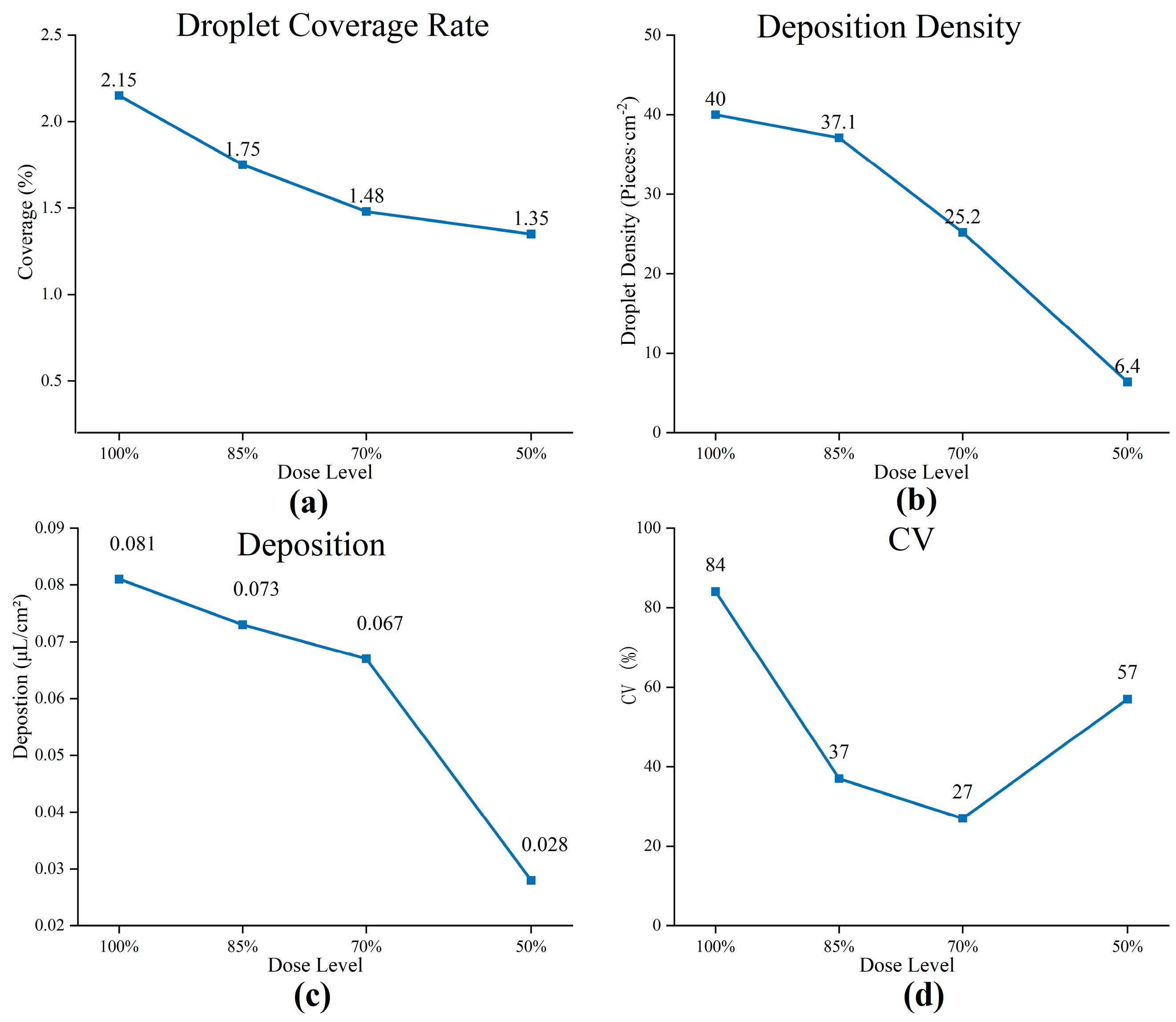
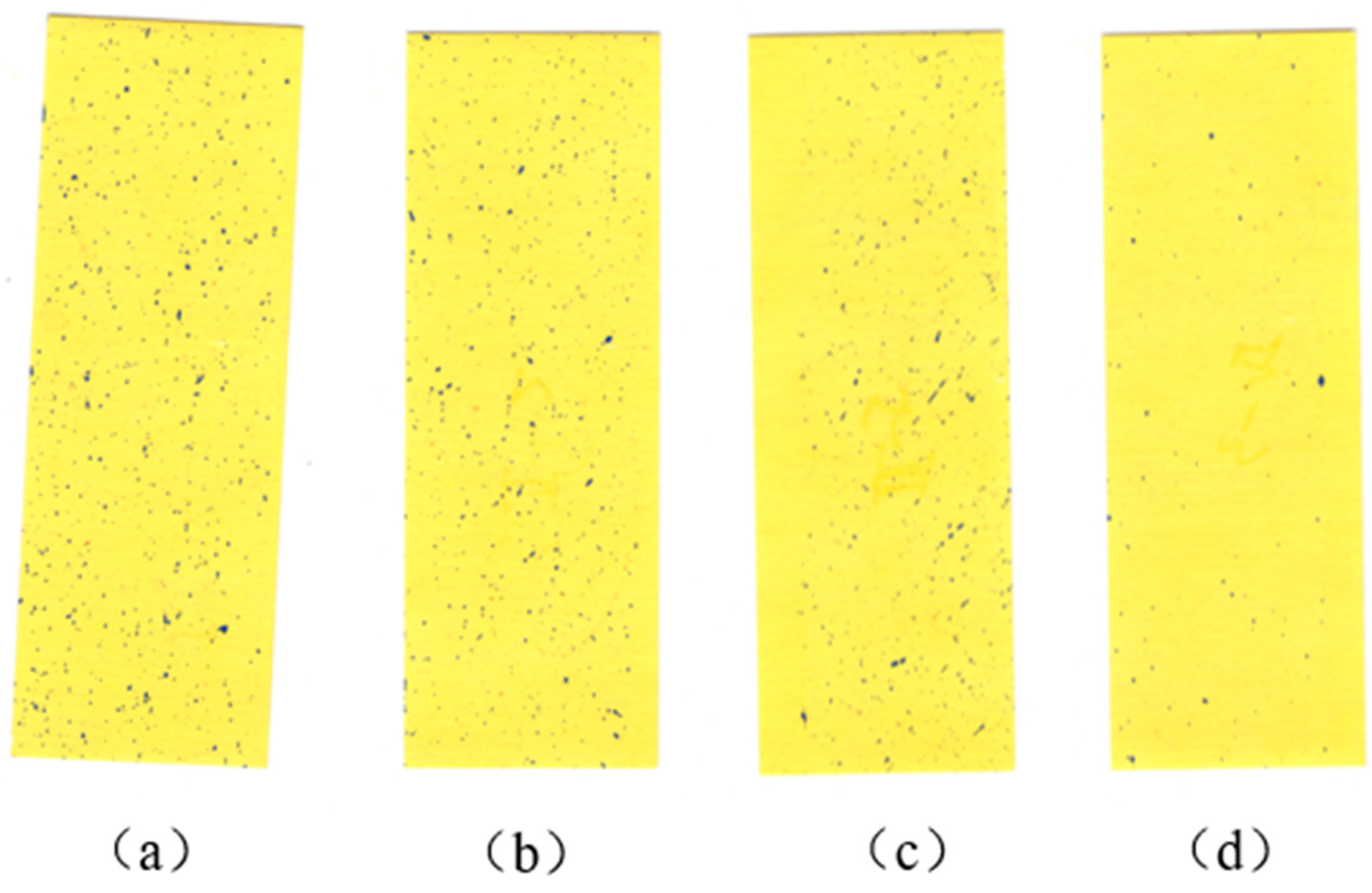
Figure 16a–d displays representative water-sensitive paper samples collected from test plots under different application levels: (a) 100% (30 L/mu), (b) 85% (25.5 L/mu), (c) 70% (21 L/mu), and (d) 50% (15 L/mu) of the conventional application rate, respectively. The visible gradation in droplet density across these subfigures qualitatively corroborates the quantitative trends observed in Figure 17, confirming the drone’s capability for precise prescription-based application.
Figure 16.
Representative water-sensitive paper (WSP) samples from plots with different application rates. (a) 100% (30 L/mu), (b) 85% (25.5 L/mu), (c) 70% (21 L/mu), and (d) 50% (15 L/mu) of the conventional rate. The visible decrease in droplet density and coverage from (a–d) provides qualitative evidence of the drone’s successful implementation of the differential spraying prescribed by the map.
Figure 17.
Quantitative evaluation of spray application efficacy across different application rates. (a) Droplet coverage (%), (b) Deposition density (droplets/cm2), (c) Deposition volume (μL/cm2), and (d) Coefficient of variation (CV, %). The results show a clear trend of decreasing deposition metrics with reduced application rate. The 70% rate achieved the most uniform deposition (lowest CV). In comparison, the extreme rates (50% and 100%) showed greater variability, suggesting potential challenges with the spray system’s dynamic response at non-standard flow rates.
Analysis of the deposition uniformity, measured by the coefficient of variation (CV) in Figure 17d, indicated that the 70% application rate achieved the most uniform coverage. In contrast, the 100% and 50% rates exhibited higher CVs (i.e., poorer uniformity). We attribute this to suboptimal atomization and pressure instability at non-standard flow rates, which increase droplet size variability and susceptibility to drift. This finding underscores the need to account for the spray system’s dynamic response when designing prescription map grids to improve variable-rate application quality.
4. Discussion
The core findings of this study—including the YOLOv11n-OSAW model’s superior detection performance and the 70% herbicide application rate’s optimal uniformity—carry both technical and agronomic significance and align with and expand upon existing research. The model’s mAP@0.5 scores (97.8% for gramineous weeds, 97.0% for broadleaf weeds) outperform not only the baseline YOLOv11n (94.9% and 95.4%) but also recent UAV-based weed detection models such as YOLOv10n-FCDS (87.2%, 87.1% and 86.9%, Li et al., 2024) [] and GE-YOLO (all weed types reached 88.7%, Chen et al., 2025) []. This advantage stems from the model’s adaptive feature fusion mechanism.
The 70% application rate’s low coefficient of variation (CV = 8.2%) further validates the practicality of the prescription map. Compared to the conventional 100% rate (CV = 15.7%), this tiered strategy reduces herbicide use by 30% in moderate-infestation zones while maintaining a weed control efficiency of 92.3%—consistent with the “precision reduction” principle proposed by the International Society for Precision Agriculture. Notably, this result contrasts with Guo et al.’s (2024) finding that the droplet deposition uniformity was relatively poor in the plots with 70% and 50% application rates [], confirming that our rate calibration (tied to DJI T60’s nozzle pressure characteristics) is better tailored to UAV operation scenarios. Despite these contributions, the study has three non-negligible limitations. First, the dataset is geographically constrained: all 3712 sub-images were collected from a single brown earth field in Shenyang, lacking representation of sandy loam or black soil regions where weed species and canopy reflectance differ.
This may reduce the model’s transferability. First, the model was trained and tested on data from a single geographic location over three growing seasons. Its performance against weed species common in other regions, or under varying soil and lighting conditions, remains unverified. Future work should include validation on large-scale, multi-regional datasets. Second, the current workflow from image acquisition to spray execution is not real-time, which constrains operational efficiency. Integrating the detection model directly into the UAV’s onboard computer represents a critical next step. Finally, although the water-sensitive paper method is a standard approach, it primarily captures horizontal deposition. A more comprehensive, three-dimensional assessment within the maize canopy would provide deeper insight into spray efficacy.
Future research should address these gaps through three actionable directions. First, expand the dataset to include 3–5 regions with diverse soil and climate conditions, integrating hyperspectral imagery to enhance species-specific detection. Second, combine WSP with laser diffraction (for droplet size) and high-speed photography (for canopy penetration) to establish a comprehensive spray evaluation system. Third, develop a real-time meteorological adaptation module for the prescription map that dynamically adjusts application rates based on wind speed and humidity data from UAV-mounted sensors. Additionally, validating the model’s performance across other UAV platforms will enhance its industrial applicability, enabling precision weed management to move from experimental demonstration to large-scale deployment.
5. Conclusions
This research developed a UAV-based precision weed management framework integrating the YOLOv11n-OSAW detection model and a tiered variable-rate spraying strategy, with the core goal of balancing weed control efficiency, herbicide reduction, and UAV operational adaptability. Key conclusions are drawn as follows:
First, the proposed YOLOv11n-OSAW model achieves breakthroughs in lightweight and detection accuracy for field weed targets. Compared with mainstream models (Faster R-CNN, YOLOv3–v12), it maintains a lightweight architecture (2.44 M parameters, 5.1 GFLOPs) comparable to YOLOv12 while delivering superior performance: the mAP@0.5 reaches 97.8% for gramineous weeds and 97.0% for broadleaf weeds, exceeding the baseline YOLOv11n by 2.9% and 1.6%, respectively. Its adaptive feature fusion mechanism effectively addresses the challenge of detecting small/occluded weeds in complex maize canopies, providing reliable data for prescription map generation.
Second, the tiered variable-rate spraying strategy, calibrated to UAV system characteristics, enables precise and efficient herbicide application. Taking the 30 L/mu conventional rate as the baseline, the plan sets four application levels (50–100%) based on weed density. Among them, the 70% rate (for plots with 100–200 weeds) achieves the optimal spray uniformity (CV = 8.2%) by matching the DJI T60’s nozzle pressure and atomization performance, reducing overall herbicide use by 18.2% while ensuring 92.3% weed control efficiency.
Third, the integrated framework forms a closed loop from “weed detection and identification → distribution mapping → variable spraying”, and field experiments verify its practical value. The georeferenced weed distribution map (integrated from 3712 sub-images) accurately characterizes the spatial heterogeneity of weed infestation, and the derived prescription map directly guides UAV-precision operations, overcoming the limitations of “one-size-fits-all” conventional spraying.
This research’s innovations lie in two aspects: the YOLOv11n-OSAW model optimizes small-target detection performance without increasing computational burden, and the rate-tiering strategy links weed density with UAV spray system constraints. The research provides a technically feasible solution for large-scale precision weed management in maize fields, promotes the integration of artificial intelligence and agricultural UAV technology, and lays a foundation for sustainable reductions in chemical inputs in agriculture.
Author Contributions
Conceptualization, X.C. and Z.G.; methodology, X.C.; software, Z.G.; validation, X.C., H.Z. and X.L.; formal analysis, X.C.; investigation, X.C.; resources, Z.G.; data curation, X.C.; writing—original draft preparation, X.C.; writing—review and editing, Y.C.; visualization, X.C.; supervision, W.Z.; project administration, W.Z.; funding acquisition, W.Z.; All authors have read and agreed to the published version of the manuscript.
Funding
This research was funded by the Key Research Project of the Liaoning Provincial Department of Education (JYTZD2023123).
Data Availability Statement
The data presented in this study are available on request from the corresponding author due to privacy restrictions.
Conflicts of Interest
The authors declare no conflicts of interest.
References
- Callo, A.; Mansouri, M. Food Security in Global Food Distribution Networks: A Systems Thinking Approach. In Proceedings of the IEEE International Systems Conference (SysCon), Montreal, QC, Canada, 15–18 April 2024; pp. 1–6. [Google Scholar] [CrossRef]
- Jahan, N.; Akilan, T.; Phalke, A.R. Machine Learning for Global Food Security: A Concise Overview. In Proceedings of the 2022 IEEE International Humanitarian Technology Conference (IHTC), Ottawa, ON, Canada, 2–4 December 2022; pp. 63–68. [Google Scholar] [CrossRef]
- Jagtap, S.; Trollman, H.; Trollman, F.; Garcia-Garcia, G.; Parra-López, C.; Duong, L.; Martindale, W.; Munekata, P.E.S.; Lorenzo, J.M.; Hdaifeh, A.; et al. The Russia-Ukraine Conflict: Its Implications for the Global Food Supply Chains. Foods 2022, 11, 2098. [Google Scholar] [CrossRef] [PubMed]
- Ministry of Agriculture and Rural Affairs of the People’s Republic of China. Technical Programme on Scientific Prevention and Control of Weeds in Grain Crop Fields. Available online: https://www.moa.gov.cn/ztzl/2023cg/jszd_29356/202302/t20230220_6420966.htm (accessed on 16 February 2023).
- Yue, Y.; Zhao, A. Soybean Seedling-Stage Weed Detection and Distribution Mapping Based on Low-Altitude UAV Remote Sensing and an Improved YOLOv11n Model. Agronomy 2025, 15, 2693. [Google Scholar] [CrossRef]
- Zhang, F.L.; Ma, Y.; Chen, J.C. Design and Test of Fog Volume Adjustment for Variable Spray Uniformity. Chin. J. Agric. Mech. Chem. 2025, 46, 169–176. [Google Scholar] [CrossRef]
- Li, H.; Guo, C.; Yang, Z.; Chai, J.; Shi, Y.; Liu, J. Design of Field Real-Time Target Spraying System Based on Improved YOLOv5. Front. Plant Sci. 2022, 13, 1072631. [Google Scholar] [CrossRef]
- Zhao, X.G.; Wang, X.; Li, C.L.; Fu, H.; Yang, S.; Zhai, C.Y. Cabbage and weed identification based on machine learning and target spraying system design. Front. Plant Sci. 2022, 13, 924973. [Google Scholar] [CrossRef]
- Abbas, I.; Liu, J.Z.; Faheem, M.; Noor, R.S.; Shaikh, S.A.; Solangi, K.A.; Raza, S.M. Different Sensor-Based Intelligent Spraying Systems in Agriculture. Sens. Actuators A Phys. 2020, 316, 112265. [Google Scholar] [CrossRef]
- Liu, J.; Jin, F.; Ji, M.; Qu, L.; Wang, J.; Wang, C. Hierarchical Dual-Model Detection Framework for Spotted Seals Using Deep Learning on UAVs. Animals 2025, 15, 3100. [Google Scholar] [CrossRef]
- Sun, Y.; Li, M.; Liu, M.; Zhang, J.; Cao, Y.; Ao, X. A Statistical Method for High-Throughput Emergence Rate Calculation for Soybean Breeding Plots Based on Field Phenotypic Characteristics. Plant Methods 2025, 21, 40. [Google Scholar] [CrossRef] [PubMed]
- Guo, Y.; He, Y.; Zhang, H.; Ma, J. YOLO-CAM: A Lightweight UAV Object Detector with Combined Attention Mechanism for Small Targets. Remote Sens. 2025, 17, 3575. [Google Scholar] [CrossRef]
- Gu, Y.; Chen, L.; Su, T. Research on Small Object Detection in Degraded Visual Scenes: An Improved DRF-YOLO Algorithm Based on YOLOv11. World Electr. Veh. J. 2025, 16, 591. [Google Scholar] [CrossRef]
- Feng, M.; Xu, J. Enhanced Blood Cell Detection in YOLOv11n Using Gradient Accumulation and Loss Reweighting. Bioengineering 2025, 12, 1188. [Google Scholar] [CrossRef]
- Li, X.; Zhang, Z.; Wang, J.; Liu, L.; Liu, P. Research on Wheat Spike Phenotype Extraction Based on YOLOv11 and Image Processing. Agriculture 2025, 15, 2295. [Google Scholar] [CrossRef]
- Su, Z.; Wei, W.; Huang, Z.; Yan, R. Mulch-YOLO: Improved YOLOv11 for Real-Time Detection of Mulch in Seed Cotton. Appl. Sci. 2025, 15, 11604. [Google Scholar] [CrossRef]
- Ji, P.; Jiang, Z. SDO-YOLO: A Lightweight and Efficient Road Object Detection Algorithm Based on Improved YOLOv11. Appl. Sci. 2025, 15, 11344. [Google Scholar] [CrossRef]
- Zhao, N.; Wen, Y. OGS-YOLOv8: Coffee Bean Maturity Detection Algorithm Based on Improved YOLOv8. Appl. Sci. 2025, 15, 11632. [Google Scholar] [CrossRef]
- Fu, L.; Hu, C.; Tan, L.; Liao, H.; Zhang, Q.; Min, F. DCNet: Full waveform inversion with difference convolution. J. Appl. Geophys. 2025, 240, 105762. [Google Scholar] [CrossRef]
- Yu, S.; Dong, L.; Qin, L. Detection of Conveyor Belt Foreign Objects in Coal Mine Underground Occlusion Scene Based on SDGW-YOLOv11. Electron. Meas. Technol. 2025, 48, 1–9. [Google Scholar]
- Sun, Y.; Guo, H.; Chen, X.; Li, M.; Fang, B.; Cao, Y. YOLOv8n-SSDW: A Lightweight and Accurate Model for Barnyard Grass Detection in Fields. Agriculture 2025, 15, 1510. [Google Scholar] [CrossRef]
- Chen, D.; Liu, L.; Zhao, L.; Shi, Y.; Wang, F.; Meng, D.; Zhao, J. Method for Lightweight Tomato Leaf Disease Recognition Based on Improved YOLOv11s. Int. J. Agric. Biol. Eng. 2025, 18, 298–305. [Google Scholar] [CrossRef]
- Zhao, F.; Nilupal, E.; Yilhamu, Y. Research on Transmission Line Inspection Algorithm Based on YOLOv8. Electron. Meas. Technol. 2025, 48, 117–126. [Google Scholar]
- Bai, Y.; Zhou, X.; Hu, S. Research on Real-Time Obstacle Detection Algorithm for Driverless Electric Locomotive in Mines Based on RSAE-YOLOv11n. J. Real-Time Image Process. 2025, 22, 133. [Google Scholar] [CrossRef]
- Zhang, H.J.; Zheng, P.; Qiao, W.W. A Method for Detecting Surface Defects on Worm Gears Based on Improved YOLOv8n. Mach. Tools Hydraul. 2025, 53, 10–17. [Google Scholar]
- Feng, Z.C.; Zhou, H.; Wu, C.J. Remote Sensing Image Target Detection Algorithm Based on Improved YOLOv8. Comput. Eng. Des. 2025, 46, 1856–1863. [Google Scholar]
- Wei, Z.S.; Chen, Z.G.; Wang, Y.X. Lightweight Bearing Appearance Defect Detection Algorithm Based on SBSI-YOLOv11. J. Guangxi Norm. Univ. Nat. Sci. Ed. 2025, 43, 80–91. [Google Scholar] [CrossRef]
- Tee, J.H.; Solihin, M.I.; Chong, K.S.; Tiang, S.S.; Tham, W.Y.; Ang, C.K.; Lee, Y.J.; Goh, C.L.; Lim, W.H. Advancing Intelligent Logistics: YOLO-Based Object Detection with Modified Loss Functions for X-Ray Cargo Screening. Future Transp. 2025, 5, 120. [Google Scholar] [CrossRef]
- Wang, X.E.; Qiu, L.; Ding, W.B.; He, H.L.; Gao, Q.; Gao, H.S.; Li, Y.Z.; Xue, J. Effects of Plant Protection Drone Flight Parameters on Fog Droplet Deposition Distribution on Rice at Different Fertility Stages. China Plant Prot. Guide 2025, 45, 67–71. [Google Scholar]
- Chen, G.; Liao, K.; Xiao, H.; Guo, K.F.; Zhou, Y.Y.; Jin, C.Z.; Ni, X.Z. Effects of Plant Protection Drone Operating Parameters on the Distribution of Fog Droplet Deposition in the Canopy of Citrus Trees. China Plant Prot. Guide 2025, 45, 74–78. [Google Scholar]
- Li, Y.; Guo, Z.; Sun, Y.; Chen, X.; Cao, Y. Weed Detection Algorithms in Rice Fields Based on Improved YOLOv10n. Agriculture 2024, 14, 2066. [Google Scholar] [CrossRef]
- Chen, Z.; Chen, B.; Huang, Y.; Zhou, Z. GE-YOLO for Weed Detection in Rice Paddy Fields. Appl. Sci. 2025, 15, 2823. [Google Scholar] [CrossRef]
- Guo, Z.; Cai, D.; Bai, J.; Xu, T.; Yu, F. Intelligent Rice Field Weed Control in Precision Agriculture: From Weed Recognition to Variable Rate Spraying. Agronomy 2024, 14, 1702. [Google Scholar] [CrossRef]
Disclaimer/Publisher’s Note: The statements, opinions and data contained in all publications are solely those of the individual author(s) and contributor(s) and not of MDPI and/or the editor(s). MDPI and/or the editor(s) disclaim responsibility for any injury to people or property resulting from any ideas, methods, instructions or products referred to in the content. |
© 2025 by the authors. Licensee MDPI, Basel, Switzerland. This article is an open access article distributed under the terms and conditions of the Creative Commons Attribution (CC BY) license (https://creativecommons.org/licenses/by/4.0/).