Coping Styles, Postpartum Depression, and Anxiety in Romanian Women: A Cross-Sectional Study Using the Brief COPE Inventory

 , , , , , , and
Abstract
1. Introduction
2. Materials and Methods
2.1. Study Design and Setting
2.2. Participants and Recruitment
2.3. Sociodemographic, Obstetric and Neonatal Data
2.4. Psychological Measures
Coping Strategies
2.5. Depressive Symptoms
2.6. Anxiety Symptoms
2.7. Religiosity
Data Management and Handling of Missing Data
2.8. Statistical Analysis
2.9. Ethical Considerations
3. Results
4. Discussion
4.1. Postpartum Depressive and Anxiety Symptoms
4.2. Coping Strategies and Depressive Symptoms
4.3. Religiosity and Postpartum Symptoms
5. Practical Implications for Prevention and Intervention
6. Limitations
7. Conclusions
Supplementary Materials
Author Contributions
Funding
Institutional Review Board Statement
Informed Consent Statement
Data Availability Statement
Acknowledgments
Conflicts of Interest
References
- Refaeli, L.B.; Rodrigues, M.; Neaman, A.; Bertele, N.; Ziv, Y.; Talmon, A.; Enav, Y. Supporting the Transition to Parenthood: A Systematic Review of Empirical Studies on Emotional and Psychological Interventions for First-Time Parents. Patient Educ. Couns. 2024, 120, 108090. [Google Scholar] [CrossRef]
- Kroska, E.B.; Stowe, Z.N. Postpartum Depression: Identification and Treatment in the Clinic Setting. Obstet. Gynecol. Clin. N. Am. 2020, 47, 409–419. [Google Scholar] [CrossRef] [PubMed]
- Baker, N.; Gillman, L.; Coxon, K. Assessing Mental Health during Pregnancy: An Exploratory Qualitative Study of Midwives’ Perceptions. Midwifery 2020, 86, 102690. [Google Scholar] [CrossRef]
- Watson, H.; Harrop, D.; Walton, E.; Young, A.; Soltani, H. A Systematic Review of Ethnic Minority Women’s Experiences of Perinatal Mental Health Conditions and Services in Europe. PLoS ONE 2019, 14, e0210587. [Google Scholar] [CrossRef]
- Cox, E.Q.; Sowa, N.A.; Meltzer-Brody, S.E.; Gaynes, B.N. The Perinatal Depression Treatment Cascade: Baby Steps Toward Improving Outcomes. J. Clin. Psychiatry 2016, 77, 1189–1200. [Google Scholar] [CrossRef] [PubMed]
- Franks, W.L.M.; Crozier, K.E.; Penhale, B.L.M. Women’s Mental Health during Pregnancy: A Participatory Qualitative Study. Women Birth 2017, 30, e179–e187. [Google Scholar] [CrossRef] [PubMed]
- Easter, A.; Howard, L.; Sandall, J. Mental Health near Miss Indicators in Maternity Care: A Missed Opportunity? A Commentary. BJOG Int. J. Obstet. Gynaecol. 2018, 125, 649–651. [Google Scholar] [CrossRef]
- Trost, S.L.; Beauregard, J.L.; Smoots, A.N.; Ko, J.Y.; Haight, S.C.; Moore Simas, T.A.; Byatt, N.; Madni, S.A.; Goodman, D. Preventing Pregnancy-Related Mental Health Deaths: Insights From 14 US Maternal Mortality Review Committees, 2008–2017. Health Aff. 2021, 40, 1551–1559. [Google Scholar] [CrossRef]
- Walsh, K.; McCormack, C.A.; Webster, R.; Pinto, A.; Lee, S.; Feng, T.; Krakovsky, H.S.; O’Grady, S.M.; Tycko, B.; Champagne, F.A.; et al. Maternal Prenatal Stress Phenotypes Associate with Fetal Neurodevelopment and Birth Outcomes. Proc. Natl. Acad. Sci. USA 2019, 116, 23996–24005. [Google Scholar] [CrossRef]
- Rutherford, H.J.V.; Wallace, N.S.; Laurent, H.K.; Mayes, L.C. Emotion Regulation in Parenthood. Dev. Rev. 2015, 36, 1–14. [Google Scholar] [CrossRef]
- Behrendt, H.F.; Scharke, W.; Herpertz-Dahlmann, B.; Konrad, K.; Firk, C. Like Mother, like Child? Maternal Determinants of Children’s Early Social-Emotional Development. Infant. Ment. Health J. Infancy Early Child. 2019, 40, 234–247. [Google Scholar] [CrossRef] [PubMed]
- Laopaiboon, M.; Lumbiganon, P.; Intarut, N.; Mori, R.; Ganchimeg, T.; Vogel, J.P.; Souza, J.P.; Gülmezoglu, A.M.; WHO Multicountry Survey on Maternal Newborn Health Research Network. Advanced Maternal Age and Pregnancy Outcomes: A Multicountry Assessment. BJOG 2014, 121, 49–56. [Google Scholar] [CrossRef]
- Sauer, M.V. Reproduction at an Advanced Maternal Age and Maternal Health. Fertil. Steril. 2015, 103, 1136–1143. [Google Scholar] [CrossRef]
- Lamminpää, R.; Vehviläinen-Julkunen, K.; Gissler, M.; Selander, T.; Heinonen, S. Pregnancy Outcomes of Overweight and Obese Women Aged 35 Years or Older—A Registry-Based Study in Finland. Obes. Res. Clin. Pract. 2016, 10, 133–142. [Google Scholar] [CrossRef]
- Lazarus, R.S. Stress, Appraisal, and Coping; Springer: Berlin/Heidelberg, Germany, 1984; Volume 445. [Google Scholar]
- Carver, C.S.; Scheier, M.F.; Weintraub, J.K. Assessing Coping Strategies: A Theoretically Based Approach. J. Personal. Soc. Psychol. 1989, 56, 267–283. [Google Scholar] [CrossRef]
- Alshowkan, A.; Shdaifat, E.; Alnass, F.A.; Alqahtani, F.M.; AlOtaibi, N.G.; AlSaleh, N.S. Coping Strategies in Postpartum Women: Exploring the Influence of Demographic and Maternity Factors. BMC Women’s Health 2023, 23, 582. [Google Scholar] [CrossRef] [PubMed]
- Bina, R.; Levy, D.; Alfayumi-Zeadna, S.; Mesquita, A.R.M.; Costa, R.; Domínguez-Salas, S.; Wilson, C.A.; Osorio, A.; Vousoura, E.; Uka, A.; et al. Changes to Social and Healthcare Providers Support in the Perinatal Period: Impact on Coping Strategies, Depression and Anxiety. Midwifery 2025, 142, 104295. [Google Scholar] [CrossRef]
- Gutiérrez-Zotes, A.; Labad, J.; Martín-Santos, R.; García-Esteve, L.; Gelabert, E.; Jover, M.; Guillamat, R.; Mayoral, F.; Gornemann, I.; Canellas, F.; et al. Coping Strategies for Postpartum Depression: A Multi-Centric Study of 1626 Women. Arch. Womens Ment. Health 2016, 19, 455–461. [Google Scholar] [CrossRef]
- Guardino, C.M.; Dunkel Schetter, C. Coping during Pregnancy: A Systematic Review and Recommendations. Health Psychol. Rev. 2014, 8, 70–94. [Google Scholar] [CrossRef]
- Besser, A.; Priel, B. Trait Vulnerability and Coping Strategies in the Transition to Motherhood. Curr. Psychol. 2003, 22, 57–72. [Google Scholar] [CrossRef]
- Koenig, H.G. Religion, Spirituality, and Health: The Research and Clinical Implications. Int. Sch. Res. Not. 2012, 2012, 278730. [Google Scholar] [CrossRef] [PubMed]
- Pargament, K.I.; Smith, B.W.; Koenig, H.G.; Perez, L. Patterns of Positive and Negative Religious Coping with Major Life Stressors. J. Sci. Study Relig. 1998, 37, 710–724. [Google Scholar] [CrossRef]
- Dolcos, F.; Hohl, K.; Hu, Y.; Dolcos, S. Religiosity and Resilience: Cognitive Reappraisal and Coping Self-Efficacy Mediate the Link between Religious Coping and Well-Being. J. Relig. Health 2021, 60, 2892–2905. [Google Scholar] [CrossRef]
- Mann, J.R.; McKeown, R.E.; Bacon, J.; Vesselinov, R.; Bush, F. Do Antenatal Religious and Spiritual Factors Impact the Risk of Postpartum Depressive Symptoms? J. Women’s Health 2008, 17, 745–755. [Google Scholar] [CrossRef]
- Cheadle, A.C.D.; Dunkel Schetter, C.; Community Child Health Network (CCHN). Mastery, Self-Esteem, and Optimism Mediate the Link between Religiousness and Spirituality and Postpartum Depression. J. Behav. Med. 2018, 41, 711–721. [Google Scholar] [CrossRef]
- Handelzalts, J.E.; Stringer, M.K.; Menke, R.A.; Muzik, M. The Association of Religion and Spirituality with Postpartum Mental Health in Women with Childhood Maltreatment Histories. J. Child. Fam. Stud. 2020, 29, 502–513. [Google Scholar] [CrossRef]
- Romanian Orthodox Church | Research Starters | EBSCO Research. Available online: https://www.ebsco.com (accessed on 8 January 2026).
- Population and Housing Census in Romania, 2021 Round—Synthetic Results. National Institute of Statistics. Available online: https://insse.ro/cms/en/content/population-and-housing-census-romania-2021-round-synthetic-results (accessed on 8 January 2026).
- Crașovan, D.; Sava, F. Translation, Adaptation, and Validation on Romanian Population of Cope Questionnaire for Coping Mechanisms Analysis. Cogn. Brain Behav. 2013, 17, 61. [Google Scholar]
- Cox, J.L.; Holden, J.M.; Sagovsky, R. Detection of Postnatal Depression: Development of the 10-Item Edinburgh Postnatal Depression Scale. Br. J. Psychiatry 1987, 150, 782–786. [Google Scholar] [CrossRef] [PubMed]
- Levis, B.; Negeri, Z.; Sun, Y.; Benedetti, A.; Thombs, B.D. Accuracy of the Edinburgh Postnatal Depression Scale (EPDS) for Screening to Detect Major Depression among Pregnant and Postpartum Women: Systematic Review and Meta-Analysis of Individual Participant Data. BMJ 2020, 371, m4022. [Google Scholar] [CrossRef]
- Levis, B.; Benedetti, A.; Thombs, B.D.; DEPRESsion Screening Data (DEPRESSD) Collaboration. Accuracy of Patient Health Questionnaire-9 (PHQ-9) for Screening to Detect Major Depression: Individual Participant Data Meta-Analysis. BMJ 2019, 365, l1476. [Google Scholar] [CrossRef]
- Kroenke, K.; Spitzer, R.L.; Williams, J.B.W. The PHQ-9. J. Gen. Intern. Med. 2001, 16, 606–613. [Google Scholar] [CrossRef]
- Sun, Y.; Kong, Z.; Song, Y.; Liu, J.; Wang, X. The Validity and Reliability of the PHQ-9 on Screening of Depression in Neurology: A Cross Sectional Study. BMC Psychiatry 2022, 22, 98. [Google Scholar] [CrossRef]
- Spitzer, R.L.; Kroenke, K.; Williams, J.B.W.; Löwe, B. A Brief Measure for Assessing Generalized Anxiety Disorder: The GAD-7. Arch. Intern. Med. 2006, 166, 1092–1097. [Google Scholar] [CrossRef]
- Cotiga, A.C.; Zanfirescu, Ş.A.; Iliescu, D.; Ciumăgeanu, M.; Gotca, I.; Popa, C.O. Psychometric Characteristics of the Romanian Adaptation of the GAD-7. J. Psychopathol. Behav. Assess. 2023, 45, 691–701. [Google Scholar] [CrossRef]
- Worthington, E.L., Jr.; Wade, N.G.; Hight, T.L.; Ripley, J.S.; McCullough, M.E.; Berry, J.W.; Schmitt, M.M.; Berry, J.T.; Bursley, K.H.; O’Connor, L. The Religious Commitment Inventory--10: Development, Refinement, and Validation of a Brief Scale for Research and Counseling. J. Couns. Psychol. 2003, 50, 84–96. [Google Scholar] [CrossRef]
- Benk, S.; Budak, T. Item analysis and internal consistency of Turkish version of RCI-10 scale. In The Religious Commitment Inventory 10 (RCI 10): An Adaptation to Turkish, Reliability and Validity Study. In Proceedings of the MIRDEC-16th International Academic Conference (Multidisciplinary Issues and Contemporary Discussions in Social Science), Rome, Italy, 5–7 April 2020; Available online: https://www.researchgate.net/figure/Item-analysis-and-internal-consistency-of-Turkish-version-of-RCI-10-scale_tbl2_341822647 (accessed on 15 January 2026).
- Satsios, N. Evaluating the Greek Version of Religious Commitment Inventory 10 on a Sample of Pomak Households. Rev. Appl. Socio-Econ. Res. 2016, 12, 5–11. [Google Scholar]
- Hafizi, S.; Tabatabaei, D.; Memari, A.H.; Rahmani, A.; Arbabi, M. Religious Commitment Inventory-10: Psychometric Properties of the Farsi Version in Assessing Substance Abusers. Int. J. High Risk Behav. Addict. 2017, 6, e31651. [Google Scholar] [CrossRef]
- Polak, J.; Grabowski, D. Preliminary Psychometric Characteristics of the Polish Version of the Religious Commitment Inventory–10 (RCI-10 PL) by Everett Worthington and Colleagues. Ann. Psychol. 2017, 20, 213–234. [Google Scholar] [CrossRef]
- Benjamini, Y.; Hochberg, Y. Controlling the False Discovery Rate: A Practical and Powerful Approach to Multiple Testing. J. R. Stat. Soc. Ser. B (Methodol.) 1995, 57, 289–300. [Google Scholar] [CrossRef]
- Stewart, D.E.; Vigod, S. Postpartum Depression. N. Engl. J. Med. 2016, 375, 2177–2186. [Google Scholar] [CrossRef] [PubMed]
- Dmitrovic, B.K.; Dugalić, M.G.; Balkoski, G.N.; Dmitrovic, A.; Soldatovic, I. Frequency of Perinatal Depression in Serbia and Associated Risk Factors. Int. J. Soc. Psychiatry 2014, 60, 528–532. [Google Scholar] [CrossRef]
- Contextual-Relationship and Stress-Related Factors of Postpartum Depression Symptoms in Nulliparas: A Prospective Study from Ljubljana, Slovenia. Available online: https://www.springermedizin.de/contextual-relationship-and-stress-related-factors-of-postpartum/17185442?utm_source=chatgpt.com (accessed on 18 January 2026).
- Odalovic, M.; Tadic, I.; Lakic, D.; Nordeng, H.; Lupattelli, A.; Tasic, L. Translation and Factor Analysis of Structural Models of Edinburgh Postnatal Depression Scale in Serbian Pregnant and Postpartum Women—Web-Based Study. Women Birth 2015, 28, e31–e35. [Google Scholar] [CrossRef] [PubMed]
- Nagy, E.; Molnar, P.; Pal, A.; Orvos, H. Prevalence Rates and Socioeconomic Characteristics of Post-Partum Depression in Hungary. Psychiatry Res. 2011, 185, 113–120. [Google Scholar] [CrossRef] [PubMed]
- Wang, Z.; Liu, J.; Shuai, H.; Cai, Z.; Fu, X.; Liu, Y.; Xiao, X.; Zhang, W.; Krabbendam, E.; Liu, S.; et al. Mapping Global Prevalence of Depression among Postpartum Women. Transl. Psychiatry 2021, 11, 543. [Google Scholar] [CrossRef] [PubMed]
- Citu, C.; Gorun, F.; Motoc, A.; Sas, I.; Burlea, B.; Citu, I.M.; Biris, M.; Forga, M.; Neagoe, O.; Gorun, O.M. Prevalence and Risk Factors of Postpartum Depression in Romanian Women during Two Periods of COVID-19 Pandemic. J. Clin. Med. 2022, 11, 1628. [Google Scholar] [CrossRef]
- Izvoranu, S.; Banariu, M.G.; Chirila, S.; Nour, C.; Niculescu, C.; Rus, M.; Badiu, D.; Delcea, C.; Tica, V. Risk Factors in Postpartum Depression Among Women from South-East of Romania: Importance of Early Diagnosis. Arch. Pharm. Pract. 2024, 15, 84–90. [Google Scholar] [CrossRef]
- Kirpinar, İ.; Gözüm, S.; Pasinlioğlu, T. Prospective Study of Postpartum Depression in Eastern Turkey Prevalence, Socio-Demographic and Obstetric Correlates, Prenatal Anxiety and Early Awareness. J. Clin. Nurs. 2010, 19, 422–431. [Google Scholar] [CrossRef]
- Zhong, Q.; Gelaye, B.; Rondon, M.; Sánchez, S.E.; García, P.J.; Sánchez, E.; Barrios, Y.V.; Simon, G.E.; Henderson, D.C.; Cripe, S.M.; et al. Comparative Performance of Patient Health Questionnaire-9 and Edinburgh Postnatal Depression Scale for Screening Antepartum Depression. J. Affect. Disord. 2014, 162, 1–7. [Google Scholar] [CrossRef]
- El-Hachem, C.; Rohayem, J.; Bou Khalil, R.; Richa, S.; Kesrouani, A.; Gemayel, R.; Aouad, N.; Hatab, N.; Zaccak, E.; Yaghi, N.; et al. Early Identification of Women at Risk of Postpartum Depression Using the Edinburgh Postnatal Depression Scale (EPDS) in a Sample of Lebanese Women. BMC Psychiatry 2014, 14, 242. [Google Scholar] [CrossRef]
- Haines, H.M.; Rubertsson, C.; Pallant, J.F.; Hildingsson, I. The Influence of Women’s Fear, Attitudes and Beliefs of Childbirth on Mode and Experience of Birth. BMC Pregnancy Childbirth 2012, 12, 55. [Google Scholar] [CrossRef]
- Melender, H.L.; Lauri, S. Fears Associated with Pregnancy and Childbirth--Experiences of Women Who Have Recently given Birth. Midwifery 1999, 15, 177–182. [Google Scholar] [CrossRef] [PubMed]
- Gutiérrez-Zotes, A.; Labad, J.; Martín-Santos, R.; García-Esteve, L.; Gelabert, E.; Jover, M.; Guillamat, R.; Mayoral, F.; Gornemann, I.; Canellas, F.; et al. Coping Strategies and Postpartum Depressive Symptoms: A Structural Equation Modelling Approach. Eur. Psychiatry 2015, 30, 701–708. [Google Scholar] [CrossRef]
- Kucab, A.; Barnaś, E.; Błajda, J. Assessment of the Postpartum Emotional Wellbeing among Women Participating and Not Participating in Antenatal Classes. Int. J. Environ. Res. Public Health 2022, 19, 4476. [Google Scholar] [CrossRef]
- Peñacoba Puente, C.; Suso-Ribera, C.; Blanco Rico, S.; Marín, D.; San Román Montero, J.; Catalá, P. Is the Association between Postpartum Depression and Early Maternal-Infant Relationships Contextually Determined by Avoidant Coping in the Mother? Int. J. Environ. Res. Public Health 2021, 18, 562. [Google Scholar] [CrossRef]
- Altamura, M.; Leccisotti, I.; De Masi, L.; Gallone, F.; Ficarella, L.; Severo, M.; Biancofiore, S.; Denitto, F.; Ventriglio, A.; Petito, A.; et al. Coping as a Mediator between Attachment and Depressive Symptomatology Either in Pregnancy or in the Early Postpartum Period: A Structural Equation Modelling Approach. Brain Sci. 2023, 13, 1002. [Google Scholar] [CrossRef] [PubMed]
- Zuralska, R.; Postrozny, D.; Sein Anand, J. Pregnant women and strategies of coping with stress and attachment styles. Prz. Lek. 2013, 70, 561–564. [Google Scholar]
- Dennis, C.-L.; Letourneau, N. Global and Relationship-Specific Perceptions of Support and the Development of Postpartum Depressive Symptomatology. Soc. Psychiatry Psychiatr. Epidemiol. 2007, 42, 389–395. [Google Scholar] [CrossRef] [PubMed]
- Cho, H.; Lee, K.; Choi, E.; Cho, H.N.; Park, B.; Suh, M.; Rhee, Y.; Choi, K.S. Association between Social Support and Postpartum Depression. Sci. Rep. 2022, 12, 3128. [Google Scholar] [CrossRef]
- Catala, P.; Suso-Ribera, C.; Carmona, J.; Marín-Morales, D.; Peñacoba, C. Does Pain after Delivery Unequivocally Lead to Postpartum Depression? The Moderating Role of Religious Coping. J. Reprod. Infant. Psychol. 2023, 41, 417–427. [Google Scholar] [CrossRef]
- Simonovich, S.D.; Quad, N.; Kanji, Z.; Tabb, K.M. Faith Practices Reduce Perinatal Anxiety and Depression in Muslim Women: A Mixed-Methods Scoping Review. Front. Psychiatry 2022, 13, 826769. [Google Scholar] [CrossRef]
- Lara-Cinisomo, S.; Wood, J.; Fujimoto, E.M. A Systematic Review of Cultural Orientation and Perinatal Depression in Latina Women: Are Acculturation, Marianismo, and Religiosity Risks or Protective Factors? Arch. Womens Ment. Health 2019, 22, 557–567. [Google Scholar] [CrossRef] [PubMed]
- Hanlon, C.; Whitley, R.; Wondimagegn, D.; Alem, A.; Prince, M. Postnatal Mental Distress in Relation to the Sociocultural Practices of Childbirth: An Exploratory Qualitative Study from Ethiopia. Soc. Sci. Med. 2009, 69, 1211–1219. [Google Scholar] [CrossRef] [PubMed]



| Variable | Level | Missing (n) | Overall (n = 201) | Bihor (n = 100) | Timiș (n = 101) | p-Value |
|---|---|---|---|---|---|---|
| N | 201 | 100 | 101 | |||
| Age at delivery, mean (SD) | 3 | 29.7 (5.8) | 30.1 (6.0) | 29.4 (5.6) | 0.389 | |
| Living environment, n (%) | Rural | 1 | 88 (44.0) | 37 (37.4) | 51 (50.5) | 0.084 |
| Urban | 112 (56.0) | 62 (62.6) | 50 (49.5) | |||
| Ethnicity, n (%) | Romanian | 0 | 187 (93.0) | 90 (90.0) | 97 (96.0) | 0.079 |
| Hungarian | 6 (3.0) | 6 (6.0) | 0 (0.0) | |||
| Roma | 3 (1.5) | 1 (1.0) | 2 (2.0) | |||
| Other | 5 (2.5) | 3 (3.0) | 2 (2.0) | |||
| Satisfied with housing, n (%) | Yes | 1 | 198 (99.0) | 98 (99.0) | 100 (99.0) | 1.000 |
| No | 2 (1.0) | 1 (1.0) | 1 (1.0) | |||
| Number of rooms in dwelling, mean (SD) | 5 | 3.5 (1.8) | 3.3 (1.3) | 3.7 (2.1) | 0.105 | |
| Number of people in dwelling, mean (SD) | 4 | 3.4 (1.6) | 3.2 (1.2) | 3.5 (1.8) | 0.185 | |
| Lives with, n (%) | Husband | 8 | 67 (34.7) | 32 (34.0) | 35 (35.4) | 0.018 |
| Husband and children | 80 (41.5) | 47 (50.0) | 33 (33.3) | |||
| Husband, children and other people | 46 (23.8) | 15 (16.0) | 31 (31.3) | |||
| Education level, n (%) | Higher education | 0 | 115 (57.2) | 62 (62.0) | 53 (52.5) | 0.013 |
| High school | 73 (36.3) | 33 (33.0) | 40 (39.6) | |||
| Middle school | 4 (2.0) | 4 (4.0) | 0 (0.0) | |||
| Primary school | 9 (4.5) | 1 (1.0) | 8 (7.9) | |||
| Stressful job, n (%) | Yes | 31 | 101 (59.4) | 57 (64.8) | 44 (53.7) | 0.187 |
| No | 69 (40.6) | 31 (35.2) | 38 (46.3) | |||
| Marital status, n (%) | Married | 0 | 179 (89.1) | 91 (91.0) | 88 (87.1) | 0.179 |
| Divorced | 7 (3.5) | 5 (5.0) | 2 (2.0) | |||
| Unmarried | 14 (7.0) | 4 (4.0) | 10 (9.9) | |||
| Widowed | 1 (0.5) | 0 (0.0) | 1 (1.0) | |||
| Job category, n (%) | Administrative/office | 0 | 54 (26.9) | 24 (24.0) | 30 (29.7) | 0.259 |
| Retail & services | 36 (17.9) | 18 (18.0) | 18 (17.8) | |||
| Unemployed/homemaker/student | 35 (17.4) | 12 (12.0) | 23 (22.8) | |||
| Education | 19 (9.5) | 11 (11.0) | 8 (7.9) | |||
| Healthcare | 17 (8.5) | 11 (11.0) | 6 (5.9) | |||
| Manual/technical/industrial | 16 (8.0) | 10 (10.0) | 6 (5.9) | |||
| Other | 24 (11.9) | 14 (14.0) | 10 (9.9) | |||
| Perceived family income level, n (%) | Income insufficient to cover expenses | 0 | 18 (9.0) | 10 (10.0) | 8 (7.9) | 0.491 |
| Income sufficient but should be higher | 33 (16.4) | 20 (20.0) | 13 (12.9) | |||
| Income sufficient to cover expenses | 119 (59.2) | 55 (55.0) | 64 (63.4) | |||
| Income more than needed | 31 (15.4) | 15 (15.0) | 16 (15.8) |
| Variable | Missing (N) | Bihor (N = 100) | Timiș (N = 101) | Total (N = 201) | p-Value |
|---|---|---|---|---|---|
| BMI at delivery—categorical | 11 | 0.707 | |||
| Normal weight | — | 19 (21.3%) | 20 (19.8%) | 39 (20.5%) | |
| Overweight | — | 37 (41.6%) | 48 (47.5%) | 85 (44.7%) | |
| Obesity | — | 33 (37.1%) | 33 (32.7%) | 66 (34.7%) | |
| BMI at delivery—continuous | 11 | 0.572 | |||
| Mean (SD) | — | 29.0 (5.1) | 28.6 (4.2) | 28.8 (4.3) | |
| Range | — | 20.0–48.3 | 22.1–37.8 | 20.0–40.9 | |
| BMI at pregnancy onset—continuous | 19 | 0.236 | |||
| Mean (SD) | — | 24.0 (4.6) | 23.2 (4.0) | 23.6 (4.3) | |
| Range | — | 13.6–40.9 | 12.8–37.8 | 12.8–40.9 | |
| Gestational weight gain (kg) | 25 | 0.049 | |||
| Mean (SD) | — | 17.1 (5.6) | 15.4 (5.4) | 16.1 (5.6) | |
| Range | — | 6.0–30.0 | 5.0–30.0 | 5.0–30.0 | |
| BMI at pregnancy onset—categorical | 19 | 0.187 | |||
| Underweight | — | 8 (9.6%) | 7 (7.1%) | 15 (8.2%) | |
| Normal weight | — | 42 (50.6%) | 65 (65.7%) | 107 (58.8%) | |
| Overweight | — | 26 (31.3%) | 19 (19.2%) | 45 (24.7%) | |
| Obesity | — | 7 (8.4%) | 8 (8.1%) | 15 (8.2%) | |
| Gestational age at birth (weeks) | 6 | 37.5 (4.4) | 38.0 (3.8) | 37.8 (4.1) | 0.421 |
| Birth weight (g) | 4 | 3201.8 (602.6) | 3193.4 (506.5) | 3197.5 (554.0) | 0.916 |
| Birth length (cm) | 4 | 51.6 (5.2) | 50.9 (2.6) | 51.2 (4.1) | 0.227 |
| Apgar score at 1 min | 9 | 8.7 (1.1) | 9.1 (1.0) | 8.9 (1.1) | 0.026 |
| Apgar score at 5 min | 33 | 9.0 (0.5) | 9.4 (0.8) | 9.2 (0.7) | 0.002 |
| Neonatal intensive care unit stay (days) | 165 | 8.5 (11.8) | 6.2 (4.5) | 7.6 (9.6) | 0.410 |
| Variable | Category | Overall (n = 201) | Bihor (n = 100) | Timiș (n = 101) | p-Value |
|---|---|---|---|---|---|
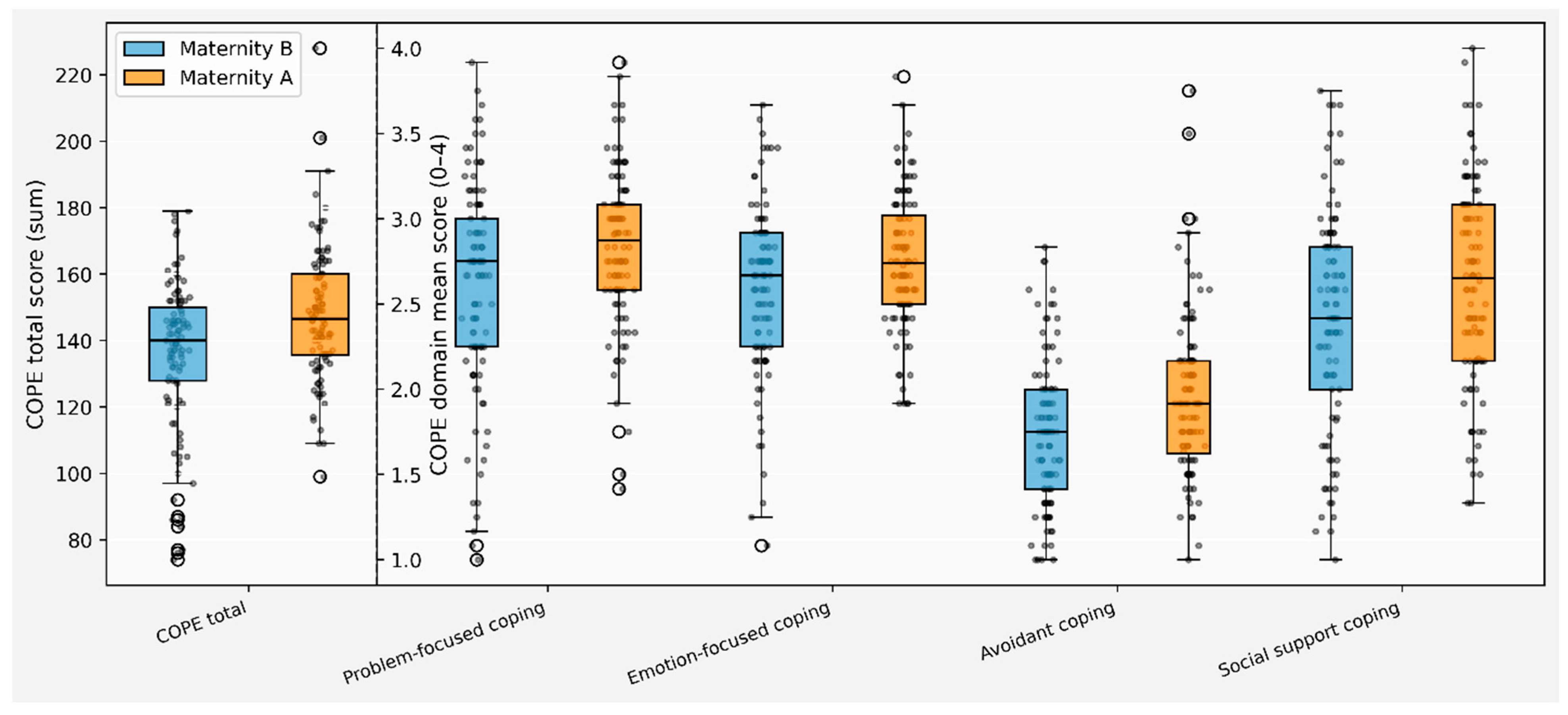
| Problem-focused coping | 2.7 (0.6) | 2.8 (0.5) | 2.6 (0.6) | 0.003 | |
| Emotion-focused coping | 2.7 (0.5) | 2.7 (0.4) | 2.6 (0.5) | 0.013 | |
| Social support coping | 2.5 (0.6) | 2.6 (0.6) | 2.4 (0.6) | 0.017 | |
| Avoidant coping | 1.8 (0.5) | 2.0 (0.5) | 1.7 (0.4) | <0.001 | |
| Rosenberg Self-Esteem Scale | |||||
| Rosenberg total score | 16.8 (4.4) | 16.6 (4.4) | 17.0 (4.5) | 0.556 | |
| Rosenberg self-esteem level | High (30–40) | 2 (1.0) | 1 (1.0) | 1 (1.0) | 0.993 |
| Medium (20–29) | 51 (25.4) | 25 (25.0) | 26 (25.7) | ||
| Low (10–19) | 148 (73.6) | 74 (74.0) | 74 (73.3) | ||
| EPDS, PHQ-9 and GAD-7 | |||||
| EPDS total score | 7.3 (5.1) | 7.5 (4.8) | 7.0 (5.5) | 0.535 | |
| EPDS risk ≥ 10 | No | 135 (67.2) | 68 (68.0) | 67 (66.3) | 0.920 |
| Yes | 66 (32.8) | 32 (32.0) | 34 (33.7) | ||
| EPDS risk ≥ 13 | No | 170 (84.6) | 86 (86.0) | 84 (83.2) | 0.718 |
| Yes | 31 (15.4) | 14 (14.0) | 17 (16.8) | ||
| PHQ-9 total score | 6.0 (4.7) | 6.5 (4.7) | 5.4 (4.7) | 0.111 | |
| PHQ-9 severity level | Minimal | 88 (43.8) | 37 (37.0) | 51 (50.5) | 0.346 |
| Mild | 73 (36.3) | 39 (39.0) | 34 (33.7) | ||
| Moderate | 27 (13.4) | 17 (17.0) | 10 (9.9) | ||
| Moderately severe | 11 (5.5) | 6 (6.0) | 5 (5.0) | ||
| Severe | 2 (1.0) | 1 (1.0) | 1 (1.0) | ||
| GAD-7 total score | 5.1 (4.9) | 5.8 (5.4) | 4.4 (4.2) | 0.041 | |
| GAD-7 severity level | Minimal | 112 (55.7) | 51 (51.0) | 61 (60.4) | 0.245 |
| Mild | 57 (28.4) | 28 (28.0) | 29 (28.7) | ||
| Moderate | 16 (8.0) | 10 (10.0) | 6 (5.9) | ||
| Severe | 16 (8.0) | 11 (11.0) | 5 (5.0) | ||
| RCI-10 Religiosity | |||||
| RCI-10 total score | 23.1 (10.6) | 25.4 (10.5) | 20.9 (10.2) | 0.002 | |
| RCI-10 religiosity level | Low | 93 (46.3) | 37 (37.0) | 56 (55.4) | 0.043 |
| Low–moderate | 61 (30.3) | 33 (33.0) | 28 (27.7) | ||
| Moderate | 30 (14.9) | 20 (20.0) | 10 (9.9) | ||
| High | 17 (8.5) | 10 (10.0) | 7 (6.9) |
| Pearson Correlation Coefficients with 95% Confidence Intervals | |||||||
|---|---|---|---|---|---|---|---|
| Psychological Measure | Overall Sample | Bihor Center | Timiș Center | ||||
| N | Overall r [95% CI] | p | Bihor r [95% CI] | p | Timiș r [95% CI] | p | |
| Depressive symptoms (PHQ-9 total) | 201 | 0.58 [0.48, 0.66] | <0.001 | 0.51 [0.34, 0.64] | <0.001 | 0.64 [0.51, 0.74] | <0.001 |
| Anxiety symptoms (GAD-7 total) | 201 | 0.61 [0.52, 0.69] | <0.001 | 0.57 [0.42, 0.69] | <0.001 | 0.69 [0.57, 0.78] | <0.001 |
| Problem-focused coping | 201 | −0.02 [−0.16, 0.12] | 0.806 | −0.15 [−0.33, 0.05] | 0.149 | 0.05 [−0.15, 0.24] | 0.633 |
| Emotion-focused coping | 201 | −0.03 [−0.17, 0.11] | 0.677 | −0.03 [−0.23, 0.17] | 0.752 | −0.04 [−0.24, 0.15] | 0.676 |
| Social support coping | 201 | 0.29 [0.16, 0.41] | <0.001 | 0.25 [0.05, 0.42] | 0.014 | 0.32 [0.13, 0.48] | 0.001 |
| Avoidant coping | 201 | 0.28 [0.14, 0.40] | <0.001 | 0.35 [0.16, 0.51] | <0.001 | 0.21 [0.01, 0.39] | 0.037 |
| Religious commitment (RCI-10 total) | 201 | 0.12 [−0.02, 0.25] | 0.091 | 0.03 [−0.17, 0.22] | 0.779 | 0.19 [−0.01, 0.37] | 0.058 |
| Predictor | B | SE | 95% CI | β | t | p |
|---|---|---|---|---|---|---|
| (Intercept) | 8.27 | 2.60 | [3.14, 13.41] | — | 3.178 | 0.002 |
| Coping Strategies | ||||||
| Avoidant coping | 2.82 | 0.84 | [1.16, 4.48] | 0.260 | 3.347 | <0.001 |
| Social support coping | 2.46 | 0.69 | [1.09, 3.83] | 0.298 | 3.541 | <0.001 |
| Emotion-focused coping | −2.97 | 1.01 | [−4.95, −0.98] | −0.258 | −2.945 | 0.004 |
| Problem-focused coping | −0.46 | 0.81 | [−2.07, 1.15] | −0.049 | −0.566 | 0.572 |
| Other Predictors | ||||||
| Religiosity (RCI-10) | 0.02 | 0.03 | [−0.04, 0.09] | 0.046 | 0.669 | 0.504 |
| County (Timis vs. Bihor) | −0.24 | 0.70 | [−1.63, 1.15] | −0.024 | −0.342 | 0.732 |
| Maternal age (years) | −0.12 | 0.06 | [−0.24, −0.002] | −0.145 | −1.998 | 0.047 |
Disclaimer/Publisher’s Note: The statements, opinions and data contained in all publications are solely those of the individual author(s) and contributor(s) and not of MDPI and/or the editor(s). MDPI and/or the editor(s) disclaim responsibility for any injury to people or property resulting from any ideas, methods, instructions or products referred to in the content. |
© 2026 by the authors. Licensee MDPI, Basel, Switzerland. This article is an open access article distributed under the terms and conditions of the Creative Commons Attribution (CC BY) license.
Share and Cite
Motofelea, N.; Galis, R.; Szasz, F.A.; Motofelea, A.C.; Hoinoiu, T.; Trinc, S.; Papava, I.; Olaru, F.; Berceanu, C.; Parvanescu, R.; et al. Coping Styles, Postpartum Depression, and Anxiety in Romanian Women: A Cross-Sectional Study Using the Brief COPE Inventory. J. Clin. Med. 2026, 15, 1029. https://doi.org/10.3390/jcm15031029
Motofelea N, Galis R, Szasz FA, Motofelea AC, Hoinoiu T, Trinc S, Papava I, Olaru F, Berceanu C, Parvanescu R, et al. Coping Styles, Postpartum Depression, and Anxiety in Romanian Women: A Cross-Sectional Study Using the Brief COPE Inventory. Journal of Clinical Medicine. 2026; 15(3):1029. https://doi.org/10.3390/jcm15031029
Chicago/Turabian StyleMotofelea, Nadica, Radu Galis, Florin Adrian Szasz, Alexandru Catalin Motofelea, Teodora Hoinoiu, Sorin Trinc, Ion Papava, Flavius Olaru, Costin Berceanu, Raluca Parvanescu, and et al. 2026. "Coping Styles, Postpartum Depression, and Anxiety in Romanian Women: A Cross-Sectional Study Using the Brief COPE Inventory" Journal of Clinical Medicine 15, no. 3: 1029. https://doi.org/10.3390/jcm15031029
APA StyleMotofelea, N., Galis, R., Szasz, F. A., Motofelea, A. C., Hoinoiu, T., Trinc, S., Papava, I., Olaru, F., Berceanu, C., Parvanescu, R., Vilibić, M., Pljakić, I., Crintea, A., Voita-Mekeres, F., & Navolan, D.-B. (2026). Coping Styles, Postpartum Depression, and Anxiety in Romanian Women: A Cross-Sectional Study Using the Brief COPE Inventory. Journal of Clinical Medicine, 15(3), 1029. https://doi.org/10.3390/jcm15031029