Hot Topics in Implant-Based Breast Reconstruction

Abstract
1. Introduction
2. Prepectoral Breast Reconstruction
3. Nipple-Sparing Mastectomy
4. Oncoplastic Techniques
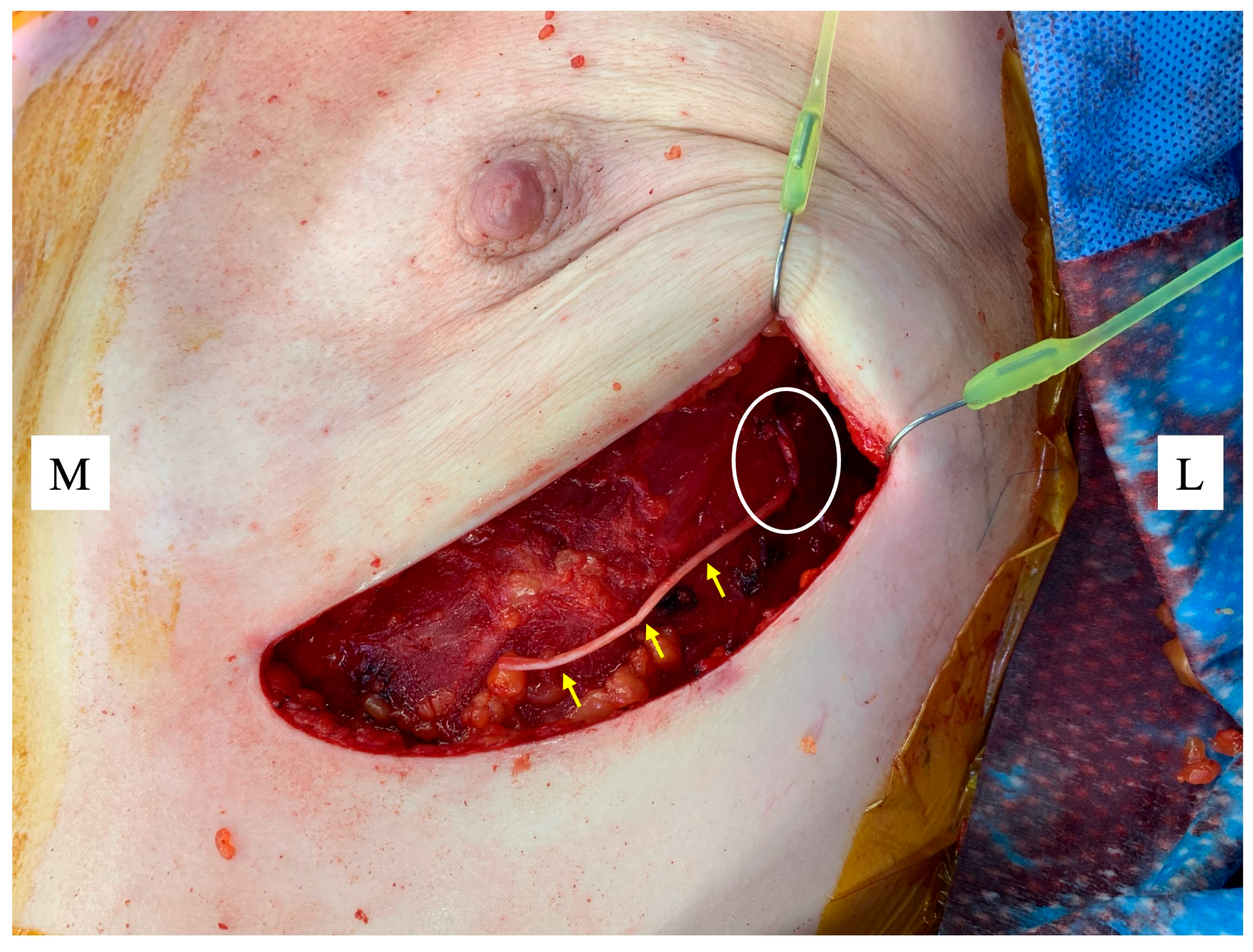
5. Nipple–Areolar Complex (NAC) Neurotization
6. Optimizing Aesthetic Outcomes
7. Biologic Matrices and Synthetic Meshes
8. Next-Generation Implants
9. Implant-Associated Cancers and Systemic Concerns
10. Implant-Based Breast Reconstruction and Safety
11. Conclusions
Funding
Data Availability Statement
Conflicts of Interest
References
- Graziano, F.D.; Henderson, P.W.; Jacobs, J.; Salzberg, C.A.; Sbitany, H. How to Optimize Prepectoral Breast Reconstruction. Aesthetic Surg. J. 2020, 40, S22–S28. [Google Scholar] [CrossRef] [PubMed]
- Ostapenko, E.; Nixdorf, L.; Devyatko, Y.; Exner, R.; Wimmer, K.; Fitzal, F. Prepectoral Versus Subpectoral Implant-Based Breast Reconstruction: A Systemic Review and Meta-analysis. Ann. Surg. Oncol. 2023, 30, 126–136. [Google Scholar] [CrossRef]
- Cordray, H.; Khan, S.; Voytik, M.; Zemberi, J.; Capone, G.; Chang, A.E.; Broach, R.B.; Azoury, S.C. Prepectoral vs Subpectoral Implant-Based Breast Reconstruction: Evaluating the Shift. Plast. Reconstr. Surg. 2025. [Google Scholar] [CrossRef]
- Xiao, X.; Feng, Y.; Zhu, Z.; Tang, Y.; Wu, Y.; Zhang, X.; Zhou, J.; Zhou, Y.; Du, Z. Prepectoral versus Subpectoral Dual-Plane Direct-to-Implant Breast Reconstruction with the TiLoop Bra: A Single-Center Prospective Cohort Study. Plast. Reconstr. Surg. 2025, 156, 710e–720e. [Google Scholar] [CrossRef] [PubMed]
- Sbitany, H.; Piper, M.; Lentz, R. Prepectoral Breast Reconstruction: A Safe Alternative to Submuscular Prosthetic Reconstruction following Nipple-Sparing Mastectomy. Plast. Reconstr. Surg. 2017, 140, 432–443. [Google Scholar] [CrossRef] [PubMed]
- Graziano, F.D.; Lu, J.; Sbitany, H. Prepectoral Breast Reconstruction. Clin. Plast. Surg. 2023, 50, 235–242. [Google Scholar] [CrossRef]
- Kim, Y.-H.; Yang, Y.-J.; Lee, D.-W.; Song, S.-Y.; Lew, D.-H.; Yang, E.-J. Prevention of Postoperative Complications by Prepectoral versus Subpectoral Breast Reconstruction: A Systematic Review and Meta-Analysis. Plast. Reconstr. Surg. 2024, 153, 10e–24e. [Google Scholar] [CrossRef]
- Harvey, K.L.; Sinai, P.; Mills, N.; White, P.; Holcombe, C.; Potter, S.; Pre-BRA Feasibility Study Steering Group; Barry, P.; O’COnnell, R.; Cawthorn, S.; et al. Short-term safety outcomes of mastectomy and immediate prepectoral implant-based breast reconstruction: Pre-BRA prospective multicentre cohort study. Br. J. Surg. 2022, 109, 530–538. [Google Scholar] [CrossRef]
- Harvey, K.L.; Johnson, L.; Sinai, P.; Mills, N.; White, P.; Holcombe, C.; Potter, S.; The Pre-BRA Feasibility Study Steering Group; Barry, P.; Cawthorn, S.; et al. Patient-reported outcomes 3 and 18 months after mastectomy and immediate prepectoral implant-based breast reconstruction in the UK Pre-BRA prospective multicentre cohort study. Br. J. Surg. 2025, 112, znaf032. [Google Scholar] [CrossRef]
- Asaad, M.; Yu, J.Z.; Tran, J.P.; Liu, J.; O’grady, B.P.-C.; Clemens, M.W.M.; Largo, R.D.; Mericli, A.F.; Schaverien, M.M.; Shuck, J.; et al. Surgical and Patient-Reported Outcomes of 694 Two-Stage Prepectoral versus Subpectoral Breast Reconstructions. Plast. Reconstr. Surg. 2023, 152, 43S–54S. [Google Scholar] [CrossRef]
- Ghosh, K.; Kuchta, K.; Alva, D.; Seth, A.K.; Sisco, M. Is Prepectoral Implant Reconstruction Associated with Better Physical Well-Being? J. Surg. Oncol. 2025, 132, 1071–1075. [Google Scholar] [CrossRef]
- Amro, C.; Sorenson, T.J.; Boyd, C.J.; Hemal, K.; Vernice, N.A.; Park, J.J.; Cohen, O.D.; Choi, M.; Karp, N.S. The Evolution of Implant-Based Breast Reconstruction: Innovations, Trends, and Future Directions. J. Clin. Med. 2024, 13, 7407. [Google Scholar] [CrossRef]
- Zhu, L.; Liu, C. Postoperative Complications Following Prepectoral Versus Partial Subpectoral Implant-Based Breast Reconstruction Using ADM: A Systematic Review and Meta-analysis. Aesthetic Plast. Surg. 2023, 47, 1260–1273. [Google Scholar] [CrossRef]
- Nolan, I.T.; Farajzadeh, M.M.; Bekisz, J.M.M.; Boyd, C.J.M.; Gibson, E.G.; Salibian, A.A. Prepectoral versus Subpectoral Breast Reconstruction after Nipple-sparing Mastectomy: A Systematic Review and Meta-Analysis. Plast. Reconstr. Surg. Glob. Open 2024, 12, e5808. [Google Scholar] [CrossRef]
- Sorenson, T.J.; Boyd, C.J.; Hemal, K.; Choi, M.; Karp, N.; Cohen, O. Failure of Salvage in Prepectoral Implant Breast Reconstruction: A Single-Center Cohort. Am. Surg. 2025, 31348251405560. [Google Scholar] [CrossRef]
- Wang, J.B.; Shammas, R.L.; Montes-Smith, E.; Boe, L.A.; Levy, J.; Graziano, F.D.; Stern, C.S.; Nelson, J.A.; Disa, J.J. Complications and Patient-Reported Outcomes in Prepectoral vs Submuscular Breast Reconstruction Following Nipple Sparing Mastectomy. Plast. Reconstr. Surg. 2025, 156, 513–520. [Google Scholar] [CrossRef]
- Rampal, R.; Jones, S.J.; Hartup, S.; Robertson, C.; Tahir, W.; Jones, S.L.; McKenzie, S.; Savage, J.A.; Kim, B. Three and twelve-month analysis of the PROM-Q study: Comparison of patient-reported outcome measures using the BREAST-Q questionnaire in pre- vs. sub-pectoral implant-based immediate breast reconstruction. Breast Cancer Res. Treat. 2024, 208, 275–282. [Google Scholar] [CrossRef] [PubMed]
- Sbitany, H. Important Considerations for Performing Prepectoral Breast Reconstruction. Plast. Reconstr. Surg. 2017, 140, 7S–13S. [Google Scholar] [CrossRef] [PubMed]
- Hemal, K.; Boyd, C.M.; Otero, S.B.P.; Kabir, R.B.; Sorenson, T.J.; Thanik, V.; Levine, J.; Cohen, O.; Choi, M.; Karp, N.S. Is a Seroma the “Kiss of Death” in Prepectoral Tissue Expander Reconstruction? Plast. Reconstr. Surg. Glob. Open 2025, 13, e6842. [Google Scholar] [CrossRef]
- Perez-Otero, S.B.; Hemal, K.; Boyd, C.J.M.; Kabir, R.B.; Sorenson, T.J.; Jacobson, A.B.; Thanik, V.D.; Levine, J.P.; Cohen, O.D.; Karp, N.S.; et al. Minimizing Nipple-Areolar Complex Complications in Prepectoral Breast Reconstruction After Nipple-Sparing Mastectomy. Ann. Plast. Surg. 2024, 92, S179–S184. [Google Scholar] [CrossRef] [PubMed]
- Hemal, K.; Boyd, C.M.; Otero, S.P.B.; Kabir, R.B.; Sorenson, T.J.; Jacobson, A.B.; Thanik, V.; Levine, J.; Cohen, O.; Choi, M.; et al. Finding the Right Fill: The Ideal Tissue Expander Fill in Immediate Prepectoral Breast Reconstruction. Ann. Plast. Surg. 2025, 94, S134–S138. [Google Scholar] [CrossRef]
- Nolan, I.T.; Farajzadeh, M.M.; Boyd, C.J.; Bekisz, J.M.; Gibson, E.G.; Salibian, A.A. Do we need acellular dermal matrix in prepectoral breast reconstruction? A systematic review and meta-analysis. J. Plast. Reconstr. Aesthetic Surg. 2023, 86, 251–260. [Google Scholar] [CrossRef]
- Karp, N.; Sorenson, T.J.; Boyd, C.J.M.M.; Hemal, K.; Lin, A.; Robinson, I.S.; Choi, M. The GalaFLEX “Empanada” for Direct-to-Implant Prepectoral Breast Reconstruction. Plast. Reconstr. Surg. 2025, 155, 488e–491e. [Google Scholar] [CrossRef]
- Galimberti, V.; Morigi, C.; Bagnardi, V.; Corso, G.; Vicini, E.; Fontana, S.K.R.; Naninato, P.; Ratini, S.; Magnoni, F.; Toesca, A.; et al. Oncological Outcomes of Nipple-Sparing Mastectomy: A Single-Center Experience of 1989 Patients. Ann. Surg. Oncol. 2018, 25, 3849–3857. [Google Scholar] [CrossRef]
- De La Cruz, L.; Moody, A.M.; Tappy, E.E.; Blankenship, S.A.; Hecht, E.M. Overall Survival, Disease-Free Survival, Local Recurrence, and Nipple–Areolar Recurrence in the Setting of Nipple-Sparing Mastectomy: A Meta-Analysis and Systematic Review. Ann. Surg. Oncol. 2015, 22, 3241–3249. [Google Scholar] [CrossRef] [PubMed]
- Mota, B.S.; Riera, R.; Ricci, M.D.; Barrett, J.; de Castria, T.B.; Atallah, Á.N.; Bevilacqua, J.L.B. Nipple- and areola-sparing mastectomy for the treatment of breast cancer. Cochrane Database Syst. Rev. 2016, 11, CD008932. [Google Scholar] [CrossRef]
- Zaborowski, A.M.; Roe, S.; Rothwell, J.; Evoy, D.; Geraghty, J.; McCartan, D.; Prichard, R.S. A systematic review of oncological outcomes after nipple-sparing mastectomy for breast cancer. J. Surg. Oncol. 2023, 127, 361–368. [Google Scholar] [CrossRef]
- Park, J.J.; Boyd, C.J.; Hemal, K.; Sorenson, T.J.; Amro, C.; Vernice, N.A.; Lakatta, A.C.; Cohen, O.; Choi, M.; Karp, N.S. Techniques for Success in Nipple-Sparing Mastectomy and Immediate Reconstruction. J. Clin. Med. 2025, 14, 4363. [Google Scholar] [CrossRef] [PubMed]
- Romanoff, A.; Zabor, E.C.; Stempel, M.; Sacchini, V.; Pusic, A.; Morrow, M. A Comparison of Patient-Reported Outcomes After Nipple-Sparing Mastectomy and Conventional Mastectomy with Reconstruction. Ann. Surg. Oncol. 2018, 25, 2909–2916. [Google Scholar] [CrossRef]
- Webster, A.J.; Shanno, J.N.; Cruz, H.S.S.; Kelly, B.N.; Garstka, M.; Henriquez, A.; Specht, M.C.; Gadd, M.A.; Verdial, F.C.; Nguyen, A.; et al. Oncologic Safety of Nipple-Sparing Mastectomy for Breast Cancer in BRCA Gene Mutation Carriers: Outcomes at 70 Months Median Follow-Up. Ann. Surg. Oncol. 2023, 30, 3215–3222. [Google Scholar] [CrossRef] [PubMed]
- Meli, E.Z.; De Santis, A.; Cortese, G.; Manna, E.; Mastropietro, T.; La Pinta, M.; Loreti, A.; Arelli, F.; Scavina, P.; Minelli, M.; et al. Nipple-Sparing Mastectomy After Neoadjuvant Chemotherapy: Definitive Results with a Long-Term Follow-Up Evaluation. Ann. Surg. Oncol. 2023, 30, 2163–2172. [Google Scholar] [CrossRef]
- Youn, S.; Lee, E.; Peiris, L.; Olson, D.; Lesniak, D.; Rajaee, N. Spare the Nipple: A Systematic Review of Tumor Nipple-Distance and Oncologic Outcomes in Nipple-Sparing Mastectomy. Ann. Surg. Oncol. 2023, 30, 8381–8388. [Google Scholar] [CrossRef]
- Boyd, C.J.M.; Bekisz, J.M.M.; Ramesh, S.B.; Hemal, K.; Guth, A.A.; Axelrod, D.M.; Shapiro, R.L.; Hiotis, K.; Schnabel, F.R.; Choi, M.; et al. No Cancer Occurrences in 10-year Follow-Up After Prophylactic Nipple-Sparing Mastectomy. Plast. Reconstr. Surg. Glob. Open 2023, 11, e5087. [Google Scholar] [CrossRef]
- Boyd, C.J.M.; Salibian, A.A.; Bekisz, J.M.M.; Axelrod, D.M.; Guth, A.A.; Shapiro, R.L.; Schnabel, F.R.; Karp, N.S.; Choi, M. Long-Term Cancer Recurrence Rates following Nipple-Sparing Mastectomy: A 10-Year Follow-Up Study. Plast. Reconstr. Surg. 2022, 150, 13S–19S. [Google Scholar] [CrossRef] [PubMed]
- Jakub, J.W.; Peled, A.W.; Gray, R.J.; Greenup, R.A.; Kiluk, J.V.; Sacchini, V.; McLaughlin, S.A.; Tchou, J.C.; Vierkant, R.A.; Degnim, A.C.; et al. Oncologic Safety of Prophylactic Nipple-Sparing Mastectomy in a Population with BRCA Mutations: A Multi-Institutional Study. JAMA Surg. 2018, 153, 123–129. [Google Scholar] [CrossRef]
- Boyd, C.J.M.; Ramesh, S.B.; Bekisz, J.M.M.; Guth, A.A.; Axelrod, D.M.; Shapiro, R.L.; Hiotis, K.; Schnabel, F.R.; Karp, N.S.; Choi, M. Low Cancer Occurrence Rate following Prophylactic Nipple-Sparing Mastectomy. Plast. Reconstr. Surg. 2024, 153, 37e–43e. [Google Scholar] [CrossRef] [PubMed]
- Nguyen, C.L.; Dayaratna, N.; Easwaralingam, N.; Seah, J.L.; Azimi, F.; Mak, C.; Pulitano, C.; Warrier, S.K. Developing an Indocyanine Green Angiography Protocol for Predicting Flap Necrosis During Breast Reconstruction. Surg. Innov. 2025, 32, 77–84. [Google Scholar] [CrossRef]
- Nguyen, C.L.; Zhou, M.; Easwaralingam, N.; Seah, J.L.; Chan, B.; Graham, S.; Azimi, F.; Mak, C.; Pulitano, C.; Warrier, S. Mastectomy skin flap necrosis after implant-based breast reconstruction: Intraoperative predictors and indocyanine green angiography. Plast. Reconstr. Surg. 2025, 157, 19–28. [Google Scholar] [CrossRef]
- Ibraheem, M.H.; Essawy, O.M.M.; Moaz, I.; Osman, Z.S.M.; Omara, Y.S.; Farouk, A.; Amin, A.; Elzohery, Y.H.A.M.; Awad, M.G.A. Single stage direct-to-implant breast reconstruction following mastectomy (The use of Ultrapro® Mesh). World J. Surg. Oncol. 2024, 22, 297. [Google Scholar] [CrossRef] [PubMed]
- Sorenson, T.J.; Boyd, C.J.; Park, J.J.; Hemal, K.; Amro, C.; Vernice, N.; Lakatta, A.; Cohen, O.; Karp, N.; Choi, M. Nipple Areolar Complex (NAC) Neurotization After Nipple-Sparing Mastectomy (NSM) in Implant-Based Breast Reconstruction: A Systematic Review of the Literature. Breast J. 2025, 2025, 2362697. [Google Scholar] [CrossRef]
- Nanda, A.; Hu, J.; Hodgkinson, S.; Ali, S.; Rainsbury, R.; Roy, P.G. Oncoplastic breast-conserving surgery for women with primary breast cancer. Cochrane Database Syst. Rev. 2021, 10, CD013658. [Google Scholar] [CrossRef]
- Tian, R.; Zheng, Y.; Liu, R.; Jiang, C.; Zheng, H. Efficacy and safety of oncoplastic breast-conserving surgery versus conventional breast-conserving surgery: An updated meta-analysis. Breast 2024, 77, 103784. [Google Scholar] [CrossRef]
- Mohamedahmed, A.Y.Y.; Zaman, S.; Zafar, S.; Laroiya, I.; Iqbal, J.; Tan, M.L.H.; Shetty, G. Comparison of surgical and oncological outcomes between oncoplastic breast-conserving surgery versus conventional breast-conserving surgery for treatment of breast cancer: A systematic review and meta-analysis of 31 studies. Surg. Oncol. 2022, 42, 101779. [Google Scholar] [CrossRef]
- Davies, C.; Johnson, L.; Conefrey, C.; Mills, N.; Fairbrother, P.; Holcombe, C.; Whisker, L.; Hollingworth, W.; Skillman, J.; White, P.; et al. Clinical and patient-reported outcomes in women offered oncoplastic breast-conserving surgery as an alternative to mastectomy: ANTHEM multicentre prospective cohort study. Br. J. Surg. 2024, 112, znae306. [Google Scholar] [CrossRef]
- Chatterjee, A.; Gass, J.; Patel, K.; Holmes, D.; Kopkash, K.; Peiris, L.; Peled, A.; Ryan, J.; El-Tamer, M.; Reiland, J. A Consensus Definition and Classification System of Oncoplastic Surgery Developed by the American Society of Breast Surgeons. Ann. Surg. Oncol. 2019, 26, 3436–3444. [Google Scholar] [CrossRef]
- Escandón, J.M.; Butterfield, J.A.; Christiano, J.G.; Gooch, J.C.; Olzinski, A.T.; Prieto, P.A.; Skinner, K.A.; Langstein, H.N.; Manrique, O.J.M. Wise Pattern Versus Transverse Pattern Mastectomy in Two-Stage Implant-Based Breast Reconstruction: A Propensity Score–Matched Analysis. Plast. Reconstr. Surg. 2023, 152, 69S–80S. [Google Scholar] [CrossRef] [PubMed]
- Gunn, J.; Dortch, J.; TerKonda, S.; Schilling, K.; Li, Z.; Diehl, N.; Gibson, T.; Bagaria, S.; Perdikis, G.; McLaughlin, S. Comparing morbidity rates between wise pattern and standard horizontal elliptical mastectomy incisions in patients undergoing immediate breast reconstruction. Breast J. 2019, 25, 20–25. [Google Scholar] [CrossRef]
- Huang, A.; Kuchta, K.; Alva, D.; Sisco, M.; Seth, A.K. Wise-pattern Mastectomy with an Inferior Dermal Sling: A Viable Alternative to Elliptical Mastectomy in Prosthetic Based Breast Reconstruction. Plast. Reconstr. Surg. 2024, 153, 505e–515e. [Google Scholar] [CrossRef] [PubMed]
- Calderon, T.; Skibba, K.E.; Hansen, T.; Amalfi, A.; Chen, E. Safety of Breast Reconstruction Using Inferiorly Based Dermal Flap for the Ptotic Breast. Ann. Plast. Surg. 2022, 88, S156–S162. [Google Scholar] [CrossRef] [PubMed]
- Bayram, Y.; Kulahci, Y.; Irgil, C.; Calikapan, M.; Noyan, N. Skin-reducing subcutaneous mastectomy using a dermal barrier flap and immediate breast reconstruction with an implant: A new surgical design for reconstruction of early-stage breast cancer. Aesthetic Plast. Surg. 2010, 34, 71–77. [Google Scholar] [CrossRef]
- Caputo, G.G.; Marchetti, A.; Pozza, E.D.; Vigato, E.; Domenici, L.; Cigna, E.; Governa, M. Skin-Reduction Breast Reconstructions with Prepectoral Implant. Plast. Reconstr. Surg. 2016, 137, 1702–1705. [Google Scholar] [CrossRef]
- Marongiu, F.; Bertozzi, N.; Sibilio, A.; Tognali, D.; Mingozzi, M.; Curcio, A. The First Use of Human-Derived ADM in Prepectoral Direct-to-Implant Breast Reconstruction after Skin-Reducing Mastectomy. Aesthetic Plast. Surg. 2021, 45, 2048–2057. [Google Scholar] [CrossRef]
- Salinas, H.M.; Ainuz, B.Y.; Pourmoussa, A.J.; Levitt, E.B.; Ali, A.M.; Bouz, A.; Treiser, M.D.; Medina, M.A. Oncoplastic Augmentation Mastopexy in Breast Conservation Therapy: Retrospective Study and Postoperative Complications. Ann. Plast. Surg. 2023, 90, 33–40. [Google Scholar] [CrossRef]
- Barnea, Y.; Friedman, O.; Arad, E.; Barsuk, D.; Menes, T.; Zaretski, A.; Leshem, D.; Gur, E.; Inbal, A. An Oncoplastic Breast Augmentation Technique for Immediate Partial Breast Reconstruction following Breast Conservation. Plast. Reconstr. Surg. 2017, 139, 348e–357e. [Google Scholar] [CrossRef] [PubMed]
- Schaverien, M.V.M.; Stutchfield, B.M.M.; Raine, C.F.; Dixon, J.M.F. Implant-based augmentation mammaplasty following breast conservation surgery. Ann. Plast. Surg. 2012, 69, 240–243. [Google Scholar] [CrossRef] [PubMed]
- Pan, S.Y.; Lavigne, E.; Holowaty, E.J.; Villeneuve, P.J.; Xie, L.; Morrison, H.; Brisson, J. Canadian breast implant cohort: Extended follow-up of cancer incidence. Int. J. Cancer 2012, 131, E1148–E1157. [Google Scholar] [CrossRef] [PubMed]
- Jakubietz, M.G.; Janis, J.E.; Jakubietz, R.G.; Rohrich, R.J. Breast Augmentation: Cancer Concerns and Mammography—A Literature Review. Plast. Reconstr. Surg. 2004, 113, 117e–122e. [Google Scholar] [CrossRef]
- Haloua, M.H.; Krekel, N.M.; Winters, H.A.; Rietveld, D.H.; Meijer, S.; Bloemers, F.W.; Tol, M.P.v.D. A systematic review of oncoplastic breast-conserving surgery: Current weaknesses and future prospects. Ann. Surg. 2013, 257, 609–620. [Google Scholar] [CrossRef]
- Dossett, L.A.; Lowe, J.; Sun, W.; Lee, M.; Smith, P.D.; Jacobsen, P.B.; Laronga, C. Prospective evaluation of skin and nipple-areola sensation and patient satisfaction after nipple-sparing mastectomy. J. Surg. Oncol. 2016, 114, 11–16. [Google Scholar] [CrossRef]
- Hammond, J.B.; Kandi, L.A.; Armstrong, V.L.; Kosiorek, H.E.; Rebecca, A.M.; Casey, W.J.; Kruger, E.A.; Cronin, P.A.; Pockaj, B.A.; Teven, C.M. Long-term breast and nipple sensation after nipple-sparing mastectomy with implant reconstruction: Relevance to physical, psychosocial, and sexual well-being. J. Plast. Reconstr. Aesthetic Surg. 2022, 75, 2914–2919. [Google Scholar] [CrossRef]
- Smeele, H.P.; Bijkerk, E.; van Kuijk, S.M.J.; Lataster, A.M.M.; van der Hulst, R.R.W.J.; Tuinder, S.M.H. Innervation of the Female Breast and Nipple: A Systematic Review and Meta-Analysis of Anatomical Dissection Studies. Plast. Reconstr. Surg. 2022, 150, 243–255. [Google Scholar] [CrossRef]
- Sarhadi, N.S.; Shaw-Dunn, J.; Soutar, D.S. Nerve supply of the breast with special reference to the nipple and areola: Sir Astley Cooper revisited. Clin. Anat. 1997, 10, 283–288. [Google Scholar] [CrossRef]
- Peled, A.W.; Peled, Z.M. Nerve Preservation and Allografting for Sensory Innervation Following Immediate Implant Breast Reconstruction. Plast. Reconstr. Surg. Glob. Open 2019, 7, e2332. [Google Scholar] [CrossRef]
- Djohan, R.; Scomacao, I.; Knackstedt, R.M.; Cakmakoglu, C.; Grobmyer, S.R. Neurotization of the Nipple-Areola Complex during Implant-Based Reconstruction: Evaluation of Early Sensation Recovery. Plast. Reconstr. Surg. 2020, 146, 250–254. [Google Scholar] [CrossRef] [PubMed]
- Peled, A.W.; von Eyben, R.; Peled, Z.M. Sensory Outcomes After Neurotization in Nipple-Sparing Mastectomy and Implant-Based Breast Reconstruction. Plast. Reconstr. Surg. Glob. Open 2023, 11, e5437. [Google Scholar] [CrossRef]
- Chang, T.N.-J.; Lu, J.C.-Y.; Sung, C.W.-H.; Illias, A.M.; Kao, S.-W.; Kuo, W.-L.; Pindur, L.; Chen, L.W.-Y.; Lin, J.A.-J.; Chuang, D.C.-C.; et al. Elongation of intercostal nerve cutaneous branches for breast and nipple neurotization during breast reconstruction after mastectomy for breast cancer: Case–control study. Br. J. Surg. 2024, 111, znae005. [Google Scholar] [CrossRef]
- Zhang, C.; Moroni, E.A.; Moreira, A.A. One Size Does Not Fit All: Prediction of Nerve Length in Implant-Based Nipple–Areola Complex Neurotization. J. Reconstr. Microsurg. 2024, 41, 566–574. [Google Scholar] [CrossRef]
- Shyu, S.; Chang, T.N.-J.; Lu, J.-Y.M.; Chen, C.-F.; Cheong, D.C.-F.; Kao, S.-W.B.; Kuo, W.-L.; Huang, J.-J.M. Breast neurotization along with breast reconstruction after nipple sparing mastectomy enhances quality of life and reduces denervation symptoms in patient-reported outcome: A prospective cohort study. Int. J. Surg. 2025, 111, 3235–3247. [Google Scholar] [CrossRef] [PubMed]
- Boyd, C.J.M.; Hemal, K.; Sorenson, T.J.; Amro, C.; Lu, S.B.; Miller, B.M.; Karp, N.S.; Choi, M. Assessing Perioperative Complications and Cost of Nipple-Areolar Complex Neurotization in Immediate Implant-Based Breast Reconstruction Following Nipple-Sparing Mastectomy: A Matched-Paired Comparison. Ann. Plast. Surg. 2025, 94, S118–S120. [Google Scholar] [CrossRef]
- Weichman, K.E.; Broer, P.N.; Tanna, N.; Wilson, S.C.; Allan, A.; Levine, J.P.; Ahn, C.; Choi, M.; Karp, N.S.; Allen, R. The role of autologous fat grafting in secondary microsurgical breast reconstruction. Ann. Plast. Surg. 2013, 71, 24–30. [Google Scholar] [CrossRef] [PubMed]
- Kuruvilla, A.S.B.; Yan, Y.; Rathi, S.B.; Wang, F.B.; Weichman, K.E.; Ricci, J.A. Oncologic Safety in Autologous Fat Grafting After Breast Conservation Therapy: A Systematic Review and Meta-Analysis of the Literature. Ann. Plast. Surg. 2023, 90, 106–110. [Google Scholar] [CrossRef] [PubMed]
- Stead, T.S.S.; Francalancia, S.; Laspro, M.B.; Tanney, K.M.; Larson, B.P.-C.; Mitra, A.M. Immediate Nipple Reconstruction in Skin-sparing Mastectomy with A Modified Wise-pattern Design. Plast. Reconstr. Surg.—Glob. Open 2024, 12, e5979. [Google Scholar] [CrossRef] [PubMed]
- Boyd, C.J.M.; Bekisz, J.M.M.; Choi, M.; Karp, N.S. Catch-22: Acellular Dermal Matrix and U.S. Food and Drug Administration Premarket Approval—How Can We Construct Studies? Plast. Reconstr. Surg. 2022, 150, 1363–1366. [Google Scholar] [CrossRef]
- Blohmer, J.-U.; Beier, L.; Faridi, A.; Ankel, C.; Krause-Bergmann, B.; Paepke, S.; Mau, C.; Keller, M.; Strittmatter, H.J.; Karsten, M.M. Patient-Reported Outcomes and Aesthetic Results after Immediate Breast Reconstruction Using Human Acellular Dermal Matrices: Results of a Multicenter, Prospective, Observational NOGGO-AWOGyn Study. Breast Care 2021, 16, 335–342. [Google Scholar] [CrossRef] [PubMed]
- Margulies, I.G.; Salzberg, C.A. The use of acellular dermal matrix in breast reconstruction: Evolution of techniques over 2 decades. Gland. Surg. 2019, 8, 3–10. [Google Scholar] [CrossRef]
- Salibian, A.A.; Bekisz, J.M.M.; Kussie, H.C.; Thanik, V.D.; Levine, J.P.; Choi, M.; Karp, N.S. Do We Need Support in Prepectoral Breast Reconstruction? Comparing Outcomes with and Without ADM. Plast. Reconstr. Surg. Glob. Open 2021, 9, e3745. [Google Scholar] [CrossRef] [PubMed]
- Salibian, A.A.; Frey, J.D.; Choi, M.; Karp, N.S. Subcutaneous Implant-based Breast Reconstruction with Acellular Dermal Matrix/Mesh: A Systematic Review. Plast. Reconstr. Surg. Glob. Open 2016, 4, e1139. [Google Scholar] [CrossRef] [PubMed]
- Dugue, D.; Kim, D.K.; Powell, S.D.M.; Perez, M.T.B.; Alas, H.; Ascherman, J.A.; Rohde, C.H. Trends in Acellular Dermal Matrix Utilization in Postmastectomy Tissue Expander Placement: An 11-Year Retrospective Study. Ann. Plast. Surg. 2025, 94, S128–S133. [Google Scholar] [CrossRef] [PubMed]
- Avraham, T.; Weichman, K.E.; Wilson, S.; Weinstein, A.; Haddock, N.T.; Szpalski, C.; Choi, M.; Karp, N.S. Postoperative Expansion is not a Primary Cause of Infection in Immediate Breast Reconstruction with Tissue Expanders. Breast J. 2015, 21, 501–507. [Google Scholar] [CrossRef] [PubMed]
- Ng, T.P.; Loo, B.Y.K.; Yong, N.; Chia, C.L.K.; Lohsiriwat, V. Review: Implant-Based Breast Reconstruction After Mastectomy for Breast Cancer: A Meta-Analysis of Randomized Controlled Trials and Prospective Studies Comparing Use of Acellular Dermal Matrix (ADM) Versus Without ADM. Ann. Surg. Oncol. 2024, 31, 3366–3376. [Google Scholar] [CrossRef] [PubMed]
- Arnautovic, A.; Williams, S.; Ash, M.; Menon, A.; Shauly, O.; Losken, A. Outcomes in Implant-Based Breast Reconstruction Utilizing Biosynthetic Mesh: A Meta-Analysis. Aesthet. Surg. J. 2025, 45, 365–372. [Google Scholar] [CrossRef] [PubMed]
- Sigalove, S.M.; O’rorke, E.B.; Maxwell, G.P.M.; Gabriel, A.M. Evaluation of the Safety of a GalaFLEX-AlloDerm Construct in Prepectoral Breast Reconstruction. Plast. Reconstr. Surg. 2022, 150, 75S–81S. [Google Scholar] [CrossRef] [PubMed]
- Diffley, M.; Tang, A.; Sawar, K.B.; Al-Saghir, T.B.; Gonte, M.R.; Hall, J.; Tepper, D.; Darian, V.; Evangelista, M.; Atisha, D. Comparative Postoperative Complications of Acellular Dermal Matrix and Mesh Use in Prepectoral and Subpectoral One-Stage Direct to Implant Reconstruction: A Retrospective Cohort Study. Ann. Plast. Surg. 2025, 94, 521–527. [Google Scholar] [CrossRef] [PubMed]
- Sorenson, T.J.; Boyd, C.J.; Hemal, K.; Park, J.J.; Amro, C.; Vernice, N.; Lakatta, A.; Cohen, O.; Choi, M.; Karp, N. Outcome of Prepectoral Direct-to-Implant Breast Reconstruction with the Poly-4-hydroxybutyrate Wrap. Plast. Reconstr. Surg. Glob. Open 2025, 13, e7268. [Google Scholar] [CrossRef] [PubMed]
- Cordeiro, P.G.; Ghione, P.; Ni, A.; Hu, Q.; Ganesan, N.; Galasso, N.; Dogan, A.; Horwitz, S.M. Risk of breast implant associated anaplastic large cell lymphoma (BIA-ALCL) in a cohort of 3546 women prospectively followed long term after reconstruction with textured breast implants. J. Plast. Reconstr. Aesthetic Surg. 2020, 73, 841–846. [Google Scholar] [CrossRef]
- Boyd, C.J.M.; Salibian, A.A.; Bekisz, J.M.M.; Karp, N.S.; Choi, M. Patient Decision-Making for Management of Style 410 Anatomical Implants in Breast Reconstruction. Plast. Reconstr. Surg. 2023, 151, 479–485. [Google Scholar] [CrossRef] [PubMed]
- Wazir, U.; Patani, N.; Heeney, J.; Mokbel, K. Pre-pectoral Immediate Breast Reconstruction Following Conservative Mastectomy Using Acellular Dermal Matrix and Semi-Smooth Implants. Anticancer Res. 2022, 42, 1013–1018. [Google Scholar] [CrossRef] [PubMed]
- Kaplan, H.Y.; Rysin, R.; Zer, M.; Shachar, Y. A single surgeon’s experience with Motiva Ergonomix round SilkSurface silicone implants in breast reconstruction over a 5-year period. J. Plast. Reconstr. Aesthetic Surg. 2023, 80, 156–164. [Google Scholar] [CrossRef]
- Brown, M.H.; Shenker, R.; Silver, S.A. Cohesive silicone gel breast implants in aesthetic and reconstructive breast surgery. Plast. Reconstr. Surg. 2005, 116, 768–779. [Google Scholar] [CrossRef] [PubMed]
- Govrin-Yehudain, J.; Dvir, H.; Preise, D.; Govrin-Yehudain, O.; Govreen-Segal, D. Lightweight breast implants: A novel solution for breast augmentation and reconstruction mammaplasty. Aesthetic Surg. J. 2015, 35, 965–971. [Google Scholar] [CrossRef] [PubMed]
- He, Y.; Liang, Q.; Liu, Q.; Lv, H.; Yuan, W.; Wang, Z.; Liu, Y.; Wu, J.; Zhao, L.; Wang, Y. Compliant, Tough, Fatigue-Resistant, and Biocompatible PHEMA-Based Hydrogels as a Breast Implant Material. ACS Omega 2025, 10, 35301–35308. [Google Scholar] [CrossRef] [PubMed]
- Prasad, K.; Rifai, A.; Recek, N.; Schuessler, D.; Levchenko, I.; Murdock, A.; Mozetič, M.; Fox, K.; Alexander, K. Nanocarbon-Polymer Composites for Next-Generation Breast Implant Materials. ACS Appl. Mater. Interfaces 2024, 16, 50251–50266. [Google Scholar] [CrossRef] [PubMed]
- Heno, F.; Azoulay, Z.; Khalfin, B.; Craddock, H.A.; Silberstein, E.; Moran-Gilad, J.; Rapaport, H. Comparing the Antimicrobial Effect of Silver Ion-Coated Silicone and Gentamicin-Irrigated Silicone Sheets from Breast Implant Material. Aesthetic Plast. Surg. 2021, 45, 2980–2989. [Google Scholar] [CrossRef]
- Nelson, J.A.; Dabic, S.; Mehrara, B.J.; Cordeiro, P.G.; Disa, J.J.; Pusic, A.L.M.; Matros, E.; Dayan, J.H.; Allen, R.J.J.; Coriddi, M.; et al. Breast Implant-associated Anaplastic Large Cell Lymphoma Incidence: Determining an Accurate Risk. Ann. Surg. 2020, 272, 403–409. [Google Scholar] [CrossRef]
- de Oliveira-Junior, I.; Gonzaga, M.I.; Amirati, C.C.; Vilela, N.M.; Wohnrath, D.R.; da Costa Vieira, R.A. Primary Breast Implant-Associated Squamous Cell Carcinoma: A Proposal for a Better Surgical Approach and Clinical Staging System Based on Tumour Characteristics. Ann. Surg. Oncol. 2025, 32, 9857–9867. [Google Scholar] [CrossRef]
- Niraula, S.; Katel, A.; Barua, A.; Weiss, A.; Strawderman, M.S.; Zhang, H.; Manrique, O.; O’connell, A.; Pandey, S.R.; Dhakal, A. A Systematic Review of Breast Implant-Associated Squamous Cell Carcinoma. Cancers 2023, 15, 4516. [Google Scholar] [CrossRef]
- Yeow, M.; Ching, A.H.; Guillon, C.; Alperovich, M. Breast implant capsule-associated squamous cell carcinoma: A systematic review and individual patient data meta-analysis. J. Plast. Reconstr. Aesthetic Surg. 2023, 86, 24–32. [Google Scholar] [CrossRef]
- Kabir, R.; Stanton, E.; Sorenson, T.J.; Hemal, K.; Boyd, C.J.; Karp, N.S.; Choi, M. Breast Implant Illness as a Clinical Entity: A Systematic Review of the Literature. Aesthetic Surg. J. 2024, 44, NP629–NP636. [Google Scholar] [CrossRef]
- Kaplan, J.; Rohrich, R. Breast implant illness: A topic in review. Gland. Surg. 2021, 10, 430–443. [Google Scholar] [CrossRef]
- Nugent, N. Breast implant illness: We must counter misinformation around this mysterious condition. BMJ 2024, 384, q265. [Google Scholar] [CrossRef] [PubMed]


| Category | Favorable Indications | Relative Contraindications | Absolute Contraindications |
|---|---|---|---|
| Oncologic factors | - Tumor ≥ 2 cm away from nipple on imaging/clinical exam - No evidence of nipple involvement on MRI or retroareolar biopsy - DCIS or invasive carcinoma confined to breast parenchyma | - Tumor-to-nipple distance < 2 cm - Multicentric disease without retroareolar involvement - Lobular histology (higher occult nipple involvement) | - Clinical or radiographic involvement of NAC - Positive retroareolar margin on frozen/permanent pathology - Inflammatory breast cancer |
| Patient factors | - Small to moderate breast size (<C cup) - None or minimal ptosis (Grade I–II) - Non-smoker - Normal BMI | - Large breast size (≥C cup) - Moderate ptosis (Grades II–III) - Remote smoking history - Prior breast surgery or irradiation | - Very large breast size - Severe ptosis that may compromise mastectomy skin flaps - Active smoking - Uncontrolled vascular comorbidities |
| Technical considerations | - Good mastectomy flap vascularity - Ability to use inframammary or lateral incision | - Need for periareolar or radial incision (higher ischemic risk) | - Inability to achieve oncologically safe resection with preserved NAC |
| Feature | Acellular Dermal Matrix (ADM) | Synthetic/Biosynthetic Meshes |
|---|---|---|
| Source | Biological, human or porcine-derived extracellular matrix | Synthetic (e.g., polypropylene and polydioxanone) or biosynthetic (e.g., poly-4-hydroxybutyrate and TIGR mesh) |
| Tissue integration | Facilitates neovascularization and tissue incorporation | Gradual resorption with fibrous tissue replacement with variable integration depending on material |
| Pocket control/support | Provides soft-tissue reinforcement and implant coverage | Can provide more structural support and may be less pliable than ADM |
| Complications | Associated with higher rates of seroma, infection, and “red breast syndrome” | Generally lower seroma rates but long-term complication data still limited |
| Cost | High; barrier to widespread use | Lower; more cost effective in most settings |
| Brand/Manufacturer | Implant Type | Key Features | Regulatory Status |
|---|---|---|---|
| Allergan Natrelle INSPIRA® (AbbVie/Allergan Aesthetics) | Cohesive silicone gel implants (smooth, moderate/mid/high projection) | Wide range of profiles; highly cohesive gel (“gummy bear” type) | FDA and CE approved |
| Mentor MemoryGel® Xtra (Johnson & Johnson) | Highly cohesive silicone gel | Increased projection and upper pole fullness; smooth shell | FDA and CE approved |
| Mentor MemoryShape® (Johnson & Johnson) | Anatomically shaped, cohesive gel | “Tear-drop” profile for contour shaping | FDA approved |
| Sientra OPUS® Silicone Gel Implants (Tiger Aesthetics) | Cohesive silicone gel (round and shaped) | U.S. only; smooth and microtextured surfaces | FDA approved (U.S. exclusive) |
| Motiva Ergonomix® (Establishment Labs) | “Dynamic” silicone gel implant | Nanotextured “SilkSurface®”; designed to mimic natural movement | CE marked (not FDA approved for reconstruction) |
| Motiva Ergonomix2® (Establishment Labs) | Next-gen with “BluSeal®” barrier and RFID chip | Enhanced safety features; real-time device identification | CE marked (not FDA approved for reconstruction) |
| Polytech Microthane® (Polytech Health & Aesthetics) | Polyurethane-coated silicone implants | Lower capsular contracture rates; adherent surface | CE marked (not FDA approved in U.S.) |
| B-Lite® (G&G Biotechnology) | Lightweight silicone gel + borosilicate microspheres | Up to 30% lighter; reduces implant weight burden | CE marked (not FDA approved in U.S.) |
| Sebbin Integrity®/Cristalline® (Sebbin, France) | Cohesive gel implants (round and anatomical) | Customizable volumes and projections | CE marked (not FDA approved in U.S.) |
Disclaimer/Publisher’s Note: The statements, opinions and data contained in all publications are solely those of the individual author(s) and contributor(s) and not of MDPI and/or the editor(s). MDPI and/or the editor(s) disclaim responsibility for any injury to people or property resulting from any ideas, methods, instructions or products referred to in the content. |
© 2025 by the authors. Licensee MDPI, Basel, Switzerland. This article is an open access article distributed under the terms and conditions of the Creative Commons Attribution (CC BY) license.
Share and Cite
Sorenson, T.J.; Boyd, C.J.; Karp, N.S. Hot Topics in Implant-Based Breast Reconstruction. J. Clin. Med. 2026, 15, 263. https://doi.org/10.3390/jcm15010263
Sorenson TJ, Boyd CJ, Karp NS. Hot Topics in Implant-Based Breast Reconstruction. Journal of Clinical Medicine. 2026; 15(1):263. https://doi.org/10.3390/jcm15010263
Chicago/Turabian StyleSorenson, Thomas J., Carter J. Boyd, and Nolan S. Karp. 2026. "Hot Topics in Implant-Based Breast Reconstruction" Journal of Clinical Medicine 15, no. 1: 263. https://doi.org/10.3390/jcm15010263
APA StyleSorenson, T. J., Boyd, C. J., & Karp, N. S. (2026). Hot Topics in Implant-Based Breast Reconstruction. Journal of Clinical Medicine, 15(1), 263. https://doi.org/10.3390/jcm15010263