Early Independent Wheeled Mobility in Children with Cerebral Palsy: A Norwegian Population-Based Registry Study

 , , and
Abstract
1. Introduction
2. Materials and Methods
2.1. Study Design
2.2. Participants
2.3. Variables and Data Collection
2.4. Statistical Analyses
3. Results
3.1. Background Characteristics
3.2. Wheelchair Users
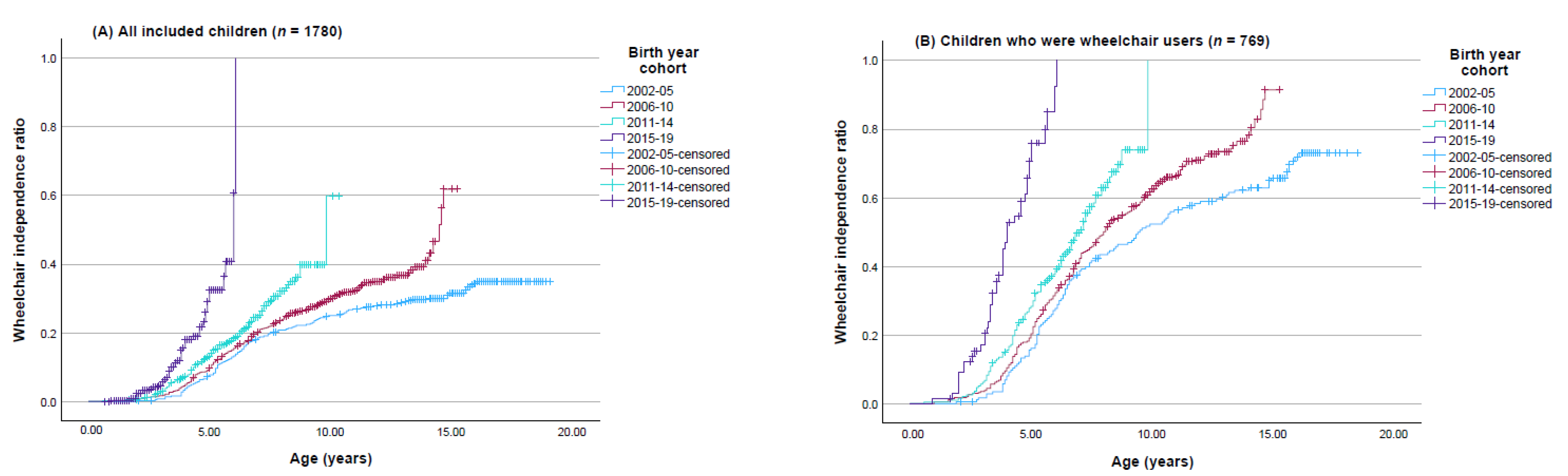
3.3. Independent Wheeled Mobility
3.4. Predictors of Early Independent Wheeled Mobility

4. Discussion
5. Conclusions
Author Contributions
Funding
Institutional Review Board Statement
Informed Consent Statement
Data Availability Statement
Acknowledgments
Conflicts of Interest
Abbreviations
| CI | Confidence intervals |
| CP | Cerebral Palsy |
| GMFCS | Gross Motor Function Classification System |
| MACS | Manual Ability Classification System |
| OT | Occupational therapist |
| PT | Physiotherapist |
| NorCP | Norwegian Quality and Surveillance Registry for Cerebral Palsy |
References
- Hendrix, R.R.; Thompson, R.A. Development of self-produced locomotion in the first year: Changes in parent perceptions and infant behaviour. Infant Child Dev. 2011, 20, 288–300. [Google Scholar] [CrossRef]
- Asbjørnslett, M.; Hemmingsson, H. Participation at school as experienced by teenagers with physical disabilities. Scand. J. Occup. Ther. 2008, 15, 153–161. [Google Scholar] [CrossRef] [PubMed]
- Lobo, M.A.; Harbourne, R.T.; Dusing, S.C.; McCoy, S.W. Grounding early intervention: Physical therapy cannot just be about motor skills anymore. Phys. Ther. 2013, 93, 94–103. [Google Scholar] [CrossRef] [PubMed]
- Adolph, K.E.; Franchak, J.M. The development of motor behavior. Wiley Interdiscip. Rev. Cogn. Sci. 2017, 8, e1430. [Google Scholar] [CrossRef]
- Anderson, D.I.; Campos, J.J.; Witherington, D.C.; Dahl, A.; Rivera, M.; He, M.; Uchiyama, I.; Barbu-Roth, M. The role of locomotion in psychological development. Front. Psychol. 2013, 4, 440. [Google Scholar] [CrossRef]
- Livingstone, R.; Paleg, G. Practice considerations for the introduction and use of power mobility for children. Dev. Med. Child. Neurol. 2014, 56, 210–221. [Google Scholar] [CrossRef]
- Kenyon, L.K.; Mortenson, W.B.; Miller, W.C. ‘Power in Mobility’: Parent and therapist perspectives of the experiences of children learning to use powered mobility. Dev. Med. Child. Neurol. 2018, 60, 1012–1017. [Google Scholar] [CrossRef]
- Huang, H.H.; Chen, Y.M.; Huang, H.W. Ride-On Car Training for Behavioral Changes in Mobility and Socialization Among Young Children with Disabilities. Pediatr. Phys. Ther. 2017, 29, 207–213. [Google Scholar] [CrossRef]
- Evensen, K.A.I. Does movement matter? Consequences of motor problems for everyday life in children born preterm. Dev. Med. Child. Neurol. 2023, 65, 1546–1547. [Google Scholar] [CrossRef]
- Rodby-Bousquet, E. The power of mobility. Dev. Med. Child. Neurol. 2018, 60, 968–969. [Google Scholar] [CrossRef]
- Kenyon, L.K.; Jones, M.; Livingstone, R.; Breaux, B.; Tsotsoros, J.; Williams, K.M. Power mobility for children: A survey study of American and Canadian therapists’ perspectives and practices. Dev. Med. Child. Neurol. 2018, 60, 1018–1025. [Google Scholar] [CrossRef] [PubMed]
- Rodby-Bousquet, E. The gap between current knowledge and clinical practice in childhood disability. Dev. Med. Child. Neurol. 2018, 60, 969–970. [Google Scholar] [CrossRef] [PubMed]
- Rodby-Bousquet, E.; Paleg, G.; Casey, J.; Wizert, A.; Livingstone, R. Physical risk factors influencing wheeled mobility in children with cerebral palsy: A cross-sectional study. BMC Pediatr. 2016, 16, 165. [Google Scholar] [CrossRef] [PubMed]
- Guerette, P.; Furumasu, J.; Tefft, D. The positive effects of early powered mobility on children’s psychosocial and play skills. Assist. Technol. 2013, 25, 39–48, quiz 9–50. [Google Scholar] [CrossRef]
- Hospodar, C.M.; Feldner, H.A.; Logan, S.W. Active mobility, active participation: A systematic review of modified ride-on car use by children with disabilities. Disabil. Rehabil. Assist. Technol. 2023, 18, 974–988. [Google Scholar] [CrossRef]
- Livingstone, R.; Field, D. Systematic review of power mobility outcomes for infants, children and adolescents with mobility limitations. Clin. Rehabil. 2014, 28, 954–964. [Google Scholar] [CrossRef]
- Novak, I.; Morgan, C.; Adde, L.; Blackman, J.; Boyd, R.N.; Brunstrom-Hernandez, J.; Cioni, G.; Damiano, D.; Darrah, J.; Eliasson, A.-C.; et al. Early, Accurate Diagnosis and Early Intervention in Cerebral Palsy: Advances in Diagnosis and Treatment. JAMA Pediatr. 2017, 171, 897–907. [Google Scholar] [CrossRef]
- Morgan, C.; Fetters, L.; Adde, L.; Badawi, N.; Bancale, A.; Boyd, R.N.; Chorna, O.; Cioni, G.; Damiano, D.L.; Darrah, J.; et al. Early Intervention for Children Aged 0 to 2 Years with or at High Risk of Cerebral Palsy International Clinical Practice Guideline Based on Systematic Reviews. JAMA Pediatr. 2021, 175, 846–858. [Google Scholar] [CrossRef]
- Feldner, H.A.; Logan, S.W.; Otieno, S.; Fragomeni, A.; Kono, C.; Riordan, K.; Sloane, B.; Kenyon, L.K. Short-Term Powered Mobility Intervention is Associated with Improvements in Development and Participation for Young Children with Cerebral Palsy: A Randomized Clinical Trial. Phys. Ther. 2024, pzae152. [Google Scholar] [CrossRef]
- Currier, B.A.; Jones, M.A.; DeGrace, B.W. Experiences of Families with Young Power Wheelchair Users. J. Early Interv. 2019, 41, 125–140. [Google Scholar] [CrossRef]
- Rodby-Bousquet, E.; Hägglund, G. Use of manual and powered wheelchair in children with cerebral palsy: A cross-sectional study. BMC Pediatr. 2010, 10, 59. [Google Scholar] [CrossRef] [PubMed]
- Bray, N.; Kolehmainen, N.; McAnuff, J.; Tanner, L.; Tuersley, L.; Beyer, F.; Grayston, A.; Wilson, D.; Edwards, R.T.; Noyes, J.; et al. Powered mobility interventions for very young children with mobility limitations to aid participation and positive development: The EMPoWER evidence synthesis. Health Technol. Assess. 2020, 24, 1–194. [Google Scholar] [CrossRef] [PubMed]
- Hollung, S.J.; Jahnsen, R.; Klevberg, G.L.; Kløve, N.; Andersen, G.L. The impact of longitudinal surveillance of individuals with cerebral palsy in Norway; a 20-year quality registry and follow-up program perspective. Norsk Epidemiol. 2023, 31, 15–23. [Google Scholar] [CrossRef]
- Palisano, R.J.; Rosenbaum, P.; Bartlett, D.; Livingston, M.H. Content validity of the expanded and revised Gross Motor Function Classification System. Dev. Med. Child. Neurol. 2008, 50, 744–750. [Google Scholar] [CrossRef]
- Eliasson, A.-C.; Krumlinde-Sundholm, L.; Rösblad, B.; Beckung, E.; Arner, M.; Öhrvall, A.-M.; Rosenbaum, P. The Manual Ability Classification System (MACS) for children with cerebral palsy: Scale development and evidence of validity and reliability. Dev. Med. Child. Neurol. 2006, 48, 549–554. [Google Scholar] [CrossRef]
- Rich, J.T.; Neely, J.G.; Paniello, R.C.; Voelker, C.C.; Nussenbaum, B.; Wang, E.W. A practical guide to understanding Kaplan-Meier curves. Otolaryngol. Head Neck Surg. 2010, 143, 331–336. [Google Scholar] [CrossRef]
- NorCP. Norsk Kvalitet- og Oppfølgingsregister for Cerebral Parese (NorCP): Årsrapport for 2023; Sykehuset i Vestfold: Tønsberg, Norway, 2024. [Google Scholar]
- NorCP. Norwegian Quality and Surveillance Registry (NorCP) Webpage. Available online: https://www.oslo-universitetssykehus.no/avdelinger/barne-og-ungdomsklinikken/barneavdeling-for-nevrofag/norsk-kvalitets-og-oppfolgingsregister-for-cerebral-parese (accessed on 1 December 2024).
- Alriksson-Schmidt, A.I.; Arner, M.; Westbom, L.; Krumlinde-Sundholm, L.; Nordmark, E.; Rodby-Bousquet, E.; Hägglund, G. A combined surveillance program and quality register improves management of childhood disability. Disabil. Rehabil. 2016, 39, 830–836. [Google Scholar] [CrossRef]
- Patel, D.R.; Neelakantan, M.; Pandher, K.; Merrick, J. Cerebral palsy in children: A clinical overview. Transl. Pediatr. 2020, 9 (Suppl. S1), S125–S135. [Google Scholar] [CrossRef]
- Arner, M.; Eliasson, A.C.; Nicklasson, S.; Sommerstein, K.; Hagglund, G. Hand function in cerebral palsy. Report of 367 children in a population-based longitudinal health care program. J. Hand Surg. Am. 2008, 33, 1337–1347. [Google Scholar] [CrossRef]
- Andersen, G.L.; Irgens, L.M.; Haagaas, I.; Skranes, J.S.; Meberg, A.E.; Vik, T. Cerebral palsy in Norway: Prevalence, subtypes and severity. Eur. J. Paediatr. Neurol. 2008, 12, 4–13. [Google Scholar] [CrossRef]
- Palisano, R.; Rosenbaum, P.; Bartlett, D.; Livingston, M.H. Gross Motor Function Classification System, Expanded and Revised (GMFCS E&R ©); CanChild Centre for Childhood Disability Research, McMaster University: Hamilton, ON, Canada, 2007; Available online: https://www.canchild.ca/system/tenon/assets/attachments/000/000/058/original/GMFCS-ER_English.pdf (accessed on 1 December 2024).
- Eken, M.M.; Houdijk, H.; Doorenbosch, C.A.M.; Kiezebrink, F.E.M.; Bennekom, C.A.M.v.; Harlaar, J.; Dallmeijer, A.J. Relations between muscle endurance and subjectively reported fatigue, walking capacity, and participation in mildly affected adolescents with cerebral palsy. Dev. Med. Child. Neurol. 2016, 58, 814–821. [Google Scholar] [CrossRef] [PubMed]
- Brunton, L.K. Descriptive Report of the Impact of Fatigue and Current Management Strategies in Cerebral Palsy. Pediatr. Phys. Ther. 2018, 30, 135–141. [Google Scholar] [CrossRef] [PubMed]
- Compagnone, E.; Maniglio, J.; Camposeo, S.; Vespino, T.; Losito, L.; De Rinaldis, M.; Gennaro, L.; Trabacca, A. Functional classifications for cerebral palsy: Correlations between the gross motor function classification system (GMFCS), the manual ability classification system (MACS) and the communication function classification system (CFCS). Res. Dev. Disabil. 2014, 35, 2651–2657. [Google Scholar] [CrossRef] [PubMed]
- Carnahan, K.D.; Arner, M.; Hagglund, G. Association between gross motor function (GMFCS) and manual ability (MACS) in children with cerebral palsy. A population-based study of 359 children. BMC Musculoskelet. Disord. 2007, 8, 50. [Google Scholar] [CrossRef] [PubMed]
- Dicianno, B.E.; Cooper, R.A.; Coltellaro, J. Joystick Control for Powered Mobility: Current State of Technology and Future Directions. Phys. Med. Rehabil. Clin. N. Am. 2010, 21, 79–86. [Google Scholar] [CrossRef]
- Novak, I.; Hines, M.; Goldsmith, S.; Barclay, R. Clinical prognostic messages from a systematic review on cerebral palsy. Pediatrics 2012, 130, e1285–e1312. [Google Scholar] [CrossRef]
- Campos, J.J.; Anderson, D.I.; Barbu-Roth, M.A.; Hubbard, E.M.; Hertenstein, M.J.; Witherington, D. Travel Broadens the Mind. Infancy 2000, 1, 149–219. [Google Scholar] [CrossRef]
- Foreman, N.; Orencas, C.; Nicholas, E.; Morton, P.; Gell, M. Spatial awareness in seven to 11-year-old physically handicapped children in mainstream schools. Eur. J. Spec. Needs Educ. 1989, 4, 171–179. [Google Scholar] [CrossRef]
- Kerem Günel, M.; Arslan, U.; Bıyık, K.; Özal, C.; Numanoğlu, A.; Unes, S.; Tunçdemir, M.; Çankaya, Ö.; Özcebe, H.; Green, D. Evaluation of daily and social participation of children with Cerebral Palsy across different age groups with a focus on the ‘F’-words: Function, family, fitness, fun, friends and future. Res. Dev. Disabil. 2023, 140, 104588. [Google Scholar] [CrossRef]

| Age at Independent Wheeled Mobility | ||||
|---|---|---|---|---|
| n | Primary Analysis | Secondary Analysis | ||
| Wheelchair user | 769 | |||
| Independent | 511 | Known | Known | |
| Non-independent/dead | 17 | Censored | Censored | |
| Non-independent/emigrated | 2 | Censored | Censored | |
| Non-independent | 226 | Censored | Censored | |
| Unknown independence status | 13 | Excluded | Excluded | |
| Non-wheelchair user | 999 | |||
| GMFCS I–II | 943 | Censored | Excluded | |
| GMFCS III–V | 56 | Censored | Excluded | |
| Missing data for wheelchair use | 12 | Excluded | Excluded | |
| Total | Wheelchair User | Independent Wheeled Mobility | Independent Manual Wheelchair | Independent Powered Wheelchair | Independent Wheelchair Both | Independent Wheelchair Unknown | ||
|---|---|---|---|---|---|---|---|---|
| N (%) | N (%) 1 | N (%) 2 | N (%) 3 | N (%) 3 | N (%) 3 | N (%) 3 | ||
| Total number | 1780 | 769 (43.1) | 511 (66.5) | 196 (38.4) | 237 (46.4) | 53 (10.4) | 137 (26.8) | |
| Sex | ||||||||
| Girls | 744 (41.8) | 320 (43.0) | 220 (68.8) | 83 (37.7) | 95 (43.2) | 24 (10.9) | 67 (30.5) | |
| Boys | 1036 (58.2) | 449 (43.3) | 291 (64.8) | 113 (38.8) | 142 (48.8) | 29 (10.0) | 70 (24.1) | |
| Birth year | ||||||||
| 2002–2005 | 367 (20.6) | 175 (47.7) | 118 (67.4) | 46 (38.9) | 51 (43.2) | 12 (10.2) | 36 (30.5) | |
| 2006–2010 | 704 (39.6) | 335 (47.6) | 237 (70.7) | 88 (37.1) | 101 (42.6) | 20 (8.4) | 68 (28.7) | |
| 2011–2014 | 419 (23.5) | 192 (45.8) | 111 (57.8) | 47 (42.3) | 55 (49.5) | 15 (13.5) | 24 (21.6) | |
| 2015–2019 | 290 (16.3) | 67 (23.1) | 45 (67.2) | 15 (33.3) | 30 (66.7) | 6 (13.3) | 9 (20.0) | |
| CP subtype | ||||||||
| Spastic hemiplegia | 785 (44.1) | 139 (17.7) | 95 (68.3) | 21 (22.1) | 60 (63.2) | 7 (7.4) | 22 (23.2) | |
| Spastic diplegia | 535 (30.1) | 280 (52.3) | 228 (81.4) | 125 (54.8) | 119 (52.2) | 35 (15.4) | 24 (10.5) | |
| Spastic quadriplegia | 231 (13.0) | 198 (85.7) | 94 (47.5) | 14 (14.9) | 18 (19.1) | 4 (4.3) | 66 (70.2) | |
| Dyskinetic | 130 (7.3) | 103 (79.2) | 59 (57.3) | 19 (32.2) | 26 (44.1) | 5 (8.5) | 19 (32.2) | |
| Ataxic | 69 (3.9) | 32 (46.4) | 28 (87.5) | 13 (46.4) | 13 (46.4) | 2 (7.1) | 4 (14.3) | |
| Unspecified | 30 (1.7) | 17 (56.7) | 7 (41.2) | 4 (57.1) | 1 (14.3) | 0 (0) | 0 (0) | |
| GMFCS | ||||||||
| I | 943 (53.0) | 117 (12.4) | 80 (68.4) | 17 (21.3) | 56 (70.0) | 7 (8.8) | 14 (17.5) | |
| II | 276 (15.5) | 162 (58.7) | 123 (75.9) | 46 (37.4) | 78 (63.4) | 18 (14.6) | 19 (15.4) | |
| III | 135 (7.6) | 129 (95.6) | 111 (86.0) | 75 (67.6) | 46 (41.4) | 14 (12.6) | 8 (7.2) | |
| IV | 161 (9.0) | 138 (85.7) | 113 (81.9) | 55 (48.7) | 46 (40.7) | 13 (11.5) | 25 (22.1) | |
| V | 253 (14.2) | 221 (87.4) | 84 (38.0) | 3 (3.6) | 11 (13.1) | 1 (1.2) | 71 (84.5) | |
| Missing | 12 (0.7) | 2 (16.7) | 0 (0) | 0 (0) | 0 (0) | 0 (0) | 0 (0) | |
| MACS | ||||||||
| I | 719 (40.4) | 136 (18.9) | 104 (76.5) | 49 (47.1) | 60 (57.7) | 16 (15.4) | 14 (13.5) | |
| II | 468 (26.3) | 178 (38.0) | 145 (81.5) | 70 (48.3) | 83 (57.2) | 22 (15.7) | 14 (9.7) | |
| III | 202 (11.3) | 139 (68.8) | 108 (77.7) | 48 (44.4) | 49 (45.4) | 7 (6.5) | 21 (19.4) | |
| IV | 119 (6.7) | 106 (89.1) | 72 (67.9) | 24 (33.3) | 29 (40.3) | 6 (8.3) | 25 (34.7) | |
| V | 211 (11.9) | 189 (89.6) | 70 (37.0) | 2 (2.9) | 8 (66.7) | 1 (1.4) | 61 (22.9) | |
| Missing | 61 (3.4) | 21 (34.4) | 12 (57.1) | 3 (25.0) | 8 (66.7) | 0 (0) | 0 (0) | |
| Total n (%) | Independent Manual Wheelchair | Independent Powered Wheelchair | Independent Both Wheelchair Types | Independent Unknown Wheelchair Type | ||
|---|---|---|---|---|---|---|
| Total, n (%) | 511 | 196 (38.4) 1 | 237 (46.4) 1 | 53 (10.4) 1 | 137 (26.8) 1 | |
| Age | ||||||
| 0–6 years | 337 (65.9) 1 | 140 (41.5) 2 | 151 (44.8) 2 | 32 (9.4) 2 | 81 (24.0) 2 | |
| 0–3 | 101 (19.8) 1 | 49 (48.5) 2 | 27 (26.7) 2 | 6 (5.9) 2 | 34 (33.7) 2 | |
| 4–6 | 236 (46.2) 1 | 91 (38.6) 2 | 124 (52.5) 2 | 26 (11.0) 2 | 47 (19.9) 2 | |
| 7–18 years | 174 (34.1) 1 | 56 (32.2) 2 | 86 (49.4) 2 | 21 (12.1) 2 | 56 (32.2) 2 | |
| 7–12 | 150 (29.4) 1 | 51 (34.0) 2 | 79 (52.7) 2 | 20 (13.3) 2 | 41 (27.3) 2 | |
| 13–18 | 24 (4.7) 1 | 5 (20.8) 2 | 7 (28.0) 2 | 1 (4.2) 2 | 15 (62.5) 2 | |
| Unadjusted | Adjusted | |||||||
|---|---|---|---|---|---|---|---|---|
| Covariate | n | Wheelchair Independence Ratio | 95% CI | p | n | Wheelchair Independence Ratio | 95% CI | p |
| (A) Primary analysis | ||||||||
| Total | 511 1/1766 2 | 499 1/1691 2 | ||||||
| Sex | ||||||||
| boy | 291/1028 | ref | 280/982 | ref | ||||
| girl | 220/738 | 1.01 | 0.85 to 1.20 | 0.90 | 219/709 | 1.16 | 0.97 to 1.39 | 0.11 |
| Birth year cohort | ||||||||
| 2002–2005 | 118/363 | ref | 116/360 | ref | ||||
| 2006–2010 | 237/697 | 1.43 | 1.13 to 1.81 | 0.003 | 234/687 | 1.61 | 1.27 to 2.03 | <0.001 |
| 2011–2014 | 111/419 | 1.90 | 1.44 to 2.52 | <0.001 | 110/406 | 1.73 | 1.30 to 2.31 | <0.001 |
| 2015–2019 | 45/287 | 4.64 | 3.17 to 6.80 | <0.001 | 39/238 | 4.38 | 2.92 to 6.57 | <0.001 |
| CP subtype | ||||||||
| Hemiplegia | 95/779 | ref | 94/757 | ref | ||||
| Diplegia | 228/537 | 4.17 | 3.28 to 5.30 | <0.001 | 221/512 | 1.45 | 1.08 to 1.95 | 0.013 |
| Quadriplegia | 94/222 | 3.88 | 2.92 to 5.16 | <0.001 | 93/213 | 1.51 | 0.97 to 2.35 | 0.070 |
| Dyskinetic | 59/126 | 5.04 | 3.64 to 6.98 | <0.001 | 57/118 | 1.34 | 0.89 to 2.03 | 0.17 |
| Ataxic | 28/68 | 4.10 | 2.69 to 6.26 | <0.001 | 28/65 | 1.59 | 1.02 to 2.47 | 0.039 |
| Unclassified | 7/34 | 3.84 | 1.78 to 8.29 | <0.001 | 6/26 | 1.30 | 0.55 to 3.04 | 0.55 |
| GMFCS | ||||||||
| I | 80/932 | ref | 79/912 | ref | ||||
| II | 123/276 | 6.41 | 4.83 to 8.49 | <0.001 | 121/271 | 5.32 | 3.88 to 7.29 | <0.001 |
| III | 111/135 | 24.97 | 18.63 to 33.46 | <0.001 | 106/126 | 18.75 | 12.83 to 27.39 | <0.001 |
| IV | 113/158 | 19.93 | 14.88 to 26.67 | <0.001 | 109/148 | 23.24 | 14.98 to 36.05 | <0.001 |
| V | 84/243 | 4.56 | 3.36 to 6.19 | <0.001 | 84/234 | 9.75 | 5.50 to 17.28 | <0.001 |
| MACS | ||||||||
| I | 104/713 | ref | 104/708 | ref | ||||
| II | 145/467 | 2.50 | 1.94 to 3.21 | <0.001 | 145/462 | 1.36 | 1.04 to 1.79 | 0.026 |
| III | 108/200 | 5.38 | 4.10 to 7.04 | <0.001 | 108/167 | 1.22 | 0.89 to 1.67 | 0.22 |
| IV | 72/120 | 5.96 | 4.41 to 8.06 | <0.001 | 72/119 | 0.65 | 0.43 to 1.00 | 0.052 |
| V | 70/206 | 2.49 | 1.84 to 3.37 | <0.001 | 70/205 | 0.37 | 0.22 to 0.63 | <0.001 |
| (B) Secondary analysis | ||||||||
| Total | 511 1/767 3 | 499 1/747 3 | ||||||
| Sex | ||||||||
| boy | 291/447 | ref | 280/431 | ref | ||||
| girl | 220/320 | 1.09 | 0.91 to 1.30 | 0.34 | 219/316 | 1.052 | 0.88 to 1.26 | 0.58 |
| Birth year cohort | ||||||||
| 2002–2005 | 118/175 | ref | 116/172 | ref | ||||
| 2006–2010 | 237/334 | 1.46 | 1.16 to 1.84 | 0.002 | 234/330 | 1.44 | 1.14 to 1.83 | 0.003 |
| 2011–2014 | 111/192 | 1.97 | 1.49 to 2.61 | <0.001 | 110/189 | 1.75 | 1.32 to 2.33 | <0.001 |
| 2015–2019 | 45/66 | 7.64 | 5.23 to 11.16 | <0.001 | 39/56 | 5.74 | 3.83 to 8.59 | <0.001 |
| CP subtype | ||||||||
| Hemiplegia | 95/138 | ref | 94/136 | ref | ||||
| Diplegia | 228/285 | 1.59 | 1.25 to 2.02 | <0.001 | 221/276 | 1.07 | 0.79 to 1.44 | 0.68 |
| Quadriplegia | 94/198 | 0.61 | 0.46 to 0.81 | <0.001 | 93/193 | 1.29 | 0.81 to 2.04 | 0.28 |
| Dyskinetic | 59/101 | 0.91 | 0.66 to 1.26 | 0.57 | 57/99 | 1.10 | 0.72 to 1.68 | 0.66 |
| Ataxic | 28/32 | 1.89 | 1.24 to 2.89 | 0.003 | 28/32 | 1.54 | 0.99 to 2.39 | 0.053 |
| Unclassified | 7/13 | 1.49 | 0.69 to 3.22 | 0.31 | 6/11 | 1.25 | 0.52 to 3.02 | 0.61 |
| GMFCS | ||||||||
| I | 80/116 | ref | 79/115 | ref | ||||
| II | 123/170 | 1.12 | 0.85 to 1.49 | 0.42 | 121/167 | 1.15 | 0.85 to 1.57 | 0.38 |
| III | 111/123 | 2.68 | 2.00 to 3.57 | <0.001 | 106/116 | 2.68 | 1.86 to 3.90 | <0.001 |
| IV | 113/141 | 2.09 | 1.57 to 2.79 | <0.001 | 109/136 | 3.60 | 2.36 to 5.57 | <0.001 |
| V | 84/216 | 0.45 | 0.33 to 0.61 | <0.001 | 84/213 | 1.28 | 0.73 to 2.29 | 0.40 |
| MACS | ||||||||
| I | 104/136 | ref | 104/136 | ref | ||||
| II | 145/180 | 1.21 | 0.94 to 1.56 | 0.14 | 145/180 | 1.07 | 0.82 to 1.39 | 0.64 |
| III | 108/139 | 1.29 | 0.98 to 1.69 | 0.065 | 108/138 | 0.85 | 0.63 to 1.15 | 0.30 |
| IV | 72/106 | 0.89 | 0.66 to 1.21 | 0.45 | 72/106 | 0.44 | 0.29 to 0.66 | <0.001 |
| V | 70/187 | 0.35 | 0.26 to 0.47 | <0.001 | 70/187 | 0.27 | 0.16 to 0.44 | <0.001 |
| Birth Cohort | ||||
|---|---|---|---|---|
| 2002–2005 | 2006–2010 | 2011–2014 | 2015–2019 | |
| Median (Quartiles) | Median (Quartiles) | Median (Quartiles) | Median (Quartiles) | |
| Kaplan–Meier Estimate primary 1 | n.a. (9.9 to n.a.) | 14.5 (8.3 to n.a.) | 9.8 (7.1 to n.a.) | 6.0 (4.8 to 6.1) |
| Kaplan–Meier Estimate secondary 2 | 9.5 (5.7 to n.a.) | 8.0 (5.3 to 13.3) | 7.1 (4.8 to 9.8) | 4.0 (3.3 to 5.0) |
Disclaimer/Publisher’s Note: The statements, opinions and data contained in all publications are solely those of the individual author(s) and contributor(s) and not of MDPI and/or the editor(s). MDPI and/or the editor(s) disclaim responsibility for any injury to people or property resulting from any ideas, methods, instructions or products referred to in the content. |
© 2025 by the authors. Licensee MDPI, Basel, Switzerland. This article is an open access article distributed under the terms and conditions of the Creative Commons Attribution (CC BY) license (https://creativecommons.org/licenses/by/4.0/).
Share and Cite
Kilde, A.; Evensen, K.A.I.; Kløve, N.; Rodby-Bousquet, E.; Lydersen, S.; Klevberg, G.L. Early Independent Wheeled Mobility in Children with Cerebral Palsy: A Norwegian Population-Based Registry Study. J. Clin. Med. 2025, 14, 923. https://doi.org/10.3390/jcm14030923
Kilde A, Evensen KAI, Kløve N, Rodby-Bousquet E, Lydersen S, Klevberg GL. Early Independent Wheeled Mobility in Children with Cerebral Palsy: A Norwegian Population-Based Registry Study. Journal of Clinical Medicine. 2025; 14(3):923. https://doi.org/10.3390/jcm14030923
Chicago/Turabian StyleKilde, Anne, Kari Anne I. Evensen, Nina Kløve, Elisabet Rodby-Bousquet, Stian Lydersen, and Gunvor Lilleholt Klevberg. 2025. "Early Independent Wheeled Mobility in Children with Cerebral Palsy: A Norwegian Population-Based Registry Study" Journal of Clinical Medicine 14, no. 3: 923. https://doi.org/10.3390/jcm14030923
APA StyleKilde, A., Evensen, K. A. I., Kløve, N., Rodby-Bousquet, E., Lydersen, S., & Klevberg, G. L. (2025). Early Independent Wheeled Mobility in Children with Cerebral Palsy: A Norwegian Population-Based Registry Study. Journal of Clinical Medicine, 14(3), 923. https://doi.org/10.3390/jcm14030923