Real-World Outcomes of Treatment Approaches and the Impact of Systemic Inflammation Markers on Survival in Patients with Locally Advanced and Metastatic Laryngeal Cancer

 , , , , , , , , , and
Abstract
1. Introduction
2. Materials and Methods
2.1. Patient Data
- Histologically confirmed laryngeal squamous cell carcinoma (LSCC).
- Age ≥ 18 years.
- Availability of complete pretreatment laboratory parameters including full blood count, albumin, CRP, and cholesterol.
- Documented TNM staging (AJCC 8th edition).
- Received definitive or systemic oncologic treatment at the participating center.
- Blood samples obtained within 1–7 days before treatment initiation.
- Complete clinical follow-up information available for survival analysis.
- Active local or systemic infections at the time of blood sampling (acute tonsillitis, sinusitis, dental/periodontal infection, pneumonia, urinary infection).
- Chronic inflammatory or autoimmune diseases (RA, IBD, SLE, sarcoidosis).
- Hematologic malignancy or concurrent active cancer other than LSCC.
- Chronic liver disease, cirrhosis, chronic kidney disease, or severe heart failure.
- Use of corticosteroids, immunosuppressants, or NSAIDs within 2 weeks before blood sampling.
- Laboratory tests not obtained within the standardized pretreatment window.
- Incomplete clinical or biochemical data.
2.2. Laboratory Measurements
2.3. Calculated Parameters
- PNI = [Serum albumin (g/dL) × 10] + [Lymphocyte count (/nL) × 0.005].
- SII = (Platelet count × Neutrophil count)/Lymphocyte count.
- SIRI = (Neutrophil count × Monocyte count)/Lymphocyte count.
- NLR = Neutrophil/Lymphocyte.
- PLR = Platelet/Lymphocyte.
- LMR = Lymphocyte/Monocyte.
- CAR = CRP/Albumin.
- BMI = weight (kg)/height2 (m2).
2.4. Nutritional Status Score (CONUT)
2.5. Naples Prognostic Score (NPS) Classification
2.6. Statistical Analysis
3. Results
4. Discussion
5. Conclusions
Supplementary Materials
Author Contributions
Funding
Institutional Review Board Statement
Informed Consent Statement
Data Availability Statement
Acknowledgments
Conflicts of Interest
References
- Global Cancer Observatory. International Agency for Research on Cancer. World Health Organization. Available online: https://gco.iarc.fr/ (accessed on 8 February 2024).
- National Comprehensive Cancer Network (NCCN). Head and Neck Cancers; Version 2.2025; NCCN Clinical Practice Guidelines in Oncology; NCCN: Plymouth Meeting, PA, USA, 2025; Available online: https://www.nccn.org/ (accessed on 26 October 2025).
- Marur, S.; Forastiere, A.A. Head and Neck Squamous Cell Carcinoma: Update on Epidemiology, Diagnosis, and Treatment. Mayo Clin. Proc. 2016, 91, 386–396. [Google Scholar] [CrossRef]
- Kelly, S.L.; Jackson, J.E.; Hickey, B.E.; Szallasi, F.G.; Bond, C.A. Multidisciplinary clinic care improves adherence to best practice in head and neck cancer. Am. J. Otolaryngol. 2013, 34, 57–60. [Google Scholar] [CrossRef] [PubMed]
- Wheless, S.A.; McKinney, K.A.; Zanation, A.M. A prospective study of the clinical impact of a multidisciplinary head and neck tumor board. Otolaryngol. Head Neck Surg. 2010, 143, 650–654. [Google Scholar] [CrossRef]
- Song, M.; Graubard, B.I.; Rabkin, C.S.; Engels, E.A. Neutrophil-to-lymphocyte ratio and mortality in the United States general population. Sci. Rep. 2021, 11, 464. [Google Scholar] [CrossRef] [PubMed]
- Kumarasamy, C.; Tiwary, V.; Sunil, K.; Suresh, D.; Shetty, S.; Muthukaliannan, G.K.; Baxi, S.; Jayaraj, R. Prognostic Utility of Platelet–Lymphocyte Ratio, Neutrophil–Lymphocyte Ratio and Monocyte–Lymphocyte Ratio in Head and Neck Cancers: A Detailed PRISMA Compliant Systematic Review and Meta-Analysis. Cancers 2021, 13, 4166. [Google Scholar] [CrossRef]
- Sun, K.; Chen, S.; Xu, J.; Li, G.; He, Y. The prognostic significance of the prognostic nutritional index in cancer: A systematic review and meta-analysis. J. Cancer Res. Clin. Oncol. 2014, 140, 1537–1549. [Google Scholar] [CrossRef]
- Kheirouri, S.; Alizadeh, M. Prognostic potential of the preoperative controlling nutritional status (CONUT) score in predicting survival of patients with cancer: A systematic review. Adv. Nutr. 2021, 12, 234–250. [Google Scholar] [CrossRef] [PubMed]
- Nøst, T.H.; Alcala, K.; Urbarova, I.; Byrne, K.S.; Guida, F.; Sandanger, T.M.; Johansson, M. Systemic inflammation markers and cancer incidence in the UK Biobank. Eur. J. Epidemiol. 2021, 36, 841–848. [Google Scholar] [CrossRef]
- Liang, C.; Zhang, C.; Song, J.; Yan, L.; Xiao, Y.; Cheng, N.; Wu, H.; Chen, X.; Yang, J. The Naples prognostic score serves as a predictor and prognostic indicator for cancer survivors in the community. BMC Cancer 2024, 24, 696. [Google Scholar] [CrossRef]
- Zhu, M.; Ma, Z.; Zhang, X.; Hang, D.; Yin, R.; Feng, J.; Xu, L.; Shen, H. C-reactive protein and cancer risk: A pan-cancer study of prospective cohort and Mendelian randomization analysis. BMC Med. 2022, 20, 301. [Google Scholar] [CrossRef]
- Woodley, N.; Rogers, A.D.G.; Turnbull, K.; Slim, M.A.M.; Ton, T.; Montgomery, J.; Douglas, C. Prognostic scores in laryngeal cancer. Eur. Arch. Otorhinolaryngol. 2022, 279, 3705–3715. [Google Scholar] [CrossRef]
- Murad, L.D.; Silva, T.Q.; Schilithz, A.O.C.; Monteiro, M.C.; Murad, L.B.; Fialho, E. Body mass index alters the predictive value of the neutrophil-to-lymphocyte ratio and systemic inflammation response index in laryngeal squamous cell carcinoma patients. Nutr. Cancer 2022, 74, 1261–1269. [Google Scholar] [CrossRef]
- Wang, T.; Zhang, D.; Tang, D.; Heng, Y.; Lu, L.M.; Tao, L. The role of systemic inflammatory response index (SIRI) and tumor-infiltrating lymphocytes (TILs) in the prognosis of patients with laryngeal squamous cell carcinoma. J. Cancer Res. Clin. Oncol. 2023, 149, 5627–5636. [Google Scholar] [CrossRef]
- Ignacio de Ulíbarri, J.; González-Madroño, A.; de Villar, N.G.; González, P.; González, B.; Mancha, A.; Rodríguez, F.; Fernández, G. CONUT: A tool for controlling nutritional status. First validation in a hospital population. Nutr. Hosp. 2005, 20, 38–45. [Google Scholar]
- Galizia, G.; Lieto, E.; Auricchio, A.; Cardella, F.; Mabilia, A.; Podzemny, V.; Castellano, P.; Orditura, M.; Napolitano, V. Naples Prognostic Score, Based on Nutritional and Inflammatory Status, is an Independent Predictor of Long-term Outcome in Patients Undergoing Surgery for Colorectal Cancer. Dis. Colon Rectum 2017, 60, 1273–1284. [Google Scholar] [CrossRef]
- Huang, Y.; Chen, S.-W.; Chiang, Y.-C. Prognostic value of GNRI and CONUT in head and neck cancer: A systematic review and meta-analysis. BMC Cancer 2025, 25, 242. [Google Scholar] [CrossRef]
- Lin, Q.; Lin, S.; Chen, W.; Chen, X.; Yi, X.; Lu, S.; Li, H.; Li, C.; Wang, D. Controlling Nutritional Status (CONUT) score is a prognostic marker for laryngeal cancer patients with curative resection. Head Neck 2022, 44, 2834–2841. [Google Scholar] [CrossRef]
- Ferreira, A.F.; Fernandes, T.; Carvalho, M.d.C.; Loureiro, H.S. The Prognostic Role of Prognostic Nutritional Index and Controlling Nutritional Status in Predicting Survival in Older Adults with Oncological Disease: A Systematic Review. Onco 2024, 4, 101–115. [Google Scholar] [CrossRef]
- Wang, Y.; Qian, C. Prognostic and clinicopathological value of the controlling nutritional status (CONUT) score in patients with head and neck cancer: A meta-analysis. World J. Surg. Oncol. 2024, 22, 223. [Google Scholar] [CrossRef] [PubMed]
- Tsai, M.-H.; Yang, C.-H.; Tsai, Y.-T.; Lin, Y.-T.; Chao, C.-Y.; Chuang, H.-C.; Huang, T.-L.; Lu, H.; Tsai, W.-L.; Chien, C.-Y.; et al. Controlling nutritional status score as a survival prognosticator in patients with head and neck cancer. J. Formos. Med. Assoc. 2025. S0929-6646(25)00186-X Advance online publication. [Google Scholar] [CrossRef]
- Yi, H.; Chen, C.; Zhou, S.; Wang, Y.; Zhou, Y.; Chen, J.; Liang, Q. Comparison of three nutritional assessment methods associated with the prognostic impact of laryngeal cancer. Support. Care Cancer 2023, 31, 737. [Google Scholar] [CrossRef]
- Xu, X.L.; Wu, C.C.; Cheng, H. Prognostic significance of preoperative Naples prognostic score for disease-free and overall survival in oral cavity squamous cell carcinoma post-surgery. BMC Cancer 2025, 25, 757. [Google Scholar] [CrossRef] [PubMed]
- Xu, X.L.; Cheng, H. A novel survival prediction nomogram based on the Naples prognostic score and clinicopathological factors for postoperative hypopharyngeal squamous cell carcinoma patients. J. Inflamm. Res. 2025, 18, 7245–7257. [Google Scholar] [CrossRef]
- Wang, Y.S.; Niu, L.; Shi, W.X.; Li, X.Y.; Shen, L. Naples prognostic score as a predictor of outcomes in lung cancer: A systematic review and meta-analysis. Eur. Rev. Med. Pharmacol. Sci. 2023, 27, 8144–8153. [Google Scholar] [CrossRef] [PubMed]
- Lo, W.-C.; Chang, C.-M.; Wu, C.-Y.; Hsieh, C.-H.; Shueng, P.-W.; Cheng, P.-W.; Liao, L.-J. A predictive model for advanced oropharyngeal cancer patients treated with chemoradiation. BMC Cancer 2022, 22, 615. [Google Scholar] [CrossRef]
- Wang, Y.-T.; Kuo, L.-T.; Weng, H.-H.; Hsu, C.-M.; Tsai, M.-S.; Chang, G.-H.; Lee, Y.-C.; Huang, E.I.; Tsai, Y.-T. Systemic immune–inflammation index as a predictor for head and neck cancer prognosis: A meta-analysis. Front. Oncol. 2022, 12, 899518. [Google Scholar] [CrossRef]
- Lin, J.; Chen, L.; Chen, Q.; Zhuang, Z.; Bao, X.; Qian, J.; Hong, Y.; Yan, L.; Lin, L.; Shi, B.; et al. Prognostic value of preoperative systemic inflammation response index in patients with oral squamous cell carcinoma: Propensity score-based analysis. Head Neck 2020, 42, 3263–3274. [Google Scholar] [CrossRef]
- Valero, C.; Pardo, L.; Sansa, A.; Garcia Lorenzo, J.; López, M.; Quer, M.; León, X. Prognostic capacity of Systemic Inflammation Response Index (SIRI) in patients with head and neck squamous cell carcinoma. Head Neck 2020, 42, 336–343. [Google Scholar] [CrossRef]
- Yu, S.-T.; Zhou, Z.; Cai, Q.; Liang, F.; Han, P.; Chen, R.; Huang, X.-M. Prognostic value of the C-reactive protein/albumin ratio in patients with laryngeal squamous cell carcinoma: A retrospective study. Oncol. Targets Ther. 2017, 10, 879–886. [Google Scholar] [CrossRef] [PubMed]
- Kuboki, A.; Kanaya, H.; Nakayama, T.; Konno, W.; Goto, K.; Nakajima, I.; Kashiwagi, T.; Hirabayashi, H.; Haruna, S.I. Prognostic value of C-reactive protein/albumin ratio for patients with hypopharyngeal and laryngeal cancer undergoing invasive surgery involving laryngectomy. Head Neck 2019, 41, 1342–1350. [Google Scholar] [CrossRef]
- Chen, Y.; Cong, R.; Ji, C.; Ruan, W. The prognostic role of C-reactive protein in patients with head and neck squamous cell carcinoma: A systematic review and meta-analysis. Cancer Med. 2020, 9, 3493–3505. [Google Scholar] [CrossRef] [PubMed]
- Noormohammadpour, P.; Hueniken, K.; Pienkowski, M.; Huang, S.H.; Yuan, B.; Grant, B.; Yao, C.; Hope, A.; Tsai, J.; McPartlin, A.; et al. Differential prognostic association of systemic inflammatory biomarkers on survival outcomes in head and neck squamous cell carcinoma patients by human papillomavirus status. Neoplasia 2025, 66, 101178. [Google Scholar] [CrossRef] [PubMed]



| Parameters | Normal (0) | Mild (1–2) | Moderate (4–6) | Severe (≥7) |
|---|---|---|---|---|
| Serum albumin (g/dL) | ≥3.5 (0) | 3.0–3.49 (2) | 2.5–2.99 (4) | <2.5 (6) |
| Total lymphocyte count (/mm3) | ≥1600 (0) | 1200–1599 (1) | 800–1199 (2) | <800 (3) |
| Total cholesterol (mg/dL) | ≥180 (0) | 140–179 (1) | 100–139 (2) | <100 (3) |
| Total score | 0–1 | 2–4 | 5–8 | 9–12 |
| Parameters | Values | Score |
|---|---|---|
| Serum albumin (g/dL) | ≥4; <4 | 0/1 |
| Total cholesterol (mg/dL) | >180; ≤180 | 0/1 |
| NLR | ≤2.96; >2.96 | 0/1 |
| LMR | >4.44; ≤4.44 | 0/1 |
| Variables | N | % |
|---|---|---|
| Age | ||
| Mean ± SD | 61.00 ± 9.83 | |
| Median (min–max) | 61.0 (33–86) | |
| ≤65 | 98 | 66.7 |
| >65 | 49 | 33.3 |
| Gender | ||
| Female | 9 | 6.1 |
| Male | 138 | 93.9 |
| Tumor Location | ||
| Supraglottic | 45 | 30.6 |
| Glottic | 78 | 53.1 |
| Subglottic | 24 | 16.3 |
| Smoking | ||
| No | 7 | 4.8 |
| Yes | 140 | 95.2 |
| Alcohol | ||
| No | 123 | 83.7 |
| Yes | 24 | 16.3 |
| Surgery | ||
| No | 51 | 34.7 |
| Yes | 96 | 65.3 |
| HPV | ||
| Negative | 22 | 15.0 |
| Positive | 8 | 5.4 |
| Unknown | 117 | 79.6 |
| P16 | ||
| Negative | 14 | 9.5 |
| Positive | 33 | 22.4 |
| Unknown | 100 | 68.0 |
| Stage | ||
| III | 59 | 40.1 |
| IV | 88 | 59.9 |
| NPS | ||
| Grade-0 | 12 | 8.2 |
| Grade-1 | 70 | 47.6 |
| Grade-2 | 65 | 44.2 |
| CONUT | ||
| <3 | 96 | 65.3 |
| ≥3 | 51 | 34.7 |
| SIRI | ||
| <1890.62 | 71 | 48.3 |
| ≥1890.62 | 76 | 51.7 |
| SII | ||
| <909,583.93 | 70 | 47.6 |
| ≥909,583.93 | 77 | 52.4 |
| CAR | ||
| <2.86 | 71 | 48.3 |
| ≥2.86 | 76 | 51.7 |
| PNI | ||
| >48.77 | 71 | 48.3 |
| ≤48.77 | 76 | 51.7 |
| Progression | ||
| No | 55 | 37.4 |
| Yes | 82 | 62.6 |
| Mortality | ||
| Alive | 62 | 42.2 |
| Deceased | 85 | 57.8 |
| Follow-up time (months) | ||
| Mean ± SD | 50.79 ± 46.24 | |
| Median (min–max) | 34.57 (2.87–258.87) |
| Variables | 2-Year OS (%) | 5-Year OS (%) | Median OS (95% CI) | p-Value |
|---|---|---|---|---|
| Overall | 71.5 | 48.7 | 55.53 (27.90–82.15) | |
| Age | 0.005 | |||
| ≤65 | 71.7 | 57.4 | 97.03 (59.61–134.44) | |
| >65 | 64.1 | 30.2 | 38.00 (25.57–50.42) | |
| Gender | 0.394 | |||
| Female | 44.4 | 33.3 | 20.30 (12.35–28.30) | |
| Male | 73.3 | 49.6 | 57.10 (33.33–80.86) | |
| Tumor location | 0.993 | |||
| Supraglottic | 70.4 | 49.4 | 45.57 (15.03–76.10) | |
| Glottic | 73.7 | 47.6 | 54.80 (25.11–84.48) | |
| Subglottic | 66.4 | 50.2 | 83.53 (10.62–156.43) | |
| Smoking | 0.042 | |||
| No | 42.9 | 14.3 | 20.33 (13.32–27.33) | |
| Yes | 73.0 | 50.1 | 60.30 (36.07–84.52) | |
| Alcohol | 0.046 | |||
| No | 69.3 | 45.0 | 51.97 (33.52–70.41) | |
| Yes | 78.4 | 67.6 | 121.17 (49.44–192.89) | |
| Surgery | 0.007 | |||
| No | 51.4 | 36.0 | 24.03 (11.98–36.07) | |
| Yes | 82.0 | 55.4 | 82.93 (51.74–114.11) | |
| Surgery Type | 0.772 | |||
| Total | 84.3 | 53.1 | 61.03 (16.46–105.41) | |
| Subtotal | 74.5 | 59.2 | 83.53 (25.71–141.34) | |
| HPV | 0.652 | |||
| Negative | 59.1 | 47.4 | 54.43 (8.17–100.68) | |
| Positive | 62.5 | 62.5 | 60.30 (0.00–151.77) | |
| Unknown | 74.4 | 47.9 | 55.53 (20.81–90.24) | |
| P16 | 0.597 | |||
| Negative | 71.4 | 54.4 | 61.03 (23.55–98.50) | |
| Positive | 72.6 | 56.6 | 60.30 (5.85–114.74) | |
| Unknown | 71.2 | 45.4 | 51.97 (19.35–84.58) | |
| Stage | 0.002 | |||
| III | 84.6 | 65.3 | 99.13 (62.14–136.12) | |
| IV | 62.5 | 35.9 | 34.57 (22.98–46.15) | |
| Initial treatment | 0.440 | |||
| None | 66.7 | 55.6 | 73.50 (0.00–170.70) | |
| CT | 64.3 | 41.7 | 45.57 (18.09–73.05) | |
| CRT | 61.9 | 50.4 | 61.03 (6.26–115.79) | |
| RT | 82.7 | 53.8 | 78.77 (44.90–112.63) | |
| Induction therapy | 0.845 | |||
| Received | 65.8 | 65.8 | 97.03 (-) | |
| Not received | 71.9 | 48.0 | 55.53 (29.30–81.75) | |
| Adjuvant therapy | 0.048 | |||
| Received | 88.9 | 80.8 | – (–) | |
| Not received | 69.1 | 44.7 | 51.97 (35.83–68.10) | |
| Chemotherapy response | <0.001 | |||
| Stable disease | 81.6 | 66.9 | 185.00 (-) | |
| Progressive disease | 47.3 | 19.1 | 17.60 (7.13–28.06) | |
| Mixed response | - | - | 82.93 (-) | |
| Complete response | 96.3 | 66.3 | (–) | |
| Partial response | 43.8 | 29.2 | 19.83 (14.52–25.13) | |
| Second-line CT | 0.154 | |||
| Received | 81.8 | 41.5 | 39.50 (21.21–51.78) | |
| Not received | 68.6 | 51.4 | 73.50 (36.37–110.62) | |
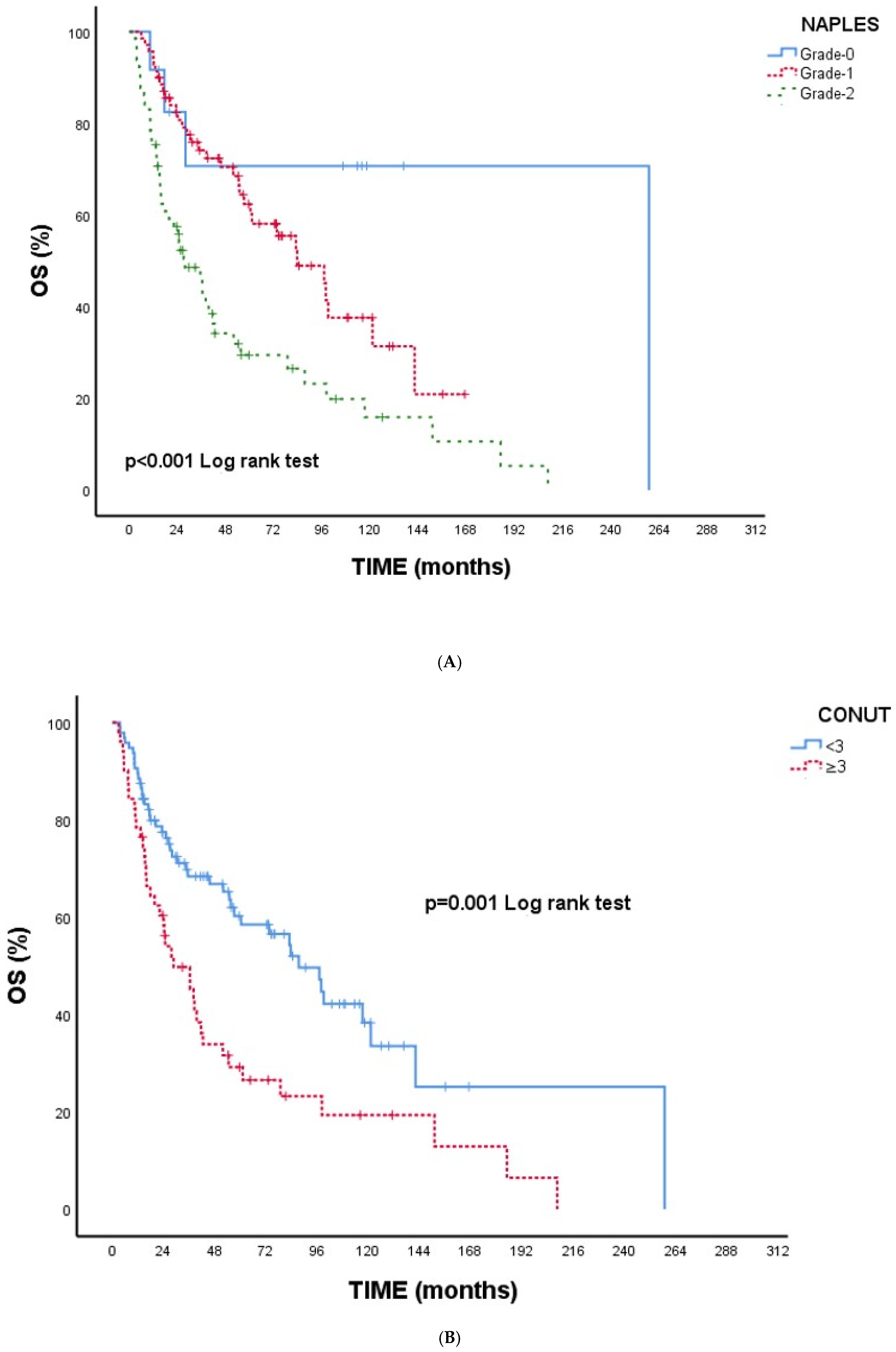
| NPS | <0.001 | |||
| Grade-0 | 82.5 | 70.7 | 258.87 (-) | |
| Grade-1 | 82.4 | 62.4 | 83.53 (58.27–108.78) | |
| Grade-2 | 57.5 | 29.5 | 27.63 (14.16–41.09) | |
| CONUT | 0.001 | |||
| <3 | 77.5 | 60.3 | 83.37 (61.77–112.97) | |
| ≥3 | 60.4 | 29.2 | 28.73 (14.20–43.25) | |
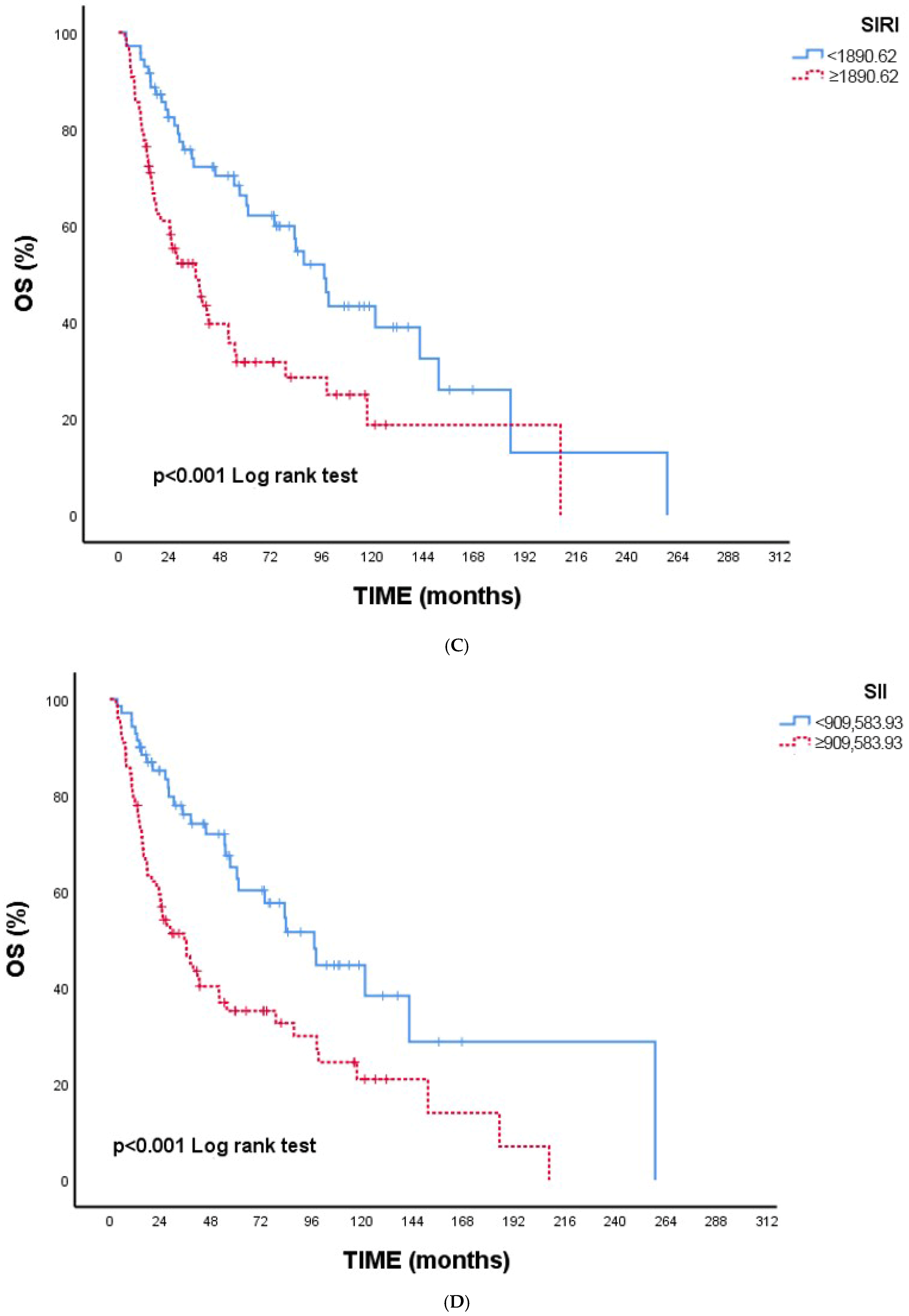
| SIRI | <0.001 | |||
| <1890.62 | 82.4 | 68.3 | 97.03 (80.51–113.54) | |
| ≥1890.62 | 61.0 | 31.7 | 36.43 (22.06–50.79) | |
| SII | <0.001 | |||
| <909,583.93 | 85.2 | 65.0 | 97.03 (68.31–125.74) | |
| ≥909,583.93 | 59.4 | 35.1 | 35.33 (21.31–49.34) | |
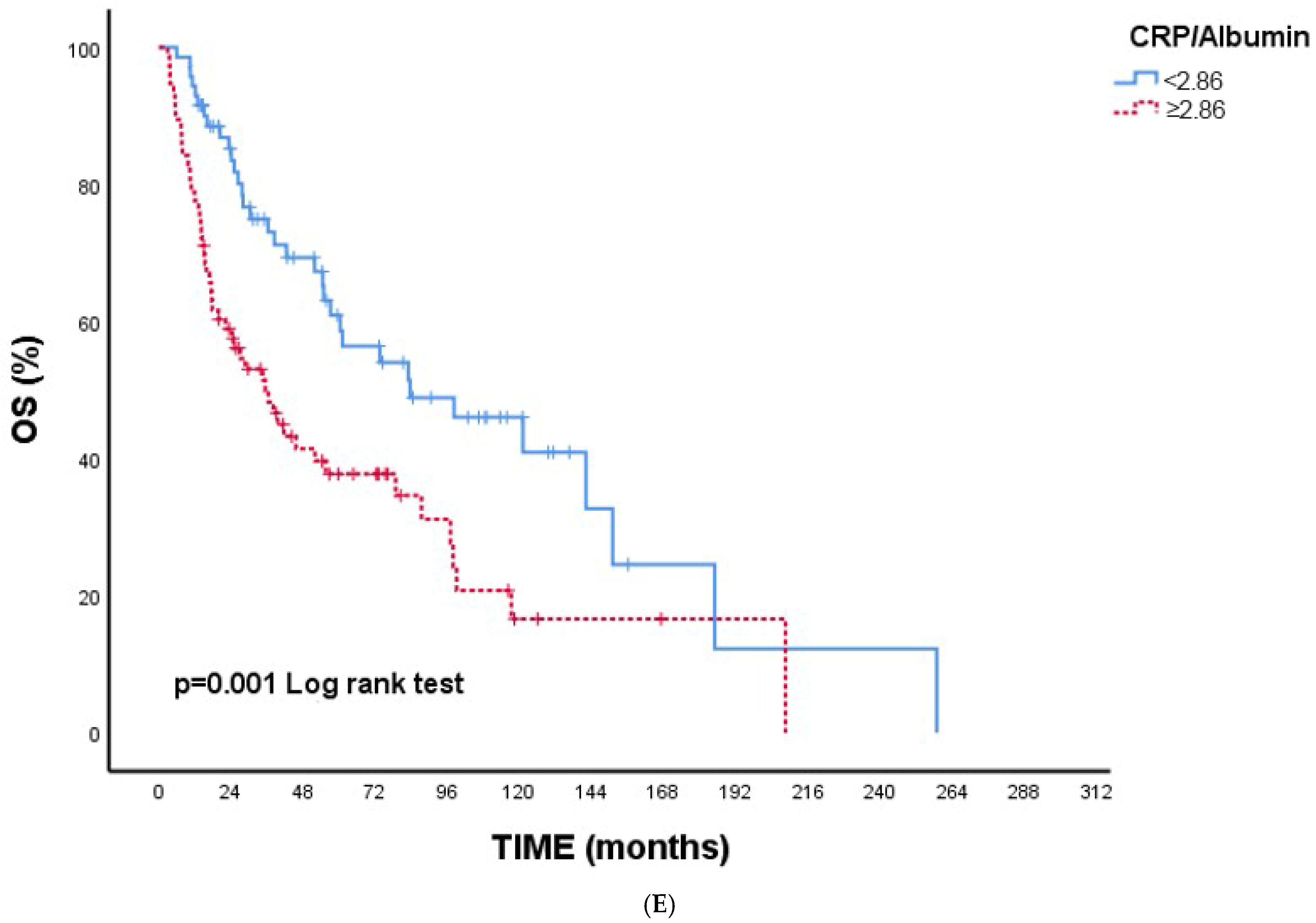
| CAR | 0.001 | |||
| <2.86 | 85.2 | 60.9 | 83.53 (29.13–137.92) | |
| ≥2.86 | 59.0 | 37.8 | 35.33 (20.00–50.65) | |
| PNI | 0.144 | |||
| >48.77 | 77.9 | 54.6 | 73.50 (45.81–101.18) | |
| ≤48.77 | 65.4 | 41.7 | 51.77 (33.90–69.63) |
| Variables | 2-Year % | 5-Year % | Median (95% CI) | p |
|---|---|---|---|---|
| Overall | 63.4 | 43.3 | 48.83 (30.15–67.50) | |
| Age | 0.026 | |||
| ≤65 | 66.6 | 50.4 | 66.73 (26.92–106.53) | |
| >65 | 56.5 | 27.2 | 29.23 (13.67–44.78) | |
| Gender | 0.051 | |||
| Female | 44.4 | 22.2 | 15.57 (1.25–29.88) | |
| Male | 64.6 | 44.8 | 53.90 (35.76–72.03) | |
| Tumor location | 0.783 | |||
| Supraglottic | 61.2 | 42.7 | 38.00 (7.27–68.72) | |
| Glottic | 69.1 | 44.4 | 54.43 (32.52–76.30) | |
| Subglottic | 50.0 | 39.8 | 23.63 (0.00–66.69) | |
| Smoking | 0.001 | |||
| No | 28.6 | - | 15.57 (2.99–28.14) | |
| Yes | 65.3 | 45.8 | 54.43 (30.03–78.82) | |
| Alcohol | 0.032 | |||
| No | 61.4 | 39.0 | 38.00 (16.60–59.39) | |
| Yes | 74.2 | 64.9 | 121.17 (49.21–193.12) | |
| Surgery | 0.008 | |||
| No | 50.9 | 32.0 | 24.03 (9.83–38.22) | |
| Yes | 70.0 | 49.1 | 57.10 (25.87–88.32) | |
| Surgery Type | 0.856 | |||
| Total | 71.1 | 46.2 | 54.80 (12.68–96.91) | |
| Subtotal | 65.8 | 55.7 | 78.77 (0.00–162.48) | |
| HPV | 0.896 | |||
| Negative | 54.5 | 42.1 | 53.90 (5.25–102.54) | |
| Positive | 62.5 | 41.7 | 34.67 (0.00–76.75) | |
| Unknown | 65.2 | 43.3 | 41.60 (19.64–63.55) | |
| P16 | 0.668 | |||
| Negative | 63.5 | 44.4 | 53.90 (0.00–128.03) | |
| Positive | 66.5 | 46.9 | 55.53 (6.63–104.42) | |
| Unknown | 62.4 | 41.8 | 38.00 (13.98–62.02) | |
| Stage | 0.003 | |||
| III | 77.8 | 60.5 | 87.37 (54.79–119.95) | |
| IV | 53.0 | 29.6 | 26.87 (20.11–33.62) | |
| Initial treatment | 0.465 | |||
| None | 66.7 | 55.6 | 73.50 (0.00–170.70) | |
| CT | 53.9 | 37.2 | 26.87 (5.72–48.01) | |
| CRT | 65.3 | 49.5 | 53.90 (0.00–112.14) | |
| RT | 70.5 | 44.7 | 51.77 (29.13–74.40) | |
| Induction therapy | 0.646 | |||
| Received | 51.9 | 51.9 | 97.03 (-) | |
| Not received | 62.8 | 43.1 | 48.83 (30.56–67.09) | |
| Adjuvant therapy | 0.110 | |||
| Received | 76.9 | 62.2 | 97.03 (-) | |
| Not received | 61.6 | 40.8 | 38.00 (15.87–60.12) | |
| Chemotherapy response | <0.001 | |||
| Stable disease | 75.3 | 54.9 | 184.00 (-) | |
| Progressive disease | 21.4 | 9.5 | 11.07 (7.25–14.88) | |
| Mixed response | - | - | 80.23 (-) | |
| Complete response | 91.9 | 61.9 | (-) | |
| Partial response | 46.9 | 31.3 | 15.30 (0.00–39.39) | |
| Second-line CT | <0.001 | |||
| Received | 45.5 | 18.2 | 23.63 (17.77–29.48) | |
| Not received | 69.3 | 52.0 | 78.70 (41.01–116.52) | |
| NPS | 0.001 | |||
| Grade-0 | 72.9 | 60.8 | 118.30 (0.00–282.64) | |
| Grade-1 | 75.2 | 54.1 | 73.50 (45.51–101.48) | |
| Grade-2 | 48.4 | 27.8 | 23.77 (15.22–32.31) | |
| CONUT | 0.003 | |||
| <3 | 70.6 | 53.9 | 80.23 (49.07–111.38) | |
| ≥3 | 50.4 | 25.3 | 24.03 (13.22–34.83) | |
| SIRI | 0.001 | |||
| <1890.62 | 74.7 | 58.4 | 81.87 (50.03–113.70) | |
| ≥1890.62 | 52.7 | 28.9 | 25.03 (13.58–36.47) | |
| SII | 0.003 | |||
| <909,583.93 | 79.0 | 55.1 | 80.23 (47.55–112.90) | |
| ≥909,583.93 | 49.9 | 33.2 | 23.77 (17.49–30.04) | |
| CAR | <0.001 | |||
| <2.86 | 80.6 | 54.0 | 80.23 (21.23–139.22) | |
| ≥2.86 | 47.8 | 33.5 | 23.63 (14.65–32.60) | |
| PNI | 0.260 | |||
| >48.77 | 69.0 | 46.2 | 54.80 (13.78–95.81) | |
| ≤48.77 | 58.3 | 40.6 | 41.60 (12.15–71.04) |
| Variables | HR (95% CI) | p |
|---|---|---|
| Age | 0.525 | |
| ≤65 | ref | |
| >65 | 1.23 (0.64–2.36) | |
| Smoking | 0.318 | |
| No | ref | |
| Yes | 0.60 (0.22–1.62) | |
| Alcohol | 0.803 | |
| No | ref | |
| Yes | 0.88 (0.34–2.26) | |
| Surgery | 0.025 | |
| No | ref | |
| Yes | 0.48 (0.25–0.91) | |
| Stage | 0.001 | |
| III | ref | |
| IV | 3.71 (1.76–7.84) | |
| Adjuvant therapy | 0.627 | |
| Received | ref | |
| Not received | 1.30 (0.44–3.78) | |
| Chemotherapy response | 0.003 | |
| Stable disease | ref | |
| Progressive disease | 3.21 (1.19–8.65) | 0.021 |
| Mixed response | 1.873 (0.31–11.45) | 0.494 |
| Complete response | 0.58 (0.19–1.79) | 0.346 |
| Partial response | 2.36 (0.64–8.66) | 0.195 |
| NPS | 0.027 | |
| Grade-0 | ref | |
| Grade-1 | 7.66 (1.56–37.63) | 0.012 |
| Grade-2 | 12.74 (1.94–83.52) | 0.008 |
| CONUT | 0.752 | |
| <3 | ref | |
| ≥3 | 0.87 (0.37–2.03) | |
| SIRI | 0.937 | |
| <1890.62 | ref | |
| ≥1890.62 | 1.03 (0.45–2.34) | |
| SII | 0.445 | |
| <909,583.93 | ref | |
| ≥909,583.93 | 1.49 (0.53–4.20) | |
| CAR | 0.819 | |
| <2.86 | ref | |
| ≥2.86 | 0.92 (0.46–1.82) |
| Variables | HR (95% CI) | p |
|---|---|---|
| Age | 0.641 | |
| ≤65 | ref | |
| >65 | 1.16 (0.62–2.16) | |
| Smoking | 0.831 | |
| No | ref | |
| Yes | 0.89 (0.33–2.42) | |
| Alcohol | 0.260 | |
| No | ref | |
| Yes | 0.59 (0.23–1.47) | |
| Surgery | 0.001 | |
| No | ref | |
| Yes | 0.33 (0.17–0.64) | |
| Stage | 0.024 | |
| III | ref | |
| IV | 2.19 (1.11–4.34) | |
| Chemotherapy response | <0.001 | |
| Stable disease | ref | |
| Progressive disease | 3.25 (1.31–8.08) | 0.011 |
| Mixed response | 0.86 (0.13–5.56) | 0.875 |
| Complete response | 0.48 (0.17–1.34) | 0.163 |
| Partial response | 1.40 (0.40–4.79) | 0.592 |
| Second-line CT | 0.009 | |
| Received | ref | |
| Not received | 0.37 (0.18–0.78) | |
| NPS | 0.028 | |
| Grade-0 | ref | |
| Grade-1 | 3.79 (1.16–12.40) | 0.027 |
| Grade-2 | 8.05 (1.75–37.05) | 0.007 |
| CONUT | 0.316 | |
| <3 | ref | |
| ≥3 | 0.66 (0.29–1.48) | |
| SIRI | 0.526 | |
| <1890.62 | ref | |
| ≥1890.62 | 1.32 (0.55–3.15) | |
| SII | 0.789 | |
| <909,583.93 | ref | |
| ≥909,583.93 | 1.14 (0.42–3.10) | |
| CAR | 0.709 | |
| <2.86 | ref | |
| ≥2.86 | 1.12 (0.61–2.06) |
Disclaimer/Publisher’s Note: The statements, opinions and data contained in all publications are solely those of the individual author(s) and contributor(s) and not of MDPI and/or the editor(s). MDPI and/or the editor(s) disclaim responsibility for any injury to people or property resulting from any ideas, methods, instructions or products referred to in the content. |
© 2025 by the authors. Licensee MDPI, Basel, Switzerland. This article is an open access article distributed under the terms and conditions of the Creative Commons Attribution (CC BY) license (https://creativecommons.org/licenses/by/4.0/).
Share and Cite
Çakan Demirel, B.; Taş, S.; Kantar, T.G.; Özdemir, M.; Doğan, T.; Karan, C.; Taşköylü, B.Y.; Demiray, A.G.; Değirmencioğlu, S.; Bilici, A.; et al. Real-World Outcomes of Treatment Approaches and the Impact of Systemic Inflammation Markers on Survival in Patients with Locally Advanced and Metastatic Laryngeal Cancer. J. Clin. Med. 2025, 14, 8924. https://doi.org/10.3390/jcm14248924
Çakan Demirel B, Taş S, Kantar TG, Özdemir M, Doğan T, Karan C, Taşköylü BY, Demiray AG, Değirmencioğlu S, Bilici A, et al. Real-World Outcomes of Treatment Approaches and the Impact of Systemic Inflammation Markers on Survival in Patients with Locally Advanced and Metastatic Laryngeal Cancer. Journal of Clinical Medicine. 2025; 14(24):8924. https://doi.org/10.3390/jcm14248924
Chicago/Turabian StyleÇakan Demirel, Burçin, Semra Taş, Taliha Güçlü Kantar, Melek Özdemir, Tolga Doğan, Canan Karan, Burcu Yapar Taşköylü, Atike Gökçen Demiray, Serkan Değirmencioğlu, Ahmet Bilici, and et al. 2025. "Real-World Outcomes of Treatment Approaches and the Impact of Systemic Inflammation Markers on Survival in Patients with Locally Advanced and Metastatic Laryngeal Cancer" Journal of Clinical Medicine 14, no. 24: 8924. https://doi.org/10.3390/jcm14248924
APA StyleÇakan Demirel, B., Taş, S., Kantar, T. G., Özdemir, M., Doğan, T., Karan, C., Taşköylü, B. Y., Demiray, A. G., Değirmencioğlu, S., Bilici, A., Doğu, G. G., & Yaren, A. (2025). Real-World Outcomes of Treatment Approaches and the Impact of Systemic Inflammation Markers on Survival in Patients with Locally Advanced and Metastatic Laryngeal Cancer. Journal of Clinical Medicine, 14(24), 8924. https://doi.org/10.3390/jcm14248924