Exposure-Based Intervention in Virtual Reality to Address Kinesiophobia in Parkinson’s Disease: A Narrative Review



Abstract
1. Introduction
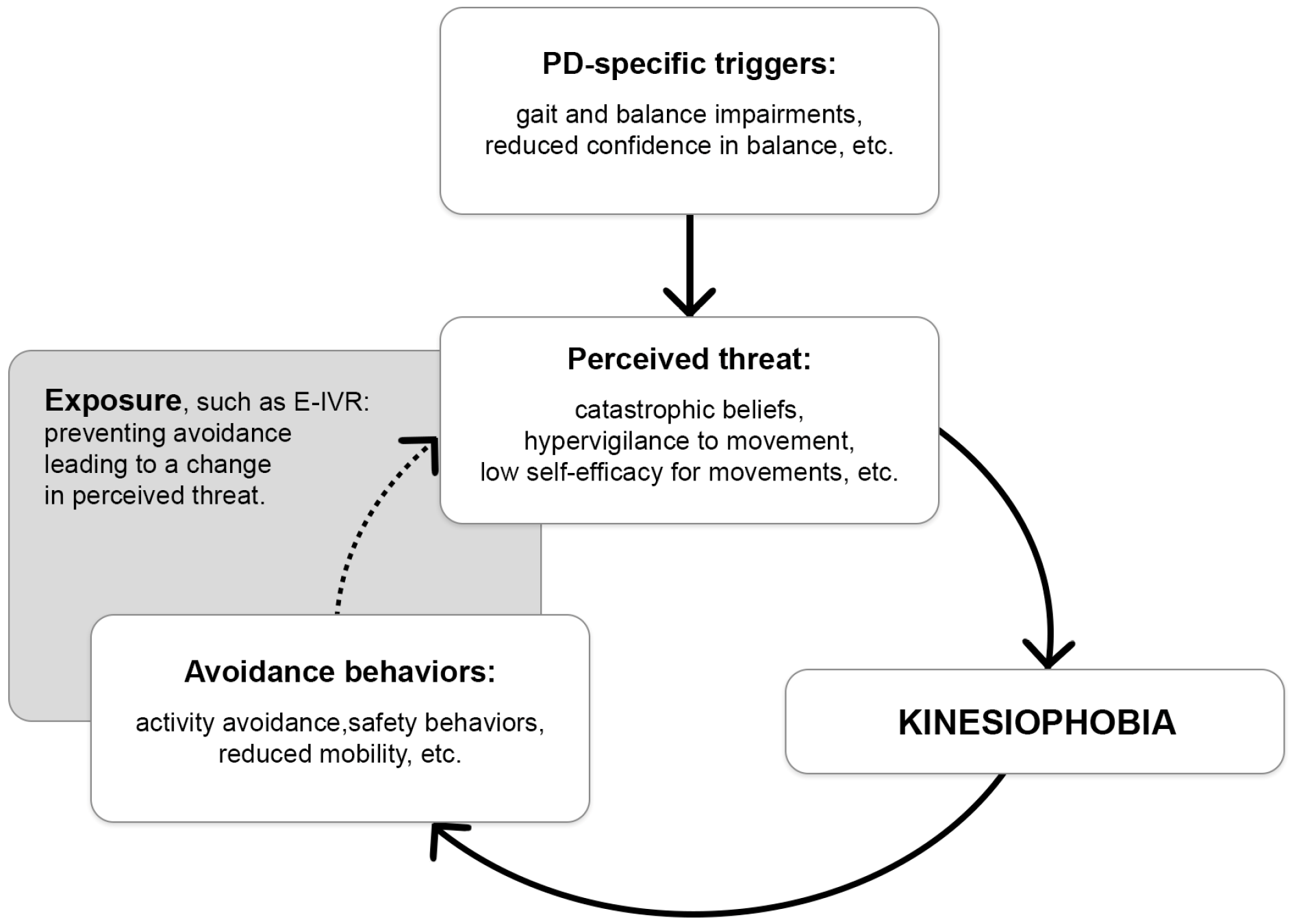
2. The Psychological Basis of Kinesiophobia
3. Virtual Reality-Based Exposure Intervention as a Treatment of Kinesiophobia
4. Feasibility and Efficacy of VR Interventions in Individuals Living with PD
5. Insight into Designing Exposure-Based Interventions in VR Targeting Kinesiophobia in PD
6. Conclusions
Author Contributions
Funding
Institutional Review Board Statement
Informed Consent Statement
Data Availability Statement
Acknowledgments
Conflicts of Interest
Abbreviations
| PD | Parkinson Disease |
| VR | Virtual Reality |
| E-IVR | Exposure-based intervention in virtual reality |
| TSK | Tampa Scale for Kinesiophobia |
| FABQ | Fear-Avoidance Beliefs Questionnaire |
| POQ | Pain Outcomes Questionnaire |
| FES | Falls Efficacy Scale |
| FDAQ | Fear of Daily Activities Questionnaire |
References
- World Health Organization. Parkinson Disease. 2023. Available online: https://www.who.int/news-room/fact-sheets/detail/parkinson-disease (accessed on 8 June 2025).
- Armstrong, M.J.; Okun, M.S. Diagnosis and treatment of Parkinson disease: A review. JAMA 2020, 323, 548–560. [Google Scholar] [CrossRef]
- Martinez-Martin, P.; Rodriguez-Blazquez, C.; Kurtis, M.M.; Chaudhuri, K.R.; NMSS Validation Group. The impact of non-motor symptoms on health-related quality of life of patients with Parkinson’s disease. Mov. Disord. 2011, 26, 399–406. [Google Scholar] [CrossRef]
- Fan, X.; Yuan, Y.; Bai, Y.; Cheng, C.; Wang, J.; Wang, T.; Yang, Y.; Chen, K.-C. Optimal dose and type of exercise improve the overall balance in adults with Parkinson’s disease: A systematic review and Bayesian network meta-analysis. Neurol. Sci. 2025, 46, 4169–4180. [Google Scholar] [CrossRef]
- Zhen, K.; Zhang, S.; Tao, X.; Li, G.; Lv, Y.; Yu, L. A systematic review and meta-analysis on effects of aerobic exercise in people with Parkinson’s disease. NPJ Parkinsons Dis. 2022, 8, 146. [Google Scholar] [CrossRef]
- van der Kolk, N.M.; de Vries, N.M.; Kessels, R.P.C.; Joosten, H.; Zwinderman, A.H.; Post, B.; Bloem, B.R. Effectiveness of home-based and remotely supervised aerobic exercise in Parkinson’s disease: A double-blind, randomized controlled trial. Lancet Neurol. 2019, 18, 998–1008. [Google Scholar] [CrossRef]
- Schenkman, M.; Moore, C.G.; Kohrt, W.M.; Hall, D.A.; Delitto, A.; Comella, C.L.; Josbeno, D.A.; Christiansen, C.L.; Berman, B.D.; Kluger, B.M.; et al. Effect of high-intensity treadmill exercise on motor symptoms in patients with de novo Parkinson disease: A phase 2 randomized clinical trial. JAMA Neurol. 2018, 75, 219–226. [Google Scholar] [CrossRef]
- Ahmad, S.O.; Longhurst, J.; Stiles, D.; Downard, L.; Martin, S. A meta-analysis of exercise intervention and the effect on Parkinson’s disease symptoms. Neurosci. Lett. 2023, 801, 137162. [Google Scholar] [CrossRef] [PubMed]
- Chen, K.; Tan, Y.; Lu, Y.; Wu, J.; Liu, X.; Zhao, Y. Effect of exercise on quality of life in Parkinson’s disease: A systematic review and meta-analysis. Parkinsons Dis. 2020, 2020, 3257623. [Google Scholar] [CrossRef] [PubMed]
- Feller, D.; Fox, I.; Gozzer, P.; Trentin, F.; Papola, D. Exercise for depressive symptoms in Parkinson disease: A systematic review and meta-analysis of randomized controlled trials. Arch. Phys. Med. Rehabil. 2023, 104, 331–339. [Google Scholar] [CrossRef] [PubMed]
- Costa, V.; Suassuna, A.D.O.B.; Brito, T.S.S.; Rocha, T.F.D.; Gianlorenco, A.C. Physical exercise for treating non-motor symptoms assessed by general Parkinson’s disease scales: Systematic review and meta-analysis of clinical trials. BMJ Neurol. Open 2023, 5, e000469. [Google Scholar] [CrossRef]
- Yoon, S.Y.; Suh, J.H.; Yang, S.N.; Han, K.; Kim, Y.W. Association of physical activity, including amount and maintenance, with all-cause mortality in Parkinson disease. JAMA Neurol. 2021, 78, 1446–1453. [Google Scholar] [CrossRef]
- Oguh, O.; Eisenstein, A.; Kwasny, M.; Simuni, T. Back to the basics: Regular exercise matters in Parkinson’s disease-Results from the National Parkinson Foundation QII registry study. Parkinsonism Relat. Disord. 2014, 20, 1221–1226. [Google Scholar] [CrossRef]
- Nimwegen, M.; Speelman, A.D.; Rossum, E.J.M.H.-V.; Overeem, S.; Deeg, D.J.H.; Borm, G.F.; Horst, M.H.L.; Bloem, B.R.; Munneke, M. Physical inactivity in Parkinson’s disease. J. Neurol. 2011, 258, 2214–2221. [Google Scholar] [CrossRef]
- Schootemeijer, S.; van der Kolk, N.M.; Ellis, T.; Mirelman, A.; Nieuwboer, A.; Nieuwhof, F.; Schwarzschild, M.A.; de Vries, N.M.; Bloem, B.R. Barriers and motivators to engage in exercise for persons with Parkinson’s disease. J. Parkinsons Dis. 2020, 10, 1293–1305. [Google Scholar] [CrossRef] [PubMed]
- Ellis, T.; Boudreau, J.K.; DeAngelis, T.R.; Brown, L.E.; Cavanaugh, J.T.; Earhart, G.M.; Ford, M.P.; Foreman, K.B.; Dibble, L.E. Barriers to exercise in people with Parkinson disease. Phys. Ther. 2013, 93, 628–636. [Google Scholar] [CrossRef]
- Kori, S.H.; Miller, R.P.; Todd, D.D. Kinisophobia: A new view of chronic pain behavior. Pain Manag. 1990, 3, 35–43. [Google Scholar]
- Jiménez-Cebrián, A.M.; Becerro-De-Bengoa-Vallejo, R.; Losa-Iglesias, M.E.; de Labra, C.; Calvo-Lobo, C.; Palomo-López, P.; Martínez-Jiménez, E.M.; Navarro-Flores, E. Kinesiophobia levels in patients with Parkinson’s disease: A case-control investigation. Int. J. Environ. Res. Public Health 2021, 18, 4791. [Google Scholar] [CrossRef]
- Vlaeyen, J.W.S.; Kole-Snijders, A.M.J.; Rotteveel, A.M.; Ruesink, R.; Heuts, P.H.T.G. The role of fear of movement/(re)injury in pain disability. J. Occup. Rehabil. 1995, 5, 235–252. [Google Scholar] [CrossRef] [PubMed]
- Oğuz, S.; Ertürk, G.; Polat, M.G.; Apaydın, H. The effect of kinesiophobia on physical activity, balance, and fear of falling in patients with Parkinson’s disease. Physiother. Theory Pract. 2023, 39, 865–872. [Google Scholar] [CrossRef]
- Sütçü, G.; Ayvat, E.; Kilinç, M. Effects of fatigue and kinesiophobia on functional capacity, physical activity, and quality of life in Parkinson’s disease. Int. J. Rehabil. Res. 2021, 44, 65–68. [Google Scholar] [CrossRef] [PubMed]
- Wasiuk-Zowada, D.; Knapik, A.; Szefler-Derela, J.; Brzęk, A.; Krzystanek, E. Kinesiophobia in stroke patients, multiple sclerosis and Parkinson’s disease. Diagnostics 2021, 11, 796. [Google Scholar] [CrossRef] [PubMed]
- Monticone, M.; Ferrante, S.; Ambrosini, E.; Rocca, B.; Secci, C.; Foti, C. Development of the Tampa Scale of Kinesiophobia for Parkinson’s disease: Confirmatory factor analysis, reliability, validity, and sensitivity to change. Int. J. Rehabil. Res. 2015, 38, 113–120. [Google Scholar] [CrossRef] [PubMed]
- Ioannou, A.; Papastavrou, E.; Avraamides, M.N.; Charalambous, A. Virtual reality and symptom management of anxiety, depression, fatigue, and pain: A systematic review. SAGE Open Nurs. 2020, 6, 2377960820936163. [Google Scholar] [CrossRef]
- Petrakis, A.; Koumakis, L.; Kazantzaki, E.; Kondylakis, H. Transforming healthcare: A comprehensive review of augmented and virtual reality interventions. Sensors 2025, 25, 3748. [Google Scholar] [CrossRef]
- Bracq, M.S.; Michinov, E.; Jannin, P. Virtual reality simulation in nontechnical skills training for healthcare professionals: A systematic review. Simul. Healthc. 2019, 14, 188–198. [Google Scholar] [CrossRef]
- Liu, M.; Zhou, K.; Chen, Y.; Zhou, L.; Bao, D.; Zhou, J. Is virtual reality training more effective than traditional physical training on balance and functional mobility in healthy older adults? A systematic review and meta-analysis. Front. Hum. Neurosci. 2022, 16, 843481. [Google Scholar] [CrossRef]
- Sadowski, J.; Wolaniuk, S.; Klaudel, T.; Sikorski, M.; Wąsik, M. A review of the latest information on the implementation of virtual reality for medical applications including educational, intraoperative, diagnostic, rehabilitation and therapeutic applications with consideration of selected reports on Apple Vision Pro. Health Technol. 2025, 15, 29–40. [Google Scholar] [CrossRef]
- Thangavelu, K.; Hayward, J.A.; Pachana, N.A.; Byrne, G.J.; Mitchell, L.K.; Wallis, G.M.; Au, T.R.; Dissanayaka, N.N. Designing virtual reality–assisted psychotherapy for anxiety in older adults living with Parkinson’s disease: Integrating literature for scoping. Eur. Rev. Aging Phys. Act. 2022, 19, 4. [Google Scholar] [CrossRef] [PubMed]
- Knapik, A.; Saulicz, E.; Gnat, R. Kinesiophobia—Introducing a new diagnostic tool. J. Hum. Kinet. 2011, 28, 25–31. [Google Scholar] [CrossRef] [PubMed]
- Phillips, M.L.; Drevets, W.C.; Rauch, S.L.; Lane, R. Neurobiology of emotion perception II: Implications for major psychiatric disorders. Biol. Psychiatry 2003, 54, 515–528. [Google Scholar] [CrossRef]
- Rachman, S. The determinants and treatment of simple phobias. Adv. Behav. Res. Ther. 1990, 12, 1–30. [Google Scholar] [CrossRef]
- Sangha, S.; Diehl, M.M.; Bergstrom, H.C.; Drew, M.R. Know safety, no fear. Neurosci. Biobehav. Rev. 2020, 108, 218–230. [Google Scholar] [CrossRef] [PubMed]
- Picavet, H.S.J.; Vlaeyen, J.W.S.; Schouten, J.S.A.G. Pain catastrophizing and kinesiophobia: Predictors of chronic low back pain. Am. J. Epidemiol. 2002, 156, 1028–1034. [Google Scholar] [CrossRef] [PubMed]
- Zale, E.L.; Ditre, J.W. Pain-related fear, disability, and the fear-avoidance model of chronic pain. Curr. Opin. Psychol. 2015, 5, 24–30. [Google Scholar] [CrossRef]
- Leeuw, M.; Goossens, M.E.J.B.; Linton, S.J.; Crombez, G.; Boersma, K.; Vlaeyen, J.W.S. The fear-avoidance model of musculoskeletal pain: Current state of scientific evidence. J. Behav. Med. 2007, 30, 77–94. [Google Scholar] [CrossRef]
- Lethem, J.; Slade, P.D.; Troup, J.D.G.; Bentley, G. Outline of a fear-avoidance model of exaggerated pain perception—I. Behav. Res. Ther. 1983, 21, 401–408. [Google Scholar] [CrossRef]
- Slepian, P.M.; Ankawi, B.; France, C.R. Longitudinal analysis supports a fear-avoidance model that incorporates pain resilience alongside pain catastrophizing. Ann. Behav. Med. 2020, 54, 335–345. [Google Scholar] [CrossRef]
- Hoffman, L.J.; Chu, B.C. When is seeking safety functional? Taking a pragmatic approach to distinguishing coping from safety. Cogn. Behav. Pract. 2019, 26, 176–185. [Google Scholar] [CrossRef]
- Bandelow, B.; Sagebiel, A.; Belz, M.; Görlich, Y.; Michaelis, S.; Wedekind, D. Enduring effects of psychological treatments for anxiety disorders: Meta-analysis of follow-up studies. Br. J. Psychiatry 2018, 212, 333–338. [Google Scholar] [CrossRef]
- Carpenter, J.K.; Andrews, L.A.; Witcraft, S.M.; Powers, M.B.; Smits, J.A.J.; Hofmann, S.G. Cognitive behavioral therapy for anxiety and related disorders: A meta-analysis of randomized placebo-controlled trials. Depress. Anxiety 2018, 35, 502–514. [Google Scholar] [CrossRef]
- Kazantzis, N.; Luong, H.K.; Usatoff, A.S.; Impala, T.; Yew, R.Y.; Hofmann, S.G. The processes of cognitive behavioral therapy: A review of meta-analyses. Cogn. Ther. Res. 2018, 42, 349–372. [Google Scholar] [CrossRef]
- Abramowitz, J.S. The practice of exposure therapy: Relevance of cognitive-behavioral theory and extinction theory. Behav. Ther. 2013, 44, 548–558. [Google Scholar] [CrossRef] [PubMed]
- Wolitzky-Taylor, K.B.; Horowitz, J.D.; Powers, M.B.; Telch, M.J. Psychological approaches in the treatment of specific phobias: A meta-analysis. Clin. Psychol. Rev. 2008, 28, 1021–1037. [Google Scholar] [CrossRef]
- Bordeleau, M.; Vincenot, M.; Lefevre, S.; Duport, A.; Seggio, L.; Breton, T.; Lelard, T.; Serra, E.; Roussel, N.; Das Neves, J.F.; et al. Treatments for kinesiophobia in people with chronic pain: A scoping review. Front. Behav. Neurosci. 2022, 16, 933483. [Google Scholar] [CrossRef]
- Bouchard, S.; Milosevic, I.; McCabe, R.E. Virtual reality treatment. In Phobias: The Psychology of Irrational Fear; Bloomsbury Publishing: New York, NY, USA, 2015; pp. 411–414. [Google Scholar]
- Côté, S.; Bouchard, S. Virtual reality exposure for phobias: A critical review. J. Cyber Ther. Rehabil. 2008, 1, 75–91. [Google Scholar]
- Garcia-Palacios, A.; Botella, C.; Hoffman, H.; Fabregat, S. Comparing acceptance and refusal rates of virtual reality exposure vs in vivo exposure by patients with specific phobias. Cyberpsychol. Behav. 2007, 10, 722–724. [Google Scholar] [CrossRef]
- Bouchard, S.; Dumoulin, S.; Robillard, G.; Guitard, T.; Klinger, É.; Forget, H.; Loranger, C.; Roucaut, F.X. Virtual reality compared with in vivo exposure in the treatment of social anxiety disorder: A three-arm randomised controlled trial. Br. J. Psychiatry 2017, 210, 276–283. [Google Scholar] [CrossRef]
- Ma, L.; Mor, S.; Anderson, P.L.; Baños, R.M.; Botella, C.; Bouchard, S.; Cárdenas-López, G.; Donker, T.; Fernández-Álvarez, J.; Lindner, P.; et al. Integrating virtual realities and psychotherapy: SWOT analysis on VR and MR-based treatments of anxiety and stress-related disorders. Cogn. Behav. Ther. 2021, 50, 509–526. [Google Scholar] [CrossRef] [PubMed]
- Bouchard, S.; Côté, S.; Richard, D.C.S. Virtual reality applications for exposure. In Handbook of Exposure Therapies; Neimeyer, R.A., Ed.; Elsevier: Amsterdam, The Netherlands, 2007; pp. 347–388. [Google Scholar]
- Scheveneels, S.; De Witte, N.; Van Daele, T. The first steps in facing your fears: The acceptability of virtual reality and in vivo exposure treatment for specific fears. J. Anxiety Disord. 2023, 95, 102695. [Google Scholar] [CrossRef]
- Andersen, N.J.; Schwartzman, D.; Martinez, C.; Cormier, G.; Drapeau, M. Virtual reality interventions for the treatment of anxiety disorders: A scoping review. J. Behav. Ther. Exp. Psychiatry 2023, 81, 101851. [Google Scholar] [CrossRef] [PubMed]
- Carl, E.; Stein, A.T.; Levihn-Coon, A.; Pogue, J.R.; Rothbaum, B.; Emmelkamp, P.; Asmundson, G.J.; Carlbring, P.; Powers, M.B. Virtual reality exposure therapy for anxiety and related disorders: A meta-analysis of randomized controlled trials. J. Anxiety Disord. 2019, 61, 27–36. [Google Scholar] [CrossRef]
- Ling, Y.; Nefs, H.T.; Morina, N.; Heynderickx, I.; Brinkman, W.P. A meta-analysis on the relationship between self-reported presence and anxiety in virtual reality exposure therapy for anxiety disorders. PLoS ONE 2014, 9, e96144. [Google Scholar] [CrossRef]
- Slater, M. Place illusion and plausibility can lead to realistic behaviour in immersive virtual environments. Philos. Trans. R. Soc. Lond. B Biol. Sci. 2009, 364, 3549–3557. [Google Scholar] [CrossRef]
- Maples-Keller, J.L.; Bunnell, B.E.; Kim, S.J.; Rothbaum, B.O. The use of virtual reality technology in the treatment of anxiety and other psychiatric disorders. Harv. Rev. Psychiatry 2017, 25, 103–113. [Google Scholar] [CrossRef]
- Wang, S.; Sun, J.; Yin, X.; Li, H. Effect of virtual reality technology as an intervention for people with kinesiophobia: A meta-analysis of randomised controlled trials. J. Clin. Nurs. 2023, 32, 3074–3086. [Google Scholar] [CrossRef]
- Li, R.; Li, Y.; Kong, Y.; Li, H.; Hu, D.; Fu, C.; Wei, Q. Virtual reality–based training in chronic low back pain: Systematic review and meta-analysis of randomized controlled trials. J. Med. Internet Res. 2024, 26, e45406. [Google Scholar] [CrossRef]
- Percy, D.; Phillips, T.; Torres, F.; Chaleunphonh, M.; Sung, P. Effectiveness of virtual reality–based balance and gait in older adults with fear of movement: A systematic review and meta-analysis. Physiother. Res. Int. 2023, 28, e2006. [Google Scholar] [CrossRef]
- Fowler, C.A.; Ballistrea, L.M.; Mazzone, K.E.; Martin, A.M.; Kaplan, H.; Kip, K.E.; Ralston, K.; Murphy, J.L.; Winkler, S.L. Virtual reality as a therapy adjunct for fear of movement in veterans with chronic pain: Single-arm feasibility study. Pain Med. 2019, 20, 2284–2296. [Google Scholar] [CrossRef]
- Chen, K.B.; Sesto, M.E.; Ponto, K.; Leonard, J.; Mason, A.; Vanderheiden, G.; Williams, J.; Radwin, R.G. Use of virtual reality feedback for patients with chronic neck pain and kinesiophobia. IEEE Trans. Neural Syst. Rehabil. Eng. 2017, 9, 846–855. [Google Scholar] [CrossRef]
- Wang, B.; Shen, M.; Wang, Y.X.; He, Z.W.; Chi, S.Q.; Yang, Z.H. Effect of virtual reality on balance and gait ability in patients with Parkinson’s disease: A systematic review and meta-analysis. Clin. Rehabil. 2019, 33, 1130–1138. [Google Scholar] [CrossRef]
- Bouchard, S.; Robillard, G.; Larouche, S.; Loranger, C. Description of a treatment manual for in virtuo exposure with specific phobia. In Virtual Reality in Psychological, Medical and Pedagogical Applications; Eichenberg, C., Ed.; InTech: Rijeka, Croatia, 2012; pp. 109–134. [Google Scholar]
- Bouchard, S.; Paquette, A. Un survol des stratégies de régulation de l’anxiété à l’aide de la réalité virtuelle: Du traitement par exposition à l’adaptation culturelle des stratégies favorisant la résilience. Sci. Comport. 2023, 33, 57–71. [Google Scholar]
- Milosevic, I.; McCabe, R.E. (Eds.) Phobias: The Psychology of Irrational Fear; Bloomsbury Publishing USA: New York, NY, USA, 2015. [Google Scholar]
- Tayyebi, G.; Asadiof, F.; Hashempour, B.; Lotfi, M.; Taheri, M.; Naeim, M. Efficacy of virtual reality-based cognitive behavioral group therapy in enhancing emotional well-being and quality of life in Parkinson’s disease: A randomized controlled trial. Clin. Park. Relat. Disord. 2025, 12, 100316. [Google Scholar] [CrossRef]
- Goh, L.; Allen, N.E.; Ahmadpour, N.; Martens, K.A.E.; Song, J.; Clemson, L.; Lewis, S.J.G.; MacDougall, H.G.; Canning, C.G. A video self-modeling intervention using virtual reality plus physical practice for freezing of gait in Parkinson disease: Feasibility and acceptability study. JMIR Form. Res. 2021, 5, e30251. [Google Scholar] [CrossRef]
- Kwon, S.H.; Park, J.K.; Koh, Y.H. A systematic review and meta-analysis on the effect of virtual reality-based rehabilitation for people with Parkinson’s disease. J. Neuroeng. Rehabil. 2023, 20, 94. [Google Scholar] [CrossRef] [PubMed]
- Lu, Y.; Ge, Y.; Chen, W.; Xing, W.; Wei, L.; Zhang, C.; Yang, Y. The effectiveness of virtual reality for rehabilitation of Parkinson disease: An overview of systematic reviews with meta-analyses. Syst. Rev. 2022, 11, 233. [Google Scholar] [CrossRef]
- De la Cruz, N.B.; Secorro, N.; Calvo, S.; Benyoucef, Y.; Herrero, P.; Bellosta-López, P. Immersive virtual reality and antigravity treadmill training for gait rehabilitation in Parkinson’s disease: A pilot and feasibility study. Rev. Neurol. 2020, 71, 447–454. [Google Scholar] [CrossRef]
- Hara, M.; Murakawa, Y.; Wagatsuma, T.; Shinmoto, K.; Tamaki, M. Feasibility of somato-cognitive coordination therapy using virtual reality for patients with advanced severe Parkinson’s disease. J. Parkinsons Dis. 2024, 14, 895–898. [Google Scholar] [CrossRef]
- Schuch, C.P.; Balbinot, G.; Bonilla, M.N.; Guedes Machado, A.; Oliveira, A.A.D. Feasibility of a short-term virtual reality balance intervention to improve mobility smoothness in Parkinson’s disease. Front. Virtual Real. 2020, 1, 602560. [Google Scholar] [CrossRef]
- Campo-Prieto, P.; Cancela-Carral, J.M.; Rodríguez-Fuentes, G. Wearable immersive virtual reality device for promoting physical activity in Parkinson’s disease patients. Sensors 2022, 22, 3302. [Google Scholar] [CrossRef] [PubMed]
- Sánchez-Herrera-Baeza, P.; Cano-De-La-Cuerda, R.; Oña-Simbaña, E.D.; Palacios-Ceña, D.; Pérez-Corrales, J.; Cuenca-Zaldivar, J.N.; Gueita-Rodriguez, J.; de Quirós, C.B.-B.; Jardón-Huete, A.; Cuesta-Gomez, A. The impact of a novel immersive virtual reality technology associated with serious games in Parkinson’s disease patients on upper limb rehabilitation: A mixed methods intervention study. Sensors 2020, 20, 2168. [Google Scholar] [CrossRef]
- Zhang, Y.; Su, X.; Xu, X. Research on the design and production of VR rehabilitation game for Parkinson’s disease patients based on real-time action acquisition. In Medical Imaging and Computer-Aided Diagnosis; Lecture Notes in Electrical Engineering; Su, R., Zhang, Y., Liu, H., Frangi, A.F., Eds.; Springer: Singapore, 2023; pp. 551–559. [Google Scholar] [CrossRef]
- Landers, M.R.; Nilsson, M.H. A theoretical framework for addressing fear of falling avoidance behavior in Parkinson’s disease. Physiother. Theory Pract. 2023, 39, 895–911. [Google Scholar] [CrossRef] [PubMed]
- Pérez-Sanpablo, A.I.; González-Mendoza, A.; Quiñones-Uriostegui, I.; Rodríguez-Reyes, G.; Núñez-Carrera, L.; Hernández–Arenas, C.; Boll-Woehrlen, M.C.; Montero, A.A. Evidence-based design and development of a VR-based treadmill system for gait research and rehabilitation of patients with Parkinson’s disease. Rev. Investig. Clin. 2014, 66, 39–47. [Google Scholar] [PubMed]
- Finley, J.M.; Gotsis, M.; Lympouridis, V.; Jain, S.; Kim, A.; Fisher, B.E. Design and development of a virtual reality-based mobility training game for people with Parkinson’s disease. Front. Neurol. 2021, 11, 577713. [Google Scholar] [CrossRef] [PubMed]


| Study | Population | Design and Sample Size (n) | Immersion Type and Type of Intervention | Measures of Kinesiophobia | Main Outcomes | Limitations |
|---|---|---|---|---|---|---|
| Li et al. (2024) [59] | Adults with chronic low back pain | Systematic review + meta-analysis RCT 20 RCTs included (n ≈ 1059) | Mixed: non-immersive (Nintendo Wii, Kinect) and fully immersive Various VR exercise or rehabilitation programs | TSK, FABQ | VR improved pain and disability; small to moderate reduction in kinesiophobia short-term; no long-term effect; high heterogeneity across studies. | Low-quality evidence; small samples; inconsistent follow-up; kinesiophobia not consistently measured across studies |
| Wang et al. (2019) [63] | Adults with musculoskeletal pain (no restriction on the type of disease) | Meta-analysis of RCT: 11 RCT (n ≈ 645) | Mixed: non-immersive (Nintendo Wii, Kinect) and fully immersive VR-based movement therapy, VR exercise, VR distraction | TSK, FABQ | VR significantly reduced kinesiophobia; Results inconsistent across studies; Non-immersive technology more effective than fully immersive | Heterogeneity of VR protocols; kinesiophobia not primary target; inconsistent measurement tools |
| Percy et al. (2023) [60] | Older adults with fear of falling & mobility impairments | Systematic review + meta-analysis of RCT: 7 RCT (n ≈ 297) | Mixed: non-immersive (Nintendo Wii, Kinect) and one fully immersive VR-based exercise or balance training | FES | VR improved mobility but did not significantly reduce fear of movement | Use of non-specific fear-of-movement measures; inconsistent exposure intensity across studies. |
| Fowler et al. (2019) [61] | Veterans with chronic pain | Single-arm feasibility study, n = 16 | Fully immersive graded VR exposure therapy | POQ, FDAQ | 38% reached minimum clinically important difference on FDAQ; small improvements in movement fear POQ | No control group; small sample; hierarchy design issues |
| Chen et al. (2017) [62] | Adults with chronic neck pain | Two single-session experimental studies (within-subject), asymptomatic vs. chronic neck pain. Chronic pain n = 9 Asymptomatic n = 10 | Semi-immersive VR with manipulated visual feedback during neck rotation. Visuomotor perturbation VR task (sensorimotor manipulation). | TSK | Increased movement under altered visual feedback; kinesophobia assessed but not evaluated for change (no pre–post measurement). | Kinesiophobia not primary focus; lacks standardized measures; small sample |
Disclaimer/Publisher’s Note: The statements, opinions and data contained in all publications are solely those of the individual author(s) and contributor(s) and not of MDPI and/or the editor(s). MDPI and/or the editor(s) disclaim responsibility for any injury to people or property resulting from any ideas, methods, instructions or products referred to in the content. |
© 2025 by the authors. Licensee MDPI, Basel, Switzerland. This article is an open access article distributed under the terms and conditions of the Creative Commons Attribution (CC BY) license (https://creativecommons.org/licenses/by/4.0/).
Share and Cite
Jeanningros, A.; Bouchard, S.; Potvin-Desrochers, A. Exposure-Based Intervention in Virtual Reality to Address Kinesiophobia in Parkinson’s Disease: A Narrative Review. J. Clin. Med. 2025, 14, 8837. https://doi.org/10.3390/jcm14248837
Jeanningros A, Bouchard S, Potvin-Desrochers A. Exposure-Based Intervention in Virtual Reality to Address Kinesiophobia in Parkinson’s Disease: A Narrative Review. Journal of Clinical Medicine. 2025; 14(24):8837. https://doi.org/10.3390/jcm14248837
Chicago/Turabian StyleJeanningros, Alice, Stéphane Bouchard, and Alexandra Potvin-Desrochers. 2025. "Exposure-Based Intervention in Virtual Reality to Address Kinesiophobia in Parkinson’s Disease: A Narrative Review" Journal of Clinical Medicine 14, no. 24: 8837. https://doi.org/10.3390/jcm14248837
APA StyleJeanningros, A., Bouchard, S., & Potvin-Desrochers, A. (2025). Exposure-Based Intervention in Virtual Reality to Address Kinesiophobia in Parkinson’s Disease: A Narrative Review. Journal of Clinical Medicine, 14(24), 8837. https://doi.org/10.3390/jcm14248837