Current and Emerging Technologies for Continuous Intraocular Pressure Monitoring in the Control of Glaucoma Progression: A Scoping Review

 ,
,  , and
, and
Abstract
1. Introduction
2. Material and Methods
- “intraocular pressure” AND “glaucoma diagnosis” AND (“control” OR “measurement” OR “monitoring”)
- “intraocular pressure” AND “glaucoma diagnosis” AND (“control” OR “measurement” OR “monitoring” OR “assessment”) AND “devices”
- (“intraocular pressure”) AND (“control” OR “monitoring” OR “assessment” OR “measurement”) AND (“implantable” OR “wearable”)
- (“intraocular pressure”) AND (“control” OR “monitoring” OR “assessment” OR “measurement”) AND (“contact lenses” OR “contact lens”)
- (“intraocular pressure”) AND (“control” OR “monitoring” OR “assessment” OR “measurement”) AND (“biosensor” OR “biosensors”)
- (“intraocular pressure”) AND (“control” OR “monitoring” OR “assessment” OR “measurement”) AND (“eyemate”)
- (“intraocular pressure”) AND (“control” OR “monitoring” OR “assessment” OR “measurement”) AND (“new technologies” OR “new devices” OR “new methods”)
- (“intraocular pressure”) AND (“control” OR “monitoring” OR “assessment” OR “measurement”) AND (“invasive” OR “non-invasive”) AND (“device” OR “devices”)
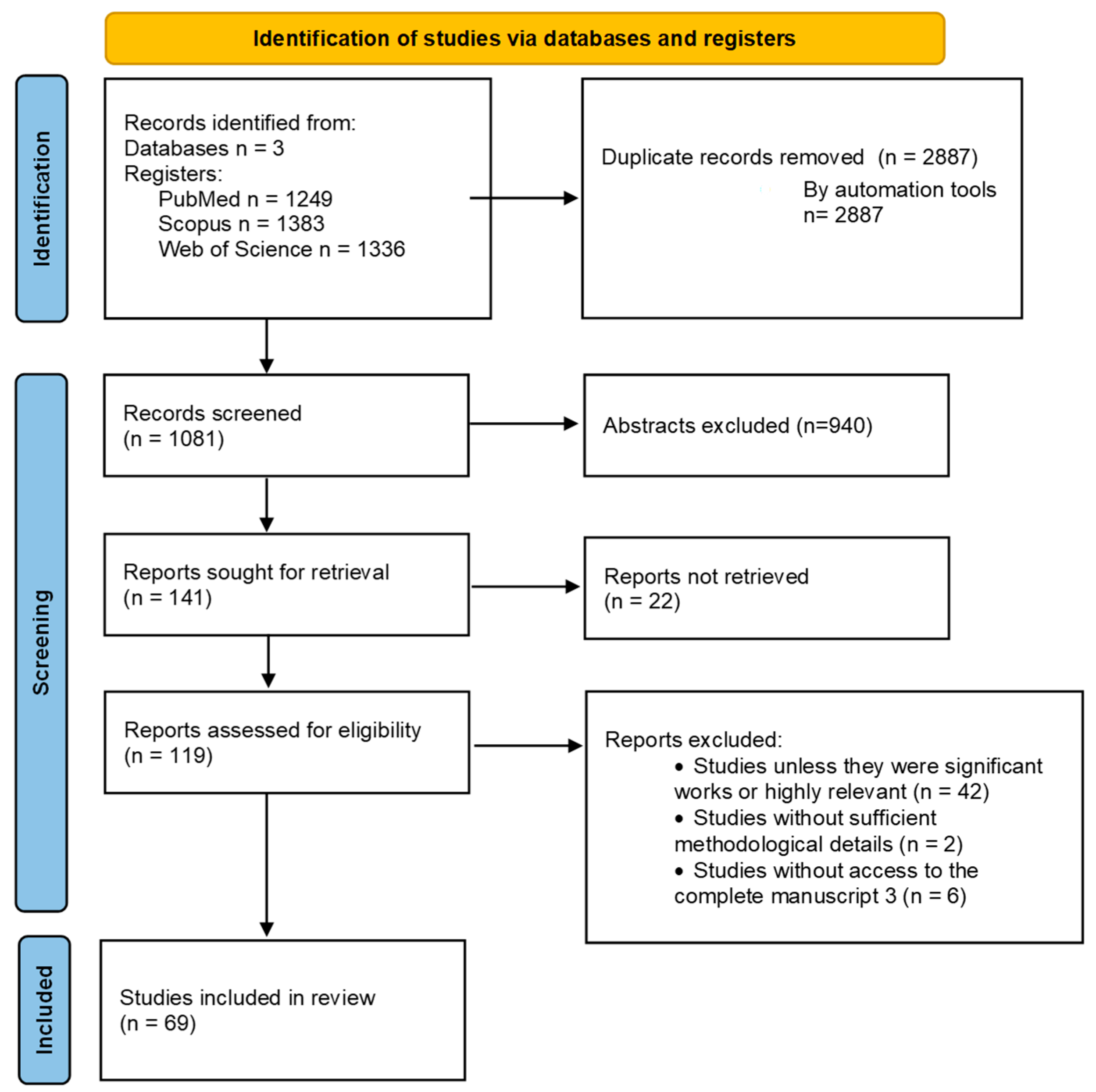
- Studies published in the last 10 years (2015–2025) to ensure the inclusion of recent advancements in technology.
- Studies related to IOP measurement using emerging technologies.
- Articles published in peer-reviewed journals.
- Studies providing clinical data, technological evaluations, or user feedback on the effectiveness of IOP monitoring devices.
- Research conducted on human subjects or validated through clinical trials.
- Studies published prior to 2015, unless they were significant works or highly relevant.
- Studies focusing on traditional tonometry methods without innovative technological aspects.
- Articles that are reviews, editorials, or conference abstracts without primary or full-text data.
- Duplicate publications or studies without sufficient methodological details.
- Stage 1: Titles and abstracts were screened for relevance to the topic by two independent reviewers. Cohen’s kappa statistic (κ) was employed to evaluate the agreement between the reviewers.
- Stage 2: Full-text articles were assessed for eligibility based on the inclusion and exclusion criteria.
- Stage 3: Relevant data were extracted from eligible studies, including study design, sample size, technology used, outcomes, and limitations.
3. Results
4. Discussion
4.1. Self-Tonometry Devices
Evaluation and Agreement with Gold-Standard
4.2. Biosensors
4.3. Contact-Lens-Based Sensor Wearable Devices
Evaluation and Agreement with Gold-Standard and Other Methods
4.4. Intraocular Implantable bioMEMS
Evaluation and Agreement with Gold-Standard
4.5. Comparative Utility and Measurement Reliability
4.6. Practical Barriers to Clinical Implementation
4.7. Future Perspectives
5. Conclusions
Author Contributions
Funding
Institutional Review Board Statement
Informed Consent Statement
Data Availability Statement
Conflicts of Interest
References
- Weinreb, R.N.; Tee Khaw, P. Primary open-angle glaucoma. Lancet 2004, 363, 1711–1720. [Google Scholar] [CrossRef]
- Weinreb, R.N.; Aung, T.; Medeiros, F.A. The Pathophysiology and Treatment of Glaucoma: A Review. JAMA 2014, 311, 1901. [Google Scholar] [CrossRef]
- McMonnies, C.W. Glaucoma history and risk factors. J. Optom. 2016, 10, 71. [Google Scholar] [CrossRef]
- Goel, M.; Picciani, R.G.; Lee, R.K.; Bhattacharya, S.K. Aqueous Humor Dynamics: A Review. Open Ophthalmol. J. 2010, 4, 52. [Google Scholar] [CrossRef]
- Asrani, S.G.; McGlumphy, E.J.; Al-Aswad, L.A.; Chaya, C.J.; Lin, S.; Musch, D.C.; Pitha, I.; Robin, A.L.; Wirostko, B.; Johnson, T.V. The relationship between intraocular pressure and glaucoma: An evolving concept. Prog. Retin. Eye Res. 2024, 103, 101303. [Google Scholar] [CrossRef]
- Kass, M.A.; Heuer, D.K.; Higginbotham, E.J.; Johnson, C.A.; Keltner, J.L.; Miller, J.P.; Parrish, R.K., 2nd; Wilson, M.R.; Gordon, M.O. The Ocular Hypertension Treatment Study: A randomized trial determines that topical ocular hypotensive medication delays or prevents the onset of primary open-angle glaucoma. Arch. Ophthalmol. Res. 2002, 120, 701–713. [Google Scholar] [CrossRef]
- Raveendran, R.; Prabakaran, L.; Senthil, R.; Yesudhason, B.V.; Dharmalingam, S.; Sathyaraj, W.V.; Atchudan, R. Current Innovations in Intraocular Pressure Monitoring Biosensors for Diagnosis and Treatment of Glaucoma—Novel Strategies and Future Perspectives. Biosensors 2023, 13, 663. [Google Scholar] [CrossRef]
- Sanchez, I.; Martin, R. Advances in diagnostic applications for monitoring intraocular pressure in Glaucoma: A review. J. Optom. 2019, 12, 211–221. [Google Scholar] [CrossRef]
- Konstas, A.G.; Kahook, M.Y.; Araie, M.; Katsanos, A.; Quaranta, L.; Rossetti, L.; Holló, G.; Detorakis, E.T.; Oddone, F.; Mikropoulos, D.G.; et al. Diurnal and 24-h Intraocular Pressures in Glaucoma: Monitoring Strategies and Impact on Prognosis and Treatment. Adv. Ther. 2018, 35, 1775–1804. [Google Scholar] [CrossRef]
- Ittoop, S.M.; SooHoo, J.R.; Seibold, L.K.; Mansouri, K.; Kahook, M.Y. Systematic Review of Current Devices for 24-h Intraocular Pressure Monitoring. Adv. Ther. 2016, 33, 1679–1690. [Google Scholar] [CrossRef]
- Sit, A.J.; Pruet, C.M. Personalizing intraocular pressure: Target intraocular pressure in the setting of 24-hour intraocular pressure monitoring. Asia-Pacific J. Ophthalmol. 2016, 5, 17–22. [Google Scholar] [CrossRef]
- Brusini, P.; Salvetat, M.L.; Zeppieri, M. How to Measure Intraocular Pressure: An Updated Review of Various Tonometers. J. Clin. Med. 2021, 10, 3860. [Google Scholar] [CrossRef]
- Mansouri, K.; Tanna, A.P.; De Moraes, C.G.; Camp, A.S.; Weinreb, R.N. Review of the measurement and management of 24-hour intraocular pressure in patients with glaucoma. Surv. Ophthalmol. 2020, 65, 171–186. [Google Scholar] [CrossRef]
- Page, M.J.; McKenzie, J.E.; Bossuyt, P.M.; Boutron, I.; Hoffmann, T.C.; Mulrow, C.D.; Shamseer, L.; Tetzlaff, J.M.; Akl, E.A.; Brennan, S.E.; et al. The PRISMA 2020 statement: An updated guideline for reporting systematic reviews. BMJ 2021, 372, n71. [Google Scholar] [CrossRef]
- Moher, D.; Liberati, A.; Tetzlaff, J.; Altman, D.G. The PRISMA Group. Preferred Reporting Items for Systematic Reviews and Meta-Analyses: The PRISMA Statement. PLoS Med. 2009, 6, e1000097. [Google Scholar] [CrossRef]
- Nayak, A.; Ramesh, S.V.; Kuzhuppilly, N.I.R.; Pai, V.H.; Chaitanya, A. Performance of home-based self-tonometry (iCare HOME (TA022)) for measuring intraocular pressure among healthy and glaucoma patients. F1000Research 2023, 12, 128. [Google Scholar] [CrossRef]
- Kadambi, S.V.; Aishwarya, M.; Leelavathy, C.; George, R.; Balekudaru, S.; Lingam, V.; Baskaran, M. Clinical utility, feasibility of home tonometry using iCare HOME by glaucoma patients. Indian. J. Ophthalmol. 2023, 71, 2727–2732. [Google Scholar] [CrossRef]
- Quérat, L.; Chen, E. Self-monitoring of the intraocular pressure with ICARE® HOME2 and a smartphone application: Feasibility and acceptability. Acta Ophthalmol. 2025, 103, 109–114. [Google Scholar] [CrossRef]
- Romano, D.; Montesano, G.; Aminoleslami, A.A.; Colizzi, B.; Rossetti, L.M. Reliability of Self-Monitoring of Intraocular Pressure With iCare Home2 Rebound Tonometry. J. Glaucoma 2025, 34, 447–454. [Google Scholar] [CrossRef]
- Wei, Y.; Zhang, Y.; Chen, Z.; Chong, J.I.T.; Lee, C.C.H.; Karunaratne, I.K.; Zhang, X.; Deng, M.; Yang, Y.; Lam, D.C.C.; et al. A Novel Contact Lens Sensor System for Continuous Intraocular Pressure Monitoring: Evaluation of Accuracy in Human Eyes. Ophthalmol. Sci. 2025, 5, 100826. [Google Scholar] [CrossRef]
- Wasilewicz, R.; Varidel, T.; Simon-Zoula, S.; Schlund, M.; Cerboni, S.; Mansouri, K. First-in-human continuous 24-hour measurement of intraocular pressure and ocular pulsation using a novel contact lens sensor. Br. J. Ophthalmol. 2020, 104, 1519–1523. [Google Scholar] [CrossRef]
- Gillmann, K.; Wasilewicz, R.; Hoskens, K.; Simon-Zoula, S.; Mansouri, K. Continuous 24-hour measurement of intraocular pressure in millimeters of mercury (mmHg) using a novel contact lens sensor: Comparison with pneumatonometry. PLoS ONE 2021, 16, e0248211. [Google Scholar] [CrossRef]
- Zhang, Y.; Wei, Y.; Lee, C.H.C.; Or, P.W.; Karunaratne, I.K.; Deng, M.; Yang, W.; Chong, I.T.; Yang, Y.; Chen, Z.; et al. Continuous 24-hour intraocular pressure monitoring in normal Chinese adults using a novel contact lens sensor system. Br. J. Ophthalmol. 2024, 108, 1535–1542. [Google Scholar] [CrossRef]
- Kim, Y.W.; Kim, J.S.; Lee, S.Y.; Ha, A.; Lee, J.; Park, Y.J.; Kim, Y.K.; Jeoung, J.W.; Park, K.H. Twenty-four–Hour Intraocular Pressure–Related Patterns from Contact Lens Sensors in Normal-Tension Glaucoma and Healthy Eyes: The Exploring Nyctohemeral Intraocular pressure related pattern for Glaucoma Management (ENIGMA) Study. Ophthalmology 2020, 127, 1487–1497. [Google Scholar] [CrossRef]
- Gaboriau, T.; Dubois, R.; Foucque, B.; Malet, F.; Schweitzer, C. 24-Hour Monitoring of Intraocular Pressure Fluctuations Using a Contact Lens Sensor: Diagnostic Performance for Glaucoma Progression. Investig. Ophthalmol. Vis. Sci. 2023, 64, 3. [Google Scholar] [CrossRef] [PubMed]
- De Moraes, C.G.; Mansouri, K.; Liebmann, J.M.; Ritch, R. Association between 24-hour intraocular pressure monitored with contact lens sensor and visual field progression in older adults with glaucoma. JAMA Ophthalmol. 2018, 136, 779–785. [Google Scholar] [CrossRef]
- Tojo, N.; Hayashi, A.; Otsuka, M. Correlation between 24-h continuous intraocular pressure measurement with a contact lens sensor and visual field progression. Graefe’s Arch. Clin. Exp. Ophthalmol. 2020, 258, 175–182. [Google Scholar] [CrossRef] [PubMed]
- Zhang, Y.; Yang, W.; Chen, Z.; Zhang, X.; Or, P.W.; Lee, C.H.C.; Karunaratne, I.K.; Xu, Y.; Liu, P.; Chong, I.T.; et al. Continuous intraocular pressure variations following positional transitions in normal subjects and open angle glaucoma patients using a contact lens sensor system. Graefe’s Arch. Clin. Exp. Ophthalmol. 2025, 263, 1061–1070. [Google Scholar] [CrossRef]
- Beltran-Agulló, L.; Buys, Y.M.; Jahan, F.; Shapiro, C.M.; Flanagan, J.G.; Cheng, J.; Trope, G.E. Twenty-four hour intraocular pressure monitoring with the SENSIMED Triggerfish contact lens: Effect of body posture during sleep. Br. J. Ophthalmol. 2017, 101, 1323–1328. [Google Scholar] [CrossRef]
- Carnero, E.; Bragard, J.; Urrestarazu, E.; Rivas, E.; Polo, V.; Larrosa, J.M.; Antón, V.; Peláez, A.; Moreno-Montañés, J. Continuous intraocular pressure monitoring in patients with obstructive sleep apnea syndrome using a contact lens sensor. PLoS ONE 2020, 15, e0229856. [Google Scholar] [CrossRef]
- Posarelli, C.; Ortenzio, P.; Ferreras, A.; Toro, M.D.; Passani, A.; Loiudice, P.; Oddone, F.; Casini, G.; Figus, M. Twenty-Four-Hour Contact Lens Sensor Monitoring of Aqueous Humor Dynamics in Surgically or Medically Treated Glaucoma Patients. J. Ophthalmol. 2019, 2019, 9890831. [Google Scholar] [CrossRef]
- Huang, S.K.; Ishii, M.; Mizuki, Y.; Kawagoe, T.; Takeuchi, M.; Nomura, E.; Mizuki, N. Circadian Fluctuation Changes in Intraocular Pressure Measured Using a Contact Lens Sensor in Patients with Glaucoma after the Adjunctive Administration of Ripasudil: A Prospective Study. J. Pers. Med. 2023, 13, 800. [Google Scholar] [CrossRef]
- Muniesa, M.J.; Ezpeleta, J.; Benítez, I. Fluctuations of the Intraocular Pressure in Medically Versus Surgically Treated Glaucoma Patients by a Contact Lens Sensor. Am. J. Ophthalmol. 2019, 203, 1–11. [Google Scholar] [CrossRef]
- Shioya, S.; Higashide, T.; Tsuchiya, S.; Simon-Zoula, S.; Varidel, T.; Cerboni, S.; Mansouri, K.; Sugiyama, K. Using 24-hr ocular dimensional profile recorded with a sensing contact lens to identify primary open-angle glaucoma patients with intraocular pressure constantly below the diagnostic threshold. Acta Ophthalmol. 2020, 98, e1017–e1023. [Google Scholar] [CrossRef]
- Zhang, Y.; Wei, Y.; Karunaratne, I.K.; Lee, C.H.C.; Deng, M.; Chen, Z.; Yang, Y.; Chong, I.T.; Lam, D.C.C.; Yu, M. A New Contact Lens Sensor System for Continuous Intraocular Pressure Monitoring: Evaluation of Safety and Tolerability. Eye Contact Lens 2022, 48, 439–444. [Google Scholar] [CrossRef]
- Otsuka, M.; Hayashi, A.; Tojo, N. Questionnaire survey on complications during 24-h measurement of intraocular pressure-related patterns with a contact lens sensor. Int. Ophthalmol. 2020, 40, 1963–1968. [Google Scholar] [CrossRef]
- Morales-Fernandez, L.; Garcia-Bella, J.; Martinez-de-la-Casa, J.M.; Sanchez-Jean, R.; Saenz-Frances, F.; Arriola-Villalobos, P.; Perucho, L.; Santos-Bueso, E.; Garcia-Feijoo, J. Changes in corneal biomechanical properties after 24 hours of continuous intraocular pressure monitoring using a contact lens sensor. Can. J. Ophthalmol. 2018, 53, 236–241. [Google Scholar] [CrossRef] [PubMed]
- Koutsonas, A.; Walter, P.; Roessler, G.; Plange, N. Long-term follow-up after implantation of a telemetric intraocular pressure sensor in patients with glaucoma: A safety report. Clin. Exp. Ophthalmol. 2018, 46, 473–479. [Google Scholar] [CrossRef]
- Choritz, L.; Mansouri, K.; van den Bosch, J.; Weigel, M.; Dick, H.B.; Wagner, M.; Thieme, H.; ARGOS Study Group. Telemetric Measurement of Intraocular Pressure via an Implantable Pressure Sensor-12-Month Results from the ARGOS-02 Trial. Am. J. Ophthalmol. 2020, 209, 187–196. [Google Scholar] [CrossRef]
- Micheletti, E.; Rao, H.; Weinreb, R.N.; Mansouri, K. Intraocular Pressure Monitoring Using an Implantable Sensor Detects Structural Glaucoma Progression in the EYEMATE-IO Trial. Am. J. Ophthalmol. 2025, 277, 112–119. [Google Scholar] [CrossRef]
- Szurman, P.; Mansouri, K.; Dick, H.B.; Mermoud, A.; Hoffmann, E.M.; Mackert, M.; Weinreb, R.N.; Rao, H.L.; Seuthe, A.M.; EYEMATE-SC Study Group. Safety and performance of a suprachoroidal sensor for telemetric measurement of intraocular pressure in the EYEMATE-SC trial. Br. J. Ophthalmol. 2023, 107, 518–524. [Google Scholar] [CrossRef]
- Szurman, P.; Gillmann, K.; Seuthe, A.M.; Dick, H.B.; Hoffmann, E.M.; Mermoud, A.; Mackert, M.J.; Weinreb, R.N.; Rao, H.L.; Mansouri, K.; et al. EYEMATE-SC Trial: Twelve-Month Safety, Performance, and Accuracy of a Suprachoroidal Sensor for Telemetric Measurement of Intraocular Pressure. Ophthalmology 2023, 130, 304–312. [Google Scholar] [CrossRef]
- Micheletti, E.; Mansouri, K.; Dick, H.B.; Hoffmann, E.M.; Mackert, M.J.; Weinreb, R.N.; Szurman, P.; EYEMATE-SC Study Group. Long-term Safety and Performance of a Suprachoroidal Pressure Sensor System: Results of the EYEMATE-SC Trial Follow-up Study. Ophthalmology 2025, 132, 775–784. [Google Scholar] [CrossRef]
- Hu, G.Y.; Prasad, J.; Chen, D.K.; Alcantara-Castillo, J.C.; Patel, V.N.; Al-Aswad, L.A. Home Monitoring of Glaucoma Using a Home Tonometer and a Novel Virtual Reality Visual Field Device: Acceptability and Feasibility. Ophthalmol. Glaucoma 2023, 6, 121–128. [Google Scholar] [CrossRef]
- Molaei, A.; Karamzadeh, V.; Safi, S.; Esfandiari, H.; Dargahi, J.; Khosravi, M.A. Upcoming Methods and Specifications of Continuous Intraocular Pressure Monitoring Systems for Glaucoma. J. Ophthalmic Vis. Res. 2018, 13, 66–71. [Google Scholar] [CrossRef] [PubMed]
- Abhinav, V.; Basu, P.; Verma, S.S.; Verma, J.; Das, A.; Kumari, S.; Yadav, P.R.; Kumar, V. Advancements in Wearable and Implantable BioMEMS Devices: Transforming Healthcare Through Technology. Micromachines 2025, 16, 522. [Google Scholar] [CrossRef]
- Wu, K.Y.; Mina, M.; Carbonneau, M.; Marchand, M.; Tran, S.D. Advancements in Wearable and Implantable Intraocular Pressure Biosensors for Ophthalmology: A Comprehensive Review. Micromachines 2023, 14, 1915. [Google Scholar] [CrossRef]
- Yang, C.; Huang, X.; Li, X.; Yang, C.; Zhang, T.; Wu, Q.; Liu, D.; Lin, H.; Chen, W.; Hu, N.; et al. Wearable and Implantable Intraocular Pressure Biosensors: Recent Progress and Future Prospects. Adv. Sci. 2021, 8, 2002971. [Google Scholar] [CrossRef]
- Fardoost, A.; Karimi, K.; Singh, J.; Patel, H.; Javanmard, M. Enhancing glaucoma care with smart contact lenses: An overview of recent developments. Biomed. Microdevices 2025, 27, 18. [Google Scholar] [CrossRef]
- Khosravi, A.; Zarepour, A.; Zarrabi, A.; Iravani, S. MXene-Based Wearable Contact Lenses: Integrating Smart Technology into Vision Care. Nano-Micro Lett. 2025, 18, 20. [Google Scholar] [CrossRef]
- Kazanskiy, N.L.; Khonina, S.N.; Butt, M.A. Smart Contact Lenses—A Step towards Non-Invasive Continuous Eye Health Monitoring. Biosensors 2023, 13, 933. [Google Scholar] [CrossRef] [PubMed]
- Shi, Y.; Jiang, N.; Bikkannavar, P.; Cordeiro, M.F.; Yetisen, A.K. Ophthalmic sensing technologies for ocular disease diagnostics. Analyst 2021, 146, 6416–6444. [Google Scholar] [CrossRef]
- Shin, H.; Seo, H.; Chung, W.G.; Joo, B.J.; Jang, J.; Park, J.U. Recent progress on wearable point-of-care devices for ocular systems. Lab A Chip 2021, 21, 1269–1286. [Google Scholar] [CrossRef]
- Hoban, K.; Peden, R.; Megaw, R.; Halpin, P.; Tatham, A.J. 24-Hour Contact Lens Sensor Monitoring of Intraocular Pressure-Related Profiles in Normal-Tension Glaucoma and Rates of Disease Progression. Ophthalmic Res. 2017, 57, 208–215. [Google Scholar] [CrossRef] [PubMed]
- Kim, T.Y.; Mok, J.W.; Hong, S.H.; Jeong, S.H.; Choi, H.; Shin, S.; Joo, C.K.; Hahn, S.K. Wireless theranostic smart contact lens for monitoring and control of intraocular pressure in glaucoma. Nat. Commun. 2022, 13, 6801. [Google Scholar] [CrossRef]
- Ren, X.; Zhou, Y.; Lu, F.; Zhai, L.; Wu, H.; Chen, Z.; Wang, C.; Zhu, X.; Xie, Y.; Cai, P.; et al. Contact Lens Sensor with Anti-jamming Capability and High Sensitivity for Intraocular Pressure Monitoring. ACS Sensors 2023, 8, 2691–2701. [Google Scholar] [CrossRef]
- Tai, Y.; Cheng, Q.; Liu, Y.; Lu, X.; Xu, T.; Li, X.; Liu, P.; Luo, T.; Liu, G.; Gan, Y.; et al. Smart Contact Lens with High Sensitivity and Biocompatibility for Continuous Non-Invasive Intraocular Pressure Monitoring. ACS Sensors 2025, 10, 4996–5007. [Google Scholar] [CrossRef] [PubMed]
- Kouhani, M.H.M.; Wu, J.; Tavakoli, A.; Weber, A.J.; Li, W. Wireless, passive strain sensor in a doughnut-shaped contact lens for continuous non-invasive self-monitoring of intraocular pressure. Lab A Chip 2020, 20, 332–342. [Google Scholar] [CrossRef]
- Xie, M.; Yao, G.; Zhang, T.; Wang, Q.; Mo, X.; Dong, Q.; Lou, W.; Lu, F.; Pan, T.; Gao, M.; et al. Multifunctional flexible contact lens for eye health monitoring using inorganic magnetic oxide nanosheets. J. Nanobiotechnol. 2022, 20, 202. [Google Scholar] [CrossRef]
- Campigotto, A.; Leahy, S.; Zhao, G.; Campbell, R.J.; Lai, Y. Non-invasive Intraocular pressure monitoring with contact lens. Br. J. Ophthalmol. 2020, 104, 1324–1328. [Google Scholar] [CrossRef]
- Liu, Z.; Wang, G.; Pei, W.; Wei, C.; Wu, X.; Dou, Z.; Li, Y.; Wang, Y.; Chen, H. Application of graphene nanowalls in an intraocular pressure sensor. J. Mater. Chem. B 2020, 8, 8794–8802. [Google Scholar] [CrossRef]
- Li, X.; Chen, W.; Li, H.; Shen, B.; He, J.; Gao, H.; Bin, F.; Li, H.; Xiao, D. Temperature Self-Compensating Intelligent Wireless Measuring Contact Lens for Quantitative Intraocular Pressure Monitoring. ACS Appl. Mater. Interfaces 2024, 16, 22522–22531. [Google Scholar] [CrossRef]
- Zhu, H.; Yang, H.; Zhan, L.; Chen, Y.; Wang, J.; Xu, F. Hydrogel-Based Smart Contact Lens for Highly Sensitive Wireless Intraocular Pressure Monitoring. ACS Sensors 2022, 7, 3014–3022. [Google Scholar] [CrossRef]
- Zhang, J.; Kim, K.; Kim, H.J.; Meyer, D.; Park, W.; Lee, S.A.; Dai, Y.; Kim, B.; Moon, H.; Shah, J.V.; et al. Smart soft contact lenses for continuous 24-hour monitoring of intraocular pressure in glaucoma care. Nat. Commun. 2022, 13, 5518. [Google Scholar] [CrossRef] [PubMed]
- Liu, W.; Du, Z.; Duan, Z.; Li, L.; Shen, G. Neuroprosthetic contact lens enabled sensorimotor system for point-of-care monitoring and feedback of intraocular pressure. Nat. Commun. 2024, 15, 5635. [Google Scholar] [CrossRef] [PubMed]
- Kim, T.Y.; Shin, S.; Choi, H.; Jeong, S.H.; Myung, D.; Hahn, S.K. Smart Contact Lenses with a Transparent Silver Nanowire Strain Sensor for Continuous Intraocular Pressure Monitoring. ACS Appl. Bio Mater. 2021, 4, 4532–4541. [Google Scholar] [CrossRef] [PubMed]
- Kim, J.; Park, J.; Park, Y.G.; Cha, E.; Ku, M.; An, H.S.; Lee, K.P.; Huh, M.I.; Kim, J.; Kim, T.S.; et al. A soft and transparent contact lens for the wireless quantitative monitoring of intraocular pressure. Nat. Biomed. Eng. 2021, 5, 772–782. [Google Scholar] [CrossRef]
- Gan, X.; Yao, G.; Li, C.; Mu, Y.; Xie, M.; Zhou, C.; Li, P.; Dong, Q.; Chen, K.; Zhao, K.; et al. Closed-eye intraocular pressure and eye movement monitoring via a stretchable bimodal contact lens. Microsyst. Nanoeng. 2025, 11, 83. [Google Scholar] [CrossRef]
- Lee, S.H.; Shin, K.S.; Kim, J.W.; Kang, J.Y.; Kim, J.K. Stimulus-Responsive Contact Lens for IOP Measurement or Temperature-Triggered Drug Release. Transl. Vis. Sci. Technol. 2020, 9, 1. [Google Scholar] [CrossRef]
- Zhang, Y.; Chen, Y.; Man, T.; Huang, D.; Li, X.; Zhu, H.; Li, Z. High resolution non-invasive intraocular pressure monitoring by use of graphene woven fabrics on contact lens. Microsyst. Nanoeng. 2019, 5, 39. [Google Scholar] [CrossRef]
- Xu, J.; Cui, T.; Hirtz, T.; Qiao, Y.; Li, X.; Zhong, F.; Han, X.; Yang, Y.; Zhang, S.; Ren, T.L. Highly Transparent and Sensitive Graphene Sensors for Continuous and Non-invasive Intraocular Pressure Monitoring. ACS Appl. Mater. Interfaces 2020, 12, 18375–18384. [Google Scholar] [CrossRef]
- Duan, Z.; Yuan, M.; Liu, Z.; Pei, W.; Jiang, K.; Li, L.; Shen, G. An Ultrasensitive Ti3C2Tx MXene-based Soft Contact Lens for Continuous and Nondestructive Intraocular Pressure Monitoring. Small 2024, 20, e2309785. [Google Scholar] [CrossRef]
- Pang, Y.; Li, Y.; Wang, X.; Qi, C.; Yang, Y.; Ren, T.L. A contact lens promising for non-invasive continuous intraocular pressure monitoring. RSC Adv. 2019, 9, 5076–5082. [Google Scholar] [CrossRef]
- Van Den Bosch, J.J.O.N.; Pennisi, V.; Mansouri, K.; Weinreb, R.N.; Thieme, H.; Hoffmann, M.B.; Choritz, L. Effect of eyelid muscle action and rubbing on telemetrically obtained intraocular pressure in patients with glaucoma with an IOP sensor implant. Br. J. Ophthalmol. 2023, 107, 1425–1431. [Google Scholar] [CrossRef] [PubMed]
- Invernizzi, A.; Haykal, S.; Lo Faro, V.; Pennisi, V.; Choritz, L. Influence of electromagnetic radiation emitted by daily-use electronic devices on the Eyemate® system in-vitro: A feasibility study. BMC Ophthalmol. 2020, 20, 357. [Google Scholar] [CrossRef] [PubMed]
- Li, Y.; Li, L.; Ye, Z.; Zhang, H.; Sun, X.; Li, C.; Gui, L. A Novel Implantable Piezoresistive Microsensor for Intraocular Pressure Measurement. ACS Sens. 2024, 9, 3958–3966. [Google Scholar] [CrossRef]
- Bhamra, H.; Tsai, J.W.; Huang, Y.W.; Yuan, Q.; Shah, J.V.; Irazoqui, P. A Subcubic Millimeter Wireless Implantable Intraocular Pressure Monitor Microsystem. IEEE Trans. Biomed. Circuits Syst. 2017, 11, 1204–1215. [Google Scholar] [CrossRef]
- Xu, X.; Liu, Z.; Wang, L.; Huang, Y.; Yang, H. High-Accuracy Film-Integrated Optical Sensor for Real-Time Intraocular Pressure Monitoring. Micromachines 2023, 14, 353. [Google Scholar] [CrossRef] [PubMed]


| Article & Device | Study Design & Population | Agreement Results | Repeatability Results | Key Findings |
|---|---|---|---|---|
| Nayak et al., 2023 [16] (iCare HOME) | Prospective observational study. 76 certified Indian patients (out of 83 recruited). MA: 53.1 ± 15.5 years M: 53%-F: 47% | MD ICH vs. GAT: 0.83 mmHg (95% LoA: −2.25 to 3.92 mmHg), 94.7% agreement. High IOP (>23 mmHg): −0.11 mmHg (95% LoA: −2.74 to 2.52 mmHg), 100% agreement. | Precision (ICC): 0.996 (95% CI 0.994–0.998). CoV: ICH = 6.6; GAT = 3.4. | Patients performed self-tonometry with good reliability and safety, showing good agreement with GAT. |
| Kadambi et al., 2023 [17] (iCare HOME) | Prospective observational study. Diurnal Variation Testing. 51 patients (102 eyes) with glaucoma and suspects. MA: 53 ± 16 years M: 63%-F:27% | MD ICH vs. GAT: 2.2 mmHg (95% LoA: −5.7 to 10.1 mmHg). ICH Optometrist vs. Participant: 0.1 mmHg (95% LoA: −5.3 to 5.5 mmHg). | Intradevice (ICH): ICC = 0.95 (95% CI 0.94–0.97). Interrater (ICH): ICC = 0.916 (95% CI 0.787–0.960). | Agreement between ICH and GAT was limited; home tonometry cannot substitute GAT DVT. |
| Quérat and Chen, 2025 [18] (iCare HOME2) | Prospective observational pilot study. 25 motivated participants with glaucoma or suspects. MA: 61 ± 17 years M: 52%-F: 48% | MD ICH2 vs. GAT: RE: 0.17 mmHg. LE: 0.08 mmHg. Bias: Difference increased progressively when IOP was above 20 mmHg (RE) or 17 mmHg (LE). | Not reported | Demonstrated feasibility and acceptability of unsupervised self-tonometry with good to excellent agreement. |
| Romano et al., 2025 [19] (iCare HOME2) | Observational cross-sectional study. 104 glaucoma patients and glaucoma suspects. MA: 58.2 ± 14.6 years M: 58%-F: 42% | MD ICH2 vs. GAT: −0.28 ± 1.57 mmHg (95% LoA: −3.36 to 2.79 mmHg). MD ICH2 vs. IC200: 0.92 ± 1.48 mmHg (95% LoA: −1.98 to 3.82 mmHg). | LoR: GAT: 95% LoR (−1.71 to 2.13 mmHg). ICH2: 95% LoR (−2.27 to 1.81 mmHg). IC200: 95% LoR (−2.20 to 2.16 mmHg) | Self-measured IOP showed good reliability and excellent repeatability compared to physician-measured IOP using both GAT and rebound tonometry. |
| Article & Device | Study Design & Population | Main Objective | Key Findings |
|---|---|---|---|
| I. Device Accuracy, Feasibility, and Direct IOP Measurement | |||
| Wei et al., 2025 [20] Pressure-Measuring Contact Lens | Cross-sectional study. 80 eyes (40 Normal, 40 POAG/OHT). MA: 23.8 ± 3.2 years (NE). MA: 35.0 ± 14.8 years (POAG). MA: 37.1 ± 9.1 years (OHT). M: 50%-F: 50%. | Evaluate the accuracy against GAT in seated and supine positions. | Good Agreement with GAT in sitting and supine positions: Mean IOP differences between CLBS and GAT were consistently <2 mmHg in all groups. |
| Wasilewicz R et al., 2020 [21] Pressure-Measuring Contact Lens (mmHg) | Prospective, open, single-center, non-randomized study. 8 subjects (4 Healthy, 4 Glaucoma). MA: 52.9 ± 17.2 years. M: 37.5%-F: 62.5%. | Assess feasibility for 24 h continuous IOP and OPA measurement. | Good agreement with GAT: Mean IOP difference −2.75 ± 3.52 mmHg. The IOP difference within ±5 mmHg in 75% of subjects. |
| Gillmann, et al., 2021 [22] Pressure-Measuring Contact Lens (mmHg) | Prospective study. 8 subjects (4 Healthy, 4 POAG/NTG). MA: 63.0 ± 18.2 years (NE) MA: 42.7 ± 9.4 years (POAG). M: 25%-F: 75% (NE). M: 50%-F: 50% (POAG). | Assess reliability/accuracy against pneumatonometry, validating ability to measure IOP in mmHg. | Fair Accuracy and Sensitivity: Confirmed capability for IOP values measurement in mmHg and good sensitivity to subtle IOP variations. Good agreement: 88.0% of IOP variations measured by CLBS were within ±5 mmHg of pneumatonometry in the fellow eye over 24 h. |
| II. Nyctohemeral Patterns, Variation, and Risk Factors | |||
| Zhang et al., 2024 [23] Pressure-Measuring Contact Lens | Descriptive analysis. 59 normal Chinese adults. 2 groups: G1 > 30 and G2 < 30 years. M: 37.3%-F: 62.7%. | Investigate physiological nyctohemeral rhythms in normal adults. | Stable Mean IOP: 24 h mean IOP was comparable between day and night (p = 0.695). Demographics Impact: Subjects ≥ 30 years old had higher 24-h mean IOP and larger MAPE. |
| Kim et al., 2020 [24] SENSIMED Triggerfish (mVEq) | Prospective case–control study. 30 NTG eyes, 20 Healthy controls. MA: 65.2 ± 7.7 years (NE). MA: 57.7 ± 10.1 years (NTG). M: 40%-F: 60% (NE). M: 46.7%-F: 53.3% (NTG). | Investigate 24 h IOP-related patterns and association with NTG risk. | Greater Variation in NTG: NTG eyes showed greater 24 h variation. Nocturnal Peak: CLBS measurement values during the nocturnal acrophase were significantly greater in NTG than in healthy controls. |
| Gaboriau et al., 2023 [25] SENSIMED Triggerfish (mVEq) | Cross-sectional prospective study. 54 POAG patients (Fast vs. Slow progression groups). MA: 69.6 ± 6.2 years. M: 50%-F: 50% (G1). M: 63.6%-F: 36.4% (G2). | Compare IOP fluctuations between POAG patients with different VF progression rates. | CCT and Progression: Patients with a faster progression rate (Mean deviation rate < −0.5 dB/year) had significantly thinner mean CCT. |
| De Moraes et al., 2018 [26] SENSIMED Triggerfish (mVEq) | Multicenter retrospective cohort study. 445 eyes (Treated POAG). MA: 68.9 ± 11.2 years. M: 46.5%-F: 53.5%. | Test if 24 h CLBS patterns correlate with prior rates of VF progression. | CLBS Correlates with Progression: A single 24 h CLBS recording provided a signature associated with prior rates of VF progression. |
| Tojo et al., 2020 [27] SENSIMED Triggerfish (mVEq) | Not reported study design. 69 glaucoma eyes (Follow-up > 2 years). MA: 70.8 ± 8.5 years. M: 49.3%-F:50.7%. | Investigate correlations between 24 h CLBS measurement and VF progression. | Fluctuation Predicts Progression: Large SD of IOP fluctuation during the 24 h, diurnal, and especially nocturnal periods (p = 0.0027) were identified as risk factors for rapid VF progression. |
| III. Positional Effects and Environmental Triggers | |||
| Zhang et al., 2025 [28] Pressure-Measuring Contact Lens (mmHg) | Prospective comparative study. 20 Normal, 14 HTG, 16 NTG, 14 OHT (all untreated). MA: 31.1 ± 10.0 years (NE). MA: 29.7 ± 7.5 years (HTG). MA: 38.1 ± 10.6 years (NTG). M-F Not reported. | Evaluate CLBS efficacy in detecting continuous IOP variations following positional transitions (sitting, supine, HDT). | Increased IOP on Change: Normal subjects, HTG, and NTG patients showed higher CLS IOP mean/peak in supine/HDT compared to sitting (p < 0.05). HTG Hyper-Responsiveness: HTG showed higher IOP increment and velocity during the sitting-to-supine transition than normal subjects (p < 0.05). OHT Non-Responsiveness: OHT subjects generally did not show significant IOP differences across the 3 positions (p > 0.1). |
| Beltran-Agulló et al., 2017 [29] SENSIMED Triggerfish (mVEq) | Prospective, randomized, cross-over, open-label comparative study. 12 subjects with progressive POAG or NTG. MA: 67.9 ± 8.9 years. M: 16.7%-F: 83.3%. | Determine the effect of sleeping flat versus 30° head-up position on IOP-related patterns. | Inconsistent Positional Effect: No significant difference in mean values was observed between positions (p = 0.51). |
| Carnero et al., 2020 [30] SENSIMED Triggerfish (mVEq) | Prospective observational study. 19 patients suspected of having OSAS (11 Severe, 8 Non-Severe). MA: 49.3 ± 9.5 years (no severe). MA: 55.9 ± 10.3 years (severe). M: 80%-F: 20%. | Analyze nocturnal IOP fluctuations and correlation with OSAS severity. | Periods of nocturnal IOP elevation were longer in patients with severe OSAS and correlated with disease severity. Patients with OSAS may have normal IOP measurements during medical visits, but their IOP may be significantly elevated at night. |
| IV. Treatment Efficacy and Diagnostic Utility | |||
| Posarelli et al., 2019 [31] SENSIMED Triggerfish (mVEq) | Cross-sectional, nonrandomized, prospective, pilot study. 89 POAG (G1: Ex-PRESS mini glaucoma; G2: Hydrus microstent implantation; G3: treated medically). MA: 71.1 ± 11.4 years (G1). MA: 77.8 ± 4.6 years (G2). MA: 73.3 ± 4.8 years (G3). M: 58.6%-F: 41.4% (G1). M: 37.9%-F: 62.1% (G2). M: 34.4%-F: 65.6% (G3). | Compare 24 h patterns in medically treated versus surgically treated glaucoma patients. | Surgery Reduces Fluctuation: The signal fluctuation range was significantly smaller in both surgical groups compared to the medically treated group. |
| Huang SK et al., 2023 [32] SENSIMED Triggerfish (mVEq) | Prospective open-label, single-arm study. 6 POAG/NTG subjects. MA: 58.3 ± 13.9 years. M: 66.6%-F: 33.4%. | Compare circadian IOP fluctuations before and after adjunctive ripasudil eye drop administration. | Reduced Average IOP: 24 h average IOP and awake-time average IOP were significantly lower after ripasudil administration (p ≤ 0.0265). Contact Lenses Effect: CLBS can act as barriers that affect the absorption of eye drops and weaken the IOP-lowering effect. |
| Muniesa et al., 2019 [33] SENSIMED Triggerfish (mVEq) | Prospective, nonrandomized case series. 91 subjects with OHM (medical group), and POAG (surgical group). MA: 66.6 ± 8.50 years (OHM). MA: 68.3 ± 12.5 years (POAG). M: 45.8%-F: 54.2% (OHM). M: 59.4%-F: 40.6% (POAG). | Compare fluctuations in IOP in medically vs. surgically treated glaucoma patients. | Fluctuations related to IOP were greater in eyes with medically treated glaucoma than in those with surgically treated glaucoma. |
| Shioya et al., 2020 [34] SENSIMED Triggerfish (vEQq) | Prospective open-label, single-center evaluation. 65 subjects with NTG. MA: 50.8 ± 14.6 (M). MA: 52.6 ± 10.2 years (F). M: 43.1%-F: 56.9%. | Evaluate if CLBS combined with a single GAT reading can predict the potential for IOP to exceed the diagnostic threshold (20 mmHg). | Effectiveness: Two measurement times (15:00 and 18:00) with 1 tonometry reading provided high sensitivity and high Negative Predictive Value. Clinical Utility: CLBS can reduce the number of POAG patients potentially misclassified as NTG without a full 24 h tonometric curve. |
| V. Safety, Tolerability, and Adverse Events | |||
| Zhang et al., 2022 [35] Pressure-Measuring Contact Lens (mmHg) | Not reported study design. 30 subjects (10 Normal, 20 Glaucoma) for 24 h wear. MA: 24.1 ± 3.4 years (NE). MA: 30.9 ± 9.8 years (POAG). M: 44%-F: 56% (NE). M: 66%-F: 34% (POAG). | Assess the safety and tolerability of the novel CLS system. | Generally Tolerable: The CLS was found to be potentially safe and tolerable for 24 h monitoring. Transient Worsening: Ocular surface indicators (CFS, OSDI, VAS discomfort, TBUT) worsened immediately after measurement but showed significant recovery within one day. |
| Otsuka et al., 2020 [36] SENSIMED Triggerfish (mVEq) | Prospective observational study. 56 POAG subjects. MA: 71.2 ± 7.9 years. M: 62.5%-F: 37.5%. | Conduct a questionnaire survey on complications and subjective symptoms. | Common Subjective Symptoms: Blurred vision (55%), ocular pain (30%), conjunctival hyperemia, and sleeping disorder (29%). |
| Morales-Fernandez et al., 2018 [37] SENSIMED Triggerfish (mVEq) | Prospective case–control study. 30 subjects (14 Healthy, 16 Glaucoma). MA: 74,8 ± 6,7 years. M: 42.9%-F: 57.1% (NE). M: 43.8%-F: 66.2% (POAG). | Assess changes in corneal topography and biomechanics after 24 h of CLS wear. | Topographic Changes: CLS use caused significant topographic changes (increased steep keratometry, mean keratometry, and astigmatism) after 24 h of wear. No Biomechanical Change: Corneal biomechanical properties (CH and CRF) did not significantly change in post-wear. |
| Article & Device | Study Design and Population | Agreement with GAT | Key Findings |
|---|---|---|---|
| Koutsonas et al., 2018 [38] EYEMATE-IO (1st generation) | Retrospective analysis. 6 patients with POAG. Mean follow-up was 37.5 months. MA: 72.8 ± 2.3 years. M: 33%-F: 67%. | Uncertain correlation with GAT. | Good functionality and tolerability over time. |
| Choritz et al., 2020 [39] EYEMATE-IO (2nd generation) | Prospective study. 22 POAG patients. Follow-up lasted 12 months. MA: 67.8 ± 6.8 years. M: 64%-F: 36%. | Good agreement (ICC = 0.783) EYEMATE-IO readings 3.2 mmHg higher than GAT (95% LoA: −3.8 to 10.2 mmHg). | Safely implanted and reliable. This device allows for continual and long-term IOP measurements. |
| Micheletti et al., 2025 [40] EYEMATE-IO | Prospective case series. 8 eyes of 8 POAG patients. Mean follow-up was 2.88 years. MA: 70.6 ± 6.7 years. M: 75%-F: 25%. | MD: 1.2 mmHg. 95% LoA: −4.6 mmHg to 7.0 mmHg. | Peak IOP and IOP fluctuations from the sensor were significantly associated with glaucoma progression (RNFL thinning). |
| Szurman et al., 2023 [41] EYEMATE-SC | Prospective study. 24 POAG patients Follow-up was 6 months. MA: 65.1 ± 10.2 years. M: 50%-F: 50%. | MD: 1.31 mmHg (95% LoA: −4.92 to 7.55 mmHg). MD: −0.15 mmHg after 6 months (100% within ±5 mmHg). | Sensor was safe and well-tolerated. |
| Szurman et al., 2023 [42] EYEMATE-SC | Prospective clinical trial. 24 POAG patients. Follow-up 12 months. MA: 65.1 ± 10.2 years. M: 50%-F: 50%. | MD: 0.8 mmHg (95% LoA: −5.1 to 6.7 mmHg). From 3 months onward, mean difference −0.2 mmHg (95% LoA: −4.6 to 4.2 mmHg). | Sensor was safe and well-tolerated through 12 months. |
| Micheletti et al., 2025 [43] EYEMATE-SC | 3-year prospective follow-up study 22 POAG patients. Mean follow-up was 2.7 years. MA: 65.0 ± 10.6 years. M: 53.5%-F: 54.5%. | MD: 2.3 mmHg (95% LoA: −6.2 to 5.7 mmHg). More than 85% within ±5 mmHg. | Long-term safety and good tolerability over 3 years. |
Disclaimer/Publisher’s Note: The statements, opinions and data contained in all publications are solely those of the individual author(s) and contributor(s) and not of MDPI and/or the editor(s). MDPI and/or the editor(s) disclaim responsibility for any injury to people or property resulting from any ideas, methods, instructions or products referred to in the content. |
© 2025 by the authors. Licensee MDPI, Basel, Switzerland. This article is an open access article distributed under the terms and conditions of the Creative Commons Attribution (CC BY) license (https://creativecommons.org/licenses/by/4.0/).
Share and Cite
Monsálvez-Romín, D.; Martínez-Albert, N.; García-Domene, M.C.; Ortí-Navarro, S. Current and Emerging Technologies for Continuous Intraocular Pressure Monitoring in the Control of Glaucoma Progression: A Scoping Review. J. Clin. Med. 2025, 14, 8795. https://doi.org/10.3390/jcm14248795
Monsálvez-Romín D, Martínez-Albert N, García-Domene MC, Ortí-Navarro S. Current and Emerging Technologies for Continuous Intraocular Pressure Monitoring in the Control of Glaucoma Progression: A Scoping Review. Journal of Clinical Medicine. 2025; 14(24):8795. https://doi.org/10.3390/jcm14248795
Chicago/Turabian StyleMonsálvez-Romín, Daniel, Noelia Martínez-Albert, Mari Carmen García-Domene, and Susana Ortí-Navarro. 2025. "Current and Emerging Technologies for Continuous Intraocular Pressure Monitoring in the Control of Glaucoma Progression: A Scoping Review" Journal of Clinical Medicine 14, no. 24: 8795. https://doi.org/10.3390/jcm14248795
APA StyleMonsálvez-Romín, D., Martínez-Albert, N., García-Domene, M. C., & Ortí-Navarro, S. (2025). Current and Emerging Technologies for Continuous Intraocular Pressure Monitoring in the Control of Glaucoma Progression: A Scoping Review. Journal of Clinical Medicine, 14(24), 8795. https://doi.org/10.3390/jcm14248795