

Temporary Portocaval Shunts During Liver Transplantation: A Narrative Review of Technical Solutions and Post-Transplant Outcomes
 ,
,  , , ,
, , ,
Abstract
1. Introduction and Background
2. Portocaval Shunts
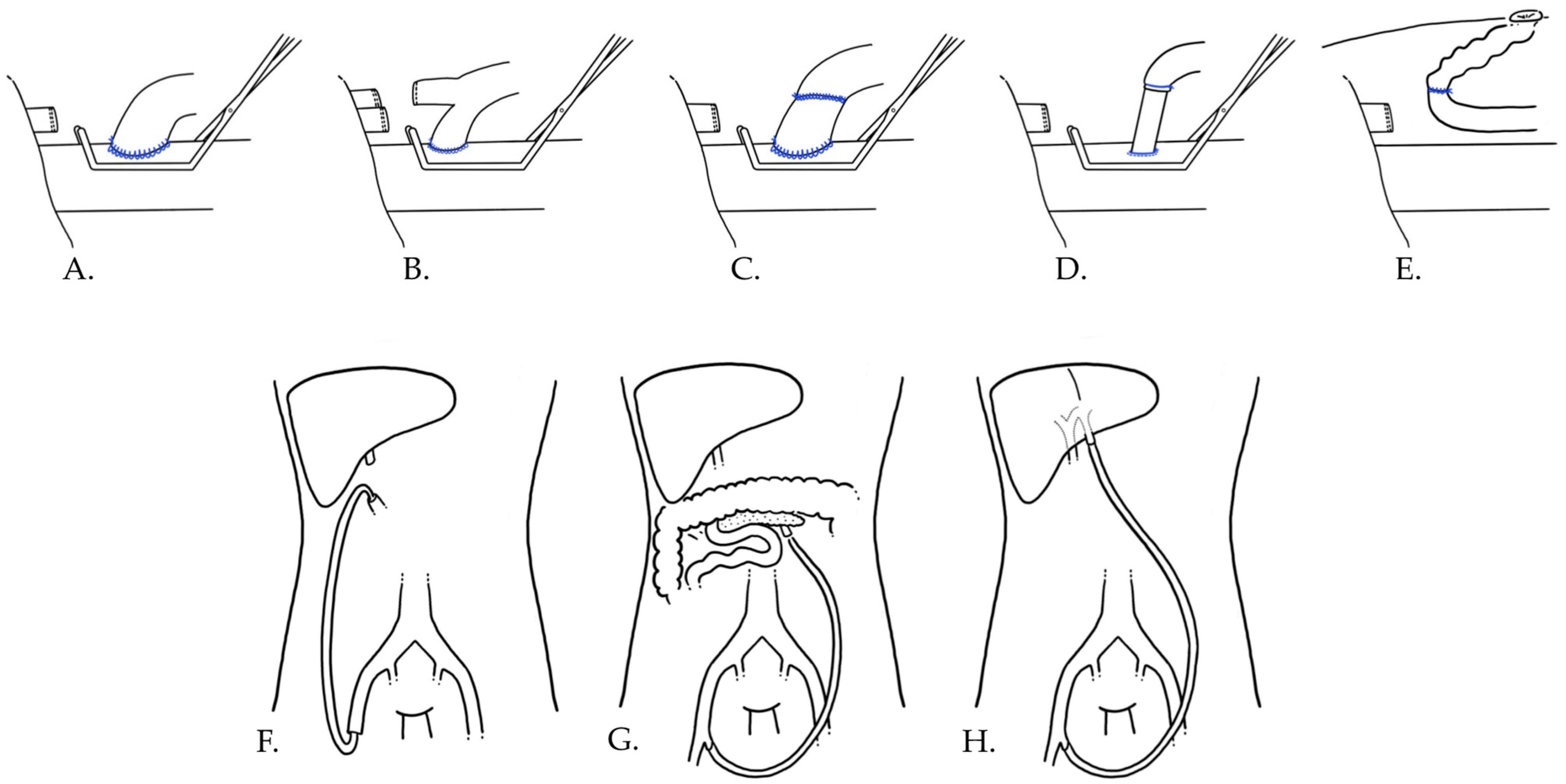
2.1. Direct PCS
2.2. Ex Situ Portal-Venous Shunts
3. Clinical Impact of PCS During LT: A Critical Review of Evidence
- -
- Hemodynamic stability and preserved renal function;
- -
- Duration of the entire surgical procedure;
- -
- Blood transfusion requirement;
- -
- Survival rate.
Evidence from Meta-Analyses and Randomized Clinical Trials
4. Discussion
Author Contributions
Funding
Institutional Review Board Statement
Informed Consent Statement
Data Availability Statement
Conflicts of Interest
Abbreviations
| EAD | Early Allograft Disfunction |
| ECD | Extended-Criteria Donor |
| IMV | Inferior Mesenteric Vein |
| IRI | Ischemia–Reperfusion Injury |
| IVC | Inferior Vena Cava |
| LT | Liver Transplantation |
| PCS | Portocaval Shunt |
| PRS | Postreperfusion Syndrome |
| PV | Portal Vein |
| VVB | Veno-venous Bypass |
References
- Starzl, T.E.; Marchioro, T.L.; Vonkaulla, K.N.; Hermann, G.; Brittain, R.S.; Waddell, W.R. Homotransplantation of the liver in humans. Surg. Gynecol. Obstet. 1963, 117, 659–676. [Google Scholar]
- Hoffmann, K.; Weigand, M.A.; Hillebrand, N.; Büchler, M.W.; Schmidt, J.; Schemmer, P. Is veno-venous bypass still needed during liver transplantation? A review of the literature. Clin. Transplant. 2009, 23, 1–8. [Google Scholar] [CrossRef] [PubMed]
- Tzakis, A.; Todo, S.; Starzl, T.E. Orthotopic liver transplantation with preservation of the inferior vena cava. Ann. Surg. 1989, 210, 649–652. [Google Scholar] [CrossRef]
- Belghiti, J.; Panis, Y.; Sauvanet, A.; Gayet, B.; Fékété, F. A new technique of side-to-side caval anastomosis during orthotopic hepatic transplantation without inferior vena caval occlusion. Hepatogastroenterology 1992, 39, 275–277. [Google Scholar]
- Marzi, I.; Knee, J.; Menger, M.D.; Harbauer, G.; Bühre, V. Hepatic microcirculatory disturbances due to portal vein clamping in the orthotopic rat liver transplantation model. Transplant. Proc. 1991, 23, 2704–2705. [Google Scholar]
- Paugam-Burtz, C.; Kavafyan, J.; Merckx, P.; Dahmani, S.; Sommacale, D.; Ramsay, M.; Belghiti, J.; Mantz, J. Postreperfusion syndrome during liver transplantation for cirrhosis: Outcome and predictors. Liver Transplant. 2009, 15, 522–529. [Google Scholar] [CrossRef]
- Tzakis, A.G.; Reyes, J.; Nour, B.; Marino, I.R.; Todo, S.; Starzl, T.E. Temporary end-to-side portacaval shunt in orthotopic hepatic transplantation in humans. Surg. Gynecol. Obstet. 1993, 176, 180–182. [Google Scholar]
- Belghiti, J.; Noun, R.; Sauvanet, A. Temporary portocaval anastomosis with preservation of caval flow during orthotopic liver transplantation. Am. J. Surg. 1995, 169, 277–279. [Google Scholar] [CrossRef]
- Busuttil, R.W. Transplantation of the Liver, 2nd ed.; Saunders Elsevier: Philadelphia, PA, USA, 2005. [Google Scholar]
- Addeo, P.; Locicero, A.; Faitot, F.; Bachellier, P. Temporary right portocaval shunt during piggyback liver transplantation. World J. Surg. 2019, 43, 2612–2615. [Google Scholar] [CrossRef]
- Molmenti, E.P.; Marsh, J.W.; Fung, J.J.; Casavilla, F.A. Rapid temporary portosystemic bypass. Dig. Dis. Sci. 2002, 47, 448–449. [Google Scholar] [CrossRef] [PubMed]
- Addeo, P.; De Mathelin, P.; Paul, C.; Bachellier, P. Iliac venous conduit interposition for temporary portocaval shunt during liver transplantation. Updates Surg. 2025, 77, 1–4. [Google Scholar] [CrossRef]
- Faitot, F.; Addeo, P.; Besch, C.; Michard, B.; Oncioiu, C.; Ellero, B.; Woehl-Jaeglé, M.-L.; Bachellier, P. Passive mesenterico-saphenous shunt: An alternative to portocaval anastomosis for tailored portal decompression during liver transplantation. Surgery 2019, 165, 970–977. [Google Scholar] [CrossRef] [PubMed]
- Addeo, P.; Julliard, O.; Terrone, A.; Schaaf, C.; Faitot, F.; Bachellier, P. Temporary portal decompression during liver transplantation: A video review of the different techniques. Langenbecks Arch. Surg. 2021, 406, 227–231. [Google Scholar] [CrossRef]
- Pratschke, S.; Meimarakis, G.; Bruns, C.J.; Kaspar, M.; Prix, N.; Zachoval, R.; Guba, M.; Jauch, K.-W.; Loehe, F.; Angele, M.K. Temporary intraoperative porto-caval shunt: Useless or beneficial in piggyback liver transplantation? Transpl. Int. 2013, 26, 90–98. [Google Scholar] [CrossRef] [PubMed]
- Doğrul, A.B.; Yankol, Y.; Mecit, N.; Çimşit, B.; Kanmaz, T.; Acarlı, K.; Kalayoğlu, M. Preservation of the patent umbilical vein during a recipient hepatectomy: Case report. Exp. Clin. Transplant. 2014, 12, 484–486. [Google Scholar]
- González-Pinto, I.M.; Miyar, A.; García-Bernardo, C.; Vázquez, L.; Barneo, L.; Cortés, E.; Díaz, P.; Arias, D.; Moreno, M.; Granero, P. Portoumbilical anastomosis as a simple method of transient portosystemic shunt during liver transplantation. Transplant. Proc. 2009, 41, 996–997. [Google Scholar] [CrossRef]
- Addeo, P.; Marchitelli, I. Rex saphenous shunt in patients with massive patent umbilical veins: An alternative temporary portocaval shunt during liver transplantation. J. Gastrointest. Surg. 2025, 29, 102059. [Google Scholar] [CrossRef] [PubMed]
- Belghiti, J.; Noun, R.; Sauvanet, A.; Durand, F.; Aschehoug, J.; Erlinger, S.; Benhamou, J.P.; Bernuau, J. Transplantation for fulminant and subfulminant hepatic failure with preservation of portal and caval flow. Br. J. Surg. 1995, 82, 986–989. [Google Scholar] [CrossRef]
- Figueras, J.; Llado, L.; Ramos, E.; Jaurrieta, E.; Rafecas, A.; Fabregat, J.; Torras, J.; Sabate, A.; Dalmau, A. Temporary portocaval shunt during liver transplantation with vena cava preservation: Results of a prospective randomized study. Liver Transplant. 2001, 7, 904–911. [Google Scholar] [CrossRef] [PubMed]
- Ghinolfi, D.; Martí, J.; Rodríguez-Laiz, G.; Sturdevant, M.; Iyer, K.; Bassi, D.; Scher, C.; Schwartz, M.; Schiano, T.; Sogawa, H.; et al. The beneficial impact of temporary porto-caval shunt in orthotopic liver transplantation: A single center analysis. Transpl. Int. 2011, 24, 243–250. [Google Scholar] [CrossRef]
- Margarit, C.; de Cenarruzabeitia, I.L.; Lázaro, J.L.; Cancino, J.D.; Rojas, L.H.; Escartín, A.; Mora, A.; Bilbao, I. Portacaval shunt and inferior vena cava preservation in orthotopic liver transplantation. Transplant. Proc. 2005, 37, 3896–3898. [Google Scholar] [CrossRef]
- Pietersen, L.C.; Broekman, N.; Reekers, M.; Putter, H.; Tushuizen, M.E.; Alwayn, I.P.J.; van Hoek, B.; Braat, A.E. Addition of a temporary portocaval shunt does not reduce acute kidney injury in caval-sparing liver transplantation. Clin. Transplant. 2025, 39, e70259. [Google Scholar] [CrossRef] [PubMed]
- Nacif, L.S.; Zanini, L.Y.; Sartori, V.F.; Kim, V.; Rocha-Santos, V.; Andraus, W.; D’ALbuquerque, L.C. Intraoperative surgical portosystemic shunt in liver transplantation: Systematic review and meta-analysis. Ann. Transplant. 2018, 23, 721–732. [Google Scholar] [CrossRef]
- Pietersen, L.C.; Sarton, E.; Alwayn, I.; Lam, H.; Putter, H.; Van Hoek, B.; Braat, A.E. Impact of temporary portocaval shunting and initial arterial reperfusion in orthotopic liver transplantation. Liver Transplant. 2019, 25, 1690–1699. [Google Scholar] [CrossRef] [PubMed]
- Arzu, G.D.; De Ruvo, N.; Montalti, R.; Masetti, M.; Begliomini, B.; Di Benedetto, F.; Rompianesi, G.; Di Sandro, S.; Smerieri, N.; D’AMico, G.; et al. Temporary porto-caval shunt utility during orthotopic liver transplantation. Transplant. Proc. 2008, 40, 1937–1940. [Google Scholar] [CrossRef]
- Neri, I.; Pascale, M.M.; Bianco, G.; Frongillo, F.; Agnes, S.; Giovinazzo, F. Age and liver graft: A systematic review with meta-regression. Updates Surg. 2023, 75, 2075–2083. [Google Scholar] [CrossRef]
- Rayar, M.; Levi Sandri, G.B.; Cusumano, C.; Locher, C.; Houssel-Debry, P.; Camus, C.; Lombard, N.; Desfourneaux, V.; Lakehal, M.; Meunier, B.; et al. Benefits of temporary portocaval shunt during orthotopic liver transplantation with vena cava preservation: A propensity score analysis. Liver Transplant. 2017, 23, 174–183. [Google Scholar] [CrossRef]
- Tortolero, L.; Nuño, J.; Buenadicha, A.; Gajate, L.; Serrano, A.; Liaño, F.; Peromingo, R.; Hervás, P.L. Protective role of the portocaval shunt in liver transplantation. Transplant. Proc. 2020, 52, 1455–1458. [Google Scholar] [CrossRef]
- Pratschke, S.; Rauch, A.; Albertsmeier, M.; Rentsch, M.; Kirschneck, M.; Andrassy, J.; Thomas, M.; Hartwig, W.; Figueras, J.; Martin, J.D.R.; et al. Temporary intraoperative porto-caval shunts in piggy-back liver transplantation reduce intraoperative blood loss and improve postoperative transaminases and renal function: A meta-analysis. World J. Surg. 2016, 40, 2988–2998. [Google Scholar] [CrossRef]
- Mataruco, D.; Viana, P.; Feres, B.; Albuquerque, L.; Mora, M.R.; Putri, A.; Kueht, M.; Faria, I. The impact of temporary portocaval shunt in intraoperative and postoperative outcomes in liver transplantation: A systematic review and meta-analysis. Am. J. Transplant. 2025, 25, S715–S716. [Google Scholar] [CrossRef]
- Yl, M.K.; Patil, N.S.; Mohapatra, N.; Sindwani, G.; Dhingra, U.; Yadav, A.; Kale, P.; Pamecha, V. Temporary portocaval shunt provides superior intraoperative hemodynamics and reduces blood loss and duration of surgery in live donor liver transplantation: A randomized control trial. Ann. Surg. 2024, 279, 932–944. [Google Scholar] [CrossRef] [PubMed]


| Direct PCS | Ex Situ PCS |
|---|---|
|
|
| Study | Study Type | Patient Characteristics | Outcomes: PCS vs. No PCS | ||
|---|---|---|---|---|---|
| Positive | Neutral | Negative | |||
| Figueras et al., 2001 [20] | Prospective randomized, single-center | Cirrhotic patients, excluding re-LT, IVC resection, PV thrombosis, hepatorenal syndrome, pulmonary hypertension, and previous portosystemic shunts. | Cardiac output during anhepatic phase (particularly in patients with severe portal hypertension); Absolute need for RBC transfusions; Urinary output in the anhepatic phase (particularly in patients with severe portal hypertension); ICU stay; Ventilatory support duration; Serum creatinine in the first 72 h. | Surgical time; Reperfusion syndrome; Amount of RBC transfusions; Urinary output during LT; Hospital stay; Liver biochemical parameters in the first 72 h. | Anhepatic phase duration. |
| Margarit et al., 2005 [22] | Retrospective, single-center | Cirrhotic patients, excluding re-LT and prior portosystemic shunts. | RBC transfusion requirements and postoperative renal function, only in patients with high portal venous flow (>800 mL/min). | Surgical time (LT and anhepatic phase duration). | – |
| Arzu et al., 2008 [26] | Retrospective, single-center | Any indication for LT, excluding re-LT, patients receiving a split liver, “classic” piggyback technique *. | Warm and total ischemia time; Serum creatinine at discharge; Systolic arterial pressure at reperfusion, diastolic arterial pressure in the anhepatic phase, and reperfusion; Overall survival. | Amount of RBC and FFP transfusions; Blood loss; Urinary output; Hospital stay; Surgical time; Central venous pressure and pulmonary artery pressure in the anhepatic phase and at reperfusion; Serum creatinine at 24 h and 72 h. | – |
| Ghinolfi et al., 2011 [21] | Retrospective, single-center | Any indication for LT, excluding re-LT and patients with prior portosystemic shunts. | RBC transfusion requirement; Phenylephrine requirement; Serum creatinine in the first 72 h; 30-day mortality; Graft loss at one and three months, stratified for high DRI and high D-MELD. | Surgical time; Absolute need for RBC transfusions and amount of FFP and platelet transfusion requirements; Epinephrine and norepinephrine requirements; Length of hospital stay; Post-op liver function tests; 90-day mortality; Graft loss stratified for MELD. | – |
| Pratschke et al., 2013 [15] | Retrospective, single-center | Any indication for LT, excluding patients receiving a split liver. | Vasopressor requirements; AST/ALT levels up to 7th POD; Early graft loss and re-LT; Long-term graft survival (especially for MELD ≥ 35 and DRI ≥ 1.25). | Amount of RBC and FFP transfusions; Serum creatinine levels up to 7th POD. | – |
| Rayar et al., 2017 [28] | Retrospective, single center | Any indication for LT, excluding re-LT, ALF and patients who could not receive a PCS due to preexisting conditions, with prior portosystemic shunt, living donors, or split liver. | Absolute need and amount of RBC and FFP transfusions; Post-op GGT, alkaline phosphatase, INR, and PT values; Incidence of biliary complications; 3-month graft survival rate (particularly for ECD grafts); Overall graft survival (only in subgroup analysis, for donors over 70 y). | Cold ischemia time; Absolute need and amount of platelet transfusions; Post-op AST/ALT and bilirubin levels; Incidence of arterial complications; Post-op renal function; Incidence of Clavien–Dindo complication score ≥3; ICU and hospital stay; 3-month graft survival rate for non-ECD grafts; Overall graft survival. | Surgical time; Anhepatic phase duration. |
| Tortolero et al., 2020 [29] | Retrospective, single-center | Any indication for LT, excluding patients with chronic kidney disease, re-LT, or mortality in the first 10 days. | Mortality. | RBC transfusion requirement; Surgical time. | – |
| Nacif et al., 2018 [24] | Retrospective, single-center | Any indication for LT. | Surgical time; Warm ischemia time; Serum creatinine level at 24 and 72 h; ICU and hospital stay; Incidence of Clavien–Dindo complication score ≥ 3; Overall survival. | RBC, platelet, and FFP transfusions; Cold ischemia time. | Total ischemia time. |
| Yl et al., 2024 [32] | Randomized, single-center | Live-donor LT, excluding patients with ALF or ACLF, portal vein thrombosis, portal cavernomas, large portosystemic shunts, TIPS, and Budd–Chiari syndrome. | SBP, DBP, and mean arterial pressure before reperfusion; Intraoperative vasopressor requirements; Intraoperative urinary output; Risk of IVC injury; Intraoperative blood loss; Surgical time; Absolute need and amount of blood product transfusions; Portal pressure gradient after implantation; Time for lactate levels normalization; Enteral feed toleration. | Intraoperative and 1st POD lactate levels; Cold and warm ischemia time; Major morbidity; 90-day mortality; AKI incidence; Ascites drainage, ICU and hospital stay. | Anhepatic phase duration. |
| Pietersen et al., 2025 [23] | Retrospective, single-center | Any indication for LT, excluding ALF, patients receiving a split liver, or with prior kidney injury. | Blood product requirements. | FFP transfusion requirements; Volume of cell saver return; Serum creatinine levels up to 7th POD; Development of AKI; Need for renal replacement therapy; Incidence of Clavien–Dindo complication score ≥ 3a; 1-year graft and patient survival. | Warm ischemia time. |
| Main Indications for PCS |
|---|
|
Disclaimer/Publisher’s Note: The statements, opinions and data contained in all publications are solely those of the individual author(s) and contributor(s) and not of MDPI and/or the editor(s). MDPI and/or the editor(s) disclaim responsibility for any injury to people or property resulting from any ideas, methods, instructions or products referred to in the content. |
© 2025 by the authors. Licensee MDPI, Basel, Switzerland. This article is an open access article distributed under the terms and conditions of the Creative Commons Attribution (CC BY) license (https://creativecommons.org/licenses/by/4.0/).
Share and Cite
Schirra, E.; Mauro, A.; Bianco, G.; Pascale, M.M.; Frongillo, F.; Nure, E.; Avolio, A.W.; Agnes, S.; Spoletini, G. Temporary Portocaval Shunts During Liver Transplantation: A Narrative Review of Technical Solutions and Post-Transplant Outcomes. J. Clin. Med. 2025, 14, 8723. https://doi.org/10.3390/jcm14248723
Schirra E, Mauro A, Bianco G, Pascale MM, Frongillo F, Nure E, Avolio AW, Agnes S, Spoletini G. Temporary Portocaval Shunts During Liver Transplantation: A Narrative Review of Technical Solutions and Post-Transplant Outcomes. Journal of Clinical Medicine. 2025; 14(24):8723. https://doi.org/10.3390/jcm14248723
Chicago/Turabian StyleSchirra, Elisa, Alberto Mauro, Giuseppe Bianco, Marco Maria Pascale, Francesco Frongillo, Erida Nure, Alfonso Wolfango Avolio, Salvatore Agnes, and Gabriele Spoletini. 2025. "Temporary Portocaval Shunts During Liver Transplantation: A Narrative Review of Technical Solutions and Post-Transplant Outcomes" Journal of Clinical Medicine 14, no. 24: 8723. https://doi.org/10.3390/jcm14248723
APA StyleSchirra, E., Mauro, A., Bianco, G., Pascale, M. M., Frongillo, F., Nure, E., Avolio, A. W., Agnes, S., & Spoletini, G. (2025). Temporary Portocaval Shunts During Liver Transplantation: A Narrative Review of Technical Solutions and Post-Transplant Outcomes. Journal of Clinical Medicine, 14(24), 8723. https://doi.org/10.3390/jcm14248723