The Dominance of Attentional Focus in Sitting Postural Control Among Patients with Stroke and the Characteristics of the Disconnectome

 , and
, and
Abstract
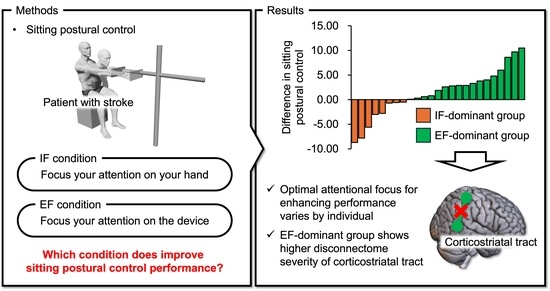
1. Introduction
2. Materials and Methods
2.1. Study Protocol
2.2. Participants
2.3. Sample Size Calculation
2.4. Sitting Postural Control Task
2.5. Brain Images and Lesion Mapping
2.6. Disconnectome Analysis
2.7. Statistical Analysis
3. Results
4. Discussion
4.1. The Dominance of Attentional Focus in Patients with Stroke
4.2. Differences in Disconnection Severity Between the IF-Dominant and EF-Dominant Groups
4.3. Limitations
5. Conclusions
Author Contributions
Funding
Institutional Review Board Statement
Informed Consent Statement
Data Availability Statement
Acknowledgments
Conflicts of Interest
Abbreviations
| CT | computed tomography |
| EF | external focus |
| FLAIR | fluid-attenuated inversion recovery |
| FSL | FMRIB Software Library |
| IF | internal focus |
| MNI | Montreal Neurological Institute |
| MMSE | Mini-Mental State Examination |
| MRI | magnetic resonance imaging |
References
- Feigin, V.L.; Brainin, M.; Norrving, B.; Martins, S.O.; Pandian, J.; Lindsay, P.; Grupper, F.M.; Rautalin, I. World Stroke Organization: Global Stroke Fact Sheet 2025. Int. J. Stroke 2025, 20, 132–144. [Google Scholar] [CrossRef]
- Tyson, S.F.; Hanley, M.; Chillala, J.; Selley, A.; Tallis, R.C. Balance disability after stroke. Phys. Ther. 2006, 86, 30–38. [Google Scholar] [CrossRef]
- Yamamoto, R.; Murata, S.; Sawai, S.; Fujikawa, S.; Shizuka, Y.; Maru, T.; Nakagawa, K.; Nakano, H. Longitudinal Changes in Factors Associated with Walking Independence at Hospital Discharge in Patients with Stroke: A Retrospective Study. J. Clin. Med. 2024, 13, 7184. [Google Scholar] [CrossRef]
- Chen, W.C.; Hsiao, M.Y.; Wang, T.G. Prognostic factors of functional outcome in post-acute stroke in the rehabilitation unit. J. Formos. Med. Assoc. 2022, 121, 670–678. [Google Scholar] [CrossRef]
- Kim, D.S.; Ko, M.H.; Won, Y.H.; Park, S.H.; Seo, J.H.; Kim, G.W. The Relations between Sitting Balance and Functional Recovery according to Characteristics of the Stroke Patients. Brain Neurorehabilit. 2019, 13, e2. [Google Scholar] [CrossRef]
- Wulf, G.; Shea, C.; Lewthwaite, R. Motor skill learning and performance: A review of influential factors. Med. Educ. 2010, 44, 75–84. [Google Scholar] [CrossRef]
- Sawai, S.; Fujikawa, S.; Yamamoto, R.; Nakano, H. Application of attention focus in rehabilitation to promote motor performance and motor learning. In Neurorehabilitation and Physical Therapy; Nakano, H., Ed.; IntechOpen: London, UK, 2022; pp. 3–25. [Google Scholar] [CrossRef]
- Park, S.H.; Yi, C.W.; Shin, J.Y.; Ryu, Y.U. Effects of external focus of attention on balance: A short review. J. Phys. Ther. Sci. 2015, 27, 3929–3931. [Google Scholar] [CrossRef]
- Wulf, G.; McNevin, N.; Shea, C.H. The automaticity of complex motor skill learning as a function of attentional focus. Q. J. Exp. Psychol. A 2001, 54, 1143–1154. [Google Scholar] [CrossRef]
- Sakurada, T.; Hirai, M.; Watanabe, E. Optimization of a motor learning attention-directing strategy based on an individual’s motor imagery ability. Exp. Brain Res. 2016, 234, 301–311. [Google Scholar] [CrossRef]
- Sakurada, T.; Hirai, M.; Watanabe, E. Individual optimal attentional strategy during implicit motor learning boosts frontoparietal neural processing efficiency: A functional near-infrared spectroscopy study. Brain Behav. 2019, 9, e01183. [Google Scholar] [CrossRef]
- Sakurada, T.; Goto, A.; Tetsuka, M.; Nakajima, T.; Morita, M.; Yamamoto, S.I.; Hirai, M.; Kawai, K. Prefrontal activity predicts individual differences in optimal attentional strategy for preventing motor performance decline: A functional near-infrared spectroscopy study. Neurophotonics 2019, 6, 025012. [Google Scholar] [CrossRef]
- Sakurada, T.; Yoshida, M.; Nagai, K. Individual Optimal Attentional Strategy in Motor Learning Tasks Characterized by Steady-State Somatosensory and Visual Evoked Potentials. Front. Hum. Neurosci. 2022, 15, 784292. [Google Scholar] [CrossRef]
- Sawai, S.; Fujikawa, S.; Murata, S.; Abiko, T.; Nakano, H. Dominance of Attention Focus and Its Electroencephalogram Activity in Standing Postural Control in Healthy Young Adults. Brain Sci. 2022, 12, 538. [Google Scholar] [CrossRef]
- Sawai, S.; Murata, S.; Fujikawa, S.; Yamamoto, R.; Nakano, H. Effects of θ High Definition-Transcranial Alternating Current Stimulation in the Anterior Cingulate Cortex on the Dominance of Attention Focus in Standing Postural Control. Behav. Sci. 2023, 13, 477. [Google Scholar] [CrossRef]
- Sawai, S.; Murata, S.; Sakano, Y.; Fujikawa, S.; Yamamoto, R.; Shizuka, Y.; Nakano, H. Dominance of attentional focus: A comparative study on its impact on standing postural control in healthy younger and older adults. Front. Hum. Neurosci. 2024, 18, 1384305. [Google Scholar] [CrossRef]
- Sakurada, T.; Nakajima, T.; Morita, M.; Hirai, M.; Watanabe, E. Improved motor performance in patients with acute stroke using the optimal individual attentional strategy. Sci. Rep. 2017, 7, 40592. [Google Scholar] [CrossRef]
- Durham, K.F.; Sackley, C.M.; Wright, C.C.; Wing, A.M.; Edwards, M.G.; van Vliet, P. Attentional focus of feedback for improving performance of reach-to-grasp after stroke: A randomised crossover study. Physiotherapy 2014, 100, 108–115. [Google Scholar] [CrossRef]
- Aloraini, S.M.; Glazebrook, C.M.; Pooyania, S.; Sibley, K.M.; Singer, J.; Passmore, S. An external focus of attention compared to an internal focus of attention improves anticipatory postural adjustments among people post-stroke. Gait Posture 2020, 82, 100–105. [Google Scholar] [CrossRef]
- Ghorbanpour, Z.; Taghizadeh, G.; Hosseini, S.A.; Pishyareh, E.; Ghomsheh, F.T.; Bakhshi, E.; Mehdizadeh, H. Overload of anxiety on postural control impairments in chronic stroke survivors: The role of external focus and cognitive task on the automaticity of postural control. PLoS ONE 2021, 16, e0252131. [Google Scholar] [CrossRef]
- Kal, E.C.; van der Kamp, J.; Houdijk, H.; Groet, E.; van Bennekom, C.A.; Scherder, E.J. Stay Focused! The Effects of Internal and External Focus of Attention on Movement Automaticity in Patients with Stroke. PLoS ONE 2015, 10, e0136917. [Google Scholar] [CrossRef]
- Kim, G.J.; Hinojosa, J.; Rao, A.K.; Batavia, M.; O’Dell, M.W. Randomized Trial on the Effects of Attentional Focus on Motor Training of the Upper Extremity Using Robotics With Individuals After Chronic Stroke. Arch. Phys. Med. Rehabil. 2017, 98, 1924–1931. [Google Scholar] [CrossRef]
- Mehta, T.; Cleland, B.; Madhavan, S. Barriers to Enrollment in a Post-Stroke Neuromodulation and Walking Study: Implications for Recruiting Women. Neurorehabilit. Neural Repair 2024, 38, 207–213. [Google Scholar] [CrossRef]
- Kanellopoulos, D.; Wilkins, V.; Avari, J.; Oberlin, L.; Arader, L.; Chaplin, M.; Banerjee, S.; Alexopoulos, G.S. Dimensions of Poststroke Depression and Neuropsychological Deficits in Older Adults. Am. J. Geriatr. Psychiatry 2020, 28, 764–771. [Google Scholar] [CrossRef]
- Kang, H. Sample size determination and power analysis using the G*Power software. J. Educ. Eval. Health Prof. 2021, 18, 17. [Google Scholar] [CrossRef]
- Suzuki, T.; Hashidate, H.; Yatsunami, M. Immediate effects of verbal instructions with internal focus of attention and external focus of attention on forward reach movement while standing. J. Phys. Ther. Sci. 2023, 35, 738–742. [Google Scholar] [CrossRef]
- Rorden, C.; Brett, M. Stereotaxic display of brain lesions. Behav. Neurol. 2000, 12, 191–200. [Google Scholar] [CrossRef]
- Rorden, C.; Bonilha, L.; Fridriksson, J.; Bender, B.; Karnath, H.O. Age-specific CT and MRI templates for spatial normalization. Neuroimage 2012, 61, 957–965. [Google Scholar] [CrossRef]
- Ashburner, J. SPM: A history. Neuroimage 2012, 62, 791–800. [Google Scholar] [CrossRef]
- Wawrzyniak, M.; Stockert, A.; Klingbeil, J.; Saur, D. Voxelwise structural disconnection mapping: Methodological validation and recommendations. Neuroimage Clin. 2022, 35, 103132. [Google Scholar] [CrossRef]
- Griffis, J.C.; Metcalf, N.V.; Corbetta, M.; Shulman, G.L. Lesion Quantification Toolkit: A MATLAB software tool for estimating grey matter damage and white matter disconnections in patients with focal brain lesions. Neuroimage Clin. 2021, 30, 102639. [Google Scholar] [CrossRef]
- Yeh, F.C. Population-based tract-to-region connectome of the human brain and its hierarchical topology. Nat. Commun. 2022, 13, 4933. [Google Scholar] [CrossRef]
- Smith, S.M.; Jenkinson, M.; Woolrich, M.W.; Beckmann, C.F.; Behrens, T.E.; Johansen-Berg, H.; Bannister, P.R.; De Luca, M.; Drobnjak, I.; Flitney, D.E.; et al. Advances in functional and structural MR image analysis and implementation as FSL. Neuroimage 2004, 23, S208–S219. [Google Scholar] [CrossRef]
- Menyhárt, O.; Győrffy, B. Multiplicity corrections in life sciences: Challenges and consequences. Int. J. Epidemiol. 2025, 54, dyaf098. [Google Scholar] [CrossRef]
- Denneman, R.P.M.; Kal, E.C.; Houdijk, H.; Kamp, J.V. Over-focused? The relation between patients’ inclination for conscious control and single- and dual-task motor performance after stroke. Gait Posture 2018, 62, 206–213. [Google Scholar] [CrossRef] [PubMed]
- Kal, E.; Houdijk, H.; van der Kamp, J.; Verhoef, M.; Prosée, R.; Groet, E.; Winters, M.; van Bennekom, C.; Scherder, E. Are the effects of internal focus instructions different from external focus instructions given during balance training in stroke patients? A double-blind randomized controlled trial. Clin. Rehabil. 2019, 33, 207–221. [Google Scholar] [CrossRef]
- Sherwood, D.E.; Lohse, K.R.; Healy, A.F. The effect of an external and internal focus of attention on dual-task performance. J. Exp. Psychol. Hum. Percept. Perform. 2020, 46, 91–104. [Google Scholar] [CrossRef] [PubMed]
- Gómez-Ocádiz, R.; Silberberg, G. Corticostriatal pathways for bilateral sensorimotor functions. Curr. Opin. Neurobiol. 2023, 83, 102781. [Google Scholar] [CrossRef]
- Shepherd, G.M. Corticostriatal connectivity and its role in disease. Nat. Rev. Neurosci. 2013, 14, 278–291. [Google Scholar] [CrossRef]
- Haber, S.N. Corticostriatal circuitry. Dialogues Clin. Neurosci. 2016, 18, 7–21. [Google Scholar] [CrossRef]


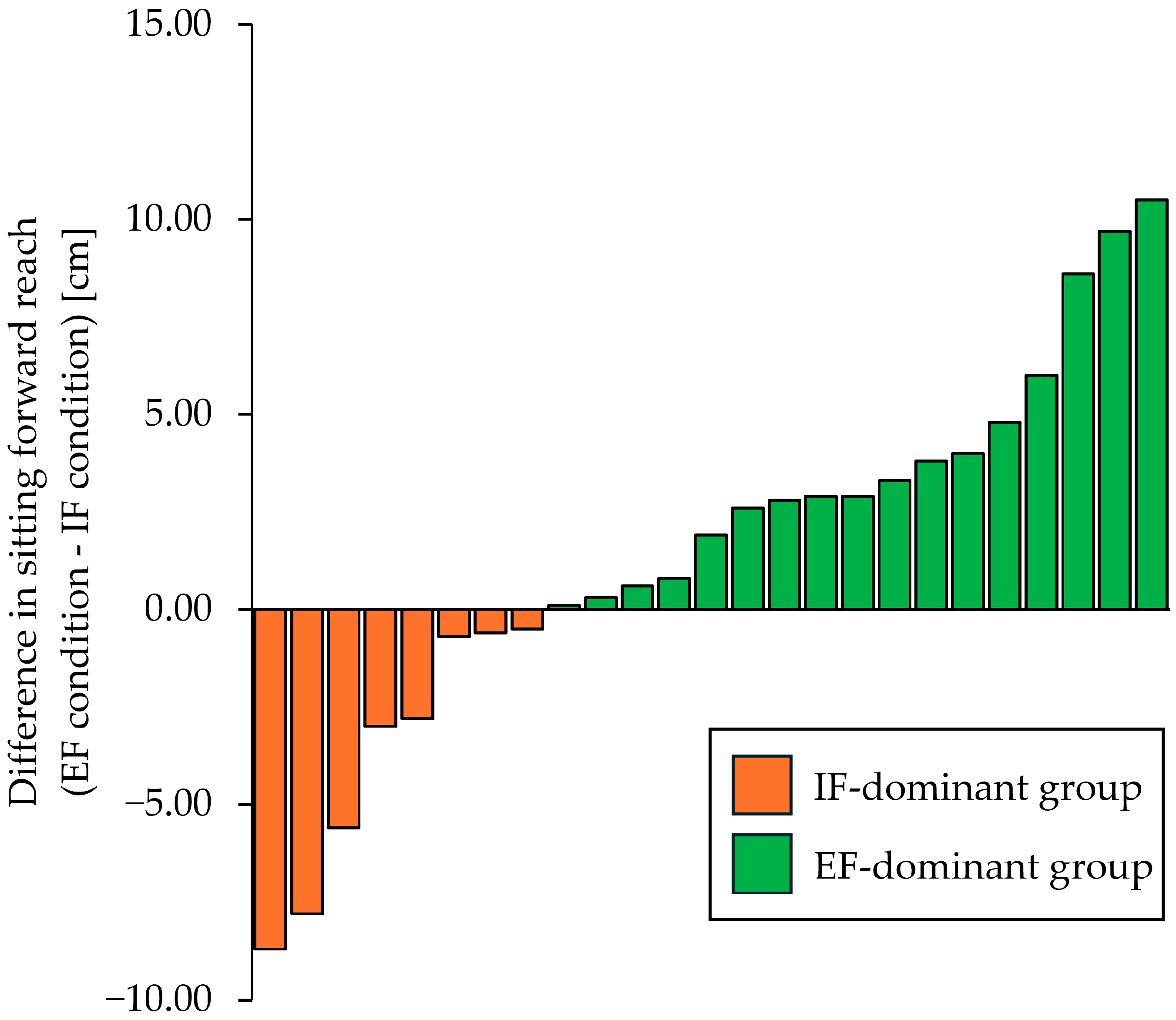
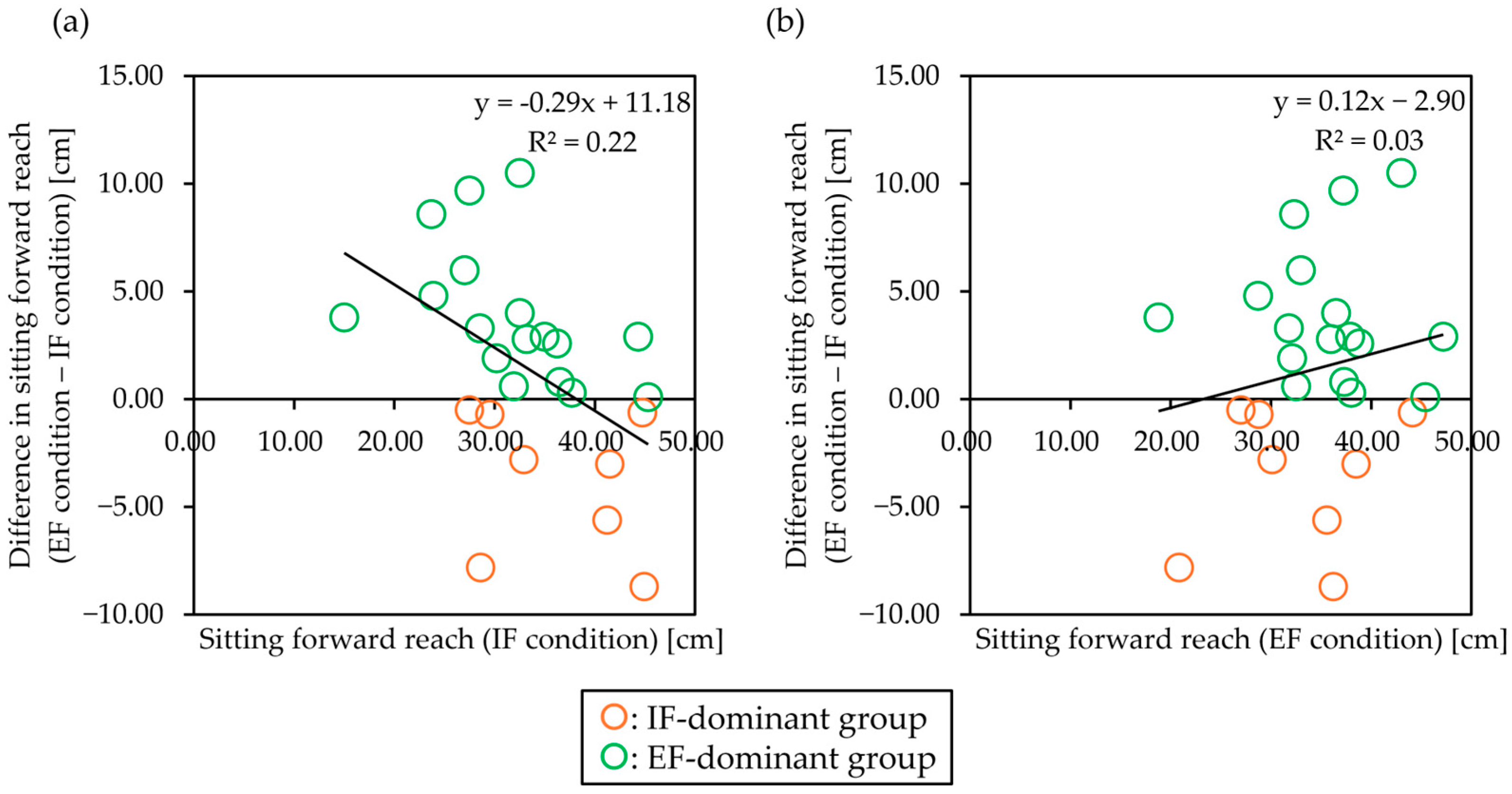
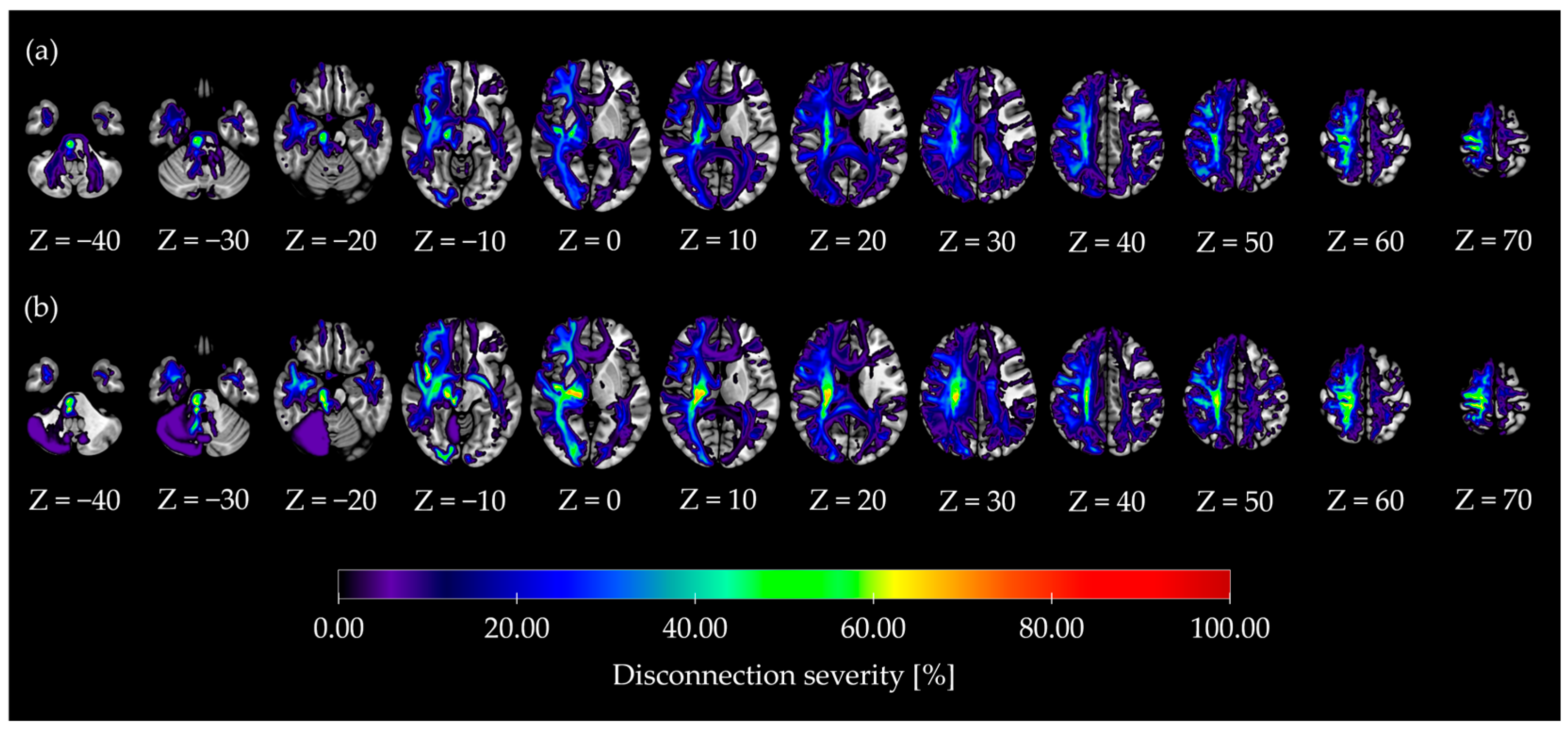


| All (n = 25) | IF-Dominant Group (n = 8) | EF-Dominant Group (n = 17) | p-Value | |
|---|---|---|---|---|
| Age [years] | 62.36 ± 11.37 | 68.88 ± 11.51 | 59.24 ± 10.63 | 0.05 |
| Height [cm] | 161.01 ± 9.30 | 156.84 ± 11.43 | 163.09 ± 8.05 | 0.13 |
| Body weight [kg] | 58.08 ± 11.53 | 54.50 ± 12.75 | 59.76 ± 11.28 | 0.31 |
| Sex: male/female [n] | 13/12 | 3/5 | 10/7 | 0.41 |
| Stroke type: hemorrhagic/cerebral infarction [n] | 14/11 | 3/5 | 11/6 | 0.39 |
| Lesioned hemisphere: right/left [n] | 9/16 | 3/5 | 6/11 | 1.00 |
| Duration from stroke onset [days] | 224.44 ± 316.38 | 169.75 ± 257.54 | 250.18 ± 352.42 | 0.71 |
| MMSE [points] | 27.08 ± 2.64 | 26.86 ± 3.31 | 27.18 ± 2.46 | 0.93 |
Disclaimer/Publisher’s Note: The statements, opinions and data contained in all publications are solely those of the individual author(s) and contributor(s) and not of MDPI and/or the editor(s). MDPI and/or the editor(s) disclaim responsibility for any injury to people or property resulting from any ideas, methods, instructions or products referred to in the content. |
© 2025 by the authors. Licensee MDPI, Basel, Switzerland. This article is an open access article distributed under the terms and conditions of the Creative Commons Attribution (CC BY) license (https://creativecommons.org/licenses/by/4.0/).
Share and Cite
Sawai, S.; Murata, S.; Ito, K.; Fujikawa, S.; Yamamoto, R.; Shizuka, Y.; Shimizu, N.; Nishida, T.; Nakano, H. The Dominance of Attentional Focus in Sitting Postural Control Among Patients with Stroke and the Characteristics of the Disconnectome. J. Clin. Med. 2025, 14, 8515. https://doi.org/10.3390/jcm14238515
Sawai S, Murata S, Ito K, Fujikawa S, Yamamoto R, Shizuka Y, Shimizu N, Nishida T, Nakano H. The Dominance of Attentional Focus in Sitting Postural Control Among Patients with Stroke and the Characteristics of the Disconnectome. Journal of Clinical Medicine. 2025; 14(23):8515. https://doi.org/10.3390/jcm14238515
Chicago/Turabian StyleSawai, Shun, Shin Murata, Ken Ito, Shoya Fujikawa, Ryosuke Yamamoto, Yusuke Shizuka, Naoki Shimizu, Takato Nishida, and Hideki Nakano. 2025. "The Dominance of Attentional Focus in Sitting Postural Control Among Patients with Stroke and the Characteristics of the Disconnectome" Journal of Clinical Medicine 14, no. 23: 8515. https://doi.org/10.3390/jcm14238515
APA StyleSawai, S., Murata, S., Ito, K., Fujikawa, S., Yamamoto, R., Shizuka, Y., Shimizu, N., Nishida, T., & Nakano, H. (2025). The Dominance of Attentional Focus in Sitting Postural Control Among Patients with Stroke and the Characteristics of the Disconnectome. Journal of Clinical Medicine, 14(23), 8515. https://doi.org/10.3390/jcm14238515