


The Relationship Between Laboratory Parameters and Coronary Slow Flow

 , , , , and
Abstract
1. Introduction
2. Materials and Methods
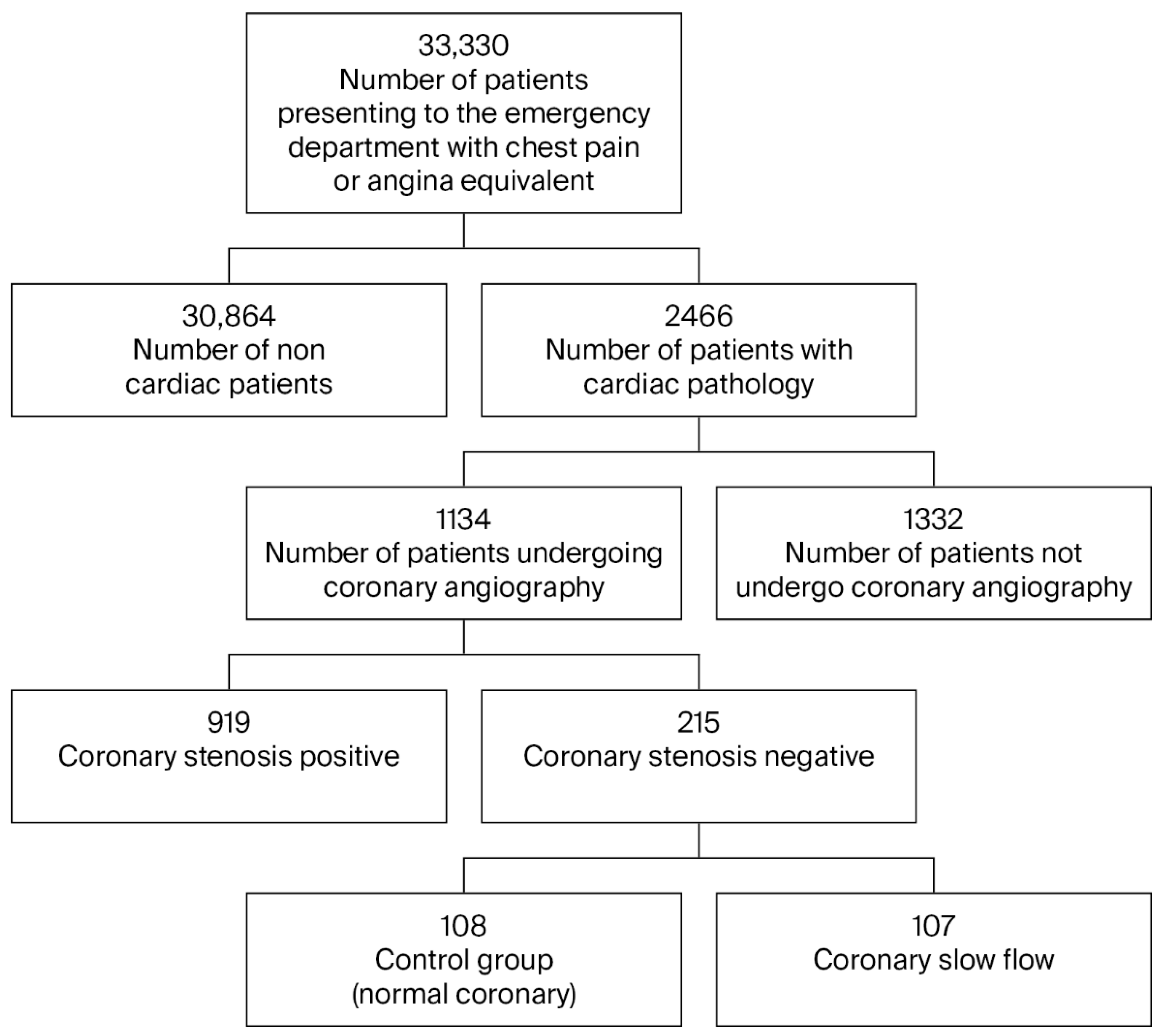
2.1. Selection of Study Groups and Study Design
- Those below the age of 18.
- Those diagnosed with ST-elevation myocardial infarction.
- Patients who had previously undergone coronary revascularization (CABG-O and PTCA stent).
- Patients receiving immunosuppressive therapy.
- Patients with renal insufficiency or those undergoing routine dialysis treatment.
- Patients with liver failure (aspartate transaminase (AST) and alanine transaminase (ALT) levels > 3 times the normal value).
- Patients with gout or those receiving hypouricemic drug therapy.
- Patients with a known history of malignancy.
- Patients with a history of cardiomyopathy (restrictive, hypertrophic, and dilated).
2.2. Coronary Angiographic Evaluation
2.3. Laboratory Tests
2.4. Statistical Analysis
3. Results
4. Discussion
Limitations
- Single-Center and Retrospective Design: As a retrospective analysis conducted at a single institution, the results may not be generalizable to broader populations. Selection bias cannot be excluded.
- Acute Patient Population: The study population consisted of patients presenting acutely to the emergency department, which may have affected the accuracy of certain indices such as the triglyceride/glucose index and Castelli risk scores.
- Lack of Long-Term Follow-Up: Clinical outcomes such as recurrent hospital admissions, arrhythmia development, or major adverse cardiac events and prognosis were not tracked, limiting our ability to assess the prognostic value of the studied parameters.
- Limited Sample Size: Although statistically powered for primary endpoints, a larger sample size would be beneficial for detecting more subtle associations between CSF and various laboratory or angiographic parameters.
- Absence of Advanced Imaging or Functional Testing: Tools such as intravascular ultrasound (IVUS) or coronary physiology tests (e.g., coronary flow reserve), which could provide more detailed insight into endothelial and microvascular function, were not utilized.
5. Conclusions
Author Contributions
Funding
Institutional Review Board Statement
Informed Consent Statement
Data Availability Statement
Conflicts of Interest
References
- Cairns, C.; Kang, K.; Santoc, L. National Hospital Ambulatory Medical Care Survey: 2018 Emergency Department Summary Tables; U.S. Department of Health and Human Services: Washington, DC, USA, 2018. [Google Scholar]
- Hsia, R.Y.; Hale, Z.; Tabas, J.A. A national study of the prevalence of life-threatening diagnoses in patients with chest pain. JAMA Intern. Med. 2016, 176, 1029–1032. [Google Scholar] [CrossRef] [PubMed]
- Markel, D.; Marill, K.A.; Schmidt, A. Identifying emergency department patients with chest pain at low risk for acute coronary syndromes. Emerg. Med. Pract. 2017, 19, 1–24. [Google Scholar] [PubMed]
- Gulati, M.; Levy, P.D.; Mukherjee, D.; Amsterdam, E.; Bhatt, D.L.; Birtcher, K.K.; Blankstein, R.; Boyd, J.; Bullock-Palmer, R.P.; Conejo, T.; et al. 2021 AHA/ACC/ASE/CHEST/SAEM/SCCT/SCMR Guideline for the Evaluation and Diagnosis of Chest Pain: A Report of the American College of Cardiology/American Heart Association Joint Committee on Clinical Practice Guidelines. Circulation 2021, 144, e368–e454, Erratum in Circulation 2021, 144, e455. [Google Scholar] [PubMed]
- Zhu, Q.; Zhao, C.; Wang, Y.; Li, X.; Xue, Y.; Ma, C. LncRNA NEAT1 promote inflammatory responses in coronary slow flow through regulating miR-148b-3p/ICAM-1 Axis. J. Inflamm. Res. 2021, 14, 2445–2463. [Google Scholar] [CrossRef] [PubMed]
- Gibson, C.M.; Cannon, C.P.; Daley, W.L. TIMI frame count: A quantitive method of assessing coronary artery flow. Circulation 1996, 93, 879–888. [Google Scholar] [CrossRef] [PubMed]
- Wang, X.; Nie, S.P. The coronary slow flow phenomenon: Characteristics, mechanism and implications. Cardiovasc. Diagn. Ther. 2011, 1, 37–43. [Google Scholar] [PubMed]
- Zhang, Q.; Liu, J.; Duan, H.; Li, R.; Peng, W.; Wu, C. Activation of Nrf2/HO-1 signaling: An important molecular mechanism of herbal medicine in the treatment of atherosclerosis via the protection of vascular endothelial cells from oxidative stress. J. Adv. Res. 2021, 34, 43–63. [Google Scholar] [CrossRef] [PubMed]
- Mangieri, E.; Macchiarelli, G.; Ciavolella, M.; Barillà, F.; Avella, A.; Martinotti, A.; Dell’ITalia, L.J.; Scibilia, G.; Motta, P.; Campa, P.P. Slow coronary flow: Clinical and histopathological features in patients with otherwise normal epicardial coronary arteries. Catheter. Cardiovasc. Diagn. 1996, 37, 375–381. [Google Scholar] [CrossRef]
- Fineschi, M.; Bravi, A.; Gori, T. The “slow coronary flow” phenomenon: Evidence of preserved coronary flow reserve despite increased resting microvascular resistances. Int. J. Cardiol. 2008, 127, 358–361. [Google Scholar] [CrossRef] [PubMed]
- Bilen, M.N.; Barman, H.A.; Dogan, O.; Ebeoglu, A.O.; Çetin, I.; Erdoğan, A.; Atıcı, A. The triglyceride-glucose index as a predictive marker for coronary slow flow phenomenon. Eur. Rev. Med. Pharmacol. Sci. 2024, 28, 3016–3023. [Google Scholar] [CrossRef] [PubMed]
- Buber, I.; Nar, R.; Kaya, D.; Senol, H.; Adali, M.K.; Nar, G. Assessment of triglyceride/glucose index with respect to coronary slow flow. Bratisl. Lekárske Listy 2022, 123, 585–588. [Google Scholar] [CrossRef] [PubMed]
- Aricatt, D.P.; Prabhu, A.; Avadhani, R.; Subramanyam, K.; Manzil, A.S.; Ezhilan, J.; Das, R. A study of coronary dominance and its clinical significance. Folia Morphol. 2023, 82, 102–107. [Google Scholar] [CrossRef] [PubMed]
- Sadr-Ameli, M.A.; Saedi, S.; Saedi, T.; Madani, M.; Esmaeili, M.; Ghardoost, B. Coronary slow flow: Benign or ominous? Anatol. J. Cardiol. 2015, 15, 531–535. [Google Scholar] [CrossRef] [PubMed][Green Version]
- Kopetz, V.; Kennedy, J.; Heresztyn, T.; Stafford, I.; Willoughby, S.R.; Beltrame, J.F. Endothelial function, oxidative stress and inflammatory studies in chronic coronary slow flow phenomenon patients. Cardiology 2012, 121, 197–203. [Google Scholar] [CrossRef] [PubMed]
- Li, J.-J.; Qin, X.-W.; Li, Z.-C.; Zeng, H.-S.; Gao, Z.; Xu, B.; Zhang, C.-Y.; Li, J. Increased plasma C-reactive protein and interleukin-6 concentrations in patients with slow coronary flow. Clin. Chim. Acta 2007, 385, 43–47. [Google Scholar] [CrossRef] [PubMed]
- Kayapinar, O.; Ozde, C.; Kaya, A. Relationship between the reciprocal change in inflammation-related biomarkers (Fibrinogen to albumin and hsCRP to albumin ratios) and the presence and severity of coronary slow flow. Clin. Appl. Thromb./Hemost. 2019, 25, 1076029619835383. [Google Scholar] [CrossRef] [PubMed]
- Zhang, X.; Ding, J.; Xia, S. A preliminary study of MMP-9 and sCD40L in patients with coronary slow flow. Ann. Palliat. Med. 2021, 10, 657–663. [Google Scholar] [CrossRef] [PubMed]
- Lanza, G.A.; Morrone, D.; Pizzi, C.; Tritto, I.; Bergamaschi, L.; De Vita, A.; Villano, A.; Crea, F. Diagnostic approach for coronary microvascular dysfunction in patients with chest pain and no obstructive coronary artery disease. Trends Cardiovasc. Med. 2022, 32, 448–453. [Google Scholar] [CrossRef] [PubMed]
- Dai, X.-T.; Kong, T.-Z.; Zhang, X.-J.; Luan, B.; Wang, Y.; Hou, A.-J. Relationship between increased systemic immune-inflammation index and coronary slow flow phenomenon. BMC Cardiovasc. Disord. 2022, 22, 362. [Google Scholar] [CrossRef] [PubMed]

| Control Group (n = 108) | Patient Group (n = 107) | Total (n = 215) | p Value | |
|---|---|---|---|---|
| Gender | 0.247 1 | |||
| Male | 47 (43.5) | 55 (51.4) | 102 (47.4) | |
| Female | 61 (56.5) | 52 (48.6) | 113 (52.6) | |
| Age, (years) | 59.9 ± 10.4 | 58.9 ± 10.3 | 59.4 ± 10.3 | 0.434 2 |
| Hypertension | 57 (52.8) | 58 (54.2) | 115 (53.2) | 0.834 1 |
| Diabetes | 27 (25.0) | 32 (29.9) | 59 (27.4) | 0.420 1 |
| Hyperlipidemia | 56 (51.9) | 64 (59.8) | 120 (55.8) | 0.240 1 |
| Dominance | <0.001 1 | |||
| Cx | 38 (35.2) | 82 (76.6) | 120 (55.8) | |
| RCA | 70 (64.8) | 25 (23.4) | 95 (44.2) | |
| Slow Current Presence | - | |||
| Cx | - | 64 (59.8) | 64 (59.8) | |
| RCA | - | 65 (60.7) | 65 (60.7) | |
| LAD | - | 94 (87.9) | 94 (87.9) |
| Control Group (n = 108) | Patient Group (n = 107) | Total (n = 215) | p Value | |
|---|---|---|---|---|
| Total Cholesterol mg/dL * | 203.4 ± 44.1 | 203.5 ± 47.8 | 203.4 ± 45.8 | 0.985 1 |
| LDL mg/dL * | 117.9 ± 38.0 | 114.9 ± 39.5 | 116.5 ± 38.7 | 0.573 1 |
| HDL mg/dL * | 52.5 ± 14.4 | 49.8 ± 11.3 | 51.1 ± 12.9 | 0.132 1 |
| TG mg/dL * | 170.3 ± 105.1 | 192.6 ± 155.7 | 181.3 ± 132.8 | 0.219 1 |
| Glucose mg/dL * | 117.6 ± 39.7 | 123.7 ± 54.4 | 120.6 ± 47.6 | 0.348 1 |
| Albumin g/L * | 40.6 ± 3.3 | 40.1 ± 3.1 | 40.3 ± 3.2 | 0.244 1 |
| Uric Acid mg/dL * | 5.6 ± 1.6 | 5.8 ± 1.7 | 5.7 ± 1.7 | 0.501 1 |
| Creatinine mg/dL * | 0.9 ± 0.4 | 0.9 ± 0.5 | 0.9 ± 0.5 | 0.629 1 |
| Hemoglobin g/dL * | 12.9 ± 1.4 | 13.6 ± 1.6 | 13.2 ± 1.5 | 0.002 1 |
| Neutrophil 103/µL * | 4.5 ± 1.6 | 4.9 ± 1.9 | 4.7 ± 1.7 | 0.060 1 |
| Lymphocyte103/µL * | 2.1 ± 0.8 | 2.3 ± 0.7 | 2.2 ± 0.7 | 0.097 1 |
| Monocyte 103/µL * | 0.5 ± 0.1 | 0.6 ± 0.2 | 0.6 ± 0.2 | 0.135 1 |
| Platelet 103/µL * | 257.2 ± 79.4 | 266.7 ± 68.6 | 261.9 ± 74.2 | 0.347 1 |
| CRP mg/L ** | 0 (0–200.0) | 3.2 (3.1–144.0) | 3.1 (0–200.0) | <0.001 2 |
| WBC 103/µL ** | 7.3 (4.0–115.0) | 7.7 (4.6–16.4) | 7.6 (4.0–115.0) | 0.011 2 |
| Troponin ng/L ** | 3.4 (2.3–671.0) | 3.4 (2.1–2803.6) | 3.4 (2.1–2803.6) | 0.300 2 |
| Control Group (n = 108) | Patient Group (n = 107) | Total (n = 215) | p Value | |
|---|---|---|---|---|
| CRP/Albumin * | 0 (0–5.6) | 0.1 (0.1–3.7) | 0.1 (0–5.6) | p < 0.001 1 |
| Uric Acid/Albumin * | 0.1 (0.1–0.3) | 0.1 (0.1–0.3) | 0.1 (0.1–0.3) | 0.507 1 |
| TG/Glucose ** | 4.8 ± 0.3 | 4.9 ± 0.4 | 4.8 ± 0.3 | 0.185 2 |
| Plasma Atherogenic Index ** | 0.1 ± 0.3 | 0.2 ± 0.3 | 0.1 ± 0.3 | 0.131 2 |
| Castelli Risk Index 1,* | 4.0 (1.4–7.3) | 4.2 (2.0–13.3) | 4.1 (1.4–13.3) | 0.390 1 |
| Castelli Risk Index 2,* | 2.3 (0.3–5.0) | 2.3 (0.4–5.3) | 2.3 (0.3–5.3) | 0.887 1 |
Disclaimer/Publisher’s Note: The statements, opinions and data contained in all publications are solely those of the individual author(s) and contributor(s) and not of MDPI and/or the editor(s). MDPI and/or the editor(s) disclaim responsibility for any injury to people or property resulting from any ideas, methods, instructions or products referred to in the content. |
© 2025 by the authors. Licensee MDPI, Basel, Switzerland. This article is an open access article distributed under the terms and conditions of the Creative Commons Attribution (CC BY) license (https://creativecommons.org/licenses/by/4.0/).
Share and Cite
Cakas, M.; Yurdakul, H.; Yildirim, S.E.; Yildirim, T.; Caglar, B.; Serin, S. The Relationship Between Laboratory Parameters and Coronary Slow Flow. J. Clin. Med. 2025, 14, 8477. https://doi.org/10.3390/jcm14238477
Cakas M, Yurdakul H, Yildirim SE, Yildirim T, Caglar B, Serin S. The Relationship Between Laboratory Parameters and Coronary Slow Flow. Journal of Clinical Medicine. 2025; 14(23):8477. https://doi.org/10.3390/jcm14238477
Chicago/Turabian StyleCakas, Muhammet, Hayrullah Yurdakul, Seda Elcim Yildirim, Tarik Yildirim, Bahadir Caglar, and Suha Serin. 2025. "The Relationship Between Laboratory Parameters and Coronary Slow Flow" Journal of Clinical Medicine 14, no. 23: 8477. https://doi.org/10.3390/jcm14238477
APA StyleCakas, M., Yurdakul, H., Yildirim, S. E., Yildirim, T., Caglar, B., & Serin, S. (2025). The Relationship Between Laboratory Parameters and Coronary Slow Flow. Journal of Clinical Medicine, 14(23), 8477. https://doi.org/10.3390/jcm14238477

