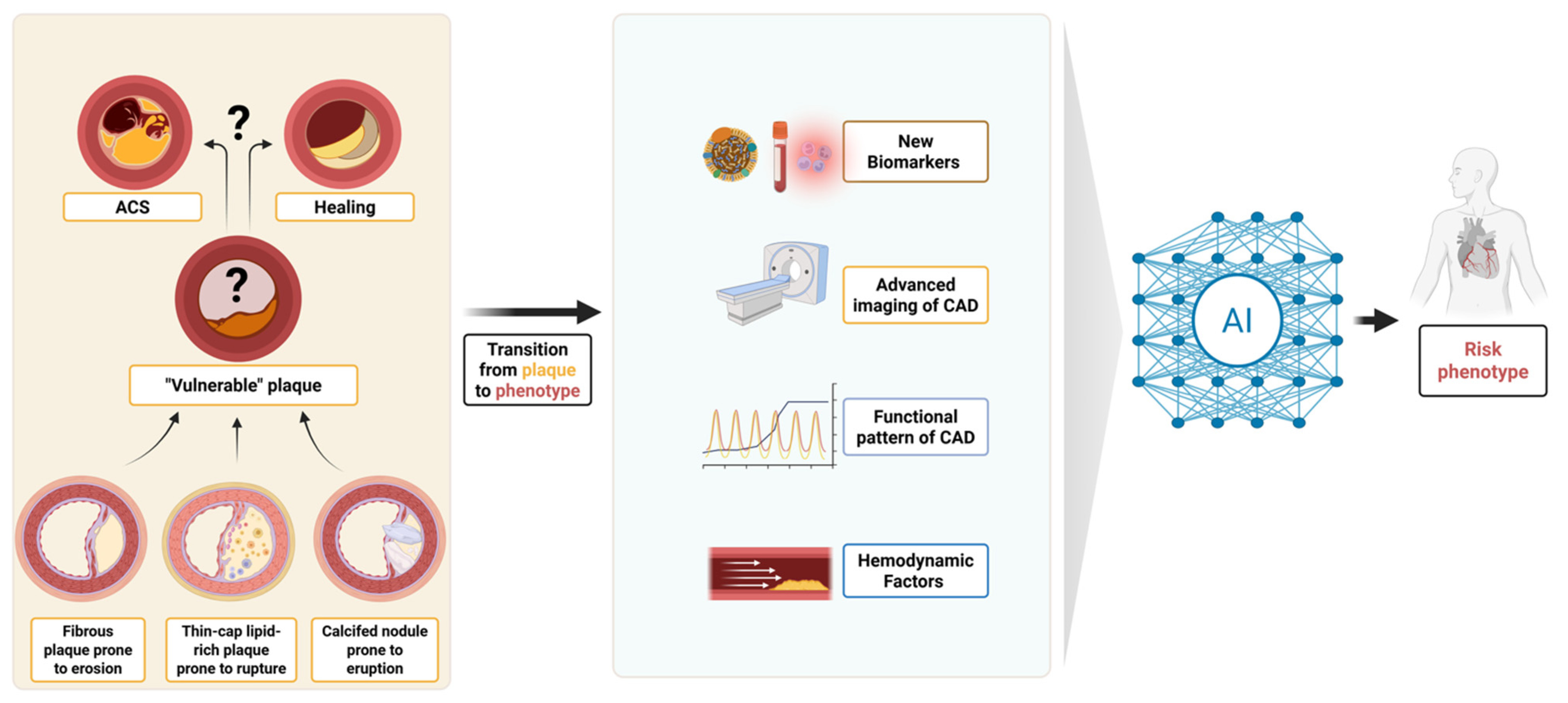
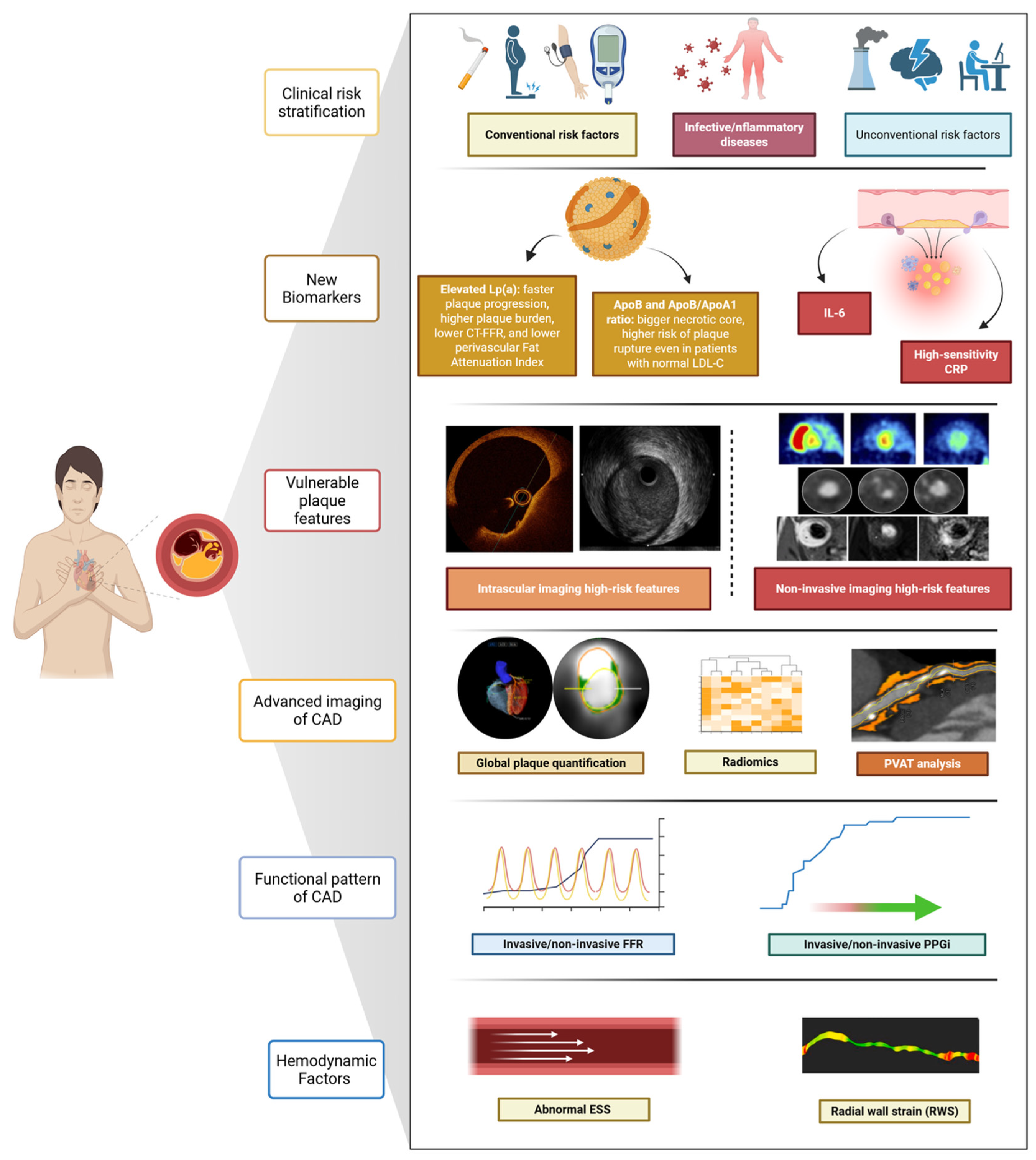
Plaques Do Not Act Alone: Time to Redefine Coronary Vulnerability from Lesion to Phenotype

 , , , , ,
Abstract
1. Introduction
2. Vulnerable Plaque: Varying Definitions and Pathophysiological Mechanisms Leading to ACS
3. Multiple Invasive and Non-Invasive Modalities to Assess Plaque Vulnerability
3.1. Invasive Imaging
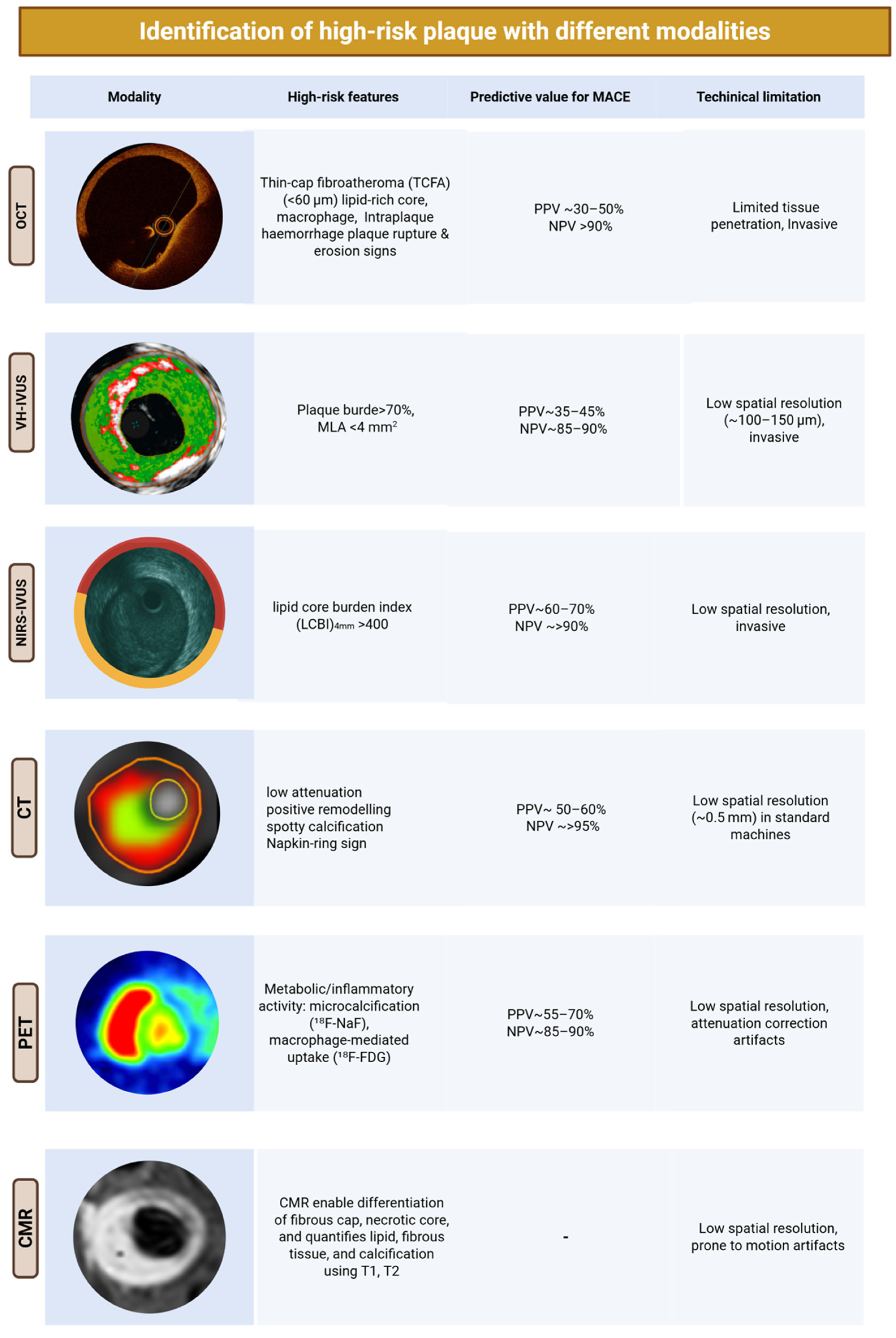
- IVUS allows visualisation of the arterial wall and lumen using ultrasound waves reflected from the vessel wall. It can identify plaque composition, rupture, and intraluminal thrombus, although its axial resolution (~150 μm) is insufficient for reliably measuring components of vulnerable plaques like the fibrous cap or the presence of macrophages infiltrates [17].
- VH-IVUS was initially introduced in 2002 and has been developed in collaboration with the IVUS catheter to overcome IVUS’s limitations. It uses spectral analysis of IVUS radiofrequency signals to generate colour-coded maps of plaque composition: fibrous (dark green), fibro-fatty (light green), necrotic core (red), and dense calcium (white) [18]. Both the ATHEROREMO-IVUS and the PROSPECT study confirmed that VH-IVUS TCFAs were significantly associated with death or ACS at one year (HR 2.56; 95% CI 1.18–5.54; p = 0.017) [19,20].
- OCT employs near-infrared light to provide high-resolution imaging (10–20 μm) of coronary plaques, allowing detailed assessment of microstructural features such as fibrous cap thickness, lipid pools, macrophage infiltration, neovascularisation, microchannels, plaque ruptures, erosions, and thrombi [21]. This unparalleled resolution makes OCT the imaging modality of choice for identifying TCFA and assessing features associated with plaque vulnerability. However, due to its limited tissue penetration (1–1.5 mm), OCT is less suitable for evaluating total plaque burden and vessel remodelling. Four OCT-derived features have been most consistently associated with plaque vulnerability:
- ○
- Fibrous cap thickness < 75 μm, the strongest predictor of rupture and adverse events.
- ○
- Minimal lumen area (MLA), which reflects the degree of luminal narrowing but remains a debated threshold. MLA cut-offs considered “high-risk” vary by coronary segment and clinical context: values between 3.5 and 4.5 mm2 are frequently reported, but the optimal threshold depends on vessel size, lesion location, and patient-specific factors [22,23,24].
- ○
- Lipid arc extension > 180°, representing the circumferential spread of necrotic lipid.
- ○
- Intraplaque macrophage infiltration, reflecting local inflammation.
In the CLIMA study, which focused on non-culprit plaques in the proximal left anterior descending artery (LAD), the simultaneous presence of TCFA < 75 μm, MLA < 3.5 mm2, lipid arc > 180°, and macrophages in a single plaque identified lesions at highest risk of future MACE [25]. - NIRS enables precise detection of intraplaque lipid content and cholesterol. It is currently the most established catheter-based technique for lipid detection, with Food and Drug Administration (FDA) approval. It also provides insights into inflammation, cell proliferation, and apoptosis. When co-registered with IVUS or OCT, it allows three-dimensional plaque visualisation, enhancing the detection of high-risk lesions [26].
3.2. Non-Invasive Imaging
- CCTA is the most widely available non-invasive technique for coronary artery imaging. Recent clinical guidelines emphasise the role of CCTA as a first-line examination for evaluating patients with suspected CAD, particularly those with low-to-intermediate “pre-test” likelihood [27]. Moreover, both European and American Guidelines recommend the use of CCTA to rule out ACS in patients presenting with acute chest pain and an inconclusive initial evaluation [28,29]. Advances in CCTA technology and software have enabled accurate evaluation of coronary plaque composition and morphology [30]. Detectable vulnerability features validated in multiple studies were as follows:
- ○
- Spotty calcification: calcified foci (≥350 HU) ≤3 mm in diameter, surrounded by non-calcified plaque.
- ○
- Low-attenuation plaque: non-calcified plaque with attenuation ≤30 HU, distinct from perivascular fat.
- ○
- Positive remodelling: an increase in vessel diameter ≥10% relative to a reference segment (remodelling index > 1.1).
- ○
- Napkin-ring sign: a central low-attenuation zone adjacent to the lumen, surrounded by a higher-attenuation rim (<130 HU).
- Photon-counting computed tomography (PCCT) represents a newly introduced detector technology in the realm of CCTA scanning. PCCT uses direct conversion detectors—typically based on cadmium telluride or silicon semiconductors—to transform incoming X-ray photons directly into electrical signals. Unlike conventional computed tomography, this enables energy-resolved imaging by categorising photons into discrete energy bins, thereby improving tissue characterisation. PCCT offers higher spatial resolution (pixel size down to 0.15–0.225 mm) and reduced electronic noise, which makes it particularly suited for detailed plaque assessment in atherosclerosis. Emerging evidence supports the diagnostic superiority of PCCT over conventional energy-integrating detector in coronary plaque assessment [31].
- Cardiac magnetic resonance (CMR), using different sequences, allows the detection of the TCFA and intraplaque components such as necrotic core, macrophages, haemorrhage, neovascularisation, calcifications, and subclinical plaque rupture; it also permits quantification of lipidic and fibrous tissues [32]. However, given the deep intrathoracic location of coronary vessels, CMR’s sensitivity is lower than that of CCTA. This, along with lower availability and susceptibility to breathing- and cardiac motion-related artefacts, limits its use in the assessment of plaque vulnerability [32].
- Positron Emission Tomography (PET) enables in vivo imaging of the metabolic activity of atherosclerotic plaques through radiotracer uptake, offering insight into disease pathophysiology. PET can visualise key biological features to assess distinct phases of inflammation or specific components of plaques [33]. Increased PET activity has been associated with adverse cardiac events [33]. Despite its capability to non-invasively characterise plaque biology, its clinical use remains limited because of background uptake of glucose in metabolically active myocardium, cardiac and respiratory motion, and the lower spatial resolution of PET; moreover, most radiotracers are still investigational and not approved for routine clinical use [33].
4. The Limits of the Vulnerable Plaque Concept
5. Clinical Settings and Limitations of Current Imaging Strategies
5.1. Scenario-Based Use in Current Practice
- ACS and PCI guidance: OCT and IVUS constitute the principal intraprocedural tools. OCT enables high-resolution visualisation of fibrous cap integrity, rupture versus erosion, thrombus, and stent–vessel interactions, but its shallow penetration depth, reliance on transient blood clearance with contrast, and inability to quantify overall plaque burden restrict broader applicability [21,38,39]. IVUS, including its virtual histology variant, remains indispensable for assessing plaque burden, vessel remodelling, stent expansion, and left main or complex coronary anatomy. Yet, the limited axial resolution precludes accurate evaluation of cap thickness or macrophage infiltration, and procedural time and operator variability remain non-trivial concerns [40]. Moreover, in ACS, intravascular imaging is increasingly used to analyse non-culprit plaques to identify features of vulnerability [41]. Frequently, multiple vulnerable plaques coexist, creating uncertainty regarding lesion selection for preventive stenting and raising concerns about overtreatment. In addition, OCT or IVUS may assist in identifying the culprit lesion when angiography is inconclusive, but performing pullbacks in multiple vessels or segments is time-consuming and often impractical in the acute setting [42]. Finally, in patients presenting with acute chest pain without overt ST-Elevation or clear evidence of obstructive CAD, CCTA focused on lesion-level assessment and integrated with Computed Tomography-derived Fractional Flow Reserve (CT-FFR) may increase the negative predictive value of the examination and inform early invasive management when appropriate [43]. This approach can help identify haemodynamically relevant or high-risk plaques while safely ruling out obstructive disease [43].
- Stable chest pain and chronic coronary syndromes: CCTA is now established as a first-line diagnostic test in patients with a low-to-intermediate (5–50%) pre-test likelihood of obstructive CAD [27]. Beyond excluding obstructive disease, CCTA enables quantification of total plaque burden, low-attenuation components, remodelling indices, and high-risk morphologies such as the napkin-ring sign [44]. Automated plaque quantification is increasingly favoured over segment-focused visual interpretation, as total burden appears to outperform isolated high-risk features in predicting events [34]. Notably, AI-assisted coronary plaque analysis (AI-CPA) has recently received FDA clearance for automated quantification of atherosclerotic burden on CCTA, marking a potential shift from lesion-based assessment to comprehensive risk phenotyping. This approach may prove particularly relevant in patients with low or zero calcium scores, in whom traditional CAC assessment underestimates non-calcific disease [45]. The rapidly expanding incorporation of CT- FFR and perivascular fat attenuation index (FAI) offers an emerging functional and inflammatory dimension to coronary phenotyping [46,47]. Nonetheless, radiation exposure, susceptibility to blooming and motion artefacts, the variable availability of advanced post-processing platforms, and unresolved questions of cost-effectiveness and standardisation limit universal adoption [8,48].
- Myocardial infarction with Non-Obstructive Coronary Arteries (MINOCA) and uncertain culprit scenarios: In patients with MINOCA, or when a culprit lesion cannot be identified despite angiography and intravascular imaging, plaque assessment with CMR may provide a comprehensive alternative [49]. When combined with myocardial tissue characterisation, a single examination could clarify both the vascular substrate and the downstream myocardial consequences [49]. However, the absence of dedicated plaque imaging sequences and the current lack of widespread technology limit routine implementation.
- High-risk or research-based clinical cohorts: NIRS-IVUS, PET, and advanced CMR imaging provide insights into the biological activity of atherosclerotic disease that remain inaccessible to conventional modalities. NIRS-IVUS enables direct lipid core quantification and has demonstrated prognostic relevance in prospective natural history cohorts [50]. However, its predictive value at the lesion level remains modest and the technology is largely confined to specialised centres due to cost and limited accessibility [50]. PET tracers targeting inflammation and CMR sequences capable of detecting intraplaque haemorrhage, neovascularisation, or fibrosis have expanded the conceptual framework of vulnerability, but their clinical applicability is constrained by spatial resolution, scan time, patient selection, and reimbursement barriers [33,51].
5.2. Future Perspectives and Emerging Clinical Applications
6. Phenotyping the Biochemical Environment of Vulnerability
6.1. Lipid-Related Risk Signatures
6.2. Phenotyping the High-Risk Inflammatory Profile
7. Integrating New Imaging Strategies to Define the “Vulnerable” Phenotype
7.1. AI
7.2. New CCTA-Derived Analyses to Refine Disease Phenotype
7.3. Integrating Haemodynamic and Biomechanical Factors to Identify Vulnerable Phenotypes
8. Unmet Needs and Gaps in Evidence
9. Conclusions
Author Contributions
Funding
Data Availability Statement
Conflicts of Interest
Abbreviations
| ACS | Acute Coronary Syndrome |
| AI | Artificial Intelligence |
| AI-CPA | AI-assisted Coronary Plaque Analysis |
| ApoA1 | Apolipoprotein A1 |
| ApoB | Apolipoprotein B |
| AUC | Area Under the Curve |
| CAD | Coronary Artery Disease |
| CCTA | Coronary Computed Tomography Angiography |
| CMR | Cardiac Magnetic Resonance |
| CT-FFR | Computed Tomography-Derived Fractional Flow Reserve |
| ESS | Endothelial Shear Stress |
| FAI | Fat Attenuation Index |
| FDA | Food and Drug Administration |
| FFR | Fractional Flow Reserve |
| hsCRP | High-Sensitivity C-Reactive Protein |
| IL-6 | Interleukin-6 |
| IVUS | Intravascular Ultrasound |
| LAD | Left Anterior Descending artery |
| LCBI | Lipid Core Burden Index |
| LDL | Low-Density Lipoprotein |
| Lp(a) | Lipoprotein(a) |
| MACE | Major Adverse Cardiac Events |
| MI | Myocardial Infarction |
| MINOCA | Myocardial Infarction with Non-Obstructive Coronary Arteries |
| MLA | Minimal Lumen Area |
| μQFR | Murray Law-Based Quantitative Flow Ratio |
| NIRS | Near-Infrared Spectroscopy |
| OCT | Optical Coherence Tomography |
| PCCT | Photon-Counting Computed Tomography |
| PCI | Percutaneous Coronary Intervention |
| PET | Positron Emission Tomography |
| PPV | Positive Predictive Value |
| RWS | Radial Wall Strain |
| STEMI | ST-Elevation Myocardial Infarction |
| SWS | Superficial Wall Strain/Stress |
| TCFA | Thin-Cap Fibroatheroma |
| VH-IVUS | Virtual Histology Intravascular Ultrasound |
| VOCE | Vessel-Oriented Composite Endpoint |
References
- GBD 2013 Mortality and Causes of Death Collaborators. Global, regional, and national age–sex specific all-cause and cause-specific mortality for 240 causes of death, 1990–2013: A systematic analysis for the Global Burden of Disease Study 2013. Lancet 2015, 385, 117–171. [Google Scholar] [CrossRef] [Scilit]
- Waksman, R.; Di Mario, C.; Torguson, R.; Ali, Z.A.; Singh, V.; Skinner, W.H.; Artis, A.K.; Cate, T.T.; Powers, E.; Kim, C.; et al. Identification of patients and plaques vulnerable to future coronary events with near-infrared spectroscopy intravascular ultrasound imaging: A prospective, cohort study. Lancet 2019, 394, 1629–1637. [Google Scholar] [CrossRef] [Scilit]
- Johnson, T.W.; Joshi, N. Vulnerable plaque imaging—A clinical reality? EuroIntervention 2020, 16, 364–366. [Google Scholar] [CrossRef] [Scilit]
- Fezzi, S.; Ding, D.; Mahfoud, F.; Huang, J.; Lansky, A.J.; Tu, S.; Wijns, W. Illusion of revascularization: Does anyone achieve optimal revascularization during percutaneous coronary intervention? Nat. Rev. Cardiol. 2024, 21, 652–662. [Google Scholar] [CrossRef] [Scilit]
- Aguirre, A.D.; Arbab-Zadeh, A.; Soeda, T.; Fuster, V.; Jang, I.-K. Optical Coherence Tomography of Plaque Vulnerability and Rupture. J. Am. Coll. Cardiol. 2021, 78, 1257–1265. [Google Scholar] [CrossRef] [Scilit] [PubMed]
- Park, D.-W.; Kim, H.; Singh, A.; Brown, D.L. Prophylactic stenting of vulnerable plaques: Pros and cons. EuroIntervention 2024, 20, e278–e280. [Google Scholar] [CrossRef] [Scilit] [PubMed]
- Burke, A.P.; Kolodgie, F.D.; Farb, A.; Weber, D.K.; Malcom, G.T.; Smialek, J.; Virmani, R. Healed Plaque Ruptures and Sudden Coronary Death. Circulation 2001, 103, 934–940. [Google Scholar] [CrossRef] [Scilit]
- Williams, M.C.; Moss, A.J.; Dweck, M.; Adamson, P.D.; Alam, S.; Hunter, A.; Shah, A.S.V.; Pawade, T.; Weir-McCall, J.R.; Roditi, G.; et al. Coronary Artery Plaque Characteristics Associated with Adverse Outcomes in the SCOT-HEART Study. J. Am. Coll. Cardiol. 2019, 73, 291–301. [Google Scholar] [CrossRef] [Scilit] [PubMed]
- Ferencik, M.; Mayrhofer, T.; Bittner, D.O.; Emami, H.; Puchner, S.B.; Lu, M.T.; Meyersohn, N.M.; Ivanov, A.V.; Adami, E.C.; Patel, M.R.; et al. Use of High-Risk Coronary Atherosclerotic Plaque Detection for Risk Stratification of Patients with Stable Chest Pain. JAMA Cardiol. 2018, 3, 144. [Google Scholar] [CrossRef] [Scilit]
- Muller, J.E.; Tofler, G.H.; Stone, P.H. Circadian variation and triggers of onset of acute cardiovascular disease. Circulation 1989, 79, 733–743. [Google Scholar] [CrossRef] [Scilit]
- Naghavi, M.; Libby, P.; Falk, E.; Casscells, S.W.; Litovsky, S.; Rumberger, J.; Badimon, J.J.; Stefanadis, C.; Moreno, P.; Pasterkamp, G.; et al. From Vulnerable Plaque to Vulnerable Patient: A Call for New Definitions and Risk Assessment Strategies: Part I. Circulation 2003, 108, 1664–1672. [Google Scholar] [CrossRef] [Scilit]
- Naghavi, M.; Libby, P.; Falk, E.; Casscells, S.W.; Litovsky, S.; Rumberger, J.; Badimon, J.J.; Stefanadis, C.; Moreno, P.; Pasterkamp, G.; et al. From Vulnerable Plaque to Vulnerable Patient: A Call for New Definitions and Risk Assessment Strategies: Part II. Circulation 2003, 108, 1772–1778. [Google Scholar] [CrossRef] [Scilit]
- Finn, A.V.; Nakano, M.; Narula, J.; Kolodgie, F.D.; Virmani, R. Concept of Vulnerable/Unstable Plaque. Arterioscler. Thromb. Vasc. Biol. 2010, 30, 1282–1292. [Google Scholar] [CrossRef] [Scilit]
- Libby, P.; Pasterkamp, G.; Crea, F.; Jang, I.-K. Reassessing the Mechanisms of Acute Coronary Syndromes. Circ. Res. 2019, 124, 150–160. [Google Scholar] [CrossRef] [Scilit]
- Jia, H.; Abtahian, F.; Aguirre, A.D.; Lee, S.; Chia, S.; Lowe, H.; Kato, K.; Yonetsu, T.; Vergallo, R.; Hu, S.; et al. In Vivo Diagnosis of Plaque Erosion and Calcified Nodule in Patients with Acute Coronary Syndrome by Intravascular Optical Coherence Tomography. J. Am. Coll. Cardiol. 2013, 62, 1748–1758. [Google Scholar] [CrossRef] [Scilit] [PubMed]
- Schuurman, A.S.; Vroegindewey, M.M.; Kardys, I.; Oemrawsingh, R.M.; Garcia-Garcia, H.M.; van Geuns, R.J.; Regar, E.; Van Mieghem, N.M.; Ligthart, J.; Serruys, P.W.; et al. Prognostic Value of Intravascular Ultrasound in Patients with Coronary Artery Disease. J. Am. Coll. Cardiol. 2018, 72, 2003–2011. [Google Scholar] [CrossRef] [Scilit]
- Ono, M.; Kawashima, H.; Hara, H.; Gao, C.; Wang, R.; Kogame, N.; Takahashi, K.; Chichareon, P.; Modolo, R.; Tomaniak, M.; et al. Advances in IVUS/OCT and Future Clinical Perspective of Novel Hybrid Catheter System in Coronary Imaging. Front. Cardiovasc. Med. 2020, 7, 119. [Google Scholar] [CrossRef] [Scilit] [PubMed]
- Nissen, S.E. IVUS Virtual Histology: Unvalidated Gimmick or Useful Technique. J. Am. Coll. Cardiol. 2016, 67, 1784–1785. [Google Scholar] [CrossRef] [Scilit] [PubMed]
- de Boer, S.; Baran, Y.; Garcia-Garcia, H.M.; Eskin, I.; Lenzen, M.J.; Kleber, M.E.; Regar, E.; de Jaegere, P.J.; Ligthart, J.M.; van Geuns, R.J.; et al. The European Collaborative Project on Inflammation and Vascular Wall Remodeling in Atherosclerosis—Intravascular Ultrasound (ATHEROREMO-IVUS) study. EuroIntervention 2018, 14, 194–203. [Google Scholar] [CrossRef] [Scilit]
- Xie, Y.; Mintz, G.S.; Yang, J.; Doi, H.; Iñiguez, A.; Dangas, G.D.; Serruys, P.W.; McPherson, J.A.; Wennerblom, B.; Xu, K.; et al. Clinical Outcome of Nonculprit Plaque Ruptures in Patients with Acute Coronary Syndrome in the PROSPECT Study. JACC Cardiovasc. Imaging 2014, 7, 397–405. [Google Scholar] [CrossRef] [Scilit]
- Kubo, T.; Ino, Y.; Mintz, G.S.; Shiono, Y.; Shimamura, K.; Takahata, M.; Terada, K.; Higashioka, D.; Emori, H.; Wada, T.; et al. Optical coherence tomography detection of vulnerable plaques at high risk of developing acute coronary syndrome. Eur. Heart J. Cardiovasc. Imaging 2021, 22, 1376–1384. [Google Scholar] [CrossRef] [Scilit]
- Prati, F.; Di Vito, L.; Biondi-Zoccai, G.; Occhipinti, M.; La Manna, A.; Tamburino, C.; Burzotta, F.; Trani, C.; Porto, I.; Ramazzotti, V.; et al. Angiography alone versus angiography plus optical coherence tomography to guide decision-making during percutaneous coronary intervention: The Centro per la Lotta contro l’Infarto-Optimisation of Percutaneous Coronary Intervention (CLI-OPCI) study. EuroIntervention 2012, 8, 823–829. [Google Scholar] [CrossRef] [Scilit]
- Prati, F.; Romagnoli, E.; Burzotta, F.; Limbruno, U.; Gatto, L.; La Manna, A.; Versaci, F.; Marco, V.; Di Vito, L.; Imola, F.; et al. Clinical Impact of OCT Findings During PCI. JACC Cardiovasc. Imaging 2015, 8, 1297–1305. [Google Scholar] [CrossRef] [Scilit]
- Prati, F.; Romagnoli, E.; Gatto, L.; La Manna, A.; Burzotta, F.; Limbruno, U.; Versaci, F.; Fabbiocchi, F.; Di Giorgio, A.; Marco, V.; et al. Clinical Impact of Suboptimal Stenting and Residual Intrastent Plaque/Thrombus Protrusion in Patients With Acute Coronary Syndrome: The CLI-OPCI ACS Substudy (Centro per la Lotta Contro L’Infarto-Optimization of Percutaneous Coronary Intervention in Acute Coronary Syndrome). Circ. Cardiovasc. Interv. 2016, 9, e003726. [Google Scholar] [CrossRef] [Scilit] [PubMed]
- Prati, F.; Romagnoli, E.; Gatto, L.; La Manna, A.; Burzotta, F.; Ozaki, Y.; Marco, V.; Boi, A.; Fineschi, M.; Fabbiocchi, F.; et al. Relationship between coronary plaque morphology of the left anterior descending artery and 12 months clinical outcome: The CLIMA study. Eur. Heart J. 2020, 41, 383–391. [Google Scholar] [CrossRef] [Scilit]
- Muller, J.; Madder, R. OCT-NIRS Imaging for Detection of Coronary Plaque Structure and Vulnerability. Front. Cardiovasc. Med. 2020, 7, 90. [Google Scholar] [CrossRef] [Scilit]
- Vrints, C.; Andreotti, F.; Koskinas, K.C.; Rossello, X.; Adamo, M.; Ainslie, J.; Banning, A.P.; Budaj, A.; Buechel, R.R.; Chiariello, G.A.; et al. 2024 ESC Guidelines for the management of chronic coronary syndromes. Eur. Heart J. 2024, 45, 3415–3537. [Google Scholar] [CrossRef] [Scilit] [PubMed]
- Gulati, M.; Levy, P.D.; Mukherjee, D.; Amsterdam, E.; Bhatt, D.L.; Birtcher, K.K.; Blankstein, R.; Boyd, J.; Bullock-Palmer, R.P.; Conejo, T.; et al. 2021 AHA/ACC/ASE/CHEST/SAEM/SCCT/SCMR Guideline for the Evaluation and Diagnosis of Chest Pain: A Report of the American College of Cardiology/American Heart Association Joint Committee on Clinical Practice Guidelines. Circulation 2021, 78, e187–e285. [Google Scholar] [CrossRef] [Scilit]
- Byrne, R.A.; Rossello, X.; Coughlan, J.J.; Barbato, E.; Berry, C.; Chieffo, A.; Claeys, M.J.; Dan, G.-A.; Dweck, M.R.; Galbraith, M.; et al. 2023 ESC Guidelines for the management of acute coronary syndromes. Eur. Heart J. Acute Cardiovasc. Care 2023, 13, 55–161. [Google Scholar] [CrossRef] [Scilit]
- Shaw, L.J.; Blankstein, R.; Bax, J.J.; Ferencik, M.; Bittencourt, M.S.; Min, J.K.; Berman, D.S.; Leipsic, J.; Villines, T.C.; Dey, D.; et al. Society of Cardiovascular Computed Tomography/North American Society of Cardiovascular Imaging—xpert Consensus Document on Coronary CT Imaging of Atherosclerotic Plaque. J. Cardiovasc. Comput. Tomogr. 2021, 15, 93–109. [Google Scholar] [CrossRef] [Scilit] [PubMed]
- Cau, R.; Saba, L.; Balestrieri, A.; Meloni, A.; Mannelli, L.; La Grutta, L.; Bossone, E.; Mantini, C.; Politi, C.; Suri, J.S.; et al. Photon-Counting Computed Tomography in Atherosclerotic Plaque Characterization. Diagnostics 2024, 14, 1065. [Google Scholar] [CrossRef] [Scilit] [PubMed]
- Gonzalez Ballester, M.A.; Zisserman, A.P.; Brady, M. Estimation of the partial volume effect in MRI. Med. Image Anal. 2002, 6, 389–405. [Google Scholar] [CrossRef] [Scilit] [PubMed]
- Kwiecinski, J. Novel PET Applications and Radiotracers for Imaging Cardiovascular Pathophysiology. Heart Fail. Clin. 2025, 21, 339–349. [Google Scholar] [CrossRef] [Scilit] [PubMed]
- Bianchini, E.; Alqahtani, F.; Alsubai, S.; del Sole, P.A.; Elzomor, H.; Sharif, R.; McCormick, J.; Revaiah, P.C.; Andreotti, F.; Burzotta, F.; et al. Advanced Analyses of Coronary Computed Tomography Angiography to Predict Future Cardiac Events: A Meta-Analysis. JACC Cardiovasc. Imaging, 2025; in press. [CrossRef] [Scilit]
- Yang, S.; Jung, J.W.; Park, S.-H.; Zhang, J.; Lee, K.; Hwang, D.; Lee, K.-S.; Na, S.-H.; Doh, J.-H.; Nam, C.-W.; et al. Prognostic Time Frame of Plaque and Hemodynamic Characteristics and Integrative Risk Prediction for Acute Coronary Syndrome. JACC Cardiovasc. Imaging 2025, 18, 784–795. [Google Scholar] [CrossRef] [Scilit]
- Stone, G.W.; Maehara, A.; Lansky, A.J.; de Bruyne, B.; Cristea, E.; Mintz, G.S.; Mehran, R.; McPherson, J.; Farhat, N.; Marso, S.P.; et al. A Prospective Natural-History Study of Coronary Atherosclerosis. N. Engl. J. Med. 2011, 364, 226–235. [Google Scholar] [CrossRef] [Scilit]
- Erlinge, D.; Maehara, A.; Ben-Yehuda, O.; Bøtker, H.E.; Maeng, M.; Kjøller-Hansen, L.; Engstrøm, T.; Matsumura, M.; Crowley, A.; Dressler, O.; et al. Identification of vulnerable plaques and patients by intracoronary near-infrared spectroscopy and ultrasound (PROSPECT II): A prospective natural history study. Lancet 2021, 397, 985–995. [Google Scholar] [CrossRef] [Scilit]
- Tearney, G.J.; Regar, E.; Akasaka, T.; Adriaenssens, T.; Barlis, P.; Bezerra, H.G.; Bouma, B.; Bruining, N.; Cho, J.; Chowdhary, S.; et al. Consensus Standards for Acquisition, Measurement, and Reporting of Intravascular Optical Coherence Tomography Studies A Report From the International Working Group for Intravascular Optical Coherence Tomography Standardization and Validation. J. Am. Coll. Cardiol. 2012, 59, 1058–1072. [Google Scholar] [CrossRef] [Scilit]
- Prati, F.; Guagliumi, G.; Mintz, G.S.; Costa, M.; Regar, E.; Akasaka, T.; Barlis, P.; Tearney, G.J.; Jang, I.-K.; Arbustini, E.; et al. Expert review document part 2: Methodology, terminology and clinical applications of optical coherence tomography for the assessment of interventional procedures. Eur. Heart J. 2012, 33, 2513–2520. [Google Scholar] [CrossRef] [Scilit]
- García-García, H.; Mintz, G.; Lerman, A.; Vince, G.; Margolis, P.; van Es, G.-A.; Morel, M.-A.; Nair, A.; Virmani, R.; Burke, A.; et al. Tissue characterisation using intravascular radiofrequency data analysis: Recommendations for acquisition, analysis, interpretation and reporting. EuroIntervention 2009, 5, 177–189. [Google Scholar] [CrossRef] [Scilit]
- Pundziute, G.; Schuijf, J.D.; Jukema, J.W.; Decramer, I.; Sarno, G.; Vanhoenacker, P.K.; Boersma, E.; Reiber, J.H.C.; Schalij, M.J.; Wijns, W.; et al. Evaluation of plaque characteristics in acute coronary syndromes: Non-invasive assessment with multi-slice computed tomography and invasive evaluation with intravascular ultrasound radiofrequency data analysis. Eur. Heart J. 2008, 29, 2373–2381. [Google Scholar] [CrossRef] [Scilit]
- Ali, Z.A.; Karimi Galougahi, K.; Mintz, G.S.; Maehara, A.; Shlofmitz, R.A.; Mattesini, A. Intracoronary optical coherence tomography: State of the art and future directions. EuroIntervention 2021, 17, e105–e123. [Google Scholar] [CrossRef] [Scilit]
- Irannejad, K.; Hubbard, L.; Narashim, A.; Mora, R.; Iskander, B.; Punnanithinont, N.; Ichikawa, K.; Kinninger, A.; Lakshmanan, S.; Roy, S.; et al. Coronary CT Angiography for Acute Chest Pain in the Emergency Department: A Systematic Review of Clinical Utility. Emerg. Care Med. 2025, 2, 46. [Google Scholar] [CrossRef] [Scilit]
- Motoyama, S.; Ito, H.; Sarai, M.; Kondo, T.; Kawai, H.; Nagahara, Y.; Harigaya, H.; Kan, S.; Anno, H.; Takahashi, H.; et al. Plaque Characterization by Coronary Computed Tomography Angiography and the Likelihood of Acute Coronary Events in Mid-Term Follow-Up. J. Am. Coll. Cardiol. 2015, 66, 337–346. [Google Scholar] [CrossRef] [Scilit]
- Mokhtar, J.; Albaree, M.; Battistin, V.; Asbaita, M.; Akbarpoor, F.; Lakshmanan, J.; El-Tamimi, H. Inadequacy of coronary calcium scoring in evaluating coronary artery disease: A call to shifting to high-resolution CT coronary imaging. Int. J. Cardiol. Cardiovasc. Risk Prev. 2025, 26, 200476. [Google Scholar] [CrossRef] [Scilit]
- Oikonomou, E.K.; Marwan, M.; Desai, M.Y.; Mancio, J.; Alashi, A.; Hutt Centeno, E.; Thomas, S.; Herdman, L.; Kotanidis, C.P.; Thomas, K.E.; et al. Non-invasive detection of coronary inflammation using computed tomography and prediction of residual cardiovascular risk (the CRISP CT study): A post-hoc analysis of prospective outcome data. Lancet 2018, 392, 929–939. [Google Scholar] [CrossRef] [Scilit]
- Chan, K.; Wahome, E.; Tsiachristas, A.; Antonopoulos, A.S.; Patel, P.; Lyasheva, M.; Kingham, L.; West, H.; Oikonomou, E.K.; Volpe, L.; et al. Inflammatory risk and cardiovascular events in patients without obstructive coronary artery disease: The ORFAN multicentre, longitudinal cohort study. Lancet 2024, 403, 2606–2618. [Google Scholar] [CrossRef] [Scilit] [PubMed]
- Meijboom, W.B.; Meijs, M.F.L.; Schuijf, J.D.; Cramer, M.J.; Mollet, N.R.; van Mieghem, C.A.G.; Nieman, K.; van Werkhoven, J.M.; Pundziute, G.; Weustink, A.C.; et al. Diagnostic Accuracy of 64-Slice Computed Tomography Coronary Angiography. J. Am. Coll. Cardiol. 2008, 52, 2135–2144. [Google Scholar] [CrossRef] [Scilit] [PubMed]
- Gerbaud, E.; Arabucki, F.; Nivet, H.; Barbey, C.; Cetran, L.; Chassaing, S.; Seguy, B.; Lesimple, A.; Cochet, H.; Montaudon, M.; et al. OCT and CMR for the Diagnosis of Patients Presenting with MINOCA and Suspected Epicardial Causes. JACC Cardiovasc. Imaging 2020, 13, 2619–2631. [Google Scholar] [CrossRef] [Scilit] [PubMed]
- Kuku, K.O.; Singh, M.; Ozaki, Y.; Dan, K.; Chezar-Azerrad, C.; Waksman, R.; Garcia-Garcia, H.M. Near-Infrared Spectroscopy Intravascular Ultrasound Imaging: State of the Art. Front. Cardiovasc. Med. 2020, 7, 107. [Google Scholar] [CrossRef] [Scilit]
- Liu, W.; Wu, S.; Wang, Z.; Du, Y.; Fan, Z.; Dong, L.; Guo, Y.; Liu, Y.; Bi, X.; An, J.; et al. Relationship between coronary hyper-intensive plaques identified by cardiovascular magnetic resonance and clinical severity of acute coronary syndrome. J. Cardiovasc. Magn. Reson. 2021, 23, 12. [Google Scholar] [CrossRef] [Scilit]
- Bruno, F.; Immobile Molaro, M.; Sperti, M.; Bianchini, F.; Chu, M.; Cardaci, C.; Wańha, W.; Gasior, P.; Zecchino, S.; Pavani, M.; et al. Adverse cardiovascular events in coronary Plaques not undeRgoing pErcutaneous coronary intervention evaluateD with optIcal Coherence Tomography. The PREDICT-AI risk model. Open Heart 2025, 12, e003389. [Google Scholar] [CrossRef] [Scilit]
- Annink, M.E.; Kraaijenhof, J.M.; Beverloo, C.Y.Y.; Oostveen, R.F.; Verberne, H.J.; Stroes, E.S.G.; Nurmohamed, N.S. Estimating inflammatory risk in atherosclerotic cardiovascular disease: Plaque over plasma? Eur. Heart J. Cardiovasc. Imaging 2025, 26, 444–460. [Google Scholar] [CrossRef] [Scilit]
- Stone, G.W.; Maehara, A.; Ali, Z.A.; Held, C.; Matsumura, M.; Kjøller-Hansen, L.; Bøtker, H.E.; Maeng, M.; Engstrøm, T.; Wiseth, R.; et al. Percutaneous Coronary Intervention for Vulnerable Coronary Atherosclerotic Plaque. J. Am. Coll. Cardiol. 2020, 76, 2289–2301. [Google Scholar] [CrossRef] [Scilit]
- Skalidis, I.; Boiago, M.; Liccardo, G.; Garrot, P. Radial Wall Strain and μQFR as Complementary Predictors of Risk After Myocardial Infarction. Catheter. Cardiovasc. Interv. 2025, 106, 1459–1460. [Google Scholar] [CrossRef] [Scilit]
- Nakajima, A.; Libby, P.; Mitomo, S.; Yuki, H.; Araki, M.; Seegers, L.M.; McNulty, I.; Lee, H.; Ishibashi, M.; Kobayashi, K.; et al. Biomarkers associated with coronary high-risk plaques. J. Thromb. Thrombolysis 2022, 54, 647–659. [Google Scholar] [CrossRef] [Scilit] [PubMed]
- Kaiser, Y.; Daghem, M.; Tzolos, E.; Meah, M.N.; Doris, M.K.; Moss, A.J.; Kwiecinski, J.; Kroon, J.; Nurmohamed, N.S.; van der Harst, P.; et al. Association of Lipoprotein(a) with Atherosclerotic Plaque Progression. J. Am. Coll. Cardiol. 2022, 79, 223–233. [Google Scholar] [CrossRef] [Scilit]
- Dai, N.; Chen, Z.; Zhou, F.; Zhou, Y.; Hu, N.; Duan, S.; Wang, W.; Yu, Y.; Zhang, L.; Qian, J.; et al. Association of Lipoprotein (a) with Coronary-Computed Tomography Angiography–Assessed High-Risk Coronary Disease Attributes and Cardiovascular Outcomes. Circ. Cardiovasc. Imaging 2022, 15, e014611. [Google Scholar] [CrossRef] [Scilit] [PubMed]
- Walldius, G.; Jungner, I.; Holme, I.; Aastveit, A.H.; Kolar, W.; Steiner, E. High apolipoprotein B, low apolipoprotein A-I, and improvement in the prediction of fatal myocardial infarction (AMORIS study): A prospective study. Lancet 2001, 358, 2026–2033. [Google Scholar] [CrossRef] [Scilit]
- Ohwada, T.; Sakamoto, T.; Kanno, Y.; Yokokawa, S.; Amami, K.; Nakazato, K.; Takeishi, Y.; Watanabe, K. Apolipoprotein B correlates with intra-plaque necrotic core volume in stable coronary artery disease. PLoS ONE 2019, 14, e0212539. [Google Scholar] [CrossRef] [Scilit]
- Ridker, P.M.; Everett, B.M.; Thuren, T.; MacFadyen, J.G.; Chang, W.H.; Ballantyne, C.; Fonseca, F.; Nicolau, J.; Koenig, W.; Anker, S.D.; et al. Antiinflammatory Therapy with Canakinumab for Atherosclerotic Disease. N. Engl. J. Med. 2017, 377, 1119–1131. [Google Scholar] [CrossRef] [Scilit] [PubMed]
- Ridker, P.M.; Rifai, N.; Stampfer, M.J.; Hennekens, C.H. Plasma Concentration of Interleukin-6 and the Risk of Future Myocardial Infarction Among Apparently Healthy Men. Circulation 2000, 101, 1767–1772. [Google Scholar] [CrossRef] [Scilit]
- Yu, M.; Yang, Y.; Dong, S.-L.; Zhao, C.; Yang, F.; Yuan, Y.-F.; Liao, Y.-H.; He, S.-L.; Liu, K.; Wei, F.; et al. Effect of Colchicine on Coronary Plaque Stability in Acute Coronary Syndrome as Assessed by Optical Coherence Tomography: The COLOCT Randomized Clinical Trial. Circulation 2024, 150, 981–993. [Google Scholar] [CrossRef] [Scilit]
- Psaltis, P.J.; Nguyen, M.T.; Singh, K.; Sinhal, A.; Wong, D.T.L.; Alcock, R.; Rajendran, S.; Dautov, R.; Barlis, P.; Patel, S.; et al. Optical coherence tomography assessment of the impact of colchicine on non-culprit coronary plaque composition after myocardial infarction. Cardiovasc. Res. 2025, 121, 468–478. [Google Scholar] [CrossRef] [Scilit]
- Föllmer, B.; Williams, M.C.; Dey, D.; Arbab-Zadeh, A.; Maurovich-Horvat, P.; Volleberg, R.H.J.A.; Rueckert, D.; Schnabel, J.A.; Newby, D.E.; Dweck, M.R.; et al. Roadmap on the use of artificial intelligence for imaging of vulnerable atherosclerotic plaque in coronary arteries. Nat. Rev. Cardiol. 2024, 21, 51–64. [Google Scholar] [CrossRef] [Scilit] [PubMed]
- Zhu, Y.; Fezzi, S.; Bargary, N.; Ding, D.; Scarsini, R.; Lunardi, M.; Leone, A.M.; Mammone, C.; Wagener, M.; McInerney, A.; et al. Validation of machine learning angiography-derived physiological pattern of coronary artery disease. Eur. Heart J. Digit. Health 2025, 6, 577–586. [Google Scholar] [CrossRef] [Scilit]
- Chu, M.; Jia, H.; Gutiérrez-Chico, J.L.; Maehara, A.; Ali, Z.A.; Zeng, X.; He, L.; Zhao, C.; Matsumura, M.; Wu, P.; et al. Artificial intelligence and optical coherence tomography for the automatic characterisation of human atherosclerotic plaques. EuroIntervention 2021, 17, 41–50. [Google Scholar] [CrossRef] [Scilit] [PubMed]
- Min, H.-S.; Yoo, J.H.; Kang, S.-J.; Lee, J.-G.; Cho, H.; Lee, P.H.; Ahn, J.-M.; Park, D.-W.; Lee, S.-W.; Kim, Y.-H.; et al. Detection of optical coherence tomography-defined thin-cap fibroatheroma in the coronary artery using deep learning. EuroIntervention 2020, 16, 404–412. [Google Scholar] [CrossRef] [Scilit]
- Koo, B.-K.; Yang, S.; Jung, J.W.; Zhang, J.; Lee, K.; Hwang, D.; Lee, K.-S.; Doh, J.-H.; Nam, C.-W.; Kim, T.H.; et al. Artificial Intelligence–Enabled Quantitative Coronary Plaque and Hemodynamic Analysis for Predicting Acute Coronary Syndrome. JACC Cardiovasc. Imaging 2024, 17, 1062–1076. [Google Scholar] [CrossRef] [Scilit] [PubMed]
- Nurmohamed, N.S.; Min, J.K.; Anthopolos, R.; Reynolds, H.R.; Earls, J.P.; Crabtree, T.; Mancini, G.B.J.; Leipsic, J.; Budoff, M.J.; Hague, C.J.; et al. Atherosclerosis quantification and cardiovascular risk: The ISCHEMIA trial. Eur. Heart J. 2024, 45, 3735–3747. [Google Scholar] [CrossRef] [Scilit]
- Matsumoto, H.; Watanabe, S.; Kyo, E.; Tsuji, T.; Ando, Y.; Otaki, Y.; Cadet, S.; Gransar, H.; Berman, D.S.; Slomka, P.; et al. Standardized volumetric plaque quantification and characterization from coronary CT angiography: A head-to-head comparison with invasive intravascular ultrasound. Eur. Radiol. 2019, 29, 6129–6139. [Google Scholar] [CrossRef] [Scilit]
- Lee, S.-E.; Sung, J.M.; Andreini, D.; Al-Mallah, M.H.; Budoff, M.J.; Cademartiri, F.; Chinnaiyan, K.; Choi, J.H.; Chun, E.J.; Conte, E.; et al. Differences in Progression to Obstructive Lesions per High-Risk Plaque Features and Plaque Volumes with CCTA. JACC Cardiovasc. Imaging 2020, 13, 1409–1417. [Google Scholar] [CrossRef] [Scilit]
- Han, D.; Kolli, K.K.; Al’Aref, S.J.; Baskaran, L.; van Rosendael, A.R.; Gransar, H.; Andreini, D.; Budoff, M.J.; Cademartiri, F.; Chinnaiyan, K.; et al. Machine Learning Framework to Identify Individuals at Risk of Rapid Progression of Coronary Atherosclerosis: From the PARADIGM Registry. J. Am. Heart Assoc. 2020, 9, e013958. [Google Scholar] [CrossRef] [Scilit]
- von Knebel Doeberitz, P.L.; De Cecco, C.N.; Schoepf, U.J.; Albrecht, M.H.; van Assen, M.; De Santis, D.; Gaskins, J.; Martin, S.; Bauer, M.J.; Ebersberger, U.; et al. Impact of Coronary Computerized Tomography Angiography-Derived Plaque Quantification and Machine-Learning Computerized Tomography Fractional Flow Reserve on Adverse Cardiac Outcome. Am. J. Cardiol. 2019, 124, 1340–1348. [Google Scholar] [CrossRef] [Scilit] [PubMed]
- Sato, Y.; Motoyama, S.; Miyajima, K.; Kawai, H.; Sarai, M.; Muramatsu, T.; Takahashi, H.; Naruse, H.; Ahmadi, A.; Ozaki, Y.; et al. Clinical Outcomes Based on Coronary Computed Tomography-Derived Fractional Flow Reserve and Plaque Characterization. JACC Cardiovasc. Imaging 2024, 17, 284–297. [Google Scholar] [CrossRef] [Scilit] [PubMed]
- Sun, X.; Zhu, Y.; Zhang, N.; Yuan, K.; Ling, J.; Ye, J. Prognostic value of serial coronary computed tomography angiography-derived perivascular fat-attenuation index and plaque volume in patients with suspected coronary artery disease. Clin. Radiol. 2024, 79, 599–607. [Google Scholar] [CrossRef] [Scilit]
- van Rosendael, A.R.; Crabtree, T.; Bax, J.J.; Nakanishi, R.; Mushtaq, S.; Pontone, G.; Andreini, D.; Buechel, R.R.; Gräni, C.; Feuchtner, G.; et al. Rationale and design of the CONFIRM2 (Quantitative COroNary CT Angiography Evaluation For Evaluation of Clinical Outcomes: An InteRnational, Multicenter Registry) study. J. Cardiovasc. Comput. Tomogr. 2024, 18, 11–17. [Google Scholar] [CrossRef] [Scilit]
- Zhou, M.; Yu, Y.; Chen, R.; Liu, X.; Hu, Y.; Ma, Z.; Gao, L.; Jian, W.; Wang, L. Wall shear stress and its role in atherosclerosis. Front. Cardiovasc. Med. 2023. [CrossRef] [Scilit]
- Hong, H.; Li, C.; Gutiérrez-Chico, J.L.; Wang, Z.; Huang, J.; Chu, M.; Kubo, T.; Chen, L.; Wijns, W.; Tu, S. Radial wall strain: A novel angiographic measure of plaque composition and vulnerability. EuroIntervention 2023, 18, 1001–1010. [Google Scholar] [CrossRef] [Scilit]
- Fezzi, S.; Huang, J.; Wijns, W.; Tu, S.; Ribichini, F. Two birds with one stone: Integrated assessment of coronary physiology and plaque vulnerability from a single angiographic view—A case report. Eur. Heart J. Case Rep. 2023, 7, ytad309. [Google Scholar] [CrossRef] [Scilit] [PubMed]
- Schaar, J.A.; de Korte, C.L.; Mastik, F.; Strijder, C.; Pasterkamp, G.; Boersma, E.; Serruys, P.W.; van der Steen, A.F.W. Characterizing Vulnerable Plaque Features with Intravascular Elastography. Circulation 2003, 108, 2636–2641. [Google Scholar] [CrossRef] [Scilit]
- Fezzi, S.; Pesarini, G.; Guerrieri, L.; Urbani, A.; Bottardi, A.; Tavella, D.; Wijns, W.; Tu, S.; Scarsini, R.; Ribichini, F. Integrated Assessment of Coronary Physiology Based on Coronary Angiography in Heart Transplant Patients. Catheter. Cardiovasc. Interv. 2025, 105, 91–98. [Google Scholar] [CrossRef] [Scilit]
- Stone, P.H.; Saito, S.; Takahashi, S.; Makita, Y.; Nakamura, S.; Kawasaki, T.; Takahashi, A.; Katsuki, T.; Nakamura, S.; Namiki, A.; et al. Prediction of Progression of Coronary Artery Disease and Clinical Outcomes Using Vascular Profiling of Endothelial Shear Stress and Arterial Plaque Characteristics. Circulation 2012, 126, 172–181. [Google Scholar] [CrossRef] [Scilit]
- Okamoto, N.; Vengrenyuk, Y.; Fuster, V.; Samady, H.; Yasumura, K.; Baber, U.; Barman, N.; Suleman, J.; Sweeny, J.; Krishnan, P.; et al. Relationship between high shear stress and OCT-verified thin-cap fibroatheroma in patients with coronary artery disease. PLoS ONE 2020, 15, e0244015. [Google Scholar] [CrossRef] [Scilit]
- Tu, S.; Xu, B.; Chen, L.; Hong, H.; Wang, Z.; Li, C.; Chu, M.; Song, L.; Guan, C.; Yu, B.; et al. Short-Term Risk Stratification of Non–Flow-Limiting Coronary Stenosis by Angiographically Derived Radial Wall Strain. J. Am. Coll. Cardiol. 2023, 81, 756–767. [Google Scholar] [CrossRef] [Scilit] [PubMed]
- Wang, Z.-Q.; Xu, B.; Li, C.-M.; Guan, C.-D.; Chang, Y.; Xie, L.-H.; Zhang, S.; Huang, J.-Y.; Serruys, P.W.; Wijns, W.; et al. Angiography-derived radial wall strain predicts coronary lesion progression in non-culprit intermediate stenosis. J. Geriatr. Cardiol. 2022, 19, 937–948. [Google Scholar] [PubMed]
- Li, C.; Wang, Z.; Yang, H.; Hong, H.; Li, C.; Xu, R.; Wu, Y.; Zhang, F.; Qian, J.; Chen, L.; et al. The Association Between Angiographically Derived Radial Wall Strain and the Risk of Acute Myocardial Infarction. JACC Cardiovasc. Interv. 2023, 16, 1039–1049. [Google Scholar] [CrossRef] [Scilit] [PubMed]
- Huang, J.; Tu, S.; Li, C.; Hong, H.; Wang, Z.; Chen, L.; Gutiérrez-Chico, J.L.; Wijns, W. Radial Wall Strain Assessment From AI-Assisted Angiography: Feasibility and Agreement with OCT as Reference Standard. J. Soc. Cardiovasc. Angiogr. Interv. 2023, 2, 100570. [Google Scholar] [CrossRef] [Scilit]



| Author, Journal | Study Design | FU Duration | N° Patients | Rate of Events | Prognostic Value |
|---|---|---|---|---|---|
| Zhiqing Wang et al. Journal of Geriatric Cardiology [86] | Retrospective analysis of a clinical registry | Median follow-up 16.8 months | 603 | Angiographic progression occurred in 49 lesions in 49 patients | RWSmax > 12.6% was independently associated with an increased risk of lesion progression (adjusted HR = 6.82) |
| Chenguang Li et al. JACC: Cardiovascular Interventions [87] | Retrospective analysis of a clinical registry | 2 years | 44 (matched with 132 controls) | 44 patients with lesion-related AMI | RWSmax > 12% was found independently associated with subsequent AMI events (RR = 7.25) |
| Shengxian Tu et al. JACC [85] | Post hoc analysis of the RCT FAVOR III China | 1 year | 751 patients | VOCE occurred in 46 out of 824 vessels | RWSmax > 12% was an independent predictor of 1-year VOCE in deferred non-flow limiting vessels (adjusted HR = 4.44) |
| Huihong Hong et al. EuroIntervention [79] | Post hoc analysis of 124 vessels with OCT assessment | NA | 114 patients | NA | RWS correlated positively with lipid cap ratio (r = 0.584; p < 0.001) lipidic plaque burden (r = 0.411; p < 0.001), and negatively with fibrous cap thickness (r = −0.439; p < 0.001). RWSmax > 12% predictor for a lipid cap ratio > 0.33 (area under the curve [AUC] = 0.86, 95% confidence interval [CI]: 0.78–0.91; p < 0.001) and TCFA (AUC = 0.72, 95% CI: 0.63–0.80; p < 0.001) |
| Jiayue Huang et al. JSCAI [88] | In silico model methodology comparison study RWSAngio vs. RWS OCT | NA | 36 patients (45 lesions) | NA | RWSAngio showed good correlation and agreement with RWSOCT (r = 0.91; p < 0.001). RWSAngio in atherosclerotic segments was significantly higher than that in healthy segments (12.6% [11.0, 16.0] vs. 4.5% [2.9, 5.5], p < 0.001). |
Disclaimer/Publisher’s Note: The statements, opinions and data contained in all publications are solely those of the individual author(s) and contributor(s) and not of MDPI and/or the editor(s). MDPI and/or the editor(s) disclaim responsibility for any injury to people or property resulting from any ideas, methods, instructions or products referred to in the content. |
© 2025 by the authors. Licensee MDPI, Basel, Switzerland. This article is an open access article distributed under the terms and conditions of the Creative Commons Attribution (CC BY) license (https://creativecommons.org/licenses/by/4.0/).
Share and Cite
Sgreva, S.; Alsubai, S.E.; Bianchini, E.; Alqahtani, F.; Del Sole, P.A.; Elzomor, H.; Sharif, R.; Fezzi, S.; Sharif, F. Plaques Do Not Act Alone: Time to Redefine Coronary Vulnerability from Lesion to Phenotype. J. Clin. Med. 2025, 14, 7568. https://doi.org/10.3390/jcm14217568
Sgreva S, Alsubai SE, Bianchini E, Alqahtani F, Del Sole PA, Elzomor H, Sharif R, Fezzi S, Sharif F. Plaques Do Not Act Alone: Time to Redefine Coronary Vulnerability from Lesion to Phenotype. Journal of Clinical Medicine. 2025; 14(21):7568. https://doi.org/10.3390/jcm14217568
Chicago/Turabian StyleSgreva, Sara, Sara Essa Alsubai, Emiliano Bianchini, Foziyah Alqahtani, Paolo Alberto Del Sole, Hesham Elzomor, Ruth Sharif, Simone Fezzi, and Faisal Sharif. 2025. "Plaques Do Not Act Alone: Time to Redefine Coronary Vulnerability from Lesion to Phenotype" Journal of Clinical Medicine 14, no. 21: 7568. https://doi.org/10.3390/jcm14217568
APA StyleSgreva, S., Alsubai, S. E., Bianchini, E., Alqahtani, F., Del Sole, P. A., Elzomor, H., Sharif, R., Fezzi, S., & Sharif, F. (2025). Plaques Do Not Act Alone: Time to Redefine Coronary Vulnerability from Lesion to Phenotype. Journal of Clinical Medicine, 14(21), 7568. https://doi.org/10.3390/jcm14217568