Sex-Based Differences in Hemodynamic Response to Anesthesia Type During TAVI and Early Transvalvular Gradient Changes
 ,
,
Abstract
1. Introduction
2. Materials and Methods
2.1. Study Population
2.2. Study Variables
2.3. Statistical Analysis
3. Results
- MAC-Male and GA-Male were significantly different in terms of DBP pre-TAVI (mmHg), DBP immediate post-TAVI (mmHg), DBP 24 h post-TAVI (mmHg), total fentanyl dose (mcg), total versed dose (mg), propofol bolus (mg), propofol infusion (mg), total propofol (mg), dexmedetomidine bolus (mcg), dexmedetomidine infusion (mcg), total dexmedetomidine used (mcg), IV fluids during TAVI (mL), 24 h fluid balance, pre-TAVI EF (%), post-TAVI EF, 30-day EF, CHA2DS2-VASc Score, and Post-TAVI length of stay.
- Comparing MAC-Male and MAC-Female, we observed significant differences in DBP immediate post-TAVI (mmHg), DBP 24 h post-TAVI (mmHg), pre-TAVI weight, post-TAVI weight, pre-TAVR ECHO AVA (cm2), pre-TAVR EF (%), post-TAVI EF, post-TAVI AVA, immediate TAVI mean gradient, 24 h TAVI mean gradient, mean gradient delta, immediate TAVI peak gradient, 24 h TAVI peak gradient, max gradient delta, 30-day TAVI mean gradient, 30-day EF, NYHA class I–IV symptoms, CHA2DS2-VASc Score, and Post-TAVI length of stay.
- For MAC-Male and GA-Female, significant differences were observed in DBP pre-TAVI (mmHg), DBP immediate post-TAVI (mmHg), DBP 24 h post-TAVI (mmHg), total fentanyl dose (mcg), total versed dose (mg), propofol bolus (mg), propofol infusion (mg), total propofol (mg), dexmedetomidine bolus (mcg), dexmedetomidine infusion (mcg), total dexmedetomidine used (mcg), 24 h fluid balance, pre-TAVI weight, post-TAVI weight, 24 h TAVI mean gradient, 24 h TAVI peak gradient, NYHA class I–IV symptoms, CHA2DS2-VASc Score, and Post-TAVI length of stay.
- In the GA-Male and MAC-Female comparison, there were significant differences in SBP pre-TAVI (mmHg), DBP pre-TAVI (mmHg), DBP 24 h post-TAVI (mmHg), total fentanyl dose (mcg), total versed dose (mg), propofol bolus (mg), propofol infusion (mg), total propofol (mg), dexmedetomidine bolus (mcg), dexmedetomidine infusion (mcg), total dexmedetomidine used (mcg), IV fluids during TAVI (ml), 24 h fluid balance, pre-TAVI weight, post-TAVI weight, pre-TAVR EF (%), post-TAVI EF, post-TAVI AVA, immediate TAVI mean gradient, 24 h TAVI mean gradient, mean gradient delta, 24 h TAVI peak gradient, max gradient delta, 30-day TAVI mean gradient, 30-day TAVI peak gradient, 30-day EF, and Post-TAVI length of stay.
- The GA-Male group was significantly different from the GA-Female group in terms of pre-TAVI weight, post-TAVI weight, pre-TAVI EF (%), post-TAVI EF, 24 h TAVI mean gradient, mean gradient delta, 24 h TAVI peak gradient, max gradient delta, and CHA2DS2-VASc Score.
- Lastly, the MAC-Female group differed significantly from the GA-Female group in DBP pre-TAVI (mmHg), total fentanyl dose (mcg), total versed dose (mg), propofol bolus (mg), propofol infusion (mg), total propofol (mg), dexmedetomidine bolus (mcg), dexmedetomidine infusion (mcg), total dexmedetomidine used (mcg), pre-TAVI EF (%), post-TAVI EF, post-TAVI AVA, immediate TAVI mean gradient, 30-day TAVI peak gradient, 30-day EF, and Post-TAVI length of stay.
4. Discussion
4.1. Interacting Effects of Sex, Anesthesia, and Valve Size on Post-TAVI Hemodynamics
4.2. Conduction Abnormalities After TAVI: Clinical Relevance and Implications for Sex and Anesthesia Differences
4.3. Study Limitations
5. Conclusions
Supplementary Materials
Author Contributions
Funding
Institutional Review Board Statement
Informed Consent Statement
Data Availability Statement
Conflicts of Interest
Abbreviations
| AKI | Acute kidney injury |
| AR | Aortic regurgitation |
| AVA | Aortic valve area |
| BMI | Body mass index |
| CABG | Coronary artery bypass graft |
| CKD | Chronic kidney disease |
| COPD | Chronic obstructive pulmonary disease |
| CV | Cardiovascular |
| DBP | Diastolic blood pressure |
| EF | Ejection fraction |
| ESRD | End-stage renal disease |
| GA | General anesthesia |
| GFR | Glomerular filtration rate |
| IQR | and interquartile ranges |
| IV | Intravenous |
| MDN | Medians |
| MI | Myocardial infarction |
| NYHA | New York Heart Association |
| SBP | Systolic blood pressure |
| SVR | Systemic vascular resistance |
| TAVI | Transcatheter aortic valve implantation |
| TIA | Transient ischemic attack |
| TV | Transvalvular |
References
- Davidson, L.J.; Davidson, C.J. Transcatheter Treatment of Valvular Heart Disease: A Review. JAMA 2021, 325, 2480–2494. [Google Scholar] [CrossRef] [PubMed]
- Cribier, A.; Eltchaninoff, H. Transcatheter Aortic Valve Implantation: Two Decades of a Revolutionary and Ongoing Odyssey. Circulation 2024, 150, 821–822. [Google Scholar] [CrossRef]
- Naidu, S.; Chen, T.; Fiorilli, P.; Li Robert, H.; Desai, N.; Szeto Wilson, Y.; Giri, J.; Kobayashi, T.; Atluri, P.; Herrmann Howard, C. Measuring TAVR Prosthesis Gradient Immediately Post-Procedure May Underestimate its Significance. JACC Cardiovasc. Interv. 2022, 15, 120–121. [Google Scholar] [CrossRef]
- Pfenniger, A.; Stolte, T.; Reichl, J.J.; Leibundgut, G.; Wagener, M.; Kaiser, C.; Boeddinghaus, J.; Mahfoud, F.; Nestelberger, T. Comparison of invasive and non-invasive gradients before and after TAVI and their implications on clinical outcomes. Cardiovasc. Interv. Ther. 2025, 40, 362–377. [Google Scholar] [CrossRef]
- Fogelson, B.; Baljepally, R.; Morvant, B.; Nowell, T.C.; Heidel, R.E.; Ferlita, S.; Weston, S.; Amro, A.; Spires, Z.; Ferraro, K.; et al. An Increase in Mean Aortic Valve Gradients the Day After Transcatheter Aortic Valve Implantation: The Effects of Evolving Anesthesia Techniques. J. Clin. Med. 2025, 14, 3272. [Google Scholar] [CrossRef]
- Wasilczuk, A.Z.; Rinehart, C.; Aggarwal, A.; Stone, M.E.; Mashour, G.A.; Avidan, M.S.; Kelz, M.B.; Proekt, A.; Group, R.S.; Basner, M.; et al. Hormonal basis of sex differences in anesthetic sensitivity. Proc. Natl. Acad. Sci. USA 2024, 121, e2312913120. [Google Scholar] [CrossRef]
- Buchanan, F.F.; Myles, P.S.; Cicuttini, F. Effect of patient sex on general anaesthesia and recovery. Br. J. Anaesth. 2011, 106, 832–839. [Google Scholar] [CrossRef] [PubMed]
- Brettner, F.; Janitza, S.; Prüll, K.; Weninger, E.; Mansmann, U.; Küchenhoff, H.; Jovanovic, A.; Pollwein, B.; Chappell, D.; Zwissler, B.; et al. Gender-Specific Differences in Low-Dose Haloperidol Response for Prevention of Postoperative Nausea and Vomiting: A Register-Based Cohort Study. PLoS ONE 2016, 11, e0146746. [Google Scholar] [CrossRef]
- Lennertz, R.; Pryor, K.O.; Raz, A.; Parker, M.; Bonhomme, V.; Schuller, P.; Schneider, G.; Moore, M.; Coburn, M.; Root, J.C.; et al. Connected consciousness after tracheal intubation in young adults: An international multicentre cohort study. Br. J. Anaesth. 2023, 130, e217–e224. [Google Scholar] [CrossRef] [PubMed]
- Lee, F.N.; Kong, V.Y.; Lee, G.P.; Ho, K.H.; Choon, S.C.; Hoh, H.B. Intraocular pressure variation following retrobulbar anaesthesia among the different sex, age and ethnic groups in Malaysia. Med. J. Malays. 1999, 54, 438–441. [Google Scholar]
- Braithwaite, H.E.; Payne, T.; Duce, N.; Lim, J.; McCulloch, T.; Loadsman, J.; Leslie, K.; Webster, A.C.; Gaskell, A.; Sanders, R.D. Impact of female sex on anaesthetic awareness, depth, and emergence: A systematic review and meta-analysis. Br. J. Anaesth. 2023, 131, 510–522. [Google Scholar] [CrossRef]
- Tanaka, M.; Kimura, T.; Goyagi, T.; Nishikawa, T. Gender differences in baroreflex response and heart rate variability in anaesthetized humans. Br. J. Anaesth. 2004, 92, 831–835. [Google Scholar] [CrossRef]
- Haensch, K.; Schultz, A.; Krauss, T.; Grouven, U.; Schultz, B. Women need more propofol than men during EEG-monitored total intravenous anaesthesia/Frauen benötigen mehr Propofol als Männer während EEG-überwachter total-intravenöser Anästhesie. Biomed Tech 2009, 54, 76–82. [Google Scholar] [CrossRef]
- Adamus, M.; Gabrhelik, T.; Marek, O. Influence of gender on the course of neuromuscular block following a single bolus dose of cisatracurium or rocuronium. Eur. J. Anaesthesiol. 2008, 25, 589–595. [Google Scholar] [CrossRef]
- Chakos, A.; Wilson-Smith, A.; Arora, S.; Nguyen, T.C.; Dhoble, A.; Tarantini, G.; Thielmann, M.; Vavalle, J.P.; Wendt, D.; Yan, T.D.; et al. Long term outcomes of transcatheter aortic valve implantation (TAVI): A systematic review of 5-year survival and beyond. Ann. Cardiothorac. Surg. 2017, 6, 432–443. [Google Scholar] [CrossRef] [PubMed]
- Rudolph, T.K.; Messika-Zeitoun, D.; Frey, N.; Thambyrajah, J.; Serra, A.; Schulz, E.; Maly, J.; Aiello, M.; Lloyd, G.; Bortone, A.S.; et al. Impact of selected comorbidities on the presentation and management of aortic stenosis. Open Heart 2020, 7, e001271. [Google Scholar] [CrossRef]
- Katov, L.; Huggle, W.; Teumer, Y.; Buss, A.; Diofano, F.; Bothner, C.; Öchsner, W.; Rottbauer, W.; Weinmann-Emhardt, K. Gender-Specific Differences in Sedation-Associated Outcomes During Complex Electrophysiological Procedures. Healthcare 2025, 13, 844. [Google Scholar] [CrossRef]
- Campesi, I.; Fois, M.; Franconi, F. Sex and gender aspects in anesthetics and pain medication. In Sex and Gender Differences in Pharmacology; Springer: Berlin/Heidelberg, Germany, 2012; pp. 265–278. [Google Scholar]
- Sudhir, K.; Chou, T.M.; Mullen, W.L.; Hausmann, D.; Collins, P.; Yock, P.G.; Chatterjee, K. Mechanisms of estrogen-induced vasodilation: In vivo studies in canine coronary conductance and resistance arteries. J. Am. Coll. Cardiol. 1995, 26, 807–814. [Google Scholar] [CrossRef]
- Orshal, J.M.; Khalil, R.A. Gender, sex hormones, and vascular tone. Am. J. Physiol.-Regul. Integr. Comp. Physiol. 2004, 286, R233–R249. [Google Scholar] [CrossRef] [PubMed]
- Myles, P.S.; McLeod, A.D.; Hunt, J.O.; Fletcher, H. Sex differences in speed of emergence and quality of recovery after anaesthesia: Cohort study. BMJ 2001, 322, 710–711. [Google Scholar] [CrossRef] [PubMed]
- DiMaria, S.; Mangano, N.; Bruzzese, A.; Bartula, B.; Parikh, S.; Costa, A. Genetic variation and sex-based differences: Current considerations for anesthetic management. Curr. Issues Mol. Biol. 2025, 47, 202. [Google Scholar] [CrossRef] [PubMed]
- Li, Y.-Y.; Ge, D.-J.; Li, J.-Y.; Qi, B. Sex differences in the morphine-sparing effects of intraoperative dexmedetomidine in patient-controlled analgesia following general anesthesia: A consort-prospective, randomized, controlled clinical trial. Medicine 2016, 95, e3619. [Google Scholar] [CrossRef] [PubMed]
- Angellotti, D.; Manzo, R.; Castiello, D.S.; Immobile Molaro, M.; Mariani, A.; Iapicca, C.; Nappa, D.; Simonetti, F.; Avvedimento, M.; Leone, A. Hemodynamic performance of transcatheter aortic valves: A comprehensive review. Diagnostics 2023, 13, 1731. [Google Scholar] [CrossRef] [PubMed]
- Leone, A.; Castiello, D.S.; Angellotti, D.; Mariani, A.; Manzo, R.; Avvedimento, M.; Ilardi, F.; Piccolo, R.; Esposito, G.; Franzone, A. Incidence, predictors, and prognostic impact of temporary left bundle branch block after transcatheter aortic valve replacement. J. Electrocardiol. 2022, 74, 114–115. [Google Scholar] [CrossRef]
- The University of Tennessee Medical Center. The University of Tennessee Medical Center. Available online: https://gsm.utmck.edu/about/documents/20170809Overview.pdf (accessed on 30 August 2025).
- Lee, K.J.; Tilling, K.M.; Cornish, R.P.; Little, R.J.A.; Bell, M.L.; Goetghebeur, E.; Hogan, J.W.; Carpenter, J.R. Framework for the treatment and reporting of missing data in observational studies: The Treatment And Reporting of Missing data in Observational Studies framework. J. Clin. Epidemiol. 2021, 134, 79–88. [Google Scholar] [CrossRef]


| Characteristic | Male | Female | p-Value | ||
|---|---|---|---|---|---|
| General Anesthesia (n = 113) | Monitored Anesthesia Care (n = 280) | General Anesthesia (n = 78) | Monitored Anesthesia Care (n = 222) | ||
| Age (Years) | 77 [71–83] | 76 [71–82] | 80 [72–86] | 77 [71–83] | 0.097 |
| Clinical History | |||||
| Diabetes Mellitus | 61 (54.0%) | 120 (42.9%) | 38 (48.7%) | 88 (39.6%) | 0.07 |
| Hypertension | 108 (95.6%) | 246 (87.9%) | 71 (91.0%) | 194 (87.4%) | 0.06 |
| Hyperlipidemia | 104 (92.0%) | 236 (84.3%) | 65 (83.3%) | 188 (84.7%) | 0.15 |
| Peripheral vascular disease | 65 (57.5%) | 58 (20.7%) | 26 (33.3%) | 35 (15.8%) | <0.001 |
| Stroke/TIA | 19 (16.8%) | 23 (8.2%) | 19 (24.4%) | 35 (15.8%) | 0.001 |
| COPD | 35 (31.0%) | 44 (15.7%) | 20 (25.6%) | 32 (14.4%) | <0.001 |
| Atrial fibrillation | 37 (32.7%) | 79 (28.2%) | 33 (42.3%) | 59 (26.6%) | 0.06 |
| Previous pacemaker | 14 (12.4%) | 36 (12.9%) | 10 (12.8%) | 21 (9.5%) | 0.65 |
| CKD (any stage) | 58 (51.3%) | 93 (33.2%) | 57 (73.1%) | 94 (42.3%) | <0.001 |
| CKD stage 4 or ESRD | 10 (8.8%) | 14 (5.0%) | 15 (19.2%) | 20 (9.0%) | 0.003 |
| GFR | 60 [43–78] | 72 [57–87] | 47 [34–60] | 65 [46–82] | <0.001 |
| Coronary artery disease | 97 (85.8%) | 176 (62.9%) | 49 (62.8%) | 102 (45.9%) | <0.001 |
| Previous myocardial infarction | 45 (39.8%) | 37 (13.2%) | 16 (20.5%) | 13 (5.9%) | <0.001 |
| Previous CABG | 42 (37.2%) | 51 (18.2%) | 13 (16.7%) | 15 (6.8%) | <0.001 |
| Obstructive sleep apnea | 32 (28.3%) | 55 (19.6%) | 11 (14.1%) | 38 (17.1%) | 0.06 |
| BMI (kg/m2) | 29 [26–35] | 29 [25–33] | 29 [25–36] | 30 [25–36] | 0.597 |
| NYHA class 1–4 symptoms | 3.0 [3.0–3.0] | 3.0 [3.0–3.0] | 3.0 [3.0–3.0] | 3.0 [3.0–4.0] | 0.002 |
| CHA2DS2-VASc Score | 5 [4–5] | 4 [3–5] | 6 [4–6] | 5 [4–6] | <0.001 |
| Characteristic | Male | Female | p-Value | ||
|---|---|---|---|---|---|
| General Anesthesia (n = 113) | Monitored Anesthesia Care (n = 280) | General Anesthesia (n = 78) | Monitored Anesthesia Care (n = 222) | ||
| Hemodynamics and Anesthesia | |||||
| SBP pre-TAVI (mmHg) | 149.0 [125.0–163.0] | 151.5 [130.0–170.0] | 149.5 [130.0–171.0] | 156.0 [39.0–180.0] | 0.022 |
| DBP pre-TAVI (mmHg) | 67.0 [57.0–75.0] | 72.0 [62.0–81.0] | 65.0 [56.0–74.0] | 71.0 [63.0–82.0] | <0.001 |
| SBP immediate post-TAVI (mmHg) | 127.0 [114.0–143.0] | 123.0 [111.0–140.0] | 129.5 [116.0–150.0] | 124.0 [111.0–137.0] | 0.070 |
| DBP immediate post-TAVI (mmHg) | 53.0 [47.0–65.0] | 62.0 [52.0–69.0] | 53.5 [46.0–63.0] | 56.0 [50.0–63.0] | <0.001 |
| SBP 24 h post-TAVI (mmHg) | 125.0 [117.0–138.0] | 131.0 [118.0–142.0] | 127.5 [118.0–146.0] | 130.0 [117.0–140.0] | 0.232 |
| DBP 24 h post-TAVI (mmHg) | 57.0 [50.0–63.0] | 63.0 [58.0–71.5] | 57.5 [49.0–65.0] | 60.0 [54.0–67.0] | <0.001 |
| Total fentanyl dose (mcg) | 250.0 [150.0–500.0] | 0.0 [0.0–62.5] | 250.0 [150.0–600.0] | 0.1 [0.0–100.0] | <0.001 |
| Total versed dose (mg) | 2.0 [0.0–3.0] | 0.0 [0.0–1.0] | 2.0 [0.0–3.0] | 0.0 [0.0–1.0] | <0.001 |
| Propofol bolus (mg) | 0.0 [0.0–50.0] | 0.0 [0.0–0.0] | 0 [0.0–50.0] | 0.0 [0.0–0.0] | <0.001 |
| Propofol infusion (mg) | 0.0 [0.0–77.6] | 0.0 [0.0–0.0] | 0.0 [0.0–67.9] | 0.0 [0.0–0.0] | <0.001 |
| Total propofol (mg) | 45.4 [0.0–104.0] | 0,0 [0.0–0.0] | 50.0 [0.0–100.0] | 0 [0.0–0.0] | <0.001 |
| Dexmedetomidine bolus (mcg) | 0.0 [0.0–0.0] | 75.0 [35.0–100.0] | 0.0 [0.0–0.0] | 60.0 [31.0–90.0] | <0.001 |
| Dexmedetomidine infusion (mcg) | 0.0 [0.0–0.0] | 55.6 [32.7–92.8] | 0.0 [0.0–0.0] | 49.3 [28.7–73.4] | <0.001 |
| Total Dexmedetomidine used (mcg), | 0.0 [0.0–0.0] | 124.1 [95.1–168.2] | 0.0 [0.0–0.0] | 109.5 [72.0–148.5] | <0.001 |
| Use of inhaled anesthetic | 112 (99.1%) | 0 (0.0%) | 78 (100.0%) | 0 (0.0%) | <0.001 |
| Need for vasopressors | 92 (81.4%) | 93 (33.2%) | 59 (75.6%) | 89 (40.1%) | <0.001 |
| IV fluids during TAVI (ml) | 750.0 [400.0–1000.0] | 500.0 [233.0–650.0] | 575.0 [300.0–800.0] | 500.0 [250.0–700.0] | <0.001 |
| 24 h fluid balance | 856.0 [100.0–1931.5] | 434.5 [−221.8- 922.0] | 704.5 [10.9.0–1503.5] | 541.0 [68.0–1028.0] | <0.001 |
| Pre-TAVI weight | 88.9 [77.0–103.4] | 89.0 [78.3–102.8] | 74.6 [64.0–92.3] | 74.8 [63.0–92.5] | <0.001 |
| Post TAVI weight | 90.7 [76.8–104.8] | 88.4 [77.1–101.5] | 76.6 [64.1–93.8] | 74.9 [63.5–93.0] | <0.001 |
| Echocardiographic | |||||
| Pre-TAVI ECHO mean gradient (mmHg) | 41.0 [30.0–46.0] | 37.6 [29.3–44.6] | 41.6 [30.7–48.8] | 40.1 [30.9–46.0] | 0.073 |
| Pre-TAVI ECHO AVA (cm2) | 0.8 [0.7–0.9] | 0.8 [0.7–0.9] | 0.8 [0.6–0.9] | 0.8 [0.6–0.9] | 0.040 |
| Pre-TAVI EF (%) | 55.0 [45.0–59.8] | 60 [53–64.5] | 55.9 [55.0–62.0] | 60.0 [56.0–65.0] | <0.001 |
| Pre-TAVI AR severity | 21 (18.6%) | 37 (13.2%) | 11 (14.1%) | 33 (14.9%) | 0.61 |
| Post-TAVI EF | 55 [45.4–60.0] | 60.0 [55.0–65.0] | 60.0 [55.0–63.0] | 63.4 [58.6–67.0] | <0.001 |
| Post-TAVI AVA | 1.7 [1.5–2.0] | 1.7 [1.4–2.1] | 1.8 [1.4–2.1] | 1.5 [1.3–1.9] | <0.001 |
| Immediate TAVI mean gradient | 4.1 [3.0–6.0] | 4.0 [3.0–6.0] | 4.1 [3.0–5.6] | 5.0 [4.0–7.0] | <0.001 |
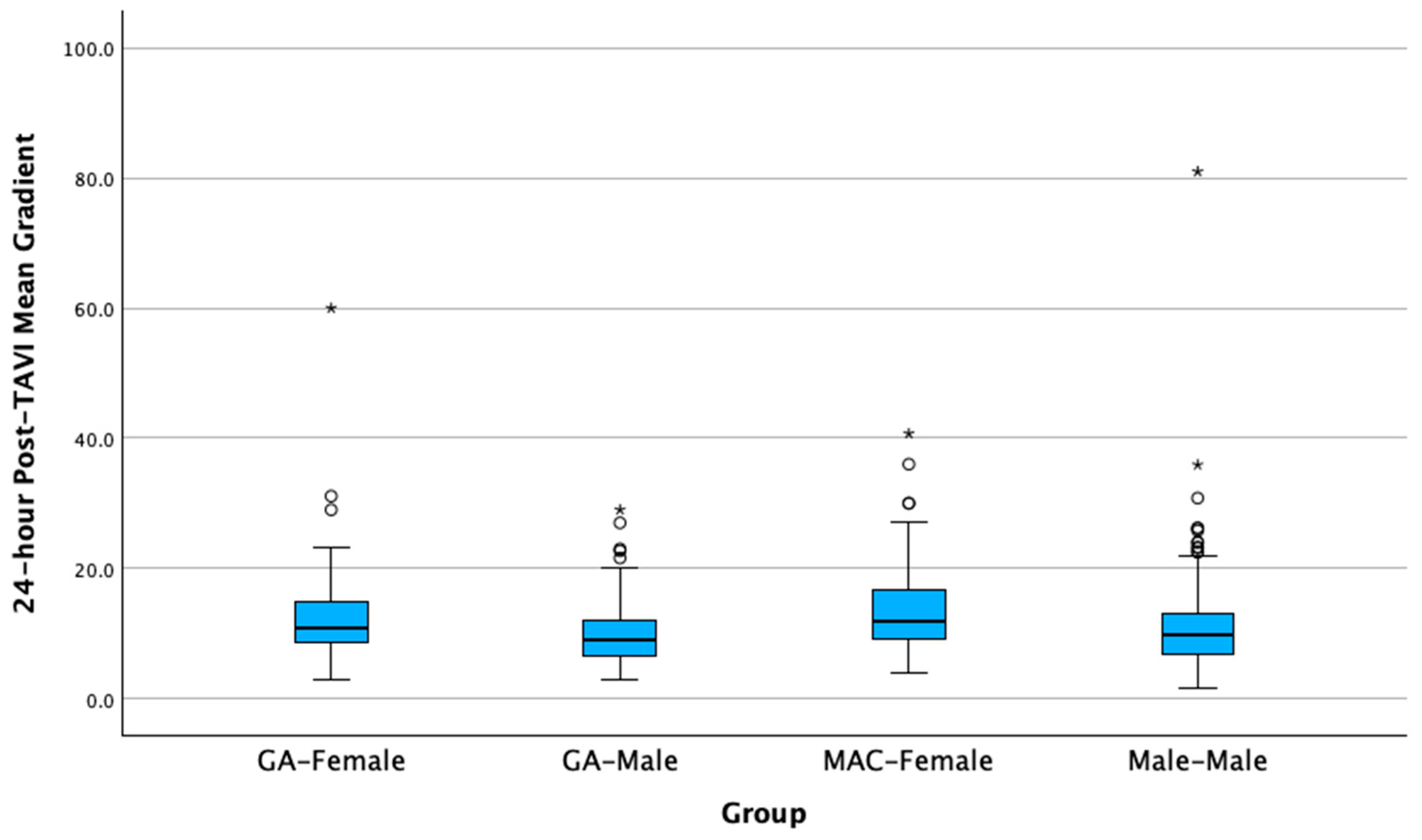
| 24 h TAVI mean gradient | 9 [6.6–12.0] | 9.7 [6.9–13.1] | 11.0 [8.6–15.0] | 12.0 [9.1–16.7] | <0.001 |
| Mean gradient delta | 4.4 [2.4–7.2] | 5.0 [2.9–8.0] | 6.4 [4.1–9.8] | 7.1 [4.0–10.8] | <0.001 |
| Immediate TAVI peak gradient | 9 [7.0–12.0] | 8.0 [6.0–11.9] | 9.0 [6.1–12.0] | 10.7 [7.8–14.8] | <0.001 |
| 24 h TAVI peak gradient | 18.2 [14.0–24.5] | 19.0 [13.3–25.0] | 22.4 [7.4–30.0] | 24.1 [17.5–32.0] | <0.001 |
| Max gradient delta | 9.7 [3.9–15.0] | 10.4 [5.5–18.0] | 13.4 [8.2–18.2] | 15.0 [8.0–22.8] | <0.001 |
| 30-day TAVI mean gradient | 10.0 [6.5–11.4] | 10.0 [7.1–13.1] | 10.2 [7.4–14.9] | 12.4 [9.0–16.5] | <0.001 |
| 30-day TAVI peak gradient | 19.8 [14.1–24.0] | 19.6 [15.0–27.0] | 20.9 [16.1–29.9] | 25.0 [17.1–31.9] | <0.001 |
| 30-day EF | 55.0 [47.7–57.0] | 58.0 [55.0–63.0] | 55.0 [53.5–60.0] | 60.0 [56.0–65.0] | <0.001 |
| Presence of paravalvular leak | 22 (19.5%) | 16 (5.7%) | 18 (23.1%) | 9 (4.1%) | <0.001 |
| Severity of paravalvular leak (trace–mild) | 20 (17.7%) | 14 (5.0%) | 16 (20.5%) | 11 (5.0%) | <0.001 |
| Severity of paravalvular leak (moderate–severe) | 1 (0.9%) | 1 (0.4%) | 0 (0.0%) | 0 (0.0%) | 0.45 |
| Outcome | Male | Female | p-Value | ||
|---|---|---|---|---|---|
| General Anesthesia (n = 113) | Monitored Anesthesia Care (n = 280) | General Anesthesia (n = 78) | Monitored Anesthesia Care (n = 222) | ||
| Post-TAVI length of stay (days) | 2 [2–5] | 1 [1–2] | 3 [2–4] | 2 [1–2] | <0.001 |
| MI post-TAVI, 6 months | 1 (0.9%) | 1 (0.4%) | 0 (0.0%) | 0 (0.0%) | 0.45 |
| Stroke/TIA post-TAVI, 6 months | 5 (7.7%) | 5 (1.8%) | 6 (7.7%) | 7 (3.2%) | 0.10 |
| All cause death post-TAVI 6 months | 6 (5.3%) | 9 (3.2%) | 4 (5.1%) | 8 (3.6%) | 0.74 |
| CV death post-TAVI, 6 months | 2 (0.7%) | 5 (4.4%) | 2 (2.6%) | 4 (1.8%) | 0.12 |
| Characteristic/Outcome | MAC-Male and GA-Male | MAC-Male and MAC-Female | MAC-Male and GA-Female | GA-Male and MAC-Female | GA-Male and GA-Female | MAC-Female and GA-Female |
|---|---|---|---|---|---|---|
| Clinical History | ||||||
| NYHA class I–IV symptoms | ✓ | ✓ | ||||
| CHA2DS2-VASc Score | ✓ | ✓ | ✓ | ✓ | ||
| Hemodynamics and Anesthesia | ||||||
| SBP pre-TAVI (mmHg) | ✓ | |||||
| DBP pre-TAVI (mmHg) | ✓ | ✓ | ✓ | ✓ | ||
| DBP immediate post-TAVI (mmHg) | ✓ | ✓ | ✓ | |||
| DBP 24 h post-TAVI (mmHg) | ✓ | ✓ | ✓ | ✓ | ||
| Total fentanyl dose (mcg) | ✓ | ✓ | ✓ | ✓ | ||
| Total versed dose (mg) | ✓ | ✓ | ✓ | ✓ | ||
| Propofol bolus (mg) | ✓ | ✓ | ✓ | ✓ | ||
| Propofol infusion (mg) | ✓ | ✓ | ✓ | ✓ | ||
| Total propofol (mg) | ✓ | ✓ | ✓ | ✓ | ||
| Dexmedetomidine bolus (mcg) | ✓ | ✓ | ✓ | ✓ | ||
| Dexmedetomidine infusion (mcg) | ✓ | ✓ | ✓ | ✓ | ||
| Total Dexmedetomidine used (mcg) | ✓ | ✓ | ✓ | ✓ | ||
| IV fluids during TAVI (ml) | ✓ | ✓ | ||||
| 24 h fluid balance | ✓ | ✓ | ✓ | |||
| Pre-TAVI weight | ✓ | ✓ | ✓ | ✓ | ||
| Post TAVI weight | ✓ | ✓ | ✓ | ✓ | ||
| Echocardiographic | ||||||
| Pre-TAVR ECHO AVA (cm2) | ✓ | |||||
| Pre-TAVR EF (%) | ✓ | ✓ | ✓ | ✓ | ✓ | |
| Post-TAVR EF | ✓ | ✓ | ✓ | ✓ | ✓ | |
| Post-TAVR AVA | ✓ | ✓ | ✓ | |||
| Immediate TAVI mean gradient | ✓ | ✓ | ✓ | |||
| 24 h TAVI mean gradient | ✓ | ✓ | ✓ | ✓ | ||
| Mean gradient delta | ✓ | ✓ | ✓ | |||
| Immediate TAVI peak gradient | ✓ | |||||
| 24 h TAVI peak gradient | ✓ | ✓ | ✓ | ✓ | ||
| Peak gradient delta | ✓ | ✓ | ✓ | |||
| 30-day TAVI mean gradient | ✓ | ✓ | ||||
| 30-day TAVI peak gradient | ✓ | ✓ | ||||
| 30-day EF | ✓ | ✓ | ✓ | ✓ | ||
| Outcomes | ||||||
| Post-TAVI length of stay (days) | ✓ | ✓ | ✓ | ✓ | ✓ | |
Disclaimer/Publisher’s Note: The statements, opinions and data contained in all publications are solely those of the individual author(s) and contributor(s) and not of MDPI and/or the editor(s). MDPI and/or the editor(s) disclaim responsibility for any injury to people or property resulting from any ideas, methods, instructions or products referred to in the content. |
© 2025 by the authors. Licensee MDPI, Basel, Switzerland. This article is an open access article distributed under the terms and conditions of the Creative Commons Attribution (CC BY) license (https://creativecommons.org/licenses/by/4.0/).
Share and Cite
Fogelson, B.; Baljepally, R.; Tran, P.; Heidel, E.; Nowell, T.C.; Morvant, B.; Ferlita, S.; Weston, S.; Amro, A.; Ferraro, K.; et al. Sex-Based Differences in Hemodynamic Response to Anesthesia Type During TAVI and Early Transvalvular Gradient Changes. J. Clin. Med. 2025, 14, 6693. https://doi.org/10.3390/jcm14196693
Fogelson B, Baljepally R, Tran P, Heidel E, Nowell TC, Morvant B, Ferlita S, Weston S, Amro A, Ferraro K, et al. Sex-Based Differences in Hemodynamic Response to Anesthesia Type During TAVI and Early Transvalvular Gradient Changes. Journal of Clinical Medicine. 2025; 14(19):6693. https://doi.org/10.3390/jcm14196693
Chicago/Turabian StyleFogelson, Benjamin, Raj Baljepally, Phoebe Tran, Eric Heidel, Terrance C. Nowell, Billy Morvant, Steve Ferlita, Stefan Weston, Aladen Amro, Kirsten Ferraro, and et al. 2025. "Sex-Based Differences in Hemodynamic Response to Anesthesia Type During TAVI and Early Transvalvular Gradient Changes" Journal of Clinical Medicine 14, no. 19: 6693. https://doi.org/10.3390/jcm14196693
APA StyleFogelson, B., Baljepally, R., Tran, P., Heidel, E., Nowell, T. C., Morvant, B., Ferlita, S., Weston, S., Amro, A., Ferraro, K., Spires, Z., & Nadkarni, S. (2025). Sex-Based Differences in Hemodynamic Response to Anesthesia Type During TAVI and Early Transvalvular Gradient Changes. Journal of Clinical Medicine, 14(19), 6693. https://doi.org/10.3390/jcm14196693