Optimizing Pediatric Intermediate Care: Clinical Predictors of Deterioration and Length of Stay in a Tertiary Setting

 , , , ,
Abstract
1. Introduction
2. Materials and Methods
3. Results
3.1. Patient Characteristics and Flow
3.2. Analysis of Risk Factors for PICU Admission
3.3. Factors Influencing PIMCU Length of Stay
4. Discussion
5. Conclusions
Supplementary Materials
Author Contributions
Funding
Institutional Review Board Statement
Informed Consent Statement
Data Availability Statement
Conflicts of Interest
Abbreviations
References
- Jaimovich, D.G.; American Academy of Pediatrics Committee on Hospital Care and Section on Critical Care. Admission and discharge guidelines for the pediatric patient requiring intermediate care. Pediatrics 2004, 113, 1430–1433. [Google Scholar] [CrossRef] [PubMed]
- Geneslaw, A.S.; Jia, H.; Lucas, A.R.; Agus, M.S.D.; Edwards, J.D. Pediatric intermediate care and pediatric intensive care units: PICU metrics and an analysis of patients that use both. J. Crit. Care 2017, 41, 268–274. [Google Scholar] [CrossRef]
- Ettinger, N.A.; Hill, V.L.; Russ, C.M.; Rakoczy, K.J.; Fallat, M.E.; Wright, T.N.; Choong, K.; Agus, M.S.D.; Hsu, B.; Section on Critical Care, Committee on Hospital Care, Section on Surgery; et al. Guidance for Structuring a Pediatric Intermediate Care Unit. Pediatrics 2022, 149, e2022057009. [Google Scholar] [CrossRef] [PubMed]
- Plate, J.D.J.; Leenen, L.P.H.; Houwert, M.; Hietbrink, F. Utilisation of intermediate care units: A systematic review. Crit. Care Res. Pract. 2017, 2017, 8038460. [Google Scholar] [CrossRef]
- Brilli, R.J.; Gibson, R.; Luria, J.W.; Wheeler, T.A.; Shaw, J.; Linam, M.; Kheir, J.; McLain, P.; Lingsch, T.; Hall-Haering, A.; et al. Implementation of a medical emergency team in a large pediatric teaching hospital prevents respiratory and cardiopulmonary arrests outside the intensive care unit. Pediatr. Crit. Care Med. 2007, 8, 236–246. [Google Scholar] [CrossRef] [PubMed]
- Gregory, C.J.; Nasrollahzadeh, F.; Dharmar, M.; Parsapour, K.; Marcin, J.P. Comparison of critically ill and injured children transferred from referring hospitals versus in-house admissions. Pediatrics 2008, 121, e906–e911. [Google Scholar] [CrossRef] [PubMed]
- Odetola, F.O.; Rosenberg, A.L.; Davis, M.M.; Clark, S.J.; Dechert, R.E.; Shanley, T.P. Do outcomes vary according to the source of admission to the pediatric intensive care unit? Pediatr. Crit. Care Med. 2008, 9, 20–25. [Google Scholar] [CrossRef] [PubMed]
- Mansel, K.O.; Chen, S.W.; Mathews, A.A.; Gothard, M.D.; Bigham, M.T. Here and Gone: Rapid Transfer from the General Care Floor to the PICU. Hosp. Pediatr. 2018, 8, 524–529. [Google Scholar] [CrossRef] [PubMed]
- Miles, A.H.; Spaeder, M.C.; Stockwell, D.C. Unplanned ICU Transfers from Inpatient Units: Examining the Prevalence and Preventability of Adverse Events Associated with ICU Transfer in Pediatrics. J. Pediatr. Intensive Care 2016, 5, 21–27. [Google Scholar] [CrossRef] [PubMed] [PubMed Central]
- Maharaj, R.; Raffaele, I.; Wendon, J. Rapid response systems: A systematic review and meta-analysis. Crit. Care 2015, 19, 254. [Google Scholar] [CrossRef]
- Chan, P.S.; Jain, R.; Nallmothu, B.K.; Berg, R.A.; Sasson, C. Rapid Response Teams: A Systematic Review and Meta-analysis. Arch. Intern. Med. 2010, 170, 18–26. [Google Scholar] [CrossRef] [PubMed]
- Humphreys, S.; Totapally, B.R. Rapid Response Team Calls and Unplanned Transfers to the Pediatric Intensive Care Unit in a Pediatric Hospital. Am. J. Crit. Care 2016, 25, e9–e13. [Google Scholar] [CrossRef] [PubMed]
- Chapman, S.M.; Grocott, M.P.; Franck, L.S. Systematic review of paediatric alert criteria for identifying hospitalized children at risk of critical deterioration. Intensive Care Med. 2010, 36, 600–661. [Google Scholar] [CrossRef]
- Cheng, D.R.; Hui, C.; Langrish, K.; Beck, C.E. Anticipating Pediatric Patient Transfers from Intermediate to Intensive Care. Hosp. Pediatr. 2020, 10, 347–352. [Google Scholar] [CrossRef] [PubMed]
- Hamze-Sinno, R.; Abdoul, H.; Neve, M.; Tsapis, M.; Jones, P.; Dauger, S. Can we easily anticipate on admission pediatric patient transfers from intermediate to intensive care? Minerva Anestesiol. 2011, 77, 1022–1023. [Google Scholar] [PubMed]
- Vincent, J.L.; Rubenfeld, G.D. Does intermediate care improve patient outcomes or reduce costs? Crit. Care 2015, 19, 89. [Google Scholar] [CrossRef] [PubMed] [PubMed Central]
- Available online: https://www.acls-pals-bls.com/algorithms/pals/ (accessed on 10 June 2025).
- Available online: https://www.dati.salute.gov.it/it/dataset/classificazione-nazionale-dei-dispositivi-medici-cnd/ (accessed on 10 June 2025).
- Parshuram, C.S.; Duncan, H.P.; Joffe, A.R.; Farrell, C.A.; Lacroix, J.R.; Middaugh, K.L.; Hutchison, J.S.; Wensley, D.; Blanchard, N.; Beyene, J.; et al. Multicentre validation of the bedside paediatric early warning system score: A severity of illness score to detect evolving critical illness in hospitalised children. Crit. Care 2011, 15, R184. [Google Scholar] [CrossRef] [PubMed] [PubMed Central]
- Brisca, G.; Tardini, G.; Pirlo, D.; Romanengo, M.; Buffoni, I.; Mallamaci, M.; Carrato, V.; Lionetti, B.; Molteni, M.; Castagnola, E.; et al. Learning from the COVID-19 pandemic: IMCU as a more efficient model of pediatric critical care organization. Am. J. Emerg. Med. 2023, 64, 169–173. [Google Scholar] [CrossRef] [PubMed] [PubMed Central]
- Available online: https://www.jointcommission.org/en/standards. (accessed on 12 June 2025).
- Jaimovich, D.G. Committee on Hospital Care and Section on Critical Care. Admission and Discharge Guidelines for the Pediatric Patient Requiring Intermediate Care. Crit. Care Med. 2004, 32, 1215–1218. [Google Scholar] [CrossRef]
- SCCM Pediatric Section Task Force on Admission and Discharge Criteria; American College of Critical Care Medicine; American Academy of Pediatrics Committee on Hospital Care. Guidelines for Admission and Discharge Policies for the Pediatric Intensive Care Unit. Crit. Care Med. 1999, 27, 843–845. [Google Scholar] [CrossRef]
- Dahn, C.M.; Manasco, A.T.; Breaud, A.H.; Kim, S.; Rumas, N.; Moin, O.; Mitchell, P.M.; Nelson, K.P.; Baker, W.; Feldman, J.A. A critical analysis of unplanned ICU transfer within 48 hours from ED admission as a quality measure. Am. J. Emerg. Med. 2016, 34, 1505–1510. [Google Scholar] [CrossRef] [PubMed]
- Delgado, M.K.; Liu, V.; Pines, J.M.; Kipnis, P.; Gardner, M.N.; Escobar, G.J. Risk factors for unplanned transfer to intensive care within 24 hours of admission from the emergency department in an integrated healthcare system. J. Hosp. Med. 2013, 8, 13–19. [Google Scholar] [CrossRef] [PubMed]
- Reese, J.; Deakyne, S.J.; Blanchard, A.; Bajaj, L. Rate of preventable early unplanned intensive care unit transfer for direct admissions and emergency department admissions. Hosp. Pediatr. 2015, 5, 27–34. [Google Scholar] [CrossRef] [PubMed]
- Chan, T.; Rodean, J.; Richardson, T.; Farris, R.W.D.; Bratton, S.L.; Di Gennaro, J.L.; Simon, T.D. Pediatric Critical Care Resource Use by Children with Medical Complexity. J. Pediatr. 2016, 177, 197–203.e1. [Google Scholar] [CrossRef] [PubMed]
- Russell, C.J.; Simon, T.D. Care of children with medical complexity in the hospital setting. Pediatr. Ann. 2014, 43, e157–e162. [Google Scholar] [CrossRef] [PubMed]
- Heneghan, J.A.; Goodman, D.M.; Ramgopal, S. Variable Identification of Children with Medical Complexity in United States PICUs. Pediatr. Crit. Care Med. 2023, 24, 56–61. [Google Scholar] [CrossRef] [PubMed]
- Bonafide, C.P.; Holmes, J.H.; Nadkarni, V.M.; Lin, R.; Landis, J.R.; Keren, R. Development of a score to predict clinical deterioration in hospitalized children. J. Hosp. Med. 2012, 7, 345–349. [Google Scholar] [CrossRef] [PubMed]
- Jensen, C.S.; Kirkegaard, H.; Aagaard, H.; Olesen, H.V. Clinical profile of children experiencing in-hospital clinical deterioration requiring transfer to a higher level of care. J. Child. Health Care. 2019, 23, 522–533. [Google Scholar] [CrossRef] [PubMed]
- Krmpotic, K.; Lobos, A.T.; Chan, J.; Toppozini, C.; McGahern, C.; Momoli, F.; Plint, A.C. A Retrospective Case-Control Study to Identify Predictors of Unplanned Admission to Pediatric Intensive Care Within 24 Hours of Hospitalization. Pediatr. Crit. Care Med. 2019, 20, e293–e300, Erratum in: Pediatr Crit Care Med. 2019, 20, 1108. https://doi.org/10.1097/PCC.0000000000002142. [Google Scholar] [CrossRef] [PubMed]
- Krmpotic, K.; Lobos, A.T. Clinical profile of children requiring early unplanned admission to the PICU. Hosp. Pediatr. 2013, 3, 212–218. [Google Scholar] [CrossRef] [PubMed]
- Lampin, M.E.; Duhamel, A.; Béhal, H.; Leteurtre, S.; Leclerc, F.; Recher, M. Patient Characteristics and Severity Trajectories in a Pediatric Intermediate Care Unit. Indian. J. Pediatr. 2025, 92, 150–156. [Google Scholar] [CrossRef] [PubMed]
- Solberg, B.C.; Dirksen, C.D.; Nieman, F.H.; van Merode, G.; Ramsay, G.; Roekaerts, P.; Poeze, M. Introducing an integrated intermediate care unit improves ICU utilization: A prospective intervention study. BMC Anesthesiol. 2014, 14, 76. [Google Scholar] [CrossRef] [PubMed] [PubMed Central]
- Sfriso, F.; Biban, P.; Paglietti, M.G.; Giuntini, L.; Rufini, E.; Mondardini, M.C.; Zaglia, F.; Cutrera, R.; De Zan, F.; Amigoni, A.; et al. Distribution and characteristics of Italian paediatric intermediate care units in Italy: A national survey. Acta Paediatr. 2020, 109, 1062–1063. [Google Scholar] [CrossRef] [PubMed]



| Total | PICU Transfer Within 48 h | No PICU Transfer Within 48 h | p Univariate | OR Univariate (95%CI) | p Multivariate | OR Multivariate (95%CI) | ||||
|---|---|---|---|---|---|---|---|---|---|---|
| N | % | N | % | N | % | |||||
| Total patients | 893 | 100 | 25 | 2.8 | 868 | 97.2 | ||||
| Sex | 0.617 | |||||||||
| Female | 401 | 45 | 10 | 40 | 391 | 45 | ||||
| Male | 492 | 55 | 15 | 60 | 477 | 55 | ||||
| Age (months) median IQR | 48 | 6–128 | 72 | 12–185 | 48 | 6–27 | 0.285 | |||
| Department of Origin | 0.149 | |||||||||
| Lower intensity | 190 | 21 | 8 | 32 | 182 | 21 | ||||
| Emergency department | 596 | 67 | 14 | 56 | 582 | 67 | ||||
| Operatory room | 8 | 1 | 1 | 4 | 7 | 1 | ||||
| Pediatric Intensive Care Unit | 99 | 11 | 2 | 8 | 97 | 11 | ||||
| Reason for admission | 0.467 | |||||||||
| Respiratory | 239 | 27 | 10 | 40 | 229 | 26 | ||||
| Cardiac | 52 | 6 | 0 | 52 | 6 | |||||
| Infectious | 123 | 14 | 1 | 4 | 122 | 14 | ||||
| Neurological/psychiatric | 175 | 20 | 5 | 20 | 170 | 20 | ||||
| Gastroenterological | 45 | 5 | 0 | 45 | 5 | |||||
| Surgical/orthopaedical | 71 | 8 | 5 | 20 | 66 | 8 | ||||
| Inflammatory disease | 19 | 2 | 0 | 19 | 2 | |||||
| Nephrological/Urological | 11 | 1 | 0 | 11 | 1 | |||||
| Endocrine | 14 | 2 | 0 | 14 | 2 | |||||
| Haemato-oncological | 94 | 11 | 3 | 12 | 91 | 11 | ||||
| Other | 50 | 5 | 1 | 4 | 49 | 5 | ||||
| Underlying disease | ||||||||||
| Respiratory | 51 | 6 | 2 | 8 | 49 | 6 | 0.649 | |||
| Cardiac | 67 | 8 | 4 | 16 | 63 | 7 | 0.111 | |||
| Infectious | 14 | 2 | 0 | 14 | 2 | 1.000 | ||||
| Neurological/psychiatric | 153 | 17 | 7 | 28 | 146 | 17 | 0.144 | |||
| Gastroenterological | 29 | 3 | 1 | 4 | 28 | 3 | 0.567 | |||
| Surgical/orthopaedical | 37 | 4 | 2 | 8 | 35 | 4 | 0.278 | |||
| Inflammatory disease | 15 | 2 | 0 | 15 | 2 | 1.000 | ||||
| Nephrological/Urological | 27 | 3 | 1 | 4 | 26 | 3 | 0.541 | |||
| Endocrine | 20 | 2 | 0 | 20 | 2 | 1.000 | ||||
| Haemato-oncological | 115 | 13 | 3 | 12 | 112 | 13 | 1.000 | |||
| Metabolic disease | 35 | 4 | 4 | 16 | 31 | 4 | 0.014 | 5 (2–16) | 0.052 | 3.29 (0.99–10.94) |
| Prematurity | 48 | 5 | 1 | 4 | 47 | 5 | 1.000 | |||
| Other | 84 | 9 | 2 | 8 | 82 | 9 | 1.000 | |||
| Temperature at admission | 0.478 | |||||||||
| <37 °C | 644 | 72 | 18 | 72 | 626 | 72 | ||||
| <38.5 °C | 196 | 22 | 7 | 28 | 189 | 22 | ||||
| >38.5 °C | 53 | 6 | 0 | 53 | 6 | |||||
| Hypotension (adjusted for age) | 34 | 4 | 2 | 8 | 32 | 4 | 0.243 | |||
| Tachycardia (adjusted for age) | 138 | 15 | 5 | 20 | 133 | 15 | 0.571 | |||
| Bradycardia (adjusted for age) | 19 | 2 | 0 | 19 | 2 | 1.000 | ||||
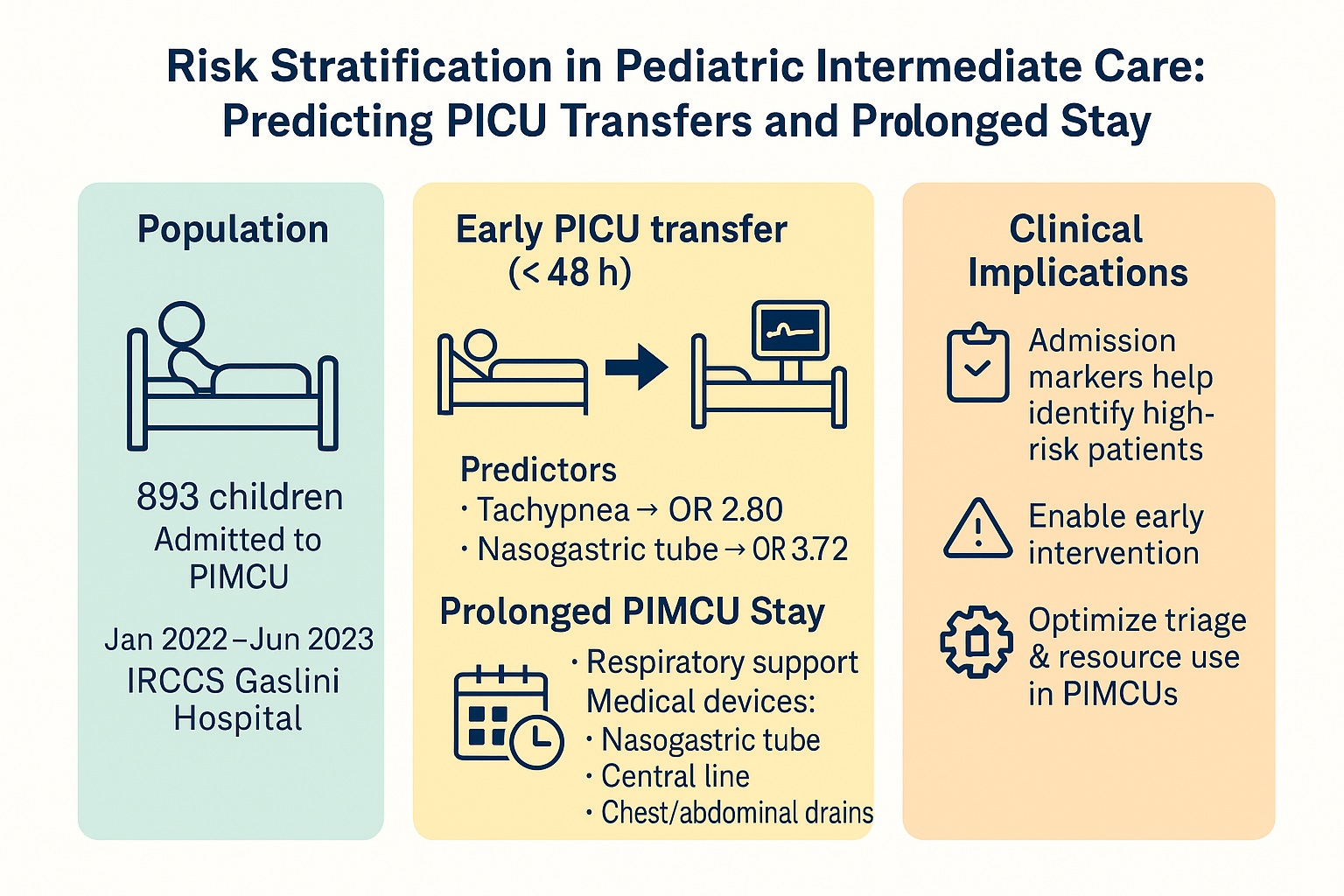
| Tachypnea (adjusted for age) | 214 | 24 | 12 | 48 | 202 | 23 | 0.008 | 3 (1.4–6.8) | 0.018 | 2.8 (1.2–6.6) |
| Bradypnea (adjusted for age) | 148 | 17 | 2 | 8 | 146 | 17 | 0.410 | |||
| SatO2/FiO2 (median, IQR) | 471 | 457–476 | 467 | 414–471 | 471 | 457–476 | 0.273 | |||
| Respiratory support (any) | 214 | 24 | 9 | 36 | 205 | 24 | 0.158 | |||
| Respiratory support type | 0.481 | |||||||||
| HFNC | 131 | 61 | 4 | 44 | 127 | 62 | ||||
| NIV | 23 | 11 | 1 | 11 | 22 | 11 | ||||
| O2 low flow | 60 | 28 | 4 | 44 | 56 | 27 | ||||
| BPEWS | 0.668 | |||||||||
| 0–2 | 716 | 94 | 18 | 100 | 698 | 93 | ||||
| 3–4 | 43 | 6 | 0 | 43 | 5 | |||||
| 5 | 2 | <1 | 0 | 2 | 1 | |||||
| ≥6 | 4 | <1 | 0 | 4 | 1 | |||||
| Device presence | ||||||||||
| Any device | 281 | 32 | 15 | 60 | 266 | 31 | 0.004 | |||
| Tracheostomy | 19 | 2 | 1 | 4 | 18 | 2 | 0.420 | |||
| Gastrostomy/ileostomy | 84 | 9 | 3 | 12 | 81 | 9 | 0.723 | |||
| Nasogastric tube | 67 | 8 | 5 | 20 | 62 | 7 | 0.033 | 3.3 (1.2–8.9) | 0.014 | 3.72 (1.30–10.57) |
| Central vascular line | 149 | 17 | 4 | 16 | 145 | 17 | 1.000 | |||
| VP/VA/EVD shunt | 28 | 3 | 1 | 4 | 27 | 3 | 0.554 | |||
| Thoracic/abdominal drainage | 14 | 2 | 1 | 4 | 13 | 2 | 0.330 | |||
| Urinary catheter | 52 | 6 | 1 | 4 | 51 | 6 | 1.000 | |||
| Peritoneal dialysis catheter | 3 | <1 | 0 | 3 | <1 | 1.000 | ||||
| Blood tests | ||||||||||
| CRP, mg/dL (median IQR) | 0.8 | 0–4 | 0.9 | 0–10 | 0.8 | 0–4 | 0.462 | |||
| PCT, ng/dL (median, IQR) | 0.2 | 0–1 | 0.4 | 0.1–2.6 | 0.2 | 0–0.9 | 0.190 | |||
| WBC, el ×103 (median, IQR) | 9.1 | 6–13 | 7.7 | 4.2–10 | 9.1 | 6–13 | 0.274 | |||
| Neutrophils, el ×103 (median, IQR) | 4.7 | 2.6–7.7 | 4.1 | 1.3–7.5 | 4.7 | 2.7–7.8 | 0.288 | |||
| Lymphocytes, el ×103 (median, IQR) | 2.2 | 1.2–4 | 1.6 | 1.2–2.3 | 2.2 | 1.2–4.1 | 0.074 | |||
| Platelets, el ×103 (median, IQR) | 290 | 202–403 | 245 | 210–330 | 290 | 200–410 | 0.160 | |||
| Hb, g/L (median, IQR) | 117 | 103–130 | 112 | 970–130 | 120 | 103–130 | 0.573 | |||
| Albumin, g/dL (median, IQR) | 3.7 | 3.2–4.1 | 3.5 | 3.1–3.8 | 3.7 | 3.2–4.1 | 0.109 | |||
| Creatinine (median, IQR) | 0.3 | 0.2–0.5 | 0.3 | 0.2–0.4 | 0.3 | 0.2–0.5 | 0.379 | |||
| Lactates (median, IQR) | 11 | 7–16 | 14 | 8–25 | 11 | 7–16 | 0.108 | |||
| Outcome | ||||||||||
| Deceased after 28 days | 11 | 1 | 5 | 20 | 6 | 7 | <0.001 | |||
| PIMCU Length of Stay (Days) | p Univariate | p Multivariable | IRR Multivariable (95% CI) | ||
|---|---|---|---|---|---|
| Median | IQR | ||||
| Total | 4 | 3–7 | |||
| Gender | 0.922 | ||||
| Female | 4 | 3–7 | |||
| Male | 4 | 3–7 | |||
| Age (months) median IQR | Spearman rho −0.074 | 0.173 | |||
| Department of Origin | <0.001 | ||||
| Lower intensity care units | 5 | 3–8 | |||
| Emergency department | 4 | 3–6 | 0.017 (vs. Lower intensity) | 0.79 (0.64, 0.96) | |
| Operatory room | 8 | 8–8 | |||
| PICU | 9 | 5.5–15.5 | |||
| Reason for hospital admission | |||||
| Respiratory | 5 | 3–8 | 0.008 | 0.119 | |
| Cardiac | 4 | 3–6 | 0.839 | ||
| Infectious | 4 | 2–6 | 0.030 | 0.422 | |
| Neurological/psychiatric | 4 | 3–5.5 | 0.041 | 0.470 | |
| Gastroenterological | 5 | 3–6 | 0.838 | ||
| Surgical/orthopaedical | 4 | 3–9.5 | 0.506 | ||
| Inflammatory disease | 5 | 4.5–6 | 0.583 | ||
| Endocrine | 3 | 3–3 | 0.246 | ||
| Cure prosecution | 7 | 5–12 | 0.140 | ||
| Haemato-oncological | 5 | 4–7.5 | 0.272 | ||
| Other | 5 | 3–6.5 | 0.827 | ||
| Underlying disease | |||||
| Respiratory | 5 | 3–5.5 | 0.911 | ||
| Cardiac | 4 | 3–7 | 0.899 | ||
| Infectious | 6 | 5–6.5 | 0.682 | ||
| Neurological/psychiatric | 4 | 3–6 | 0.533 | ||
| Gastroenterological | 6.5 | 3–10 | 0.181 | ||
| Surgical/orthopaedical | 7.5 | 4–14.5 | 0.032 | 0.470 | |
| Inflammatory disease | 6 | 4.5–6.5 | 0.705 | ||
| Nephrological/Urological | 4 | 3.5–4.5 | 0.647 | ||
| Endocrine | 3.5 | 3–4 | 0.259 | ||
| Haemato-oncological | 5 | 4–7 | 0.090 | ||
| Metabolic disease | 6.5 | 3–14.5 | 0.088 | ||
| Prematurity | 7 | 4–12 | 0.005 | 0.205 | |
| Other | 5 | 3–7 | 0.640 | ||
| Temperature at admission | 0.930 | ||||
| <37 °C | 4 | 3–7 | |||
| <38.5 °C | 4 | 3–6 | |||
| >38.5 °C | 5 | 3–7 | |||
| Hypotension (adjusted for age) | 5 | 3–6 | 0.912 | ||
| Tachycardia (adjusted for age) | 5 | 3–6 | 0.448 | ||
| Bradycardia (adjusted for age) | 4 | 3–4 | 0.609 | ||
| Tachypnea (adjusted for age) | 4 | 3–6.5 | 0.644 | ||
| Bradypnea (adjusted for age) | 5 | 3–6 | 0.771 | ||
| SatO2/FiO2 (median, IQR) | Spearman rho −0.164 | 0.002 | 0.684 | ||
| Respiratory support (any) | 6 | 4–9 | <0.001 | 0.035 | 1.36 (1.02, 1.81) |
| Respiratory support type | 0.161 | ||||
| HFNC | 7 | 5–9 | |||
| NIV | 5 | 4–6 | |||
| O2 low flow | 6 | 3.5–10 | |||
| PEWS | 0.010 | ||||
| 0–2 | 4 | 3–7 | |||
| 3–4 | 7 | 5–9 | |||
| 5 | 6 | 6–6 | |||
| ≥6 | 19 | 13–25 | |||
| Device presence | |||||
| Any device | 7 | 4–11.5 | <0.001 | ||
| Tracheostomy | 3 | 2–3 | 0.053 | ||
| Gastrostomy/ileostomy | 5 | 3–11 | 0.017 | 0.211 | |
| Nasogastric tube | 10 | 7.5–14 | <0.001 | 0.005 | 1.63 (1.15, 2.3) |
| Central vascular line | 8 | 5–14 | <0.001 | <0.001 | 1.73 (1.31, 2.27) |
| VP/VA/EVD shunt | 6.5 | 5–7 | 0.296 | ||
| Thoracic/abdominal drainage | 13 | 9–16 | 0.002 | <0.001 | 3.17 (1.81, 5.56) |
| Urinary catheter | 12.5 | 6–16 | <0.001 | 0.608 | |
| Peritoneal dialysis catheter | // | ||||
| Blood tests | |||||
| CRP (median IQR) | Spearman rho 0.192 | <0.001 | NT | ||
| PCT (median, IQR) | Spearman rho 0.204 | 0.009 | NT | ||
| WBC (median, IQR) | Spearman rho 0.036 | 0.537 | |||
| Neutrophils (median, IQR) | Spearman rho 0.013 | 0.822 | |||
| Lymphocytes (median, IQR) | Spearman rho 0.102 | 0.079 | |||
| Platelets (median, IQR) | Spearman rho 0.118 | 0.042 | NT | ||
| Hb (median, IQR) | Spearman rho −0.136 | 0.016 | NT | ||
| Albumin (median, IQR) | Spearman rho −0.159 | 0.027 | NT | ||
| Creatinine (median, IQR) | Spearman rho −0.169 | 0.005 | NT | ||
| Lactates (median, IQR) | Spearman rho −0.110 | 0.086 | |||
Disclaimer/Publisher’s Note: The statements, opinions and data contained in all publications are solely those of the individual author(s) and contributor(s) and not of MDPI and/or the editor(s). MDPI and/or the editor(s) disclaim responsibility for any injury to people or property resulting from any ideas, methods, instructions or products referred to in the content. |
© 2025 by the authors. Licensee MDPI, Basel, Switzerland. This article is an open access article distributed under the terms and conditions of the Creative Commons Attribution (CC BY) license (https://creativecommons.org/licenses/by/4.0/).
Share and Cite
Brisca, G.; Pepino, C.; Mariani, M.; Tardini, G.; Romanengo, M.; Giacheri, E.; Mallamaci, M.; Buffoni, I.; Carrato, V.; Strati, M.F.; et al. Optimizing Pediatric Intermediate Care: Clinical Predictors of Deterioration and Length of Stay in a Tertiary Setting. J. Clin. Med. 2025, 14, 6398. https://doi.org/10.3390/jcm14186398
Brisca G, Pepino C, Mariani M, Tardini G, Romanengo M, Giacheri E, Mallamaci M, Buffoni I, Carrato V, Strati MF, et al. Optimizing Pediatric Intermediate Care: Clinical Predictors of Deterioration and Length of Stay in a Tertiary Setting. Journal of Clinical Medicine. 2025; 14(18):6398. https://doi.org/10.3390/jcm14186398
Chicago/Turabian StyleBrisca, Giacomo, Carlotta Pepino, Marcello Mariani, Giacomo Tardini, Marta Romanengo, Emanuele Giacheri, Marisa Mallamaci, Isabella Buffoni, Valentina Carrato, Marina Francesca Strati, and et al. 2025. "Optimizing Pediatric Intermediate Care: Clinical Predictors of Deterioration and Length of Stay in a Tertiary Setting" Journal of Clinical Medicine 14, no. 18: 6398. https://doi.org/10.3390/jcm14186398
APA StyleBrisca, G., Pepino, C., Mariani, M., Tardini, G., Romanengo, M., Giacheri, E., Mallamaci, M., Buffoni, I., Carrato, V., Strati, M. F., Santaniello, S., Taravella, R., Puzone, L., Rossoni, L., Di Filippo, M., Pirlo, D., & Moscatelli, A. (2025). Optimizing Pediatric Intermediate Care: Clinical Predictors of Deterioration and Length of Stay in a Tertiary Setting. Journal of Clinical Medicine, 14(18), 6398. https://doi.org/10.3390/jcm14186398