Sympathetic Ophthalmia as a Complication of Untreated Choroidal Melanoma

 ,
,  , , and
Abstract
1. Introduction
2. Case Report
3. Discussion
4. Conclusions
Author Contributions
Funding
Institutional Review Board Statement
Informed Consent Statement
Data Availability Statement
Conflicts of Interest
References
- He, B.; Tanya, S.M.; Wang, C.; Kezouh, A.; Torun, N.; Ing, E. The Incidence of Sympathetic Ophthalmia After Trauma: A Meta-analysis. Am. J. Ophthalmol. 2022, 234, 117–125. [Google Scholar] [CrossRef]
- Yan, J.; Hobbs, S.D. Sympathetic Ophthalmia. In StatPearls; StatPearls Publishing: Orlando, FL, USA, 2024. Available online: https://www.ncbi.nlm.nih.gov/books/NBK589651/ (accessed on 23 July 2024).
- Paulbuddhe, V.; Addya, S.; Gurnani, B.; Singh, D.; Tripathy, K.; Chawla, R. Sympathetic Ophthalmia: Where Do We Currently Stand on Treatment Strategies? Clin. Ophthalmol. 2021, 15, 4201–4218. [Google Scholar] [CrossRef] [PubMed]
- Kaliki, S.; Shields, C.L. Uveal melanoma: Relatively rare but deadly cancer. Eye 2017, 31, 241–257. [Google Scholar] [CrossRef]
- Stålhammar, G.; Gill, V.T. Digital morphometry and cluster analysis identifies four types of melanocyte during uveal melanoma progression. Commun. Med. 2023, 3, 60. [Google Scholar] [CrossRef]
- Viswanathan, D.; Haider, A.S.; Dunlop, A.; McKeag, D. Sympathetic ophthalmia associated with untreated choroidal melanoma. Can. J. Ophthalmol. 2018, 53, e173–e176. [Google Scholar] [CrossRef]
- Brour, J.; Desjardins, L.; Lehoang, P.; Bodaghi, B.; Lumbroso-Lerouic, L.; Dendale, R.; Cassoux, N. Sympathetic Ophthalmia after Proton Beam Irradiation for Choroïdal Melanoma. Ocul. Immunol. Inflamm. 2012, 20, 273–276. [Google Scholar] [CrossRef]
- Ahmad, N.; Soong, T.K.; Salvi, S.; Rudle, P.A.; Rennie, I.G. Sympathetic ophthalmia after ruthenium plaque brachytherapy. Br. J. Ophthalmol. 2007, 91, 399–400. [Google Scholar] [CrossRef] [PubMed]
- Chen, Y.-C.; Chao, Y.-J.; Tsai, C.-C.; Chen, S.-J.; Hwang, D.-K. Sympathetic ophthalmia following radiation-induced scleral necrosis in choroidal melanoma. Taiwan J. Ophthalmol. 2023, 13, 548–551. [Google Scholar] [CrossRef] [PubMed]
- Garcia-Arumi, J.; Montolio Gil, M.; Morral Palau, M.; Segura Garcia, A. Sympathetic ophthalmia after surgical resection of iridociliary melanoma. A Case report. Graefe’s Arch. Clin. Exp. Ophthalmol. 2006, 244, 1353–1356. [Google Scholar] [CrossRef]
- Fries, P.D.; Char, D.H.; Crawford, J.B.; Waterhouse, W. Sympathetic Ophthalmia Complicating Helium Ion Irradiation of a Choroidal Melanoma. Arch. Ophthalmol. 1987, 105, 1561–1564. [Google Scholar] [CrossRef]
- Alkatan, H.M.; Al Qahtani, A.A.; Maktabi, A.M. Enucleated globes with choroidal melanoma: A retrospective histopathological study and correlation with cytogenetic profile in 2 eye centers. Ann. Med. Surg. 2020, 55, 227–233. [Google Scholar] [CrossRef]
- Tarlan, B.; Kıratlı, H. Uveal Melanoma; Current Trends in The Diagnosis and Management. Türk. Oftalmol. Derg. 2016, 46, 123–137. [Google Scholar] [CrossRef]
- Parchand, S.; Agrawal, D.; Ayyadurai, N.; Agarwal, A.; Gangwe, A.; Behera, S.; Bhatia, P.; Mulkutkar, S.; Barwar, G.; Singh, R.; et al. Sympathetic ophthalmia: A comprehensive update. Indian J. Ophthalmol. 2022, 70, 1931. [Google Scholar] [CrossRef] [PubMed]
- Macarie, S.S.; Huțu, D. Sympathetic Ophthalmia-case report. Rom. J. Ophthalmol. 2022, 66, 84–88. [Google Scholar] [PubMed]
- Suzuki, H.; Yoshioka, K.; Miyano, M.; Maeda, I.; Yamagami, K.; Morikawa, T.; Okada, N.; Konishi, Y.; Imanishi, M. Tubulointerstitial nephritis and uveitis (TINU) syndrome caused by the Chinese herb “Goreisan”. Clin. Exp. Nephrol. 2009, 13, 73–76. [Google Scholar] [CrossRef] [PubMed]



| Time | Right Eye | Left Eye |
|---|---|---|
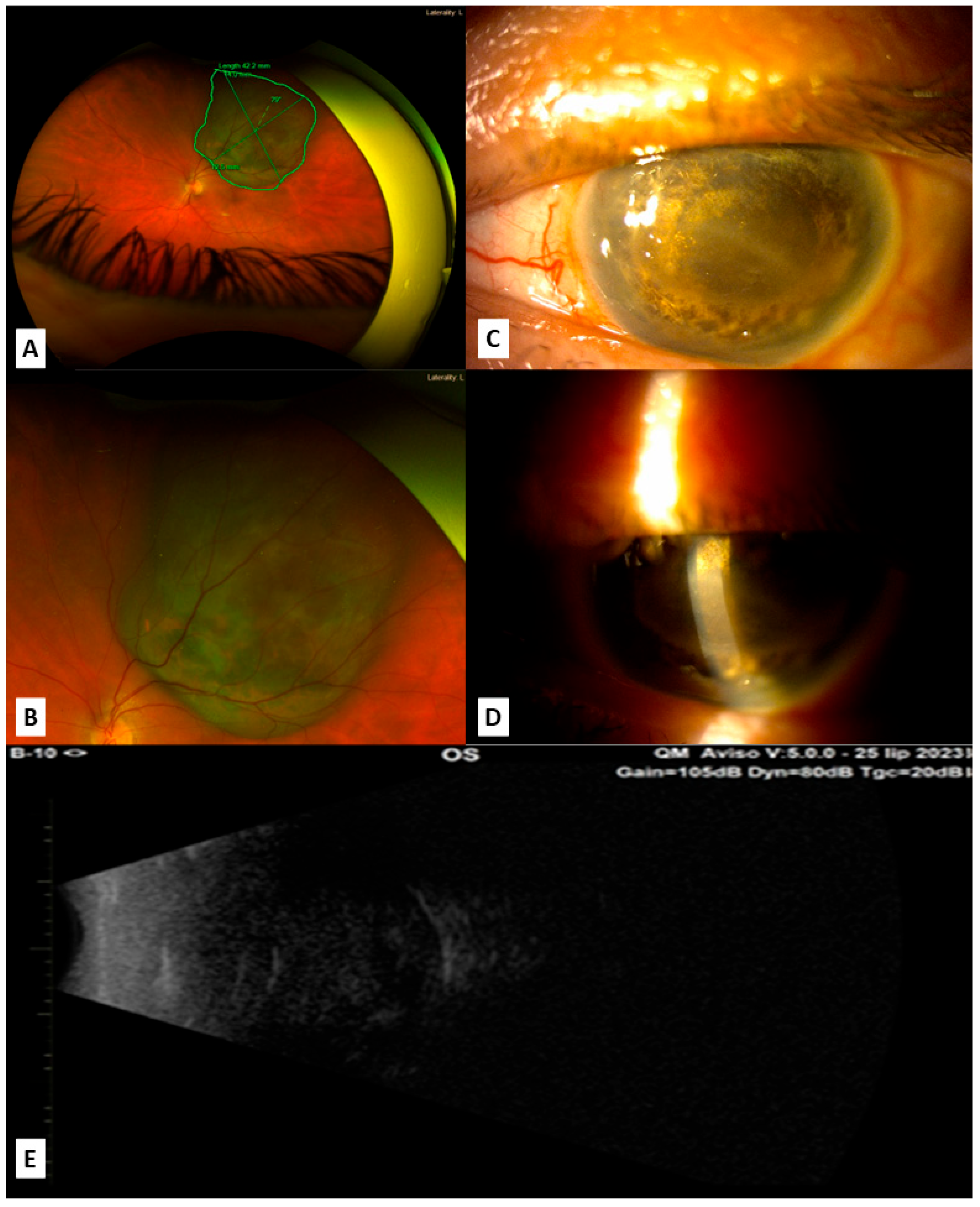
| 29 September 2021 | Physiological | Uveal melanoma diagnosis in the left eye and patient’s refusal of treatment |
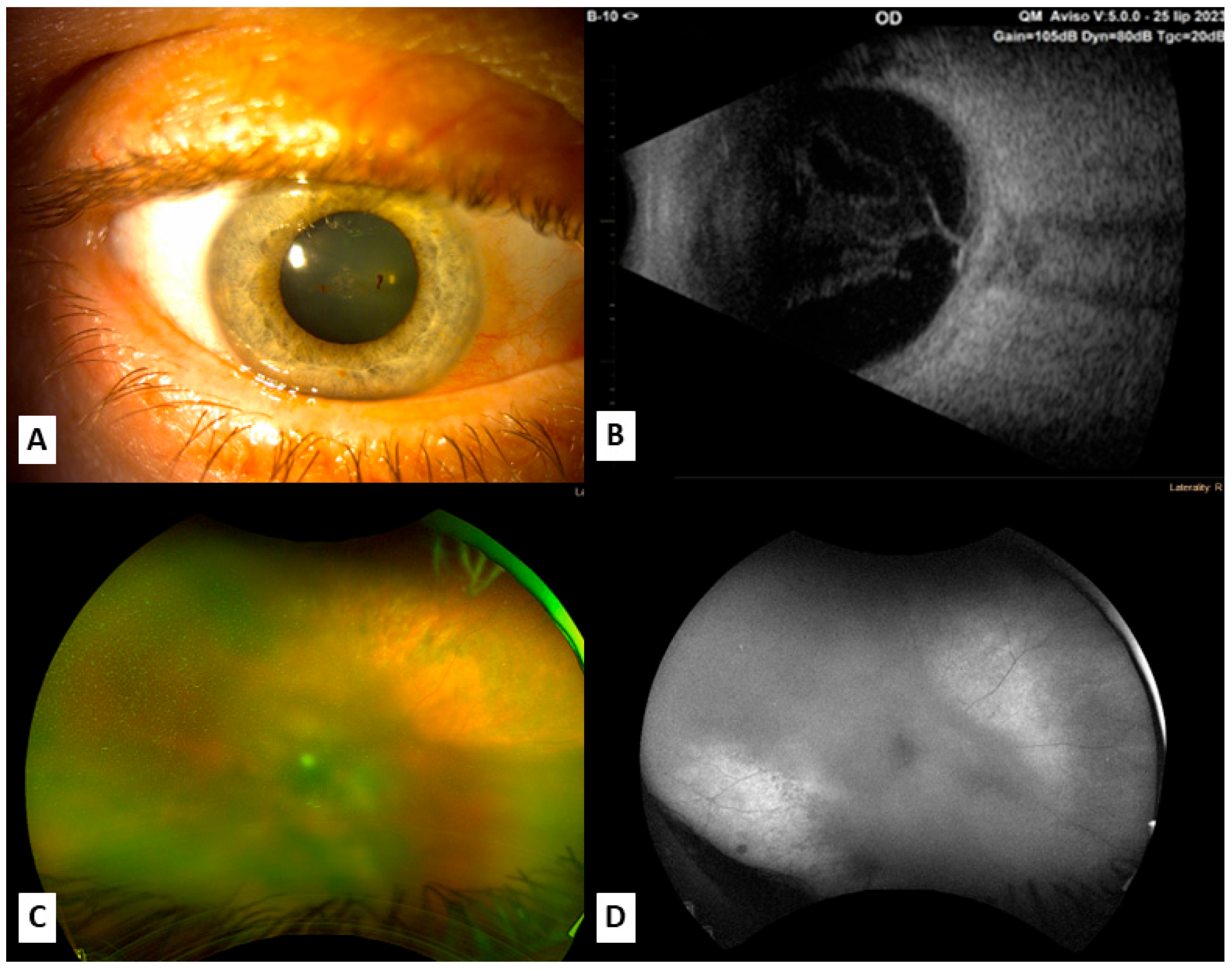
| 31 March 2023 | After 2 years of “alternative therapy” without ophthalmic care, patient has returned with SO in the right eye (VOD = 0.1). Implementation of steroid treatment. | Completely filled with tumor masses. Refusal of treatment. |
| 6 June 2023 | Continuation of treatment with steroids (VOD = 0.3), reduction in SO symptoms, incipient post-steroid cataract | Completely filled with tumor masses. Refusal of treatment. |
| 5 June 2024 | Symptoms of SO greatly reduced; post-steroid cataract and numerous vitreous floaters (VOD = 0.1) | Completely filled with tumor masses—patient agrees for enucleation of the left eye. Surgery performed on 12 June 2024. |
| 10 July 2024 | Post-steroid cataract (VOD = 0.1). Surgical intervention for the cataract was recommended. | Left eye enucleated. Histopathological examination revealed spindle cell melanoma. |
| Paper | Melanoma Status | Precipitating Factor for SO | Patient Age | Outcome |
|---|---|---|---|---|
| Fries PD et al., 1987 [11] | Choroidal melanoma OS | Helium ion irradiation | 76 | Enucleation of the left eye; BCVA 20/30 OD at SO appearance. |
| Garcia-Arumi J et al., 2006 [10] | Spindle cell melanoma of the iris and ciliary body OS | Melanoma resection | 49 | OD: BCVA 20/200 after systemic steroid and immunosuppressive (cyclosporine and azathioprine) treatment of SO, before the surgery for cataract that developed during treatment; OS: BCVA 20/25. |
| Ahmad N, Soong TK, Salvi S, Rudle PA, Rennie IG., 2007 [8] | Ciliary body malignant melanoma | 106Ru plaque brachytherapy | 41 | Vision OU 6/5 after intensive steroid treatment. |
| Brour J et al., 2012 [7] | Large choroidal juxta-papillary melanoma OS | Proton beam irradiation, then transpupillary thermotherapy | 56 | SO in right eye 7 years after melanoma irradiation treated with steroids, azathioprin, local steroids, focal laser treatment, and multiple intravitreous anti-VEGF injections. BCVA OD after treatment and cataract surgery was 20/40. |
| Brour J et al., 2012 [7] | Choroidal melanoma with retinal detachment (OD) | Proton beam irradiation and TTT of the scar, then, after complications (painful neovascular glaucoma), enucleation of the blind right eye | 63 | One year later SO developed in the left eye, VOS = 20/40. After treatment with intravenous and local steroids with antiglaucomatous eyedrops, VOS has returned to 20/20. |
| Brour J et al., 2012 [7] | Pigmented supramacular mass of 7.1 mm thickness in OD | Successful treatment with proton beam radiotherapy, complicated with irradiation retinopathy and neovascular glaucoma requiring multiple therapeutic procedures, including panretinal photocoagulation, intravitreal anti-VEGF injection, and cyclocryotherapy | 75 | After 4 years, SO occurred in the left eye; after treatment with intensive systemic steroids, local steroids, and first-line cyclophosphamide monthly, vision progressed from 20/100 to 20/40 with regression of ocular inflammation and macular edema. |
| Chen YC et al., 2022 [9] | Primary choroidal melanoma OD | Gamma Knife radiotherapy | 55 | Five years after radiotherapy SO appeared in the left eye (VOS = 0.7) along with pinkish elevated conjunctival mass in OD. After steroid pulse therapy combined with methotrexate, there was a decrease in the size of the mass in the right eye as well as SO symptoms in the left eye, along with VOS recovery to 6/6. |
| Viswanathan D et al., 2018 [6] | Six years after SO, choroidal melanoma of the left eye was diagnosed | Ocular trauma 18 months before SO or untreated choroidal melanoma | 41 | Right eye SO was treated with oral steroids and mycophenolate, cyclosporin, and methotrexate. Despite maximal tolerated treatment, OD developed persistent cystoid macular edema—treated with triamcinolone. After phacoemulsification of steroid-induced cataract, VOD was 20/40, and after 4 years, reduced to hand movement recognition. Six years after initial SO, left eye choroidal melanoma was diagnosed and eye was exenterated. |
Disclaimer/Publisher’s Note: The statements, opinions and data contained in all publications are solely those of the individual author(s) and contributor(s) and not of MDPI and/or the editor(s). MDPI and/or the editor(s) disclaim responsibility for any injury to people or property resulting from any ideas, methods, instructions or products referred to in the content. |
© 2025 by the authors. Licensee MDPI, Basel, Switzerland. This article is an open access article distributed under the terms and conditions of the Creative Commons Attribution (CC BY) license (https://creativecommons.org/licenses/by/4.0/).
Share and Cite
Chorągiewicz, T.; Oszczędłowski, P.; Dolar-Szczasny, J.; Toro, M.D.; Denysiuk, O.; Słoka, A.; Chorągiewicz, A.; Yousef, Y.A.; Rejdak, R. Sympathetic Ophthalmia as a Complication of Untreated Choroidal Melanoma. J. Clin. Med. 2025, 14, 5579. https://doi.org/10.3390/jcm14155579
Chorągiewicz T, Oszczędłowski P, Dolar-Szczasny J, Toro MD, Denysiuk O, Słoka A, Chorągiewicz A, Yousef YA, Rejdak R. Sympathetic Ophthalmia as a Complication of Untreated Choroidal Melanoma. Journal of Clinical Medicine. 2025; 14(15):5579. https://doi.org/10.3390/jcm14155579
Chicago/Turabian StyleChorągiewicz, Tomasz, Paweł Oszczędłowski, Joanna Dolar-Szczasny, Mario Damiano Toro, Olga Denysiuk, Adam Słoka, Alicja Chorągiewicz, Yacoub A. Yousef, and Robert Rejdak. 2025. "Sympathetic Ophthalmia as a Complication of Untreated Choroidal Melanoma" Journal of Clinical Medicine 14, no. 15: 5579. https://doi.org/10.3390/jcm14155579
APA StyleChorągiewicz, T., Oszczędłowski, P., Dolar-Szczasny, J., Toro, M. D., Denysiuk, O., Słoka, A., Chorągiewicz, A., Yousef, Y. A., & Rejdak, R. (2025). Sympathetic Ophthalmia as a Complication of Untreated Choroidal Melanoma. Journal of Clinical Medicine, 14(15), 5579. https://doi.org/10.3390/jcm14155579