Methodological Considerations for Studies Evaluating Bleeding Prediction Using Hemostatic Point-of-Care Tests in Cardiac Surgery

Abstract
1. Introduction
1.1. The Relevance of Bleeding Complications in Cardiac Surgery
1.2. The Relevance of Transfusion Requirements in Cardiac Surgery
1.3. The Role of Hemostatic Point-of-Care Devices in Contemporary Research of Bleeding Complications and Hemostatic Management in Cardiac Surgery
1.4. Contemporary Management of Hemostasis in Cardiac Surgery: What Do Guidelines Say?
2. Methodological Considerations for Studies Evaluating the Prediction of Bleeding Complications Using Hemostatic Point-of-Care Tests in Cardiac Surgery
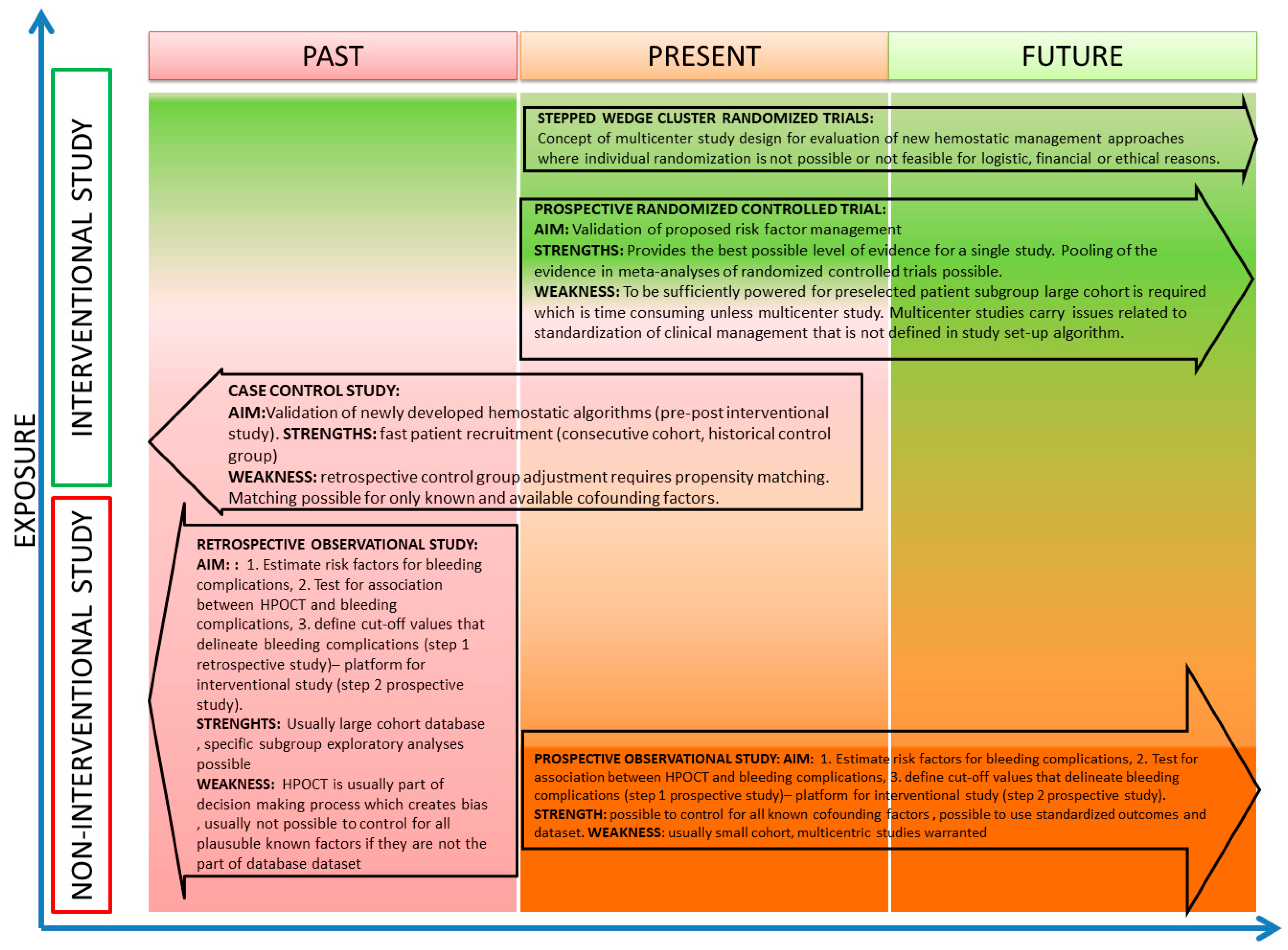
2.1. Type of Study
2.2. Prospective Studies
2.3. Retrospective Studies
2.4. Definition of Bleeding Outcomes
2.5. Bleeding Risk Stratification Models
2.6. Patient Selection
2.7. How to Set Up Appropriate Timing for Point-of-Care Measurements
- (1)
- Baseline (preoperative) hemostatic properties, in particular platelet function that may often be under considerable influence of preoperatively administered APT;
- (2)
- Intraoperative changes in hemostatic blood properties that are mainly influenced by the effects of CPB or heparin reversal by protamine;
- (3)
- Hemostatic properties following arrival to the ICU is extremely important and should not be underestimated [1].
2.8. Data Analysis—Statistical Considerations
Sample Size Calculation
2.9. Which Tests Should Be Used and When?
2.9.1. Correlation Tests
2.9.2. ROC Curve Analysis
2.10. Sensitivity, Specificity, Positive Predictive Value, and Negative Predictive Value
3. Conclusions
- Question 1: Do we have wet surgical field?—Answer 1: Yes
- Question 2: Do we have surgical bleeding?—Answer 2: No
Author Contributions
Funding
Conflicts of Interest
Abbreviations
References
- Nielsen, V.G. Coagulation crystal ball: Why can’t we predict bleeding after cardiac surgery? Anesth. Analg. 2012, 115, 490–492. [Google Scholar] [CrossRef] [Scilit] [PubMed]
- Carroll, R.C.; Chavez, J.J.; Snider, C.C.; Meyer, D.S.; Muenchen, R.A. Correlation of perioperative platelet function and coagulation tests with bleeding after cardiopulmonary bypass surgery. J. Lab. Clin. Med. 2006, 147, 197–204. [Google Scholar] [CrossRef] [Scilit] [PubMed]
- Kristensen, K.L.; Rauer, L.J.; Mortensen, P.E.; Kjeldsen, B.J. Reoperation for bleeding in cardiac surgery. Interact. Cardiovasc. Thorac. Surg. 2012, 14, 709–713. [Google Scholar] [CrossRef] [Scilit] [PubMed]
- Johansson, P.I.; Solbeck, S.; Genet, G.; Stensballe, J.; Ostrowski, S.R. Coagulopathy and hemostatic monitoring in cardiac surgery: An update. Scand. Cardiovasc. J. 2012, 46, 194–202. [Google Scholar] [CrossRef] [Scilit] [PubMed]
- Dixon, B.; Santamaria, J.D.; Reid, D.; Collins, M.; Rechnitzer, T.; Newcomb, A.E.; Nixon, I.; Yii, M.; Rosalion, A.; Campbell, D.J. The association of blood transfusion with mortality after cardiac surgery: Cause or confounding? (CME). Transfusion 2013, 53, 19–27. [Google Scholar] [CrossRef] [Scilit]
- Christensen, M.C.; Dziewior, F.; Kempel, A.; von Heymann, C. Increased chest tube drainage is independently associated with adverse outcome after cardiac surgery. J. Cardiothorac. Vasc. Anesth. 2012, 26, 46–51. [Google Scholar] [CrossRef] [Scilit]
- Ranucci, M.; Baryshnikova, E.; Castelvecchio, S.; Pelissero, G.; Surgical Clinical Outcome Research Group. Major bleeding, transfusions, and anemia: The deadly triad of cardiac surgery. Ann. Thorac. Surg. 2013, 96, 478–485. [Google Scholar] [CrossRef] [Scilit]
- Petrou, A.; Tzoka, T.; Tzimas, P.; Apostolakis, E.; Papadopoulos, G.S.; Zervou, E. Mortality associated with standard prescription transfusions in cardiac surgery. Hippokratia 2018, 22, 68–74. [Google Scholar]
- Paparella, D.; Brister, S.J.; Buchanan, M.R. Coagulation disorders of cardiopulmonary bypass: A review. Intensive Care Med. 2004, 30, 1873–1881. [Google Scholar] [CrossRef] [Scilit]
- Ranucci, M.; Bozzetti, G.; Ditta, A.; Cotza, M.; Carboni, G.; Ballotta, A. Surgical reexploration after cardiac operations: Why a worse outcome? Ann. Thorac. Surg. 2008, 86, 1557–1562. [Google Scholar] [CrossRef] [Scilit]
- Ranucci, M. Hemostatic and thrombotic issues in cardiac surgery. Semin. Thromb. Hemost. 2015, 41, 84–90. [Google Scholar] [CrossRef] [Scilit] [PubMed]
- Choong, C.K.; Gerrard, C.; Goldsmith, K.A.; Dunningham, H.; Vuylsteke, A. Delayed re-exploration for bleeding after coronary artery bypass surgery results in adverse outcomes. Eur. J. Cardio-Thorac. Surg. 2007, 31, 834–838. [Google Scholar] [CrossRef] [Scilit] [PubMed]
- Bolliger, D.; Gorlinger, K.; Tanaka, K.A. Pathophysiology and treatment of coagulopathy in massive hemorrhage and hemodilution. Anesthesiology 2010, 113, 1205–1219. [Google Scholar] [CrossRef] [Scilit] [PubMed]
- Meesters, M.I.; Veerhoek, D.; de Lange, F.; de Vries, J.W.; de Jong, J.R.; Romijn, J.W.; Kelchtermans, H.; Huskens, D.; van der Steeg, R.; Thomas, P.W.; et al. Effect of high or low protamine dosing on postoperative bleeding following heparin anticoagulation in cardiac surgery. A randomised clinical trial. Thromb. Haemost. 2016, 116, 251–261. [Google Scholar] [CrossRef] [Scilit] [PubMed]
- Boer, C.; Meesters, M.I.; Veerhoek, D.; Vonk, A.B.A. Anticoagulant and side-effects of protamine in cardiac surgery: A narrative review. Br. J. Anaesth. 2018, 120, 914–927. [Google Scholar] [CrossRef] [Scilit]
- Gorlinger, K.; Perez-Ferrer, A.; Dirkmann, D.; Saner, F.; Maegele, M.; Calatayud, A.A.P.; Kim, T.Y. The role of evidence-based algorithms for rotational thromboelastometry-guided bleeding management. Korean J. Anesthesiol. 2019, 72, 297–322. [Google Scholar] [CrossRef] [Scilit]
- Crescenzi, G.; Torracca, L.; Capestro, F.; Matteucci, M.L.; Rossi, M. Allogenic blood transfusion in cardiac surgery. J. Card. Surg. 2012, 27, 594–599. [Google Scholar] [CrossRef] [Scilit]
- Sullivan, M.T.; Cotten, R.; Read, E.J.; Wallace, E.L. Blood collection and transfusion in the United States in 2001. Transfusion 2007, 47, 385–394. [Google Scholar] [CrossRef] [Scilit]
- Whitson, B.A.; Huddleston, S.J.; Savik, K.; Shumway, S.J. Bloodless cardiac surgery is associated with decreased morbidity and mortality. J. Card. Surg. 2007, 22, 373–378. [Google Scholar] [CrossRef] [Scilit]
- Ferraris, V.A.; Ferraris, V.A.; Brown, J.R.; Despotis, G.J.; Hammon, J.W.; Reece, T.B.; Saha, S.P.; Song, H.K.; Clough, E.R.; Shore-Lesserson, L.J.; et al. 2011 update to the Society of Thoracic Surgeons and the Society of Cardiovascular Anesthesiologists blood conservation clinical practice guidelines. Ann. Thorac. Surg. 2011, 91, 944–982. [Google Scholar] [CrossRef] [Scilit]
- Bennett-Guerrero, E.; Zhao, Y.; O’Brien, S.M.; Ferguson, T.B., Jr.; Peterson, E.D.; Gammie, J.S.; Song, H.K. Variation in use of blood transfusion in coronary artery bypass graft surgery. JAMA 2010, 304, 1568–1575. [Google Scholar] [CrossRef] [Scilit]
- Shaw, R.E.; Johnson, C.K.; Ferrari, G.; Zapolanski, A.; Brizzio, M.; Rioux, N.; Edara, S.; Sperling, J.; Grau, J.B. Balancing the benefits and risks of blood transfusions in patients undergoing cardiac surgery: A propensity-matched analysis. Interact. Cardiovasc. Thorac. Surg. 2013, 17, 96–102. [Google Scholar] [CrossRef] [Scilit]
- Ti, L.K.; Cheong, K.F.; Chen, F.G. Prediction of excessive bleeding after coronary artery bypass graft surgery: The influence of timing and heparinase on thromboelastography. J. Cardiothorac. Vasc. Anesth. 2002, 16, 545–550. [Google Scholar] [CrossRef] [Scilit]
- Practice guidelines for perioperative blood management: An updated report by the american society of anesthesiologists task force on perioperative blood management*. Anesthesiology 2015, 122, 241–275. [CrossRef] [Scilit]
- Kietaibl, S.; Ahmed, A.; Afshari, A.; Albaladejo, P.; Aldecoa, C.; Barauskas, G.; De Robertis, E.; Faraoni, D.; Filipescu, D.C.; Fries, D.; et al. Management of severe peri-operative bleeding: Guidelines from the European Society of Anaesthesiology and Intensive Care: Second update 2022. Eur. J. Anaesthesiol. 2023, 40, 226–304. [Google Scholar] [CrossRef] [Scilit]
- Kozek-Langenecker, S.A.; Afshari, A.; Albaladejo, P.; Santullano, C.A.; De Robertis, E.; Filipescu, D.C.; Fries, D.; Gorlinger, K.; Haas, T.; Imberger, G.; et al. Management of severe perioperative bleeding: Guidelines from the European Society of Anaesthesiology. Eur. J. Anaesthesiol. 2013, 30, 270–382. [Google Scholar] [CrossRef] [Scilit]
- Mahla, E.; Suarez, T.A.; Bliden, K.P.; Rehak, P.; Metzler, H.; Sequeira, A.J.; Cho, P.; Sell, J.; Fan, J.; Antonino, M.J.; et al. Platelet function measurement-based strategy to reduce bleeding and waiting time in clopidogrel-treated patients undergoing coronary artery bypass graft surgery: The timing based on platelet function strategy to reduce clopidogrel-associated bleeding related to CABG (TARGET-CABG) study. Circ. Cardiovasc. Interv. 2012, 5, 261–269. [Google Scholar] [CrossRef] [Scilit]
- Petricevic, M.; Biocina, B.; Boban, M.; Samardzic, J.; Zrno Mihaljevic, M.; Milicic, D. Bleeding risk assessment using point-of-care platelet function testing in patients undergoing coronary artery surgery: How to improve predictability. J. Card. Surg. 2014, 29, 806–807. [Google Scholar] [CrossRef] [Scilit]
- Petricevic, M.; Biocina, B.; Milicic, D.; Konosic, S.; Svetina, L.; Lekic, A.; Zdilar, B.; Burcar, I.; Milosevic, M.; Brahimaj, R.; et al. Bleeding risk assessment using whole blood impedance aggregometry and rotational thromboelastometry in patients following cardiac surgery. J. Thromb. Thrombolysis 2013, 36, 514–526. [Google Scholar] [CrossRef] [Scilit]
- Petricevic, M.; Biocina, B.; Milicic, D.; Konosic, S.; Ivancan, V.; Milosevic, M.; Burcar, I.; Gasparovic, H. Bleeding risk assessment using multiple electrode aggregometry in patients following coronary artery bypass surgery. J. Thromb. Thrombolysis 2013, 35, 31–40. [Google Scholar] [CrossRef] [Scilit]
- Straub, A.; Schiebold, D.; Wendel, H.P.; Hamilton, C.; Wagner, T.; Schmid, E.; Dietz, K.; Ziemer, G. Using reagent-supported thromboelastometry (ROTEM) to monitor haemostatic changes in congenital heart surgery employing deep hypothermic circulatory arrest. Eur. J. Cardio-Thorac. Surg. 2008, 34, 641–647. [Google Scholar] [CrossRef] [Scilit]
- Hartmann, M.; Sucker, C.; Boehm, O.; Koch, A.; Loer, S.; Zacharowski, K. Effects of cardiac surgery on hemostasis. Transfus. Med. Rev. 2006, 20, 230–241. [Google Scholar] [CrossRef] [Scilit]
- Petricevic, M.; Konosic, S.; Biocina, B.; Dirkmann, D.; White, A.; Mihaljevic, M.Z.; Ivancan, V.; Konosic, L.; Svetina, L.; Gorlinger, K. Bleeding risk assessment in patients undergoing elective cardiac surgery using ROTEM((R)) platelet and Multiplate((R)) impedance aggregometry. Anaesthesia 2016, 71, 636–647. [Google Scholar] [CrossRef] [Scilit]
- Ortmann, E.; Klein, A.A.; Sharples, L.D.; Walsh, R.; Jenkins, D.P.; Luddington, R.J.; Besser, M.W. Point-of-care assessment of hypothermia and protamine-induced platelet dysfunction with multiple electrode aggregometry (Multiplate(R)) in patients undergoing cardiopulmonary bypass. Anesth. Analg. 2013, 116, 533–540. [Google Scholar] [CrossRef] [Scilit]
- Petricevic, M.; Kopjar, T.; Biocina, B.; Milicic, D.; Kolic, K.; Boban, M.; Skoric, B.; Lekic, A.; Gasparovic, H. The predictive value of platelet function point-of-care tests for postoperative blood loss and transfusion in routine cardiac surgery: A systematic review. Thorac. Cardiovasc. Surg. 2015, 63, 2–20. [Google Scholar] [CrossRef] [Scilit]
- Sambu, N.; Warner, T.; Curzen, N. Clopidogrel withdrawal: Is there a “rebound” phenomenon? Thromb. Haemost. 2011, 105, 211–220. [Google Scholar] [CrossRef] [Scilit]
- Ranucci, M.; Baryshnikova, E. Sensitivity of Viscoelastic Tests to Platelet Function. J. Clin. Med. 2020, 9, 189. [Google Scholar] [CrossRef] [Scilit]
- Metz, C.E. Basic principles of ROC analysis. Semin. Nucl. Med. 1978, 8, 283–298. [Google Scholar] [CrossRef] [Scilit]
- Weber, C.F.; Gorlinger, K.; Meininger, D.; Herrmann, E.; Bingold, T.; Moritz, A.; Cohn, L.H.; Zacharowski, K. Point-of-care testing: A prospective, randomized clinical trial of efficacy in coagulopathic cardiac surgery patients. Anesthesiology 2012, 117, 531–547. [Google Scholar] [CrossRef] [Scilit]
- Ranucci, M.; Baryshnikova, E.; Soro, G.; Ballotta, A.; De Benedetti, D.; Conti, D.; Surgical Clinical Outcome Research Group. Multiple electrode whole-blood aggregometry and bleeding in cardiac surgery patients receiving thienopyridines. Ann. Thorac. Surg. 2011, 91, 123–129. [Google Scholar] [CrossRef] [Scilit]
- Schimmer, C.; Hamouda, K.; Sommer, S.P.; Ozkur, M.; Hain, J.; Leyh, R. The predictive value of multiple electrode platelet aggregometry (multiplate) in adult cardiac surgery. Thorac. Cardiovasc. Surg. 2013, 61, 733–743. [Google Scholar] [CrossRef] [Scilit]
- Di Dedda, U.; Ranucci, M.; Baryshnikova, E.; Castelvecchio, S. Thienopyridines resistance and recovery of platelet function after discontinuation of thienopyridines in cardiac surgery patients. Eur. J. Cardio-Thorac. Surg. 2014, 45, 165–170. [Google Scholar] [CrossRef] [Scilit]
- Rosengart, T.K.; Romeiser, J.L.; White, L.J.; Fratello, A.; Fallon, E.; Senzel, L.; Shroyer, A.L. Platelet activity measured by a rapid turnaround assay identifies coronary artery bypass grafting patients at increased risk for bleeding and transfusion complications after clopidogrel administration. J. Thorac. Cardiovasc. Surg. 2013, 146, 1259–1266; discussion 1266. [Google Scholar] [CrossRef] [Scilit]
- Haensig, M.; Kempfert, J.; Kempfert, P.M.; Girdauskas, E.; Borger, M.A.; Lehmann, S. Thrombelastometry guided blood-component therapy after cardiac surgery: A randomized study. BMC Anesth. 2019, 19, 201. [Google Scholar] [CrossRef] [Scilit]
- Mehran, R.; Rao, S.V.; Bhatt, D.L.; Gibson, C.M.; Caixeta, A.; Eikelboom, J.; Kaul, S.; Wiviott, S.D.; Menon, V.; Nikolsky, E.; et al. Standardized bleeding definitions for cardiovascular clinical trials: A consensus report from the Bleeding Academic Research Consortium. Circulation 2011, 123, 2736–2747. [Google Scholar] [CrossRef] [Scilit]
- Biancari, F.; Mikkola, R.; Heikkinen, J.; Lahtinen, J.; Kettunen, U.; Juvonen, T. Individual surgeon’s impact on the risk of re-exploration for excessive bleeding after coronary artery bypass surgery. J. Cardiothorac. Vasc. Anesth. 2012, 26, 550–556. [Google Scholar] [CrossRef] [Scilit]
- Marengo-Rowe, A.J.; Lambert, C.J.; Leveson, J.E.; Thiele, J.P.; Geisler, G.F.; Adam, M.; Mitchel, B.F., Jr. The evaluation of hemorrhage in cardiac patients who have undergone extracorporeal circulation. Transfusion 1979, 19, 426–433. [Google Scholar] [CrossRef] [Scilit]
- Michelson, E.L.; Torosian, M.; Morganroth, J.; MacVaugh, H., 3rd. Early recognition of surgically correctable causes of excessive mediastinal bleeding after coronary artery bypass graft surgery. Am. J. Surg. 1980, 139, 313–317. [Google Scholar] [CrossRef] [Scilit]
- Bagge, L.; Lilienberg, G.; Nystrom, S.O.; Tyden, H. Coagulation, fibrinolysis and bleeding after open-heart surgery. Scand. J. Thorac. Cardiovasc. Surg. 1986, 20, 151–160. [Google Scholar] [CrossRef] [Scilit]
- Hirayama, T.; Roberts, D.G.; Allers, M.; Belboul, A.; al-Khaja, N.; Olsson, G.W. Association between bleeding and reduced red cell deformability following cardiopulmonary bypass. Scand. J. Thorac. Cardiovasc. Surg. 1988, 22, 171–174. [Google Scholar] [CrossRef] [Scilit]
- Gram, J.; Janetzko, T.; Jespersen, J.; Bruhn, H.D. Enhanced effective fibrinolysis following the neutralization of heparin in open heart surgery increases the risk of post-surgical bleeding. Thromb. Haemost. 1990, 63, 241–245. [Google Scholar] [CrossRef] [Scilit] [PubMed]
- Ratnatunga, C.P.; Rees, G.M.; Kovacs, I.B. Preoperative hemostatic activity and excessive bleeding after cardiopulmonary bypass. Ann. Thorac. Surg. 1991, 52, 250–257. [Google Scholar] [CrossRef] [Scilit] [PubMed]
- Villarino, M.E.; Gordon, S.M.; Valdon, C.; Potts, D.; Fish, K.; Uyeda, C.; McCarthy, P.M.; Bland, L.A.; Anderson, R.L.; Jarvis, W.R. A cluster of severe postoperative bleeding following open heart surgery. Infect. Control. Hosp. Epidemiol. 1992, 13, 282–287. [Google Scholar] [CrossRef] [Scilit] [PubMed]
- Wang, J.S.; Lin, C.Y.; Hung, W.T.; O’Connor, M.F.; Thisted, R.A.; Lee, B.K.; Karp, R.B.; Yang, M.W. Thromboelastogram fails to predict postoperative hemorrhage in cardiac patients. Ann. Thorac. Surg. 1992, 53, 435–439. [Google Scholar] [CrossRef] [Scilit]
- Hartstein; Janssens, M. Treatment of excessive mediastinal bleeding after cardiopulmonary bypass. Ann. Thorac. Surg. 1996, 62, 1951–1954. [Google Scholar] [CrossRef] [Scilit]
- Despotis, G.J.; Filos, K.S.; Zoys, T.N.; Hogue, C.W., Jr.; Spitznagel, E.; Lappas, D.G. Factors associated with excessive postoperative blood loss and hemostatic transfusion requirements: A multivariate analysis in cardiac surgical patients. Anesth. Analg. 1996, 82, 13–21. [Google Scholar]
- Despotis, G.J.; Levine, V.; Filos, K.S.; Santoro, S.A.; Joist, J.H.; Spitznagel, E.; Goodnough, L.T. Evaluation of a new point-of-care test that measures PAF-mediated acceleration of coagulation in cardiac surgical patients. Anesthesiology 1996, 85, 1311–1323. [Google Scholar] [CrossRef] [Scilit]
- Nuttall, G.A.; Oliver, W.C.; Ereth, M.H.; Santrach, P.J. Coagulation tests predict bleeding after cardiopulmonary bypass. J. Cardiothorac. Vasc. Anesth. 1997, 11, 815–823. [Google Scholar] [CrossRef] [Scilit]
- Brown, R.S.; Thwaites, B.K.; Mongan, P.D. Tranexamic acid is effective in decreasing postoperative bleeding and transfusions in primary coronary artery bypass operations: A double-blind, randomized, placebo-controlled trial. Anesth. Analg. 1997, 85, 963–970. [Google Scholar]
- Ereth, M.H.; Nuttall, G.A.; Klindworth, J.T.; MacVeigh, I.; Santrach, P.J.; Orszulak, T.A.; Harmsen, W.S.; Oliver, W.C., Jr. Does the platelet-activated clotting test (HemoSTATUS) predict blood loss and platelet dysfunction associated with cardiopulmonary bypass? Anesth. Analg. 1997, 85, 259–264. [Google Scholar]
- Dacey, L.J.; Munoz, J.J.; Baribeau, Y.R.; Johnson, E.R.; Lahey, S.J.; Leavitt, B.J.; Quinn, R.D.; Nugent, W.C.; Birkmeyer, J.D.; O’Connor, G.T. Reexploration for hemorrhage following coronary artery bypass grafting: Incidence and risk factors. Arch. Surg. 1998, 133, 442–447. [Google Scholar] [CrossRef] [Scilit] [PubMed]
- Ereth, M.H.; Nuttall, G.A.; Santrach, P.J.; Klindworth, J.T.; Oliver, W.C., Jr.; Schaff, H.V. The relation between the platelet-activated clotting test (HemoSTATUS) and blood loss after cardiopulmonary bypass. Anesthesiology 1998, 88, 962–969. [Google Scholar] [CrossRef] [Scilit] [PubMed]
- Herwaldt, L.A.; Swartzendruber, S.K.; Edmond, M.B.; Embrey, R.P.; Wilkerson, K.R.; Wenzel, R.P.; Perl, T.M. The epidemiology of hemorrhage related to cardiothoracic operations. Infect. Control. Hosp. Epidemiol. 1998, 19, 9–16. [Google Scholar] [CrossRef] [Scilit] [PubMed]
- Despotis, G.J.; Levine, V.; Saleem, R.; Spitznagel, E.; Joist, J.H. Use of point-of-care test in identification of patients who can benefit from desmopressin during cardiac surgery: A randomised controlled trial. Lancet 1999, 354, 106–110. [Google Scholar] [CrossRef] [Scilit] [PubMed]
- Mongan, P.D.; Brown, R.S.; Thwaites, B.K. Tranexamic acid and aprotinin reduce postoperative bleeding and transfusions during primary coronary revascularization. Anesth. Analg. 1998, 87, 258–265. [Google Scholar] [CrossRef] [Scilit]
- Lasne, D.; Fiemeyer, A.; Chatellier, G.; Chammas, C.; Baron, J.F.; Aiach, M. A study of platelet functions with a new analyzer using high shear stress (PFA 100) in patients undergoing coronary artery bypass graft. Thromb. Haemost. 2000, 84, 794–799. [Google Scholar]
- Casati, V.; Guzzon, D.; Oppizzi, M.; Bellotti, F.; Franco, A.; Gerli, C.; Cossolini, M.; Torri, G.; Calori, G.; Benussi, S.; et al. Tranexamic acid compared with high-dose aprotinin in primary elective heart operations: Effects on perioperative bleeding and allogeneic transfusions. J. Thorac. Cardiovasc. Surg. 2000, 120, 520–527. [Google Scholar] [CrossRef] [Scilit]
- Yende, S.; Wunderink, R.G. Effect of clopidogrel on bleeding after coronary artery bypass surgery. Crit. Care Med. 2001, 29, 2271–2275. [Google Scholar] [CrossRef] [Scilit]
- Slaughter, T.F.; Sreeram, G.; Sharma, A.D.; El-Moalem, H.; East, C.J.; Greenberg, C.S. Reversible shear-mediated platelet dysfunction during cardiac surgery as assessed by the PFA-100 platelet function analyzer. Blood Coagul. Fibrinolysis Int. J. Haemost. Thromb. 2001, 12, 85–93. [Google Scholar] [CrossRef] [Scilit]
- Ascione, R.; Williams, S.; Lloyd, C.T.; Sundaramoorthi, T.; Pitsis, A.A.; Angelini, G.D. Reduced postoperative blood loss and transfusion requirement after beating-heart coronary operations: A prospective randomized study. J. Thorac. Cardiovasc. Surg. 2001, 121, 689–696. [Google Scholar] [CrossRef] [Scilit]
- Ereth, M.H.; Nuttall, G.A.; Ericson, D.G.; Cooney, W.P.; Fisher, B.R.; Oliver, W.C., Jr.; Schaff, H.V.; Fass, D.N. Platelet glass bead retention predicts bleeding after cardiac surgery. J. Cardiothorac. Vasc. Anesth. 2001, 15, 49–54. [Google Scholar] [CrossRef] [Scilit] [PubMed]
- Forestier, F.; Coiffic, A.; Mouton, C.; Ekouevi, D.; Chene, G.; Janvier, G. Platelet function point-of-care tests in post-bypass cardiac surgery: Are they relevant? Br. J. Anaesth. 2002, 89, 715–721. [Google Scholar] [CrossRef] [PubMed]
- Fattorutto, M.; Pradier, O.; Schmartz, D.; Ickx, B.; Barvais, L. Does the platelet function analyser (PFA-100) predict blood loss after cardiopulmonary bypass? Br. J. Anaesth. 2003, 90, 692–693. [Google Scholar] [CrossRef] [Scilit] [PubMed]
- Cammerer, U.; Dietrich, W.; Rampf, T.; Braun, S.L.; Richter, J.A. The predictive value of modified computerized thromboelastography and platelet function analysis for postoperative blood loss in routine cardiac surgery. Anesth. Analg. 2003, 96, 51–57. [Google Scholar] [CrossRef] [Scilit]
- Casati, V.; Della Valle, P.; Benussi, S.; Franco, A.; Gerli, C.; Baili, P.; Alfieri, O.; D’Angelo, A. Effects of tranexamic acid on postoperative bleeding and related hematochemical variables in coronary surgery: Comparison between on-pump and off-pump techniques. J. Thorac. Cardiovasc. Surg. 2004, 128, 83–91. [Google Scholar] [CrossRef] [Scilit]
- Pleym, H.; Stenseth, R.; Wahba, A.; Bjella, L.; Tromsdal, A.; Karevold, A.; Dale, O. Prophylactic treatment with desmopressin does not reduce postoperative bleeding after coronary surgery in patients treated with aspirin before surgery. Anesth. Analg. 2004, 98, 578–584. [Google Scholar] [CrossRef] [Scilit]
- Poston, R.; Gu, J.; Manchio, J.; Lee, A.; Brown, J.; Gammie, J.; White, C.; Griffith, B.P. Platelet function tests predict bleeding and thrombotic events after off-pump coronary bypass grafting. Eur. J. Cardio-Thorac. Surg. 2005, 27, 584–591. [Google Scholar] [CrossRef] [Scilit]
- Nuttall, G.A.; Henderson, N.; Quinn, M.; Blair, C.; Summers, L.; Williams, B.A.; Oliver, W.C.; Santrach, P.J. Excessive bleeding and transfusion in a prior cardiac surgery is associated with excessive bleeding and transfusion in the next surgery. Anesth. Analg. 2006, 102, 1012–1017. [Google Scholar] [CrossRef] [Scilit]
- Marietta, M.; Facchini, L.; Pedrazzi, P.; Busani, S.; Torelli, G. Pathophysiology of bleeding in surgery. Transplant. Proc. 2006, 38, 812–814. [Google Scholar] [CrossRef] [Scilit]
- Gerrah, R.; Brill, A.; Tshori, S.; Lubetsky, A.; Merin, G.; Varon, D. Using cone and plate(let) analyzer to predict bleeding in cardiac surgery. Asian Cardiovasc. Thorac. Ann. 2006, 14, 310–315. [Google Scholar] [CrossRef] [Scilit]
- Jimenez Rivera, J.J.; Iribarren, J.L.; Raya, J.M.; Nassar, I.; Lorente, L.; Perez, R.; Brouard, M.; Lorenzo, J.M.; Garrido, P.; Barrios, Y. Factors associated with excessive bleeding in cardiopulmonary bypass patients: A nested case-control study. J. Cardiothorac. Surg. 2007, 2, 17. [Google Scholar] [CrossRef] [Scilit] [PubMed]
- Yamada, T.; Katori, N.; Tanaka, K.A.; Takeda, J. Impact of Sonoclot hemostasis analysis after cardiopulmonary bypass on postoperative hemorrhage in cardiac surgery. J. Anesth. 2007, 21, 148–152. [Google Scholar] [CrossRef] [Scilit] [PubMed]
- Ouattara, A.; Bouzguenda, H.; Le Manach, Y.; Leger, P.; Mercadier, A.; Leprince, P.; Bonnet, N.; Montalescot, G.; Riou, B.; Coriat, P. Impact of aspirin with or without clopidogrel on postoperative bleeding and blood transfusion in coronary surgical patients treated prophylactically with a low-dose of aprotinin. Eur. Heart J. 2007, 28, 1025–1032. [Google Scholar] [CrossRef] [Scilit] [PubMed]
- Kim, J.H.; Newby, L.K.; Clare, R.M.; Shaw, L.K.; Lodge, A.J.; Smith, P.K.; Jolicoeur, E.M.; Rao, S.V.; Becker, R.C.; Mark, D.B.; et al. Clopidogrel use and bleeding after coronary artery bypass graft surgery. Am. Heart J. 2008, 156, 886–892. [Google Scholar] [CrossRef] [Scilit] [PubMed]
- Berger, J.S.; Frye, C.B.; Harshaw, Q.; Edwards, F.H.; Steinhubl, S.R.; Becker, R.C. Impact of clopidogrel in patients with acute coronary syndromes requiring coronary artery bypass surgery: A multicenter analysis. J. Am. Coll. Cardiol. 2008, 52, 1693–1701. [Google Scholar] [CrossRef] [Scilit]
- Davidson, S.J.; McGrowder, D.; Roughton, M.; Kelleher, A.A. Can ROTEM thromboelastometry predict postoperative bleeding after cardiac surgery? J. Cardiothorac. Vasc. Anesth. 2008, 22, 655–661. [Google Scholar] [CrossRef] [Scilit]
- Reinhofer, M.; Brauer, M.; Franke, U.; Barz, D.; Marx, G.; Losche, W. The value of rotation thromboelastometry to monitor disturbed perioperative haemostasis and bleeding risk in patients with cardiopulmonary bypass. Blood Coagul. Fibrinolysis Int. J. Haemost. Thromb. 2008, 19, 212–219. [Google Scholar] [CrossRef] [Scilit]
- Rahe-Meyer, N.; Solomon, C.; Winterhalter, M.; Piepenbrock, S.; Tanaka, K.; Haverich, A.; Pichlmaier, M. Thromboelastometry-guided administration of fibrinogen concentrate for the treatment of excessive intraoperative bleeding in thoracoabdominal aortic aneurysm surgery. J. Thorac. Cardiovasc. Surg. 2009, 138, 694–702. [Google Scholar] [CrossRef] [Scilit]
- Gill, R.; Herbertson, M.; Vuylsteke, A.; Olsen, P.S.; von Heymann, C.; Mythen, M.; Sellke, F.; Booth, F.; Schmidt, T.A. Safety and efficacy of recombinant activated factor VII: A randomized placebo-controlled trial in the setting of bleeding after cardiac surgery. Circulation 2009, 120, 21–27. [Google Scholar] [CrossRef] [Scilit]
- Preisman, S.; Kogan, A.; Itzkovsky, K.; Leikin, G.; Raanani, E. Modified thromboelastography evaluation of platelet dysfunction in patients undergoing coronary artery surgery. Eur. J. Cardio-Thorac. Surg. 2010, 37, 1367–1374. [Google Scholar] [CrossRef] [Scilit]
- Wasowicz, M.; McCluskey, S.A.; Wijeysundera, D.N.; Yau, T.M.; Meinri, M.; Beattie, W.S.; Karkouti, K. The incremental value of thrombelastography for prediction of excessive blood loss after cardiac surgery: An observational study. Anesth. Analg. 2010, 111, 331–338. [Google Scholar] [CrossRef] [Scilit] [PubMed]
- Herman, C.R.; Buth, K.J.; Kent, B.A.; Hirsch, G.M. Clopidogrel increases blood transfusion and hemorrhagic complications in patients undergoing cardiac surgery. Ann. Thorac. Surg. 2010, 89, 397–402. [Google Scholar] [CrossRef] [Scilit] [PubMed]
- Nesher, N.; Singh, S.K.; Fawzy, H.F.; Sever, J.Y.; Goldman, B.E.; Cohen, G.N.; Laflamme, C.; Fremes, S.E. Impact of clopidogrel use on mortality and major bleeding in patients undergoing coronary artery bypass surgery. Interact. Cardiovasc. Thorac. Surg. 2010, 10, 732–736. [Google Scholar] [CrossRef] [Scilit] [PubMed]
- Kwak, Y.L.; Kim, J.C.; Choi, Y.S.; Yoo, K.J.; Song, Y.; Shim, J.K. Clopidogrel responsiveness regardless of the discontinuation date predicts increased blood loss and transfusion requirement after off-pump coronary artery bypass graft surgery. J. Am. Coll. Cardiol. 2010, 56, 1994–2002. [Google Scholar] [CrossRef] [Scilit] [PubMed]
- Coakley, M.; Hall, J.E.; Evans, C.; Duff, E.; Billing, V.; Yang, L.; McPherson, D.; Stephens, E.; Macartney, N.; Wilkes, A.R. Assessment of thrombin generation measured before and after cardiopulmonary bypass surgery and its association with postoperative bleeding. J. Thromb. Haemost. 2011, 9, 282–292. [Google Scholar] [CrossRef] [Scilit]
- Weitzel, N.S.; Weitzel, L.B.; Epperson, L.E.; Karimpour-Ford, A.; Tran, Z.V.; Seres, T. Platelet mapping as part of modified thromboelastography (TEG(R)) in patients undergoing cardiac surgery and cardiopulmonary bypass. Anaesthesia 2012, 67, 1158–1165. [Google Scholar] [CrossRef] [Scilit]
- Lee, G.C.; Kicza, A.M.; Liu, K.Y.; Nyman, C.B.; Kaufman, R.M.; Body, S.C. Does rotational thromboelastometry (ROTEM) improve prediction of bleeding after cardiac surgery? Anesth. Analg. 2012, 115, 499–506. [Google Scholar] [CrossRef] [Scilit]
- Deja, M.A.; Kargul, T.; Domaradzki, W.; Stacel, T.; Mazur, W.; Wojakowski, W.; Gocol, R.; Gaszewska-Zurek, E.; Zurek, P.; Pytel, A.; et al. Effects of preoperative aspirin in coronary artery bypass grafting: A double-blind, placebo-controlled, randomized trial. J. Thorac. Cardiovasc. Surg. 2012, 144, 204–209. [Google Scholar] [CrossRef] [Scilit]
- Wang, G.; Xie, G.; Jiang, T.; Wang, Y.; Wang, W.; Ji, H.; Liu, M.; Chen, L.; Li, L. Tranexamic acid reduces blood loss after off-pump coronary surgery: A prospective, randomized, double-blind, placebo-controlled study. Anesth. Analg. 2012, 115, 239–243. [Google Scholar] [CrossRef] [Scilit]
- Yang, L.; Vuylsteke, A.; Gerrard, C.; Besser, M.; Baglin, T. Postoperative fibrinogen level is associated with postoperative bleeding following cardiothoracic surgery and the effect of fibrinogen replacement therapy remains uncertain. J. Thromb. Haemost. 2013, 11, 1519–1526. [Google Scholar] [CrossRef] [Scilit]
- Emeklibas, N.; Kammerer, I.; Bach, J.; Sack, F.U.; Hellstern, P. Preoperative hemostasis and its association with bleeding and blood component transfusion requirements in cardiopulmonary bypass surgery. Transfusion 2013, 53, 1226–1234. [Google Scholar] [CrossRef] [Scilit] [PubMed]
- Greiff, G.; Pleym, H.; Stenseth, R.; Berg, K.S.; Wahba, A.; Videm, V. Prediction of Bleeding after Cardiac Surgery: Comparison of Model Performances: A Prospective Observational Study. J. Cardiothorac. Vasc. Anesth. 2014, 29, 311–319. [Google Scholar] [CrossRef] [Scilit] [PubMed]
- Singh, S.K.; Devenraj, V.; Tewarson, V.; Kumar, S.; Kaushal, D.; Chandra, T. Thromboelastography in off-pump coronary artery bypass grafting. Asian Cardiovasc. Thorac. Ann. 2014, 23, 430–434. [Google Scholar] [CrossRef] [Scilit] [PubMed]
- Welsh, K.J.; Padilla, A.; Dasgupta, A.; Nguyen, A.N.; Wahed, A. Thromboelastography is a suboptimal test for determination of the underlying cause of bleeding associated with cardiopulmonary bypass and may not predict a hypercoagulable state. Am. J. Clin. Pathol. 2014, 142, 492–497. [Google Scholar] [CrossRef] [Scilit] [PubMed]
- Walden, K.; Jeppsson, A.; Nasic, S.; Backlund, E.; Karlsson, M. Low preoperative fibrinogen plasma concentration is associated with excessive bleeding after cardiac operations. Ann. Thorac. Surg. 2014, 97, 1199–1206. [Google Scholar] [CrossRef] [Scilit]
- Orlov, D.; McCluskey, S.A.; Selby, R.; Yip, P.; Pendergrast, J.; Karkouti, K. Platelet dysfunction as measured by a point-of-care monitor is an independent predictor of high blood loss in cardiac surgery. Anesth. Analg. 2014, 118, 257–263. [Google Scholar] [CrossRef] [Scilit]
- Doussau, A.; Perez, P.; Puntous, M.; Calderon, J.; Jeanne, M.; Germain, C.; Rozec, B.; Rondeau, V.; Chene, G.; Ouattara, A.; et al. Fresh-frozen plasma transfusion did not reduce 30-day mortality in patients undergoing cardiopulmonary bypass cardiac surgery with excessive bleeding: The PLASMACARD multicenter cohort study. Transfusion 2014, 54, 1114–1124. [Google Scholar] [CrossRef] [Scilit]
- Chowdhury, M.; Shore-Lesserson, L.; Mais, A.M.; Leyvi, G. Thromboelastograph with Platelet Mapping(TM) predicts postoperative chest tube drainage in patients undergoing coronary artery bypass grafting. J. Cardiothorac. Vasc. Anesth. 2014, 28, 217–223. [Google Scholar] [CrossRef] [Scilit]
- Dalen, M.; van der Linden, J.; Holm, M.; Lindvall, G.; Ivert, T. Adenosine diphosphate-induced single-platelet count aggregation and bleeding in clopidogrel-treated patients undergoing coronary artery bypass grafting. J. Cardiothorac. Vasc. Anesth. 2014, 28, 230–234. [Google Scholar] [CrossRef] [Scilit]
- Ranucci, M.; Colella, D.; Baryshnikova, E.; Di Dedda, U.; Surgical Clinical Outcome Research Group. Effect of preoperative P2Y12 and thrombin platelet receptor inhibition on bleeding after cardiac surgery. Br. J. Anaesth. 2014, 113, 970–976. [Google Scholar] [CrossRef] [Scilit]
- Negargar, S.; Anvari, S.; Abbasi, K.; Enamzadeh, E. Immediate Postoperative Complications in Patients Undergoing CABG.; Investigating the Role of Prior Coronary Stenting. J. Cardiovasc. Thorac. Res. 2014, 6, 229–234. [Google Scholar] [CrossRef] [Scilit] [PubMed]
- Agarwal, S.; Johnson, R.I.; Shaw, M. Preoperative Point-of-Care Platelet Function Testing in Cardiac Surgery. J. Cardiothorac. Vasc. Anesth. 2014, 29, 333–341. [Google Scholar] [CrossRef] [Scilit] [PubMed]
- Totonchi, Z.; Baazm, F.; Chitsazan, M.; Seifi, S. Predictors of prolonged mechanical ventilation after open heart surgery. J. Cardiovasc. Thorac. Res. 2014, 6, 211–216. [Google Scholar] [CrossRef] [Scilit] [PubMed]
- Fassl, J.; Lurati Buse, G.; Filipovic, M.; Reuthebuch, O.; Hampl, K.; Seeberger, M.D.; Bolliger, D. Perioperative administration of fibrinogen does not increase adverse cardiac and thromboembolic events after cardiac surgery. Br. J. Anaesth. 2015, 114, 225–234. [Google Scholar] [CrossRef] [Scilit] [PubMed]
- Espinosa, A.; Stenseth, R.; Videm, V.; Pleym, H. Comparison of three point-of-care testing devices to detect hemostatic changes in adult elective cardiac surgery: A prospective observational study. BMC Anesthesiol. 2014, 14, 80. [Google Scholar] [CrossRef] [Scilit]
- Kindo, M.; Hoang Minh, T.; Gerelli, S.; Perrier, S.; Meyer, N.; Schaeffer, M.; Bentz, J.; Announe, T.; Mommerot, A.; Collange, O.; et al. Plasma fibrinogen level on admission to the intensive care unit is a powerful predictor of postoperative bleeding after cardiac surgery with cardiopulmonary bypass. Thromb. Res. 2014, 134, 360–368. [Google Scholar] [CrossRef] [Scilit]
- Kim, N.Y.; Shim, J.K.; Song, J.W.; Kim, E.K.; Kwak, Y.L. Impact of preoperative fibrinogen concentration on postoperative outcome in patients who received dual antiplatelet therapy in proximity to off-pump coronary bypass surgery. Circ. J. 2014, 78, 1661–1666. [Google Scholar] [CrossRef] [Scilit]
- Sharma, A.D.; Al-Achi, A.; Seccombe, J.F.; Hummel, R.; Preston, M.; Behrend, D. Does incorporation of thromboelastography improve bleeding prediction following adult cardiac surgery? Blood Coagul. Fibrinolysis Int. J. Haemost. Thromb. 2014, 25, 561–570. [Google Scholar] [CrossRef] [Scilit]
- Ghavidel, A.A.; Toutounchi, Z.; Shahandashti, F.J.; Mirmesdagh, Y. Rotational thromboelastometry in prediction of bleeding after cardiac surgery. Asian Cardiovasc. Thorac. Ann. 2015, 23, 525–529. [Google Scholar] [CrossRef] [Scilit]
- Mishra, P.K.; Thekkudan, J.; Sahajanandan, R.; Gravenor, M.; Lakshmanan, S.; Fayaz, K.M.; Luckraz, H. The role of point-of-care assessment of platelet function in predicting postoperative bleeding and transfusion requirements after coronary artery bypass grafting. Ann. Card. Anaesth. 2015, 18, 45–51. [Google Scholar] [CrossRef] [Scilit]
- Drews, S.; Bolliger, D.; Kaiser, C.; Grapow, M.; Reuthebuch, O.; Eckstein, F.; Matt, P. Prasugrel increases the need for platelet transfusions and surgical reexploration rates compared with clopidogrel in coronary artery bypass surgery. Thorac. Cardiovasc. Surg. 2015, 63, 28–35. [Google Scholar] [CrossRef] [Scilit] [PubMed]
- Besser, M.W.; Ortmann, E.; Klein, A.A. Haemostatic management of cardiac surgical haemorrhage. Anaesthesia 2015, 70 (Suppl. 1), 87–95, e29–e31. [Google Scholar] [CrossRef] [Scilit] [PubMed]
- Lahtinen, P.; Pitkanen, O.; Musialowicz, T. Levosimendan increases bleeding risk after heart valve surgery: A retrospective analysis of a randomized trial. J. Cardiothorac. Vasc. Anesth. 2014, 28, 1238–1242. [Google Scholar] [CrossRef] [Scilit] [PubMed]
- Reed, G.W.; Kumar, A.; Guo, J.; Aranki, S.; Shekar, P.; Agnihotri, A.; Maree, A.O.; McLean, D.S.; Rosenfield, K.; Cannon, C.P. Point-of-Care Platelet Function Testing Predicts Bleeding in Patients Exposed to Clopidogrel Undergoing Coronary Artery Bypass Grafting: Verify Pre-Op TIMI 45-A Pilot Study. Clin. Cardiol. 2015, 38, 92–98. [Google Scholar] [CrossRef] [Scilit] [PubMed]
- Dyke, C.; Aronson, S.; Dietrich, W.; Hofmann, A.; Karkouti, K.; Levi, M.; Murphy, G.J.; Sellke, F.W.; Shore-Lesserson, L.; von Heymann, C.; et al. Universal definition of perioperative bleeding in adult cardiac surgery. J. Thorac. Cardiovasc. Surg. 2014, 147, 1458–1463 e1. [Google Scholar] [CrossRef] [Scilit]
- Goodnough, L.T.; Johnston, M.F.; Toy, P.T. The variability of transfusion practice in coronary artery bypass surgery. JAMA 1991, 265, 86–90. [Google Scholar] [CrossRef] [Scilit]
- Gratz, J.; Guting, H.; Thorn, S.; Brazinova, A.; Gorlinger, K.; Schafer, N.; Schochl, H.; Stanworth, S.; Maegele, M. Protocolised thromboelastometric-guided haemostatic management in patients with traumatic brain injury: A pilot study. Anaesthesia 2019, 74, 883–890. [Google Scholar] [CrossRef] [Scilit]
- Rimaitis, M.; Bilskiene, D.; Tamosuitis, T.; Vilcinis, R.; Rimaitis, K.; Macas, A. Implementation of Thromboelastometry for Coagulation Management in Isolated Traumatic Brain Injury Patients Undergoing Craniotomy. Med. Sci. Monit. 2020, 26, e922879. [Google Scholar] [CrossRef] [Scilit]
- Lumbreras-Marquez, M.I.; Singh, S.; King, C.H.; Nelson, C.I.; Jespersen, K.N.; Fields, K.G.; Wang, P.; Carusi, D.A.; Farber, M.K. Rotational thromboelastometry for the transfusion management of postpartum hemorrhage after cesarean or vaginal delivery: A single-center randomized controlled trial. J. Gynecol. Obstet. Hum. Reprod. 2022, 51, 102470. [Google Scholar] [CrossRef] [Scilit]
- Vuylsteke, A.; Pagel, C.; Gerrard, C.; Reddy, B.; Nashef, S.; Aldam, P.; Utley, M. The Papworth Bleeding Risk Score: A stratification scheme for identifying cardiac surgery patients at risk of excessive early postoperative bleeding. Eur. J. Cardio-Thorac. Surg. 2011, 39, 924–930. [Google Scholar] [CrossRef] [Scilit]
- Scharf, R.E. Drugs that affect platelet function. Semin. Thromb. Hemost. 2012, 38, 865–883. [Google Scholar] [CrossRef] [Scilit] [PubMed]
- Petricevic, M.; Petricevic, M.; Pasalic, M.; Golubic Cepulic, B.; Raos, M.; Vasicek, V.; Goerlinger, K.; Rotim, K.; Gasparovic, H.; Biocina, B. Bleeding risk stratification in coronary artery surgery: The should-not-bleed score. J. Cardiothorac. Surg. 2021, 16, 103. [Google Scholar] [CrossRef] [Scilit] [PubMed]
- Petricevic, M.; Petricevic, M.; Pasalic, M.; Cepulic, B.G.; Raos, M.; Dujmic, D.; Kalamar, V.; Mestrovic, V.; Gasparovic, H.; Vasicek, V.; et al. Cost Analysis of Transfusion Therapy in Coronary Artery Surgery. Thorac. Cardiovasc. Surg. 2019, 69, 621–629. [Google Scholar] [CrossRef] [Scilit] [PubMed]
- Mehta, R.H.; Roe, M.T.; Mulgund, J.; Ohman, E.M.; Cannon, C.P.; Gibler, W.B.; Pollack, C.V., Jr.; Smith, S.C., Jr.; Ferguson, T.B.; Peterson, E.D. Acute clopidogrel use and outcomes in patients with non-ST-segment elevation acute coronary syndromes undergoing coronary artery bypass surgery. J. Am. Coll. Cardiol. 2006, 48, 281–286. [Google Scholar] [CrossRef] [Scilit] [PubMed]
- Tricoci, P.; Huang, Z.; Held, C.; Moliterno, D.J.; Armstrong, P.W.; Van de Werf, F.; White, H.D.; Aylward, P.E.; Wallentin, L.; Chen, E.; et al. Thrombin-receptor antagonist vorapaxar in acute coronary syndromes. N. Engl. J. Med. 2012, 366, 20–33. [Google Scholar] [CrossRef] [Scilit]
- Ben-Dor, I.; Kleiman, N.S.; Lev, E. Assessment, mechanisms, and clinical implication of variability in platelet response to aspirin and clopidogrel therapy. Am. J. Cardiol. 2009, 104, 227–233. [Google Scholar] [CrossRef] [Scilit]
- Petricevic, M.; Biocina, B.; Mihaljevic, M.Z.; Boban, M.; Samardzic, J.; Konosic, S.; Ivancan, V. Preoperative prasugrel discontinuation management in coronary artery surgery. Thorac. Cardiovasc. Surg. 2015, 63, 36–37. [Google Scholar] [CrossRef] [Scilit]
- Dalen, M.; Ivert, T.; Lindvall, G.; van der Linden, J. Prasugrel-related late cardiac tamponade after coronary artery bypass surgery in a patient with a recently implanted bare metal stent. J. Cardiothorac. Vasc. Anesth. 2013, 27, e57–e58. [Google Scholar] [CrossRef] [Scilit]
- Schotola, H.; Brauer, A.; Meyer, K.; Hinz, J.; Schondube, F.A.; Bauer, M.; Mohite, P.N.; Danner, B.C.; Sossalla, S.; Popov, A.F. Perioperative outcomes of cardiac surgery patients with ongoing ticagrelor therapy: Boon and bane of a new drug. Eur. J. Cardio-Thorac. Surg. 2014, 46, 198–205. [Google Scholar] [CrossRef] [Scilit]
- Vertrees, R.A.; Conti, V.R.; Lick, S.D.; Zwischenberger, J.B.; McDaniel, L.B.; Shulman, G. Adverse effects of postoperative infusion of shed mediastinal blood. Ann. Thorac. Surg. 1996, 62, 717–723. [Google Scholar] [CrossRef] [Scilit]
- Baric, D.; Biocina, B.; Unic, D.; Sutlic, Z.; Rudez, I.; Vrca, V.B.; Brkic, K.; Ivkovic, M. Topical use of antifibrinolytic agents reduces postoperative bleeding: A double-blind, prospective, randomized study. Eur. J. Cardio-Thorac. Surg. 2007, 31, 366–371; discussion 371. [Google Scholar] [CrossRef] [Scilit] [PubMed]
- Fawzy, H.; Elmistekawy, E.; Bonneau, D.; Latter, D.; Errett, L. Can local application of Tranexamic acid reduce post-coronary bypass surgery blood loss? A randomized controlled trial. J. Cardiothorac. Surg. 2009, 4, 25. [Google Scholar] [CrossRef] [Scilit] [PubMed]
- Mutlak, H.; Reyher, C.; Meybohm, P.; Papadopoulos, N.; Hanke, A.A.; Zacharowski, K.; Weber, C.F. Multiple electrode aggregometry for the assessment of acquired platelet dysfunctions during extracorporeal circulation. Thorac. Cardiovasc. Surg. 2015, 63, 21–27. [Google Scholar] [CrossRef] [Scilit] [PubMed]
- Petricevic, M.; Biocina, B.; Milicic, D.; Svetina, L.; Boban, M.; Lekic, A.; Konosic, S.; Milosevic, M.; Gasparovic, H. Activated coagulation time vs. intrinsically activated modified rotational thromboelastometry in assessment of hemostatic disturbances and blood loss after protamine administration in elective cardiac surgery: Analysis from the clinical trial (NCT01281397). J. Cardiothorac. Surg. 2014, 9, 129. [Google Scholar] [CrossRef] [Scilit] [PubMed]
- Baryshnikova, E.; Di Dedda, U.; Ranucci, M. Are Viscoelastic Tests Clinically Useful to Identify Platelet-Dependent Bleeding in High-Risk Cardiac Surgery Patients? Anesth. Analg. 2022, 135, 1198–1206. [Google Scholar] [CrossRef] [Scilit]
- Bujang, M.A. A Step-by-Step Process on Sample Size Determination for Medical Research. Malays. J. Med. Sci. 2021, 28, 15–27. [Google Scholar] [CrossRef] [Scilit]
- Nahm, F.S. Receiver operating characteristic curve: Overview and practical use for clinicians. Korean J. Anesthesiol. 2022, 75, 25–36. [Google Scholar] [CrossRef] [Scilit]
- Monaghan, T.F.; Rahman, S.N.; Agudelo, C.W.; Wein, A.J.; Lazar, J.M.; Everaert, K.; Dmochowski, R.R. Foundational Statistical Principles in Medical Research: Sensitivity, Specificity, Positive Predictive Value, and Negative Predictive Value. Medicina 2021, 57, 503. [Google Scholar] [CrossRef] [Scilit]
- Gombotz, H.; Knotzer, H. Preoperative identification of patients with increased risk for perioperative bleeding. Curr. Opin. Anaesthesiol. 2013, 26, 82–90. [Google Scholar] [CrossRef] [Scilit]
- Pandit, T.N.; Sarode, R. Blood component support in acquired coagulopathic conditions: Is there a method to the madness? Am. J. Hematol. 2012, 87 (Suppl. 1), S56–S62. [Google Scholar] [CrossRef] [Scilit]


| Author | Year of Publication | PMID | Definition of Excessive Bleeding |
|---|---|---|---|
| Marengo-Rowe et al. [47] | 1979 | 382479 | In the postoperative period, excessive hemorrhage was defined as that exceeding 600 mL CTD in the first eight hours. |
| Michelson et al. [48] | 1980 | 6965824 | When assessed as postoperative CTD volume, postoperative mediastinal bleeding of greater than 300 mL in the 1st hour, greater than 250 mL in the 2nd hour, and greater than 150 mL/h thereafter was regarded as excessive bleeding. |
| Bagge et al. [49] | 1986 | 3738446 | Heavy bleeding was defined as CTD greater than 800 mL/16 h. |
| Hirayama et al. [50] | 1988 | 3406692 | Excessive bleeding was defined as CTD exceeding 1 L. |
| Gram et al. [51] | 1990 | 2114043 | Excessive bleeding was defined as CTD exceeding 520 mL. |
| Ratnatunga et al. [52] | 1991 | 1863147 | Excessive bleeding was defined as CTD exceeding 400 mL in the first postoperative hour, or more than 300 mL in each of the first 2 h, or more than 200 mL in each of the first 3 h, or more than 100 mL in each of the first 4 h. |
| Villarino et al. [53] | 1992 | 1375613 | Excessive bleeding was defined as CTD of greater than or equal to 1000 mL within 4 h of surgery. |
| Wang et al. [54] | 1992 | 1540061 | Excessive bleeding was defined as CTD > 10 mL/kg for the first hour and more than 200 mL/h during the first 6 h after operation |
| Hartstein et al. [55] | 1996 | 8957439 | Excessive bleeding was defined as CTD > 250 to 300 mL/h for the first 2 h followed by >150 mL/h thereafter. |
| Despotis et al. [56] | 1996 | 8712388 | Excessive bleeding was defined using the following four criteria: (1) >100 mL in any postoperative hour; (2) >150 mL in any postoperative hour; (3) >1000 mL; or (4) >1600 mL cumulative CTD in the first 24 postoperative hours. |
| Despotis et al. [57] | 1996 | 8968178 | Excessive microvascular bleeding was defined as diffuse bleeding from the surgical site without an identifiable surgical source. |
| Nuttal et al. [58] | 1997 | 9412876 | The anesthesiologist and surgeon evaluated blood loss 10 min after protamine administration. The patient was characterized as a “bleeder” if both physicians determined the surgical field was “wet” (microvaseular bleeding). |
| Robert et al. [59] | 1997 | 9356085 | Excessive 24 h CTD was defined as losses greater than 1 L |
| Ereth et al. [60] | 1997 | 9249097 | More than 200 mL/h (or 100 mL/h) of CTD in the first 4 h in the ICU |
| Dacey et al. [61] | 1998 | 9565127 | Excessive bleeding was defined as bleeding that resulted in return to the operating room. No specific indication for re-explorations were reported. Decision to re-exploration was based on surgeons preference. |
| Ereth et al. [62] | 1998 | 9579505 | The two disease states of bleeding after CPB were determined by an average of 100 mL/h and 200 mL/h CTD in the first 4 h in the ICU. |
| Herwaldt et al. [63] | 1998 | 9475343 | The definition of hemorrhage following cardiothoracic operations required one of the following: reoperation for bleeding; postoperative loss of greater than 800 mL of blood over 4 h; or surgeon-diagnosed excessive intraoperative bleeding. |
| Despotis et al. [64] | 1999 | 10408485 | Excessive postoperative bleeding was defined as CTD > 1180 mL/24 h. |
| Mongan et al. [65] | 1999 | 9706913 | Excessive postoperative bleeding was defined as CTD > 1000 mL/24 h. |
| Lasne et al. [66] | 2000 | 11127858 | Mediastinal blood loss was recorded at 12 h. Calculation of blood loss was performed using Mercuriali’s formula. The patients were divided into two groups on the basis of blood loss values: below 926 mL, i.e., below the 75th percentile. Blood loss exceeding 926 mL (75th percentile) was considered as excessive bleeding. |
| Latter group. | |||
| Casati et al. [67] | 2000 | 10962414 | Bleeding of more than 600 mL in the first 24 h was considered excessive postoperative bleeding. |
| Sachin et al. [68] | 2001 | 11801823 | Patients who bled > 100 mL/h for two consecutive hours were considered to have significant chest tube output. |
| Slaughter et al. [69] | 2001 | 11302482 | Excessive bleeding was regarded if 6 h mediastinal drainage was within the highest decile of cohort CTD distribution (exceeding 646 mL/6 h). |
| Ascione et al. [70] | 2001 | 11279409 | Excessive bleeding was defined as CTD > 150 mL/h over 2 consecutive hours. |
| Ereth et al. [71] | 2001 | 11254840 | Excessive bleeding after CPB was determined by greater than an average of 100 mL/h chest tube blood loss in the first 4 h in the intensive care unit. |
| Slaughter et al. [69] | 2001 | 11302482 | Cumulative 6 h CTD exceeding 646 mL/6 h. |
| Ti et al. [23] | 2002 | 12407603 | >1000 mL/24 h CTD or >250 mL for any two consecutive hours after arrival in the ICU. |
| Forestier et al. [72] | 2002 | 12393769 | CTD > 1 mL/kg/h for at least 1 h during the first 6 h after surgery. |
| Fattorutto et al. [73] | 2003 | 12697601 | Excessive CTD was defined as >200 mL for 2 successive hours. |
| Cammerer et al. [74] | 2003 | 12505922 | Abnormal bleeding: (1) CTD 750 mL/6 h; (2) CTD exceeding 75th percentile (500 mL/6 h postoperatively). |
| Casati et al. [75] | 2004 | 15224025 | Blood loss was recorded during the first 24 h, and excessive bleeding was defined as a blood loss greater than 600 mL in 24 h. |
| Pleym et al. [76] | 2004 | 14980901 | Excessive bleeding was regarded as CTD ≥ 200 mL/h or CTD ≥ 150 mL/h persisting for >3 h. |
| Poston et al. [77] | 2005 | 15784355 | 24 h CTD > 800 mL. |
| Nuttal et al. [78] | 2006 | 16551890 | Excessive bleeding was defined by two criteria: (a) postoperating room chest tube blood loss over 24 h more than or equal to 750 mL (chest tube drainage [CTD] > or =750); and (b) transfusion of any non-red blood cell (RBC) blood products. |
| Carrol et al. [2] | 2006 | 16581348 | Bleeding assessment by observer agreement classified into the following categories: (1) not bleeding; (2) oozing; or (3) excessive bleeding. |
| Marietta et al. [79] | 2006 | 16647479 | Excessive bleeding was defined as >2 L chest tube output after surgery without pre-defined time frame for measurement of chest tube output. |
| Gerrah et al. [80] | 2006 | 16868105 | Severe blood loss > 965 mL of CTD. |
| Jimenez-Rivera et al. [81] | 2007 | 17425777 | Excehssive bleeding was defined as 24 h blood loss of >1 L post-CPB. |
| Yamada et al. [82] | 2007 | 17458642 | Excessive bleeding was defined as CTD greater than 2 mL/kg/h during the first 4 h after surgery. |
| Quattara et al. [83] | 2007 | 17431000 | Excessive bleeding was defined as chest tube output exceeding 500 mL during the first 24 h post surgery procedure. |
| Kim HJ et al. [84] | 2008 | 19061702 | Excessive bleeding was defined as a composite endpoint consisted of (1) packed red blood cell transfusion, (2) return to the operating room for bleeding, and (3) hematocrit drop of ≥15%. |
| Berger et al. [85] | 2008 | 19007688 | Major bleeding was defined as a >5 g/dL drop in hemoglobin, intracranial bleed, fatal bleed, or cardiac tamponade. |
| Davidson et al. [86] | 2008 | 18922419 | Bleeding of 200 mL or greater in a single hour was considered an abnormal result. |
| Reinhofer et al. [87] | 2008 | 18388501 | Excessive bleeding was defined as postoperative CTO ≥ 600 mL. |
| Rahe-Mmeyer et al. [88] | 2009 | 19698858 | After weaning from CPB, neutralization of heparin, and completion of surgical hemostasis and removing all blood from the wound area using suction device, dry wound area was thoroughly covered with sterile dry surgical swabs. The extent of blood loss was determined by measuring the difference in weight of the swabs before application and 5 min of adsorbing blood. Blood loss of 60 to 250 g was defined as high-level bleeding triggering coagulation therapy. Blood loss of greater than 250 g triggered additional surgical re-exploration. |
| Gill et al. [89] | 2009 | 19546387 | Excessive bleeding was defined as CTD ≥ 200 mL/h in any one hour after arrival to the ICU or ≥2 mL/kg/hr for two consecutive hours. |
| Preismann et al. [90] | 2010 | 20181490 | Cluster analysis revealed two groups of patients with respect to bleeding tendency. CTD was significantly higher in bleeding group (1216 ± 310 mL vs. 576 ± 105 mL). |
| Wasowicz et al. [91] | 2010 | 20610554 | Excessive blood loss was defined based on the number of post-CPB RBC transfusions. Specifically, it was defined as the transfusion of 5 U of RBCs from termination of CPB to 1 day after surgery. |
| Hermann et al. [92] | 2010 | 20103308 | Excessive bleeding was defined as presence of sings of tamponade or rexploration for excessive bleeding. |
| Nesher N et al. [93] | 2010 | 20061339 | Excessive blood loss was defined as >2 L of chest tube loss in the first 24 h, which corresponded to 2 S.D. above the mean for 24 h chest tube loss following isolated coronary surgery in author’s institution. |
| Kwak et al. [94] | 2010 | 21126640 | >200 mL/h in 2 consecutive hours. |
| Coakley et al. [95] | 2011 | 21091865 | Excessive bleeding was defined as the amount of CTD exceeding 1000 mL/24 h. |
| Ranucci et al. [40] | 2011 | 21172499 | ≥800 mL/12 h CTD. |
| Mehran R et al. [45] | 2011 | 21670242 | Bleeding Academic Research Consortium defined CABG related excessive bleeding that included: (1) Perioperative intracranial bleeding within 48 h; (2) Reoperation after closure of sternotomy for the purpose of controlling bleeding; (3) Transfusion of ≥5 U whole blood or packed red blood cells within a 48 h period (only allogenic transfusions are considered transfusions for CABG-related bleeds); (4) Chest tube output ≥2 L within a 24 h period. |
| Weitzel et al. [96] | 2012 | 22809250 | >1000 mL/24 h CTD. |
| Lee et al. [97] | 2012 | 22713683 | CTD was stratified at the 75th and 90th percentile of CTD distribution in patient cohort. Bleeding outcome was dichotomized at 600 mL CTD (75th percentile) and 910 mL (90th percentile). |
| Deja et al. [98] | 2012 | 22554721 | Excessive bleeding was defined in two ways: (1) More than 750 mL of bleeding during the first postoperative 12 h; and (2) more than 1000 mL of total discharge from the chest drains. |
| Biancari et al. [46] | 2012 | 22498634 | Excessive bleeding requiring reexploration was noted in following conditions: (1) drainage > 500 mL during the first postoperative hour, >400 mL during each of the first 2 h, >300 mL during each of the first 3 h, or >1000 mL in total during the first 4 h; (2) continuous bleeding throughout the first 12 h, leading to total bleeding >100 mL/h; (3) sudden massive bleehding; (4) obvious signs of cardiac tamponade secondary to active or previous bleeding; (5) cardiac arrest of a patient who continued to bleed; and (6) excess bleeding despite the correction of coagulopathies. |
| Christensen et al. [6] | 2012 | 22100857 | Excessive bleeding was defined as postoperative drainage loss exceeding 200 mL/h in 1 h or 2 mL/kg for 2 consecutive hours occurring within 6 h after cardiac surgery. |
| Wang et al. [99] | 2012 | 21737704 | Excessive bleeding requiring re-exploration was considered when the chest tube drainage was >300 mL/h in the first 2 postoperative hours or >200 mL/h for 4 consecutive hours. |
| Biancari et al. [46] | 2012 | 22498634 | Postoperative blood loss was defined as the amount of blood loss from drainages measured on the morning of the first postoperative day or in the afternoon/evening in patients who underwent night time surgery. Postoperative blood loss was dichotomized according to 95th percentiles of postoperative blood loss (1600 mL). |
| Petricevic et al. [30] | 2013 | 22926758 | 24 h CTD ≥ 11.33 mL/kg. |
| Petricevic et al. [29] | 2013 | 23341179 | 24 h CTD ≥ 12.46 mL/kg. |
| Yang et al. [100] | 2013 | 23710825 | Clinically significant bleeding was prespecified as 3 mL/kg/h. |
| Emeklibas et al. [101] | 2013 | 22934739 | The 24 h chest tube blood volume of more than 1660 mL within 24 h after surgery (limit between third and upper quartile) was considered as excessive bleeding. |
| Ranucci et al. [7] | 2013 | 23673069 | Major bleeding was defined as blood loss (mL/12 h) greater than the tenth decile of the distribution or need for surgical revision owing to bleeding. According to the pre-stated definition, major bleeding was settled at the upper 10th decile of the distribution, sorrespondent to 900 mL/12 h. |
| Rosengart et al. [43] | 2013 | 23953984 | 12 h CTD > 437 mL. |
| Greiff et al. [102] | 2014 | 25529438 | Treshold for excessive bleeding defined as ≥2 mL/kg/h within the first 4 hours postoperatively |
| Singh et al. [103] | 2014 | 25392047 | In observational study, the total mediastinal drainage ranged from 170 to 1200 mL with a mean of 52,564 ± 19,739 mL. The amount of >500 mL was defined as excessive bleeding determinant. |
| Welsh et al. [104] | 2014 | 25239416 | Significant bleeding was defined as sustained CTD of greater than 150 mL/h or more than 2 L/24 h. |
| Walden et al. [105] | 2014 | 24507940 | Exhcessive bleeding was defined as postoperative blood loss exceeding 1000 mL/12 h. |
| Orlov et al. [106] | 2014 | 24445626 | Patients whose calculated blood loss was part of the highest quartile for the cohort were classified as having had high blood loss. The amount of 1770 mL of CTD delineated high blood loss. |
| Doussau et al. [107] | 2014 | 24117772 | (1) Excessive intraoperative bleeding: Defined as either abnormal diffuse or microvascular bleeding uncontrolled by compression and electrocoagulation, needing blood transfusion of more than two units of RBCs or more than 400 mL of cell salvage blood during for patients weighing at least 60 kg (2) Excessive postoperative bleeding: Defined as a bleeding output of more than 1.5 mL/kg/h for at least 3 h or a need for surgical reexploration for hemostasis during the 48 postoperative hours. |
| Chowdhury et al. [108] | 2014 | 24630471 | Total CTD ≥ 600 mL within 12 h after surgery was used as a cut-off to define elevated CTD. |
| Dalen et al. [109] | 2014 | 24447500 | Excessive bleeding requiring reexploration was noted in patients with bleeding of more than 500 mL/h, or more than 300 mL/h in 2 consecutive hours coupled with hemodynamic instability |
| Ranucci et al. [110] | 2014 | 25209096 | Severe bleeding was defined as the presence of at least one of the following: CTD > 1 L in the first 12 postoperative hours, need for surgical reexploration, and need for >5 units of red blood cells of fresh frozen plasma. |
| Negargar et al. [111] | 2014 | 25610554 | Postoperative bleeding requiring intervention. |
| Agarwal et al. [112] | 2014 | 25440634 | Excessive bleeding requiring re-exploration occurred in the case of CTD greater than 500 mL in the first hour or greater than 1000 mL hin the first 4 h coupled with hemodynamic instability. |
| Totonchi et al. [113] | 2014 | 25610551 | Bleeding was defined as either transfusion of ≥5 U whole blood or packed red blood cells within a 48 h period or reoperation after closure of sternotomy for the purpose of controlling bleeding. |
| Fassl et al. [114] | 2014 | 25324348 | Major bleeding was defined as postoperative bleeding volumes >1000 mL during 24 h or the need for surgical re-exploration because of bleeding. |
| Espinosa et al. [115] | 2014 | 25276093 | Excessive bleeding was defined as persistent chest tube output >200 mL/h. |
| Kindo et al. [116] | 2014 | 24857189 | Excessive bleeding group was defined as patients with a 24 h chest tube output (CTD) exceeded the 90th percentile of distribution. |
| Kim et al. [117] | 2014 | 24739221 | Excessive bleeding requiring reoperation was noted when postoperative bleeding exceeded 200 mL/h for ≥6 h or ≥400 mL for the first 1 h. |
| Sharma et al. [118] | 2014 | 24717423 | Excessive bleeding was defined as chest tube output measured within 8 postoperative hours exceeded 75th percentile of distribution. |
| Ghavidel et al. [119] | 2015 | 25587193 | Abnormal or excessive mediastinal bleeding was defined as > 200 mL in a single hour or >1000 mL. |
| Mishra et al. [120] | 2015 | 25566711 | Excessive bleeding was defined as the amount of CTD exceeding 2.5 mL/kg/h within first 3 postoperative hours. |
| Drews et al. [121] | 2015 | 24838516 | Definition of excessive bleeding requiring reexploration was based on the discretion of the surgeon and intensivist and was based on triggers such as blood loss > 600 mL over the first hour, >400 mL for two consecutive hours, >300 mL for 3 consecutive hours coupled with unstable hemodynamic condition due to progressive chest blood loss. |
| Besser et al. [122] | 2015 | 25440401 | Excessive bleeding is defined as >2 mL/kg/h. |
| Lahtinen et al. [123] | 2015 | 25281042 | Excessive bleeding was defined as total postoperative drainage volume > 1000 mL. |
| Reed GW et al. [124] | 2015 | 25655085 | Excessive bleeding was defined in two ways: (1) The first way of defining excessive bleeding was based on the Thrombolysis in Myocardial Infarction (TIMI) definitions of bleeding, with major bleeding defined as clinically significant drop in Hgb of ≥5 g/dL or HCT ≥ 15%, or bleeding that resulted in death within 7 days. Minor bleeding was defined as hemorrhage resulting in a drop in Hgb of 3 ro <5 g/dL or HCT 9% to <15%. (2) The second way in defining excessive bleeding was based on the amount of postoperative chest tube output. Excessive chest tube output was defined as chest tube output within the top tertile, or >935 mL, within 24 h. |
Disclaimer/Publisher’s Note: The statements, opinions and data contained in all publications are solely those of the individual author(s) and contributor(s) and not of MDPI and/or the editor(s). MDPI and/or the editor(s) disclaim responsibility for any injury to people or property resulting from any ideas, methods, instructions or products referred to in the content. |
© 2024 by the authors. Licensee MDPI, Basel, Switzerland. This article is an open access article distributed under the terms and conditions of the Creative Commons Attribution (CC BY) license (https://creativecommons.org/licenses/by/4.0/).
Share and Cite
Petricevic, M.; Goerlinger, K.; Milojevic, M.; Petricevic, M. Methodological Considerations for Studies Evaluating Bleeding Prediction Using Hemostatic Point-of-Care Tests in Cardiac Surgery. J. Clin. Med. 2024, 13, 6737. https://doi.org/10.3390/jcm13226737
Petricevic M, Goerlinger K, Milojevic M, Petricevic M. Methodological Considerations for Studies Evaluating Bleeding Prediction Using Hemostatic Point-of-Care Tests in Cardiac Surgery. Journal of Clinical Medicine. 2024; 13(22):6737. https://doi.org/10.3390/jcm13226737
Chicago/Turabian StylePetricevic, Mirna, Klaus Goerlinger, Milan Milojevic, and Mate Petricevic. 2024. "Methodological Considerations for Studies Evaluating Bleeding Prediction Using Hemostatic Point-of-Care Tests in Cardiac Surgery" Journal of Clinical Medicine 13, no. 22: 6737. https://doi.org/10.3390/jcm13226737
APA StylePetricevic, M., Goerlinger, K., Milojevic, M., & Petricevic, M. (2024). Methodological Considerations for Studies Evaluating Bleeding Prediction Using Hemostatic Point-of-Care Tests in Cardiac Surgery. Journal of Clinical Medicine, 13(22), 6737. https://doi.org/10.3390/jcm13226737