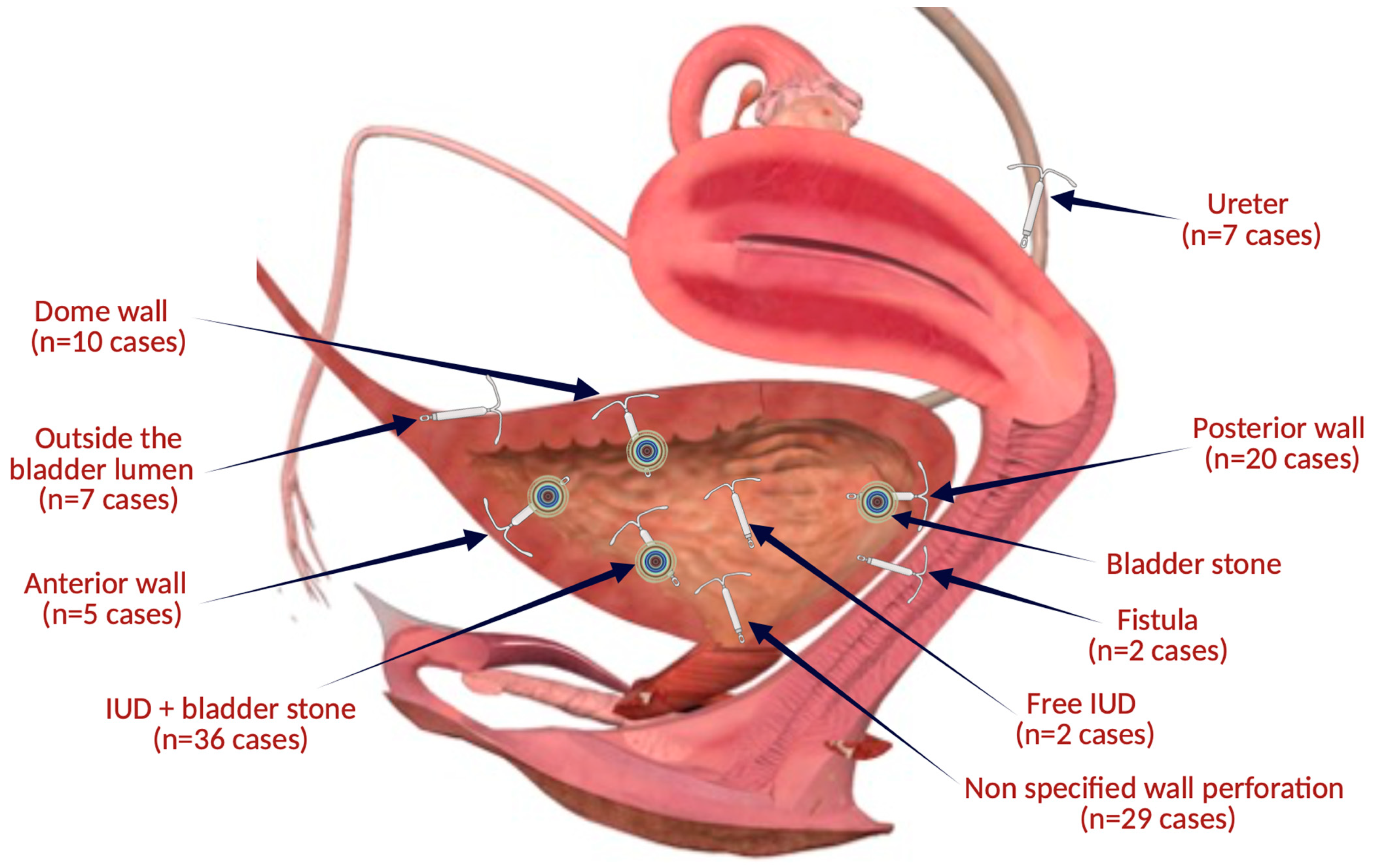
Intrauterine Contraceptive Device Migrated in the Urinary Tract: Case Report and Extensive Literature Review

 ,
, 

Abstract
1. Introduction
2. Case Presentation
3. Discussion
4. Conclusions
Supplementary Materials
Author Contributions
Funding
Institutional Review Board Statement
Informed Consent Statement
Data Availability Statement
Conflicts of Interest
References
- Gunbey, H.P.; Tanrivermis Sayit, A.; Sedakat Idilman, I.; Aksoy, O. Migration of Intrauterine Devices with Radiological Findings: Report on Two Cases. BMJ Case Rep. 2014, 2014, bcr2013202522. [Google Scholar] [CrossRef] [PubMed]
- Jb, S.; Rt, M. Mechanisms of Action of Intrauterine Devices: Update and Estimation of Postfertilization Effects. Am. J. Obstet. Gynecol. 2002, 187, 1699–1708. [Google Scholar] [CrossRef]
- Lewis, R.A.; Taylor, D.; Natavio, M.F.; Melamed, A.; Felix, J.; Mishell, D., Jr. Effects of the Levonorgestrel-Releasing Intrauterine System on Cervical Mucus Quality and Sperm Penetrability. Contraception 2010, 82, 491–496. [Google Scholar] [CrossRef] [PubMed]
- Intrauterine Devices: An Effective Alternative to Oral Hormonal Contraception. Prescrire Int. 2009, 18, 125–130.
- Cheung, M.-L.; Rezai, S.; Jackman, J.M.; Patel, N.D.; Bernaba, B.Z.; Hakimian, O.; Nuritdinova, D.; Turley, C.L.; Mercado, R.; Takeshige, T.; et al. Retained Intrauterine Device (IUD): Triple Case Report and Review of the Literature. Case Rep. Obstet. Gynecol. 2018, 2018, 9362962. [Google Scholar] [CrossRef] [PubMed]
- Aoun, J.; Dines, V.A.; Stovall, D.W.; Mete, M.; Nelson, C.B.; Gomez-Lobo, V. Effects of Age, Parity, and Device Type on Complications and Discontinuation of Intrauterine Devices. Obstet. Gynecol. 2014, 123, 585–592. [Google Scholar] [CrossRef] [PubMed]
- Aggarwal, S.; Jindal, R.P.; Deep, A. Intravesical Migration of Intrauterine Contraceptive Devices with Stone Formation. J. Fam. Med. Prim. Care 2014, 3, 449–451. [Google Scholar] [CrossRef] [PubMed]
- Takahashi, H.; Puttler, K.M.; Hong, C.; Ayzengart, A.L. Sigmoid Colon Penetration by an Intrauterine Device: A Case Report and Literature Review. Mil. Med. 2014, 179, e127–e129. [Google Scholar] [CrossRef] [PubMed]
- Aydogdu, O.; Pulat, H. Asymptomatic Far-Migration of an Intrauterine Device into the Abdominal Cavity: A Rare Entity. Can. Urol. Assoc. J. J. Assoc. Urol. Can. 2012, 6, E134–E136. [Google Scholar] [CrossRef]
- Rajaie Esfahani, M.; Abdar, A. Unusual Migration of Intrauterine Device into Bladder and Calculus Formation. Urol. J. 2007, 4, 49–51. [Google Scholar]
- Mülayim, B.; Mülayim, S.; Celik, N.Y. A Lost Intrauterine Device. Guess Where We Found It and How It Happened? Eur. J. Contracept. Reprod. Health Care Off. J. Eur. Soc. Contracept. 2006, 11, 47–49. [Google Scholar] [CrossRef] [PubMed]
- Sharifiaghdas, F.; Mohammad Ali Beigi, F.; Abdi, H. Laparoscopic Removal of a Migrated Intrauterine Device. Urol. J. 2007, 4, 177–179. [Google Scholar]
- Kho, K.A.; Chamsy, D.J. Perforated Intraperitoneal Intrauterine Contraceptive Devices: Diagnosis, Management, and Clinical Outcomes. J. Minim. Invasive Gynecol. 2014, 21, 596–601. [Google Scholar] [CrossRef] [PubMed]
- Gavin, L.; Pazol, K. Update: Providing Quality Family Planning Services—Recommendations from CDC and the U.S. Office of Population Affairs, 2015. MMWR Morb. Mortal. Wkly. Rep. 2016, 65, 231–234. [Google Scholar] [CrossRef]
- WHO Scientific Group on Mechanism of Action, Efficacy of Intrauterine Devices. Mechanism of Action, Safety and Efficacy of Intrauterine Devices. Report of a WHO Scientific Group; World Health Organization Technical Report Series; WHO: Geneva, Switzerland, 1987; Volume 753, pp. 1–91. [Google Scholar]
- Sun, C.-C.; Chang, C.-C.; Yu, M.-H. Far-Migrated Intra-Abdominal Intrauterine Device with Abdominal Pain. Taiwan J. Obstet. Gynecol. 2008, 47, 244–246. [Google Scholar] [CrossRef] [PubMed][Green Version]
- Cetinkaya, K.; Kumtepe, Y.; Ingec, M. Minimally Invasive Approach to Cases of Lost Intra-Uterine Device: A 7-Year Experience. Eur. J. Obstet. Gynecol. Reprod. Biol. 2011, 159, 119–121. [Google Scholar] [CrossRef]
- Rubin, A. Complications Due to Lippe’s Loop: Report of a Death and Other Complications Seen over an 18-Month Period at Baragwanath Hospital. S. Afr. J. Obstet. Gynaecol. 1972, 10, 45–48. [Google Scholar]
- Woods, M.; Wise, H.M. An Unusual Cause of Cystolithiasis: A Migrant Intrauterine Device. J. Urol. 1980, 124, 720–721. [Google Scholar] [CrossRef]
- Sasidharan, K.; Chally, R. Intravesical Migration of Lippes Loop with Stone Formation. Br. J. Urol. 1988, 61, 363–364. [Google Scholar] [CrossRef]
- Khan, S.R.; Wilkinson, E.J. Bladder Stone in a Human Female: The Case of an Abnormally Located Intrauterine Contraceptive Device. Scanning Microsc. 1990, 4, 395–398. [Google Scholar]
- Dietrick, D.D.; Issa, M.M.; Kabalin, J.N.; Bassett, J.B. Intravesical Migration of Intrauterine Device. J. Urol. 1992, 147, 132–134. [Google Scholar] [CrossRef] [PubMed]
- Shratter, L.A. Ultrasonographic Identification of an Ectopic Intrauterine Contraceptive Device within the Bladder: A Case Report. Am. J. Obstet. Gynecol. 1993, 169, 1608–1609. [Google Scholar] [CrossRef] [PubMed]
- el-Diasty, T.A.; Shokeir, A.A.; el-Gharib, M.S.; Sherif, L.S.; Shamaa, M.A. Bladder Stone: A Complication of Intravesical Migration of Lippes Loop. Scand. J. Urol. Nephrol. 1993, 27, 279–280. [Google Scholar] [CrossRef] [PubMed]
- Caspi, B.; Rabinerson, D.; Appelman, Z.; Kaplan, B. Penetration of the Bladder by a Perforating Intrauterine Contraceptive Device: A Sonographic Diagnosis. Ultrasound Obstet. Gynecol. Off. J. Int. Soc. Ultrasound Obstet. Gynecol. 1996, 7, 458–460. [Google Scholar] [CrossRef] [PubMed]
- Bjørnerem, A.; Tollan, A. Intrauterine Device--Primary and Secondary Perforation of the Urinary Bladder. Acta Obstet. Gynecol. Scand. 1997, 76, 383–385. [Google Scholar] [CrossRef]
- Szabó, Z.; Ficsór, E.; Nyirádi, J.; Nyirádi, T.; Pásztor, I.; Papp, F.; Danka, R. Rare Case of the Utero-Vesical Fistula Caused by Intrauterine Contraceptive Device. Acta Chir. Hung. 1997, 36, 337–339. [Google Scholar]
- Maskey, C.P.; Rahman, M.; Sigdar, T.K.; Johnsen, R. Vesical Calculus around an Intra-Uterine Contraceptive Device. Br. J. Urol. 1997, 79, 654–655. [Google Scholar] [CrossRef] [PubMed]
- Cumming, G.P.; Bramwell, S.P.; Lees, D.A. An Unusual Case of Cystolithiasis: A Urological Lesson for Gynaecologists. Br. J. Obstet. Gynaecol. 1997, 104, 117–118. [Google Scholar] [CrossRef]
- Yalçin, V.; Demirkesen, O.; Alici, B.; Onol, B.; Solok, V. An Unusual Presentation of a Foreign Body in the Urinary Bladder: A Migrant Intrauterine Device. Urol. Int. 1998, 61, 240–242. [Google Scholar] [CrossRef]
- Olaore, J.A.; Shittu, O.B.; Adewole, I.F. Intravesical Lippes Loop Following Insertion for the Treatment of Asherman’s Syndrome: A Case Report. Afr. J. Med. Med. Sci. 1999, 28, 207–208. [Google Scholar]
- Sehgal, A.; Gupta, B.; Malhotra, S. Intravesical Migration of Copper-T. Int. J. Gynaecol. Obstet. Off. Organ Int. Fed. Gynaecol. Obstet. 2000, 68, 265–266. [Google Scholar] [CrossRef]
- Güvel, S.; Tekin, M.I.; Kilinç, F.; Peskircioglu, L.; Ozkardeş, H. Bladder Stones around a Migrated and Missed Intrauterine Contraceptive Device. Int. J. Urol. Off. J. Jpn. Urol. Assoc. 2001, 8, 78–79. [Google Scholar] [CrossRef] [PubMed]
- Atakan, r.H.; Kaplan, M.; Ertrk, E. Intravesical Migration of Intrauterine Device Resulting in Stone Formation. Urology 2002, 60, 911. [Google Scholar] [CrossRef] [PubMed]
- Mahmutyazicioğlu, K.; Ozdemir, H.; Ozkan, P. Migration of an Intrauterine Contraceptive Device to the Urinary Bladder: Sonographic Findings. J. Clin. Ultrasound JCU 2002, 30, 496–498. [Google Scholar] [CrossRef]
- Senanayake, H.M.; Fernando, H. An Intrauterine Device in the Bladder Mimicking Urinary Tract Infection. Ceylon Med. J. 2002, 47, 28. [Google Scholar] [CrossRef]
- Dabbas, M.; Maaita, M. Ureteric Calculus around an Intrauterine Contraceptive Device. J. Obstet. Gynaecol. J. Inst. Obstet. Gynaecol. 2002, 22, 101–102. [Google Scholar] [CrossRef] [PubMed]
- Demirci, D.; Ekmekçioğlu, O.; Demirtaş, A.; Gülmez, I. Big Bladder Stones around an Intravesical Migrated Intrauterine Device. Int. Urol. Nephrol. 2003, 35, 495–496. [Google Scholar] [CrossRef]
- Wei, T.-Y.; Hsieh, C.-C.; Lo, T.-S. Intravesical Migration of an Intrauterine Device with Stone Formation. Aust. N. Z. J. Obstet. Gynaecol. 2003, 43, 391–392. [Google Scholar] [CrossRef] [PubMed]
- Rafique, M.; Rauf, A.; Khan, N.A.; Haque, T.U. An Unusual Cause of Vesical Stone: A Migrant Intrauterine Device. Eur. J. Contracept. Reprod. Health Care Off. J. Eur. Soc. Contracept. 2003, 8, 170–172. [Google Scholar] [CrossRef]
- Eke, N.; Okpani, A.O. Extrauterine Translocated Contraceptive Device: A Presentation of Five Cases and Revisit of the Enigmatic Issues of Iatrogenic Perforation and Migration. Afr. J. Reprod. Health 2003, 7, 117–123. [Google Scholar] [CrossRef][Green Version]
- Eskandar, O.S.; Eckford, S.D. Intravesical Migration of a GyneFix Intrauterine Device. J. Fam. Plann. Reprod. Health Care 2003, 29, 237–238. [Google Scholar] [CrossRef] [PubMed]
- Nwofor, A.M.E.; Ikechebelu, J.I. Uterovesical Fistula and Bladder Stones Following Bladder Penetration by a Perforating Intrauterine Contraceptive Device. J. Obstet. Gynaecol. J. Inst. Obstet. Gynaecol. 2003, 23, 683–684. [Google Scholar] [CrossRef]
- Ozçelik, B.; Serin, I.S.; Basbug, M.; Aygen, E.; Ekmekçioglu, O. Differential Diagnosis of Intra-Uterine Device Migrating to Bladder Using Radiographic Image of Calculus Formation and Review of Literature. Eur. J. Obstet. Gynecol. Reprod. Biol. 2003, 108, 94–96. [Google Scholar] [CrossRef]
- Ozgür, A.; Sişmanoğlu, A.; Yazici, C.; Coşar, E.; Tezen, D.; Ilker, Y. Intravesical Stone Formation on Intrauterine Contraceptive Device. Int. Urol. Nephrol. 2004, 36, 345–348. [Google Scholar] [CrossRef]
- Hick, E.J.; Hernández, J.; Yordán, R.; Morey, A.F.; Avilés, R.; García, C.R. Bladder Calculus Resulting from the Migration of an Intrauterine Contraceptive Device. J. Urol. 2004, 172 Pt 1, 1903. [Google Scholar] [CrossRef] [PubMed]
- Tunçay, Y.A.; Tunçay, E.; Güzin, K.; Oztürk, D.; Omurcan, C.; Yücel, N. Transuterine Migration as a Complication of Intrauterine Contraceptive Devices: Six Case Reports. Eur. J. Contracept. Reprod. Health Care Off. J. Eur. Soc. Contracept. 2004, 9, 194–200. [Google Scholar] [CrossRef]
- Zafar, M.; Murtaza, B.; Saeed, S. Two Displaced Intrauterine Contraceptive Devices (Copper-T). J. Coll. Physicians Surg.—Pak. JCPSP 2004, 14, 427–429. [Google Scholar]
- Dede, F.S.; Dilbaz, B.; Sahin, D.; Dilbaz, S. Vesical Calculus Formation around a Migrated Copper-T 380-A. Eur. J. Contracept. Reprod. Health Care Off. J. Eur. Soc. Contracept. 2006, 11, 50–52. [Google Scholar] [CrossRef] [PubMed]
- Hoşcan, M.B.; Koşar, A.; Gümüştaş, U.; Güney, M. Intravesical Migration of Intrauterine Device Resulting in Pregnancy. Int. J. Urol. Off. J. Jpn. Urol. Assoc. 2006, 13, 301–302. [Google Scholar] [CrossRef]
- Gillis, E.; Chhiv, N.; Kang, S.; Sayegh, R.; Lotfipour, S. Case of Urethral Foreign Body: IUD Perforation of the Bladder with Calculus Formation. Calif. J. Emerg. Med. 2006, 7, 47–53. [Google Scholar]
- Khan, Z.A.; Khan, S.A.; Williams, A.; Mobb, G.E. Intravesical Migration of Levonorgestrel-Releasing Intrauterine System (LNG-IUS) with Calculus Formation. Eur. J. Contracept. Reprod. Health Care Off. J. Eur. Soc. Contracept. 2006, 11, 243–245. [Google Scholar] [CrossRef]
- Singh, I. Intravesical Cu-T Emigration: An Atypical and Infrequent Cause of Vesical Calculus. Int. Urol. Nephrol. 2007, 39, 457–459. [Google Scholar] [CrossRef]
- Nouira, Y.; Rakrouki, S.; Gargouri, M.; Fitouri, Z.; Horchani, A. Intravesical Migration of an Intrauterine Contraceptive Device Complicated by Bladder Stone: A Report of Six Cases. Int. Urogynecol. J. Pelvic Floor Dysfunct. 2007, 18, 575–578. [Google Scholar] [CrossRef] [PubMed]
- Istanbulluoglu, M.O.; Ozcimen, E.E.; Ozturk, B.; Uckuyu, A.; Cicek, T.; Gonen, M. Bladder Perforation Related to Intrauterine Device. J. Chin. Med. Assoc. JCMA 2008, 71, 207–209. [Google Scholar] [CrossRef] [PubMed]
- Rafique, M. Intravesical Foreign Bodies: Review and Current Management Strategies. Urol. J. 2008, 5, 223–231. [Google Scholar] [PubMed]
- El-Hefnawy, A.S.; El-Nahas, A.R.; Osman, Y.; Bazeed, M.A. Urinary Complications of Migrated Intrauterine Contraceptive Device. Int. Urogynecol. J. Pelvic Floor Dysfunct. 2008, 19, 241–245. [Google Scholar] [CrossRef] [PubMed]
- Yensel, U.; Bezircioglu, I.; Yavuzcan, A.; Baloglu, A.; Cetinkaya, B. Migration of an Intrauterine Device into the Bladder: A Rare Case. Arch. Gynecol. Obstet. 2009, 279, 739–742. [Google Scholar] [CrossRef] [PubMed]
- Mustafa, M. Erosion of an Intrauterine Contraceptive Device through the Bladder Wall Causing Calculus: Management and Review of the Literature. Urol. Int. 2009, 82, 370–371. [Google Scholar] [CrossRef] [PubMed]
- Chuang, Y.-T.; Yang, W.-J.; Lee, R.K.-K.; Hwu, Y.-M. Laparoscopic Removal of a Migrated Intrauterine Contraceptive Device with Bladder Penetration. Taiwan J. Obstet. Gynecol. 2010, 49, 518–520. [Google Scholar] [CrossRef]
- Vural, M.; Toy, H.; Camuzcuoglu, H.; Sezgin, B. Lost IUD Penetrating Bladder Wall. J. Fam. Plann. Reprod. Health Care 2010, 36, 182. [Google Scholar] [CrossRef][Green Version]
- Karsmakers, R.; Weis-Potters, A.E.; Buijs, G.; Joustra, E.B. Chronic Kidney Disease after Vesico-Vaginal Stone Formation around a Migrated Intrauterine Device. BMJ Case Rep. 2010, 2010, bcr1220092547. [Google Scholar] [CrossRef] [PubMed]
- Al-Awadi, K.A.; Zaghloul, A.S.; Kehinde, E.O. Symptomatic Secondary Vesical Calculus Formed on an Intrauterine Contraceptive Device Inserted 25 Years Previously. Urol. Int. 2011, 86, 483–486. [Google Scholar] [CrossRef] [PubMed]
- Dar, L.A.; Khan, P.S.; Mushtaque, M. Giant Calculus Formation after Migration of an Intrauterine Device into the Urinary Bladder. Int. J. Gynaecol. Obstet. Off. Organ Int. Fed. Gynaecol. Obstet. 2011, 113, 243. [Google Scholar] [CrossRef] [PubMed]
- Ko, P.-C.; Lin, Y.-H.; Lo, T.-S. Intrauterine Contraceptive Device Migration to the Lower Urinary Tract: Report of 2 Cases. J. Minim. Invasive Gynecol. 2011, 18, 668–670. [Google Scholar] [CrossRef] [PubMed]
- Chae, J.Y.; Kim, J.W.; Yoon, C.Y.; Park, H.S.; Moon, D.G.; Oh, M.M. Bladder Stone Due to Accidentally Intravesically Inserted Intrauterine Device. Urol. Res. 2012, 40, 429–430. [Google Scholar] [CrossRef] [PubMed]
- Shin, D.G.; Kim, T.N.; Lee, W. Intrauterine Device Embedded into the Bladder Wall with Stone Formation: Laparoscopic Removal Is a Minimally Invasive Alternative to Open Surgery. Int. Urogynecol. J. 2012, 23, 1129–1131. [Google Scholar] [CrossRef]
- Jeje, E.A.; Ojewola, R.W.; Atoyebi, O.A. Intravesical Migration of a Failed and Forgotten Intrauterine Contraceptive Device after 20 Years of Insertion—A Case Report. Niger. Q. J. Hosp. Med. 2012, 22, 91–93. [Google Scholar]
- Guner, B.; Arikan, O.; Atis, G.; Canat, L.; Çaskurlu, T. Intravesical Migration of an Intrauterine Device. Urol. J. 2013, 10, 818–820. [Google Scholar] [PubMed]
- Ebner, F.; Petirsch, O.; Rempen, A. A Lost LNG-IUP in the Bladder. Arch. Gynecol. Obstet. 2013, 287, 1055–1056. [Google Scholar] [CrossRef]
- Campobasso, D.; Ciuffreda, M.; Maestroni, U.; Dinale, F.; Frattini, A.; Ferretti, S. Laparoscopic Removal of an Intrauterine Contraceptive Device Migrated into the Bladder: A Case Report. Urol. J. 2014, 11, 1847–1848. [Google Scholar]
- Scovell, J.M.; Chan, R.C.; Smith, C.P. Transurethral Use of a Nephroscope Significantly AIDS in the Surgical Management of an Intrauterine Device Eroding into the Bladder. Female Pelvic Med. Reconstr. Surg. 2014, 20, e8–e11. [Google Scholar] [CrossRef] [PubMed]
- Simsek, A.; Ozgor, F.; Akbulut, M.F.; Sönmezay, E.; Yuksel, B.; Sarılar, O.; Berberoglu, A.Y.; Gurbuz, Z.G. Management of Bladder Stones Associated with Foreign Bodies Following Incontinence and Contraception Surgery. Arch. Ital. Urol. Androl. Organo Uff. Soc. Ital. Ecogr. Urol. E Nefrol. 2014, 86, 108–111. [Google Scholar] [CrossRef] [PubMed][Green Version]
- Voulgaris, A.M.; Lee, T.; Habib, A.; Kavia, R. The Case of the Migrating IUD. Practitioner 2015, 259, 3, 25–27. [Google Scholar] [PubMed]
- Kart, M.; Gülecen, T.; Üstüner, M.; Çiftçi, S.; Yavuz, U.; Özkürkçügil, C. Intravesical Migration of Missed Intrauterine Device Associated with Stone Formation: A Case Report and Review of the Literature. Case Rep. Urol. 2015, 2015, 581697. [Google Scholar] [CrossRef] [PubMed]
- Liu, L.; Liu, H.; Zhang, X. Intravesical Migration of a Chinese Intrauterine Device and Secondary Stone Formation: Diagnostic Investigation and Laparoscopic Management. Int. Urogynecol. J. 2015, 26, 1715–1716. [Google Scholar] [CrossRef] [PubMed]
- Niu, H.; Qu, Q.; Yang, X.; Zhang, L. Partial Perforation of the Bladder by an Intrauterine Device in a Pregnant Woman: A Case Report. J. Reprod. Med. 2015, 60, 543–546. [Google Scholar] [PubMed]
- Bashir, B.M.; Atobatele, M.O.; Illo, H.G. Bladder Calculus Resulting from an Intravesical Translocation of Intrauterine Contraceptive Device in a Postmenopausal Woman. Niger. J. Med. J. Natl. Assoc. Resid. Dr. Niger. 2016, 25, 90–92. [Google Scholar] [CrossRef]
- Shen, J.K.; Ko, E.Y.; Staack, A. Early Pregnancy Likely Caused by an Intravesical Intrauterine Device. Can. J. Urol. 2016, 23, 8487–8490. [Google Scholar] [PubMed]
- Gyasi-Sarpong, C.K.; Maison, P.O.M.; Morhe, E.; Aboah, K.; Appiah, K.A.-A.; Azorliade, R.; Baah-Nyamekye, K.; Otu-Boateng, K.; Amoah, G.; Antwi, I.; et al. Intravesical Migration of an Intrauterine Device. BMC Res. Notes 2016, 9, 4. [Google Scholar] [CrossRef]
- Jin, C.; Fan, Y.; Zhang, Q.; Wang, Y.; Wu, S.; Jin, J. Removal of Foreign Bodies Embedded in the Urinary Bladder Wall by a Combination of Laparoscopy and Carbon Dioxide Cystoscopic Assistance: Case Report and Literature Review. Investig. Clin. Urol. 2016, 57, 449–452. [Google Scholar] [CrossRef]
- Chai, W.; Zhang, W.; Jia, G.; Cui, M.; Cui, L. Vesical Transmigration of an Intrauterine Contraceptive Device: A Rare Case Report and Literature Review. Medicine 2017, 96, e8236. [Google Scholar] [CrossRef] [PubMed]
- De Silva, W.S.L.; Kodithuwakku, K.A.S.U.A.; Aponsu, G.U.E.; Rathnayake, R.M.M.; Rajasegaram, E. A Large Bladder Stone Caused by the Intravesical Migration of an Intrauterine Contraceptive Device: A Case Report. J. Med. Case Rep. 2017, 11, 293. [Google Scholar] [CrossRef]
- Clancy, A.A.; Gerridzen, R.; Pascali, D. Intrauterine Device Visualized as Extrinsic Bladder Mass on Cystoscopy. Int. Urogynecol. J. 2017, 28, 1429–1430. [Google Scholar] [CrossRef] [PubMed]
- Wang, L.; Li, Y.; Zhao, X.P.; Zhang, W.H.; Bai, W.; He, Y.G. Hydronephrosis Caused by Intrauterine Contraceptive Device Migration: Three Case Reports with Literature Review. Clin. Exp. Obstet. Gynecol. 2017, 44, 301–304. [Google Scholar] [CrossRef]
- Vahdat, M.; Gorginzadeh, M.; Mousavi, A.S.; Afshari, E.; Ghaed, M.A. Cystoscopic Removal of a Migrated Intrauterine Device to the Bladder; a Case Report. Contracept. Reprod. Med. 2019, 4, 7. [Google Scholar] [CrossRef]
- Li, X.; Li, H.; Li, C.; Luo, X.; Song, Y.; Li, S.; Luo, S.; Wang, Y. Migration of an Intrauterine Device Causing Severe Hydronephrosis Progressing to Renal Failure: A Case Report. Medicine 2019, 98, e13872. [Google Scholar] [CrossRef]
- Niu, H.; Zhang, L.; Yao, S.; Qu, Q. Successful Removal of an Intrauterine Device Perforating the Uterus and the Bladder with the Aid of a Transurethral Nephroscope. Int. Urogynecol. J. 2019, 30, 325–326. [Google Scholar] [CrossRef] [PubMed]
- Jievaltienė, G.; Surgontaitė, D.; Aniulienė, R.; Venskutonis, D. Intrauterine Device Penetrating the Anterior Urinary Bladder Wall Discovered during Caesarean Section: A Case Report. J. Obstet. Gynaecol. J. Inst. Obstet. Gynaecol. 2020, 40, 718–720. [Google Scholar] [CrossRef]
- Basiri, A.; Shakiba, B.; Rostaminejad, N. Removal of Intramural Trapped Intrauterine Device by Cystoscopic Incision of Bladder Wall. Int. Braz J Urol Off. J. Braz. Soc. Urol. 2019, 45, 408–409. [Google Scholar] [CrossRef]
- Zhang, P.; Wang, T.; Yang, L. Extensive Intravesical Benign Hyperplasia Induced by an Extravesical Migrated Intrauterine Device: A Case Report. Medicine 2019, 98, e15671. [Google Scholar] [CrossRef]
- Zhang, N.-N.; Zuo, N.; Sun, T.-S.; Yang, Q. An Effective Method Combining Various Endoscopes in the Treatment of Intravesical Migrated Intrauterine Device. J. Minim. Invasive Gynecol. 2020, 27, 582. [Google Scholar] [CrossRef] [PubMed]
- Dappa, E.; Ramos, R.; Cunha, T.M.; Ramos, N.; Silva, E. Intrauterine Device Migration into the Bladder with Stone Formation after Radiochemotherapy for Cervical Cancer: A Case Report. J. Obstet. Gynaecol. J. Inst. Obstet. Gynaecol. 2020, 40, 1166–1168. [Google Scholar] [CrossRef] [PubMed]
- Badu-Peprah, A.; Adu-Bredu, T.K.; Adu-Takyi, C. The Role of Multimodality Radiological Imaging in Extrauterine Misplaced IUCD: A Case Report. Afr. J. Reprod. Health 2020, 24, 213–217. [Google Scholar] [PubMed]
- Christodoulides, A.P.; Karaolides, T. Intravesical Migration of an Intrauterine Device (IUD)-Case Report. Urology 2020, 139, 14–17. [Google Scholar] [CrossRef] [PubMed]
- Benaguida, H.; Kiram, H.; Telmoudi, E.C.; Ouafidi, B.; Benhessou, M.; Ennachit, M.; Elkarroumi, M. Intraperitoneal Migration of an Intrauterine Device (IUD): A Case Report. Ann. Med. Surg. 2021, 68, 102547. [Google Scholar] [CrossRef] [PubMed]
- Lin, P.-L.; Wang, Y.-L.; Weng, S.-S.; Huang, W.-C. Laparoscopic Repair of the Bladder: A Case of Intrauterine Device Migration to the Urinary Bladder. J. Minim. Invasive Gynecol. 2021, 28, 1433–1435. [Google Scholar] [CrossRef] [PubMed]
- Yang, H.; Yang, M.; Zi, D.; Duan, K.; Fu, K.; Guan, X. Single-Incision Laparoscopic Surgery for Removal of Ectopic Intrauterine Devices with Bladder Repair. Asian J. Surg. 2021, 44, 401. [Google Scholar] [CrossRef] [PubMed]
- Liu, G.; Li, F.; Ao, M.; Huang, G. Intrauterine Devices Migrated into the Bladder: Two Case Reports and Literature Review. BMC Womens Health 2021, 21, 301. [Google Scholar] [CrossRef] [PubMed]
- Akhtar, O.S.; Rasool, S.; Nazir, S.S. Migrated Intravesical Intrauterine Contraceptive Devices: A Case Series and a Suggested Algorithm for Management. Cureus 2021, 13, e12987. [Google Scholar] [CrossRef]
- Han, X.; Yang, H. Successful Endoscopic Management of 3 Cases of Translocated Intrauterine Devices: A Case Report. Ann. Palliat. Med. 2021, 10, 2371–2378. [Google Scholar] [CrossRef]
- Qu, R.; Yang, L.; Dai, Y. Cystoscopy to Remove an Intrauterine Contraceptive Device Embedded in the Urinary Bladder Wall: A Case Report and Literature Review. J. Int. Med. Res. 2021, 49, 1–4. [Google Scholar] [CrossRef] [PubMed]
- Salih, M.A.; Tefera, A.T.; Gebrehiwot, F.G.; Mideksa, A.G.; Halala, N.S.; Gebreselassie, K.H. Gross Hematuria Caused by Intravesical Migration of a Forgotten Intrauterine Device: A Case Report and Literature Review. Res. Rep. Urol. 2022, 14, 291–296. [Google Scholar] [CrossRef] [PubMed]
- Ago, B.U.; Enakirerhi, G. Bladder Stone Caused by Misplaced Intrauterine Contraceptive Device: A Case Report. Pan Afr. Med. J. 2022, 42, 143. [Google Scholar] [CrossRef] [PubMed]
- Agarwal, I.; Agarwal, H. IUCD as Bladder Stone. Trop. Doct. 2022, 52, 602–606. [Google Scholar] [CrossRef] [PubMed]
- Moy, B.M.; Andino, J.J.; Sadeghi, Z.; Gupta, P. Da Vinci-Assisted Laparoscopic Removal of an Intrauterine Device in the Bladder. Int. J. Gynaecol. Obstet. Off. Organ Int. Fed. Gynaecol. Obstet. 2022, 159, 601–603. [Google Scholar] [CrossRef] [PubMed]
- Al-Khatlan, H.S.; Al-Tuhoo, A.M.; Abu-Faza, M.; Obaid, M.; Abdelazim, I.A.; Al-Kandari, I.M. Intraperitoneally Retained Contraceptive Device After Uterine Perforation: A Case Report. J. Mother Child 2023, 27, 79–82. [Google Scholar] [CrossRef] [PubMed]
- Adeyanju, A.S.; Ogunsola, J.A.; Obajimi, G.O. Uterovesical Migration of Copper-Containing Intrauterine Device Complicated by Bladder Stone Formation. J.-Life Health 2023, 14, 302–304. [Google Scholar] [CrossRef] [PubMed]
- Saputra, A.N.D.; Permatasari, N.U.I. Intrauterine Device Migration into the Bladder Leading to Stones Formation. BMJ Case Rep. 2023, 16, e256547. [Google Scholar] [CrossRef] [PubMed]
- Agil, A.; Tjahjodjati, T.; Atik, N.; Rachmadi, D.; Zahrina, T.T. Case Report: Iatrogenic Trauma of the Bladder Due to Long-Term Unidentified Intrauterine Device Malposition inside the Bladder with Rectovesical Fistula. F1000Research 2023, 12, 1390. [Google Scholar] [CrossRef]
- Murad, M.H.; Sultan, S.; Haffar, S.; Bazerbachi, F. Methodological Quality and Synthesis of Case Series and Case Reports. BMJ Evid.-Based Med. 2018, 23, 60–63. [Google Scholar] [CrossRef]
- American College of Obstetricians and Gynecologists’ Committee on Gynecologic Practice; Long-Acting Reversible Contraceptive Expert Work Group. Committee Opinion No 672: Clinical Challenges of Long-Acting Reversible Contraceptive Methods. Obstet. Gynecol. 2016, 128, e69–e77. [Google Scholar] [CrossRef] [PubMed]
- Eka R Gunardi, Raymond Surya. Outcome of Pregnancy with Intrauterine Device In Situ: A Meta-Analysis. J. South Asian Fed. Obstet. Gynaecol. 2019, 11, 212–216. [Google Scholar] [CrossRef]
- Baker, C.C.; Creinin, M.D. Long-Acting Reversible Contraception. Obstet. Gynecol. 2022, 140, 883–897. [Google Scholar] [CrossRef] [PubMed]
- Berzenji, L.; Hosten, L.; Van Schil, P. The Lost Intrauterine Device. Eur. J. Cardio-Thorac. Surg. Off. J. Eur. Assoc. Cardio-Thorac. Surg. 2021, 60, 1477. [Google Scholar] [CrossRef]
- Pont, M.; Lantheaume, S. [Abdominal migration of a levonorgestrel-releasing intrauterine device. Case report and review of the literature]. J. Gynecol. Obstet. Biol. Reprod. 2009, 38, 179–181. [Google Scholar] [CrossRef]


| Author, Year | Age | Clinical Findings | IUD Insertion Period | IUD Type | Stone Size | Imaging Technique | Site of IUD | Surgical Procedure | Follow-Up/ Prognosis |
|---|---|---|---|---|---|---|---|---|---|
| Woods [19], 1980 | 28 | Dysuria, pelvic pain, hematuria | 7 yrs | 4 | 2.5 | Excretory urogram, cystoscopy | The left side of the bladder fundus, partially embedded in the omentum | Laparotomy | Favorable |
| Sasidharan [20], 1988 | 47 | Dysuria, frequency | 14 yrs | 1 | NS | X-ray, IVU | Bladder stone | Cystoscopy—suprapubic cystolithotomy | Favorable |
| Khan [21], 1990 | 24 | Missing strings | 4 yrs | 2 | 4.7 | X-ray | Bladder stone | Cystoscopy | Favorable |
| Dietrick [22], 1992 | 38 | Pelvic pressure, suprapubic pain, hematuria | 16 yrs | 4 | 5.2 | X-ray, CT | Bladder stone | Cystoscopy—cystolithotomy | Favorable |
| Shratter [23], 1993 | 29 | Pelvic pain | NS | 2 | NS | US | Bladder stone | Cystoscopy | Favorable |
| el-Diasty [24], 1993 | 40 | Dysuria | 8 yrs | 1 | 4.5 | X-ray, US | Bladder stone | Cystoscopy—cystolithotomy | Favorable |
| Caspi [25], 1996 | 35 | Pelvic pain | 3 yrs | 2 | NS | US | Partly on the bladder wall and bladder stone | Cystoscopy | Favorable |
| Bjørnerem [26], 1997 | 43 | Pelvic pain, frequency, dysuria | 3 wks | 2 | NS | US | Moving freely inside the bladder | Cystoscopy | Favorable |
| Szabó [27], 1997 | 30 | Cyclical hematuria | 4 yrs | NS | NS | Cystoscopy | Posterior bladder wall | Cystoscopy, laparotomy | Utero-vesical fistula after 6 wks |
| Maskey [28], 1997 | 19 | Dysuria, frequency | 7 yrs | 2 | NS | X-ray | Bladder stone | Suprapubic cystolithotomy | Favorable |
| 28 | Frequency | 6 yrs | 2 | NS | X-ray, US | Bladder stone | Suprapubic cystolithotomy | ||
| Cumming [29], 1997 | 45 | Frequency, stress incontinence | 4 yrs | 2 | 5 | X-ray, urodynamic study | Posterior bladder wall and bladder stone | Cystoscopy—cystolitholapaxy | Favorable |
| Yalçin [30], 1998 | 35 | Dysuria, frequency, suprapubic pain, urethral irritation | 11 yrs | 2 | NS | US, X-ray, IVU revealed a stone | On top of the bladder | Cystoscopy | Favorable |
| Olaore [31], 1999 | 36 | Asymptomatic | 1 yr | 1 | NS | US | Partly on the bladder wall, with bladder stone | Cystoscopy | Favorable |
| Sehgal [32], 2000 | 33 | Pelvic pain, hematuria | 13 yrs | 2 | NS | X-ray, US | One limb in the bladder, the other one in the utero-vesical interface | Laparotomy—bladder repair | Favorable |
| Güvel [33], 2001 | 30 | Dysuria, frequency, pelvic pain, hematuria | 10 yrs | 2 | 2 | X-ray | Partly on the bladder wall and bladder stone | Cystoscopy—suprapubic cystotomy | Favorable |
| Atakan [34], 2002 | 27 | Pelvic pain, frequency, dysuria | 8 yrs | 2 | 3 | X-ray | Posterior bladder wall and bladder stone | Cystoscopy—suprapubic cystotomy | Favorable |
| Mahmutyazicioğlu [35], 2002 | 30 | Pelvic pain, dysuria, frequency | 10 yrs | 2 | NS | US, X-ray | The left side of the anterior bladder wall | Cystoscopy | Favorable |
| Senanayake [36], 2002 | 22 | Pelvic pain, vaginal pain | 6 yrs | 2 | NS | X-ray, US | Bladder stone | Cystoscopy, extraperitoneal cystotomy | Favorable |
| Dabbas [37], 2002 | 32 | Left loin pain, frequency, dysuria, hematuria | 5 m | 2 | NS | US, X-ray, IVU | Right ureteric orifice with minimal hydronephrosis, omentum/bowel | Laparoscopy, suprapubic cystotomy | Favorable |
| Demirci [38], 2003 | 33 | Irritative lower UTS | 2 yrs | 2 | 4.1 | X-ray | Bladder stone | Cystoscopy—fragmented with a lithotripter | Favorable |
| Wei [39], 2003 | 74 | Frequency, dysuria, urge incontinence | 35 yrs | 1 | 4.5 | US, X-ray | Partly on the bladder wall, with bladder stone | Cystoscopy | Favorable |
| Rafique [40], 2003 | 32 | Lower UTS | NS | 2 | NS | X-ray, US | Intravesical migration with secondary stone formation | Suprapubic cystostomy | Favorable |
| Eke [41], 2003 | 31 | Missing strings | 3 wks | NS | NS | US | Bladder wall | Laparoscopy, open cystostomy | Favorable |
| Eskandar [42], 2003 | 23 | Suprapubic pain | 34 m | 2 | NS | US | Right lateral trigone of the bladder | Cystoscopy | Favorable |
| Nwofor [43], 2003 | 44 | Frequency, dysuria | 10 yrs | 2 | 4 and 2 | US, X-ray | Posterior bladder wall, with stone; bladder—uterine fistula | Cystolithotomy | Favorable |
| Ozçelik [44], 2003 | 28 | Recurrent UTI, pelvic pain | 6 m | 2 | NS | US, X-ray | Dome of the bladder, bladder stone | Cystoscopy, laparoscopy | Favorable |
| Ozgür [45], 2004 | 31 | Hematuria, frequency, urge incontinence, dysuria | 7 yrs | 2 | 5.5 | X-ray, CT | Bladder stone | Cystolithotomy | Favorable |
| Hick [46], 2004 | 31 | Recurrent UTI, irritative voiding symptoms | NS | 2 | 8 | X-ray | Bladder stone | Cystolithotomy with Burch colposuspension | Favorable |
| Tunçay [47], 2004 | 30 | Suprapubic pain | 5 yrs | 2 | NS | US, cystoscopy | Posterior bladder wall, with bladder stone | Cystoscopy, laparotomy—bladder repair | Favorable |
| Zafar [48], 2004 | 34 | Recurrent UTS | NS | 2 | NS | X-ray | One IUD in a bladder stone, and one in the posterior bladder wall | Cystoscopy | Favorable |
| Dede [49], 2006 | 28 | Recurrent UTI | 6 yrs | 2 | NS | X-ray, US | Partly at the fund uteri, omentum, bowel, posterior wall of the bladder | Laparoscopy—incompletely removed; cystoscopy—IUD + stone removed | Favorable |
| Hoşcan [50], 2006 | 29 | Pelvic pain, frequency | 8 yrs | 5 | NS | X-ray, US | Posterior bladder wall | Cystoscopy—suprapubic cystotomy | Favorable |
| Gillis [51], 2006 | 28 | Suprapubic pain, recurrent UTS, hematuria | 5 yrs | 2 | NS | X-ray, CT | Bladder stone | Cystoscopy—complete extraction | Favorable |
| Khan [52], 2006 | 28 | Frequency, suprapubic discomfort, UTI | 18 m | 3 | NS | US | LNG-IUS on the posterior bladder wall and bladder stone | Cystoscopy—fragmented with a lithotripter | Favorable |
| Singh [53], 2007 | 30 | Pelvic pain, dysuria, gross hematuria | 3 yrs | 2 | NS | X-ray, US | The posterior wall of the bladder and bladder stone | Cystoscopy—fragmented with a lithotripter | Favorable |
| Nouira [54], 2007 | 42 | Pelvic pain, dysuria | 10 yrs | 2 | NS | X-ray | Bladder stone | Cystoscopy—fragmented with a lithotripter | Favorable |
| 37 | Irritative voiding symptoms, recurrent UTI | 5 yrs | 2 | NS | X-ray, IVU | Bladder stone | Cystoscopy—complete extraction | ||
| 38 | Recurrent UTI, hematuria | 9 yrs | 2 | NS | IVU | Bladder stone | Cystoscopy—fragmented with a lithotripter | ||
| 30 | Dysuria, hematuria | 11 yrs | 2 | 3 | X-ray, IVU | Bladder stone | Cystoscopy—fragmented with a lithotripter | ||
| 26 | Recurrent UTI | 6 yrs | 2 | NS | X-ray, US, IVU | Bladder stone | Cystoscopy—complete extraction | ||
| 40 | Pelvic pain | 10 yrs | 2 | 1 | US | Bladder stone | Cystoscopy—complete extraction | ||
| Istanbulluoglu [55], 2008 | 32 | Turbid urine, recurrent UTI | 6 yrs | 2 | 2.5 | X-ray, US | Right wall of the bladder and bladder stone | Cystoscopy—fragmented with a lithotripter | Favorable |
| Rafique [56], 2008 | 28 | Recurrent UTI | 5 yrs | NS | NS | X-ray, US | Bladder stone | Cystoscopy—litholapaxy | Favorable |
| 32 | Hematuria | 5 yrs | NS | NS | X-ray, US | Bladder wall and bladder stone | Open cystotomy | ||
| 35 | Frequency, dysuria | 3 yrs | NS | NS | X-ray, US | Bladder wall and bladder stone | Open cystotomy | ||
| 40 | Hematuria, dysuria | 2 yrs | NS | NS | X-ray, US | Bladder stone | Cystoscopy—litholapaxy | ||
| El-Hefnawy [57], 2008 | 24 | Lower UTS | 6 m | 2 | NS | X-ray, US, CT | Bladder stone | Cystoscopy | Favorable |
| 27 | Lower UTS | 1 yr | 2 | NS | X-ray, US, CT | Bladder stone | Cystoscopy—litholapaxy | ||
| 20 | Lower UTS | 2 yrs | 2 | NS | X-ray, US, CT | Bladder stone | Cystoscopy—litholapaxy | ||
| 28 | Lower UTS | 1 wk | 2 | NS | X-ray, US, CT | Vesicouterine fistula | Open repair of the fistula | ||
| 32 | Lower UTS | 1 yr | 2 | NS | X-ray, US, CT | Bladder wall and bladder stone | Cystoscopy—litholapaxy | ||
| 25 | Lower UTS | 14 m | 2 | NS | X-ray, US, CT | Bladder stone | Cystoscopy—litholapaxy | ||
| 29 | Right loin pain | 2 yrs | 2 | NS | X-ray, US, CT, IVU | Right hydroureteronephrosis | Open ureteroneocystostomy | ||
| 38 | Right loin pain | 15 m | 2 | NS | X-ray, US, CT, IVU | Right hydroureteronephrosis | Open ureteroneocystostomy | ||
| Yensel [58], 2009 | 30 | Dysuria | 2 yrs | 2 | NS | US | Bladder wall | Cystoscopy | Favorable |
| Mustafa [59], 2009 | 46 | Suprapubic pain | 12 yrs | 2 | 3 | X-ray, CT | Bladder wall and bladder stone | Cystoscopy—fragmented with a lithotripter | Favorable |
| Chuang [60], 2010 | 28 | Suprapubic pain, frequency | 3 yrs | 2 | 0.9 | US; CT | Dome of the bladder, bladder stone | Cystoscopy, laparoscopy | Favorable |
| Vural [61], 2010 | 48 | Pelvic pain | 15 yrs | 2 | NS | US | Dome of the bladder, bladder stone | Cystoscopy, laparoscopy | Favorable |
| Karsmakers [62], 2010 | 74 | Weakness, dyspnea, abdominal discomfort | 39 yrs | 1 | NS | X-ray, cystoscopy | Posterior bladder, above the trigone, and bladder stone, vesicovaginal fistula | Vaginal lithotomy, without cystolithotomy and fistula repair | Hemo-dialysis |
| Al-Awadi [63], 2011 | 57 | Dysuria, lower abdominal symptoms, recurrent UTI | 25 yrs | 2 | NS | CT, cystoscopy | Bladder wall and bladder stone | Cystolithotomy | Favorable |
| Dar [64], 2011 | 60 | Suprapubic pain | 20 yrs | NS | 8 | US, X-ray | Bladder stone | Cystolithotomy | Favorable |
| Ko [65], 2011 | 50 | Frequency, dysuria, hematuria | 20 yrs | 2 | NS | US, X-ray | Bladder wall and bladder stone | Cystoscopy—fragmented with a lithotripter | Favorable |
| 26 | Hematuria, dysuria | NS | NS | NS | X-ray | Bladder wall and bladder stone near the urethra | Cystoscopy | ||
| Chae [66], 2012 | 45 | Dysuria, frequency, suprapubic pain | 10 yrs | 3 | 4 | X-ray, CT | Bladder stone | Cystoscopy | Favorable |
| Shin [67], 2012 | 38 | Recurrent UTI, dysuria, chronic pelvic pain | 12 yrs | 2 | 1.9 | X-ray, CT urography | Posterolateral bladder wall and bladder stone | Cystoscopy, laparoscopy | Favorable |
| Jeje [68], 2012 | 45 | Gross hematuria, irritative lower UTS | 20 yrs | NA | NS | US, X-ray | Posterior bladder wall and bladder stone | Cystoscopy, suprapubic cystostomy | Favorable |
| Guner [69], 2013 | 41 | Recurrent dysuria, frequency, hematuria | 15 yrs | 2 | NS | US, X-ray, CT | Partially penetrated to the bladder wall | Cystoscopy | Favorable |
| Ebner [70], 2013 | 47 | Dysuria, hypermenorrhagia | 4 wks | 3 | NS | US, X-ray | Freely movable LNG-IUP | Cystoscopy | Favorable |
| Campobasso [71], 2014 | 39 | Recurrent UTI, dysuria | 5 yrs | 2 | NS | US, CT urography | Dome of the bladder | Cystoscopy, laparoscopy | Favorable |
| Gunbey [1], 2014 | 46 | Pelvic pain | NS | 2 | NS | US (5 wks pregnancy) | The cervix and the bladder lumen | Cystoscopy, TOP | Favorable |
| Scovell [72], 2014 | 50 | Abdominal pain, recurrent UTI | 20 yrs | 2 | 2.6 | CT | Posterolateral bladder wall and bladder stone | Cystourethroscopy—cystolitholapaxy | Favorable |
| Simsek [73], 2014 | 62 1/7 | Dysuria, hematuria, recurrent UTI | NS | NS | NS | X-ray, US | Bladder wall and bladder stone | Cystoscopy—fragmented with a lithotripter | Favorable |
| Voulgaris [74], 2015 | 30 | Dysuria, hematuria, recurrent UTI | 1 yr | NS | NS | US | Right lateral bladder wall and bladder stone | Cystoscopy | Favorable |
| Kart [75], 2015 | 44 | Lower UTS | 15 yrs | NS | NS | US, X-ray | Posterior bladder wall and bladder stone | Cystoscopy—fragmented with a holmium laser lithotripter | Favorable |
| Liu [76], 2015 | 35 | Irritative voiding symptoms, gross hematuria | 10 yrs | 5 | NS | X-ray, CT | Posterior bladder wall and bladder stone | Cystoscopy, laparoscopy—IUD removed | Favorable |
| Niu [77], 2015 | 29 | Lower UTS | NS | NS | NS | US (early pregnancy) | Partial perforation of the bladder | Cystoscopy | Favorable |
| Bashir [78], 2016 | 60 | Calculus formation | 12 yrs | 2 | NS | US, X-ray | IUD migrated to the bladder | Cystolithotomy | Favorable |
| Shen [79], 2016 | 42 | Gross hematuria, urinary urgency, dyspareunia | NS | NS | NS | US | Bladder stone | Cystoscopy—fragmented using a holmium laser cystolitholapaxy | Favorable |
| Gyasi-Sarpong [80], 2016 | 33 | Dysuria, abdominal pain, frequency | 3 yrs | 2 | NS | US | Bladder stone | IUD removal by cystoscopy | Favorable |
| Jin [81], 2016 | 43 | Recurrent suprapubic pain, dysuria, frequency | 20 yrs | 2 | NS | US, CT, hysteroscopy (uterine IUD removed) | Second IUD in the posterior wall of the bladder, bladder stone, and omentum | Cystoscopy, laparoscopy—IUD removed | Favorable |
| Chai [82], 2017 | 26 | Frequency, abdominal pain for 5 yrs, hematuria | 6 yr | 2 | NS | Plain X-ray, cystoscopy | IUD migrated to the bladder | IUD removal by cystoscopy | Favorable |
| De Silva [83], 2017 | 48 | Lower UTS | 15 yrs | 2&5 | 6 × 5 | US | Bladder stone | Vesicolithotomy | Favorable |
| Clancy [84], 2017 | 45 | Suprapubic pain, frequency | 1 yr | 3 | NS | US | Extrinsic bladder mass | Cystoscopy | Favorable |
| Wang [85], 2017 | 39 | Abdominal pain | 12 yrs | NS | NS | US, X-ray, IVU | Ureteral wall, with bladder stone (uro-nephrosis) | Ureteroscopy—pneumatic lithotripsy, ureteral stent | Favorable |
| 25 | Frequency, dysuria, hematuria | 2 yrs | NS | 2 × 2.5 | US, IVU, CT | Posterior superior bladder wall and bladder stone | Cystoscopy—pneumatic lithotripsy, laparoscopy | ||
| 41 | Right hydronephrosis | NS | NS | NS | IVU, CT | Stricture and proximal expansion in the right lower ureter | Laparoscopy—removed IUD, ureter reconstruction, ureteral stent | ||
| Cheung [5], 2018 | 34 | Fever | NS | NS | NS | US, CT, cystoscopy | The anterior surface of the bladder | Laparotomy—bladder repaired | Favorable |
| Vahdat [86], 2019 | 31 | Lower UTS | 8 yrs | 2 | NS | X-ray, US, hystero-salpingraphy | Partly in the bladder lumen and in the bladder wall | IUD removal by cystoscopy | Favorable |
| Li [87], 2019 | 30 | Left side lumbago | 5 yrs | NS | NS | CT (hydro-nephrosis, ureterectasis) | Near the left lower ureter | Integrant ureterectomy by retro-peritoneoscopy and laparoscopy | Left nephrectomy |
| Niu [88], 2019 | 57 | Suprapubic pain | 26 yrs | 2 | 1 | US, X-ray | One limb in the uterine cavity, one in the bladder, embedded in a bladder stone | Hysteroscopy, cystoscopy—using a holmium laser lithotripter | Favorable |
| Jievaltiene [89], 2019 | 41 | Uterine contractions, pelvic pain | 18 m | 2 | NS | US (40 wks pregnancy) | Anterior wall of the bladder | Remove the IUD during the cesarean | Favorable |
| Basiri [90], 2019 | 37 | Recurrent UTI, dysuria | 11 yrs | 2 | 0.1 | US, X-ray | Bladder wall and bladder stone | Cystoscopic extraction | Favorable |
| Zhang [91], 2019 | 38 | Recurrent urinary urgency, dysuria | 11 yrs | 2 | NS | US, CT | Bladder wall with extensive benign hyperplasia | Transurethral bladder resection of granuloma | Favorable |
| Zhang [92], 2020 | 39 | Frequency | 2 m | NS | NS | CT, cystoscopy | Bladder wall and uterine wall | Combined hysteroscopy + cystoscopy to repair bladder and uterus | Favorable |
| Dappa [93], 2020 | 55 | Hydronephrosis, history of cervical carcinoma + CRT | NS | NS | 1.8 & 4.5 | CT | Bladder stone | Cystoscopy—mechanical lithotripsy | Vesicovaginal fistula |
| Badu-Peprah [94], 2020 | 27 | Mild pelvic pain | 2 yrs | NS | NS | US, X-ray, CT | Bladder wall and bowel (ileum about 17 cm from the ileocecal junction) | Laparotomy (bowel and serosa of the bladder were repaired) | Favorable |
| Christodoulides [95], 2020 | 67 | Recurrent UTI, dysuria, pelvic pain | 20 yrs | NS | NS | US | Free-floating intravesical stone | Cystolitholapaxy | Favorable |
| Benaguida [96], 2021 | 27 | Pelvic pain with minimal metrorrhagia | 8 m | NS | NS | Abdominal-pelvic CT | Anterior peritoneal collection above the bladder | Laparoscopy—incision/aspiration of the collection IUD removed | Favorable |
| Lin [97], 2021 | 51 | Intermitent pink urine | 10 yrs | 2 | NS | CT, cystoscopy | Extrauterine location, with a long tail, penetrated the bladder | Laparoscopy—repair the bladder | Favorable |
| Yang [98], 2021 | 42 | Asymptomatic (desire to conceive) | 18 yrs | NS | NS | US, X-ray | Partial perforation of the bladder | Hysteroscopy, single-incision laparoscopy | Favorable |
| Liu [99], 2021 | 37 | Lower UTS, frequency, hematuria | 9 yrs | NS | NS | US, CT | Right bladder wall and bladder stone | Cystoscopy—cystotomy with IUD removal | Favorable |
| 46 | Frequency, dysuria | 10 yrs | NS | NS | CT | Near the left ureteral orifice, with stone on its surface | Cystoscopy—cystotomy with IUD removal | ||
| Akhtar [100], 2021 | 40 | Asymptomatic | NS | 2 | NS | US | Right parametrium and right lateral bladder wall | Laparoscopy was converted into laparotomy; removed IUD and bladder wall repaired | Favorable |
| 35 | Dysuria | 1 yr | NS | 1 | US (3 m pregnant), CE-CT | Anterior bladder wall | Elective laparotomy 6 m after C-section, partial cystectomy | ||
| Han [101], 2021 | 40 | Asymptomatic | NS | NS | NS | CT | Bladder wall | Cystoscopy | Favorable |
| Qu [102], 2021 | 30 | Dysuria, ocassional gross hematuria | 8 yrs | NS | NS | US, X-ray, CT | Dome of the bladder and bladder stone | Cystoscopy, laparoscopic exploration | Favorable |
| Salih [103], 2022 | 38 | Gross hematuria, abdominal pain | 15 yrs | 2 | NS | US, CT, cystoscopy | Posterior bladder wall | Cystoscopy, open trans-vesical surgery—bladder wall repaired | Favorable |
| Ago [104], 2022 | 36 | Pelvic pain, dysuria, hematuria | 10 yrs | NS | 7 | US, X-ray | Bladder stone | Open vesicolithotomy | Favorable |
| Agarwal [105], 2022 | 55 | Recurrent UTI | NS | NS | NS | X-ray | Bladder stone | Cystoscopy—cystolithotripsy | Favorable |
| Moy [106], 2022 | 46 | Hematuria, frequency | 13 yrs | 2 | NS | CT urogram, cystourethroscopy | One arm—right postero-lateral bladder wall, second arm intra-peritoneally | Robotic Da Vinci—assisted laparoscopic cystostomy | Favorable |
| Al-Khatlan [107], 2023 | 29 | Missing strings | NS | 2 | NS | Abdominal—pelvic X-ray, CT, laparoscopy | Intraperitoneally, adhesions between the bladder dome and omentum | Laparoscopy—removed IUD from the omental/bladder adhesions | Favorable |
| Adeyanju [108], 2023 | 44 | Pelvic pain, hematuria | 7 yrs | 2 | NS | US, X-ray | Bladder stone | Laparotomy—urinary dome incision | Favorable |
| Saputra [109], 2023 | 30 | NS | NS | NS | NS | US, X-ray | Bladder stone | Cystoscopy | Favorable |
| Agil [110], 2024 | 36 | Lower UTS | 6 yrs | 2 | NS | CT | Posterolateral rectovesical fistula, bladder stone | Cystoscopy—lithotripsy | Rectovesi-cal fistula |
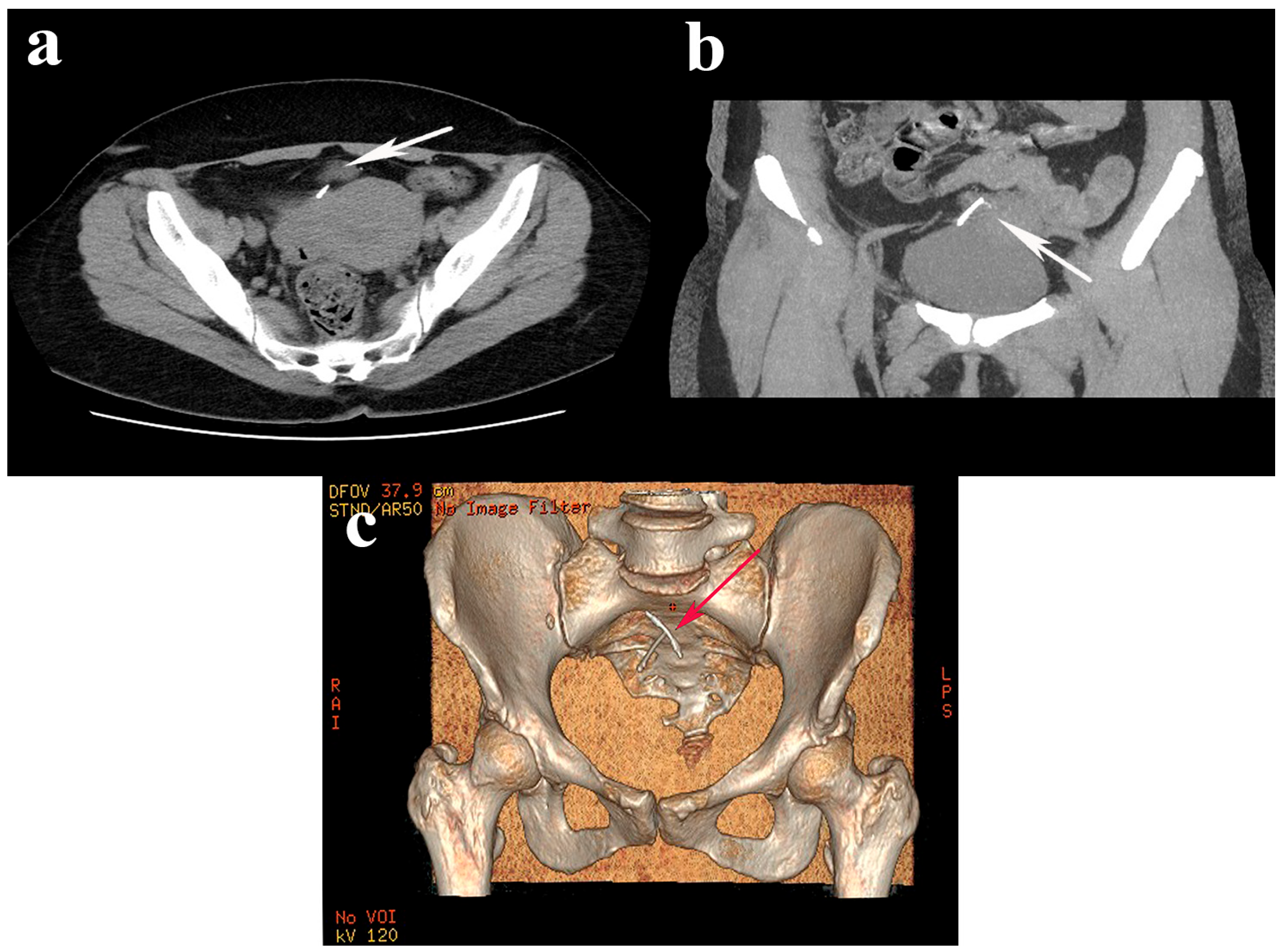
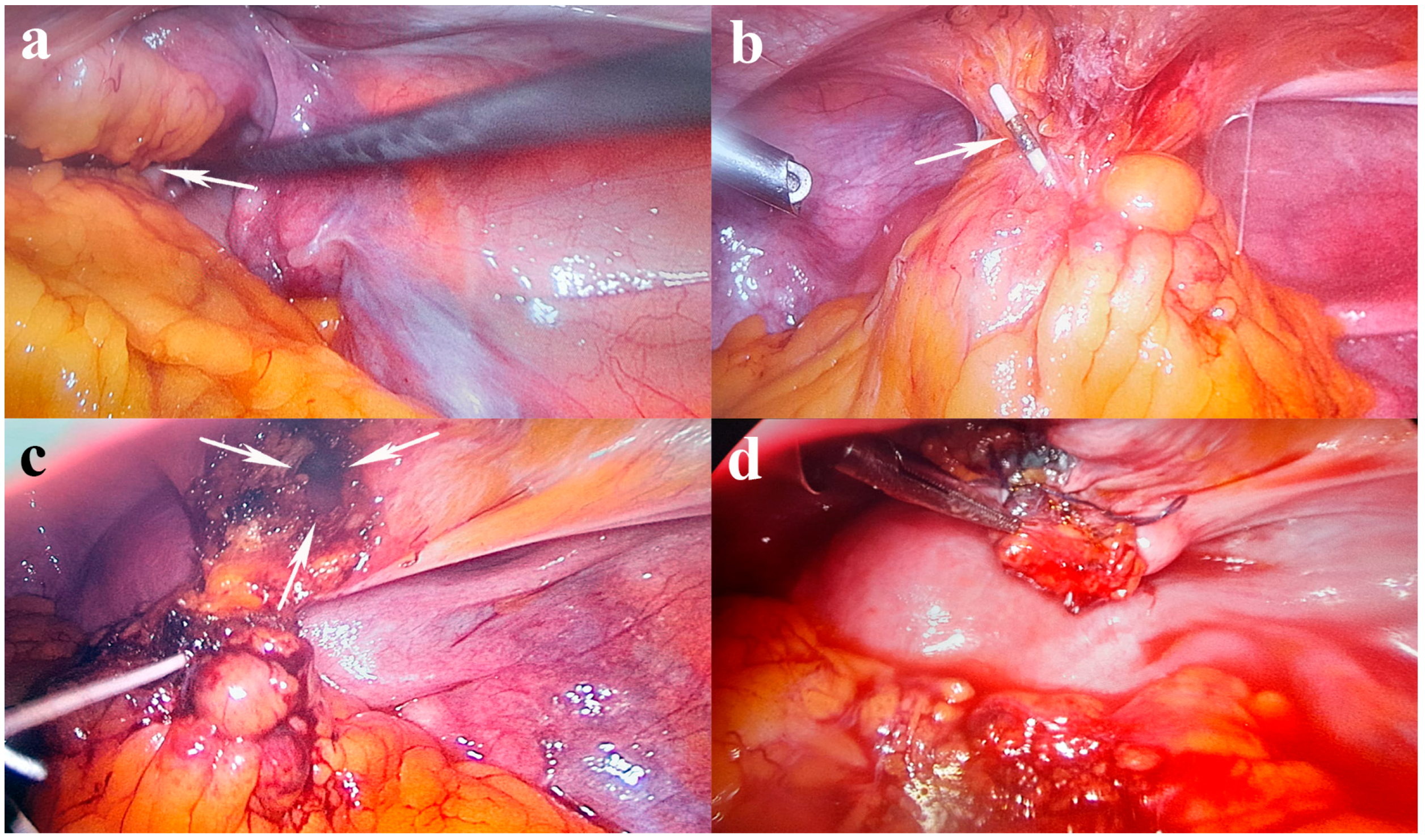
| Our case, 2023 | 55 | Asymptomatic during investigations for lumbar discopathy | 19 yrs | 2 | NS | X-ray, US, CT scan, hysteroscopy/laparoscopy | Submucosa of the bladder; pelvic mass of adhesions between omentum, sigmoid, bladder | Laparoscopic IUD removal after adhesiolysis and cystorrhaphy | Favorable |
Disclaimer/Publisher’s Note: The statements, opinions and data contained in all publications are solely those of the individual author(s) and contributor(s) and not of MDPI and/or the editor(s). MDPI and/or the editor(s) disclaim responsibility for any injury to people or property resulting from any ideas, methods, instructions or products referred to in the content. |
© 2024 by the authors. Licensee MDPI, Basel, Switzerland. This article is an open access article distributed under the terms and conditions of the Creative Commons Attribution (CC BY) license (https://creativecommons.org/licenses/by/4.0/).
Share and Cite
Varlas, V.N.; Meianu, A.I.; Rădoi, A.I.; Balescu, I.; Bacalbasa, N.; Varlas, R.G. Intrauterine Contraceptive Device Migrated in the Urinary Tract: Case Report and Extensive Literature Review. J. Clin. Med. 2024, 13, 4233. https://doi.org/10.3390/jcm13144233
Varlas VN, Meianu AI, Rădoi AI, Balescu I, Bacalbasa N, Varlas RG. Intrauterine Contraceptive Device Migrated in the Urinary Tract: Case Report and Extensive Literature Review. Journal of Clinical Medicine. 2024; 13(14):4233. https://doi.org/10.3390/jcm13144233
Chicago/Turabian StyleVarlas, Valentin Nicolae, Andreea Ioana Meianu, Andra Ioana Rădoi, Irina Balescu, Nicolae Bacalbasa, and Roxana Georgiana Varlas. 2024. "Intrauterine Contraceptive Device Migrated in the Urinary Tract: Case Report and Extensive Literature Review" Journal of Clinical Medicine 13, no. 14: 4233. https://doi.org/10.3390/jcm13144233
APA StyleVarlas, V. N., Meianu, A. I., Rădoi, A. I., Balescu, I., Bacalbasa, N., & Varlas, R. G. (2024). Intrauterine Contraceptive Device Migrated in the Urinary Tract: Case Report and Extensive Literature Review. Journal of Clinical Medicine, 13(14), 4233. https://doi.org/10.3390/jcm13144233