



Sex-Based Differences in Rotational Atherectomy and Long-Term Clinical Outcomes

 , ,
, ,  ,
,
Abstract
1. Introduction
2. Materials and Methods
2.1. Study Population
2.2. Procedural Characteristics
2.3. Clinical Measures and Follow-Up
2.4. Statistical Methods
3. Results
3.1. Procedural Characteristics
3.2. Clinical Outcomes
4. Discussion
5. Limitations
6. Conclusions
Author Contributions
Funding
Institutional Review Board Statement
Informed Consent Statement
Data Availability Statement
Conflicts of Interest
References
- Neumann, F.J.; Sousa-Uva, M.; Ahlsson, A.; Alfonso, F.; Banning, A.P.; Benedetto, U.; Byrne, R.A.; Collet, J.P.; Falk, V.; Head, S.J.; et al. 2018 ESC/EACTS Guidelines on myocardial revascularization. Eur. Heart J. 2019, 40, 87–165. [Google Scholar] [CrossRef] [PubMed]
- Abdel-Wahab, M.; Richardt, G.; Joachim Büttner, H.; Toelg, R.; Geist, V.; Meinertz, T.; Schofer, J.; King, L.; Neumann, F.-J.; Khattab, A.A.; et al. High-speed rotational atherectomy before paclitaxel-eluting stent implantation in complex calcified coronary lesions: The randomized ROTAXUS (Rotational Atherectomy Prior to Taxus Stent Treatment for Complex Native Coronary Artery Disease) trial. JACC. Cardiovasc. Interv. 2013, 6, 10–19. [Google Scholar] [CrossRef] [PubMed]
- Hemetsberger, R.; Toelg, R.; Mankerious, N.; Allali, A.; Traboulsi, H.; Sulimov, D.S.; El-Mawardy, M.; Byrne, R.A.; Robinson, D.R.; Richardt, G.; et al. Impact of Calcified Lesion Complexity on the Success of Percutaneous Coronary Intervention With Upfront High-Speed Rotational Atherectomy or Modified Balloons—A Subgroup-Analysis From the Randomized PREPARE-CALC Trial. Cardiovasc. Revascularization Med. Incl. Mol. Interv. 2021, 33, 26–31. [Google Scholar] [CrossRef] [PubMed]
- Wang, R.; Liu, X.; Wang, C.; Ye, X.; Xu, X.; Yang, C. Higher coronary artery calcification score is associated with adverse prognosis in patients with stable angina pectoris. J. Thorac. Dis. 2017, 9, 582–589. [Google Scholar] [CrossRef] [PubMed]
- Ford, T.J.; Khan, A.; Docherty, K.F.; Jackson, A.; Morrow, A.; Sidik, N.; Rocchiccioli, P.; Good, R.; Eteiba, H.; Watkins, S.; et al. Sex differences in procedural and clinical outcomes following rotational atherectomy. Catheter. Cardiovasc. Interv. Off. J. Soc. Card. Angiogr. Interv. 2020, 95, 232–241. [Google Scholar]
- Bouisset, F.; Ribichini, F.; Bataille, V.; Reczuch, K.; Dobrzycki, S.; Meyer-Gessner, M.; Bressollette, E.; Zajdel, W.; Faurie, B.; Mezilis, N.; et al. Effect of Sex on Outcomes of Coronary Rotational Atherectomy Percutaneous Coronary Intervention (From the European Multicenter Euro4C Registry). Am. J. Cardiol. 2021, 143, 29–36. [Google Scholar] [CrossRef] [PubMed]
- Ryan, T.J.; Faxon, D.P.; Gunnar, R.M.; Kennedy, J.W.; King, S.B.; Loop, F.D.; Peterson, K.L.; Reeves, T.J.; Williams, D.O.; Winters, W.L.; et al. Guidelines for percutaneous transluminal coronary angioplasty. A report of the American College of Cardiology/American Heart Association Task Force on Assessment of Diagnostic and Therapeutic Cardiovascular Procedures (Subcommittee on Percutaneous Transluminal Coronary Angioplasty). Circulation 1988, 78, 486–502. [Google Scholar]
- Mintz, G.S.; Popma, J.J.; Pichard, A.D.; Kent, K.M.; Satler, L.F.; Chuang, Y.C.; Ditrano, C.J.; Leon, M.B. Patterns of calcification in coronary artery disease. A statistical analysis of intravascular ultrasound and coronary angiography in 1155 lesions. Circulation 1995, 91, 1959–1965. [Google Scholar] [CrossRef] [PubMed]
- Otsuki, H.; Jujo, K.; Tanaka, K.; Okai, I.; Nakashima, M.; Dohi, T.; Okazaki, S.; Okabe, R.; Nagura, F.; Nara, Y.; et al. Sex differences in clinical outcomes after rotational atherectomy of calcified coronary stenoses: From multicenter registry. Am. J. Cardiovasc. Dis. 2021, 11, 12–20. [Google Scholar] [PubMed]
- Brush, J.E.; Hajduk, A.M.; Greene, E.J.; Dreyer, R.P.; Krumholz, H.M.; Chaudhry, S.I. Sex Differences in Symptom Phenotypes Among Older Patients with Acute Myocardial Infarction. Am. J. Med. 2022, 135, 342–349. [Google Scholar] [CrossRef] [PubMed]
- Mehta, L.S.; Beckie, T.M.; DeVon, H.A.; Grines, C.L.; Krumholz, H.M.; Johnson, M.N.; Lindley, K.J.; Vaccarino, V.; Wang, T.Y.; Wenger, N.K.; et al. Acute Myocardial Infarction in Women: A Scientific Statement From the American Heart Association. Circulation 2016, 133, 916–947. [Google Scholar] [CrossRef] [PubMed]
- Sederholm Lawesson, S.; Isaksson, R.-M.; Ericsson, M.; Ängerud, K.; Thylén, I. Gender disparities in first medical contact and delay in ST-elevation myocardial infarction: A prospective multicentre Swedish survey study. BMJ Open 2018, 8, e020211. [Google Scholar] [PubMed]
- Alabas, O.A.; Gale, C.P.; Hall, M.; Rutherford, M.J.; Szummer, K.; Lawesson, S.S.; Alfredsson, J.; Lindahl, B.; Jernberg, T. Sex Differences in Treatments, Relative Survival, and Excess Mortality Following Acute Myocardial Infarction: National Cohort Study Using the SWEDEHEART Registry. J. Am. Heart Assoc. 2017, 6, e007123. [Google Scholar] [CrossRef] [PubMed]
- Hvelplund, A.; Galatius, S.; Madsen, M.; Rasmussen, J.N.; Rasmussen, S.; Madsen, J.K.; Sand NP, R.; Tilsted, H.H.; Thayssen, P.; Abildstrøm, S.Z.; et al. Women with acute coronary syndrome are less invasively examined and subsequently less treated than men. Eur. Heart J. 2010, 31, 684–690. [Google Scholar] [CrossRef] [PubMed]
- Sabatowski, K.; Malinowski, K.P.; Siudak, Z.; Reczuch, K.; Dobrzycki, S.; Lesiak, M.; Hawranek, M.; Gil, R.J.; Witkowski, A.; Januszek, R.; et al. Sex-related differences and rotational atherectomy: Analysis of 5 177 percutaneous coronary interventions based on a large national registry from 2014 to 2020. Kardiol. Pol. 2021, 79, 1320–1327. [Google Scholar] [CrossRef] [PubMed]
- Heede, M.B. Prävention Der Kontrastmittelnephropathie Durch Intravenöse Hydratation. Ph.D. Dissertation, Eberhard-Karls-Universität, Tübingen, Germany, 2002. [Google Scholar]
- Bader, B.D.; Berger, E.D.; Heede, M.B.; Silberbaur, I.; Duda, S.; Risler, T.; Erley, C.M. What is the best hydration regimen to prevent contrast media-induced nephrotoxicity? Clin. Nephrol. 2004, 62, 1–7. [Google Scholar] [CrossRef] [PubMed]
- Akhter, N.; Milford-Beland, S.; Roe, M.T.; Piana, R.N.; Kao, J.; Shroff, A. Gender differences among patients with acute coronary syndromes undergoing percutaneous coronary intervention in the American College of Cardiology-National Cardiovascular Data Registry (ACC-NCDR). Am. Heart J. 2009, 157, 141–148. [Google Scholar] [CrossRef] [PubMed]
- Wu, C.; Camacho, F.T.; King, S.B.; Walford, G.; Holmes, D.R.; Stamato, N.J.; Berger, P.B.; Sharma, S.; Curtis, J.P.; Venditti, F.J.; et al. Risk stratification for long-term mortality after percutaneous coronary intervention. Circulation. Cardiovasc. Interv. 2014, 7, 80–87. [Google Scholar] [CrossRef] [PubMed]
- Wu, C.; Hannan, E.L.; Walford, G.; Ambrose, J.A.; Holmes, D.R.; King, S.B.; Clark, L.T.; Katz, S.; Sharma, S.; Jones, R.H. A risk score to predict in-hospital mortality for percutaneous coronary interventions. J. Am. Coll. Cardiol. 2006, 47, 654–660. [Google Scholar] [CrossRef] [PubMed]

| Patient Characteristics | Total Number | Women | Men | p Value |
|---|---|---|---|---|
| (n = 597) | (n = 121) | (n = 476) | ||
| Age (years) | 73.3 ± 9 | 75.3 ± 8.9 | 72.2 ± 9 | <0.001 |
| Hypertension | 532 (92.3%) | 107 (92.2%) | 425 (92.4%) | 0.956 |
| Hypercholesterinemia | 503 (89.9%) | 95 (86.3%) | 408 (90.8%) | 0.158 |
| Diabetes mellitus | 209 (37.6%) | 34 (30.9%) | 175 (39.2%) | 0.106 |
| Smoker or previous smoker | 58 (10.5%) | 13 (11.8%) | 45 (10.1%) | 0.611 |
| Previous MI | 184 (34.5%) | 37 (33.6%) | 147 (34.7%) | 0.826 |
| Acute MI | 100 (16.7%) | 29 (23.9%) | 71 (14.9%) | 0.017 |
| Previous CABG | 164 (30%) | 25 (22.7%) | 139 (31.9%) | 0.059 |
| eGFR pre-Rota | 71 ± 11 | 68 ± 11 | 74 ± 22 | 0.067 |
| LVEF (%) | 0.771 | |||
| >51% | 318 (59.2%) | 69 (61%) | 259 (58.7%) | |
| 41–51% | 126 (23.4%) | 25 (22.1%) | 101 (23.8%) | |
| 30–40% | 65 (12.1%) | 15 (13.3%) | 50 (11.8%) | |
| 0–29% | 28 (5.2%) | 4 (3.5%) | 24 (5.6%) |
| Overall Procedural Results | Total Number (n = 597) | Women (n = 121) | Men (n = 476) | p Value |
|---|---|---|---|---|
| Balloon diameter predilatation, mm | 2.8 ± 0.5 | 3.15 ± 2.4 | <0.05 | |
| Maximum inflation pressure predilatation, atm | 20.8 ± 6.2 | 21.94 ± 13.0 | 0.6 | |
| Pre-Rota stenosis, % | 87.9% ± 14.3 | 87.47% ± 14.8 | 0.92 | |
| Post-stent residual stenosis, % | 1.42 ± 9.5 | 2.7 ± 13.5 | 0.84 | |
| Number of stents implanted | 1.78 ± 1.0 | 1.87 ± 1.1 | 0.11 | |
| Diameter of implanted stent, max., mm | 3.5 ± 1.2 | 4.10 ± 6.5 | 0.01 | |
| Overall stent length, mm | 50.3 ± 30.0 | 53.3 ± 32.0 | 0.334 | |
| Balloon diameter postdilatation, mm | 4.0 ± 0.68 | 3.97 ± 1.46 | 0.82 | |
| Postdilatation pressure, atm | 21.11 ± 4.65 | 21.66 ± 5.74 | 0.52 | |
| Burr size used | 0.474 | |||
| 1.25 mm | 142 (23.78%) | 26 (21.48%) | 116 (24.36%) | |
| 1.50 mm | 252 (42.21%) | 52 (42.97%) | 200 (42.01%) | |
| 1.75 mm | 175 (29.31%) | 34 (28.09%) | 141 (29.62%) | |
| 2.00 mm | 28 (4.69%) | 9 (7.43%) | 19 (3.99%) | |
| Access site | 0.002 | |||
| Radial access | 192 (33.6%) | 23 (11.98%) | 169 (88.02%) | |
| Femoral access | 374 (65.4%) | 90 (24.06%) | 284 (75.94%) |
| Clinical Outcomes | All Patients (n = 597) | Women (n = 121) | Men (n = 476) | p Value |
|---|---|---|---|---|
| In-hospital MACCEs | 20 (3.3%) | 7 (5.8%) | 13 (2.7%) | 0.095 |
| In-hospital Mortality | 15 (2.5%) | 5 (4.1%) | 10 (2.1%) | 0.202 |
| In-hospital MI | 4 (0.67%) | 0 (0%) | 4 (0.8%) | 0.311 |
| In-hospital TVR | 20 (3.3%) | 7 (5.8%) | 13 (2.7%) | 0.095 |
| In-hospital Stroke | 1 (0.17%) | 1 (0.8%) | 0 (0%) | 0.202 |
| In-hospital TLR | 20 (3.3%) | 7 (5.8%) | 13 (2.7%) | 0.095 |
| Perforation | 28 (4.7%) | 8 (6.6%) | 20 (4.3%) | 0.281 |
| Pericardiocentesis | 8 (1.3%) | 3 (2.5%) | 5 (1%) | 0.207 |
| Bleeding | 57 (9.5%) | 7 (5.8%) | 50 (10.5%) | 0.09 |
| eGFR max. post-Rota | 68.6 ± 21 | 63.9 ± 21 | 70.6 ± 22 | 0.002 |
| 1-year MACCEs | 130 (21.8%) | 24 (19.8%) | 106 (22.3%) | 0.562 |
| 1-year Mortality | 44 (7.4%) | 13 (10.7) | 31 (6.5%) | 0.111 |
| 1-year MI | 10 (1.7%) | 2 (1.6%) | 8 (1.7%) | 0.983 |
| 1-year TVR | 122 (20.4%) | 22 (18.2%) | 100 (21%) | 0.491 |
| 1-year Stroke | 4 (0.7%) | 2 (1.6%) | 2 (0.4%) | 0.137 |
| 1-year TLR | 111 (18.6%) | 21 (17.3%) | 90 (18.9%) | 0.695 |
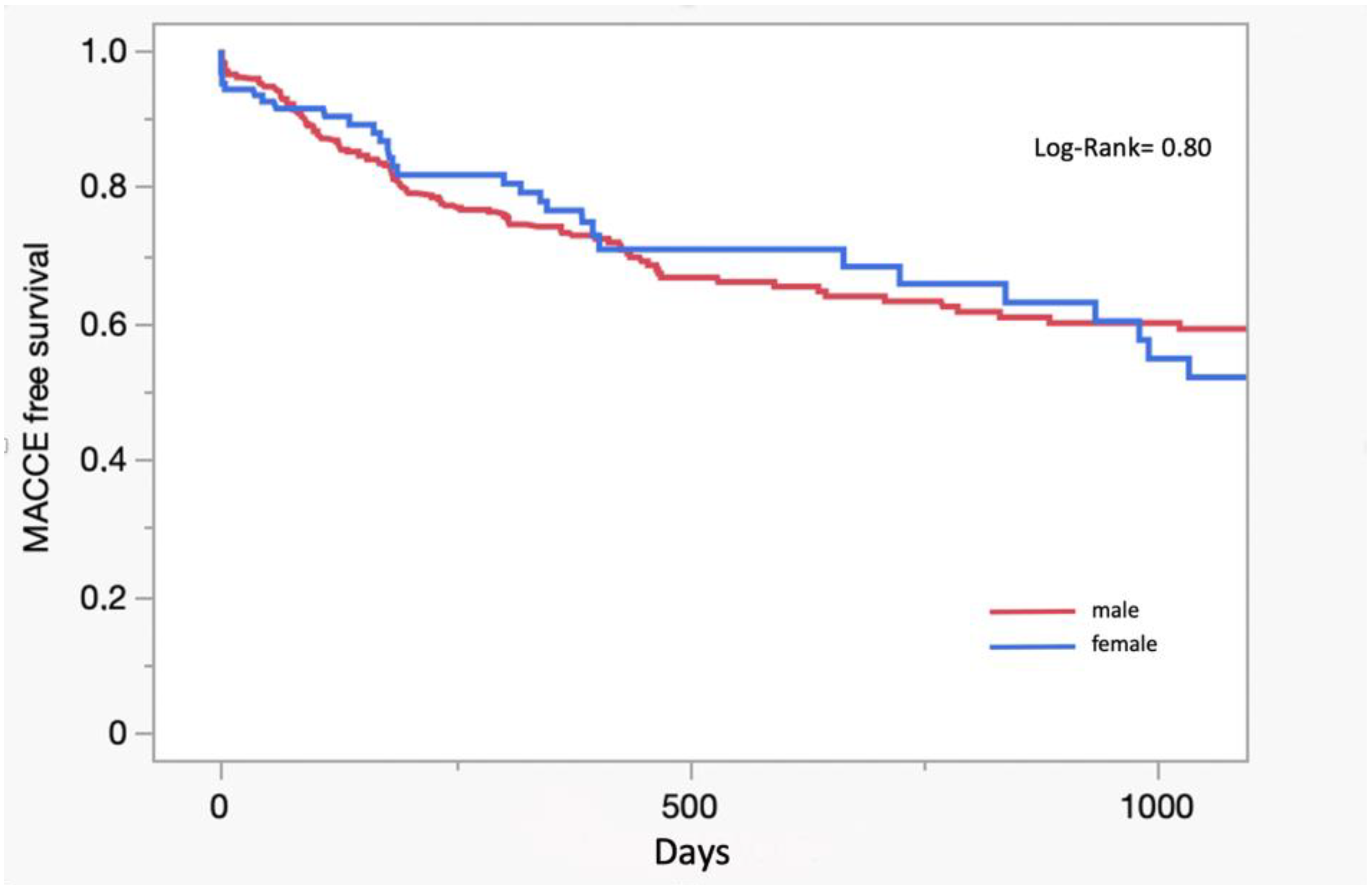
| 3-year MACCEs | 155 (25.96%) | 32 (26.45%) | 123 (25.84%) | 0.018 |
| 3-year Mortality | 61 (10.22%) | 19 (15.70%) | 42 (8.82%) | 0.025 |
| 3-year MI | 12 (2%) | 3 (2.48%) | 9 (1.89%) | 0.716 |
| 3-year TVR | 149 (24.96%) | 30 (24.79%) | 119 (25%) | 0.962 |
| 3-year Stroke | 9 (1.51%) | 4 (3.31%) | 5 (1.05%) | 0.087 |
| 3-year TLR | 138 (23.12%) | 29 (23.97%) | 109 (22.90%) | 0.803 |
| a: Cox Regression Analysis for Predictors of MACCEs | ||||||
| Univariate Analysis | Multivariate Analysis | |||||
| HR | 95% CI | p Value | HR | 95% CI | p Value | |
| Age (change per year) | 1.004 | 0.99–1.02 | 0.67 | 0.99 | 0.98–1.02 | 0.76 |
| Gender (female) | 1.05 | 0.71–1.54 | 0.81 | 0.95 | 0.62–1.46 | 0.80 |
| ACS | 2.22 | 1.58–3.13 | <0.001 | 2.33 | 1.58–3.43 | <0.001 |
| Diabetes mellitus | 1.09 | 0.78–1.53 | 0.63 | 0.98 | 0.89–1.40 | 0.92 |
| History of CABG | 1.14 | 0.80–1.63 | 0.47 | 1.16 | 0.8–1.67 | 0.44 |
| b: Cox Regression Analysis for Predictors Of All-Cause Mortality | ||||||
| Univariate Analysis | Multivariate Analysis | |||||
| HR | 95% CI | p Value | HR | 95% CI | p Value | |
| Age (change per year) | 1.06 | 1.03–1.10 | <0.001 | 1.04 | 1.01–1.07 | 0.03 |
| Gender (female) | 1.82 | 1.07–3.10 | 0.03 | 1.42 | 0.79–2.56 | 0.24 |
| ACS | 5.10 | 3.11–8.37 | <0.001 | 2.33 | 1.58–3.43 | <0.001 |
| Diabetes mellitus | 1.27 | 0.76–2.14 | 0.37 | 1.22 | 0.73–2.22 | 0.47 |
| History of CABG | 1.06 | 0.61–1.85 | 0.84 | 1.27 | 0.8–1.67 | 0.40 |
| c: Cox Regression Analysis for Predictors of Myocardial Infarction | ||||||
| Univariate Analysis | Multivariate Analysis | |||||
| HR | 95% CI | p Value | HR | 95% CI | p Value | |
| Age (change per year) | 1.005 | 0.94–1.07 | 0.90 | 0.98 | 0.91–1.06 | 0.61 |
| Gender (female) | 1.51 | 0.4 1–5.69 | 0.54 | 1.11 | 0.22–5.61 | 0.90 |
| ACS | 4.76 | 1.43–15.87 | 0.01 | 5.25 | 1.29–21.34 | 0.02 |
| Diabetes mellitus | 2.42 | 0.64–9.22 | 0.20 | 2.18 | 0.56–8.56 | 0.26 |
| History of CABG | 1.05 | 0.26–4.21 | 0.95 | 1.22 | 0.30–4.98 | 0.78 |
Disclaimer/Publisher’s Note: The statements, opinions and data contained in all publications are solely those of the individual author(s) and contributor(s) and not of MDPI and/or the editor(s). MDPI and/or the editor(s) disclaim responsibility for any injury to people or property resulting from any ideas, methods, instructions or products referred to in the content. |
© 2023 by the authors. Licensee MDPI, Basel, Switzerland. This article is an open access article distributed under the terms and conditions of the Creative Commons Attribution (CC BY) license (https://creativecommons.org/licenses/by/4.0/).
Share and Cite
Ayoub, M.; Lutsch, S.; Behnes, M.; Akin, M.; Schupp, T.; Akin, I.; Rudolph, V.; Westermann, D.; Mashayekhi, K. Sex-Based Differences in Rotational Atherectomy and Long-Term Clinical Outcomes. J. Clin. Med. 2023, 12, 5044. https://doi.org/10.3390/jcm12155044
Ayoub M, Lutsch S, Behnes M, Akin M, Schupp T, Akin I, Rudolph V, Westermann D, Mashayekhi K. Sex-Based Differences in Rotational Atherectomy and Long-Term Clinical Outcomes. Journal of Clinical Medicine. 2023; 12(15):5044. https://doi.org/10.3390/jcm12155044
Chicago/Turabian StyleAyoub, Mohamed, Selina Lutsch, Michael Behnes, Muharrem Akin, Tobias Schupp, Ibrahim Akin, Volker Rudolph, Dirk Westermann, and Kambis Mashayekhi. 2023. "Sex-Based Differences in Rotational Atherectomy and Long-Term Clinical Outcomes" Journal of Clinical Medicine 12, no. 15: 5044. https://doi.org/10.3390/jcm12155044
APA StyleAyoub, M., Lutsch, S., Behnes, M., Akin, M., Schupp, T., Akin, I., Rudolph, V., Westermann, D., & Mashayekhi, K. (2023). Sex-Based Differences in Rotational Atherectomy and Long-Term Clinical Outcomes. Journal of Clinical Medicine, 12(15), 5044. https://doi.org/10.3390/jcm12155044

