


Neurally Adjusted Ventilatory Assist in Acute Respiratory Failure—A Narrative Review


Abstract
1. Introduction
2. Lung and Respiratory Muscles Protective Ventilation
2.1. Lung Injury
2.2. Patient–Ventilator Asynchronies
2.3. Diaphragm Injury—Myotrauma
3. Proportional Ventilation
4. NAVA—Neurally Adjusted Ventilator Assist
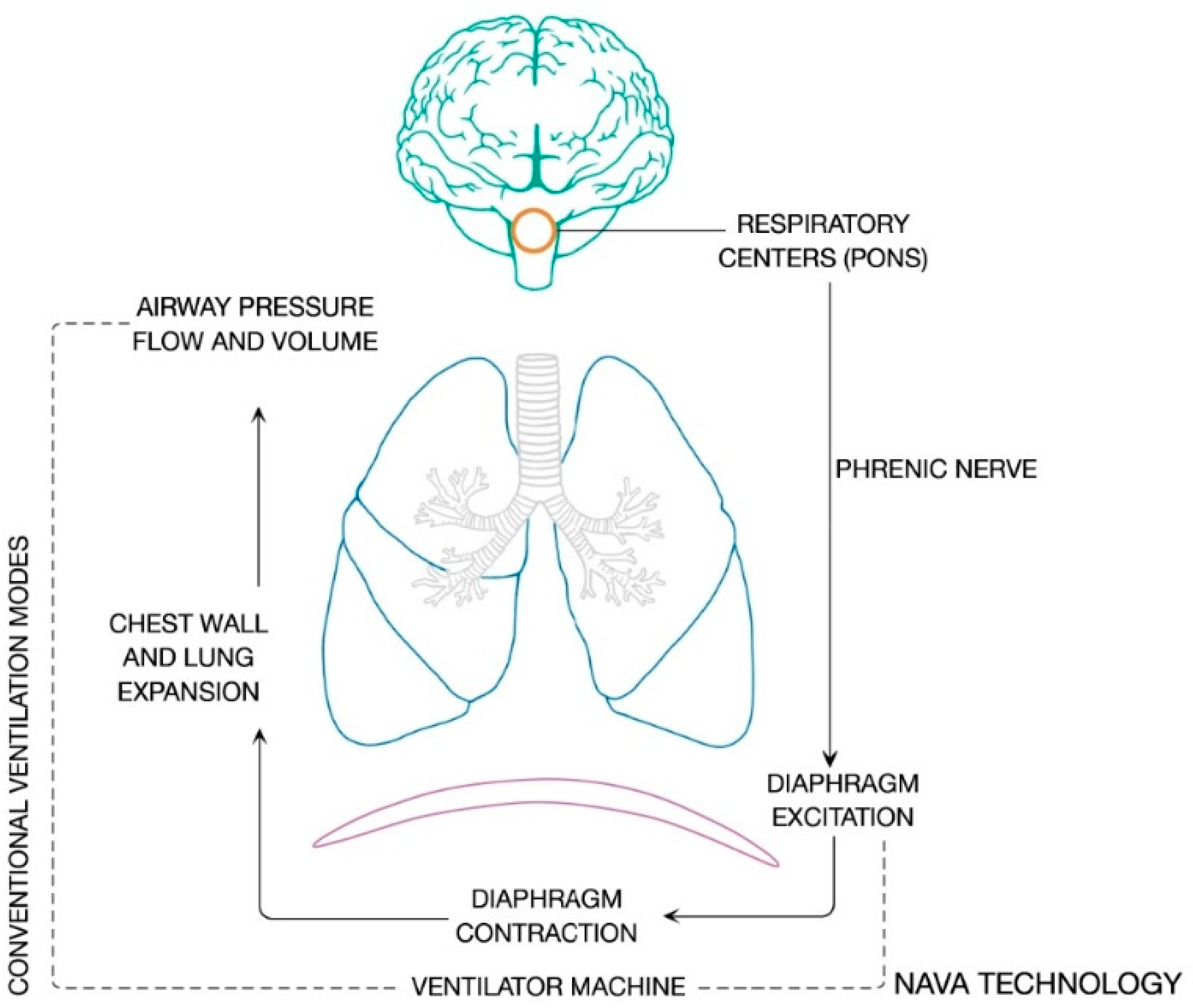
4.1. Basic Principles of NAVA
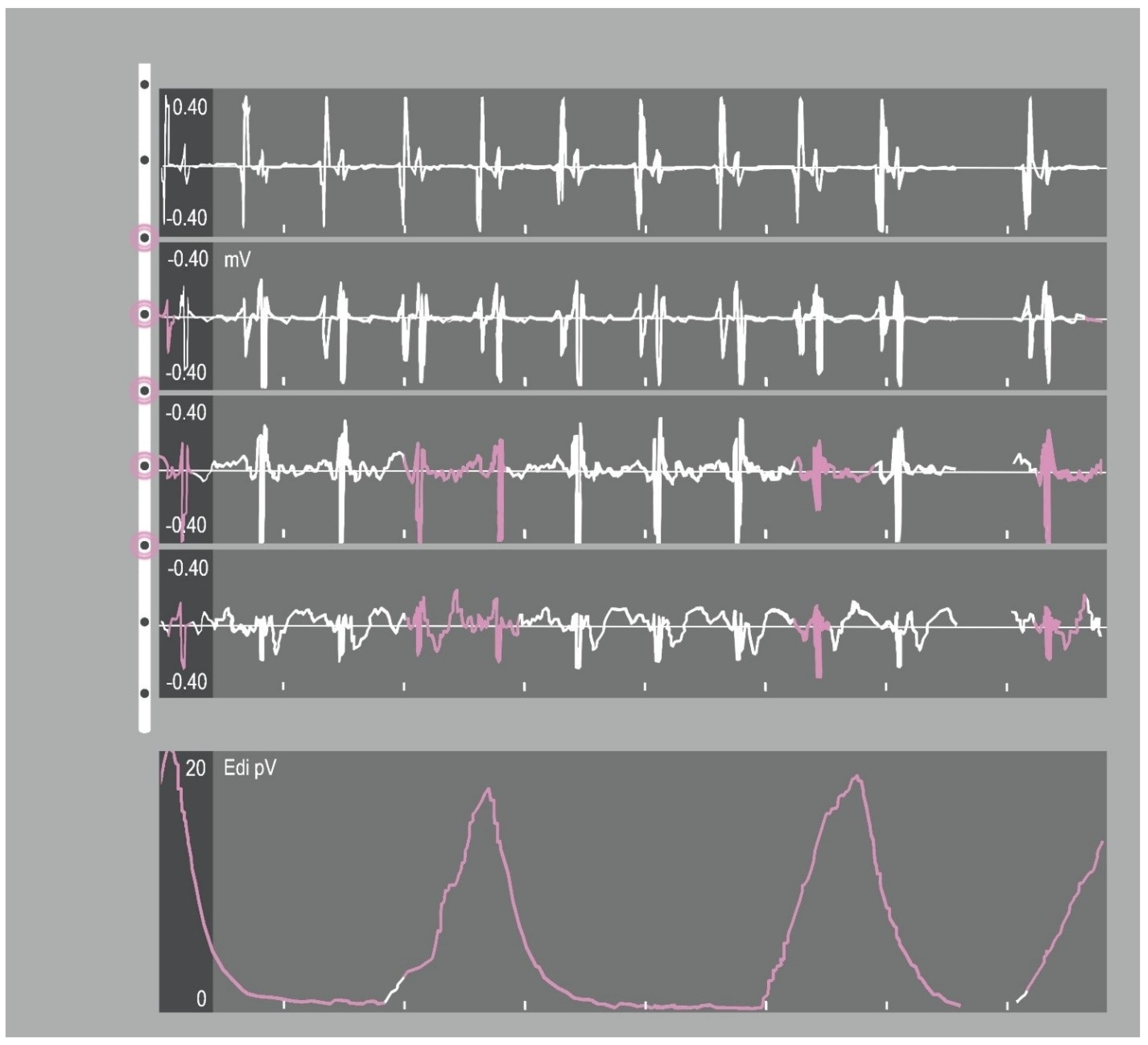
4.2. NAVA Catheter Positioning
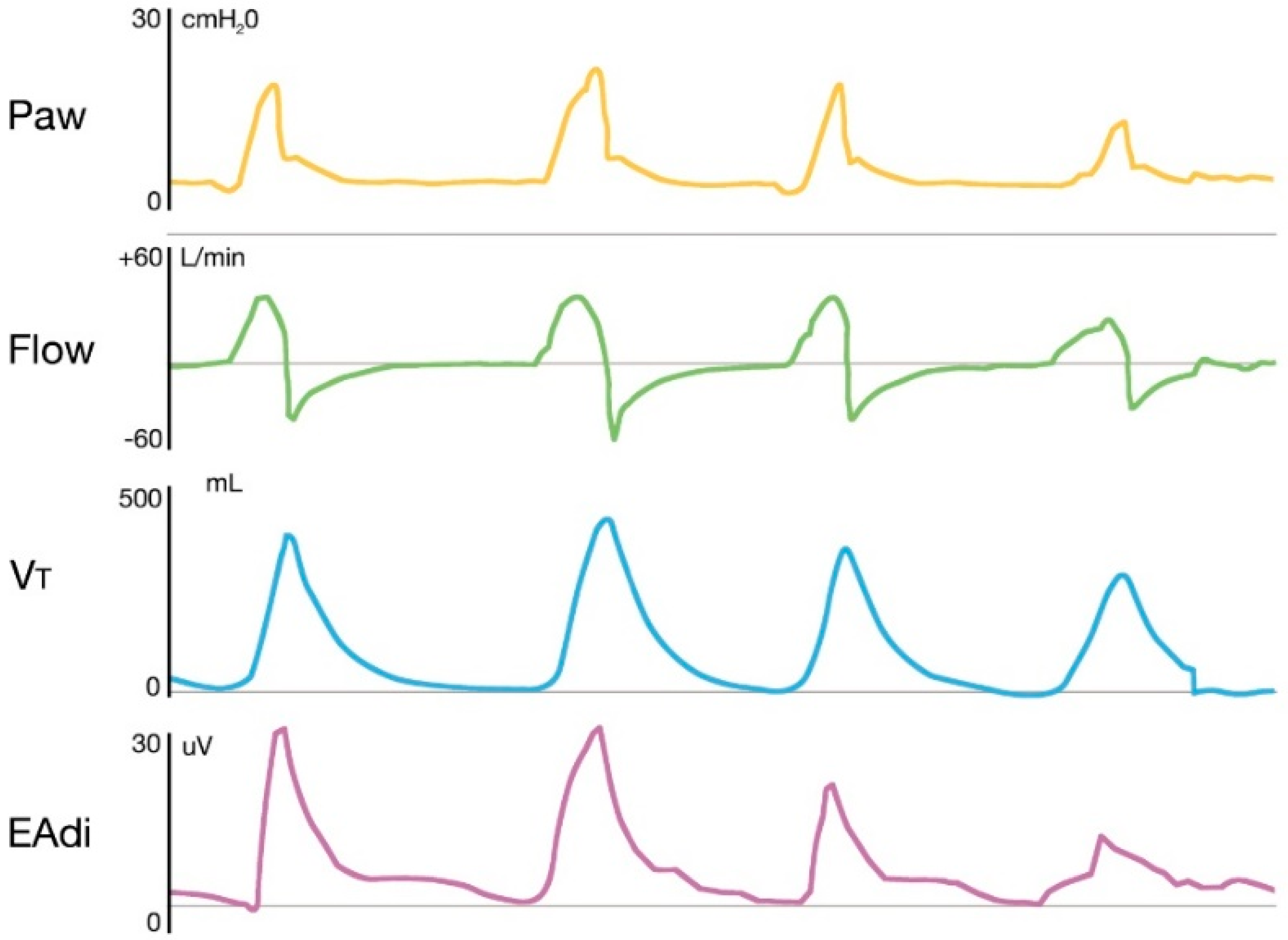
4.3. NAVA Ventilation
4.4. Neuro-Ventilatory Efficiency Index (NVE) and Patient–Ventilator Breath Contribution (PVBC)
4.5. Pmusc/EAdi Index or Neuro-Mechanical Efficiency Index (PEI or NME)
4.6. NAVA Level Setting
4.7. Effects of NAVA on Lung Protection
4.8. Effects of NAVA on Diaphragm Protection
4.9. Effects of NAVA on Breathing Pattern Variability
4.10. Effects of NAVA on Optimization of Patient–Ventilator Interaction
4.11. Possible Limitations of NAVA Ventilation
4.12. Differences with Automated Weaning Systems
5. Clinical Use of NAVA in Acute Respiratory Failure
6. Conclusions
Author Contributions
Funding
Institutional Review Board Statement
Informed Consent Statement
Data Availability Statement
Conflicts of Interest
References
- Mauri, T.; Cambiaghi, B.; Spinelli, E.; Langer, T.; Grasselli, G. Spontaneous breathing: A double-edged sword to handle with care. Ann. Transl. Med. 2017, 5, 1–11. [Google Scholar] [CrossRef] [PubMed]
- Putensen, C.; Mutz, N.J.; Putensen-Himmer, G.; Zinserling, J. Spontaneous breathing during ventilatory support improves ventilation-perfusion distributions in patients with acute respiratory distress syndrome. Am. J. Respir. Crit. Care Med. 1999, 159, 1241–1248. [Google Scholar] [CrossRef] [PubMed]
- Pinsky, M.R. Cardiopulmonary interactions: Physiologic basis and clinical applications. Ann. Am. Thorac. Soc. 2018, 15, S45–S48. [Google Scholar] [CrossRef] [PubMed]
- Yoshida, T.; Amato, M.B.P.; Kavanagh, B.P.; Fujino, Y. Impact of spontaneous breathing during mechanical ventilation in acute respiratory distress syndrome. Curr. Opin. Crit. Care 2019, 25, 192–198. [Google Scholar] [CrossRef] [PubMed]
- Dres, M.; Beitler, J.R.; Telias, I. Lung and Diaphragm-Protective Ventilation. Am. J. Respir. Crit. Care Med. 2020, 202, 950–961. [Google Scholar] [CrossRef]
- Brochard, L.; Slutsky, A.; Pesenti, A. Mechanical ventilation to minimize progression of pulmonary lung injury in acute respiratory failure. Am. J. Respir. Crit. Care Med. 2017, 195, 438–442. [Google Scholar] [CrossRef]
- Yoshida, T.; Roldan, R.; Beraldo, M.A.; Torsani, V.; Gomes, S.; De Santis, R.R.; Costa, E.L.; Tucci, M.R.; Lima, R.G.; Kavanagh, B.P.; et al. Spontaneous effort during mechanical ventilation: Maximal injury with less positive end-expiratory pressure. Crit. Care Med. 2016, 44, e678–e688. [Google Scholar] [CrossRef]
- Blanch, L.; Villagra, A.; Sales, B.; Montanya, J.; Lucangelo, U.; Luján, M.; García-Esquirol, O.; Chacón, E.; Estruga, A.; Oliva, J.C.; et al. Asynchronies during mechanical ventilation are associated with mortality. Intensive Care Med. 2015, 41, 633–641. [Google Scholar] [CrossRef]
- Bellani, G.; Grasselli, G.; Teggia-droghi, M.; Mauri, T.; Coppadoro, A.; Brochard, L.; Pesenti, A. Do spontaneous and mechanical breathing have similar effects on average transpulmonary and alveolar pressure? A clinical crossover study. Crit. Care 2016, 20, 1–10. [Google Scholar] [CrossRef] [PubMed]
- Goligher, E.C.; Brochard, L.J.; Reid, W.D.; Fan, E.; Saarela, O.; Slutsky, A.S.; Kavanagh, B.K.; Rubenfeld, G.D.; Ferguson, N.D. Diaphragmatic myotrauma: A mediator of prolonged ventilation and poor patient outcomes in acute respiratory failure. Lancet Respir. Med. 2019, 7, 90–98. [Google Scholar] [CrossRef]
- Papazian, L.; Forel, J.L.; Penot-Ragon, C.; Gacouin, A.; Perrin, G.; Loundou, A.; Jaber, S.; Arnal, J.-M.; Perez, D.; Seghboyan, J.-M.; et al. Neuromuscular Blockers in Early Acute Respiratory Distress Syndrome. N. Engl. J. Med. 2010, 363, 1107–1116. [Google Scholar] [CrossRef]
- Jonkman, A.H.; Rauseo, M.; Carteaux, G.; Telias, I.; Sklar, M.C.; Heunks, L.; Brochard, L.J. Proportional modes of ventilation: Technology to assist physiology. Intensive Care Med. 2020, 46, 2301–2313. [Google Scholar] [CrossRef] [PubMed]
- Slutsky, A.S.; Ranieri, V.M. Ventilator-Induced Lung Injury. Crit. Care Med. 2013, 369, 2126–2136. [Google Scholar] [CrossRef]
- Grieco, D.L.; Menga, L.S.; Eleuteri, D.; Antonelli, M. Patient self-inflicted lung injury: Implications for acute hypoxemic respiratory failure and ARDS patients on non-invasive support. Minerva Anestesiol 2019, 85, 1014–1023. [Google Scholar] [CrossRef]
- Yoshida, T.; Uchiyama, A.; Matsuura, N.; Mashimo, T.; Fujino, Y. Spontaneous breathing during lung-protective ventilation in an experimental acute lung injury model: High transpulmonary pressure associated with strong spontaneous breathing effort may worsen lung injury. Crit. Care Med. 2012, 40, 1578–1585. [Google Scholar] [CrossRef] [PubMed]
- Mead, J.; Takishima, T. Stress distribution in lungs: A model of elasticity. Am. J. Appl. Physiol. 1970, 28, 596–608. [Google Scholar] [CrossRef] [PubMed]
- Yoshida, T.; Torsani, V.; Gomes, S.; De Santis, R.; Beraldo, M.A.; Costa, E.L.V.; Tucci, M.R.; Zin, W.A.; Kavanagh, B.P.; Amato, M.B.P. Spontaneous effort causes occult pendelluft during mechanical ventilation. Am. J. Respir. Crit. Care Med. 2013, 188, 1420–1427. [Google Scholar] [CrossRef]
- Bhattacharya, M.; Kallet, R.; Ware, L.; Matthay, M. Negative Pressure Pulmonary Edema. Chest 2016, 150, 927–933. [Google Scholar] [CrossRef]
- Yoshida, T. Spontaneous breathing during mechanical ventilation-mechanisms, risks and management. Am. J. Respir. Crit. Care Med 2017, 195, 985–992. [Google Scholar] [CrossRef] [PubMed]
- Kondili, E.; Xirouchaki, N.; Georgopoulos, D. Modulation and treatment of patient–ventilator dyssynchrony. Curr. Opin. Crit. Care 2007, 13, 84–89. [Google Scholar] [CrossRef] [PubMed]
- Doorduin, J.; Sinderby, C.; Beck, J.; Van der Hoeven, J.; Heunks, L.M. Assisted Ventilation in Patients with Acute Respiratory. Anesthesiology 2015, 123, 181–190. [Google Scholar] [CrossRef] [PubMed]
- De Wit, M.; Miller, K.B.; Green, D.A.; Ostman, H.E.; Gennings, C.; Epstein, S.K. Ineffective triggering predicts increased duration of mechanical ventilation. Crit. Care Med. 2009, 37, 2740–2745. [Google Scholar] [CrossRef] [PubMed]
- Thille, A.W.; Rodriguez, P.; Cabello, B.; Lellouche, F.; Brochard, L. Patient-ventilator asynchrony during assisted mechanical ventilation. Intensive Care Med. 2006, 32, 1515–1522. [Google Scholar] [CrossRef]
- Thille, A.W.; Cabello, B.; Galia, F.; Lyazidi, A.; Brochard, L. Reduction of patient-ventilator asynchrony by reducing tidal volume during pressure-support ventilation. Intensive Care Med. 2008, 34, 1477–1486. [Google Scholar] [CrossRef] [PubMed]
- Akoumianaki, E.; Lyazidi, A.; Rey, N.; Matamis, D.; Perez-Martinez, N.; Giraud, R.; Mancebo, J.; Brochard, L.; Richard, J.C. Mechanical ventilation-induced reverse-triggered breaths: A frequently unrecognized form of neuromechanical coupling. Chest 2013, 143, 927–938. [Google Scholar] [CrossRef]
- Yoshida, T.; Nakahashi, S.; Nakamura, M.A.M.; Koyama, Y.; Roldan, R.; Torsani, V.; De Santis, R.R.; Gomes, S.; Uchiyama, A.; Amato, M.B.P.; et al. Volume Controlled Ventilation Does Not Prevent Injurious Inflation During Spontaneous Effort. Am. J. Respir. Crit. Care Med. 2017, 196, 590–601. [Google Scholar] [CrossRef]
- de Wit, M.; Pedram, S.; Best, A.M.; Epstein, S.K. Observational study of patient-ventilator asynchrony and relationship to sedation level. J. Crit. Care 2009, 24, 74–80. [Google Scholar] [CrossRef]
- Patroniti, N.; Bellani, G.; Saccavino, E.; Zanella, A.; Grasselli, G.; Isgrò, S.; Milan, M.; Foti, G.; Pesenti, A. Respiratory pattern during neurally adjusted ventilatory assist in acute respiratory failure patients. Intensive Care Med. 2012, 38, 230–239. [Google Scholar] [CrossRef] [PubMed]
- Parthasarathy, S.; Jubran, A.; Tobin, M.J. Assessment of neural inspiratory time in ventilator-supported patients. Am. J. Respir. Crit. Care Med. 2000, 162, 546–552. [Google Scholar] [CrossRef] [PubMed]
- Mirabella, L.; Cinnella, G.; Costa, R.; Cortegiani, A.; Tullo, L.; Rauseo, M.; Conti, G.; Gregoretti, C. Patient-ventilator asynchronies: Clinical implications and practical solutions. Respir. Care 2020, 65, 1751–1766. [Google Scholar] [CrossRef] [PubMed]
- Bertoni, M.; Spadaro, S.; Goligher, E.C. Monitoring Patient Respiratory Effort During Mechanical Ventilation: Lung and Diaphragm-Protective Ventilation. Crit. Care 2020, 2020, 21–35. [Google Scholar]
- Dres, M.; Goligher, E.C.; Heunks, L.M.A.; Brochard, L.J. Critical illness-associated diaphragm weakness. Intensive Care Med. 2017, 43, 1441–1452. [Google Scholar] [CrossRef] [PubMed]
- Wang, X.; Jiang, T.X.; Road, J.D.; Redenbach, D.M.; Reid, W.D. Granulocytosis and increased adhesion molecules after resistive loading of the diaphragm. Eur. Respir. J. 2005, 26, 786–794. [Google Scholar] [CrossRef] [PubMed]
- Reid, W.D.; Belcastro, A.N. Time course of diaphragm injury and calpain activity during resistive loading. Am. J. Respir. Crit. Care Med. 2000, 162, 1801–1806. [Google Scholar] [CrossRef]
- Jiang, T.X.; Reid, W.D.; Belcastro, A.; Road, J.D. Load dependence of secondary diaphragm inflammation and injury after acute inspiratory loading. Am. J. Respir. Crit. Care Med. 1998, 157, 230–236. [Google Scholar] [CrossRef]
- Levine, S. Rapid Disuse Atrophy of Diaphragm Fibers in Mechanically Ventilated Humans. N. Engl. J. Med. 2008, 358, 1327–1335. [Google Scholar] [CrossRef] [PubMed]
- Goligher, E.C.; Fan, E.; Herridge, M.S.; Murray, A.; Vorona, S.; Brace, D.; Rittayamai, N.; Lanys, A.; Tomlinson, G.; Singh, J.M.; et al. Evolution of Diaphragm Thickness During Mechanical Ventilation: Impact of Inspiratory Effort. Am. J. Respir. Crit. Care Med. 2005, 192, 1080–1088. [Google Scholar] [CrossRef] [PubMed]
- Pellegrini, M.; Hedenstierna, G.; Roneus, A.; Segelsjö, M.; Larsson, A.; Perchiazzi, G. The diaphragm acts as a brake during expiration to prevent lung collapse Mariangela Pellegrini. Am. J. Respir. Crit. Care Med. 2017, 195, 1608–1616. [Google Scholar] [CrossRef]
- Lindqvist, J.; van den Berg, M.; van der Pijl, R.; Hooijman, P.E.; Beishuizen, A.; Elshof, J.; de Waard, M.; Girbes, A.; Spoelstra-de Man, A.; Shi, Z.-H.; et al. Positive End-expiratory Pressure Ventilation Induces Longitudinal Atrophy in Diaphragm Fibers. American Journal of Respiratory and Critical Care Medicine. Am. J. Respir. Crit. Care Med. 2018, 120947, 1–55. [Google Scholar]
- Jaber, S.; Bellani, G.; Blanch, L.; Demoule, A.; Esteban, A.; Gattinoni, L.; Guerin, C.; Hill, N.; Laffey, J.G.; Maggiore, S.M.; et al. The intensive care medicine research agenda for airways, invasive and noninvasive mechanical ventilation. Intensive Care Med. 2017, 43, 1352–1365. [Google Scholar] [CrossRef] [PubMed]
- Rauseo, M.; Piquilloud, L. Proportional modes. In ERS Practical Handbook of Invasive Mechanical Ventilation; The European Respiratory Society: Sheffield, UK, 2019; pp. 62–73. [Google Scholar] [CrossRef]
- Younes, M. Proportional Assist Ventilation, a New Approach to Ventilatory Support. Am. Rev. Respir. Dis. 1992, 145, 114–120. [Google Scholar] [CrossRef]
- Suarez-Sipmann, F. New modes of assisted ventilation. Med. Intensiva. 2014, 38, 249–260. [Google Scholar] [CrossRef]
- Kacmarek, R.M. Proportional assist ventilation and neurally adjusted ventilatory assist. Respir. Care 2011, 56, 140–152. [Google Scholar] [CrossRef] [PubMed]
- Georgopoulos, D.; Mitrouska, I.; Bshouty, Z.; Webster, K.; Patakas, D.Y.M. Respiratory response to CO2 during pressure-support ventilation conscious normal humans. Am. J. Respir. Crit. Care Med. 1997, 6, 619–624. [Google Scholar]
- Georgopoulos, D.; Mitrouska, I.; Webster, K.; Bshouty, Z.; Younes, M. Effects of inspiratory muscle unloading on the response of respiratory motor output to CO2. Am. J. Respir. Crit. Care Med. 1997, 155, 2000–2009. [Google Scholar] [CrossRef] [PubMed]
- Mitrouska, J.; Xirouchaki, N.; Patakas, D.; Siafakas, N.; Georgopoulos, D. Effects of chemical feedback on respiratory motor and ventilatory output during different modes of assisted mechanical ventilation. Eur. Respir. J. 1999, 13, 873–882. [Google Scholar] [CrossRef]
- Spinelli, E.; Mauri, T.; Beitler, J.R.; Pesenti, A.; Brodie, D. Respiratory drive in the acute respiratory distress syndrome: Pathophysiology, monitoring, and therapeutic interventions. Intensive Care Med. 2020, 46, 606–618. [Google Scholar] [CrossRef] [PubMed]
- Alexopoulou, C.; Kondili, E.; Plataki, M.; Georgopoulos, D. Patient-ventilator synchrony and sleep quality with proportional assist and pressure support ventilation. Intensive Care Med. 2013, 39, 1040–1047. [Google Scholar] [CrossRef]
- Xirouchaki, N.; Kondili, E.; Klimathianaki, M.; Georgopoulos, D. Is proportional-assist ventilation with load-adjustable gain factors a user-friendly mode? Intensive Care Med. 2009, 35, 1599–1603. [Google Scholar] [CrossRef]
- Leiter, J.C.; Manning, H.L. The Hering-Breuer reflex, feedback control, and mechanical ventilation: The promise of neurally adjusted ventilatory assist. Crit. Care Med. 2010, 38, 1904. [Google Scholar] [CrossRef]
- Sinderby, C.; Beck, J.; Spahija, J.; de Marchie, M.; Lacroix, J.; Navalesi, P.; Slutsky, A.S. Inspiratory muscle unloading by neurally adjucted ventilatory assist during maximal inspiratory efforts in healthy subjects. Chest 2007, 131, 711–717. [Google Scholar] [CrossRef] [PubMed]
- Cecchini, J.; Schmidt, M.; Demoule, A.; Similowski, T. Increased diaphragmatic contribution to inspiratory effort during neurally adjusted ventilatory assistance versus pressure support: An electromyographic study. Anesthesiology 2014, 121, 1028–1036. [Google Scholar] [CrossRef] [PubMed]
- Kataoka, J.; Kuriyama, A.; Norisue, Y.; Fujitani, S. Proportional modes versus pressure support ventilation: A systematic review and meta-analysis. Ann. Intensive Care 2018, 8, 1–12. [Google Scholar] [CrossRef] [PubMed]
- Sinderby, C.; Navalesi, P.; Beck, J.; Skrobik, Y.; Comtois, N.; Friberg, S.; Gottfried, S.B.; Lindström, L. Neural control of mechanical ventilation in respiratory failure. Nat. Med. 1999, 5, 1433–1436. [Google Scholar] [CrossRef]
- Younes, M.; Kun, J.; Masiowski, B.; Webster, K.; Roberts, D. A Method for Noninvasive Determination of Inspiratory Resistance during Proportional Assist Ventilation. Am. J. Respir. Crit. Care Med. 2001, 163, 829–839. [Google Scholar] [CrossRef]
- Younes, M.; Webster, K.; Kun, J.; Roberts, D.; Masiowski, B. A method for measuring passive elastance during proportional assist ventilation. Am. J. Respir. Crit. Care Med. 2001, 164, 50–60. [Google Scholar] [CrossRef] [PubMed]
- Sinderby, C.A.; Beck, J.C.; Lindstrom, L.H.; Grassino, A.E. Enhancement of signal quality in esophageal recordings of diaphragm EMG. Am. J. Appl. Physiol. 1997, 82, 1370–1377. [Google Scholar] [CrossRef]
- Barwing, J.; Ambold, M.; Linden, N.; Quintel, M.; Moerer, O. Evaluation of the catheter positioning for neurally adjusted ventilatory assist. Intensive Care Med. 2009, 35, 1809–1814. [Google Scholar] [CrossRef]
- Beck, J.; Gottfried, S.B.; Navalesi, P.; Skrobik, Y.; Comtois, N.; Rossini, M.; Sinderby, C. Electrical activity of the diaphragm during pressure support ventilation in acute respiratory failure. Am. J. Respir. Crit. Care Med. 2001, 164, 419–424. [Google Scholar] [CrossRef]
- Grasselli, G.; Castagna, L.; Abbruzzese, C.; Corcione, N.; Bottino, N.; Guzzardella, A.; Colombo, S.M.; Carlesso, E.; Mauri, T.; Rossetti, V.; et al. Pulmonary volume-feedback and ventilatory pattern after bilateral lung transplantation using neurally adjusted ventilatory assist ventilation. Br. J. Anaesth. 2021, 127, 143–152. [Google Scholar] [CrossRef]
- Muttini, S.; Villani, P.G.; Trimarco, R.; Bellani, G.; Grasselli, G.; Patroniti, N. Relation between peak and integral of the diaphragm electromyographic activity at different levels of support during weaning from mechanical ventilation: A physiologic study. J. Crit. Care 2015, 30, 7–12. [Google Scholar] [CrossRef] [PubMed]
- Beck, J.; Sinderby, C.; Lindström, L.; Grassino, A. Influence of bipolar esophageal electrode positioning on measurements of human crural diaphragm electromyogram. J. Appl. Physiol. 1996, 81, 1434–1449. [Google Scholar] [CrossRef] [PubMed]
- Brander, L.; Howard, L.P.; Beck, J.; Brunet, F.; Hutchison, S.J.; Slutsky, A.S.; Sinderby, C. Titration and implementation of neurally adjusted ventilatory assist in critically III patients. Chest 2009, 135, 695–703. [Google Scholar] [CrossRef] [PubMed]
- Hanson, R.L. Predictive Criteria for Length of Nasogastric Tube Insertion for Tube Feeding. J. Parenter Enter Nutr. 1979, 3, 160–163. [Google Scholar] [CrossRef] [PubMed]
- Pengelly, L.D.; Alderson, A.M.; Milic-Emili, J. Mechanics of the diaphragm. J. Appl. Physiol. 1971, 30, 797–805. [Google Scholar] [CrossRef] [PubMed]
- Barwing, J.; Pedroni, C.; Quintel, M.; Moerer, O. Influence of body position, PEEP and intra-abdominal pressure on the catheter positioning for neurally adjusted ventilatory assist. Intensive Care Med. 2011, 37, 2041–2045. [Google Scholar] [CrossRef][Green Version]
- Meric, H.; Calabrese, P.; Pradon, D.; Lejaille, M.; Lofaso, F.; Terzi, N. Physiological comparison of breathing patterns with neurally adjusted ventilatory assist (NAVA) and pressure-support ventilation to improve NAVA settings. Respir. Physiol. Neurobiol. 2014, 195, 11–18. [Google Scholar] [CrossRef]
- Beck, J.; Sinderby, C.; Lindström, L.; Grassino, A. Effects of lung volume on diaphragm EMG signal strength during voluntary contractions. J. Appl. Physiol. 1998, 85, 1123–1134. [Google Scholar] [CrossRef]
- Sinderby, C.; Beck, J.; Spahija, J.; Weinberg, J.; Grassino, A. Voluntary activation of the human diaphragm in health and disease. J. Appl. Physiol. 1998, 85, 2146–2158. [Google Scholar] [CrossRef]
- Jolley, C.J.; Luo, Y.M.; Steier, J.; Reilly, C.; Seymour, S.; Lunt, A.; Ward, K.; Rafferty, G.F.; Polkey, M.I.; Moxham, J. Neural respiratory drive in healthy subjects and in COPD. Eur. Respir. J. 2009, 33, 289–297. [Google Scholar] [CrossRef] [PubMed]
- Piquilloud, L.; Beloncle, F.; Richard, J.C.M.; Mancebo, J.; Mercat, A.; Brochard, L. Information conveyed by electrical diaphragmatic activity during unstressed, stressed and assisted spontaneous breathing: A physiological study. Ann. Intensive Care 2019, 9, 1–14. [Google Scholar] [CrossRef] [PubMed]
- Grasselli, G.; Beck, J.; Mirabella, L.; Pesenti, A.; Slutsky, A.S.; Sinderby, C. Assessment of patient-ventilator breath contribution during neurally adjusted ventilatory assist. Intensive Care Med. 2012, 38, 1224–1232. [Google Scholar] [CrossRef]
- Rozé, H.; Repusseau, B.; Perrier, V.; Germain, A.; Seramondi, R.; Dewitte, A.; Fleureau, C.; Ouattara, A. Neuro-ventilatory efficiency during weaning from mechanical ventilation using neurally adjusted ventilatory assist. Br. J. Anaesth. 2013, 111, 955–960. [Google Scholar] [CrossRef] [PubMed]
- Bellani, G.; Mauri, T.; Coppadoro, A.; Grasselli, G.; Patroniti, N.; Spadaro, S.; Sala, V.; Foti, G.; Pesenti, A. Estimation of patient’s inspiratory effort from the electrical activity of the diaphragm. Crit. Care Med. 2013, 41, 1483–1491. [Google Scholar] [CrossRef] [PubMed]
- Jansen, D.; Jonkman, A.H.; Roesthuis, L.; Gadgil, S.; van der Hoeven, J.G.; Scheffer, G.J.; Girbes, A.; Doorduin, J.; Sinderby, C.; Heunks, L.M.A. Estimation of the diaphragm neuromuscular efficiency index in mechanically ventilated critically ill patients. Crit. Care 2018, 22, 1–8. [Google Scholar] [CrossRef]
- Coisel, Y.; Chanques, G.; Jung, B.; Constantin, J.M.; Capdevila, X.; Matecki, S.; Grasso, S.; Jaber, S. Neurally adjusted ventilatory assist in critically ill postoperative patients: A crossover randomized study. Anesthesiology 2010, 113, 925–935. [Google Scholar] [CrossRef]
- Lecomte, F.; Brander, L.; Jalde, F.; Beck, J.; Qui, H.; Elie, C.; Slutsky, A.S.; Brunet, F.; Sinderby, C. Physiological response to increasing levels of neurally adjusted ventilatory assist (NAVA). Respir. Physiol. Neurobiol. 2009, 166, 117–124. [Google Scholar] [CrossRef] [PubMed]
- Carteaux, G.; Cordoba-Izquierdo, A.; Lyazidi, A.; Heunks, L.; Thille, A.W.; Brochard, L. Comparison between Neurally Adjusted Ventilatory Assist and Pressure Support Ventilation Levels in Terms of Respiratory Effort. Crit. Care Med. 2016, 44, 503–511. [Google Scholar] [CrossRef] [PubMed]
- Rozé, H.; Lafrikh, A.; Perrier, V.; Germain, V.; Dewitte, A.; Gomez, F.; Janvier, G.; Ouattara, A. Daily titration of neurally adjusted ventilatory assist using the diaphragm electrical activity. Intensive Care Med. 2011, 37, 1087–1094. [Google Scholar] [CrossRef]
- Kacmarek, R.M.; Villar, J.; Parrilla, D.; Alba, F.; Solano, R.; Liu, S.; Montiel, R.; Rico-Feijoo, J.; Vidal, A.; Ferrando, C.; et al. Neurally adjusted ventilatory assist in acute respiratory failure: A randomized controlled trial. Intensive Care Med. 2020, 46, 2327–2337. [Google Scholar] [CrossRef] [PubMed]
- Jalde, F.C.; Jalde, F.; Wallin, M.K.E.B.; Suarez-Sipmann, F.; Radell, P.J.; Nelson, D.; Eksborg, S.; Sackey, P.V. Standardized unloading of respiratory muscles during neurally adjusted ventilatory assist: A randomized crossover pilot study. Anesthesiology 2018, 129, 769–777. [Google Scholar] [CrossRef] [PubMed]
- Blankman, P.; Hasan, D.; Van Mourik, M.S.; Gommers, D. Ventilation distribution measured with EIT at varying levels of pressure support and Neurally Adjusted Ventilatory Assist in patients with ALI. Intensive Care Med. 2013, 39, 1057–1062. [Google Scholar] [CrossRef]
- Widing, C.H.; Pellegrini, M.; Larsson, A.; Perchiazzi, G. The Effects of Positive End-Expiratory Pressure on Transpulmonary Pressure and Recruitment–Derecruitment During Neurally Adjusted Ventilator Assist: A Continuous Computed Tomography Study in an Animal Model of Acute Respiratory Distress Syndrome. Front. Physiol. 2019, 10, 1–13. [Google Scholar] [CrossRef]
- Brander, L.; Sinderby, C.; Lecomte, F.; Leong-Poi, H.; Bell, D.; Beck, J.; Tsoporis, J.N.; Vaschetto, R.; Schultz, M.J.; Parker, T.G.; et al. Neurally adjusted ventilatory assist decreases ventilator-induced lung injury and non-pulmonary organ dysfunction in rabbits with acute lung injury. Intensive Care Med. 2009, 35, 1979–1989. [Google Scholar] [CrossRef]
- Bellani, G.; Grassi, A.; Sosio, S.; Foti, G. Plateau and driving pressure in the presence of spontaneous breathing. Intensive Care Med. 2019, 45, 97–98. [Google Scholar] [CrossRef] [PubMed]
- Grasselli, G.; Castagna, L.; Abbruzzese, C.; Corcione, N.; Colombo, S.M.; Guzzardella, A.; Mauri, T.; Scaravilli, V.; Bottino, N.; Pesenti, A. Assessment of airway driving pressure and respiratory system mechanics during neurally adjusted ventilatory assist. Am. J. Respir. Crit. Care Med. 2019, 200, 785–788. [Google Scholar] [CrossRef]
- Mauri, T.; Yoshida, T.; Bellani, G.; Goligher, E.C.; Carteaux, G.; Rittayamai, N.; Mojoli, F.; Chiumello, D.; Piquilloud, L.; Grasso, S.; et al. Esophageal and transpulmonary pressure in the clinical setting: Meaning, usefulness and perspectives. Intensive Care Med. 2016, 42, 1360–1373. [Google Scholar] [CrossRef]
- Akoumianaki, E.; Dousse, N.; Lyazidi, A.; Lefebvre, J.C.; Graf, S.; Cordioli, R.L.; Rey, N.; Richard, J.C.; Brochard, L. Can proportional ventilation modes facilitate exercise in critically ill patients? A physiological cross-over study: Pressure support versus proportional ventilation during lower limb exercise in ventilated critically ill patients. Ann. Intensive Care 2017, 7, 1–10. [Google Scholar] [CrossRef]
- Allo, J.C.; Beck, J.C.; Brander, L.; Brunet, F.; Slutsky, A.S.; Sinderby, C.A. Influence of neurally adjusted ventilatory assist and positive end-expiratory pressure on breathing pattern in rabbits with acute lung injury. Crit. Care Med. 2006, 34, 2997–3004. [Google Scholar] [CrossRef]
- Shimatani, T.; Shime, N.; Nakamura, T.; Ohshimo, S.; Hotz, J.; Khemani, R.G. Neurally adjusted ventilatory assist mitigates ventilator-induced diaphragm injury in rabbits. Respir. Res. 2019, 20, 1–10. [Google Scholar] [CrossRef] [PubMed]
- Scharffenberg, M.; Moraes, L.; Güldner, A.; Hihle, R.; Braune, A.; Zeidler-Rentzsch, I.; Kasper, M.; Kunert-Keil, C.; Koch, T.; Pelosi, P.; et al. Comparative effects of neurally adjusted ventilatory assist and variable pressure support on lung and diaphragmatic function in a model of acute respiratory distress syndrome: A randomised animal study. Eur. J. Anaesthesiol. 2021, 38, 32–40. [Google Scholar] [CrossRef] [PubMed]
- Yuan, X.; Lu, X.; Chao, Y.; Beck, J.; Sinderby, C.; Xie, J.; Yang, Y.; Qui, H.; Liu, L. Neurally adjusted ventilatory assist as a weaning mode for adults with invasive mechanical ventilation: A systematic review and meta-analysis. Crit. Care 2021, 25, 1–11. [Google Scholar] [CrossRef] [PubMed]
- Demoule, A.; Clavel, M.; Debord, C.R.; Perbet, S.; Terzi, N.; Kouatchet, A.; Wallet, F.; Roze, H.; Vargas, F.; Guerin, C.; et al. Neurally adjusted ventilatory assist as an alternative to pressure support ventilation in adults: A French multicentre randomized trial. Intensive Care Med. 2016, 42, 1723–1732. [Google Scholar] [CrossRef] [PubMed]
- Liu, L.; Xu, X.; Sun, Q.; Yu, Y.; Xia, F.; Xie, J.; Yang, Y.; Heunks, L.; Qiu, H. Neurally Adjusted Ventilatory Assist versus Pressure Support Ventilation in Difficult Weaning. Anesthesiology 2020, 132, 1482–1493. [Google Scholar] [CrossRef] [PubMed]
- Goligher, E.C.; Dres, M.; Fan, E.; Rubenfeld, G.D.; Scales, D.C.; Herridge, M.S.; Vorona, S.; Sklar, M.C.; Rittayamai, N.; Lanys, A.; et al. Mechanical ventilation-induced diaphragm atrophy strongly impacts clinical outcomes. Am. J. Respir. Crit. Care Med. 2018, 197, 204–213. [Google Scholar] [CrossRef]
- Di Mussi, R.; Spadaro, S.; Mirabella, L.; Volta, C.A.; Serio, G.; Staffieri, F.; Dambrosio, M.; Cinnella, G.; Bruno, F.; Grasso, S. Impact of prolonged assisted ventilation on diaphragmatic efficiency: NAVA versus PSV. Crit. Care 2016, 20, 1–12. [Google Scholar] [CrossRef] [PubMed]
- Brack, T.; Jubran, A.; Tobin, M.J. Effect of elastic loading on variational activity of breathing. Am. J. Respir. Crit. Care Med. 1997, 155, 1341–1348. [Google Scholar] [CrossRef]
- Brack, T.; Jubran, A.; Tobin, M.J. Effect of resistive loading on variational activity of breathing. Am. J. Respir. Crit. Care Med. 1998, 157 Pt 1, 1756–1763. [Google Scholar] [CrossRef]
- Schmidt, M.; Kindler, F.; Cecchini, J.; Poitou, T.; Morawiec, E.; Persichini, R.; Similowski, T.; Demoule, A. Neurally adjusted ventilatory assist and proportional assist ventilation both improve patient-ventilator interaction. Crit. Care 2015, 19, 1–11. [Google Scholar] [CrossRef] [PubMed]
- Spahija, J.; De Marchie, M.; Albert, M.; Bellemare, P.; Delisle, S.; Beck, J.; Sinderby, C. Patient-ventilator interaction during pressure support ventilation and neurally adjusted ventilatory assist. Crit. Care Med. 2010, 38, 518–526. [Google Scholar] [CrossRef]
- Beck, J.; Campoccia, F.; Allo, J.C.; Brander, L.; Brunet, F.; Slutsky, A.S.; Sinderby, C. Improved synchrony and respiratory unloading by neurally adjusted ventilatory assist (NAVA) in lung-injured rabbits. Pediatr. Res. 2007, 61, 289–294. [Google Scholar] [CrossRef] [PubMed]
- Beck, J.; Brander, L.; Slutsky, A.S.; Reilly, M.C.; Dunn, M.S.; Sinderby, C. Non-invasive neurally adjusted ventilatory assist in rabbits with acute lung injury. Intensive Care Med. 2008, 34, 316–323. [Google Scholar] [CrossRef] [PubMed]
- Piquilloud, L.; Vignaux, L.; Bialais, E.; Roesler, J.; Sottiaux, T.; Laterre, P.F.; Jolliet, P.; Tassaux, D. Neurally adjusted ventilatory assist improves patient-ventilator interaction. Intensive Care Med. 2011, 37, 263–271. [Google Scholar] [CrossRef] [PubMed]
- Yonis, H.; Crognier, L.; Conil, J.M.; Serres, I.; Rouget, A.; Virtos, M.; Cougot, P.; Minville, V.; Fourcade, O.; Georges, B. Patient-ventilator synchrony in Neurally Adjusted Ventilatory Assist (NAVA) and Pressure Support Ventilation (PSV): A prospective observational study. BMC Anesthesiol. 2015, 15, 117. [Google Scholar] [CrossRef]
- Lamouret, O.; Crognier, L.; Bounes, F.V.; Conil, J.M.; Dilasser, C.; Raimondi, T.; Ruiz, S.; Rouget, A.; Delmas, C.; Seguin, T.; et al. Neurally adjusted ventilatory assist (NAVA) versus pressure support ventilation: Patient-ventilator interaction during invasive ventilation delivered by tracheostomy. Crit. Care 2019, 23, 1–9. [Google Scholar] [CrossRef] [PubMed]
- Ferreira, J.C.; Diniz-silva, F.; Moriya, H.T.; Alencar, A.M.; Amato, M.B.P.; Carvalho, C.R.R. Neurally Adjusted Ventilatory Assist (NAVA) or Pressure Support Ventilation (PSV) during spontaneous breathing trials in critically ill patients: A crossover trial. BMC Pulm. Med. 2017, 17, 139. [Google Scholar] [CrossRef] [PubMed]
- Akoumianaki, E.; Prinianakis, G.; Kondili, E.; Malliotakis, P.; Georgopoulos, D. Physiologic comparison of neurally adjusted ventilator assist, proportional assist and pressure support ventilation in critically ill patients. Respir. Physiol. Neurobiol. 2014, 203, 82–89. [Google Scholar] [CrossRef]
- Hadfield, D.J.; Rose, L.; Reid, F.; Cornelius, V.; Hart, N.; Finney, C.; Penhaligon, B.; Molai, J.; Harris, C.; Saha, S.; et al. Neurally adjusted ventilatory assist versus pressure support ventilation: A randomized controlled feasibility trial performed in patients at risk of prolonged mechanical ventilation. Crit. Care 2020, 24, 1–10. [Google Scholar] [CrossRef]
- Kuo, N.Y.; Tu, M.L.; Hung, T.Y.; Liu, S.F.; Chung, Y.H.; Lin, M.C.; Wu, C.C. A randomized clinical trial of neurally adjusted ventilatory assist versus conventional weaning mode in patients with COPD and prolonged mechanical ventilation. Int. J. COPD. 2016, 11, 945–951. [Google Scholar] [CrossRef]
- Diniz-Silva, F.; Moriya, H.T.; Alencar, A.M.; Amato, M.B.P.; Carvalho, C.R.R.; Ferreira, J.C. Neurally adjusted ventilatory assist vs. pressure support to deliver protective mechanical ventilation in patients with acute respiratory distress syndrome: A randomized crossover trial. Ann. Intensive Care 2020, 10, 1–10. [Google Scholar] [CrossRef]
- Hadfield, D.; Rose, L.; Reid, F.; Cornelius, V.; Hart, N.; Finney, C.; Penhaligon, B.; Harris, C.; Saha, S.; Noble, H.; et al. Factors affecting the use of neurally adjusted ventilatory assist in the adult critical care unit: A clinician survey. BMJ Open Respir. Res. 2020, 7, e000783. [Google Scholar] [CrossRef] [PubMed]
- Sulzer, C.F.; Chioléro, R.; Chassot, P.-G.; Mueller, X.M.; Revelly, J.-P. Adaptive Support Ventilation for Fast Tracheal Extubation after Cardiac Surgery. Anesthesiology 2001, 95, 1339–1345. [Google Scholar] [CrossRef] [PubMed]
- Lellouche, F.; Mancebo, J.; Jolliet, P.; Roesler, J.; Schortgen, F.; Dojat, M.; Cabello, B.; Bouadma, L.; Rodriguez, P.; Maggiore, S.; et al. A Multicenter Randomized Trial of Computer-driven Protocolized Weaning from Mechanical Ventilation. Am. J. Respir. Crit. Care Med. 2006, 174, 894–900. [Google Scholar] [CrossRef] [PubMed]
- Dongelmans, D.A.; Veelo, D.P.; Paulus, F.; de Mol, B.A.; Korevaar, J.C.; Kudoga, A.; Middelhoek, P.; Binnekade, J.M.; Schultz, M.J. Weaning Automation with Adaptive Support Ventilation: A Randomized Controlled Trial in Cardiothoracic Surgery Patients. Anesth. Analg. 2009, 108, 565–571. [Google Scholar] [CrossRef]
- Burns, K.E.A.; Meade, M.O.; Lessard, M.R.; Hand, L.; Zhou, Q.; Keenan, S.P.; Lellouche, F. Wean Earlier and Automatically with New Technology (the WEAN Study). A Multicenter, Pilot Randomized Controlled Trial. Am. J. Respir. Crit. Care Med. 2013, 187, 1203–1211. [Google Scholar] [CrossRef]
- Verbrugghe, W.; Jorens, P.G. Neurally Adjusted Ventilatory Assist: A Ventilation Tool or a Ventilation Toy? Respir. Care 2011, 56, 327–335. [Google Scholar] [CrossRef]
- Cereda, M.; Foti, G.; Marcora, B.; Gili, M.; Giacomini, M.; Sparacino, M.E.; Pesenti, A. Pressure support ventilation in patients with acute lung injury. Crit. Care Med. 2000, 28, 1269–1275. [Google Scholar] [CrossRef]
- Colombo, D.; Cammarota, G.; Bergamaschi, V.; De Lucia, M.; Della Corte, F.N.P. Physiologic response to varying levels of pressure support and neurally adjusted ventilatory assist in patients with acute respiratory failure. Intensive Care Med. 2008, 34, 2010–2018. [Google Scholar] [CrossRef]
- Terzi, N.; Pelieu, I.; Guittet, L.; Ramakers, M.; Seguin, A.; Daubin, C.; Charbonneau, P.; du Cheyron, D.; Lofaso, F. Neurally adjusted ventilatory assist in patients recovering spontaneous breathing after acute respiratory distress syndrome: Physiological evaluation. Crit. Care Med. 2010, 38, 1830–1837. [Google Scholar] [CrossRef]
- Chen, C.; Wen, T.; Liao, W. Neurally adjusted ventilatory assist versus pressure support ventilation in patient-ventilator interaction and clinical outcomes: A meta-analysis of clinical trials. Ann. Transl. Med. 2019, 7, 382. [Google Scholar] [CrossRef]

| Method | Advantages | Disvantages | Reference | |
|---|---|---|---|---|
| Conventional approach. (does not integrate EAdi signal) | Mean or peak airway pressure matching (NAVA preview) | Easy to use. Possible use as a monitoring tool to detect asynchronies method in PSV mode. | Does not consider variation in EAdi caused by PSV to NAVA transition. Breathing pattern variability in EAdi may determinate difficult comparison. Paw peak matching does not guarantee similar assist levels due to differences in pressure curve shape. Depends on initial PSV titration quality. | Cecchini et al., 2014 |
| Ventilation matching | Easy to use. | Tidal ventilation in NAVA is not under the user’s control. Depends on initial PSV titration quality. | Coisel et al., 2010 | |
| Patient’s response-based approach | Biphasic breathing pattern response | Physiological method. Reflects patient’s muscular activity. Proved to result in a more personalized assistance level compared to NAVA preview methods. | Not obvious recognition of transition point (curvilinear relationship between EAdi and Pmusc), e.g., high-respiratory-drive patients. | Brander et al., 2009 |
| Percentage of EAdi peak during SBT | Physiological method. Direct observation of diaphragm activity. Provides periodical reassessment of the NAVA level and EAdi | Limited to use after a negative SBT. Maximum EAdi during SBT may be different according to the SBT setting and method. Does not consider accessory respiratory muscles. It may result in deleterious high inspiratory efforts in patients with high respiratory drive. | Rozè et al., 2011 | |
| Ventilatory muscles unloading (NVE based) | Physiological method. Easy to perform at the bedside. Recommended to use moderate unloading target | Limited to the weaning phase. NVE does not directly represent breathing effort. | Campoccia et al., 2018 | |
| Author, Year | Study Type | Etiology and Inclusion | Sample Size | Design | Intervention | Control | Conclusions |
|---|---|---|---|---|---|---|---|
| Colombo et al., 2008 | Crossover, prospective, randomized, controlled trial | All intubated patients receiving partial ventilatory support | 14 | Physiological, 20 min duration | NAVA Paw peak-titrated support level to PSV | PSV Support level set to obtain protective tidal volume | NAVA mitigated the risk of overassistance, reduced patient–ventilator asynchrony, and improved patient–ventilator interaction. |
| Demoule et al., 2016 | Parallel, multicenter, randomized trial | De novo hypoxemic respiratory failure, acute on chronic respiratory failure, acute cardiogenic pulmonary edema; Patients on MV > 24 h for ARF | 128 | Clinical, weaning phase (14 days); weaning failure defined as the need for switching to a controlled mode | NAVA Ventilation-titrated support level | PSV Support level set to obtain protective tidal volume, PEEP set according to local guidelines | NAVA is safe and feasible; it does not increase the probability of remaining in assisted ventilatory mode. NAVA decreases patient–ventilator asynchrony and is associated with less frequent application of post-extubation NIV. |
| Ferreira et al., 2017 | Randomized, monocentric crossover trial | COPD, pneumonia, pleural effusion, sepsis, coma, trauma, drowning, cardiac failure, cardiac arrest; Patients on MV > 48 h and considered ready for SBT | 20 | Physiological, 30 min SBT duration | NAVA Airway peak pressure matching | PSV Support level 5 cmH2O, PEEP level 5 cmH2O | NAVA reduces patient–ventilator asynchrony and generates a respiratory pattern similar to PSV during SBTs. Safe submission to SBT in NAVA. |
| Liu et al., 2020 | Randomized, monocentric clinical trial | COPD, pneumonia, sepsis, acute cardiogenic shock, neurologic disease, surgery; Difficult-to-wean patients; Invasive MV > 24 h | 99 | Clinical, difficult weaning patients | NAVA Ventilation-titrated support level | PSV No EADi signal available Support level set to obtain protective tidal volume PEEP set to maintain SpO2 >90% | In patients difficult to wean, NAVA decreased the duration of weaning and increased ventilator-free days. |
| Hadfield et al., 2020 | Open-label, parallel, multicenter, randomized controlled trial | COPD, heart failure, ARDS; Patients at risk of prolonged MV | 72 | Feasibility in weaning phase, mode adherence and protocol compliance beyond 48 h | NAVA Paw titrated-support level EAdi target 8 µV | PSV Support level set to obtain protective tidal volume | Good adherence to assigned ventilation mode and ability to meet a priori protocol criteria. Exploratory outcomes suggest clinical benefit for NAVA compared to PSV. |
| Diniz-Silva et al., 2020 | Prospective, monocentric, randomized, crossover trial | Pneumonia, aspiration, anaphylactic shock ARDS, MV > 24 h, inspiratory efforts for more than 6 h | 20 | Feasibility, provide protective ventilation in ARDS patients | NAVA Airway peak pressure matching | PSV support level set to generate tidal volume < 6 mL/kg PBW | NAVA is feasible as a protective ventilation strategy in selected ARDS patients, under continuous sedation |
| Kackmarek et al., 2020 | Multicenter, randomized, controlled trial | ARF patients (heterogeneous etiologies); MV < 5 days | 306 | Clinical, patients expected to require MV ≥ 72 h | NAVA Level titration: EAdi 50% of the maximum EAdi peak obtained during an SBT | PSV Support level set to obtain protective tidal volume | NAVA decreased duration of MV, it did not improve survival in ventilated patients with ARF. |
Publisher’s Note: MDPI stays neutral with regard to jurisdictional claims in published maps and institutional affiliations. |
© 2022 by the authors. Licensee MDPI, Basel, Switzerland. This article is an open access article distributed under the terms and conditions of the Creative Commons Attribution (CC BY) license (https://creativecommons.org/licenses/by/4.0/).
Share and Cite
Umbrello, M.; Antonucci, E.; Muttini, S. Neurally Adjusted Ventilatory Assist in Acute Respiratory Failure—A Narrative Review. J. Clin. Med. 2022, 11, 1863. https://doi.org/10.3390/jcm11071863
Umbrello M, Antonucci E, Muttini S. Neurally Adjusted Ventilatory Assist in Acute Respiratory Failure—A Narrative Review. Journal of Clinical Medicine. 2022; 11(7):1863. https://doi.org/10.3390/jcm11071863
Chicago/Turabian StyleUmbrello, Michele, Edoardo Antonucci, and Stefano Muttini. 2022. "Neurally Adjusted Ventilatory Assist in Acute Respiratory Failure—A Narrative Review" Journal of Clinical Medicine 11, no. 7: 1863. https://doi.org/10.3390/jcm11071863
APA StyleUmbrello, M., Antonucci, E., & Muttini, S. (2022). Neurally Adjusted Ventilatory Assist in Acute Respiratory Failure—A Narrative Review. Journal of Clinical Medicine, 11(7), 1863. https://doi.org/10.3390/jcm11071863

