1. Introduction
The exponential increase in atmospheric CO
2 concentration, largely due to fossil fuel combustion and industrial emissions, has led to pressing environmental concerns such as global warming and ocean acidification [
1]. According to the International Energy Agency (IEA) report, global CO
2 emissions reached an all-time high of 36.8 gigatons in 2022, indicating an urgent need for improved CO
2 capture techniques [
2]. Membrane-based gas separation has emerged as a promising, energy-efficient, and environmentally friendly technology for the selective removal of carbon dioxide (CO
2) from gas mixtures, owing to its simplicity, small footprint, and low operational cost [
3]. Membranes turn out to be a reliable approach to CO
2/N
2 separation in power plants, gas treatment, and biogas improvement [
4]. However, traditional polymeric membranes show a permeability–selectivity trade-off described by Robeson’s Upper Bound, such that materials that have higher permeability exhibit lower selectivity and vice versa. Polymers such as polysulfone (PSF), polyethersulfone (PES), cellulose acetate (CA), and Matrimid exhibit this kind of behavior in gas separation [
5,
6].
To overcome the limitations demonstrated by polymeric membranes, the innovations in mixed matrix membranes (MMMs) have become a promising means of overcoming these barriers [
7]. MMMs refer to a polymer matrix that has inorganic/organic fillers added to it in order to synergize the good features of both phases [
8]. Examples of widely used fillers in MMMs are zeolites, carbon molecular sieves, metal–organic frameworks (MOFs), and metal oxide nanoparticles. These fillers offer an excellent intrinsic selectivity and surface area, whereas the polymer matrix supplies high mechanical strength and processability [
9,
10]. Through a combination of the above components, the composite intends to address the weaknesses of pure polymers. Nevertheless, even though it has been hypothesized that it is superior, MMMs are frequently faced with problems during production, such as insufficient interfacial adhesion, the aggregation of fillers, the appearance of non-selective voids, and thermal instability [
11]. Interface imperfections frequently result in performance degradation with a capacity to allow gas to bypass selective regions [
12]. Therefore, it is critical to ensure the absence of defects at the filler–polymer matrix interface for the fabrication of efficient MMMs.
Among various polymers used in MMMs, polysulfone (PSF) is a widely employed polymer that is characterized by superior thermal and mechanical properties, and plays a leading role in the production of membranes used in gas separation processes [
13]. However, its relatively hydrophobic nature limits its compatibility with many inorganic fillers, particularly hydrophilic metal oxide nanoparticles like titanium dioxide (TiO
2) [
14]. Although the hydrophobicity of PSF is considered a useful property in its operation under humid flue gas streams, the same property lowers its affinity to the hydrophilic nanoparticles. Therefore, surface modification of fillers is required in order to improve dispersion and interfacial adhesion with PSF matrix. TiO
2 is an attractive filler due to its thermal stability, non-toxicity, chemical inertness, and potential for CO
2 affinity through surface hydroxyl groups [
15]. However, its tendency to aggregate and form weak interfaces within the PSF matrix severely hinders its effectiveness in MMMs [
16]. To address this challenge, surface functionalization of fillers is an established strategy to enhance polymer–filler interactions and ensure uniform dispersion. Functional groups such as amines, carboxyls, and silanes can form covalent or hydrogen bonds with the polymer, thereby mitigating phase separation and improving gas transport behavior [
17].
Scientific findings prove that modified fillers can increase the effectiveness of gas separation [
18]. For example, a study was conducted by using supercritical CO
2 to silanize nanosilica, which was then mixed with cellulose acetate to make MMMs. Because this silanization method is environmentally friendly, it improved compatibility between the inorganic filler and the polymer, leading to a more uniform membrane with less agglomeration. When compared to the pure CA membranes, the modified CA had reduced hydrogen permeability (by 93%) and a higher CO
2/H
2 selectivity [
19]. In another study, titanium dioxide nanoparticles were coated and then added to a polymer to increase CO
2 separation. Modified TiO
2 nanoparticles could spread better in the polymer, so the MMMs had a much higher CO
2 permeability and CO
2/N
2 selectivity [
20]. Mustafa et al. [
21] synthesized polyethersulfone and ethylene diamine (EDA) modified TiO
2 MMMs for CO
2/CH
4 separation. The authors concluded that the highest permeability and selectivity were achieved at 5% filler loading. Xin et al. [
22] studied amine-functionalization of TiO
2 and their incorporation in SPEEK matrix. The presence of abundant amine groups on TiO
2 surface resulted in improved structural, thermal, mechanical, and transport properties. Nguyen studied VTMS modification effect on the properties of polyethylene/TiO
2 nanocomposites. The authors concluded that this modification has resulted in good dispersibility and adhesion of the modified nanoparticles in the LDPE matrix [
23]. These studies demonstrate that surface modification significantly improves filler dispersion and gas separation performance.
In this work, MMMs that combine PSF and VTMS-modified TiO
2 were successfully prepared and characterized for CO
2 capture. To the best of the authors’ knowledge, no systematic study is reported on PSF and VTMS-modified TiO
2-based MMMs for gas separation applications. TiO
2-based MMMs with other functionalization agents have been reported in the literature, but VTMS-modified TiO
2-based MMMs are not widely reported. Because VTMS contains methoxy groups that hydrolyze and react with TiO
2’s surface oxygen, and vinyl groups that bind to PSF’s aromatic rings, it successfully brings together the inorganic and organic phase [
24]. Therefore, dual interfacial functionality and CO
2-philic interfacial chemistry have been introduced in this system by silanol/siloxane bonding and vinyl–aromatic interactions. It is anticipated that with this modification, filler distribution is improved without void formation; CO
2 sorption selectivity has been enhanced to ultimately improve the separation performance of PSF/VTMS@TiO
2 MMMs. While MMMs with TiO
2 have been reported, VTMS-modified TiO
2 in PSF for CO
2/N
2 separation has not been mechanistically evaluated in the prior literature. The modified TiO
2 particles were prepared by sol–gel surface modification and added to PSF using solution casting to create flat-sheet MMMs with a range of filler loadings. The fabricated membranes were examined with SEM, FTIR, TGA, and XRD to study their morphology, structural strength, thermal behavior, and interfacial properties. Gas permeation analysis was conducted to check the performance of the fabricated mixed matrix membranes for CO
2 and N
2 separation applications.
3. Results and Discussion
3.1. Characterization of VTMS@TiO2
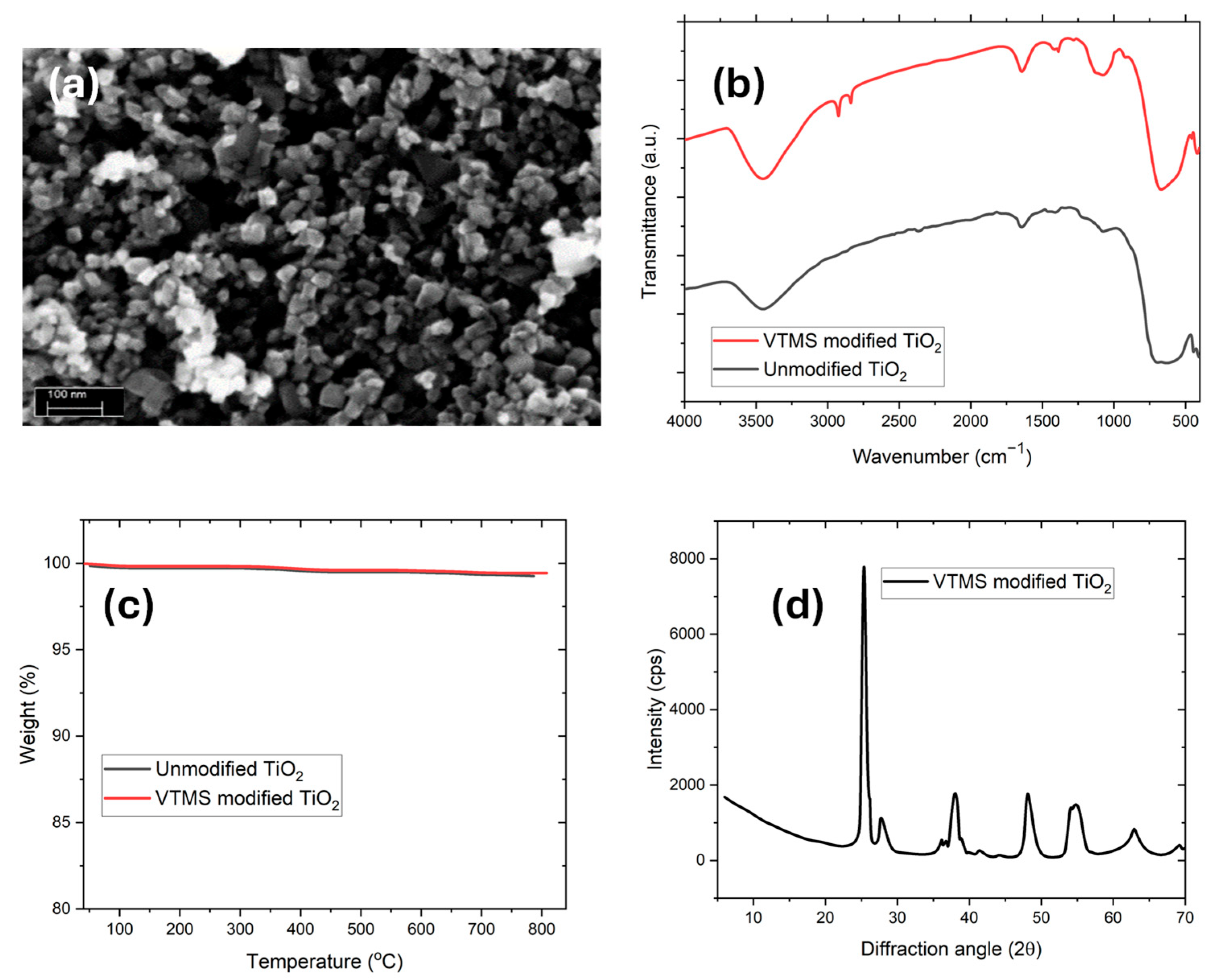
The morphological characteristics of VTMS-functionalized TiO
2 nanoparticles were investigated using Scanning Electron Microscopy (SEM), as shown in
Figure 1a. The image shows agglomeration-free, nanoscale particles exhibiting quasi-spherical to slightly irregular morphologies. The average particle size is below 100 nm, with uniform particle dispersion across the observed field. The clean and well-defined particle boundaries suggest effective surface functionalization with VTMS, which likely contributed to enhanced steric hindrance and reduced particle–particle interactions. The absence of significant agglomerates demonstrates that the modification process improved the colloidal stability of TiO
2, which is essential for further applications in polymer nanocomposites and mixed matrix systems [
33].
Fourier Transform Infrared (FTIR) spectroscopy was performed to confirm the chemical modification of TiO
2 nanoparticles with VTMS in
Figure 1b. The spectrum of unmodified TiO
2 primarily shows broad absorption bands below 800 cm
−1, corresponding to Ti-O-Ti stretching vibrations [
34]. Upon VTMS modification, new absorption bands emerge between 1000 and 1200 cm
−1, which are attributed to Si-O-Si and Si-O-Ti bonds, which is evidence of successful salinization [
23]. More peaks in the range of 2850–2950 cm
−1 refer to aliphatic C-H stretching vibrations of the vinyl groups of VTMS [
35]. These spectral characteristics confirm covalent coupling of silane moiety onto the TiO
2 surface, thus confirming the surface functionalization protocol [
36].
Thermogravimetric Analysis (TGA) was used to evaluate the thermal properties of unmodified and VTMS-modified TiO
2 nanoparticles shown in
Figure 1c. The TiO
2 in its original form showed minimal weight loss between the temperature range of 25 °C to 700 °C, which illustrates its inherent stability towards temperature changes. In comparison, the VTMS-modified TiO
2 lost weight slightly (1–2%), with most of the weight loss taking place within the range of 200–500 °C. This mass loss is explained by the thermal decomposition of the organic silane functional groups that are grafted on the surface of the TiO
2. Additionally, TiO
2 is a thermally stable inorganic oxide, and its functionalization with VTMS does not affect its structural stability but enhances surface chemistry and interfacial compatibility with the polymer matrix. The thermal decomposition profile confirms the presence of organic content while demonstrating that the modified nanoparticles retain high thermal stability, essential for processing in high-temperature membrane fabrication or catalytic applications [
37].
X-ray Diffraction (XRD) analysis was conducted to determine the crystalline phase and structural integrity of the VTMS-modified TiO
2 nanoparticles as depicted in
Figure 1d. The diffraction pattern displays distinct peaks at 2θ values around 25.3°, 37.8°, 48.0°, 54.0°, and 62.5°, corresponding to the (101), (004), (200), (105), and (204) planes of anatase TiO
2, in agreement with JCPDS card No. 21-1272. No additional peaks were detected, indicating phase purity [
38]. Furthermore, the crystallinity and peak positions remain unchanged following VTMS treatment, suggesting that the surface modification process does not disrupt the TiO
2 crystal structure. This preservation of the phase confirms that salinization occurred only on the surface without affecting the bulk structure of the nanoparticles [
39]. The particle size of VTMS@TiO
2 was calculated using the XRD data from the graph to confirm its nanoscale structure, critical for CO
2 separation applications. The crystallite size (DD) was determined using the Scherrer equation [
40,
41]. The calculated crystallite size of VTMS@TiO
2 is 20.35 nm, which confirmed the nanoscale structure of VTMS@TiO
2. The nanoscale crystallinity enhanced the surface area and is expected to enhance gas interaction, improving the permeability and selectivity of the MMMs for CO
2 separation.
3.2. SEM Analysis of Pure PSF and PSF/VTMS@TiO2 MMMs
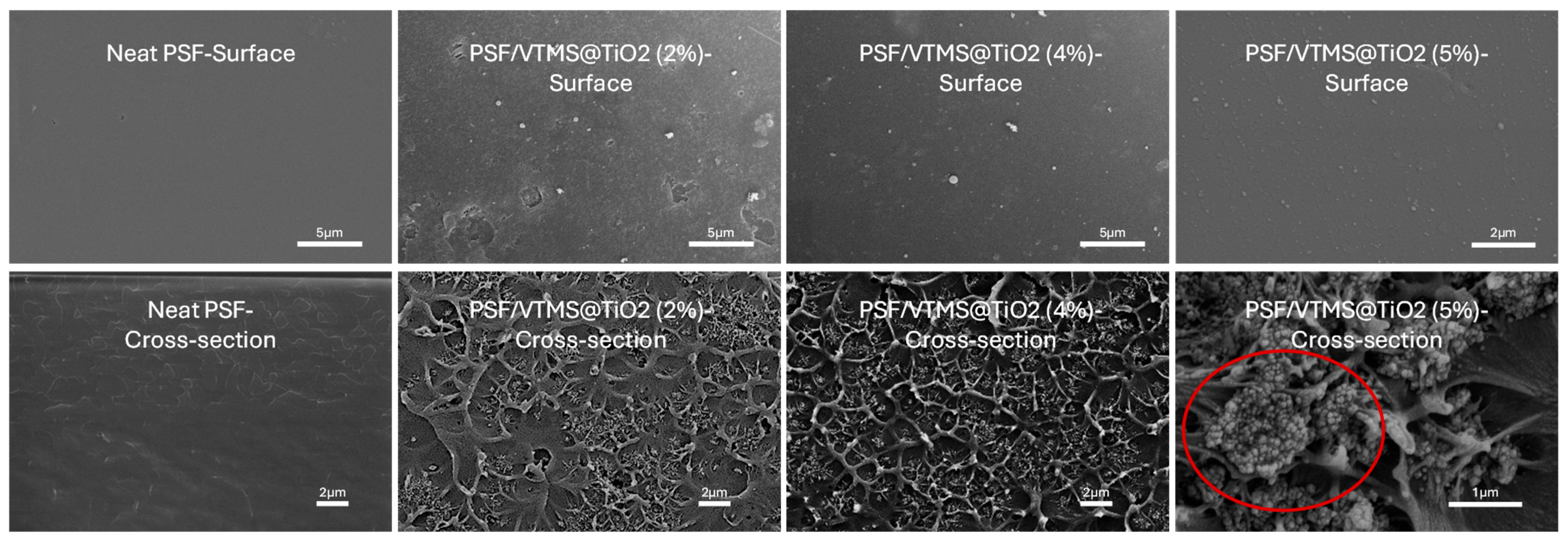
The surface and cross-sectional morphological characteristics of pure PSF and PSF-based mixed matrix membranes (MMMs) containing 2 wt.%, 4 wt.%, and 5 wt.% VTMS-functionalized TiO
2 nanoparticles were analyzed using SEM, as shown in
Figure 2. Neat PSF membrane exhibited a smooth and homogeneous surface, which is a dense and defect-free structure. This is a typical structure of unfilled polymeric membranes like PSF. The cross-sectional morphology of neat PSF membrane is homogeneous and non-porous, with no visible phase separation or internal heterogeneities.
The membrane with 2 wt.% VTMS@TiO
2 in
Figure 2 exhibits a relatively smooth polymer surface with irregularly distributed filler particles. While most of the nanoparticles appear embedded within the matrix, several regions display localized micro-aggregates, indicative of partial filler agglomeration. However, no significant phase separation or interfacial voids are visible, suggesting moderate compatibility between the filler and the PSF matrix at this loading. The presence of some clustered domains may affect gas selectivity by introducing less tortuous pathways, although the overall surface remains largely defect-free. The cross-sectional image of 2 wt.% VTMS@TiO
2 in
Figure 2 indicates a dense, continuous morphology, though minor heterogeneity appears at the nanoscale. The nanoparticles are embedded in PSF matrix without forming voids or defects, suggesting strong interfacial adhesion and good polymer–filler compatibility.
In the case of the SEM micrograph of the 4 wt.% VTMS@TiO
2-filled membrane shown in
Figure 2, a markedly improved filler dispersion was observed. The surface is denser and more homogeneously populated with well-embedded nanoparticles, and no visible agglomerates or non-selective voids. Cross-sectional analysis of 4 wt.% VTMS@TiO
2-filled membrane reveals a slightly more textured internal structure, and the membrane maintains its dense nature, with no evidence of delamination or void formation. This uniform distribution reflects strong interfacial interaction between the VTMS-modified TiO
2 and the polymer chains, which is a result of enhanced compatibility afforded by the silane coupling agent. The nanofillers appear to be evenly distributed at the microscale, contributing to the formation of a continuous and selective transport pathway for CO
2 molecules [
18]. The cross-sectional SEM of 5 wt.% VTMS@TiO
2-filled membrane shows significant agglomeration of TiO
2 particles, highlighted by the red circle. The presence of dense filler clusters and possible non-selective voids around the agglomerates suggests phase separation and poor filler–polymer interaction.
These morphological observations point towards the possible superior gas separation performance for the 4 wt.% membrane, where the balance of high filler loading and excellent dispersion would enhance both permeability and selectivity. The microstructural integrity at this optimal loading level validates the effectiveness of VTMS surface functionalization in minimizing filler aggregation and optimizing polymer–filler interfacial bonding in MMMs designed for CO2/N2 separation that is also evident from FTIR analysis, as discussed in the following section.
3.3. FTIR Analysis of Pure PSF and PSF/VTMS@TiO2 MMMs
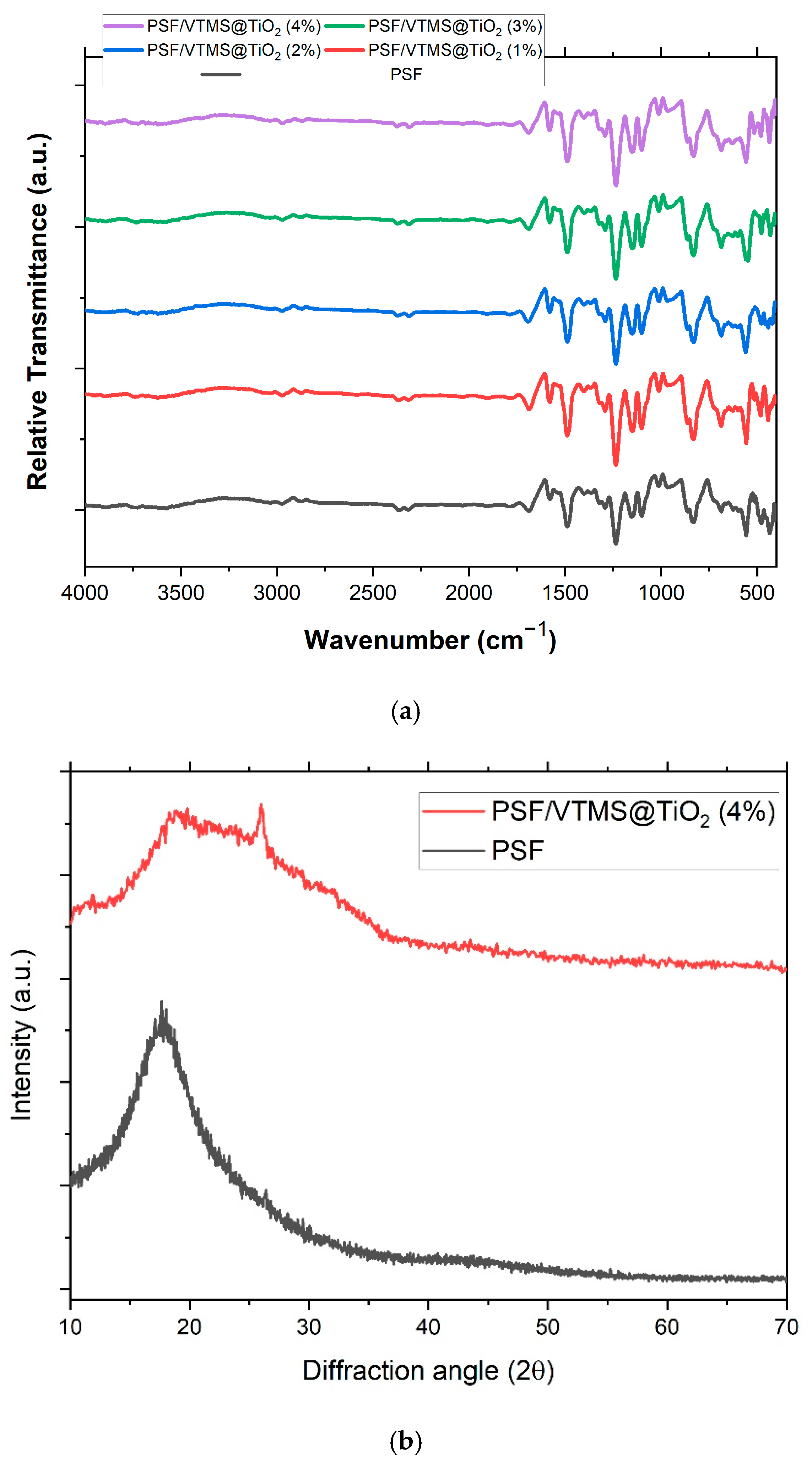
Fourier Transform Infrared (FTIR) spectroscopy was utilized to investigate the chemical interactions between pure polysulfone (PSF) and VTMS-functionalized TiO
2 nanoparticles across a range of filler concentrations (1–4 wt.%), as shown in
Figure 3a. The spectrum of the pure PSF membrane (black curve) exhibited distinct peaks characteristic of its polymer backbone of aromatic C=C stretching at 1586 cm
−1, sulfone (O=S=O) asymmetric stretching at 1321 cm
−1, and C-O-C ether linkages at 1231 cm
−1 and 1156 cm
−1 [
31,
42]. Additional signals at 1072 cm
−1 (S-O/C-H bending) and 823 cm
−1 (aromatic ring deformation) confirmed the presence of sulfone and aromatic functionalities in the polymer chain [
43].
Upon incorporation of VTMS@TiO
2, the most prominent spectral changes were observed in the membrane containing 4 wt.% filler, which exhibited intensified absorption bands at 1062 cm
−1 and 970 cm
−1, corresponding to Si-O-Ti/Si-O-Si linkages and Si-OH groups, respectively [
21]. These enhancements suggest a higher degree of chemical bonding between the silane-modified filler and the polymer matrix, indicating successful VTMS grafting and improved interfacial compatibility. A pronounced peak at 690 cm
−1, attributed to Ti-O lattice vibrations, became more defined with increasing filler concentration, particularly in the 4% sample, confirming the increased presence of TiO
2 and its good dispersion [
44]. Furthermore, the slight increase in intensity of the C-H stretching vibration at 2923 cm
−1 in the 3% and 4% composites indicates the growing contribution of the VTMS organic moiety. These findings collectively suggest that the 4% VTMS@TiO
2 membrane demonstrates the most effective integration and surface interaction among all tested compositions. Low loadings of the filler (1–3 wt.%) also showed the same behavioral trend of the spectra but to a reduced extent. The appearance of silanol (Si-OH) and Si-O-Ti features at 1 wt.% was weak, suggesting limited surface coverage or interaction. When loading increased to 2% and 3%, Si-related peaks started to appear in a prominent way which indicates an improvement in the filler distribution and bonding. Notably, among all measured samples, the typical PSF backbone peaks were not affected in position and intensity, thus confirming that the polymer structure does not chemically change and is not destroyed even after the addition of the filled material [
45].
The water contact angle measurements shown in
Table S1 demonstrate enhanced surface hydrophilicity of the membranes with increasing VTMS@TiO
2 loading up to 4 wt.%. This trend can be attributed to the introduction of polar silanol and hydroxyl groups as seen in FTIR spectra. However, a slight increase in water contact angle at 5 wt.% indicates filler agglomeration which is also evident in SEM images. The agglomeration leads to reduced exposure of hydrophilic sites and increases surface heterogeneity.
The observed spectral modifications provide evidence to the formation of chemical bonds like Si-O-Ti and Si-O-Si on filler surface, supporting the efficiency of VTMS modification. The stronger silanol (Si-OH) retention also indicates partial condensation that will help interfacial hydrogen bonding or secondary interactions with PSF. These interactions are very important in enhancing performance of the resulting membranes in mechanical, thermal, and separation of gases. Overall, the FTIR results confirm favorable chemically induced TiO2 surface modification and successful incorporation into the PSF matrix, with an optimized filler loading of 4 wt.%.
3.4. XRD Analysis of Pure PSF and PSF/VTMS@TiO2 MMMs
The XRD technique was applied to characterize the phase composition and structure of the pure PSF membrane and MMM having 4 wt.% VTMS@TiO
2 as shown in
Figure 3b. The curve for the pure PSF membrane (black curve) shows a broad and featureless peak at about 2θ ≈ 18.6° and, therefore, it can be concluded that the membrane is mostly amorphous, typical of thermoplastic polysulfone membranes [
46]. In contrast, the PSF/VTMS@TiO
2 (4%) membrane (red curve) shows a significant change in the XRD profile. In addition to the polymer’s amorphous hump, several sharp diffraction peaks appear at 2θ ≈ 25.3°, 37.9°, 48.0°, 54.0°, and 62.6°, which correspond to the (101), (004), (200), (105), and (204) planes of the anatase phase of TiO
2, respectively, as per JCPDS card No. 21-1272. These peaks confirm that the crystalline structure of TiO
2 remained intact after VTMS modification and subsequent incorporation into the polymer matrix. The peak at 25.3° (101) is particularly intense and dominant, which is a hallmark of TiO
2 and confirms its structural stability.
The emergence of these distinct peaks in the MMM spectrum strongly supports the successful dispersion of VTMS@TiO2 nanoparticles within the PSF matrix. Moreover, the amorphous part of the PSF’s diffraction pattern did not change, which indicated the polymer’s internal structural integrity and the lack of crystallization of the filler in the polymer matrix. The co-existence of amorphous matrix of PSF and well-defined crystalline structure of TiO2 in the composite presents a material that is flexible and rigid at the same time. The increase in the diffraction intensity of the composite membrane points to higher crystallinity from the inorganic filler, which helps to enhance the material’s mechanical strength, thermal stability, and gas permeation properties. From the observed XRD patterns, successful integration of VTMS@TiO2 nanoparticles in the PSF matrix can be seen, highlighting the promise of the material for gas separation membranes.
3.5. TGA of Pure PSF and PSF/VTMS@TiO2 MMMs
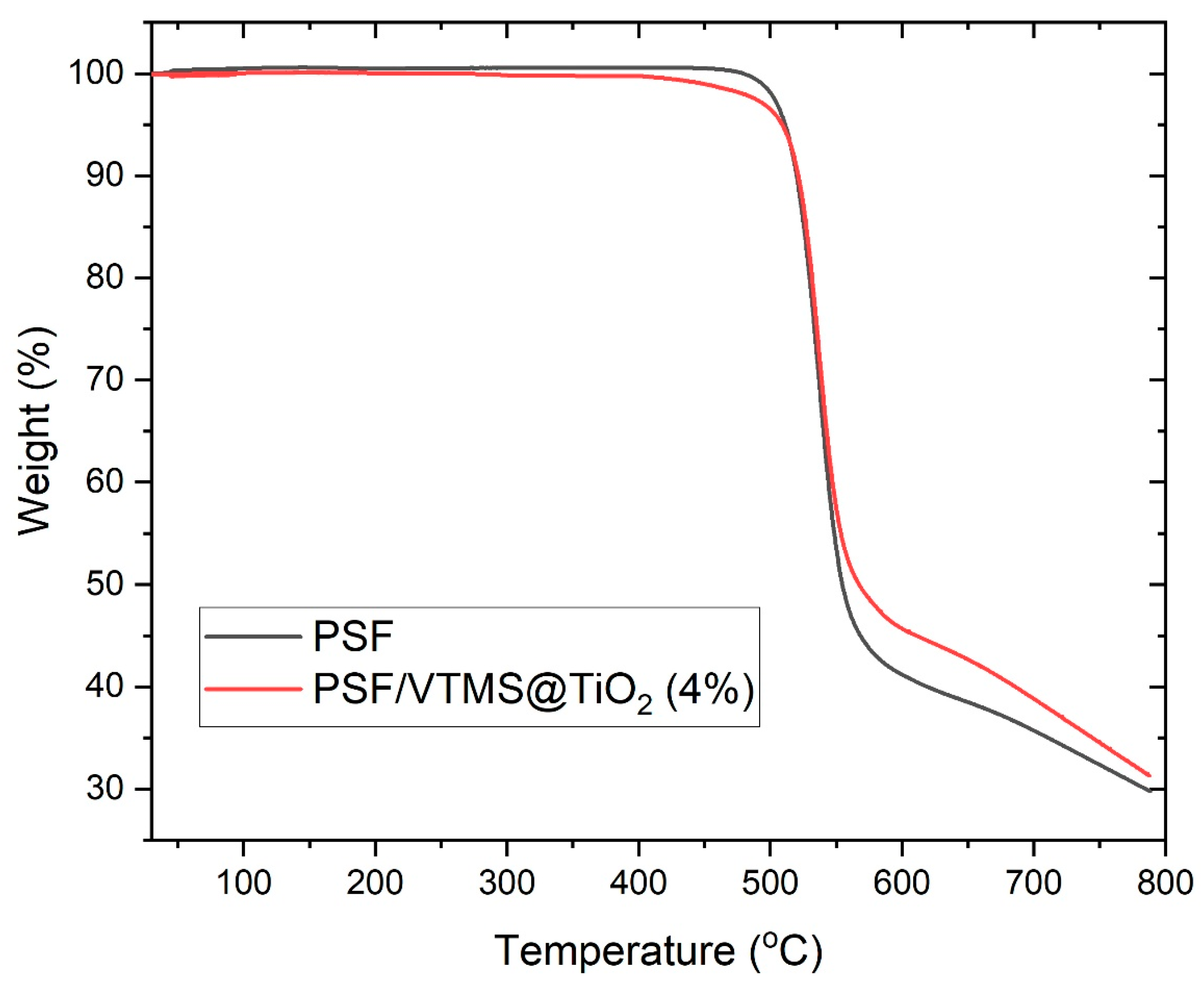
Thermogravimetric Analysis (TGA) was conducted to evaluate the thermal stability and decomposition behavior of the pure polysulfone (PSF) membrane and the PSF-based mixed matrix membrane (MMM) containing 4 wt.% VTMS-functionalized TiO
2 (VTMS@TiO
2). The TGA curves, presented in
Figure 4, illustrate weight loss (%) as a function of temperature in the range of 30 °C to 800 °C under a nitrogen atmosphere.
The TGA curve of pure PSF (black curve) shows excellent thermal stability up to approximately 500 °C, beyond which a rapid weight loss occurs. This major degradation event corresponds to the thermal decomposition of the PSF backbone, involving scission of sulfone, ether, and aromatic linkages. The onset of degradation (T-onset) is observed around 520 °C, and the maximum decomposition rate occurs near 550–580 °C, leading to a substantial mass loss. By 800 °C, the residual weight is approximately 31%, primarily consisting of carbonaceous char and thermally stable aromatic fragments. On the other hand, the PSF/VTMS@TiO2 (4%) membrane (red curve) displays a similar thermal profile but with subtle shifts indicating enhanced thermal resistance. The onset of thermal degradation is slightly delayed, beginning around 530 °C, and the final residue at 800 °C is higher (~35%), which is attributed to the presence of thermally stable TiO2 nanoparticles and residual siloxane components from VTMS. The incorporation of VTMS@TiO2 contributes to improved char formation and enhanced thermal shielding due to its high decomposition resistance and inorganic nature.
The little increase in onset decomposition temperature and the increased residue content in the MMMs suggest that the filler provides a thermal barrier against heat-catalyzed degradation of the polymer matrix. Additionally, VTMS-functionalized surface could boost interfacial adhesion and restrict the mobility of the chains at high temperatures, adding to thermal stability [
18]. The similarity in degradation behavior of pure PSF and PSF/VTMS@TiO
2 shows that the thermal stability of the composite membrane is still dominated by the PSF matrix, while with introduction of the thermally stable TiO
2 nanoparticles slightly increases the time scale of the decomposition. Therefore, the slight variation in the TGA curves is mainly due to the low number and high thermal resistance of the VTMS-modified TiO
2, which proves that the treatment on the surface of the nanoparticles primarily improves the interfacial interaction, with no detrimental effect on the thermal integrity of the nanoparticles or the MMMs. TGA confirmed the incorporation of 4 wt.% VTMS@TiO
2 in PSF matrix and enhanced the strength of the membrane relating to the thermal robustness, which is beneficial, particularly in high temperature applications like the gas separation processes in toxic industrial environments.
3.6. Effect of VTMS@TiO2 Loading on Gas Permeation Properties
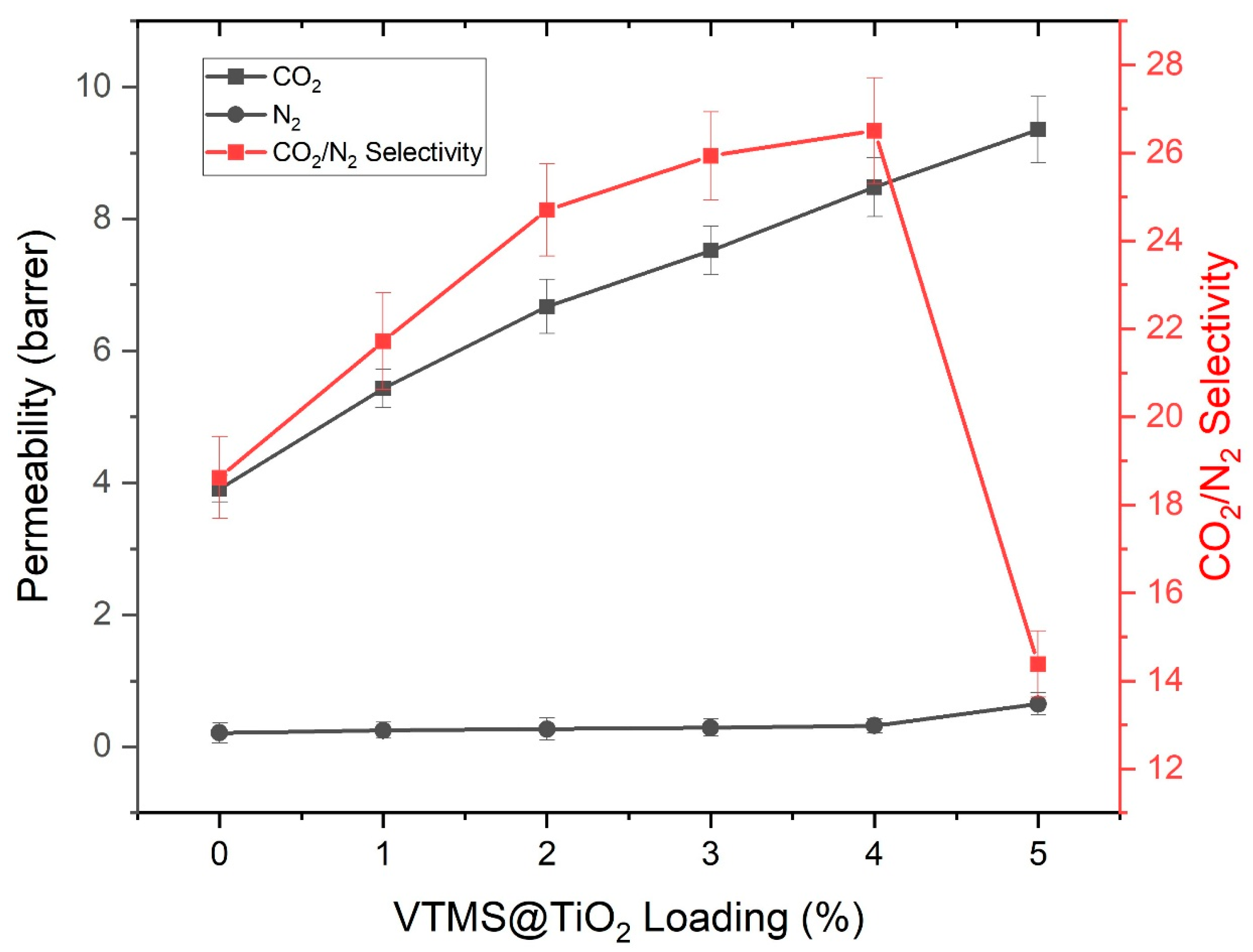
In order to understand the influence of VTMS@TiO
2 filler loading on the performance of the membranes in terms of CO
2, N
2 permeability, and CO
2/N
2 selectivity, a graphical representation displayed in
Figure 5 was used. The pure PSF membrane (without filler) has shown a CO
2 permeability of 3.91 barrer and N
2 permeability of 0.21 barrer, which gives the selectivity as 18.62. Upon incorporating 1 wt.% VTMS@TiO
2, the CO
2 permeability increased to 5.43 barrer and the selectivity improved to 21.72, indicating enhanced CO
2 transport properties due to better gas sorption and diffusion facilitated by the dispersed nanofiller. With 2 wt.% filler loading, CO
2 permeability further rose to 6.67 barrer, while selectivity increased to 24.70, suggesting improved interfacial compatibility between the filler and polymer matrix. At 3 wt.% loading, the membrane demonstrated a CO
2 permeability of 7.52 barrer with a selectivity of 25.93. The consistent enhancement in both parameters up to this level is attributed to the uniform dispersion of the VTMS-functionalized TiO
2 particles as seen in SEM analysis, which likely provided more accessible sorption sites and better chain packing for selective gas transport [
43].
The most significant performance was observed at 4 wt.% VTMS@TiO2, where the membrane achieved a CO2 permeability of 8.48 barrer and the highest CO2/N2 selectivity of 26.50. This optimum behavior is attributed to the synergistic effects of filler–polymer interactions, enhanced gas affinity of the modified TiO2, and the absence of structural defects or agglomeration. The VTMS@TiO2 filler improves CO2/N2 selectivity by introducing CO2-philic functional groups in TiO2 surface, as observed in FTIR analysis, which enhance CO2 sorption. Hence, the selectivity enhancement could be predominantly attributed to sorption in these membranes. In general, gas transport through dense membranes is governed by solution diffusion mechanism. Since TiO2 is a nonporous filler, molecular sieving may not be realized in these MMMs. SEM analysis also revealed improved filler dispersion and polymer–filler compatibility. This reduces non-selective voids and creates a more size-selective, solubility-enhanced membrane environment that favors CO2 over N2. However, at 5 wt.% filler loading, although CO2 permeability continued to increase to 9.35 barrer, the selectivity sharply declined to 14.38 due to a significant rise in N2 permeability (0.65 barrer). This drop in selectivity is likely due to the onset of filler agglomeration and the formation of non-selective voids at higher loading levels, which disrupts the membrane’s morphological integrity and reduces the selective advantage provided by the filler.
It is worth mentioning that CO2 permeability obtained in this research is lower than other PSF-based MMMs filled with highly porous nanostructures (ZIF-8, UiO-66, carbon-based nanostructures, etc.). It is expected that since TiO2 is a non-porous filler, it does not add any further microporosity for diffusional transport through the membrane. Therefore, transport of gases in dense PSF matrix is only through the solution-diffusion mechanism, and permeability is highly restricted by the inherent polymer rigidity and low free volume instead of filler porosity. The VTMS modification enhances interfacial compatibility and CO2 sorption but cannot create high-throughput channels like porous MOFs or zeolitic fillers. Thus, the permeability is low, but the improvement is based on increased polymer–filler interaction and CO2-philic chemistry but not related to increases in microporosity. Thus, 4 wt.% VTMS@TiO2 was identified as the optimal loading, balancing both permeability and selectivity, and highlighting the importance of controlling filler dispersion to avoid performance deterioration at higher concentrations.
3.7. Effect of Feed Pressure on Gas Permeation Properties
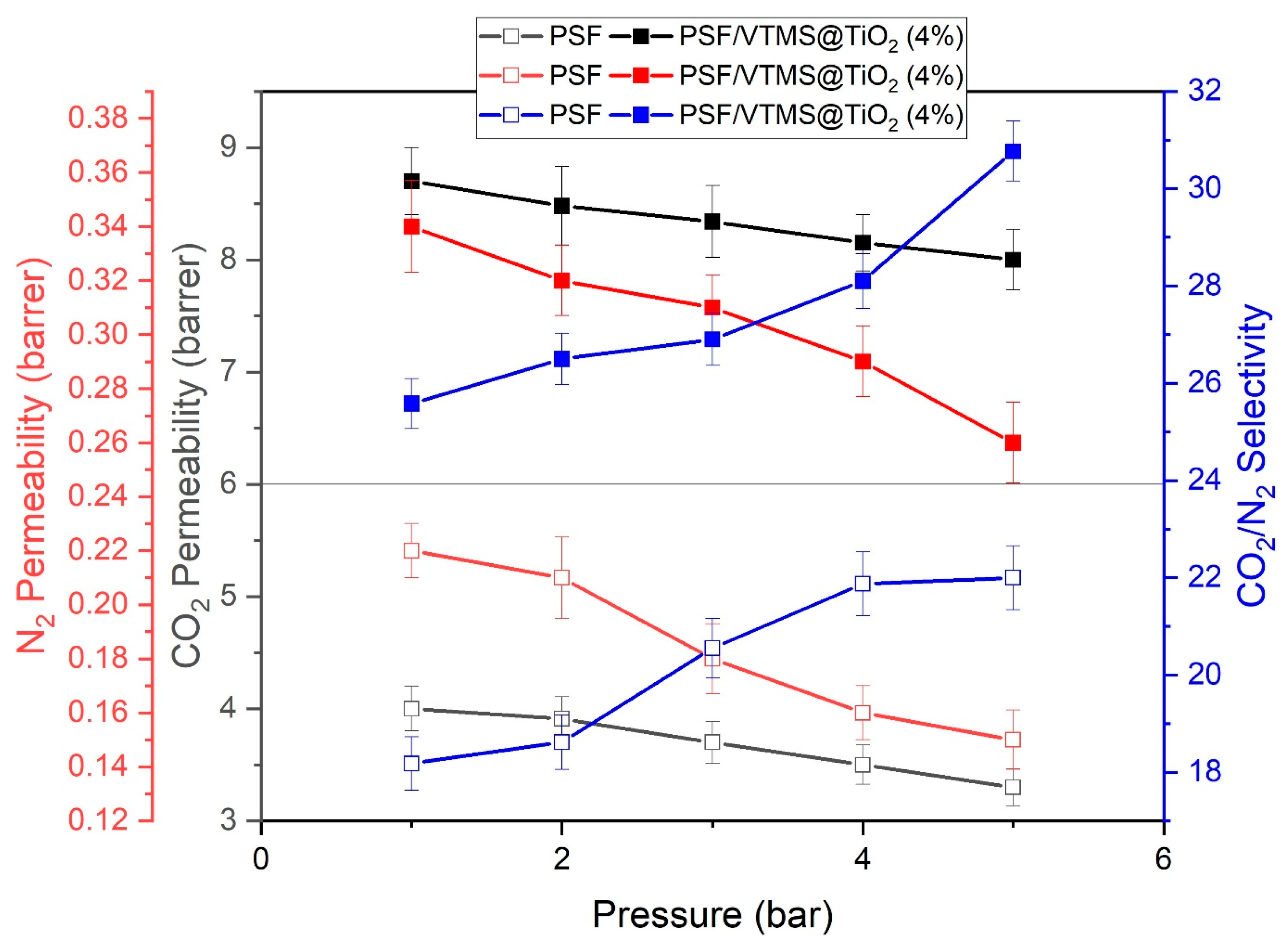
The impact of feed pressure on CO
2 and N
2 permeability as well as CO
2/N
2 selectivity was evaluated for the PSF/VTMS@TiO
2 (4%) mixed matrix membrane (MMM) in
Figure 6. As shown in the corresponding plots, the CO
2 permeability of the membrane shows a slight decline with increasing pressure, decreasing from 8.7 barrer at 1 bar to 8.0 barrer at 5 bar. Similarly, N
2 permeability also decreases with pressure, from 0.34 barrer to 0.26 barrer across the same range. This pressure-dependent decline in gas permeability is commonly attributed to polymer chain packing and reduced segmental mobility under higher pressure, leading to lower diffusivity [
45]. Interestingly, while permeability for both gases decreases, the CO
2/N
2 selectivity significantly increases with pressure, rising from 25.58 at 1 bar to 30.77 at 5 bar. This trend indicates that MMM becomes increasingly selective toward CO
2 at higher pressures, which is a desirable trait in gas separation applications. The enhanced selectivity can be explained by the differential compressibility and kinetic diameters of CO
2 and N
2; CO
2’s higher solubility and smaller kinetic diameter allow it to permeate more favorably, especially under densifying membrane conditions.
Overall, the PSF/VTMS@TiO2 (4%) membrane demonstrates excellent performance, maintaining high CO2 permeability while achieving superior selectivity at elevated pressures. This behavior makes it a promising candidate for practical CO2/N2 separation processes, especially where operations occur under moderate to high pressures.
3.8. Effect of Feed Temperature on Gas Permeation Properties
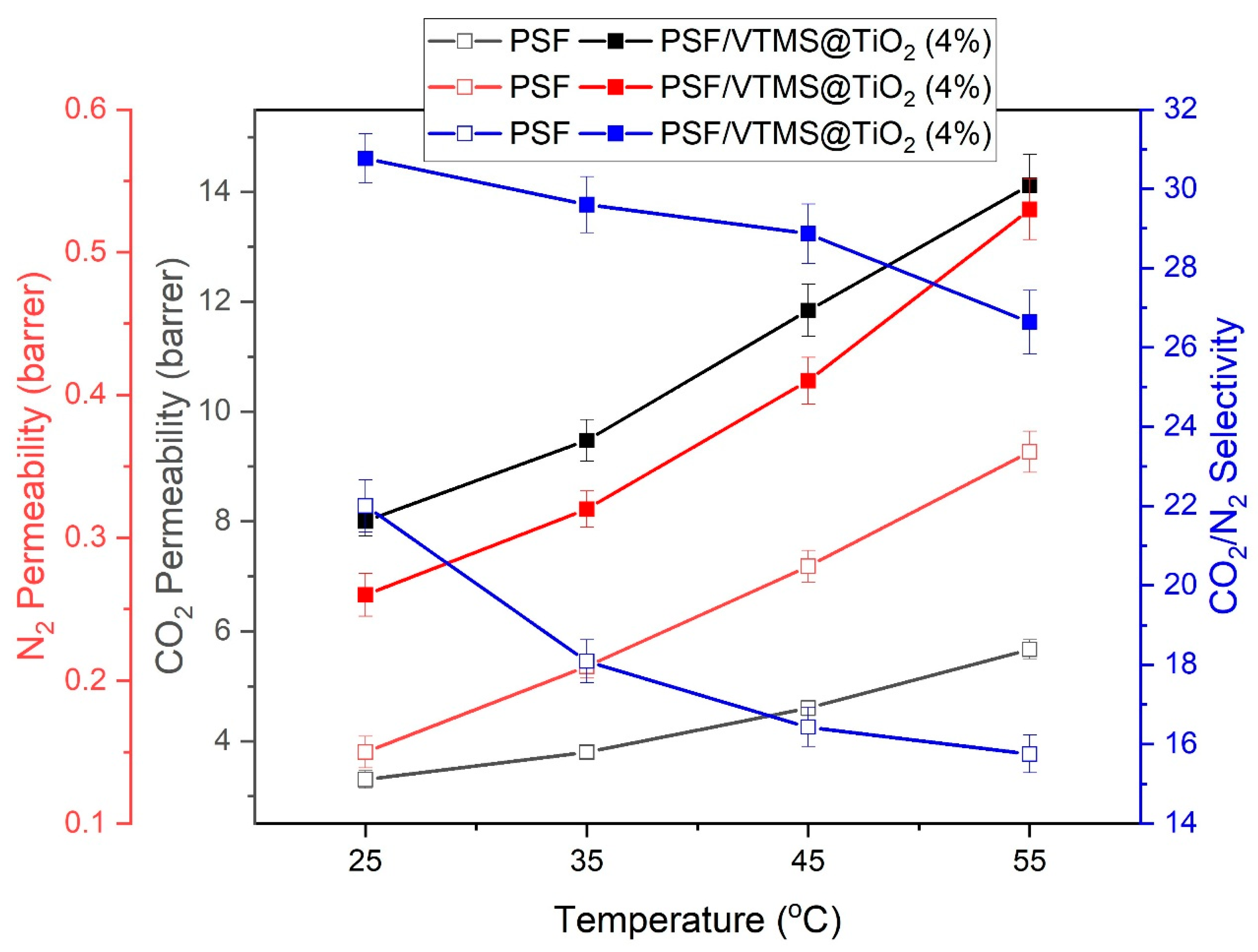
The effect of feed temperature on the gas transport properties of PSF and PSF/VTMS@TiO
2 (4%) membranes is illustrated by analyzing the permeability of CO
2 and N
2, along with their selectivity ratio (CO
2/N
2), across the temperature range of 25–55 °C shown in
Figure 7. The incorporation of 4% VTMS-functionalized TiO
2 nanoparticles significantly enhances both CO
2 and N
2 permeability compared to the pure PSF membrane at all temperatures. As temperature increases, the permeability of both gases rises, which is consistent with the increased chain mobility of the polymer matrix and greater diffusivity at higher temperatures [
47].
For the PSF/VTMS@TiO2 (4%) membrane, CO2 permeability increases markedly from 8 barrer at 25 °C to 14.12 barrer at 55 °C, while N2 permeability increases from 0.26 to 0.53 barrer over the same range. This rise in permeability is expected due to the thermally activated nature of gas diffusion. However, a key observation is the declining trend in CO2/N2 selectivity with increasing temperature from 30.77 at 25 °C down to 26.64 at 55 °C, suggesting that the temperature has a more pronounced effect on the diffusion of the less permeable gas (N2), thereby reducing the membrane’s ability to discriminate between CO2 and N2.
Despite the decline in selectivity at higher temperatures, the PSF/VTMS@TiO
2 (4%) membrane consistently outperforms the unmodified PSF in both permeability and selectivity across the full temperature range. The highest selectivity (30.77) and a reasonable CO
2 permeability (8 barrer) are observed at 25 °C, indicating this condition as optimal for applications prioritizing separation performance. Therefore, the PSF/VTMS@TiO
2 (4%) membrane at 25 °C can be considered the optimal sample in this study for efficient CO
2/N
2 separation, balancing both high selectivity and adequate permeability. These findings are in line with solution-diffusion mechanism for dense polymeric membranes such as PSF. With the increase in temperature, the influence of sorption decreases due to the exothermic nature of gas–polymer interactions, and the diffusion becomes dominant due to increased segmental mobility [
48]. Hence increased permeability and lower selectivity are observed in glassy polymers. Even though the permeability is still less than the highly porous filler systems, yet the VTMS@TiO
2 filler provides a stable and defect-free interface throughout the temperature range.
3.9. Robeson Upper Bound Plot
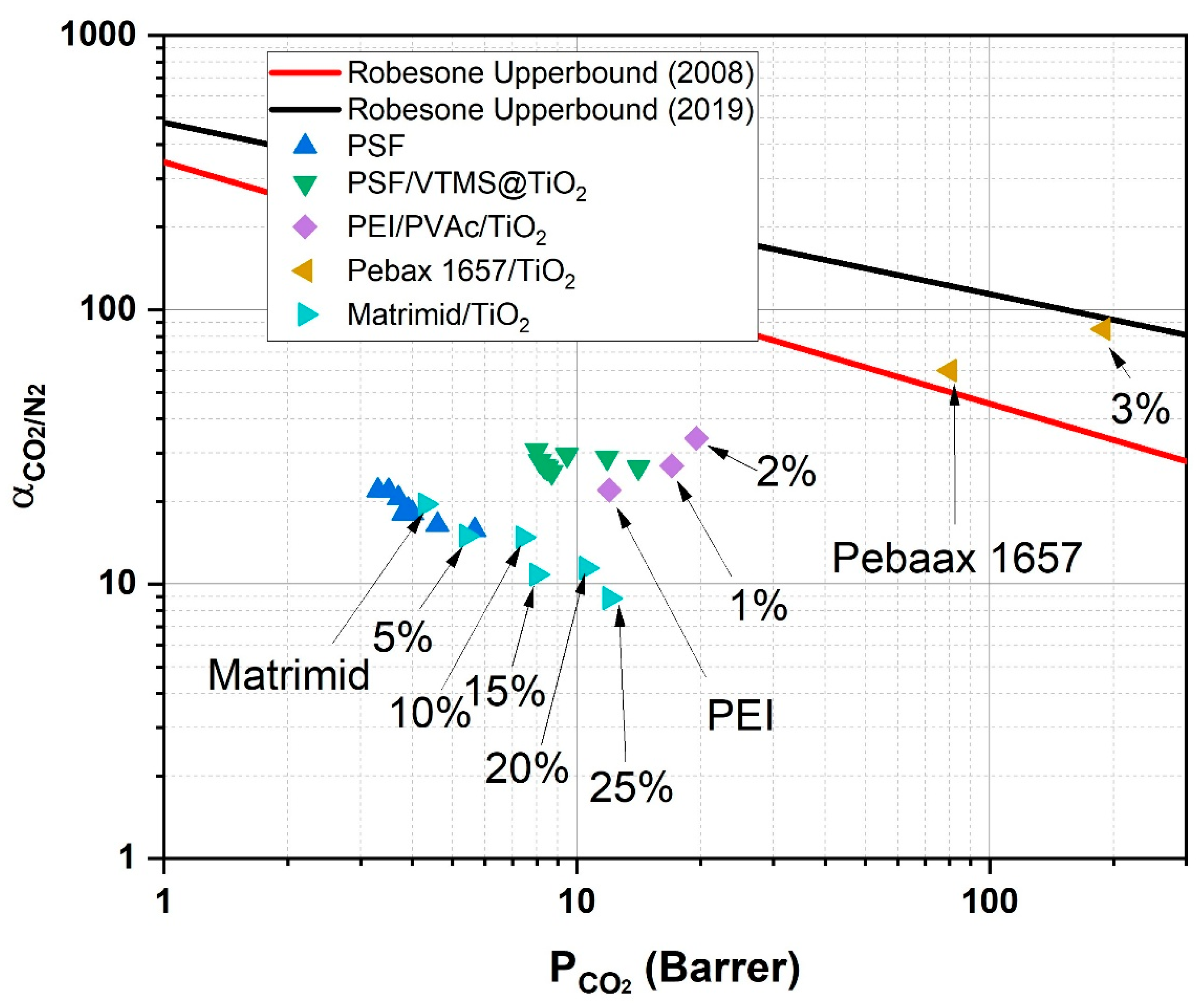
Figure 8 presents the position of PSF and PSF/VTMS@TiO
2 (4%) mixed matrix membranes (MMMs) on the Robeson Upper Bound plot for CO
2/N
2 separation, offering a comparative assessment of their performance in terms of permeability and selectivity. The Robeson Upper Bound serves as a benchmark for evaluating membrane efficiency, illustrating the typical trade-off between gas permeability and selectivity in polymeric membranes. Ideally, high-performance membranes are those that can simultaneously achieve both high permeability and high selectivity, positioning them closer to or beyond the upper bound line. In this study, the PSF membrane (without any filler) displayed limited separation performance, with a CO
2 permeability of 3.91 barrer and CO
2/N
2 selectivity of 18.62, placing it well below both the 2008 and 2019 Robeson limits. However, incorporation of VTMS-functionalized TiO
2 nanoparticles into the PSF matrix notably improved membrane performance. Among all tested formulations, the membrane containing 4 wt.% VTMS@TiO
2 demonstrated the best balance, exhibiting a CO
2 permeability of up to 14.12 barrer and selectivity reaching 30.77 under optimal operational conditions, including low feed temperature and elevated pressure [
49]. Data of three other TiO
2-filled polymer systems, i.e., Pebax [
18], Matrimid [
50], and PEI [
51] have also been included in the comparison as shown in
Figure 8. Matrimid was filled with a higher loading of TiO
2 which resulted in poor selectivity of this system. PEI/PVAc/TiO
2 system has shown a superior performance that can be attributed to the presence of both glassy and rubbery polymers in the system along with TiO
2 nanoparticles. Pebax/TiO
2 system has a much superior performance as compared to the present study. This is due to the intrinsic superior performance of Pebax polymer. Additionally, the membranes were tested at much higher pressure, i.e., 20 bar. Therefore, higher separation performance was observed.
The enhancement in separation performance with increasing VTMS@TiO
2 content up to 4 wt.% is attributed to the synergistic effect between the polymer matrix and the well-dispersed, surface-functionalized inorganic filler. The VTMS modification of TiO
2 improves compatibility with the polymer, enabling uniform dispersion and minimizing interfacial voids, which contribute to a more tortuous and selective pathway for gas molecules. The increased CO
2 affinity of the filler, coupled with the reduced kinetic diameter of CO
2 compared to N
2, further promotes preferential CO
2 transport. Additionally, other operating conditions like increased feed pressure were seen to increase the selectivity of the membrane without having as much adverse effect on the permeability, indicating the stability and efficiency of the membrane under practical application conditions. Notably, at 4 wt.% loading of VTMS@TiO
2, the optimal performance was achieved, and its further enhancement to 5 wt.% resulted in a decrease in the selectivity along with an incremental increase in the CO
2 permeability. The decrease is likely caused by the agglomeration of nanoparticles at high levels, leading to the creation of the non-selective voids, which affect the discriminative ability of the membrane [
52]. Thus, PSF/VTMS@TiO
2 (4%) membrane exhibits a considerable improvement relative to neat PSF, and its location on the Robeson plot is close to the 2019 upper bound.
When compared with recent advances in PSF-based MMMs, the present study is consistent with the literature trend that dense polymer matrices incorporating non-porous fillers typically exhibit moderate permeability but improved selectivity. Higher CO2 permeability in PSF membranes is typically achieved by the incorporation of porous fillers such as MOFs or carbon-based materials. However, these MMMs often suffer from poor interfacial compatibility, resulting in decreased selectivity. In contrast, the VTMS-functionalized TiO2 used here provides a stable and well-bonded interface, improving selectivity even though the permeability remains moderate. It highlights the promise of VTMS-functionalized TiO2 as a promising filler in improving membrane-based CO2/N2 separation, particularly when used with optimal loading and working environment.







 ,
,