


Abstract
Honey bee products comprise various compounds, including honey, propolis, royal jelly, bee pollen, bee wax and bee venom, which have long been recognized for their pharmacological and health-promoting benefits. Scientists have discovered that periodontal disorders stem from dental biofilm, an inflammatory response to bacterial overgrowth produced by dysbiosis in the oral microbiome. The bee products have been investigated for their role in prevention of oral diseases, which are attributed to a myriad of biologically active compounds including flavonoids (pinocembrin, catechin, caffeic acid phenethyl ester (CAPE) and galangin), phenolic acids (hydroxybenzoic acid, hydroxycinnamic acid, p-coumaric, ellagic, caffeic and ferulic acids) and terpenoids. This review aims to update the current understanding of role of selected bee products, namely, honey, propolis and royal jelly, in preventing oral diseases as well as their potential biological activities and mechanism of action in relation to oral health have been discussed. Furthermore, the safety of incorporation of bee products is also critically discussed. To summarize, bee products could potentially serve as a therapy option for people suffering from a variety of oral disorders.
1. Introduction
Honey bees are members of the genus Apis, which means “bee” in Latin. The prefix “api” is frequently used in beekeeping terms such as apiarist or a beekeeper. Apitherapy is defined as the use of beehive produces such as honey, pollen, royal jelly, propolis, bee venom and wax for treating and healing of ailments as well as in boosting the human immune system [1,2]. The origin of apitherapy can be pinpointed to more than 6000 years back in medicine of ancient Egypt [3]. The bee products are rich in natural antioxidants, and these are commonly used as natural remedies for health maintenance in traditional medicine in many countries. Honey bee products are popular among people of all ages, and are used across cultural and ethnic boundaries, and all religious and cultural beliefs promote and embrace the usage of honey bee products [4]. Among the various bee products, honey, propolis, and royal jelly have been discussed for improving oral health in the present review.
Natural honey is the world’s oldest sweetener, with records indicating that it was used around the planet several million years ago [5]. Honey is produced by the honey bees that collect nectar from flowers and process it through repeated digestion and regurgitation. It comprises fructose (38.5%), glucose (31%), other sugars (12.9%), water (17.1%), protein (0.5%) and minerals such as Ca, Co, Fe, Mg, Mn, Zn, Na, F and K [6,7]. In addition, it comprises valuable bioactive compounds, such as phenolic acids, carotenoids, flavonoids, organic acids, ascorbic acid, enzymes and other proteins [8,9,10,11].
Propolis, also known as “bee glue”, is the third most important bee product after honey and wax. The term “propolis” comes from the Greek words “pro” for defense and “polis” for city or community [12]. Its complex composition includes phenolic compounds (58%), beeswax (24%), lipids and wax (8%), flavonoids (6%), terpenes (0.5%), bio-elements (0.5%) and other substances (3%) [13,14]. It provides thermal insulation and protects the hive from invaders and is used to strengthen the hive by filling cracks and holes [13,15,16].
Royal jelly is a white, viscous jelly-like material secreted by worker bees’ hypopharyngeal and mandibular glands [17]. Royal jelly consists of water (50–60%), proteins (18%), carbohydrates (15%), lipids (3–6%), mineral salts (1.5%) and vitamins [18,19,20]. With around 185 organic compounds, royalactin is one of the major royal jelly proteins (MRJPs) [18,19,20]. Besides polyphenolic and flavonoid compounds, royal jelly is rich in essential amino acids, small peptides, fatty acids and vitamins. Other prominent carboxylic acids discovered in royal jelly include sebacic acid (SA) and 10-hydroxy-2-decenoic acid (10H2DA), which has not been recorded in any other natural raw material or even in any other apiculture product [21].
According to a report, oral diseases are becoming a matter of concern globally [22]. Oral health, in turn, affects the systemic health. An increased risk of cardiovascular diseases, digestive problems, diabetes and bacterial pneumonia has been reported in patients with poor oral health [23]. Various studies have explained the unique bioactive components of honey bee products that confer therapeutic and medicinal properties and improve the overall health. The bioactive compounds found in honey, propolis and royal jelly are known to possess antioxidant, anti-microbial, anti-inflammatory, anti-cancer, anti-ulcer, immunomodulatory, neuromodulatory and metabolic syndrome preventing activities [24,25,26,27,28,29,30,31,32,33,34,35,36]. Due to these properties, these products are being used/or show wide applications in preventing oral diseases like stomatitis, mouth ulcers, dental caries, plaque, gingivitis, periodontitis, cavity infection, dentin hypersensitivity, oral cancer, malodor and mucositis [15,37,38,39,40].
In today’s health-conscious society, honey bee products are gaining attention in traditional and modern medicine [41]. Application of bee products alleviates the consequences of oral disorders in a cost-effective manner. Thus, it is a challenge for researchers all over the world to make their effective use and realize their maximum medicinal benefits. There are no critical miscellanea on key facts about the role of bee products in treatment of oral diseases. As a result, the focus of this review will be on the major bioactive components, possible pharmacological characteristics and mechanism of action of bee products in the treatment of oral diseases. Figure 1 depicts the various components as discussed in this review.
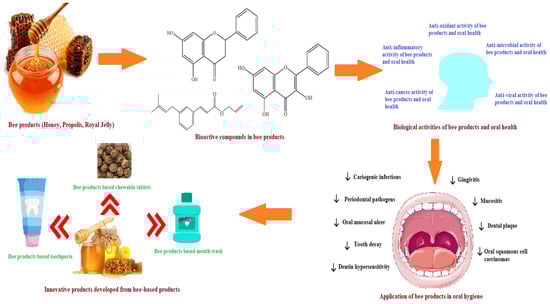
Figure 1.
Various components discussed in current review.
2. Bioactive Compounds of Bee Products in Relation to Oral Health
Natural bee products (honey, propolis and royal jelly) are generally considered as high-quality sources of bioactive compounds, having impressive biomedical potential. The therapeutic effect of these products is associated with their bioactive composition and plant source from which they are derived [42].
Bioactive Compounds
Honey is rich in bioactive compounds such as phenolic acids and flavonoids, which contribute to its beneficial properties [8,9,10,43]. The composition of these compounds in honey can vary based on factors such as environmental conditions, geographical location, production process, and the specific flora from which the honey bees collect nectar [10,15,43,44]. Dark-colored honey is believed to contain higher levels of bioactive chemicals compared to light-colored honey. For example, manuka honey has been found to contain compounds such as pinocembrin, chrysin, pinobanksin, kaempferol, luteolin, isorhamnetin, galangin, sakuranetin, quercetin and magniferolic acid [45]. Similarly, honey produced from different plant sources, such as Echium plantagineum L., may exhibit variations in their phenolic acid and flavonoid content [46]. Flavonoids are another significant group of bioactive components found in honey. Their content can vary among different honey types, with values ranging from 1.93 to 21.16 mg of quercetin equivalents per 100 g in samples such as sunflower and Heather honey [47]. Flavonoids possess antioxidant properties and contribute to protecting cell membranes by reducing lipid peroxidation and scavenging free radicals [48,49]. The composition of flavonoids in honey is influenced by floral origin and geographical location. For example, chrysin and apigenin are commonly found flavonoids in honey from Spain and New Zealand, while orange blossom honey has a significant amount of quercetin [50]. Propolis, another bee-derived product, contains bioactive compounds such as flavonoids (apigenin, acacetin, chrysin, catechin, naringenin, luteolin, galangin, kaempferol, rutin, pinocembrin, myricetin and quercetin) and phenolic acids (cinnamic acid and caffeic acid) [51,52,53]. The composition of propolis varies depending on its geographical and botanical origins [54]. Cinnamic acid derivatives and flavonoids, collectively known as citrin and vitamin P, are considered prime bioactive compounds in propolis [4,55]. The specific composition of propolis differs among regions, with caffeic acid phenethyl ester (CAPE) being the most common compound in temperate propolis, geranyl flavanones prevalent in Pacific and African propolis, and prenylated phenyl propanoids, acetophenones, terpenoids and aromatic acid derivatives found in tropical regions [4,55].
Royal jelly is composed of a small amount of minor bioactive compounds, including flavonoids such as flavanones (hesperetin, naringenin, isosakuranetin), flavones (chrysin, acacetin, luteolin, epigenin and its glycoside), flavonols (kaempferol and isorhamnetin glycosides) and isoflavonoids (coumestrol, genistein, formononetin) [18,56,57]. Phenolic acids such as octanoic acid, dodecanoic acid, pinobanksin and 1,2-benzenedicarboxylic acid, along with their esters, are also present in royal jelly [18,56]. The concentration of these phenolic acids and flavonoids in royal jelly is influenced by several factors, including the type of plants used by bees, seasonal variations and environmental factors [58,59]. In a study by Nagai and Inoue [60], the total phenolic compound content in royal jelly powder was reported as 21.2 µg/mg in water and 22.8 µg/mg in an alkaline extract. Different bioactive compounds in bee products and their actions are represented in Table 1.

Table 1.
Bioactive compounds with their biological activities in bee products.
3. Biological Activities of Bee Products in Relation to Oral Health
3.1. Antioxidant Activity of Bee Products and Its Effects on Diseases of the Oral Cavity
Honey has been reported to show antioxidant activity since the phenolic level is related to radical scavenging activity of honey and other bee products [64,65,66]. Polyphenols are regarded to be the key components responsible for honey and bee products’ antioxidant properties. These components have the ability to counteract the effects of oxidative stress, which is a key factor in the development of many diseases. [67]. In the area of dental medicine, the awareness of the potential benefits of bee products as antioxidants is rising. During normal metabolism, reactive oxygen species (ROS) are generated, which include free radicals (superoxide anion radical, hydroxyl radical, etc.) and non-radical molecules (hydrogen peroxide, singlet oxygen, lipoperoxides, etc.). These ROS interact with lipids, protein components in the cell membranes, enzymes and DNA of cell and may cause damage to them, which, in turn, may lead to various diseases. The antioxidants are compounds that seize free radicals before they can cause damage to the cell as they donate hydrogen atoms from their hydroxyl groups to free radicals [68]. According to Zhang et al. [32], polyphenols have the capability to control the nuclear factor kappa B (NF-κB), which is associated with modulating cell signaling pathways involved in cancer and inflammation. Antioxidants are generally given as oral ingestion, diet or vitamin supplements and in the form of nutraceuticals. Natural antioxidants that can be applied topically such as mouth rinse, gel, paste, gum, or lozenge compositions are nowadays gaining importance. These topical antioxidants may help to reduce ROS, which may act as inflammatory factors in the development of gingival and periodontal problems [69].
Honey has a high level of antioxidant activity and can lessen the effects of oxidative reactions that produce free radicals. Buckwheat and Heather honey are typically dark brown or black in color and are the richest sources of antioxidants and can ameliorate oxidative stress [70,71] while manuka honey has been reported to be rich source of flavonoids and also possesses higher antioxidant properties in comparison to other types of honey. Kishore et al. [72] compared antioxidant activity of Tualang, Indian forest, pineapple and Gelam honey samples and reported highest antioxidants in Tualang honey collected from Tulang honey bees in forests of Malaysia. Rosa et al. [73] studied TPC and antioxidant activities in Asphodel, Acacia, Eucalyptus, Heather, Citrus, Honeydew and Strawberry tree honey samples and found that Strawberry tree honey expressed the highest 2,2-diphenylpicrylhydrazyl (DPPH) and ferric reducing ability of plasma (FRAP) activities. They further reported 2,5-dihydroxyphenylacetic acid and homogentisic acid (HGA), major phenolic compound and a chemical marker for strawberry tree honey, were the potent antioxidants. Alvarez–Suarez et al. [74] reported significant radical scavenging activity in the ether-soluble phenolic extracts of Cuban honeys. Yuslianti et al. [75] used Rambutan honey to investigate free radical scavenging capacity (in vitro) and lipid peroxidation inhibition of oral mucosal wounds (in vivo) in male Wistar rats. They reported that 1 mg/mL honey showed 45.3% DPPH inhibition. Significant (p = 0.028) reduction in lipid peroxidation in oral mucosa wound tissue was observed. Toczewska et al. [76] reported that the antioxidant capacity in gingival crevicular fluid and saliva of periodontitis patients is diminished as a result of the chronic inflammatory process, which further makes proteins, lipids and DNA prone to oxidative damage and may result in the progressive devastation of the periodontal attachment apparatus. The beneficial effect of honey rich in polyphenolic compounds in enhancing the antioxidant capacity of oral fluids has been reviewed [77]. According to Ding et al. [78], the antioxidant properties of polyphenols appear to give significant protection against oral malignancies. Phenolic chemicals aid in the treatment of periodontal disease, the strengthening of teeth and the prevention of tooth decay [79,80,81]. Patients with recurrent aphthous stomatitis (RAS) exhibited considerably lower salivary antioxidant levels than healthy controls, according to Babaee et al. [82]. They correlated that ulcerations created ROS, which resulted in a reduction in antioxidant compounds in the mouth. Honey, when applied topically, has antioxidant components that can help minimize the effects of ROS activity during the development of ulcers.
Propolis possesses high concentration of phenolics [83] and is well-known for its antioxidant and radical-scavenging properties [61,81]. Bioactive substances such as pinocembrin, chrysin and pinobanksin have high antioxidant and anti-radical properties [82]. In DPPH and ORAC tests, pinobanksin-3-acetate was found to be the most powerful antioxidant component [84]. Fabris et al. [85] studied ethanol extracts of Russian and Italian propolis and found similarity in their total phenol content and antioxidant activity while low levels of phenolics and antioxidants were observed in ethanolic extract of Brazilian propolis. Zhang et al. [32] reported that antioxidant activity in Brazilian green propolis was due to 4,5-dicaffeoylquinic acid, 3,4,5-tricaffeoylquinic acid, artepillin C compounds and 3,5-dicaffeoylquinic acid. Total polyphenol and total flavonoid levels in poplar propolis contribute to antioxidant action [86]. In vitro investigations by Kumari et al. [87] and Bonamigo et al. [88] reported that propolis extracts were discovered to have antioxidant properties similar to the synthetic antioxidants, butylated hydroxytoluene or ascorbic acid. The total phenolic content (TPC), antioxidant activity and free radical scavenging activities (FRSA) of 70 Turkish samples of various honey bee products (honey, pollen, royal jelly and propolis) and their mixtures were examined by Ozkök and Silici [89]. Among the studied samples, honey bee propolis exhibited highest antioxidant and FRSA activity. Moreover, TPC was also found to have a positive relationship with antioxidant activity and FRSA. Kocot et al. [90] evaluated the total phenolic content (30 to 200 mg gallic acid equivalents/g DW), DPPH free radical-scavenging activity (20 to 190 g/mL) and flavonoid content (30 to 70 mg quercetin equivalents/g) of several propolis extracts. Aghel et al. [91] studied the useful result of propolis antioxidants on saliva in the test animals. El-Sharkawy [92] used propolis as a dietary supplement and found that when compared to the control group, the propolis-treated group had a substantial decrease in pocket depth (PD) and a rise in clinical attachment level (CAL), which could be due to antioxidant activity and other propolis properties. Giammarinaro et al. [93] compared the propolis efficacy with chlorhexidine in 40 patients of gingivitis and found that propolis-treated patients had improved results in terms of oxidative stress markers in their saliva, as well as significant improvements in their periodontal health. CAPE, extracted from propolis, is a strong antioxidant compound that is potentially used in oral squamous cell carcinoma (OSCC) patients for adjuvant therapy [38].
Royal jelly has been found to have antioxidant action owing to its total phenolic content, fatty acids and proteins. The small peptides contained in royal jelly, which are made up of 2–4 amino acid residues, have a high antioxidant activity. Tyrosine residues at the C-terminus of most active peptides in royal jelly allow them to scavenge hydroxyl radicals and H2O2 [94]. Nagai and Inoue [60] investigated the antioxidative activity and scavenging ability of protein fractions of royal jelly against free radicals such as the DPPH (1,1-diphenyl-2-picrylhydrazyl) radical, hydroxyl radical and superoxide anion radical. The antioxidant effect of royal jelly was studied by Silici et al. [95], who found a decrease in malondialdehyde levels and an increase in catalase superoxide and glutathione peroxidase dismutase activities. Park et al. [96] studied the assays of purified recombinant Apis mellifera major royal jelly proteins (AmMRJPs) and found that these proteins displayed radical-scavenging activity with 1,1-diphenyl-2-picrylhydrazyl and protection against oxidative DNA damage. Effect of the harvest time and the initial larval age has significant effect on the antioxidant potential in Royal jelly. Royal jelly collected 24 h after the larval transfer had the highest antioxidant activity in terms of DPPH radicals, prevention of linoleic acid peroxidation and reducing power [97]. Anatolian royal jelly samples were examined by Kolayli et al. [21] for their chemical composition and antioxidant capabilities. The total phenolic content ranged from 91.0 to 301.0 mg gallic acid equivalents/kg fresh weight. Anatolian royal jelly samples were found to be similar with other royal jelly samples around the world. Balkanska et al. [98] evaluated the antioxidant activity of royal jelly (RJ) collected from different areas of Bulgaria. The FRAP and total polyphenols showed variability and values ranged from 0.44–8.49 mM Fe2+/g and from 11.66–36.73 (mgGAE/g) for FRAP and total polyphenols, respectively. Uçar and Barlak [99] studied the antioxidant activity of water, dimethyl sulfoxide (DMSO) and methanol extracts of royal jelly from Bursa province in Turkey and found all the extracts showed total phenol content (TPC) and free radical scavenging capacity. The Table 2 represents the different biological activities of bee products and their relation in improving the oral health.
Table 2.
Biological activities of bee products in relation to oral health.
3.2. Anti-Microbial Activity of Bee-Based Products and Its Effects on Diseases of the Oral Cavity
The microbial flora associated with oral disease is diverse, including aerobic and anaerobic bacteria, viruses, parasites and other pathogens [113,114]. Oral microbial infections have been treated with a variety of agents, like amine fluorides, chlorhexidine, cetylpyridinium chloride and ethanol, which are commonly present in mouthwashes. But these have been proven to discolor teeth and may be toxic and cause oral malignancies, as well as have an undesirable taste [115]. Furthermore, the interest in such natural product as a possible source of novel antimicrobials has grown due to a concurrent decline in the number of effective antibiotics available and the ever-increasing prevalence of antibiotic resistance among pathogenic bacteria [116,117]. Natural substances discovered in bee-based product such as honey, propolis and royal jelly have been used for its anti-bacterial, anti-fungal and antiviral activities as well as anti-microbial benefits [118]. The antimicrobial properties of propolis against oral pathogens are attributed to the flavonone pinocembrin, amyrins, flavonol galangin and the caffeic acid phenethyl ester by inhibiting the bacterial RNA polymerase [119].
3.2.1. Anti-Bacterial Activity of Bee-Based Products and Its Effects on Diseases of the Oral Cavity
Numerous bacterial microbiotas inhabit in the mouth cavity with Streptococcus mutans, Porphyromonas gingivalis, Staphylococcus and Lactobacillus being the common oral bacteria [120]. Lactobacillus is a bacterium that produces lactic acid by fermenting sugar, which can easily cause caries [121]. P. gingivalis is a periodontal pathogen that is a Gram-negative anaerobic bacterium of non-glycolytic nature. P. gingivalis, if left untreated, could cause the teeth to fall off from gums. Further, anti-bacterial resistance has become a major problem globally that has prompted scientist community to study active ingredients used before the antibiotic era. Van Ketel, a Dutch scientist, was the first to identify honey’s bactericidal properties in 1892 [122]. This anti-bacterial activity is attributed to its properties which include: (i) its hygroscopic nature that can draw moisture out of the environment and dehydrate bacteria, (ii) its high sugar content and acidity (low pH) that prevents the microbes from growth [123], (iii) presence of hydrogen peroxide and phenolic acids [124], flavonoids [125] and lysozyme [126] as oxidizing agents restrict the bacterial responses to proliferative signals due to which bacterial growth remains arrested [127], (iv) phytochemical components like methylglyoxal (MGO) (non-peroxide) trigger modifications in the shape of bacterial flagella and fimbriae that impede bacterial adhesion and motility [128,129] and (v) an anti-microbial peptide, bee defensin-1 [130]. Honey’s pH (3.2–4.5) is low enough to suppress specific bacterial infections, such as Salmonella spp. (4.0), E. coli (4.3), P. aeruginosa (4.4) and S. pyogenes (4.5) [131], and enhances the healing process of wound through epithelialization [132]. Moreover, its anti-bacterial action was not shown to be affected by loss of its acidity after dilution [133]. Shiga et al. [134] reported the antibacterial action of honey was derived from methylglyoxal component, which help in oral disorders like halitosis (a bad breath condition). Honey is also used to prevent dental plaque, gingivitis, mouth ulcers and periodontitis. Honey may decrease dental plaque production and aid in reducing gingivitis associated with orthodontic operations, according to a study conducted by Patel et al. [135] on bacterial isolates collected from patients receiving orthodontic treatment. Honey inhibits anaerobic bacteria, which helps to prevent periodontal disease caused by Porphyromonas gingivalis [136]. In a trial of 150 dyspeptic individuals, honey consumption at least once a week dramatically reduced the chance of Helicobacter pylori infection. [137]. Honey can be used to replace glucose in oral rehydration, and its anti-bacterial qualities helped to shorten the duration of bacterial diarrhea [130].
The anti-bacterial properties of propolis have also been reported due to presence of caffeic acids, benzophenone derivatives, ferulic acid, prenylated coumaric acid and diterpenic acids [12,138,139,140,141]. The anti-bacterial properties of propolis have been shown to prevent the formation of bacterial plaques [142]. When compared to chlorhexidine, propolis solutions had a lesser cytotoxic effect on human gum fibroblasts. Mouthwashes containing propolis were discovered to have anti-bacterial action towards S. mutans and has been used as an alternative treatment for dental caries prevention [143]. Propolis fluoride was administered to teeth of children with dental caries surface to investigate the efficacy of propolis in combating dental caries. In another study, researchers treated individuals with a 10% hydroalcoholic solution of propolis extract, who were suffering from chronic periodontitis, and discovered a 95% reduction in chronic periodontitis [144]. It played an important role in the repair of tooth pulp [145]. The combined use of mouthwash and toothpaste with ethanolic extract of propolis improved the prevention of microbial infection and the treatment of gum inflammation [15,146].
The protein components of royal jelly like RJ proteins, royalisin, jellenies and enzymes, such as glucose oxidase, have significant anti-microbial potential [147]. The fatty acid 10-HDA, which also has immunomodulatory effects, is responsible for royal jelly’s anti-bacterial capabilities [148]. Terada et al. [149] found that the fatty acids contained 32% (10-HDA), 24% gluconic acid, 22% 10-hydroxydecanoic acid (HDAA), 5% dicarboxylic acids and several other acids, which effectively suppressed oral pathogens S. viridans and S. mutans as well as S. aureus and S. epidermis. Overall, royal jelly is a natural product having minimal side effects that works in synergy with other anti-plaque agents. Therefore, it can be used as an alternative to synthetic antibiotics [150].
3.2.2. Anti-Fungal Activity of Bee-Based Products and Its Effects on Diseases of the Oral Cavity
In human mouth, around 85 different fungi could be found and the most significant one is Candida [151]. When the oral microbiota is balanced, Candida sp. remains neutral; nevertheless, if the equilibrium is disrupted, this fungus will seek a chance to harm oral health. The Candida species, particularly Candida albicans, are major human fungal pathogens that can cause superficial oral mucosal infections often known as Candidiasis. According to reports, honey, propolis and royal jelly have anti-fungal properties against Candida albicans. Honey is also effective against dermatophytes (Microsporum ferrugineum, Trichophyton mentagrophyte, Trichophyton longfeuseus, Trichophyton semmie, Trichophyton tonsurance), parasitic fungi (Allescheria boydii), saprophytes (Mucor mucaralis) and Aspergillus species, according to Sheikh et al. [152]. Honey’s anti-fungal action has been associated with: (i) H2O2, which is formed in honey after dilution as a result of glucose oxidation [153,154], (ii) MGO, bee defensin-1 and other bee substances (e.g., phenolic compounds and flavonoids of floral origin and lysozyme), and (iii) honey’s osmotic impact. The honey’s mode of action, which inhibits biofilm development or accelerates the rupture of mature biofilms, includes the breakdown of cell membrane integrity and suppression of extracellular polysaccharide matrix creation [155]. Honey could be used to treat oral candidiasis so as to prevent infections from becoming more severe. In pilot research conducted by English et al. [156], patients were given chewable ‘honey leather’ and showed a substantial reduction in mean plaque scores and bleeding sites; the same strategy could be used to treat oral candidiasis. The flavonoid content of propolis confers its anti-fungal properties and also prevents division of fungal cell that further disrupts fungal cell wall and cytoplasm and which is comparable to several antibiotics [157]. Geopropolis produced by bees such as M. fasciculata possesses anti-fungal characteristics, according to Feres et al. [158]. In recent in vivo studies, geopropolis produced by M. fasciculata was reported to lower salivary S. mutans populations. This anti-fungal effect is attributable to caffeic acid derivatives (benzyl ester and pterostilbene) and flavonoids (sakuranetin, pinobanksin and pinocembrin) found in bee propolis. Propolis extract applied topically to oral Candida albicans lesions achieved remission in three weeks, with treatment efficacy comparable to nystatin, the most commonly used anti-fungal medication [159]. Royalisin is an insect defensin extracted from the royal jelly (RJ) and its inhibitory effect against a large spectrum of fungi was observed [160,161,162]. Royalisin has also been shown to have anti-fungal effect against Botrytis cinerea [163]. According to Melliou and Chinou [164], royal jelly carboxylic acids such as sebacic acid have high anti-fungal action against Candida albicans, Candida tropicalis and Candida glabrata.
3.2.3. Antiviral Activity of Bee-Based Products and Its Effects on Diseases of the Oral Cavity
The oral microbiome also contains viruses, primarily phages [165]. When human body is acquainted with certain diseases, other certain viruses may also arise in the mouth, for example, mumps virus [166] and HIV [167] are the most frequent. The DNA and RNA based viruses are responsible for oral cavity infection in the mucosal epithelium, which may further lead to ulceration or blistering [168]. Human herpes virus (HHV) members including varicella-zoster virus (VZV), HSV-1 and 2, HHV-6, HHV-7, and HHV-8, cytomegalovirus (CMV), human papillomaviruses (HPV) and Epstein-Barr virus (EBV) cause primary oral infections and diseases such as herpes ulcers, tumors, herpes zoster, precancerous lesions, periodontitis and herpes chicken pox etc. The oral mucosa may also be affected by secondary pathological processes [169]. Honey’s efficacy in the treatment of recurrent HSV lesions and oral mucositis in cancer patients has been well documented [30,170,171]. Antiviral effects of propolis have been established against a wide spectrum of viruses. Pagani [172] studied the antiviral activity of propolis flavonoids such as acacetin, kaempferol, chrysin, quercetin and galangin against diverse types of adenoviruses, influenza viruses, rotavirus, herpesvirus and coronavirus. Serkedjieva et al. [173] found that propolis phenolics, particularly isopentyl ferulate, have potent antiviral properties against the H3N2 influenza A virus. It is often applied in the treatment of diseases involving the oral cavity and gums. Antiviral effects of propolis against herpes viruses are also promising. In vitro studies have also revealed that the flavonoids present in propolis inhibited herpes virus strains from replicating intracellularly [174]. Using the plaque assay approach, in an extra-somatic environment, Hashemipour et al. [175] studied the antiviral properties of honey, royal jelly and acyclovir on herpes simplex virus-1. Honey, royal jelly and acyclovir at concentrations of 500, 250 and 100 g/mL, respectively, had the strongest inhibitory effects on HSV-1.
3.2.4. Anti-Inflammatory Activity of Honey Bee-Derived Products and Its Effects on Diseases of the Oral Cavity
Inflammation is the immune system’s natural innate response to infections, resulting in the development of diverse cellular and humoral immunological responses [176]. Parallelly, oxidative stress occurs when the equilibrium favors free radical formation over antioxidant components. Inflammation and oxidative stress are linked through a number of signaling mechanisms [27]. Reactive oxygen species (ROS) produced by mitochondria activate a number of transcription factors involved in the production of pro-inflammatory cytokines and mediators (NF-κB, extracellular signal-regulated kinase/ERK, janus kinase/JNK, mitogen-activated protein kinase/MAPK). Similarly, a few cytokines, such as TNF-α and IL-1, can cause mitochondrial ROS generation [177]. Metabolic and cellular alterations are caused by the interaction of ROS with pro-inflammatory cytokines. In other words, the initiation of an uncontrolled inflammatory process in the presence of oxidative stress is a key element in the pathophysiology of chronic diseases like mental, cardiovascular, traumatic, metabolic and autoimmune diseases. Stomatitis, or inflammation of the mouth’s mucous membranes, can cause redness and swelling of the oral tissues as well as prominent and painful ulcers.
Honey has been proposed as an immunologic modulator with two functions: (1) anti-inflammatory activities by downregulating inflammatory transcription factors (NF-κB and MAPK) and/or suppressing the production of pro-inflammatory cytokines, and (2) stimulation of inflammatory mediators such as prostaglandin E2 (PGE2) and cyclooxygenase-2 (COX-2) [178]. Honey is superior to dextromethorphan and diphenhydramine for the treatment of cough-induced upper respiratory infections. Honey is useful against stomatitis because it penetrates fast into the tissues [179,180].
Many studies have found that propolis has anti-inflammatory activities, which may be because of phenolic acids, notably CAPE. Anti-inflammatory properties of propolis are commonly used in mouthwashes. CAPE, in particular, has been proven to have anti-gingivitis properties [181]. Furthermore, in randomized, double-blind, placebo-controlled studies, rinse solutions containing Brazilian green propolis with higher artepillin C concentration decreased gingivitis to same extent as a NaF/cetylpyridinium chloride rinse or a chlorhexidine solution [169]. Royal jelly has been shown to have anti-inflammatory properties [182]. The key anti-inflammatory and immunosuppressive component of RJ that promotes anti-allergic response has been identified as major royal jelly protein 3 [183].
3.2.5. Anti-Cancer Activity of Bee Products in Relation to Oral Health
Oral cancer refers to malignant tumors that develop in mouth, and the majority includes squamous cell carcinoma, also known as mucosal variation. In clinical practice, gingival, jaw, tongue, oropharyngeal, soft and hard sputum, salivary gland, lip, maxillary sinus and face mucosal are all examples of oral cancer [184]. There are several strategies that can combat cancer, but many of them are associated with detrimental side effects on the health of patients As a result, when chemotherapy and radiotherapy are employed systemically or over a large area of tissue to kill malignant cells, they often affect healthy cells as well, resulting in undesirable side effects. Natural anti-proliferative compounds are an excellent alternative. Several recent studies have found that several natural bee products suppress tumor cell growth and spread and induce cancer cell apoptosis [185], implying that these natural chemicals (or their active components) could be used as part of an alternative medical treatment for human tumors.
Honey bee polyphenols have been demonstrated to have improved anti-cancer effects, helping to prevent oral cancer initiation, proliferation and progression. Apoptosis, cell cycle arrest, oxidative stress regulation, inflammation relief, increased mitochondrial outer membrane permeabilization and angiogenesis suppression are all involved in mechanism. Tualang honey inhibited cell proliferation and promoted apoptosis in oral squamous cell cancer under in vitro conditions [186]. The anti-cancer action of crude honey extracts in oral malignancies is most likely due to caspase 3 activation, which induces apoptosis [187]. Purified polyphenols, rather than crude honey, are currently being studied in cancer research. Caffeic acid, phenyl esters, galangin, kaempferol, acacetin, chrysin, quercetin, pinobanksin, apigenin and pinocembrin are simple polyphenols found in honey bees that are prospective pharmacological agents in cancer treatment [187], but cancer of colon, gastric tract, skin, fibrosarcoma and glioma cell have all been shown to be resistant to these phenolic chemicals.
Propolis is an effective antioxidant in the treatment of oral cancer due to presence of high concentration of phenolics and another antioxidant. When glutathione synthesis is low, tumor cells are more vulnerable to radiation impacts [188]. Propolis produces glutathione in hematopoietic tissue, which has anti-cancer properties [189]. Propolis is used as a supplement to help people avoid chronic degenerative disorders like mouth cancer [190]. Propolis contains caffeic acid phenyl ester (CAPE), which possesses anti-mitogenic and anti-cancer characteristics [191]. CAPE could be used as an adjuvant treatment for people with oral squamous cell cancer (OSCC). Because of its high oral absorption and long-term safety profile, propolis is an ideal adjuvant medication for future immunomodulatory or anti-cancer regimens [190]. Flavonoids in propolis stop oral cancer as well as esophagus, stomach, colorectal, prostate and skin cancer [67].
In experimental animals, RJ has shown pharmacological actions, including anti-tumor activity [192]. RJ’s anti-tumor effects were studied using transplantable mice tumors, including advanced leukemia strains and solid tumors [185]. In murine tumor models, effects of RJ formation of tumor and metastasis were investigated [193]. A spontaneous mammary carcinoma (MCa) and a methylcholanthrene-induced fibrosarcoma (FS) of the CBA mouse were employed as transplantable murine tumors. When injected intra-peritoneally or subcutaneously, RJ had no effect on metastases while intravenous administration of tumor cells and RJ dramatically reduced the metastases growth. Royal jelly components like 10-HDA and 4-hydroperoxy-2-decenoic acid ethyl ester possess high anti-proliferative effect.
4. Applications of Bee-Based Products in Managing oral Diseases
In recent years, increased implementation of honey bee products like honey, propolis and RJ as an alternative medicine has been witnessed due to their health-promoting activities such as antioxidant, anti-microbial, anti-bacterial, anti-inflammatory, anti-cancer, etc. [25,26,27,28,194]. Honey is employed in treatment of multiple oral ailments such as dental caries, gingivitis, oral cancer, plaque, malodor, radiation-induced oral mucositis and xerostomia [195,196,197]. Similarly, role of propolis has been shown to help with dental caries prevention, oral mucositis reduction, oral cancer prevention and gingival and periodontal disease prevention [37,38,39]. It also reduces dental hypersensitivity and dentin permeability as well as obstruction of dentinal tubules. It works as a transport medium to improve the periodontal ligament cell viability of avulsed teeth as well as for direct pulp capping and analgesia [198,199]. In another study, a positive effect of royal jelly (with anti-microbial activity) on periodontium has been found and that makes it a valuable agent in dentistry [200]. Figure 2 presents the mechanism of action of polyphenols in maintaining oral health.
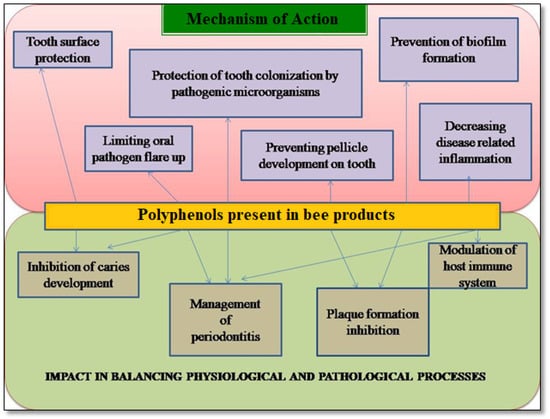
Figure 2.
Importance of polyphenols in bee products for oral health.
4.1. Gingivitis
Gingivitis arises due to bacterial presence in plaque biofilm resulting in inflammation of gingival tissues. Gingivitis can be treated with good oral hygiene practice, but failing to do so can develop periodontal (gum) disorders leading to loss of alveolar bone and periodontal ligaments attachment [201]. In terms of reducing gingival scores, mouthwash containing manuka honey has been found to be equally efficient as chlorhexidine [202]. The principal infective bacterium responsible for persistent periodontal inflammation is called Porphyromonas gingivalis. Levels of inflammatory cytokines, chemokines and CD54 increase in inflammatory sites in periodontal lesions in response to P. gingivalis lipopolysaccharides. It has been observed that consumption of royal jelly can inhibit the development of periodontal infections [147].
4.2. Dental Caries
The effectiveness of honey has been shown against 60 different species of bacteria, including S. mutans, a heavily involved pathogen in dental caries [203]. Presence of bacteria and fermentable carbohydrates along with a susceptible tooth surface are all etiological factors for dental caries. Catechins cause irreversible damage to the microbial cytoplasmic membrane, regulate biofilm production, decrease several cariogenic virulence factors and increase dental caries prevention, according to Xu et al. [204]. Other polyphenols such as flavonols, myricetin and proanthocyanins also work in a similar way by disrupting biofilm development, which inhibit attachment of oral harmful bacteria and reduce acid production by S. mutans [205]. Numerous studies have demonstrated anti-bacterial activity of propolis against caries-causing bacteria with no side effects in animal/human models. Fatty acids in propolis act as an anti-caries agent by limiting acid generation and reducing the microorganism’s tolerance to low pH [206]. Hayacibara et al. [207] investigated the impact of propolis on S. mutans vulnerability, caries development and glycosyl transferase activity in rats, concluding propolis extract as an anti-caries agent. Nam et al. [208] reported that propolis prevents dental caries by inhibiting the cell division and enzyme activity of bacteria. Propolis has also been incorporated into certain products to prevent caries.
Current research has shown that apigenin and trans-trans farnesol may have biological activity against dental caries by suppressing several virulence associated genes (GtfB and C in S. mutans) by apigenin [209]. Topical treatments of 1 mM apigenin, 5 mM tt-farnesol and 13 mM fluoride combination twice a day inhibited the production of S. mutans biofilms in the experimental organisms, according to Koo et al. [205]. Likewise, in an in vitro tooth avulsion model, royal jelly solution was observed to be more effective compared to milk and Hank’s balanced salt solution for preservation and transportation [39,210].
4.3. Oral Cancer
Oral cancer is among the sixth common type of cancer reported globally [209]. Pathologically, oral squamous cell carcinoma (OSCC) is most widespread contributing remarkably for 84–97% of all cases [211,212]. Tualang honey has been found to exhibit chemopreventive activity due to its phenolic acids and flavonoids in an animal model against 4-nitroquinoline 1-oxide-induced oral cancer [167,213]. Mahmood et al. [214] revealed that Trigona itama honey may be an effective chemotherapeutic adjunct in managing HSC-2 cells derived from OSCC. The anti-cancer activity of crude honey extraction in oral cancer appears to be associated with polyphenolic chemical-induced apoptosis via caspase 3 activation. Chrysin, caffeic acid, acacetin, galangin, kaempferol, phenyl esters, pinobanksin, quercetin, pinocembrin and apigenin are the most promising pharmacological compounds identified in honey for cancer treatment. Because of their easy of application in the mouth and established anti-cancer influence on other malignancies, polyphenolic chemicals derived from bee products have a promising future in the creation of a natural, non-toxic, effective alternative in oral cancer treatment [215].
Similar to honey, propolis is found to be one of the natural agents against oral cancer. The anti-cancer properties of propolis are attributed to its flavonoid compounds. Dornelas et al. [216] discovered that pharmacological substances extracted from propolis (artepilin C, p-coumaric acid, CAPE, quercetin, chrysin, caffeic acid and naringenin) had lethal effects in cultured human tumor cells and shrink tumors in animals. CAPE was discovered to suppress oral cancer cell metastasis by modulating matrix metalloproteinase-2 and MAP kinase pathway in another investigation, suggesting that it could be utilized as a chemotherapeutic to prevent oral cancer metastasis [217]. Yanagita et al. [218] reported that royal jelly reduces the production of interleukin 6 and CXC chemokine ligand 10 formation from MPDL22 cells. CD54, a cell adhesion protein involved in the proliferation of leukocytes in periodontal disorders, was also suppressed by royal jelly in MPDL22 cells. These findings suggest that royal jelly has anti-inflammatory and osteoinductive effects, and it may have a role in periodontal disease prevention.
4.4. Oral Malodor (Halitosis)
Nowadays, oral malodor (halitosis) draws more attention as it is one of the causes of interpersonal interaction issues. Halitosis can be treated by removing coated tongue with a brushing tooth, tongue scraper, oral prophylaxis and anti-microbial mouth rinse. Patients with oral squamous cell cancer who used manuka honey reported less halitosis, likely due to the honey’s anti-bacterial activity and its ability to divert microbes’ nourishment away from the production of malodor sulfur compounds and toward the production of lactic acid [219,220]. Mouth rinse containing propolis had shown similar effects to those containing essential oils in reducing oral malodor [221].
4.5. Oral Mucositis
Honey had been reported to alleviate the severity and duration of radiation-induced oral mucositis (OM), an epithelial injury to the oral, laryngeal or pharyngeal mucosa produced by ionizing radiation during the second and third weeks of radiotherapy [37,222]. Raeessi et al. [223] observed that honey plus coffee regimen is the effective modality for treating oral mucositis. Abdulrhman et al. [37] suggested the honey usage help in faster healing of patients with chemotherapy-induced oral mucositis. RAS Noronha et al. [224] reported that propolis gel with mucoadhesive properties could be used as a potential topical treatment for preventing radiation-induced oral mucositis. Use of propolis assists in replantation of avulsed permanent teeth as well as their healing after oral surgery by reducing inflammation, accelerating the formation of granulation tissue and also imparting analgesic effect [39]. According to Erdem and Güngörmüs [225], royal jelly extract demonstrated a significant reduction in the signs, symptoms and healing time of oral mucositis. Similarly, Yamauchi et al. [226] reported that RJ-treated patients had significantly less mucositis than the non-treated group.
4.6. Xerostomia
Xerostomia is defined as a considerable reduction and/or thickening of saliva owing to reduced salivary flow during radiation therapy for neck and head cancer [227]. Charalambous et al. [228] observed that thyme honey is an effective treatment for patients with radiation-induced xerostomia. Thyme honey also enhanced overall quality of life and relieved severe pain and dysphagia. Polyphenolic extracts of honey have been shown to have synergistic effect with antibiotics (e.g., amoxicillin) and are now recommended as a viable alternative to synthetic medications in the prevention and treatment of oral illnesses [229].
4.7. Dentin Hypersensitivity
Dentin hypersensitivity (DH) occurs when dentin is exposed to any kind of stimuli such as thermal, osmotic, evaporative, tactile or chemical stimuli. This exposure activates the odontoblast process, resulting in an acute pain [230]. Recently, Tavares et al. [231] reported propolis as an effective, safe and low-cost alternative of reducing DH. Number of researchers [232,233,234,235] have shown evidences that propolis is a promising agent for reducing DH. Current application of bee products and their role in the alleviation of oral pathologies are presented in Table 3.
Table 3.
Current applications of bee-based products in the improvement of oral health.
5. Bee Products-Based Innovative Products for Oral Hygiene
Oral and dental and hygiene is practice of maintaining clean and healthy mouth and teeth in order to avoid dental problems such as cavities, gingivitis, periodontal disease and bad breath. Periodontal disorders are caused by poor oral hygiene, which can occur at any age [246,247]. As a result, suitable and effective plaque reduction methods must be implemented on a regular basis [247]. Mechanical approaches, however, may not be practicable or sufficient. As a result, chemical preparations such as anti-bacterial mouthwashes have been proposed as a complement to or replacement for mechanical plaque control [248]. Chlorhexidine (CHX) is most commonly used mouthwash and considered as golden standard against dental plaque [248,249]. However, long-term application of CHX is associated with various adverse effects including changed taste sensitivity, staining of teeth and burning sensation [249,250]. As a result, pharmaceutical companies are working to develop natural-derived oral care products such as toothpaste, mouthwash and chewable tablets or chewing gums based on bee products.
5.1. Bee Product-Based Toothpaste
Herbal toothpaste containing clove fruit, neem leaves, honey and Acacia powder for maintaining oral hygiene was developed and it was found that the developed herbal toothpaste was equally effective as per Bureau of Indian standards [251]. The propolis containing toothpaste showed positive biological activity with respect to spectra of oral microbiota without causing adverse effect and can be used as natural alternative to chemical mouthwashes [252]. Similarly, the toothpaste developed using tea tree oil and propolis extract was found to be effective in maintaining oral hygiene by quantitative reduction in oral microbiota due to their anti-microbial and anti-fungal properties [253]. Propolis based toothpaste is intended to prevent the formation of bacterial plaque and pathogenic microflora, which can lead to tooth decay. It has been reported that propolis-based toothpaste was more effective than calcium hydroxide-based toothpaste and showed good anti-bacterial activity [254]. A patent application (CN102283795A) for the toothpaste preparation method with propolis is under consideration. This invention claims effective control and treatment of oral diseases like dental caries by reducing plaque bacteria [255]. Another patent application (CN110755355A) for toothpaste containing propolis extract claims to inhibit pathogenic bacteria in an oral cavity improves bleeding gum and maintain oral health [256].
5.2. Bee Product-Based Mouthwash
Mouth rinse has been quite popular due to its ease of use; however, chemical compounds found in mouth rinses such as cetylpyridinium chloride, chlorhexidine and zinc chloride may have side effects if used for long term [257,258]. Propolis-based mouth rinse or mouthwashes have been studied by several researchers and observed great potential in reducing dental plaque and gingival inflammation [259,260,261,262,263]. A patent (CN104739738A) was granted for a mouthwash made with propolis to improve oral health and to treat oral diseases [264].
5.3. Bee Product-Based Chewable Tablets or Chewing Gums
Chewable tablets are tablets that are chewed in the oral cavity before being swallowed. These tablets have several benefits such as oral drug delivery without any requirement of water, palatability and stability. These tablets are suitable for children, the elderly and patients suffering from dysphagia. Commercially available chewing gums containing propolis was superior to the one with xylitol gum in reducing bacterial count [265]. A patent (CN107198189B) was granted for a chewable tablet made with propolis, royal jelly, honey, beeswax, sodium citrate, mannitol, maltodextrin and xanthan gum [266]. Another patent application (CN102326723A) is under consideration for development of chewable propolis tablet [267]. Chewing gum are confectionary products that are chewed for various reasons. A worldwide patent (WO2020101601A2) was assigned for producing three types of propolis chewing gums viz. sugar, sweetener and sugar-free [268]. Various innovative products developed from the bee products are presented in Table 4.
Table 4.
Various innovative products developed from bee products.
6. Safety Aspects of Honey and Bee Products
Although, consumption of bee products like honey, propolis and royal jelly is safe and allergies and sensitivities to them are uncommon. However, patients who are taking them extensively should be advised about the possibility of adverse reactions and allergies. Toxic chemicals in honey have been reported including polycyclic diterpene grayanotoxins in honey from rhododendron plants such as R. luteum and R. ponticum. This honey is recognized as “mad honey” because of its severe neural intoxication and even death, particularly in Turkey’s eastern Black Sea region. In spite of its toxicity, it is used as a traditional remedy for sexual dysfunction, hypertension and other diseases, probably because its activity [273,274]. Plants in the Boraginaceae, Asteraceae and Fabaceae families possess pyrrolizidine alkaloids, which are not hazardous but are transformed into injurious pyrrolic metabolites by the liver after ingesting honey. These alkaloids may provide a health danger to honey consumers because they are found in common honey botanical sources [275]. Honey poisoning has been associated to incidences of convulsions, delirium and poor memory due to contamination by the neurotoxic sesquiterpene. Honey bees gather dew produced by passionvine hoppers (Scolypopa australis), which feed on sap of the poisonous shrub tutu (Coriaria spp.) and swallow these oxygenated sesquiterpene picrotoxanes, which further target GABAergic and glycinergic receptors [276,277]. Hyoscyamine, saponins, strychnine, gelsemine, hyoscine, oleandrin and oleandrigenin are some of the other plant secondary metabolites identified in honey that may be toxic to humans. Honey can be polluted by environmental pollutants such as heavy metals, pesticides and antibiotics in addition to phytochemicals. Furthermore, honey that has been stored or heated for an extended period of time may produce Maillard reaction products [278]. Clinical and in vivo animal studies have shown that propolis is safe and non-toxic. At higher doses (>15 g/day) it shows toxic effects in humans [12]. However, incidences of propolis allergy and contact dermatitis have long been observed, primarily among beekeepers. Furthermore, it has the potential to irritate the skin, causing eczema, lesions, psoriasis and mouth sores [279]. The main sensitizers in propolis, according to Burdock [138] and Walgrave et al. [280], are 3-methyl-2-butenyl caffeate, phenylethyl caffeate, benzyl salicylate, benzyl cinnamate and 1,1-dimethylallylcaffeic acid. Similar to honey, harmful chemicals and pollutants are also present in royal jelly. Pesticides from the organochlorine, organophosphorus and carbamate families are the most common. Eczema, asthma and hypersensitivity have all been linked to royal jelly consumption, and the royal jelly proteins MRJP-1 and MRJP-2 have been recognized as key allergens [281].
7. Conclusions
Honey bee products have remarkably high biological and therapeutic properties since they are imparted with a wide variety of bioactive such as phenolic compounds, flavonoids and terpenoids. Studies with in vitro, in vivo and clinical trials showed on anti-microbial activities of bee products against various pathogenic bacteria such as S. mutans and Porphyromonas gingivalis, antioxidant, anti-inflammatory and anti-cancer against various oral pathologies periodontitis, dental caries, mucositis and dentin hypersensitivity. Many human clinical trials revealed bee products are safe and helpful in the treatment of various oral diseases. It was reported that novel products based on bee products, such as chewing gums, toothpaste, and mouthwash, could be sources of cost-effective and consumer-friendly nutritional components for improving human oral health. However, there is a lot of potential in using these qualities of bee products to cure a variety of diseases. In vitro and intervention study results have been inconsistent in identifying the various functional characteristics of each bioactive compound in bee products, as well as the method to improve their bio-accessibility. Though, honey bee products also cause some side effects like allergies, but they appear only when they are used in high concentrations. The molecular mechanism of action of bee products must be explored in order to fully comprehend their mode of action. In addition, to confirm the influence of bee products on human health, in vivo and human clinical investigations should be conducted. Based on these findings, a policy for using bee products in commercial products must be developed.
Author Contributions
Conceptualization, P.C., S.T., M.K. and M.M.; Writing—original draft preparation, M.B., S.S., M.K.S., H.R., D.C., P.C., S.T., N.R.Y., P.K. and D.S.; writing—review and editing, M.K., M.M. and P.C. All authors have read and agreed to the published version of the manuscript.
Funding
This research received no external funding.
Acknowledgments
The authors would like to thank the University of Kiel and Schleswig-Holstein for the support through the OA program.
Conflicts of Interest
The authors declare no conflict of interest.
References
- Apimondia. Rodusele Stupului—Hrană, Sănătate, Frumuseţe; Apimondia: Bucureşti, Romania, 1989. [Google Scholar]
- Apimondia. Un Preţios Produs al Apiculturii. Propolisul; Apimondia: Bucureşti, Romania, 1990. [Google Scholar]
- Hellner, M.; Winter, D.; von Georgi, R.; Münstedt, K. Apitherapy: Usage and experience in German beekeepers. Evid.-Based Complement. Altern. Med. 2008, 5, 475–479. [Google Scholar] [CrossRef] [PubMed]
- Khurshid, Z.; Naseem, M.; Zafar, M.S.; Najeeb, S.; Zohaib, S. Propolis: A natural biomaterial for dental and oral healthcare. J. Dent. Res. Dent. Clin. Dent. Prospect. 2017, 11, 265–274. [Google Scholar] [CrossRef]
- Crane, E. History of Honey in Honey: A Comprehensive Survey; Crane, E., Ed.; Northern Bee Books: West Yorkshire, UK, 1975. [Google Scholar]
- Rossi, M.; Marrazzo, P. The potential of honeybee products for biomaterial applications. Biomimetics 2021, 6, 6. [Google Scholar] [CrossRef] [PubMed]
- Tappi, S.; Laghi, L.; Dettori, A.; Piana, L.; Ragni, L.; Rocculi, P. Investigation of water state during induced crystallization of honey. Food Chem. 2019, 294, 260–266. [Google Scholar] [CrossRef] [PubMed]
- Nguyen, H.; Panyoyai, N.; Kasapis, S.; Pang, E.; Mantri, N. Honey and its role in relieving multiple facets of atherosclerosis. Nutrients 2019, 11, 167. [Google Scholar] [CrossRef] [PubMed]
- Pashte, V.V.; Pashte, S.V.; Said, P.P. Nutraceutical properties of natural honey to fight health issues: A comprehensive review. J. Pharmacogn. Phytochem. 2020, 9, 234–242. [Google Scholar] [CrossRef]
- Cianciosi, D.; Forbes-Hernández, T.Y.; Afrin, S.; Gasparrini, M.; Reboredo-Rodriguez, P.; Manna, P.P.; Zhang, J.; Lamas, L.B.; Flórez, S.M.; Toyos, P.A. Phenolic compounds in honey and their associated health benefits: A review. Molecules 2018, 23, 2322. [Google Scholar] [CrossRef]
- Escuredo, O.; Seijo, M.C.; Salvador, J.; González-Martín, M.I. Near infrared spectroscopy for prediction of antioxidant compounds in the honey. Food Chem. 2013, 141, 3409–3414. [Google Scholar] [CrossRef]
- Castaldo, S.; Capasso, F. Propolis, an old remedy used in modern medicine. Fitoterapia 2002, 73, S1–S6. [Google Scholar] [CrossRef]
- Kasote, D.M. Propolis: A neglected product of value in the Indian beekeeping sector. Bee World 2017, 94, 80–83. [Google Scholar] [CrossRef]
- Kurek-Górecka, A.; Górecki, M.; Rzepecka-Stojko, A.; Balwierz, R.; Stojko, J. Bee products in dermatology and skin care. Molecules 2020, 25, 556. [Google Scholar] [CrossRef] [PubMed]
- Pasupuleti, V.R.; Sammugam, L.; Ramesh, N.; Gan, S.H. Honey, Propolis, and Royal Jelly: A Comprehensive Review of Their Biological Actions and Health Benefits. Oxidative Med. Cell. Longev. 2017, 2017, 1259510. [Google Scholar] [CrossRef] [PubMed]
- Ebadi, P.; Fazeli, M. Evaluation of the potential in vitro effects of propolis and honey on wound healing in human dermal fibroblast cells. S. Afr. J. Bot. 2021, 137, 414–422. [Google Scholar] [CrossRef]
- Buttstedt, A.; Mureşan, C.I.; Lilie, H.; Hause, G.; Ihling, C.H.; Schulze, S.-H.; Pietzsch, M.; Moritz, R.F. How honeybees defy gravity with royal jelly to raise queens. Curr. Biol. 2018, 28, 1095–1100.e1093. [Google Scholar] [CrossRef]
- Kunugi, H.; Ali, A.M. Royal jelly and its components promote healthy aging and longevity: From animal models to humans. Int. J. Mol. Sci. 2019, 20, 4662. [Google Scholar] [CrossRef] [PubMed]
- Kamakura, M. Royalactin induces queen differentiation in honeybees. Nature 2011, 473, 478–483. [Google Scholar] [CrossRef]
- Detienne, G.; De Haes, W.; Ernst, U.R.; Schoofs, L.; Temmerman, L. Royalactin extends lifespan of Caenorhabditis elegans through epidermal growth factor signaling. Exp. Gerontol. 2014, 60, 129–135. [Google Scholar] [CrossRef]
- Kolayli, S.; Sahin, H.; Can, Z.; Yildiz, O.; Malkoc, M.; Asadov, A. A member of complementary medicinal food: Anatolian royal jellies, their chemical compositions, and antioxidant properties. J. Evid.-Based Complement. Altern. Med. 2016, 21, NP43–NP48. [Google Scholar] [CrossRef]
- WHO. Oral Health. EXECUTIVE BOARD 148th Session Provisional Agenda Item 6. Available online: https://apps.who.int/gb/ebwha/pdf_files/EB148/B148_8-en.pdf (accessed on 30 January 2023).
- Yu, X.; Chen, Y.; Li, Y.; Hong, J.; Hua, F. A bibliometric mapping study of the literature on oral health-related quality of life. J. Evid.-Based Dent. Pract. 2020, 23, 101780. [Google Scholar] [CrossRef]
- Almuhayawi, M.S. Propolis as a novel antibacterial agent. Saudi J. Biol. Sci. 2020, 27, 3079–3086. [Google Scholar] [CrossRef]
- Biluca, F.C.; da Silva, B.; Caon, T.; Mohr, E.T.B.; Vieira, G.N.; Gonzaga, L.V.; Vitali, L.; Micke, G.; Fett, R.; Dalmarco, E.M. Investigation of phenolic compounds, antioxidant and anti-inflammatory activities in stingless bee honey (Meliponinae). Food Res. Int. 2020, 129, 108756. [Google Scholar] [CrossRef] [PubMed]
- Didaras, N.A.; Karatasou, K.; Dimitriou, T.G.; Amoutzias, G.D.; Mossialos, D. Antimicrobial activity of bee-collected pollen and beebread: State of the art and future perspectives. Antibiotics 2020, 9, 811. [Google Scholar] [CrossRef] [PubMed]
- Ranneh, Y.; Akim, A.M.; Hamid, H.A.; Khazaai, H.; Fadel, A.; Zakaria, Z.A.; Albujja, M.; Bakar, M.F.A. Honey and its nutritional and anti-inflammatory value. BMC Complement. Med. Ther. 2021, 21, 30. [Google Scholar] [CrossRef] [PubMed]
- Almasaudi, S. The antibacterial activities of honey. Saudi J. Biol. Sci. 2021, 28, 2188. [Google Scholar] [CrossRef] [PubMed]
- Fontana, R.; Mendes, M.A.; De Souza, B.M.; Konno, K.; César, L.l.M.M.; Malaspina, O.; Palma, M.S. Jelleines: A family of antimicrobial peptides from the Royal Jelly of honeybees (Apis mellifera). Peptides 2004, 25, 919–928. [Google Scholar] [CrossRef]
- Yang, Y.-C.; Chou, W.-M.; Widowati, D.A.; Lin, I.-P.; Peng, C.-C. 10-hydroxy-2-decenoic acid of royal jelly exhibits bactericide and anti-inflammatory activity in human colon cancer cells. BMC Complement. Altern. Med. 2018, 18, 202. [Google Scholar] [CrossRef]
- Filipič, B.; Gradišnik, L.; Rihar, K.; Šooš, E.; Pereyra, A.; Potokar, J. The influence of royal jelly and human interferon-alpha (HuIFN-αN3) on proliferation, glutathione level and lipid peroxidation in human colorectal adenocarcinoma cells in vitro. Arhiv za Higijenu Rada i Toksikologiju 2015, 66, 269–274. [Google Scholar] [CrossRef]
- Zhang, S.; Shao, Q.; Geng, H.; Su, S. The effect of royal jelly on the growth of breast cancer in mice. Oncol. Lett. 2017, 14, 7615–7621. [Google Scholar] [CrossRef]
- Guendouz, M.; Haddi, A.; Grar, H.; Kheroua, O.; Saidi, D.; Kaddouri, H. Preventive effects of royal jelly against anaphylactic response in a murine model of cow’s milk allergy. Pharm. Biol. 2017, 55, 2145–2152. [Google Scholar] [CrossRef]
- Taniguchi, Y.; Kohno, K.; Inoue, S.-I.; Koya-Miyata, S.; Okamoto, I.; Arai, N.; Iwaki, K.; Ikeda, M.; Kurimoto, M. Oral administration of royal jelly inhibits the development of atopic dermatitis-like skin lesions in NC/Nga mice. Int. Immunopharmacol. 2003, 3, 1313–1324. [Google Scholar] [CrossRef]
- Kai, H.; Motomura, Y.; Saito, S.; Hashimoto, K.; Tatefuji, T.; Takamune, N.; Misumi, S. Royal jelly enhances antigen-specific mucosal IgA response. Food Sci. Nutr. 2013, 1, 222–227. [Google Scholar] [CrossRef]
- Ramadan, M.F.; Al-Ghamdi, A. Bioactive compounds and health-promoting properties of royal jelly: A review. J. Funct. Foods 2012, 4, 39–52. [Google Scholar] [CrossRef]
- Abdulrhman, M.; Elbarbary, N.S.; Amin, D.A.; Ebrahim, R.S. Honey and a mixture of honey, beeswax, and olive oil–propolis extract in treatment of chemotherapy-induced oral mucositis: A randomized controlled pilot study. Pediatr. Hematol. Oncol. 2012, 29, 285–292. [Google Scholar] [CrossRef]
- Kuo, Y.-Y.; Lin, H.-P.; Huo, C.; Su, L.-C.; Yang, J.; Hsiao, P.-H.; Chiang, H.-C.; Chung, C.-J.; Wang, H.-D.; Chang, J.-Y. Caffeic acid phenethyl ester suppresses proliferation and survival of TW2. 6 human oral cancer cells via inhibition of Akt signaling. Int. J. Mol. Sci. 2013, 14, 8801–8817. [Google Scholar] [CrossRef]
- Więckiewicz, W.; Miernik, M.; Więckiewicz, M.; Morawiec, T. Does propolis help to maintain oral health? Evid.-Based Complement. Altern. Med. 2013, 2013, 351062. [Google Scholar] [CrossRef]
- Ahmad, S.; Campos, M.G.; Fratini, F.; Altaye, S.Z.; Li, J. New insights into the biological and pharmaceutical properties of royal jelly. Int. J. Mol. Sci. 2020, 21, 382. [Google Scholar] [CrossRef]
- Meo, S.A.; Al-Asiri, S.A.; Mahesar, A.L.; Ansari, M.J. Role of honey in modern medicine. Saudi J. Biol. Sci. 2017, 24, 975–978. [Google Scholar] [CrossRef]
- Zhang, H.; Tsao, R. Dietary polyphenols, oxidative stress and antioxidant and anti-inflammatory effects. Curr. Opin. Food Sci. 2016, 8, 33–42. [Google Scholar] [CrossRef]
- Liu, J.-R.; Ye, Y.-L.; Lin, T.-Y.; Wang, Y.-W.; Peng, C.-C. Effect of floral sources on the antioxidant, antimicrobial, and anti-inflammatory activities of honeys in Taiwan. Food Chem. 2013, 139, 938–943. [Google Scholar] [CrossRef]
- Abbas, M.; Saeed, F.; Anjum, F.M.; Afzaal, M.; Tufail, T.; Bashir, M.S.; Ishtiaq, A.; Hussain, S.; Suleria, H.A.R. Natural polyphenols: An overview. Int. J. Food Prop. 2017, 20, 1689–1699. [Google Scholar] [CrossRef]
- Ahmed, S.; Othman, N.H. Review of the medicinal effects of tualang honey and a comparison with manuka honey. Malays. J. Med. Sci. MJMS 2013, 20, 6. [Google Scholar] [PubMed]
- Olas, B. Honey and its phenolic compounds as an effective natural medicine for cardiovascular diseases in humans? Nutrients 2020, 12, 283. [Google Scholar] [CrossRef] [PubMed]
- Socha, R.; Juszczak, L.; Pietrzyk, S.; Gałkowska, D.; Fortuna, T.; Witczak, T. Phenolic profile and antioxidant properties of Polish honeys. Int. J. Food Sci. Technol. 2011, 46, 528–534. [Google Scholar] [CrossRef]
- Hung, H.-C.; Joshipura, K.J.; Jiang, R.; Hu, F.B.; Hunter, D.; Smith-Warner, S.A.; Colditz, G.A.; Rosner, B.; Spiegelman, D.; Willett, W.C. Fruit and vegetable intake and risk of major chronic disease. J. Natl. Cancer Inst. 2004, 96, 1577–1584. [Google Scholar] [CrossRef] [PubMed]
- Chaudhuri, S.; Banerjee, A.; Basu, K.; Sengupta, B.; Sengupta, P.K. Interaction of flavonoids with red blood cell membrane lipids and proteins: Antioxidant and antihemolytic effects. Int. J. Biol. Macromol. 2007, 41, 42–48. [Google Scholar] [CrossRef] [PubMed]
- Cheung, Y.; Meenu, M.; Yu, X.; Xu, B. Phenolic acids and flavonoids profiles of commercial honey from different floral sources and geographic sources. Int. J. Food Prop. 2019, 22, 290–308. [Google Scholar] [CrossRef]
- Curti, V.; Zaccaria, V.; Sokeng, A.J.T.; Dacrema, M.; Masiello, I.; Mascaro, A.; D’Antona, G.; Daglia, M. Bioavailability and In Vivo Antioxidant Activity of a Standardized Polyphenol Mixture Extracted from Brown Propolis. Int. J. Mol. Sci. 2019, 20, 1250. [Google Scholar] [CrossRef]
- Anjum, S.I.; Ullah, A.; Khan, K.A.; Attaullah, M.; Khan, H.; Ali, H.; Bashir, M.A.; Tahir, M.; Ansari, M.J.; Ghramh, H.A.; et al. Composition and functional properties of propolis (bee glue): A review. Saudi J. Biol. Sci. 2019, 26, 1695–1703. [Google Scholar] [CrossRef]
- Dezmirean, D.S.; Paşca, C.; Moise, A.R.; Bobiş, O. Plant Sources Responsible for the Chemical Composition and Main Bioactive Properties of Poplar-Type Propolis. Plants 2021, 10, 22. [Google Scholar] [CrossRef]
- Almaraz-Abarca, N.; da Graça Campos, M.; Avila-Reyes, J.A.; Naranjo-Jimenez, N.; Corral, J.H.; Gonzalez-Valdez, L.S. Antioxidant activity of polyphenolic extract of monofloral honeybee-collected pollen from mesquite (Prosopis juliflora, Leguminosae). J. Food Compos. Anal. 2007, 20, 119–124. [Google Scholar] [CrossRef]
- Ahuja, V.; Ahuja, A. Apitherapy-A sweet approach to dental diseases. Part II: Propolis. J. Adv. Oral Res. 2011, 2, 1–8. [Google Scholar] [CrossRef]
- López-Gutiérrez, N.; del Mar Aguilera-Luiz, M.; Romero-González, R.; Vidal, J.L.M.; Frenich, A.G. Fast analysis of polyphenols in royal jelly products using automated TurboFlow™-liquid chromatography–Orbitrap high resolution mass spectrometry. J. Chromatogr. B 2014, 973, 17–28. [Google Scholar] [CrossRef] [PubMed]
- Shi, Z.; Enayatullah, H.; Lv, Z.; Dai, H.; Wei, Q.; Shen, L.; Karwand, B.; Shi, F. Freeze-dried royal jelly proteins enhanced the testicular development and spermatogenesis in pubescent male mice. Animals 2019, 9, 977. [Google Scholar] [CrossRef] [PubMed]
- Gómez-Caravaca, A.; Gómez-Romero, M.; Arráez-Román, D.; Segura-Carretero, A.; Fernández-Gutiérrez, A. Advances in the analysis of phenolic compounds in products derived from bees. J. Pharm. Biomed. Anal. 2006, 41, 1220–1234. [Google Scholar] [CrossRef]
- Küçük, M.; Kolaylı, S.; Karaoğlu, Ş.; Ulusoy, E.; Baltacı, C.; Candan, F. Biological activities and chemical composition of three honeys of different types from Anatolia. Food Chem. 2007, 100, 526–534. [Google Scholar] [CrossRef]
- Nagai, T.; Inoue, R. Preparation and the functional properties of water extract and alkaline extract of royal jelly. Food Chem. 2004, 84, 181–186. [Google Scholar] [CrossRef]
- Viuda-Martos, M.; Ruiz-Navajas, Y.; Fernandez-Lopez, J.; Perez-Alvarez, J.A. Functional properties of honey, propolis, and royal jelly. J. Food Sci. 2008, 73, R117–R124. [Google Scholar] [CrossRef]
- Khalil, M.; Sulaiman, S.A. The potential role of honey and its polyphenols in preventing heart disease: A review. Afr. J. Tradit. Complement. Altern. Med. 2010, 7, 315–321. [Google Scholar] [CrossRef]
- Ratajczak, M.; Kaminska, D.; Matuszewska, E.; Hołderna-Kedzia, E.; Rogacki, J.; Matysiak, J. Promising antimicrobial properties of bioactive compounds from different honeybee products. Molecules 2021, 26, 4007. [Google Scholar] [CrossRef]
- Pérez-Pérez, E.; Vit, P.; Huq, F. Flavonoids and polyphenols in studies of honey antioxidant activity. Int. J. Med. Plant Altern. Med. 2013, 1, 63–72. [Google Scholar]
- Gheldof, N.; Wang, X.-H.; Engeseth, N.J. Buckwheat honey increases serum antioxidant capacity in humans. J. Agric. Food Chem. 2003, 51, 1500–1505. [Google Scholar] [CrossRef] [PubMed]
- Hunter, M.; Kellett, J.; D’Cunha, N.M.; Toohey, K.; McKune, A.; Naumovski, N. The effect of honey as a treatment for oral ulcerative lesions: A systematic review. Explor. Res. Hypothesis Med. 2020, 5, 27–37. [Google Scholar] [CrossRef]
- Martinello, M.; Mutinelli, F. Antioxidant activity in bee products: A review. Antioxidants 2021, 10, 71. [Google Scholar] [CrossRef] [PubMed]
- Martinotti, S.; Ranzato, E. Propolis: A new frontier for wound healing? Burn. Trauma 2015, 3, 9. [Google Scholar] [CrossRef]
- Miguel, S.M.S.; Opperman, L.A.; Allen, E.P.; Svoboda, K.K. Use of antioxidants in oral healthcare. Compend. Contin. Educ. Dent. 2011, 32, E156–E159. [Google Scholar]
- Kuś, P.M.; Congiu, F.; Teper, D.; Sroka, Z.; Jerković, I.; Tuberoso, C.I.G. Antioxidant activity, color characteristics, total phenol content and general HPLC fingerprints of six Polish unifloral honey types. LWT-Food Sci. Technol. 2014, 55, 124–130. [Google Scholar] [CrossRef]
- Dżugan, M.; Grabek-Lejko, D.; Swacha, S.; Tomczyk, M.; Bednarska, S.; Kapusta, I. Physicochemical quality parameters, antibacterial properties and cellular antioxidant activity of Polish buckwheat honey. Food Biosci. 2020, 34, 100538. [Google Scholar] [CrossRef]
- Kishore, R.K.; Halim, A.S.; Syazana, M.N.; Sirajudeen, K. Tualang honey has higher phenolic content and greater radical scavenging activity compared with other honey sources. Nutr. Res. 2011, 31, 322–325. [Google Scholar] [CrossRef]
- Rosa, A.; Tuberoso, C.I.G.; Atzeri, A.; Melis, M.P.; Bifulco, E.; Dessì, M.A. Antioxidant profile of strawberry tree honey and its marker homogentisic acid in several models of oxidative stress. Food Chem. 2011, 129, 1045–1053. [Google Scholar] [CrossRef]
- Alvarez-Suarez, J.M.; Giampieri, F.; González-Paramás, A.M.; Damiani, E.; Astolfi, P.; Martinez-Sanchez, G.; Bompadre, S.; Quiles, J.L.; Santos-Buelga, C.; Battino, M. Phenolics from monofloral honeys protect human erythrocyte membranes against oxidative damage. Food Chem. Toxicol. 2012, 50, 1508–1516. [Google Scholar] [CrossRef]
- Yuslianti, E.R.; Bachtiar, B.M.; Sastradipura, D.F.S.; Sutjiatmo, A.B. Antioxidant Activity of Rambutan Honey: The free radical-scavenging activity in vitro and lipid peroxidation inhibition of oral mucosa wound tissue in vivo. Res. J. Med. Plant 2015, 9, 284–292. [Google Scholar] [CrossRef]
- Toczewska, J.; Maciejczyk, M.; Konopka, T.; Zalewska, A. Total oxidant and antioxidant capacity of gingival crevicular fluid and saliva in patients with periodontitis: Review and clinical study. Antioxidants 2020, 9, 450. [Google Scholar] [CrossRef] [PubMed]
- Petti, S.; Scully, C. Polyphenols, oral health and disease: A review. J. Dent. 2009, 37, 413–423. [Google Scholar] [CrossRef] [PubMed]
- Ding, Y.; Yao, H.; Yao, Y.; Fai, L.Y.; Zhang, Z. Protection of dietary polyphenols against oral cancer. Nutrients 2013, 5, 2173–2191. [Google Scholar] [CrossRef] [PubMed]
- Chatterjee, A.; Saluja, M.; Agarwal, G.; Alam, M. Green tea: A boon for periodontal and general health. J. Indian Soc. Periodontol. 2012, 16, 161. [Google Scholar] [PubMed]
- Khan, H.; Sureda, A.; Belwal, T.; Çetinkaya, S.; Süntar, İ.; Tejada, S.; Devkota, H.P.; Ullah, H.; Aschner, M. Polyphenols in the treatment of autoimmune diseases. Autoimmun. Rev. 2019, 18, 647–657. [Google Scholar] [CrossRef]
- Abbasi, A.J.; Mohammadi, F.; Bayat, M.; Gema, S.M.; Ghadirian, H.; Seifi, H.; Bayat, H.; Bahrami, N. Applications of Propolis in Dentistry: A Review. Ethiop. J. Health Sci. 2018, 28, 505–512. [Google Scholar] [CrossRef]
- Babaee, N.; Hosseinkazemi, H.; Pouramir, M.; Baboli, O.K.; Salehi, M.; Khadir, F.; Bijani, A.; Mehryari, M. Salivary oxidant/antioxidant status and hematological parameters in patients with recurrent aphthous stomatitis. Casp. J. Intern. Med. 2016, 7, 13. [Google Scholar]
- Samarghandian, S.; Farkhondeh, T.; Samini, F. Honey and Health: A Review of Recent Clinical Research. Pharmacogn. Res. 2017, 9, 121–127. [Google Scholar] [CrossRef]
- Boisard, S.; Le Ray, A.-M.; Gatto, J.; Aumond, M.-C.; Blanchard, P.; Derbré, S.; Flurin, C.; Richomme, P. Chemical composition, antioxidant and anti-AGEs activities of a French poplar type propolis. J. Agric. Food Chem. 2014, 62, 1344–1351. [Google Scholar] [CrossRef]
- Fabris, S.; Bertelle, M.; Astafyeva, O.; Gregoris, E.; Zangrando, R.; Gambaro, A.; Lima, G.P.P.; Stevanato, R. Antioxidant Properties and Chemical Composition Relationship of Europeans and Brazilians Propolis; Scientific Research Publishing: Wuhan, China, 2013. [Google Scholar]
- Socha, R.; Gałkowska, D.; Bugaj, M.; Juszczak, L. Phenolic composition and antioxidant activity of propolis from various regions of Poland. Nat. Prod. Res. 2015, 29, 416–422. [Google Scholar] [CrossRef] [PubMed]
- Kumari, S.; Naik, P.; Vishma, B.; Salian, S.R.; Devkar, R.A.; Khan, S.; Mutalik, S.; Kalthur, G.; Adiga, S.K. Mitigating effect of Indian propolis against mitomycin C induced bone marrow toxicity. Cytotechnology 2016, 68, 1789–1800. [Google Scholar] [CrossRef] [PubMed]
- Bonamigo, T.; Campos, J.F.; Alfredo, T.M.; Balestieri, J.B.P.; Cardoso, C.A.L.; Paredes-Gamero, E.J.; de Picoli Souza, K.; Dos Santos, E.L. Antioxidant, cytotoxic, and toxic activities of propolis from two native bees in Brazil: Scaptotrigona depilis and Melipona quadrifasciata anthidioides. Oxidative Med. Cell. Longev. 2017, 2017, 1038153. [Google Scholar] [CrossRef] [PubMed]
- Özkök, D.; Silici, S. Antioxidant activities of honeybee products and their mixtures. Food Sci. Biotechnol. 2017, 26, 201–206. [Google Scholar] [CrossRef] [PubMed]
- Kocot, J.; Kielczykowska, M.; Luchowska-Kocot, D.; Kurzepa, J.; Musik, I. Antioxidant Potential of Propolis, Bee Pollen, and Royal Jelly: Possible Medical Application. Oxidative Med. Cell. Longev. 2018, 2018, 7074209. [Google Scholar] [CrossRef]
- Aghel, S.; Pouramir, M.; Moghadamnia, A.A.; Moslemi, D.; Molania, T.; Ghassemi, L.; Motallebnejad, M. Effect of Iranian propolis on salivary total antioxidant capacity in gamma-irradiated rats. J. Dent. Res. Dent. Clin. Dent. Prospect. 2014, 8, 235. [Google Scholar]
- El-Sharkawy, H.M.; Anees, M.M.; Van Dyke, T.E. Propolis Improves Periodontal Status and Glycemic Control in Patients With Type 2 Diabetes Mellitus and Chronic Periodontitis: A Randomized Clinical Trial. J. Periodontol. 2016, 87, 1418–1426. [Google Scholar] [CrossRef]
- Giammarinaro, E.; Marconcini, S.; Genovesi, A.; Poli, G.; Lorenzi, C.; Covani, U. Propolis as an adjuvant to non-surgical periodontal treatment: A clinical study with salivary anti-oxidant capacity assessment. Minerva Stomatol. 2018, 67, 183–188. [Google Scholar] [CrossRef]
- Guo, H.; Kouzuma, Y.; Yonekura, M. Structures and properties of antioxidative peptides derived from royal jelly protein. Food Chem. 2009, 113, 238–245. [Google Scholar] [CrossRef]
- Silici, S.; Ekmekcioglu, O.; Eraslan, G.; Demirtas, A. Antioxidative effect of royal jelly in cisplatin-induced testes damage. Urology 2009, 74, 545–551. [Google Scholar] [CrossRef]
- Park, M.J.; Kim, B.Y.; Deng, Y.; Park, H.G.; Choi, Y.S.; Lee, K.S.; Jin, B.R. Antioxidant capacity of major royal jelly proteins of honeybee (Apis mellifera) royal jelly. J. Asia-Pac. Entomol. 2020, 23, 445–448. [Google Scholar] [CrossRef]
- Liu, J.-R.; Yang, Y.-C.; Shi, L.-S.; Peng, C.-C. Antioxidant properties of royal jelly associated with larval age and time of harvest. J. Agric. Food Chem. 2008, 56, 11447–11452. [Google Scholar] [CrossRef] [PubMed]
- Balkanska, R.; Marghitas, L.-A.; Pavel, C.I. Antioxidant activity and total polyphenol content of royal jelly from Bulgaria. Int. J. Curr. Microbiol. Appl. Sci 2017, 6, 578–585. [Google Scholar] [CrossRef]
- Uçar, M.; Barlak, Y. The Antioxidant Activity of Water, DMSO and Methanol Extracts of Royal Jelly from Bursa Province in Turkey. Pharm. Drug Regul. Aff. J. 2019, 2, 1–5. [Google Scholar] [CrossRef]
- Aparna, S.; Srirangarajan, S.; Malgi, V.; Setlur, K.P.; Shashidhar, R.; Setty, S.; Thakur, S. A Comparative Evaluation of the Antibacterial Efficacy of Honey In Vitro and Antiplaque Efficacy in a 4-Day Plaque Regrowth Model In Vivo: Preliminary Results. J. Periodontol. 2012, 83, 1116–1121. [Google Scholar] [CrossRef]
- Moussa, A.; Noureddine, D.; Saad, A.; Abdelmelek, M.; Abdelkader, B. Antifungal activity of four honeys of different types from Algeria against pathogenic yeast: Candida albicans and Rhodotorula sp. Asian Pac. J. Trop. Biomed. 2012, 2, 554–557. [Google Scholar] [CrossRef]
- Awad, O.G.A.-N.; Hamad, A.-M.H. Honey can help in herpes simplex gingivostomatitis in children: Prospective randomized double blind placebo controlled clinical trial. Am. J. Otolaryngol. 2018, 39, 759–763. [Google Scholar] [CrossRef]
- Candiracci, M.; Piatti, E.; Dominguez-Barragán, M.; García-Antrás, D.; Morgado, B.; Ruano, D.; Gutiérrez, J.F.; Parrado, J.; Castaño, A.l. Anti-inflammatory activity of a honey flavonoid extract on lipopolysaccharide-activated N13 microglial cells. J. Agric. Food Chem. 2012, 60, 12304–12311. [Google Scholar] [CrossRef]
- Ghashm, A.A.; Othman, N.H.; Khattak, M.N.; Ismail, N.M.; Saini, R. Antiproliferative effect of Tualang honey on oral squamous cell carcinoma and osteosarcoma cell lines. BMC Complement. Altern. Med. 2010, 10, 49. [Google Scholar] [CrossRef]
- Skaba, D.; Morawiec, T.; Tanasiewicz, M.; Mertas, A.; Bobela, E.; Szliszka, E.; Skucha-Nowak, M.; Dawiec, M.; Yamamoto, R.; Ishiai, S. Influence of the toothpaste with brazilian ethanol extract propolis on the oral cavity health. Evid.-Based Complement. Altern. Med. 2013, 2013, 215391. [Google Scholar] [CrossRef]
- Kujumgiev, A.; Tsvetkova, I.; Serkedjieva, Y.; Bankova, V.; Christov, R.; Popov, S. Antibacterial, antifungal and antiviral activity of propolis of different geographic origin. J. Ethnopharmacol. 1999, 64, 235–240. [Google Scholar] [CrossRef] [PubMed]
- Schnitzler, P.; Neuner, A.; Nolkemper, S.; Zundel, C.; Nowack, H.; Sensch, K.H.; Reichling, J. Antiviral activity and mode of action of propolis extracts and selected compounds. Phytother. Res. 2010, 24, S20–S28. [Google Scholar] [CrossRef] [PubMed]
- Bretz, W.A.; Paulino, N.; Nör, J.E.; Moreira, A. The effectiveness of propolis on gingivitis: A randomized controlled trial. J. Altern. Complement. Med. 2014, 20, 943–948. [Google Scholar] [CrossRef]
- Kuo, Y.-Y.; Jim, W.-T.; Su, L.-C.; Chung, C.-J.; Lin, C.-Y.; Huo, C.; Tseng, J.-C.; Huang, S.-H.; Lai, C.-J.; Chen, B.-C. Caffeic acid phenethyl ester is a potential therapeutic agent for oral cancer. Int. J. Mol. Sci. 2015, 16, 10748–10766. [Google Scholar] [CrossRef]
- Moghim, H.; Taghipour, S.; Kheiri, S.; Khabbazi, H.; Baradaran, A. Antifungal effects of iranian propolis extract and royal jelly against candida albicans in-vitro. Int. J. Prev. Med. 2021, 12, 163. [Google Scholar] [PubMed]
- Kohno, K.; Okamoto, I.; Sano, O.; Arai, N.; Iwaki, K.; Ikeda, M.; Kurimoto, M. Royal jelly inhibits the production of proinflammatory cytokines by activated macrophages. Biosci. Biotechnol. Biochem. 2004, 68, 138–145. [Google Scholar] [CrossRef]
- Izuta, H.; Chikaraishi, Y.; Shimazawa, M.; Mishima, S.; Hara, H. 10-Hydroxy-2-decenoic acid, a major fatty acid from royal jelly, inhibits VEGF-induced angiogenesis in human umbilical vein endothelial cells. Evid.-Based Complement. Altern. Med. 2009, 6, 489–494. [Google Scholar] [CrossRef]
- Garcia, G.; Ramos, F.; Maldonado, J.; Fernandez, A.; Yáñez, J.; Hernandez, L.; Gaytán, P. Prevalence of two Entamoeba gingivalis ST1 and ST2-kamaktli subtypes in the human oral cavity under various conditions. Parasitol. Res. 2018, 117, 2941–2948. [Google Scholar] [CrossRef]
- Teles, R.; Teles, F.; Frias-Lopez, J.; Paster, B.; Haffajee, A. Lessons learned and unlearned in periodontal microbiology. Periodontology 2000, 62, 95–162. [Google Scholar] [CrossRef]
- Prabu, G.; Gnanamani, A.; Sadulla, S. Guaijaverin–a plant flavonoid as potential antiplaque agent against Streptococcus mutans. J. Appl. Microbiol. 2006, 101, 487–495. [Google Scholar] [CrossRef]
- McGrath, L.J.; Becker-Dreps, S.; Pate, V.; Brookhart, M.A. Trends in antibiotic treatment of acute otitis media and treatment failure in children, 2000–2011. PLoS ONE 2013, 8, e81210. [Google Scholar] [CrossRef]
- Hwang, A.Y.; Gums, J.G. The emergence and evolution of antimicrobial resistance: Impact on a global scale. Bioorg. Med. Chem. 2016, 24, 6440–6445. [Google Scholar] [CrossRef]
- Brown, H.L.; Roberts, A.E.L.; Cooper, R.; Jenkins, R. A review of selected bee products as potential anti-bacterial, anti-fungal, and anti-viral agents. Med. Res. Arch. 2016, 4, 1–20. [Google Scholar]
- Topcuoglu, N.; Ozan, F.; Ozyurt, M.; Kulekci, G. In Vitro antibacterial effects of glassionomer cement containing ethanolic extract of propolis on Streptococcus mutans. Eur. J. Dent. 2012, 6, 428–433. [Google Scholar] [CrossRef]
- Dzidic, M.; Collado, M.C.; Abrahamsson, T.; Artacho, A.; Stensson, M.; Jenmalm, M.C.; Mira, A. Oral microbiome development during childhood: An ecological succession influenced by postnatal factors and associated with tooth decay. ISME J. 2018, 12, 2292–2306. [Google Scholar] [CrossRef]
- Tanner, A.; Kressirer, C.A.; Faller, L.L. Understanding Caries From the Oral Microbiome Perspective. J. Calif. Dent. Assoc. 2016, 44, 437–446. [Google Scholar] [CrossRef]
- Dustmann, J.H. Antibacterial effect of honey. Apiacta 1979, 14, 7–11. [Google Scholar]
- Kiamco, M.M.; Atci, E.; Mohamed, A.; Call, D.R.; Beyenal, H. Hyperosmotic agents and antibiotics affect dissolved oxygen and PH concentration gradients in Staphylococcus aureus biofilms. Appl. Environ. Microbiol. 2017, 83, e02783-16. [Google Scholar] [CrossRef]
- Bucekova, M.; Jardekova, L.; Juricova, V.; Bugarova, V.; Di Marco, G.; Gismondi, A.; Leonardi, D.; Farkasovska, J.; Godocikova, J.; Laho, M. Antibacterial activity of different blossom honeys: New findings. Molecules 2019, 24, 1573. [Google Scholar] [CrossRef]
- Combarros-Fuertes, P.; Estevinho, L.M.; Dias, L.G.; Castro, J.M.; Tomás-Barberán, F.A.; Tornadijo, M.E.; Fresno-Baro, J.M. Bioactive components and antioxidant and antibacterial activities of different varieties of honey: A screening prior to clinical application. J. Agric. Food Chem. 2018, 67, 688–698. [Google Scholar] [CrossRef]
- Molan, P.C. The antibacterial activity of honey: 1. The nature of the antibacterial activity. Bee World 1992, 73, 5–28. [Google Scholar] [CrossRef]
- Brudzynski, K.; Abubaker, K.; Castle, A. Re-examining the role of hydrogen peroxide in bacteriostatic and bactericidal activities of honey. Front. Microbiol. 2011, 2, 213. [Google Scholar] [CrossRef]
- Rabie, E.; Serem, J.C.; Oberholzer, H.M.; Gaspar, A.R.M.; Bester, M.J. How methylglyoxal kills bacteria: An ultrastructural study. Ultrastruct. Pathol. 2016, 40, 107–111. [Google Scholar] [CrossRef]
- Terio, V.; Bozzo, G.; Ceci, E.; Savarino, A.E.; Barrasso, R.; Di Pinto, A.; Mottola, A.; Marchetti, P.; Tantillo, G.; Bonerba, E. Methylglyoxal (MGO) in Italian Honey. Appl. Sci. 2021, 11, 831. [Google Scholar] [CrossRef]
- Mandal, M.D.; Mandal, S. Honey: Its medicinal property and antibacterial activity. Asian Pac. J. Trop. Biomed. 2011, 1, 154–160. [Google Scholar] [CrossRef]
- Koochak, H.; Seyyednejad, S.M.; Motamedi, H. Preliminary study on the antibacterial activity of some medicinal plants of Khuzestan (Iran). Asian Pac. J. Trop. Med. 2010, 3, 180–184. [Google Scholar] [CrossRef]
- Pieper, B. Honey-based dressings and wound care: An option for care in the United States. J. Wound Ostomy Cont. Nurs. 2009, 36, 60–66. [Google Scholar] [CrossRef]
- Al-Waili, N.S. Investigating the antimicrobial activity of natural honey and its effects on the pathogenic bacterial infections of surgical wounds and conjunctiva. J. Med. Food 2004, 7, 210–222. [Google Scholar] [CrossRef]
- Shiga, H.; Jo, A.; Terao, K.; Nakano, M.; Oshima, T.; Maeda, N. Decrease of halitosis by intake of Manuka honey. Gen. Sess. IADR Barc. 2010, 14, 234–238. [Google Scholar]
- Patel, R.; Thaker, V.; Patel, V.; Shukla, P.; Bhatnagar, P.; Patel, A. In-Vitro study of changing antibiotic sensitivity and resistance by honey on gingival inflammation during orthodontic treatment a preliminary report. Orthod. Cyber J. 2010, 20, 3–8. [Google Scholar]
- Eick, S.; Schäfer, G.; Kwieciński, J.; Atrott, J.; Henle, T.; Pfister, W. Honey—A potential agent against Porphyromonas gingivalis: An in vitro study. BMC Oral Health 2014, 14, 24. [Google Scholar] [CrossRef]
- Boyanova, L.; Ilieva, J.; Gergova, G.; Vladimirov, B.; Nikolov, R.; Mitov, I. Honey and green/black tea consumption may reduce the risk of Helicobacter pylori infection. Diagn. Microbiol. Infect. Dis. 2015, 82, 85–86. [Google Scholar] [CrossRef] [PubMed]
- Burdock, G. Review of the biological properties and toxicity of bee propolis (propolis). Food Chem. Toxicol. 1998, 36, 347–363. [Google Scholar] [CrossRef] [PubMed]
- Bouchelaghem, S. Propolis characterization and antimicrobial activities against Staphylococcus aureus and Candida albicans: A review. Saudi J. Biol. Sci. 2022, 29, 1936–1946. [Google Scholar] [CrossRef]
- Popova, M.P.; Bankova, V.S.; Bogdanov, S.; Tsvetkova, I.; Naydenski, C.; Marcazzan, G.L.; Sabatini, A.-G. Chemical characteristics of poplar type propolis of different geographic origin. Apidologie 2007, 38, 306–311. [Google Scholar] [CrossRef]
- Mirzoeva, O.; Grishanin, R.; Calder, P. Antimicrobial action of propolis and some of its components: The effects on growth, membrane potential and motility of bacteria. Microbiol. Res. 1997, 152, 239–246. [Google Scholar] [CrossRef]
- Koo, H.; Cury, J.A.; Rosalen, P.L.; Ambrosano, G.M.; Ikegaki, M.; Park, Y.K. Effect of a mouthrinse containing selected propolis on 3-day dental plaque accumulation and polysaccharide formation. Caries Res. 2002, 36, 445–448. [Google Scholar] [CrossRef]
- Duailibe, S.A.d.C.; Gonçalves, A.G.; Ahid, F.J.M. Effect of a propolis extract on Streptococcus mutans counts in vivo. J. Appl. Oral Sci. 2007, 15, 420–423. [Google Scholar] [CrossRef]
- do Amaral, R.C.; Gomes, R.T.; Rocha, W.M.S.; Lemos, S.; Abreu, R.; Santos, V.R. Periodontitis treatment with Brazilian green propolis gel. Pharmacologyonline 2006, 3, 336–341. [Google Scholar]
- Chandna, P.; Adlakha, V.K.; Das, S.; Singh, S. Complementary and Alternative Medicine (CAM): A review of propolis in dentistry. Technology 2014, 4, 675–685. [Google Scholar]
- Castro, S.L. Propolis: Biological and pharmacological activities. Therapeutic uses of this bee-product. Annu. Rev. Biomed. Sci. 2001, 3, 49–83. [Google Scholar] [CrossRef]
- Coutinho, D.; Karibasappa, S.N.; Mehta, D.S. Royal jelly antimicrobial activity against periodontopathic bacteria. J. Interdiscip. Dent. 2018, 8, 18. [Google Scholar]
- Sugiyama, T.; Takahashi, K.; Mori, H. Royal jelly acid, 10-hydroxy-trans-2-decenoic acid, as a modulator of the innate immune responses. Endocr. Metab. Immune Disord.-Drug Targets (Former. Curr. Drug Targets-Immune Endocr. Metab. Disord.) 2012, 12, 368–376. [Google Scholar] [CrossRef]
- Terada, Y.; Narukawa, M.; Watanabe, T. Specific hydroxy fatty acids in royal jelly activate TRPA1. J. Agric. Food Chem. 2011, 59, 2627–2635. [Google Scholar] [CrossRef] [PubMed]
- Khosla, A.; Gupta, S.J.; Jain, A.; Shetty, D.C.; Sharma, N. Evaluation and comparison of the antimicrobial activity of royal jelly—A holistic healer against periodontopathic bacteria: An in vitro study. J. Indian Soc. Periodontol. 2020, 24, 221–226. [Google Scholar] [CrossRef]
- Baker, J.L.; Bor, B.; Agnello, M.; Shi, W.; He, X. Ecology of the oral microbiome: Beyond bacteria. Trends Microbiol. 2017, 25, 362–374. [Google Scholar] [CrossRef]
- Sheikh, D.; Zaman, S.; Naqvi, S.; Sheikh, M.; Ali, G. Studies on the antimicrobial activity of honey. Pak. J. Pharm. Sci. 1995, 8, 51–62. [Google Scholar]
- White, J.W., Jr.; Subers, M.H.; Schepartz, A.I. The identification of inhibine, the antibacterial factor in honey, as hydrogen peroxide and its origin in a honey glucose-oxidase system. Biochim. Biophys. Acta (BBA)-Spec. Sect. Enzymol. Subj. 1963, 73, 57–70. [Google Scholar] [CrossRef]
- Bang, L.M.; Buntting, C.; Molan, P. The effect of dilution on the rate of hydrogen peroxide production in honey and its implications for wound healing. J. Altern. Complement. Med. 2003, 9, 267–273. [Google Scholar] [CrossRef]
- Irish, J.; Carter, D.A.; Shokohi, T.; Blair, S.E. Honey has an antifungal effect against Candida species. Med. Mycol. 2006, 44, 289–291. [Google Scholar] [CrossRef]
- English, H.; Pack, A.; Molan, P.C. The effects of manuka honey on plaque and gingivitis: A pilot study. J. Int. Acad. Periodontol. 2004, 6, 63–67. [Google Scholar]
- Takaisi-Kikuni, N.B.; Schilcher, H. Electron microscopic and microcalorimetric investigations of the possible mechanism of the antibacterial action of a defined propolis provenance. Planta Medica 1994, 60, 222–227. [Google Scholar] [CrossRef] [PubMed]
- Feres, M.; Figueiredo, L.C.; Barreto, I.; Coelho, M.; Araujo, M.; Cortelli, S.C. In vitro antimicrobial activity of plant extracts and propolis in saliva samples of healthy and periodontally-involved subjects. J. Int. Acad. Periodontol. 2005, 7, 90–96. [Google Scholar]
- Santos, V.; Pimenta, F.; Aguiar, M.; Do Carmo, M.; Naves, M.; Mesquita, R. Oral candidiasis treatment with Brazilian ethanol propolis extract. Phytother. Res. Int. J. Devoted Pharmacol. Toxicol. Eval. Nat. Prod. Deriv. 2005, 19, 652–654. [Google Scholar] [CrossRef] [PubMed]
- Bachanová, K.; Klaudiny, J.; Kopernický, J.; Šimúth, J. Identification of honeybee peptide active against Paenibacillus larvae larvae through bacterial growth-inhibition assay on polyacrylamide gel. Apidologie 2002, 33, 259–269. [Google Scholar] [CrossRef]
- Bílikova, K.; Huang, S.-C.; Lin, I.-P.; Šimuth, J.; Peng, C.-C. Structure and antimicrobial activity relationship of royalisin, an antimicrobial peptide from royal jelly of Apis mellifera. Peptides 2015, 68, 190–196. [Google Scholar] [CrossRef] [PubMed]
- Hetru, C. Antimicrobial peptides from insects. In Molecular Mechanisms of Immune Responses in Insects; Springer: Berlin/Heidelberg, Germany, 1998. [Google Scholar]
- Fujiwara, S.; Imai, J.; Fujiwara, M.; Yaeshima, T.; Kawashima, T.; Kobayashi, K. A potent antibacterial protein in royal jelly. Purification and determination of the primary structure of royalisin. J. Biol. Chem. 1990, 265, 11333–11337. [Google Scholar] [CrossRef]
- Melliou, E.; Chinou, I. Chemistry and bioactivity of royal jelly from Greece. J. Agric. Food Chem. 2005, 53, 8987–8992. [Google Scholar] [CrossRef]
- Wang, J.; Gao, Y.; Zhao, F. Phage–bacteria interaction network in human oral microbiome. Environ. Microbiol. 2016, 18, 2143–2158. [Google Scholar] [CrossRef]
- Sällberg, M. Oral viral infections of children. Periodontol. 2000 2009, 49, 87–95. [Google Scholar] [CrossRef]
- Presti, R.M.; Handley, S.; Droit, L.; Ghannoum, M.; Jacobson, M.; Shiboski, C.H.; Webster-Cyriaque, J.; Brown, T.; Michael, T.Y.; Overton, E.T. Alterations in the oral microbiome in HIV-infected participants after ART administration are influenced by immune status. AIDS 2018, 32, 1279. [Google Scholar] [CrossRef]
- Santosh, A.B.R.; Muddana, K. Viral infections of oral cavity. J. Fam. Med. Prim. Care 2020, 9, 36. [Google Scholar] [CrossRef]
- Asai, D.; Nakashima, H. Pathogenic viruses commonly present in the oral cavity and relevant antiviral compounds derived from natural products. Medicines 2018, 5, 120. [Google Scholar] [CrossRef]
- Nagi, R.; Patil, D.J.; Rakesh, N.; Jain, S.; Sahu, S. Natural agents in the management of oral mucositis in cancer patients-systematic review. J. Oral Biol. Craniofac. Res. 2018, 8, 245–254. [Google Scholar] [CrossRef]
- Münstedt, K. Bee products and the treatment of blister-like lesions around the mouth, skin and genitalia caused by herpes viruses—A systematic review. Complement. Ther. Med. 2019, 43, 81–84. [Google Scholar] [CrossRef]
- Pagani, L. Effects of propolis flavonoids on virus infectivity and replication. Microbiologica 1990, 13, 207–213. [Google Scholar]
- Serkedjieva, J.; Manolova, N.; Bankova, V. Anti-influenza virus effect of some propolis constituents and their analogues (esters of substituted cinnamic acids). J. Nat. Prod. 1992, 55, 294–297. [Google Scholar] [CrossRef]
- Woźniak, M.; Sip, A.; Mrówczyńska, L.; Broniarczyk, J.; Waśkiewicz, A.; Ratajczak, I. Biological Activity and Chemical Composition of Propolis from Various Regions of Poland. Molecules 2022, 28, 141. [Google Scholar] [CrossRef]
- Hashemipour, M.A.; Tavakolineghad, Z.; Arabzadeh, S.; Iranmanesh, Z.; Nassab, S. Antiviral Activities of Honey, Royal Jelly, and Acyclovir Against HSV-1. Wounds Compend. Clin. Res. Pract. 2014, 26, 47–54. [Google Scholar]
- Ingawale, D.K.; Mandlik, S.K.; Patel, S.S. An emphasis on molecular mechanisms of anti-inflammatory effects and glucocorticoid resistance. J. Complement. Integr. Med. 2015, 12, 1–13. [Google Scholar] [CrossRef]
- Yang, D.; Elner, S.G.; Bian, Z.-M.; Till, G.O.; Petty, H.R.; Elner, V.M. Pro-inflammatory cytokines increase reactive oxygen species through mitochondria and NADPH oxidase in cultured RPE cells. Exp. Eye Res. 2007, 85, 462–472. [Google Scholar] [CrossRef]
- Schieber, M.; Chandel, N.S. ROS function in redox signaling and oxidative stress. Curr. Biol. 2014, 24, R453–R462. [Google Scholar] [CrossRef]
- Halim, D.S.; Mahanani, E.S.; Saini, R.; Omar, M.; bt Ibrahi, N.R.; Alam, M.K. A comparison study on the effectiveness of local honey and salicylate gel for treatment of minor recurrent aphtous stomatitis. Int. Med. J. 2013, 20, 770–772. [Google Scholar]
- Song, J.J.; Twumasi-Ankrah, P.; Salcido, R. Systematic review and meta-analysis on the use of honey to protect from the effects of radiation-induced oral mucositis. Adv. Ski. Wound Care 2012, 25, 23–28. [Google Scholar] [CrossRef]
- Li, H.; Wang, Q.; Ding, Y.; Bao, C.; Li, W. Mangiferin ameliorates Porphyromonas gingivalis-induced experimental periodontitis by inhibiting phosphorylation of nuclear factor-κB and Janus kinase 1–signal transducer and activator of transcription signaling pathways. J. Periodontal Res. 2017, 52, 1–7. [Google Scholar] [CrossRef]
- Fuji, A.; Kobayashi, S.; Kuboyama, N.; Furukawa, Y.; Kaneko, Y.; Ishihama, S. Augmantation of wound healing by royal jelly in streptozocindiabetic rats. J. Pharmacol. 1990, 53, 331–337. [Google Scholar]
- Okamoto, I.; Taniguchi, Y.; Kunikata, T.; Kohno, K.; Iwaki, K.; Ikeda, M.; Kurimoto, M. Major royal jelly protein 3 modulates immune responses in vitro and in vivo. Life Sci. 2003, 73, 2029–2045. [Google Scholar] [CrossRef]
- Shillitoe, E.J. The microbiome of oral cancer. In Critical Reviews™ in Oncogenesis; Begell House: Danbury, CT, USA, 2018; Volume 23. [Google Scholar]
- Tamura, T.; Fujii, A.; Kuboyama, N. Effects of royal jelly on experimental transplantable tumours. In Proceedings of the XXXth International Apicultural Congress, Nagoya, Japan, 10–16 October 1985; Constantinescu, C., Ed.; Apimondia Publ House: Bucharest, Romania, 1985; pp. 474–477. [Google Scholar]
- Afrin, S.; Haneefa, S.M.; Fernandez-Cabezudo, M.J.; Giampieri, F.; Al-Ramadi, B.K.; Battino, M. Therapeutic and preventive properties of honey and its bioactive compounds in cancer: An evidence-based review. Nutr. Res. Rev. 2020, 33, 50–76. [Google Scholar] [CrossRef]
- Saxena, S.; Gautam, S.; Maru, G.; Kawle, D.; Sharma, A. Suppression of error prone pathway is responsible for antimutagenic activity of honey. Food Chem. Toxicol. 2012, 50, 625–633. [Google Scholar] [CrossRef]
- Meister, A. Glutathione deficiency produced by inhibition of its synthesis, and its reversal; applications in research and therapy. Pharmacol. Ther. 1991, 51, 155–194. [Google Scholar] [CrossRef]
- Orsolic, N.; Tadic, Z.; Benkovic, V.; Horvat, A.; Lojkic, M.; Basic, I. Radioprotective effect of a water-soluble derivative of propolis in mice. Mellifera 2004, 4, 45–52. [Google Scholar]
- Chung, L.C.; Chiang, K.C.; Feng, T.H.; Chang, K.S.; Chuang, S.T.; Chen, Y.J.; Tsui, K.H.; Lee, J.C.; Juang, H.H. Caffeic acid phenethyl ester upregulates N-myc downstream regulated gene 1 via ERK pathway to inhibit human oral cancer cell growth in vitro and in vivo. Mol. Nutr. Food Res. 2017, 61, 1600842. [Google Scholar] [CrossRef] [PubMed]
- Taheri, J.B.; Azimi, S.; Rafieian, N.; Zanjani, H.A. Herbs in dentistry. Int. Dent. J. 2011, 61, 287–296. [Google Scholar] [CrossRef] [PubMed]
- Tamura, T.; Fujii, A.; Kuboyama, N. Antitumor effects of royal jelly (RJ). Nihon Yakurigaku Zasshi. Folia Pharmacol. Jpn. 1987, 89, 73–80. [Google Scholar] [CrossRef] [PubMed]
- Oršolić, N.; Terzić, S.; Šver, L.; Bašić, I. Honey-bee products in prevention and/or therapy of murine transplantable tumours. J. Sci. Food Agric. 2005, 85, 363–370. [Google Scholar] [CrossRef]
- Aljaghwani, A.; Allemailem, K.S.; Aljaghwani, L.F.; Alrumaihi, F.; Joseph, R.J.; Khan, A.A.; Rahmani, A.H.; Almatroudi, A. Antimicrobial Effect of Different Types of Honey on Selected ATCC Bacterial Strains. Pharmacogn. J. 2021, 13, 217–225. [Google Scholar] [CrossRef]
- Atwa, A.-D.A.; AbuShahba, R.Y.; Mostafa, M.; Hashem, M.I. Effect of honey in preventing gingivitis and dental caries in patients undergoing orthodontic treatment. Saudi Dent. J. 2014, 26, 108–114. [Google Scholar] [CrossRef]
- Ramsay, E.I.; Rao, S.; Madathil, L.; Hegde, S.K.; Baliga-Rao, M.P.; George, T.; Baliga, M.S. Honey in oral health and care: A mini review. J. Oral Biosci. 2019, 61, 32–36. [Google Scholar] [CrossRef]
- Beegum, N.; Nandan, N.; Vishwanathan, S. Honey the paradisiacal panacea-A Review. J. Ayurveda Integr. Med. Sci. 2019, 4, 273–280. [Google Scholar]
- Sanghavi, T.; Shah, N.; Parekh, V.; Singbal, K. Evaluation and comparison of efficacy of three different storage media, coconut water, propolis, and oral rehydration solution, in maintaining the viability of periodontal ligament cells. J. Conserv. Dent. JCD 2013, 16, 71. [Google Scholar] [CrossRef]
- Kamburoğlu, K.; Özen, T. Analgesic effect of Anatolian propolis in mice. Agri 2011, 23, 47–50. [Google Scholar]
- Dhanesuan, N.; Srisuparbh, D.; Tiranathanagul, S.; Rungsiyanont, S. The In Vitro Effect of Royal Jelly, Apis mellifera, on Proliferation of Human Gingival, Periodontal Ligament Fibroblasts and Human Bone Cells. Thai Pharm. Health Sci. J. 2011, 6, 182–187. [Google Scholar]
- Qamar, Z.; Alghonaim, M.; Almohana, S.; Almohana, A.; Zeeshan, T. Potential biochemical effects of honey in oral health care: A review. Int. Food Res. J. 2021, 28, 23–30. [Google Scholar] [CrossRef]
- Singhal, R.; Siddibhavi, M.; Sankeshwari, R.; Patil, P.; Jalihal, S.; Ankola, A. Effectiveness of three mouthwashes—Manuka honey, Raw honey, and Chlorhexidine on plaque and gingival scores of 12-15-year-old school children: A randomized controlled field trial. J. Indian Soc. Periodontol. 2018, 22, 34–39. [Google Scholar] [CrossRef]
- Beena, J.P.; Sahoo, P.; Konde, S.; Raj, N.S.; Kumar, N.C.; Agarwal, M. Manuka Honey: A Potent Cariostatic Agent—An in vitro Study. Int. J. Clin. Pediatr. Dent. 2018, 11, 105. [Google Scholar]
- Xu, X.; Zhou, X.D.; Wu, C.D. Tea catechin epigallocatechin gallate inhibits Streptococcus mutans biofilm formation by suppressing gtf genes. Arch. Oral Biol. 2012, 57, 678–683. [Google Scholar] [CrossRef]
- Koo, H.; Schobel, B.; Scott-Anne, K.; Watson, G.; Bowen, W.; Cury, J.; Rosalen, P.; Park, Y. Apigenin and tt-farnesol with fluoride effects on S. mutans biofilms and dental caries. J. Dent. Res. 2005, 84, 1016–1020. [Google Scholar] [CrossRef]
- .Duarte, S.; Rosalen, P.L.; Hayacibara, M.F.; Cury, J.A.; Bowen, W.H.; Marquis, R.; Rehder, V.L.; Sartoratto, A.; Ikegaki, M.; Koo, H. The influence of a novel propolis on mutans streptococci biofilms and caries development in rats. Arch. Oral Biol. 2006, 51, 15–22. [Google Scholar] [CrossRef]
- Hayacibara, M.F.; Koo, H.; Rosalen, P.L.; Duarte, S.; Franco, E.M.; Bowen, W.H.; Ikegaki, M.; Cury, J.A. In Vitro and In Vivo effects of isolated fractions of Brazilian propolis on caries development. J. Ethnopharmacol. 2005, 101, 110–115. [Google Scholar] [CrossRef]
- Nam, S.; Choi, Y.; Jang, S.; Shim, Y.; Han, G. Antimicrobial activity of propolis on different oral bacteria. Indian J. Sci. Technol. 2016, 9, 1–4. [Google Scholar] [CrossRef]
- Kuang, X.; Chen, V.; Xu, X. Novel approaches to the control of oral microbial biofilms. BioMed Res. Int. 2018, 2018, 6498932. [Google Scholar] [CrossRef]
- Sricholpech, M.; Srisupabh, D. Royal jelly promotes the viability and proliferation of periodontal ligament fibroblasts in an in vitro tooth avulsion simulation. Mahidol Dent. J. 2015, 35, 47–56. [Google Scholar]
- Scully, C.; Bagan, J. Oral squamous cell carcinoma: Overview of current understanding of aetiopathogenesis and clinical implications. Oral Dis. 2009, 15, 388–399. [Google Scholar] [CrossRef]
- Borse, V.; Konwar, A.N.; Buragohain, P. Oral cancer diagnosis and perspectives in India. Sens. Int. 2020, 1, 100046. [Google Scholar] [CrossRef]
- Al-Koshab, M.; Alabsi, A.M.; Bakri, M.M.; Naicker, M.S.; Seyedan, A. Chemopreventive activity of Tualang honey against oral squamous cell carcinoma—In Vivo. Oral Surg. Oral Med. Oral Pathol. Oral Radiol. 2020, 129, 484–492. [Google Scholar] [CrossRef]
- Mahmood, R.; Asif, J.A.; Shahidan, W.N.S. Stingless-bee (Trigona itama) honey adversely impacts the growth of oral squamous cell carcinoma cell lines (HSC-2). Eur. J. Integr. Med. 2020, 37, 101162. [Google Scholar] [CrossRef]
- Jaganathan, S.K.; Mandal, M. Antiproliferative effects of honey and of its polyphenols: A review. J. Biomed. Biotechnol. 2009, 2009, 830616. [Google Scholar] [CrossRef]
- Dornelas, C.A.; Fechine-Jamacaru, F.V.; Albuquerque, I.L.; Magalhães, H.I.F.; Souza, A.J.S.D.; Alves, L.A.; Almeida, P.R.C.D.; Lemos, T.L.G.D.; Castro, J.D.V.D.; Moraes, M.E.A. Chemoprevention with green propolis green propolis extracted in L-lysine versus carcinogenesis promotion with L-lysine in N-Butyl-N-[4-hydroxybutyl] nitrosamine (BBN) induced rat bladder cancer. Acta Cir. Bras. 2012, 27, 185–192. [Google Scholar] [CrossRef]
- Peng, C.-Y.; Yang, H.-W.; Chu, Y.-H.; Chang, Y.-C.; Hsieh, M.-J.; Chou, M.-Y.; Yeh, K.-T.; Lin, Y.-M.; Yang, S.-F.; Lin, C.-W. Caffeic Acid phenethyl ester inhibits oral cancer cell metastasis by regulating matrix metalloproteinase-2 and the mitogen-activated protein kinase pathway. Evid.-Based Complement. Altern. Med. 2012, 2012, 732578. [Google Scholar] [CrossRef]
- Yanagita, M.; Kojima, Y.; Mori, K.; Yamada, S.; Murakami, S. Osteoinductive and anti-inflammatory effect of royal jelly on periodontal ligament cells. Biomed. Res. 2011, 32, 285–291. [Google Scholar] [CrossRef]
- Drain, J.; Fleming, M.O. Palliative management of malodorous squamous cell carcinoma of the oral cavity with Manuka honey. J. Wound Ostomy Cont. Nurs. 2015, 42, 190–192. [Google Scholar] [CrossRef]
- Lusby, P.; Coombes, A.; Wilkinson, J. Honey: A potent agent for wound healing? J. WOCN 2002, 29, 295–300. [Google Scholar] [CrossRef]
- Kim, K.-E.; Kang, J.-O.; Park, Y.-D. Effect of mouthrinse containing propolis on oral malodor. Int. J. Clin. Prev. Dent. 2014, 10, 179–184. [Google Scholar] [CrossRef]
- Biswal, B.M.; Zakaria, A.; Ahmad, N.M. Topical application of honey in the management of radiation mucositis. A preliminary study. Support. Care Cancer 2003, 11, 242–248. [Google Scholar] [CrossRef]
- Raeessi, M.A.; Raeessi, N.; Panahi, Y.; Gharaie, H.; Davoudi, S.M.; Saadat, A.; Karimi Zarchi, A.A.; Raeessi, F.; Ahmadi, S.M.; Jalalian, H. “Coffee plus honey” versus “topical steroid” in the treatment of chemotherapy-induced oral mucositis: A randomised controlled trial. BMC Complement. Altern. Med. 2014, 14, 293. [Google Scholar] [CrossRef]
- Davari, A.; Ataei, E.; Assarzadeh, H. Dentin hypersensitivity: Etiology, diagnosis and treatment; a literature review. J. Dent. 2013, 14, 136. [Google Scholar]
- Erdem, O.; Gungormus, Z. The effect of royal jelly on oral mucositis in patients undergoing radiotherapy and chemotherapy. Holist. Nurs. Pract. 2014, 28, 242–246. [Google Scholar] [CrossRef]
- Yamauchi, K.; Kogashiwa, Y.; Moro, Y.; Kohno, N. The effect of topical application of royal jelly on chemoradiotherapy-induced mucositis in head and neck cancer: A preliminary study. Int. J. Otolaryngol. 2014, 2014, 974967. [Google Scholar] [CrossRef]
- Wojtaszek, C.; Kochis, L.; Cunningham, R. Nutrition Impact Systems in the Oncology Patient. Oncol. Issues 2002, 17, 15–17. [Google Scholar]
- Charalambous, A.; Lambrinou, E.; Katodritis, N.; Vomvas, D.; Raftopoulos, V.; Georgiou, M.; Paikousis, L.; Charalambous, M. The effectiveness of thyme honey for the management of treatment-induced xerostomia in head and neck cancer patients: A feasibility randomized control trial. Eur. J. Oncol. Nurs. 2017, 27, 1–8. [Google Scholar] [CrossRef]
- Sateriale, D.; Facchiano, S.; Colicchio, R.; Pagliuca, C.; Varricchio, E.; Paolucci, M.; Volpe, M.G.; Salvatore, P.; Pagliarulo, C. In Vitro synergy of polyphenolic extracts from honey, myrtle and pomegranate against oral pathogens, S. mutans and R. dentocariosa. Front. Microbiol. 2020, 11, 1465. [Google Scholar] [CrossRef]
- Akber, A.; Ahmed, S.; Umer Hasan, S.M. A comparative study on the effect of propolis and dentine bonding agent in treating dentine hypersensitivity. J. Pak. Med. Assoc. 2022, 72, 2417–2421. [Google Scholar] [CrossRef]
- Tavares, J.A.O.; da Silva, F.A.; Santos, T.M.L.; Caneppele, T.M.F.; Augusto, M.G. The effectiveness of propolis extract in reducing dentin hypersensitivity: A systematic review. Arch. Oral Biol. 2021, 131, 105248. [Google Scholar] [CrossRef]
- Mehta, P.; Vimala, N.; Mandke, L. An insight into dentin desensitizing agents-In vivo study. Indian J. Dent. Res. 2013, 24, 571. [Google Scholar] [CrossRef]
- Purra, A.R.; Mushtaq, M.; Acharya, S.R.; Saraswati, V. A comparative evaluation of propolis and 5.0% potassium nitrate as a dentine desensitizer: A clinical study. J. Indian Soc. Periodontol. 2014, 18, 466. [Google Scholar] [CrossRef]
- Askari, M.; Yazdani, R. Comparison of two desensitizing agents for decreasing dentin hypersensitivity following periodontal surgeries: A randomized clinical trial. Quintessence Int. 2019, 50, 320–329. [Google Scholar]
- Maity, S.; Priyadharshini, V.; Basavaraju, S. A comparative evaluation of propolis and light-cured ormocer-based desensitizer in reducing dentin hypersensitivity. J. Indian Soc. Periodontol. 2020, 24, 441. [Google Scholar] [CrossRef]
- Nayak, P.A.; Nayak, U.A.; Mythili, R. Effect of Manuka honey, chlorhexidine gluconate and xylitol on the clinical levels of dental plaque. Contemp. Clin. Dent. 2010, 1, 214. [Google Scholar] [CrossRef]
- Alibasyah, Z.M.; Saputri, D.; Alviana, V. The Comparison Between Dental Plaque Score Before and After Gargling with Tongra Original Honey 5% Solution (Study of Student in Dentistry of Syiah Kuala University). Biomed. Pharmacol. J. 2018, 11, 381–385. [Google Scholar] [CrossRef]
- Nik Man, N.M.; Hassan, R.; Ang, C.Y.; Abdullah, A.D.; Mohd Radzi, M.A.; Sulaiman, S.A. Antileukemic Effect of Tualang Honey on Acute and Chronic Leukemia Cell Lines. Biomed. Res. Int. 2015, 2015, 307094. [Google Scholar] [CrossRef]
- Yılmaz, N.; Nisbet, Ö.; Nisbet, C.; Ceylan, G.; Hoşgör, F.; Dede, Ö.D. Biochemical evaluation of the therapeutic effectiveness of honey in oral mucosal ulcers. Bosn. J. Basic Med. Sci. 2009, 9, 290. [Google Scholar] [CrossRef] [PubMed]
- Nakao, R.; Senpuku, H.; Ohnishi, M.; Takai, H.; Ogata, Y. Effect of topical administration of propolis in chronic periodontitis. Odontology 2020, 108, 704–714. [Google Scholar] [CrossRef] [PubMed]
- Bolouri, A.J.; Pakfetrat, A.; Tonkaboni, A.; Aledavood, S.A.; Najafi, M.F.; Delavarian, Z.; Shakeri, M.T.; Mohtashami, A. Preventing and therapeutic effect of propolis in radiotherapy induced mucositis of head and neck cancers: A triple-blind, randomized, placebo-controlled trial. Iran. J. Cancer Prev. 2015, 8, e4019. [Google Scholar]
- Pina, G.d.; Lia, E.N.; Berretta, A.A.; Nascimento, A.P.; Torres, E.C.; Buszinski, A.F.; de Campos, T.A.; Coelho, E.B.; Martins, V.d.P. Efficacy of propolis on the denture stomatitis treatment in older adults: A multicentric randomized trial. Evid.-Based Complement. Altern. Med. 2017, 2017, 8971746. [Google Scholar] [CrossRef] [PubMed]
- Netto, C.A.; Marcucci, M.C.; Paulino, N.; Anido-Anido, A.; Amore, R.; de Mendonça, S.; Neto, L.B.; Bretz, W.A. Effects of typified propolis on mutans streptococci and lactobacilli: A randomized clinical trial. Braz. Dent. Sci. 2013, 16, 31. [Google Scholar] [CrossRef] [PubMed]
- Pereira, E.M.R.; da Silva, J.L.D.C.; Silva, F.F.; De Luca, M.P.; Lorentz, T.C.M.; Santos, V.R. Clinical evidence of the efficacy of a mouthwash containing propolis for the control of plaque and gingivitis: A phase II study. Evid.-Based Complement. Altern. Med. 2011, 2011, 750249. [Google Scholar] [CrossRef] [PubMed]
- de Faveri, M.; Pupio, G.C.; Koo, H.; Bueno-Silva, B.; de Oliveira, K.M.; Figueiredo, L.C.; Rosalen, P.L.; Hayacibara, R.M.; Fujimaki, M. The effect of Brazilian propolis type-3 against oral microbiota and volatile sulfur compounds in subjects with morning breath malodor. Clin. Oral Investig. 2021, 26, 1531–1541. [Google Scholar] [CrossRef]
- Barnett, M.L. The rationale for the daily use of an antimicrobial mouthrinse. J. Am. Dent. Assoc. 2006, 137, S16–S21. [Google Scholar] [CrossRef]
- Colombo, A.; Tanner, A. The role of bacterial biofilms in dental caries and periodontal and peri-implant diseases: A historical perspective. J. Dent. Res. 2019, 98, 373–385. [Google Scholar] [CrossRef]
- James, P.; Worthington, H.V.; Parnell, C.; Harding, M.; Lamont, T.; Cheung, A.; Whelton, H.; Riley, P. Chlorhexidine mouthrinse as an adjunctive treatment for gingival health. Cochrane Database Syst. Rev. 2017, CD008676. [Google Scholar] [CrossRef]
- Lim, K.-S.; Kam, P. Chlorhexidine-pharmacology and clinical applications. Anaesth. Intensive Care 2008, 36, 502–512. [Google Scholar] [CrossRef] [PubMed]
- Osso, D.; Kanani, N. Antiseptic mouth rinses: An update on comparative effectiveness, risks and recommendations. Am. Dent. Hyg. Assoc. 2013, 87, 10–18. [Google Scholar]
- Mude, G.; Pise, S.; Thombare, G. Formulation and evaluation of polyherbal toothpaste and comparative study with marketed formulations. Int. J. Creat. Res. Thoughts 2020, 8, 3796–3806. [Google Scholar]
- Morawiec, T.; Dziedzic, A.; Niedzielska, I.; Mertas, A.; Tanasiewicz, M.; Skaba, D.; Kasperski, J.; Machorowska-Pieniążek, A.; Kucharzewski, M.; Szaniawska, K. The biological activity of propolis-containing toothpaste on oral health environment in patients who underwent implant-supported prosthodontic rehabilitation. Evid.-Based Complement. Altern. Med. 2013, 2013, 704947. [Google Scholar] [CrossRef] [PubMed]
- Wiatrak, K.; Morawiec, T.; Rój, R.; Kownacki, P.; Nitecka-Buchta, A.; Niedzielski, D.; Wychowański, P.; Machorowska-Pieniążek, A.; Cholewka, A.; Baldi, D. Evaluation of Effectiveness of a Toothpaste Containing Tea Tree Oil and Ethanolic Extract of Propolis on the Improvement of Oral Health in Patients Using Removable Partial Dentures. Molecules 2021, 26, 4071. [Google Scholar] [CrossRef] [PubMed]
- Victorino, F.R.; Bramante, C.M.; Watanabe, E.; Ito, I.Y.; Franco, S.L.; Hidalgo, M.M. Antibacterial activity of propolis-based toothpastes for endodontic treatment. Braz. J. Pharm. Sci. 2009, 45, 795–800. [Google Scholar] [CrossRef]
- Li, J.; Luo, S.; Susha, Y.L. Propolis Toothpaste and Preparation Method Thereof. CN102283795A, 22 August 2011. [Google Scholar]
- Zhang, Y.; Zhang, Y. Propolis Toothpaste and Preparation Method Thereof. CN110755355A, 6 August 2019. [Google Scholar]
- Alviano, W.; Mendonça-Filho, R.; Alviano, D.; Bizzo, H.; Souto-Padrón, T.; Rodrigues, M.; Bolognese, A.; Alviano, C.; Souza, M. Antimicrobial activity of Croton cajucara Benth linalool-rich essential oil on artificial biofilms and planktonic microorganisms. Oral Microbiol. Immunol. 2005, 20, 101–105. [Google Scholar] [CrossRef]
- Yoo, C.-S.; Chae, S.-K.; Lee, H.-G.; Kim, C.-H.; Kim, D.-K.; Kim, W.-G.; Kim, K.-E.; Ahn, H.-K.; Kim, J.-E.; Oh, Y.-J. The inhibition effects of cetylpyridinium chloride in dentifrices on plaque formation: Clinical test. Int. J. Clin. Prev. Dent. 2014, 10, 9–14. [Google Scholar] [CrossRef]
- Halboub, E.; Al-Maweri, S.A.; Al-Wesabi, M.; Al-Kamel, A.; Shamala, A.; Al-Sharani, A.; Koppolu, P. Efficacy of propolis-based mouthwashes on dental plaque and gingival inflammation: A systematic review. BMC Oral Health 2020, 20, 198. [Google Scholar] [CrossRef]
- Murray, M.; Worthington, H.; Blinkhorn, A. A study to investigate the effect of a propolis-containing mouthrinse on the inhibition of de novo plaque formation. J. Clin. Periodontol. 1997, 24, 796–798. [Google Scholar] [CrossRef]
- Dehghani, M.; Abtahi, M.; Hasanzadeh, N.; Farahzad, Z.; Noori, M.; Noori, M. Effect of Propolis mouthwash on plaque and gingival indices over fixed orthodontic patients. J. Clin. Exp. Dent. 2019, 11, e244–e249. [Google Scholar] [CrossRef] [PubMed]
- Santiago, K.B.; Piana, G.M.; Conti, B.J.; Cardoso, E.d.O.; Murbach Teles Andrade, B.F.; Zanutto, M.R.; Mores Rall, V.L.; Fernandes, A., Jr.; Sforcin, J.M. Microbiological control and antibacterial action of a propolis-containing mouthwash and control of dental plaque in humans. Nat. Prod. Res. 2018, 32, 1441–1445. [Google Scholar] [CrossRef] [PubMed]
- Krishna, K.; Manjunath, S.; Shivanagendra, S.; Kumar, S.D.; Shekar, S.S. Health from the hive: 5% Propolis mouth wash as an adjunct in the treatment of chronic generalized gingivitis-a randomized controlled clinical trial. Dentistry 2019, 9, 1–6. [Google Scholar] [CrossRef]
- Ke, W.; Duan, Y. Propolis Mouthwash and Preparation Method Thereof. CN104739738A, 27 December 2013. [Google Scholar]
- Tulsani, S.G.; Chikkanarasaiah, N.; Siddaiah, S.B.; Krishnamurthy, N.H. The effect of Propolis and Xylitol chewing gums on salivary Streptococcus mutans count: A clinical trial. Indian J. Dent. Res. 2014, 25, 737. [Google Scholar] [CrossRef]
- Liu, G. Compound Bee Product Chewable Tablet. CN107198189B, 26 June 2017. [Google Scholar]
- Fan, S. Chewable Propolis Tablet and Production Technology Thereof. CN102326723A, 31 May 2011. [Google Scholar]
- Ibrahim, P. Method for Producing Chewing Gum Using Propolis in Solid Resin Form. WO2020101601, 15 November 2018. [Google Scholar]
- Liu, S.; Liu, Y. Brazil Green Propolis Toothpaste. CN107412138B, 6 September 2017. [Google Scholar]
- Wang, J. Manuka Honey Toothpaste for Pregnant Women and Preparation Method of Toothpaste. CN105287328A, 23 September 2015. [Google Scholar]
- Sung, K.H. A composition for Cleaning Oral Cavity Containing Water-Soluble Propolis Extract. KR100719306B1, 4 November 2004. [Google Scholar]
- Feng, M. Hive Honey Chewing Gum and Preparation Method. CN107751533A, 10 October 2017. [Google Scholar]
- Koca, I.; Koca, A.F. Poisoning by mad honey: A brief review. Food Chem. Toxicol. 2007, 45, 1315–1318. [Google Scholar] [CrossRef] [PubMed]
- Silici, S.; Atayoglu, A.T. Mad honey intoxication: A systematic review on the 1199 cases. Food Chem. Toxicol. 2015, 86, 282–290. [Google Scholar] [CrossRef]
- Edgar, J.A.; Roeder, E.; Molyneux, R.J. Honey from plants containing pyrrolizidine alkaloids: A potential threat to health. J. Agric. Food Chem. 2002, 50, 2719–2730. [Google Scholar] [CrossRef]
- Fields, B.A.; Reeve, J.; Bartholomaeus, A.; Mueller, U. Human pharmacokinetic study of tutin in honey; a plant-derived neurotoxin. Food Chem. Toxicol. 2014, 72, 234–241. [Google Scholar] [CrossRef]
- Larsen, L.; Joyce, N.I.; Sansom, C.E.; Cooney, J.M.; Jensen, D.J.; Perry, N.B. Sweet poisons: Honeys contaminated with glycosides of the neurotoxin tutin. J. Nat. Prod. 2015, 78, 1363–1369. [Google Scholar] [CrossRef]
- Islam, M.N.; Khalil, M.I.; Islam, M.A.; Gan, S.H. Toxic compounds in honey. J. Appl. Toxicol. 2014, 34, 733–742. [Google Scholar] [CrossRef]
- Fearnley, J. Bee Propolis: Natural Healing from the Hive; Souvenir: London, UK, 2001. [Google Scholar]
- Walgrave, S.E.; Warshaw, E.M.; Glesne, L.A. Allergic contact dermatitis from propolis. Dermatitis 2005, 16, 209–215. [Google Scholar] [PubMed]
- Rosmilah, M.; Shahnaz, M.; Patel, G.; Lock, J.; Rahman, D.; Masita, A.; Noormalin, A. Characterization of major allergens of royal jelly Apis mellifera. Trop. Biomed. 2008, 25, 243–251. [Google Scholar] [PubMed]
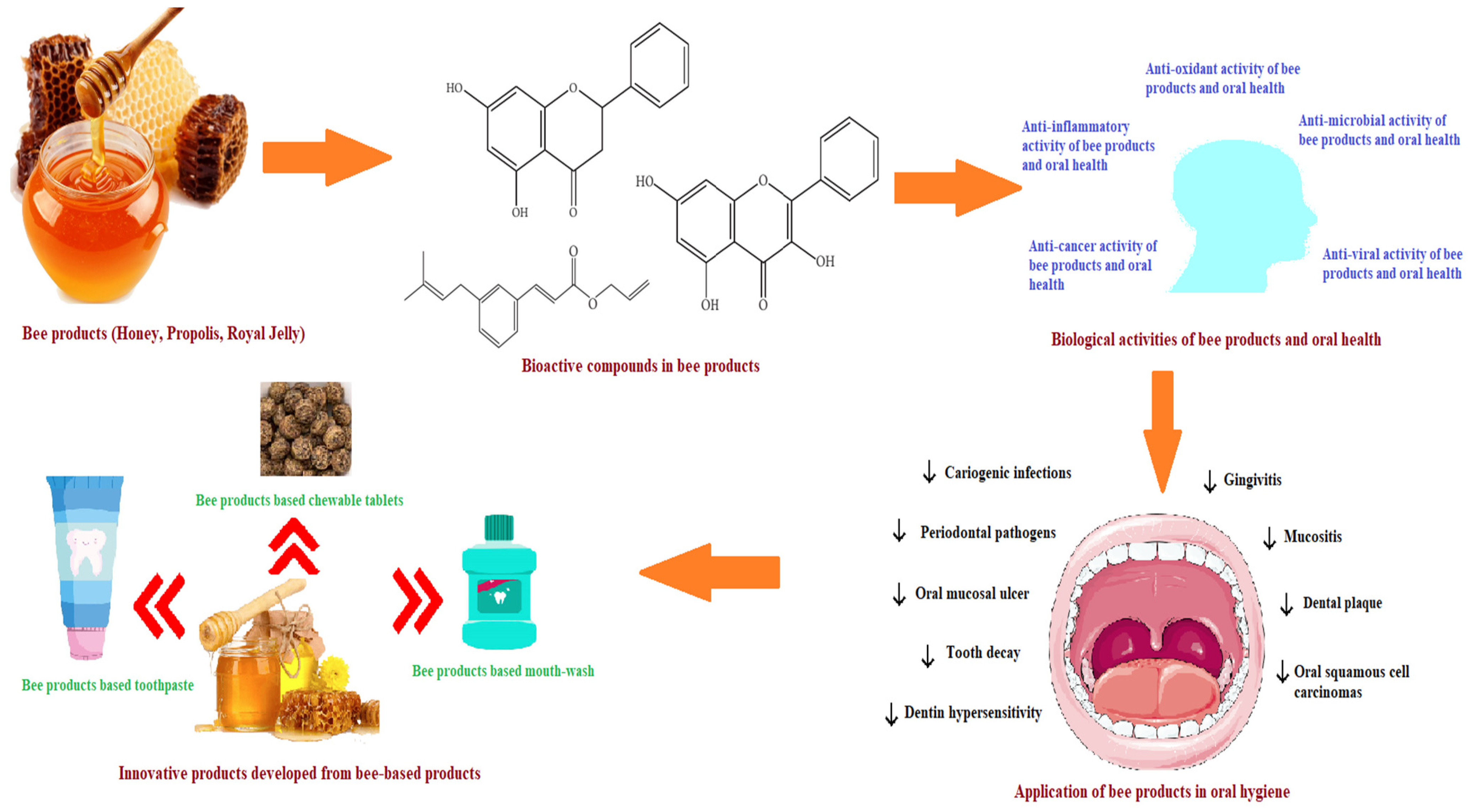
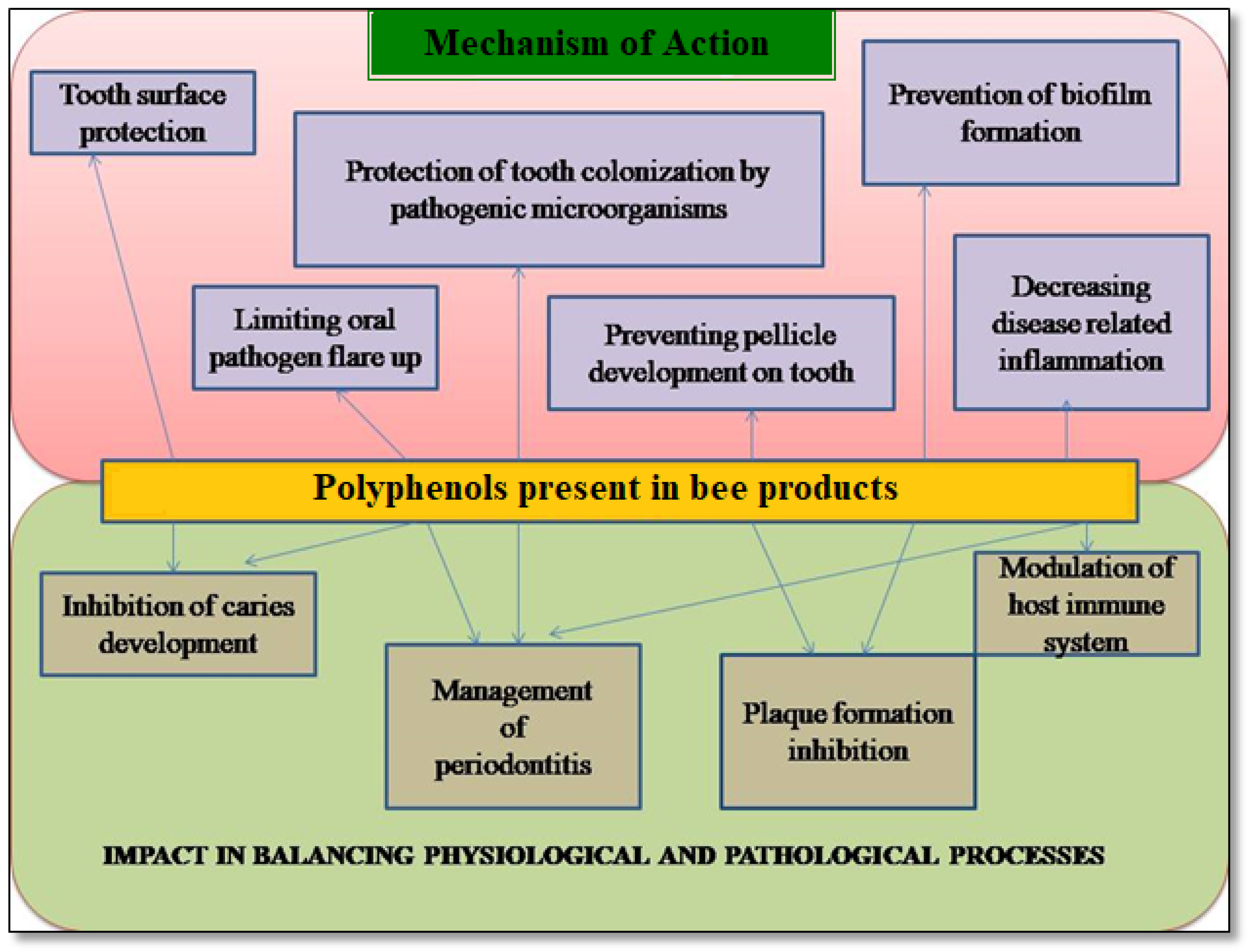
Disclaimer/Publisher’s Note: The statements, opinions and data contained in all publications are solely those of the individual author(s) and contributor(s) and not of MDPI and/or the editor(s). MDPI and/or the editor(s) disclaim responsibility for any injury to people or property resulting from any ideas, methods, instructions or products referred to in the content. |
© 2023 by the authors. Licensee MDPI, Basel, Switzerland. This article is an open access article distributed under the terms and conditions of the Creative Commons Attribution (CC BY) license (https://creativecommons.org/licenses/by/4.0/).