


Featured Application
The results of this work could be applied to obtain enantiomeric separation by using electromagnetic fields.
Abstract
A numerical analysis is carried out of the influence of the de-phasing parameter of an optical conveyor belt in the enantiomeric separation. The optical conveyor belt is obtained by the interference of a Laguerre Gaussian and a Gaussian beam with different beam waists, which are temporally de-phased. In order to obtain the maximum separation distance between enantiomers, we calculate the optimum range of values of the de-phasing parameter.
1. Introduction
One important task in biology is the separation of enantiomers, which can be achieved by using different techniques such as gas chromatography, high performance liquid chromatography, or capillary electrophoresis [1]. Different groups [2,3,4,5] have recently analyzed the use of optical fields to generate enantiomeric separation. In this sense, a study has been made of lateral optical forces (LOF) generated by interfering plane waves [6] in order to obtain chirality sorting, and the LOF effect on paired chiral particles has also been discussed [7]. Furthermore, another way of generating LOF is given by evanescent waves, which transport spin angular momentum and could be used for chirality sorting [3]. Thus, micro-metric particles have been sorted in a fluidic medium by using the spin-dependent optical forces of chiral particles [8]. Moreover, our group has demonstrated that it is possible to obtain chiral resolution of nanoparticles by using an optical conveyor belt [9,10,11,12] through the superposition of two orthogonal counter-propagating temporally-de-phased beams [13,14]. In this paper, we are going to analyze the effects of the temporal de-phasing parameter on the chiral resolution of the optical conveyor belt, showing that the maximum separation distance between enantiomers can be obtained by selecting the correct range of the de-phased parameter. Finally, the dynamics of enantiomers are studied in their final trap region.
2. Results
2.1. Optical Forces
In order to analyze particle dynamics, we have solved the overdamped Langevin equation [15]:
where is the optical force, is the position vector of the particle at time t, is the frictional force of a particle, and is a random function force with time that we have assumed null (the Brownian effect is not taken into account). Coefficient , where is the viscosity of the medium (water in our case) and parameter a is the particle radius. We consider small chiral particles with radius a much lower than the wavelength of the electromagnetic field , inside a dielectric medium of refractive index n. The optical force on the chiral sphere (CS) can be deduced by using the dipole approximation for which CS is modeled as an induced magnetic () and electric dipole () given by [16]:
where and are the magnetic and electric fields, , , and are the electric, magnetic, and chiral polarizability, respectively, is the vacuum impedance, and is the permittivity of free space. In the case of Rayleigh particles with a small chirality parameter (it is assumed that the refractive index of the chiral particle is given by , where defines the refractive index for the left-handed enantiomer and for the right-handed one), the electric, magnetic, and chiral polarizability can be written (in absence of absorption) as [3,16]:
These expressions have been obtained by taking into account that the chirality parameter , which implies that in the dipolar limit, all magnetic parts ( is proportional to ) of force can be disregarded [2]. The electric energy density () and the helicity density () can be defined as:
where ℑ and ∗ denote the imaginary part and the complex conjugate respectively, is the relative permittivity of the medium in which the particle is immersed, and is the wavenumber. Due to the electric density energy and helicity density , the particle is subject to a potential energy W given by:
In the Rayleigh regime, the optical force , described by Equation (1), exerted upon the chiral spheres by the electromagnetic field, can be approximated to a gradient force [4,17]:
2.2. Electromagnetic Field
Let us consider two counter-propagating Gaussian and Laguerre-Gaussian beams (LGB) [13], whose electric fields () are elliptically polarized, slightly temporally de-phased , and with different beam waist:
The total electric field may be written as:
introducing cylindrical coordinates and , the amplitude and phase of the fields () given by Equations (8) and (9) can be expressed (assuming a (1-1) Laguerre Gaussian beam) as:
where is the generalized Laguerre (1,1) polynomial, is the wave number inside of a dielectric medium of refractive index n, and , , , and are the electric field amplitude, beam waist, the Gouy phase, and the curvature radius of Gaussian wave fronts for , respectively [18]. These parameters are given by:
where is the vacuum wavelength. The magnetic field according to the Maxwell equations is given by:
being the electromagnetic field frequency.
Under the condition , the polarization of the counter-propagating beams will be right-handed and left-handed, respectively, the degree of circular polarization being different from one if . In this case, Equation (6) can be written as:
where:
Taking into account that , Equation (20) can therefore be written as:
where . Equation (24) describes a chiral-dielectric optical trap given by and a chiral conveyor given by .
By introducing Equation (24) into Equations (7) and (1), we obtain the following dynamic equations for chiral particles:
3. Discussion
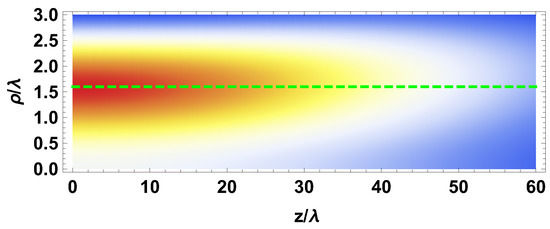
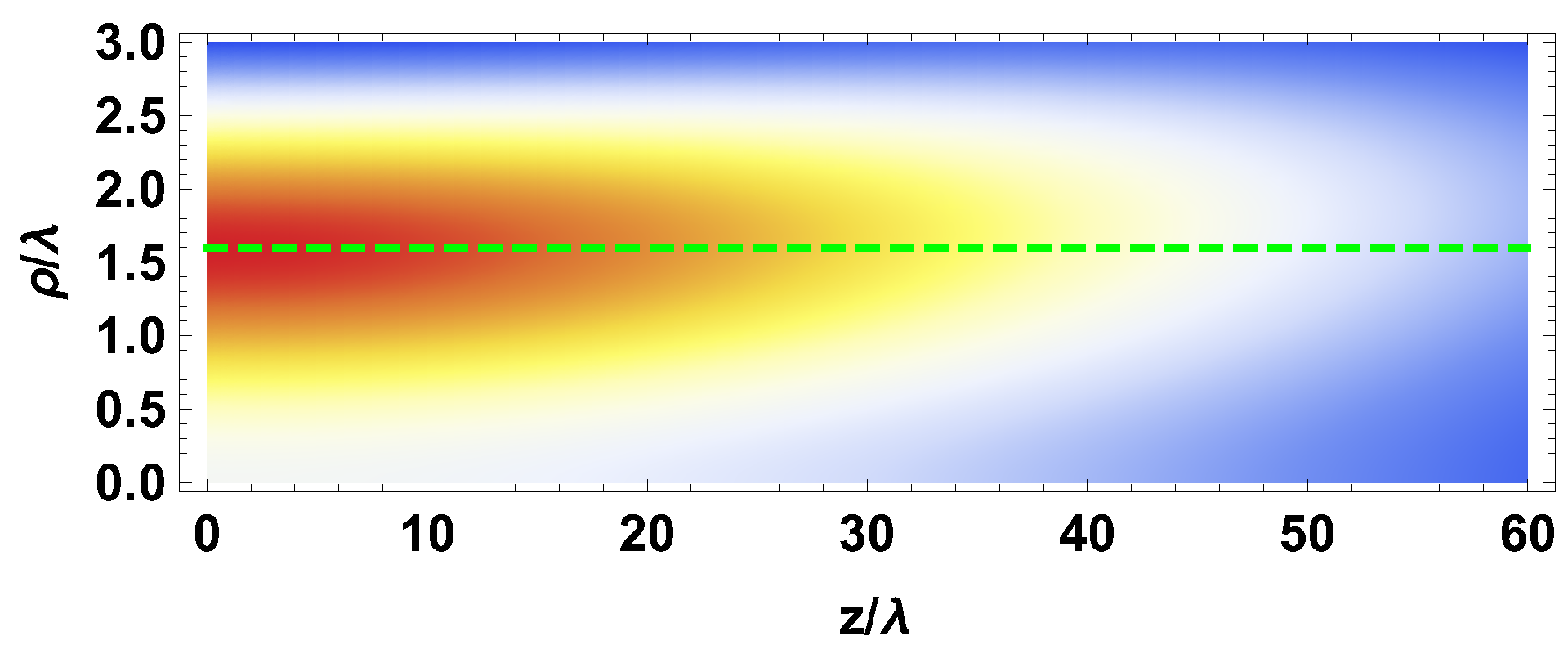
In the numerical calculation, we have used the values of nm, , , , , , , , and V/m assuming that the initial position of the enantiomers is . Figure 1 shows the potential energy W() given by Equation (20). As can be observed, W shows a maximum at radial position (green dashed line), which is the radial coordinate where particles will be initially trapped according to Equation (28).
Figure 1.
Potential energy W() for parameters: nm, , , , , , , , and V/m.
Thus, by using the indicated fixed values, the chiral conveyor is mainly controlled by the de-phase , which governs the conveyor velocity. In fact, if , there will not be any temporal dependence in Equations (29) and (30), and there will not be a chiral conveyor; consequently, W will act like a chiral trap.
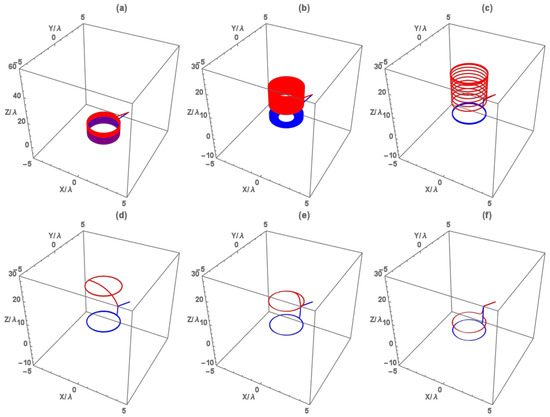
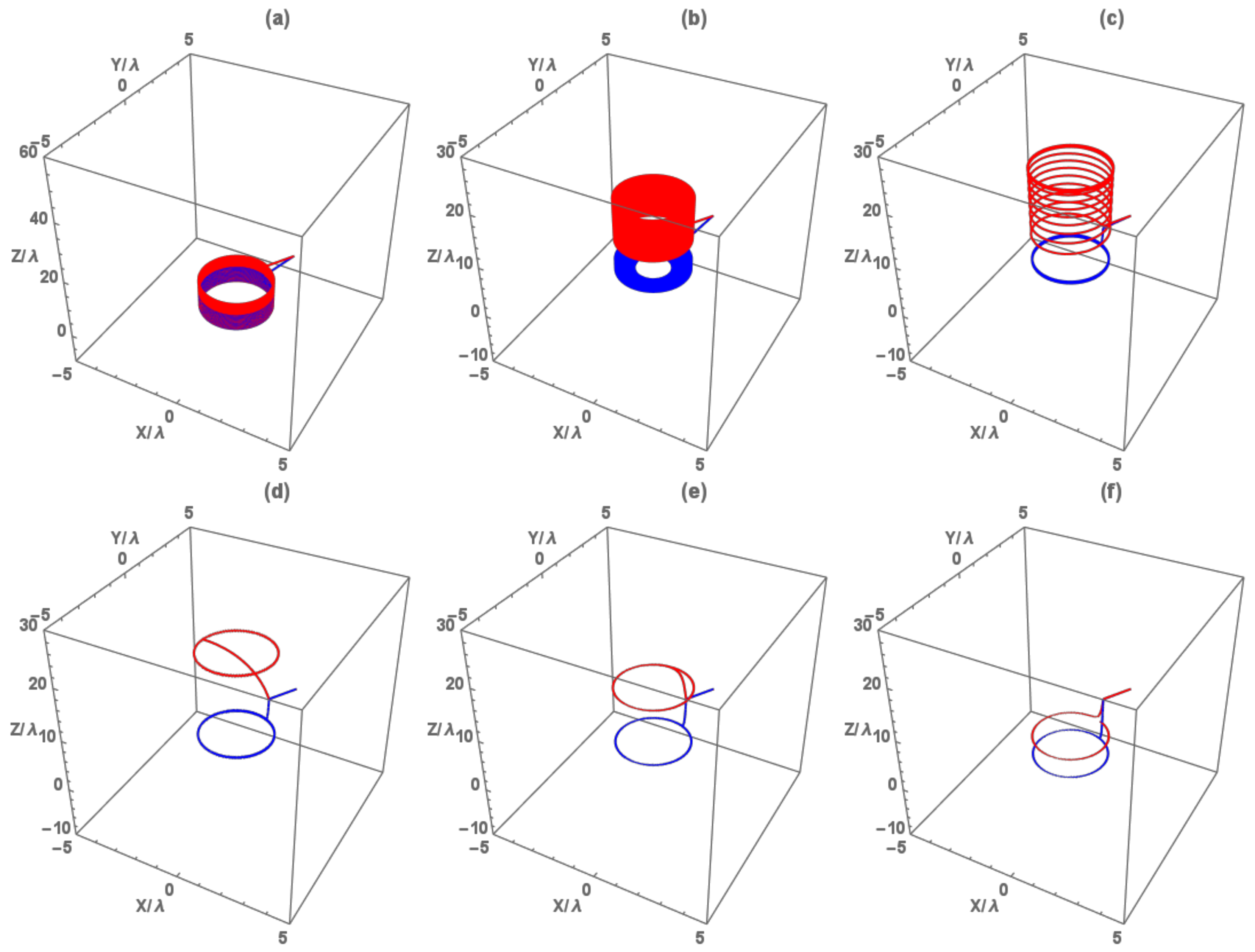
In this case, both enantiomers will be trapped in the same region, as shown in Figure 2a, and as a result, there is no effective enantiomeric separation. Figure 2b–f shows the enantiomeric separation produced by the action of the chiral optical conveyor described by Equations (1), (7), and (25)–(27). As can be observed, the particle trajectories are spiral in all cases, the pitch and velocity of optical conveyors being strongly dependent on de-phase parameter [19]. In this sense, the behavior of chiral conveyors is very similar to dielectric conveyors, and the main difference from the results obtained in [19] is that the movement of particles in the z direction is limited due to the axial dependence of parameters and . Furthermore, as can be seen in Figure 2, on increasing , the enantiomeric separation also increases until it reaches a maximum separation that slowly decreases for high values of de-phase .
Figure 2.
Particle trajectories for different values and for both enantiomers ( blue and red). (a) Hz, (b) Hz, (c) Hz, (d) Hz, (e) kHz, and (f) kHz.
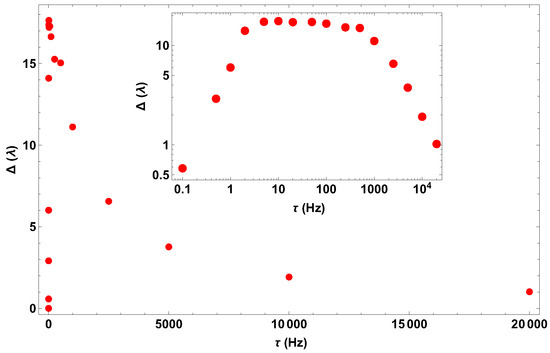
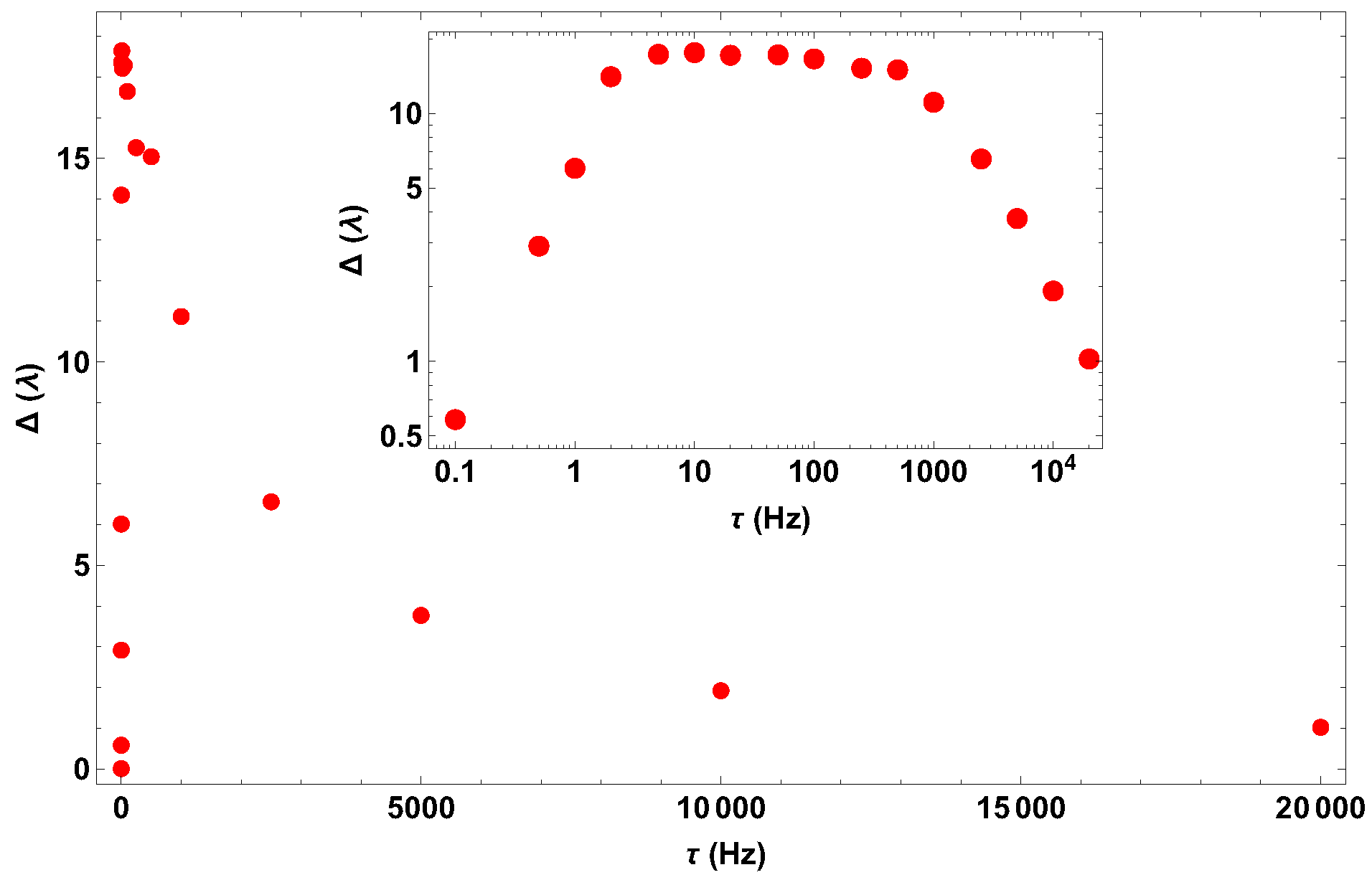
This result can be clarified in Figure 3, where the behavior of enantiomeric separation (, defined as the axial distance between trapped enantiomers) is represented as a function of . As previously mentioned, there is a fast increment of when rises, obtaining a maximum value of 18 for Hz, which remains nearly constant (see the inset graphics in Figure 3), until reaching a value of Hz to decrease slowly subsequently.
Figure 3.
Enantiomeric separation versus . The inset figure shows enantiomeric separation versus in the logarithmic scale.
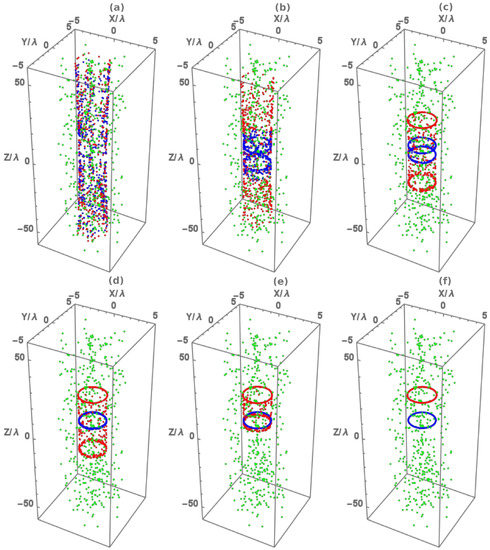
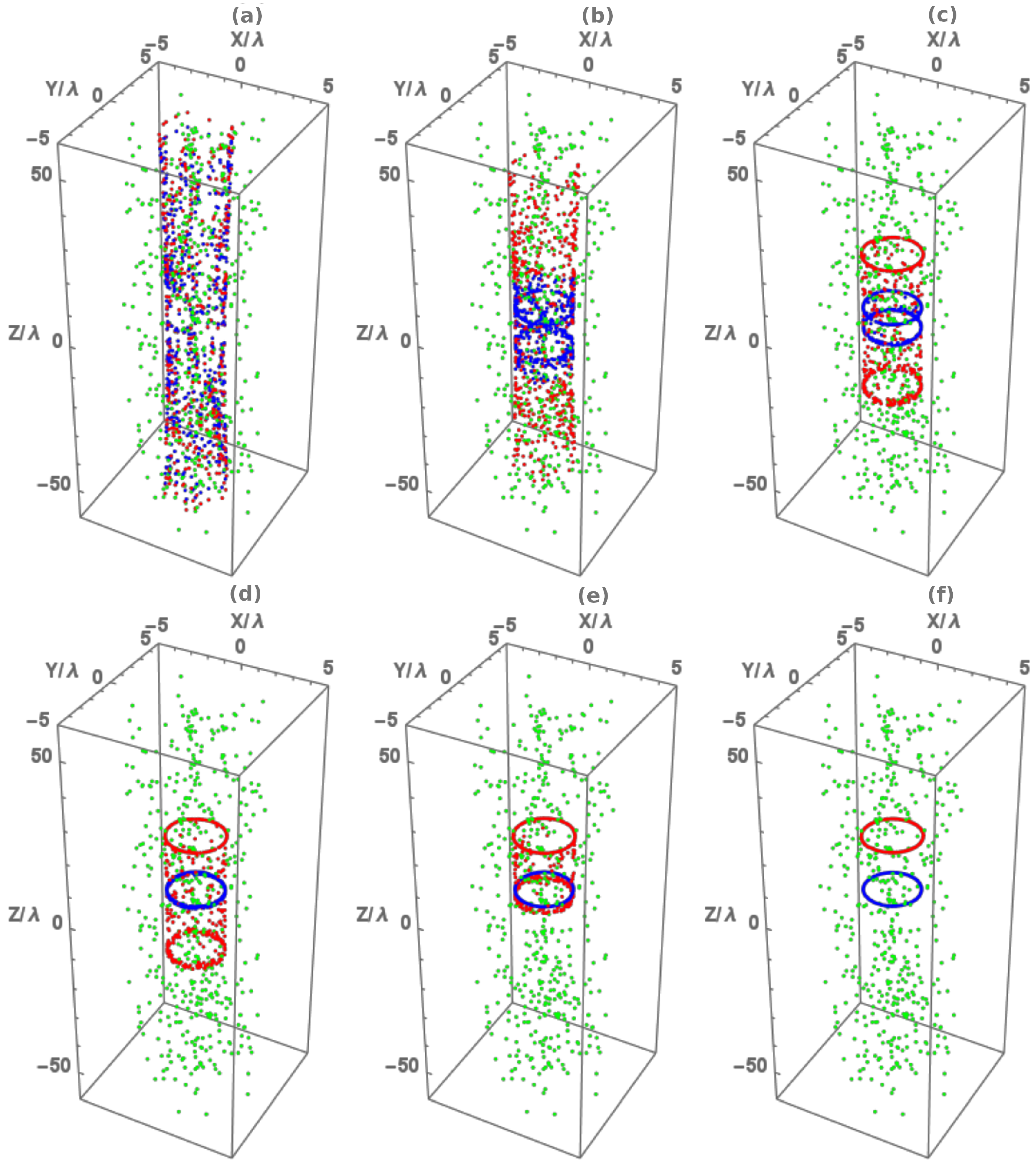
Figure 4 shows the particles position at different times for a de-phase parameter Hz. As can be observed in Figure 4a, enantiomers are trapped at in different z positions in a short time ( s). Figure 4b–d shows that positive enantiomers () are trapped more quickly than negative ones. It can also be observed in Figure 4b–e that there are two traps, but at the end ( s), only one of them is stable for each enantiomer.
Figure 4.
Particles’ position at different times: (a) s, (b) s, (c) s, (d) s, (e) s, and (f) s, for Hz ( blue and red; green dots show the initial particles’ position).
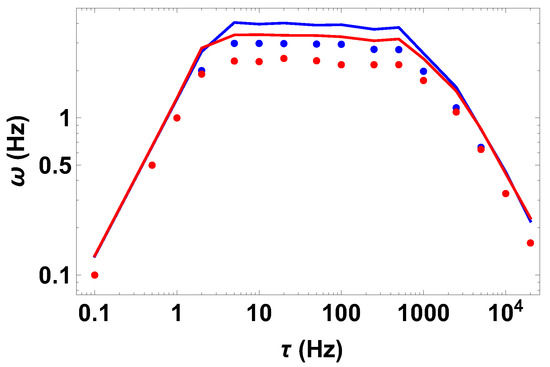
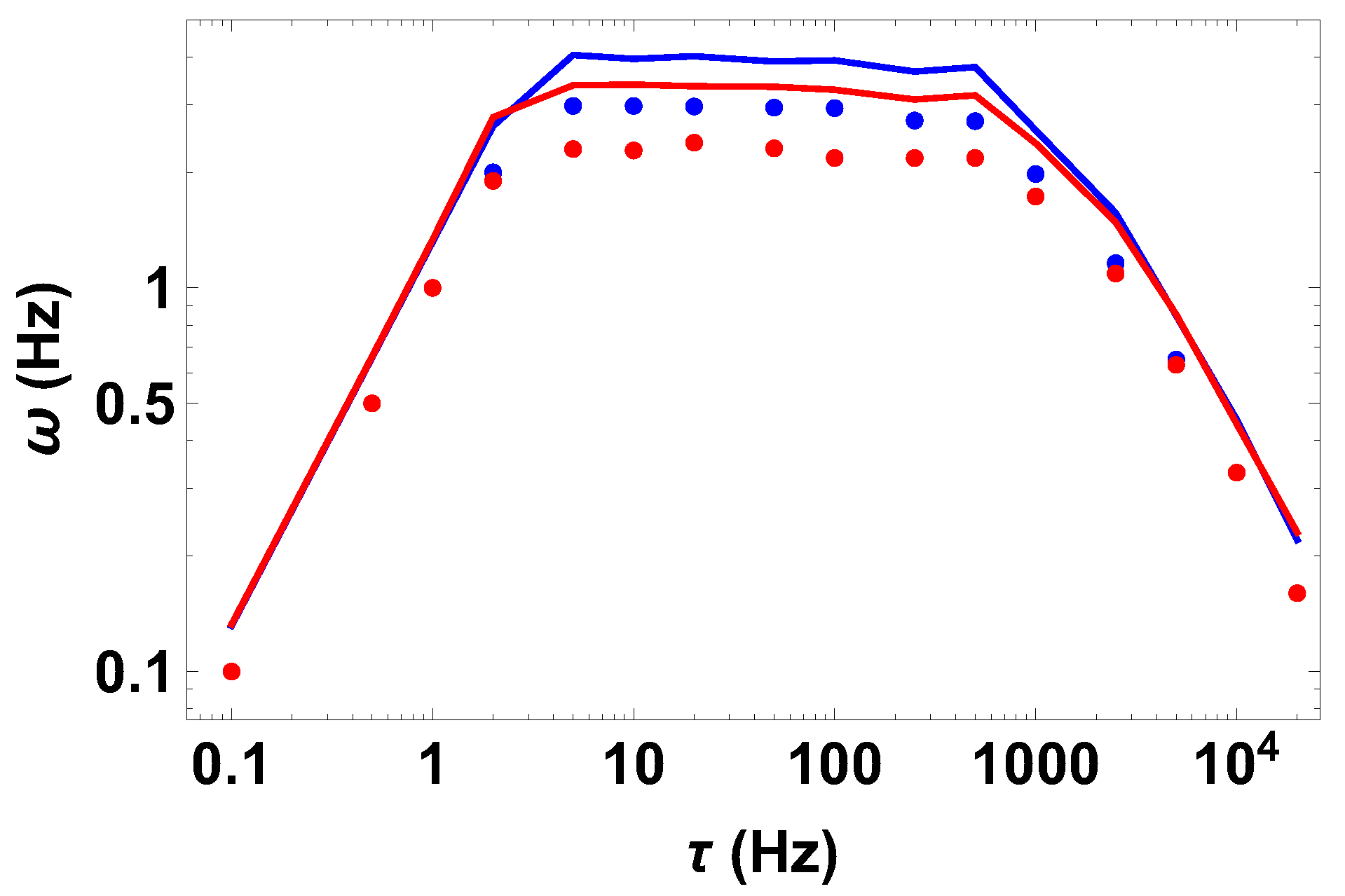
It is interesting to note that when enantiomers are finally trapped at different z positions (see Figure 2 and Figure 4f), they describe circular trajectories with angular frequencies , which are shown in Figure 5.
Figure 5.
Angular frequency of the last circular trajectory of trapped enantiomers ( blue and red) versus (the continuous line shows the predicted results from Equation (34)).
As can be observed in Figure 5, at low and high values, the frequency of the circular trajectories shows similar values for both enantiomers (1 kHz 1 Hz). However, for values between 1 and 1000 Hz, the frequency is nearly constant and equal to 2 Hz for enantiomers with and 3 Hz in the case of . One explanation for this result could be that, at the final time, particles describe a limit cycle in which reaches a limit value (each enantiomer goes to a final z position that depends on their value and de-phase ) at the fixed value (see Figure 2). In this case (when the limit cycle is reached ), Equations (28) and (30) can be approximated to:
As can be observed in Figure 5, the approximated function (34) qualitatively explains the final frequency values , although quantitatively, the predictions are overestimated be approximately 1 Hz.
A possible explanation for this observed overestimation is that we have used the approximations:
in order to obtain the analytical approximated Equation (34).
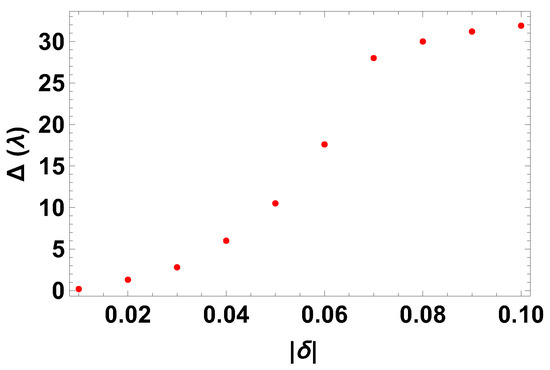
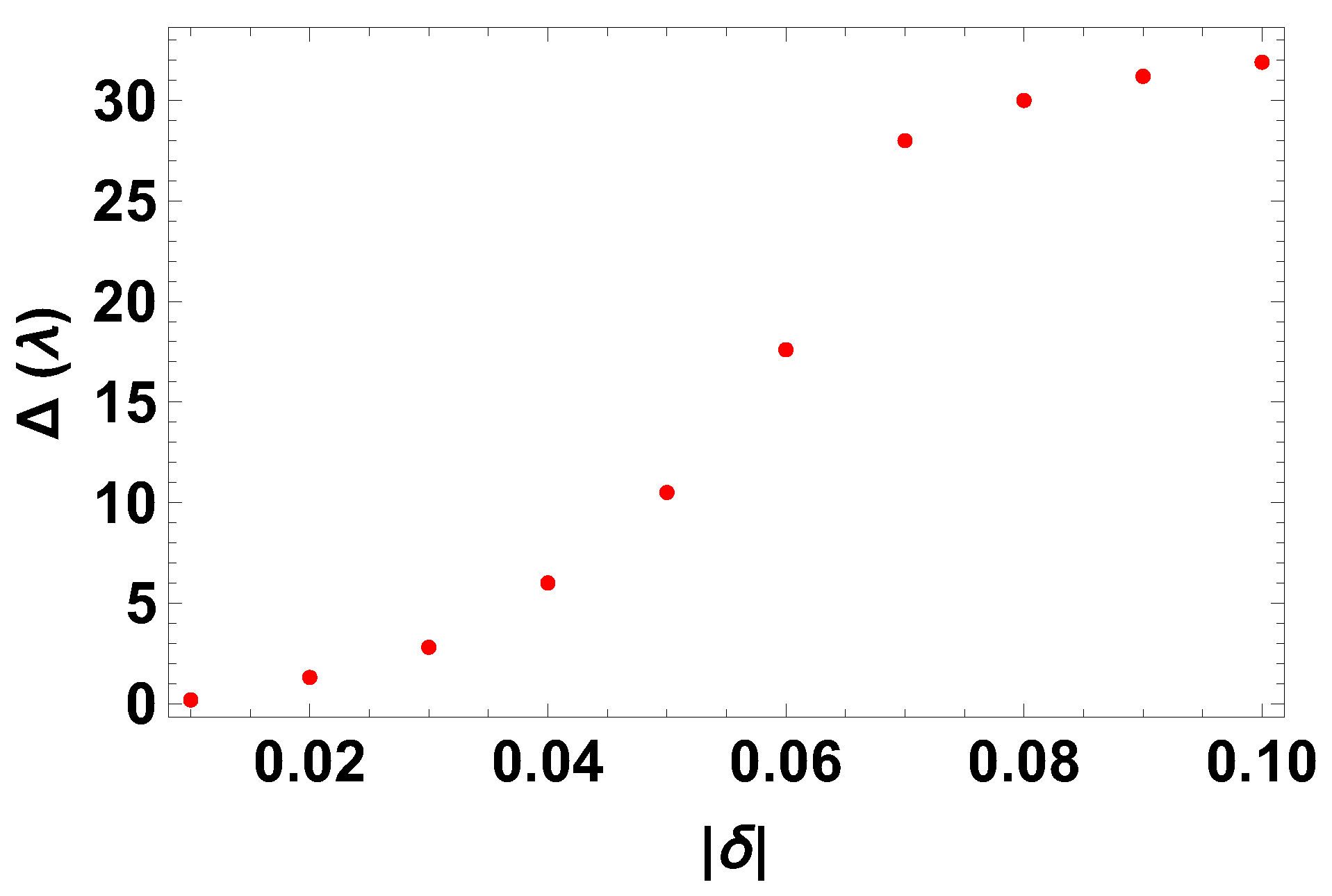
Finally, Figure 6 shows the particle separation of particles with different chiral parameter when we use the de-phasing parameter Hz, taking in all cases a final time of 50 s.
Figure 6.
Particle separation of particles with different chiral parameter , when we use the de-phasing parameter Hz, taking in all cases a final time of 50 s.
As can be observed, the particle separation is null for low values of , increasing for higher values of until reaching a saturation zone for a fixed time of 50 s. It is important to note that at this time, particles with have not reached their limit cycle.
4. Conclusions
We have demonstrated that the role of the de-phasing parameter in an optical conveyor is critical for chiral separation results. We have presented a range of values for such a parameter where maximum enantiomeric discrimination is reached. We have also shown that particles reach a limit cycle in which they describe circular trajectories with a constant angular frequency, which can be analytically estimated with dynamic equations in the limit cycle.
Author Contributions
Conceptualization, L.C. and P.A.; methodology, S.B.; software, L.C.; investigation, L.C., P.A. and S.B.; writing, original draft preparation, L.C.
Funding
This research received no external funding.
Conflicts of Interest
The authors declare no conflict of interest.
References
- Gubitz, G.; Schmidt, M.G. (Eds.) Chiral Separations. Methods and Protocols; Humana Press: New York, NY, USA, 2004. [Google Scholar]
- Canaguier-Durand, A.; Hutchison, J.A.; Genet, C.; Ebbesen, T.W. Mechanical separation of chiral dipoles by chiral light. New J. Phys. 2013, 15, 123037. [Google Scholar]
- Hayat, A.; Mueller, J.P.B.; Capasso, F. Lateral chirality-sorting optical forces. Proc. Natl. Acad. Sci. USA 2015, 112, 13190–13194. [Google Scholar] [CrossRef] [Scilit] [PubMed]
- Cameron, R.P.; Barnett, S.M.; Yao, A.M. Discriminatory optical force for chiral molecules. New J. Phys. 2014, 16, 013020. [Google Scholar] [CrossRef] [Scilit]
- Bradshaw, D.S.; Forbes, K.A.; Leeder, J.M.; Andrews, D.L. Chirality in Optical Trapping and Optical Binding. Photonics 2015, 2, 483–497. [Google Scholar] [CrossRef] [Scilit]
- Chen, H.; Liang, C.; Liu, S.; Lin, Z. Chirality sorting using two-wave-interference induced lateral optical force. Phys. Rev. A 2016, 93, 053833. [Google Scholar] [CrossRef] [Scilit]
- Chen, H.; Jiang, Y.; Wang, N.; Lu, W.; Liu, S.; Lin, Z. Lateral optical force on paired chiral nanoparticles in linearly polarized plane waves. Opt. Lett. 2015, 40, 5530–5533. [Google Scholar] [CrossRef] [Scilit]
- Tkachenko, G.; Brasselet, E. Optofluidic sorting of material chirality by chiral light. Nat. Commun. 2014, 5, 3577. [Google Scholar] [CrossRef] [Scilit] [PubMed]
- Cizmar, T.; Garces-Chavez, V.; Dholakia, K.; Zemanek, P. Optical conveyor belt for delivery submicron objects. Appl. Phys. Lett. 2005, 86, 174101. [Google Scholar] [CrossRef] [Scilit]
- Ruffner, D.B.; Grier, D.G. Optical conveyors: A class of active tractor beams. Phys. Rev. Lett. 2012, 109, 163903. [Google Scholar] [CrossRef] [Scilit] [PubMed]
- Fernandes, D.E.; Silveirinha, M.G. Optical tractor beam with chiral light. Phys. Rev. A 2015, 91, 061801. [Google Scholar] [CrossRef] [Scilit]
- Fernandes, D.E.; Silveirinha, M.G. Single-Beam Optical Conveyor Belt for Chiral Particles. Phys. Rev. Appl. 2016, 6, 014016. [Google Scholar] [CrossRef] [Scilit]
- Carretero, L.; Acebal, P.; Blaya, S. Chiral Rayleigh particles discrimination in dynamic dual optical traps. J. Quant. Spectrosc. Radiat. Transf. 2017, 201, 209–215. [Google Scholar] [CrossRef] [Scilit]
- Acebal, P.; Carretero, L.; Blaya, S. Design of an optical conveyor for selective separation of a mixture of enantiomers. Opt. Express 2017, 25, 32290–32304. [Google Scholar] [CrossRef] [Scilit]
- Reif, F. Fundamentals of Statistical and Thermal Physics; McGraw-Hill Book Company: Nong Grove, IL, USA, 1965. [Google Scholar]
- Lakhtakia, A.; Varadan, V.K.; Varadan, V.V. Effective properties of a sparse random distribution of non-interacting small chiral spheres in a chiral host medium. J. Phys. D Appl. Phys. 1991, 24, 1. [Google Scholar] [CrossRef] [Scilit]
- Zhao, Y.; Saleh, A.A.E.; Dionne, J.A. Enantioselective Optical Trapping of Chiral Nanoparticles with Plasmonic Tweezers. ACS Photonics 2016, 3, 304–309. [Google Scholar] [CrossRef] [Scilit]
- Saleh, B.E.A.; Teich, M.C. Fundamentals of Photonics; Wiley: Hoboken, NJ, USA, 1991. [Google Scholar]
- Carretero, L.; Acebal, P.; Garcia, C.; Blaya, S. Helical tractor beam: analytical solution of Rayleigh particle dynamics. Opt. Express 2015, 23, 20529–20539. [Google Scholar] [CrossRef] [Scilit] [PubMed]
© 2019 by the authors. Licensee MDPI, Basel, Switzerland. This article is an open access article distributed under the terms and conditions of the Creative Commons Attribution (CC BY) license (http://creativecommons.org/licenses/by/4.0/).