


Abstract
Ferromagnetic phase in a two-dimensional system plays an important role not only in applications but also in studies of phase transition theory. Among numerous ferromagnetic materials, is famous for its half-metallicity, itinerant ferromagnetism and non-Fermi liquid metalicity. Single layer in / (SRO/STO) superlattice has been predicted as a two-dimensional half-metallic ferromagnetic system based on density functional theory (DFT). However, experiments show that metal–insulator transition associated with ferro–antiferromagnetism (FM–AFM) transition occurs when the thickness of SRO is less than 4 u.c. Combining DFT calculations with Monte Carlo simulations, we demonstrate in this work that the bulk ferromagnetic metallicity can be realized in single layer SRO in SRO/STO superlattice by manipulating the strain effect to trigger the metal–insulator transition, achieving two-dimensional (2D) half-metallic SRO thin film beyond the experimental observation of AFM insulator.Our results pave a new route to fulfill the ultrathin spin-polarized-2D electron gas (SP-2DEG).
1. Introduction
Magnetic thin films and two-dimensional magnetic materials have attracted worldwide attention owing to the interesting physical phenomenon and various applications. For example, the spin current transport in a confined thin film implies the prospect to control the spin signal in the nano-scale. Several spintronic devices have been proposed or implemented, such as the magnetic tunnel junction [1,2,3], magnetic random access memory (MRAM) [4,5,6], and solid-state drive (SSD). To improve the efficiency of spin devices, magnetic materials or magnetic heterostructures, particularly magnetic thin films composed of transition metal oxide (TMO), have been proposed and caught many researcher’s eyes. Thanks to the huge family of TMO, many heterostructures, such as / [7,8], / [9,10,11], / [12] and so on, provide diverse, unusual properties for different kinds of applications.
The ferromagnetic metal (SRO) with Currie temperature [13] has been studied in many heterostructures [14,15,16]. Unusual properties such as the half-metallicity [17,18,19,20], itinerant ferromagnetism [21,22] and non-Fermi liquid [23,24] in SRO have been well documented. In particular, monolayer SRO sandwiched by (STO) is predicted as a two-dimensional half-metallic electron gas based on DFT calculations [25]. However, experiments show that the SRO thin film exhibits a metal–insulator transition below 4 unit cell (u.c.) [26,27]. Several theoretical studies have tried to explain this metal–insulator transition. However, most of them provide only partially correct properties for SRO thin films, such as correct insulating behaviors for two and three layers only [28] or simply non-ferromagnetic phase [27]. One successful study combines density functional theory (DFT) with many body dynamical mean-field theory (DFT+DMFT), which can reproduce the metal–insulator transition in SRO thin film and the antiferromagnetic insulator property in SRO monolayer [29]. However, a successful route toward the desired ultrathin spin-polarized (SP) layer hosting the SP-2DEG based on SRO is still lacking.
In this paper, we study the electronic and magnetic properties of SRO through ab initio calculations using the LDA + U method. Based on the Heisenberg model, we simulate the Curie temperature of bulk SRO by the usual mean-field method, self-consistent Gaussian approximation (SCGA) [30] and Monte Carlo (MC) method [31]. We successfully reproduced the Curie temperature of bulk SRO from the intersite exchange parameters given by DFT + U calculations. Moreover, we show that, by taking the on-site energy of both Ru and Ti ions into consideration, the metal–insulator transition in single layer SRO associated with the transition from half-metallic ferromagnetism to insulating antiferromagnetism can be induced by tuning the lattice constant from the SRO to STO one. Therefore, the half-metallic phase of single layer SRO in SRO/STO superlattic can be achieved by manipulating the strain effect or applying an external lateral stress. Our work thus paves a new way toward the desired ultrathin SP-2DEG based on SRO.
2. Method
First-principles calculations are performed using the Vienna ab initio simulation package (VASP) [32,33,34] based on the density functional theory (DFT). The projector augmented wave (PAW) [35,36] pseudopotentials with the exchange correlation energy term from Ceperley–Alder [37] and Perdew–Zunger [38] (CA-PZ) type local density approximation (LDA) [39] are used in this work. To account for the strong-correlations in d-orbitals, we include the on-site Coulomb repulsion U (LDA + U) [40] with , for Ru ions [20]. Different U and J values for Ru ions are also considered to see the effects. The reasonable U value of Ti ions ranges from 3.5 to 8.0 eV [41,42,43,44]. Because the lattice constants and the bulk modulus of bulk STO agree better with experimental results [42], we thus adopt the on-site , for Ti ions [41,42]. Owing to the same ionicity of Ru(Ti) ions and the same local RuO(TiO) octahedral structure, the same U and J values of Ru(Ti) ions are adopted for both bulk and monolayer systems. The k-mesh and energy cutoff are () and 400 eV for bulk SRO (SRO/STO superlattice). In all calculations, the lattice structure is optimized until the total energy converges within eV. The Curie temperature () of the ferromagnetic phase are simulated through the Monte Carlo method based on the Heisenberg model using the VAMPIRE package [31]. A () supercell for bulk SRO (SRO/STO superlattice) is used in Monte Carlo simulations.
3. Results
3.1. Bulk Properties of SRO
Firstly, we discuss the electronic and magnetic properties of bulk SRO in this section. The counterpart for the single layer SRO in SRO/STO superlattice is discussed in the next section. SRO crystallizes in the perovskite structure similar to many transition metal oxides such as and . Each Ru ion is surrounded by six O ions forming an RuO octahedron. At low temperature, SRO transits from space group of the original perovskite unit cell into (#62, ) with a lower symmetry and a larger supercell [13] by rotating the octahedrons, as shown in Figure 1a.
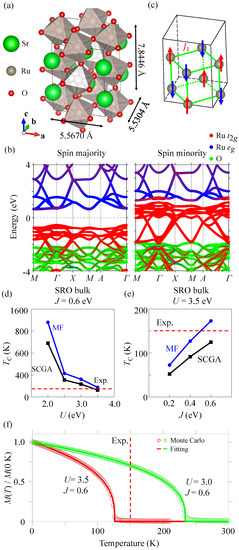
Figure 1.
(a) The crystal structure of . (b) Calculated band structures of SRO from LDA + U. The colors indicate different orbital components. (c) The G-type antiferromagnetism spin configuration of SRO. (d) The mean field and SCGA. (e) Curie temperatures of bulk SRO with different U and J. The experimental Tc is shown in red dashed line. (f) The Monte Carlo simulations of Curie temperatures. The colors indicate different U and J. The lines are the fitted curves for the data points given from Monte Carlo simulations. The red dashed line indicate the experiment result.
The LDA + U band structures of SRO in Figure 1b show the half-metallic behavior, that is, the majority spin channel shows a Mott insulating energy band gap at the Fermi level (), while the spin minority channel is metallic. Therefore, only the spin down electrons can conduct, resulting in 100% spin polarization at which is ideal for spintronics. The orbital projections of the band structure demonstrate that the band gap in the majority spin channel is between the Ru-(, , ) and (, ) bands. These half-metal characters are the same as those in previous experimental observations [17,18,19] as well as ab initio calculations including LDA + U [20], DMFT method [21], and method [45].
Based on these LDA + U results, we then simulate the Curie temperature by considering the Heisenberg model:
Here, is the intersite exchange parameter between different magnetic (Ru) ions and indicates the unit vector of the spin direction. These values can be calculated from the DFT total energies of different magnetic phases. Beside the above ferromagnetic (FM) phase, we have also calculated the DFT total energy of SRO in the G-type antiferromagnetic (AFM) phase, as shown in Figure 1c. The exchange parameter between nearest-neighbor Ru ions is then calculated by
Here, the () is the total energy of the AFM (FM) phase, is the number of magnetic Ru ions in the unit cell and is the number of nearest-neighbor Ru ions of each Ru ion. Since the Ru sublattice is of the simple cubic structure, the number , while because the SRO unit cell is composed of four simple perovskite unit cells. Thus, we obtain .
Several approaches can be used to estimate based on the Heisenberg model. The simplest one is the mean field (MF) method:
This gives , which is somewhat larger than the experimental [13]. As in the usual cases, the mean field method overestimates the value of SRO. Thus, we also adopt the self-consistent Gaussian approximation (SCGA) method [30].
Here, is a structure dependent parameter. Because the Ru ions are arranged in the simple cubic structure, the parameter is used accordingly [30]. The Curie Temperature calculated by the SCGA method is , which is 16% underestimated in comparison with the experiment result [13].
To see the influence of on-site Coulomb repulsion U and exchange J on , we have done DFT total energy calculations with U ranging from 2.0 eV to 3.5 eV and J ranging from 0.2 eV to 0.6 eV. The estimated values are presented in Figure 1d. As can be seen in the figure, the highly overestimated with eV decreases along with increasing U. With the U value of 3.5 eV, the estimated approaches the experimental . This behavior that the on-site U can lower the of SRO is compatible with the Goodenough–Kanamori superexchange rule that the Hubbard U can stabilize the AFM phase. On the other hand, the on-site exchange J plays a different role to enhance , as shown in Figure 1e. It should be noted that, in addition to Hubbard U, is also sensitive to the on-site exchange J in the opposite direction. These contrary trends imply that the Liechtenstein’s rotationally invariant LDA + U scheme [40] and the Dudarev’s simplified LDA + U scheme [46], which takes as a single parameter, could lead to different behaivor of the Curie temperature.
Furthermore, we also perform the Monte Carlo simulations for the magnetizations of SRO as functions of temperature based on the Heisenberg model with and , as presented in Figure 1f. We then fit the Monte Carlo magnetizations by the formula to estimate with the fitted curves also depicted in Figure 1f. Here, is the critical exponent for the eV case. Surprisingly, for both cases with different U values of 3.0 and 3.5 eV, our Monte Carlo values agree well with our SCGA within 2%. Moreover, for , the estimated is close to the experimental . Consequently our LDA + U calculations and Monte Carlo simulations for SRO are reliable.
3.2. Monolayer SRO in SRO/STO Superlattice
To study the phase transition of the single layer (1 u.c.) SRO, we consider the SRO/STO superlattice containing 1 u.c. SRO and 5 u.c. STO in the (001) direction. The distorted oxide octahedron in bulk STO, which rotates in the antiferrodistortive structure [47], is used as the initial structure, as shown in Figure 2a,b. To take the strong correlation into account, we apply on-site and for Ru-4d orbital and and for Ti-3d orbital. To study the lateral strain induced metal–insulator transition, we tune the lattice constants of the SRO/STO superlattice from the SRO lattice parameters (denoted as ) to the STO lattice parameters (or in 1 × 1 u.c.) (denoted as ) with the parameter indicating the strain effect. We then optimize the c-axis as well as the ion positions with lattice fixed at a given . Three different magnetic phases, including paramagnetic, ferromagnetic (FM) and antiferromagnetic (AFM), of the SRO layer are considered as discussed below.
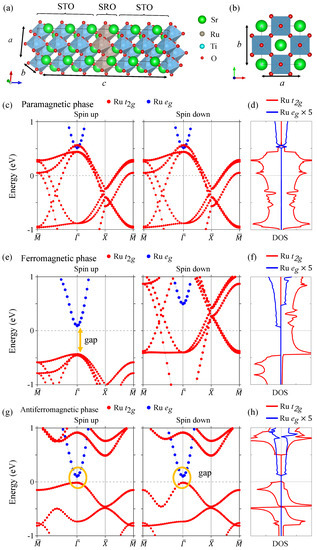
Figure 2.
Side (a) and top (b) view of the superlattice structure used in the calculations. (c,e,g) Band structures of three magnetic phases of superlattice. The red (blue) dots present the component of Ru and orbitals. The orange circle and arrow highlight the band gap. (d,f,h) The total density of states of each magnetic phase.
The electronic structures of three different magnetic phase of superlattice are shown in Figure 2c–h. For the paramagnetic phase (Figure 2c,d), the band structures of spin up and spin down channels degenerate owing to the time reversal symmetry and spin rotational symmetry. The orbitals near the Fermi level are dominated by Ru d orbitals. The Ru and Ru bands cross each other showing metallic behaviors. The orbital decomposition also presents a spin-unpolarized two-dimensional electron gas (2DEG) conducted by Ru orbitals. On the other hand, for the ferromagnetic phase shown in Figure 2e,f, the spin up Ru and bands split with each other and hence open an energy gap of 0.52 eV at the Fermi level (), whereas the spin down channel remains gapless. Therefore, the ferromagnetic phase shows the half-metallic character, in which one spin channel is conducting while the other is insulating, similar to the fully spin polarized metallic behavior in bulk SRO. More importantly, this half-metallic single u.c. SRO in superlattice demonstrates the desired ultrathin fully spin-polarized (SP) 2DEG within a single layer, same as previous studies. As for the antiferromagnetic phase shown in Figure 2g,h, there exists a small energy gap ∼ between and bands, leading to the antiferromagnetic insulator. Total energy analysis shows that the half-metallic FM phase is energetically most favorable and is thus the ground state among all the three phase, while the paramagnetic phase is of the highest total energy. However, the total energy of the AFM phase is only 0.47 meV higher than that of the FM phase, indicating that the insulating AFM phase could also be observed experimentally. Previous studies also show that the doping or interdiffusion of Ti ions may enhance the insulating phase [48,49,50] in real systems.
To study the strain effect originated from the lattice mismatch between SRO and STO in the SRO/STO superlattice, we tune the lattice parameters a and b with the order parameter representing the bulk SRO lattice parameters a and b, and corresponding to the bulk STO lattice parameters . The c-axis and ion positions are optimized for all cases. Similar to the previous section, we perform electronic structure calculations and Monte Carlo simulations for AFM and FM phases. To determine the intersite exchange parameters, we use for the nearest-neighbor Ru ions and for the two magnetic ions in the superlattice in Equation (2). Figure 3a shows the calculated with different lattice constants (strains). For eV and eV (square), the decreases with increasing , similar to previous conclusions of the lattice effect on the SRO magnetic phase (cf. [51,52]). Precisely for , the and . However, with , as described in the previous paragraph, the energy difference between FM and AFM phases becomes fairly small and the is only 0.5 K with
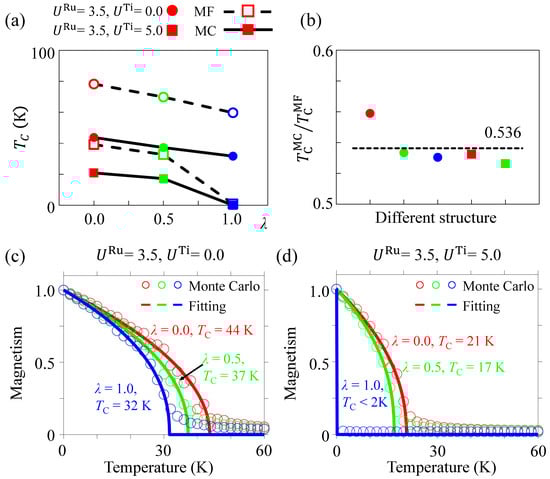
Figure 3.
(a) Mean field and Monte Carlo of different lattice constants and in SRO/STO superlattice. indicates using the SRO lattice constants a, b, while indicates that the STO lattice constants a, b are used. The solid (dashed) line indicates the Monte Carlo (mean field) result. The circle (square) symbol indicates the () cases. (b) The ratio of all considered cases. The dashed line represents the average ratio of 0.536. (c,d) The Monte Carlo and the fitting magnetization of SRO/STO superlattice.
The strong correlations in Ti d orbitals also play an important role in this system. As also shown in Figure 3a, by tuning the order parameter with (circle), the energy difference between FM and AFM phases becomes larger and hence makes the much higher, strongly stabilizing the FM half-metallic phase. The for decreases to 59.7 K with . In other words, the strong correlations in Ti ions help stabilize the AFM insulating phase and thus achieve the FM–AFM metal–insulator phase transition upon lateral strain.
The Monte Carlo calculations of Curie temperature are also accomplished for the superlattice, as presented in Figure 3c,d. Different from the zero magnetism at high temperature for the bulk systems (Figure 1f), the magnetism does not vanish at high temperatures for the superlattice cases. This is due to the Heisenberg model and the Mermin–Wagner theorem for two dimensional systems which conclude that there is no phase transition in a two-dimensional system. To simulate the Curie temperature, the magnetism of Monte Carlo results with are fitted by with the critical exponents ranging from 0.42 to 0.50 (Figure 3c,d). As shown Figure 3a, the MC and MF results both show the same trend with more or less a constant ratio by tuning and . The only difference is that the MF method always overestimates the Curie temperature for all the considered systems.
4. Discussion
Previous DFT studies on show different magnetic phases in 1 u.c. SRO including ferromagnetic and paramagnetic ones. Many-body simulations by dynamical mean-field theory (DMFT) show AFM insulator of 1 u.c. SRO in SRO/STO superlattice. Thus far, no insulating phases of 1 u.c. thickness SRO are reported by DFT calculations. Our study demonstrates that the antiferromagnetic insulating phase in 1 u.c. SRO can be obtained in the single particle picture. In addition, the lattice constant and on-site energy of Ti play an important role in this magnetic metal–insulator transition. More importantly, our results agree well with the experimental findings in which tensile strain can affect the Curie temperature in SRO thin film [51,52].
Note that the MIT of the SRO monolayer could have several sources such as the defect effect, inter-diffusion, layer thickness, as well as the strain effect and magnetic phase transition as studied in this work. Particularly, the SRO/STO interface exhibits intermixing on a length scale of 1∼1.5 unit cells [53]. Thus, the impurities and intermixing may also play an important role in MIT of SRO monolayer. However, among the aforementioned several effects that could cause MIT of SRO monolayer, we focus on the strain induced magnetic phase transition associated MIT of SRO monolayer. Our study offers a route to tuning the electric and magnetic properties of SRO monolayer, and could be generalized to SRO multilayers.
Our aforementioned conclusions are slightly different from those from previous study using DFT + DMFT [29]. In a previous DMFT study, Si et al. [29] claimed SRO thin films are always antiferromagnetic insulator even under the lattice stress of . Differences in computational methods between our work and previous studies are discussed below. Firstly, we use the experimental STO lattice constant of while the previous study [29] uses the optimized lattice constant of , differing from the former by 1.2%. Secondly, the lattice structure is optimized using the PBE+mBJ method in the previous study [29], even though mBJ method actually does not contribute to atomic forces. We use LDA + U method to optimize our atomic positions. Thirdly, all calculations in the previous studies do not consider the on-site Hubbard energy of Ti d orbitals.
To realize the room temperature ultra-thin spin-polarized two-dimensional electron gas is an important issue [25,29]. From our calculations, the intersite exchange field can be modified by lateral strain through tuning the lattice parameter a and b. Therefore, the FM half-metallic phase in monolayer SRO can be induced by applying the external tensile lateral strain. Experimentally, this can be achieved by growing SRO on another perovskite with similar lattice constants as SRO, i.e., larger lattice parameters than the STO ones. This pave a new route toward realizing the desirable ultra-thin spin-polarized 2DEG for future spintronics.
Owing to the inability of handling two-dimensional systems by the self-consistent Gaussian approximation (SCGA), the of the SRO layer in superlattice cannot be calculated. However, combining our MC and MF results, we can estimate the SCGA counterparts by . As shown in Figure 3b and discussed previously, . This parameter also gives a convenient method to estimate the two-dimensional square lattice such as the other two-dimensional magnetic perovskite.
5. Conclusions
In this paper, we perform first-principles electronic calculations as well as Monte Carlo simulations for single layer SRO in SRO/STO superlattice. We discover a metal–insulator transition associated with FM–AFM transition of SRO single layer in SRO/STO superlattice. This combined transition is sensitive to the lattice mismatch, strong correlation, as well as the interlayer electronic interactions. We demonstrate that the bulk ferromagnetic metallicity can be restored in single layer SRO in SRO/STO superlattice by manipulating the strain effect, giving rise to spin polarized half-metallic 2D SRO layer beyond the experimental observation of AFM insulating thin films. Moreover, based on the Heisenberg model, the accurate Curie temperate is estimated by three different methods including the mean field, SCGA, and Monte Carlo simulations. The mean field method, as in usual cases, overestimates the in both bulk and thin film SRO. While the SCGA and Monte Carlo methods yield excellent consistent with the experimental for the bulk phase. For the single layer SRO in the SRO/STO superlattice, we predict the Curie temperature of the SRO layer ranging from ∼20 to ∼40 K. Furthermore, this can be increased by applying an external lateral stress. Our results present a new route to implement the ultrathin spin-polarized 2DEG.
Author Contributions
A.H. performed band structures calculations and prepared the original draft. S.-H.H. performed Curie temperature simulations and prepared the original draft. H.-T.J. supervised the project and reviewed and edited the manuscript.
Funding
This research received no external funding.
Acknowledgments
This work was supported by the Ministry of Science and Technology, Taiwan. H.-T.J. also thanks NCHC and CINC-NTU, Taiwan for technical support.
Conflicts of Interest
The authors declare no conflict of interest.
References
- Ikeda, S.; Miura, K.; Yamamoto, H.; Mizunuma, K.; Gan, H.D.; Endo, M.; Kanai, S.; Hayakawa, J.; Matsukura, F.; Ohno, H. A perpendicular-anisotropy CoFeB-MgO magnetic tunnel junction. Nat. Mater. 2010, 9, 721–724. [Google Scholar] [CrossRef] [PubMed]
- Kubota, H.; Fukushima, A.; Yakushiji, K.; Nagahama, T.; Yuasa, S.; Ando, K.; Maehara, H.; Nagamine, Y.; Tsunekawa, K.; Djayaprawira, D.D.; et al. Quantitative measurement of voltage dependence of spin-transfer torque in MgO-based magnetic tunnel junctions. Nat. Phys. 2007, 4, 37–41. [Google Scholar] [CrossRef]
- Wang, W.G.; Li, M.; Hageman, S.; Chien, C.L. Electric-field-assisted switching in magnetic tunnel junctions. Nat. Mater. 2011, 11, 64–68. [Google Scholar] [CrossRef] [PubMed]
- Fang, D.; Kurebayashi, H.; Wunderlich, J.; Vyborny, K.; Zarbo, L.P.; Campion, R.P.; Casiraghi, A.; Gallagher, B.L.; Jungwirth, T.; Ferguson, A.J. Spin-orbit-driven ferromagnetic resonance. Nat. Nanotechnol. 2011, 6, 413–417. [Google Scholar] [CrossRef] [PubMed]
- Sankey, J.C.; Cui, Y.-T.; Buhrman, R.A.; Ralph, D.C.; Sun, J.Z.; Slonczewski, J.C. Measurement of the spin-transfer-torque vector in magnetic tunnel junctions. Nat. Phys. 2007, 4, 67–71. [Google Scholar] [CrossRef]
- Slonczewski, J.C. Conductance and exchange coupling of two ferromagnets separated by a tunneling barrier. Phys. Rev. B 1989, 39, 6995–7002. [Google Scholar] [CrossRef]
- Reyren, N.; Thiel, S.; Caviglia, A.D.; Kourkoutis, L.F.; Hammerl, G.; Richter, C.; Schneider, C.W.; Kopp, T.; Rüetschi, A.S.; Jaccard, D.; et al. Superconducting Interfaces Between Insulating Oxides. Science 2007, 317, 1196–1199. [Google Scholar] [CrossRef] [PubMed]
- Ohtomo, A.; Hwang, H.Y. A high-mobility electron gas at the LaAlO3/SrTiO3 heterointerface. Nature 2004, 427, 423–426. [Google Scholar] [CrossRef] [PubMed]
- Burton, J.D.; Tsymbal, E.Y. Prediction of electrically induced magnetic reconstruction at the manganite/ferroelectric interface. Phys. Rev. B 2009, 80, 174406. [Google Scholar] [CrossRef]
- Chen, H.; Qiao, Q.; Marshall, M.S.J.; Georgescu, A.B.; Gulec, A.; Phillips, P.J.; Klie, R.F.; Walker, F.J.; Ahn, C.H.; Ismail-Beigi, S. Reversible Modulation of Orbital Occupations via an Interface-Induced Polar State in Metallic Manganites. Nano Lett. 2014, 14, 4965–4970. [Google Scholar] [CrossRef] [PubMed]
- Lu, H.; George, T.A.; Wang, Y.; Ketsman, I.; Burton, J.D.; Bark, C.-W.; Ryu, S.; Kim, D.J.; Wang, J.; Binek, C.; et al. Electric modulation of magnetization at the BaTiO3/La0.67Sr0.33MnO3 interfaces. Appl. Phys. Lett. 2012, 100, 232904. [Google Scholar] [CrossRef]
- Yu, P.; Lee, J.S.; Okamoto, S.; Rossell, M.D.; Huijben, M.; Yang, C.H.; He, Q.; Zhang, J.X.; Yang, S.Y.; Lee, M.J.; et al. Interface Ferromagnetism and Orbital Reconstruction in BiFeO3–La0.7Sr0.3MnO3 Heterostructures. Phys. Rev. Lett. 2010, 105, 027201. [Google Scholar] [CrossRef] [PubMed]
- Koster, G.; Klein, L.; Siemons, W.; Rijnders, G.; Dodge, J.S.; Eom, C.B.; Blank, D.H.A.; Beasley, M.R. Structure, physical properties, and applications of SrRuO3 thin films. Rev. Mod. Phys. 2012, 84, 253–298. [Google Scholar] [CrossRef]
- Das, S.; Herklotz, A.; Pippel, E.; Guo, E.J.; Rata, D.; Dörr, K. Strain dependence of antiferromagnetic interface coupling in La0.7Sr0.3MnO3/SrRuO3 superlattices. Phys. Rev. B 2015, 91, 134405. [Google Scholar] [CrossRef]
- Ke, X.; Belenky, L.J.; Lauter, V.; Ambaye, H.; Bark, C.W.; Eom, C.B.; Rzchowski, M.S. Spin Structure in an Interfacially Coupled Epitaxial Ferromagnetic Oxide Heterostructure. Phys. Rev. Lett. 2013, 110, 237201. [Google Scholar] [CrossRef] [PubMed]
- Ziese, M.; Bern, F.; Pippel, E.; Hesse, D.; Vrejoiu, I. Stabilization of Ferromagnetic Order in La0.7Sr0.3MnO3/SrRuO3 Superlattices. Nano Lett. 2012, 12, 4276–4281. [Google Scholar] [CrossRef] [PubMed]
- Nadgorny, B.; Osofsky, M.S.; Singh, D.J.; Woods, G.T.; Soulen, R.J.; Lee, M.K.; Bu, S.D.; Eom, C.B. Measurements of spin polarization of epitaxial SrRuO3 thin films. Appl. Phys. Lett. 2003, 82, 427–429. [Google Scholar] [CrossRef]
- Raychaudhuri, P.; Mackenzie, A.P.; Reiner, J.W.; Beasley, M.R. Transport spin polarization in SrRuO3 measured through point-contact Andreev reflection. Phys. Rev. B 2003, 67, 020411. [Google Scholar] [CrossRef]
- Sanders, J.; Woods, G.T.; Poddar, P.; Srikanth, H.; Dabrowski, B.; Kolesnik, S. Spin polarization measurements on polycrystalline strontium ruthenates using point-contact Andreev reflection. J. Appl. Phys. 2005, 97, 10C912. [Google Scholar] [CrossRef]
- Jeng, H.T.; Lin, S.H.; Hsue, C.S. Orbital Ordering and Jahn-Teller Distortion in Perovskite Ruthenate SrRuO3. Phys. Rev. Lett. 2006, 97, 067002. [Google Scholar] [CrossRef] [PubMed]
- Kim, M.; Min, B.I. Nature of itinerant ferromagnetism of SrRuO3: A DFT+DMFT study. Phys. Rev. B 2015, 91, 205116. [Google Scholar] [CrossRef]
- Jeong, D.W.; Choi, H.C.; Kim, C.H.; Chang, S.H.; Sohn, C.H.; Park, H.J.; Kang, T.D.; Cho, D.Y.; Baek, S.H.; Eom, C.B.; et al. Temperature Evolution of Itinerant Ferromagnetism in SrRuO3 Probed by Optical Spectroscopy. Phys. Rev. Lett. 2013, 110, 247202. [Google Scholar] [CrossRef] [PubMed]
- Kostic, P.; Okada, Y.; Collins, N.C.; Schlesinger, Z.; Reiner, J.W.; Klein, L.; Kapitulnik, A.; Geballe, T.H.; Beasley, M.R. Non-Fermi-Liquid Behavior of SrRuO3: Evidence from Infrared Conductivity. Phys. Rev. Lett. 1998, 81, 2498–2501. [Google Scholar] [CrossRef]
- Laad, M.S.; Müller-Hartmann, E. Origin of the Non-Fermi Liquid Behavior of SrRuO3. Phys. Rev. Lett. 2001, 87, 246402. [Google Scholar] [CrossRef] [PubMed]
- Verissimo-Alves, M.; García-Fernández, P.; Bilc, D.I.; Ghosez, P.; Junquera, J. Highly Confined Spin-Polarized Two-Dimensional Electron Gas in SrTiO3/SrRuO3 Superlattices. Phys. Rev. Lett. 2012, 108, 107003. [Google Scholar] [CrossRef] [PubMed]
- Shen, X.; Qiu, X.; Su, D.; Zhou, S.; Li, A.; Wu, D. Thickness-dependent metal–insulator transition in epitaxial SrRuO3 ultrathin films. J. Appl. Phys. 2015, 117, 015307. [Google Scholar] [CrossRef]
- Chang, Y.J.; Kim, C.H.; Phark, S.H.; Kim, Y.S.; Yu, J.; Noh, T.W. Fundamental Thickness Limit of Itinerant Ferromagnetic SrRuO3 Thin Films. Phys. Rev. Lett. 2009, 103, 057201. [Google Scholar] [CrossRef] [PubMed]
- Gupta, K.; Mandal, B.; Mahadevan, P. Strain-induced metal–insulator transition in ultrathin films of SrRuO3. Phys. Rev. B 2014, 90, 125109. [Google Scholar] [CrossRef]
- Si, L.; Zhong, Z.; Tomczak, J.M.; Held, K. Route to room-temperature ferromagnetic ultrathin SrRuO3 films. Phys. Rev. B 2015, 92, 041108. [Google Scholar] [CrossRef]
- Garanin, D.A. Self-consistent Gaussian approximation for classical spin systems: Thermodynamics. Phys. Rev. B 1996, 53, 11593–11605. [Google Scholar] [CrossRef]
- Evans, R.F.L.; Fan, W.J.; Chureemart, P.; Ostler, T.A.; Ellis, M.O.A.; Chantrell, R.W. Atomistic spin model simulations of magnetic nanomaterials. J. Phys. Condens. Matter 2014, 26, 103202. [Google Scholar] [CrossRef] [PubMed]
- Kresse, G.; Hafner, J. Ab initio molecular dynamics for open-shell transition metals. Phys. Rev. B 1993, 48, 13115. [Google Scholar] [CrossRef]
- Kresse, G.; Furthmüller, J. Efficiency of ab-initio total energy calculations for metals and semiconductors using a plane-wave basis set. Comput. Mater. Sci. 1996, 6, 15–50. [Google Scholar] [CrossRef]
- Kresse, G.; Furthmüller, J. Efficient iterative schemes for ab initio total-energy calculations using a plane-wave basis set. Phys. Rev. B 1996, 54, 11169. [Google Scholar] [CrossRef]
- Blöchl, P.E. Projector augmented-wave method. Phys. Rev. B 1994, 50, 17953. [Google Scholar] [CrossRef]
- Kresse, G.; Joubert, D. From ultrasoft pseudopotentials to the projector augmented-wave method. Phys. Rev. B 1999, 59, 1758. [Google Scholar] [CrossRef]
- Ceperley, D.M.; Alder, B.J. Ground State of the Electron Gas by a Stochastic Method. Phys. Rev. Lett. 1980, 45, 566. [Google Scholar] [CrossRef]
- Perdew, J.P.; Zunger, A. Self-interaction correction to density-functional approximations for many-electron systems. Phys. Rev. B 1981, 23, 5048–5079. [Google Scholar] [CrossRef]
- Kohn, W.; Sham, L.J. Self-Consistent Equations Including Exchange and Correlation Effects. Phys. Rev. 1965, 140, A1133. [Google Scholar] [CrossRef]
- Liechtenstein, A.I.; Anisimov, V.I.; Zaanen, J. Density-functional theory and strong interactions: Orbital ordering in Mott-Hubbard insulators. Phys. Rev. B 1995, 52, R5467. [Google Scholar] [CrossRef]
- Pavarini, E.; Biermann, S.; Poteryaev, A.; Lichtenstein, A.I.; Georges, A.; Andersen, O.K. Mott Transition and Suppression of Orbital Fluctuations in Orthorhombic 3d1 Perovskites. Phys. Rev. Lett. 2004, 92, 176403. [Google Scholar] [CrossRef] [PubMed]
- Kinaci, A.; Sevik, C.; Çağ ın, T. Electronic transport properties of SrTiO3 and its alloys: Sr1−xLaxTiO3 and SrTi1−xMxO3 (M = Nb, Ta). Phys. Rev. B 2010, 82, 155114. [Google Scholar] [CrossRef]
- Solovyev, I.; Hamada, N.; Terakura, K. t2g versus all 3d localization in LaMO3 perovskites (M=Ti–Cu): First-principles study. Phys. Rev. B 1996, 53, 7158–7170. [Google Scholar] [CrossRef]
- Pentcheva, R.; Pickett, W.E. Ionic relaxation contribution to the electronic reconstruction at the n-type LaAlO3/SrTiO3 interface. Phys. Rev. B 2008, 78, 205106. [Google Scholar] [CrossRef]
- Ryee, S.; Jang, S.W.; Kino, H.; Kotani, T.; Han, M.J. Quasiparticle self-consistent GW calculation of Sr2RuO4 and SrRuO3. Phys. Rev. B 2016, 93, 075125. [Google Scholar] [CrossRef]
- Dudarev, S.L.; Botton, G.A.; Savrasov, S.Y.; Humphreys, C.J.; Sutton, A.P. Electron-energy-loss spectra and the structural stability of nickel oxide: An LSDA+U study. Phys. Rev. B 1998, 57, 1505–1509. [Google Scholar] [CrossRef]
- El-Mellouhi, F.; Brothers, E.N.; Lucero, M.J.; Bulik, I.W.; Scuseria, G.E. Structural phase transitions of the metal oxide perovskites SrTiO3, LaAlO3, and LaTiO3 studied with a screened hybrid functional. Phys. Rev. B 2013, 87, 035107. [Google Scholar] [CrossRef]
- Kim, J.; Kim, J.Y.; Park, B.G.; Oh, S.J. Photoemission and x-ray absorption study of the electronic structure of SrRu1−xTixO3. Phys. Rev. B 2006, 73, 235109. [Google Scholar] [CrossRef]
- Kim, K.W.; Lee, J.S.; Noh, T.W.; Lee, S.R.; Char, K. Metal–insulator transition in a disordered and correlated SrTi1−xRuxO3 system: Changes in transport properties, optical spectra, and electronic structure. Phys. Rev. B 2005, 71, 125104. [Google Scholar] [CrossRef]
- Lin, P.A.; Jeng, H.T.; Hsue, C.S. Electronic structure and orbital ordering of SrRu1−xTixO3: GGA + U investigations. Phys. Rev. B 2008, 77, 085118. [Google Scholar] [CrossRef]
- Herklotz, A.; Kataja, M.; Nenkov, K.; Biegalski, M.D.; Christen, H.M.; Deneke, C.; Schultz, L.; Dörr, K. Magnetism of the tensile-strain-induced tetragonal state of SrRuO3 films. Phys. Rev. B 2013, 88, 144412. [Google Scholar] [CrossRef]
- Wang, X.W.; Wang, X.; Zhang, Y.Q.; Zhu, Y.L.; Wang, Z.J.; Zhang, Z.D. Magnetic anisotropy and metal–insulator transition in SrRuO3 thin films at different growth temperatures. J. Appl. Phys. 2010, 107, 113925. [Google Scholar] [CrossRef]
- Bern, F.; Ziese, M.; Setzer, A.; Pippel, E.; Hesse, D.; Vrejoiu, I. Structural, magnetic and electrical properties of SrRuO3 films and SrRuO3/SrTiO3 superlattices. J. Phys. Condens. Matter 2013, 25, 496003. [Google Scholar] [CrossRef] [PubMed]
© 2018 by the authors. Licensee MDPI, Basel, Switzerland. This article is an open access article distributed under the terms and conditions of the Creative Commons Attribution (CC BY) license (http://creativecommons.org/licenses/by/4.0/).