DiffusionNet++: A Robust Framework for High-Resolution 3D Dental Mesh Segmentation


Abstract
1. Introduction
- Direction-sensitive normal features, which strengthen the model’s ability to capture local geometric patterns and curvature-related variations.
- A lightweight Squeeze-and-Excitation (SE) channel-attention module, enabling the network to adaptively emphasize informative features while suppressing redundant channels, thereby improving the discriminative power of the learned representations.
- 1.
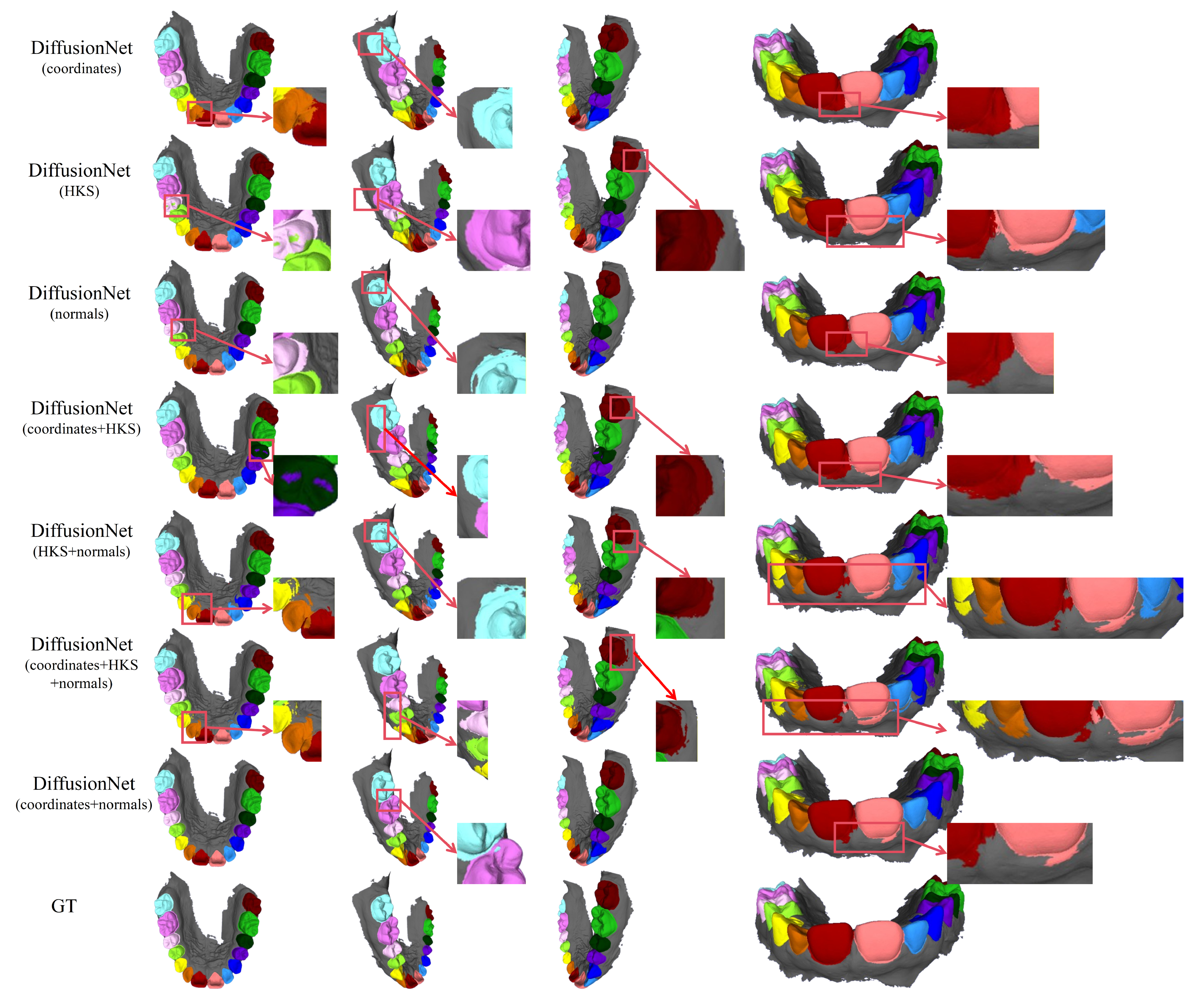
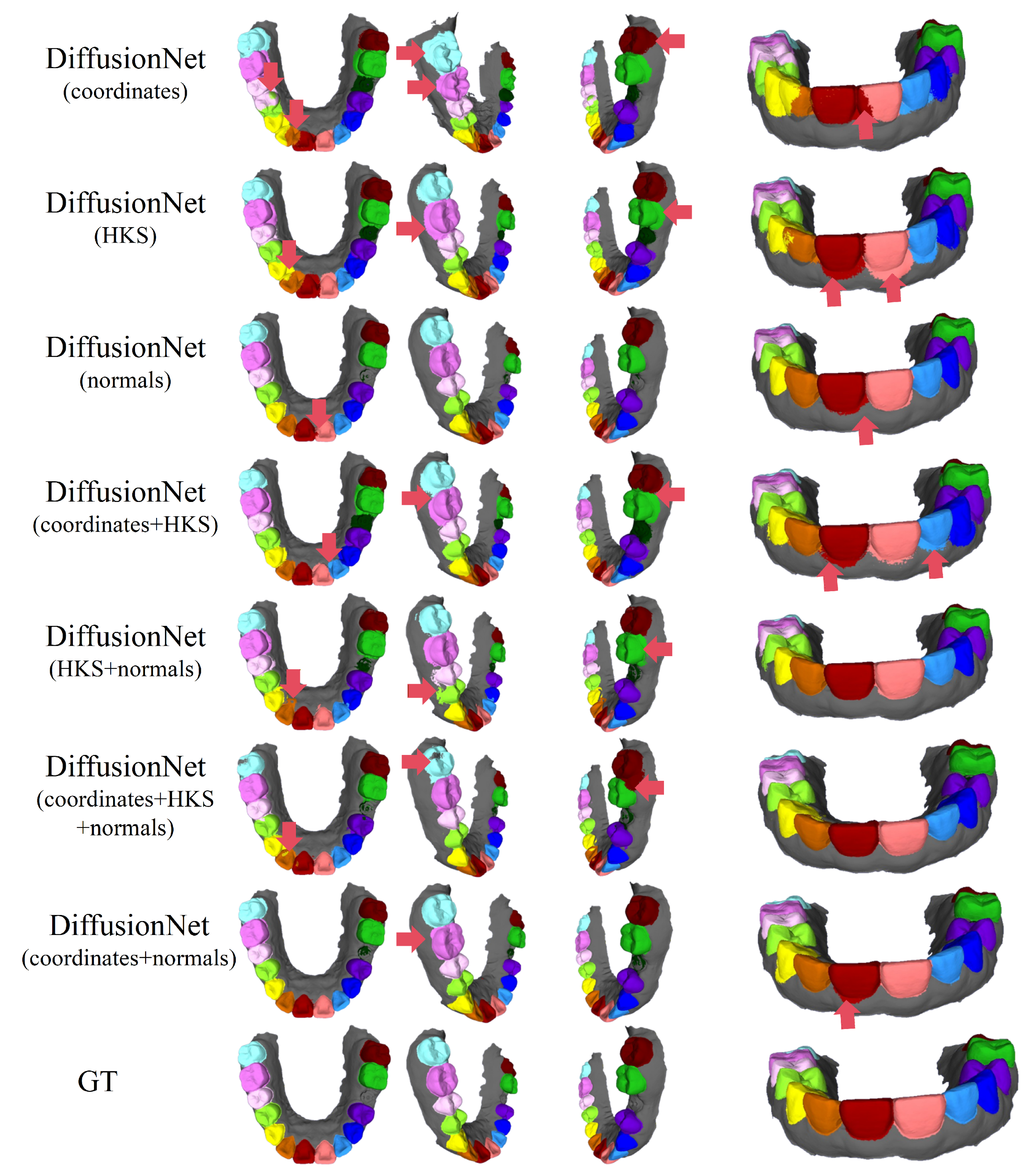
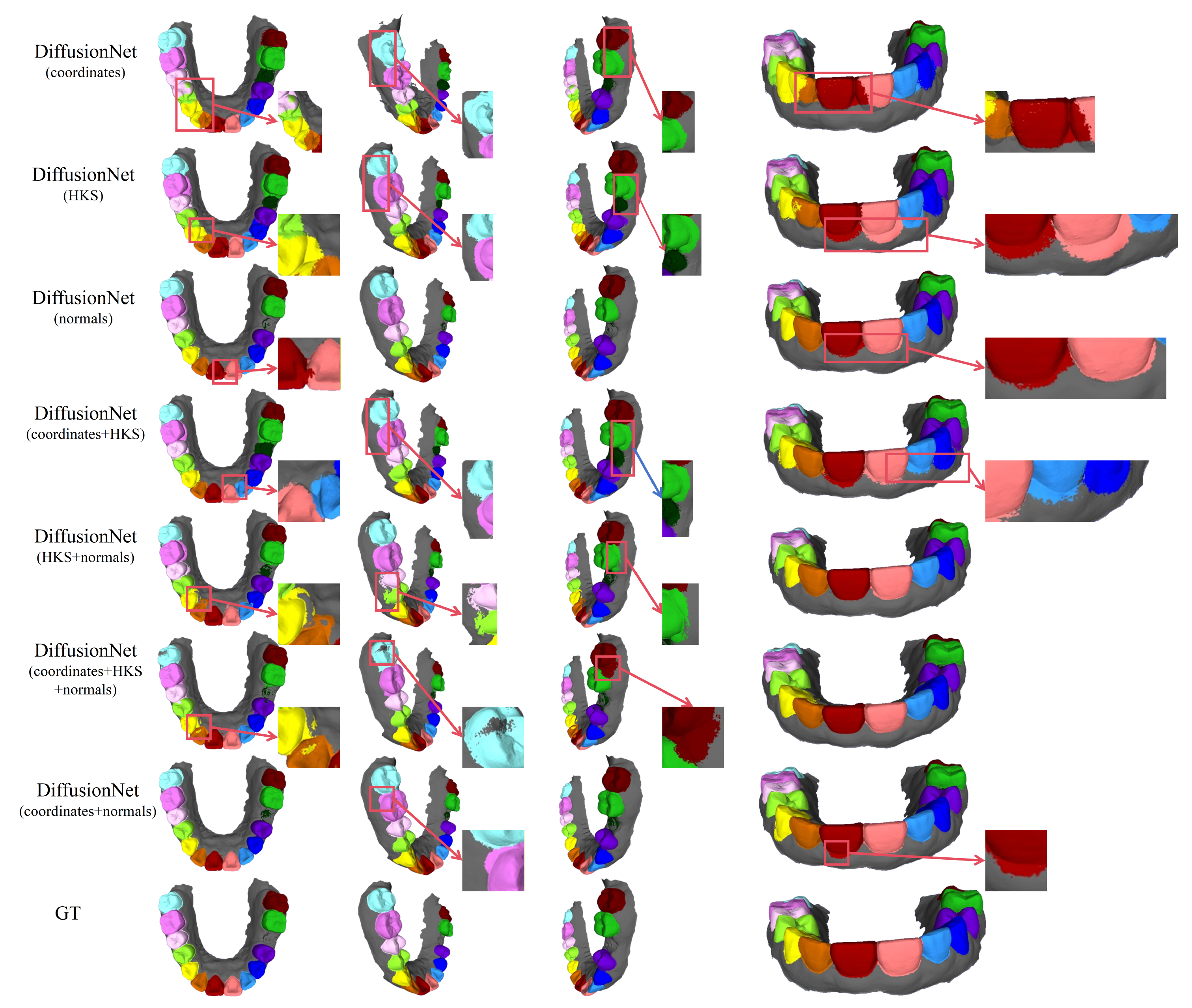
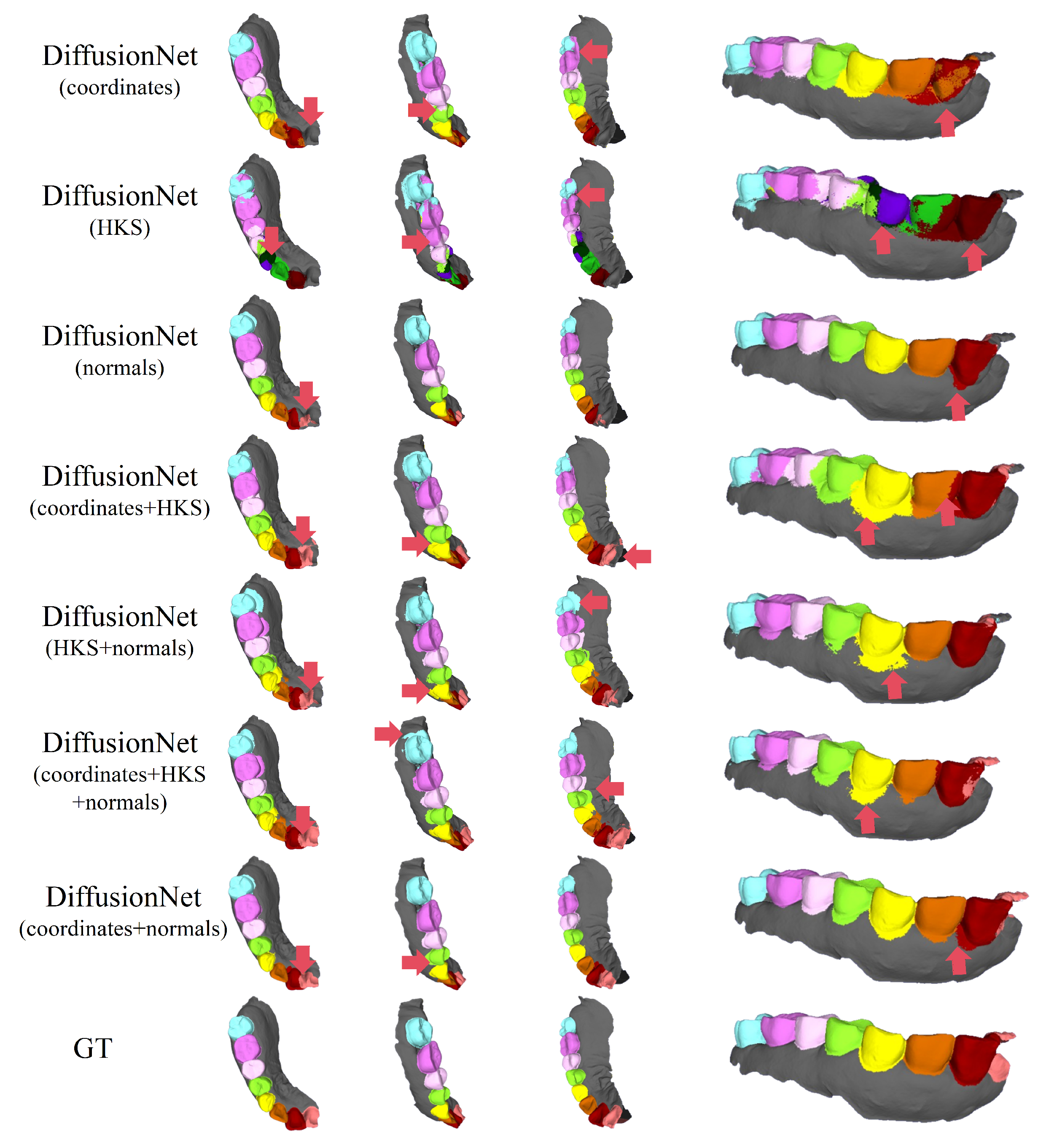
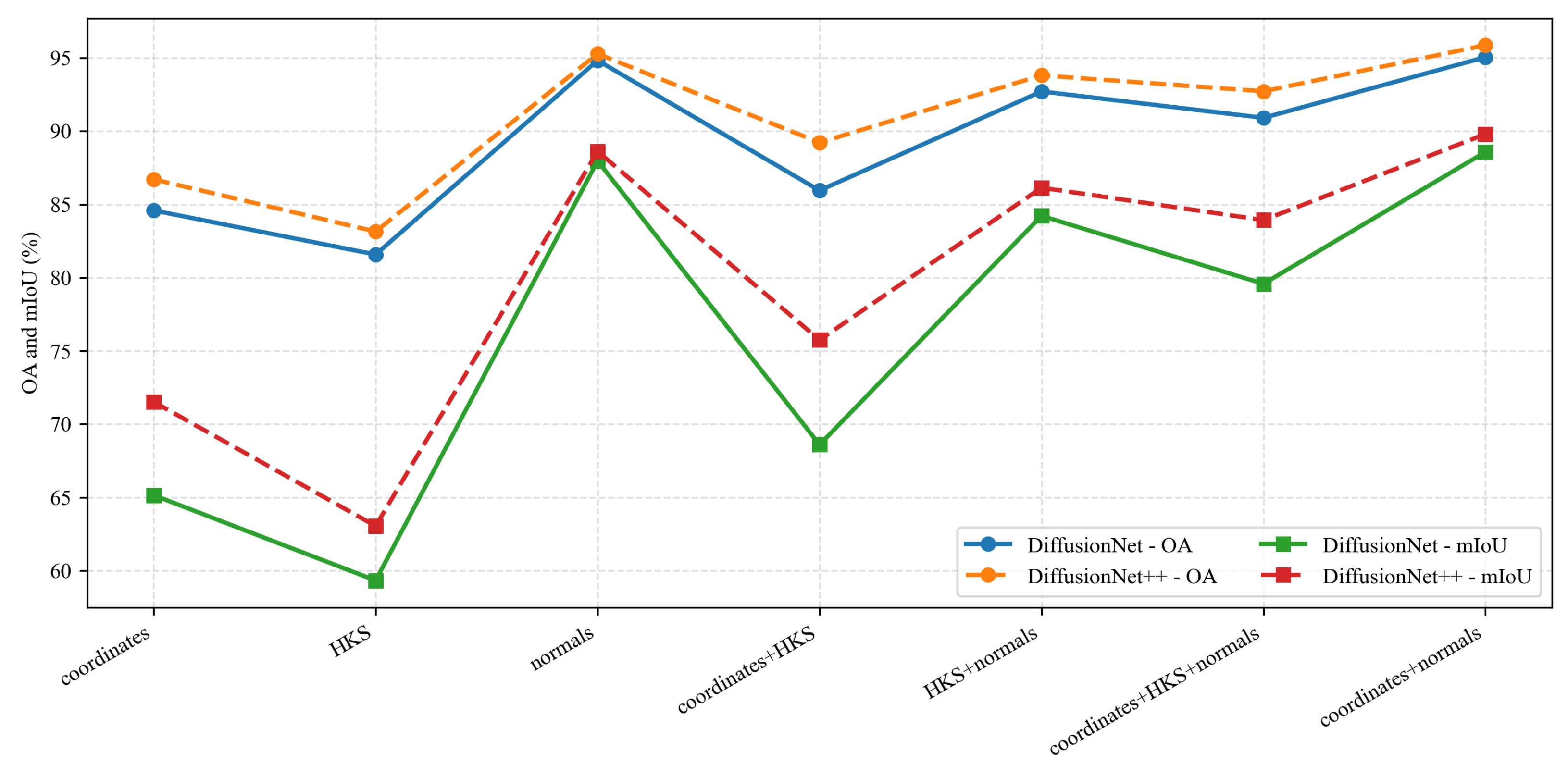
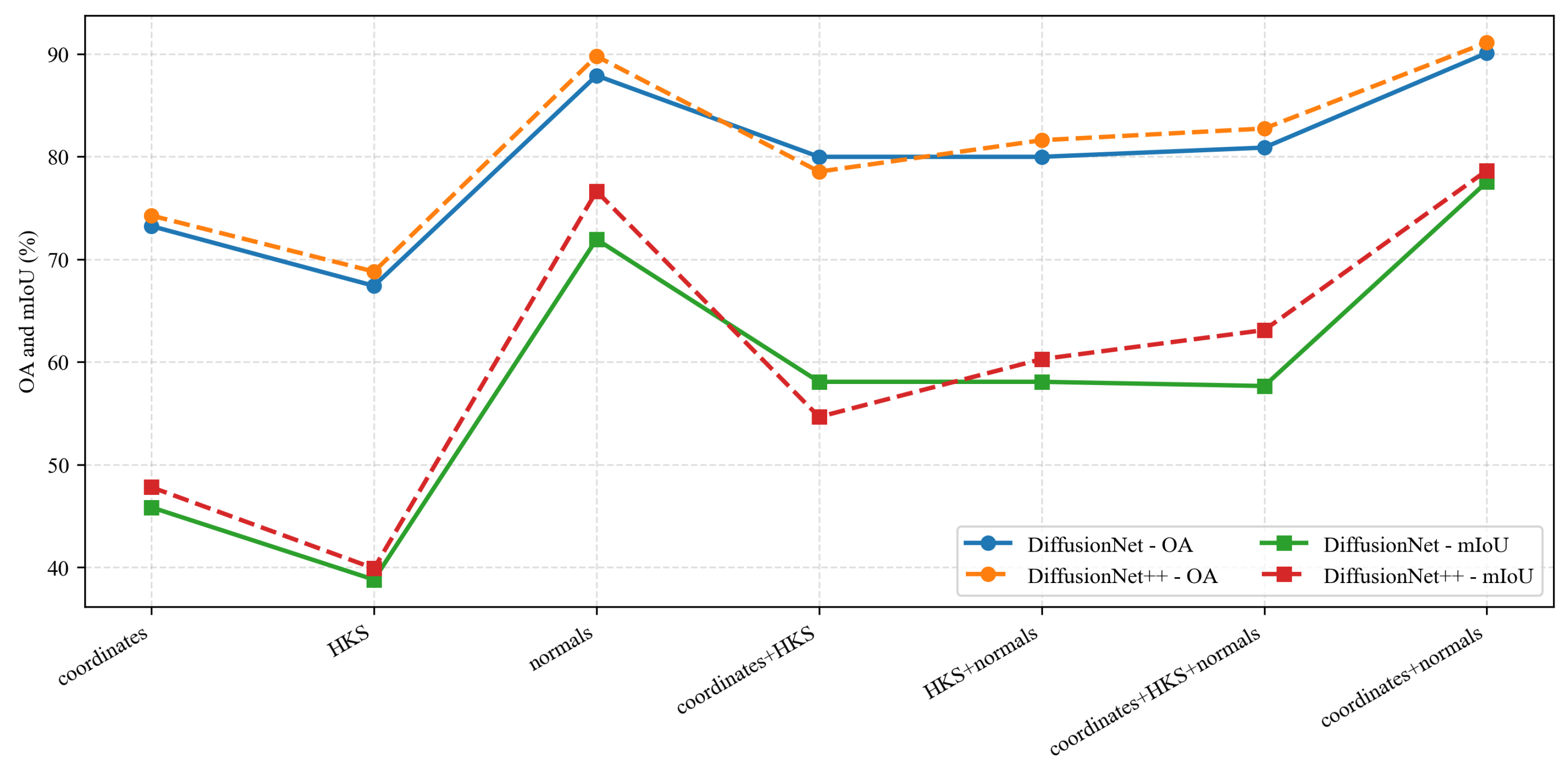
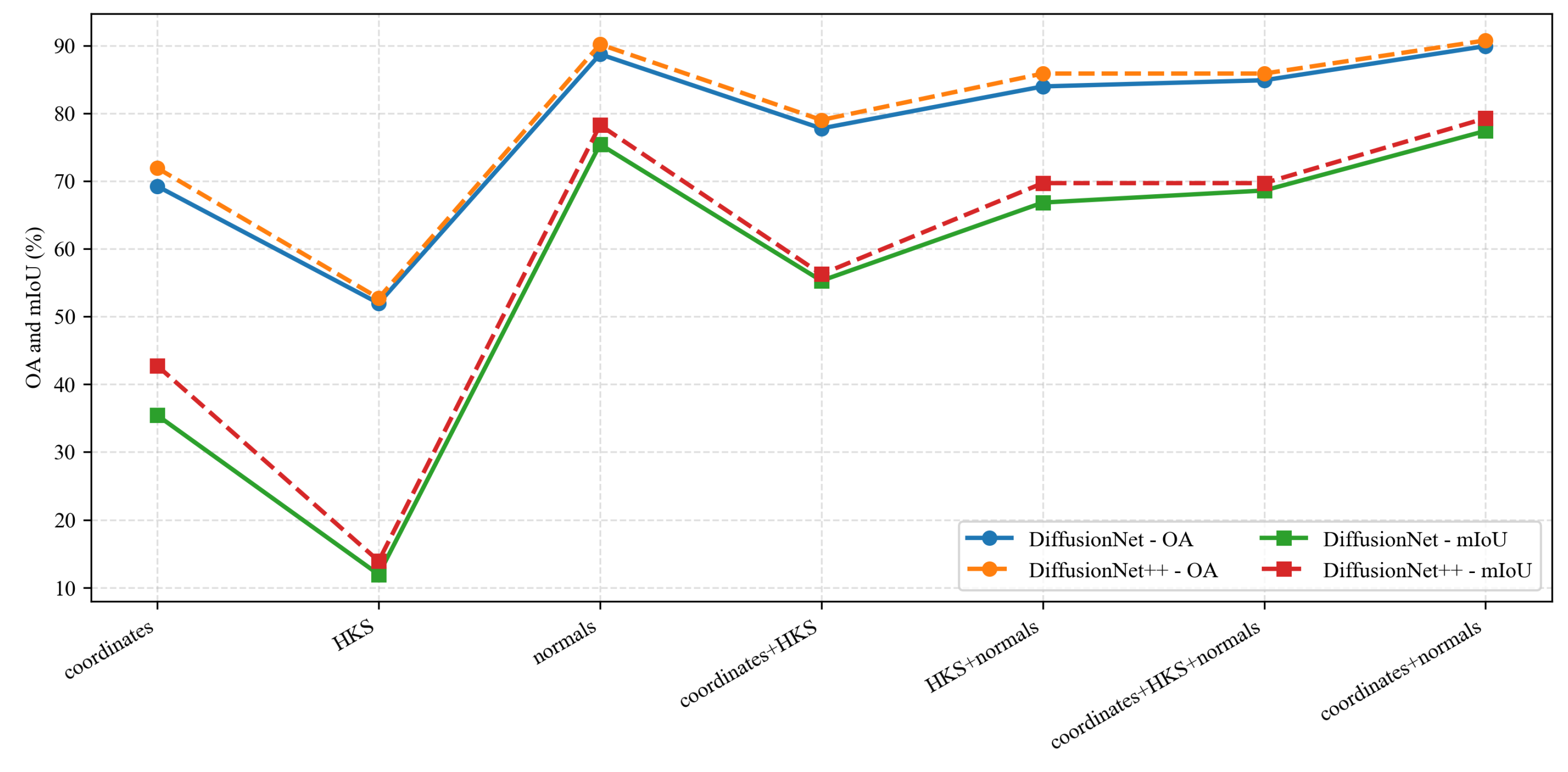
- This study introduces DiffusionNet++, an enhanced framework for high-resolution 3D tooth segmentation. By integrating normal features and a lightweight SE channel-attention mechanism, the method substantially improves segmentation performance without incurring significant additional computational cost. Comprehensive comparative experiments further demonstrate that the coordinates + normals constitute the optimal input-feature configuration for 3D dental segmentation.
- 2.
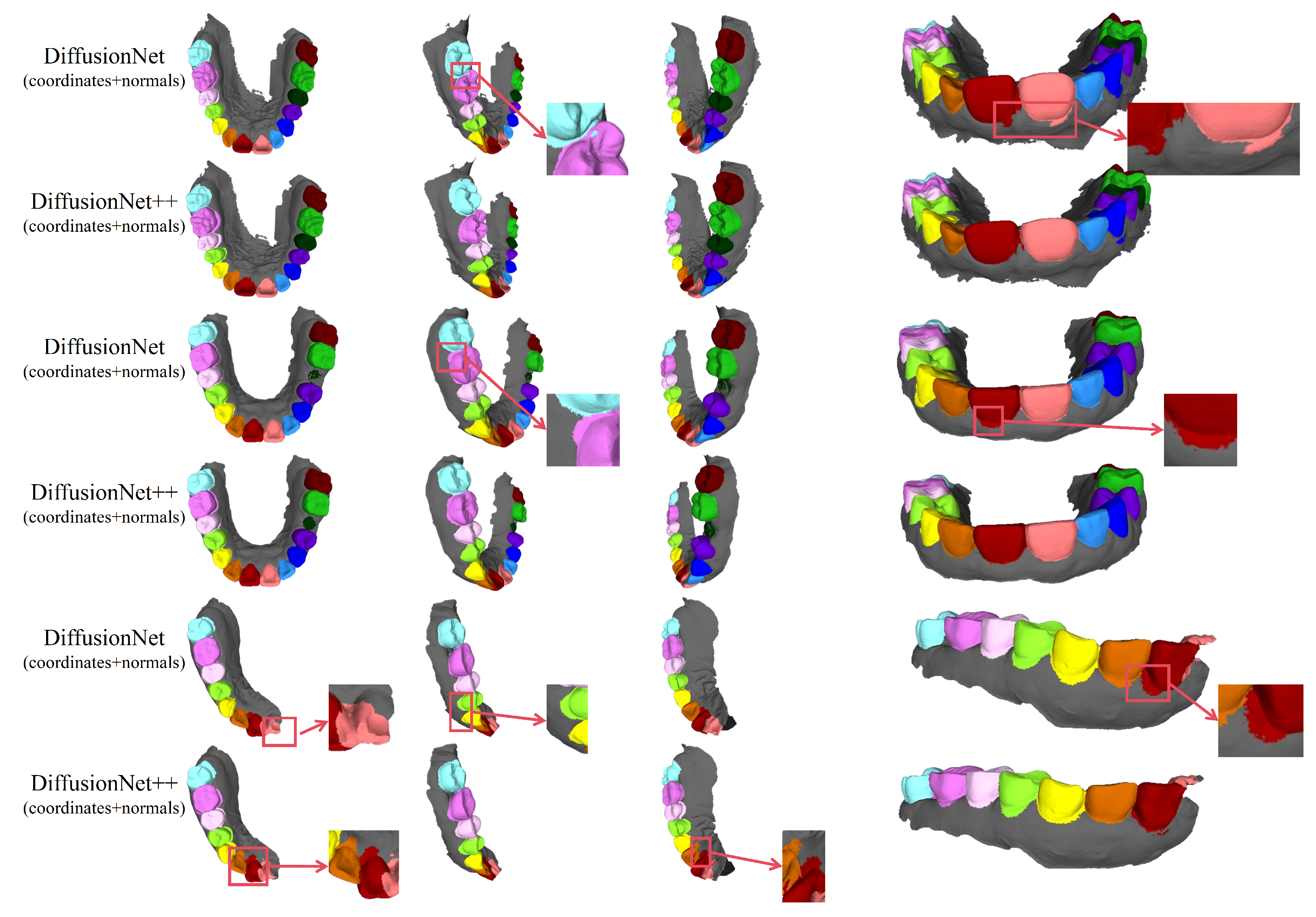
- DiffusionNet++ demonstrates strong robustness and reliability across diverse and challenging clinical scenarios. The proposed method consistently achieves superior results on cases involving missing teeth and partially scanned data. Ultimately, it attains an overall accuracy (OA) of 95.87% and a mean Intersection over Union (mIoU) of 89.80%, providing compelling evidence of its effectiveness and practical applicability.
- 3.
- This study provides the first systematic investigation on the automatic segmentation of raw high-resolution 3D dental meshes. The proposed approach overcomes the prevailing reliance on aggressive downsampling in existing methods, offering a new pathway for preserving fine-grained geometric details and achieving clinically viable accuracy.
2. Related Works
2.1. 3D Data Segmentation
- 1.
- Voxel Segmentation: Voxel, short for volumetric pixel, is analogous to a pixel in 2D space but occupies volume in 3D space. Each voxel can store information such as color and density, making it well suited for representing objects with regular structures. Daniel Maturana et al. proposed VoxNet [5], which employs a 3D convolutional neural network (CNN) to process voxel data; however, voxel sparsity leads to increased computational costs. To address this limitation, Hu et al. proposed VMNet [6], a 3D deep network that combines voxel and mesh representations, leveraging both Euclidean and geodesic information to enhance the accuracy of sparse voxel segmentation. Nevertheless, when processing high-resolution data, the number of model parameters increases significantly, limiting the model’s generalization ability. Consequently, voxel-based methods incur substantial computational costs, posing challenges in balancing spatial resolution and computational efficiency.
- 2.
- View Segmentation: View-based segmentation methods project 3D objects from multiple viewpoints to generate 2D images, upon which conventional 2D image segmentation techniques are applied to achieve 3D segmentation. Su et al. proposed the MVCNN [7], which renders 3D data from 12 predefined viewpoints and employs a two-stage CNN architecture for feature extraction. The first stage utilizes a shared-parameter CNN to extract features from each view, followed by max-pooling to aggregate multi-view information, while the second stage learns a compact 3D shape representation. To address variations in recognition performance across different viewpoints, Feng et al. introduced GVCNN [8], which groups views, assigns weights, and performs pooling within each group, and subsequently fuses the group-level features to obtain a holistic representation. Furthermore, Abhijit Kundu et al. proposed Virtual Multi-View Fusion [9], which generates virtual views, renders synthetic images, trains a 2D semantic segmentation model, and fuses multi-view predictions onto 3D mesh vertices for 3D scene segmentation. While view-based methods effectively leverage well-established 2D image segmentation techniques with relatively low computational cost, they are fundamentally constrained by their 2D projections. Consequently, these methods struggle to fully capture 3D topological structures and geometric relationships. In addition, complex geometries often lead to information loss due to occlusions from certain viewpoints.
- 3.
- Point cloud segmentation: Point cloud is an unordered three-dimensional data representation consisting of a set of points, each with 3D coordinates (x, y, z), and may include additional attributes such as color and normal vectors. PointNet [10], proposed by researchers at Stanford University in 2017, is a deep learning network specifically designed for processing point cloud data. It consists of a point cloud feature extractor and a global feature aggregator and performs well in 3D object classification and segmentation. PointNet++ [11] is an improved version of PointNet proposed by Qi et al. It addresses PointNet’s limitation of ignoring local structures. PointNet++ employs a multi-scale hierarchical aggregation strategy, enabling the model to better capture local information, particularly in cases of uneven point cloud density. Weng et al. proposed the 3D-PAM [12] to enhance 3D point cloud semantic segmentation. By incorporating plane-guided information, 3D-PAM improves the ability to recognize object boundaries and large surface areas while capturing the global scene structure, effectively overcoming the limitations of traditional methods in these aspects. Point cloud data is inherently unstructured, allowing flexible adaptation to objects of various shapes. However, its unordered nature hinders the modeling of complex topological relationships, which negatively affects segmentation accuracy.
- 4.
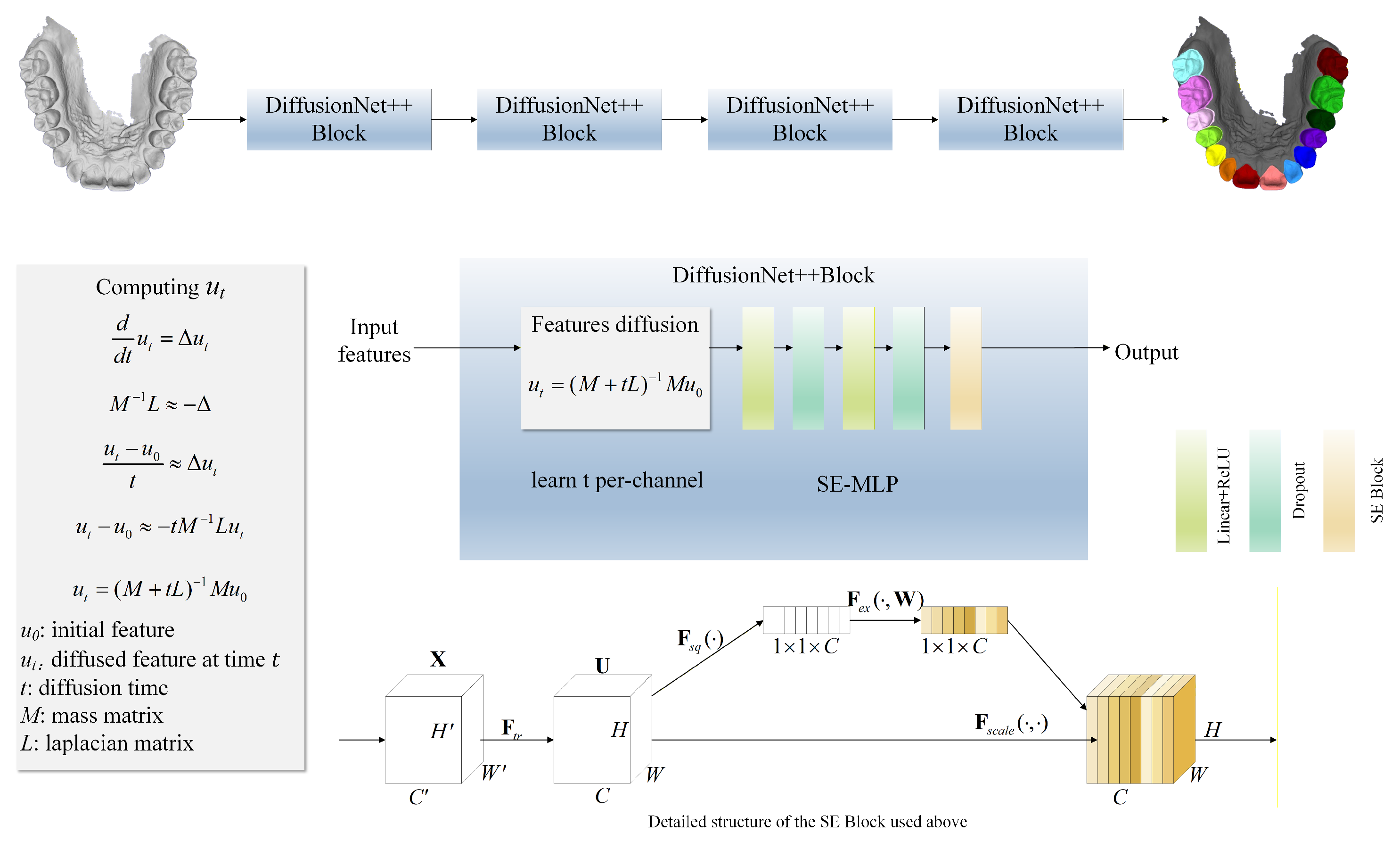
- Mesh Segmentation: Three-dimensional mesh data is a collection of vertices, edges, and faces. Feng et al. proposed MeshNet [13], which treats mesh faces as fundamental units. It employs multi-level feature extraction to capture local details and global topological information for segmentation. V. V. Singh et al. introduced MeshNet++ [14], an enhanced version of MeshNet equipped with specialized convolution and pooling modules for multi-scale local feature learning. Alon Lahav et al. proposed MeshWalker [15], which performs random walks along the mesh surface to extract geometric and topological features, followed by an RNN for segmentation. Hanocka et al. introduced MeshCNN [16], a pioneering architecture that operates directly on mesh edges. It designs novel edge-based convolution, pooling, and unpooling operations: the convolution aggregates features from an edge and its four neighboring edges, while the pooling operation collapses edges on the mesh surface, allowing the network to effectively capture fine-grained local geometry. Sharp et al. proposed DiffusionNet [4], which replaces traditional, computationally expensive geometric convolutions and pooling layers with a learnable diffusion process. By independently learning diffusion times for each feature channel, the network dynamically adapts its receptive field, enabling effective modeling of both local geometric details and global structural information. A multilayer perceptron (MLP) is then employed to nonlinearly fuse and enhance the multi-scale diffused features, leading to robust and accurate performance on 3D classification and segmentation tasks.
2.2. Three-Dimensional Tooth Segmentation
- 1.
- Voxel Segmentation: Cui et al. proposed ToothNet [18], a two-stage deep learning framework for 3D tooth segmentation. In the first stage, a deep supervision network is trained to extract tooth edge information. In the second stage, the extracted edge information and original data are input into a 3D Region Proposal Network (RPN), together with spatial relationship features of the teeth, to enhance tooth recognition accuracy. Ahn et al. proposed the WCTN [19], which integrates voxel grid division, weighted sparse convolution, and global feature extraction. It employs an adaptive feature fusion strategy to effectively integrate local and global information, thus making it particularly suitable for uniformly dense dental data.
- 2.
- View Segmentation: Zhang et al. proposed a view-based segmentation approach utilizing the harmonic field parameter space [20]. The method performs harmonic parameterization, projection, and data augmentation on labeled 3D dental data to generate a corresponding 2D image dataset for training. The segmentation mask is obtained through image segmentation approaches and then mapped back to 3D space for further processing. Mochen Yu et al. introduced a deformable exemplar-based conditional random field model [21] for tooth segmentation and mapping back to 3D. Ahmed Rekik et al. proposed a multi-stage dental segmentation framework, TSegLab [22], in which 3D dental geometries are first unfolded into 2D representations via curvature-based and harmonic mapping. A coarse segmentation is then performed using Mask R-CNN, after which the results are projected back into 3D space and further refined through a graph neural network (GNN) to explicitly model tooth geometry and spatial relationships. Kim Taeksoo et al. proposed a 3D tooth segmentation method based on Generative Adversarial Network (GAN) [23]. Their approach slices 3D teeth into 2D images along the horizontal direction, fills the missing areas via generative modeling, and then stacks and reconstructs the 3D model to complete the segmentation. TJ Jang et al. presented a stepwise segmentation strategy that integrates both 2D and 3D information [24]. Their method first identifies individual tooth regions in 2D images and localizes the corresponding three-dimensional regions of interest (ROIs), after which fine-grained segmentation is performed directly in 3D space. While view-based segmentation methods are effective for simple tooth models or single-tooth segmentation, their performance degrades significantly in complex cases involving tooth crowding or misalignment.
- 3.
- Point cloud segmentation: Joon Im et al. employed a Dynamic Graph Convolutional Neural Network (DGCNN) to achieve automatic segmentation of 3D dental point cloud data [25]. By dynamically constructing graph structures within local neighborhoods, their method captures and models the underlying geometric features of the point clouds. Farhad Ghazvinian Zanjani et al. proposed Mask-MCNet [26], a Mask R-CNN-based framework for 3D dental point cloud segmentation. The method achieves instance-level segmentation by predicting 3D bounding boxes for each tooth and then segmenting the point clouds within each bounding box. Cui et al. proposed TSegNet [27], a two-stage network designed for the segmentation of 3D dental point cloud data, with PointNet++ serving as the backbone. In the first stage, the farthest point sampling (FPS) method is applied to calculate the centroid of each tooth. The centroid information is subsequently used to segment individual teeth, and this hierarchical framework enhances the model’s capability to handle complex dental geometries. Similarly, Qiu et al. proposed the Darch algorithm [28], which refines centroid estimation by incorporating the dental arch structure rather than relying solely on farthest point sampling. Specifically, a Bézier curve is utilized to generate an initial dental arch, which is further refined using a Graph Convolutional Network (GCN). Based on the refined dental arch, an arch-aware point sampling (APS) method is proposed to guide accurate centroid estimation and improve tooth segmentation precision.
- 4.
- Mesh Segmentation: Lian et al. proposed MeshSegNet [29], an end-to-end deep learning framework for the automatic segmentation of 3D dental mesh data. MeshSegNet employs a graph-based learning module to extract multi-scale local features and integrates local and global geometric information to enhance segmentation accuracy. Building upon this, Wu et al. developed TS-MDL [30], a two-stage model that utilizes an efficient variant of MeshSegNet, iMeshSegNet, for initial dental segmentation in the first stage, followed by PointNet to regress dental surface heatmaps for fine-grained shape refinement. Zhao et al. proposed TSGCN [31], which uses a dual-stream architecture to simultaneously learn coordinates and normal vector features. It integrates self-attention mechanisms to enhance global feature processing, thus achieving excellent results in dental shape segmentation. Li et al. introduced ThisNet [32], which emphasizes the dental region and improves segmentation and labeling accuracy by combining a dental similarity module with global context information. Furthermore, Zheng et al. proposed TeethGNN [33], a graph neural network for dental mesh segmentation. It employs a dual-branch architecture to predict triangle labels and centroid offsets and then applies the clustering algorithm to separate adjacent teeth. This design enables precise boundary localization and effectively addresses the issue of incomplete segmentation. Lucas Krenmayr et al. introduced DilatedToothSegNet [34], a graph neural network-based approach for 3D dental segmentation. By incorporating dilated edge convolution to expand the receptive field, the method captures long-range geometric dependencies, resulting in a substantial improvement in segmentation accuracy on 3D dental meshes.
3. Methods
3.1. Network Structure
3.2. Input Features
3.3. Features Diffusion
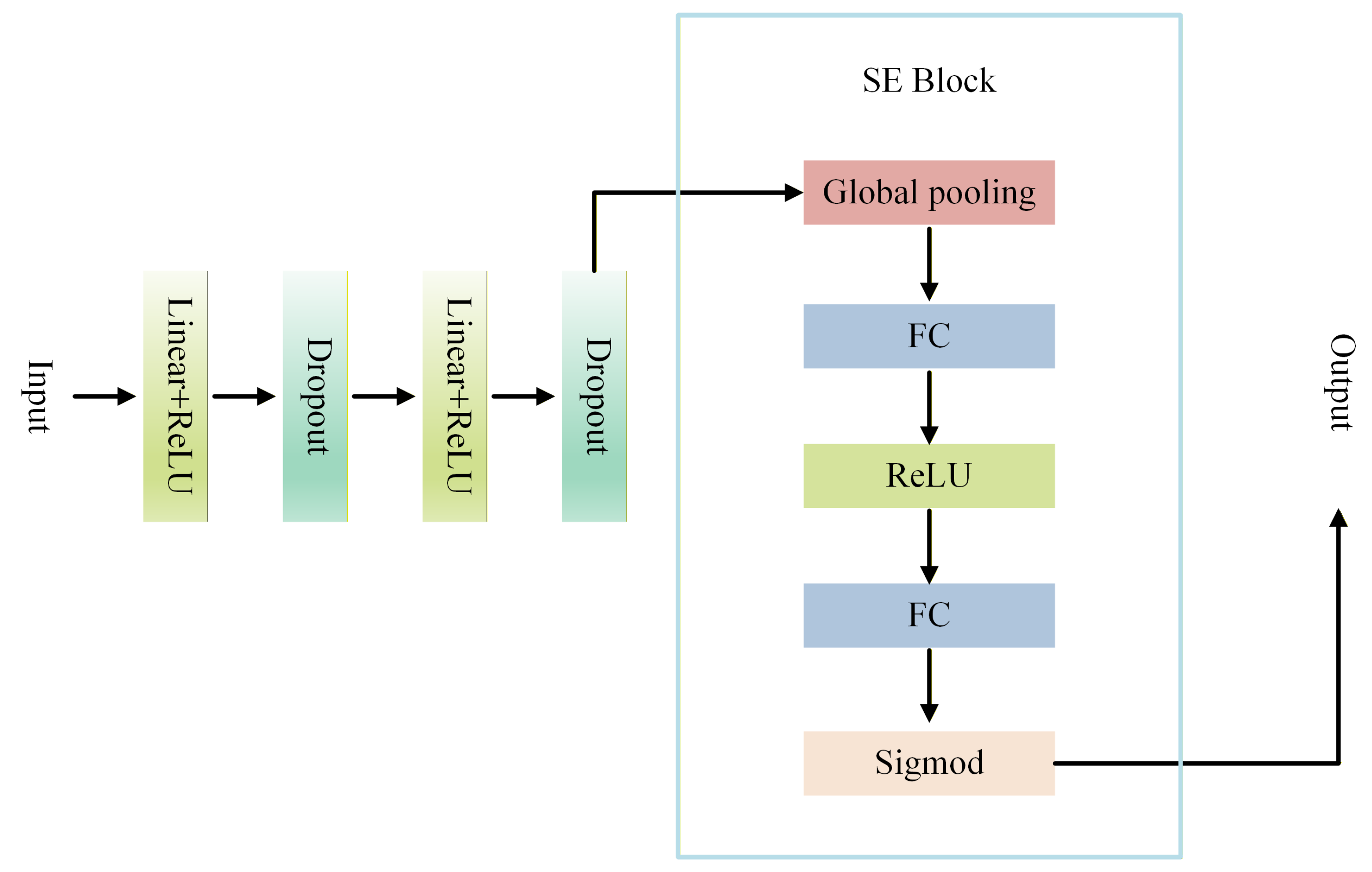
3.4. SE-MLP
- 1.
- Squeeze: The input features are globally average-pooled across the spatial dimensions, compressing the spatial distribution of each channel into a single global statistic. This operation effectively captures each channel’s overall contribution to the feature representation and provides a foundation for subsequent channel weight modeling.
- 2.
- Excitation: Two consecutive fully connected layers are employed to learn inter-channel dependencies. The first layer performs channel-wise dimensionality reduction to reduce parameters and extract compact features, followed by a ReLU activation. The second layer restores the original channel dimension to model the complete distribution of channel importance.
- 3.
- Scale: The learned channel weights are passed through a Sigmoid function to map them to the range [0,1] and then multiplied with the original features in a channel-wise manner, achieving adaptive feature recalibration. Important channels are amplified, while less relevant channels are suppressed.
4. Experiments
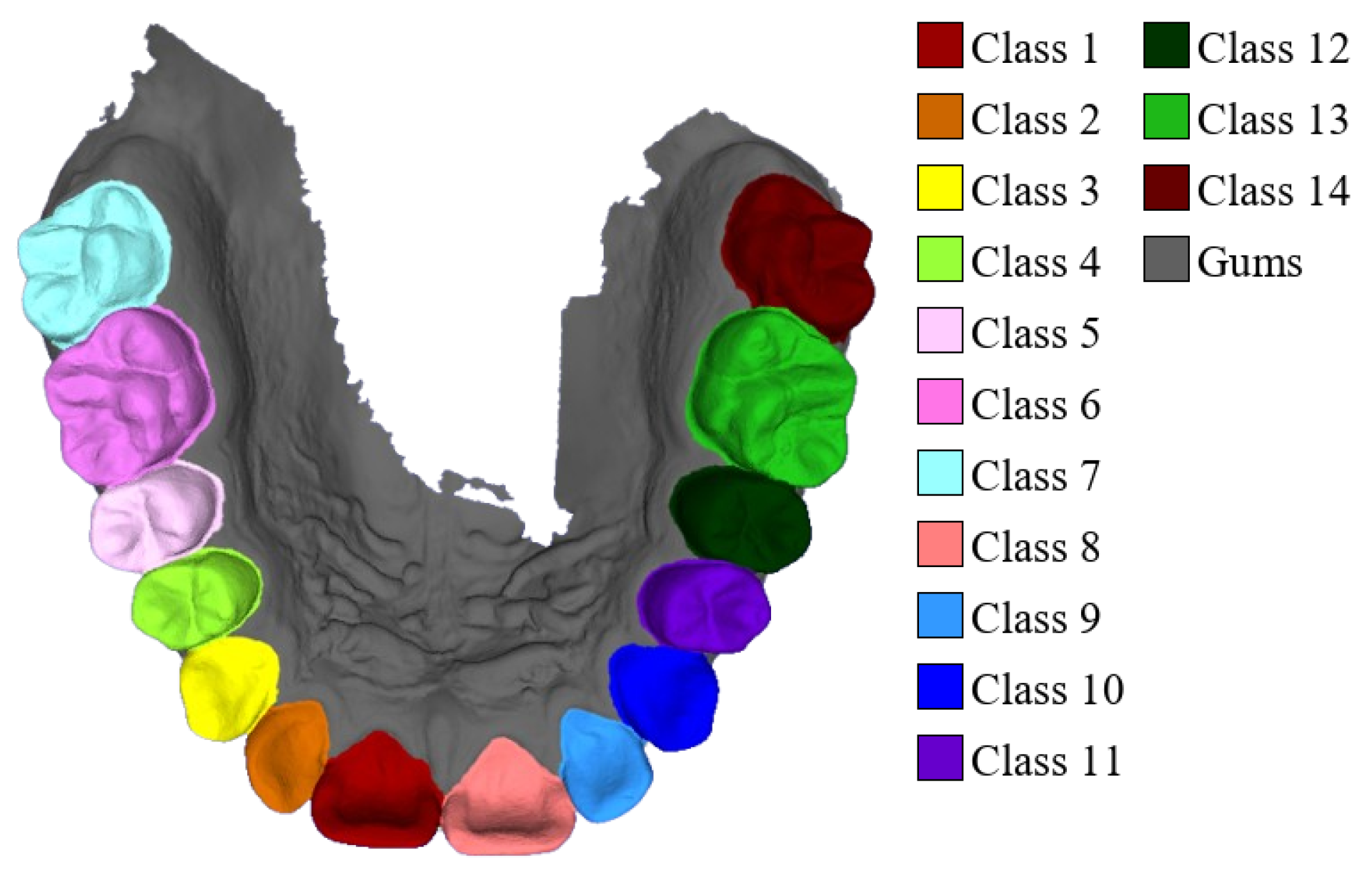
4.1. Dataset and Preprocessing
4.2. Experimental Setup and Evaluation Metrics
4.3. Experimental Results
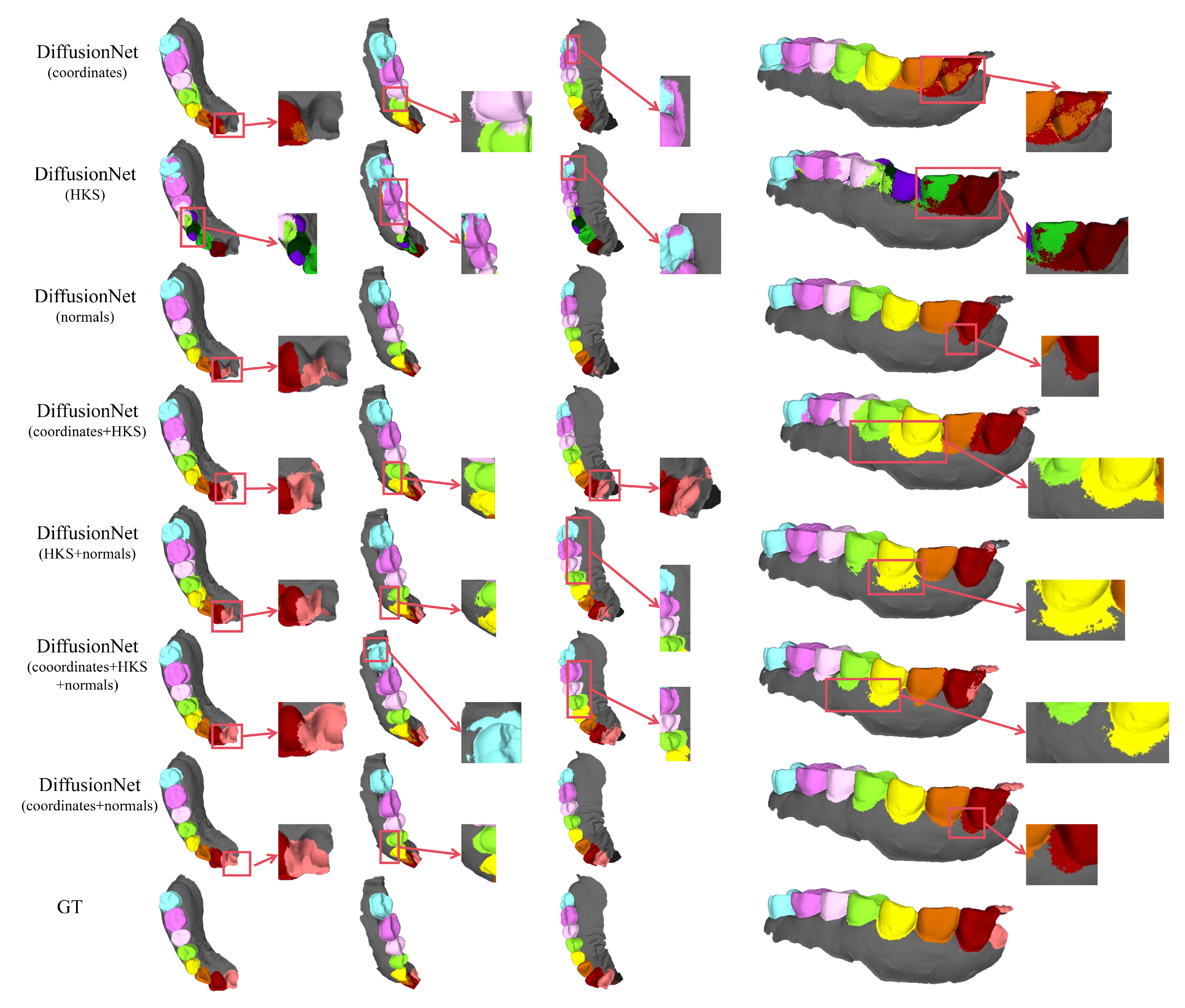
- Standard DiffusionNet without attention mechanisms.
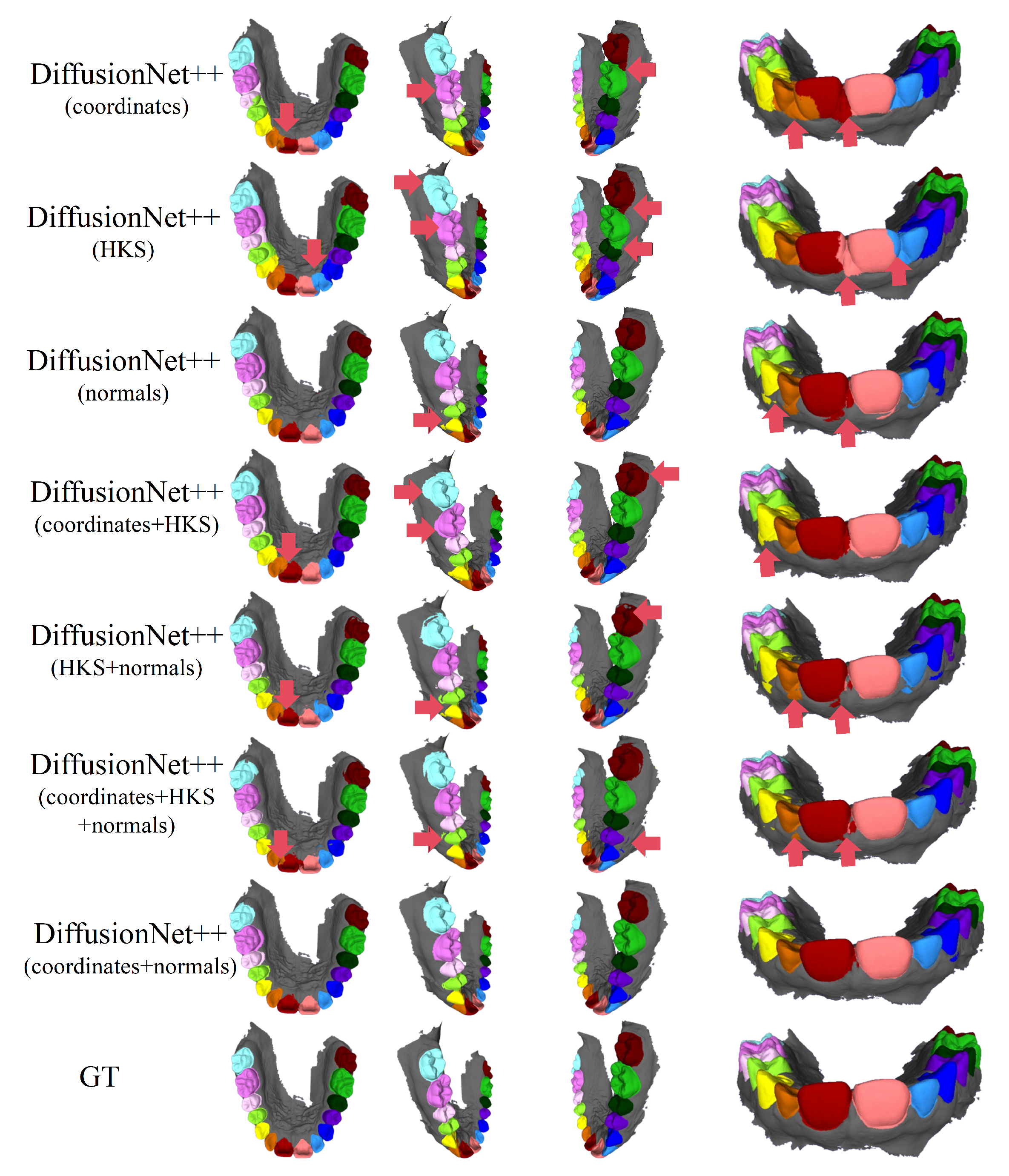
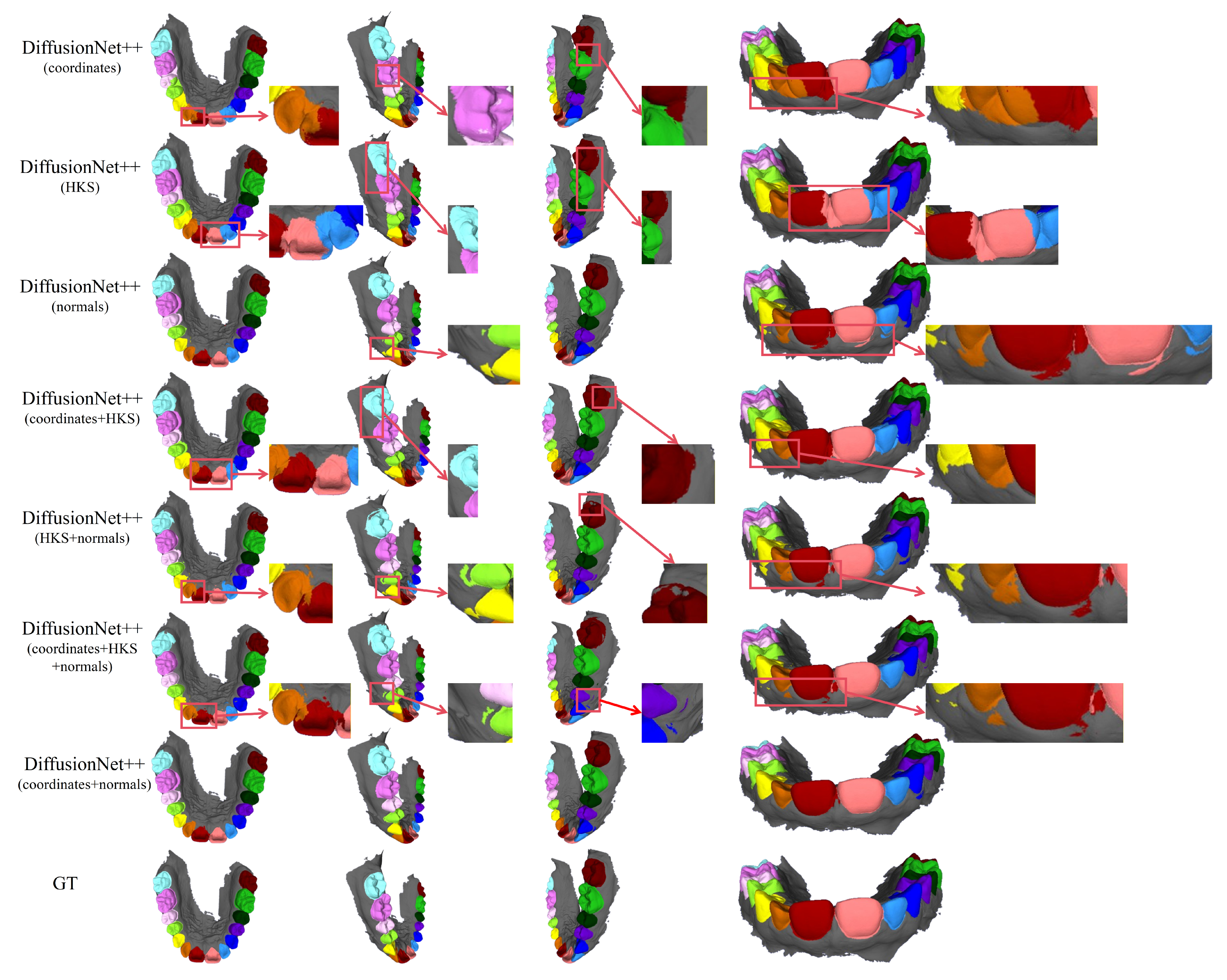
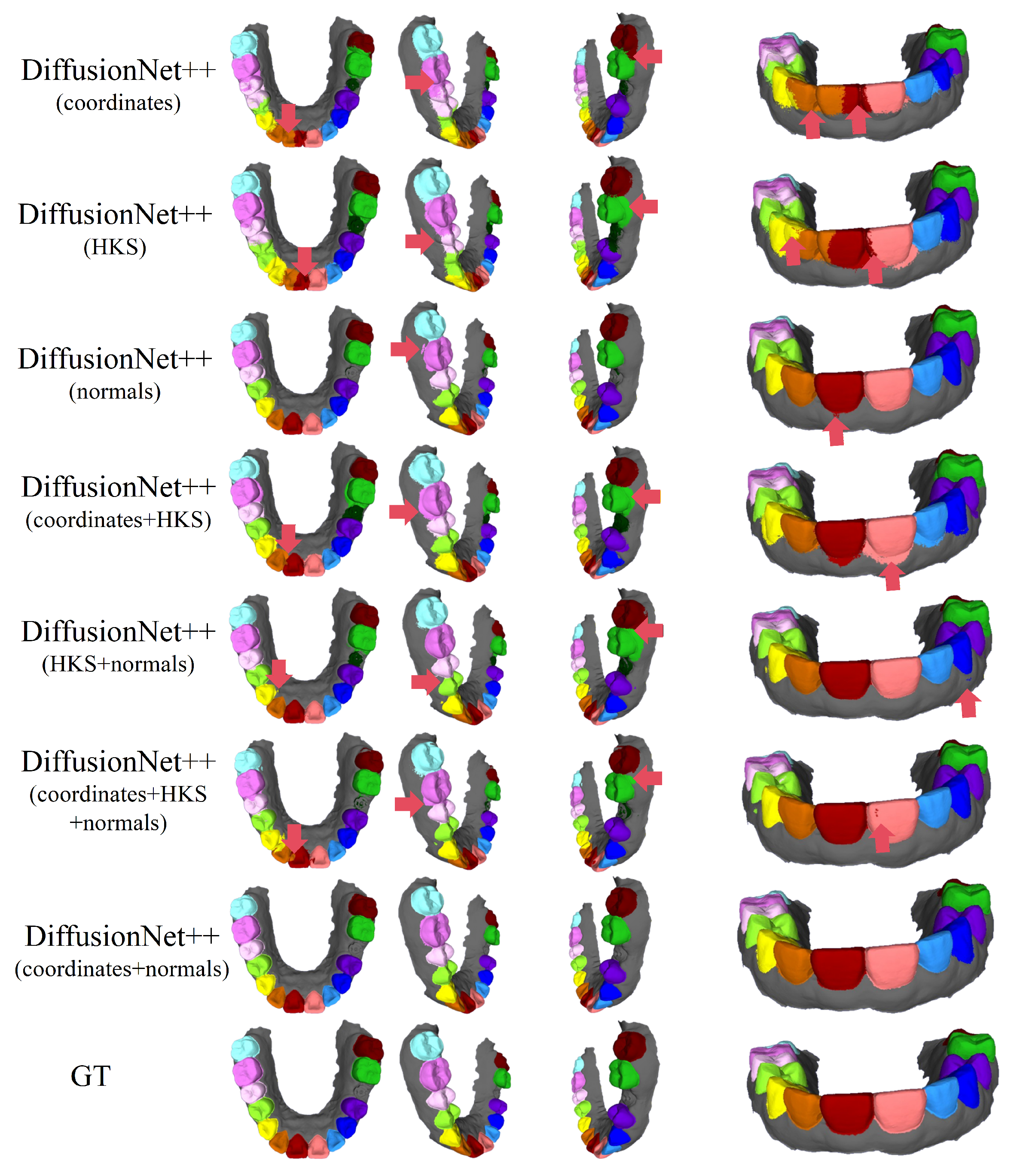
- DiffusionNet++, the improved model integrating the SE channel attention mechanism.
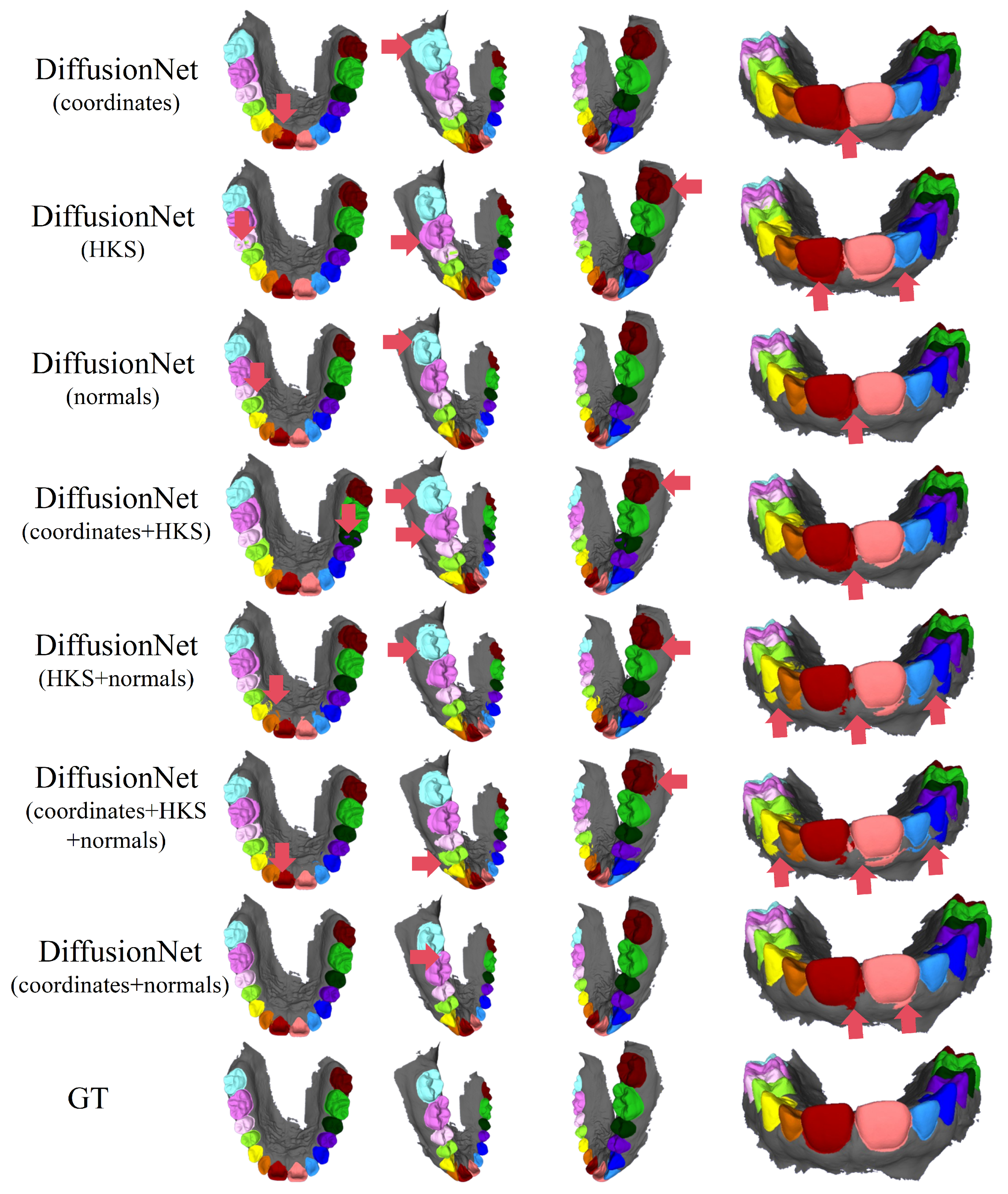
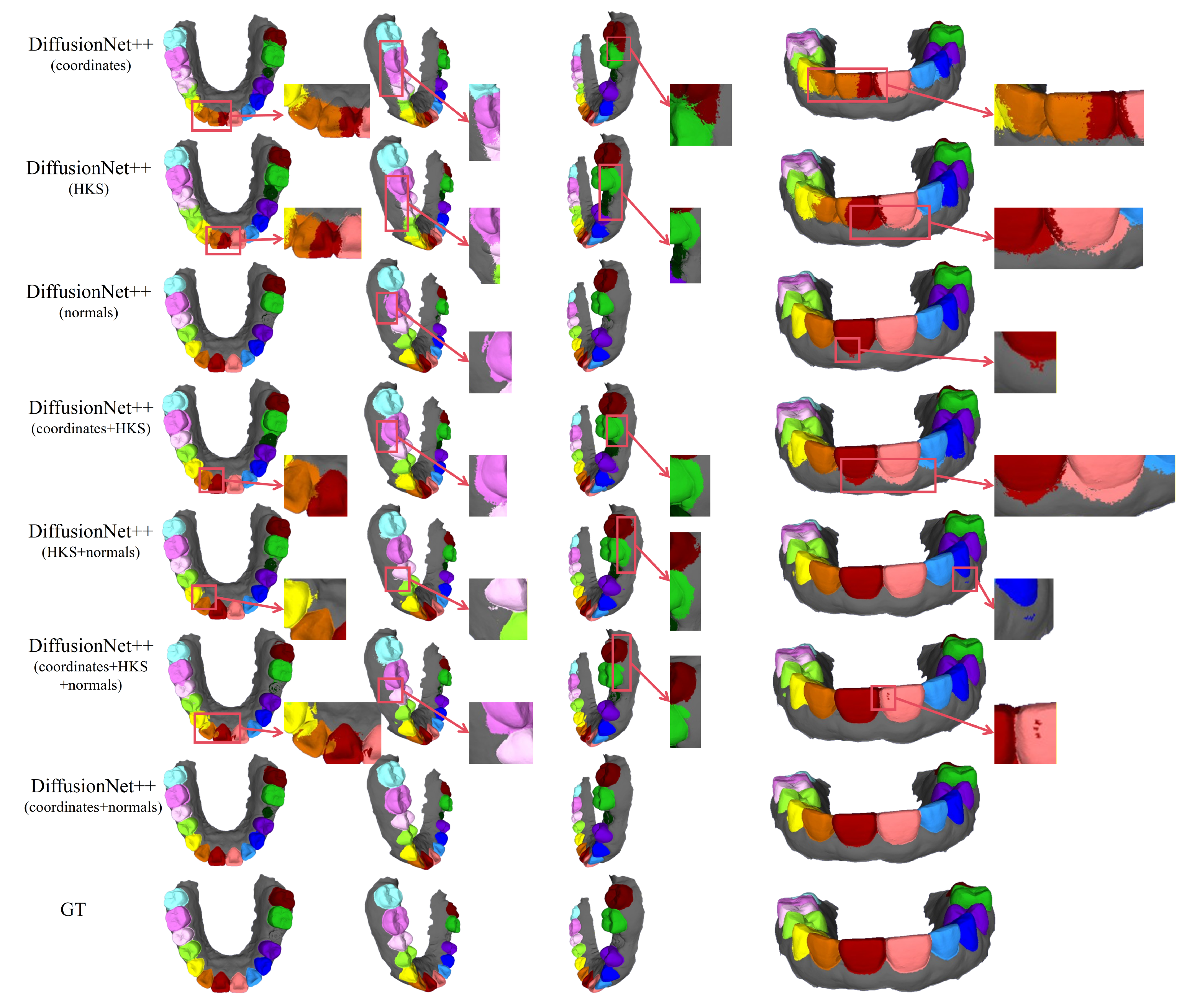
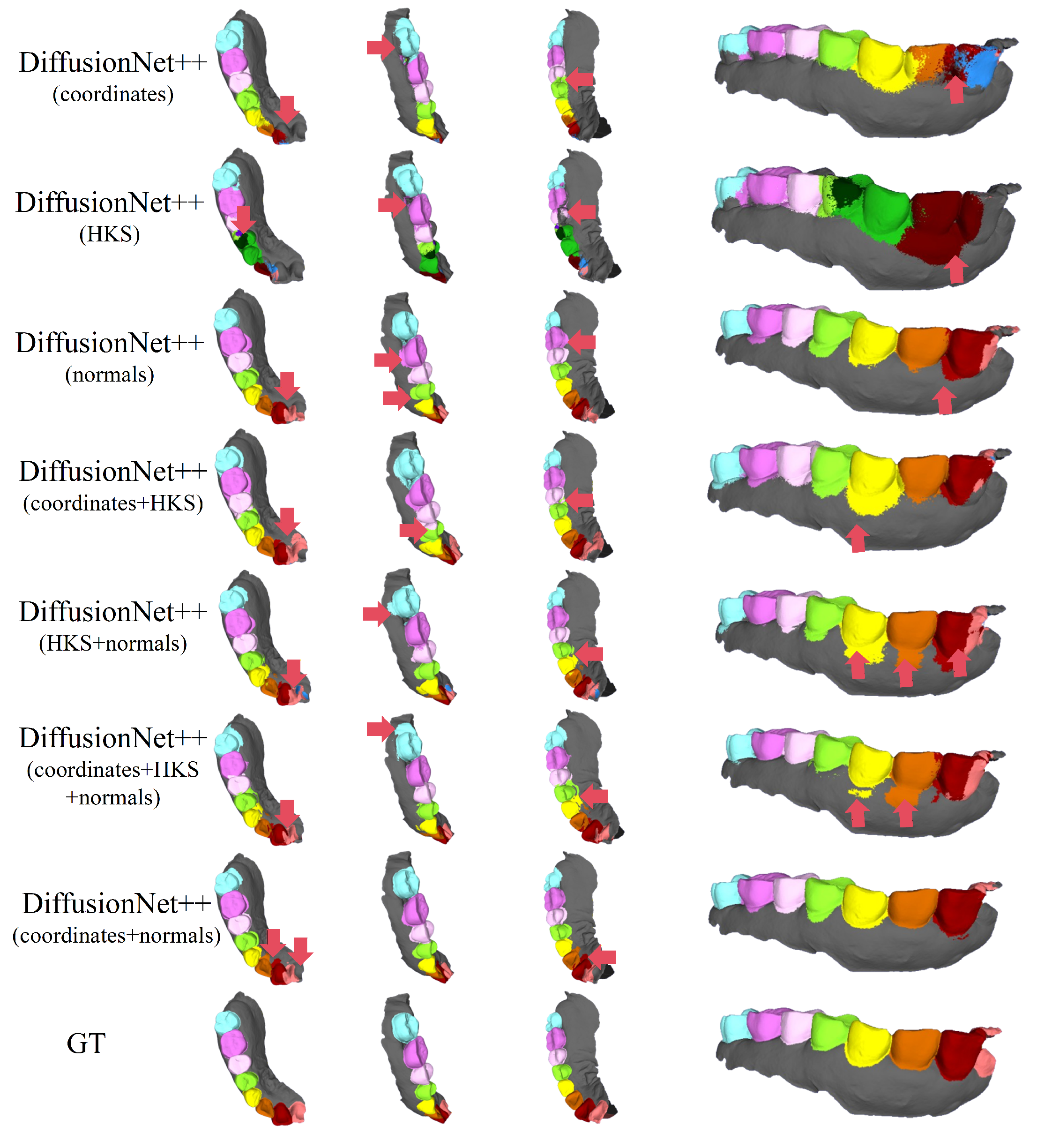
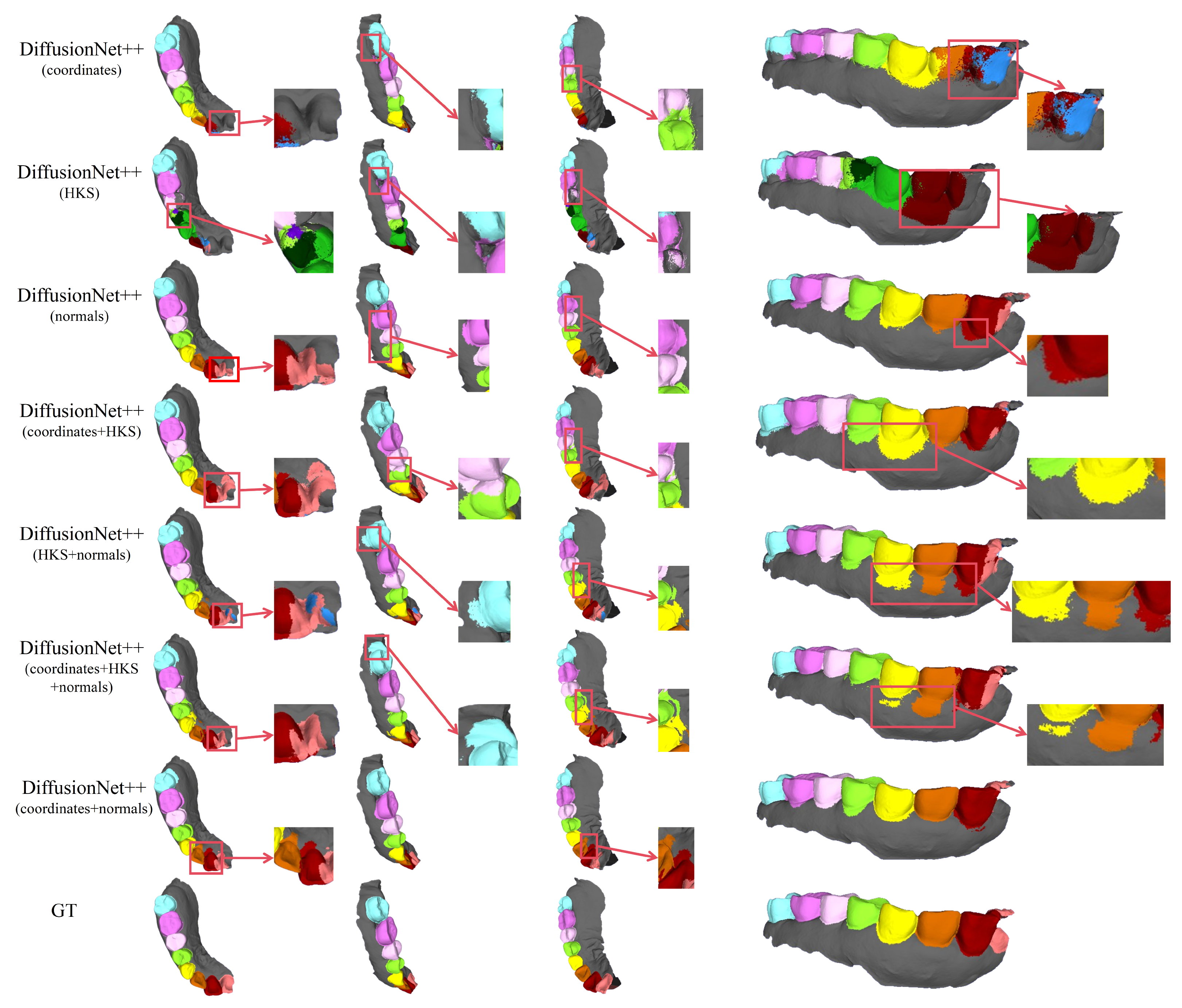
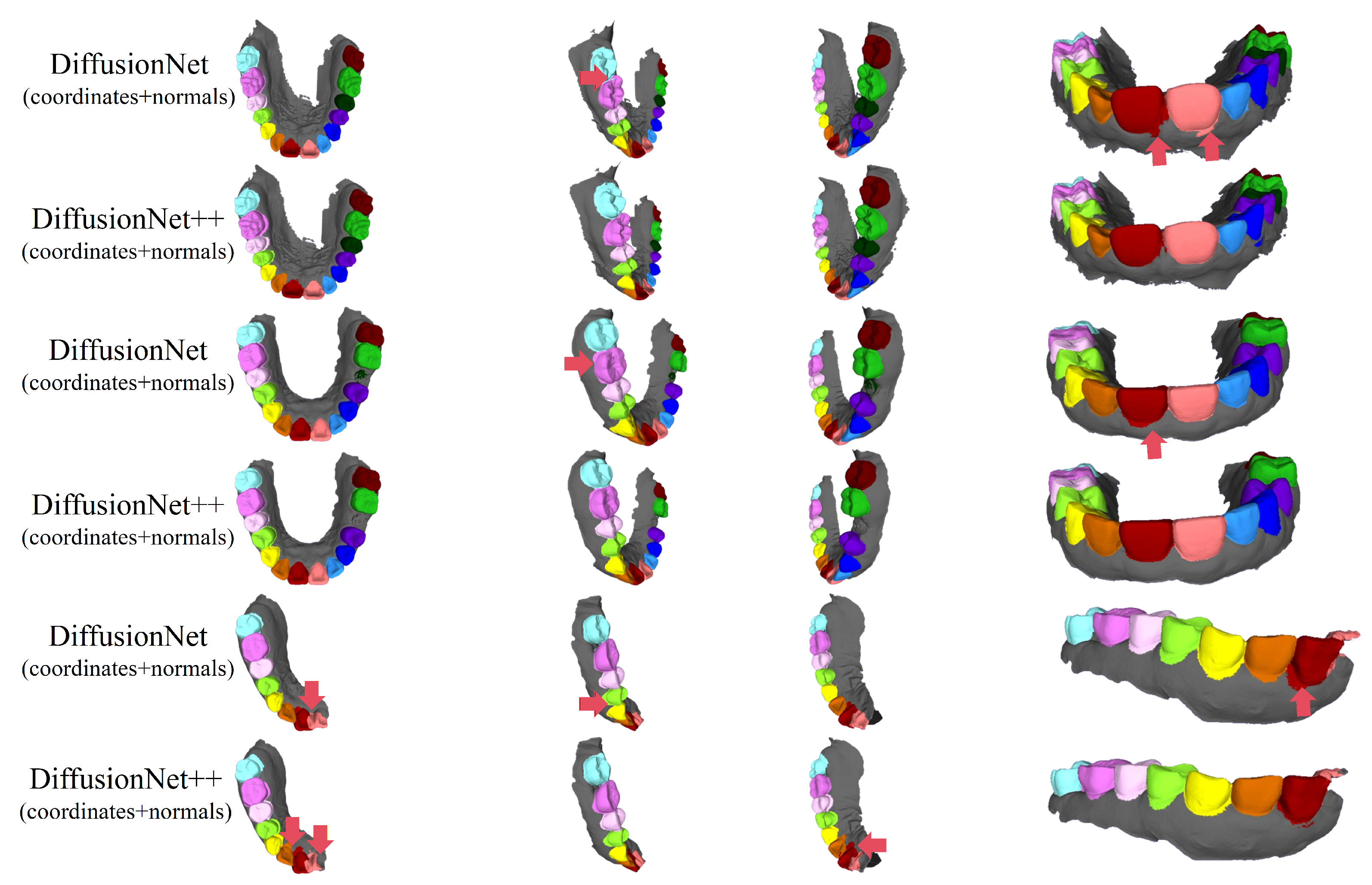
4.3.1. Qualitative Experiments
4.3.2. Quantitative Experiments
5. Discussion
6. Conclusions
Author Contributions
Funding
Institutional Review Board Statement
Informed Consent Statement
Data Availability Statement
Conflicts of Interest
References
- Lloyd, D.F.A.; Pushparajah, K.; Simpson, J.M.; Van Amerom, J.F.P.; Van Poppel, M.P.M.; Schulz, A.; Kainz, B.; Deprez, M.; Lohezic, M.; Allsop, J.; et al. Three-dimensional visualisation of the fetal heart using prenatal MRI with motion-corrected slice-volume registration: A prospective, single-centre cohort study. Lancet 2019, 393, 1619–1627. [Google Scholar] [CrossRef] [PubMed]
- Chen, J.; Wu, L.; Zhang, J.; Zhang, L.; Gong, D.; Zhao, Y.; Chen, Q.; Huang, S.; Yang, M.; Yang, X.; et al. Deep learning-based model for detecting 2019 novel coronavirus pneumonia on high-resolution computed tomography. Sci. Rep. 2020, 10, 19196. [Google Scholar] [CrossRef] [PubMed]
- Bakhtiarnia, A.; Zhang, Q.; Iosifidis, A. Efficient high-resolution deep learning: A survey. ACM Comput. Surv. 2024, 56, 1–35. [Google Scholar] [CrossRef]
- Sharp, N.; Attaiki, S.; Crane, K.; Ovsjanikov, M. DiffusionNet: Discretization agnostic learning on surfaces. ACM Trans. Graph. (TOG) 2022, 41, 1–16. [Google Scholar] [CrossRef]
- Maturana, D.; Scherer, S. VoxNet: A 3D convolutional neural network for real-time object recognition. In Proceedings of the 2015 IEEE/RSJ International Conference on Intelligent Robots and Systems (IROS), Hamburg, Germany, 28 September–2 October 2015; pp. 922–928. [Google Scholar]
- Hu, Z.; Bai, X.; Shang, J.; Zhang, R.; Dong, J.; Wang, X.; Sun, G.; Fu, H.; Tai, C.-L. VMNet: Voxel-Mesh Network for Geodesic-Aware 3D Semantic Segmentation. In Proceedings of the 2021 IEEE/CVF International Conference on Computer Vision (ICCV), Montreal, QC, Canada, 11–17 October 2021; pp. 15468–15478. [Google Scholar]
- Su, H.; Maji, S.; Kalogerakis, E.; Learned-Miller, E. Multi-view convolutional neural networks for 3D shape recognition. In Proceedings of the IEEE International Conference on Computer Vision (ICCV), Santiago, Chile, 7–13 December 2015; pp. 945–953. [Google Scholar]
- Feng, Y.; Zhang, Z.; Zhao, X.; Ji, R.; Gao, Y. GV-CNN: Group-view convolutional neural networks for 3D shape recognition. In Proceedings of the IEEE Conference on Computer Vision and Pattern Recognition, Salt Lake City, UT, USA, 18–23 June 2018. [Google Scholar]
- Kundu, A.; Yin, X.; Fathi, A.; Ross, D.; Brewington, B.; Funkhouser, T.; Pantofaru, C. Virtual multi-view fusion for 3D semantic segmentation. In Proceedings of the Computer Vision—ECCV 2020: 16th European Conference, Glasgow, UK, 23–28 August 2020; pp. 518–535. [Google Scholar]
- Qi, C.R.; Su, H.; Mo, K.; Guibas, L.J. PointNet: Deep learning on point sets for 3D classification and segmentation. In Proceedings of the IEEE Conference on Computer Vision and Pattern Recognition (CVPR), Honolulu, HI, USA, 21–26 July 2017; pp. 652–660. [Google Scholar]
- Qi, C.R.; Yi, L.; Su, H.; Guibas, L.J. PointNet++: Deep hierarchical feature learning on point sets in a metric space. In Proceedings of the NIPS’17: Proceedings of the 31st International Conference on Neural Information Processing Systems, Long Beach, CA, USA, 4–9 December 2017; Volume 30. [Google Scholar]
- Weng, T.; Xiao, J.; Yan, F.; Jiang, H. Context-aware 3D point cloud semantic segmentation with plane guidance. IEEE Trans. Multimed. 2022, 25, 6653–6664. [Google Scholar] [CrossRef]
- Feng, Y.; Feng, Y.; You, H.; Zhao, X.; Gao, Y. MeshNet: Mesh neural network for 3D shape representation. In Proceedings of the AAAI Conference on Artificial Intelligence, Honolulu, HI, USA, 27 January–1 February 2019; pp. 8279–8286. [Google Scholar]
- Singh, V.V.; Sheshappanavar, S.V.; Kambhamettu, C. MeshNet++: A Network with a Face. In Proceedings of the ACM Multimedia, Virtual, 20–24 October 2021; pp. 4883–4891. [Google Scholar]
- Lahav, A.; Tal, A. MeshWalker: Deep mesh understanding by random walks. ACM Trans. Graph. 2020, 39, 263. [Google Scholar] [CrossRef]
- Hanocka, R.; Hertz, A.; Fish, N.; Giryes, R.; Fleishman, S.; Cohen-Or, D. MeshCNN: A network with an edge. ACM Trans. Graph. (ToG) 2019, 38, 1–12. [Google Scholar] [CrossRef]
- Marinelli, G.; Inchingolo, A.D.; Inchingolo, A.M.; Malcangi, G.; Limongelli, L.; Montenegro, V.; Coloccia, G.; Laudadio, C.; Patano, A.; Inchingolo, F.; et al. White spot lesions in orthodontics: Prevention and treatment. A descriptive review. J. Biol. Regul. Homeost. Agents 2021, 35, 227–240. [Google Scholar] [CrossRef]
- Cui, Z.; Li, C.; Wang, W. ToothNet: Automatic tooth instance segmentation and identification from cone beam CT images. In Proceedings of the IEEE/CVF Conference on Computer Vision and Pattern Recognition (CVPR), Long Beach, CA, USA, 15–20 June 2019; pp. 6368–6377. [Google Scholar]
- Ahn, J.S.; Cho, Y.-R. Weighted Sparse Convolution and Transformer Feature Aggregation Networks for 3D Dental Segmentation. IEEE Access 2024, 12, 135172–135184. [Google Scholar] [CrossRef]
- Zhang, J.; Li, C.; Song, Q.; Gao, L.; Lai, Y.-K. Automatic 3D tooth segmentation using convolutional neural networks in harmonic parameter space. Graph. Model. 2020, 109, 101071. [Google Scholar] [CrossRef]
- Yu, M.; Guo, Y.; Sun, D.; Pei, Y.; Xu, T. Automatic tooth segmentation and 3D reconstruction from panoramic and lateral radiographs. In Proceedings of the Pattern Recognition and Computer Vision: Third Chinese Conference, PRCV 2020, Nanjing, China, 16–18 October 2020; pp. 53–64. [Google Scholar]
- Rekik, A.; Ben-Hamadou, A.; Smaoui, O.; Bouzguenda, F.; Pujades, S.; Boyer, E. TSegLab: Multi-stage 3D dental scan segmentation and labeling. Comput. Biol. Med. 2025, 185, 109535. [Google Scholar] [CrossRef]
- Kim, T.; Cho, Y.; Kim, D.; Chang, M.; Kim, Y.-J. Tooth segmentation of 3D scan data using generative adversarial networks. Appl. Sci. 2020, 10, 490. [Google Scholar] [CrossRef]
- Jang, T.J.; Kim, K.C.; Cho, H.C.; Seo, J.K. A fully automated method for 3D individual tooth identification and segmentation in dental CBCT. IEEE Trans. Pattern Anal. Mach. Intell. 2022, 44, 6562–6568. [Google Scholar] [CrossRef] [PubMed]
- Im, J.; Kim, J.-Y.; Yu, H.-S.; Lee, K.-J.; Choi, S.-H.; Kim, J.-H.; Ahn, H.-K.; Cha, J.-Y. Accuracy and efficiency of automatic tooth segmentation in digital dental models using deep learning. Sci. Rep. 2022, 12, 9429. [Google Scholar] [CrossRef] [PubMed]
- Zanjani, F.G.; Moin, D.A.; Claessen, F.; Cherici, T.; Parinussa, S.; Pourtaherian, A.; Zinger, S.; de With, P.H.N. Mask-MCNet: Instance Segmentation in 3D Point Cloud of Intra-oral Scans. In Medical Image Computing and Computer Assisted Intervention—MICCAI 2019; Springer International Publishing: Cham, Switzerland, 2019; pp. 128–136. [Google Scholar]
- Cui, Z.; Li, C.; Chen, N.; Wei, G.; Chen, R.; Zhou, Y.; Shen, D.; Wang, W. TSegNet: An efficient and accurate tooth segmentation network on 3D dental model. Med. Image Anal. 2021, 69, 101949. [Google Scholar] [CrossRef]
- Qiu, L.; Ye, C.; Chen, P.; Liu, Y.; Han, X.; Cui, S. Darch: Dental arch prior-assisted 3D tooth instance segmentation with weak annotations. In Proceedings of the IEEE/CVF Conference on Computer Vision and Pattern Recognition (CVPR), New Orleans, LA, USA, 19–24 June 2022; pp. 20752–20761. [Google Scholar]
- Lian, C.; Wang, L.; Wu, T.-H.; Wang, F.; Yap, P.-T.; Ko, C.-C.; Shen, D. Deep multi-scale mesh feature learning for automated labeling of raw dental surfaces from 3D intraoral scanners. IEEE Trans. Med. Imaging 2020, 39, 2440–2450. [Google Scholar] [CrossRef]
- Wu, T.-H.; Lian, C.; Lee, S.; Pastewait, M.; Piers, C.; Liu, J.; Wang, F.; Wang, L.; Chiu, C.-Y.; Wang, W.; et al. Two-stage mesh deep learning for automated tooth segmentation and landmark localization on 3D intraoral scans. IEEE Trans. Med. Imaging 2022, 41, 3158–3166. [Google Scholar] [CrossRef]
- Zhao, Y.; Zhang, L.; Liu, Y.; Meng, D.; Cui, Z.; Gao, C.; Gao, X.; Lian, C.; Shen, D. Two-stream graph convolutional network for intra-oral scanner image segmentation. IEEE Trans. Med. Imaging 2021, 41, 826–835. [Google Scholar] [CrossRef]
- Li, P.; Gao, C.; Liu, F.; Meng, D.; Yan, Y. THISNet: Tooth Instance Segmentation on 3D Dental Models via Highlighting Tooth Regions. IEEE Trans. Circuits Syst. Video Technol. 2023, 34, 5229–5241. [Google Scholar] [CrossRef]
- Zheng, Y.; Chen, B.; Shen, Y.; Shen, K. TeethGNN: Semantic 3D Teeth Segmentation With Graph Neural Networks. IEEE Trans. Vis. Comput. Graph. 2023, 29, 3158–3168. [Google Scholar] [CrossRef]
- Krenmayr, L.; von Schwerin, R.; Schaudt, D.; Riedel, P.; Hafner, A. DilatedToothSegNet: Tooth Segmentation Network on 3D Dental Meshes Through Increasing Receptive Vision. J. Imaging Inform. Med. 2024, 37, 1846–1862. [Google Scholar] [CrossRef]
- Atwood, J.; Towsley, D. Diffusion-convolutional neural networks. In Proceedings of the NIPS’16: Proceedings of the 30th International Conference on Neural Information Processing Systems, Barcelona, Spain, 5–10 December 2016; Volume 29. [Google Scholar]
- Chen, Y.-T.; Ahmad, N.; Khursheed, A. Enhancing 3D U-Net with Residual and Squeeze-and-Excitation Attention Mechanisms for Improved Brain Tumor Segmentation in Multimodal MRI. Comput. Model. Eng. Sci. 2025, 144, 1197. [Google Scholar] [CrossRef]
- Glorot, X.; Bordes, A.; Bengio, Y. Deep Sparse Rectifier Neural Networks. In Proceedings of the Fourteenth International Conference on Artificial Intelligence and Statistics (AISTATS 2011); JMLR Workshop and Conference Proceedings: Fort Lauderdale, FL, USA, 2011; pp. 315–323. [Google Scholar]
- Ben-Hamadou, A.; Smaoui, O.; Chaabouni-Chouayakh, H.; Rekik, A.; Pujades, S.; Boyer, E.; Strippoli, J.; Thollot, A.; Setbon, H.; Trosset, C.; et al. Teeth3ds: A benchmark for teeth segmentation and labeling from intra-oral 3D scans. arXiv 2022, arXiv:2210.06094. [Google Scholar]





| Category | Metrics | A | B | C | A + B | B + C | A + B + C | A + C |
|---|---|---|---|---|---|---|---|---|
| All Teeth | OA | 84.59% | 81.58% | 94.83% | 85.95% | 92.71% | 90.91% | 95.05% |
| mIoU | 65.15% | 59.33% | 87.97% | 68.60% | 84.22% | 79.58% | 88.58% | |
| Each Class (IoU) | Class 1 | 44.94% | 51.55% | 84.62% | 65.20% | 82.33% | 78.01% | 88.87% |
| Class 2 | 51.05% | 50.43% | 83.60% | 61.20% | 78.90% | 76.21% | 86.92% | |
| Class 3 | 61.52% | 51.80% | 86.88% | 63.63% | 78.01% | 78.55% | 86.34% | |
| Class 4 | 65.12% | 59.36% | 88.18% | 64.40% | 81.74% | 84.14% | 83.45% | |
| Class 5 | 61.37% | 54.96% | 83.96% | 56.67% | 84.98% | 73.73% | 80.13% | |
| Class 6 | 69.67% | 67.98% | 90.90% | 69.00% | 89.84% | 80.26% | 91.61% | |
| Class 7 | 65.97% | 65.22% | 90.49% | 62.75% | 82.45% | 76.43% | 90.26% | |
| Class 8 | 55.31% | 53.06% | 84.21% | 64.76% | 83.25% | 77.25% | 87.65% | |
| Class 9 | 60.12% | 50.17% | 82.34% | 63.62% | 80.72% | 77.33% | 84.94% | |
| Class 10 | 67.38% | 58.23% | 87.51% | 69.09% | 84.02% | 81.77% | 88.04% | |
| Class 11 | 73.06% | 57.04% | 92.12% | 73.05% | 86.75% | 83.43% | 92.62% | |
| Class 12 | 73.73% | 52.46% | 91.99% | 73.73% | 88.10% | 79.35% | 92.68% | |
| Class 13 | 76.37% | 68.23% | 92.69% | 82.05% | 89.95% | 83.59% | 92.89% | |
| Class 14 | 68.30% | 68.22% | 88.15% | 75.50% | 83.96% | 75.21% | 89.69% | |
| Gums | 83.42% | 81.21% | 92.26% | 84.42% | 88.24% | 88.40% | 92.60% |
| Category | Metrics | A | B | C | A + B | B + C | A + B + C | A + C |
|---|---|---|---|---|---|---|---|---|
| All Teeth | OA | 73.24% | 67.42% | 87.91% | 76.43% | 79.99% | 80.89% | 90.11% |
| mIoU | 45.84% | 38.79% | 71.95% | 52.07% | 58.07% | 57.66% | 77.54% | |
| Each Class (IoU) | Class 1 | 39.93% | 29.94% | 70.49% | 51.99% | 58.25% | 58.94% | 74.62% |
| Class 2 | 28.47% | 23.11% | 75.41% | 49.22% | 50.50% | 50.91% | 78.36% | |
| Class 3 | 44.72% | 29.63% | 80.40% | 61.27% | 56.21% | 57.80% | 83.78% | |
| Class 4 | 37.06% | 26.43% | 75.86% | 52.98% | 56.44% | 52.67% | 81.96% | |
| Class 5 | 50.61% | 28.33% | 79.22% | 55.49% | 63.17% | 52.04% | 80.56% | |
| Class 6 | 55.14% | 34.72% | 76.09% | 58.94% | 65.88% | 61.97% | 78.46% | |
| Class 7 | 54.06% | 45.85% | 63.97% | 56.02% | 68.27% | 60.97% | 66.23% | |
| Class 8 | 36.29% | 31.98% | 63.23% | 46.93% | 50.99% | 53.89% | 74.00% | |
| Class 9 | 31.61% | 32.89% | 58.18% | 40.45% | 46.87% | 44.36% | 70.40% | |
| Class 10 | 33.61% | 39.59% | 64.19% | 42.43% | 45.33% | 47.48% | 73.81% | |
| Class 11 | 44.21% | 44.73% | 71.16% | 47.14% | 50.88% | 54.16% | 80.99% | |
| Class 12 | 41.18% | 36.51% | 69.80% | 39.07% | 48.64% | 54.32% | 80.62% | |
| Class 13 | 56.69% | 50.81% | 75.68% | 50.67% | 65.24% | 66.98% | 79.63% | |
| Class 14 | 58.16% | 56.44% | 68.37% | 50.33% | 65.00% | 66.02% | 71.82% | |
| Gums | 75.96% | 70.72% | 87.20% | 78.09% | 79.28% | 82.41% | 87.91% |
| Category | Metrics | A | B | C | A + B | B + C | A + B + C | A + C |
|---|---|---|---|---|---|---|---|---|
| All Teeth | OA | 69.23% | 51.96% | 88.71% | 77.76% | 83.96% | 84.87% | 89.91% |
| mIoU | 35.42% | 11.94% | 75.41% | 55.28% | 66.82% | 68.60% | 77.40% | |
| Each Class (IoU) | Class 1 | 7.16% | 0.96% | 35.52% | 34.98% | 41.97% | 43.19% | 47.28% |
| Class 2 | 13.72% | 3.60% | 55.87% | 34.00% | 48.34% | 45.05% | 58.99% | |
| Class 3 | 34.98% | 6.19% | 76.17% | 51.95% | 64.68% | 60.27% | 82.22% | |
| Class 4 | 59.05% | 10.65% | 84.84% | 59.77% | 67.84% | 66.33% | 89.01% | |
| Class 5 | 35.84% | 11.01% | 84.43% | 49.12% | 58.86% | 66.96% | 88.14% | |
| Class 6 | 49.27% | 19.01% | 89.78% | 60.08% | 82.37% | 77.96% | 88.20% | |
| Class 7 | 54.03% | 20.21% | 78.95% | 59.51% | 76.26% | 79.14% | 87.83% | |
| Class 8 | 5.32% | 1.99% | 25.05% | 25.27% | 23.95% | 43.12% | 34.24% | |
| Class 9 | 13.71% | 1.89% | 76.03% | 50.65% | 62.45% | 72.75% | 75.91% | |
| Class 10 | 25.53% | 0.77% | 86.70% | 61.19% | 78.36% | 82.13% | 88.20% | |
| Class 11 | 29.22% | 2.35% | 89.17% | 70.10% | 79.35% | 81.78% | 90.58% | |
| Class 12 | 41.66% | 0.11% | 90.47% | 63.67% | 80.41% | 82.47% | 91.39% | |
| Class 13 | 50.76% | 17.41% | 90.00% | 65.65% | 81.14% | 74.02% | 84.68% | |
| Class 14 | 40.07% | 18.16% | 82.87% | 67.48% | 76.38% | 71.48% | 66.86% | |
| Gums | 70.94% | 67.12% | 85.27% | 75.74% | 79.80% | 82.20% | 87.43% |
| Category | Metrics | A | B | C | A + B | B + C | A + B + C | A + C |
|---|---|---|---|---|---|---|---|---|
| All Teeth | OA | 86.71% | 83.15% | 95.28% | 89.22% | 93.81% | 92.72% | 95.87% |
| mIoU | 71.52% | 63.05% | 88.62% | 75.75% | 86.14% | 83.93% | 89.80% | |
| Each Class (IoU) | Class 1 | 66.99% | 54.68% | 86.07% | 67.40% | 82.61% | 83.91% | 88.25% |
| Class 2 | 63.38% | 51.08% | 86.50% | 66.62% | 80.99% | 79.67% | 85.01% | |
| Class 3 | 67.93% | 55.30% | 88.50% | 69.31% | 82.80% | 79.35% | 87.06% | |
| Class 4 | 68.29% | 61.29% | 90.95% | 77.64% | 88.98% | 83.79% | 92.79% | |
| Class 5 | 68.16% | 61.19% | 87.41% | 80.14% | 86.28% | 82.90% | 91.66% | |
| Class 6 | 78.56% | 72.51% | 91.13% | 85.89% | 89.73% | 85.55% | 93.15% | |
| Class 7 | 71.35% | 65.15% | 88.31% | 75.61% | 81.80% | 81.24% | 88.15% | |
| Class 8 | 64.58% | 55.65% | 84.44% | 66.05% | 81.22% | 80.67% | 86.86% | |
| Class 9 | 67.83% | 51.92% | 80.99% | 66.90% | 81.19% | 76.65% | 85.10% | |
| Class 10 | 72.00% | 58.07% | 85.51% | 74.00% | 87.70% | 83.35% | 88.34% | |
| Class 11 | 76.32% | 68.43% | 91.84% | 79.49% | 90.05% | 86.98% | 92.75% | |
| Class 12 | 73.99% | 68.00% | 92.45% | 80.37% | 89.13% | 88.86% | 92.82% | |
| Class 13 | 78.16% | 74.67% | 93.34% | 85.89% | 91.88% | 90.99% | 92.92% | |
| Class 14 | 72.18% | 66.54% | 89.45% | 75.56% | 86.89% | 85.92% | 89.89% | |
| Gums | 83.69% | 81.31% | 92.44% | 85.45% | 90.90% | 89.17% | 92.30% |
| Category | Metrics | A | B | C | A + B | B + C | A + B + C | A + C |
|---|---|---|---|---|---|---|---|---|
| All Teeth | OA | 74.27% | 68.81% | 89.79% | 78.55% | 81.61% | 82.75% | 91.14% |
| mIoU | 47.80% | 39.89% | 76.64% | 54.65% | 60.28% | 63.11% | 78.66% | |
| Each Class (IoU) | Class 1 | 37.90% | 28.92% | 70.20% | 54.33% | 56.79% | 59.33% | 72.54% |
| Class 2 | 37.07% | 26.18% | 71.08% | 48.11% | 48.94% | 55.05% | 75.54% | |
| Class 3 | 48.29% | 38.65% | 81.17% | 57.70% | 59.54% | 64.79% | 84.77% | |
| Class 4 | 48.48% | 35.21% | 80.56% | 54.92% | 55.98% | 64.17% | 84.46% | |
| Class 5 | 47.61% | 39.04% | 83.62% | 57.75% | 62.05% | 67.64% | 86.63% | |
| Class 6 | 47.91% | 38.83% | 87.38% | 63.72% | 73.21% | 67.14% | 80.10% | |
| Class 7 | 47.28% | 44.07% | 75.03% | 64.20% | 64.41% | 61.50% | 72.15% | |
| Class 8 | 37.04% | 21.46% | 66.04% | 50.23% | 49.81% | 57.84% | 73.21% | |
| Class 9 | 31.35% | 34.72% | 65.19% | 42.22% | 46.54% | 54.22% | 74.82% | |
| Class 10 | 37.86% | 37.30% | 76.47% | 45.20% | 53.90% | 56.92% | 77.36% | |
| Class 11 | 49.91% | 44.22% | 84.19% | 51.61% | 60.90% | 61.02% | 84.07% | |
| Class 12 | 44.39% | 41.35% | 79.03% | 43.64% | 56.49% | 61.13% | 75.92% | |
| Class 13 | 54.75% | 46.40% | 78.54% | 51.46% | 67.01% | 68.67% | 80.11% | |
| Class 14 | 52.51% | 53.99% | 63.39% | 52.05% | 67.21% | 65.94% | 69.66% | |
| Gums | 79.64% | 68.04% | 87.79% | 81.65% | 81.35% | 81.35% | 88.57% |
| Category | Metrics | A | B | C | A + B | B + C | A + B + C | A + C |
|---|---|---|---|---|---|---|---|---|
| All Teeth | OA | 71.91% | 52.72% | 90.17% | 79.01% | 84.58% | 85.86% | 90.75% |
| mIoU | 42.73% | 13.92% | 78.25% | 56.25% | 67.95% | 69.69% | 79.26% | |
| Each Class (IoU) | Class 1 | 19.17% | 3.95% | 55.82% | 33.49% | 35.33% | 49.04% | 55.77% |
| Class 2 | 21.41% | 4.82% | 73.24% | 50.17% | 43.59% | 54.66% | 74.16% | |
| Class 3 | 25.02% | 9.76% | 85.52% | 63.82% | 63.44% | 71.59% | 85.07% | |
| Class 4 | 43.01% | 15.11% | 82.32% | 62.41% | 63.78% | 71.84% | 72.79% | |
| Class 5 | 46.55% | 12.76% | 82.66% | 58.96% | 72.94% | 69.69% | 77.20% | |
| Class 6 | 59.22% | 23.12% | 86.35% | 64.79% | 82.99% | 79.57% | 90.47% | |
| Class 7 | 53.26% | 21.42% | 82.48% | 60.56% | 77.78% | 77.57% | 88.24% | |
| Class 8 | 11.44% | 0.52% | 27.94% | 18.63% | 45.50% | 24.47% | 41.74% | |
| Class 9 | 21.21% | 5.16% | 71.68% | 38.53% | 62.33% | 63.47% | 75.11% | |
| Class 10 | 29.95% | 7.32% | 85.58% | 50.79% | 82.78% | 79.00% | 84.08% | |
| Class 11 | 50.75% | 6.85% | 91.40% | 62.77% | 77.90% | 84.23% | 91.80% | |
| Class 12 | 67.03% | 6.46% | 89.10% | 58.49% | 71.20% | 80.81% | 92.47% | |
| Class 13 | 64.94% | 8.86% | 91.69% | 73.41% | 79.02% | 86.80% | 87.50% | |
| Class 14 | 53.26% | 17.52% | 81.35% | 71.39% | 80.97% | 71.27% | 84.45% | |
| Gums | 74.61% | 65.24% | 86.29% | 75.49% | 79.83% | 82.33% | 88.19% |
Disclaimer/Publisher’s Note: The statements, opinions and data contained in all publications are solely those of the individual author(s) and contributor(s) and not of MDPI and/or the editor(s). MDPI and/or the editor(s) disclaim responsibility for any injury to people or property resulting from any ideas, methods, instructions or products referred to in the content. |
© 2026 by the authors. Licensee MDPI, Basel, Switzerland. This article is an open access article distributed under the terms and conditions of the Creative Commons Attribution (CC BY) license.
Share and Cite
Zhang, K.; Wang, C.; Wang, S. DiffusionNet++: A Robust Framework for High-Resolution 3D Dental Mesh Segmentation. Appl. Sci. 2026, 16, 1415. https://doi.org/10.3390/app16031415
Zhang K, Wang C, Wang S. DiffusionNet++: A Robust Framework for High-Resolution 3D Dental Mesh Segmentation. Applied Sciences. 2026; 16(3):1415. https://doi.org/10.3390/app16031415
Chicago/Turabian StyleZhang, Kaixin, Changying Wang, and Shengjin Wang. 2026. "DiffusionNet++: A Robust Framework for High-Resolution 3D Dental Mesh Segmentation" Applied Sciences 16, no. 3: 1415. https://doi.org/10.3390/app16031415
APA StyleZhang, K., Wang, C., & Wang, S. (2026). DiffusionNet++: A Robust Framework for High-Resolution 3D Dental Mesh Segmentation. Applied Sciences, 16(3), 1415. https://doi.org/10.3390/app16031415