Article

Karrikin 1 Modulates Germination and Growth of Invasive Solidago gigantea: Potential for Ecological Management and Photoblastism Research


by
Renata Bączek-Kwinta
1,*,
Aleksandra Grabowska-Joachimiak
2,
Agnieszka Baran
3 and
Aysha Rizwana Jamal
1
1
Department of Plant Breeding, Physiology and Seed Science, University of Agriculture in Krakow, ul. Podłużna 3, 30-239 Cracow, Poland
2
Department of Plant Breeding, Physiology and Seed Science, University of Agriculture in Krakow, ul. Łobzowska 24, 31-140 Cracow, Poland
3
Department of Agricultural and Environmental Chemistry, University of Agriculture in Krakow, Al. Mickiewicza 21, 31-120 Cracow, Poland
*
Author to whom correspondence should be addressed.
Appl. Sci. 2026, 16(3), 1419; https://doi.org/10.3390/app16031419
Submission received: 15 November 2025 / Revised: 24 January 2026 / Accepted: 27 January 2026 / Published: 30 January 2026
(This article belongs to the Special Issue Sustainable Application of Ecosystem Services and Landscape Ecology)

Featured Application

This study shows that karrikin 1 (KAR) can temporarily alter vegetation composition in goldenrod-invaded habitats and may serve as a tool for managing small goldenrod populations in invaded temperate habitats, particularly in the early stages of colonization. The germination of goldenrod seeds in darkness following treatment with KAR indicates that this species is a suitable model for researching the replacement of light by KAR in positively photoblastic species.

Abstract

Outside their native habitat, goldenrods (Solidago spp.) threaten ecosystem biodiversity through aggressive vegetative reproduction and by establishing dense stands. Climate-driven fire risks and illegal grassland burning increase exposure to smoke-derived compounds such as karrikins (KARs), which are known to regulate germination and development in many species but have never been studied in goldenrods. Understanding KARs’ effects on seeds and rhizomes is essential for predicting invasion dynamics and designing effective management strategies. This study aimed to determine whether karrikin 1 (KAR1) influences seed germination and rhizome bud development in Solidago gigantea, thereby affecting its invasiveness and offering a potential method of control. Two geographically isolated populations were analyzed using seeds, soil, above-ground plant biomass and rhizomes. Germination tests evaluated whether KAR mimics light and gibberellic acid (GA), a known germination stimulant. Greenhouse trials assessed rhizome response, while field experiments monitored whole-plant performance over two years. KAR stimulated seed germination comparably to light and GA and promoted seedling emergence from the seed bank, but it inhibited rhizome sprouting by about 15%. It also enhanced the emergence of other species, suggesting broad physiological activity and the potential to influence early-season plant community dynamics. These findings highlight KAR’s potential as a management tool for invasive goldenrod and provide new insights into smoke-derived compounds as ecological regulators.

1. Introduction

For many years, species of the goldenrod genus (Solidago spp.) have threatened the natural state of ecosystems in areas where they are not native [1,2,3]. Their populations continue to expand due to highly efficient vegetative reproduction and changes in European agriculture, such as land abandonment and cessation of grazing [4,5,6]. Goldenrod invasions reduce native plant diversity, diminish grassland forage value [1,7], and negatively impact insect and bird biodiversity [8,9,10].
Among these species, giant goldenrod (Solidago gigantea Aiton) is a rhizomatous perennial forb of North American origin. It forms dense monospecific stands that are particularly problematic in unmown grasslands, riparian zones, wetlands, and forest margins, including legally protected areas [11]. Its spread relies mainly on rhizomes, which exhibit physiological adaptations to variable hydration and temperature during ontogenesis [1,12]. Although positively photoblastic seeds contribute to colonization, their role is secondary [1].
Various local factors influence goldenrod seed germination and plant development [12,13,14,15,16]. One such factor—smoke from burning organic matter—was first suggested by Bączek-Kwinta [16]. This is relevant because illegal grassland burning persists in Europe despite legal bans [17], and climate change is increasing the risk of wildfire [18]. Smoke contains physiologically active compounds called karrikins (KARs), notably karrikin 1 (KAR1), which regulate plant life processes [19,20,21,22,23,24]. Importantly, their effect on goldenrods remains poorly understood; one study examined KAR1’s impact on rhizomes but focused primarily on mint species [25].
It is worth noting that illegal grassland burning is practiced in many European countries, despite legal regulations prohibiting it [17], and the risk of natural forest fires in Europe is increasing due to climate change [18]. Since KARs are used in vegetation restoration [26], their potential role in managing goldenrod invasions is intriguing. Stimulating growth to enable rapid mowing could weaken the plants over time. We hypothesize that KAR1 (referred to as KAR hereafter) promotes goldenrod seed germination and rhizome bud activation, initiating new shoot formation. To test this, we analyzed seeds and rhizomes from two geographically distinct sites with contrasting soils and anthropogenic pressures. Seed response to KAR was compared with light and gibberellic acid (GA), a phytohormone known to substitute for light in positively photoblastic species [27].
In invaded European habitats, four alien Solidago species—S. gigantea, S. canadensis, S. (Euthamia) graminifolia, and S. altissima—and hybrids with native species occur [28,29,30,31]. The native species is S. virgaurea. To confirm species identity, we monitored morphological traits (leaf serration, shoot pubescence, inflorescence, and rhizome structure) throughout the study and performed karyological analysis. The genus Solidago has a basic chromosome number of x = 9, and S. gigantea in Europe is typically tetraploid (4×) [32,33], while S. virgaurea, S. canadensis, and S. graminifolia are diploid. Despite karyological variability in S. altissima, its morphology clearly differs from S. gigantea and S. virgaurea, minimizing misidentification risk [11,31,33].

2. Materials and Methods

2.1. Site Description

Achenes equipped with pappus (hereafter called “seeds”) and rhizomes of Solidago gigantea Aiton, together with the soil, were collected from natural sites. The experimental procedures are described in detail below.
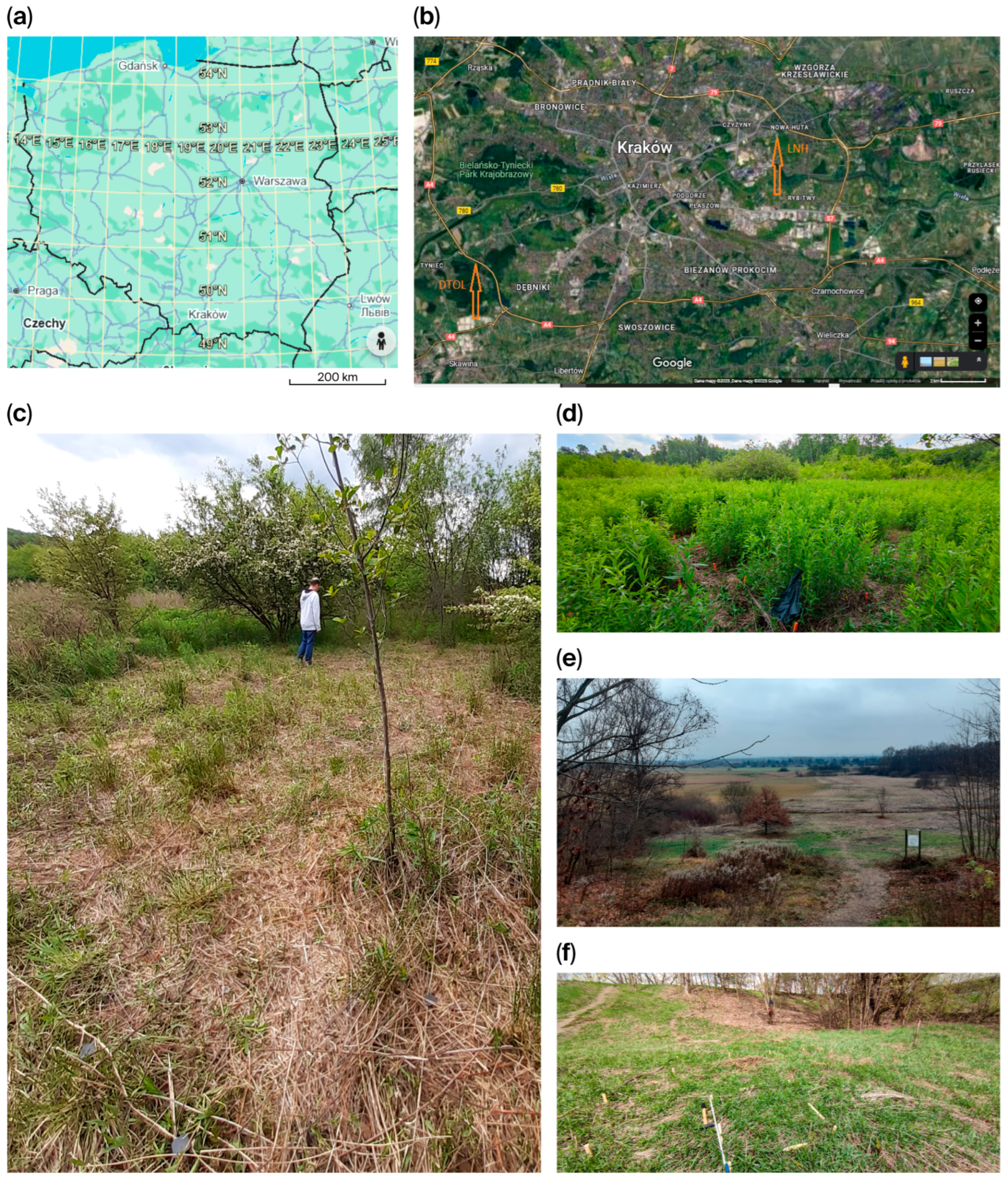
Both sites are located in municipal plots on opposite sides of Kraków (south, DTOL, 19.83611111 E, 50.0169444 N; north, LNH, 20.03361111 E, 50.0702778 N; Figure 1a,b). They are managed by The Krakow Municipal Greenspace Authority, and this study and sampling were performed with the permission of this entity. The straight-line distance between the two sites is 15.26 km (measured via Google maps). This distance, the diverse terrain, the high level of dense urban development of the city, and the estimated seed dispersal distance of 5 km [34] allow us to assume that these are separate local populations of goldenrod. Collecting seeds and plant specimens is not prohibited at these sites, as long as the species are not protected by law. This research was conducted in accordance with all relevant institutional, national, and international guidelines and legislation for plant research. Formal identification of the plant material used in our study was made by the corresponding author, following information from The Krakow Municipal Greenspace Authority. Voucher specimens, including all plant parts, were prepared according to [35] and deposited in the collection of the Department of Plant Breeding, Physiology and Seed Science of the University of Agriculture in Kraków.
Krakow is situated in a temperate, warm, transitional climate separating maritime and continental climates. It is characterized by frequent weather changes, as dry air masses from the Eurasian continent and humid ones from the Atlantic meet over Poland [36]. In 2022, the mean temperatures in Krakow were 0.7 °C in January and 19.5 °C in June. The mean monthly precipitation in 2022 was 37 mm in January and 57 mm in June, and the annual precipitation was ca. 593 mm. In 2023, the values were as follows: temperature of 2.5 °C in January and 17.8 °C in June; mean monthly precipitation of 49 mm in January and 48 mm in June; and annual precipitation ca. 752 mm [37]. The sites chosen for this experiment had been free of fire for many years, which could have caused a physiological response to smoke chemicals prior to the experiment.
The DTOL (Dębnicko-Tyniecki Obszar Łąkowy, Debnicko-Tyniecki Meadow Area) experimental site was located on a flat, periodically submerged (e.g., after a few days of rainfall or long-term snow cover) area of a natural abandoned meadow partially covered with shrubs and individual trees. A motorway runs close by, although the experimental site is set back from the road by another meadow approximately 160 m long, which is covered with dense bushes and trees (Figure 1c,d). The area is frequented by animals, mainly roe deer and wild boar. The DTOL site was still an agricultural area in the XX century, when the land was divided into arable fields, meadows, and pastures [38].
The LNH area (Łąki Nowohuckie, Nowa Huta Meadows) includes the former Vistula riverbed, also called the Vistula Proglacial Valley [39]. The LNH site was located on a light slope on the local escarpment (Figure 1e,f), so it was never submerged. The soil in the area covered by goldenrod is of partially anthropogenic origin, because in the late 1940s, the village of Mogiła, located there, was transformed into an urban center with a developed metallurgical industry and housing estates, and there are now tobacco production facilities nearby. The site is mainly frequented by small animals, such as hedgehogs, and occasionally by foxes and wild boars. Details of the seed and rhizome collection are provided in the following subsections.

2.2. Collection of Biological Samples

Achenes equipped with pappus (hereafter called “seeds”), rhizomes, and roots of Solidago gigantea Aiton, together with the soil, were collected from the natural sites described in Section 2.1. The experimental procedures are described in detail in the subsequent subsections.

2.3. Chromosome Number Analysis

To obtain chromosome counts, young roots were collected at both the DTOL and LNH sites from 10 randomly selected specimens, including those from the experimental plots and the margin area of ±1 m. They were placed on-site in Eppendorf-type tubes in a saturated aqueous solution of α-bromonaphthalene, transported immediately to the laboratory, and stored in darkness at 4 °C. Incubation lasted 24 h, after which the samples were fixed in a mixture of glacial acetic acid and absolute ethanol (1:3, v/v). Fixed roots were rinsed with distilled water and then treated with 1M HCl at 60 °C for 12 min. For slide preparation, root tip meristems were cut off, covered with a coverslip, and squashed in a drop of 45% acetic acid. After freezing in liquid nitrogen, the cover glasses were removed, and the squashed samples were stained with a 0.1% aqueous solution of toluidine blue for 1 min. Then, the slides were thoroughly air-dried and mounted in Entellan New® (a rapid mounting medium for microscopy, Merck KGaA, Darmstadt, Germany). The chromosomes were observed and photographed using a 100× objective lens on a Nikon Eclipse E800 microscope (Nikon, Yokohama-shi, Japan) equipped with a Nikon DS-2MBWc camera (Nikon, Yokohama-shi, Japan) and NIS-Elements BR 3.0 software.

2.4. Soil Analysis

Soil was sampled down to 20 cm below the soil surface at 10 randomly selected points in plots at each site in spring 2023. Approximately 20 L of soil was collected from 10 locations within each site. For soil analysis and pot experiments, these samples were mixed to minimize variability. Three soil samples from this collection were used for chemical soil testing. The pH was determined using potentiometry in a soil suspension with H2O or 1 M KCl (at a ratio of 1:2.5). The cation sorption capacity was determined by summing the hydrolytic acidity results (Hh) obtained after extraction with ammonium acetate to the total base cations measured using the Kappen method (S) [40]. Total organic carbon (TOC) and nitrogen (N) content were assessed using a CNS elemental analyzer (Vario EL Cube, Elementar Analysensysteme, Langenselbold, Germany). Elemental concentrations in the soil were determined using an inductively coupled plasma optical emission spectrometer (ICP-OES; PerkinElmer Optima 7300 DV, PerkinElmer, Inc., Waltham, MA, USA). The available element content was determined using the Mehlich method, with a Mehlich 3 extraction solution (0.2 M acetic acid, 0.25 M ammonium nitrate, 0.015 M ammonium fluoride, 0.013 M nitric acid, and 0.001 M EDTA at a pH of 2.5 ± 0.1) [41].

2.5. In Vitro Seed Experiments with KAR and GA

Achenes of Solidago gigantea were collected in October 2021 from plants at the DTOL and LNH sites. They were kept in paper bags at a temperature of about 20/18 °C (day/night). In December 2022, the largest seeds were sown on 4 cm Petri dishes with two layers of filter paper, 10 seeds per Petri dish, and 3 replicates for each treatment. Distilled water was used for the control, and 10 and 100 μM gibberellin (gibberellic acid, GA3, Sigma-Aldrich Chemie GmbH, Taufkirchen, Germany) and 0.67 μΜ karrikin (KAR1, Carbosynth, Ltd., Berkshire, UK) were applied (0.6 mL per Petri dish). GA3 and KAR were applied once at the beginning of the experiment. The concentrations of GA3 and KAR1 were established based on preliminary experiments and the literature [41].
Germination was performed at temperatures of 20–22 °C during the day/18–20° at night, in darkness (achieved by covering the seeds with aluminum foil) or natural light (PPFD approx. 100 μmol quantum m−2 s−1), with 16/8 h (day/night) illumination for 23 days. At the start of the experiment, 600 mL of distilled water or KAR solution was added to each Petri dish. Moisture was then maintained by adding 600 µL of distilled water on day 2, followed by 200 µL daily. The germinated seeds were counted every 24 h (±2 h) under weak scattered light (PPFD approx. 3 μmol quantum m−2 s−1), and the moisture of the germination paper was checked daily and adjusted with distilled water. The experiment was performed twice. Mean values for days 4–17 were chosen for analysis because the onset of germination occurred on day 4, and the germination percentage reached its maximum on day 17.

2.6. Greenhouse Experiment with KAR and Rhizomes

An experiment involving goldenrod rhizomes in pots was designed to address the issue of plants in the invasive stage after mowing. Root clumps with rhizomes, the adjacent soil, and 1–2 cm of the main shoot were collected in November 2021 at the same sites used for the seed experiment. Samples were taken from visually healthy plants that had large stems over 50 cm in length. The soil itself was also collected for further rhizome planting and chemical analysis. The experiment was performed in a greenhouse of the Department of Plant Breeding, Physiology and Seed Science of the University of Agriculture in Kraków.
The rhizomes were gently shaken out of the soil, and the viable, reddish vegetative buds were counted. The number of buds per rhizome was 1–5. They were then planted in 5 L plastic pots with soil taken from the individual sites, 1 rhizome per pot, and supplemented with the general-purpose medium Sterlux at pH 5.5–6.5 (Agaris Poland Sp. z o.o. Pasłęk, Poland) to the full volume of the pot. The size of the rhizomes and the number of vegetative buds were uniformly distributed within the treatments, resulting in an average of 2 buds per treatment. First, the Sterlux medium was poured into the bottom of the pots. Then, the soil collected from the respective stand was added on top. This means that the rhizomes were in contact with the soil from their natural habitat first, and this soil also covered the rhizomes from above. When water was added, it seeped through the original soil. On the day of planting, the whole set was watered with tap water until the full water capacity was reached.
The plants were cultivated in a greenhouse at 20–25 °C/17–20 °C (day/night), with a relative humidity of 30–50%, a 14/10 h (day/night) photoperiod, and a natural light intensity (photosynthetic photon flux density, PPFD) up to 400–500 μmol quantum m−2 s−1. Additional automatic lighting was provided on cloudy days to achieve this light intensity. Every third day, the soil moisture was checked and adjusted by watering with tap water. The pots were randomly arranged and systematically repositioned by approximately 0.5 m to minimize microclimatic variations in humidity, temperature, and light within the greenhouse.
For the DTOL and LNH samples, after 9 and 13 days from planting, respectively, KAR (3 methyl-2H-furo[2,3-c]pyran-2-one) (Carbosynth, Ltd., Berkshire, UK) was applied in two concentrations: KAR H at 6.7 μM and KAR L at 0.67 μM, with 10 mL per pot. The control was the 10 mL of distilled water. KAR was applied in the evening in an unlit greenhouse, and no lighting was applied for the next three days. This approach was taken due to the potential sensitivity of KAR to light-induced chemical reactions. Each experiment comprised 10 replicates (pots) for DTOL and 5–7 for LNH. Fewer LNH rhizomes were used due to the limited number of plants with sufficiently large rhizomes that could be collected from this stand.
Plant condition was regularly monitored by counting the emerging offshoots (vegetative parts, individual leaves, and leaf rosettes) of goldenrod on the soil surface on 6 terms for the DTOL site (days 9, 14, 21, 32, 47, and 73) and 5 for the LNH site (days 18, 20, 27, 32, and 63). On the same dates, the emergence of other plant species and goldenrod seedlings grown from the seed bank in the soil was also assessed. Soil moisture was regulated twice a week with tap water to maintain proper hydration of the plant material.

2.7. Field Trials with KAR

To establish the plots, sites were selected where the goldenrod cover was between 90 and 100%. The plots were established after mowing the vegetation growing there (mainly species of the genus Rubus sp. and the removal of goldenrod offshoots higher than 5 cm and offshoots of other plants). The DTOL plots were selected randomly at the site, beginning with the outskirts in 2022 and moving into the center of the site in 2023. For the LNH site, which was located on an escarpment (Figure 1e,f), a rule was adopted that the control and KAR plots would be placed in parallel locations on the slope (opposite each other). It was assumed that this would unify the light and thermal conditions and, to a large extent, the soil conditions (including the influence of soil erosion).
Surveyor pegs were driven into all plots to delineate the corners, and each 1 m2 plot was edged with string (Figure 1d,f). A buffer zone at least 0.5 m wide was left covered by goldenrod plants to avoid marginal effects. Each year, 10 plots were established at each site, so in the two year-study, there were a total of 40 plots, 20 of which were carefully and thoroughly sprayed with deionized water and the other 20 with KAR (0.67 μM KAR1 (Carbosynth, Ltd., Berkshire, UK) dissolved in deionized water) at a rate of 125 mL. This corresponded to 1.33 g of KAR per hectare, which was comparable to the approach described in [42], where 2.5 g per hectare was used. Spraying was carried out between 20.00 and 22.00 to avoid the influence of light while the fluids seeped into the soil and plant organs.
In 2022, the work period at DTOL lasted from 12 June (when the experiment was set up) to 30 October (when the harvest took place), and in 2023, it took place from 30 April to 31 August. At LNH, the 2022 work period took place from 17 June to 21 October, and in 2023, it extended from 17 April to 23 August. The dates of experiment installation and harvesting were determined mostly by weather conditions and technical feasibility.
Morphometric analyses included counting goldenrod offshoots, measuring shoot biomass, and examining the rhizome buds at harvest. The shoots, together with the rhizome, were gently excavated from each plot, transported to the laboratory, and maintained at a temperature of 4 °C. The vegetative buds were counted from the section between the lower part of the shoot and the upper part of the root (in 2022 and 2023). In 2022, the length was also measured. The number of plots and biological replicates (n) is indicated in the table captions. In the LNH stand in 2022, the plots were affected by the mass appearance and feeding of snails (Limax sp.) and partial devastation by wild boars (Sus scrofa). Therefore, the number of intact plots that could be included was 2 control plots and 2 KAR plots. In other cases, data from 5 plots were collected and analyzed.

2.8. Statistical Analysis

All data were processed using Excel 2016 (Microsoft Corporation, Redmond, WA, USA) and Statistica 14 (Tibco Software, Palo Alto, CA, USA). In total, 420 seed counts and 275 rhizome counts were available for the statistical analysis. The Kolmogorov–Smirnov test was used to check data normality, after which the nonparametric Kruskal–Wallis test and multiple comparisons of means within the treatment were conducted. Vegetative bud parameters were measured on 20–125 randomly chosen plants per experiment. Detailed information is provided in the table captions. For comparisons between two means, Student’s t-test was performed, with a significance level of p = 0.05.

3. Results

3.1. Karyological Analysis of Goldenrod

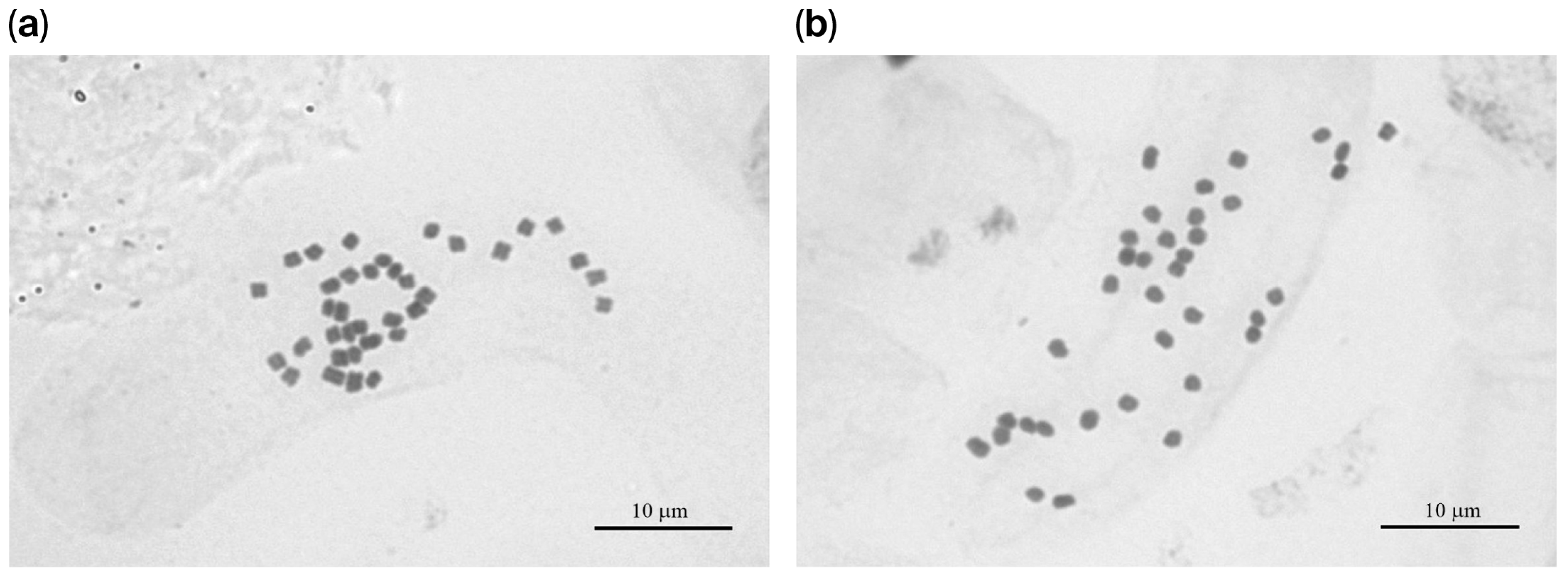
We performed chromosome counts to verify that the studied plants were correctly morphologically identified as giant goldenrod. The somatic chromosome number (2n = 4x = 36) was established for all analyzed specimens from both studied populations (Figure 2). There were no deviations from this number, which means that no variation in the ploidy level was observed, confirming that the plants used in the experiments were giant goldenrod (Solidago gigantea).

3.2. Soil Analysis

The soil’s chemical composition differed significantly between the two sites (Table 1). The DTOL soil pH was neutral, while the LNH soil was acidic. The content of organic carbon (C) and total nitrogen (N) was twice as high in DTOL as in LNH, as was the content of total cadmium (Cd). Similarly, the content of sodium (Na), iron (Fe) and magnesium (Mg) was an order of magnitude higher in DTOL, while the reverse was true for phosphorus (P), potassium (K), calcium (Ca), zinc (Zn), copper (Cu), and nickel (Ni), as well as toxic lead (Pb). In general, DTOL was characterized by a high humus content but deficient phosphorus and potassium content. In contrast, LNH had a high phosphorus and potassium content but was deficient in magnesium (Mg) and nitrogen (N), as well as heavy metals.

3.3. Effect of KAR on Goldenrod Seed Germination

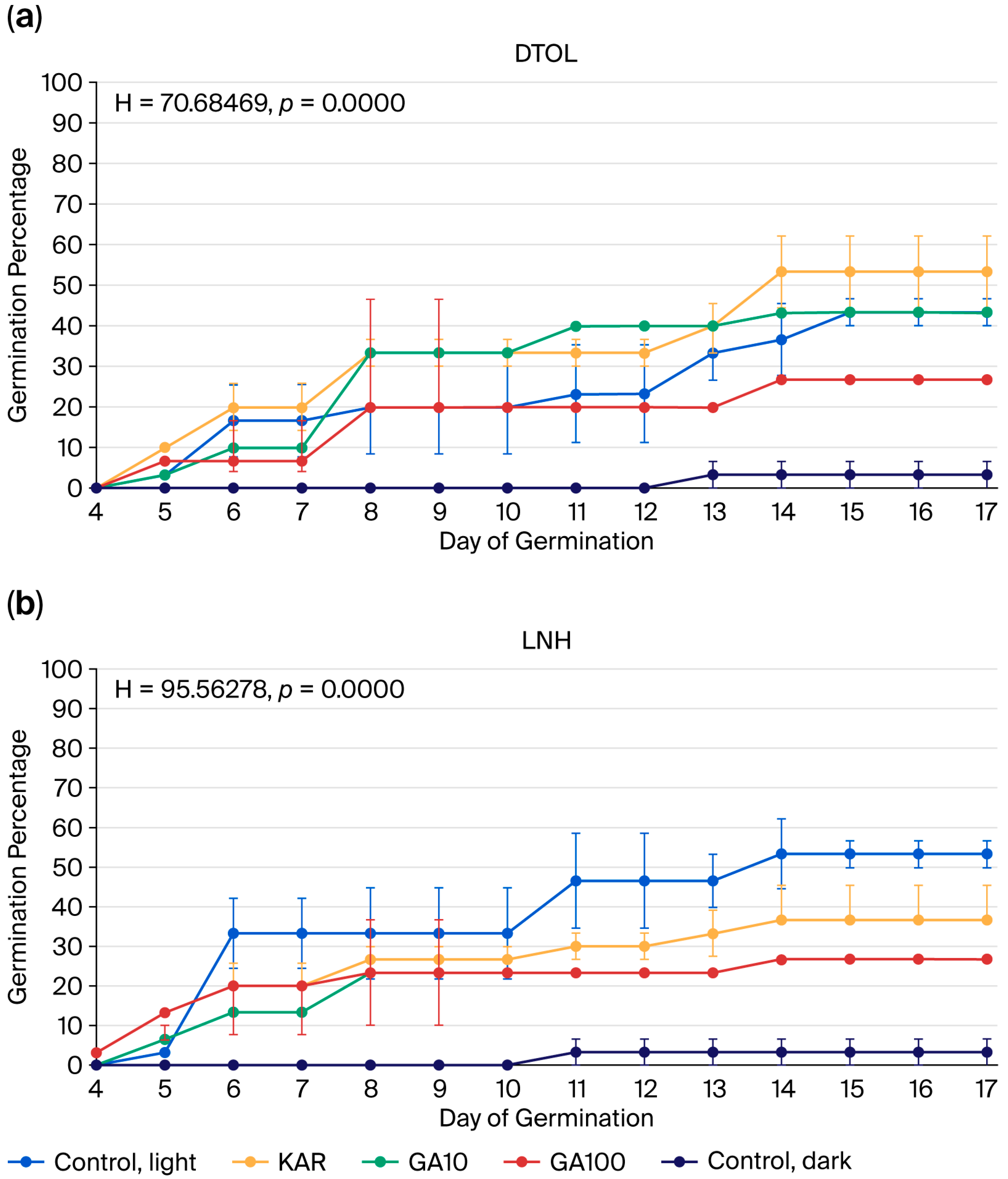
In both cases, the dark control had the lowest germination percentage (0–3%), with the onset of germination on days 11–13. In contrast, the light control had a germination percentage of over 50%, with germination onset on days 5–6 (Figure 3).
A non-parametric analysis of variance showed that the KAR treatment had a significant effect on goldenrod seed germination (Kruskal–Wallis test: H = 152.7050, p = 0.000 for pooled data from both sites). It was also significant when the data were separated according to the two sites (p = 0.000 in both cases, Figure 3a,b). KAR was found to have a strong stimulating effect on seed germination, which was similar to or higher than the effect of light or GA (Figure 3a,b). The highest final germination percentage (on day 17) was 53% for KAR (Figure 3a) or light (Figure 3b).
It is worth noting that the susceptibility of seeds to GA and KAR differed. As can be seen in Figure 3a, the lower GA concentration (GA10) was more effective than GA100 for the DTOL seeds, and the DTOL seeds were most stimulated by KAR. On the other hand, the LNH seeds showed similar responses to GA 10 and GA 100, and they were most stimulated by light (Figure 3b).

3.4. The Impact of KAR on the Goldenrod Sprouting and Vegetative Development of Other Plants

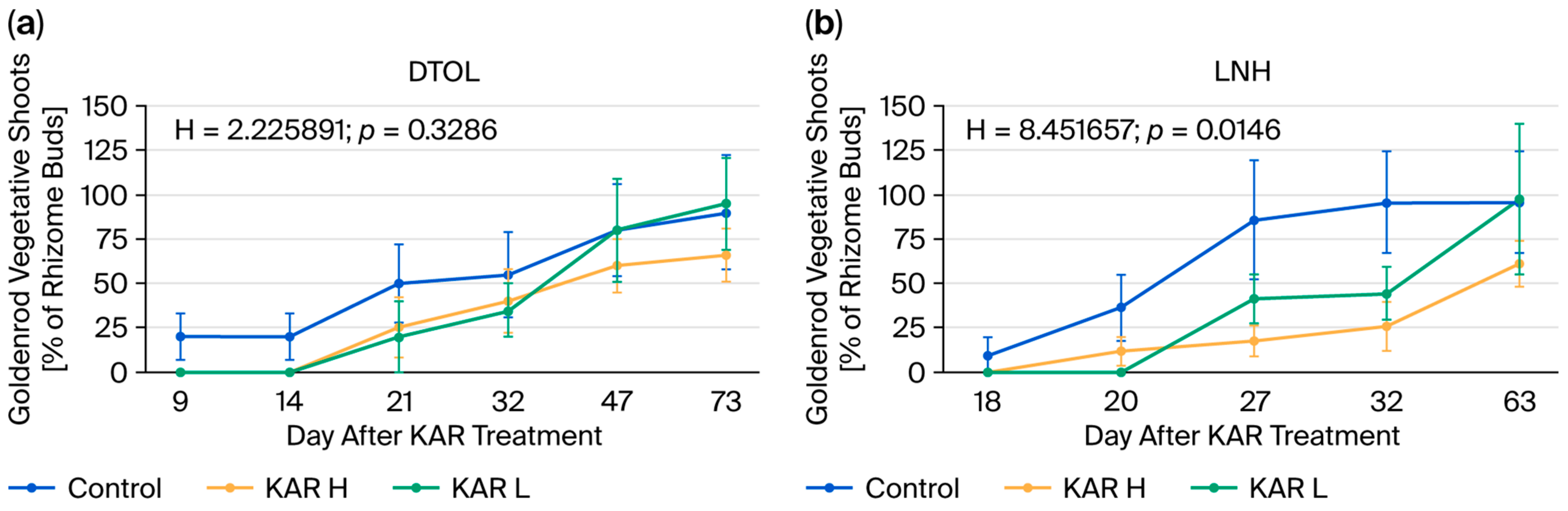
In the pot experiment with the soil collected from the individual stands, the appearance of goldenrod vegetative shoots was monitored in relation to the number of rhizome buds counted prior to the experiment (Figure 4). The emergence of goldenrod seedlings from the seed bank was also observed (Table 2).
KAR1 applied at a higher dose (KAR H) at the beginning of rhizome planting continuously reduced sprouting of LNH shoots compared to the control and KAR at a lower dose (KAR L) (Figure 4b, Kruskal–Wallis test: H = 8.451657, p = 0.0146, and the multiple comparison of means). The final percentage of KAR H shoots was 62% of the rhizome buds, while for the control plants, it was 97%, and for KAR L, it was 99%. From day 32 onward, the KAR L treatment showed a strong tendency to increase the number of shoots, and at the end of the experiment, their number did not differ from the control. A similar trend was observed for the DTOL site plants (Figure 4a), but the effect was not statistically significant, even though there were more rhizome specimens per treatment and one additional counting period.
On the other hand, the number of newly appearing goldenrod seedlings grown from the seeds was stimulated by KAR in pots with the plant and soil material collected from the DTOL site (Table 2). Also, the general effect of KAR on goldenrod seedling occurrence was significant (Kruskal–Wallis test: H = 6.766711, p = 0.0339).
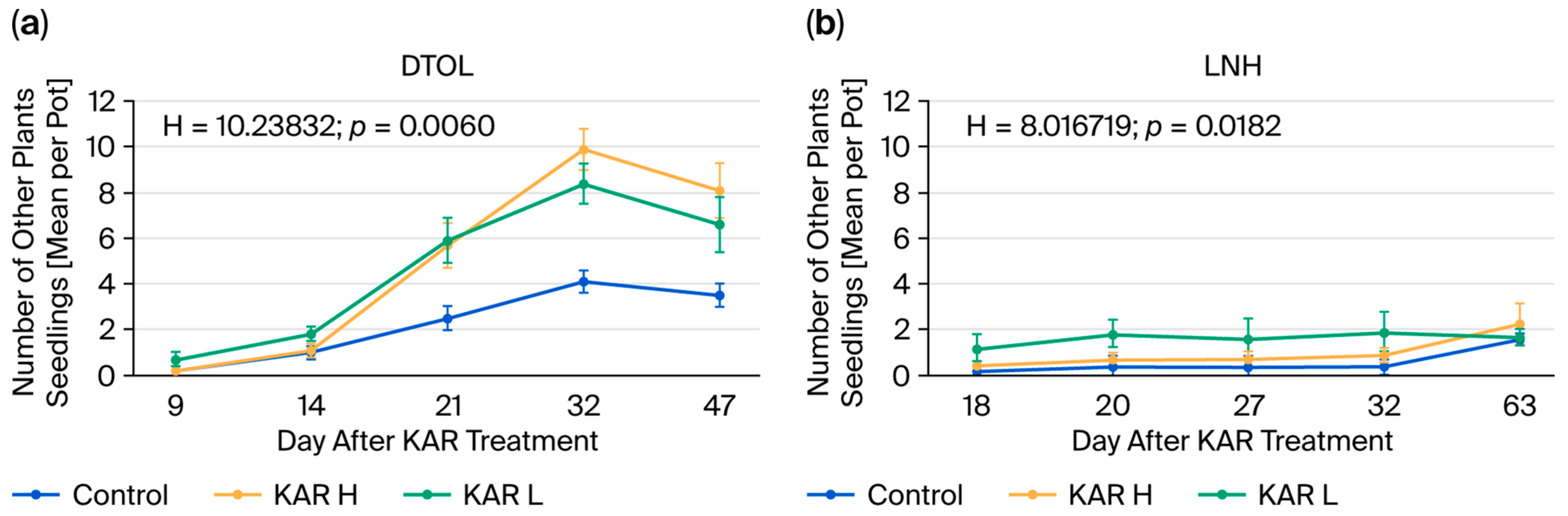
Species other than goldenrod were also found in the pots. They also responded distinctly to KAR. According to the Kruskal–Wallis test, the effect of KAR was significant for both sites. However, the pattern of seedling appearance differed for the two sites (see Figure 5a,b). For the DTOL site, the number of new plants following the KAR treatments was double that of the control stand (Figure 5a). On day 47, the number of seedlings declined slightly in all experiments, probably because the limited space in the pots resulted in competition, but the pattern of differences remained the same.
In the LNH site pots, the number of seedlings was much lower than in the DTOL site pots, but a difference between control and KAR L was observed (Figure 5b and the multiple comparison of means).

3.5. KAR Applied in the Field Experiments

In 2022, KAR applied to plants in the early growth stage had no influence on shoot parameters at harvest but decreased either the number of newly formed vegetative buds shorter than 5 cm or their length (Table 3). The effect of KAR on the bud number was also distinctive in 2023 for a set of other plots located in both stands (Table 3). In 2023, we aimed to increase the number of biological replicates compared to 2022. This was successful for bud counting, but we were unable to measure rhizome length due to rapid molding, despite storing the samples at a low temperature.
Considering the differences between stands, the shoot biomass varied greatly between the DTOL and LNH plants, although there was no common trend. In 2022, in DTOL plants, the number of shoots and biomass were very low, ranging lower than the LNH plants (Table 3). In 2023, the biomass and shoot number of the DTOL plants were approximately twice as large as in the LNH plants (Table 3).
In both years, various observations and measurements were made at different growth stages to determine the impact of KAR on the aerial parts of the plants, but there was no common trend; therefore, these results are not presented.

4. Discussion

4.1. Uniform Effect of KAR on Giant Goldenrod Propagules Across Experimental Scales

This study showed that KAR stimulates goldenrod seed germination both in vitro and in the soil. When used on the underground parts, it diminishes the number of vegetative buds on rhizomes in pot experiments and in natural stands of goldenrod. These effects occur irrespective of the seed batch and specific edaphic conditions. This study is the first to explore goldenrod’s response to KAR. The aim is to improve our understanding of goldenrod biology in terms of natural growth regulators and environmental alterations. One such alteration is the introduction of smoke flowing from fire areas, which can be a source of KAR. This is also the first study to propose the use of KAR to manage invasive plants.
Karyological analysis supporting visual observations of morphological traits revealed the tetraploid chromosome number, which confirmed beyond doubt that the investigated plants belonged to the Solidago gigantea species [32,33].
Considering soil conditions, giant goldenrod usually prefers humid but not waterlogged sites, which were provided at the DTOL location. The LNH site was drier due to its location on a slope, and the presence of the plant here indicates its tolerance of a range of soil humidity levels [1]. Research into the mechanisms of goldenrod rhizome resistance to water deficiency indicated an increased amount of osmoprotectants such as soluble sugars and the amino acid proline, as well as a high amount of abscisic acid (ABA), a phytohormone responsible for adaptive responses to drought [15].
The soil pH at both study sites was within the range optimal for nutrient availability [43]. Regarding the soil richness on which goldenrod vitality depends, the amount of calcium (Ca) was similar and high in both stands [44]. Ca-rich soils are often inhabited by goldenrod [45]. Macronutrients like nitrogen (N) and phosphorus (P) are responsible for the shoot and underground biomass, respectively [2,46,47]. Both N and P were more abundant in DTOL, but from our study, it seems that they do not appear to be the primary cues for goldenrod biomass and/or shoot number. The shoot number and biomass in 2022 were even lower in DTOL than in LNH, probably due to the initiation of invasion of the area in which the plots were located, because the shoots had grown on the outskirts of the area selected for the plot installation. However, the shoot density of approx. 300 g/m2 is within the range previously indicated [48]. In other cases in our experiment, the biomass is always an order of magnitude higher: it oscillates between 1763 g and 4255 g per m2, which is quite high, and, in addition to other features, indicates the possibility of using goldenrod as an energy crop. Another species, Solidago Canadensis, has already considered for this, as it occurs more frequently in invaded stands in Europe [49]. In 2023, for the other plot sets, the relationship between DTOL and LNH in terms of biomass was reversed. We believe this is because soil humidity is higher in DTOL than in LNH, as we previously mentioned.
Goldenrod is known to grow in heavy-metal-contaminated areas and is considered a potential bioindicator of such contamination [1,6,50]. The content of toxic heavy metals in the soils of both experimental stands was quite low in relation to that reported by, e.g., Bąba et al. [15], who studied the physiological performance of Solidago gigantea on lead (Pb) and zinc (Zn) spoil heap and indicated approx. 13,071 mg∙kg−1 Zn, 76 mg∙kg−1 Cd and 4365 mg∙kg−1 Pb in the soil substrate. All observations regarding soil conditions in our experiment confirm the high plasticity of goldenrod.

4.2. KAR-Induced Germination: Potential Implications for Invasion Ecology

The results demonstrate the ability of KAR to substitute for the impact of light on positively photoblastic seeds of goldenrod, a species that has not previously been studied in terms of the relationship between KAR and photoblasticity. Regarding the appearance of goldenrod specimens in new stands, it can be concluded that KAR increases the likelihood of this occurring by stimulating seeds covered by soil. Although plants grown from seeds can invade new areas [1], at this stage of the research, it is not possible to determine the role of KAR in stimulating goldenrod invasion, particularly since KAR also stimulates the seeds of other species, according to data in the literature on restoring vegetation through the application of smoke compounds [26,51]. Different numbers of newly appearing seedlings of various unidentified species at DTOL and LNH reveal differences in biodiversity in individual stands resulting from the local environment and support our personal and yet unpublished observations on species richness in the stands. The difference in plant biodiversity could partially result from soil richness, because the DTOL soil has, e.g., more C and N than the LNH soil. There may also be other factors, the analysis of which was not the aim of this study.
The differentiated sensitivity of the DTOL and LNH seeds to KAR and light is not due to dormancy, because goldenrod seeds do not demonstrate this phenomenon [1]. We attribute the cause to the specific phytohormonal balance resulting from the stimulating effect of both factors, which may vary between seed batches.
Regarding the goldenrod seed germination rate, the highest value obtained in this experiment, 53%, is similar to that mentioned by Weber and Jakobs [1], but the rate can vary from 10% to 100% [13,15]. As the number of achenes per ramet can reach several thousand [1], even if only half of these are viable, they can still disperse to colonize new areas. In our opinion, the gradual germination of goldenrod seeds over several days can facilitate invasion, as successively appearing seedlings can encounter the right temperature and humidity, among other conditions, for development.
The concentration of KAR needed to physiologically affect the seeds was higher in the pot experiment than in the Petri dish experiment, which means that KAR is likely subject to partial retention and metabolization in the soil. This can also be surmised from the shoot generation dynamics (vegetative buds sprouting) in the KAR H treatment, which increased over time, approaching control levels at the last date of counting.

4.3. Physiological Basis of Karrikin Action on Seed Germination

KAR can replace the effect of light and stimulate goldenrod seeds in a manner similar to the phytohormone gibberellic acid (GA), a well-known germination stimulator [27]. A similar effect was obtained on seeds of chamomile in the same family as goldenrod, Asteraceae, under the influence of smoke-infused water [52]. Bochenek et al. [13] found GA to be ineffective because their seeds were exposed to light over a 16/8 h photoperiod, resulting in cumulative effects of GA and light. In this experiment, however, the seeds were maintained in darkness to separate the effects of light and GA.
The seed germination mechanism of the Asteraceae family is based on the perception of red light by phytochromes [27]. The photoconversion of phytochrome red (Pr) to phytochrome far-red (Pfr) triggers signal transduction towards the expression of genes involved in phytohormonal balance. In this case, genes responsible for the biosynthesis of auxin and abscisic acid, which hamper germination, are downregulated [53]. At the same time, the GA3ox1 and GA3ox2 genes, which are responsible for GA biosynthesis, are upregulated. This leads to cell wall extension, cell elongation, radicle protrusion, the hydrolysis of storage materials, and the initiation of the embryo’s metabolic processes [53]. This is also why GA itself had a stimulatory effect on goldenrod seeds in our experiment.
The KAR signaling cascade partially shares the light-specific signaling pathway. It begins with the KAI2 enzyme, which is an α/β-hydrolase. KAI2 binds with the MAX2 protein to form a complex that leads to the degradation of repressors such as SMAX1 and SMAX2. This results in the downregulation of genes responsible for auxin (AUX) and abscisic acid (ABA) biosynthesis, as well as the increased expression of the GA3ox genes, which leads to radicle protrusion [54,55].

4.4. The Potential of KAR on Goldenrod After Population Establishment

Under KAR treatment applied in the field in spring or early summer, the number of rhizomatous buds, i.e., potential sources of new shoots, decreases at the flowering stage, which indicates that plants regulate the balance between the development of the above-ground part, which is capable of photosynthesis and generative reproduction, and the underground part, which is the reservoir of future vegetative generations. Based on current knowledge of KAR’s interactions with phytohormones [21,53,56], it is reasonable to assume that it is hormonal in nature and worth further study.
It is also noteworthy that the sprouting rate of goldenrod vegetative buds was high, which confirms the previous observations and data on goldenrod vitality [1,57].
In the context of natural or anthropogenic fires in the vicinity of goldenrod-invaded grasslands, it can be assumed that smoke flowing into these habitats may temporarily reduce the number of goldenrod shoots. Based on the data in Table 3, we can currently estimate a 15% reduction in the number of goldenrod shoots the following year. Although pot experiments indicate the inhibition of the physiological activity of rhizome buds, resulting in less intense vegetative development (fewer new shoots), it is unclear whether this inhibition would occur in an invaded ecosystem in which goldenrod is established. The primary reason for this is that we do not know how many rhizome buds were present when the KAR was applied in the initial stage of vegetation. Instead, we observed a decrease in the number and/or length of new rhizome buds a few months after KAR application. This effect occurred in both experimental years and in both stands. However, further research is needed, as a recent study shows that work carried out under semi-laboratory conditions does not reflect the complexity found in nature. Another issue is the complexity of the smoke composition. While KAR is often considered the primary smoke cue for the initiation of plant metabolic activity, other chemicals such as cyanohydrins, glyceronitrile (2,3-dihydroxypropanenitrile), mandelonitrile (MAN), and trimethylbutenolide (TMB) can also influence seed germination [21,22,56] and probably other physiological processes. A negative effect of smoke formulation was indicated on plants grown in heavy-metal contaminated soil or poor (e.g., devoid of calcium) soil [58]. Another study indicated that smoke deposition negatively affects the rhizosphere by impairing genes involved in carbon cycling [59]. Hence, the results obtained with KAR may not be applicable to smoke and its formulations; nevertheless, they represent a first step towards achieving a comprehensive understanding of how invasive goldenrods respond to components of smoke.
It is also worth remembering that the invasive potential of established goldenrod plants is high due to their large biomass, fast growth, and release of allelopathic compounds [60,61]. This means that only native plants with similar characteristics can compete with goldenrods, especially when agricultural practices such as mowing or grazing by ruminants are implemented [57]. Thus, the limitation of such activities over increasingly extensive areas in the 20th and 21st centuries is one of the main causes of the invasiveness of goldenrod species.

4.5. Potential Use of KAR in the Management of Goldenrod

Based on greenhouse experiments with isolated rhizomes and two-year field trials in geographically distinct locations with different agricultural histories and soil properties, it can be concluded that the application of KAR to goldenrod plants during the initial growth stage induces changes within the root system. These changes result in a significant reduction in the number of rhizome buds a few months after application.
Regarding the sprouting of goldenrod from rhizomes (Figure 4), we observed a similar trend between control and KAR-treated rhizomes at both sites. The emergence of goldenrod seedlings (Table 2) and seedlings of other species (Figure 5) was primarily determined by site conditions, regardless of KAR application. From these results, we conclude that edaphic differences do not appear to influence the sensitivity of local flora to KAR.
As previously mentioned, the data from this study suggest that a reduction in the number of rhizome buds in goldenrod could lead to a decrease of around 15% in the number of shoots the following growing season. As the effect of KAR weakens over time, which was demonstrated in the greenhouse experiment, a second KAR treatment should be applied to manage goldenrod. Thus, it would be a gradual removal method, best applied for small populations, e.g., in protected natural areas, and especially in the early stages of colonization. Our preliminary research on Canadian goldenrod indicates a similar response of seeds of this species to KAR, and a similar rhizome reaction can also be assumed. The use of KAR would be limited for large goldenrod populations (more than a hectare) due to increased time and cost. Based on Montgomery et al. [62], the mean cost of glyphosate is USD 32.5 (approximately EUR 27.7) per hectare. Given that 10 mg of KAR costs EUR 1100 (data for January 2026), the estimated cost of the KAR application would be approximately EUR 146,300 per hectare.
It is also worth bearing in mind that goldenrod regrowth in subsequent seasons can be weather-dependent, especially when heavy rainfall follows the application of KAR, which will reduce its concentration in the soil.

4.6. Limitations of This Study and Directions for Future Research

The pot experiment was the first attempt to assess the impact of KAR on the interactions between goldenrod and other species within an ecosystem. However, three considerations remain. First, field studies are required to confirm the effects under natural conditions. Second, KAR alone cannot fully replicate smoke, which contains compounds that stimulate and inhibit germination. Third, goldenrod communities vary and often include other invasive species. These complexities highlight the need for research in real ecosystems to improve our understanding of smoke-derived compounds and their role in invasion dynamics. Nevertheless, these findings present opportunities for the integration of smoke-derived compounds into strategies for controlling invasive species.

5. Conclusions

  • KAR, a smoke-derived compound with biological activity, enhances seedling emergence in goldenrod and other plant species. This confirms its broad physiological activity and suggests its potential to influence early-season plant community dynamics, which may alter competitive interactions in invaded ecosystems.
  • Field studies are essential to determine the scale and ecological desirability of these changes. Controlled experiments provide valuable insights, but natural conditions involve complex interactions that must be assessed before practical application.
  • The suppression of goldenrod rhizome bud growth observed in field experiments indicates that KAR could serve as a gradual control method. This approach may be particularly useful for managing small populations in protected areas, where mechanical removal is challenging and herbicides are prohibited.
  • The light-mimicking mode of action of KAR that promotes goldenrod seed germination opens new research directions. Investigating seed photoblastism in relation to plant invasiveness could improve our understanding of germination ecology and inform strategies for invasive species management.
  • To improve our understanding of smoke-derived compounds and their role in invasion dynamics, it is necessary to conduct research in real ecosystems.

Author Contributions

Conceptualization, R.B.-K.; methodology, R.B.-K., A.G.-J. and A.B.; software, R.B.-K., A.G.-J. and A.B.; validation, R.B.-K., A.G.-J. and A.B.; formal analysis, R.B.-K., A.G.-J. and A.B.; investigation, R.B.-K., A.G.-J., A.B. and A.R.J.; resources, R.B.-K., A.G.-J. and A.B.; data curation, R.B.-K., A.G.-J. and A.B.; writing—original draft preparation, R.B.-K.; writing—review and editing, R.B.-K., A.G.-J., A.B. and A.R.J.; visualization, R.B.-K., and A.G.-J.; supervision, R.B.-K.; project administration, R.B.-K.; funding acquisition, R.B.-K., A.G.-J. and A.B. All authors have read and agreed to the published version of the manuscript.

Funding

The research was financed from the Project Integrated approach to ecosystems protection against invasive alien plants in southern Poland—IAS/EcoSystemCARE, MFEOG.07.02.02-50-0032/21-00, within the Environment, Energy and Climate Change Programme EEA Financial Mechanism 2014–2021 for the action aimed at Increasing the protection of ecosystems against invasive alien species, and from the institutional funding of the Ministry of Science and Higher Education of the Republic of Poland awarded to the University of Agriculture in Kraków.

Institutional Review Board Statement

Not applicable.

Informed Consent Statement

Not applicable.

Data Availability Statement

The datasets generated during the study are available from the corresponding author upon reasonable request.

Acknowledgments

R.B.-K. thanks Przemysław Szwałko from The Krakow Municipal Greenspace Authority, for cooperation, the invaluable Wojciech Kwinta for his support in the field experiments and Ebubekir Hasanov for his technical assistance at goldenrod harvest. The authors also thank Bastian Steudel for his critical reading of the manuscript and Marcin Rapacz for organizational support.

Conflicts of Interest

The authors declare no conflicts of interest. The funders had no role in the design of the study; in the collection, analyses, or interpretation of data; in the writing of the manuscript; or in the decision to publish the results.

References

  1. Weber, E.; Jakobs, G. Biological flora of Central Europe: Solidago gigantea Aiton. Flora-Morphol. Distrib. Funct. Ecol. Plants 2005, 200, 109–118. [Google Scholar] [CrossRef]
  2. Scharfy, D.; Gusewell, S.; Gessner, M.O.; Olde Venterink, H. Invasion of Solidago gigantea in contrasting experimental plant communities: Effects on soil microbes, nutrients and plant–soil feedbacks. J. Ecol. 2010, 98, 1379–1388. [Google Scholar] [CrossRef]
  3. Nentwig, W.; Bacher, S.; Kumschick, S.; Pyšek, P.; Vilà, M. More than “100 worst” alien species in Europe. Biol. Invasions 2018, 20, 1611–1621. [Google Scholar] [CrossRef]
  4. Karpavičienė, B.; Radušienė, J.; Viltrakytė, J. Distribution of two invasive goldenrod species Solidago canadensis and Solidago gigantea in Lithuania. Bot. Lith. 2015, 21, 125–132. [Google Scholar] [CrossRef]
  5. Nagy, D.U.; Stranczinger, S.; Godi, A.; Weisz, A.; Rosche, C.; Suda, J.; Mariano, M.; Pal, R.W. Does higher ploidy level increase the risk of invasion? A case study with two geo-cytotypes of Solidago gigantea Aiton (Asteraceae). J. Plant Ecol. 2018, 11, 317–327. [Google Scholar] [CrossRef]
  6. Czortek, P.; Królak, E.; Borkowska, L.; Bielecka, A. Impacts of soil properties and functional diversity on the performance of invasive plant species Solidago canadensis L. on post-agricultural wastelands. Sci. Total Environ. 2020, 729, 139077. [Google Scholar] [CrossRef]
  7. Tokarska-Guzik, B.; Bzdęga, K.; Dajdok, Z.; Mazurska, K.; Solarz, W. Invasive alien plants in Poland—The state of research and the use of the results in practice. Environ. Socio-Econ. Stud. 2021, 9, 71–95. [Google Scholar] [CrossRef]
  8. Moroń, D.; Lenda, M.; Skórka, P.; Szentgyörgyi, H.; Settele, J.; Woyciechowski, M. Wild pollinator communities are negatively affected by invasion of alien goldenrods in grassland landscapes. Biol. Conserv. 2009, 142, 1322–1332. [Google Scholar] [CrossRef]
  9. Skórka, P.; Lenda, M.; Tryjanowski, P. Invasive alien goldenrods negatively affect grassland bird communities in Eastern Europe. Biol. Conserv. 2010, 143, 856–861. [Google Scholar] [CrossRef]
  10. Lenda, M.; Witek, M.; Skórka, P.; Moroń, D.; Woyciechowski, M. Invasive alien plants affect grassland ant communities, colony size and foraging behaviour. Biol. Invasions 2013, 15, 2403–2414. [Google Scholar] [CrossRef]
  11. Szymura, M.; Szymura, T.H.; Kreitschitz, A. Morphological and cytological diversity of goldenrods (Solidago L. and Euthamia Nutt.) from south-western Poland. Biodivers. Res. Conserv. 2015, 38, 41–49. [Google Scholar] [CrossRef]
  12. Bączek-Kwinta, R.; Janowiak, F.; Simlat, M.; Antonkiewicz, J. Involvement of dynamic adjustment of ABA, proline and sugar levels in rhizomes in effective acclimation of Solidago gigantea to contrasting weather and soil conditions in the country of invasion. Int. J. Mol. Sci. 2023, 24, 15368. [Google Scholar] [CrossRef]
  13. Bochenek, A.; Synowiec, A.; Kondrat, B.; Szymczak, M.; Lahuta, L.B.; Gołaszewski, J. Do the seeds of Solidago gigantea Aiton have physiological determinants of invasiveness? Acta Physiol. Plant 2016, 38, 159. [Google Scholar] [CrossRef]
  14. Najberek, K.; Solarz, W. Control method that may limit an invasive plant in a protected area: Stem breaking decreases alien goldenrod performance and enhances pest attack. Glob. Ecol. Conserv. 2021, 30, e01785. [Google Scholar] [CrossRef]
  15. Bąba, W.; Kompała-Bąba, A.; Sierka, E.; Bierza, W. Photosynthetic response of Solidago gigantea Aiton and Calamagrostis epigejos L. (Roth) to complex environmental stress on heavy metal contaminated sites. Sci. Rep. 2024, 14, 31481. [Google Scholar] [CrossRef]
  16. Bączek-Kwinta, R. Swailing affects seed germination of plants of European bio- and agricenosis in a different way. Open Life Sci. 2017, 12, 62–75. [Google Scholar] [CrossRef]
  17. Journal of Laws 2024.1478 Act of 16 April 2004 on Nature Protection. Available online: https://isap.sejm.gov.pl/isap.nsf/DocDetails.xsp?id=wdu20040920880 (accessed on 26 January 2026).
  18. EASAC. Changing Wildfires: Policy Options for a Fire-Literate and Fire-Adapted Europe; Elmqvist, T., Valkó, O., Stoof, C., Aakala, T., Arca, B., Arianoutsou, M., Arsava, K., Ascoli, D., Bengtsson, J., Castro, R., Eds.; EASAC Policy Report 48; EASAC: Kraków, Poland, 2025; ISBN 978-3-7001-9739-3. [Google Scholar]
  19. Flematti, G.R.; Ghisalberti, E.L.; Dixon, K.W.; Trengove, R.D. A compound from smoke that promotes seed germination. Science 2004, 305, 977. [Google Scholar] [CrossRef] [PubMed]
  20. Reynolds, C.J.; Long, R.L.; Flematti, G.R.; Cherry, H.; Turner, S.R. Karrikins promote germination of physiologically dormant seeds of Chrysanthemoides monilifera ssp. monilifera (boneseed). Weed Res. 2013, 54, 48–57. [Google Scholar]
  21. Tavşanoğlu, Ç.; Ergan, G.; Çatav, Ş.S.; Zare, G.; Küçükakyüz, K.; Özüdoğru, B. Multiple fire-related cues stimulate germination in Chaenorhinum rubrifolium (Plantaginaceae), a rare annual in the Mediterranean Basin. Seed Sci. Res. 2017, 27, 26–38. [Google Scholar] [CrossRef]
  22. Çatav, Ţ.S.; Küçükakyüz, K.; Tavţanođlu, Ç.; Pausas, J.G. Effect of fire-derived chemicals on germination and seedling growth in Mediterranean plant species. Basic Appl. Ecol. 2018, 30, 65–75. [Google Scholar] [CrossRef]
  23. Nemahunguni, N.K.; Gupta, S.; Kulkarni, M.; Finnie, J.F.; van Staden, J. The effect of biostimulants and light wavelengths on the physiology of Cleome gynandra seeds. Plant Growth Regul. 2020, 90, 467–474. [Google Scholar]
  24. Singh, S.; Uddin, M.; Khan, M.M.A.; Chishti, A.S.; Singh, S.; Bhat, U.H. The role of plant-derived smoke and karrikinolide in abiotic stress mitigation: An omic approach. Plant Stress 2023, 7, 100147. [Google Scholar] [CrossRef]
  25. Uddin, M.; Singh, S.; Chishti, A.S.; Singh, S.; Bhat, U.H.; Khan, M.M.A. Rhizomes priming with smoke–water and karrikinolide enhance the production of essential oil and bioactive constituents of Mentha arvensis L. via improving the growth and physiological attributes of plant. J. Plant Growth Regul. 2023, 42, 7023–7037. [Google Scholar] [CrossRef]
  26. Kochanek, J.; McGregor, G.; Tryggestad, K.A.; Flematti, G.R.; Wang, Y.; Krisantini, S. The role of karrikins in addressing pressing global challenges: Plant abiotic stress tolerance, biodiversity restoration, and karrikin commercial realities. In Strigolactones, Alkamides and Karrikins in Plants: Recent Updates and Future Prospects, 1st ed.; Mukherjee, S., Aftab, T., Eds.; CRC Press: Boca Raton, FL, USA, 2023; pp. 249–271. [Google Scholar] [CrossRef]
  27. Tognacca, R.S.; Botto, J.F. Post-transcriptional regulation of seed dormancy and germination: Current understanding and future directions. Plant Commun. 2021, 2, 100169. [Google Scholar] [CrossRef]
  28. Botta-Dukát, Z.; Balogh, L. The Most Important Invasive Plants in Hungary; HAS Institute of Ecology and Botany: Vácrátót, Hungary, 2008; p. 255. [Google Scholar]
  29. Szymura, M.; Szymura, T.H. Growth, phenology, and biomass allocation of alien Solidago species in Central Europe. Plant Species Biol. 2015, 30, 245–256. [Google Scholar] [CrossRef]
  30. Verloove, F.; Zonneveld, B.J.M.; Semple, J.C. First evidence for the presence of invasive Solidago altissima (Asteraceae) in Europe. Willdenowia 2017, 47, 69–75. [Google Scholar] [CrossRef]
  31. Musiał, K.; Pagitz, K.; Gudžinskas, Z.; Łazarski, G.; Pliszko, A. Chromosome numbers in hybrids between invasive and native Solidago (Asteraceae) species in Europe. Phytotaxa 2020, 471, 267–275. [Google Scholar] [CrossRef]
  32. Schlaepfer, D.R.; Edwards, P.J.; Semple, J.C.; Billeter, R. Cytogeography of Solidago gigantea (Asteraceae) and its invasive ploidy level. J. Biogeogr. 2008, 35, 2119–2127. [Google Scholar] [CrossRef]
  33. Morton, J.K.; Venn, J.; Semple, J.C. Chromosome number determinations in Solidago gigantea (Asteraceae: Astereae). Rhodora 2019, 121, 347–352. [Google Scholar] [CrossRef]
  34. Vittoz, P.; Engler, R. Seed dispersal distances: A typology based on dispersal modes and plant traits. Bot. Helv. 2007, 117, 109–124. [Google Scholar] [CrossRef]
  35. Carter, R.; Bryson, C.T.; Darbyshire, S.J. Preparation and use of voucher specimens for documenting research in weed science. Weed Technol. 2007, 21, 1101–1108. [Google Scholar] [CrossRef]
  36. Regional Water Management Board in Cracow, Poland, Climate of Cracow. Available online: https://ziw.krakow.pl/klimat-krakowa/ (accessed on 26 January 2026). (In Polish)
  37. Institute of Meteorology and Water Management, National Research Institute, Warsaw, Poland. Available online: https://danepubliczne.imgw.pl/data/dane_pomiarowo_obserwacyjne/dane_meteorologiczne/ (accessed on 26 January 2026). (In Polish)
  38. Bzdęga, K.D.; Urbisz, A.; Tokarska-Guzik, B.E. Ochrona Ekosystemów Przed Inwazyjnymi Gatunkami Roślin Obcego Pochodzenia w Południowej Polsce—Dobre Praktyki i Nowe Wyzwania; Wydawnictwo Kontekst: Poznań, Poland, 2024; p. 288. [Google Scholar]
  39. Budnik, A.; Kupiec, I.; Kwiatek, A.; Kasprzyk, G. Miejscowy Plan Zagospodarowania Przestrzennego Obszaru Łąki Nowohuckie. Prognoza Oddziaływania na środowisko; Urząd Miasta Krakowa, Biuro Planowania Przestrzennego, Pracownia Branżowa: Kraków, Poland, 2018; p. 128. [Google Scholar]
  40. Ostrowska, A.; Gawliński, S.; Szczubiałka, Z. Methods of Analysis and Assessment of Soil and Plant Properties: A Catalogue; Institute of Environmental Protection–National Research Institute: Warsaw, Poland, 1991; Volume 334. [Google Scholar]
  41. Mehlich, A. Mehlich 3 soil test extractant: A modification of Mehlich 2 extractant. Commun. Soil. Sci. Plant Anal. 1984, 15, 1409–1416. [Google Scholar]
  42. Hidayati, S.N.; Walck, J.L.; Merritt, D.J.; Turner, S.R.; Turner, D.W.; Dixon, K.W. Sympatric species of Hibbertia (Dilleniaceae) vary in dormancy break and germination requirements: Implications for classifying morphophysiological dormancy in Mediterranean biomes. Ann. Bot. 2012, 109, 1111–1123. [Google Scholar] [CrossRef] [PubMed]
  43. O’Kennedy, S. Soil pH and its impact on nutrient availability and crop growth. Int. J. Geogr. Geol. Environ. 2022, 4, 236–238. [Google Scholar]
  44. Dou, X.; Zhang, C.; Chen, L.; Wu, Q.; Zhou, G.; Ma, D.; Zhao, Z.; Zhang, J. Calcium forms influence soil organic carbon by mediating labile organic carbon fractions, carbon pool management indices and microbial communities in calcareous alkaline soils. Plant Soil 2025, 512, 801–817. [Google Scholar] [CrossRef]
  45. Weber, E. Strong regeneration ability from rhizome fragments in two invasive clonal plants (Solidago canadensis and S. gigantea). Biol. Invasions 2011, 13, 2947–2955. [Google Scholar] [CrossRef]
  46. Herr, C.; Chapuis-Lardy, L.; Dassonville, N.; Vanderhoeven, S.; Meerts, P. Seasonal effect of the exotic invasive plant Solidago gigantea on soil pH and P fractions. J. Plant Nutr. Soil Sci. 2007, 170, 729–738. [Google Scholar] [CrossRef]
  47. Stefanowicz, A.M.; Stanek, M.; Nobis, M.; Zubek, S. Few effects of invasive plants Reynoutria japonica, Rudbeckia laciniata and Solidago gigantea on soil physical and chemical properties. Sci. Total Environ. 2017, 574, 938–946. [Google Scholar] [PubMed]
  48. Jakobs, G.; Weber, E.; Edwards, P.J. Introduced plants of the invasive perennial Solidago gigantea are larger and grow denser than conspecifics in the native range. Divers. Distrib. 2004, 10, 10–19. [Google Scholar]
  49. Bielecka, A.; Królak, E. Selected features of Canadian goldenrod that predispose the plant to phytoremediation. J. Ecol. Eng. 2019, 20, 88–93. [Google Scholar] [CrossRef]
  50. Dambiec, M.; Klink, A.; Polechońska, L. Concentration and translocation of trace metals in Solidago gigantea in urban areas: A potential bioindicator. Int. J. Environ. Sci. Technol. 2022, 19, 11729–11740. [Google Scholar] [CrossRef]
  51. Dixon, K.W.; Merritt, D.J.; Flematti, G.R.; Ghisalberti, E.L. Karrikinolide—A phytoreactive compound derived from smoke with applications in horticulture, ecological restoration and agriculture. In Acta Horticulturae; Johnston, M., Dragovic, M.J.O., Criley, R.A., Eds.; ISHS Acta Horticulturae: Madeira, Portugal, 2009; pp. 155–170. [Google Scholar] [CrossRef]
  52. Bączek-Kwinta, R.; Michałek, S. Smoke Compounds Compensate for Light Irrespective of Its Spectrum in Positively Photoblastic German Chamomile Seeds, Although Red Light Is Crucial. Agronomy 2025, 15, 700. [Google Scholar] [CrossRef]
  53. Meng, Y.; Chen, F.; Shuai, H.; Luo, X.; Ding, J.; Tang, S.; Xu, S.; Liu, J.; Liu, W.; Du, J.; et al. Karrikins delay soybean seed germination by mediating abscisic acid and gibberellin biogenesis under shaded conditions. Sci. Rep. 2016, 6, 22073. [Google Scholar] [CrossRef] [PubMed]
  54. Nelson, D.C.; Flematti, G.R.; Riseborough, J.A.; Ghisalberti, E.L.; Dixon, K.W.; Smith, S.M. Karrikins enhance light responses during germination and seedling development in Arabidopsis thaliana. Proc. Natl. Acad. Sci. USA 2010, 107, 7095–7100. [Google Scholar] [CrossRef]
  55. Hountalas, J.E.; Bunsick, M.; Xu, Z.; Taylor, A.A.; Pescetto, G.; Ly, G.; Hountalas, J.; Boyer, F.D.; McErlean, C.S.; Scholes, J.D.; et al. HTL/KAI2 signalling substitutes for light to control plant germination. PLoS Genet. 2024, 20, e1011447. [Google Scholar] [CrossRef]
  56. Pošta, M.; Papenfus, H.B.; Light, M.E.; Beier, P.; Van Staden, J. Structure–activity relationships of N- and S-analogs of the seed germination inhibitor (3,4,5-trimethylfuran-2(5H)-one) for mode of action elucidation. Plant Growth Regul. 2017, 82, 47–53. [Google Scholar] [CrossRef]
  57. Szymura, M.; Świerszcz, S.; Szymura, T.H. Restoration of ecologically valuable grassland on sites degraded by invasive Solidago: Lessons from a 6-year experiment. Land Degrad. Dev. 2022, 33, 1985–1998. [Google Scholar] [CrossRef]
  58. Bączek-Kwinta, R.; Antonkiewicz, J. Differential Physiological Response and Potential Toxicological Risk of White Cabbage Grown in Zinc-Spiked Soil. Agronomy 2022, 12, 2186. [Google Scholar] [CrossRef]
  59. Zhan, X.; Huang, Z.; Tigabu, M.; Chen, J.; Li, Z.; Wang, G.; Guo, F. Rhizosphere carbon reaction in response to wildfire smoke deposition. Biol. Fertil. Soils 2025, 61, 1197–1213. [Google Scholar] [CrossRef]
  60. Ravlić, M.; Baličević, R.; Peharda, A. Allelopathic effect of invasive species giant goldenrod (Solidago gigantea Ait.) on wheat and scentless mayweed. Herbologia 2015, 15, 19. [Google Scholar]
  61. Lenda, M.; Steudel, B.; Skórka, P.; Zagrodzka, Z.; Moroń, D.; Bączek-Kwinta, R.; Janowiak, F.; Baran, A.; Possingham, H.P.; Knops, J.M.H. Multiple invasive species affect germination, growth, and photosynthesis of native weeds and crops in experiments. Sci. Rep. 2023, 13, 22146. [Google Scholar] [CrossRef] [PubMed]
  62. Montgomery, C.L.-M.; Spackman, J.A.; Schroeder, K.L.; Adjesiwor, A.T. Efficacy, crop response, and economics of alternatives to glyphosate for pre-plant weed control in small grains. Agrosyst. Geosci. Environ. 2024, 7, e20551. [Google Scholar] [CrossRef]
Figure 1. Locations of the sites involved in the experiment in Poland (a) and Kraków (b) and close-up images of the sites (cf). A view of the DTOL site prior to the installation of plots in 2022 (c) and before the goldenrod harvest in 2023 (d). A view of the LNH site in the year of seed collection (2021, (e)) and prior to the establishment of plots (2023, (f)). Figure 1a from Google Earth, Figure 1b from Google Maps, attribution: GoogleGeoBasis-DE/BKG (©2009), figs (cf) Renata Bączek-Kwinta.
Applsci 16 01419 g001
Figure 2. Toluidine blue-stained metaphase plates (2n = 36) of analyzed Solidago gigantea specimens from two separate sites: DTOL (a) and LNH (b).
Applsci 16 01419 g002
Figure 3. Germination patterns of the goldenrod seeds collected from the two geographically separated stands, DTOL (a) and LNH (b), in response to 0.67 μΜ karrikin 1 (KAR), light, darkness, and two concentrations of gibberellic acid (GA). Each point represents the mean of n = 30 seeds for each treatment ±SE. The Kruskal–Wallis H and p values are indicated.
Applsci 16 01419 g003
Figure 4. Sprouting of goldenrod from rhizomes collected from the two geographically separated stands: DTOL (a) and LNH (b), after KAR treatment (KAR H—6.7 μM, KAR L—0.67 μM). Each point represents the mean of n = 10 pots for DTOL and n = 5–7 pots for LNH per each treatment ± SE. The Kruskal–Wallis H and p values are indicated.
Applsci 16 01419 g004
Figure 5. Appearance of seedlings of plants other than goldenrod in subsequent stages of the greenhouse experiment with two KAR concentrations (KAR H—6.7 μΜ, KAR L—0.67 μΜ) applied on the rhizomes and soil collected from two geographically separated stands at sites of goldenrod occurrence: DTOL (a) and LNH (b). Each point represents the mean of n = 10 pots for DTOL and n = 5–7 pots for LNH per treatment ± SE. The Kruskal–Wallis H and p values are indicated. The total (cumulative) number of observations was 150 for DTOL and 94 for LNH.
Applsci 16 01419 g005
Table 1. Soil parameters of two sites containing giant goldenrod were used in the study. The means of 10 soil replicates are presented. DW—dry mass.
ParametersUnitDTOLLNH
pH(H2O)-7.09 ± 0.010 a6.34 ± 0.025 b
pH(KCl)-6.68 ± 0.007 a5.50 ± 0.007 b
C organic%4.67 ± 0.168 a2.37 ± 0.050 b
N total%0.357 ± 0.014 a0.175 ± 0.004 b
P availablemg∙kg−1 DW5.71 ± 0.130 a41.8 ± 0.077 b
K availablemg∙kg−1 DW58.9 ± 2.59 a106.0 ± 2.84 b
Ca availablemg∙kg−1 DW1139 ± 12.0 b1580 ± 24.0 a
Na availablemg∙kg−1 DW29.7 ± 0.989 a2.48 ± 0.069 b
Fe availablemg∙kg−1 DW133 ± 3.29 a79.9 ± 3.96 b
Mg availablemg∙kg−1 DW143.7 ± 1.28 a62.0 ± 0.32 b
Zn availablemg∙kg−1 DW2.79 ± 0.117 a11.1 0 ± 0.220 b
Ni availablemg∙kg−1 DW0.12 ± 0.001 a0.24 ± 0.001 b
Cd availablemg∙kg−1 DW0.178 ± 0.001 a0.087 ± 0.000 b
Pb availablemg∙kg−1 DW4.79 ± 0.070 a6.57 ± 0.011 b
Cu availablemg∙kg−1 DW0.73 ± 0.001 a2.20 ± 0.005 b
Statistically significant differences between means are labeled with different letters (Student’s t-test, p ≤ 0.05).
Table 2. Appearance of goldenrod seedlings in pots with planted rhizomes and soil collected from two geographically separated stands in sites of goldenrod occurrence. DTOL and LNH after KAR treatment (KAR H—6.7 μM, KAR L—0.67 μM). Seedlings were counted on day 73 for DTOL and day 63 for LNH. Means ± SE, n = 10 pots (DTOL) and n = 5–7 pots (LNH) per treatment.
SiteObject
ControlKAR HKAR L
DTOL, total number83328
DTOL, mean 0.80 ± 0.29 b3.30 ± 0.70 a2.80 ± 0.65 ab
LNH, total number146
LNH, mean0.20 ± 0.02 a0.57 ± 0.04 a0.86 ± 0.06 a
Different lowercase letters indicate significant differences between the means within the site according to the non-parametric multiple comparison of means and the Kruskal–Wallis test (for DTOL: H = 8.642667; p = 0.0133).
Table 3. Morphometric parameters of goldenrod treated with KAR (0.67 μΜ) in the early growth stage for two geographically separated stands. DTOL and LNH in 2022, obtained at harvest (DTOL—after 145 days; LNH—after 128 days) and in 2023 (after 123 days). 2022: Data for plots of 1 m2 each; means of 5 plots for DTOL and 2 plots for LNH, ±SE. 2023: Data for plots of 1 m2 each, means of 5 plots for each object ± SE. Vegetative bud parameters are representative of 50 and of 125 randomly chosen plants for each object in 2022 and 2023, respectively (see Section 2). Statistically significant differences between means within the site are labeled with different letters (Student’s t-test, p ≤ 0.05).
Parameter20222023
DTOLLNHDTOLLNH
ControlKARControlKARControlKARControlKAR
Shoot biomass [g/m2]297 ± 23.1 a387 ± 41.6 a2378 ± 517.5 a1978 ± 62.5 a4244 ± 338 a4158 ± 320 a1855 ± 342 a1763 ± 232 a
Shoot number per m2 70 ± 7 a97 ± 19 a149 ± 9 a186 ± 50 a221 ± 18 a234 ± 31 a141 ± 31 a129 ± 11 a
Number of vegetative buds on the underground part2.82 ± 0.29 a2.66 ± 0.38 a6.18 ± 0.18a4.92 ± 0.23 b5.62 ± 0.18 a5.02 ± 0.18 b5.90 ± 0.19 a4.82 ± 0.16 b
Length of vegetative buds on the underground part [mm]22.4 ± 3.57 a15.8 ± 1.14 b27.3 a ± 5.3016.6 ± 4.98 bn/an/an/an/a
Statistically significant differences between means within the site are labeled with different letters (Student’s t-test, p ≤ 0.05).
Disclaimer/Publisher’s Note: The statements, opinions and data contained in all publications are solely those of the individual author(s) and contributor(s) and not of MDPI and/or the editor(s). MDPI and/or the editor(s) disclaim responsibility for any injury to people or property resulting from any ideas, methods, instructions or products referred to in the content.