CIR-SSM: A Cross and Inter Resolution State-Space Model for Underwater Image Enhancement


Abstract
1. Introduction
1.1. Background
1.2. Related Work
1.2.1. Traditional Prior-Based UIE Methods
1.2.2. Learning-Based UIE Approaches
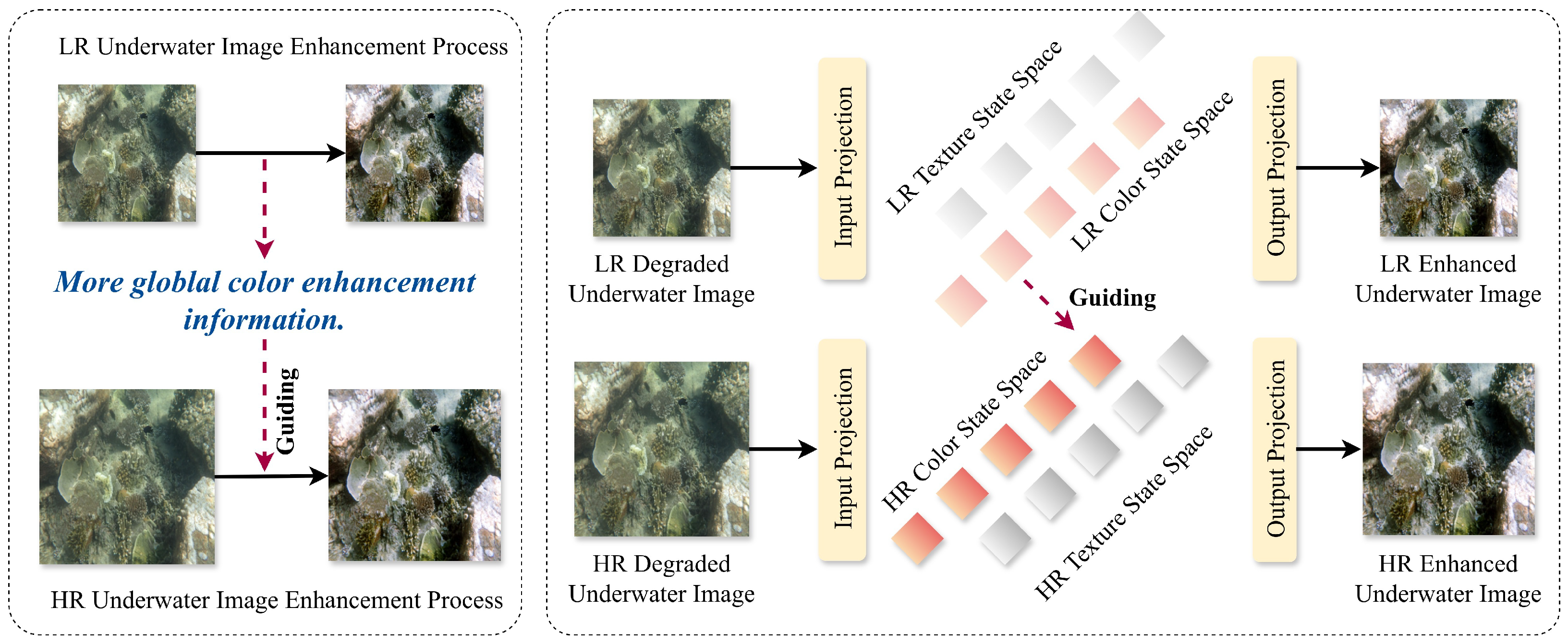
1.3. Contributions
2. Materials and Methods
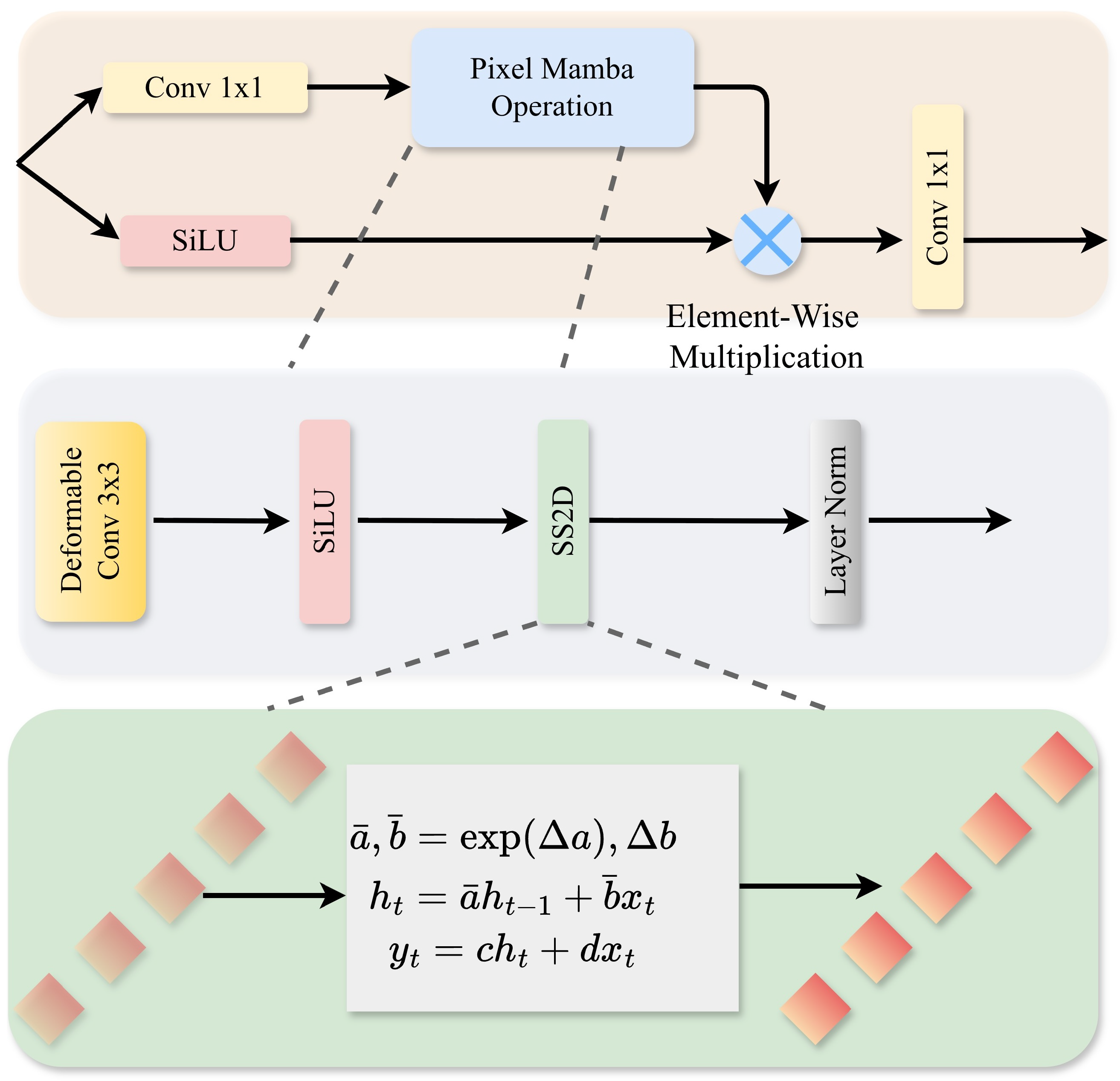
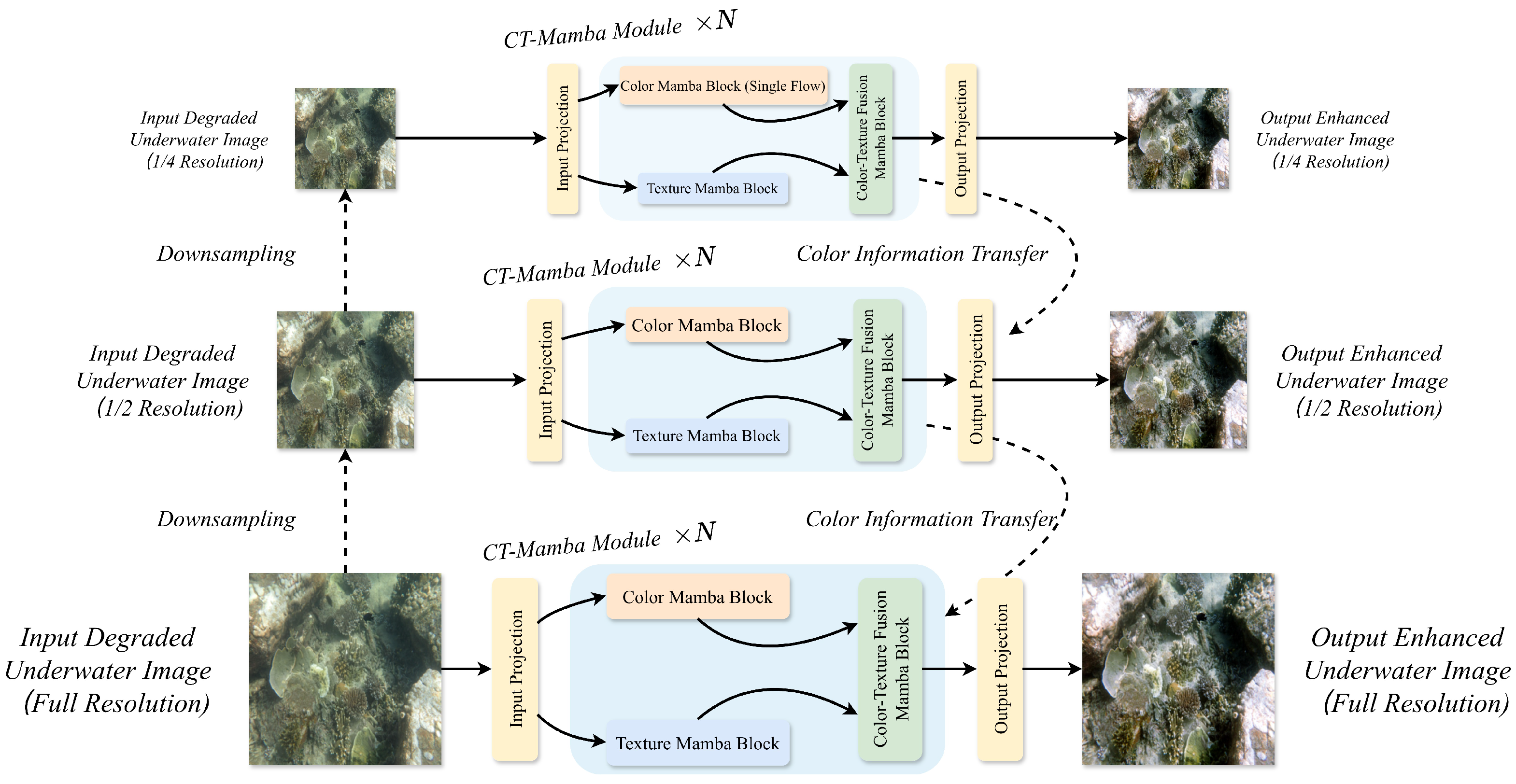
2.1. Color Mamba Block
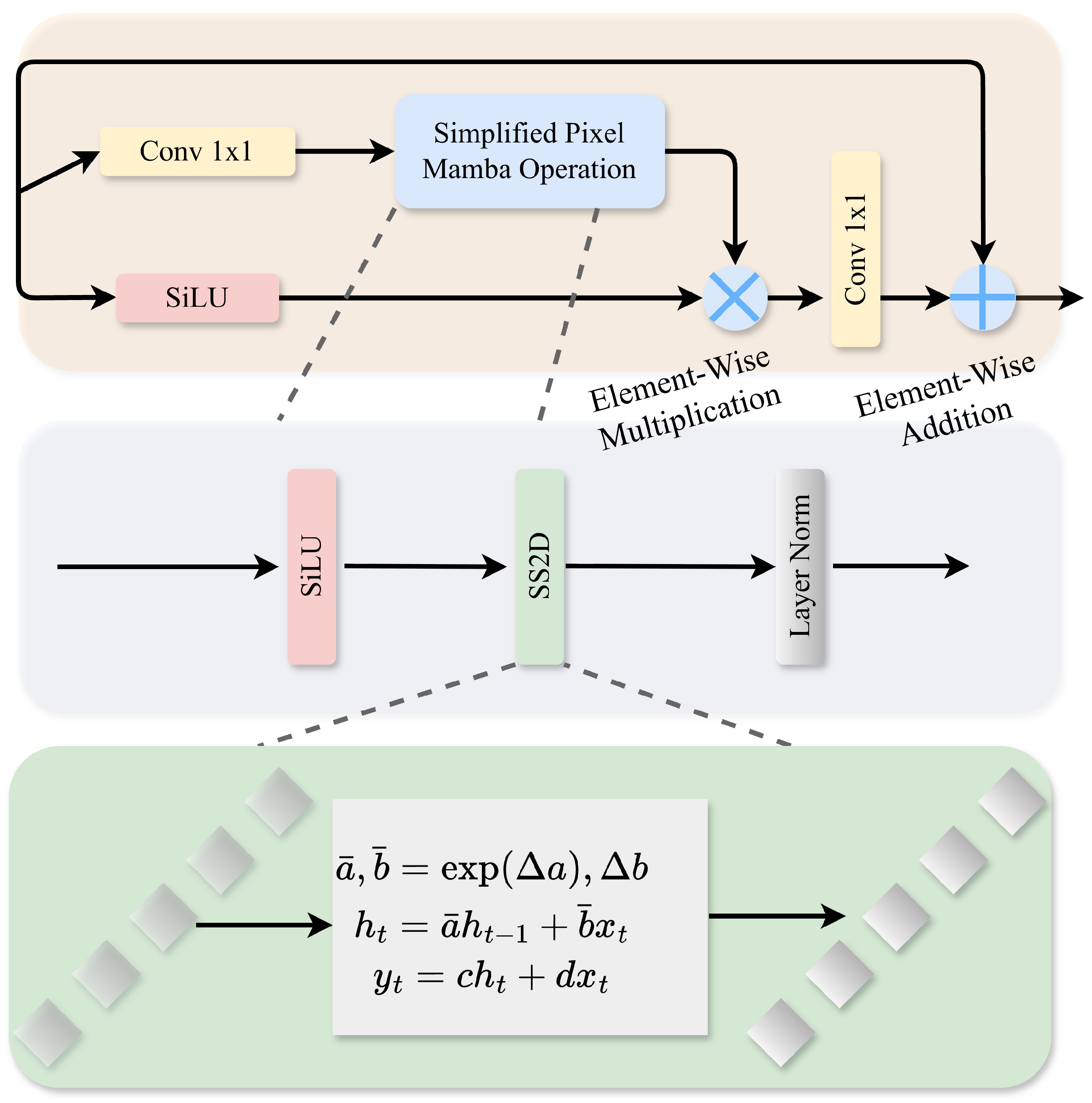
2.2. Texture Mamba Block
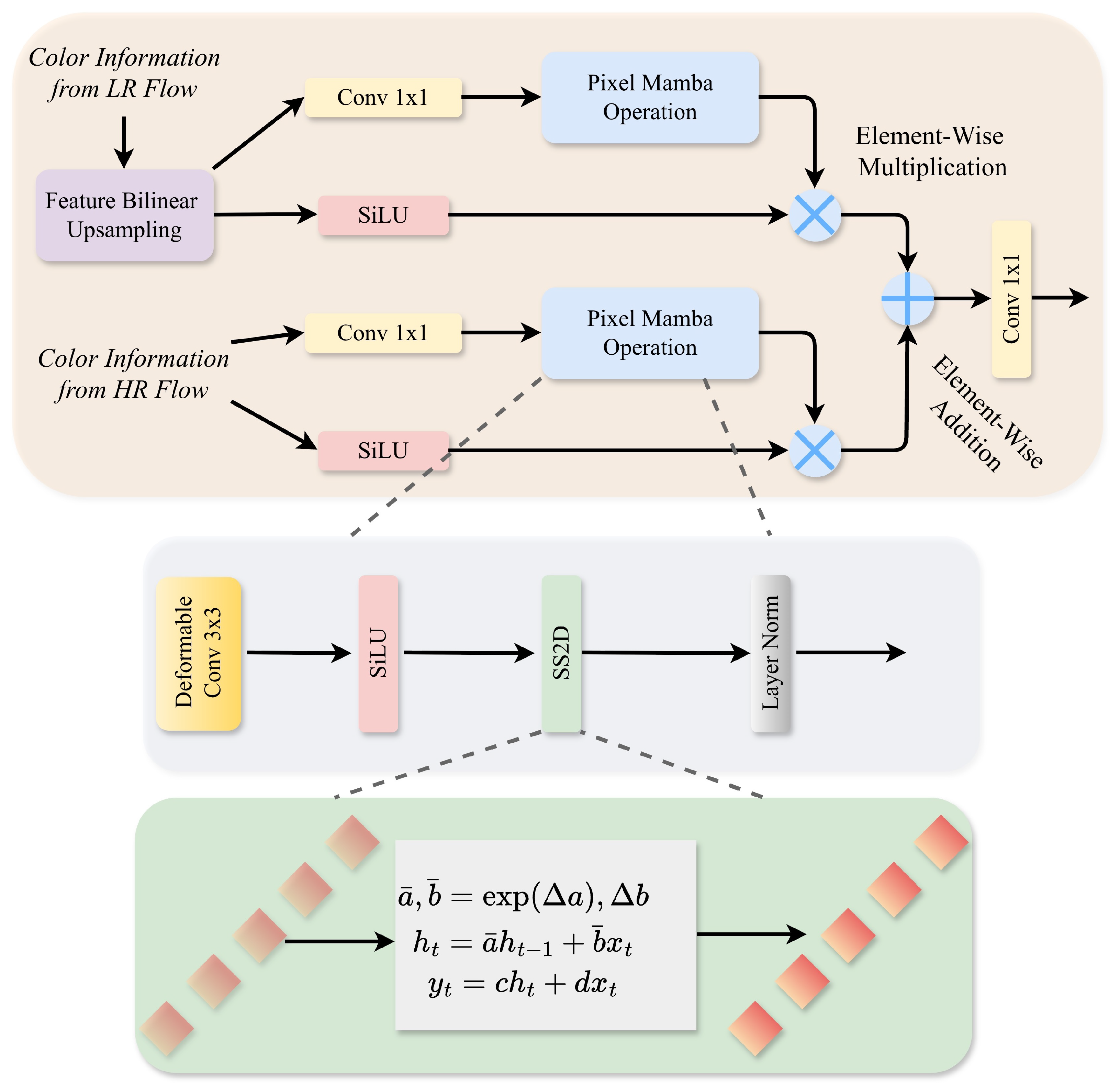
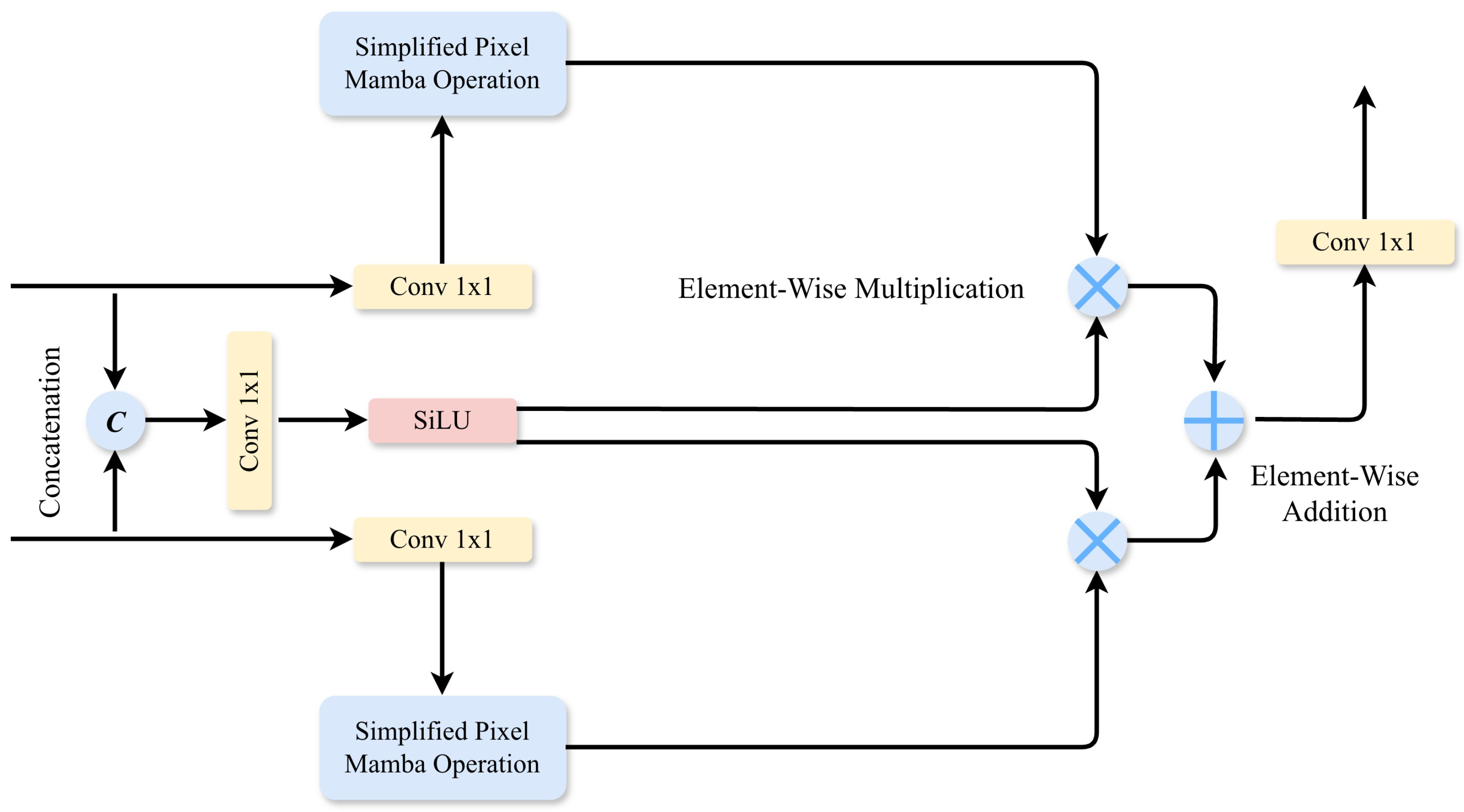
2.3. Color–Texture Fusion Mamba Block
2.4. Loss Function
3. Experimental Results and Analysis
3.1. Datasets
3.2. Experimental Settings
3.3. Compared Methods
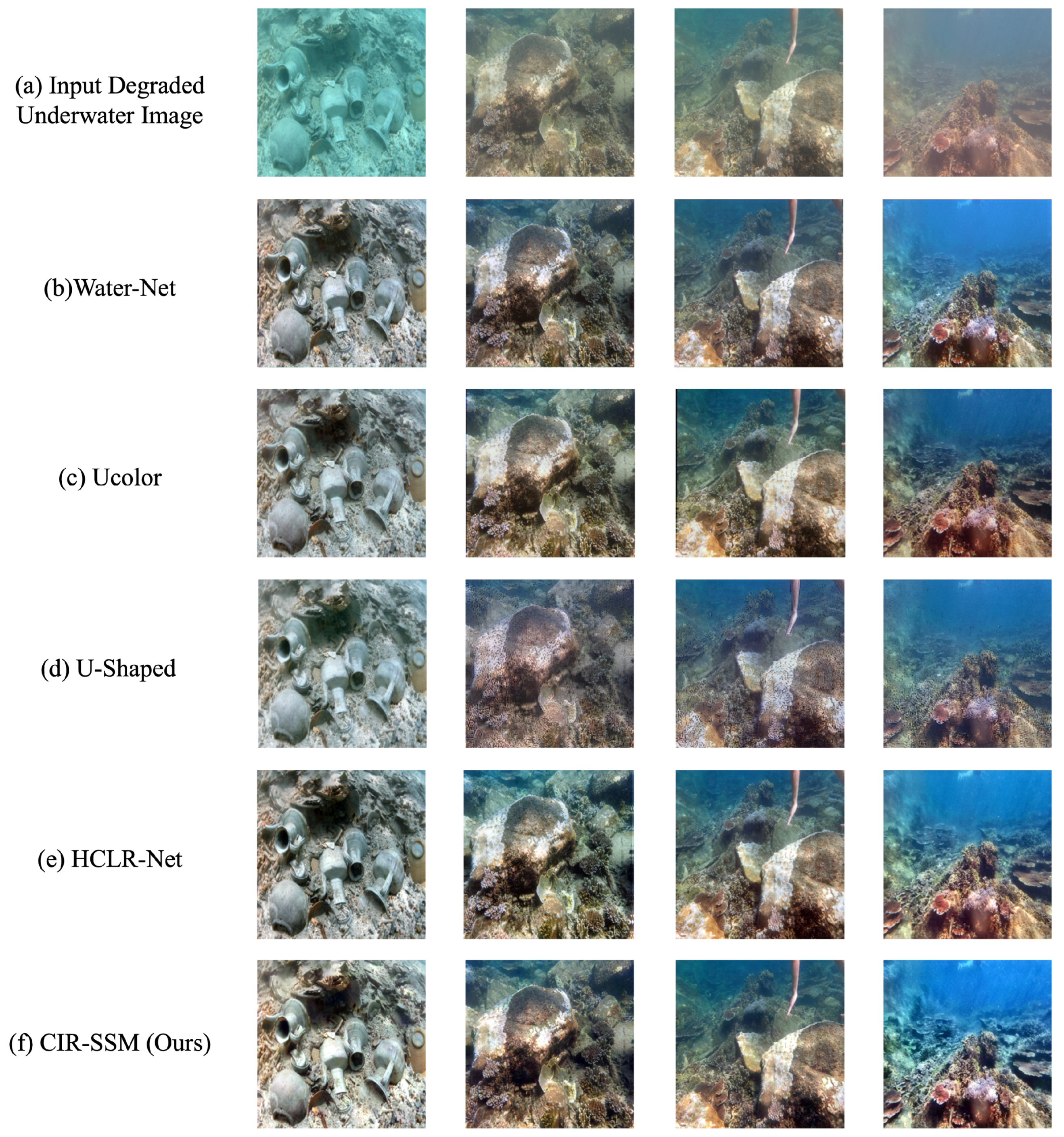
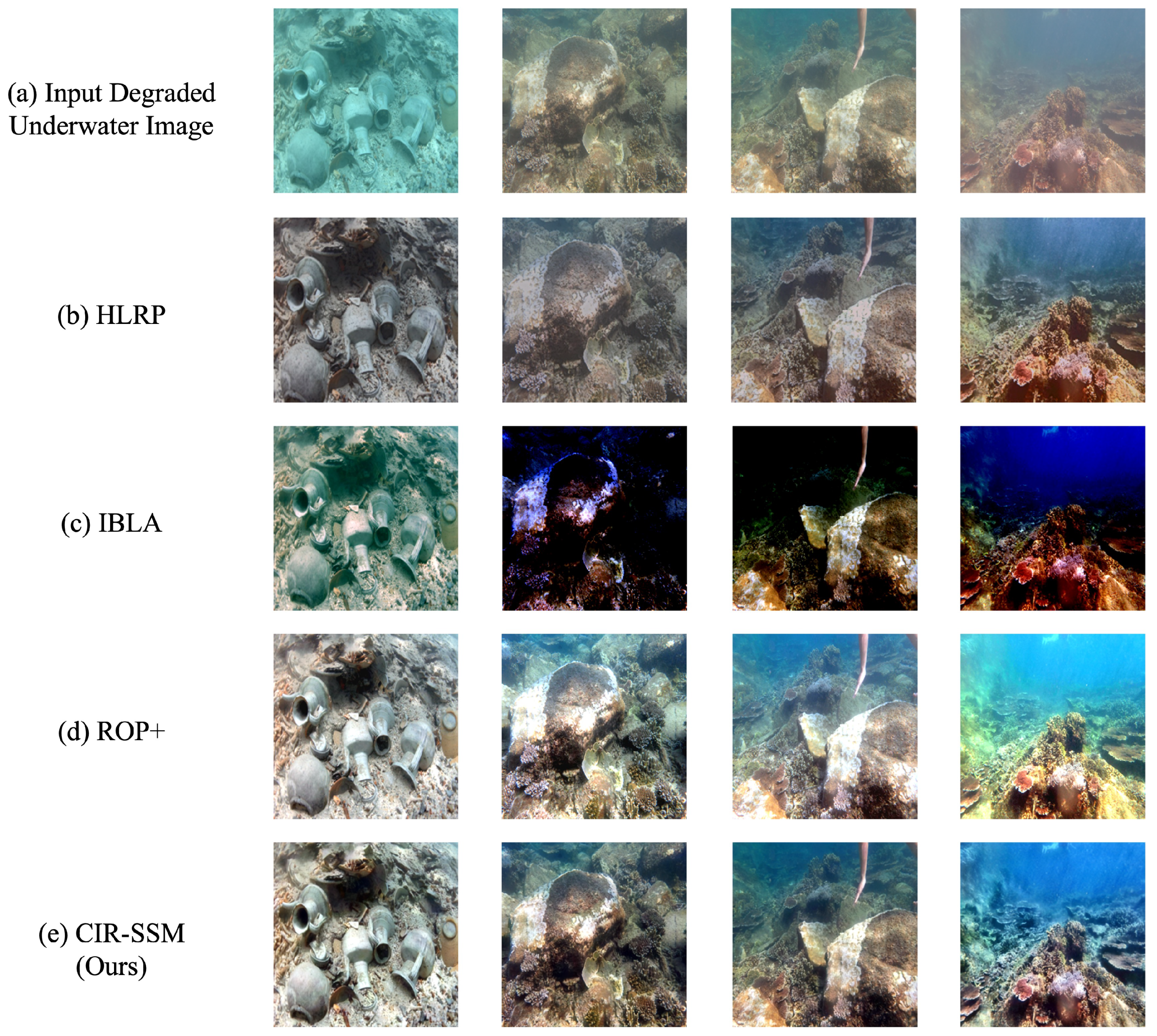
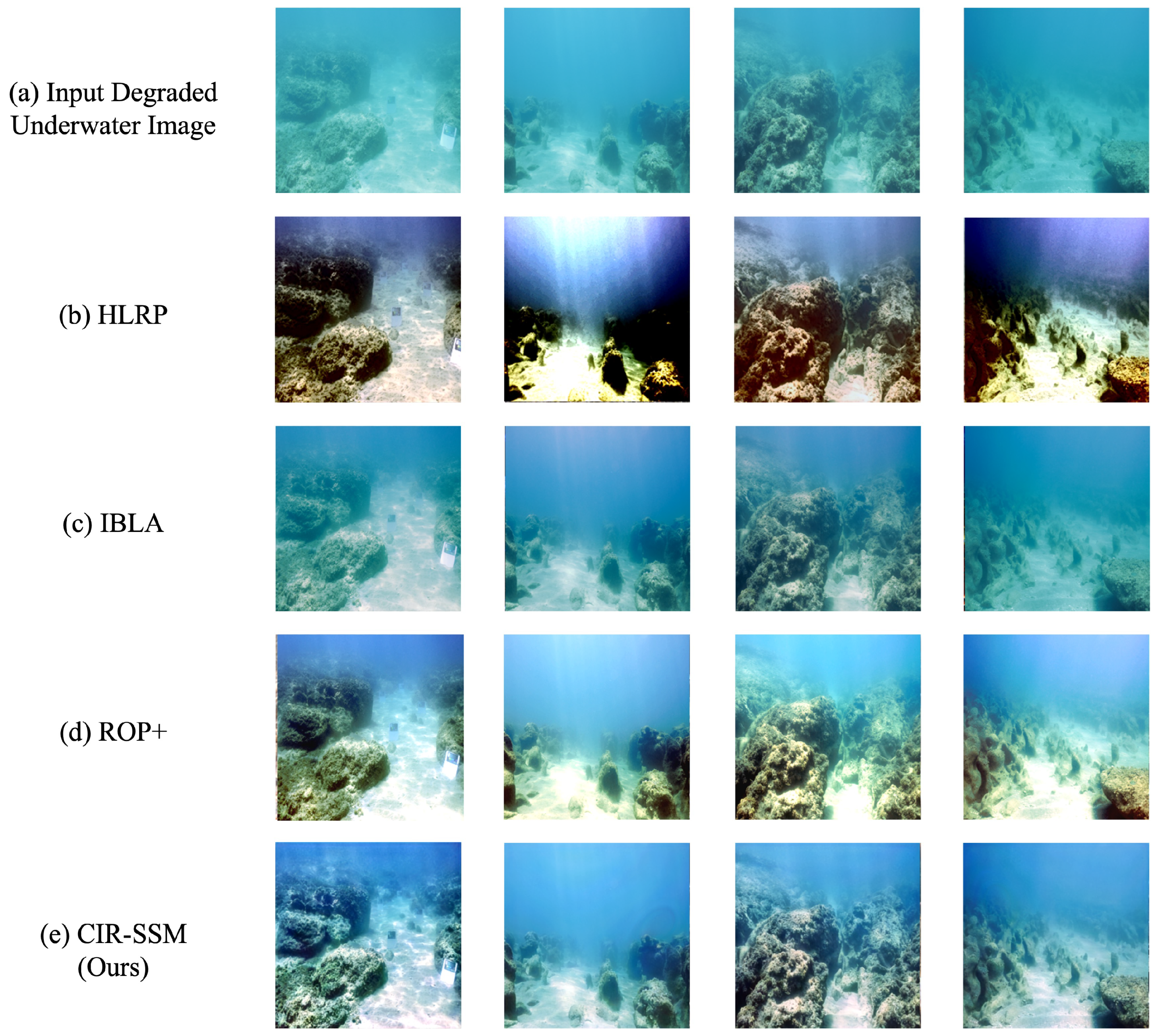
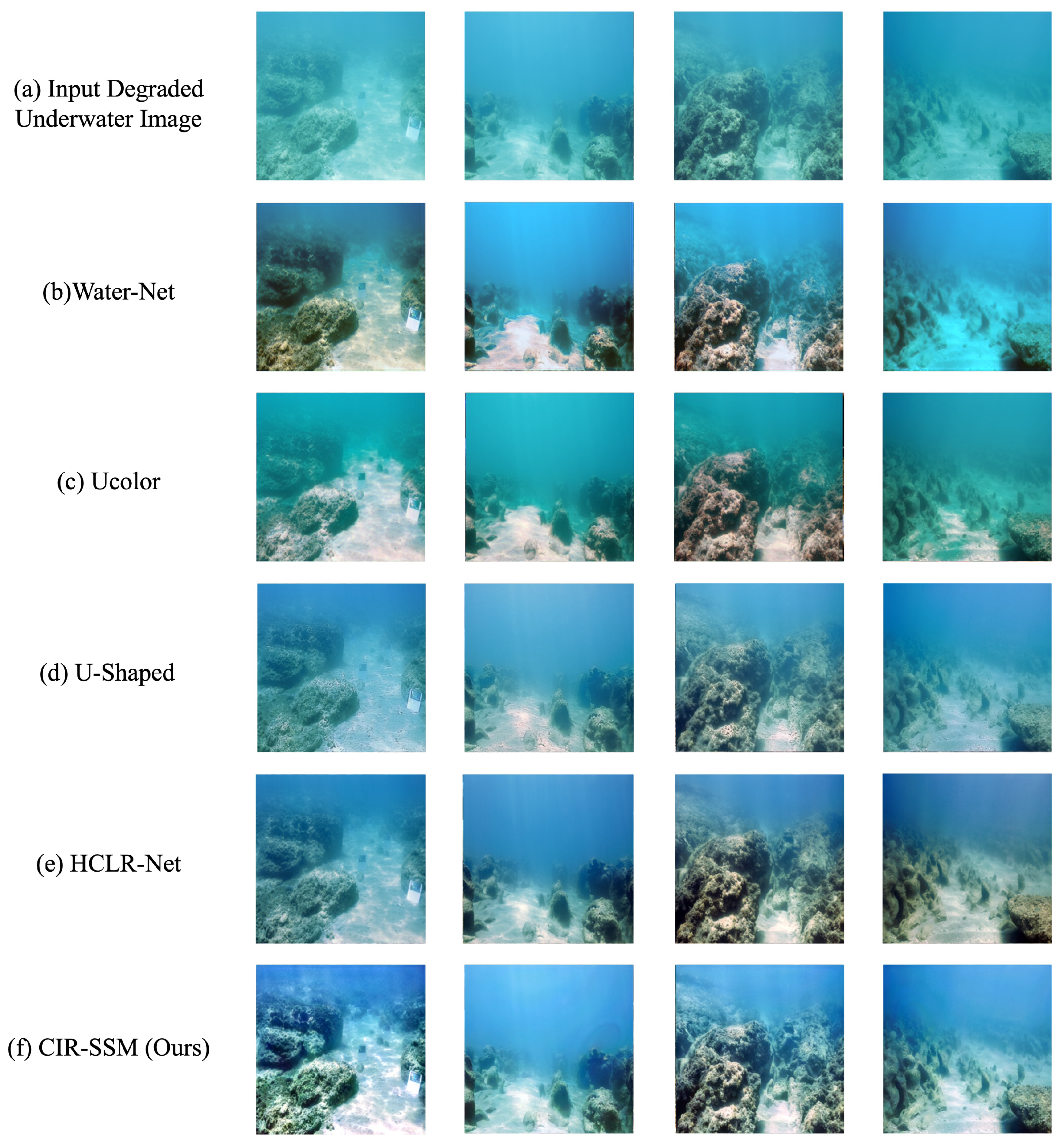
3.4. Qualitative Evaluation
3.5. Quantitative Evaluation
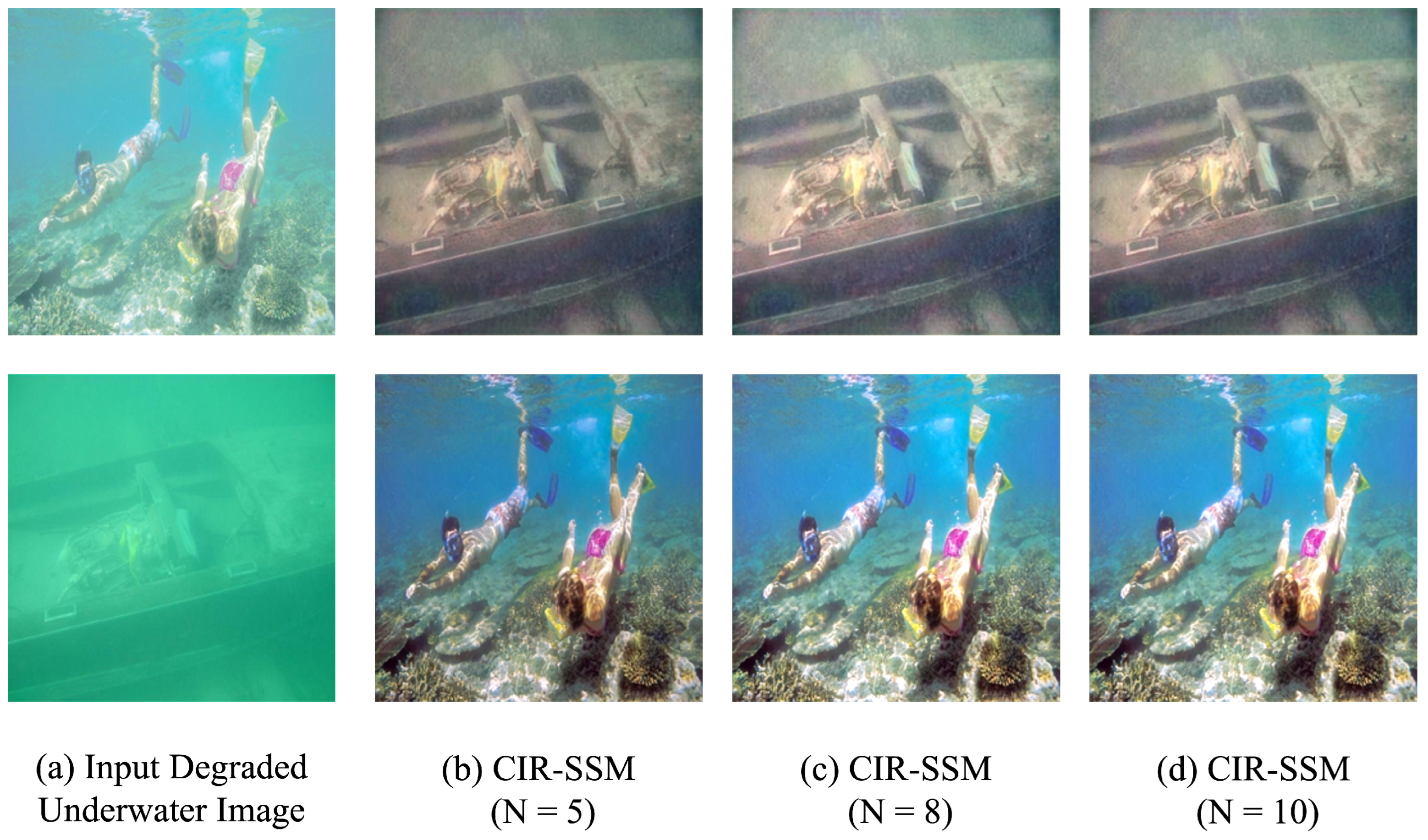
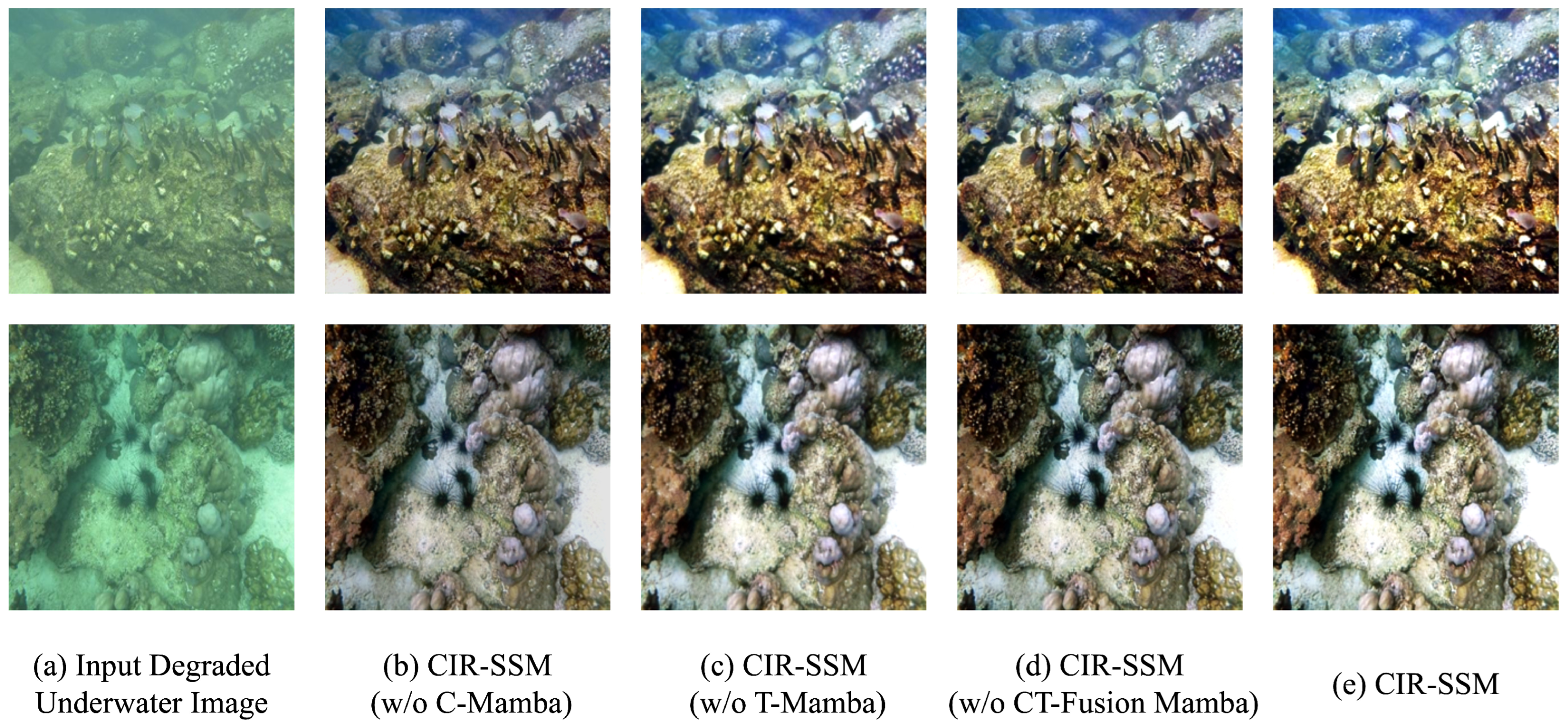
3.6. Ablation Study
4. Discussion
5. Conclusions
Author Contributions
Funding
Institutional Review Board Statement
Informed Consent Statement
Data Availability Statement
Conflicts of Interest
References
- González-García, J.; Gómez-Espinosa, A.; Cuan-Urquizo, E.; García-Valdovinos, L.G.; Salgado-Jiménez, T.; Escobedo Cabello, J.A. Autonomous underwater vehicles: Localization, navigation, and communication for collaborative missions. Appl. Sci. 2020, 10, 1256. [Google Scholar] [CrossRef] [Scilit]
- Schettini, R.; Corchs, S. Underwater image processing: State of the art of restoration and image enhancement methods. EURASIP J. Adv. Signal Process. 2010, 2010, 746052. [Google Scholar] [CrossRef] [Scilit]
- Moghimi, M.K.; Mohanna, F. Real-time underwater image enhancement: A systematic review. J. Real-Time Image Process. 2021, 18, 1509–1525. [Google Scholar] [CrossRef] [Scilit]
- Raveendran, S.; Patil, M.D.; Birajdar, G.K. Underwater image enhancement: A comprehensive review, recent trends, challenges and applications. Artif. Intell. Rev. 2021, 54, 5413–5467. [Google Scholar] [CrossRef] [Scilit]
- Schechner, Y.Y.; Karpel, N. Recovery of underwater visibility and structure by polarization analysis. IEEE J. Ocean. Eng. 2006, 30, 570–587. [Google Scholar] [CrossRef] [Scilit]
- Du, R.; Li, W.; Chen, S.; Li, C.; Zhang, Y. Unpaired underwater image enhancement based on cyclegan. Information 2021, 13, 1. [Google Scholar] [CrossRef] [Scilit]
- Iqbal, K.; Salam, R.A.; Osman, A.; Talib, A.Z. Underwater image enhancement using an integrated colour model. IAENG Int. J. Comput. Sci. 2007, 34, 239. [Google Scholar]
- Fan, B.; Chen, W.; Cong, Y.; Tian, J. Dual refinement underwater object detection network. In Proceedings of the European Conference on Computer Vision 2020—16th European Conference, Glasgow, UK, 23–28 August 2020; Springer: Berlin/Heidelberg, Germany, 2020; pp. 275–291. [Google Scholar]
- Li, X.; Martínez, J.F.; Rubio, G. Towards a hybrid approach to context reasoning for underwater robots. Appl. Sci. 2017, 7, 183. [Google Scholar] [CrossRef] [Scilit]
- Gong, T.; Zhang, M.; Zhou, Y.; Bai, H. Underwater image enhancement based on color feature fusion. Electronics 2023, 12, 4999. [Google Scholar] [CrossRef] [Scilit]
- Yuan, X.; Guo, L.; Luo, C.; Zhou, X.; Yu, C. A survey of target detection and recognition methods in underwater turbid areas. Appl. Sci. 2022, 12, 4898. [Google Scholar] [CrossRef] [Scilit]
- Chen, D.; Huang, B.; Kang, F. A review of detection technologies for underwater cracks on concrete dam surfaces. Appl. Sci. 2023, 13, 3564. [Google Scholar] [CrossRef] [Scilit]
- Zhang, J.; Su, H.; Zhang, T.; Tian, H.; Fan, B. Multi-Scale Fusion Underwater Image Enhancement Based on HSV Color Space Equalization. Sensors 2025, 25, 2850. [Google Scholar] [CrossRef] [Scilit]
- Zheng, M.; Luo, W. Underwater image enhancement using improved CNN based defogging. Electronics 2022, 11, 150. [Google Scholar] [CrossRef] [Scilit]
- Hou, G.; Li, N.; Zhuang, P.; Li, K.; Sun, H.; Li, C. Non-uniform illumination underwater image restoration via illumination channel sparsity prior. IEEE Trans. Circuits Syst. Video Technol. 2023, 34, 799–814. [Google Scholar] [CrossRef] [Scilit]
- Liu, X.; Lin, S.; Chi, K.; Tao, Z.; Zhao, Y. Boths: Super lightweight network-enabled underwater image enhancement. IEEE Geosci. Remote Sens. Lett. 2022, 20, 1500405. [Google Scholar] [CrossRef] [Scilit]
- Liang, Z.; Ding, X.; Wang, Y.; Yan, X.; Fu, X. GUDCP: Generalization of underwater dark channel prior for underwater image restoration. IEEE Trans. Circuits Syst. Video Technol. 2021, 32, 4879–4884. [Google Scholar] [CrossRef] [Scilit]
- He, K.; Sun, J.; Tang, X. Single image haze removal using dark channel prior. IEEE Trans. Pattern Anal. Mach. Intell. 2010, 33, 2341–2353. [Google Scholar] [CrossRef] [Scilit] [PubMed]
- Zheng, Z.; Huang, X.; Wang, L. Underwater low-light enhancement network based on bright channel prior and attention mechanism. PLoS ONE 2023, 18, e0281093. [Google Scholar] [CrossRef] [Scilit]
- Li, C.Y.; Guo, J.C.; Cong, R.M.; Pang, Y.W.; Wang, B. Underwater image enhancement by dehazing with minimum information loss and histogram distribution prior. IEEE Trans. Image Process. 2016, 25, 5664–5677. [Google Scholar] [CrossRef] [Scilit]
- Li, C.; Guo, C.; Ren, W.; Cong, R.; Hou, J.; Kwong, S.; Tao, D. An underwater image enhancement benchmark dataset and beyond. IEEE Trans. Image Process. 2019, 29, 4376–4389. [Google Scholar] [CrossRef] [Scilit]
- Liu, X.; Zhao, Y.; Chi, K.; Zhang, Z.; Chen, Y.; Jia, W. Towards Individual Tone Preference in Underwater Image Enhancement. IEEE Trans. Geosci. Remote Sens. 2024, 62, 4212211. [Google Scholar] [CrossRef] [Scilit]
- Tang, Y.; Liu, X.; Zhang, Z.; Lin, S. Adaptive underwater image enhancement guided by generalized imaging components. IEEE Signal Process. Lett. 2023, 30, 1772–1776. [Google Scholar] [CrossRef] [Scilit]
- Peng, L.; Zhu, C.; Bian, L. U-shape transformer for underwater image enhancement. IEEE Trans. Image Process. 2023, 32, 3066–3079. [Google Scholar] [CrossRef] [Scilit]
- Zhang, W.; Wang, Y.; Li, C. Underwater image enhancement by attenuated color channel correction and detail preserved contrast enhancement. IEEE J. Ocean. Eng. 2022, 47, 718–735. [Google Scholar] [CrossRef] [Scilit]
- Qiang, H.; Zhong, Y.; Zhu, Y.; Zhong, X.; Xiao, Q.; Dian, S. Underwater image enhancement based on multichannel adaptive compensation. IEEE Trans. Instrum. Meas. 2024, 73, 5014810. [Google Scholar] [CrossRef] [Scilit]
- Zhuang, P.; Li, C.; Wu, J. Bayesian retinex underwater image enhancement. Eng. Appl. Artif. Intell. 2021, 101, 104171. [Google Scholar] [CrossRef] [Scilit]
- Zhuang, P.; Wu, J.; Porikli, F.; Li, C. Underwater image enhancement with hyper-laplacian reflectance priors. IEEE Trans. Image Process. 2022, 31, 5442–5455. [Google Scholar] [CrossRef] [Scilit] [PubMed]
- Zhou, J.; Wang, S.; Lin, Z.; Jiang, Q.; Sohel, F. A pixel distribution remapping and multi-prior retinex variational model for underwater image enhancement. IEEE Trans. Multimed. 2024, 26, 7838–7849. [Google Scholar] [CrossRef] [Scilit]
- Lu, J.; Li, N.; Zhang, S.; Yu, Z.; Zheng, H.; Zheng, B. Multi-scale adversarial network for underwater image restoration. Opt. Laser Technol. 2019, 110, 105–113. [Google Scholar] [CrossRef] [Scilit]
- Qi, Q.; Li, K.; Zheng, H.; Gao, X.; Hou, G.; Sun, K. SGUIE-Net: Semantic attention guided underwater image enhancement with multi-scale perception. IEEE Trans. Image Process. 2022, 31, 6816–6830. [Google Scholar] [CrossRef] [Scilit]
- Erdemir, E.; Tung, T.Y.; Dragotti, P.L.; Gündüz, D. Generative joint source-channel coding for semantic image transmission. IEEE J. Sel. Areas Commun. 2023, 41, 2645–2657. [Google Scholar] [CrossRef] [Scilit]
- Liu, X.; Lin, S.; Tao, Z. Learning multiscale pipeline gated fusion for underwater image enhancement. Multimed. Tools Appl. 2023, 82, 32281–32304. [Google Scholar] [CrossRef] [Scilit]
- Ancuti, C.; Ancuti, C.O.; Haber, T.; Bekaert, P. Enhancing underwater images and videos by fusion. In Proceedings of the 2012 IEEE Conference on Computer Vision and Pattern Recognition, Providence, RI, USA, 16–21 June 2012; IEEE: Piscataway, NJ, USA, 2012; pp. 81–88. [Google Scholar]
- Li, J.; Skinner, K.A.; Eustice, R.M.; Johnson-Roberson, M. WaterGAN: Unsupervised generative network to enable real-time color correction of monocular underwater images. IEEE Robot. Autom. Lett. 2017, 3, 387–394. [Google Scholar] [CrossRef] [Scilit]
- Guo, Y.; Li, H.; Zhuang, P. Underwater image enhancement using a multiscale dense generative adversarial network. IEEE J. Ocean. Eng. 2019, 45, 862–870. [Google Scholar] [CrossRef] [Scilit]
- Fabbri, C.; Islam, M.J.; Sattar, J. Enhancing underwater imagery using generative adversarial networks. In Proceedings of the 2018 IEEE International Conference on Robotics and Automation (ICRA), Brisbane, Australia, 21–25 May 2018; IEEE: Piscataway, NJ, USA, 2018; pp. 7159–7165. [Google Scholar]
- Islam, M.J.; Xia, Y.; Sattar, J. Fast underwater image enhancement for improved visual perception. IEEE Robot. Autom. Lett. 2020, 5, 3227–3234. [Google Scholar] [CrossRef] [Scilit]
- Cong, R.; Yang, W.; Zhang, W.; Li, C.; Guo, C.L.; Huang, Q.; Kwong, S. Pugan: Physical model-guided underwater image enhancement using gan with dual-discriminators. IEEE Trans. Image Process. 2023, 32, 4472–4485. [Google Scholar] [CrossRef] [Scilit]
- Xie, X.; Cui, Y.; Tan, T.; Zheng, X.; Yu, Z. Fusionmamba: Dynamic feature enhancement for multimodal image fusion with mamba. Vis. Intell. 2024, 2, 37. [Google Scholar] [CrossRef] [Scilit]
- Guo, H.; Li, J.; Dai, T.; Ouyang, Z.; Ren, X.; Xia, S.T. Mambair: A simple baseline for image restoration with state-space model. In Proceedings of the European Conference on Computer Vision 2024—18th European Conference, Milan, Italy, 29 September–4 October 2024; Springer: Berlin/Heidelberg, Germany, 2024; pp. 222–241. [Google Scholar]
- Guan, M.; Xu, H.; Jiang, G.; Yu, M.; Chen, Y.; Luo, T.; Song, Y. WaterMamba: Visual state space model for underwater image enhancement. arXiv 2024, arXiv:2405.08419. [Google Scholar] [CrossRef] [Scilit]
- Dong, C.; Zhao, C.; Cai, W.; Yang, B.; Guo, Y. O-mamba: O-shape state-space model for underwater image enhancement. In Proceedings of the Chinese Conference on Pattern Recognition and Computer Vision (PRCV), Shanghai, China, 15–18 October 2025; Springer: Berlin/Heidelberg, Germany, 2025; pp. 168–182. [Google Scholar]
- Lin, W.T.; Lin, Y.X.; Chen, J.W.; Hua, K.L. PixMamba: Leveraging state space models in a dual-level architecture for underwater image enhancement. In Proceedings of the 17th Asian Conference on Computer Vision, Hanoi, Vietnam, 8–12 December 2024; pp. 3622–3637. [Google Scholar]
- Gu, A.; Goel, K.; Ré, C. Efficiently modeling long sequences with structured state spaces. arXiv 2021, arXiv:2111.00396. [Google Scholar]
- Berman, D.; Treibitz, T.; Avidan, S. Diving into haze-lines: Color restoration of underwater images. In Proceedings of the British Machine Vision Conference (BMVC) 2017, London, UK, 4–7 September 2017; Volume 1, p. 2. [Google Scholar]
- Zhang, Z. Improved adam optimizer for deep neural networks. In Proceedings of the 2018 IEEE/ACM 26th International Symposium on Quality of Service (IWQoS), Banff, AB, Canada, 4–6 June 2018; IEEE: Piscataway, NJ, USA, 2018; pp. 1–2. [Google Scholar]
- Tanchenko, A. Visual-PSNR measure of image quality. J. Vis. Commun. Image Represent. 2014, 25, 874–878. [Google Scholar] [CrossRef] [Scilit]
- Hore, A.; Ziou, D. Image quality metrics: PSNR vs. SSIM. In Proceedings of the 2010 20th International Conference on Pattern Recognition, Istanbul, Turkey, 23–26 August 2010; IEEE: Piscataway, NJ, USA, 2010; pp. 2366–2369. [Google Scholar]
- Ding, K.; Ma, K.; Wang, S.; Simoncelli, E.P. Image quality assessment: Unifying structure and texture similarity. IEEE Trans. Pattern Anal. Mach. Intell. 2020, 44, 2567–2581. [Google Scholar] [CrossRef] [Scilit]
- Panetta, K.; Gao, C.; Agaian, S. Human-visual-system-inspired underwater image quality measures. IEEE J. Ocean. Eng. 2015, 41, 541–551. [Google Scholar] [CrossRef] [Scilit]
- Yang, M.; Sowmya, A. An underwater color image quality evaluation metric. IEEE Trans. Image Process. 2015, 24, 6062–6071. [Google Scholar] [CrossRef] [Scilit] [PubMed]
- Peng, Y.T.; Cosman, P.C. Underwater image restoration based on image blurriness and light absorption. IEEE Trans. Image Process. 2017, 26, 1579–1594. [Google Scholar] [CrossRef] [Scilit]
- Liu, J.; Liu, R.W.; Sun, J.; Zeng, T. Rank-one prior: Real-time scene recovery. IEEE Trans. Pattern Anal. Mach. Intell. 2022, 45, 8845–8860. [Google Scholar] [CrossRef] [Scilit] [PubMed]
- Li, C.; Anwar, S.; Hou, J.; Cong, R.; Guo, C.; Ren, W. Underwater image enhancement via medium transmission-guided multi-color space embedding. IEEE Trans. Image Process. 2021, 30, 4985–5000. [Google Scholar] [CrossRef] [Scilit]
- Zhou, J.; Sun, J.; Li, C.; Jiang, Q.; Zhou, M.; Lam, K.M.; Zhang, W.; Fu, X. HCLR-Net: Hybrid contrastive learning regularization with locally randomized perturbation for underwater image enhancement. Int. J. Comput. Vis. 2024, 132, 4132–4156. [Google Scholar] [CrossRef] [Scilit]







| Method | Metrics | ||||
|---|---|---|---|---|---|
| PSNR | SSIM | UCIQE | UIQM | LPIPS | |
| HLRP | 15.95 | 0.3049 | 0.5582 | 1.096 | 0.3715 |
| IBLA | 20.94 | 0.7749 | 0.5746 | 1.072 | 0.2268 |
| ROP+ | 19.67 | 0.8246 | 0.5801 | 1.055 | 0.2819 |
| Water-Net | 24.54 | 0.9165 | 0.5910 | 1.113 | 0.1784 |
| Ucolor | 25.62 | 0.9359 | 0.5593 | 1.021 | 0.1525 |
| U-Shaped | 25.89 | 0.9396 | 0.5352 | 1.038 | 0.1314 |
| HCLR-Net | 26.54 | 0.9414 | 0.5791 | 1.045 | 0.1117 |
| CIR-SSM | 26.75 | 0.9488 | 0.5812 | 1.082 | 0.1023 |
| Method | Metrics | ||||
|---|---|---|---|---|---|
| UCIQE | UIQM | Parameters | FLOPs | Runtime | |
| HLRP | 0.5017 | 0.983 | - | - | 1.327 |
| IBLA | 0.5581 | 0.993 | - | - | 8.240 |
| ROP+ | 0.5708 | 1.103 | - | - | 0.095 |
| Water-Net | 0.5641 | 0.991 | 1.10 | 1938.00 | 0.133 |
| Ucolor | 0.5013 | 0.906 | 148.80 | 2806.10 | 0.587 |
| U-Shaped | 0.5687 | 0.972 | 66.20 | 420.50 | 0.077 |
| HCLR-Net | 0.5797 | 1.037 | 4.89 | 402.10 | 0.053 |
| CIR-SSM | 0.5805 | 1.076 | 30.52 | 195.17 | 0.028 |
| Method | Metrics | ||||
|---|---|---|---|---|---|
| PSNR | SSIM | UCIQE | UIQM | LPIPS | |
| N = 5 | 25.96 | 0.9378 | 0.5711 | 1.013 | 0.1206 |
| N = 8 | 26.42 | 0.9399 | 0.5744 | 1.045 | 0.1103 |
| N = 10 | 26.58 | 0.9422 | 0.5791 | 1.071 | 0.1061 |
| CIR-SSM | 26.75 | 0.9488 | 0.5812 | 1.082 | 0.1023 |
| Method | Metrics | ||
|---|---|---|---|
| Parameters | FLOPs | Runtime | |
| N = 5 | 17.76 | 78.13 | 0.018 |
| N = 8 | 22.14 | 138.11 | 0.021 |
| N = 10 | 27.33 | 165.74 | 0.024 |
| CIR-SSM | 30.52 | 195.17 | 0.028 |
| Method | Metrics | ||||
|---|---|---|---|---|---|
| PSNR | SSIM | UCIQE | UIQM | LPIPS | |
| w/o color Mamba block | 25.92 | 0.9311 | 0.5703 | 1.024 | 0.1108 |
| w/o texture Mamba block | 26.59 | 0.9387 | 0.5762 | 1.067 | 0.1079 |
| w/o color–texture Mamba fusion block | 26.72 | 0.9433 | 0.5799 | 1.077 | 0.1036 |
| CIR-SSM | 26.75 | 0.9488 | 0.5812 | 1.082 | 0.1023 |
| Method | Metrics | ||
|---|---|---|---|
| Parameters | FLOPs | Runtime | |
| w/o color Mamba block | 23.98 | 161.37 | 0.020 |
| w/o texture Mamba block | 25.72 | 171.21 | 0.022 |
| w/o color–texture Mamba fusion block | 27.18 | 177.67 | 0.025 |
| CIR-SSM | 30.52 | 195.17 | 0.028 |
Disclaimer/Publisher’s Note: The statements, opinions and data contained in all publications are solely those of the individual author(s) and contributor(s) and not of MDPI and/or the editor(s). MDPI and/or the editor(s) disclaim responsibility for any injury to people or property resulting from any ideas, methods, instructions or products referred to in the content. |
© 2026 by the authors. Licensee MDPI, Basel, Switzerland. This article is an open access article distributed under the terms and conditions of the Creative Commons Attribution (CC BY) license.
Share and Cite
Liu, F.; Ye, N.; Wang, H. CIR-SSM: A Cross and Inter Resolution State-Space Model for Underwater Image Enhancement. Appl. Sci. 2026, 16, 1297. https://doi.org/10.3390/app16031297
Liu F, Ye N, Wang H. CIR-SSM: A Cross and Inter Resolution State-Space Model for Underwater Image Enhancement. Applied Sciences. 2026; 16(3):1297. https://doi.org/10.3390/app16031297
Chicago/Turabian StyleLiu, Fengxian, Ning Ye, and Haitao Wang. 2026. "CIR-SSM: A Cross and Inter Resolution State-Space Model for Underwater Image Enhancement" Applied Sciences 16, no. 3: 1297. https://doi.org/10.3390/app16031297
APA StyleLiu, F., Ye, N., & Wang, H. (2026). CIR-SSM: A Cross and Inter Resolution State-Space Model for Underwater Image Enhancement. Applied Sciences, 16(3), 1297. https://doi.org/10.3390/app16031297