1. Introduction
In recent decades, there has been sustained growth in professions linked to sport, driven by increasing public demand for exercise-related services and the widespread promotion of physical activity as a health-enhancing behavior [
1,
2]. At the same time, participation in recreational and non-elite competitive sports has expanded markedly, with endurance events and amateur competitions attracting growing numbers of participants who often engage in structured training and substantial workloads comparable to sub-elite contexts [
3]. This evolving landscape has raised performance standards in both professional and recreational settings, reinforcing the need for rigorous and accessible measurement tools to support monitoring, decision-making, and injury-prevention strategies.
The professionalization of the sector and technological progress have accelerated the transition from traditional, often subjective methods toward a data-driven paradigm in which quantitative metrics play a central role [
4]. This shift is supported by scientifically grounded procedures and interdisciplinary contributions [
5]. In this context, technology enables more precise monitoring of athletes and patients, providing actionable information to optimize performance and reduce injury risk [
6].
However, a notable technological accessibility gap persists. While consumer wearables (e.g., heart-rate monitors, accelerometers) have become increasingly affordable, research-grade electromyography systems used in advanced clinical and applied settings remain expensive—typically ranging from 5000 to 20,000 euros for multichannel configurations [
1]—and often require medical certifications that further increase their cost. This economic barrier limits their adoption in educational contexts, grassroots sport, and resource-constrained health services, restricting the transfer of evidence-based practices beyond elite environments and affecting talent identification, injury prevention, and population health promotion.
Open-source technologies offer an opportunity to democratize access. Their flexibility (e.g., Arduino or Raspberry Pi platforms) facilitates the construction and adaptation of instrumentation to specific needs, encouraging innovation with fewer entry barriers [
7,
8,
9]. Nevertheless, implementation challenges remain: they demand technical expertise, may lack formal support or compatibility with proprietary systems, and the absence of certifications hampers their acceptance in professional settings [
10].
Among the most relevant monitoring techniques in this landscape, surface electromyography (sEMG) is a key non-invasive tool for assessing muscle activation, with established applications in sports science, education, and rehabilitation. sEMG enables evaluation of neuromuscular function, quantification of force-related activity, and monitoring of training-induced changes, while supporting load management, injury prevention, and return-to-play processes [
11,
12,
13]. However, it is crucial to interpret these metrics with caution, as signal amplitude does not linearly reflect muscle force or hypertrophy potential in all contexts [
14]. The development of portable solutions has further facilitated ecological data collection with near-immediate feedback [
15].
However, the high cost of certified commercial sEMG systems restricts their use to well-equipped laboratories and elite organizations. Although low-cost and open-source alternatives exist, their widespread adoption is hindered by the limited and heterogeneous evidence regarding measurement validity and reliability. Without standardized methodologies ensuring accuracy and reproducibility, practitioners lack confidence to base critical decisions on such devices. Recent studies have explored the feasibility of affordable systems by comparing them with commercial references under controlled protocols: Fuentes del Toro et al. [
16] and Lynn et al. [
17] reported acceptable agreement in laboratory conditions, while Bawa and Banitsas [
18] and Molina-Molina et al. [
19] demonstrated their viability in dynamic tasks and fatigue assessment. Nonetheless, there remains a need for standardized, replicable procedures that support the reliable transfer of these systems to everyday practice.
As a preliminary step, our previous work developed and published a laboratory calibration method for an open-source sEMG system, comparing it with a gold-standard oscilloscope and obtaining a strong linear relationship with bounded errors across amplitude and frequency ranges, which enabled derivation of a simple and reliable conversion equation [
20]. Building on that foundation, the aim of the present study is to validate an open-source sEMG system (OLI) under practical conditions against a commercially used field reference (SHI) during representative tasks. Specifically, we examine (i) the degree of agreement between signals from both systems and (ii) the optimal preprocessing flow that facilitates the practical use of the open-source device. Consequently, the choice of preprocessing pipeline is not merely a technical detail but a critical determinant of data validity, often serving to mitigate hardware limitations such as lower signal-to-noise ratios or latency.
2. Materials and Methods
2.1. Participants
Thirty-six healthy adults (23 men, 13 women; age: 24.3 ± 4.1 years; body mass: 72.5 ± 11.8 kg; height: 173.2 ± 8.4 cm) participated in this study. Inclusion criteria were: (i) age between 18 and 40 years, (ii) no musculoskeletal injuries in the lower limbs within the past six months, (iii) no neurological or cardiovascular conditions contraindicating exercise, and (iv) ability to perform pain-free knee extension. Exclusion criteria included the presence of metallic implants in the evaluated limb or known allergies to electrode adhesives. All participants were informed verbally and in writing about the study aims, procedures, and potential risks, and provided written informed consent prior to participation. The experimental protocol was approved by the Research Ethics Committee of the University of Alicante (UA-2025-06-16) and complied with the principles of the Declaration of Helsinki for research involving human participants. Sample size was determined based on previous EMG validation studies (15–16) which used 20–40 participants. Furthermore, for the agreement analysis (Bland–Altman), statistical power is determined by the total number of paired observations rather than subjects alone. With 36 participants × 10 repetitions × 2 tasks (expected ~720 repetitions), the dataset substantially exceeds the recommended sample size (n > 50) for stable limits of agreement.
2.2. Instrumentation
2.2.1. Acquisition Systems
An Olimexino-328 microcontroller open-source board (Olimex, Plovdiv, Bulgaria) connected to the Shield-EKG-EMG module was used, sampling at 500 Hz via the onboard 10-bit ADC. Signals were streamed through USB and stored in CSV format using a Python script (Python Software Foundation, Wilmington, DE, USA). Information regarding internal gain and analog filtering was not available in the technical documentation. A Shimmer3 EXG Unit SR47-4-0 (Shimmer Sensing, Dublin, Ireland) was used as the commercial reference. Processed data were exported at 4 Hz (RMS data provided by device firmware) using Consensys software (v1.6.0); raw data were not used. ADC resolution and specific gain/analog filter parameters for this configuration were not provided by the manufacturer. It is important to note that the SHI device, in its standard field configuration, streams a pre-processed RMS envelope at 4 Hz, the algorithms of which are proprietary (‘black box’). This lack of transparency regarding internal gain and filtering stages fundamentally constrains the ability to perform direct absolute amplitude comparisons between the systems. Consequently, this study validates the ability of the OLI system to replicate this commercial output (‘output equivalence’) rather than comparing raw signals from both sources. This approach reflects the practical reality of users transitioning between commercial and open-source tools.
2.2.2. Skin Preparation and Electrode Placement
Recordings were performed on the vastus lateralis of the dominant limb (identified as the preferred kicking leg). Skin preparation consisted of cleaning with 70% isopropyl alcohol, without shaving or abrasion, ensuring removal of superficial sweat. This protocol was chosen to replicate typical field conditions where shaving is not always feasible. Signal quality was verified visually for baseline noise prior to data collection. Visual inspection of the signal was performed to ensure signal quality, although formal impedance measurements were not recorded. This absence of impedance verification (<10 kΩ) represents a deviation from SENIAM recommendations, which is a relevant factor when comparing devices with potential differences in input impedance. Disposable Ag/AgCl electrodes (BlueSensor N-00-S, Ambu A/S, Ballerup, Denmark) were placed in a bipolar configuration with a 25 mm interelectrode distance, following SENIAM recommendations for sensor location and orientation. Electrodes were placed over the belly of the vastus lateralis, positioned at approximately two-thirds of the distance between the anterior superior iliac spine and the lateral border of the patella, and aligned with the direction of the muscle fibers. Each system used its own independent bipolar electrode pair, arranged longitudinally along the muscle and interleaved to avoid direct overlap between systems. Both systems used their own reference electrodes, each placed over the tibial tuberosity of the recorded limb. Cables were kept physically separated to minimize electromagnetic interference.
2.3. Experimental Protocol
2.3.1. Positioning
Participants were seated on a standard custom-made plyometric box with their feet hanging freely. The box height (70 cm) ensured that participants’ feet hung freely without touching the floor, preventing ground reaction forces from contributing to the movement. They were instructed to maintain an upright trunk position and to keep the knee at approximately 90° of flexion while at rest. No external support was provided for the back, and joint angles were not measured instrumentally; instead, the investigator ensured correct positioning through visual inspection. Participants were asked to keep their arms relaxed to avoid upper-body compensation.
2.3.2. Tasks
Two tasks were performed in a fixed order (DIN → ISO) on the same muscle and within the same session.
Dynamic task (DIN): Participants performed full knee extensions (from 90° of flexion to full extension, ~0°) against gravity without additional load. They raised the foot to reach full extension, held the position briefly (<1 s), and returned to the starting position in a controlled manner. The cadence was approximately 2–3 s per repetition (1–1.5 s concentric, 1–1.5 s eccentric), performed without a metronome and at a perceived intensity described as “strong” (~70–80% of maximal perceived effort), without explicit instructions to produce maximal intensity.
Isometric task (ISO): Participants performed maximal voluntary contractions (MVC) in knee extension, with the foot held in full extension by manual resistance applied by the investigator over the distal third of the anterior tibia. To ensure consistency in the applied resistance, the same investigator performed the manual opposition for all participants. Each contraction lasted 3–5 s. Participants were instructed to push as hard as possible against the resistance. Each task consisted of 10 consecutive repetitions with 2–3 s pauses between repetitions, allowing full muscle relaxation as visually confirmed in the real-time EMG signal. A passive rest period of 2 min was provided between tasks to minimize fatigue.
2.3.3. Recording
Throughout the protocol, participants were instructed to avoid abrupt movements, maintain trunk position, and breathe normally. EMG data from both systems were recorded continuously and without interruptions during each task (10 repetitions per task), generating a single time series per system and task.
2.4. Data Acquisition
EMG signals from both systems were recorded simultaneously. For each participant and task, a continuous time series containing 10 consecutive repetitions was obtained for each device. This design yielded an expected total of 360 repetitions per system (36 participants × 10 repetitions × 1 task for each of the two tasks), for a total of 720 repetitions.
The OLI system acquired data using custom software implemented in Arduino IDE (version 1.8.19, Somerville, MA, USA), sampling at 500 Hz. The SHI system exported processed signals at 4 Hz. Recording was manually synchronized: the investigator initiated both systems simultaneously, with an estimated timing mismatch of <1 s. Because the sampling frequencies differed between systems (
fOLI = 500 Hz vs.
fSHI = 4 Hz processed export), the resulting time series had different lengths. This mismatch was addressed through synchronization and resampling procedures described in
Section 2.5 and
Section 2.6.
2.5. Synchronization Between Systems and Definition of Repetitions
After data acquisition, manual visual synchronization was performed for each OLI–SHI pair. Both time series were plotted on the same graph using two temporal axes (primary and secondary), and the axis limits were adjusted to align the peaks and troughs of each repetition. This procedure was necessary due to the absence of a common hardware trigger and the different sampling frequencies of the two systems. The visualization and alignment were performed using Microsoft Excel (Microsoft Corporation, Redmond, WA, USA), which enabled precise manual adjustment of the temporal windows.
Repetition boundaries were defined on the SHI signal by annotating the start and end indices (temporal coordinates). These indices were then translated to the OLI time base using linear mapping of the temporal scale (interpolating relative positions) to account for the mismatch in sampling rates. This procedure generated two ordered index tables per subject and task—INSHI and INOLI—ensuring full traceability of the segmentation process even when the sampling frequencies differed between systems.
2.6. Signal Preprocessing
2.6.1. Preprocessing Scenarios Evaluated
Three preprocessing pipelines were evaluated for the OLI system, while the SHI signal was kept in its original form without additional filtering, as the device already applies its own internal analog and digital conditioning recommended by the manufacturer. The three OLI pipelines were:
RAW: Unprocessed raw signal.
Global RMS: Application of a Root Mean Square (RMS) filter to the entire OLI time series before segmentation into repetitions. A right-aligned sliding window of 200 samples (~400 ms at 500 Hz), a commonly used smoothing window in EMG processing, was applied. Because this causal filter introduces a ~200 ms phase delay, the repetition boundaries were shifted by 200 samples to compensate for the latency and temporally align events with the SHI system.
Cycle-Centered RMS: Application of an RMS filter after segmenting the individual repetitions. A centered window of 200 samples was used. This symmetric zero-phase filter introduces no net delay but is more sensitive to segmentation mismatches between systems because the centered window depends directly on the accuracy of cycle boundaries.
2.6.2. Temporal Normalization
Following segmentation, each repetition from both systems was temporally normalized by linear interpolation to 101 points (0–100% of the movement cycle) using the numpy.interp() function in Python. This procedure standardizes repetition duration regardless of its original length, enabling point-by-point comparison across systems and participants.
2.6.3. Shape-Based Filtering (CMC)
To ensure morphological similarity between systems, the Coefficient of Multiple Correlation (CMC; [
21]) was computed between the normalized OLI and SHI profiles for each repetition. However, it is acknowledged that the 4 Hz sampling rate of the commercial reference limits the resolution of high-frequency signal components. Therefore, the CMC analysis in this context quantifies the similarity of the low-frequency ‘activation envelopes’ (macro-morphology) pertinent to biofeedback and training applications, rather than the fine structure of the electromyographic signal. Only repetitions with CMC ≥ 0.80 were retained; values above this threshold indicate high waveform similarity [
22]. Repetitions below this threshold were excluded to avoid distortions caused by artifacts, segmentation errors, or substantial misalignment. This threshold was selected to mitigate the impact of manual synchronization errors. Since CMC is highly sensitive to temporal misalignment, repetitions with CMC < 0.80 were excluded to ensure that subsequent agreement analyses (e.g., Bland–Altman) were performed on temporally aligned data, rather than reflecting synchronization artifacts.
2.7. Statistical Analysis
Signal preprocessing and synchronization were performed in Python 3.9. Statistical analyses were performed in R (v.2024.09.0+375; R Foundation for Statistical Computing, Vienna, Austria). Data import, preprocessing, and reshaping were conducted using the packages readxl (v1.4.4), openxlsx (v4.2.5), dplyr (v1.1.4), tidyr (v1.3.1), and purrr (v1.1.0), while model fitting and summarization relied on broom (v1.0.10) and lme4 (v1.1-37). The ICC package (v2.4.0) was used to compute intraclass correlation coefficients, and RcppRoll (v0.3.1) was employed for rolling-window operations such as RMS filtering. For each repetition, the CMC was calculated between the normalized 101-point temporal profiles of OLI and SHI. Retention rate was calculated for the three preprocessing scenarios (RAW, global RMS, cycle-centered RMS), together with the mean CMC (mean ± SD) of retained repetitions.
To evaluate the gain relationship between systems, a simple linear regression was fitted for each valid repetition using the model SHI = a + b × OLI, where b represents relative gain and a represents additive offset. Because repeated observations within each participant are not independent, parameters were handled hierarchically: (i) at the repetition level, a regression was fitted for every repetition, yielding slopes b1, b2…; (ii) at the subject level, slopes were averaged to obtain one representative value b per participant and task; and (iii) at the group level, descriptive statistics (mean, SD, 95% CI) were computed across all subject-level slopes. Intercepts (a) were summarized as group means ± SD but not used for inferential purposes due to device-specific baseline offsets.
The consistency of the slope
b was evaluated using the two-way random-effects, absolute-agreement, single-measurement Intraclass Correlation Coefficient (ICC(2,1)) [
23], with 95% confidence intervals computed using Fisher’s analytical method and interpreted according to [
24]. Although all three preprocessing scenarios were computed, the RAW condition was excluded from agreement analyses due to its high noise level and lack of smoothing. Bland–Altman and association analyses were therefore restricted to the two filtered scenarios (global RMS and cycle-centered RMS). For these analyses, each repetition (101 points) was amplitude-normalized using a per-repetition, per-system min–max transformation [
ynorm = 100 × (
y − min(
y))/(max(
y) − min(
y))] where
y denotes the original profile in microvolts (µV). Min–max normalization was chosen over %MVC normalization because the primary aim was to assess inter-device agreement for the same physiological signal, rather than inter-subject comparison. This normalization approach was selected specifically to facilitate inter-device comparison of activation dynamics (output equivalence) by removing gain differences, rather than for physiological interpretation of amplitude. It scales all repetitions to [0, 100] while preserving waveform proportions, enabling inter-system comparison without physiological normalization [
25,
26].
From each normalized repetition, two representative metrics of muscle activation were extracted. First, RMS (Root Mean Square) [RMS = √((1/
N) Σ
y2i)] where
N = 101 sample points. RMS reflects the effective average energy of the signal and is typically associated with activation amplitude [
27]. Second, AUC (Area Under the Curve) [AUC = Σ
yi] also known as integrated EMG (iEMG), which captures the total accumulated electrical activity during the contraction and is more sensitive to cycle duration and morphology [
28]. Both metrics were expressed in normalized units (theoretical range: 0–100 for RMS; 0–10, 100 for AUC considering 101 points).
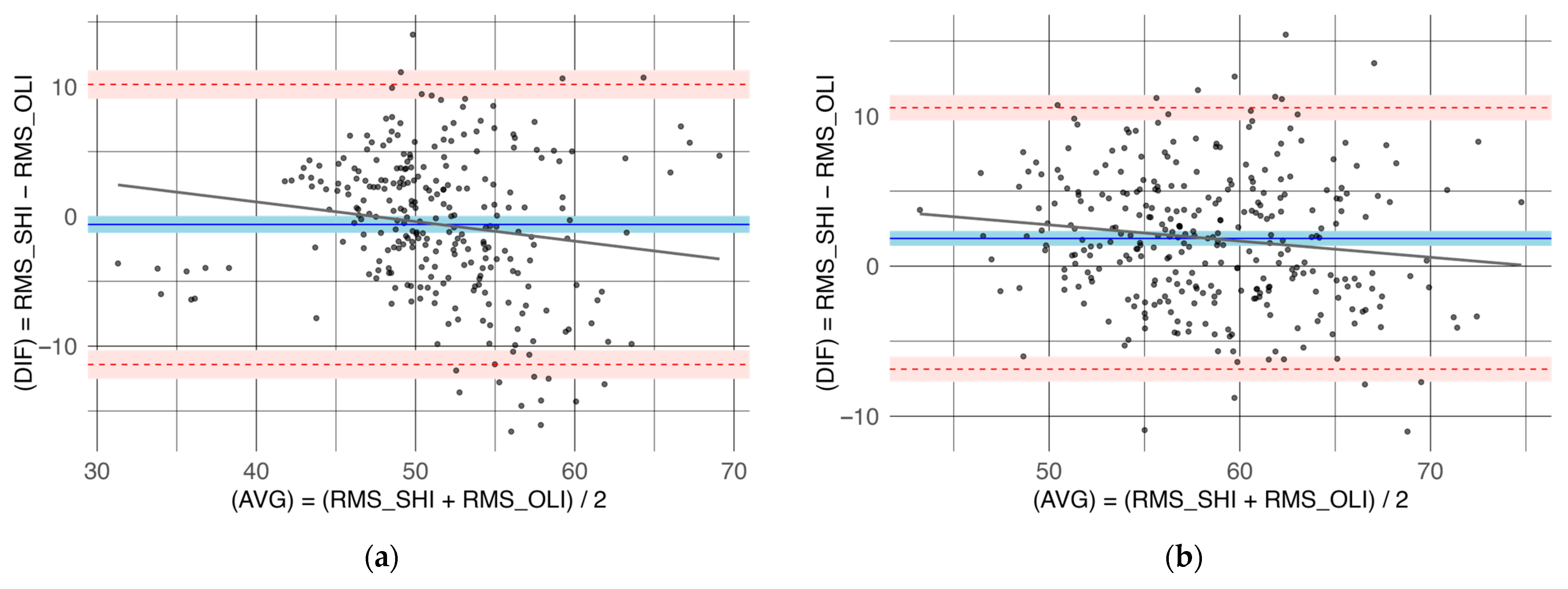
For Bland–Altman analysis, the difference DIF = SHI − OLI and mean AVG = (SHI + OLI)/2 were computed for each metric and task [
29]. The bias and limits of agreement (LoA = Bias ± 1.96 × SD
dif) were obtained together with their 95% confidence intervals. Proportional bias was examined by regressing DIF on AVG (DIF ~ AVG). The normality of DIF was assessed using the Shapiro–Wilk test (
n < 50) or the Kolmogorov–Smirnov test (
n ≥ 50). When strong deviations from normality were detected (
p < 0.001), Bland–Altman plots were visually inspected and medians and interquartile ranges were reported as complementary descriptors. Additionally, a paired-samples
t-test was performed on DIF to test whether the mean bias differed significantly from zero; the significance level was set at α = 0.05.
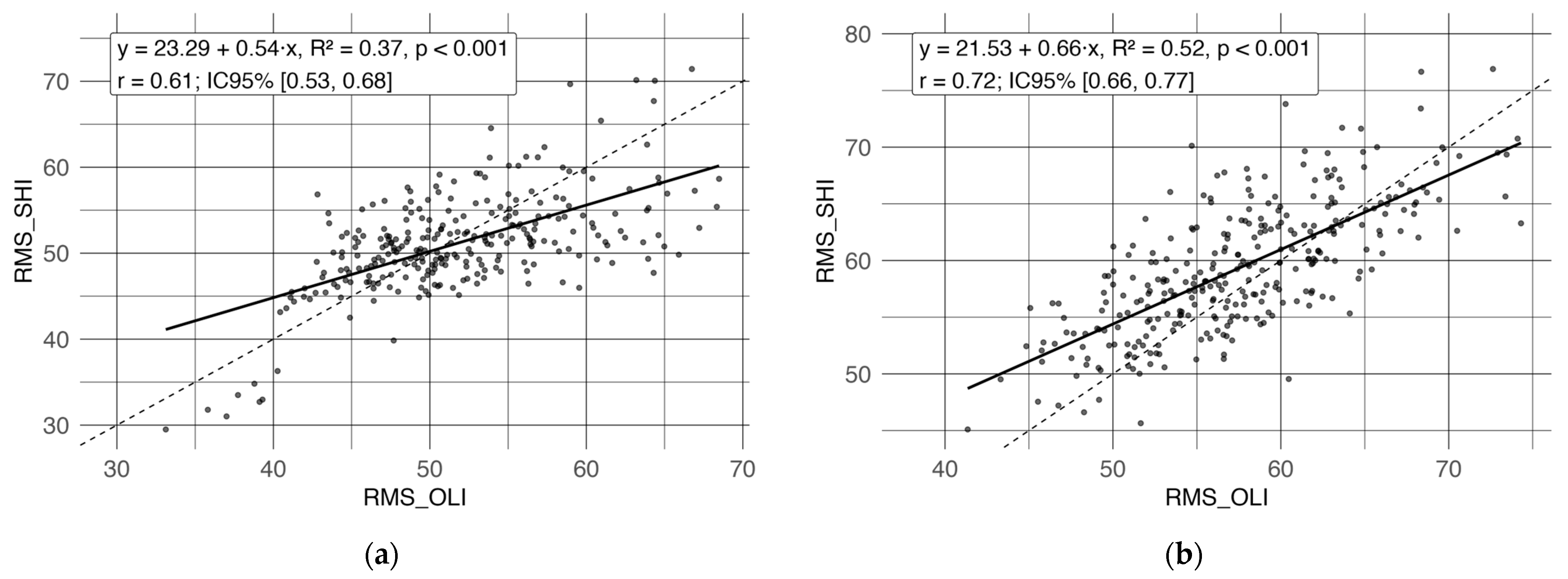
Linear association between systems was evaluated using Pearson’s correlation coefficient (r) and simple linear regression reporting slope (β1), intercept (β0), determination coefficient (R2), p-values, and 95% confidence intervals. All agreement and association analyses were conducted separately for DIN and ISO tasks.
4. Discussion
The objective of this study was to assess the concurrent validity of a low-cost, open-source sEMG system (OLI) against a commercially available field device (SHI) during representative tasks, comparing alternative preprocessing scenarios to identify an optimal pipeline for practical use. The main findings show that, when a standardized preprocessing procedure based on global RMS with latency compensation is used, OLI achieves acceptable agreement with SHI for the RMS metric: the mean bias is minimal (−0.69 normalized units, i.e., <1% of the 0–100 scale), limits of agreement are on the order of ±10% of the scale, and the correlation is moderate-to-high (
r = 0.73). The global RMS scenario retained 81.9% of repetitions with high morphological similarity (CMC = 0.92 ± 0.04), outperforming both the raw signal (72.5%) and the cycle-centered RMS condition (80.8%). These indices of concordance are comparable to those typically reported in validation studies between commercial systems [
16,
17]. However, their protocol incorporated hardware triggers for synchronization, removing a source of temporal variability that was present here. This suggests that OLI can provide measurements that are effectively interchangeable with SHI for applications focused on relative activation patterns and timing rather than absolute amplitude.
However, the calibration relationship between systems indicated that OLI produces signals with amplitudes approximately six times larger than those of SHI (slope
b ≈ 0.16), with only low-to-moderate within-session consistency of this gain across repetitions (ICC(2,1) = 0.45). This implies that direct quantitative comparisons of absolute amplitudes require session- or task-specific calibration when high numerical accuracy is needed. The task-stratified analysis revealed stronger correlation in the isometric condition (
r = 0.72) than in the dynamic task (
r = 0.61), plausibly reflecting the greater stability of the signal during sustained contractions compared with the variability inherent to ballistic movements. Taken together, these results bridge the gap between the previously reported laboratory calibration of this open-source system [
20] and its practical validation, providing a complete protocol that supports the responsible transfer of open-source technology to resource-limited applied settings. However, this gain difference is effectively nullified for the user by the min–max normalization step, which scales both signals to a common 0–100% relative range.
Our findings are consistent with recent validations of low-cost sEMG systems against commercial references. Molina-Molina et al. [
19] reported correlations of
r = 0.70–0.85 when validating the wearable mDurance system against Delsys Trigno during dynamic and fatigue tasks, magnitudes similar to ours (
r = 0.61–0.72). Bawa and Banitsas [
18] observed limits of agreement of approximately ±15% when comparing a low-cost EMG system with Delsys during isometric contractions, slightly wider than our ±10%, which may be partly explained by differences in normalization (they used raw amplitudes, whereas we applied per-repetition min–max scaling). Lynn et al. [
17] reported ICC values between 0.76 and 0.91 when comparing Athos with Noraxon during squats and jumps, higher than those observed in our study; however, their protocol incorporated hardware triggers for synchronization, removing a source of temporal variability that was present here. Additionally, their ICC assessed test–retest reliability across sessions, whereas our ICC(2,1) = 0.45 evaluated within-session consistency of the calibration slope across repetitions—a different construct that inherently exhibits greater variability. Fuentes del Toro et al. [
16] found excellent correlations (
r = 0.89–0.95) when validating MyoWare against Delsys Trigno in isometric contractions, again higher than our values and likely reflecting the lower variability of purely isometric protocols compared with our mixed dynamic–isometric design.
A distinctive contribution of the present work is the systematic evaluation of how preprocessing choices affect concordance. We show that global RMS with latency compensation substantially improves the retention rate (81.9% vs. 72.5% in RAW) and reduces bias compared with cycle-centered RMS, particularly for the AUC metric. To our knowledge, none of the previous low-cost sEMG validation studies in this domain compared multiple preprocessing pipelines in this manner, which represents a relevant methodological contribution toward standardizing open-source systems. With regard to calibration, our slope
b ≈ 0.16 and its limited within-session consistency (ICC ≈ 0.45) are consistent with reports of intra- and inter-session variability in sEMG: Gaudet et al. [
30] reported ICC values of 0.45–0.68 in forearm muscles, and Fauth et al. [
31] found ICC values ranging from 0.40 to 0.85 depending on muscle and task. Boyer et al. [
32] further showed that session-specific calibration adjustments improve the reliability of fatigue indicators derived from sEMG, supporting our recommendation to apply session- or task-specific calibration when quantitative accuracy is required.
The absence of a common hardware trigger required retrospective manual synchronization, which may have introduced temporal inaccuracies on the order of ±1–2 samples (~2–4 ms). However, the shape filter (CMC ≥ 0.80) ensured that only repetitions with high morphological similarity were retained for analysis, mitigating the impact of such micro-misalignments on the observed agreement. The superiority of the global RMS scenario over the cycle-centered RMS condition in terms of bias is likely attributable to the built-in latency compensation: by applying RMS before segmentation and then adjusting the cutting indices, the relative temporal alignment between systems is preserved, reducing sensitivity to small variations in the segmentation points. This finding is consistent with the known influence of RMS window type on bias and signal-to-noise characteristics [
27] and has practical implications for the standardization of preprocessing pipelines in open-source sEMG systems.
We adopted per-repetition min–max normalization to homogenize the scales between devices with different gains, thereby facilitating agreement analysis without imposing specific physiological assumptions. This approach differs from normalization to %MVC (maximal voluntary contraction), which is widely recommended in clinical sEMG for inter-subject comparisons [
26]. However, in the context of device validation—where the aim is to quantify agreement between systems for the same underlying physiological signal—min–max normalization removes gain and offset biases and focuses the analysis on the concordance of relative patterns, which is most relevant for applications such as biofeedback, detection of muscle activation timing, or fatigue monitoring based on spectral changes [
25]. This choice aligns with recommendations for device comparison studies where the focus is on inter-device agreement rather than physiological interpretation [
29]. For applications that require absolute physiological interpretation (e.g., force estimation), min–max normalization should be complemented with %MVC-based procedures.
We followed SENIAM recommendations for electrode placement [
33] and skin preparation. However, we utilized an interelectrode distance of 25 mm (vs. the standard 20 mm recommended by SENIAM) to accommodate the specific electrode footprint and connector geometry of our devices. This minor deviation from the 20 mm standard is not expected to substantially affect signal characteristics given the large muscle belly of the vastus lateralis and the predominance of parallel fibers [
34]. The interleaved configuration of OLI–SHI electrode pairs (required to sample the same muscle source) introduced a distance of approximately 20–30 mm between pairs, which could slightly affect amplitude estimates due to spatial aliasing. However, this effect is expected to be minimal in the vastus lateralis, a large muscle with predominantly parallel fibers. While formal impedance checks were not performed—a limitation of this study—careful skin preparation and visual signal verification were employed to minimize interference and artifacts. Future studies should incorporate impedance monitoring (<10 kΩ) to ensure optimal signal quality and minimize noise contamination [
35].
Both tasks exhibited a mild but statistically significant proportional bias (
β ≈ 0.11–0.15), indicating that measurement error increased slightly with activation magnitude. This pattern is common in EMG validation studies and may reflect differences in nonlinear amplification characteristics at different signal levels or variability in signal-to-noise ratios that differentially affect low versus high amplitudes. Similar proportional bias patterns have been reported in other device comparison studies [
16,
18], suggesting this is an inherent challenge when comparing systems with different hardware architectures. The higher correlation observed during isometric contractions (
r = 0.72) compared with dynamic movements (
r = 0.61) is consistent with the greater stability of the signal during sustained contractions and the absence of movement artifacts and changes in muscle geometry that occur during ballistic tasks.
The results of this study have direct implications for the democratization of muscle monitoring in resource-limited settings. The OLI system has an approximate cost of 50–80 euros for a single-channel configuration, compared with 1500–8000 euros per channel for commercial systems (e.g., Shimmer, Delsys, Noraxon), a 20- to 100-fold difference that constitutes a critical barrier for higher education, grassroots sports, rehabilitation services, and research centers in low- and middle-income countries. Our findings show that, when a standardized procedure is applied (global RMS preprocessing, per-repetition min–max normalization, and session-specific calibration), OLI provides sufficiently accurate information for various applications, including educational contexts, where it can demonstrate muscle activation patterns and timing relationships for teaching purposes—emphasizing relative feedback over absolute quantification. It is also useful in rehabilitation biofeedback to support motor retraining and assess movement quality, offering real-time visual or auditory feedback to guide patient performance. Additionally, OLI can be applied in fatigue monitoring by detecting changes in spectral characteristics, such as median frequency shifts, that signal neuromuscular fatigue progression during training or rehabilitation. Finally, it facilitates temporal pattern analysis by characterizing activation onset, offset, and coordination between muscle groups during functional tasks. It must be emphasized that the high agreement observed relies on Min–Max normalization. Consequently, the OLI system is validated here for determining relative activation patterns and temporal dynamics (geometric similarity), which are sufficient for biofeedback and technique training. However, it is not suitable for absolute amplitude quantification or force estimation without device-specific calibration. In these contexts, the primary goal is relative feedback rather than exact amplitude quantification. While OLI is suitable for biofeedback and monitoring relative activation patterns in educational and sports settings, the present validation does not support its use for clinical diagnostic purposes or clinical decision-making, as absolute precision, inter-session reliability, and performance in clinical populations have not been evaluated.
This study presents several limitations. First, we assessed concurrent validity (agreement with a reference standard) but did not evaluate between-session test–retest reliability, which would require participants to return on separate days with electrode re-application. Therefore, the temporal stability of OLI measurements across days or weeks remains unknown and should be investigated in future work. Second, the fixed task order (DIN → ISO) was chosen to prevent fatigue from maximal isometric contractions from affecting the dynamic trials; however, this lack of randomization may have introduced order effects. Third, manual synchronization in the absence of a common hardware trigger relies on visual alignment. This introduces a potential source of error compared to automated threshold-based methods and may have introduced temporal inaccuracies on the order of ±1–2 samples. although the CMC ≥ 0.80 filter likely mitigated their impact on the analyzed repetitions. Fourth, the generalizability of the findings is limited to the vastus lateralis, the SENIAM-based electrode placement (adjusted to 25 mm distance), and the per-repetition min–max normalization scheme adopted here; extrapolation to other muscles, electrode configurations, or normalization strategies (e.g., %MVC) should be made cautiously and, ideally, supported by specific validation. Fifth, we used a Shimmer3 device as the practical field reference rather than a laboratory “gold standard” such as Delsys Trigno; direct comparisons against higher-precision systems might yield different results. Finally, the moderate within-session consistency of the calibration slope (ICC ≈ 0.45) indicates substantial variability in the gain relationship across repetitions, which limits the applicability of the system for absolute quantification unless session-wise recalibration is performed.
This work establishes the technical feasibility of the OLI system under controlled laboratory conditions. As an immediate next step, we plan to conduct a comparative intervention study to evaluate the added value of sEMG-based biofeedback versus practice without biofeedback in motor control tasks, with the aim of quantifying its actual impact on performance and determining when and how it is worthwhile to implement in applied settings. In the medium term, it will be necessary to: (i) assess between-session test–retest reliability with electrode re-application to characterize temporal stability across days or weeks; (ii) validate the system across multiple muscles and in field conditions outside the laboratory, where movement artifacts and variable environmental conditions may affect agreement; (iii) implement hardware-trigger synchronization to eliminate temporal variability; and (iv) perform direct comparisons against higher-precision systems (e.g., Delsys Trigno, Noraxon) to more fully characterize the limitations and advantages of the OLI system. Finally, integration with biomechanical analyses (kinematics and kinetics) would allow sEMG signals to be interpreted in the context of complex dynamic movements, enhancing their usefulness for sports and rehabilitation applications.