


Featured Application
A post-processing approach to converting NWP instantaneous solar irradiance forecasts into reliable hourly mean estimates, supporting operational solar energy applications.
Abstract
The accurate short-term forecasting of global horizontal irradiance (GHI) is essential to optimizing the operation and integration of solar energy systems into the power grid. This study evaluates the performance of the Weather Research and Forecasting (WRF) model in predicting GHI over a 48 h forecast horizon at an Italian site: the ENEA Casaccia Research Center, near Rome (central Italy). The instantaneous GHI provided by WRF at model output frequency was post-processed to derive the mean GHI over the preceding hour, consistent with typical energy forecasting requirements. Furthermore, a decomposition model was applied to estimate direct normal irradiance (DNI) and diffuse horizontal irradiance (DHI) from the forecasted GHI. These derived components enable the estimation of solar energy yield for both concentrating solar power (CSP) and photovoltaic (PV) technologies (on tilted surfaces) by accounting for direct, diffuse, and reflected components of solar radiation. Model performance was evaluated against ground-based pyranometer and pyrheliometer measurements by using standard statistical indicators, including RMSE, MBE, and correlation coefficient (r). Results demonstrate that WRF-based forecasts, combined with suitable post-processing and decomposition techniques, can provide reliable 48 h predictions of GHI and DNI at the study site, highlighting the potential of the WRF framework for operational solar energy forecasting in the Mediterranean region.
1. Introduction
Solar radiation is the main source of renewable energy available on Earth and represents a key element in the global transition toward sustainable energy systems. Thanks to its abundance and the relative ease with which it can be converted into electricity through photovoltaic or thermal technologies, solar energy makes a significant contribution to reducing greenhouse-gas emissions and mitigating climate change. However, the availability of solar radiation at the Earth’s surface is strongly influenced by complex atmospheric parameters, including cloud cover, the presence of aerosols, relative humidity, turbulence, and local topographic features. The spatial and temporal variability in solar radiation poses a major challenge for planning and optimizing energy production, making the accurate forecasting of this parameter a priority for both the scientific community and the industrial sector.
The accurate estimation of solar radiation has numerous practical applications. In the context of photovoltaic systems, for example, forecasting enables the optimization of operational management, the planning of maintenance activities, the scheduling of energy storage, and the anticipation of fluctuations in electricity generation. At the regional and national scales, reliable irradiance forecasts are essential to ensuring grid stability, supporting energy-policy decisions, and assessing the potential generation of renewable energy across different time horizons. The complexity of atmospheric processes requires advanced modeling approaches that integrate observational data with sophisticated physical schemes capable of realistically representing the dynamics of solar radiation and its interactions with the complex Earth–atmosphere system.
The WRF-ARW (Weather Research and Forecasting—Advanced Research WRF) [1] is a version of the WRF model designed for atmospheric simulation and numerical weather prediction. It is a non-hydrostatic model that employs an Arakawa-C horizontal grid, enabling detailed representation of atmospheric processes at local and regional scales. Thanks to its flexibility, WRF-ARW is widely used in operational meteorology and scientific research to provide high-resolution spatial and temporal simulations of complex atmospheric phenomena such as storms, local wind systems, convective precipitation, and interactions between the atmosphere and the Earth’s surface. The model supports flexible architecture which allows users to select and combine different physical parameterization schemes, including those for cloud microphysics, atmospheric turbulence, convection, solar and thermal radiation, and the treatment of complex surface conditions, allowing simulations to be tailored to different spatial and temporal resolutions. This combination of accuracy, scalability, and an active development community makes it a benchmark tool in modern atmospheric modeling. In this context, the WRF-ARW model emerges as one of the leading numerical models for weather forecasting and for simulating solar radiation at regional and local scales.
In recent years, numerous studies have highlighted the potential of the WRF-ARW in the field of solar radiation forecasting [1]. Comparative analyses between WRF-ARW simulations and observational data have shown that with appropriate configurations of physical parameterizations, the model is able to estimate global irradiance with good accuracy at hourly and daily timescales [2]. These findings confirm the importance of an integrated approach that combines numerical modeling, in situ meteorological observations, and advanced statistical methods to reduce forecast uncertainty and support operational decision making in the energy sector [3,4,5].
This paper aims to present the methodology for forecasting solar radiation using the WRF-ARW model, outlining the configuration choices, the physical parameter schemes employed, and the adopted validation strategies.
2. Materials and Methods
2.1. WRF-ARW Model and Simulation Setup
Forecasting solar radiation using the WRF-ARW model requires a rigorous and multidisciplinary methodological approach that integrates observational data, advanced physical schemes, and dedicated post-processing procedures. The methodology adopted is structured into six main phases: data preparation, domain configuration, selection of physical parameterizations, model simulation, result validation, and data post-processing.
Preparing the input data is the first crucial step of the methodology. The main datasets include settings of initial and boundary fields of meteorological variables and a topographic calculation domain with land–sea cover mask and aerosol information. The initial and lateral boundary atmospheric fields for the domain in this study were extracted from the Global Forecast System (GFS) model [6], with a spatial resolution of 0.5° × 0.5° and updates every 3 h. These data provide information on pressure, temperature, humidity, wind, and geopotential throughout the atmospheric column, enabling the model to accurately represent the structure of regional weather systems.
For this study, WRF model version 4.5.2 is used [1]. The domain configuration employs a nested-grid approach to combine broad regional coverage with high resolution over the area of interest. The parent domain spans a wide region encompassing all of Europe with a horizontal resolution of 20 km, sufficient to capture dominant weather systems and large-scale atmospheric mass flows. The inner domain, cantered on the study region (Italy), is configured at a higher resolution of 4 km, counting 380 × 366 grid points. Both domains are defined on a Lambert conformal conic projection, with spatial coverage extending beyond the target area to reduce boundary-induced artifacts. Vertically, the model uses 35 terrain-following sigma levels up to the lowest stratosphere, with the bottom one representing the first 50 m layer, with increased level density within the lowest 3 km of the atmosphere, where most relevant meteorological processes occur.
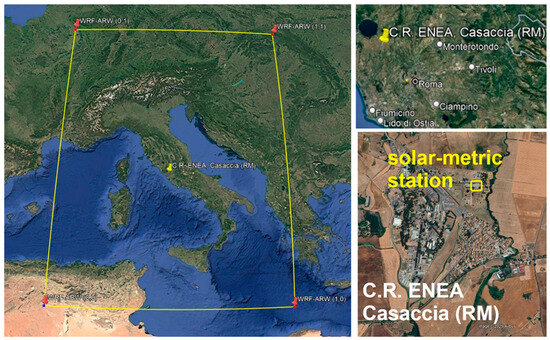
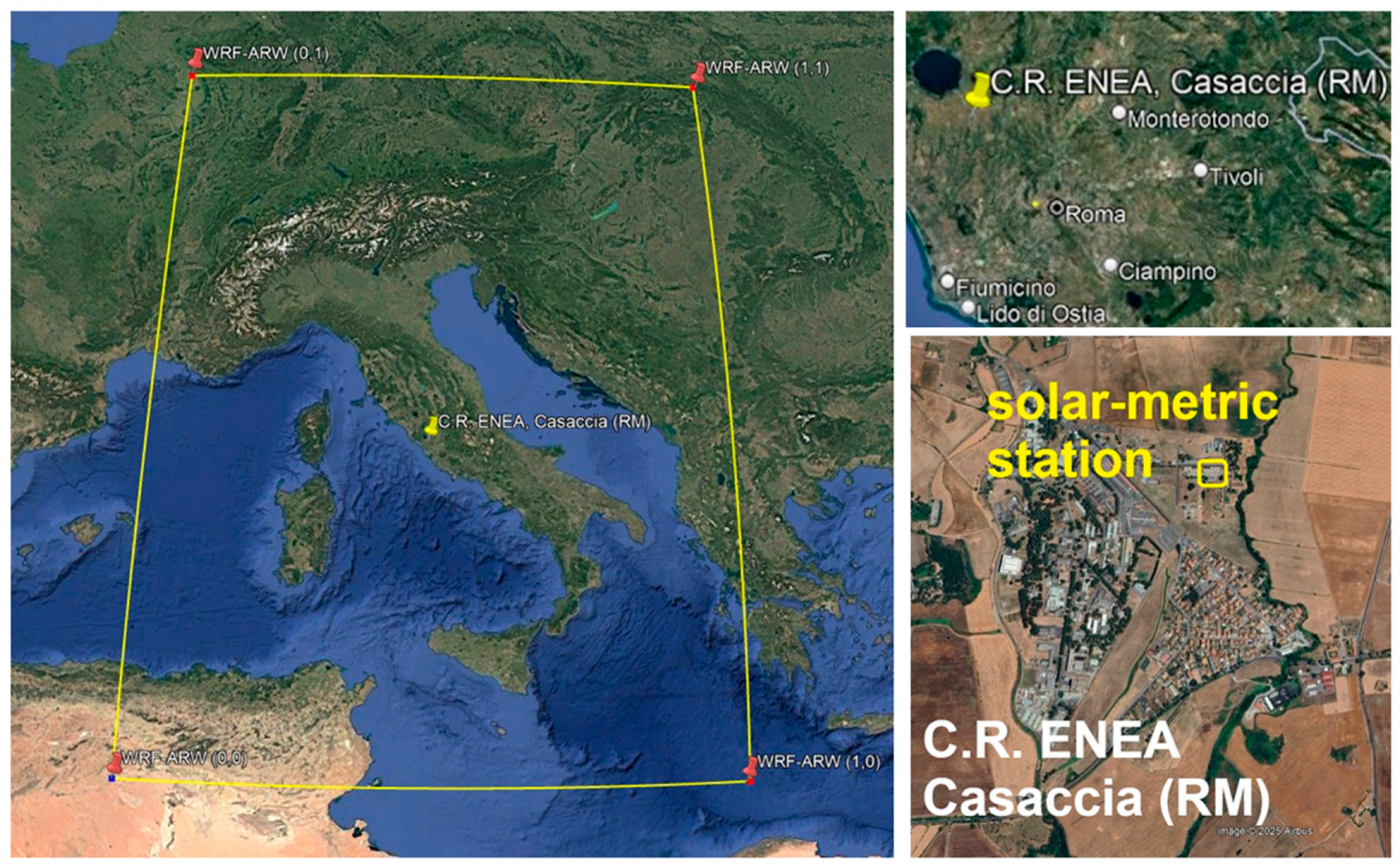
This vertical structure enables accurate representation of temperature, humidity, and cloud microphysics, a key parameter for computing the solar irradiance reaching the Earth’s surface. Figure 1 illustrates the computational domain along with the geographical location of ENEA C.R., the station used for comparison. The model is initialized every day with the 18:00 UTC forecast from the GFS. After applying a 6 h spin-up, each simulation starts at 00:00 UTC and produces outputs for the subsequent 72 h.
Figure 1.
WRF-ARW calculation domain (left) and more detailed views of the location of interest (right). The points of the computational domain are at latitudes 34.320° to 49.480° and in the longitude range of 4.375° to 21.125°. The geographical context and study area location were visualized using Google Earth satellite imagery [7].
The selection of physical parameterizations is important to solving the governing key physical process in complex system interactions between the Earth and the atmosphere inside the numerical model that guides us in the computation of solar radiation. Global horizontal irradiance represents the sum of direct incident radiation on a horizontal surface and diffuse radiation generated through interactions of sunlight with atmospheric aerosols, molecules, and cloud particles. Consequently, forecast accuracy depends on the proper representation of a set of interconnected physical parameters that control the transmission, scattering, and absorption of solar radiation. Cloud microphysics, atmospheric convection, radiative schemes, vertical mixing and turbulence, surface parameters, aerosols and atmospheric transparency, and interactions between physical parameters and quantitative impacts on GHI are just some of the physical parametrizations that could be selected in the architecture of numerical calculations.
Model simulation involves the numerical computation of the state of the atmosphere and the Earth’s surface over time, producing consistent and reliable output fields. The numerical stability of the simulation depends on the choice of spatial and temporal numerical steps to satisfy the Courant–Friedrichs–Lewy criterion and ensure accurate resolution of local atmospheric phenomena. Once the domain, computational grid, time steps, and physical parameters are configured, the WRF model proceeds with the numerical computation of Navier–Stokes, energy, and mass partial differential equations. The simulation evolves explicitly in time, updating the atmospheric state at each time interval. Within this phase, the model calculates the following: global radiation at each grid point using the RRTMG scheme [8]; cloud formation and distribution through the WRF Single moment 6-class (WSM6) microphysics scheme [9]; vertical transport and mixing in the boundary layer using the Younsei University scheme [10]; surface energy fluxes, including sensible and latent heat, via the Unified Noah Land Surface Model [11]; the influence of aerosols and greenhouse gases on solar radiation transmission and scattering. These calculations are performed simultaneously along the vertical column and across the horizontal grid, generating a three-dimensional representation of the atmospheric state. Computational execution produces hourly temporal outputs containing key meteorological variables and radiative fields, such as temperature, wind, humidity, cloud fraction, GHI, and more. The data outputs of meteorological fields on a three-dimensional grid (space and time) are saved in NetCDF format with hourly time resolution.
The extraction of data from the NetCDF files in the post-processing phase is necessary to tailor model outputs for the specific requirements of the case study. In this work, we focused on the analysis of solar irradiance at the location of interest, for which the direct GHI outputs and relevant atmospheric variables associated with solar radiation were extracted from the NetCDF files produced by the WRF model. The extraction process was performed in Python 3.11 by using the xarray [12] and netCDF4 libraries, which enable the efficient reading and manipulation of multi-dimensional datasets. The geographic coordinates of the selected site are 42.0433° N and 12.3082° E (ENEA C.R. Casaccia). The location of interest, in many cases, do not correspond to exact points on computational grids within the WRF domain (even with coarser grids), and in cases where the coordinates did not exactly match a grid node, the value of the nearest grid point was used. The nearest-grid-point approach is preferred because it preserves the natural intermittency in solar radiation caused by cloud movement and other short-lived atmospheric fluctuations. Spatial interpolation across neighboring grid points artificially smoothed these variations, thereby reducing the realism of the extracted time series. The processed data were subsequently organized in tabular format to facilitate statistical analysis and graphical visualization in the later stages of this study.
The simulation results were compared with observational data from the ENEA C.R. Casaccia meteorological and solar radiation station, calculating accuracy metrics such as RMSE and MAE. This validation confirmed the consistency of the simulation with real-world conditions and helped identify any localized discrepancies due to microclimatic phenomena not captured by the model.
Data post-processing included the generation of hourly data (averaged over the previous hour). In addition, using a decomposition model for global horizontal irradiance, direct normal irradiance (DNI) and diffuse horizontal irradiance (DHI) were calculated, providing all three components of solar radiation for analysis.
2.2. BSC (Balog–Spinelli–Caputo) Decomposition Model for Estimating Direct Normal Solar Irradiance (DNI) from Global Horizontal Solar Irradiance (GHI)
Decomposition models provide the mathematical framework for deriving direct normal irradiance (DNI) and diffuse horizontal irradiance (DHI) from global horizontal irradiance (GHI), an essential step when only GHI is available from measurements, satellites, or numerical weather prediction models. Classical empirical models [13,14,15], estimate the diffuse fraction directly from the clearness index, but their accuracy may degrade under highly variable sky conditions or in climates with strong aerosol influence. To overcome these limitations, modern decomposition approaches incorporate physical clear-sky modeling and satellite-derived cloud information. Clear-sky transmittance formulations [16,17], combined with Linke turbidity [18], enable the determination of clear-sky transmission coefficients for both global and direct irradiance. Cloud attenuation is then quantified through a clear-sky index, typically derived from geostationary satellite imagery via the Heliosat method [19].
Most decomposition models available in the literature are traditionally designed to first estimate DHI and subsequently derive DNI as the residual between the global and diffuse components. In contrast, the BSC (Balog–Spinelli–Caputo) decomposition model adopts a novel and physically oriented approach: it prioritizes the direct normal component as the primary quantity to be determined. This choice is motivated by the crucial role of DNI in concentrated solar power (CSP) systems, where even small inaccuracies in its estimation can propagate into significant performance deviations.
The intensity of solar energy reaching the Earth is fundamentally linked to the solar irradiance at the top of the atmosphere and to its attenuation as it passes through the atmospheric layers. By the time it reaches the Earth’s surface, this irradiance can be decomposed into its horizontal and normal components. The relationship between extra-atmospheric horizontal irradiance (I0) and extra-atmospheric normal irradiance (I0n) is expressed as
where θz is the zenith angle, defined as the angle between the Sun and the vertical direction at the observer’s location. The zenith angle varies throughout the day as a function of the hour angle. The computation of astronomical variables is described in detail in Appendix A.
Knowing the fundamental irradiance at the top of the atmosphere, the global horizontal irradiance at the Earth’s surface can be expressed as
where KT is the transmission coefficient (clearness index). This coefficient can be written as
In this expression, KT,c is the global transmission coefficient under clear-sky conditions, and kc is the clear-sky index representing the attenuation due to cloud cover (ratio between the measured and clear-sky GHI). The coefficient KT,c can be calculated by the Bourges formula [20], , where B is the clear-sky transmission coefficient for the hypothetical condition in which the Sun is at its zenith. This coefficient is location-dependent, as it accounts for site-specific atmospheric and climatological characteristics. For the Italian territory, B was derived using 10 years of data (2010–2020) of GHI from the Copernicus CAMS platform [21]. A set of representative locations (331 within Italy and 122 outside the national borders) was selected to ensure spatial uniformity in the resulting maps. For each site, the corresponding GHI values of clear-sky conditions during periods of maximum solar elevation (i.e., the daily maxima of cosθz) were extracted, and Kriging interpolation was used to obtain average monthly maps. This procedure enabled the construction of 12 monthly maps of the coefficient B for the entire Italian territory [22]. Consequently, the global horizontal irradiance for any location on the Italian territory can be expressed as
Similarly, the direct normal irradiance at the ground (DNI) we can written as
where Kbn is the atmospheric transmission coefficient for the DNI component. By analogy with the horizontal case, the transmission coefficient for the normal component can be expressed as
where Kbn,c is the clear-sky transmission coefficient for DNI under clear-sky conditions and fc is the clear-sky index (attenuation factor) associated with cloud effects on the direct component. The coefficient Kbn,c can be computed using the Linke formula (see Appendix B), , where m is the optical air mass, δR is the Rayleigh optical depth, and TL is the Linke turbidity factor. The coefficients m and δR can be calculated with empirical formulas, where for m, we used the formulas in [23], while for δR, those in [24].
The Linke turbidity factor (TL) and clear-sky transmission coefficient (B) play analogous roles for DNI and GHI, respectively. To relate these two quantities, we used long-term minute-resolution time series of GHI and DNI collected over long time series of several years (2012–2024) at the ENEA Casaccia Research Centre near Rome, Italy (latitude 42.0433° N, longitude 12.3082° E). Measurements were obtained using an EKO solar-metric station (a pyranometer for GHI and a pyrheliometer with solar tracker for DNI) [25]. From this dataset, we derived the following empirical relationship between TL and B:
Assuming that the attenuation of GHI and DNI by clouds has the same physical origin, a first approximation is to set the DNI clear-sky index equal to the global attenuation (fc = kc). In practice, however, the attenuation of the direct component (fc) and that of the global component (kc), which also depends on the diffuse irradiance component, differ under cloudy conditions. Using the same observational dataset, we established the following correlation between the global horizontal attenuation factor kc and the direct normal attenuation factor fc:
Finaly, DNI, in this BSC model approach, can be computed starting from measured GHI by using
Lastly, the diffuse horizontal irradiance at the Earth’s surface (DHI) is obtained as
If we want to follow the same analogy and to express DHI as a fraction of the global irradiance k, , using the above Equations (1), (2), (5) and (10), we could now rewrite the diffuse fraction related to global and direct attenuation as
The equivalence between the transmission factor of DNI (Kbn) and that of the direct horizontal component (Kbh) follows from
where DirHI is the direct horizontal irradiance at the Earth’s surface.
The advantage of the proposed BSC decomposition model is that the coefficients in Equation (7) for TL and Equation (8) for fc, at this precise location, calculated with long-term observations, can be applied to any other location. The coefficients in Equation (8) are based solely on the attenuation effect of clouds on incoming solar radiation, which is governed by radiative processes that are physically the same regardless of location. Therefore, cloud-induced attenuation is expected to affect solar radiation in a similar manner worldwide.
All additional variables in the model are known or straightforward to compute, and the astronomical quantities have well-defined spatial and temporal dependencies (see Appendix A).
The BSC decomposition model adopted in this study belongs to the family of transmittance-based approaches. It incorporates a physically consistent description of atmospheric transmission through the use of the clear-sky coefficients B (Bourges coefficient) and TL (Linke turbidity factor), combined with cloud-attenuation indices derived from long-term ground measurements and geostationary satellite observations. This framework enables a robust estimation of DNI and DHI from GHI for a wide range of atmospheric conditions and ensures applicability across the entire Italian territory. Within this methodology, we established a correlation between the clear-sky transmission coefficient B for GHI and the turbidity factor TL, using high-quality GHI and DNI observations from clear-sky periods to ensure physical consistency and minimize model uncertainty.
2.3. Calculation of Hourly Averaged Solar Radiation from Instantaneous Data and Introduction of Correction Factor f for GHI
The calculation of hourly averaged solar radiation from instantaneous data is an essential step in re-processing measurements for engineering applications. In fields such as PV and CSP system simulations, it is more often necessary to use the mean over a preceding hourly period of global, direct, and diffuse radiation. However, the WRF model typically provides instantaneous data at one-hour intervals.
To derive physically meaningful hourly averages, these instantaneous values must be integrated and corrected using a rigorous aggregation procedure that accounts for solar geometry and the intrinsic variability in radiative flux. The instantaneous value I(t), expressed in W·m−2, represents the momentary intensity of the available energy flux, whereas the hourly mean I(h) corresponds to the total energy received over one hour divided by the duration of the interval:
where Δt = 3600 s. In discrete form, for data sampled every δt, this becomes
with .
This arithmetic mean provides a first approximation of the hourly average, but it does not account for the fact that solar radiation does not vary linearly with time. Instead, it follows a pattern governed by the Sun’s apparent trajectory, primarily through changes in the solar zenith angle (θz). The correction for this nonlinearity yields an hourly average that more accurately represents the true radiative behavior over the solar hour. The following paragraph introduces the physical meaning of the correction factor f.
The correction factor f is a multiplicative coefficient that enables the estimation of hourly averaged solar radiation from instantaneous values. It assumes that ground irradiance follows the theoretical temporal variation in extra-atmospheric radiation. In other words, f accounts for the fact that solar radiation at the beginning and end of an hour differs from the radiation at the midpoint of the interval (i.e., the average of the two extreme values), due to changes in the solar elevation angle.
The general relationship for the hourly averaged extra-atmospheric irradiance is
where is the average of the instantaneous extra-atmospheric irradiance values at the beginning (Ifirst) and end (Ilast) of the interval. The dimensionless factor f depends on the hour angles at the start and end of the interval (ωfirst and ωlast), the solar declination δ, and the site latitude ϕ. The correction factor is computed using extra-atmospheric global horizontal irradiance (see Appendix A) for the location of interest. For example, if instantaneous irradiance values are available at 10:00 and 11:00 for a site location at latitude ϕ, then Iₕ represents the hourly averaged extra-atmospheric irradiance between 10:01 and 11:00 (referenced to 11:00).
Once the instantaneous values with the WRF-ARW model are available and the hourly GHI averaged values have been calculated, the next step is to compute the hourly averaged DNI using decomposition models.
3. Results
In the one-year period of WRF forecasts, from 1 November 2024 to 30 November 2025, we have 28 missing days due to unavailable computations caused by regular maintenance of the hosting cluster. Even though we have the forecast data for 72 h, here we will present the data for 24 and 48 h. This section shows the results for the 24 and 48 h forecasts for GHI and DNI compared with observations for instantaneous and hourly averaged data. In the following figures showing dispersion graphs and Taylor diagrams, we introduce patterns in seasonal coloring, where blue colors stand for winter months, green for spring, red for summer, and yellow for the autumn months. In the presented statistics, the entire dataset is considered.
3.1. Model Ability to Forecast Instantaneous and Hourly GHI
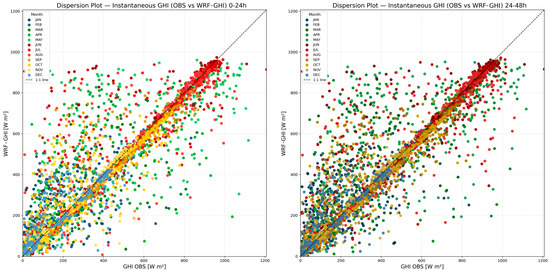
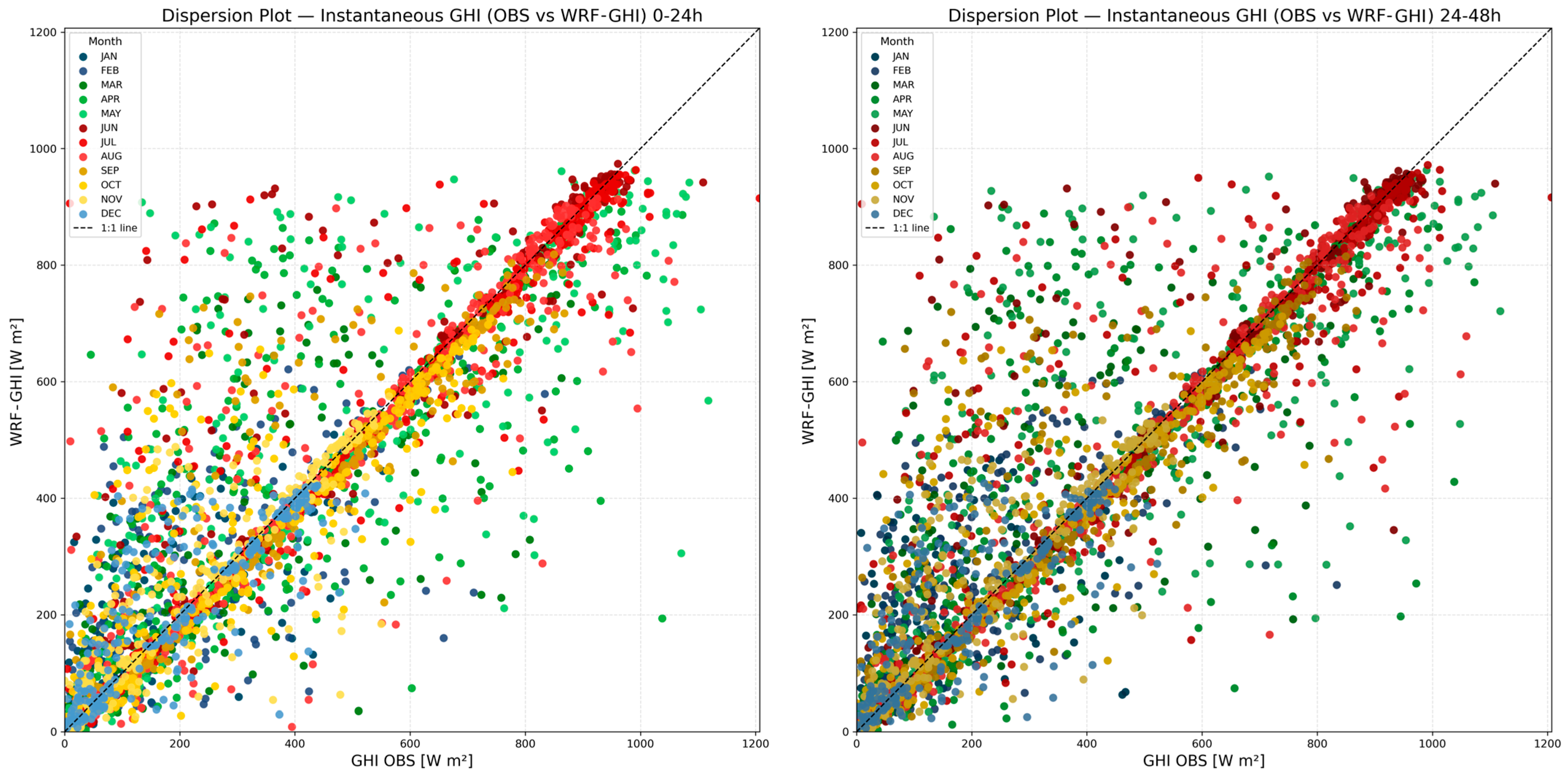
Figure 2 presents the dispersion plots comparing observed instantaneous GHI with model forecasts at the lead times of 24 h (left) and 48 h (right). In both cases, the dashed line represents the 1:1 correspondence between observations and predictions, while the color pattern highlights the seasonal variability across months.
Figure 2.
Comparison of GHI values for instantaneous (GHIobs) and WRF (GHI WRF) forecasts of 0–24 h (left) and 24–48 h (right).
For the 24 h forecast, the scatter points are closely clustered around the 1:1 line over the full range of GHI values, indicating strong agreement between measured and predicted irradiance. The dispersion increases moderately at low irradiance levels (<200 W·m−2), which is mainly attributable to early morning, late afternoon, and cloudy conditions, where rapid atmospheric variability is more difficult to capture. At higher irradiance values (>600 W·m−2), the forecast ability remains high, with limited bias and reduced spread, suggesting that clear-sky conditions are well represented by the model. Seasonal effects are evident, with summer months showing higher concentrations at elevated GHI levels and reduced relative scatter.
In contrast, the 48 h forecast exhibits visibly larger dispersion around the 1:1 line, reflecting the expected degradation in predictive ability with the increase in lead time. While the overall linear relationship between observed and predicted GHI is preserved, the spread of points increases across all irradiance ranges, particularly at intermediate and high GHI values. This indicates a growing uncertainty in cloud cover and atmospheric dynamics representation at longer horizons. A slight tendency toward underestimation at high irradiance levels can also be observed, especially during summer months, suggesting cumulative forecast errors under synoptic-scale conditions.
The comparison between the two lead times highlights a clear reduction in forecast accuracy from 24 h to 48 h. The 24 h predictions demonstrate tighter clustering, lower variance, and closer adherence to the ideal 1:1 relationship, whereas the 48 h forecasts show increased scatter and reduced reliability. Nevertheless, the persistence of a strong correlation even at 48 h confirms the robustness of the forecasting framework and its suitability for short- to medium-term solar resource assessment. These results underline the trade-off between forecast horizon and accuracy and emphasize the added value of shorter lead times for operational solar energy applications.
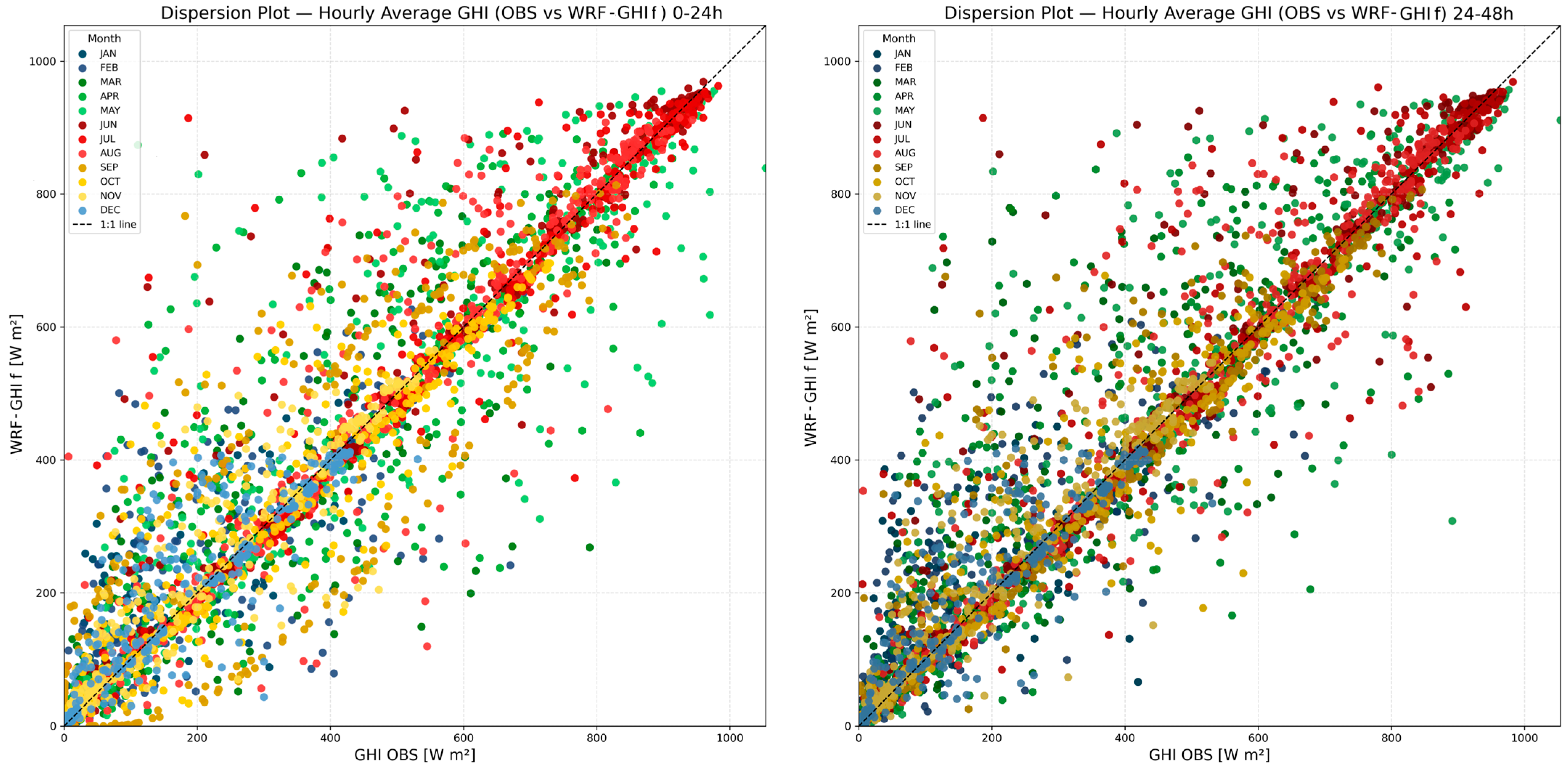
In Figure 3 we show the dispersion plots comparing observed hourly averaged GHI with WRF forecasts for the previous hour calculated with the proposed correction factor (WRF-GHIf) at the lead times of 24 h (left) and 48 h (right). For the 24 h horizon, the points are strongly concentrated along the 1:1 line across the whole irradiance range, indicating high agreement between measured and predicted hourly mean GHI. The spread is relatively limited, with the largest dispersion occurring at low irradiance (<200 W·m−2), where sunrise/sunset effects and intermittent cloudiness introduce higher relative variability. At medium-to-high values (>600 W·m−2), the cloud of points becomes tighter and the bias appears small, suggesting that clear-sky and predominantly stable conditions are well reproduced. Summer months dominate the upper-right region and exhibit the densest clustering, consistent with the higher frequency of clear-sky conditions and a more regular diurnal cycle.
Figure 3.
Comparison of GHI values for hourly average (GHIobs) and the WRF forecasts for the previous hour calculated with the proposed correction factor (WRF-GHIf) for 0–24 h (left) and 24–48 h (right).
In the 48 h forecast, the overall linear relationship is preserved, but the scatter around the 1:1 line increases, especially in the intermediate irradiance range (300–700 W·m−2), where forecast uncertainty in cloud timing and extent is typically the highest. While high-GHI conditions still show clear alignment with the 1:1 line, the broader dispersion indicates reduced reliability and increasing variance with lead time, as expected for a longer forecast horizon. The comparison between lead times confirms a systematic degradation in hourly mean data from 24 h to 48 h also presented in instantaneous data, particularly under partly cloudy regimes.
Compared with the analogous dispersion plots for instantaneous GHI discussed previously, the hourly averaged GHI results display visibly reduced scatter and more compact distribution around the 1:1 line at both lead times. This improvement is consistent with the smoothing effect of temporal aggregation, which attenuates high-frequency fluctuations driven by rapidly evolving cloud fields and short-lived atmospheric variability. Consequently, hourly averaging yields more robust and operationally reliable GHI forecasts, and it mitigates the loss of forecast ability associated with extending the forecast horizon from 24 h to 48 h.
Regarding WRF-GHIf for the 0–24 h case (Figure 3, left), the data points exhibit a noticeably more compact alignment compared with the instantaneous WRF-GHI (Figure 2, left). The regression line displays a slope very close to unity (0.9862 versus 0.9418) and a reduced intercept (10.967 W·m−2 versus 18.805 W·m−2), indicating an almost negligible systematic bias over the entire irradiance range. The R2 value of 0.9367 (compared with 0.8911) further confirms an improvement in predictive performance.
Also, regarding WRF-GHIf for the 24–48 h case (Figure 3, right), the regression line for the hourly mean exhibits a slope with a value of 0.9883 compared with the WRF-GHI 24–48-h case (Figure 2, right), which shows a value of 0.9433, and a limited intercept (13.341 W·m−2 versus 21.378 W·m−2), indicating minimal systematic bias over the entire irradiance range. The high value of the coefficient of determination R2 (0.9321 compared with 0.8837) confirms the strong predictive capability of the model even at a 24–48 h forecast horizon when hourly averaged GHI is considered.
Overall, the approach based on hourly averages corrected by the factor f is more robust and reliable for operational applications and energy assessment purposes than the direct use of instantaneous forecasts from the numerical model.
The seasonal measure, following the same color pattern, and the ability of the WRF model to forecast GHI values are also described in Taylor diagrams, providing a compact assessment of model ability across different months. The statistics and formation of the diagram are described in detail in Appendix C. Full monthly statistics for the 24 h and 48 h instantaneous and hourly GHI forecasts are shown in Table 1 and Table 2.
Table 1.
Statistics of instantaneous GHI values. STD is standard deviation, r is Pearson correlation coefficient, RMSE is Root Mean Square Error, and R2 is coefficient of determination.
Table 2.
Statistics for hourly averaged GHI. STD is standard deviation, r is Pearson correlation coefficient, RMSE is Root Mean Square Error, and R2 is coefficient of determination.
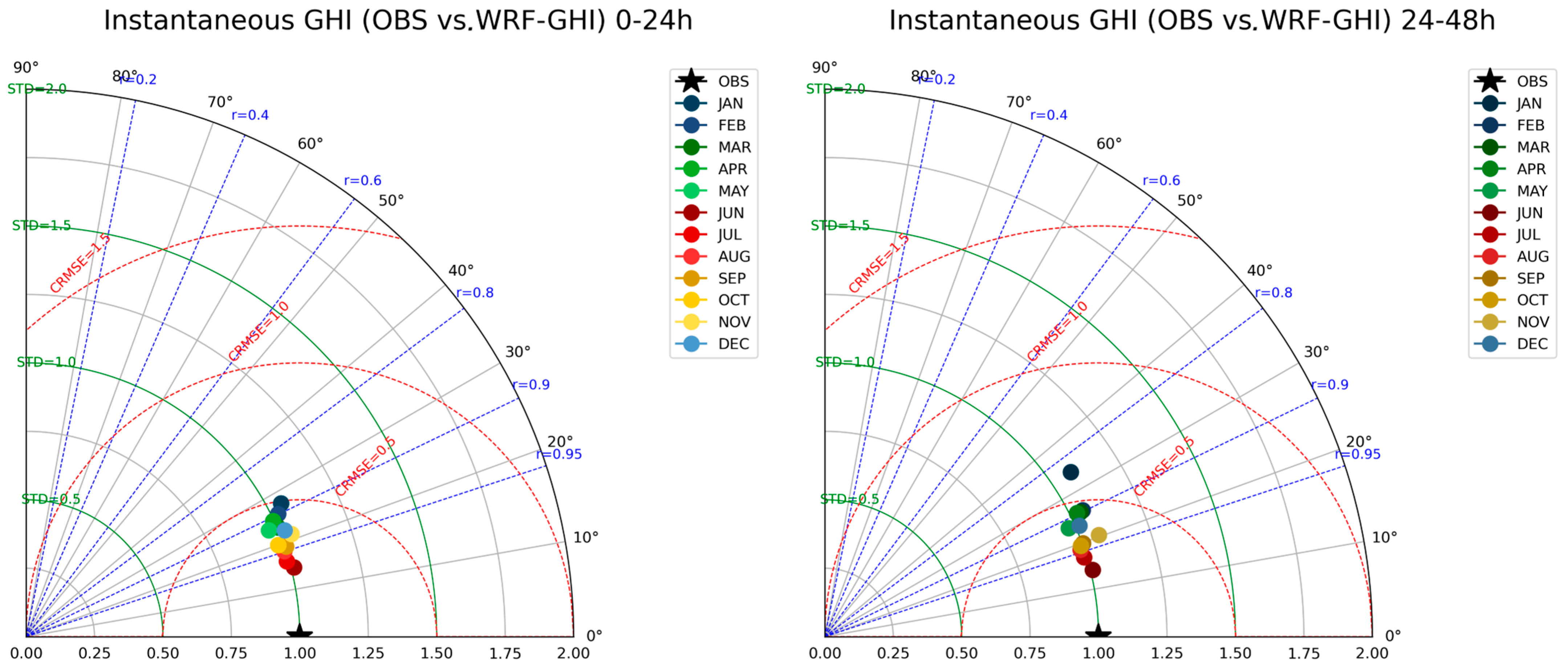
Figure 4 illustrates the Taylor diagrams summarizing the statistical performance of the instantaneous GHI forecasts against observations for lead times of 24 h (left) and 48 h (right). For the 24 h forecast, the monthly points are clustered relatively close to the reference observation point, indicating a high degree of consistency between observed and forecasted GHI. Correlation coefficients are generally high, with values approaching or exceeding 0.9 for most months, particularly during late spring and summer. The normalized standard deviation is close to unity, indicating that the model captures the overall magnitude of the observed GHI variability. The relatively small Centered Root Mean Square Error (CRMSE) values further confirm the good performance of the forecast at this lead time, especially under conditions dominated by stable atmospheric regimes.
Figure 4.
Taylor diagrams of instantaneous GHI values: data for the first 24 h of the forecast are on the left, while 48 h data are on the right. The diagrams are presented with season coloring.
In the 48 h forecast, a noticeable degradation in model performance is observed. The monthly points shift away from the reference point, reflecting a reduction in correlation and an increase in CRMSE. Although correlations remain reasonably strong for most months, their values are systematically lower than those observed at 24 h, indicating diminished temporal coherence between forecasts and measurements. Additionally, the normalized standard deviation tends to deviate more from unity, revealing an over- or under-representation of GHI variability depending on the season. This behavior is particularly evident during transitional months, when rapidly evolving meteorological conditions increase forecast uncertainty.
The comparison between the two lead times clearly highlights the impact of the forecast horizon on predictive ability. The 24 h forecasts exhibit higher correlations, better representation of observed variance, and lower CRMSE across all seasons, whereas the 48 h forecasts show increased dispersion and reduced accuracy. Nonetheless, the overall structure of the Taylor diagrams indicates that the model retains a substantial level of forecast ability even at 48 h, supporting its applicability for short- to medium-term solar resource forecasting. These results emphasize the importance of lead-time selection in operational applications and demonstrate the added value of shorter forecasts for accurate GHI prediction.
The results reported in Table 1 highlight the statistical performance of the WRF model in forecasting instantaneous GHI over 0–24 h and 24–48 h horizons.
For both forecast horizons, the standard deviation (STD) values are close to unity throughout the year, indicating a good forecast ability of the model. The correlation coefficient (r) shows a marked seasonal behavior, with generally higher values during summer for the short-term forecast (up to 0.961 in June) and a more pronounced reduction for the 24–48 h horizon, particularly in winter months. Similarly, the Root Mean Square Error (RMSE) increases with the forecast lead time, with lower values in the 0–24 h forecast (e.g., 51.902 W·m−2 in December) and higher errors during spring and summer, when solar irradiance intensity is higher. Overall, the results indicate that model accuracy is strongly dependent on both season and forecast horizon, with the best performance obtained during high radiation months and for short-term predictions.
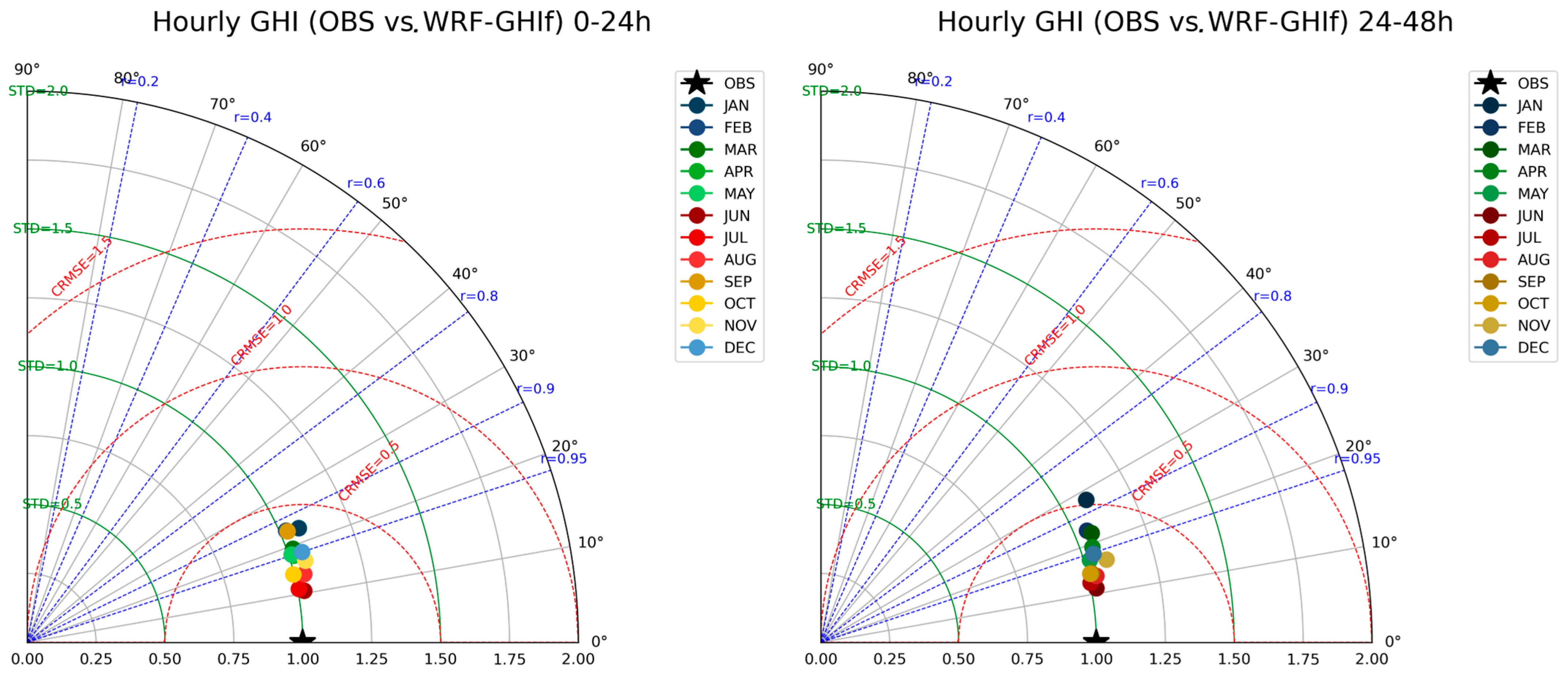
Figure 5 presents the Taylor diagrams for hourly averaged GHI, comparing observations with model forecasts at lead times of 24 h (left) and 48 h (right), allowing for a concise evaluation of forecast performance across different months.
Figure 5.
Taylor diagrams of hourly average GHI values: data for the first 24 h of the forecast are on the left, while 48 h data are on the right. The diagrams are presented with season coloring.
For the 24 h hourly mean forecast, the monthly markers are tightly clustered near the reference observation point, indicating very strong agreement between measured and predicted GHI. Correlation coefficients are consistently high, generally exceeding those obtained for instantaneous GHI, and the normalized standard deviation is close to unity for most months. This demonstrates that temporal averaging effectively reduces high-frequency variability, enabling the model to better capture the dominant diurnal and synoptic-scale features of solar irradiance. Consequently, CRMSE values are reduced, particularly during summer months characterized by more stable atmospheric conditions.
In the 48 h hourly mean forecast, a degradation in model performance is again evident, with statistical points moving farther from the reference position compared with the 24 h case. However, the dispersion remains smaller than that observed in the corresponding instantaneous GHI Taylor diagram. Correlations remain relatively high, and the normalized standard deviation shows a moderate deviation from unity, suggesting that hourly averaging mitigates part of the forecast uncertainty associated with cloud evolution and short-term atmospheric fluctuations. This results in lower CRMSE values compared with the instantaneous 48 h forecasts.
The comparison between the two lead times confirms that forecast ability decreases with the increase in the horizon, as already observed for instantaneous GHI. Nevertheless, the reduction in performance from 24 h to 48 h is less pronounced for hourly averaged GHI, highlighting the stabilizing effect of temporal aggregation. This behavior is particularly substantial for operational energy applications, where hourly values are often more representative of system-scale performance than instantaneous measurements.
In Table 2 we show reports of the statistical performance of the model for hourly averaged GHI forecasts over 0–24 h and 24–48 h horizons. For both forecast ranges, the standard deviation (STD) is close to unity in all months, indicating that the model captures the overall magnitude of the observed hourly irradiance variability, although this metric alone does not assess temporal agreement. Correlation values (r) exhibit pronounced seasonality, with higher correlations during summer months, reaching 0.971 for the 0–24 h horizon in June, and slightly lower but still strong values for the 24–48 h horizon (e.g., 0.976 in June). The RMSE values indicate that forecast errors are generally lower in summer and autumn, while larger discrepancies occur during spring months and September, especially for the 0–24 h horizon. As expected, an increase in forecast lead time systematically results in higher RMSE values, although the degradation in performance from 24 h to 48 h is moderate, particularly during high-radiation months.
Both the Taylor diagrams and table statistics for instantaneous and hourly averaged GHI forecasts reveal that hourly averaging tends to improve forecast accuracy overall, especially in terms of correlation and RMSE. In Taylor diagrams of instantaneous GHI, the hourly mean results show systematically higher correlations, a closer match to observed variance, and reduced CRMSE for both lead times. This indicates that while instantaneous GHI forecasts are more sensitive to short-lived cloud processes and rapid atmospheric changes, hourly averaging enhances forecast robustness and reliability. Overall, these findings demonstrate that hourly averaged GHI forecasts provide improved statistical performance relative to instantaneous predictions, especially at longer lead times, reinforcing their suitability for short- to medium-term solar energy forecasting and grid management applications.
3.2. Model Ability to Forecast Hourly DNI
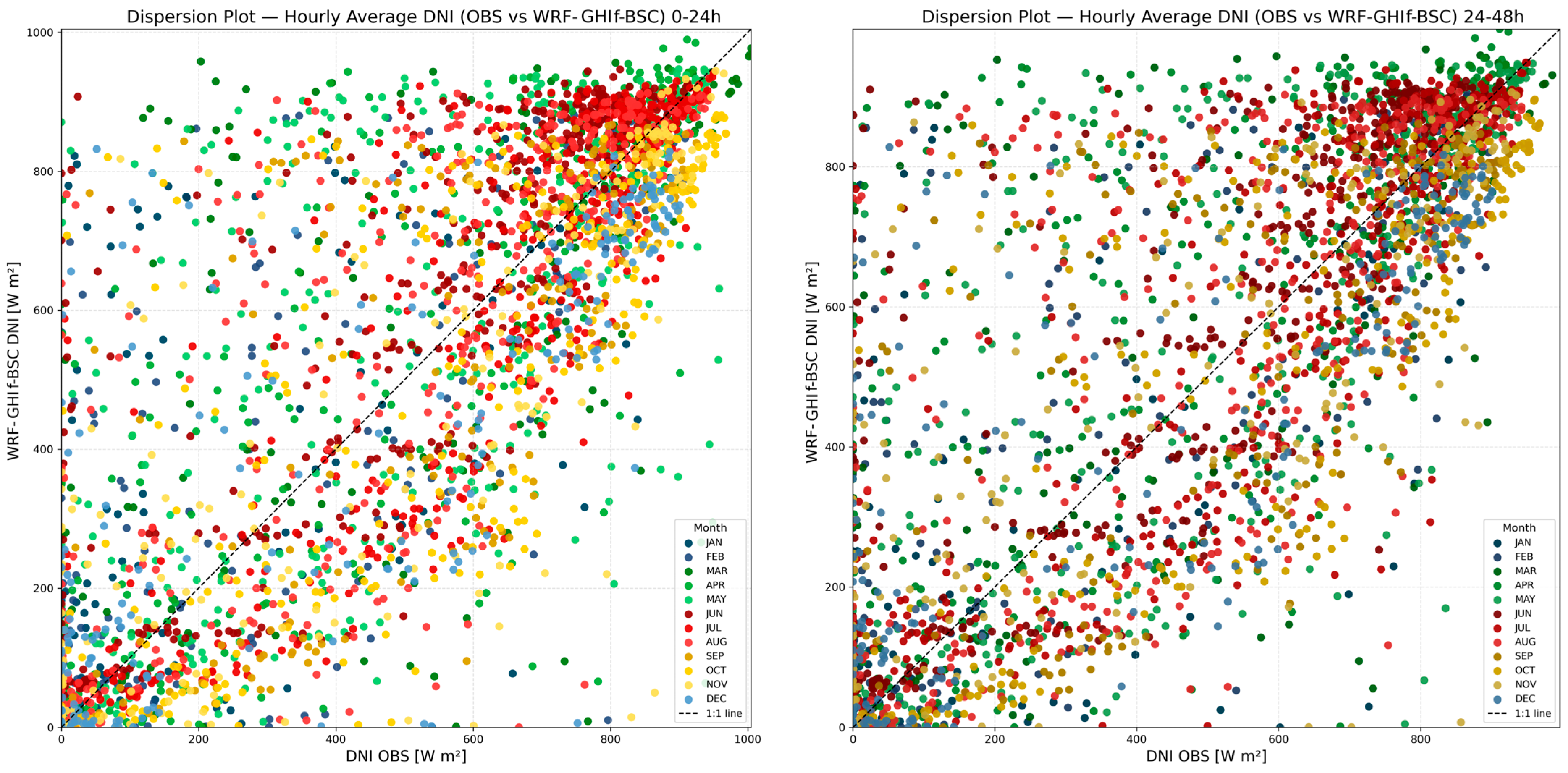
Figure 6 shows the dispersion plots comparing observed hourly averaged direct normal irradiance (DNI) with model forecasts at the lead times of 24 h (left) and 48 h (right).
Figure 6.
Yearly dispersion plot with seasonal colors for DNI at 0–24 h (left) and 24–48 h (right). Comparison of DNI values for hourly (DNIobs) and WRF forecasts for the previous hour calculated with the proposed correction factor and decomposition model (DNI WRF-GHIf-BSC).
For the 24 h forecast, the scatter distribution reveals a clear linear relationship between measured and predicted DNI, with a substantial concentration of points aligned along the 1:1 line. This indicates good overall agreement and satisfactory model capability to reproduce hourly mean DNI values. The dispersion increases at low to intermediate DNI levels, reflecting the higher sensitivity of direct irradiance to cloud cover variability, aerosol loading, and transient atmospheric conditions. At higher DNI values, typically associated with clear-sky conditions, the model performance improves, with reduced scatter and limited bias. Seasonal differences are evident, with summer months showing higher density of points at elevated DNI values and relatively tighter clustering.
In the 48 h forecast, broader dispersion around the 1:1 line is observed, consistent with the expected degradation in forecast accuracy at longer lead times. While the overall linear trend is preserved, the scatter increases across the entire DNI range, particularly at intermediate and high irradiance levels. This behavior highlights the growing uncertainty in predicting cloud evolution and atmospheric transparency over longer horizons. A slight tendency toward underestimation at high DNI values can be identified, especially during periods characterized by strong solar forcing, suggesting cumulative forecast errors in clear-sky representation or cloud timing.
The comparison between the two lead times clearly indicates superior performance for the 24 h forecast, characterized by tighter clustering, reduced variance, and closer adherence to the ideal 1:1 relationship. The 48 h forecast, although it still captures the general variability in DNI, exhibits increased scatter and reduced reliability, especially under conditions of high irradiance. Nevertheless, the persistence of a well-defined correlation even at 48 h demonstrates the robustness of the forecasting framework and its applicability for short- to medium-term solar energy assessments. These results emphasize the strong dependence of DNI forecast accuracy on lead time and highlight the added value of shorter-term predictions for applications requiring precise estimates of direct solar radiation.
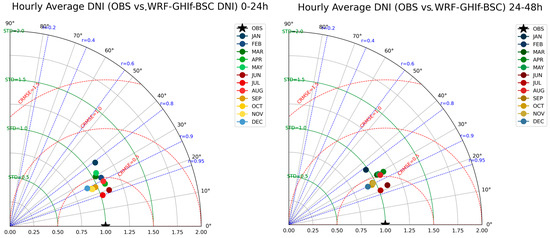
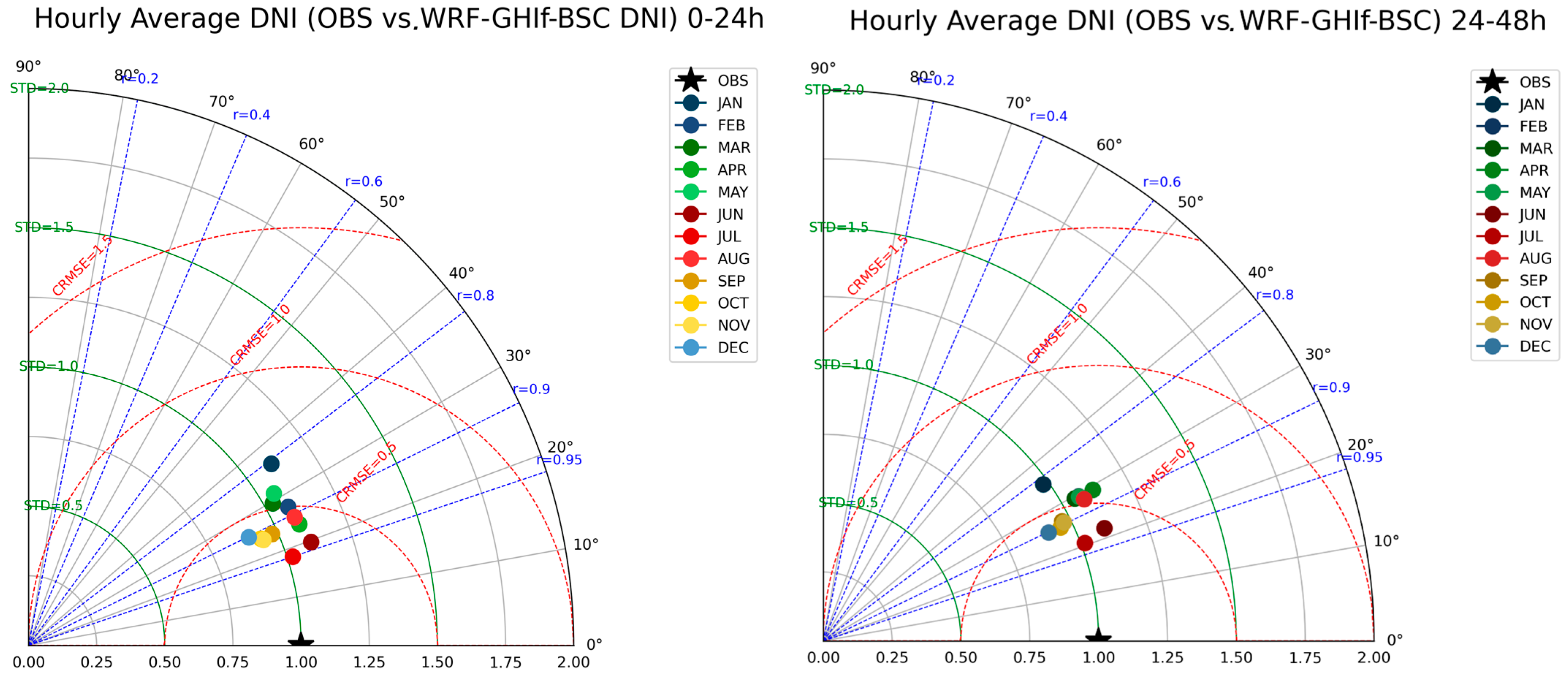
Figure 7 presents the Taylor diagrams for hourly averaged DNI, comparing observations with WRF-GHIf-BSC DNI forecasts at lead times of 24 h (left) and 48 h (right).
Figure 7.
Taylor diagrams of hourly average DNI values: data for the first 24 h of the forecast are on the left, while 48 h data are on the right. The diagrams are presented with seasonal coloring.
For the 24 h DNI forecast, the monthly points are relatively close to the reference observations, indicating a good representation of the observed variability and generally high correlation coefficients. However, compared with GHI, the spread of points is larger, and correlations are slightly lower, reflecting the intrinsic sensitivity of DNI to cloud optical depth, cloud fraction, and aerosol variability. The normalized standard deviation is close to unity for several months, although deviations are evident, particularly during transitional seasons, suggesting that the model sometimes overestimates or underestimates the amplitude of DNI fluctuations. CRMSE values remain moderate, indicating acceptable forecast ability at this lead time.
In the 48 h forecast, a clearer degradation in performance is observed. The monthly points shift further away from the reference position, with reduced correlation coefficients and increased CRMSE compared with the 24 h case. The normalized standard deviation tends to deviate more from unity, indicating a less accurate reproduction of the observed hourly DNI. This degradation is particularly pronounced during months characterized by higher atmospheric instability, confirming the increased difficulty in predicting DNI at longer lead times due to uncertainties in cloud evolution and atmospheric transparency.
The comparison between the two lead times highlights a systematic reduction in forecast ability from 24 h to 48 h, consistent with the behavior observed for GHI. Nevertheless, the relative loss of performance is more pronounced for DNI than for GHI, underlining the higher predictability of GHI compared with its DNI component. Despite this reduction, the 48 h forecasts still preserve a meaningful correlation with observations, indicating that the modeling system retains useful predictive capability for short- to medium-term applications.
Hourly averaged GHI forecasts are generally more robust and less sensitive to short-term cloud variability than DNI forecasts. The findings emphasize that while temporal averaging improves forecast performance for both variables, DNI remains inherently more challenging to predict, especially at longer lead times. These results are particularly relevant for solar energy applications relying on direct radiation, where shorter forecast horizons and additional post-processing may be required to achieve accuracy levels comparable to those obtained for GHI.
The statistical evaluation of hourly averaged DNI forecasts in Table 3 indicates generally good model performance across all months, with consistently high correlation coefficients (r ≈ 0.80–0.95) and coefficients of determination (R2 > 0.55). Forecast ability is the highest during summer months, particularly June and July, characterized by maximum correlation and minimum RMSE values, reflecting more stable clear-sky conditions. A moderate degradation in performance is observed for the 24–48 h forecast compared with the 0–24 h forecast, evidenced by increased RMSE and slightly reduced correlation, especially during spring and transitional seasons. Nevertheless, the similarity of standard deviation values between lead times suggests that the model adequately represents the variability in hourly DNI throughout the year.
Table 3.
Statistics for hourly averaged DNI. STD is standard deviation, r is Pearson correlation coefficient, RMSE is Root Mean Square Error, and R2 is coefficient of determination.
3.3. Model Bias and Daily Energy Distribution
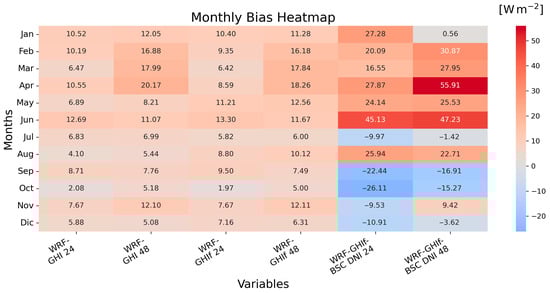
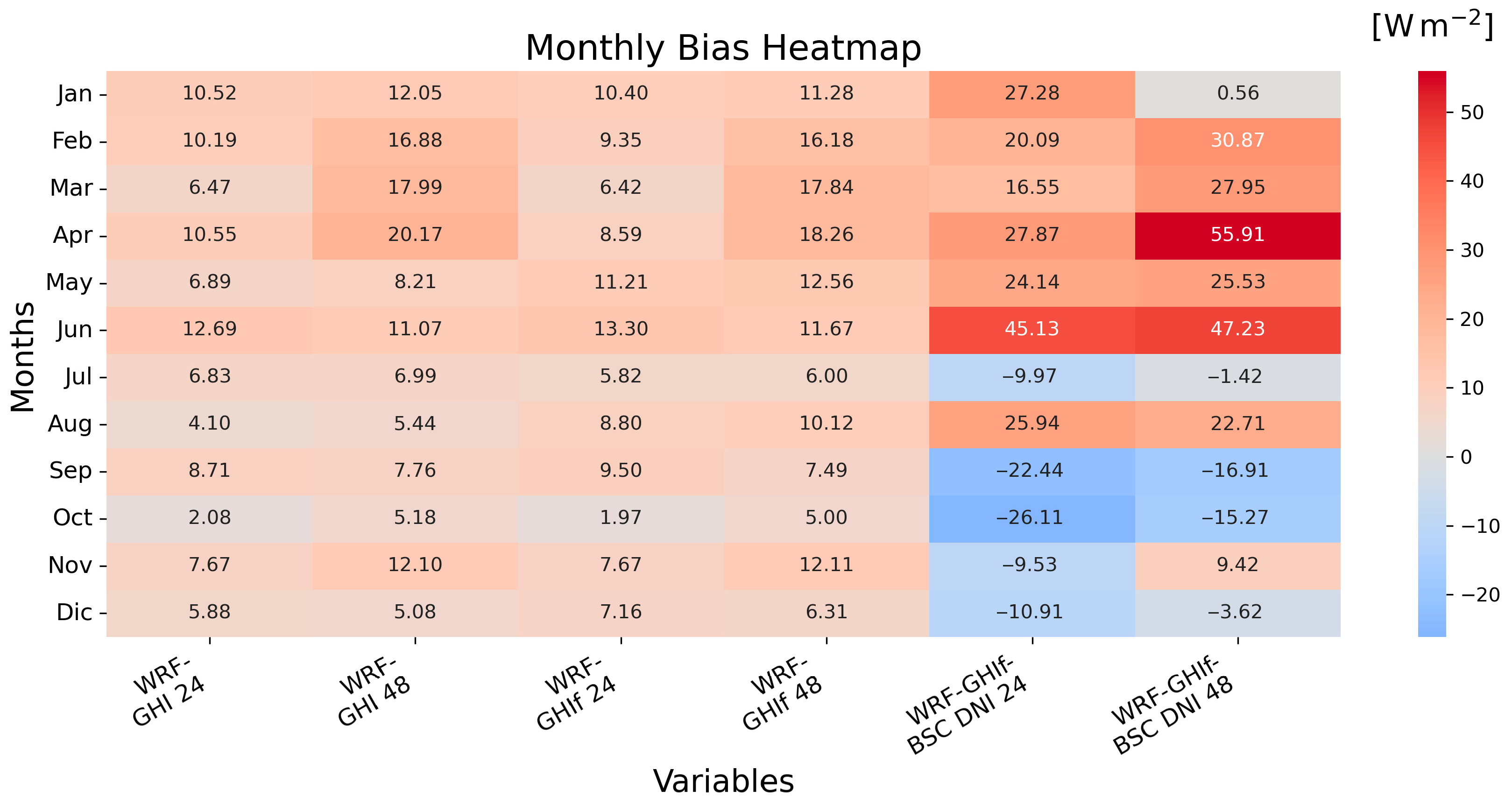
The monthly bias heatmap highlights and compares different bias types. The clear seasonal patterns in model performance for both GHI and DNI forecasts at the 24 h and 48 h horizons are presented in Figure 8. For GHI, both instantaneous and hourly biases remain positive throughout the year, with generally higher errors in winter and spring and lower values in summer. The 48 h forecasts consistently exhibit larger biases than the 24 h forecasts, particularly from February to April, possibly indicating systematic forecast ability degradation with the increase in lead time. In contrast, DNI biases show more pronounced seasonal variability, with large positive errors during late spring and early summer and negative biases during autumn, suggesting difficulties in accurately representing direct irradiance under transitional atmospheric conditions. The strong positive DNI biases in April–June and the negative values in September–November emphasize the model’s sensitivity to seasonal changes in cloud dynamics and aerosol loading. Overall, the heatmap underscores that forecast accuracy varies substantially across months, variables, and time horizons, with 48 h forecasts showing the greatest deviations, particularly for DNI.
Figure 8.
Monthly bias heatmap.
Daily energy distribution from GHI and DNI was derived from observed irradiance measurements and forecasts by temporal integration over each day at both the 24 h and 48 h horizons. Daily GHI (Figure 9) and DNI (Figure 10) energy was subsequently obtained by integrating the hourly mean irradiance over the entire daily period. The observations were aggregated by computing the mean irradiance for each day and multiplying it by the corresponding daylight duration, yielding daily energy values expressed in Wh·m−2. Forecast values were derived from instantaneous model outputs using a dedicated temporal interpolation and averaging scheme to produce hourly mean irradiance consistent with the observational processing. This approach provides a consistent estimate of daily surface solar energy suitable for comparison with forecast data.
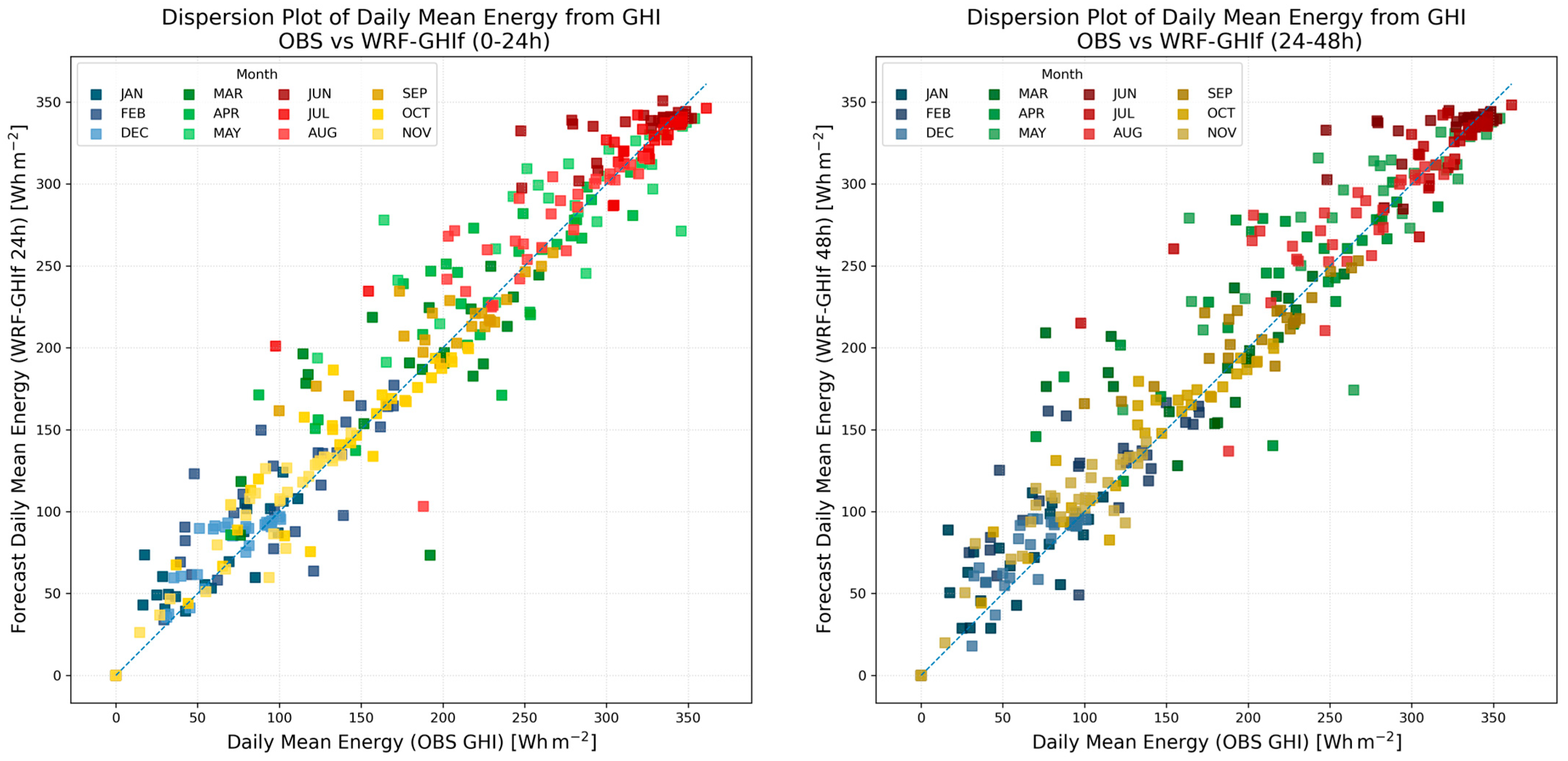
Figure 9.
Daily mean energy dispersion plot with seasonal colors: GHI for 0–24 h is shown on the left, and that for 24–48 h is shown on the right.
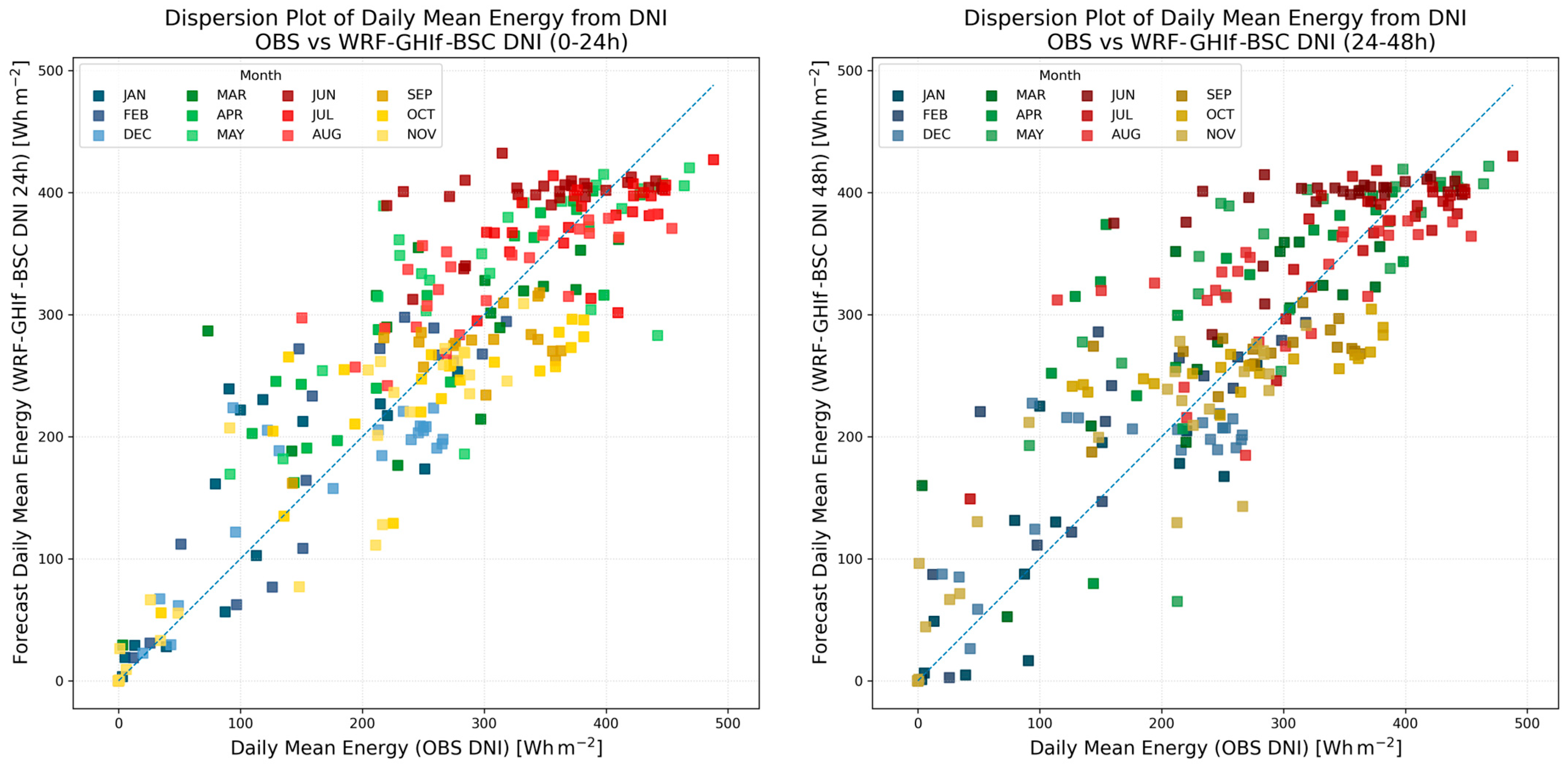
Figure 10.
Daily mean energy dispersion plot with seasonal colors: DNI for 0–24 h is shown on the left, and that for 24–48 h is shown on the right.
Figure 9 (left) presents the dispersion plot between the observed daily mean global horizontal irradiance (GHI) and the corresponding forecasted daily mean GHI obtained from hourly forecasts with a 24 h lead time, where each point represents a daily mean value. The results show a strong linear relationship between observed and forecasted values, indicating that the aggregation of hourly GHI forecasts at a 24 h horizon provides a reliable estimate of daily mean irradiance. Most data points are closely clustered around the 1:1 line, particularly for intermediate and high GHI values, which are mainly associated with spring and summer months. A slightly larger dispersion is observed at lower GHI levels, typical of winter conditions, suggesting increased uncertainty under cloudy or low-irradiance regimes.
Figure 9 (right) shows the same comparison but for daily mean GHI forecasts derived from hourly predictions with a 48 h lead time. Although the overall linear correlation with observations is preserved, the scatter around the 1:1 line is visibly larger compared with the 24 h forecast. This effect is more pronounced during months characterized by higher atmospheric variability, such as spring and autumn, where several points deviate more substantially from the ideal agreement. High GHI values remain reasonably well captured but with a modest tendency toward underestimation at the upper end of the irradiance range.
A direct comparison of the two dispersion plots highlights the impact of forecast lead time on daily GHI accuracy. The 24 h forecasts exhibit tighter clustering around the 1:1 line and reduced spread across all seasons, indicating higher reliability and lower uncertainty. In contrast, the 48 h forecasts show increased dispersion and degradation in accuracy. Nevertheless, the preservation of the overall linear trend at 48 h suggests that the forecasting system retains predictive ability even at longer horizons. These results confirm that while daily GHI estimates derived from hourly forecasts are robust at both lead times, shorter forecast horizons provide superior performance and are more suitable for applications requiring high accuracy, such as short-term energy management and the operational planning of photovoltaic systems.
Figure 10 (left) illustrates the dispersion plot comparing the observed daily mean DNI with the corresponding daily mean forecasts derived from the proposed approach for hourly predictions (WRF-GHIf-BSC) with a 24 h lead time. The results show a clear positive correlation between observed and forecasted DNI, confirming the capability of the forecasting system to reproduce the day-to-day variability in direct irradiance. However, compared with GHI, the scatter around the 1:1 line is more pronounced, particularly for intermediate DNI values. This behavior is evident also here, where it reflects the higher sensitivity of DNI to cloud cover and atmospheric conditions, which introduces larger uncertainties in the forecasting of the direct component. Seasonal patterns are evident, with summer months generally associated with higher DNI values and a more compact distribution, while winter months show larger dispersion and increased variability.
Figure 10 (right) presents the dispersion plot for daily mean DNI forecasts obtained from hourly forecasts with a 48 h lead time. While the overall linear relationship with observations is preserved, a noticeable increase in scatter is observed relative to the 24 h forecast. Deviations from the 1:1 line become more frequent, especially under moderate-DNI conditions, indicating a degradation in forecast accuracy with the increase in lead time. High DNI values are still reasonably captured, although with a tendency toward both underestimation and overestimation, depending on the season. This increased dispersion highlights the cumulative impact of forecast uncertainty when extending the prediction horizon for a variable such as DNI.
A direct comparison of the two DNI dispersion plots reveals that the 24 h forecasts provide a more accurate and stable representation of daily mean DNI, with tighter clustering around the 1:1 line across most seasons. In contrast, the 48 h forecasts exhibit increased spread and reduced consistency, particularly during transitional seasons characterized by rapidly changing atmospheric conditions. These findings confirm that forecast lead time plays a critical role in DNI predictability and that shorter horizons are preferable for applications requiring precise estimates of direct solar irradiance, such as concentrating solar power systems.
When compared with the corresponding dispersion plots of daily mean GHI, the DNI results exhibit systematically larger scatter and higher sensitivity to forecast lead time. The GHI forecasts, both at 24 h and 48 h, show tighter clustering around the 1:1 line and more uniform performance across seasons. This difference is primarily attributable to the integrated nature of GHI, which includes both direct and diffuse components and is therefore less sensitive to short-term cloud variability. Conversely, DNI, being strongly dependent on direct beam radiation, is more affected by errors in cloud timing, optical depth, and atmospheric transparency. As a result, while both GHI and DNI forecasts retain predictive ability at 24 h and 48 h, the relative degradation with the increase in lead time is more pronounced for DNI. These results emphasize the greater forecasting challenge associated with direct irradiance and underline the importance of carefully accounting for lead time-dependent uncertainties in solar energy applications relying on DNI predictions.
Hourly averaged irradiance values provide a more meaningful representation of the energy available to solar power systems than instantaneous measurements. While instantaneous GHI and DNI capture short-lived fluctuations caused by transient cloud dynamics, they do not reflect the integrated energy that photovoltaic and concentrating solar systems can actually convert during an operational interval. Energy demand and power system performance are inherently driven by the accumulated irradiance over time, making hourly averages a more appropriate metric for evaluating forecast ability and estimating real-case energy yield. Consequently, using hourly averaged data provides a more robust basis for assessing model performance and its relevance for energy production applications.
In the next section, we present the monthly mean energy budget from the forecasted GHI and DNI values compared with the corresponding observations. Monthly values are calculated from the hourly values.
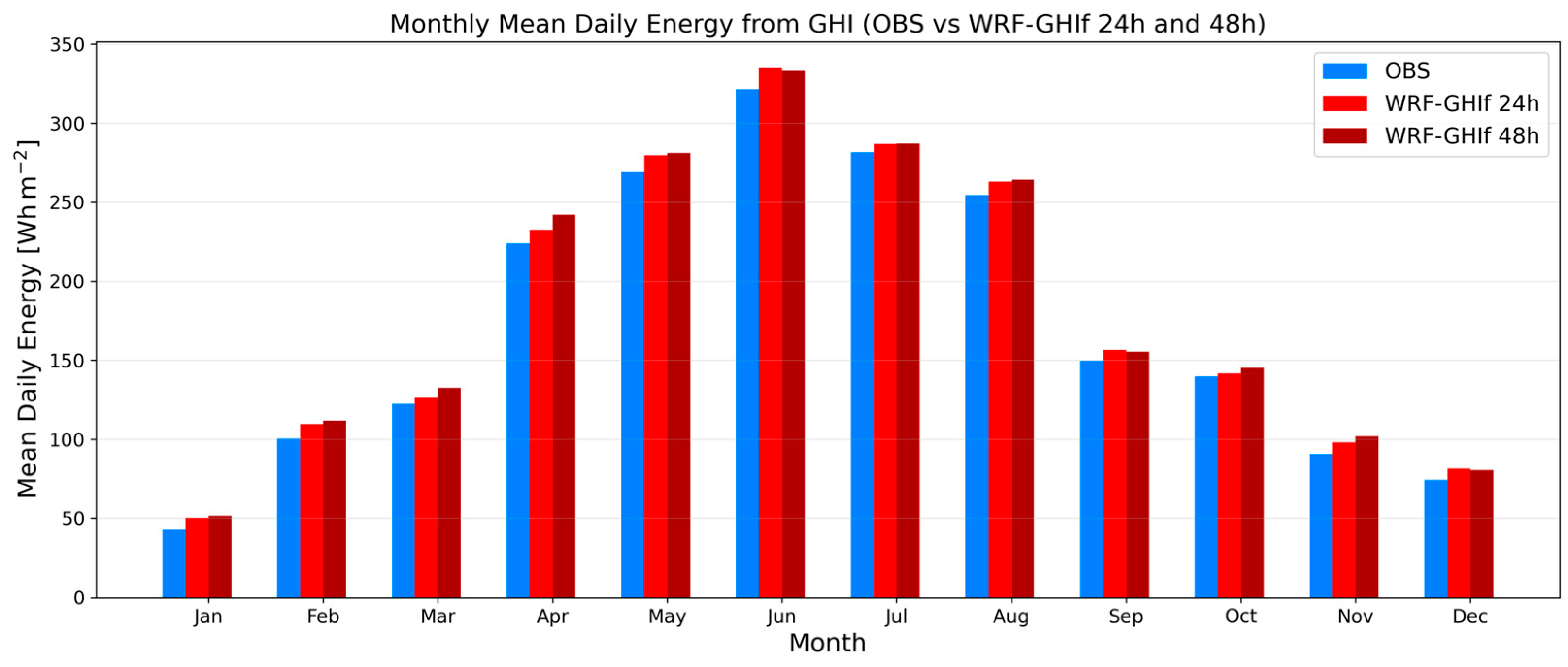
In Figure 11, the GHI forecasts reproduces the observed seasonal cycle well, with higher values during late spring and summer and lower estimated values in winter. Both forecast horizons show a slight positive bias during high-irradiance months, while differences between 24 h and 48 h forecasts remain limited, indicating stable model performance across lead times. The monthly mean daily energy statistics indicate that the GHI 24 h forecast achieves an MBE of 8.32, an RMSE of 28.06, an MAE of 18.90, and a correlation coefficient of 0.964 relative to the observations. For the 48 h forecast, the corresponding values are an MBE of 11.10, an RMSE of 31.13, an MAE of 20.92, and a correlation of 0.957, indicating a slight degradation in forecast accuracy with the increase in lead time.
Figure 11.
Monthly mean daily energy bar chart for GHI hourly mean values.
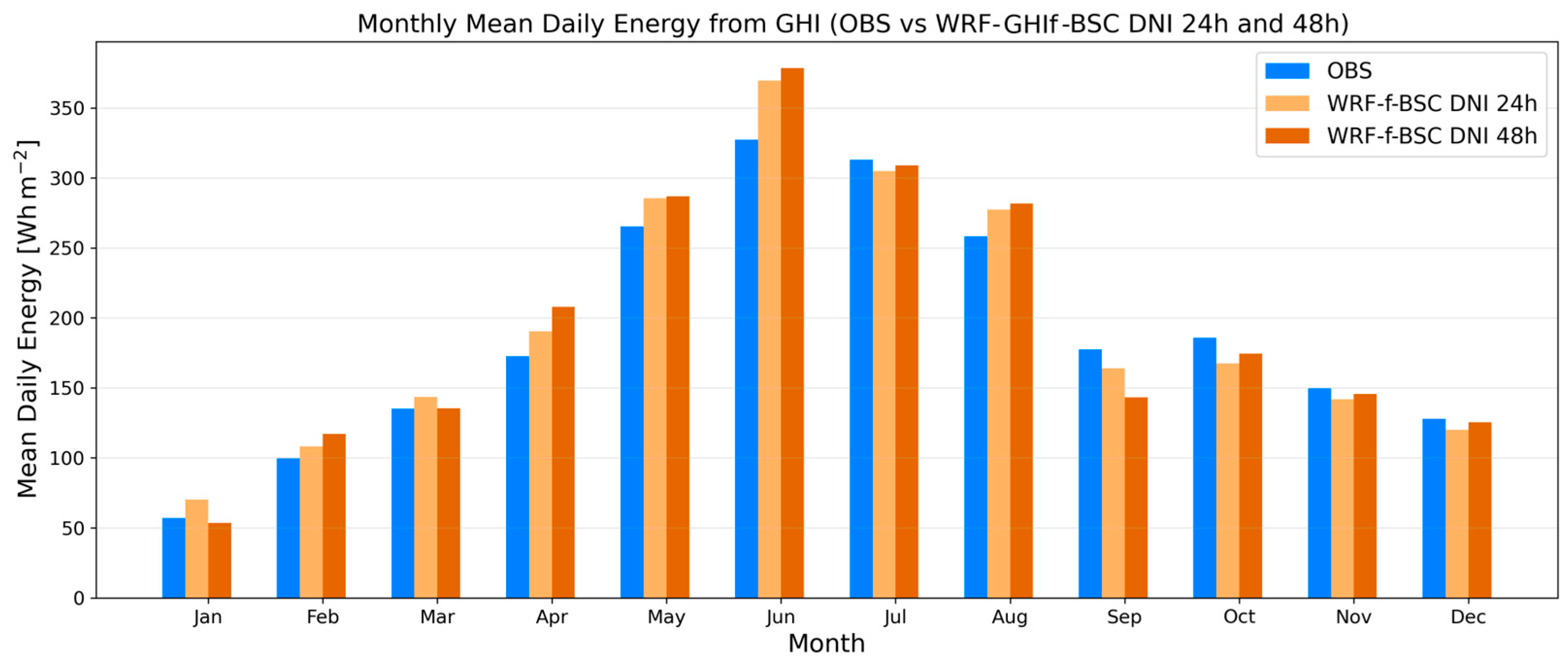
The post-processing approach applied for the DNI-based energy model (Figure 12) captures well the seasonal evolution, with a pronounced maximum in late spring and summer and reduced values during winter months. Compared with observations, the forecasts show a tendency toward overestimation during high-irradiance months, particularly in late spring and early summer, while a slight underestimation is observed in some autumn months. Differences between the 24 h and 48 h forecasts are generally limited, indicating consistent forecast performance across lead times. For DNI, the 24 h forecast shows an MBE of 8.73, an RMSE of 61.54, an MAE of 48.24, and a correlation of 0.854. The 48 h forecast exhibits higher errors, with an MBE of 15.78, an RMSE of 68.41, an MAE of 52.92, and a correlation of 0.824, confirming that DNI forecasts are generally more challenging and more sensitive to increased lead time compared with GHI.
Figure 12.
Monthly mean daily energy bar chart for DNI hourly mean values.
A comparison with the monthly mean daily energy estimated from GHI forecasts highlights distinct implications for solar technologies. GHI-based energy, which is directly relevant for photovoltaic (PV) systems, exhibits smaller forecast deviations and reduced seasonal variability, reflecting its lower sensitivity to cloud and aerosol representation. In contrast, DNI-based energy, curtailed for concentrating solar power (CSP) applications, shows a stronger seasonal amplitude and larger forecast uncertainty, especially during summer. These results underline the greater sensitivity of CSP-relevant forecasts to atmospheric conditions and emphasize the need for dedicated post-processing strategies when using NWP outputs for operational CSP energy assessment.
4. Discussion
This study provides a comprehensive assessment of the forecasting performance of global horizontal (GHI) and direct normal irradiance (DNI) by considering multiple temporal scales (instantaneous, hourly, and daily) and forecast horizons of 24 h and 48 h. Model outputs were systematically evaluated against ground-based measurements using scatter plots, correlation coefficients, coefficients of determination, and standard statistical error metrics and model biases computed on both a monthly basis and over the entire study period.
For GHI, the results indicate that the WRF model is capable of reproducing the temporal variability in global irradiance with good accuracy even in its instantaneous configuration. Nevertheless, the use of hourly averaged GHI corrected through the factor f leads to a small systematic improvement in forecast performance, with reduced dispersion, lower bias, and smaller RMSE and MAE values across all months. The extension of the forecast horizon from 24 h to 48 h results in a moderate degradation in performance, which remains limited when hourly averaging is applied. Further improvements are observed at the daily scale, where temporal integration effectively mitigates the propagation of hourly errors, yielding highly stable and reliable GHI daily forecasts suitable for operational energy applications.
In contrast, the prediction of DNI proves to be significantly more challenging. At the hourly scale, both 24 h and 48 h forecasts exhibit lower R2 values, larger scatter, and higher error metrics compared with GHI. Beyond cloud-related uncertainties, the analysis of hourly profiles reveals a systematic discrepancy between measured and forecast DNI during sunrise and sunset periods, even under clear-sky conditions. This behavior can be attributed to the high solar zenith angles in these periods, which makes DNI extremely sensitive to small errors in solar geometry, atmospheric transmittance, and aerosol representation, as well as to the smoothing effects introduced by hourly averaging.
At the daily scale, the integration of hourly DNI values partially compensates for these discrepancies, leading to more stable estimates on clear-sky days. However, under cloudy conditions, significant deviations persist, with a tendency toward underestimation of daily DNI due to the inability to fully capture short behavior in clear-sky intervals. The degradation in performance from 24 h to 48 h is particularly pronounced for DNI, confirming its strong sensitivity to increased forecast lead time.
Overall, the comparative analysis across variables, temporal scales, and forecast horizons leads to the following key conclusions: GHI is inherently more robust and predictable than DNI at all temporal scales considered. The use of hourly averaging and statistical correction substantially enhances GHI forecast accuracy relative to instantaneous predictions. Daily aggregation effectively reduces variability and error propagation, especially for GHI. DNI exhibits intrinsic limitations even under clear-sky conditions, particularly near sunrise and sunset, and shows marked sensitivity to cloud variability and extended forecast horizons.
In summary, hourly and daily GHI forecasts, presented with this methodology, including those at the 48 h lead time, demonstrate a mature level of accuracy and robustness suitable for operational solar energy applications. Conversely, the forecasting of DNI, while representing valuable steps, requires cautious interpretation and still remains a complex challenge, especially during cloudy conditions and low-solar-elevation periods.
5. Conclusions
The results demonstrate that the proposed methodology significantly improves solar irradiance forecasting performance, particularly when hourly averaged GHI and DNI are considered. The results show reduced bias, lower error dispersion, and higher correlation with observations across all forecast ranges, confirming the robustness of the approach for operational applications.
While the prediction of DNI remains more challenging than that of GHI, the obtained results indicate a reliable representation of its variability and encouraging predictive ability. Future work will focus on further improving DNI forecasts through advanced post-processing techniques and data assimilation. In addition, the methodology will be extended to other geographical sites once high-quality ground-based observational datasets become available, allowing for an assessment of its general applicability under different climatic conditions. Finally, application-oriented analyses linking irradiance forecast errors to solar energy production are envisaged to better quantify the operational value of the proposed approach.
Author Contributions
Conceptualization, I.B., M.D. and G.C.; methodology, I.B. and G.C.; validation, I.B., M.D. and G.C.; formal analysis, G.C.; data curation, I.B., M.D. and G.C.; writing—original draft preparation, I.B. and G.C.; writing—review and editing, I.B., M.D. and G.C.; visualization, I.B.; supervision, I.B., M.D. and G.C. All authors have read and agreed to the published version of the manuscript.
Funding
This research received no external funding.
Institutional Review Board Statement
Not applicable.
Informed Consent Statement
Not applicable.
Data Availability Statement
The original contributions presented in the study are included in the article, further inquiries can be directed to the corresponding author.
Acknowledgments
The authors gratefully acknowledge Francesco Spinelli, retired colleague, and Arcangelo Benedetti for their assistance in the acquisition of observational data. The computing resources and the related technical support used for the WRF operational forecasts were provided by the CRESCO/ENEAGRID High-Performance Computing infrastructure and its staff (Iannone et al., 2019). The infrastructure is funded by ENEA, the Italian National Agency for New Technologies, Energy and Sustainable Economic Development and by Italian and European research programs (http://www.cresco.enea.it/english (accessed before 1 January 2026)).
Conflicts of Interest
The authors declare no conflicts of interest. The funders had no role in the design of the study; in the collection, analyses, or interpretation of data; in the writing of the manuscript; or in the decision to publish the results.
Abbreviations
The following abbreviations are used in this manuscript:
| GHI | Global Horizontal Irradiance |
| WRF-ARW | Weather Research and Forecasting- Advanced Research WRF |
| DNI | Direct Normal Irradiance |
| DHI | Diffuse Horizontal Irradiance |
| CSP | Concentrating Solar Power |
| PV | Photovoltaic |
| GFS | Global Forecast System |
| UTC | Coordinated Universal Time |
| NetCDF | Network Common Data Form |
| I(t) | instantaneous value |
| I(h) | hourly mean |
| θz | solar zenith angle |
| f | correction factor |
| I(t) | instantaneous irradiance values |
| ω | hour angle |
| δ | solar declination |
| ϕ | latitude |
| BSC | Balog–Spinelli–Caputo |
| I0n | extra-atmospheric normal irradiance |
| I0 | extra-atmospheric horizontal irradiance |
| KT | transmission coefficient, clearness index |
| KT,c | global transmission coefficient under clear-sky conditions |
| kc | clear-sky index regarding global irradiance due to the presence of clouds |
| Kbn | transmission coefficient for direct normal irradiance component |
| Kbn,c | transmission coefficient for direct normal irradiance under clear-sky conditions |
| fc | clear-sky index regarding the direct normal irradiance component |
| B | Bourges coefficient |
| TL | Linke turbidity coefficient |
| m | optical air mass |
| δR | Rayleigh optical depth |
| k | attenuation regarding diffuse horizontal irradiance |
| Kbh | transmission coefficient for direct horizontal irradiance |
| DirHI | Direct Horizontal Irradiance |
| GHIobs | GHI observational data |
| WRF-GHIf | hourly GHI from WRF model calculated with the proposed correction factor f |
| DNIobs | DNI observational data |
| WRF-GHIf-BSC DNI | DNI mean values calculated with BSC decomposition model |
| r | Pearson correlation coefficient measures |
| R2 | coefficient of determination |
| STD | Standard Deviation |
| RMSE | Root Mean Square Error |
| CRMSE | Centered Root Mean Square Error |
Appendix A. Calculating Extra-Atmospheric Solar Irradiance
The extraterrestrial global horizontal irradiance represents the solar energy flux incident on a horizontal surface located at the top of the Earth’s atmosphere. It constitutes a fundamental reference for solar resource assessment, normalization of measured irradiance data, and validation of solar radiation models.
Appendix A.1. Solar Constant
Appendix A.2. Angle of the Day of the Year
N is the day of the year, with N = 1 corresponding to 1 January.
Appendix A.3. Solar Declination
δ = a0 + a1 cos(Γ) + a2 sin(Γ) + a3 cos(2 Γ) + a4 sin(2 Γ) + a5 cos(3 Γ) + a6 sin(3 Γ)
a0 = 0.006918
a1 = −0.399912
a2 = 0.070257
a3 = −0.006759
a4 = 0.000907
a5 = −0.002697
a6 = 0.00148
Appendix A.4. Time Equation
Et = a0 + a1 cos(Γ) + a2 sin(Γ) + a3 cos(2 Γ) + a4 sin(2 Γ)
a0 = 0.00075
a1 = 0.001868
a2 = −0.032077
a3 = −0.014615
a4 = −0.04089
Appendix A.5. True Solar Time
Appendix A.6. Hour Angle
Appendix A.7. Cosine of the Zenith Angle
T0 = sinδ sinϕ
U0 = cosδ cosϕ
cosθz = T0 + U0cosω
Appendix A.8. Earth’s Orbit Eccentricity Factor
a0 = 1.000110
a1 = 0.034221
a2 = 0.001280
a3 = 0.000719
a4 = 0.000077
Appendix A.9. Extra-Atmospheric Normal Irradiance
Appendix A.10. Extra-Atmospheric Horizontal Irradiance
Appendix B. Atmospheric Optical Parameters
Appendix B.1. Optical Air Mass (AM)
Optical air mass quantifies the relative atmospheric path length of solar radiation reaching the surface. The most basic definition of air mass assumes a flat, homogeneous, and non-stratified atmosphere, where the air mass depends exclusively on the solar zenith angle θz:
This expression diverges as θz → 90°, limiting its applicability at low solar elevations. To address this limitation, empirical formulations have been introduced, among which the Kasten and Young [23] approximation is widely adopted:
This formulation remains stable for large zenith angles and provides a realistic representation of the increased optical path near the horizon.
Air mass is also influenced by atmospheric pressure. Since absorption scales with air density, high-altitude locations experience reduced effective air mass. This effect is accounted for by the pressure correction:
where p is the local pressure and p0 = 1013.25 hPa represents the standard sea-level pressure.
Appendix B.2. Rayleigh Optical Thickness
Rayleigh optical thickness δR represents the wavelength-independent optical depth associated with molecular scattering along the atmospheric path and depends solely on the air mass (m). According to Kasten, Rayleigh optical thickness can be approximated by the following piecewise formulation.
For m > 20,
For m < 20,
This formulation allows for a smooth and physically consistent transition between moderate and very large air mass values, improving the accuracy of radiative transfer calculations under low-solar-elevation conditions.
Appendix B.3. Linke Turbidity Factor (TL)
The Linke turbidity coefficient (TL) is a dimensionless parameter that quantifies the atmospheric turbidity by accounting for the combined attenuation effects of aerosols and water vapor under cloud-free conditions. It is defined as the ratio between the actual optical thickness of the atmosphere and the optical thickness of a clean and dry (Rayleigh) atmosphere. Physically, TL represents the number of hypothetical standard atmospheres required to produce the same attenuation of direct solar radiation as the real atmosphere under consideration. A value of TL = 1 corresponds to a perfectly clean and dry atmosphere, while higher values indicate increasing atmospheric turbidity. The Linke turbidity coefficient is commonly derived from the Beer–Lambert law applied to the direct normal solar irradiance. It is defined as
where δtot is the total optical thickness of the atmosphere and δR is the Rayleigh optical thickness of a clean and dry atmosphere. In practical applications, TL is often expressed as a function of the measured or modeled direct normal irradiance (DNI):
Rearranging the equation yields an explicit expression for the Linke turbidity coefficient:
Appendix C. Statistics Introduced in Taylor Diagrams
Main statistics used for Taylor diagrams. Let us assume that observations are expressed as O, where Oi, i = 1, 2, …, N; model or forecasts as M, where Mi, i = 1, 2, …, N; and the number of points as N.
The standard deviation (σ) measures the spread of values; for observations,
for the model,
where
The correlation coefficient (r) used in the Taylor diagrams is the Pearson correlation coefficient, which measures the linear relationship between the model and observations:
where r = 1 stands for a perfect positive correlation, r = 0 for no correlation, and r = −1 a perfect negative correlation.
Centered Root Mean Square Error (CRMSE) is a measure of the average magnitude of the differences between a model and observations:
where σo is the standard deviation of observations, σM is that of the model, and r is the correlation coefficient. This makes CRMSE dimensionless, while RMSE has the dimension of the variable.
The Taylor diagram is a geometric relationship between the above statistics. The statistics are visualized in polar coordinates, where radial distance stands for the model standard deviation (σM), the angle from the x-axis denotes θ = arccos(r), and the distance from the observation point (σO,0) = RMSE, according to CRMSE = RMSE2 = σM2 + σO2 − 2 σM σO r, plotted relative to the reference standard deviation.
References
- Skamarock, W.C.; Klemp, J.B.; Dudhia, J.; Gill, D.O.; Liu, Z.; Berner, J.; Wang, W.; Powers, J.G.; Duda, M.G.; Barker, D.M.; et al. A Description of the Advanced Research WRF Version 4; NCAR Tech. Note NCAR/TN-556+STR; National Science Foundation: Alexandria, VA, USA, 2019; 145p. [Google Scholar] [CrossRef]
- Isvoranu, D.; Badescu, V. Preliminary WRF-ARW model analysis of global solar irradiation forecasting. Math. Model. Civ. Eng. 2014, 10, 1–8. [Google Scholar] [CrossRef] [Scilit]
- Pérez, A.P.; Valdés, J.A.C.; Valera, A.J.J. Short-Term Wind-Forecast Calibration for Energy Management Using Numerical Modeling and In-Situ Measurements. Energies 2025, 18, 6342. [Google Scholar] [CrossRef] [Scilit]
- Mayer, M.J.; Yang, D. Pairing ensemble numerical weather prediction with ensemble physical model chain for probabilistic photovoltaic power forecasting. Renew. Sustain. Energy Rev. 2023, 175, 113171. [Google Scholar] [CrossRef] [Scilit]
- Vannitsem, S.; Bremnes, J.B.; Demaeyer, J.; Evans, G.R.; Flowerdew, J.; Hemri, S.; Lerch, S.; Roberts, N.; Theis, S.; Atencia, A.; et al. Statistical Postprocessing for Weather Forecasts: Review, Challenges, and Avenues in a Big Data World. Bull. Am. Meteorol. Soc. 2021, 102, E681–E699. [Google Scholar] [CrossRef] [Scilit]
- National Oceanic and Atmospheric Administration (NOAA), Global Forecast System (GFS) [Dataset]. Available online: https://www.ncei.noaa.gov/products/weather-climate-models/global-forecast (accessed on 1 December 2025).
- Google Earth. Satellite Imagery. © Google. Available online: https://earth.google.com (accessed on 15 November 2025).
- Available online: https://agupubs.onlinelibrary.wiley.com/doi/10.1029/2008jd009944 (accessed on 1 December 2025).
- Hong, S.-Y.; Lim, O.J. The WRF single–moment 6–class microphysics scheme (WSM6). J. Korean Meteor. Soc. 2006, 42, 129–151. [Google Scholar]
- Hong, S.-Y.; Noh, Y.; Dudhia, J. A new vertical diffusion package with an explicit treatment of entrainment processes. Mon. Weather Rev. 2006, 134, 2318–2341. [Google Scholar] [CrossRef] [Scilit]
- Tewari, M.; Chen, F.; Wang, W.; Dudhia, J.; LeMone, M.A.; Mitchell, K.; Ek, M.; Gayno, G.; Wegiel, J.; Cuenca, R.H. Implementation and verification of the unified NOAH land surface model in the WRF model. In Proceedings of the 20th Conference on Weather Analysis and Forecasting/16th Conference on Numerical Weather Prediction, Seattle, WA, USA, 12–16 January 2004; pp. 11–15. [Google Scholar]
- Available online: https://docs.xarray.dev/en/stable/index.html (accessed on 1 December 2025).
- Liu, B.Y.H.; Jordan, R.C. The Interrelationship and Characteristic Distribution of Direct, Diffuse and Total Solar Radiation. Sol. Energy 1960, 4, 1–19. [Google Scholar] [CrossRef] [Scilit]
- Erbs, D.G.; Klein, S.A.; Duffie, J.A. Estimation of the diffuse radiation fraction for hourly, daily and monthly-average global radiation. Sol. Energy 1982, 28, 293–302. [Google Scholar] [CrossRef] [Scilit]
- Orgill, J.F.; Holland, K.G.T. Correlation Equation for Hourly Diffuse Radiation on a Horizontal Surface. Sol. Energy 1977, 9, 357–359. [Google Scholar] [CrossRef] [Scilit]
- Bird, R.E.; Hulstrom, R.L. A Simplified Clear Sky Model for Direct and Diffuse Insolation on Horizontal Surfaces; Tr-642-761; Solar Energy Research Institute (SERI)—US Department of Energy: Golden, CO, USA, 1981. [Google Scholar] [CrossRef] [Scilit]
- Ineichen, P.; Perez, R. A New Airmass Independent Formulation for the Linke Turbidity Coefficient. Sol. Energy 2002, 73, 151–157. [Google Scholar] [CrossRef] [Scilit]
- Ineichen, P. Conversion function between the Linke turbidity and the atmospheric water vapor and aerosol content. Sol. Energy 2008, 82, 1095–1097. [Google Scholar] [CrossRef] [Scilit]
- Rigollier, C.; Lefevre, M.; Wald, L. The method Heliosat-2 for deriving shortwave solar radiation from satellite images. Sol. Energy 2004, 77, 159–169. [Google Scholar] [CrossRef] [Scilit]
- Bourges, G. Reconstitution des courbes de fréquence cumulées de l’irradiation solaire globale horaire recue par une surface plane. In Report CEE 295-77-ESF, Vol. Tome II; Centre d’Energétique de l’Ecole Nationale Supérieure des Mines de Paris: Paris, France, 1979. [Google Scholar]
- Available online: https://atmosphere.copernicus.eu/ (accessed on 21 November 2025).
- Caputo, G.; Balog, I.; Benedetti, A. Implementazione di un Modello di Cielo Sereno per L’irradianza Globale Orizzontale e Diretta Normale per L’italia, Accordo di Programma Ministero della Transizione Ecologica—ENEA, PNRR Ricerca e Sviluppo Sull’idrogeno 2022-2025—M12, Progetto: Piano Operativo della Ricerca Sull’idrogeno; Programma Ministero della Transizione Ecologica—ENEA: Rome, Italy, 2023. [Google Scholar]
- Kasten, F.; Young, A.T. Revised optical air mass tables and approximation formula. Appl. Opt. 1989, 28, 4735–4738. [Google Scholar] [CrossRef] [Scilit] [PubMed]
- Kasten, F. The Linke turbidity factor based on improved values of the integral Rayleigh optical thickness. Sol. Energy 1996, 56, 239–244. [Google Scholar] [CrossRef] [Scilit]
- Available online: https://www.eko-instruments.com/eu (accessed on 1 February 2023).

Disclaimer/Publisher’s Note: The statements, opinions and data contained in all publications are solely those of the individual author(s) and contributor(s) and not of MDPI and/or the editor(s). MDPI and/or the editor(s) disclaim responsibility for any injury to people or property resulting from any ideas, methods, instructions or products referred to in the content. |
© 2026 by the authors. Licensee MDPI, Basel, Switzerland. This article is an open access article distributed under the terms and conditions of the Creative Commons Attribution (CC BY) license.