Comparing Extraction Techniques and Varieties in Grape Stems: A Chemical Assessment of Antioxidant Phenolics




Abstract
1. Introduction
2. Materials and Methods
2.1. Chemical and Reagents
2.2. Plant Material
2.3. Conventional Extraction of Phenolic Compounds
2.4. Advanced Extraction Techniques
2.4.1. Pressurized Liquid Extraction
2.4.2. Ultrasound-Assisted Extraction
2.5. Total Phenolic Content (TPC)
2.6. Antioxidant Capacity
2.7. Identification and Quantification of Phenolic Compounds by High-Performance Liquid Chromatography with Diode Array Detection (HPLC-DAD)
2.8. Statistical Analysis
3. Results
3.1. Influence of the Extraction Technique and Grape Variety on the Recovery of Antioxidant Phenolic Compounds from Stems
3.2. Exhaustive Identification and Quantification of Phenolic Compounds by HPLC-DAD
3.2.1. Phenolic Profile of SLE Extracts
3.2.2. Phenolic Profile of PLE Extracts
3.2.3. Phenolic Profile of UAE Extracts
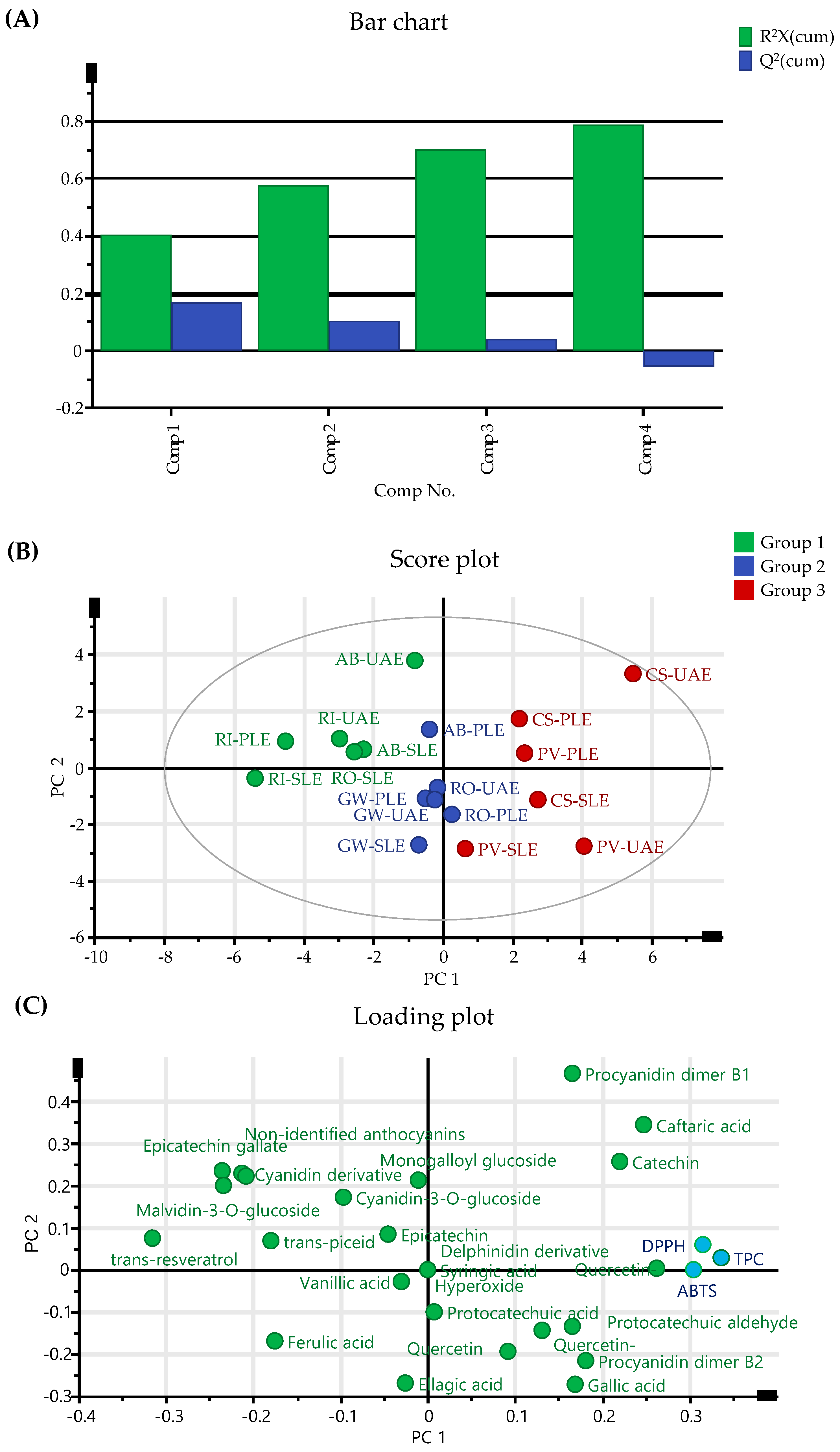
3.3. Role of the Extraction Technique and Grape Variety on the Recovery of Antioxidant Phenolic Compounds from Stems
4. Discussion
4.1. Role of Extraction Technique and Grape Variety in Phenolic Recovery and Antioxidant Capacity
4.2. Influence of the Extraction Technique and Grape Stem Variety in the Phenolic Profile of the Extracts
5. Conclusions
Supplementary Materials
Author Contributions
Funding
Institutional Review Board Statement
Informed Consent Statement
Data Availability Statement
Acknowledgments
Conflicts of Interest
Abbreviations
| AB | Alicante Bouschet |
| CS | Cabernet Sauvignon |
| GAE | Gallic Acid Equivalents |
| GW | Gewürztraminer |
| PCA | Principal Component Analysis |
| PLE | Pressurized liquid extraction |
| PV | Petit Verdot |
| RI | Riesling |
| RO | Roussanne |
| SLE | Solid–liquid extraction |
| TEAC | Trolox Equivalent Antioxidant Capacity |
| TPC | Total phenolic content |
| UAE | Ultrasound assisted extraction |
References
- Contreras, M.D.M.; Romero-García, J.M.; López-Linares, J.C.; Romero, I.; Castro, E. Residues from grapevine and wine production as feedstock for a biorefinery. Food Bioprod. Process. 2022, 134, 56–79. [Google Scholar] [CrossRef]
- Machado, A.R.; Voss, G.B.; Machado, M.; Paiva, J.A.P.; Nunes, J.; Pintado, M. Exploring the chemical potential of ‘Vinhão’ grape stalks for circular economy applications. Food Bioprod. Process. 2025, 152, 98–106. [Google Scholar] [CrossRef]
- Filippi, K.; Georgaka, N.; Alexandri, M.; Papapostolou, H.; Koutinas, A. Valorisation of grape stalks and pomace for the production of bio-based succinic acid by Actinobacillus succinogenes. Ind. Crops Prod. 2021, 168, 113578. [Google Scholar] [CrossRef]
- Serna-Loaiza, S.; Kornpointner, C.; Pazzaglia, A.; Jordan, C.; Halbwirth, H.; Friedl, A. Biorefinery concept for the valorization of grapevine shoots: Study case for the Austrian variety Grüner Veltliner. Food Bioprod. Process. 2022, 136, 154–165. [Google Scholar] [CrossRef]
- De Almeida Sousa Cruz, M.A.; De Barros Elias, M.; Calina, D.; Sharifi-Rad, J.; Teodoro, A.J. Insights into grape-derived health benefits: A comprehensive overview. Food Prod. Process. Nutr. 2024, 6, 91. [Google Scholar] [CrossRef]
- Kumar Singh, A.; Cabral, C.; Kumar, R.; Ganguly, R.; Kumar Rana, H.; Gupta, A.; Rosaria Lauro, M.; Carbone, C.; Reis, F.; Pandey, A.K. Beneficial effects of dietary polyphenols on gut microbiota and strategies to improve delivery efficiency. Nutrients 2019, 11, 2216. [Google Scholar] [CrossRef] [PubMed]
- Dias-Costa, R.; Coelho, M.; Domínguez-Perles, R.; Gouvinhas, I.; Barros, A.N. Overview of polyphenolic composition and related biological activities of grape stems. Eur. Food Res. Technol. 2025, 251, 3389–3416. [Google Scholar] [CrossRef]
- Mitić, M.; Stankov-Jovanović, V.P.; Mitić, J.; Nikolić, J.; Karioti, A.; Lazari, D. Chemometric insights into grape stems: Antioxidant capacity, phenolic composition, and mineral profile. Stud. Univ. Babeș-Bolyai Chem. 2024, 69, 129–144. [Google Scholar] [CrossRef]
- Karastergiou, A.; Gancel, A.L.; Jourdes, M.; Teissedre, P.L. Valorization of grape pomace: A review of phenolic composition, bioactivity, and therapeutic potential. Antioxidants 2024, 13, 1131. [Google Scholar] [CrossRef] [PubMed]
- Nieto, J.A.; Santoyo, S.; De Sá, M.; Baoshan, S.; Reglero, G.; Jaime, L. Comprehensive study of sustainable pressurized liquid extractions to obtain bioavailable antioxidant phenolic compounds from grape seed by-products. Processes 2024, 12, 2308. [Google Scholar] [CrossRef]
- Voss, M.; Gaudino, E.C.; Tabasso, S.; Forte, C.; Cravotto, G. Current emerging green technologies for the valorization of grape and cherry wastes. Curr. Food Sci. Technol. Rep. 2023, 1, 47–61. [Google Scholar] [CrossRef]
- El-Sawi, S.A.; Ragab, N.A.; Sleem, A.A.; Farghaly, A.A.; Awad, G.E.A.; Maamoun, M.A.I. Principal component analysis of phenolic compounds of grape waste parts and correlations to their bioassays. Biocatal. Agric. Biotechnol. 2023, 51, 102780. [Google Scholar] [CrossRef]
- Jevtovic, V.; Alabbosh, K.F.S.; Pržić, Z.; Nikolić, J.; Ali Alyami, R.; Alshammari, M.R.; Alshammari, B.; Rakic, V.; Alshammari, O.A.O.; Mitić, M. Targeted recovery of phenolic antioxidants from grape stems: A sequential approach. Molecules 2025, 30, 3546. [Google Scholar] [CrossRef]
- Nieto, J.A.; Santoyo, S.; Prodanov, M.; Reglero, G.; Jaime, L. Valorisation of grape stems as a source of phenolic antioxidants using a sustainable extraction methodology. Foods 2020, 9, 604. [Google Scholar] [CrossRef] [PubMed]
- Pinilla, J.M.; López-Padilla, A.; Vicente, G.; Fornari, T.; Quintela, J.C.; Reglero, G. Recovery of betulinic acid from plane tree (Platanus acerifolia L.). J. Supercrit. Fluids 2014, 95, 541–545. [Google Scholar] [CrossRef]
- Singleton, V.L.; Orthofer, R.; Lamuela-Raventós, R.M. Analysis of total phenols and other oxidation substrates and antioxidants by means of folin-ciocalteu reagent. Methods Enzymol. 1999, 299, 152–178. [Google Scholar]
- Brand-Williams, W.; Cuvelier, M.E.; Berset, C. Use of a free radical method to evaluate antioxidant activity. LWT—Food Sci. Technol. 1995, 28, 25–30. [Google Scholar] [CrossRef]
- Jiménez-Moreno, N.; Volpe, F.; Moler, J.A.; Esparza, I.; Ancín-Azpilicueta, C. Impact of extraction conditions on the phenolic composition and antioxidant capacity of grape stem extracts. Antioxidants 2019, 8, 597. [Google Scholar] [CrossRef]
- Domínguez-Perles, R.; Teixeira, A.I.; Rosa, E.; Barros, A.I. Assessment of (poly)phenols in grape (Vitis vinifera L.) stems using food/pharma industry compatible solvents and response surface methodology. Food Chem. 2014, 164, 339–346. [Google Scholar] [CrossRef]
- Brianceau, S.; Turk, M.; Vitrac, X.; Vorobiev, E. High voltage electric discharges assisted extraction of phenolic compounds from grape stems: Effect of processing parameters on flavan-3-ols, flavonols and stilbenes recovery. Innov. Food Sci. Emerg. Technol. 2016, 35, 67–74. [Google Scholar] [CrossRef]
- Barp, L.; Višnjevec, A.M.; Moret, S. Pressurized liquid extraction: A powerful tool to implement extraction and purification of food contaminants. Foods 2023, 12, 2017. [Google Scholar] [CrossRef] [PubMed]
- Višnjevec, A.M.; Barp, L.; Lucci, P.; Moret, S. Pressurized liquid extraction for the determination of bioactive compounds in plants with emphasis on phenolics. TrAC Trends Anal. Chem. 2024, 173, 117620. [Google Scholar] [CrossRef]
- Spatafora, C.; Barbagallo, E.; Amico, V.; Tringali, C. Grape stems from Sicilian Vitis vinifera cultivars as a source of polyphenol-enriched fractions with enhanced antioxidant activity. LWT—Food Sci. Technol. 2013, 54, 542–548. [Google Scholar] [CrossRef]
- González-Centeno, M.R.; Jourdes, M.; Femenia, A.; Simal, S.; Rosselló, C.; Teissedre, P.L. Proanthocyanidin composition and antioxidant potential of stem winemaking byproducts from 10 different grape varieties (Vitis vinifera L.). J. Agric. Food Chem. 2012, 60, 11850–11858. [Google Scholar] [CrossRef]
- Esparza, I.; Moler, J.A.; Arteta, M.; Jiménez-Moreno, N.; Ancín-Azpilicueta, C. Phenolic composition of grape stems from different Spanish varieties and vintages. Biomolecules 2021, 11, 1221. [Google Scholar] [CrossRef] [PubMed]
- Stanek-Wandzel, N.; Zarębska, M.; Wasilewski, T.; Hordyjewicz-Baran, Z.; Krzyszowska, A.; Gębura, K.; Tomaka, M. Enhancing phenolic compound recovery from grape pomace residue: Synergistic approach of ultrasound- and enzyme-assisted extraction. ACS Omega 2025, 10, 23129–23138. [Google Scholar] [CrossRef]
- Castellarin, S.D.; Di Gaspero, G.; Marconi, R.; Nonis, A.; Peterlunger, E.; Paillard, S.; Adam-Blondon, A.F.; Testolin, R. Colour variation in red grapevines (Vitis vinifera L.): Genomic organisation, expression of flavonoid hydroxylase genes and metabolite profiling. BMC Genom. 2006, 7, 12. [Google Scholar] [CrossRef]
- Boss, P.K.; Davies, C.; Robinson, S.P. Analysis of the expression of anthocyanin pathway genes in developing Vitis vinifera L. cv Shiraz grape berries. Plant Physiol. 1996, 111, 1059–1066. [Google Scholar] [CrossRef]
- Walker, A.R.; Lee, E.; Bogs, J.; McDavid, D.A.J.; Thomas, M.R.; Robinson, S.P. White grapes arose through mutation of two adjacent regulatory genes. Plant J. 2007, 49, 772–785. [Google Scholar] [CrossRef]
- Mosele, J.; Da Costa, B.S.; Bobadilla, S.; Motilva, M.J. Phenolic composition of red and white wine byproducts from La Rioja (Spain) and the effect of winemaking. J. Agric. Food Chem. 2023, 71, 18746–18757. [Google Scholar] [CrossRef] [PubMed]
- Machado, T.O.X.; de A.C. Kodel, H.; Alves dos Santos, F.; Dos Santos Lima, M.; Costa, A.S.G.; Oliveira, M.B.P.P.; Dariva, C.; Estevam, C.d.S.; Fathi, F.; Souto, E.B. Cellulase-assisted extraction followed by pressurized liquid extraction for enhanced recovery of phenolic compounds from ‘BRS Violeta’ grape pomace. Sep. Purif. Technol. 2025, 354, 129218. [Google Scholar] [CrossRef]
- Nieto, J.A.; Fernández-Jalao, I.; Siles-Sánchez, M.D.L.N.; Santoyo, S.; Jaime, L. Implication of the polymeric phenolic fraction and matrix effect on antioxidant activity, bioaccessibility and bioavailability of grape stem extracts. Molecules 2023, 28, 2461. [Google Scholar] [CrossRef]
- Machado, T.D.O.X.; Portugal, I.; Kodel, H.D.A.C.; Fathi, A.; Fathi, F.; Oliveira, M.B.P.P.; Dariva, C.; Souto, E.B. Pressurized liquid extraction as an innovative high-yield greener technique for phenolic compounds recovery from grape pomace. Sustain. Chem. Pharm. 2024, 40, 101635. [Google Scholar] [CrossRef]
- Demesa, A.G.; Saavala, S.; Pöysä, M.; Koiranen, T. Overview and toxicity assessment of ultrasound-assisted extraction of natural ingredients from plants. Foods 2024, 13, 3066. [Google Scholar] [CrossRef]
- Elmas, E.; Şen, F.B.; Kublay, İ.Z.; Baş, Y.; Tüfekci, F.; Derman, H.; Bekdeşer, B.; Aşçı, Y.S.; Capanoglu, E.; Bener, M.; et al. Green extraction of antioxidants from hazelnut by-products using microwave-, ultrasound-, and pressurized-liquid extraction. Food Bioprocess Technol. 2025, 18, 5388–5406. [Google Scholar] [CrossRef]
- Albuquerque, B.R.; Pinela, J.; Pereira, C.; Calhelha, R.C.; Oliveira, I.; Heleno, S.; Oliveira, M.B.P.; Barros, L. Optimization and comparison of heat- and ultrasound-assisted extraction for anthocyanin recovery from Sicana odorifera. Biomass Convers. Biorefin. 2025, 15, 1027–1040. [Google Scholar] [CrossRef]
- Sumere, B.R.; De Souza, M.C.; Dos Santos, M.P.; Bezerra, R.M.N.; Da Cunha, D.T.; Martinez, J.; Rostagno, M.A. Combining pressurized liquids with ultrasound to improve the extraction of phenolic compounds from pomegranate peel. Ultrason. Sonochem. 2018, 48, 151–162. [Google Scholar] [CrossRef] [PubMed]
- Carrera, C.; Ruiz-Rodríguez, A.; Palma, M.; Barroso, C.G. Ultrasound-assisted extraction of phenolic compounds from grapes. Anal. Chim. Acta 2012, 732, 100–104. [Google Scholar] [CrossRef]
- Ntourtoglou, G.; Drosou, F.; Chatzimitakos, T.; Athanasiadis, V.; Bozinou, E.; Dourtoglou, V.G.; Elhakem, A.; Sami, R.; Ashour, A.A.; Shafie, A.; et al. Combination of pulsed electric field and ultrasound in the extraction of polyphenols and volatile compounds from grape stems. Appl. Sci. 2022, 12, 6219. [Google Scholar] [CrossRef]
- Barros, A.; Gironés-Vilaplana, A.; Teixeira, A.; Collado-González, J.; Moreno, D.A.; Gil-Izquierdo, A.; Rosa, E.; Domínguez-Perles, R. Evaluation of grape (Vitis vinifera L.) stems from Portuguese varieties as a resource of phenolic compounds: A comparative study. Food Res. Int. 2014, 65, 375–384. [Google Scholar] [CrossRef]
- Queiroz, M.; Oppolzer, D.; Gouvinhas, I.; Silva, A.M.; Barros, A.I.R.N.A.; Domínguez-Perles, R. New grape stems’ isolated phenolic compounds modulate ROS, glutathione and lipid peroxidation in vitro: Combined formulations with vitamins C and E. Fitoterapia 2017, 120, 146–157. [Google Scholar] [CrossRef] [PubMed]
- Iacopini, P.; Baldi, M.; Storchi, P.; Sebastiani, L. Catechin, epicatechin, quercetin, rutin and resveratrol in red grape: Content, in vitro antioxidant activity and interactions. J. Food Compos. Anal. 2008, 21, 589–598. [Google Scholar] [CrossRef]
- Püssa, T.; Floren, J.; Kuldkepp, P.; Raal, A. Survey of grapevine Vitis vinifera stem polyphenols by LC-DAD-MS/MS. J. Agric. Food Chem. 2006, 54, 7488–7494. [Google Scholar] [CrossRef] [PubMed]
- Makris, D.P.; Boskou, G.; Andrikopoulos, N.K.; Kefalas, P. Characterisation of major polyphenolic antioxidants in grape (Vitis vinifera cv. Roditis) stems. Eur. Food Res. Technol. 2008, 226, 1075–1079. [Google Scholar] [CrossRef]
- Silva, V.; Igrejas, G.; Falco, V.; Santos, T.P.; Torres, C.; Oliveira, A.M.P.; Pereira, J.E.; Amaral, J.S.; Poeta, P. Chemical composition, antioxidant and antimicrobial activity of phenolic compounds extracted from wine industry by-products. Food Control 2018, 92, 516–522. [Google Scholar] [CrossRef]
- Luo, L.; Cui, Y.; Zhang, S.; Li, L.; Suo, H.; Sun, B. Detailed phenolic composition of Vidal grape pomace by UHPLC–MS/MS. J. Chromatogr. B 2017, 1068–1069, 201–209. [Google Scholar] [CrossRef]


| Variety | SLE | PLE | UAE |
|---|---|---|---|
| AB | 26 ± 6 b*C | 60.1 ± 0.5 aA | 53 ± 2 aA |
| CS | 31 ± 1 bA,B,C | 53.9 ± 0.6 aB,C | 51 ± 3 aA |
| PV | 39 ± 2 bA | 58.0 ± 0.2 aA,B | 43 ± 1 bA |
| RO | 24.6 ± 0.3 cC | 47 ± 2 aD | 38 ± 2 bB |
| GW | 27.4 ± 0.7 cB,C | 56.2 ± 0.5 aA,B,C | 48 ± 2 bA |
| RI | 35 ± 5 bA,B | 52 ± 4 aC | 48.2 ± 0.6 aA |
| TPC | DPPH | ABTS | |||||||
|---|---|---|---|---|---|---|---|---|---|
| Variety | SLE | PLE | UAE | SLE | PLE | UAE | SLE | PLE | UAE |
| AB | 106 ± 9 bC | 135 ± 8 aD | 130 ± 11 aC | 1.1 ± 0.1 cD | 1.44 ± 0.04 bD | 1.57 ± 0.04 aB,C | 1.71 ± 0.09 bB | 1.93 ± 0.03 aD | 1.75 ± 0.08 bB |
| CS | 178 ± 4 bA | 179 ± 4 bA | 222 ± 12 aA | 1.89 ± 0.06 cA | 2.03 ± 0.03 bA | 2.4 ± 0.1 aA | 2.36 ± 0.05 bA | 3.1 ± 0.3 aA | 2.5 ± 0.2 bA |
| PV | 128 ± 7 cB | 146 ± 14 bC | 199 ± 1 aB | 1.29 ± 0.02 bC | 1.52 ± 0.03 bC | 1.89 ± 0.01 aB,C | 1.57 ± 0.08 cC | 2.4 ± 0.1 bB | 2.58 ± 0.07 aA |
| RO | 129 ± 10 cB | 158 ± 11 aB | 144 ± 8 bC | 1.41 ± 0.02 bB | 1.83 ± 0.04 aB | 1.43 ± 0.02 bC | 1.47 ± 0.04 cD | 2.27 ± 0.06 aB,C | 1.8 ± 0.1 bB |
| GW | 133 ± 5 bB | 161 ± 6 aB | 135 ± 9 bC | 1.43 ± 0.05 bB | 1.48 ± 0.06 bC,D | 1.70 ± 0.04 aB | 2.29 ± 0.04 aA | 2.14 ± 0.07 bC | 1.72 ± 0.05 cB |
| RI | 61 ± 3 cD | 109 ± 3 aE | 101 ± 3 bD | 0.63 ± 0.02 bE | 1.10 ± 0.03 aE | 0.59 ± 0.01 cD | 0.95 ± 0.08 cE | 1.39 ± 0.04 aE | 1.30 ± 0.07 bC |
| SLE Extracts | ||||||
|---|---|---|---|---|---|---|
| AB | CS | PV | RO | GW | RI | |
| Gallic acid | 0.280 ± 0.009 c | 0.57 ± 0.02 a | 0.60 ± 0.04 a | 0.29 ± 0.01 c | 0.50 ± 0.03 b | 0.30 ± 0.02 c |
| Protocatechuic acid | Nd | Nd | Nd | 0.001 ± 0.000 a | Nd | Nd |
| Vanillic acid | 0.5 ± 0.2 a | Nd | Nd | Nd | Nd | Nd |
| trans-Caftaric acid | 0.091 ± 0.006 c | 0.24 ± 0.02 a | 0.19 ± 0.01 b | Nd | 0.040 ± 0.002 d | 0.02 ± 0.01 d,e |
| Protocatechuic aldehyde | Nd | 0.053 ± 0.008 a | Nd | Nd | Nd | Nd |
| Catechin | 3.9 ± 0.4 c | 5.6 ± 0.2 a | 3.488 ± 0.002 b | 1.6 ± 0.2 e | 1.34 ± 0.01 d | 1.93 ± 0.06 d,e |
| Epicatechin | 1.54 ± 0.07 a | 1.5 ± 0.1 a | 0.902 ± 0.005 b | 1.4 ± 0.4 a | 0.63 ± 0.09 b | 0.79 ± 0.03 b |
| Epicatechin gallate | Nd | 0.08 ± 0.01 a | Nd | Nd | Nd | Nd |
| Procyanidin B1 | 1.4 ± 0.3 c | 1.71 ± 0.01 b | 0.75 ± 0.05 d | 2.10 ± 0.05 a | Nd | 0.80 ± 0.02 d |
| Procyanidin B2 | 0.7 ± 0.1 b | 0.67 ± 0.02 b,c | 1.97 ± 0.06 a | 0.6 ± 0.1 b,c | 0.69 ± 0.06 b | 0.493 ± 0.006 c |
| Quercetin-3-O-glucuronide | 1.01 ± 0.04 b | 0.95 ± 0.01 b | 1.096 ± 0.003 a | 0.67 ± 0.01 d | 0.87 ± 0.03 c | 0.40 ± 0.02 e |
| Quercetin-3-O-glucoside | 0.30 ± 0.01 b | 0.207 ± 0.002 d | 0.41 ± 0.01 a | 0.218 ± 0.008 d | 0.28 ± 0.01 c | 0.199 ± 0.005 e |
| Malvidin glucoside | 2.5 ± 0.3 a | 0.109 ± 0.004 b,c | 0.37 ± 0.02 b | |||
| Cyanidin glucoside | 0.11 ± 0.02 a | Nd | Nd | |||
| Cyanidin derivative | 2.0 ± 0.3 a | Nd | Nd | |||
| Unidentified anthocyanins | 1.6 ± 0.2 a | 0.196 ± 0.006 b,c | 0.35 ± 0.02 b | |||
| PLE Extracts | ||||||
|---|---|---|---|---|---|---|
| AB | CS | PV | RO | GW | RI | |
| Gallic acid | 0.13 ± 0.02 b | 0.18 ± 0.08 b | 0.316 ± 0.004 a | 0.16 ± 0.01 b | 0.28 ± 0.03 a | 0.16 ± 0.04 b |
| Protocatechuic acid | 0.004 ± 0.000 c | 0.006 ± 0.001 a,b | 0.006 ± 0.001 a,b,c | 0.008 ± 0.001 a | 0.005 ± 0.000 b,c | 0.005 ± 0.001 b,c |
| Monogalloyl glucoside | 0.015 ± 0.003 a | Nd | Nd | Nd | 0.015 ± 0.002 a | Nd |
| Vanillic acid | 0.32 ± 0.01 a | Nd | Nd | Nd | Nd | Nd |
| Syringic acid | 0.19 ± 0.02 b | Nd | Nd | Nd | 10.3 ± 0.8 a | Nd |
| trans-Caftaric acid | 0.37 ± 0.02 b | 0.40 ± 0.04 b | 0.497 ± 0.008 a | 0.130 ± 0.005 c | 0.125 ± 0.008 c | 0.14 ± 0.02 c |
| Ferulic acid | 0.004 ± 0.000 b | 0.004 ± 0.000 b | 0.004 ± 0.000 b | 0.007 ± 0.001 a | Nd | 0.007 ± 0.000 a |
| Ellagic acid derivative | 0.034 ± 0.001 b | 0.034 ± 0.001 b | 0.034 ± 0.003 b | 0.11 ± 0.02 a | 0.05 ± 0.01 b | 0.047 ± 0.001 b |
| Protocatechuic aldehyde | Nd | 0.043 ± 0.009 a | Nd | Nd | Nd | Nd |
| trans-Piceid | Nd | 0.019 ± 0.001 c | Nd | Nd | 0.89 ± 0.01 a | 0.29 ± 0.02 b |
| trans-Resveratrol | 0.039 ± 0.001 c | 0.061 ± 0.007 b,c | 0.050 ± 0.005 c | 0.08 ± 0.02 b | 0.083 ± 0.007 b | 0.26 ± 0.01 a |
| Catechin | 2.57 ± 0.05 c | 3.9 ± 0.3 a | 3.49 ± 0.04 b | 1.667 ± 0.008 d | 1.20 ± 0.02 e | 1.9 ± 0.1 d |
| Epicatechin | 2.2 ± 0.4 a,b | 2.4 ± 0.1 a | 1.67 ± 0.04 c,d | 1.88 ± 0.09 b,c | 1.2 ± 0.2 d,e | 0.8 ± 0.1 e |
| Epicatechin gallate | 0.22 ± 0.02 b,c | 0.290 ± 0.001 b | 0.204 ± 0.005 c | 0.27 ± 0.05 b,c | 0.265 ± 0.007 b,c | 0.37 ± 0.06 a |
| Procyanidin B1 | 2.3 ± 0.1 b | 3.2 ± 0.2 a | 3.22 ± 0.08 a | 1.72 ± 0.02 c | 0.94 ± 0.05 d | 1.1 ± 0.3 d |
| Procyanidin B2 | 0.62 ± 0.07 ab | 0.50 ± 0.02 b,c | 0.658 ± 0.006 a | 0.57 ± 0.03 a,b,c | 0.5 ± 0.1 c,d | 0.339 ± 0.007 d |
| Quercetin-3-O-glucuronide | 1.22 ± 0.06 b,c | 1.1 ± 0.1 b,c | 1.56 ± 0.02 a | 1.24 ± 0.05 b | 1.07 ± 0.03 c | 0.54 ± 0.03 d |
| Quercetin-3-O-glucoside | 0.159 ± 0.009 d | 0.11 ± 0.01 e | 0.277 ± 0.005 b | 0.33 ± 0.02 a | 0.20 ± 0.01 c | 0.076 ± 0.004 f |
| Quercetin | 0.001 ± 0.000 b | Nd | Nd | 0.005 ± 0.000 a | 0.005 ± 0.000 a | 0.001 ± 0.000 b |
| Quercetin-3-O-galactoside | Nd | 0.037 ± 0.009 a | Nd | Nd | Nd | Nd |
| Malvidin glucoside | 2.1 ± 0.2 a | 0.07 ± 0.02 c | 0.35 ± 0.02 b | |||
| Cyanidin glucoside | 0.11 ± 0.01 a | Nd | 0.025 ± 0.001 b | |||
| Delphinidin derivative | 0.104 ± 0.009 a | Nd | Nd | |||
| Cyanidin derivative | 1.7 ± 0.1 a | Nd | 0.07 ± 0.01 b | |||
| Unidentified anthocyanins | 1.5 ± 0.1 a | 0.180 ± 0.004 c | 0.33 ± 0.03 b | |||
| UAE Extracts | ||||||
|---|---|---|---|---|---|---|
| AB | CS | PV | RO | GW | RI | |
| Gallic acid | 0.164 ± 0.003 c | 0.45 ± 0.05 a | 0.58 ± 0.03 a | 0.117 ± 0.003 c | 0.25 ± 0.01 b | 0.24 ± 0.01 b |
| Monogalloyl glucoside | 0.03 ± 0.00 a | Nd | Nd | Nd | Nd | Nd |
| trans-Caftaric acid | 0.602 ± 0.008 b | 0.81 ± 0.08 a | 0.4 ± 0.1 a,b | 0.17 ± 0.03 c | 0.20 ± 0.05 c | 0.233 ± 0.003 c |
| trans-Piceid | Nd | 0.019 ± 0.001 b | Nd | Nd | Nd | Nd |
| trans-Resveratrol | Nd | 0.061 ± 0.007 b,c | Nd | 0.04 ± 0.03 b | 0.05 ± 0.01 b | 0.110 ± 0.001 a |
| Catechin | 3.88 ± 0.07 b,c | 7.1 ± 0.7 a | 3.5 ± 0.5 b | 1.9 ± 0.3 d | 1.8 ± 0.1 d | 3.8 ± 0.1 c |
| Epicatechin | 1.441 ± 0.001 a | 1.4 ± 0.3 a | 1.0 ± 0.6 b | 1.1 ± 0.2 b | 0.69 ± 0.04 b | 0.665 ± 0.003 b |
| Epicatechin gallate | Nd | 0.202 ± 0.002 b | Nd | Nd | Nd | 0.32 ± 0.01 a |
| Procyanidin B1 | 4.02 ± 0.04 c | 6.7 ± 0.5 a | 0.64 ± 0.05 b | 1.9 ± 0.3 d,e | 1.3 ± 0.2 e | 2.5 ± 0.2 d |
| Procyanidin B2 | 0.71 ± 0.03 c | 1.1 ± 0.2 b | 2.8 ± 0.4 a | 0.69 ± 0.08 c | 0.7 ± 0.2 c | 0.78 ± 0.02 c |
| Quercetin-3-O-glucuronide | 1.16 ± 0.08 a,b | 1.08 ± 0.03 b | 1.18 ± 0.08 a | 1.1 ± 0.2 b | 1.0 ± 0.1 b | 0.493 ± 0.004 c |
| Quercetin-3-O-glucoside | 0.41± 0.02 c | 0.344 ± 0.007 c | 0.46 ± 0.05 a | 0.6 ± 0.1 a,b | 0.43 ± 0.04 b,c | 0.185 ± 0.002 d |
| Malvidin glucoside | 3.2 ± 0.1 a | 0.137 ± 0.007 c | 0.36 ± 0.04 b | |||
| Cyanidin glucoside | 0.16 ± 0.01 a | Nd | Nd | |||
| Cyanidin derivative | 2.6 ± 0.1 a | Nd | 0.06 ± 0.02 b | |||
| Unidentified anthocyanins | 2.7 ± 0.4 a | 0.30 ± 0.02 b,c | 0.42 ± 0.03 b | |||
Disclaimer/Publisher’s Note: The statements, opinions and data contained in all publications are solely those of the individual author(s) and contributor(s) and not of MDPI and/or the editor(s). MDPI and/or the editor(s) disclaim responsibility for any injury to people or property resulting from any ideas, methods, instructions or products referred to in the content. |
© 2026 by the authors. Licensee MDPI, Basel, Switzerland. This article is an open access article distributed under the terms and conditions of the Creative Commons Attribution (CC BY) license.
Share and Cite
Domínguez-Rodríguez, G.; Nieto, J.A.; Santoyo, S.; Jaime, L. Comparing Extraction Techniques and Varieties in Grape Stems: A Chemical Assessment of Antioxidant Phenolics. Appl. Sci. 2026, 16, 877. https://doi.org/10.3390/app16020877
Domínguez-Rodríguez G, Nieto JA, Santoyo S, Jaime L. Comparing Extraction Techniques and Varieties in Grape Stems: A Chemical Assessment of Antioxidant Phenolics. Applied Sciences. 2026; 16(2):877. https://doi.org/10.3390/app16020877
Chicago/Turabian StyleDomínguez-Rodríguez, Gloria, Juan Antonio Nieto, Susana Santoyo, and Laura Jaime. 2026. "Comparing Extraction Techniques and Varieties in Grape Stems: A Chemical Assessment of Antioxidant Phenolics" Applied Sciences 16, no. 2: 877. https://doi.org/10.3390/app16020877
APA StyleDomínguez-Rodríguez, G., Nieto, J. A., Santoyo, S., & Jaime, L. (2026). Comparing Extraction Techniques and Varieties in Grape Stems: A Chemical Assessment of Antioxidant Phenolics. Applied Sciences, 16(2), 877. https://doi.org/10.3390/app16020877