2. Formulation of the Problem
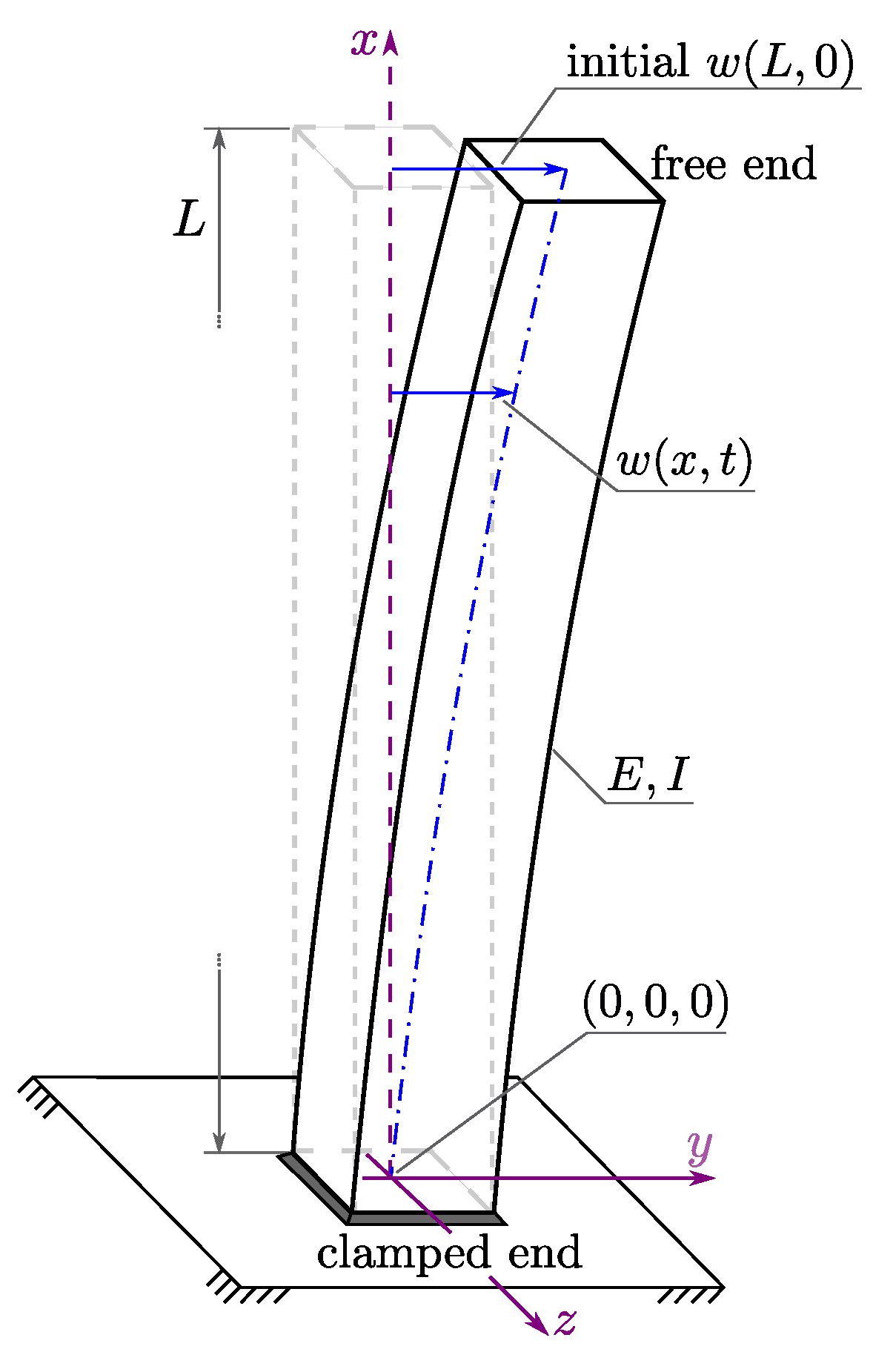
Consider the cantilever (clamped–free) beam shown in
Figure 2, characterized by length
L, mass per unit length
m, flexural rigidity (bending stiffness)
, and area moment of inertia
I. The structure is slender (
) and undergoes in-plane transverse flexural vibrations.
We assume that the Euler–Bernoulli beam theory governs the transverse vibrations of the structure. Shear deformation and rotary inertia are neglected, which is fully consistent with the geometry of the experimental specimen used later in this work. The in-plane flexural vibrations of the beam, including geometric nonlinearities, are described by the following partial differential Equation [
55]:
Here,
x is the axial coordinate measured from the clamped end (
Figure 2), and
denotes the lateral displacement in the
y-direction. Equation (
1) captures the beam’s dynamic deformation under inertial and nonlinear geometric effects. Each term has a specific physical role:
- (i)
—inertia associated with the distributed mass;
- (ii)
—linear flexural rigidity term, governing small-amplitude flexural waves;
- (iii)
the third term—geometric nonlinearity induced by mid-plane stretching, arising from axial deformation associated with finite slopes ;
- (iv)
the fourth term—nonlinear coupling between bending and axial strain, which becomes relevant once curvature and slope are no longer infinitesimal.
Together, these contributions represent a standard geometrically nonlinear Euler–Bernoulli model, appropriate for slender beams subjected to moderate but dynamically significant deflections.
To simplify the nonlinear PDE (
1) and extract a tractable dynamical description, we apply a single-mode approximation via the Bubnov–Galerkin method. The displacement field is approximated by
where
is the generalized coordinate (time-dependent modal amplitude) corresponding to the
n-th vibration mode, and
is the
n-th mode shape of a clamped–free beam. The function
is given in a non-dimensional and non-normalized form [
55]:
Here,
is the
n-th root of the characteristic equation for a clamped–free beam, and
L is the beam length. The parameter
is the spatial eigenvalue associated with the
n-th vibration mode. It arises from solving the boundary value problem obtained via separation of variables applied to the governing PDE. Physically,
, and it characterizes the spatial frequency of the
n-th mode shape
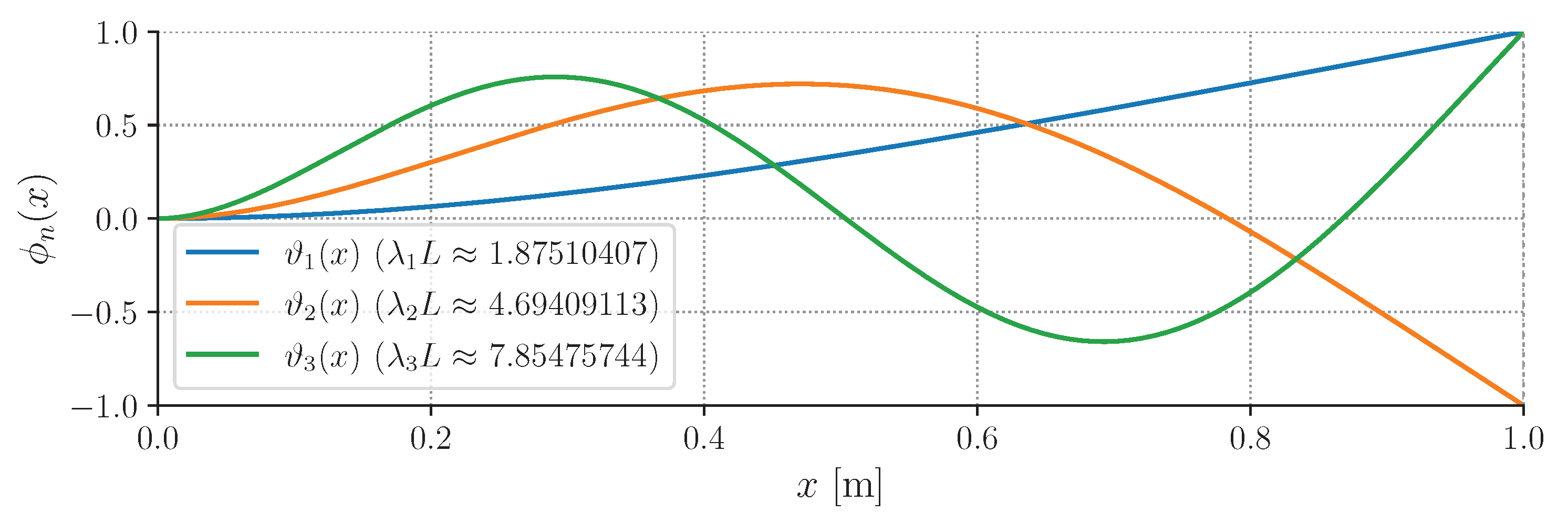
, i.e., the rate at which the mode shape oscillates along the beam’s length. Higher values of
correspond to modes with increased curvature and a larger number of internal nodes, as illustrated in
Figure 3.
In what follows, the mode shape associated with the first mode is renormalised so that , ensuring that the dimensionless modal coordinate coincides with the dimensionless tip deflection.
The spatial eigenvalue
is related to the natural angular frequency
of the
n-th vibration mode by:
where
m is the mass per unit length and
is the flexural rigidity of the beam. This relation simply reflects the balance between inertia and flexural rigidity at the modal level.
To facilitate non-dimensional analysis and to reveal the intrinsic time scale of the system, we introduce the scaled variables:
where
is the dimensionless time and
is the normalized dimensionless modal amplitude associated with the
nth vibration mode. When the mode shape
is normalized such that
, the dimensionless coordinate
coincides with the normalized tip deflection of the beam.
The quantity serves as the reference angular frequency of the beam and provides the natural time-scaling factor based purely on its physical and geometric properties.
In this non-dimensional formulation, the linear single-mode dynamics reduce to a dimensionless harmonic oscillator
where the dimensionless angular natural frequency is
Equivalently, when working with the non-dimensional spatial coordinate
and denoting by
the corresponding eigenvalue of the clamped–free problem, the dimensionless angular frequency is
The associated physical angular frequency is then obtained by rescaling with the reference frequency,
In the present work, we focus on the fundamental mode. To extract it, we set , the smallest positive root of the characteristic equation . This eigenvalue and its associated spatial mode shape follow directly from linear Euler–Bernoulli beam theory. Following standard practice in Galerkin-based model reduction for weakly to moderately nonlinear structures, the linear mode shape is retained, while the nonlinear effects are assumed to manifest primarily in the time-dependent modal amplitude .
This single-mode approximation is justified under key conditions relevant to the present study. First, it assumes that the shape of the fundamental mode is not significantly altered by nonlinear effects, so that the spatial deformation remains close to even at finite amplitudes. Second, it neglects nonlinear energy transfer to higher modes, which may arise through mechanisms such as mid-plane stretching. This assumption is appropriate when the natural frequencies of a clamped–free beam are well separated, and the system is not subjected to internal or external resonances capable of efficiently exciting higher modes.
Crucially, the experimental observations presented in
Section 6 provide direct empirical support for this modelling choice. The measured deformation fields are overwhelmingly dominated by the first bending mode, and no measurable contribution from higher modes is detected within the spatial and temporal resolution of the vision-based measurements. The good agreement between the model predictions and the experimental results, discussed in
Section 7, therefore serves as an a posteriori validation of the single-mode reduction.
Applying the Bubnov–Galerkin method to Equation (
1) and projecting onto the first clamped–free mode shape
, we obtain the following dimensionless nonlinear ODE for the modal amplitude
:
with dimensionless coefficients (see
Table A1):
Here, denotes the second derivative with respect to . The individual terms can be interpreted as —linear modal stiffness, —cubic geometric stiffness nonlinearity (finite-slope effect), —nonlinear inertia (from axial inertia associated with finite slopes), and —amplitude-dependent inertia (inertial nonlinearity).
The coefficients
are computed numerically based on integrals involving the first mode shape
and its spatial derivatives. The full derivation is presented in
Appendix A. It should be emphasized that both the resulting ODE and the values of the coefficients are specific to this first mode and to the adopted normalization (here
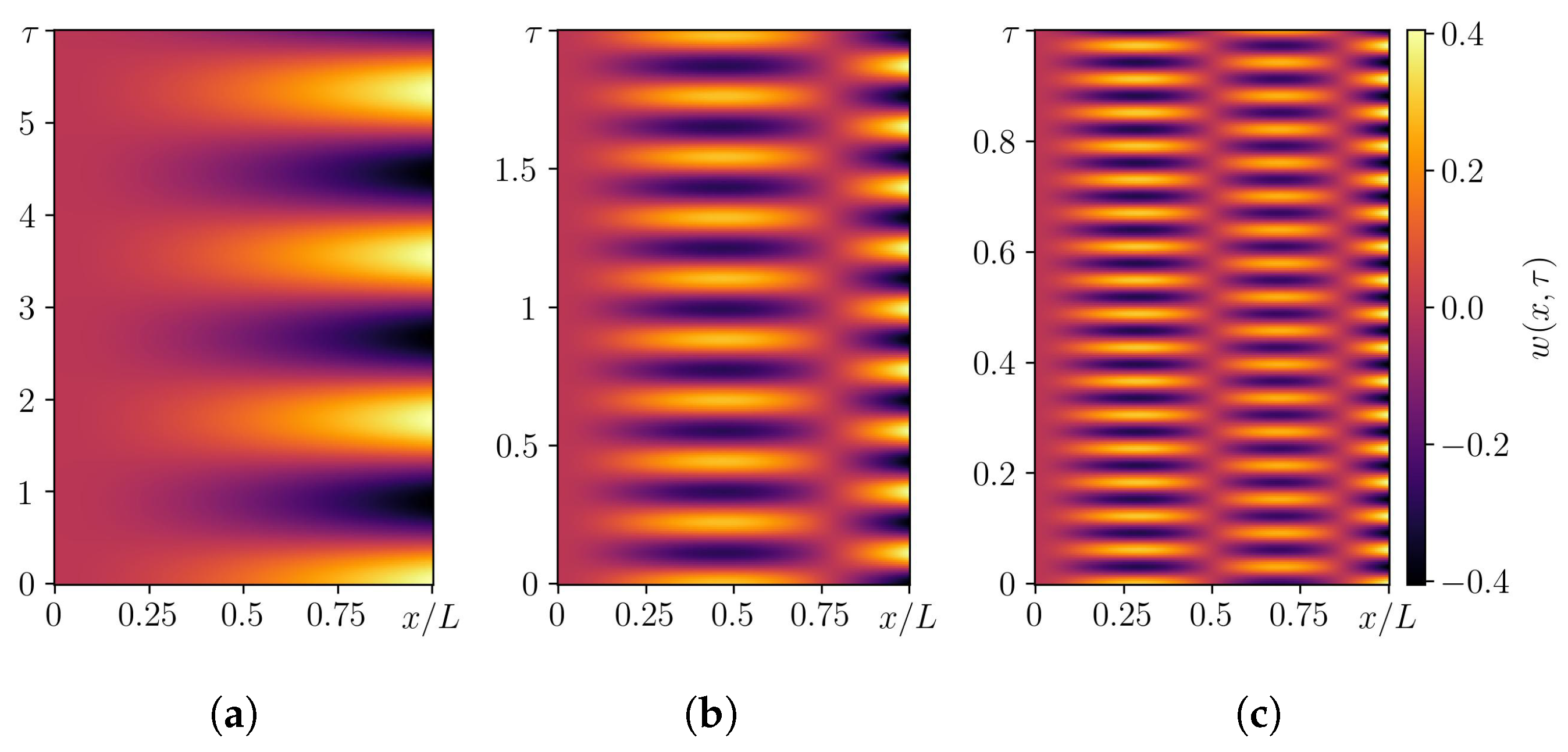
). Higher modes exhibit increasing spatial complexity (more internal nodes and curvature extrema), which would require a multi-mode reduction to capture modal interactions. This motivates the single-mode framework adopted here, consistent with the experimentally observed mode dominance (see
Figure 4 and
Appendix B).
Figure 4 highlights the rapid increase in spatial complexity associated with higher vibration modes, manifested by additional nodal lines and higher curvature content. This visualization clarifies why, in the moderate-amplitude free-vibration regime considered here, the first mode provides a dominant and physically meaningful reduced-order description.
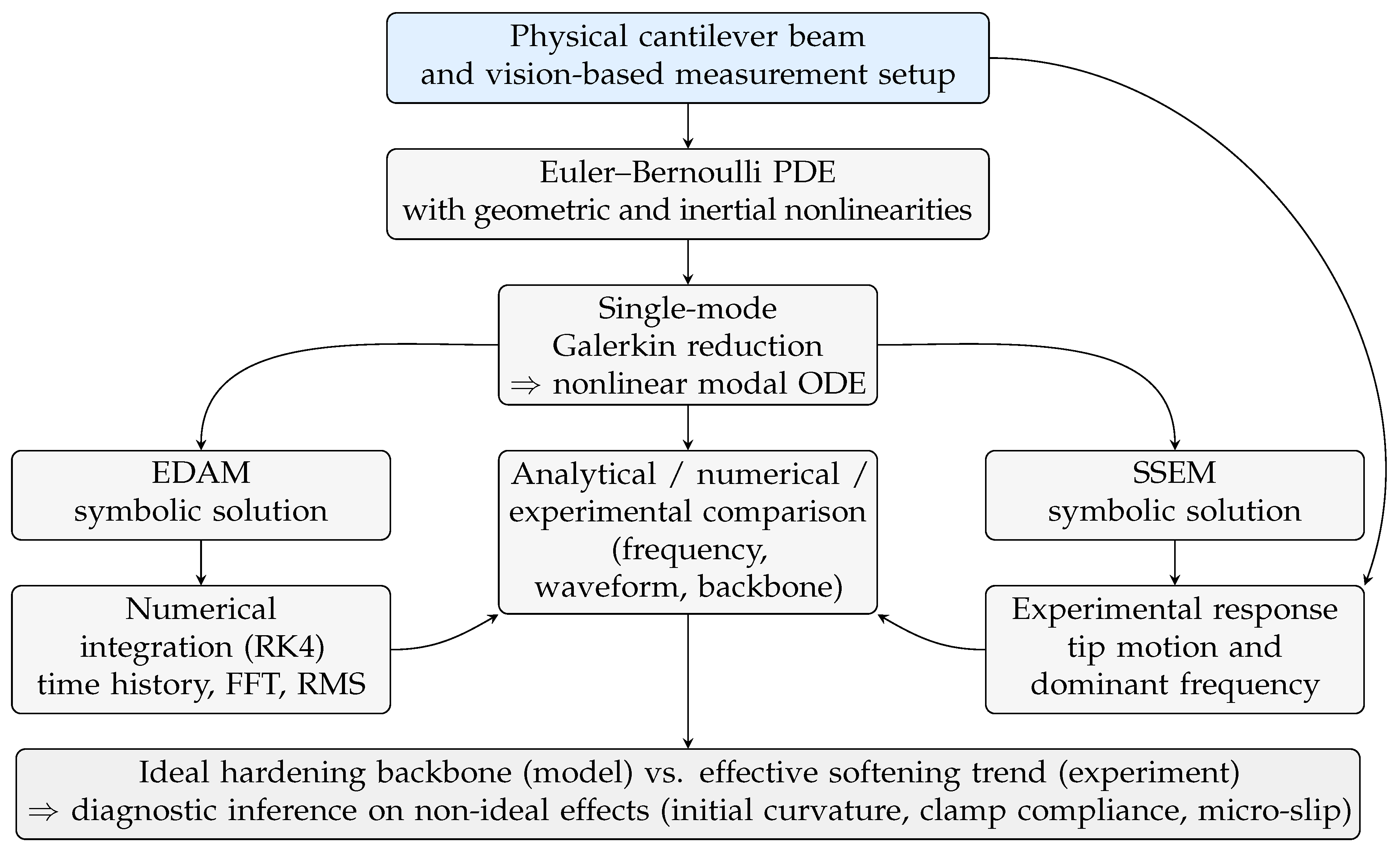
This reduced-order, single-mode model forms the basis for analyzing the nonlinear dynamics of the cantilever beam undergoing moderate-to-large-amplitude free vibrations. In the following sections, we discuss its practical relevance and present two analytical methods for constructing closed-form solutions to Equation (
5).
2.1. Key Assumptions of the Reduced-Order Model
The reduced-order model developed in this study is based on the following assumptions:
Euler–Bernoulli beam theory. The beam is slender (its length is much larger than its thickness); shear deformation and rotary inertia are neglected. The geometry of the experimental specimen is consistent with this assumption.
Single-mode Galerkin reduction. Only the fundamental bending mode is retained in the approximation. This choice is motivated by the strong spectral separation of the natural frequencies of a clamped–free beam and by experimental evidence showing that the free vibration response is dominated by the first mode (
Section 6). A detailed justification of this modelling strategy is provided in
Section 1.4.
Conservative system. No explicit damping terms are included in the governing equation. This simplification is deliberately adopted to enable the derivation of exact analytical solutions and to isolate the intrinsic geometric and inertial nonlinearities. The comparison with the experiment is therefore restricted to a quasi-steady interval of motion where damping effects are weak.
Planar motion. The vibration is assumed to remain planar, with no torsional or out-of-plane components.
Linear elastic material behaviour and free vibration. The material is assumed to be linearly elastic, and no external forces, axial preload, or gravitational effects are included.
Within these assumptions, the model captures the dominant undamped single-mode nonlinear dynamics of the beam and provides a compact analytical description that can be directly confronted with numerical simulations and experimental measurements.
2.2. Engineering Context and Practical Relevance
Cantilever beams are ubiquitous in engineering systems where lightweight design and low damping make nonlinear dynamic effects particularly relevant. The undamped single-mode formulation developed in
Section 2 is applicable whenever free vibrations dominate and backbone-type amplitude–frequency characteristics are of primary interest.
In aerospace structures, flexible cantilevered components such as satellite appendages and aircraft wings exhibit low damping and large dynamic deflections, influencing stability and control [
56,
57,
58]. Similar considerations arise in mechanical and microscale systems, including robotic manipulators and MEMS cantilever beams, where elastic deflections and shock-induced responses lead to pronounced nonlinear behaviour under weak damping [
59,
60,
61].
Cantilever configurations are also common in civil engineering, particularly in bridge construction, where long-term monitoring reveals deflections exceeding design predictions even when damping is weak [
62,
63]. In such contexts, simplified undamped models remain useful for early-stage dynamic assessment.
These examples indicate that the nonlinear undamped cantilever model considered here provides a practical analytical reference for interpreting numerical simulations and experimental observations in systems dominated by geometric nonlinearities.
3. Analytical Solution Methods
In this section, we address the analytical solution of the dimensionless nonlinear ODE governing the modal amplitude, given in Equation (
5) for a selected mode. Two symbolic techniques are employed: the Extended Direct Algebraic Method (EDAM) and the Sardar Sub-Equation Method (SSEM). These methods are designed to construct exact closed-form solutions to nonlinear evolution equations and are adapted here to describe the dynamics of cantilever beam vibrations.
In the remainder of the paper, all equations are expressed in terms of the dimensionless time variable
introduced in (
4). Since the analysis focuses exclusively on the first bending mode, we drop the mode index and write
with overdots denoting subsequent differentiation with respect to
. For brevity, the bar notation will also be omitted when no confusion arises, so that
and
both denote the dimensionless modal amplitude of the first mode.
The reduced equation of motion from Equation (
5) can therefore be written in the unified notation as
where
denotes the dimensionless modal amplitude of the first bending mode, and the coefficients
are defined through spatial integrals of the corresponding mode shape (see
Appendix A).
Step 1: We recall the general structure of a nonlinear PDE used to model beam dynamics:
where
is the unknown displacement field, and
J is a polynomial in the indicated derivatives.
Step 2: Based on the single-mode approximation introduced in
Section 2, the governing PDE was reduced to the nonlinear ODE (
5) for the modal amplitude
. The analytical methods are applied directly to this ODE, where the independent variable is the dimensionless time
.
Step 3: To solve Equation (
7) for the modal amplitude
, we introduce the ansatz
where
is an auxiliary function to be determined by either EDAM or SSEM, and
are constant coefficients.
The purpose of this ansatz is to reduce the nonlinear ODE to an algebraic system by assuming a functional dependence on that satisfies a suitable auxiliary equation.
Using the balancing principle, we compare the orders of the dominant linear term
and the nonlinear term
. Setting
yields
(see [
64]).
It is noted that Equation (
7) also contains other nonlinear terms, namely
and
, which are of higher algebraic order (schematically
). For the investigated moderate-amplitude regime
, the nonlinear inertial contributions are of higher order with respect to the ansatz scaling. In particular, terms of the form
and
scale as
relative to the leading linear inertia
, whereas the dominant geometric nonlinearity provides the primary mechanism responsible for the observed waveform distortion and frequency shift. Consequently, neglecting these nonlinear inertial terms in the leading-order balance affects the solution mainly quantitatively (small corrections) rather than qualitatively (no change in the response type within the considered amplitude range). This is further confirmed by the close agreement between the analytical expressions and the numerical reference solutions reported in
Section 4. A full balance including these terms would lead to a substantially more complicated ansatz. In line with common practice for this class of methods, we balance the linear inertia term against the dominant geometric stiffness nonlinearity (
). This choice is physically justified, as it confronts the primary linear dynamics with the main source of physical nonlinearity (mid-plane stretching). The high accuracy of the resulting solutions, demonstrated in
Section 4, serves as an a posteriori validation of this simplifying assumption.
For
, the ansatz reduces to
The auxiliary function
will now be determined by solving a suitable sub-equation, depending on the method employed.
3.1. The New Extended Direct Algebraic Method
In the new Extended Direct Algebraic Method (EDAM), the auxiliary function
is assumed to satisfy a first-order nonlinear differential equation of the Riccati type:
where
is a multiplicative regularization factor,
, and
are parameters to be identified. The factor
is introduced as a scaling parameter that facilitates compact closed-form expressions and does not affect the qualitative structure of the resulting solutions.
To classify the solutions of Equation (
11), we introduce the discriminant
which determines the nature of the roots of the associated quadratic polynomial and thus the functional forms of the resulting solutions
. Different signs of
lead to distinct families of analytical expressions, such as trigonometric, hyperbolic, or rational functions.
Substituting the ansatz (
10) into the governing Equation (
7) and using the chain rule to express
and
in terms of
and
from Equation (
11), we obtain an algebraic system in the unknowns
,
, and the parameters
. Solving this system yields, in particular,
with
, while
remains a free parameter to be specified from boundary or initial conditions. This relation corresponds to the non-degenerate branch of solutions with
, which yields physically admissible, non-singular expressions.
The solutions obtained via EDAM for various parameter regimes are denoted by
, where each
represents a specific closed-form expression for the modal amplitude
. They are grouped according to the signs and values of
,
,
, and
, and provide a catalogue of exact solutions to Equation (
7). The constants
m,
c,
,
p,
q (and similar symbols appearing below) are real integration parameters arising from the solution of the auxiliary Equation (
11).
For illustration, the following representative cases are retained. Many of the solutions listed below are mathematically equivalent under time shifts, sign changes, or parameter rescaling; their classification is nevertheless retained for completeness and transparency.
1: If
and
, then:
2: If
,
, and
, then:
3: If
and
, then
4: If
,
,
, then
i.e., a constant-amplitude (equilibrium) solution.
5: If
and
, then
again yielding a trivial constant solution.
6: If
and
, then
7: If
,
and
, then
Candidate solutions containing in the denominator lead to singular or undefined expressions and are therefore excluded from the final set as physically inadmissible.
3.2. The Sardar Sub-Equation Method
In the Sardar Sub-Equation Method (SSEM), the auxiliary function
is assumed to satisfy the following first-order nonlinear differential equation:
where
F and
G are real-valued constants. This choice leads to families of solutions expressed in terms of trigonometric, hyperbolic, or related functions, depending on the signs of
F and
G. This quartic polynomial form is chosen because it admits exact integration and generates a broad class of elementary and hyperbolic functions commonly encountered in nonlinear oscillatory systems.
Substituting the ansatz (
10) together with the auxiliary Equation (
17) into the governing Equation (
7), and applying the chain rule, we obtain an algebraic system relating
,
,
F,
G, and the coefficients
. When
, this system yields
for parameter combinations such that the radicand is nonnegative. The condition
arises algebraically from the consistency of the reduced system and does not restrict the admissible oscillatory dynamics.
For consistency with the EDAM notation, each SSEM solution is again denoted by .
Case A:
1: If
and
:
2: If
,
, and
:
Case B:
In this case, Equation (
18) becomes singular due to division by zero. We therefore treat
as a free parameter (to be determined from boundary or energy conditions) and write
In summary, the EDAM and SSEM procedures generate distinct families of closed-form solutions to the nonlinear ODE (
7), explicitly characterizing the modal displacement
of the cantilever beam under various parameter regimes. In the subsequent sections, selected representative members of these families (in particular
) are compared quantitatively against numerical simulations.
4. Physical Interpretation of Analytical Solutions
In this study, two different analytical techniques, the new EDAM and the SSEM, were applied to solve the nonlinear modal amplitude equation. Their predictions are compared against a high-accuracy numerical solution obtained using a classical fourth-order Runge–Kutta (RK4) time integrator.
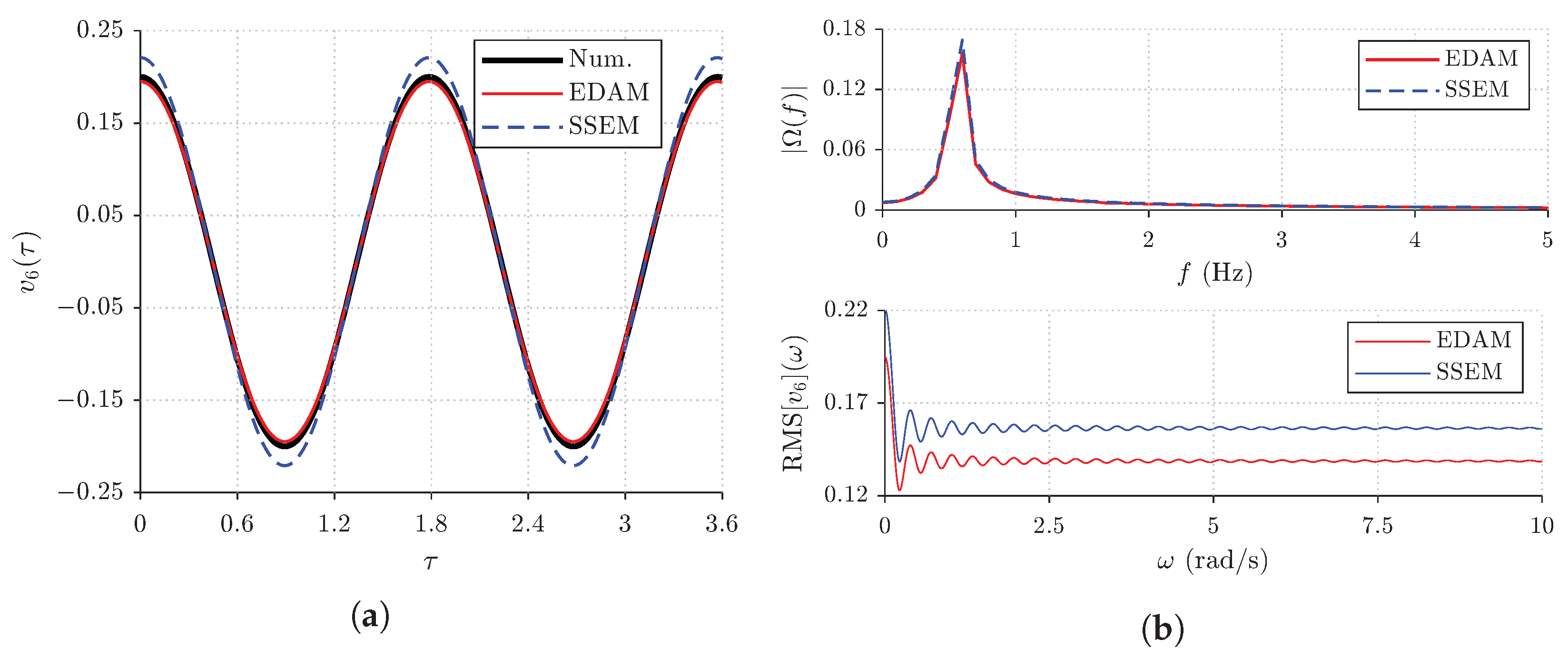
Figure 5a shows the time-history response of the non-dimensional lateral displacement
at the free end of the cantilever beam. The corresponding frequency-domain analysis, together with a comparison of root mean square (RMS) values, is presented in
Figure 5b. In all cases, the numerical RK4 solution is treated as the reference, while the EDAM- and SSEM-based analytical solutions are superimposed for comparison.
As expected for in-plane flexural vibrations governed by a nonlinear modal equation, the waveforms exhibit periodic oscillations with a slightly nonsinusoidal character. Both analytical techniques reproduce these qualitative features. In the frequency domain (
Figure 5b), the spectra display a sharp, well-isolated peak near the dimensionless fundamental frequency, confirming that the dominant bending mode is correctly captured.
A closer inspection of
Figure 5a reveals systematic differences between the analytical methods. The EDAM curve (red solid line) is almost indistinguishable from the RK4 solution over the entire simulated time interval, whereas the SSEM curve (blue dashed line) exhibits noticeable amplitude deviations near the crests and troughs. This difference reflects the fact that EDAM balances the dominant geometric nonlinearity directly against linear inertia, whereas SSEM introduces an additional functional constraint through the quartic sub-equation, which affects the amplitude scaling near extrema. This behaviour is quantified in
Table 1, which reports pointwise values of the numerical, EDAM, and SSEM solutions at selected instants over a single period
.
The EDAM approximation maintains a pointwise relative error typically between
and
, while the SSEM shows errors in the range
–
. These values are fully consistent with the visual impression from
Figure 5a, where EDAM follows the numerical trace almost perfectly, whereas SSEM systematically overestimates the displacement amplitude.
4.1. Numerical Reference Solution and Convergence Considerations
Because the analytical methods are benchmarked against a numerical solution, it is important to ensure that the latter is computed with accuracy well beyond the discrepancies reported in
Table 1. To this end, the RK4 time integration was performed with a sufficiently small time step, and standard convergence checks were carried out: halving the time step did not produce any visible change in the displacement history at the scale of
Figure 5a, and the corresponding variations in the peak amplitudes remained significantly below the EDAM and SSEM errors listed in
Table 1. Moreover, for the undamped system, the total mechanical energy remained practically constant over many vibration cycles, confirming that the numerical discretisation error is negligible over the time window considered.
These checks justify treating the RK4 solution as a reliable numerical reference for assessing the accuracy of the analytical techniques. Consequently, the discrepancies reported in
Table 1 can be attributed to the intrinsic approximation properties of EDAM and SSEM, rather than to numerical integration artefacts.
4.2. RMS-Based Global Comparison
To complement the pointwise error analysis, we also compute the RMS values of the non-dimensional displacement response over the interval . The RMS provides a scalar measure of the effective amplitude of the signal over time. Since the average modal energy of an undamped oscillator is proportional to the mean square of its displacement, the RMS value is a robust global metric for comparing the overall magnitude of periodic or quasi-periodic waveforms.
The RMS values are computed for the numerical reference solution and for each analytical approximation using the standard definition
approximated numerically using the discrete signal data in MATLAB 2025b. The results are gathered in
Table 2.
These global indicators fully support the time-domain observations. The new EDAM solution reproduces the effective amplitude of the numerical benchmark with an RMS deviation of only about , whereas SSEM overestimates the average amplitude by nearly . Both methods capture the correct oscillatory nature and dominant frequency of the response, but EDAM finds a significantly more faithful representation of the waveform and associated energy content over the analysed interval.
4.3. Completeness, Equivalence, and Physical Admissibility of EDAM Solutions
Before relating the analytical solutions to experimental observations, it is necessary to clarify the completeness, equivalence, and physical admissibility of the EDAM solution catalog.
The EDAM procedure yields a catalog of closed-form solutions that is complete in the following operational sense: all solutions satisfying the adopted polynomial ansatz and the governing reduced-order equation are generated, up to equivalence under time translation, sign inversion, and parameter rescaling.
Several EDAM solutions are mathematically equivalent in the sense that they can be transformed into one another by: (i) a time shift , (ii) a sign change in the state variable , or (iii) a rescaling of integration constants that does not modify the frequency–amplitude relationship.
Such transformations leave invariant the backbone curve and the qualitative phase portrait and therefore do not correspond to physically distinct dynamical responses.
Among the obtained EDAM solutions, solution was selected for experimental comparison because it represents a minimal canonical form that: (i) admits real-valued, bounded periodic motion, (ii) exhibits a monotonic frequency–amplitude dependence, (iii) avoids redundant phase shifts or sign symmetries, and (iv) allows a direct identification of analytical parameters with experimentally observable quantities.
All other physically admissible periodic solutions reduce to under the equivalence transformations described above.
Physical admissibility of the EDAM solutions requires that the governing parameters satisfy conditions ensuring: (i) bounded periodic motion, (ii) real-valued oscillation frequencies, (iii) positive effective stiffness in the small-amplitude limit, and (iv) absence of finite-time singularities.
In particular, the admissible parameter domain is restricted to combinations of (or, equivalently, ) for which the polynomial governing the oscillation frequency remains positive over the admissible amplitude range and the resulting solution amplitude remains finite for all .
Parameter sets violating these conditions correspond to mathematically valid but physically inadmissible solutions and are therefore excluded from experimental interpretation.
4.4. Relation to an Experimental Verification
Among the physically admissible and mutually equivalent EDAM solutions discussed above, solution is adopted as a representative reference for experimental comparison.
The availability of analytical expressions for the dimensionless modal amplitude
enables a direct pathway to experimental validation. Once the beam parameters: length
L, flexural rigidity
, and mass per unit length
m are known, the solutions can be mapped back to dimensional form via:
where
—physical modal amplitude (displacement of the free end of the beam),
—dimensionless modal amplitude.
This reverse transformation allows comparison with displacement measurements or full-field experimental data, such as laser vibrometry or digital image correlation.
Such mapping supports model calibration and parameter identification. Deviations between predicted and measured responses can guide updates to physical parameters or model assumptions. This is particularly useful in applications like MEMS devices or aerospace structures, where damping is minimal or difficult to quantify. This procedure is adopted in
Section 6 for the comparison with vision-based measurements of the cantilever tip motion.
4.5. Robustness and Practical Utility
Although the analytical solutions derived here rely on a single-mode approximation and neglect explicit damping, these assumptions are appropriate for weakly damped free vibrations and early-stage engineering analysis. In particular, the selected EDAM solution corresponds to a bounded, symmetric, zero-mean periodic response, consistent with experimentally observed free-decay oscillations dominated by the fundamental bending mode.
A key practical advantage of the EDAM formulation is its compact parametric structure. The solution depends on a small set of physically interpretable parameters governing amplitude and frequency, enabling efficient parametric studies and sensitivity analyses. This compactness makes the solution suitable not only for analytical investigations but also as a lightweight surrogate model in applications such as vibration monitoring, reduced-order control, and diagnostic analysis.
Furthermore, the closed-form structure of the EDAM solution permits straightforward extension to include empirical damping or slow parameter modulation, providing a natural link between idealized conservative dynamics and experimentally observed responses. Overall, its robustness with respect to numerical reference solutions and its analytical transparency support the use of EDAM as a practical and physically meaningful reference model for nonlinear cantilever beam dynamics.
6. Experimental Observation
The primary objective of this study is the analytical investigation of a geometrically nonlinear single-degree-of-freedom oscillator using symbolic methods (EDAM and SSEM), with particular emphasis on the structure, completeness, and physical admissibility of closed-form solutions. The experimental cantilever beam is introduced as a physically realizable system exhibiting the qualitative dynamical features predicted by the mathematical model, namely single-mode dominance and softening-type nonlinearity. The experiment therefore serves as a structural and qualitative validation of the analytical framework, focusing on modal dominance, frequency–amplitude trends, and admissibility of the closed-form solutions.
A brief description of the experimental preparation is nevertheless provided to ensure reproducibility of the observed global response. Prior to imposing the prescribed initial tip displacement, the beam exhibits a slight initial curvature. The maximum deviation from an ideal straight reference line occurs near mid-span and is of the order of the beam thickness b. Given the high slenderness ratio of the specimen, this imperfection is considered intrinsic to the manufacturing and handling process. The beam surface is polished and exhibits a glossy finish typical of machined slender beams, with surface roughness within the range reported in the literature for such finishes (–).
The beam is clamped at its base by embedding it from both sides within the lower support over the full clamping height, achieved by bonding both beam faces to the support. This configuration provides a strong geometric constraint; however, limited boundary compliance cannot be excluded due to the finite stiffness of the adhesive layer and the elastic properties of the additively manufactured support. This compliance is treated as a secondary effect and does not alter the qualitative nonlinear dynamics investigated here.
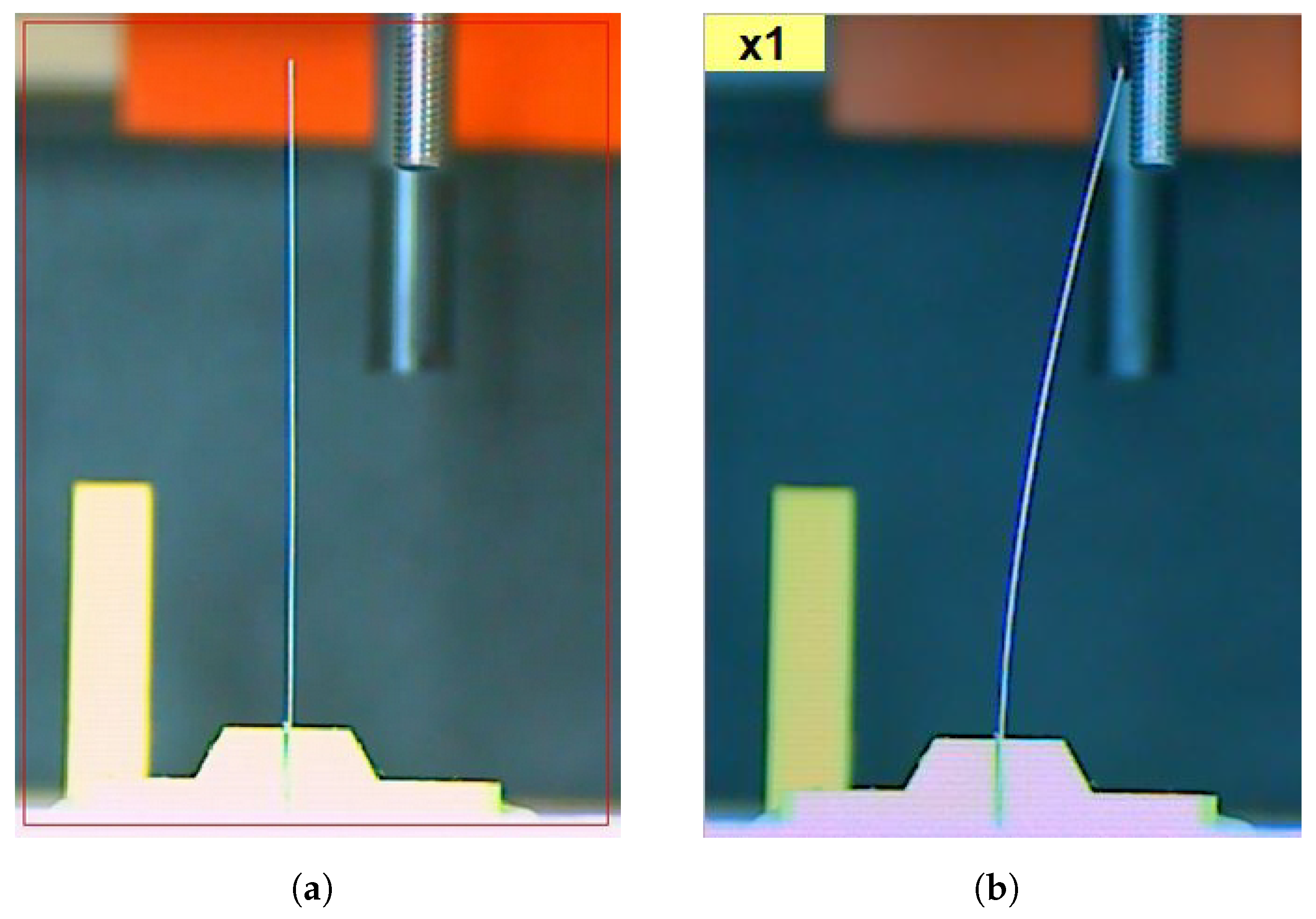
To validate the analytical and numerical results, a series of free-vibration experiments was performed on a weakly damped cantilever beam. The specimen, shown in
Figure 10, was displaced at the free end, released from rest, and its subsequent motion was recorded using a high-speed camera.
The motion was captured with a high-speed MEMRECAM HX-7 (model V-1001-C1, nac Image Technology Inc., Tokyo, Japan) equipped with a SIGMA 18-300mm F3.5-6.3 DC MACRO OS HSM (Sigma Corporation, Kanagawa, Japan), operating at 2000 fps to ensure precise resolution of the rapid vibration cycles. The displacement field was extracted from the recorded video using advanced edge-tracking techniques based on convolutional neural networks and dedicated YOLO detection frameworks. This automated procedure enabled high-fidelity reconstruction of the beam’s silhouette throughout the experiment. It should be noted that while the reconstructed displacement fields are well suited for frequency and backbone identification, the spatially non-uniform measurement uncertainty inherent to vision-based tracking at very small amplitudes limits the robustness of pointwise modal projection metrics.
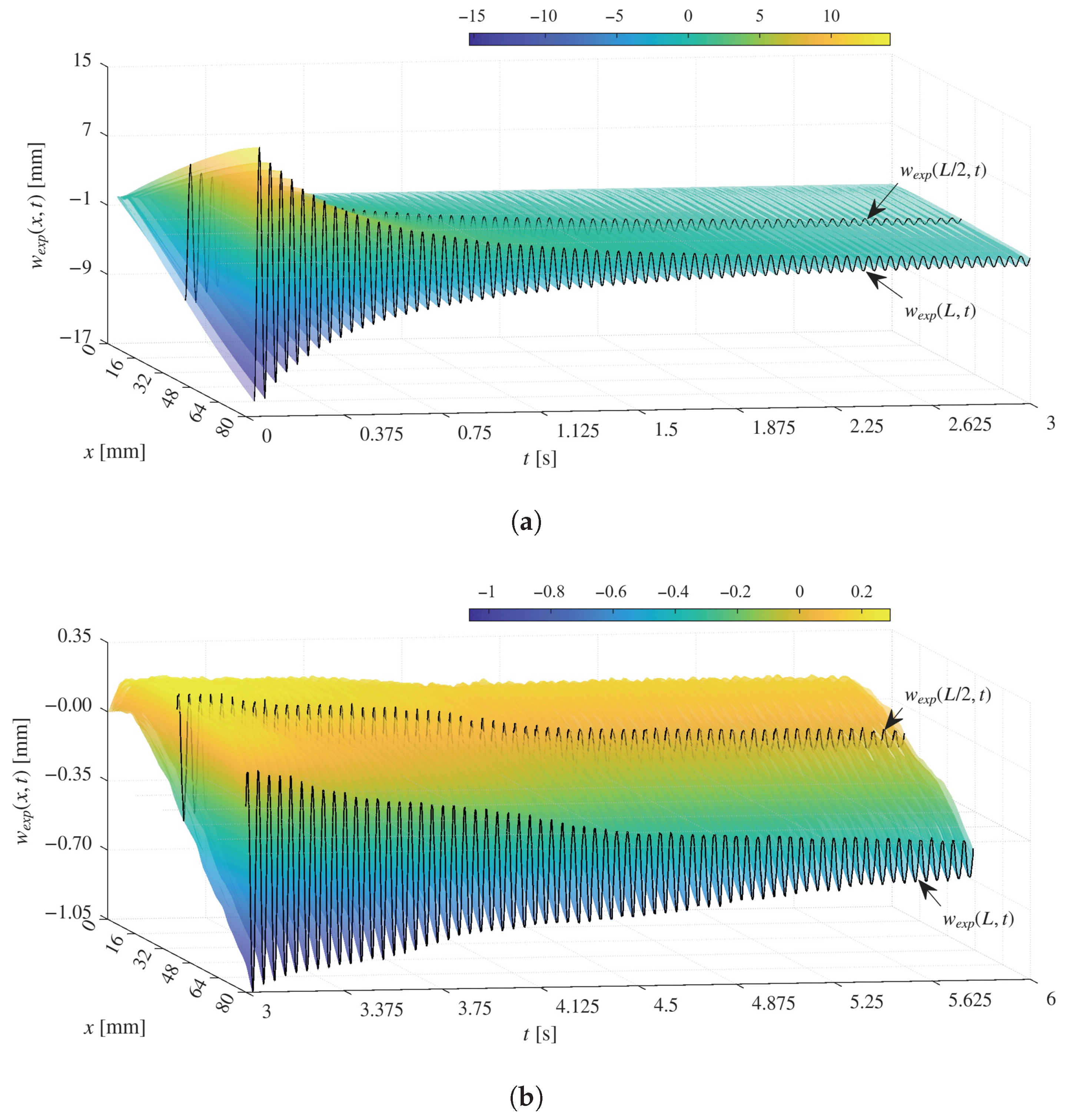
Figure 11 illustrates the measured deformation surface during the initial transient (
s) and a later interval (
s), highlighting the rapid early amplitude decay followed by a nearly periodic, weakly damped response. The displacement traces at the free end,
, and at midspan,
, are superimposed as black lines in
Figure 11a for reference.
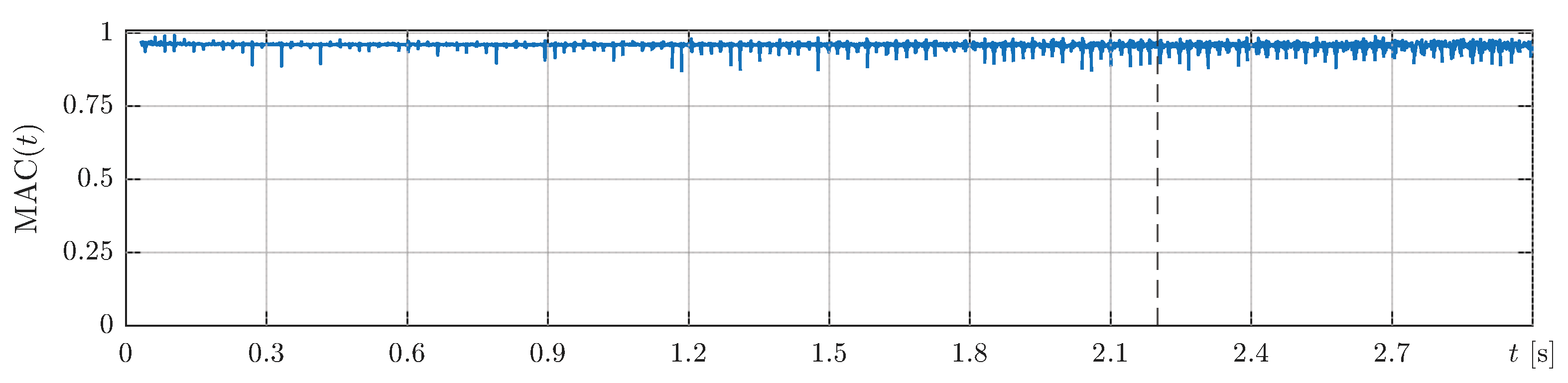
The observed deformation surfaces further indicate a clear dominance of the first bending mode throughout the analyzed response. In particular, the spatial profiles remain smooth and monotonic along the beam length, without the appearance of internal nodes or localized curvature reversals that would be indicative of higher bending modes. This behaviour persists both during the initial transient and in the subsequent quasi-steady regime, despite the gradual amplitude decay.
The dominant frequency values reported in
Table 3 were identified exclusively within a quasi-steady response window (
s) using a unified FFT–Hann–least-squares procedure applied to the tip displacement
. The frequencies are therefore not directly inferred from the time intervals visualized in
Figure 11, which serve primarily to illustrate the global spatiotemporal response and the transition from transient to quasi-steady dynamics.
The quasi-steady window was selected after the initial transient, where the oscillation amplitude decays rapidly due to weak damping, and before the late-time regime in which the vibration amplitude approaches the resolution limit of the vision-based tracking. Within this interval, the motion remains nearly periodic, weakly damped, and dominated by a single spectral peak near 24 Hz, providing a reliable basis for quantitative comparison with the conservative analytical model.
Repeatability of the experimental response was assessed indirectly through multiple free-decay realizations with different initial tip displacements (Series I–IV). Despite significant variation in the initial amplitude
, the dominant frequencies identified in the quasi-steady regime remain narrowly clustered around 24 Hz (
Table 3), indicating a robust single-mode response and consistent softening-type frequency–amplitude behaviour.
A full statistical reconstruction of experimental backbone bands was not pursued, as the decreasing signal-to-noise ratio at very small vibration amplitudes limits the robustness of frequency extraction from vision-based measurements. The adopted strategy therefore prioritizes repeatable identification of the dominant frequency in a well-defined quasi-steady regime, which is the quantity directly compared with the analytical backbone solutions.
The experimentally identified damping ratios remain of the order of , with all values below and multiple realizations exhibiting . This confirms a weakly damped regime and justifies the use of a quasi-steady time window for comparison with conservative analytical solutions.
Accordingly, modal dominance in the present study is established in an operational sense, through spatial smoothness of the deformation fields, spectral purity of the response, and repeatability of the identified frequencies. Together, these indicators provide sufficient evidence for validating the single-degree-of-freedom analytical backbone model adopted herein.
7. Analytical and Experimental Comparison Focused on Oscillation Frequency
A number of strategies can be used to compare analytical and experimental responses of nonlinear structures, including time-domain overlays, amplitude envelopes, frequency–time spectrograms, and full-field displacement reconstruction. In the present study, however, the most robust and unambiguous quantity is the dominant oscillation frequency extracted from the quasi-steady portion of the experimental response. This choice avoids the need for spatial mode-shape identification, which is unavoidably influenced by damping, measurement noise, and geometric imperfections.
During the free vibration of the physical beam, a distinct interval emerges in which the amplitude decays very slowly, and the motion becomes nearly periodic (
Figure 11b). Because damping effects are minimal in this window and the response remains dominated by the first bending mode, the dominant frequency measured there provides a reliable reference for direct comparison with the analytical model.
7.1. Dimensionless Dynamics and Linear Calibration
The reduced-order model introduced earlier is expressed in terms of the dimensionless time variable
, the modal coordinate
, and the nonlinear system (
24). Its linear behaviour is governed by the clamped–free eigenvalue
,
This intrinsic dimensionless frequency is visible as the dominant peak in the numerical frequency spectra shown in
Figure 5b. The small discrepancy between this analytical value and the numerically extracted peak (
–
) arises from finite FFT resolution and the limited duration of the analysed signal and does not reflect any difference in physical frequency.
The transformation to dimensional time is
so that the physical frequency is
. The experimental reference frequency
is defined as the mean dominant frequency obtained from four independent free-decay realizations (Series I–IV in
Table 3), identified within a common quasi-steady time window
s.
In order to align the theoretical model with the experimental specimen, the flexural rigidity
is determined such that the fundamental frequency matches the experimentally identified value
Hz. Using the measured geometric characteristics and mass per unit length (
Table 4), this yields
and thus
This calibration establishes a consistent mapping between the dimensionless model and the physical specimen, enabling direct comparison of nonlinear frequency shifts.
7.2. Nonlinear Frequency Shift in the Analytical Model
With the linear scaling fixed, we analyse the nonlinear response predicted by the reduced-order model. Due to the geometric nonlinearity associated with mid-plane stretching, the simulated solutions exhibit a slightly nonsinusoidal waveform and an amplitude-dependent frequency. The dominant frequency is extracted from the steady-state portion of using zero-crossing-based period estimation, which provides high accuracy and avoids discretization effects associated with FFT binning.
The analytical results show a clear increase in the dimensionless frequency with growing initial amplitude. This monotonic trend corresponds to a hardening-type geometric nonlinearity: as the beam deflects further, axial stretching introduces additional stiffness and increases the effective vibration frequency. Such behaviour is a classical hallmark of clamped–free beams with geometric nonlinearity and is consistent with both historical studies and recent high-fidelity NNM analyses.
7.3. Backbone Curve and Normalized Amplitude
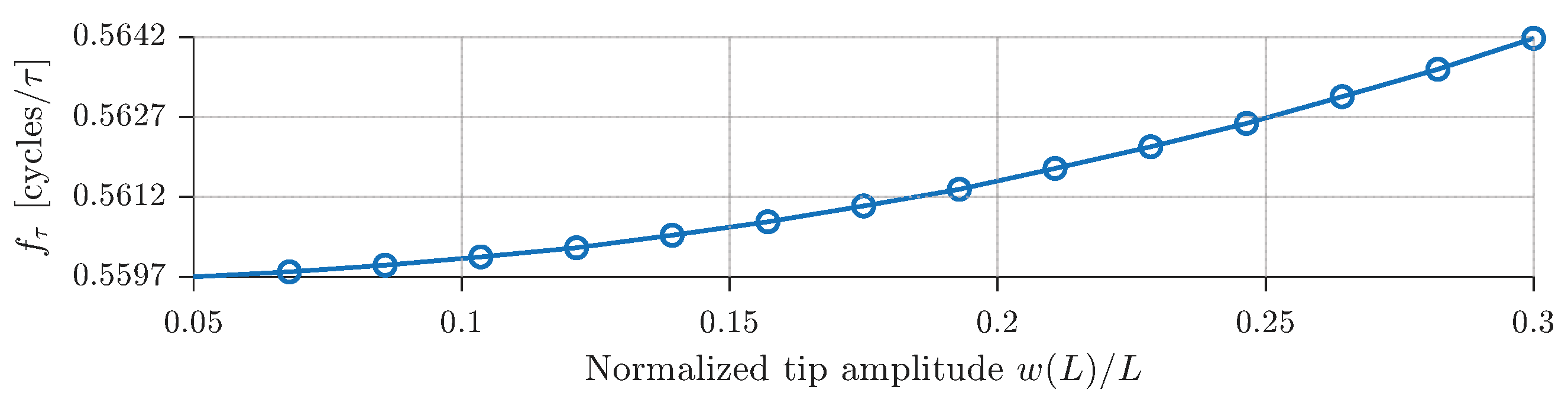
To quantify the nonlinear frequency shift independently of initial conditions, we compute the backbone curve relating the dimensionless frequency to the normalized tip amplitude
For each prescribed amplitude, the system (
24) is integrated over many cycles and the dominant frequency
is obtained from the steady-state portion of the response. The resulting backbone curve is shown in
Figure 12. It is smooth, monotonic, and displays the expected hardening trend for amplitudes
up to
, corresponding to the moderately nonlinear regime in which the single-mode approximation remains valid.
Backbone curves obtained from NNMs and geometrically exact beam theories may extend to amplitudes as large as –. Capturing such regimes requires multi-mode expansions and significant mode-shape modifications, which are beyond the scope of a single linear-mode truncation. The present backbone therefore serves as a compact, analytically tractable reference for the intrinsic geometric hardening of an ideal cantilever beam.
7.4. Validity Range of the Single-Mode Approximation
The single-mode model remains accurate as long as the first mode dominates the dynamic response and the deformation field does not deviate substantially from the linear mode shape. For clamped–free beams of the present type, this typically holds for normalized amplitudes up to –. Beyond this range, several nonlinear mechanisms become significant: mode-shape distortion, cross-modal energy transfer, quadratic nonlinearities induced by boundary compliance, and sensitivity to initial curvature.
These effects cannot be reproduced by a single linear mode truncation and explain why high-amplitude backbone curves computed in the NNM literature cannot be directly compared to the present model. Within its validity range, however, the single-mode formulation provides a reliable and physically interpretable description of the essential geometric nonlinearity, forming a necessary baseline for understanding the experimental observations.
7.5. Experimental Observation of Softening
In contrast to the analytically predicted hardening behaviour, the experimental data exhibit a clear softening-type frequency shift. Repeated measurements summarized in
Table 3 show that the dominant frequency extracted from the quasi-steady response depends systematically on vibration amplitude.
The lowest frequency,
is observed for the largest initial tip displacement (Series I), whereas the highest frequency,
corresponds to smaller vibration amplitudes (Series II). The resulting monotonic decrease in frequency with increasing amplitude indicates an effective softening response that departs from the hardening behaviour of an ideal Euler–Bernoulli cantilever.
The dimensionless eigenvalues
used for frequency calibration are listed in
Table A1. Combined with the calibrated time-scaling factor
, they yield physical natural frequencies that follow the characteristic ratios of slender steel cantilever beams.
On the scope of validation. A direct point-by-point comparison between analytical and experimental time histories is not meaningful, since the reduced-order model is conservative while the experimental response exhibits damping-induced decay. The comparison is therefore restricted to quasi-steady intervals.
Within these intervals, the experimental waveform shows mild asymmetry and crest sharpening, consistent with nonlinear waveform distortion. A physical interpretation of these observations is provided in
Section 8.
8. Discussion of the Observed Softening Behaviour
For an ideal, rectilinear cantilever beam governed by Euler–Bernoulli kinematics with mid-plane stretching, the first bending mode is expected to exhibit a hardening-type nonlinear response. This behaviour is a cornerstone of classical nonlinear vibration theory and is consistently reproduced by geometrically exact models, reduced-order formulations, and nonlinear normal mode (NNM) analyses. The single-mode reduced-order model developed in
Section 2.2 conforms to this theoretical expectation, yielding a hardening backbone curve dominated by cubic geometric nonlinearity.
The experimentally observed softening response reported in
Section 6 does not contradict this classical prediction. Instead, it highlights the sensitivity of cantilever dynamics to non-ideal features inevitably present in real structures. As documented in the literature, even small initial curvature, limited clamp compliance, or frictional micro-slip can introduce effective quadratic nonlinearities that dominate the cubic stretching contribution and reverse the backbone slope.
In the present experiment, a slight initial curvature is visible in the undeformed configuration (
Figure 10a), with an estimated out-of-straightness of approximately
mm. Together with unavoidable clamp compliance, this imperfection is sufficient to alter the effective nonlinear stiffness. Similar softening mechanisms associated with geometric imperfections, boundary flexibility, and micro-slip have been widely reported in experimental and NNM-based studies of cantilever beams and related structures [
65,
66,
67].
In this context, the reduced analytical model serves as a physically transparent reference rather than a direct predictor of the measured response. By providing the backbone of an ideal beam, it enables a diagnostic interpretation of deviations observed experimentally. The discrepancy between analytically predicted hardening and experimentally observed softening therefore reveals additional nonlinear mechanisms that are absent from the idealized formulation and would remain obscured in purely numerical or purely experimental studies.
The role of the analytical model thus extends beyond prediction. It acts as a virtual baseline that isolates non-ideal physical effects in the real structure. In this sense, the combination of symbolic closed-form solutions and high-resolution experimental measurements provides a robust framework for interpreting nonlinear dynamics in slender cantilever beams. Although the present study focuses on a single specimen, the analytical–experimental workflow is directly transferable to other cantilever configurations with comparable modal separation.
9. Conclusions
This work developed and validated a reduced-order nonlinear model of a cantilever beam based on a single-mode Galerkin projection of the geometrically nonlinear Euler–Bernoulli equation. Despite its simplicity, the formulation is well suited to the investigated regime, where both numerical simulations and high-speed vision measurements confirm the strong dominance of the first bending mode.
Two symbolic techniques, the Extended Direct Algebraic Method (EDAM) and the Sardar Sub-Equation Method (SSEM), were employed to obtain exact closed-form solutions of the nonlinear modal equation. Comparison with high-accuracy numerical integration demonstrates that EDAM reproduces the nonlinear waveform and amplitude–phase structure with higher fidelity, making it particularly effective for weakly to moderately nonlinear flexural vibrations.
A central contribution of this study is the integration of exact analytical solutions with experimental observations. After calibrating the flexural rigidity using the measured linear frequency, the analytical model accurately captures the steady-state oscillation characteristics. The comparison reveals a key physical insight: while the ideal model predicts geometric hardening, the experiment exhibits a clear softening trend. This discrepancy points to real-world effects, such as initial curvature, clamp compliance, or micro-slip, that are absent from the ideal theory but become identifiable precisely because an analytical benchmark is available.
The main limitation of the present formulation is the absence of damping, which precludes a direct comparison of transient decay. Incorporating dissipation and extending the model to multiple modes would enable the analysis of decay rates, internal resonances, and more complex nonlinear phenomena.
Overall, the results demonstrate that exact analytical solutions, when combined with controlled experiments, provide a compact and physically transparent framework for interpreting nonlinear vibrations of slender beams. Such hybrid analytical–experimental approaches are particularly well suited for diagnostics and physics-based reduced-order modelling.
Future work will focus on incorporating damping in a physically interpretable manner, developing multi-mode reductions for larger amplitudes, and including experimentally identified boundary nonlinearities to bridge the observed hardening–softening discrepancy.