Diagnostic Approaches to Total Knee Arthroplasty Loosening: From Conventional Imaging to Modern Techniques

 , , and
Abstract
1. Introduction
2. Materials and Methods
3. Diagnosis of Endoprosthesis Loosening—Conventional and Alternative Methods
3.1. Imaging-Based Diagnostic Methods
3.2. Contemporary Laboratory Diagnostic Methods for Assessing Knee Endoprosthesis Stability
3.3. Biomechanical Methods
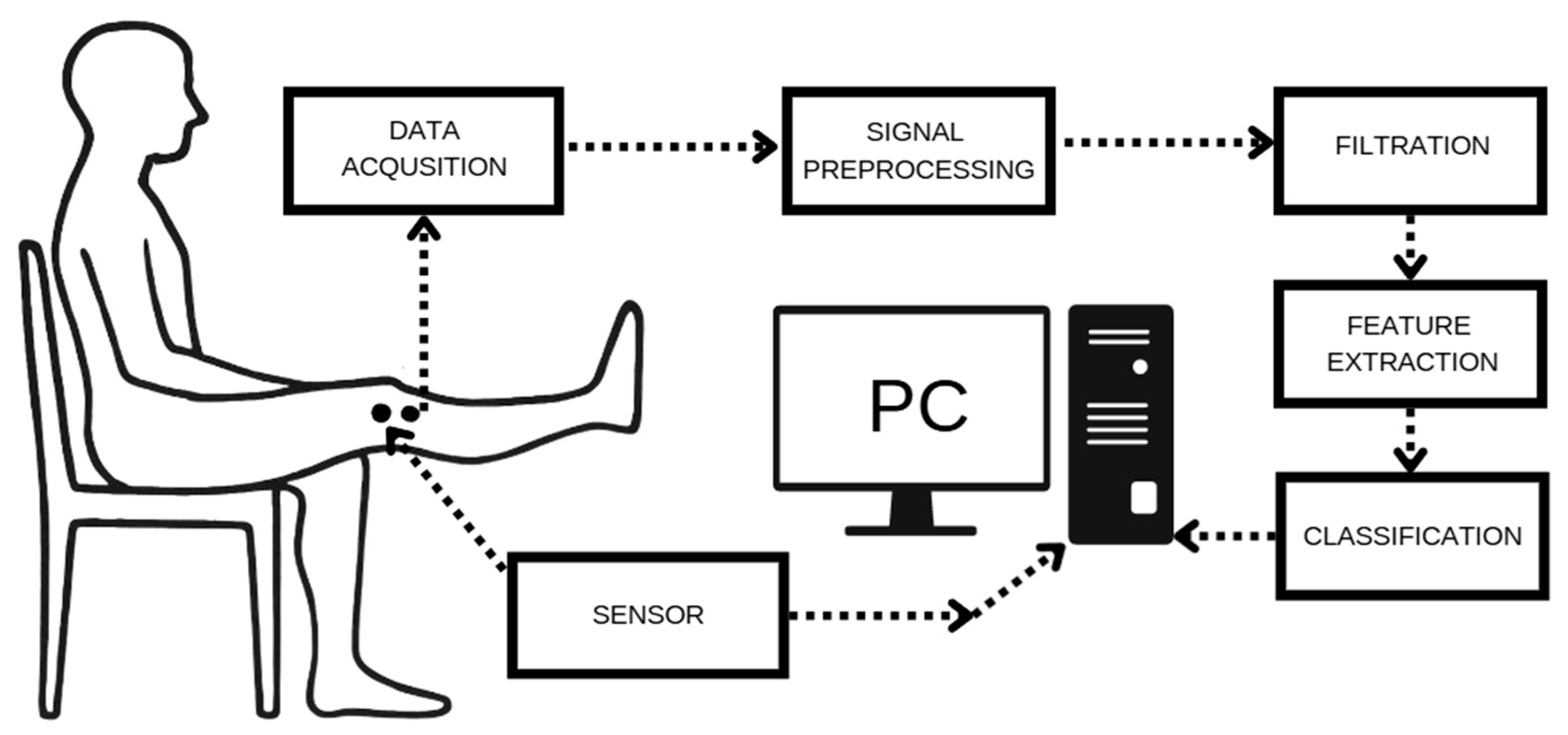
3.4. Vibroarthrography
4. Conclusions and Future Directions
Author Contributions
Funding
Institutional Review Board Statement
Informed Consent Statement
Data Availability Statement
Conflicts of Interest
Abbreviations
References
- Kim, M.-S.; Kim, J.-J.; Kang, K.-H.; Lee, J.-H.; In, Y. Detection of Prosthetic Loosening in Hip and Knee Arthroplasty Using Machine Learning: A Systematic Review and Meta-Analysis. Medicina 2023, 59, 782. [Google Scholar] [CrossRef] [Scilit]
- Hootman, J.M.; Helmick, C.G.; Barbour, K.E.; Theis, K.A.; Boring, M.A. Updated Projected Prevalence of Self-Reported Doctor-Diagnosed Arthritis and Arthritis-Attributable Activity Limitation Among US Adults, 2015–2040. Arthritis Rheumatol. 2016, 68, 1582–1587. [Google Scholar] [CrossRef] [Scilit] [PubMed]
- Nham, F.H.; Patel, I.; Zalikha, A.K.; El-Othmani, M.M. Epidemiology of Primary and Revision Total Knee Arthroplasty: Analysis of Demographics, Comorbidities and Outcomes from the National Inpatient Sample. Arthroplasty 2023, 5, 18. [Google Scholar] [CrossRef] [Scilit] [PubMed]
- Kerner, P.J.; Clarke, H.D.; Scuderi, G.R. Total Knee Arthroplasty for Rheumatoid Arthritis. Mod. Rheumatol. 2003, 13, 289–292. [Google Scholar] [CrossRef]
- Qiao, Y.; Li, F.; Zhang, L.; Song, X.; Yu, X.; Zhang, H.; Liu, P.; Zhou, S. A Systematic Review and Meta-Analysis Comparing Outcomes Following Total Knee Arthroplasty for Rheumatoid Arthritis versus for Osteoarthritis. BMC Musculoskelet. Disord. 2023, 24, 484. [Google Scholar] [CrossRef] [Scilit]
- Ren, Y.; Yang, Q.; Luo, T.; Lin, J.; Jin, J.; Qian, W.; Weng, X.; Feng, B. Better Clinical Outcome of Total Knee Arthroplasty for Rheumatoid Arthritis with Perioperative Glucocorticoids and Disease-Modifying Anti-Rheumatic Drugs after an Average of 11.4-Year Follow-Up. J. Orthop. Surg. Res. 2021, 16, 84. [Google Scholar] [CrossRef] [Scilit]
- Hernigou, P.; Auregan, J.C.; Dubory, A.; Flouzat-Lachaniette, C.H.; Chevallier, N.; Rouard, H. Subchondral Stem Cell Therapy versus Contralateral Total Knee Arthroplasty for Osteoarthritis Following Secondary Osteonecrosis of the Knee. Int. Orthop. 2018, 42, 2563–2571. [Google Scholar] [CrossRef] [Scilit] [PubMed]
- Houdek, M.T.; Wagner, E.R.; Wilke, B.K.; Wyles, C.C.; Taunton, M.J.; Sim, F.H. Long Term Outcomes of Cemented Endoprosthetic Reconstruction for Periarticular Tumors of the Distal Femur. Knee 2016, 23, 167–172. [Google Scholar] [CrossRef] [Scilit]
- Sharkey, P.F.; Lichstein, P.M.; Shen, C.; Tokarski, A.T.; Parvizi, J. Why Are Total Knee Arthroplasties Failing Today—Has Anything Changed After 10 Years? J. Arthroplast. 2014, 29, 1774–1778. [Google Scholar] [CrossRef] [Scilit]
- Wretenberg, P. Implant Movement Analysis (IMA), A New CT Based Technique for Diagnosis of Aseptic Loosening of Total Knee Arthroplasty. Orthop. Res. Online J. 2021, 8, 868–872. [Google Scholar] [CrossRef] [Scilit]
- Kim, M.-S.; Cho, R.-K.; Yang, S.-C.; Hur, J.-H.; In, Y. Machine Learning for Detecting Total Knee Arthroplasty Implant Loosening on Plain Radiographs. Bioengineering 2023, 10, 632. [Google Scholar] [CrossRef] [Scilit] [PubMed]
- De Tocqueville, S.; Marjin, M.; Ruzek, M. A Review of the Vibration Arthrography Technique Applied to the Knee Diagnostics. Appl. Sci. 2021, 11, 7337. [Google Scholar] [CrossRef] [Scilit]
- Arami, A.; Delaloye, J.-R.; Rouhani, H.; Jolles, B.M.; Aminian, K. Knee Implant Loosening Detection: A Vibration Analysis Investigation. Ann. Biomed. Eng. 2018, 46, 97–107. [Google Scholar] [CrossRef] [Scilit]
- Walker, E.A.; Fox, M.G.; Blankenbaker, D.G.; French, C.N.; Frick, M.A.; Hanna, T.N.; Jawetz, S.T.; Onks, C.; Said, N.; Stensby, J.D.; et al. ACR Appropriateness Criteria® Imaging After Total Knee Arthroplasty: 2023 Update. J. Am. Coll. Radiol. 2023, 20, S433–S454. [Google Scholar] [CrossRef] [Scilit]
- Wautier, D.; Ftaïta, S.; Thienpont, E. Radiolucent Lines around Knee Arthroplasty Components: A Narrative Review. Acta Orthop. Belg. 2020, 86, 82–94. [Google Scholar]
- Palestro, C.J. Radionuclide Imaging of Musculoskeletal Infection: A Review. J. Nucl. Med. 2016, 57, 1406–1412. [Google Scholar] [CrossRef] [Scilit] [PubMed]
- Vessely, M.B.; Frick, M.A.; Oakes, D.; Wenger, D.E.; Berry, D.J. Magnetic Resonance Imaging with Metal Suppression for Evaluation of Periprosthetic Osteolysis After Total Knee Arthroplasty. J. Arthroplast. 2006, 21, 826–831. [Google Scholar] [CrossRef] [Scilit]
- Zhang, K.; Han, Q.; Xu, X.; Jiang, H.; Ma, L.; Zhang, Y.; Yang, K.; Chen, B.; Wang, J. Metal Artifact Reduction of Orthopedics Metal Artifact Reduction Algorithm in Total Hip and Knee Arthroplasty. Medicine 2020, 99, e19268. [Google Scholar] [CrossRef] [Scilit]
- Jeong, S.; Kim, S.H.; Hwang, E.J.; Shin, C.; Han, J.K.; Choi, B.I. Usefulness of a Metal Artifact Reduction Algorithm for Orthopedic Implants in Abdominal CT: Phantom and Clinical Study Results. Am. J. Roentgenol. 2015, 204, 307–317. [Google Scholar] [CrossRef] [Scilit]
- Kohyama, S.; Yoshii, Y.; Okamoto, Y.; Nakajima, T. Advances in Bone Joint Imaging-Metal Artifact Reduction. Diagnostics 2022, 12, 3079. [Google Scholar] [CrossRef] [Scilit]
- Midthun, P.; Kirkhus, E.; Østerås, B.H.; Høiness, P.R.; England, A.; Johansen, S. Metal Artifact Reduction on Musculoskeletal CT: A Phantom and Clinical Study. Eur. Radiol. Exp. 2023, 7, 46. [Google Scholar] [CrossRef] [Scilit]
- Shim, E.; Kang, Y.; Ahn, J.M.; Lee, E.; Lee, J.W.; Oh, J.H.; Kang, H.S. Metal Artifact Reduction for Orthopedic Implants (O-MAR): Usefulness in CT Evaluation of Reverse Total Shoulder Arthroplasty. Am. J. Roentgenol. 2017, 209, 860–866. [Google Scholar] [CrossRef] [Scilit] [PubMed]
- Naraghi, A.M.; White, L.M. Magnetic Resonance Imaging of Joint Replacements. Semin. Musculoskelet. Radiol. 2006, 10, 098–106. [Google Scholar] [CrossRef] [Scilit] [PubMed]
- Koch, K.M.; Brau, A.C.; Chen, W.; Gold, G.E.; Hargreaves, B.A.; Koff, M.; McKinnon, G.C.; Potter, H.G.; King, K.F. Imaging near Metal with a MAVRIC-SEMAC Hybrid. Magn. Reson. Med. 2011, 65, 71–82. [Google Scholar] [CrossRef] [Scilit]
- Hayter, C.L.; Koff, M.F.; Shah, P.; Koch, K.M.; Miller, T.T.; Potter, H.G. MRI After Arthroplasty: Comparison of MAVRIC and Conventional Fast Spin-Echo Techniques. Am. J. Roentgenol. 2011, 197, W405–W411. [Google Scholar] [CrossRef] [Scilit]
- Choi, S.-J.; Koch, K.M.; Hargreaves, B.A.; Stevens, K.J.; Gold, G.E. Metal Artifact Reduction with MAVRIC SL at 3-T MRI in Patients with Hip Arthroplasty. Am. J. Roentgenol. 2015, 204, 140–147. [Google Scholar] [CrossRef] [Scilit]
- Sutter, R.; Hodek, R.; Fucentese, S.F.; Nittka, M.; Pfirrmann, C.W.A. Total Knee Arthroplasty MRI Featuring Slice-Encoding for Metal Artifact Correction: Reduction of Artifacts for STIR and Proton Density–Weighted Sequences. Am. J. Roentgenol. 2013, 201, 1315–1324. [Google Scholar] [CrossRef] [Scilit]
- Khodarahmi, I.; Khanuja, H.S.; Stern, S.E.; Carrino, J.A.; Fritz, J. Compressed Sensing SEMAC MRI of Hip, Knee, and Ankle Arthroplasty Implants: A 1.5-T and 3-T Intrapatient Performance Comparison for Diagnosing Periprosthetic Abnormalities. Am. J. Roentgenol. 2023, 221, 661–672. [Google Scholar] [CrossRef] [Scilit]
- Niccoli, G.; Mercurio, D.; Cortese, F. Bone Scan in Painful Knee Arthroplasty: Obsolete or Actual Examination? Acta Biomed. Atenei Parm. 2017, 88, 68. [Google Scholar]
- Claassen, L.; Ettinger, M.; Plaass, C.; Daniilidis, K.; Calliess, T.; Ezechieli, M. Diagnostic Value of Bone Scintigraphy for Aseptic Loosening after Total Knee Arthroplasty. THC 2014, 22, 767–773. [Google Scholar] [CrossRef] [Scilit] [PubMed]
- Verberne, S.J.; Kuiper, J.W.P.; Broos, W.A.M.; Temmerman, O.P.P. Systematic Review on Reproducibility of Nuclear Imaging in the Assessment of Painful Hip and Knee Replacements. SN Compr. Clin. Med. 2020, 2, 1491–1504. [Google Scholar] [CrossRef] [Scilit]
- Boero, M.; Allocca, M.; Pisu, N.; Sanna, S.; Ruggiero, A.; Pung, B.L.J.; Margotti, S.; Dessì, G. Management of Periprosthetic Knee Joint Infections: Focus on the Role of Nuclear Medicine (V2). Orthop. Rev. 2022, 14, 39646. [Google Scholar] [CrossRef] [Scilit] [PubMed]
- Palestro, C.J. Nuclear Medicine and the Failed Joint Replacement: Past, Present, and Future. WJR 2014, 6, 446. [Google Scholar] [CrossRef] [Scilit] [PubMed]
- Izakovicova, P.; Borens, O.; Trampuz, A. Periprosthetic Joint Infection: Current Concepts and Outlook. EFORT Open Rev. 2019, 4, 482–494. [Google Scholar] [CrossRef] [Scilit]
- Palestro, C.J.; Swyer, A.J.; Kim, C.K.; Goldsmith, S.J. Infected Knee Prosthesis: Diagnosis with In-111 Leukocyte, Tc-99m Sulfur Colloid, and Tc-99m MDP Imaging. Radiology 1991, 179, 645–648. [Google Scholar] [CrossRef] [Scilit]
- Verberne, S.J.; Sonnega, R.J.A.; Temmerman, O.P.P.; Raijmakers, P.G. What Is the Accuracy of Nuclear Imaging in the Assessment of Periprosthetic Knee Infection? A Meta-Analysis. Clin. Orthop. Relat. Res. 2017, 475, 1395–1410. [Google Scholar] [CrossRef] [Scilit]
- Hirschmann, M.T.; Amsler, F.; Rasch, H. Clinical Value of SPECT/CT in the Painful Total Knee Arthroplasty (TKA): A Prospective Study in a Consecutive Series of 100 TKA. Eur. J. Nucl. Med. Mol. Imaging 2015, 42, 1869–1882. [Google Scholar] [CrossRef] [Scilit]
- Peng, Z.; Jia, Y.; Li, J.; Wang, G. Diagnostic Performance of Single-Photon Emission Computed Tomography/Computed Tomography in Aseptic Loosening: A Systematic Review and Meta-Analysis. J. Arthroplast. 2021, 36, 4003–4012.e3. [Google Scholar] [CrossRef] [Scilit]
- Murer, A.M.; Hirschmann, M.T.; Amsler, F.; Rasch, H.; Huegli, R.W. Bone SPECT/CT Has Excellent Sensitivity and Specificity for Diagnosis of Loosening and Patellofemoral Problems after Total Knee Arthroplasty. Knee Surg. Sports Traumatol. Arthrosc. 2020, 28, 1029–1035. [Google Scholar] [CrossRef] [Scilit] [PubMed]
- Bao, B.; Liu, C.; Masson, E.C.O.; Abele, J. Diagnostic Accuracy of SPECT/CT Arthrography in Patients with Suspected Aseptic Joint Prosthesis Loosening 2020. Eur. J. Hybrid Imaging 2021, 5, 4. [Google Scholar] [CrossRef] [Scilit]
- Chew, C.G.; Lewis, P.; Middleton, F.; Van Den Wijngaard, R.; Deshaies, A. Radionuclide Arthrogram with SPECT/CT for the Evaluation of Mechanical Loosening of Hip and Knee Prostheses. Ann. Nucl. Med. 2010, 24, 735–743. [Google Scholar] [CrossRef] [Scilit]
- Hoveidaei, A.; Tavakoli, Y.; Ramezanpour, M.R.; Omouri-kharashtomi, M.; Taghavi, S.P.; Hoveidaei, A.H.; Conway, J.D. Imaging in Periprosthetic Joint Infection Diagnosis: A Comprehensive Review. Microorganisms 2024, 13, 10. [Google Scholar] [CrossRef] [Scilit] [PubMed]
- Mokoala, K.M.G.; Ndlovu, H.; Lawal, I.; Sathekge, M.M. PET/CT and SPECT/CT for Infection in Joints and Bones: An Overview and Future Directions. Semin. Nucl. Med. 2024, 54, 394–408. [Google Scholar] [CrossRef] [Scilit]
- Koob, S.; Gaertner, F.C.; Jansen, T.R.; Schmolders, J.; Gravius, S.; Strunk, H.; Wirtz, D.C.; Essler, M. Diagnosis of Peri-Prosthetic Loosening of Total Hip and Knee Arthroplasty Using 18F-Fluoride PET/CT. Oncotarget 2019, 10, 2203–2211. [Google Scholar] [CrossRef] [Scilit]
- Röhner, E.; Heinecke, M.; Matziolis, G. Diagnostic Algorithm in Aseptic TKA Failure—What Is Evidence-Based? J. Orthop. 2021, 24, 248–253. [Google Scholar] [CrossRef] [Scilit]
- Van Den Wyngaert, T.; Palli, S.R.; Imhoff, R.J.; Hirschmann, M.T. Cost-Effectiveness of Bone SPECT/CT in Painful Total Knee Arthroplasty. J. Nucl. Med. 2018, 59, 1742–1750. [Google Scholar] [CrossRef] [Scilit] [PubMed]
- Love, C.; Marwin, S.E.; Palestro, C.J. Nuclear Medicine and the Infected Joint Replacement. Semin. Nucl. Med. 2009, 39, 66–78. [Google Scholar] [CrossRef] [Scilit] [PubMed]
- Al-Jabri, T.; Ridha, M.; Wood, M.J.; Kayani, B.; Jayadev, C.; McCulloch, R.A.; Schemitsch, E. An Overview of the Current Diagnostic Approach to Periprosthetic Joint Infections. Orthop. Rev. 2024, 16, 120308. [Google Scholar] [CrossRef] [Scilit]
- Puijk, R.; Lubbe, P.; Sierevelt, I.N.; Kristians, A.E.; Boer, J.; Nolte, P.A. The Diagnostic Characteristic and Reproducibility of Bone Scintigraphy Single-Photon Emission Computed Tomography/Computed Tomography for Diagnosing Aseptic Loosening of Uncemented Total Knee Arthroplasty. J. Arthroplast. 2024, 39, 1707–1713.e1. [Google Scholar] [CrossRef] [Scilit]
- Anzola, L.K.; Hernandez, N.; Rodriguez, L.F.; Sanguino, G.; Martinez, E.; Lopez, R.; Moreno, S.; Prill, R.; Mut, F.; Rasch, H.; et al. The Role of SPECT/CT in Painful, Noninfected Knees after Knee Arthroplasty: A Systematic Review and Meta-Analysis—A Diagnostic Test Accuracy Review. J. Orthop. Surg. Res. 2023, 18, 223. [Google Scholar] [CrossRef] [Scilit]
- Tian, Y.; Jiang, Y.; Feng, B.; Zhao, T.; Cai, W.; Dong, Y.; Zhao, Q. Can99mTc-MDP–SPECT/CT Differentiate Loosening and Infection After Hip and Knee Replacements? JOIO 2024, 58, 316–322. [Google Scholar] [CrossRef] [Scilit]
- Talebi, S.; Rahmani, E.; Abdinejad, M.; Ahmadzade, M.; Hoorshad, B.; Fard, A.M.; Fard, T.M.; Shafigh, A.; Momeni, H.; Radpour, N.; et al. Diagnostic Performance of SPECT/CT for Identification of Aseptic Loosening after Total Knee and Hip Arthroplasty: A Systematic Review and Meta-Analysis. Acta Orthop. Belg. 2024, 90, 503–511. [Google Scholar] [CrossRef] [Scilit]
- Hu, M.; Chen, G.; Luo, L.; Shang, L. A Systematic Review and Meta-Analysis on the Accuracy of Fluorodeoxyglucose Positron Emission Tomography/Computerized Tomography for Diagnosing Periprosthetic Joint Infections. Front. Surg. 2022, 9, 698781. [Google Scholar] [CrossRef] [Scilit]
- Kim, S.-J.; Cho, Y.J. Current Guideline for Diagnosis of Periprosthetic Joint Infection: A Review Article. Hip Pelvis 2021, 33, 11–17. [Google Scholar] [CrossRef] [Scilit]
- Parvizi, J.; Tan, T.L.; Goswami, K.; Higuera, C.; Della Valle, C.; Chen, A.F.; Shohat, N. The 2018 Definition of Periprosthetic Hip and Knee Infection: An Evidence-Based and Validated Criteria. J. Arthroplast. 2018, 33, 1309–1314.e2. [Google Scholar] [CrossRef] [Scilit]
- Tsikopoulos, K.; Meroni, G. Periprosthetic Joint Infection Diagnosis: A Narrative Review. Antibiotics 2023, 12, 1485. [Google Scholar] [CrossRef] [Scilit]
- McNally, M.; Sousa, R.; Wouthuyzen-Bakker, M.; Chen, A.F.; Soriano, A.; Vogely, H.C.; Clauss, M.; Higuera, C.A.; Trebše, R. The EBJIS Definition of Periprosthetic Joint Infection: A Practical Guide for Clinicians. Bone Jt. J. 2021, 103-B, 18–25. [Google Scholar] [CrossRef] [Scilit] [PubMed]
- Xie, K.; Dai, K.; Qu, X.; Yan, M. Serum and Synovial Fluid Interleukin-6 for the Diagnosis of Periprosthetic Joint Infection. Sci. Rep. 2017, 7, 1496. [Google Scholar] [CrossRef] [Scilit] [PubMed]
- Li, J.; Zhou, Q.; Deng, B. Serum versus Synovial Fluid Interleukin-6 for Periprosthetic Joint Infection Diagnosis: A Systematic Review and Meta-Analysis of 30 Diagnostic Test Accuracy Studies. J. Orthop. Surg. Res. 2022, 17, 564. [Google Scholar] [CrossRef] [Scilit]
- Li, C.; Li, H.; Yang, X.; Zhu, F.-Z.; Xu, C.; Trampuz, A. Meta-Analysis of Synovial Fluid Polymerase Chain Reaction for Diagnosing Periprosthetic Hip and Knee Infection. J. Orthop. Surg. Res. 2022, 17, 3. [Google Scholar] [CrossRef] [Scilit] [PubMed]
- Esteban, J.; Salar-Vidal, L.; Schmitt, B.H.; Waggoner, A.; Laurent, F.; Abad, L.; Bauer, T.W.; Mazariegos, I.; Balada-Llasat, J.-M.; Horn, J.; et al. Multicenter Evaluation of the BIOFIRE Joint Infection Panel for the Detection of Bacteria, Yeast, and AMR Genes in Synovial Fluid Samples. J. Clin. Microbiol. 2023, 61, e00357-23. [Google Scholar] [CrossRef] [Scilit]
- Bonanzinga, T.; Ferrari, M.C.; Tanzi, P.; Vandenbulcke, F.; Zahar, A.; Marcacci, M. The Role of Alpha Defensin in Prosthetic Joint Infection (PJI) Diagnosis: A Literature Review. EFORT Open Rev. 2019, 4, 10–13. [Google Scholar] [CrossRef] [Scilit]
- Trampuz, A.; Piper, K.E.; Jacobson, M.J.; Hanssen, A.D.; Unni, K.K.; Osmon, D.R.; Mandrekar, J.N.; Cockerill, F.R.; Steckelberg, J.M.; Greenleaf, J.F.; et al. Sonication of Removed Hip and Knee Prostheses for Diagnosis of Infection. N. Engl. J. Med. 2007, 357, 654–663. [Google Scholar] [CrossRef] [Scilit]
- Araújo, D.; Martins, J.P.; Ferreira, S.L.; Mota, S.; Ferreira, P.L.; Pimenta, R. A Meta-Analysis on the Role of Sonication in the Diagnosis of Cardiac Implantable Electronic Device-Related Infections. Front. Microbiol. 2024, 15, 1361626. [Google Scholar] [CrossRef] [Scilit] [PubMed]
- Alvarez Otero, J.; Karau, M.J.; Greenwood-Quaintance, K.E.; Abdel, M.P.; Mandrekar, J.; Patel, R. Evaluation of Sonicate Fluid Culture Cutoff Points for Periprosthetic Joint Infection Diagnosis. Open Forum Infect. Dis. 2024, 11, ofae159. [Google Scholar] [CrossRef] [Scilit]
- Silva, N.D.S.; De Melo, B.S.T.; Oliva, A.; De Araújo, P.S.R. Sonication Protocols and Their Contributions to the Microbiological Diagnosis of Implant-Associated Infections: A Review of the Current Scenario. Front. Cell. Infect. Microbiol. 2024, 14, 1398461. [Google Scholar] [CrossRef] [Scilit] [PubMed]
- Mederake, M.; Hofmann, U.K.; Fink, B. The Significance of Synovial Biopsy in the Diagnostic Workup of the Low-Grade Periprosthetic Joint Infection of Shoulder Arthroplasty. Arch. Orthop. Trauma. Surg. 2021, 142, 3157–3164. [Google Scholar] [CrossRef] [Scilit] [PubMed]
- Deirmengian, C.; Kardos, K.; Kilmartin, P.; Cameron, A.; Schiller, K.; Parvizi, J. Combined Measurement of Synovial Fluid α-Defensin and C-Reactive Protein Levels: Highly Accurate for Diagnosing Periprosthetic Joint Infection. J. Bone Jt. Surg. 2014, 96, 1439–1445. [Google Scholar] [CrossRef] [Scilit]
- Beguiristain, I.; Henriquez, L.; Sancho, I.; Martin, C.; Hidalgo-Ovejero, A.; Ezpeleta, C.; Portillo, M.E. Direct Prosthetic Joint Infection Diagnosis from Sonication Fluid Inoculated in Blood Culture Bottles by Direct MALDI-TOF Mass Spectrometry. Diagnostics 2023, 13, 942. [Google Scholar] [CrossRef] [Scilit]
- Ro, J.; Ro, D.H.; Kang, Y.; Han, H.-S.; Shin, C.S. Biomechanical Effect of Coronal Alignment and Ligament Laxity in Total Knee Arthroplasty: A Simulation Study. Front. Bioeng. Biotechnol. 2022, 10, 851495. [Google Scholar] [CrossRef] [Scilit]
- Van Hamersveld, K.T.; Marang-van De Mheen, P.J.; Tsonaka, R.; Nilsson, K.G.; Toksvig-Larsen, S.; Nelissen, R.G.H.H. Risk Factors for Tibial Component Loosening: A Meta-Analysis of Long-Term Follow-up Radiostereometric Analysis Data. J. Bone Jt. Surg. 2021, 103, 1115–1124. [Google Scholar] [CrossRef] [Scilit]
- Ten Brinke, B.; Beumer, A.; Koenraadt, K.L.M.; Eygendaal, D.; Kraan, G.A.; Mathijssen, N.M.C. The Accuracy and Precision of Radiostereometric Analysis in Upper Limb Arthroplasty: A Systematic Review of 23 RSA Studies. Acta Orthop. 2017, 88, 320–325. [Google Scholar] [CrossRef] [Scilit]
- Marino, G.; De Capitani, F.; Adamo, P.; Bolzoni, L.; Gatti, R.; Temporiti, F. Long-Term Gait Analysis in Patients after Total Knee Arthroplasty: A Systematic Review and Meta-Analysis. Gait Posture 2024, 113, 75–98. [Google Scholar] [CrossRef] [Scilit]
- Yu, X.; Zhuang, R.; Jin, P. Evaluation of the Efficacy after Total Knee Arthroplasty by Gait Analysis in Patients with Knee Osteoarthritis: A Meta-Analysis. J. Orthop. Surg. Res. 2024, 19, 612. [Google Scholar] [CrossRef] [Scilit] [PubMed]
- Szczypiór-Piasecka, K.; Adamczewska, P.; Kołodziej, Ł.; Ziętek, P. The Temporal–Spatial Parameters of Gait After Total Knee Arthroplasty. JCM 2025, 14, 4548. [Google Scholar] [CrossRef] [Scilit] [PubMed]
- Stentz-Olesen, K.; Nielsen, E.T.; De Raedt, S.; Jørgensen, P.B.; Sørensen, O.G.; Kaptein, B.L.; Andersen, M.S.; Stilling, M. Validation of Static and Dynamic Radiostereometric Analysis of the Knee Joint Using Bone Models from CT Data. Bone Jt. Res. 2017, 6, 376–384. [Google Scholar] [CrossRef] [Scilit]
- Van De Vusse, S.F.; De Laat, N.N.; Koster, L.A.; Kaptein, B.L. The Accuracy and Precision of CT-RSA in Arthroplasty: A Systematic Review and Meta-Analysis. Acta Orthop. 2025, 96, 295–303. [Google Scholar] [CrossRef] [Scilit] [PubMed]
- Salis, F.; Bertuletti, S.; Bonci, T.; Caruso, M.; Scott, K.; Alcock, L.; Buckley, E.; Gazit, E.; Hansen, C.; Schwickert, L.; et al. A Multi-Sensor Wearable System for the Assessment of Diseased Gait in Real-World Conditions. Front. Bioeng. Biotechnol. 2023, 11, 1143248. [Google Scholar] [CrossRef] [Scilit]
- Feng, Y.; Liu, Y.; Fang, Y.; Chang, J.; Deng, F.; Liu, J.; Xiong, Y. Advances in the Application of Wearable Sensors for Gait Analysis after Total Knee Arthroplasty: A Systematic Review. Arthroplasty 2023, 5, 49. [Google Scholar] [CrossRef] [Scilit]
- Giuntoli, M.; Scaglione, M.; Bonicoli, E.; Piolanti, N.; Puccioni, G.; Zepeda, K.; Giannini, E.; Marchetti, S.; Indelli, P.F. Intraoperative Load Sensing in Total Knee Arthroplasty Leads to a Functional but Not Clinical Difference: A Comparative, Gait Analysis Evaluation. JFMK 2022, 7, 23. [Google Scholar] [CrossRef] [Scilit]
- Al-Nasser, S.; Noroozi, S.; Harvey, A.; Aslani, N.; Haratian, R. Exploring the Performance of an Artificial Intelligence-Based Load Sensor for Total Knee Replacements. Sensors 2024, 24, 585. [Google Scholar] [CrossRef] [Scilit]
- Kubo, Y.; Fujita, D.; Sugiyama, S.; Takachu, R.; Sugiura, T.; Sawada, M.; Yamashita, K.; Kobori, K.; Kobori, M. Quadriceps Strength Loss Following Total Knee Arthroplasty as a Predictor of Three-Month Strength Recovery: A Secondary Analysis of a Randomized Controlled Trial. Cureus 2024, 16, e68244. [Google Scholar] [CrossRef] [Scilit]
- Paravlic, A.H.; Meulenberg, C.J.; Drole, K. The Time Course of Quadriceps Strength Recovery After Total Knee Arthroplasty Is Influenced by Body Mass Index, Sex, and Age of Patients: Systematic Review and Meta-Analysis. Front. Med. 2022, 9, 865412. [Google Scholar] [CrossRef] [Scilit] [PubMed]
- Puijk, R.; Singh, J.; Puijk, R.H.; Laende, E.K.; Plevier, J.W.M.; Nolte, P.A.; Pijls, B.G.C.W. Evaluation and Refinement of Thresholds for Early Migration of Total Knee Replacements as an Estimator of Late Aseptic Loosening: An Updated Systematic Review of RSA and Survival Studies. Acta Orthop. 2025, 96, 1–10. [Google Scholar] [CrossRef] [Scilit] [PubMed]
- Mizner, R.L.; Petterson, S.C.; Snyder-Mackler, L. Quadriceps Strength and the Time Course of Functional Recovery After Total Knee Arthroplasty. J. Orthop. Sports Phys. Ther. 2005, 35, 424–436. [Google Scholar] [CrossRef] [Scilit] [PubMed]
- Kaptein, B.L.; Pijls, B.; Koster, L.; Kärrholm, J.; Hull, M.; Niesen, A.; Heesterbeek, P.; Callary, S.; Teeter, M.; Gascoyne, T.; et al. Guideline for RSA and CT-RSA Implant Migration Measurements: An Update of Standardizations and Recommendations. Acta Orthop. 2024, 95, 256–267. [Google Scholar] [CrossRef] [Scilit]
- Wang, J.; Zhu, R.; Xu, X.; Liu, S.; Li, Z.; Guo, C.; Tao, X.; Qian, L.; Charles, R.; Fang, L. Effects of Strength Training on Functional Ambulation Following Knee Replacement: A Systematic Review, Meta-Analysis, and Meta-Regression. Sci. Rep. 2023, 13, 10728. [Google Scholar] [CrossRef] [Scilit]
- Hiyama, Y.; Asai, T.; Wada, O. Effect of Improvement in Quadriceps Strength Asymmetry on Trunk Movement Asymmetry after Total Knee Arthroplasty. Gait Posture 2020, 79, 21–25. [Google Scholar] [CrossRef] [Scilit]
- Karpiński, R.; Syta, A. Application of encoder-based motion analysis and machine learning for knee osteoarthritis detection: A pilot study. Appl. Comput. Sci. 2025, 21, 21–31. [Google Scholar] [CrossRef] [Scilit]
- Khokhlova, L.; Komaris, D.-S.; Tedesco, S.; O’Flynn, B. Assessment of Hip and Knee Joints and Implants Using Acoustic Emission Monitoring: A Scoping Review. IEEE Sens. J. 2021, 21, 14379–14388. [Google Scholar] [CrossRef] [Scilit]
- Karpiński, R.; Prus, A.; Jonak, K.; Krakowski, P. Vibroarthrography as a Noninvasive Screening Method for Early Diagnosis of Knee Osteoarthritis: A Review of Current Research. Appl. Sci. 2024, 15, 279. [Google Scholar] [CrossRef] [Scilit]
- Krishnan, S.; Rangayyan, R.M.; Bell, G.D.; Frank, C.B. Adaptive Time-Frequency Analysis of Knee Joint Vibroarthrographic Signals for Noninvasive Screening of Articular Cartilage Pathology. IEEE Trans. Biomed. Eng. 2000, 47, 773–783. [Google Scholar] [CrossRef] [Scilit]
- Machrowska, A.; Karpiński, R.; Maciejewski, M.; Jonak, J.; Krakowski, P.; Syta, A. Hybrid Framework for Cartilage Damage Detection from Vibroacoustic Signals Using Ensemble Empirical Mode Decomposition and CNNs. Sensors 2025, 25, 6638. [Google Scholar] [CrossRef] [Scilit]
- Kienapfel, H.; Sprey, C.; Wilke, A.; Griss, P. Implant Fixation by Bone Ingrowth. J. Arthroplast. 1999, 14, 355–368. [Google Scholar] [CrossRef] [Scilit] [PubMed]
- Schwabe, M.T.; Hannon, C.P. The Evolution, Current Indications and Outcomes of Cementless Total Knee Arthroplasty. JCM 2022, 11, 6608. [Google Scholar] [CrossRef] [Scilit]
- Gao, X.; Fraulob, M.; Haïat, G. Biomechanical Behaviours of the Bone-Implant Interface: A Review. J. R. Soc. Interface 2019, 16, 20190259. [Google Scholar] [CrossRef] [Scilit] [PubMed]
- Whittingslow, D.C.; Zia, J.; Gharehbaghi, S.; Gergely, T.; Ponder, L.A.; Prahalad, S.; Inan, O.T. Knee Acoustic Emissions as a Digital Biomarker of Disease Status in Juvenile Idiopathic Arthritis. Front. Digit. Health 2020, 2, 571839. [Google Scholar] [CrossRef] [Scilit]
- Glaser, D.; Komistek, R.D.; Cates, H.E.; Mahfouz, M.R. A Non-Invasive Acoustic and Vibration Analysis Technique for Evaluation of Hip Joint Conditions. J. Biomech. 2010, 43, 426–432. [Google Scholar] [CrossRef] [Scilit]
- Georgiou, A.P.; Cunningham, J.L. Accurate Diagnosis of Hip Prosthesis Loosening Using a Vibrational Technique. Clin. Biomech. 2001, 16, 315–323. [Google Scholar] [CrossRef] [Scilit]
- Leuridan, S.; Goossens, Q.; Vander Sloten, T.; De Landsheer, K.; Delport, H.; Pastrav, L.; Denis, K.; Desmet, W.; Vander Sloten, J. Vibration-Based Fixation Assessment of Tibial Knee Implants: A Combined in Vitro and in Silico Feasibility Study. Med. Eng. Phys. 2017, 49, 109–120. [Google Scholar] [CrossRef] [Scilit]
- Zhou, Q.; Rose, L.R.F.; Ebeling, P.; Russ, M.; Fitzgerald, M.; Chiu, W.K. Harmonic Vibration Analysis in a Simplified Model for Monitoring Transfemoral Implant Loosening. Sensors 2024, 24, 6453. [Google Scholar] [CrossRef] [Scilit]
- Karpiński, R.; Prus, A.; Baj, J.; Radej, S.; Prządka, M.; Krakowski, P.; Jonak, K. Articular Cartilage: Structure, Biomechanics, and the Potential of Conventional and Advanced Diagnostics. Appl. Sci. 2025, 15, 6896. [Google Scholar] [CrossRef] [Scilit]
- Kalo, K.; Niederer, D.; Sus, R.; Sohrabi, K.; Groß, V.; Vogt, L. Reliability of Vibroarthrography to Assess Knee Joint Sounds in Motion. Sensors 2020, 20, 1998. [Google Scholar] [CrossRef] [Scilit] [PubMed]
- Tenberg, S.; Kalo, K.; Niederer, D.; Vogt, L. Effect of Warm-up and Muscle Fatiguing Exercise on Knee Joint Sounds in Motion by Vibroarthrography: A Randomized Crossover Trial. PLoS ONE 2021, 16, e0257652. [Google Scholar] [CrossRef] [Scilit]
- Łysiak, A.; Froń, A.; Bączkowicz, D.; Szmajda, M. Vibroarthrographic Signal Spectral Features in 5-Class Knee Joint Classification. Sensors 2020, 20, 5015. [Google Scholar] [CrossRef] [Scilit]
- Kręcisz, K.; Bączkowicz, D.; Kawala-Sterniuk, A. Using Nonlinear Vibroartrographic Parameters for Age-Related Changes Assessment in Knee Arthrokinematics. Sensors 2022, 22, 5549. [Google Scholar] [CrossRef] [Scilit] [PubMed]
- Barnsley, L.; Barnsley, L. Detection of Aseptic Loosening in Total Knee Replacements: A Systematic Review and Meta-Analysis. Skelet. Radiol. 2019, 48, 1565–1572. [Google Scholar] [CrossRef] [Scilit]
- Park, C.; Lee, S.-M.; Seo, J.S.; Kim, T.W.; Rhee, S.J.; Jeong, H.S. Metal Artifact Reduction Dual-Energy CT as an Accurate and Reliable Method for Measuring Total Knee Arthroplasty Femoral Component Rotation Compared to Conventional CT. J. Knee Surg. 2023, 36, 988–994. [Google Scholar] [CrossRef] [Scilit]
- Zhang, J.; Wang, X.; Zhao, F.; Zhang, K.; Li, Y.; Zhang, Y.; Zeng, Y.; Xia, C.; Li, Z. Application of Metal Artifact Reduction Software in Gemstone Spectral Computed Tomography for Patients after Total Knee Arthroplasty. Ann. Transl. Med. 2022, 10, 864. [Google Scholar] [CrossRef] [Scilit]
- Endo, Y.; Burge, A.J.; Koff, M.F.; Lin, B.; Westrich, G.H.; Boettner, F.; Chiu, Y.-F.; Potter, H.G. Diagnostic Performance of MRI for Component Loosening in Total Knee Arthroplasty Compared with Radiography. Radiology 2022, 304, 128–136. [Google Scholar] [CrossRef] [Scilit]
- Fritz, J.; Lurie, B.; Potter, H.G. MR Imaging of Knee Arthroplasty Implants. RadioGraphics 2015, 35, 1483–1501. [Google Scholar] [CrossRef] [Scilit] [PubMed]
- Quinlan, N.D.; Jennings, J.M. Joint Aspiration for Diagnosis of Chronic Periprosthetic Joint Infection: When, How, and What Tests? Arthroplasty 2023, 5, 43. [Google Scholar] [CrossRef] [Scilit] [PubMed]


| Imaging Method | Sensitivity/Specificity | Advantages | Disadvantages | Sources |
|---|---|---|---|---|
| Radiography | 50–70%/70–90% | Preliminary radiological assessment of component location, presence of large radiolucent lines and signs of migration | Low sensitivity in early osteolysis, lack of information on metabolism | [14,17,30] |
| CT | 70–90%/75–90% | Precise assessment of the bone/implant interface, useful in revision planning | Radiation, presence of metallic artefacts | [18,21,38] |
| CT MAR/DECT | 80–95%/85–95% | Reduction in metallic artefacts, precise detection of osteolysis and evaluation of the interface | Limited availability, dedicated software required | [18,20,21,38,49,50] |
| MRI (MAVRIC/SEMAC) | 75–90%/80–90% | Precise imaging of soft tissues, no radiation, detection of effusion, synovitis, abscesses, bone marrow changes | High cost, longer examination time, presence of metallic artefacts, although in limited quantities | [25,26,27,28,50,51] |
| Planar bone scintigraphy | 70–90%/30–85% | Sensitive screening for metabolic changes and bone remodelling | Low specificity | [29,30,36] |
| SPECT | 80–95%/60–85% | Better location, 3D functional image | No precise anatomical correlation without CT | [29,36] |
| SPECT/CT | 86–94%/85–90% | Differentiation between loosening and non-specific changes, precise localisation of foci of increased uptake, usefulness in planning revision surgery | High cost, limited availability, CT radiation | [38,49,50,52] |
| Leukocyte scintigraphy | 80–91%/80–97% | High specificity, ideal tool for differentiating between aseptic loosening and PJI | Requires a laboratory, time-consuming procedure | [34,36] |
| PET/CT | 90–95%/85–90% | High resolution and quantitative assessment capability, useful in the process of bone remodelling assessment | High cost, limited availability, lack of standardisation | [51,53] |
| Diagnostic Method | Advantages | Limitations | Sources |
|---|---|---|---|
| RTG | availability, low cost, assessment of component migration over time, assessment of osteolytic gap presence | limited sensitivity, lack of information about the condition of soft tissues, influence of metallic artefacts on the interpretation of results | [14,15,16,17,107] |
| CT | high spatial resolution, precision in assessing bone loss and gaps around the implant, possibility of 3D reconstruction | influence of metallic artefacts on the interpretation of results, ionising radiation, limited specificity in differentiating between aseptic loosening and infection | [18,108,109] |
| MRI | assessment of soft tissues and synovial membrane, imaging capability in the presence of metal, detection of effusion and inflammatory response | high cost, examination time, more difficult accessibility, possibility of limitation due to metallic artefacts | [23,110,111] |
| Bone scintigraphy | high sensitivity to metabolic changes, detection of loosening prior to radiological changes, possible differentiation between infection and aseptic loosening in combination with leukocyte testing | low specificity, radioactive isotropes, limited spatial resolution | [29,30,31,32] |
| SPECT/CT | differentiation of the type of loosening, precise localisation of the area of increased metabolism | high cost, limited availability, radiation | [39,40,42] |
| Laboratory diagnostics (CRP, ESR, leukocytosis, joint aspirate culture) | essential in differentiating between aseptic loosening and infection, availability, low cost, key microbiological information | requires interpretation in conjunction with imaging, normal inflammatory values in chronic infection, no specificity for aseptic loosening | [58,112] |
| VAG | non-invasive, no radiation, dynamic assessment during movement, sensitivity to mechanical changes in the implant–bone connection | lack of extensive clinical validation, high sensitivity to motion artefacts and interference, lack of standardisation of measurement protocols and data analysis | [13,89,91,92,100,101,102] |
Disclaimer/Publisher’s Note: The statements, opinions and data contained in all publications are solely those of the individual author(s) and contributor(s) and not of MDPI and/or the editor(s). MDPI and/or the editor(s) disclaim responsibility for any injury to people or property resulting from any ideas, methods, instructions or products referred to in the content. |
© 2025 by the authors. Licensee MDPI, Basel, Switzerland. This article is an open access article distributed under the terms and conditions of the Creative Commons Attribution (CC BY) license.
Share and Cite
Karpiński, R.; Prus, A.; Krakowski, P.; Paśnikowska-Łukaszuk, M.; Jonak, K. Diagnostic Approaches to Total Knee Arthroplasty Loosening: From Conventional Imaging to Modern Techniques. Appl. Sci. 2026, 16, 445. https://doi.org/10.3390/app16010445
Karpiński R, Prus A, Krakowski P, Paśnikowska-Łukaszuk M, Jonak K. Diagnostic Approaches to Total Knee Arthroplasty Loosening: From Conventional Imaging to Modern Techniques. Applied Sciences. 2026; 16(1):445. https://doi.org/10.3390/app16010445
Chicago/Turabian StyleKarpiński, Robert, Aleksandra Prus, Przemysław Krakowski, Magdalena Paśnikowska-Łukaszuk, and Kamil Jonak. 2026. "Diagnostic Approaches to Total Knee Arthroplasty Loosening: From Conventional Imaging to Modern Techniques" Applied Sciences 16, no. 1: 445. https://doi.org/10.3390/app16010445
APA StyleKarpiński, R., Prus, A., Krakowski, P., Paśnikowska-Łukaszuk, M., & Jonak, K. (2026). Diagnostic Approaches to Total Knee Arthroplasty Loosening: From Conventional Imaging to Modern Techniques. Applied Sciences, 16(1), 445. https://doi.org/10.3390/app16010445