User Experience in Virtual Self-Disclosure: Appraising Natural, Urban, and Artificial VR Environments


Featured Application
Abstract
1. Introduction
1.1. Nature vs. Non-Nature Environments for Emotionally Meaningful Interaction
1.2. VR Self-Disclosure as a Paradigm for Emotionally Meaningful Interaction
1.3. The Present Study
2. Materials and Methods
2.1. Design
2.2. Participants
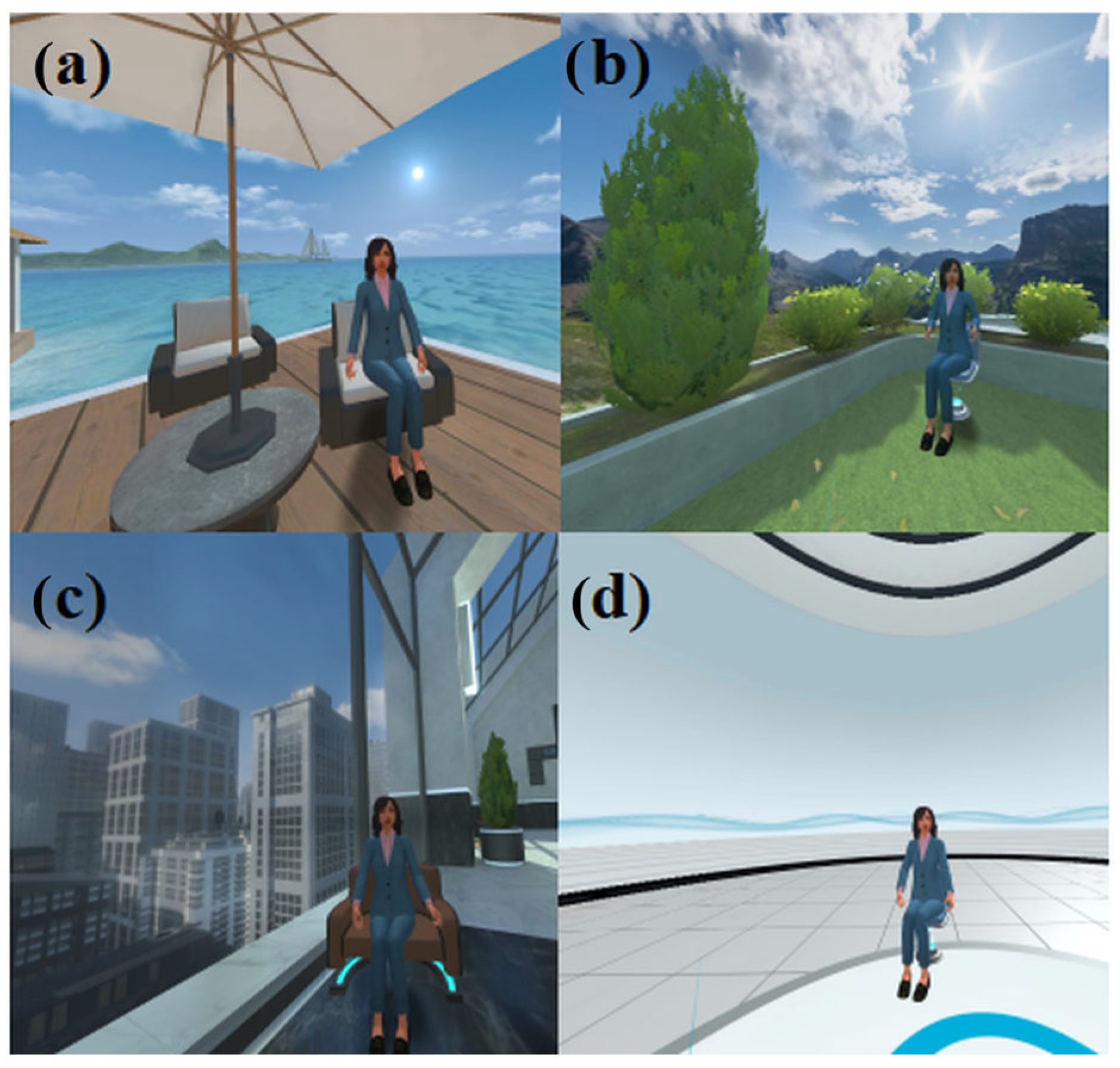
2.3. Materials—Virtual Environments and Hardware
2.4. Materials—Avatar Selection and Standardisation
2.5. Materials—Self-Disclosure Prompts and Questionnaires
- I felt comfortable in the environment.
- The environment had a calming/soothing effect on me.
- I felt the environment was pleasant to look at.
- In the environment, I felt a sense of privacy for disclosing my experiences.
- I felt the environment helped me focus on the task of disclosing my experiences.
- I think this environment would be well suited for psychological therapy.
2.6. Procedure
2.7. Data Analysis
3. Results
3.1. Post-Interaction Ratings
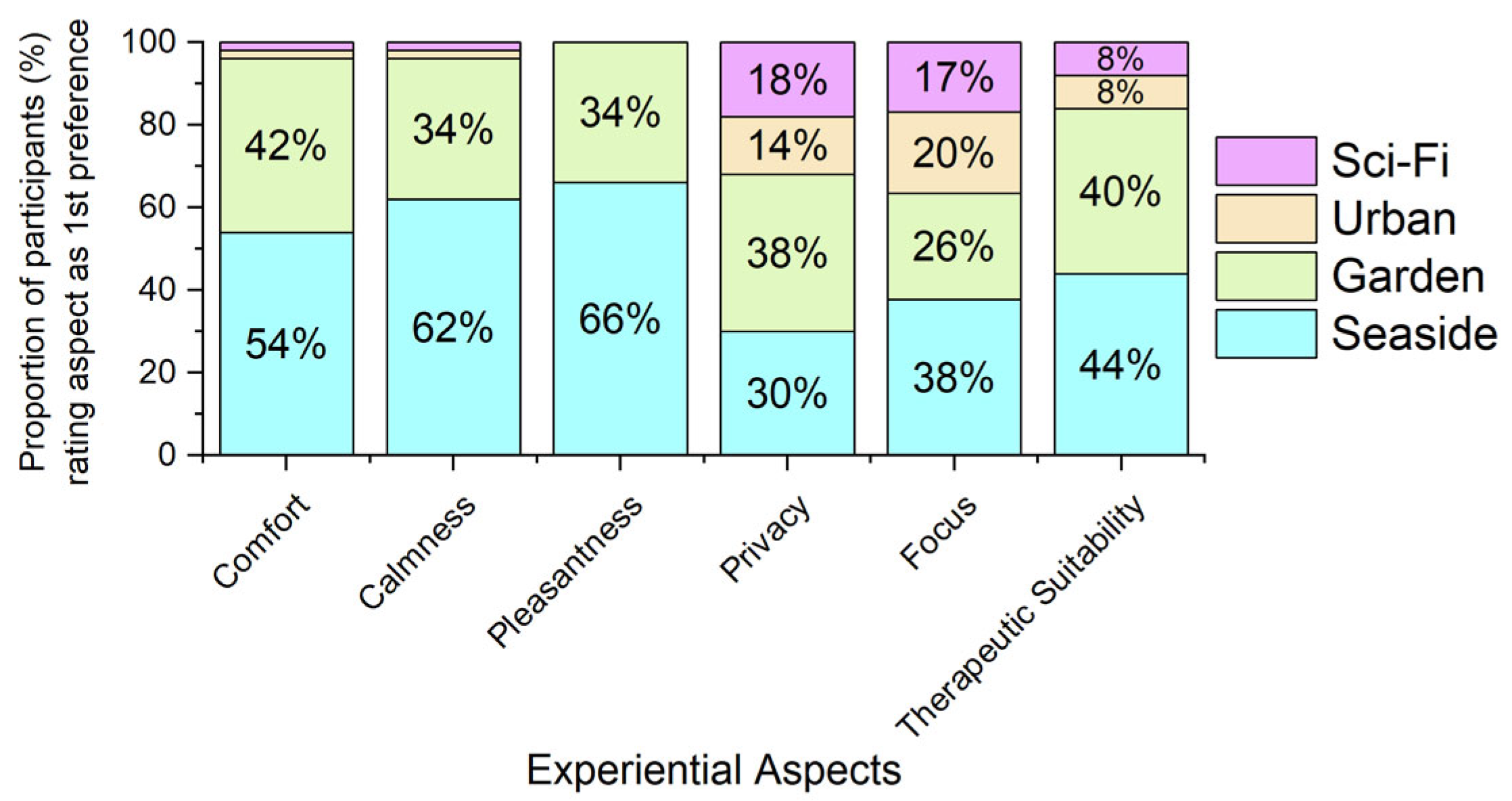
3.2. Preference Rankings
4. Discussion
4.1. Environmental Design Matters for Emotionally Meaningful Interaction
4.2. Distinctions Within Environment Types
4.3. Implications for VR Therapy and Conversational Systems
4.4. Limitations and Future Research
5. Conclusions
Supplementary Materials
Author Contributions
Funding
Institutional Review Board Statement
Informed Consent Statement
Data Availability Statement
Acknowledgments
Conflicts of Interest
References
- Spaulding, E.M.; Fang, M.; Commodore-Mensah, Y.; Himmelfarb, C.R.; Martin, S.S.; Coresh, J. Prevalence and disparities in telehealth use among US adults following the COVID-19 pandemic: National cross-sectional survey. J. Med. Internet Res. 2024, 26, e52124. [Google Scholar] [CrossRef]
- Nowrouzi-Kia, B.; Bani-Fatemi, A.; Jackson, T.D.; Li, A.K.C.; Chattu, V.K.; Lytvyak, E.; Deibert, D.; Dennett, L.; Ferguson-Pell, M.; Hagtvedt, R.; et al. Evaluating the efficacy of telehealth-based treatments for depression in adults: A rapid review and meta-analysis. J. Occup. Rehabil. 2024, 35, 703–724. [Google Scholar] [CrossRef]
- Perle, J.G.; Perle, A.R.; Scarisbrick, D.M.; Mahoney, J.J., III. Educating for the future: A preliminary investigation of doctoral-level clinical psychology training program’s implementation of telehealth education. J. Technol. Behav. Sci. 2022, 7, 351–357. [Google Scholar] [CrossRef]
- Geller, S. Cultivating online therapeutic presence: Strengthening therapeutic relationships in teletherapy session. Couns. Psychol. Q. 2020, 34, 687–703. [Google Scholar] [CrossRef]
- Connolly, S.L.; Miller, C.J.; Lindsay, J.A.; Bauer, M.S. A systematic review of providers’ attitudes toward telemental health via videoconferencing. Clin. Psychol. Sci. Pract. 2020, 27, e12311. [Google Scholar] [CrossRef] [PubMed]
- Blair, M.; Tweedlie, L.; Minnis, H.; Cronin, I.; Turner, F. Online therapy with families—What can families tell us about how to do this well? A qualitative study assessing families’ experience of remote Dyadic Developmental Psychotherapy compared to face-to-face therapy. PLoS ONE 2024, 19, e0301640. [Google Scholar] [CrossRef]
- Akdag, M.T.; Jacquemin, P.H.; Wahl, N. Visit your therapist in metaverse-designing a virtual environment for mental health counselling. In Proceedings of the ICIS 2023 Proceedings, Hyderabad, India, 12 December 2023; p. 1579. [Google Scholar]
- Baccon, L.A.; Chiarovano, E.; MacDougall, H.G. Virtual reality for teletherapy: Avatars may combine the benefits of face-to-face communication with the anonymity of online text-based communication. Cyberpsychol. Behav. Soc. Netw. 2019, 22, 158–165. [Google Scholar] [CrossRef] [PubMed]
- Rogers, S.L.; Broadbent, R.; Brown, J.; Fraser, A.; Speelman, C.P. Realistic motion avatars are the future for social interaction in virtual reality. Front. Virtual Real. 2022, 2, 750729. [Google Scholar] [CrossRef]
- Fraser, A.; Hollett, R.; Speelman, C.; Rogers, S.L. Behavioural realism and its impact on virtual reality social interactions involving self-disclosure. Appl. Sci. 2025, 15, 2896. [Google Scholar] [CrossRef]
- Fraser, A.D.; Branson, I.; Hollett, R.C.; Speelman, C.P.; Rogers, S.L. Do realistic avatars make virtual reality better? Examining human-like avatars for VR social interactions. Comput. Hum. Behav. Artif. Hum. 2024, 2, 100082. [Google Scholar] [CrossRef]
- Fraser, A.D.; Branson, I.; Hollett, R.C.; Speelman, C.P.; Rogers, S.L. Expressiveness of real-time motion captured avatars influences perceived animation realism and perceived quality of social interaction in virtual reality. Front. Virtual Real. 2022, 3, 981400. [Google Scholar] [CrossRef]
- Rogers, S.L.; Pallister, A.; Canes, N. Virtual reality for self-disclosure: Comparing user experiences across VR, video and text chat. J. Technol. Behav. Sci. 2025; in press. [Google Scholar] [CrossRef]
- Britton, E.; Kindermann, G.; Domegan, C.; Carlin, C. Blue care: A systematic review of blue space interventions for health and wellbeing. Health Promot. Int. 2020, 35, 50–69. [Google Scholar] [CrossRef]
- Burke, J.; Clarke, D.; O’Keeffe, J.; Meehan, T. The impact of blue and green spaces on wellbeing: A review of reviews through a positive psychology Lens. J. Happiness Health 2023, 3, 93–108. [Google Scholar] [CrossRef]
- Hermanski, A.; McClelland, J.; Pearce-Walker, J.; Ruiz, J.; Verhougstraete, M. The effects of blue spaces on mental health and associated biomarkers. Int. J. Ment. Health 2022, 51, 203–217. [Google Scholar] [CrossRef]
- White, M.P.; Elliott, L.R.; Gascon, M.; Roberts, B.; Fleming, L.E. Blue space, health and well-being: A narrative overview and synthesis of potential benefits. Environ. Res. 2020, 191, 110169. [Google Scholar] [CrossRef]
- Wood, C.; Wicks, C.; Barton, J. Green spaces for mental disorders. Curr. Opin. Psychiatry 2023, 36, 41–46. [Google Scholar] [CrossRef]
- Kaplan, S. The restorative benefits of nature: Toward an integrative framework. J. Environ. Psychol. 1995, 15, 169–182. [Google Scholar] [CrossRef]
- Ulrich, R.S.; Simons, R.F.; Losito, B.D.; Fiorito, E.; Miles, M.A.; Zelson, M. Stress recovery during exposure to natural and urban environments. J. Environ. Psychol. 1991, 11, 201–230. [Google Scholar] [CrossRef]
- Scott, E.E.; McDonnell, A.S.; LoTemplio, S.B.; Uchino, B.N.; Strayer, D.L. Toward a unified model of stress recovery and cognitive restoration in nature. Parks Steward. Forum 2021, 37, 46–60. [Google Scholar] [CrossRef]
- Jo, H.; Song, C.; Miyazaki, Y. Physiological benefits of viewing nature: A systematic review of indoor experiments. Int. J. Environ. Res. Public Health 2019, 16, 4739. [Google Scholar] [CrossRef]
- Yao, W.; Zhang, X.; Gong, Q. The effect of exposure to the natural environment on stress reduction: A meta-analysis. Urban For. Urban Green. 2021, 57, 126932. [Google Scholar] [CrossRef]
- Shuda, Q.; Bougoulias, M.E.; Kass, R. Effect of nature exposure on perceived and physiologic stress: A systematic review. Complement. Ther. Med. 2020, 53, 102514. [Google Scholar] [CrossRef]
- Evans, S.; Livingstone, A.; Dodds, M.; Kotte, D.; Geertsema, M.; O’Shea, M. Exploring forest therapy as an adjunct to treatment as usual within a community health counselling service. J. Spiritual. Ment. Health 2023, 25, 320–342. [Google Scholar] [CrossRef]
- Cooley, S.J.; Robertson, N.; Jones, C.R.; Scordellis, J.-A. “Walk to wellbeing” in community mental health: Urban and green space walks provide transferable biopsychosocial benefits. Ecopsychology 2021, 13, 84–95. [Google Scholar] [CrossRef]
- Jordan, M. Moving beyond counselling and psychotherapy as it currently is—Taking therapy outside. Eur. J. Psychother. Couns. 2014, 16, 361–375. [Google Scholar] [CrossRef]
- Jordan, M.; Marshall, H. Taking counselling and psychotherapy outside: Destruction or enrichment of the therapeutic frame? Eur. J. Psychother. Couns. 2010, 12, 345–359. [Google Scholar] [CrossRef]
- Lane, D.; Reed, P. The nature space. A reflexive thematic analysis of therapists’ experiences of 1:1 nature-based counselling and psychotherapy with children and young people: Exploring perspectives on the influence of nature within the therapeutic process. Couns. Psychother. Res. 2023, 23, 432–445. [Google Scholar] [CrossRef]
- Dickmeyer, A.; Smith, J.J.; Halpin, S.; McMullen, S.; Drew, R.; Morgan, P.; Valkenborghs, S.; Kay-Lambkin, F.; Young, M.D. Walk-and-talk therapy versus conventional indoor therapy for men with low mood: A randomised pilot study. Clin. Psychol. Psychother. 2025, 32, e70035. [Google Scholar] [CrossRef]
- James, G.; Kidd, K.; Cooley, S.J.; Fenton, K. The feasibility of outdoor psychology sessions in an adult mental health inpatient rehabilitation unit: Service user and psychologist perspectives. Front. Psychol. 2021, 12, 769590. [Google Scholar] [CrossRef]
- Kamitsis, I.; Simmonds, J.G. Using resources of nature in the counselling room: Qualitative research into ecotherapy practice. Int. J. Adv. Couns. 2017, 39, 229–248. [Google Scholar] [CrossRef]
- Newman, E.; Gabriel, L. Investigating clients’ experiences of walk and talk counselling. Couns. Psychother. Res. 2023, 23, 125–133. [Google Scholar] [CrossRef]
- Prince-Llewellyn, H.; McCarthy, P. Walking and talking for well-being: Exploring the effectiveness of walk and talk therapy. Couns. Psychother. Res. 2025, 25, e12847. [Google Scholar] [CrossRef]
- Sanders, R.; Lehmann, J. An exploratory study of clients’ experiences and preferences for counselling room space and design. Couns. Psychother. Res. 2019, 19, 57–65. [Google Scholar] [CrossRef]
- Hauge, A.L.; Lindheim, M.O.; Rotting, K.; Jonsen, S.A.K. The meaning of the physical environment in child and adolescent therapy: A qualitative study of the outdoor care retreat. Ecopsychology 2023, 15, 244–258. [Google Scholar] [CrossRef]
- Greenleaf, A.T.; Williams, J.M.; Leibsohn, J.; Park, J.; Walther, B. “Put on Your Walking Shoes”: A Phenomenological Study of Clients’ Experience of Walk and Talk Therapy. J. Creat. Ment. Health 2024, 19, 352–367. [Google Scholar] [CrossRef]
- Chan, S.H.M.; Qiu, L.; Esposito, G.; Mai, K.P.; Tam, K.-P.; Cui, J. Nature in virtual reality improves mood and reduces stress: Evidence from young adults and senior citizens. Virtual Real. 2023, 27, 3285–3300. [Google Scholar] [CrossRef]
- Gentile, A.; Ficarra, S.; Thomas, E.; Bianco, A.; Nordstrom, A. Nature through virtual reality as a stress-reduction tool: A systematic review. Int. J. Stress Manag. 2023, 30, 341. [Google Scholar] [CrossRef]
- Owens, M.; Bunce, H. The effect of brief exposure to virtual nature on mental wellbeing in adolescents. Sci. Rep. 2023, 13, 17769. [Google Scholar] [CrossRef]
- Wen, Y.; Shen, X.; Shen, Y. Improving immersive experiences in virtual natural setting for public health and environmental design: A systematic review and meta-analysis of randomized controlled trials. PLoS ONE 2024, 19, e0297986. [Google Scholar] [CrossRef]
- Riches, S.; Kaleva, I.; Nicholson, S.L.; Payne-Gill, J.; Steer, N.; Azevedo, L.; Vasile, R.; Rumball, F.; Fisher, H.L.; Veling, W. Virtual reality relaxation for stress in young adults: A remotely delivered pilot study in participants’ homes. J. Technol. Behav. Sci. 2024, 9, 771–783. [Google Scholar] [CrossRef]
- Berdejo-Espinola, V.; Zahnow, R.; O’Bryan, C.J.; Fuller, R.A. Virtual reality for nature experiences. Nat. Hum. Behav. 2024, 8, 1005–1007. [Google Scholar] [CrossRef] [PubMed]
- Li, H.; Zhang, X.; Wang, H.; Yang, Z.; Liu, H.; Cao, Y.; Zhang, G. Access to nature via virtual reality: A mini-review. Front. Psychol. 2021, 12, 725288. [Google Scholar] [CrossRef]
- Li, H.; Ding, Y.; Zhao, B.; Xu, Y.; Wei, W. Effects of immersion in a simulated natural environment on stress reduction and emotional arousal: A systematic review and meta-analysis. Front. Psychol. 2023, 13, 1058177. [Google Scholar] [CrossRef] [PubMed]
- Lachini, T.; Coello, Y.; Frassinetti, F.; Ruggiero, G. Body space in social interactions: A comparison of reaching and comfort distance in immersive virtual reality. PLoS ONE 2014, 9, e111511. [Google Scholar] [CrossRef]
- Karakoc, C.; Lucifora, C.; Massimino, S.; Nucera, S.; Vicario, C.M. Extending peri-personal space in immersive virtual reality: A systematic review. Virtual Worlds 2025, 4, 5. [Google Scholar] [CrossRef]
- Gascon, M.; Zijlema, W.; Vert, C.; White, M.P.; Nieuwenhuijsen, M. Outdoor blue spaces, human health, and well-being: A systematic review of quantitative studies. Int. J. Hyg. Environ. Health 2017, 220, 1207–1221. [Google Scholar] [CrossRef]
- Wang, X.; Feng, B.; Wang, J. Green spaces, blue spaces and human health: An updated umbrella review of epidemiological meta-analyses. Front. Public Health 2025, 13, 1505292. [Google Scholar] [CrossRef]
- Hameed, A.; Perkis, A. Authenticity and presence: Defining perceived quality in VR experiences. Front. Psychol. 2024, 15, 1291650. [Google Scholar] [CrossRef]
- Safikhani, S.; Gattringer, V.; Schmied, M.; Pirker, J.; Wriessnegger, S.C. The influence of realism on the sense of presence in virtual reality: Neurophysiological insights using EEG. Multimodal Technol. Interact. 2024, 8, 104. [Google Scholar] [CrossRef]
- Moriuchi, E. Leveraging the science to understand factors influencing the use of AI-powered avatar in healthcare services. J. Technol. Behav. Sci. 2022, 7, 588–602. [Google Scholar] [CrossRef]
- Colvin, A.D.; Benjamin, C. Exploring the use of AI avatars by marriage and family therapists practitioners as a therapeutic intervention. Fam. Relat. 2024, 74, 1341–1353. [Google Scholar] [CrossRef]
- Parmar, D.; Olafsson, S.; Utami, D.; Murali, P.; Bickmore, T. Designing empathic virtual agents: Manipulating animation, voice, rendering, and empathy to create persuasive agents. Auton. Agents Multi-Agent Syst. 2022, 36, 17. [Google Scholar] [CrossRef] [PubMed]
- Rheu, M.; Shin, J.Y.; Huh-Yoo, J. Systematic review: Trust-building factors and implications for conversational agent design. Int. J. Hum.-Comput. Interact. 2020, 37, 81–96. [Google Scholar] [CrossRef]
- Bell, I.H.; Pot-Kolder, R.; Rizzo, A.; Rus-Calafell, M.; Cardi, V.; Cella, M.; Ward, T.; Riches, S.; Reinoso, M.; Thompson, A. Advances in the use of virtual reality to treat mental health conditions. Nat. Rev. Psychol. 2024, 3, 552–567. [Google Scholar] [CrossRef]
- Geraets, C.N.; Van der Stouwe, E.C.; Pot-Kolder, R.; Veling, W. Advances in immersive virtual reality interventions for mental disorders: A new reality? Curr. Opin. Psychol. 2021, 41, 40–45. [Google Scholar] [CrossRef] [PubMed]
- Paalimäki-Paakki, K.; Virtanen, M.; Henner, A.; Vähänikkilä, H.; Nieminen, M.T.; Schroderus-Salo, T.; Kääriäinen, M. Effects of a 360° virtual counselling environment on patient anxiety and CCTA process time: A randomised controlled trial. Radiography 2023, 29, S13–S23. [Google Scholar] [CrossRef] [PubMed]
- Wang, X.; Shi, Y.; Zhang, B.; Chiang, Y. The influence of forest resting environments on stress using virtual reality. Int. J. Environ. Res. Public Health 2019, 16, 3263. [Google Scholar] [CrossRef]
- Ladakis, I.; Filos, D.; Chouvarda, I. Virtual reality environments for stress reduction and management: A scoping review. Virtual Real. 2024, 28, 50. [Google Scholar] [CrossRef]



| Seaside | Garden | Urban | Sci-Fi | |
|---|---|---|---|---|
| Comfort | 3.42 (0.70) | 3.32 (0.74) | 2.74 (0.80) | 2.30 (0.86) |
| Calmness | 3.40 (0.73) | 3.36 (0.72) | 2.26 (0.92) | 1.84 (0.93) |
| Pleasantness | 3.76 (0.48) | 3.68 (0.55) | 2.60 (0.83) | 1.66 (0.75) |
| Privacy | 3.12 (0.72) | 3.16 (0.96) | 2.56 (0.91) | 2.66 (1.02) |
| Focus | 2.72 (0.86) | 2.80 (0.90) | 2.44 (0.88) | 2.36 (0.88) |
| Therapeutic Suitability | 3.16 (0.82) | 3.30 (0.88) | 2.32 (0.98) | 1.88 (0.96) |
| Composite Score | 3.26 (0.53) | 3.27 (0.60) | 2.49 (0.68) | 2.11 (0.73) |
Disclaimer/Publisher’s Note: The statements, opinions and data contained in all publications are solely those of the individual author(s) and contributor(s) and not of MDPI and/or the editor(s). MDPI and/or the editor(s) disclaim responsibility for any injury to people or property resulting from any ideas, methods, instructions or products referred to in the content. |
© 2025 by the authors. Licensee MDPI, Basel, Switzerland. This article is an open access article distributed under the terms and conditions of the Creative Commons Attribution (CC BY) license.
Share and Cite
Rogers, S.L.; Canes, T.; Pallister, A. User Experience in Virtual Self-Disclosure: Appraising Natural, Urban, and Artificial VR Environments. Appl. Sci. 2026, 16, 33. https://doi.org/10.3390/app16010033
Rogers SL, Canes T, Pallister A. User Experience in Virtual Self-Disclosure: Appraising Natural, Urban, and Artificial VR Environments. Applied Sciences. 2026; 16(1):33. https://doi.org/10.3390/app16010033
Chicago/Turabian StyleRogers, Shane L., Tasha Canes, and Alexis Pallister. 2026. "User Experience in Virtual Self-Disclosure: Appraising Natural, Urban, and Artificial VR Environments" Applied Sciences 16, no. 1: 33. https://doi.org/10.3390/app16010033
APA StyleRogers, S. L., Canes, T., & Pallister, A. (2026). User Experience in Virtual Self-Disclosure: Appraising Natural, Urban, and Artificial VR Environments. Applied Sciences, 16(1), 33. https://doi.org/10.3390/app16010033