Cyber–Physical Systems in Healthcare Based on Medical and Social Research Reflected in AI-Based Digital Twins of Patients

 ,
, 
Featured Application
Abstract
1. Introduction
- RQ1: How do current cyber–physical systems integrate physiological, behavioral, and environmental data to create AI-based patient DTs?
- RQ2: What advances in medical and social research play the most important role in increasing the accuracy, personalization, and clinical relevance of patient diagnoses?
- RQ3: What technical, ethical, and methodological gaps (including in the areas of well-being and user eXperience (UX)) limit the effective implementation of cyber–physical systems with AI-based DTs in real-world healthcare settings?
- RQ4: How can interdisciplinary evidence be used to improve the design, validation, and scalability of cyber–physical systems that support patient-centered, predictive, and proactive healthcare?
2. Materials and Methods
2.1. Dataset
2.2. Methods
3. Results
3.1. Data Sources
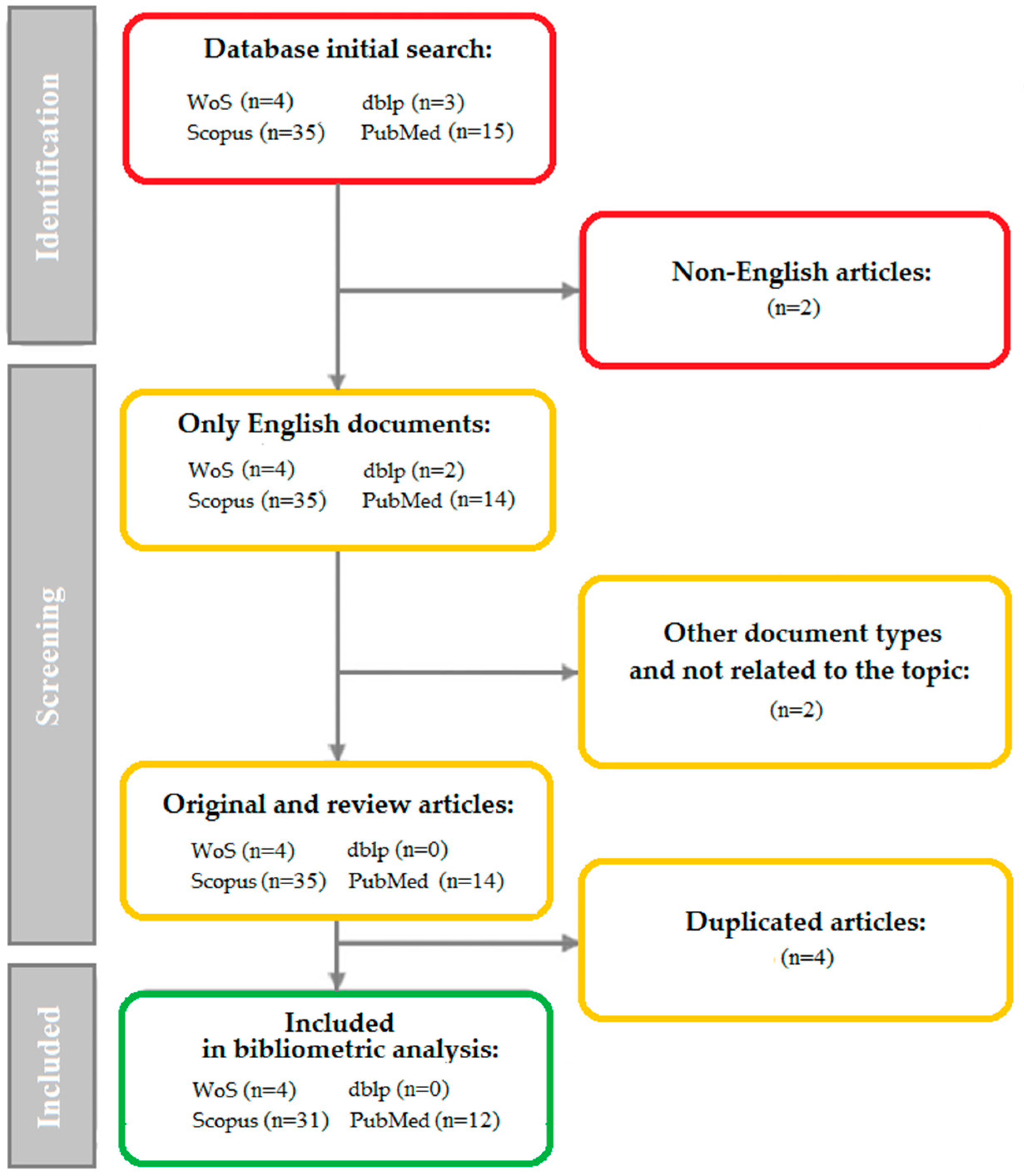
- In Web of Science (WoS), the “Subject” field was used, encompassing the title, abstract, keywords, and related terms;
- In Scopus, searches were conducted across the article title, abstract, and keywords;
- In PubMed and dblp, customized manual keyword sets were employed.
3.2. General Results of Analysis
3.3. UX in Healthcare CPS
3.4. Roadmap Toward Framework
4. Discussion
4.1. Limitations
4.2. Technological Implications
4.3. Economic Implications
4.4. Social Implications
4.5. Ethical and Legal Implications
4.6. Directions for Further Research
5. Conclusions
Supplementary Materials
Author Contributions
Funding
Institutional Review Board Statement
Informed Consent Statement
Data Availability Statement
Conflicts of Interest
Abbreviations
| AI | Artificial intelligence |
| CPS | Cyber–physical system |
| DT | Digital twin |
| ML | Machine learning |
| SDOH | Social determinants of health |
| UX | User eXperience |
References
- Shaikh, T.A.; Rasool, T.; Verma, P. Machine intelligence and medical cyber-physical system architectures for smart healthcare: Taxonomy, challenges, opportunities, and possible solutions. Artif. Intell. Med. 2023, 146, 102692. [Google Scholar] [CrossRef]
- Dey, N.; Ashour, A.S.; Shi, F.; Fong, S.J.; Tavares, J.M.R.S. Medical cyber-physical systems: A survey. J. Med. Syst. 2018, 42, 74. [Google Scholar] [CrossRef]
- Iyer, A.A.; Umadevi, K.S. Design and analysis of TwinCardio framework to detect and monitor cardiovascular diseases using digital twin and deep neural network. Sci. Rep. 2025, 15, 24376. [Google Scholar] [CrossRef]
- Łukaniszyn, M.; Majka, Ł.; Grochowicz, B.; Mikołajewski, D.; Kawala-Sterniuk, A. Digital Twins Generated by Artificial Intelligence in Personalized Healthcare. Appl. Sci. 2024, 14, 9404. [Google Scholar] [CrossRef]
- Coorey, G.; Figtree, G.A.; Fletcher, D.F.; Snelson, V.J.; Vernon, S.T.; Winlaw, D.; Grieve, S.M.; McEwan, A.; Yang, J.Y.H.; Qian, P.; et al. The health digital twin to tackle cardiovascular disease-a review of an emerging interdisciplinary field. npj Digit. Med. 2022, 5, 126. [Google Scholar] [CrossRef]
- Mikołajewska, E.; Masiak, J.; Mikołajewski, D. Applications of Artificial Intelligence-Based Patient Digital Twins in Decision Support in Rehabilitation and Physical Therapy. Electronics 2024, 13, 4994. [Google Scholar] [CrossRef]
- Mikołajewska, E.; Mikołajewski, D.; Mikołajczyk, T.; Paczkowski, T. Generative AI in AI-Based Digital Twins for Fault Diagnosis for Predictive Maintenance in Industry 4.0/5.0. Appl. Sci. 2025, 15, 3166. [Google Scholar] [CrossRef]
- Mohsin, A.H.; Zaidan, A.A.; Zaidan, B.B.; Albahri, A.S.; Albahri, O.S.; Alsalem, M.A.; Mohammed, K.I. Real-Time Remote Health Monitoring Systems Using Body Sensor Information and Finger Vein Biometric Verification: A Multi-Layer Systematic Review. J. Med. Syst. 2018, 42, 238. [Google Scholar] [CrossRef] [PubMed]
- Wisniewski, R.; Grobelna, I.; Karatkevich, A. Determinism in Cyber-Physical Systems Specified by Interpreted Petri Nets. Sensors 2020, 20, 5565. [Google Scholar] [CrossRef] [PubMed]
- Lee, E.A. The past, present and future of cyber-physical systems: A focus on models. Sensors 2015, 15, 4837–4869. [Google Scholar] [CrossRef]
- Mahmood, M.S.; Shoyaeb, M.; Chowdhury, A.; Chowdhury, M.H. Automated health monitoring system using YOLOv8 for real-time device parameter detection. Phys. Eng. Sci. Med. 2025, ahead of print. [Google Scholar] [CrossRef]
- Balador, A.; Kouba, A.; Cassioli, D.; Foukalas, F.; Severino, R.; Stepanova, D.; Agosta, G.; Xie, J.; Pomante, L.; Mongelli, M.; et al. Wireless Communication Technologies for Safe Cooperative Cyber Physical Systems. Sensors 2018, 18, 4075. [Google Scholar] [CrossRef]
- Yin, D.; Ming, X.; Zhang, X. Understanding Data-Driven Cyber-Physical-Social System (D-CPSS) Using a 7C Framework in Social Manufacturing Context. Sensors 2020, 20, 5319. [Google Scholar] [CrossRef]
- Mikołajewska, E.; Mikołajewski, D. Integrated IT environment for people with disabilities: A new concept. Cent. Eur. J. Med. 2014, 9, 177–182. [Google Scholar] [CrossRef]
- Bao, X.; Liang, H.; Han, L. Transmission Optimization of Social and Physical Sensor Nodes via Collaborative Beamforming in Cyber-Physical-Social Systems. Sensors 2018, 18, 4300. [Google Scholar] [CrossRef] [PubMed]
- Babamiri, M.; Heidarimoghadam, R.; Ghasemi, F.; Tapak, L.; Mortezapour, A. Ergonomics 4.0: A bibliometric review of Human Factors research in Industrial Revolution 4.0 (IR 4.0). Work 2021, 70, 321–334. [Google Scholar] [CrossRef]
- Shah, I.A.; Mishra, S. Artificial intelligence in advancing occupational health and safety: An encapsulation of developments. J. Occup. Health 2024, 66, uiad017. [Google Scholar] [CrossRef]
- Sun, S.; Zheng, X.; Gong, B.; García Paredes, J.; Ordieres-Meré, J. Healthy Operator 4.0: A Human Cyber-Physical System Architecture for Smart Workplaces. Sensors 2020, 20, 2011. [Google Scholar] [CrossRef]
- Strawderman, L.; Jose, B.; Burch, R.; Saucier, D.; Poudel, A.; Smith, B. Wearable Technology Hesitancy in Industrial Applications. IISE Trans. Occup. Ergon. Hum. Factors 2025, 13, 64–73. [Google Scholar] [CrossRef]
- Fiegler-Rudol, J.; Lau, K.; Mroczek, A.; Kasperczyk, J. Exploring Human-AI Dynamics in Enhancing Workplace Health and Safety: A Narrative Review. Int. J. Environ. Res. Public Health 2025, 22, 199. [Google Scholar] [CrossRef]
- El-Helaly, M. Artificial Intelligence and Occupational Health and Safety, Benefits and Drawbacks. Med. Lav. 2024, 115, e2024014. [Google Scholar] [CrossRef]
- Biswas, A.; Severin, C.N.; Smith, P.M.; Steenstra, I.A.; Robson, L.S.; Amick, B.C., III. Larger Workplaces, People-Oriented Culture, and Specific Industry Sectors Are Associated with Co-Occurring Health Protection and Wellness Activities. Int. J. Environ. Res. Public Health 2018, 15, 2739. [Google Scholar] [CrossRef]
- Alzahrani, A.; Alshehri, M.; AlGhamdi, R.; Sharma, S.K. Improved Wireless Medical Cyber-Physical System (IWMCPS) Based on Machine Learning. Healthcare 2023, 11, 384. [Google Scholar] [CrossRef]
- Sobb, T.; Turnbull, B.; Moustafa, N. A Holistic Review of Cyber-Physical-Social Systems: New Directions and Opportunities. Sensors 2023, 23, 7391. [Google Scholar] [CrossRef]
- Premalatha, G.; Bai, V.T. Wireless IoT and Cyber-Physical System for Health Monitoring Using Honey Badger Optimized Least-Squares Support-Vector Machine. Wirel. Pers. Commun. 2022, 124, 3013–3034. [Google Scholar] [CrossRef]
- Rajeswari, R.; Sriramakrishnan, G.V.; Vidyadhari, C.; Kanimozhi, K.V. ExpHBA Deep-IoT: Exponential Honey Badger Optimized Deep Learning for Breast Cancer Detection in IoT Healthcare System. J. Digit. Imaging 2023, 36, 2461–2479. [Google Scholar] [CrossRef]
- Palumbo, F.; Crivello, A.; Furfari, F.; Girolami, M.; Mastropietro, A.; Manferdelli, G.; Röcke, C.; Guye, S.; Salvá Casanovas, A.; Caon, M.; et al. “Hi This Is NESTORE, Your Personal Assistant”: Design of an Integrated IoT System for a Personalized Coach for Healthy Aging. Front. Digit. Health 2020, 2, 545949. [Google Scholar] [CrossRef]
- Ganesan, A.; Paul, A.; Nagabushnam, G.; Gul, M.J.J. Human-in-the-Loop Predictive Analytics Using Statistical Learning. J. Healthc. Eng. 2021, 2021, 9955635. [Google Scholar] [CrossRef]
- Dovjak, M.; Shukuya, M.; Krainer, A. User-Centred Healing-Oriented Conditions in the Design of Hospital Environments. Int. J. Environ. Res. Public Health 2018, 15, 2140. [Google Scholar] [CrossRef] [PubMed]
- García-Valls, M.; Touahria, I.E. On Line Service Composition in the Integrated Clinical Environment for eHealth and Medical Systems. Sensors 2017, 17, 1333. [Google Scholar] [CrossRef]
- Al-Jaroodi, J.; Mohamed, N.; Abukhousa, E. Health 4.0: On the Way to Realizing the Healthcare of the Future. IEEE Access 2020, 8, 211189–211210. [Google Scholar] [CrossRef]
- Propkopowicz, P.; Mikołajewski, D.; Tyburek, K.; Mikołajewska, E. Computational gait analysis for post-stroke rehabilitation purposes using fuzzy numbers, fractal dimension and neural networks. Bull. Pol. Acad. Sci. Tech. Sci. 2020, 68, 191–198. [Google Scholar] [CrossRef]
- Marceglia, S.; Rigby, M.; Alonso, A.; Keeling, D.; Kubitschke, L.; Pozzi, G. DEDICATE: Proposal for a conceptual framework to develop dementia-friendly integrated eCare support. Biomed. Eng. Online 2018, 17, 121. [Google Scholar] [CrossRef]
- Fatoum, H.; Hanna, S.; Halamka, J.D.; Sicker, D.C.; Spangenberg, P.; Hashmi, S.K. Blockchain Integration with Digital Technology and the Future of Health Care Ecosystems: Systematic Review. J. Med. Internet Res. 2021, 23, e19846. [Google Scholar] [CrossRef] [PubMed]
- Stary, C. Digital Twin Generation: Re-Conceptualizing Agent Systems for Behavior-Centered Cyber-Physical System Development. Sensors 2021, 21, 1096. [Google Scholar] [CrossRef] [PubMed]
- Mei, M.; Ye, D. Multisensor Transmission Scheduling for State Estimation Over Multihop Networks in a Cyber-Physical System Environment. IEEE Trans. Cybern. 2025, 55, 5081–5090. [Google Scholar] [CrossRef]
- Lubkowski, P.; Krygier, J.; Sondej, T.; Dobrowolski, A.P.; Apiecionek, L.; Znaniecki, W.; Oskwarek, P. Decision Support System Proposal for Medical Evacuations in Military Operations. Sensors 2023, 23, 5144. [Google Scholar] [CrossRef]
- Grobelna, I. Formal Verification of Control Modules in Cyber-Physical Systems. Sensors 2020, 20, 5154. [Google Scholar] [CrossRef] [PubMed]
- Khan, A.A.; Laghari, A.A.; Alsafyani, M.; Baqasah, A.M.; Kryvinska, N.; Almadhor, A.; Alroobaea, R.; Gregus, M., Jr. A cost-effective approach using generative AI and gamification to enhance biomedical treatment and real-time biosensor monitoring. Sci. Rep. 2025, 15, 17305. [Google Scholar] [CrossRef]
- Różanowski, K.; Sondej, T.; Piotrowski, Z.; Sawicki, K. Architecture of Car Measurement System for Driver Monitoring. In Communication Technologies for Vehicles; Vinel, A., Mehmood, R., Berbineau, M., Garcia, C.R., Huang, C.M., Chilamkurti, N., Eds.; Lecture Notes in Computer Science; Springer: Berlin/Heidelberg, Germany, 2012; Volume 7266. [Google Scholar] [CrossRef]
- Jayakumar, P.; Rathouz, P.J.; Lin, E.; Trutner, Z.; Uhler, L.M.; Andrawis, J.; Koenig, K.M.; Tsevat, J.; Bozic, K.J. Shared decision making using digital twins in knee osteoarthritis care: A randomized clinical trial of an AI-enabled decision aid versus education alone on decision quality, physical function, and user experience. E Clin. Med. 2025, 89, 103545. [Google Scholar] [CrossRef]
- Choi, S.Y.; Choi, D.H.; Cho, S.H.; Ahn, S.H.; Han, S.H. Anatomy education potential of the first digital twin of a Korean cadaver. PLoS ONE 2025, 20, e0305679. [Google Scholar] [CrossRef]
- Elkefi, S.; Asan, O. Digital Twins for Managing Health Care Systems: Rapid Literature Review. J. Med. Internet Res. 2022, 24, e37641. [Google Scholar] [CrossRef]
- Elkefi, S.; Asan, O. How technology impacts communication between cancer patients and their health care providers: A systematic literature review. Int. J. Med. Inform. 2021, 149, 104430. [Google Scholar] [CrossRef]
- Fischer, R.P.; Volpert, A.; Antonino, P.; Ahrens, T.D. Digital patient twins for personalized therapeutics and pharmaceutical manufacturing. Front. Digit. Health 2024, 5, 1302338. [Google Scholar] [CrossRef]
- Kawala-Janik, A.; Podpora, M.; Pelc, M.; Piatek, P.; Baranowski, J. Implementation of an inexpensive EEG headset for the pattern recognition purpose. In Proceedings of the 2013 IEEE 7th International Conference on Intelligent Data Acquisition and Advanced Computing Systems (IDAACS), Berlin, Germany, 12–14 September 2013; pp. 399–403. [Google Scholar] [CrossRef]
- Gajos, A.; Wójcik, G.M. Independent component analysis of EEG data for EGI system. Bio-Algorithms Med.-Syst 2016, 12, 67–72. [Google Scholar] [CrossRef]
- Arntz, A.; Weber, F.; Handgraaf, M.; Lällä, K.; Korniloff, K.; Murtonen, K.P.; Chichaeva, J.; Kidritsch, A.; Heller, M.; Sakellari, E.; et al. Technologies in Home-Based Digital Rehabilitation: Scoping Review. JMIR Rehabil. Assist. Technol. 2023, 10, e43615. [Google Scholar] [CrossRef] [PubMed]
- Xames, M.D.; Topcu, T.G.; Parker, S.H.; Zagarese, V.; Epling, J.W. Evaluating CFIR 2.0 in identifying digital twin implementation challenges in healthcare: Bridging the dichotomy between engineering and healthcare communities. Front. Digit. Health 2025, 7, 1611225. [Google Scholar] [CrossRef]
- Vassolo, R.S.; Mac Cawley, A.F.; Tortorella, G.L.; Fogliatto, F.S.; Tlapa, D.; Narayanamurthy, G. Hospital investment decisions in healthcare 4.0 technologies: Scoping review and framework for exploring challenges, trends, and research directions. J. Med. Internet Res. 2021, 23, e27571. [Google Scholar] [CrossRef]
- Khoshfekr Rudsari, H.; Tseng, B.; Zhu, H.; Song, L.; Gu, C.; Roy, A.; Irajizad, E.; Butner, J.; Long, J.; Do, K.A. Digital twins in healthcare: A comprehensive review and future directions. Front. Digit. Health 2025, 7, 1633539. [Google Scholar] [CrossRef]
- Nieto-Alvarez, I.; Bojorges-Valdez, E.; Lang, E.; Ranaei Sharif, M.; Köber, G.; Rohleder, N.; Amft, O. Patient-centered modeling of the breast biopsy experience. Front. Artif. Intell. 2025, 8, 1618357. [Google Scholar] [CrossRef]
- Chen, J.; Abbod, M.; Shieh, J.S. Pain and stress detection using wearable sensors and devices—A review. Sensors 2021, 21, 1030. [Google Scholar] [CrossRef]
- Sun, T.; Lu, J.; Li, Q.; Kou, Y. Can digital twin technology revolutionize public health emergency management? Insights from the PPRR framework. Front. Public Health 2025, 13, 1631339. [Google Scholar] [CrossRef] [PubMed]
- Liew, S.L.; Cotton, R.J.; Burdet, E.; Bermúdez, I.; Badia, S.; Celnik, P.; Cole, J.H.; Liu, R.; Soekadar, S.R.; Winstein, C.; et al. Collaborative AI for precision neurorehabilitation: A roadmap. J. Neuroeng. Rehabil. 2025, ahead of print. [Google Scholar] [CrossRef]
- Seki, T.; Kawazoe, Y.; Ito, H.; Takiguchi, T.; Akagi, Y.; Ebara, M.; Ohe, K. Assessment of Medically Relevant Ageism Inherent in Large Language Models. Stud. Health Technol. Inform. 2025, 329, 603–607. [Google Scholar] [CrossRef] [PubMed]
- Drummond, D.; Gonsard, A. Definitions and Characteristics of Patient Digital Twins Being Developed for Clinical Use: Scoping Review. J. Med. Internet Res. 2024, 26, e58504. [Google Scholar] [CrossRef]
- Awad, A.; Trenfield, S.J.; Pollard, T.D.; Ong, J.J.; Elbadawi, M.; McCoubrey, L.E.; Goyanes, A.; Gaisford, S.; Basit, A.W. Connected healthcare: Improving patient care using digital health technologies. Adv. Drug Deliv. Rev. 2021, 178, 113958. [Google Scholar] [CrossRef]
- Nadeem, M.; Kostic, S.; Dornhöfer, M.; Weber, C.; Fathi, M. A comprehensive review of digital twin in healthcare in the scope of simulative health-monitoring. Digit. Health 2025, 11, 20552076241304078. [Google Scholar] [CrossRef]
- Mirza, I.B.; Georgakopoulos, D.; Yavari, A. Cyber-Physical-Social Awareness Platform for Comprehensive Situation Awareness. Sensors 2023, 23, 822. [Google Scholar] [CrossRef]
- Mony, P.K.; Thankachan, P.; Bhat, S.; Rao, S.; Washington, M.; Antony, S.; Thomas, A.; Nagarajarao, S.C.; Rao, H.; Amrutur, B. Remote biomonitoring of temperatures in mothers and newborns: Design, development and testing of a wearable sensor device in a tertiary-care hospital in southern India. BMJ Innov. 2018, 4, 60–67. [Google Scholar] [CrossRef][Green Version]
- Ragno, L.; Borboni, A.; Vannetti, F.; Amici, C.; Cusano, N. Application of Social Robots in Healthcare: Review on Characteristics, Requirements, Technical Solutions. Sensors 2023, 23, 6820. [Google Scholar] [CrossRef] [PubMed]
- Tan, C.K.; Lou, V.W.Q.; Cheng, C.Y.M.; He, P.C.; Khoo, V.E.J. Improving the Social Well-Being of Single Older Adults Using the LOVOT Social Robot: Qualitative Phenomenological Study. JMIR Hum. Factors 2024, 11, e56669. [Google Scholar] [CrossRef]
- Moyle, W.; Arnautovska, U.; Ownsworth, T.; Jones, C. Potential of telepresence robots to enhance social connectedness in older adults with dementia: An integrative review of feasibility. Int. Psychogeriatr. 2017, 29, 1951–1964. [Google Scholar] [CrossRef]
- Shen, J.; Yu, J.; Zhang, H.; Lindsey, M.A.; An, R. Artificial intelligence-powered social robots for promoting physical activity in older adults: A systematic review. J. Sport Health Sci. 2025, 14, 101045. [Google Scholar] [CrossRef] [PubMed]
- Han, I.H.; Kim, D.H.; Nam, K.H.; Lee, J.I.; Kim, K.H.; Park, J.H.; Ahn, H.S. Human-Robot Interaction and Social Robot: The Emerging Field of Healthcare Robotics and Current and Future Perspectives for Spinal Care. Neurospine 2024, 21, 868–877. [Google Scholar] [CrossRef]
- Giansanti, D. Bridging the Gap: Exploring Opportunities, Challenges, and Problems in Integrating Assistive Technologies, Robotics, and Automated Machines into the Health Domain. Healthcare 2023, 11, 2462. [Google Scholar] [CrossRef]
- Baban, N.S.; Bhattacharjee, S.; Song, Y.A.; Chakrabarty, K.; Karri, R. Cyber-physical security of biochips: A perspective. Biomicrofluidics 2025, 19, 031304. [Google Scholar] [CrossRef]
- Onur, D.; Özbakır, Ç. Pediatrics 4.0: The Transformative Impacts of the Latest Industrial Revolution on Pediatrics. Health Care Anal, 2025; ahead of print. [Google Scholar] [CrossRef]
- Aguiar Noury, G.; Walmsley, A.; Jones, R.B.; Gaudl, S.E. The Barriers of the Assistive Robotics Market-What Inhibits Health Innovation? Sensors 2021, 21, 3111. [Google Scholar] [CrossRef]
- Giansanti, D. Advancements and Impacts of Assistive Technologies, Robotics, and Automated Machines in Healthcare: Insights from an Editorial Initiative of Exploration. Healthcare 2025, 13, 1121. [Google Scholar] [CrossRef] [PubMed]
- Rabbitt, S.M.; Kazdin, A.E.; Scassellati, B. Integrating socially assistive robotics into mental healthcare interventions: Applications and recommendations for expanded use. Clin. Psychol. Rev. 2015, 35, 35–46. [Google Scholar] [CrossRef] [PubMed]
- Rossi, V.J.; Wells-Quinn, T.A.; Malham, G.M. Negotiating for new technologies: Guidelines for the procurement of assistive technologies in spinal surgery: A narrative review. J. Spine Surg. 2022, 8, 254–265. [Google Scholar] [CrossRef]
- Raja Santhi, A.; Muthuswamy, P. Industry 5.0 or industry 4.0S? Introduction to industry 4.0 and a peek into the prospective industry 5.0 technologies. Int. J. Interact. Des. Manuf. 2023, 17, 947–979. [Google Scholar] [CrossRef]
- Töpfer, A.; Brabänder, G. Personalisation of treatment pathways—Analysis of chances and barriers by the implementation of digital technologies under the conditions of the German Health System. F1000Research 2021, 10, 147. [Google Scholar] [CrossRef]
- Grobelna, I.; Wiśniewski, R.; Grobelny, M.; Wiśniewska, M. Design and Verification of Real-Life Processes with Application of Petri Nets. IEEE Trans. Syst. Man Cybern. Syst. 2017, 47, 2856–2869. [Google Scholar] [CrossRef]
- Adel, A. Future of industry 5.0 in society: Human-centric solutions, challenges and prospective research areas. J. Cloud Comput. 2022, 11, 40. [Google Scholar] [CrossRef]
- Xu, H.; Yu, W.; Griffith, D.; Golmie, N. A Survey on Industrial Internet of Things: A Cyber-Physical Systems Perspective. IEEE Access 2018, 6, 78238–78259. [Google Scholar] [CrossRef]
- Argyridou, E.; Nifakos, S.; Laoudias, C.; Panda, S.; Panaousis, E.; Chandramouli, K.; Navarro-Llobet, D.; Mora Zamorano, J.; Papachristou, P.; Bonacina, S. Cyber Hygiene Methodology for Raising Cybersecurity and Data Privacy Awareness in Health Care Organizations: Concept Study. J. Med. Internet Res. 2023, 25, e41294. [Google Scholar] [CrossRef]
- Kozak, K.; Seidel, A.; Matvieieva, N.; Neupetsch, C.; Teicher, U.; Lemme, G.; Ben Achour, A.; Barth, M.; Ihlenfeldt, S.; Drossel, W.G. Unique Device Identification-Based Linkage of Hierarchically Accessible Data Domains in Prospective Surgical Hospital Data Ecosystems: User-Centered Design Approach. JMIR Med. Inform. 2023, 11, e41614. [Google Scholar] [CrossRef]
- Novak, L.L.; Harris, J.W.; Koonce, T.Y.; Johnson, K.B. Design thinking in applied informatics: What can we learn from Project HealthDesign? J. Am. Med. Inform. Assoc. 2021, 28, 1858–1865. [Google Scholar] [CrossRef]
- Puliafito, A.; Tricomi, G.; Zafeiropoulos, A.; Papavassiliou, S. Smart Cities of the Future as Cyber Physical Systems: Challenges and Enabling Technologies. Sensors 2021, 21, 3349. [Google Scholar] [CrossRef]
- Yaacoub, J.A.; Salman, O.; Noura, H.N.; Kaaniche, N.; Chehab, A.; Malli, M. Cyber-physical systems security: Limitations, issues and future trends. Microprocess. Microsyst. 2020, 77, 103201. [Google Scholar] [CrossRef]
- Younas, M.; Awan, I.; Martin, L.; Wu, H. (Eds.) Proceedings of 21st International Conference on Mobile Web and Intelligent Information Systems; Lecture Notes in Computer Science (LNCS); Springer: Berlin/Heidelberg, Germany, 2026; Volume 16066. [Google Scholar]
- Page, M.J.; McKenzie, J.E.; Bossuyt, P.M.; Boutron, I.; Hoffmann, T.C.; Mulrow, C.D.; Shamseer, L.; Tetzlaff, J.M.; Akl, E.A.; Brennan, S.E.; et al. The PRISMA 2020 statement: An updated guideline for reporting systematic reviews. BMJ 2021, 372, n71. [Google Scholar] [CrossRef]



| Stage Name | Tasks |
|---|---|
| Defining research goal(s) | Defining goals of the bibliometric analysis |
| Selecting databases and data collections | Selecting appropriate dataset(s) and developing research queries according to the study goals |
| Data preprocessing | Cleaning the collected dataset(s) to remove duplicates and irrelevant records |
| Bibliometric software (WoS, Scopus, dblp, PubMed, and Biblioshiny) selection | Choosing suitable bibliometric software/tools for analysis |
| Data analysis | Description, author, journal, area, topics, institution, country, etc. |
| Visualization (if possible) | Visualizing the analysis results to present insights |
| Interpretation and discussion | Interpreting findings in the context of the research goals and RQs |
| Parameter/Feature | Detailed Description |
|---|---|
| Inclusion criteria | Books and chapters in books, articles (original, reviews, communication, editorials), and conference proceedings, in English |
| Exclusion criteria | Older than 10 years, letters, conference abstracts without full text, other languages than English |
| Exact keywords used | Healthcare AND (“cyber-physical” OR “cyber physical”) AND “digital twin” AND (“artificial intelligence” OR “machine learning”) |
| Used field codes (WoS) | “Subject” field (consisting of title, abstract, keyword plus and other keywords): healthcare AND (“cyber-physical” OR “cyber physical”) AND “digital twin” AND (“artificial intelligence” OR “machine learning”) |
| Used field codes (Sopus) | Article title, abstract and keywords: healthcare AND (“cyber-physical” OR “cyber physical”) AND “digital twin” AND (“artificial intelligence” OR “machine learning”) |
| Used field codes (PubMed) | Manually: healthcare AND (“cyber-physical” OR “cyber physical”) AND “digital twin” AND (“artificial intelligence” OR “machine learning”) |
| Used field codes (dblp) | Manually: healthcare AND (“cyber-physical” OR “cyber physical”) AND “digital twin” AND (“artificial intelligence” OR “machine learning”) |
| Boolean operators used | Yes, e.g., (“cyber-physical” OR “cyber physical”) |
| Applied filters | Results refined by publication year, document type (e.g., articles, reviews), and subject area (e.g., industry, engineering). |
| Iteration and validation options | Queries are run iteratively, refined based on results, and validated by ensuring that relevant publications appear among the top results |
| Leverage truncation and wildcards used | Used symbols like * for word variations and ? for alternative spellings |
| Parameter/Feature | Value |
|---|---|
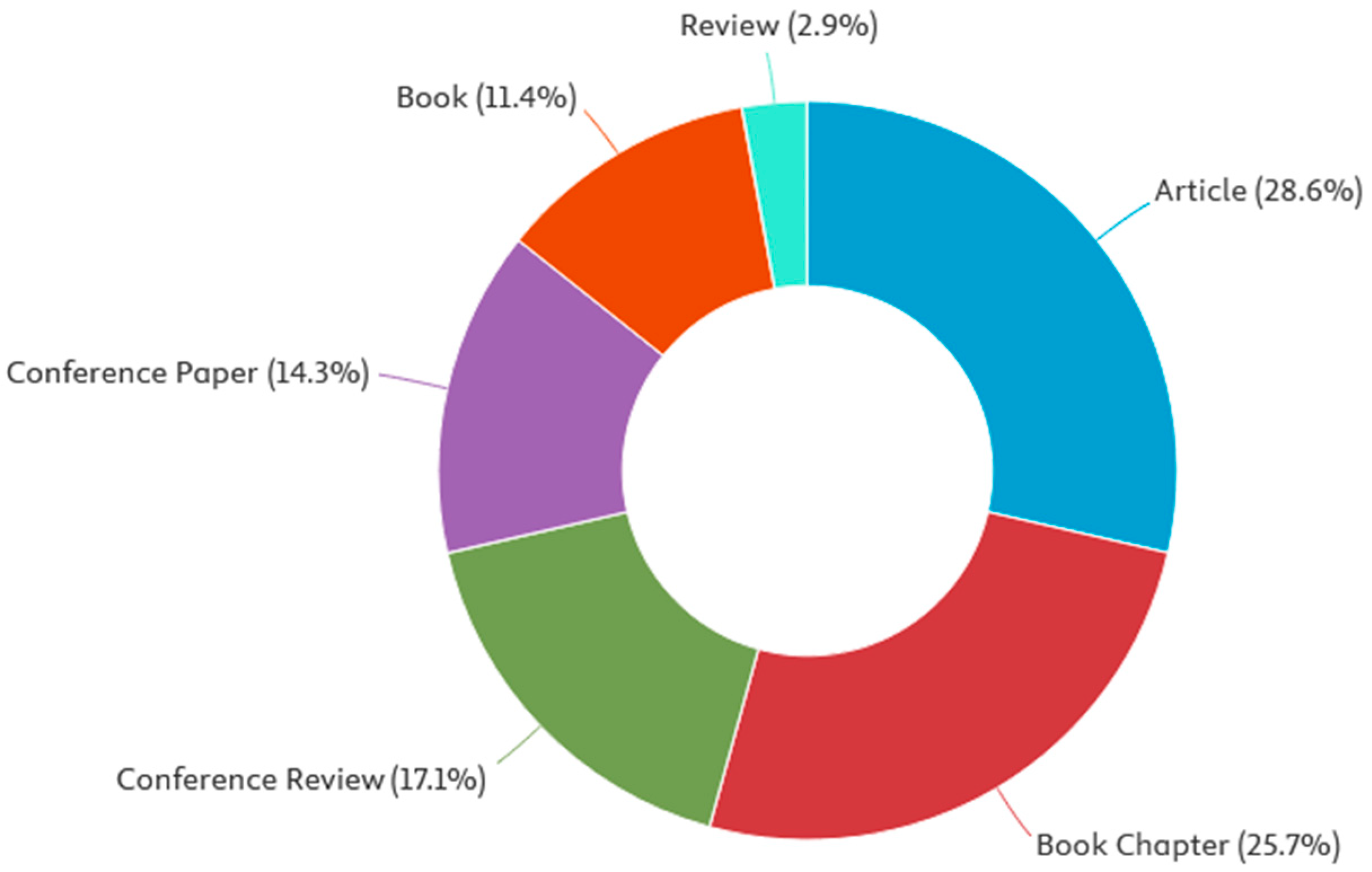
| Leading types of publication | Article (28.60%), Book chapter (25.70%), Conference review (17.1%) |
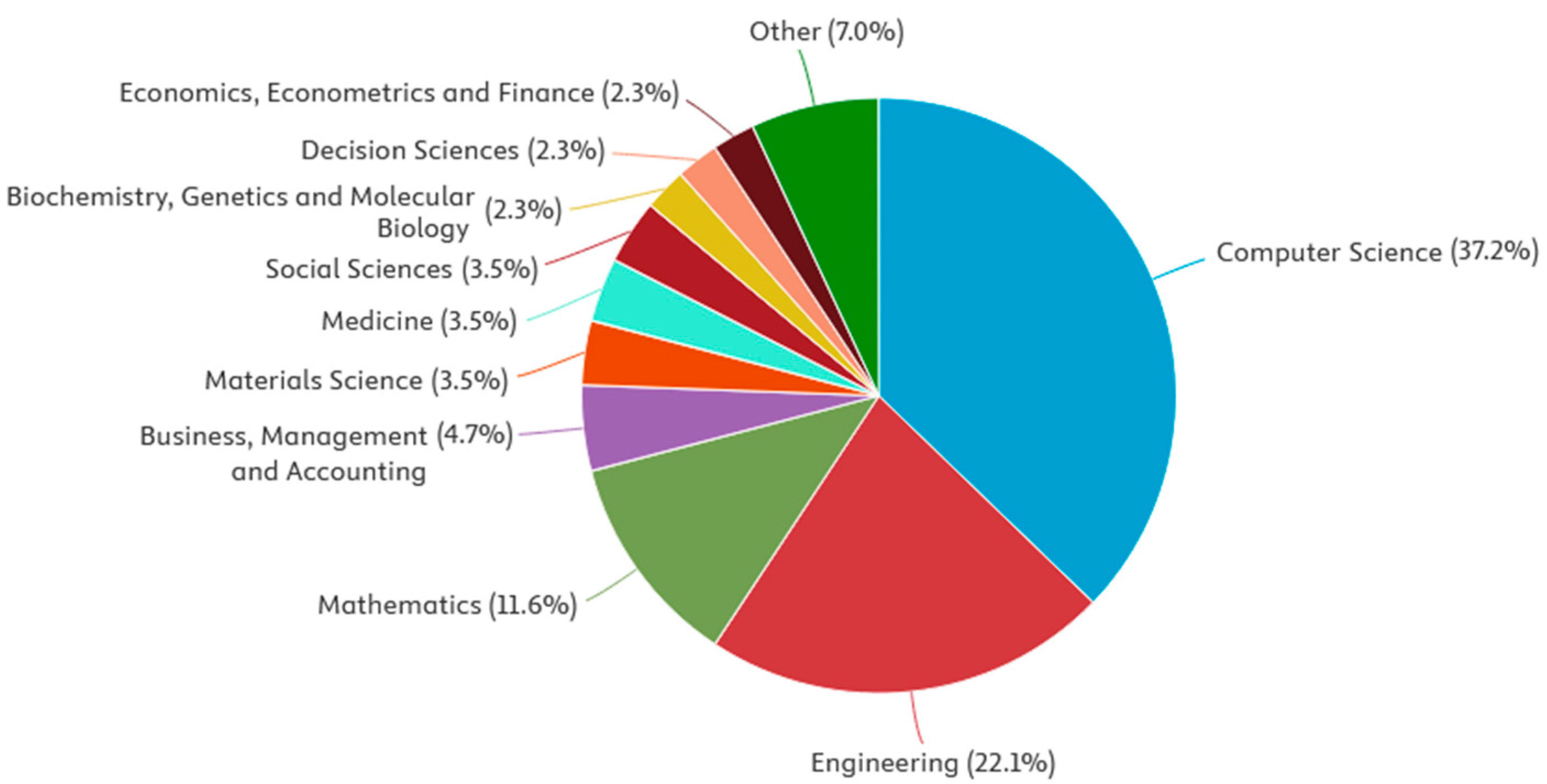
| Leading areas of science | Computer science (37.20%), Engineering (22.10%), Mathematics (11.60%) |
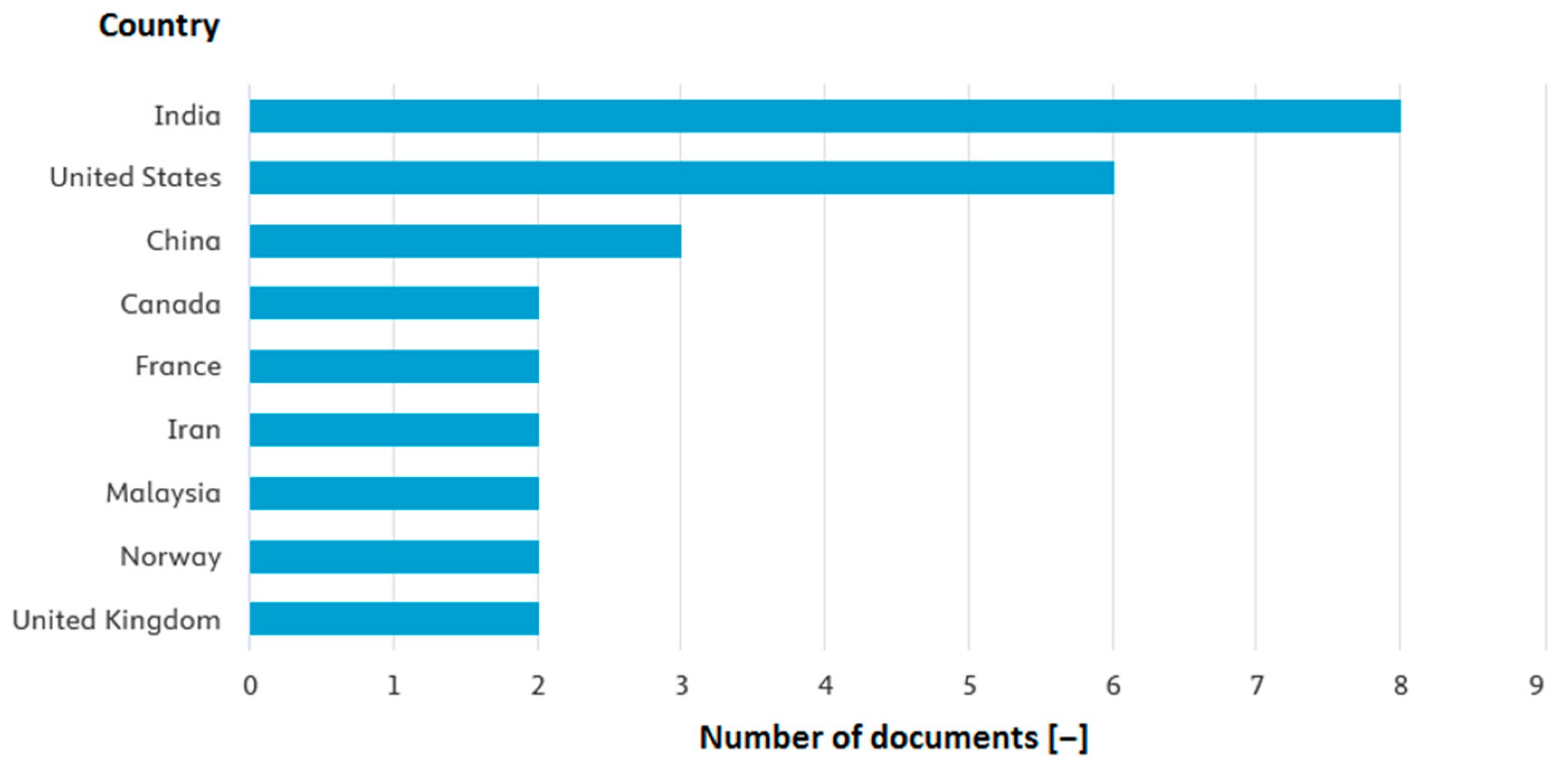
| Leading countries | India (22.86%), USA (17.14%), China (8.57%) |
| Leading scientists | None observed |
| Leading affiliations | None observed |
| Leading funders (where information available) | None observed |
| Sustainable development goals | Industry Innovation and Infrastructure (5.71%), Responsible Production and Consumption (5.71%) |
Disclaimer/Publisher’s Note: The statements, opinions and data contained in all publications are solely those of the individual author(s) and contributor(s) and not of MDPI and/or the editor(s). MDPI and/or the editor(s) disclaim responsibility for any injury to people or property resulting from any ideas, methods, instructions or products referred to in the content. |
© 2025 by the authors. Licensee MDPI, Basel, Switzerland. This article is an open access article distributed under the terms and conditions of the Creative Commons Attribution (CC BY) license.
Share and Cite
Mikołajewska, E.; Rogalla-Ładniak, U.; Masiak, J.; Panas, E.; Mikołajewski, D. Cyber–Physical Systems in Healthcare Based on Medical and Social Research Reflected in AI-Based Digital Twins of Patients. Appl. Sci. 2026, 16, 318. https://doi.org/10.3390/app16010318
Mikołajewska E, Rogalla-Ładniak U, Masiak J, Panas E, Mikołajewski D. Cyber–Physical Systems in Healthcare Based on Medical and Social Research Reflected in AI-Based Digital Twins of Patients. Applied Sciences. 2026; 16(1):318. https://doi.org/10.3390/app16010318
Chicago/Turabian StyleMikołajewska, Emilia, Urszula Rogalla-Ładniak, Jolanta Masiak, Ewelina Panas, and Dariusz Mikołajewski. 2026. "Cyber–Physical Systems in Healthcare Based on Medical and Social Research Reflected in AI-Based Digital Twins of Patients" Applied Sciences 16, no. 1: 318. https://doi.org/10.3390/app16010318
APA StyleMikołajewska, E., Rogalla-Ładniak, U., Masiak, J., Panas, E., & Mikołajewski, D. (2026). Cyber–Physical Systems in Healthcare Based on Medical and Social Research Reflected in AI-Based Digital Twins of Patients. Applied Sciences, 16(1), 318. https://doi.org/10.3390/app16010318