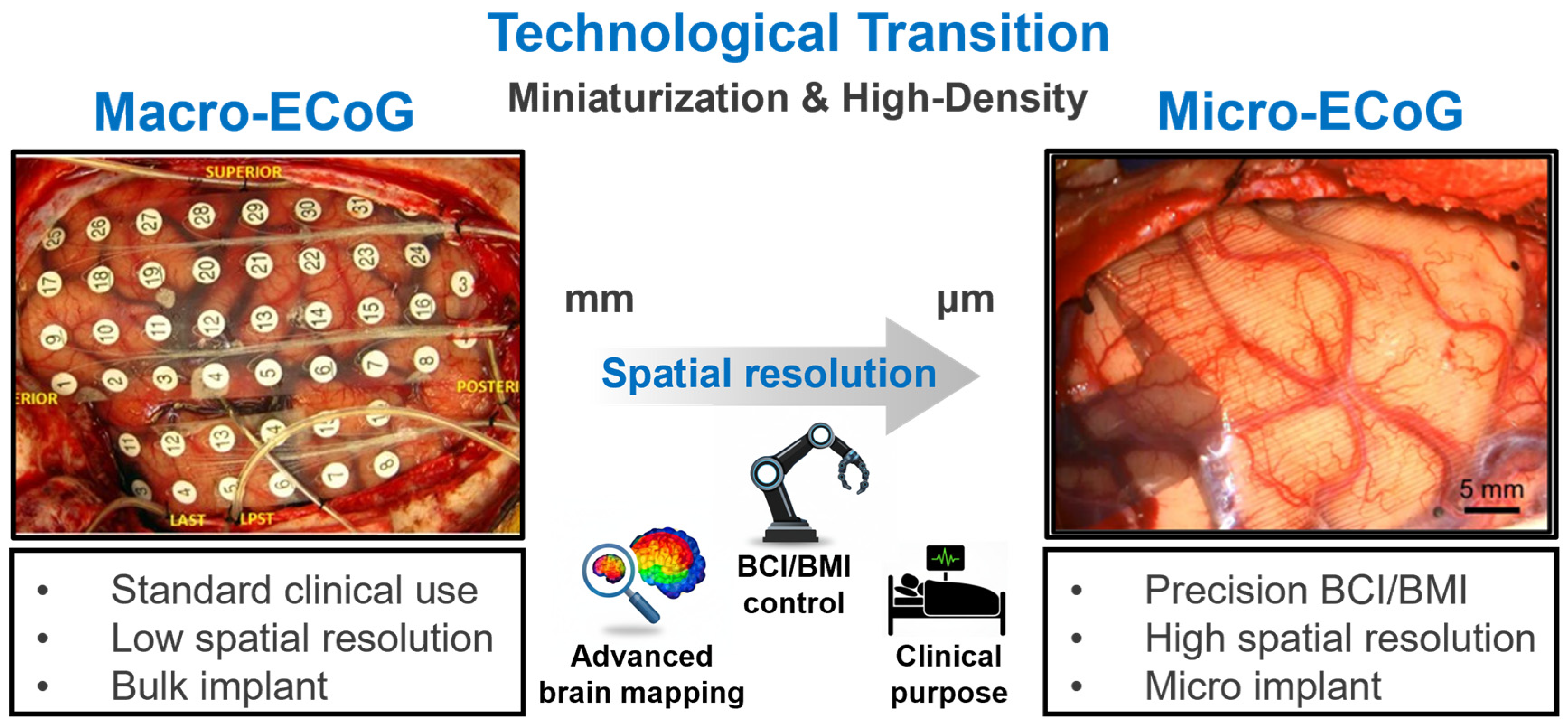
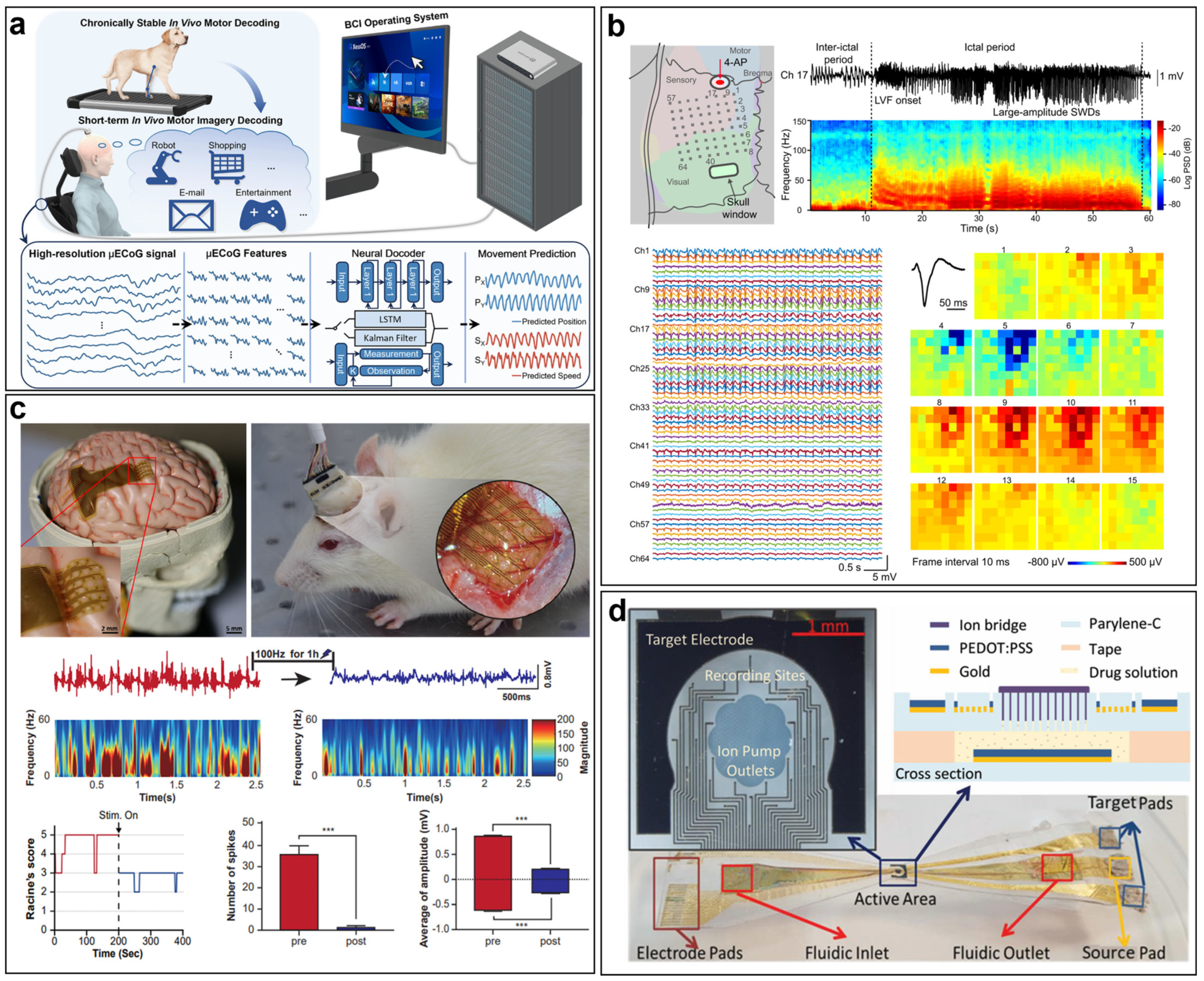
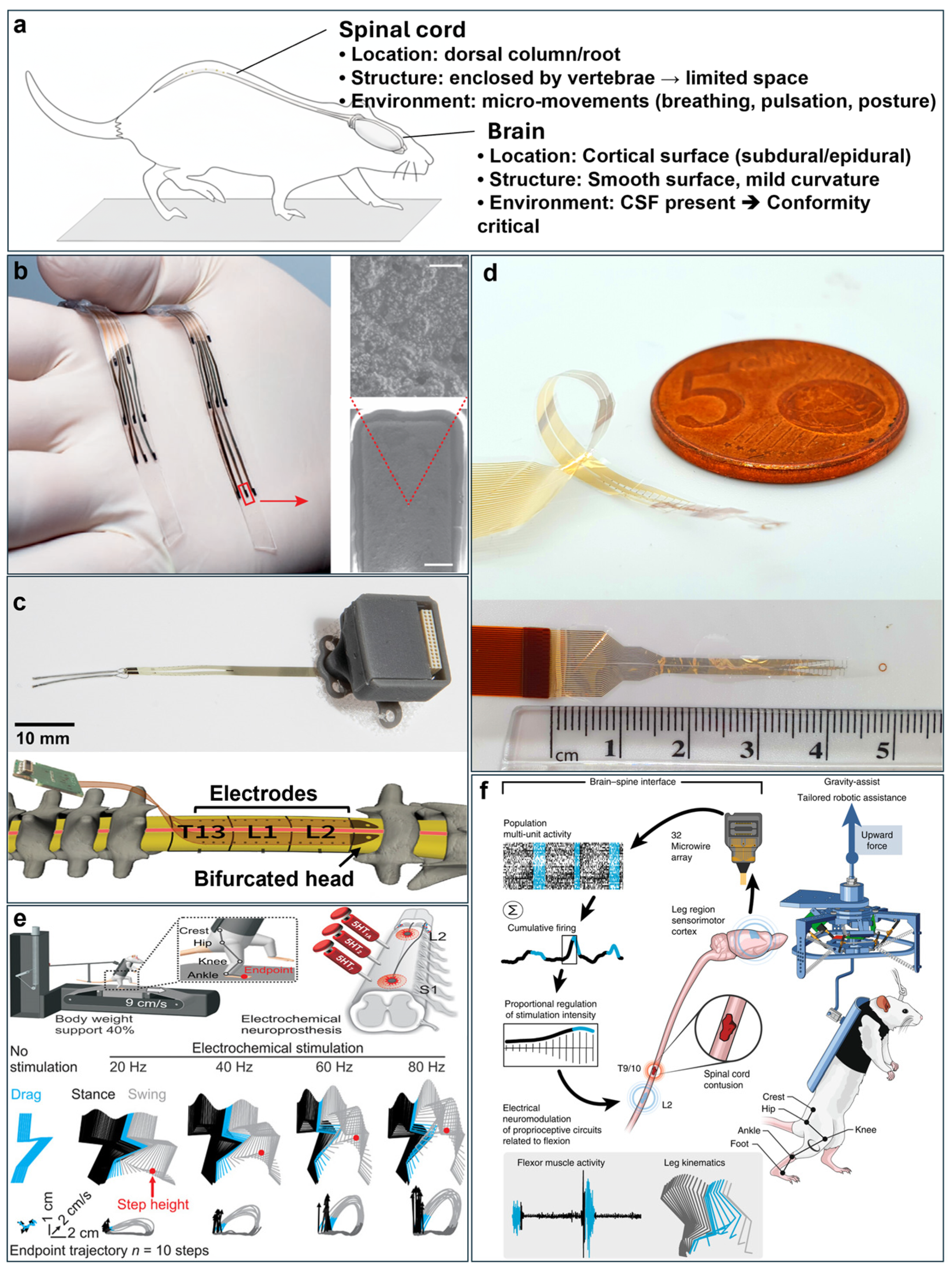
Flexible Micro-Neural Interface Devices: Advances in Materials Integration and Scalable Manufacturing Technologies

Abstract
1. Introduction

2. Architecture and Applications of Biointerfaces for μECoG Recording
2.1. Material Components of Neural Electrodes for μECoG Recording
2.1.1. Guidelines for Substrate Material Selection
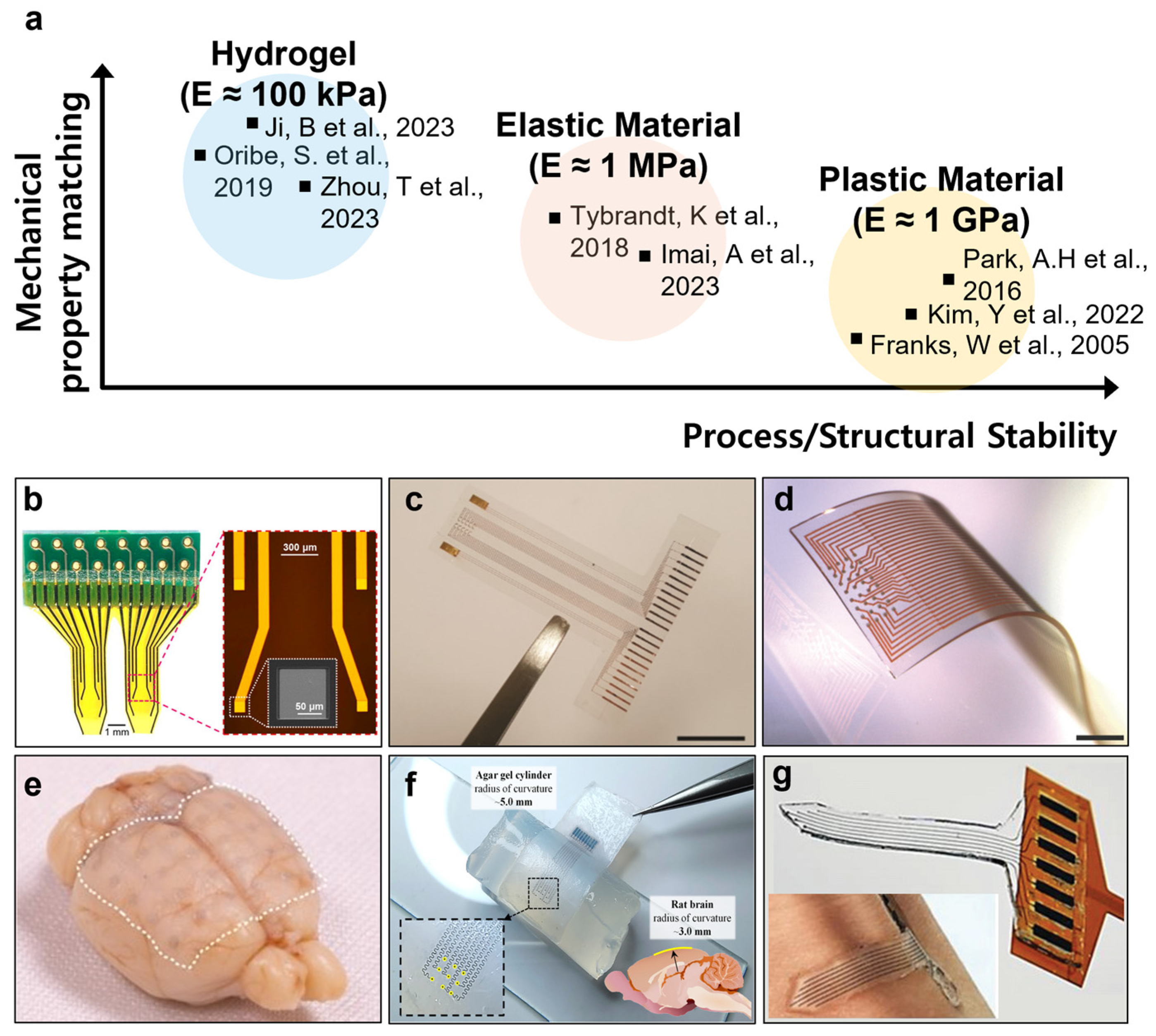
2.1.2. Guidelines for Selection and Application of Electrode Materials
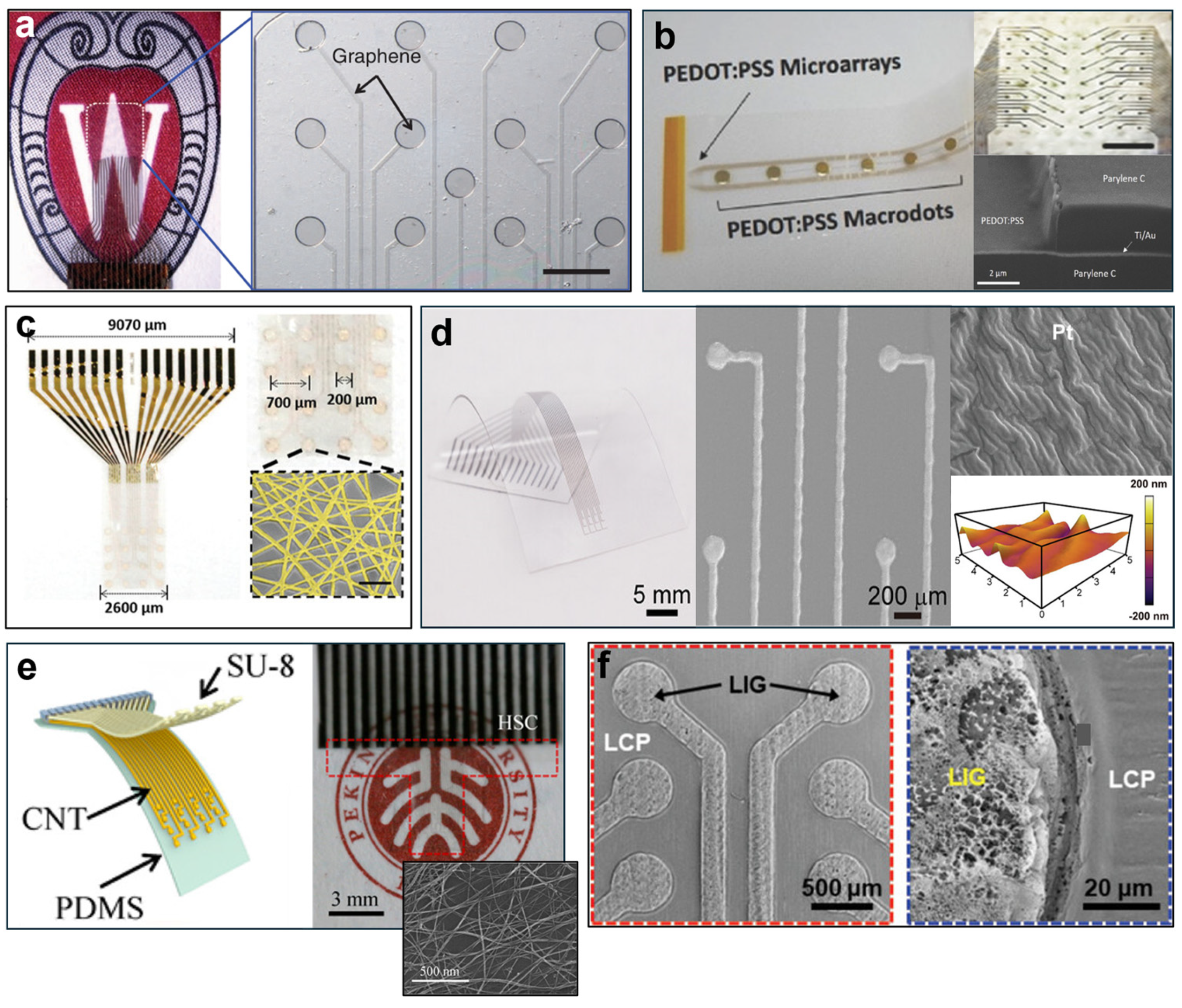
2.2. Structural Design Considerations for Neural Electrodes in ECoG Recording
2.2.1. Electrode Size Optimization for Signal Acquisition
2.2.2. Guidelines for Selecting the Electrode Pitch in Microelectrode Arrays
2.2.3. Design Considerations for the Number of Channels in Single μECoG Electrode Arrays
2.3. Development of Neuroengineering Technologies for μECoG Signal Utilization
2.3.1. Data-Driven System Design for BCI/BMI Applications
2.3.2. Development of μECoG Signal Acquisition for Clinical Applications
2.4. Integration of Electrical Stimulation and Signal Acquisition in μECoG Interfaces
2.4.1. Bidirectional μECoG System Technologies
2.4.2. Electrode Design for Cortical Stimulation Using μECoG Systems
2.4.3. Artifact Suppression During Stimulation in Bidirectional μECoG Systems
2.5. Hardware for μECoG Neural Signal Acquisition: Commercial Systems
2.6. Transitioning Flexible Neural Interfaces Toward Spinal Cord Electrode Systems

3. Outlook: Future Challenges and Opportunities
Author Contributions
Funding
Institutional Review Board Statement
Informed Consent Statement
Data Availability Statement
Conflicts of Interest
References
- Wise, K.D.; Angell, J.B.; Starr, A. An Integrated-Circuit Approach to Extracellular Microelectrodes. IEEE Trans. Biomed. Eng. 1970, 17, 238–247. [Google Scholar] [CrossRef]
- Campbell, P.K.; Jones, K.E.; Huber, R.J.; Horch, K.W.; Normann, R.A. A silicon-based, three-dimensional neural interface: Manufacturing processes for an intracortical electrode array. IEEE Trans. Biomed. Eng. 1991, 38, 758–768. [Google Scholar] [CrossRef] [PubMed]
- Moldovan, C.; Ilian, V.; Constantin, G.; Iosub, R.; Modreanu, M.; Dinoiu, I.; Firtat, B.; Voitincu, C. Micromachining of a silicon multichannel microprobe for neural electrical activity recording. Sens. Actuators A Phys. 2002, 99, 119–124. [Google Scholar] [CrossRef]
- Stensaas, S.S.; Stensaas, L.J. Histopathological evaluation of materials implanted in the cerebral cortex. Acta Neuropathol. 1978, 41, 145–155. [Google Scholar] [CrossRef] [PubMed]
- Turner, J.N.; Shain, W.; Szarowski, D.H.; Andersen, M.; Martins, S.; Isaacson, M.; Craighead, H. Cerebral Astrocyte Response to Micromachined Silicon Implants. Exp. Neurol. 1999, 156, 33–49. [Google Scholar] [CrossRef]
- Szarowski, D.H.; Andersen, M.D.; Retterer, S.; Spence, A.J.; Isaacson, M.; Craighead, H.G.; Turner, J.N.; Shain, W. Brain responses to micro-machined silicon devices. Brain Res. 2003, 983, 23–35. [Google Scholar] [CrossRef]
- Biran, R.; Martin, D.C.; Tresco, P.A. Neuronal cell loss accompanies the brain tissue response to chronically implanted silicon microelectrode arrays. Exp. Neurol. 2005, 195, 115–126. [Google Scholar] [CrossRef]
- Edell, D.J.; Toi, V.V.; McNeil, V.M.; Clark, L.D. Factors influencing the biocompatibility of insertable silicon microshafts in cerebral cortex. IEEE Trans. Biomed. Eng. 1992, 39, 635–643. [Google Scholar] [CrossRef]
- Maynard, E.M.; Fernandez, E.; Normann, R.A. A technique to prevent dural adhesions to chronically implanted microelectrode arrays. J. Neurosci. Methods 2000, 97, 93–101. [Google Scholar] [CrossRef]
- Shain, W.; Spataro, L.; Dilgen, J.; Haverstick, K.; Retterer, S.; Isaacson, M.; Saltzman, M.; Turner, J.N. Controlling cellular reactive responses around neural prosthetic devices using peripheral and local intervention strategies. IEEE Trans. Neural Syst. Rehabil. Eng. 2003, 11, 186–188. [Google Scholar] [CrossRef]
- Lv, S.; Mo, F.; Xu, Z.; Wang, Y.; Yang, G.; Han, M.; Jing, L.; Xu, W.; Duan, Y.; Liu, Y.; et al. Tentacle Microelectrode Arrays Uncover Soft Boundary Neurons in Hippocampal CA1. Adv. Sci. 2024, 11, 2401670. [Google Scholar] [CrossRef] [PubMed]
- Kim, J.-M.; Im, C.; Lee, W.R. Plateau-Shaped Flexible Polymer Microelectrode Array for Neural Recording. Polymers 2017, 9, 690. [Google Scholar] [CrossRef] [PubMed]
- Zhuang, Q.; Yao, K.; Wu, M.; Lei, Z.; Chen, F.; Li, J.; Mei, Q.; Zhou, Y.; Huang, Q.; Zhao, X.; et al. Wafer-patterned, permeable, and stretchable liquid metal microelectrodes for implantable bioelectronics with chronic biocompatibility. Sci. Adv. 2023, 9, eadg8602. [Google Scholar] [CrossRef] [PubMed]
- Brien, D.P.O.; Nichols, T.R.; Allen, M.G. Flexible microelectrode arrays with integrated insertion devices. In Proceedings of the Technical Digest. MEMS 2001. 14th IEEE International Conference on Micro Electro Mechanical Systems (Cat. No.01CH37090), Interlaken, Switzerland, 25 January 2001; pp. 216–219. [Google Scholar]
- Wu, Y.; Temple, B.A.; Sevilla, N.; Zhang, J.; Zhu, H.; Zolotavin, P.; Jin, Y.; Duarte, D.; Sanders, E.; Azim, E.; et al. Ultraflexible electrodes for recording neural activity in the mouse spinal cord during motor behavior. Cell Rep. 2024, 43, 114199. [Google Scholar] [CrossRef]
- Muller, L.; Felix, S.; Shah, K.G.; Lee, K.; Pannu, S.; Chang, E.F. Thin-film, high-density micro-electrocorticographic decoding of a human cortical gyrus. In Proceedings of the 2016 38th Annual International Conference of the IEEE Engineering in Medicine and Biology Society (EMBC), Orlando, FL, USA, 16–20 August 2016; pp. 1528–1531. [Google Scholar]
- Ledochowitsch, P.; Olivero, E.; Blanche, T.; Maharbiz, M.M. A transparent μECoG array for simultaneous recording and optogenetic stimulation. In Proceedings of the 2011 Annual International Conference of the IEEE Engineering in Medicine and Biology Society, Piscataway, NJ, USA, 30 August–3 September 2011; pp. 2937–2940. [Google Scholar]
- Woods, V.; Trumpis, M.; Bent, B.; Palopoli-Trojani, K.; Chiang, C.-H.; Wang, C.; Yu, C.; Insanally, M.N.; Froemke, R.C.; Viventi, J. Long-term recording reliability of liquid crystal polymer µECoG arrays. J. Neural Eng. 2018, 15, 066024. [Google Scholar] [CrossRef]
- Escabí, M.A.; Read, H.L.; Viventi, J.; Kim, D.-H.; Higgins, N.C.; Storace, D.A.; Liu, A.S.K.; Gifford, A.M.; Burke, J.F.; Campisi, M.; et al. A high-density, high-channel count, multiplexed μECoG array for auditory-cortex recordings. J. Neurophysiol. 2014, 112, 1566–1583. [Google Scholar] [CrossRef]
- Kuzum, D.; Takano, H.; Shim, E.; Reed, J.C.; Juul, H.; Richardson, A.G.; de Vries, J.; Bink, H.; Dichter, M.A.; Lucas, T.H.; et al. Transparent and flexible low noise graphene electrodes for simultaneous electrophysiology and neuroimaging. Nat. Commun. 2014, 5, 5259. [Google Scholar] [CrossRef]
- Yang, W.; Fan, Q.H.; Li, W. A Fully Transparent, Flexible μECoG Array Based on Highly Conductive and Anti-reflective PEDOT:PSS-ITO-Ag-ITO Thin Films. In Proceedings of the 2020 IEEE 15th International Conference on Nano/Micro Engineered and Molecular System (NEMS), Virtual, 27–30 September 2020; pp. 124–129. [Google Scholar]
- Lyu, H.; Liu, X.; Rogers, N.; Gilja, V.; Kuzum, D. Graphene neural interfaces for artifact free optogenetics. In Proceedings of the 2016 38th Annual International Conference of the IEEE Engineering in Medicine and Biology Society (EMBC), Orlando, FL, USA, 16–20 August 2016; pp. 4204–4207. [Google Scholar]
- Kim, Y.; Alimperti, S.; Choi, P.; Noh, M. An Inkjet Printed Flexible Electrocorticography (ECoG) Microelectrode Array on a Thin Parylene-C Film. Sensors 2022, 22, 1277. [Google Scholar] [CrossRef]
- Muller, R.; Le, H.P.; Li, W.; Ledochowitsch, P.; Gambini, S.; Bjorninen, T.; Koralek, A.; Carmena, J.M.; Maharbiz, M.M.; Alon, E.; et al. A Minimally Invasive 64-Channel Wireless μECoG Implant. IEEE J. Solid-State Circuits 2015, 50, 344–359. [Google Scholar] [CrossRef]
- Richner, T.J.; Thongpang, S.; Brodnick, S.K.; Schendel, A.A.; Falk, R.W.; Krugner-Higby, L.A.; Pashaie, R.; Williams, J.C. Optogenetic micro-electrocorticography for modulating and localizing cerebral cortex activity. J. Neural Eng. 2014, 11, 016010. [Google Scholar] [CrossRef]
- Lee, S.; Kum, J.; Kim, S.; Jung, H.; An, S.; Choi, S.J.; Choi, J.H.; Kim, J.; Yu, K.J.; Lee, W.; et al. A shape-morphing cortex-adhesive sensor for closed-loop transcranial ultrasound neurostimulation. Nat. Electron. 2024, 7, 800–814. [Google Scholar] [CrossRef]
- Yang, H.; Qian, Z.; Wang, J.; Feng, J.; Tang, C.; Wang, L.; Guo, Y.; Liu, Z.; Yang, Y.; Zhang, K.; et al. Carbon Nanotube Array-Based Flexible Multifunctional Electrodes to Record Electrophysiology and Ions on the Cerebral Cortex in Real Time. Adv. Funct. Mater. 2022, 32, 2204794. [Google Scholar] [CrossRef]
- Woodington, B.J.; Lei, J.; Carnicer-Lombarte, A.; Güemes-González, A.; Naegele, T.E.; Hilton, S.; El-Hadwe, S.; Trivedi, R.A.; Malliaras, G.G.; Barone, D.G. Flexible circumferential bioelectronics to enable 360-degree recording and stimulation of the spinal cord. Sci. Adv. 2024, 10, eadl1230. [Google Scholar] [CrossRef] [PubMed]
- Lim, J.; Zoss, P.A.; Powley, T.L.; Lee, H.; Ward, M.P. A flexible, thin-film microchannel electrode array device for selective subdiaphragmatic vagus nerve recording. Microsyst. Nanoeng. 2024, 10, 16. [Google Scholar] [CrossRef]
- Skoch, J.; Adelson, P.D.; Bhatia, S.; Greiner, H.M.; Rydenhag, B.; Scavarda, D.; Mangano, F.T. Subdural grid and depth electrode monitoring in pediatric patients. Epilepsia 2017, 58, 56–65. [Google Scholar] [CrossRef]
- Tchoe, Y.; Bourhis, A.M.; Cleary, D.R.; Stedelin, B.; Lee, J.; Tonsfeldt, K.J.; Brown, E.C.; Siler, D.A.; Paulk, A.C.; Yang, J.C.; et al. Human brain mapping with multithousand-channel PtNRGrids resolves spatiotemporal dynamics. Sci. Transl. Med. 2022, 14, eabj1441. [Google Scholar] [CrossRef]
- Brodnick, S.K.; Ness, J.P.; Richner, T.J.; Thongpang, S.; Novello, J.; Hayat, M.; Cheng, K.P.; Krugner-Higby, L.; Suminski, A.J.; Ludwig, K.A.; et al. μECoG Recordings Through a Thinned Skull. Front. Neurosci. 2019, 13, 1017. [Google Scholar] [CrossRef]
- Kaiju, T.; Inoue, M.; Hirata, M.; Suzuki, T. High-density mapping of primate digit representations with a 1152-channel µECoG array. J. Neural Eng. 2021, 18, 036025. [Google Scholar] [CrossRef]
- Viventi, J.; Kim, D.-H.; Vigeland, L.; Frechette, E.S.; Blanco, J.A.; Kim, Y.-S.; Avrin, A.E.; Tiruvadi, V.R.; Hwang, S.-W.; Vanleer, A.C.; et al. Flexible, foldable, actively multiplexed, high-density electrode array for mapping brain activity in vivo. Nat. Neurosci. 2011, 14, 1599–1605. [Google Scholar] [CrossRef]
- Jeong, U.-J.; Lee, J.; Chou, N.; Kim, K.; Shin, H.; Chae, U.; Yu, H.-Y.; Cho, I.-J. A minimally invasive flexible electrode array for simultaneous recording of ECoG signals from multiple brain regions. Lab Chip 2021, 21, 2383–2397. [Google Scholar] [CrossRef]
- Khodagholy, D.; Gelinas, J.N.; Zhao, Z.; Yeh, M.; Long, M.; Greenlee, J.D.; Doyle, W.; Devinsky, O.; Buzsáki, G. Organic electronics for high-resolution electrocorticography of the human brain. Sci. Adv. 2016, 2, e1601027. [Google Scholar] [CrossRef]
- Park, A.H.; Lee, S.H.; Lee, C.; Kim, J.; Lee, H.E.; Paik, S.-B.; Lee, K.J.; Kim, D. Optogenetic Mapping of Functional Connectivity in Freely Moving Mice via Insertable Wrapping Electrode Array Beneath the Skull. ACS Nano 2016, 10, 2791–2802. [Google Scholar] [CrossRef] [PubMed]
- Rubehn, B.; Bosman, C.; Oostenveld, R.; Fries, P.; Stieglitz, T. A MEMS-based flexible multichannel ECoG-electrode array. J. Neural Eng. 2009, 6, 036003. [Google Scholar] [CrossRef] [PubMed]
- Li, X.; Song, Y.; Xiao, G.; He, E.; Xie, J.; Dai, Y.; Xing, Y.; Wang, Y.; Wang, Y.; Xu, S.; et al. PDMS–Parylene Hybrid, Flexible Micro-ECoG Electrode Array for Spatiotemporal Mapping of Epileptic Electrophysiological Activity from Multicortical Brain Regions. ACS Appl. Bio Mater. 2021, 4, 8013–8022. [Google Scholar] [CrossRef] [PubMed]
- Tybrandt, K.; Khodagholy, D.; Dielacher, B.; Stauffer, F.; Renz, A.F.; Buzsáki, G.; Vörös, J. High-Density Stretchable Electrode Grids for Chronic Neural Recording. Adv. Mater. 2018, 30, 1706520. [Google Scholar] [CrossRef]
- Imai, A.; Takahashi, S.; Furubayashi, S.; Mizuno, Y.; Sonoda, M.; Miyazaki, T.; Miyashita, E.; Fujie, T. Flexible Thin-Film Neural Electrodes with Improved Conformability for ECoG Measurements and Electrical Stimulation. Adv. Mater. Technol. 2023, 8, 2300300. [Google Scholar] [CrossRef]
- Choi, K.M. Photopatternable Silicon Elastomers with Enhanced Mechanical Properties for High-Fidelity Nanoresolution Soft Lithography. J. Phys. Chem. B 2005, 109, 21525–21531. [Google Scholar] [CrossRef]
- Yan, X.; Liu, Z.; Zhang, Q.; Lopez, J.; Wang, H.; Wu, H.-C.; Niu, S.; Yan, H.; Wang, S.; Lei, T.; et al. Quadruple H-Bonding Cross-Linked Supramolecular Polymeric Materials as Substrates for Stretchable, Antitearing, and Self-Healable Thin Film Electrodes. J. Am. Chem. Soc. 2018, 140, 5280–5289. [Google Scholar] [CrossRef]
- Wu, T.; Zhang, X.; Yuan, Q.; Xue, J.; Lu, G.; Liu, Z.; Wang, H.; Wang, H.; Ding, F.; Yu, Q.; et al. Fast growth of inch-sized single-crystalline graphene from a controlled single nucleus on Cu-Ni alloys. Nat. Mater. 2016, 15, 43–47. [Google Scholar] [CrossRef]
- Araki, T.; Yoshida, F.; Uemura, T.; Noda, Y.; Yoshimoto, S.; Kaiju, T.; Suzuki, T.; Hamanaka, H.; Baba, K.; Hayakawa, H.; et al. Long-Term Implantable, Flexible, and Transparent Neural Interface Based on Ag/Au Core–Shell Nanowires. Adv. Healthc. Mater. 2019, 8, 1900130. [Google Scholar] [CrossRef]
- Won, D.; Kim, J.; Choi, J.; Kim, H.; Han, S.; Ha, I.; Bang, J.; Kim, K.K.; Lee, Y.; Kim, T.-S.; et al. Digital selective transformation and patterning of highly conductive hydrogel bioelectronics by laser-induced phase separation. Sci. Adv. 2022, 8, eabo3209. [Google Scholar] [CrossRef] [PubMed]
- Ji, B.; Sun, F.; Guo, J.; Zhou, Y.; You, X.; Fan, Y.; Wang, L.; Xu, M.; Zeng, W.; Liu, J.; et al. Brainmask: An ultrasoft and moist micro-electrocorticography electrode for accurate positioning and long-lasting recordings. Microsyst. Nanoeng. 2023, 9, 126. [Google Scholar] [CrossRef] [PubMed]
- Zhou, T.; Yuk, H.; Hu, F.; Wu, J.; Tian, F.; Roh, H.; Shen, Z.; Gu, G.; Xu, J.; Lu, B.; et al. 3D printable high-performance conducting polymer hydrogel for all-hydrogel bioelectronic interfaces. Nat. Mater. 2023, 22, 895–902. [Google Scholar] [CrossRef] [PubMed]
- Franks, W.; Schenker, I.; Schmutz, P.; Hierlemann, A. Impedance characterization and modeling of electrodes for biomedical applications. IEEE Trans. Biomed. Eng. 2005, 52, 1295–1302. [Google Scholar] [CrossRef]
- Oribe, S.; Yoshida, S.; Kusama, S.; Osawa, S.-i.; Nakagawa, A.; Iwasaki, M.; Tominaga, T.; Nishizawa, M. Hydrogel-Based Organic Subdural Electrode with High Conformability to Brain Surface. Sci. Rep. 2019, 9, 13379. [Google Scholar] [CrossRef]
- Lei, W.-L.; Peng, C.-W.; Chiu, S.-C.; Lu, H.-E.; Wu, C.-W.; Cheng, T.-Y.; Huang, W.-C. All Biodisintegratable Hydrogel Biohybrid Neural Interfaces with Synergistic Performances of Microelectrode Array Technologies, Tissue Scaffolding, and Cell Therapy. Adv. Funct. Mater. 2024, 34, 2307365. [Google Scholar] [CrossRef]
- Lee, K.Y.; Moon, H.; Kim, B.; Kang, Y.N.; Jang, J.-W.; Choe, H.K.; Kim, S. Development of a Polydimethylsiloxane-Based Electrode Array for Electrocorticography. Adv. Mater. Interfaces 2020, 7, 2001152. [Google Scholar] [CrossRef]
- Graudejus, O.; Barton, C.; Ponce Wong, R.D.; Rowan, C.C.; Oswalt, D.; Greger, B. A soft and stretchable bilayer electrode array with independent functional layers for the next generation of brain machine interfaces. J. Neural Eng. 2020, 17, 056023. [Google Scholar] [CrossRef]
- Setogawa, S.; Kanda, R.; Tada, S.; Hikima, T.; Saitoh, Y.; Ishikawa, M.; Nakada, S.; Seki, F.; Hikishima, K.; Matsumoto, H.; et al. A novel micro-ECoG recording method for recording multisensory neural activity from the parietal to temporal cortices in mice. Mol. Brain 2023, 16, 38. [Google Scholar] [CrossRef]
- Dong, R.; Wang, L.; Hang, C.; Chen, Z.; Liu, X.; Zhong, L.; Qi, J.; Huang, Y.; Liu, S.; Wang, L.; et al. Printed Stretchable Liquid Metal Electrode Arrays for In Vivo Neural Recording. Small 2021, 17, 2006612. [Google Scholar] [CrossRef]
- Cho, Y.U.; Lee, J.Y.; Jeong, U.-J.; Park, S.H.; Lim, S.L.; Kim, K.Y.; Jang, J.W.; Park, J.H.; Kim, H.W.; Shin, H.; et al. Ultra-Low Cost, Facile Fabrication of Transparent Neural Electrode Array for Electrocorticography with Photoelectric Artifact-Free Optogenetics. Adv. Funct. Mater. 2022, 32, 2105568. [Google Scholar] [CrossRef]
- Park, D.-W.; Ness, J.P.; Brodnick, S.K.; Esquibel, C.; Novello, J.; Atry, F.; Baek, D.-H.; Kim, H.; Bong, J.; Swanson, K.I.; et al. Electrical Neural Stimulation and Simultaneous in Vivo Monitoring with Transparent Graphene Electrode Arrays Implanted in GCaMP6f Mice. ACS Nano 2018, 12, 148–157. [Google Scholar] [CrossRef] [PubMed]
- Lee, M.; Lee, S.; Kim, J.; Lim, J.; Lee, J.; Masri, S.; Bao, S.; Yang, S.; Ahn, J.-H.; Yang, S. Graphene-electrode array for brain map remodeling of the cortical surface. NPG Asia Mater. 2021, 13, 65. [Google Scholar] [CrossRef]
- Park, D.-W.; Schendel, A.A.; Mikael, S.; Brodnick, S.K.; Richner, T.J.; Ness, J.P.; Hayat, M.R.; Atry, F.; Frye, S.T.; Pashaie, R.; et al. Graphene-based carbon-layered electrode array technology for neural imaging and optogenetic applications. Nat. Commun. 2014, 5, 5258. [Google Scholar] [CrossRef]
- Ganji, M.; Kaestner, E.; Hermiz, J.; Rogers, N.; Tanaka, A.; Cleary, D.; Lee, S.H.; Snider, J.; Halgren, M.; Cosgrove, G.R.; et al. Development and Translation of PEDOT:PSS Microelectrodes for Intraoperative Monitoring. Adv. Funct. Mater. 2018, 28, 1700232. [Google Scholar] [CrossRef]
- Seo, J.-W.; Kim, K.; Seo, K.-W.; Kim, M.K.; Jeong, S.; Kim, H.; Ghim, J.-W.; Lee, J.H.; Choi, N.; Lee, J.-Y.; et al. Artifact-Free 2D Mapping of Neural Activity In Vivo through Transparent Gold Nanonetwork Array. Adv. Funct. Mater. 2020, 30, 2000896. [Google Scholar] [CrossRef]
- Zhang, X.; Liu, B.; Gao, J.; Lang, Y.; Lv, X.; Deng, Z.; Gui, L.; Liu, J.; Tang, R.; Li, L. Liquid Metal-Based Electrode Array for Neural Signal Recording. Bioengineering 2023, 10, 578. [Google Scholar] [CrossRef]
- Zhang, J.; Liu, X.; Xu, W.; Luo, W.; Li, M.; Chu, F.; Xu, L.; Cao, A.; Guan, J.; Tang, S.; et al. Stretchable Transparent Electrode Arrays for Simultaneous Electrical and Optical Interrogation of Neural Circuits in Vivo. Nano Lett. 2018, 18, 2903–2911. [Google Scholar] [CrossRef]
- Tian, B.; Liu, J.; Dvir, T.; Jin, L.; Tsui, J.H.; Qing, Q.; Suo, Z.; Langer, R.; Kohane, D.S.; Lieber, C.M. Macroporous nanowire nanoelectronic scaffolds for synthetic tissues. Nat. Mater. 2012, 11, 986–994. [Google Scholar] [CrossRef]
- Park, R.; Lee, D.H.; Koh, C.S.; Kwon, Y.W.; Chae, S.Y.; Kim, C.-S.; Jung, H.H.; Jeong, J.; Hong, S.W. Laser-Assisted Structuring of Graphene Films with Biocompatible Liquid Crystal Polymer for Skin/Brain-Interfaced Electrodes. Adv. Healthc. Mater. 2024, 13, 2301753. [Google Scholar] [CrossRef]
- Kaiju, T.; Doi, K.; Yokota, M.; Watanabe, K.; Inoue, M.; Ando, H.; Takahashi, K.; Yoshida, F.; Hirata, M.; Suzuki, T. High Spatiotemporal Resolution ECoG Recording of Somatosensory Evoked Potentials with Flexible Micro-Electrode Arrays. Front. Neural Circuits 2017, 11, 20. [Google Scholar] [CrossRef] [PubMed]
- Wei, S.; Jiang, A.; Sun, H.; Zhu, J.; Jia, S.; Liu, X.; Xu, Z.; Zhang, J.; Shang, Y.; Fu, X.; et al. Shape-changing electrode array for minimally invasive large-scale intracranial brain activity mapping. Nat. Commun. 2024, 15, 715. [Google Scholar] [CrossRef] [PubMed]
- Tringides, C.M.; Vachicouras, N.; de Lázaro, I.; Wang, H.; Trouillet, A.; Seo, B.R.; Elosegui-Artola, A.; Fallegger, F.; Shin, Y.; Casiraghi, C.; et al. Viscoelastic surface electrode arrays to interface with viscoelastic tissues. Nat. Nanotechnol. 2021, 16, 1019–1029. [Google Scholar] [CrossRef] [PubMed]
- Fallegger, F.; Schiavone, G.; Pirondini, E.; Wagner, F.B.; Vachicouras, N.; Serex, L.; Zegarek, G.; May, A.; Constanthin, P.; Palma, M.; et al. MRI-Compatible and Conformal Electrocorticography Grids for Translational Research. Adv. Sci. 2021, 8, 2003761. [Google Scholar] [CrossRef]
- Wang, X.; Gkogkidis, C.A.; Iljina, O.; Fiederer, L.D.J.; Henle, C.; Mader, I.; Kaminsky, J.; Stieglitz, T.; Gierthmuehlen, M.; Ball, T. Mapping the fine structure of cortical activity with different micro-ECoG electrode array geometries. J. Neural Eng. 2017, 14, 056004. [Google Scholar] [CrossRef]
- Hermiz, J.; Rogers, N.; Kaestner, E.; Ganji, M.; Cleary, D.R.; Carter, B.S.; Barba, D.; Dayeh, S.A.; Halgren, E.; Gilja, V. Sub-millimeter ECoG pitch in human enables higher fidelity cognitive neural state estimation. NeuroImage 2018, 176, 454–464. [Google Scholar] [CrossRef]
- Londoño-Ramírez, H.; Huang, X.; Cools, J.; Chrzanowska, A.; Brunner, C.; Ballini, M.; Hoffman, L.; Steudel, S.; Rolin, C.; Mora Lopez, C.; et al. Multiplexed Surface Electrode Arrays Based on Metal Oxide Thin-Film Electronics for High-Resolution Cortical Mapping. Adv. Sci. 2024, 11, 2308507. [Google Scholar] [CrossRef]
- Renz, A.F.; Lee, J.; Tybrandt, K.; Brzezinski, M.; Lorenzo, D.A.; Cerra Cheraka, M.; Lee, J.; Helmchen, F.; Vörös, J.; Lewis, C.M. Opto-E-Dura: A Soft, Stretchable ECoG Array for Multimodal, Multiscale Neuroscience. Adv. Healthc. Mater. 2020, 9, 2000814. [Google Scholar] [CrossRef]
- Dubey, A.; Ray, S. Spatial spread of local field potential is band-pass in the primary visual cortex. J. Neurophysiol. 2016, 116, 1986–1999. [Google Scholar] [CrossRef]
- Katzner, S.; Nauhaus, I.; Benucci, A.; Bonin, V.; Ringach, D.L.; Carandini, M. Local Origin of Field Potentials in Visual Cortex. Neuron 2009, 61, 35–41. [Google Scholar] [CrossRef]
- Xing, D.; Yeh, C.-I.; Shapley, R.M. Spatial Spread of the Local Field Potential and its Laminar Variation in Visual Cortex. J. Neurosci. 2009, 29, 11540. [Google Scholar] [CrossRef] [PubMed]
- Du, J.; Riedel-Kruse, I.H.; Nawroth, J.C.; Roukes, M.L.; Laurent, G.; Masmanidis, S.C. High-Resolution Three-Dimensional Extracellular Recording of Neuronal Activity With Microfabricated Electrode Arrays. J. Neurophysiol. 2009, 101, 1671–1678. [Google Scholar] [CrossRef] [PubMed]
- Wu, C.Y.; Cheng, C.H.; Chen, Z.X. A 16-Channel CMOS Chopper-Stabilized Analog Front-End ECoG Acquisition Circuit for a Closed-Loop Epileptic Seizure Control System. IEEE Trans. Biomed. Circuits Syst. 2018, 12, 543–553. [Google Scholar] [CrossRef] [PubMed]
- Huang, X.; Londoño-Ramírez, H.; Ballini, M.; Hoof, C.V.; Genoe, J.; Haesler, S.; Gielen, G.; Helleputte, N.V.; Lopez, C.M. Actively Multiplexed μECoG Brain Implant System With Incremental-ΔΣ ADCs Employing Bulk-DACs. IEEE J. Solid-State Circuits 2022, 57, 3312–3323. [Google Scholar] [CrossRef]
- Lopez, C.M.; Andrei, A.; Mitra, S.; Welkenhuysen, M.; Eberle, W.; Bartic, C.; Puers, R.; Yazicioglu, R.F.; Gielen, G.G.E. An Implantable 455-Active-Electrode 52-Channel CMOS Neural Probe. IEEE J. Solid-State Circuits 2014, 49, 248–261. [Google Scholar] [CrossRef]
- Mojarradi, M.; Binkley, D.; Blalock, B.; Andersen, R.; Ulshoefer, N.; Johnson, T.; Castillo, L.D. A miniaturized neuroprosthesis suitable for implantation into the brain. IEEE Trans. Neural Syst. Rehabil. Eng. 2003, 11, 38–42. [Google Scholar] [CrossRef]
- Shin, U.; Ding, C.; Zhu, B.; Vyza, Y.; Trouillet, A.; Revol, E.C.M.; Lacour, S.P.; Shoaran, M. NeuralTree: A 256-Channel 0.227-μJ/Class Versatile Neural Activity Classification and Closed-Loop Neuromodulation SoC. IEEE J. Solid-State Circuits 2022, 57, 3243–3257. [Google Scholar] [CrossRef]
- Zhou, E.; Wang, X.; Liang, J.; Liu, Y.; Yang, Q.; Ran, X.; Xia, L.; Zou, X.; Liu, C.; Sun, L.; et al. Chronically Stable, High-Resolution Micro-Electrocorticographic Brain-Computer Interfaces for Real-Time Motor Decoding. Adv. Sci. 2025, 12, e06663. [Google Scholar] [CrossRef]
- Branco, M.P.; Freudenburg, Z.V.; Aarnoutse, E.J.; Bleichner, M.G.; Vansteensel, M.J.; Ramsey, N.F. Decoding hand gestures from primary somatosensory cortex using high-density ECoG. NeuroImage 2017, 147, 130–142. [Google Scholar] [CrossRef]
- Hochberg, L.R.; Bacher, D.; Jarosiewicz, B.; Masse, N.Y.; Simeral, J.D.; Vogel, J.; Haddadin, S.; Liu, J.; Cash, S.S.; van der Smagt, P.; et al. Reach and grasp by people with tetraplegia using a neurally controlled robotic arm. Nature 2012, 485, 372–375. [Google Scholar] [CrossRef]
- Williams, J.J.; Rouse, A.G.; Thongpang, S.; Williams, J.C.; Moran, D.W. Differentiating closed-loop cortical intention from rest: Building an asynchronous electrocorticographic BCI. J. Neural Eng. 2013, 10, 046001. [Google Scholar] [CrossRef]
- Rouse, A.G.; Williams, J.J.; Wheeler, J.J.; Moran, D.W. Cortical Adaptation to a Chronic Micro-Electrocorticographic Brain Computer Interface. J. Neurosci. 2013, 33, 1326. [Google Scholar] [CrossRef] [PubMed]
- Rouse, A.G.; Williams, J.J.; Wheeler, J.J.; Moran, D.W. Spatial co-adaptation of cortical control columns in a micro-ECoG brain–computer interface. J. Neural Eng. 2016, 13, 056018. [Google Scholar] [CrossRef] [PubMed]
- Lim, J.; Lee, S.; Kim, J.; Hong, J.; Lim, S.; Kim, K.; Kim, J.; Yang, S.; Yang, S.; Ahn, J.-H. Hybrid graphene electrode for the diagnosis and treatment of epilepsy in free-moving animal models. NPG Asia Mater. 2023, 15, 7. [Google Scholar] [CrossRef]
- Proctor, C.M.; Uguz, I.; Slezia, A.; Curto, V.; Inal, S.; Williamson, A.; Malliaras, G.G. An Electrocorticography Device with an Integrated Microfluidic Ion Pump for Simultaneous Neural Recording and Electrophoretic Drug Delivery In Vivo. Adv. Biosyst. 2019, 3, 1800270. [Google Scholar] [CrossRef]
- Kellis, S.; Miller, K.; Thomson, K.; Brown, R.; House, P.; Greger, B. Classification of spoken words using surface local field potentials. In Proceedings of the 2010 Annual International Conference of the IEEE Engineering in Medicine and Biology, Buenos Aire, Argentina, 31 August–4 September 2010; pp. 3827–3830. [Google Scholar]
- Kellis, S.; Miller, K.; Thomson, K.; Brown, R.; House, P.; Greger, B. Decoding spoken words using local field potentials recorded from the cortical surface. J. Neural Eng. 2010, 7, 056007. [Google Scholar] [CrossRef]
- Duraivel, S.; Rahimpour, S.; Chiang, C.-H.; Trumpis, M.; Wang, C.; Barth, K.; Harward, S.C.; Lad, S.P.; Friedman, A.H.; Southwell, D.G.; et al. High-resolution neural recordings improve the accuracy of speech decoding. Nat. Commun. 2023, 14, 6938. [Google Scholar] [CrossRef]
- Willett, F.R.; Avansino, D.T.; Hochberg, L.R.; Henderson, J.M.; Shenoy, K.V. High-performance brain-to-text communication via handwriting. Nature 2021, 593, 249–254. [Google Scholar] [CrossRef]
- Hettick, M.; Ho, E.; Poole, A.J.; Monge, M.; Papageorgiou, D.; Takahashi, K.; LaMarca, M.; Trietsch, D.; Reed, K.; Murphy, M.; et al. Minimally invasive implantation of scalable high-density cortical microelectrode arrays for multimodal neural decoding and stimulation. Nat. Biomed. Eng. 2025. Online ahead of print. [Google Scholar] [CrossRef]
- Chen, X.; Wang, R.; Khalilian-Gourtani, A.; Yu, L.; Dugan, P.; Friedman, D.; Doyle, W.; Devinsky, O.; Wang, Y.; Flinker, A. A neural speech decoding framework leveraging deep learning and speech synthesis. Nat. Mach. Intell. 2024, 6, 467–480. [Google Scholar] [CrossRef]
- Ding, J.; Chen, Z.; Liu, X.; Tian, Y.; Jiang, J.; Qiao, Z.; Zhang, Y.; Xiao, Z.; Wei, D.; Sun, J.; et al. A mechanically adaptive hydrogel neural interface based on silk fibroin for high-efficiency neural activity recording. Mater. Horiz. 2022, 9, 2215–2225. [Google Scholar] [CrossRef]
- Shi, Z.; Zheng, F.; Zhou, Z.; Li, M.; Fan, Z.; Ye, H.; Zhang, S.; Xiao, T.; Chen, L.; Tao, T.H.; et al. Silk-Enabled Conformal Multifunctional Bioelectronics for Investigation of Spatiotemporal Epileptiform Activities and Multimodal Neural Encoding/Decoding. Adv. Sci. 2019, 6, 1801617. [Google Scholar] [CrossRef] [PubMed]
- Guo, Y.; Fang, Z.; Du, M.; Yang, L.; Shao, L.; Zhang, X.; Li, L.; Shi, J.; Tao, J.; Wang, J.; et al. Flexible and biocompatible nanopaper-based electrode arrays for neural activity recording. Nano Res. 2018, 11, 5604–5614. [Google Scholar] [CrossRef]
- Driscoll, N.; Rosch, R.E.; Murphy, B.B.; Ashourvan, A.; Vishnubhotla, R.; Dickens, O.O.; Johnson, A.T.C.; Davis, K.A.; Litt, B.; Bassett, D.S.; et al. Multimodal in vivo recording using transparent graphene microelectrodes illuminates spatiotemporal seizure dynamics at the microscale. Commun. Biol. 2021, 4, 136. [Google Scholar] [CrossRef] [PubMed]
- Sun, J.; Barth, K.; Qiao, S.; Chiang, C.-H.; Wang, C.; Rahimpour, S.; Trumpis, M.; Duraivel, S.; Dubey, A.; Wingel, K.E.; et al. Intraoperative microseizure detection using a high-density micro-electrocorticography electrode array. Brain Commun. 2022, 4, fcac122. [Google Scholar] [CrossRef]
- Minev, I.R.; Musienko, P.; Hirsch, A.; Barraud, Q.; Wenger, N.; Moraud, E.M.; Gandar, J.; Capogrosso, M.; Milekovic, T.; Asboth, L.; et al. Electronic dura mater for long-term multimodal neural interfaces. Science 2015, 347, 159–163. [Google Scholar] [CrossRef]
- Sung, S.H.; Kim, Y.S.; Joe, D.J.; Mun, B.H.; You, B.K.; Keum, D.H.; Hahn, S.K.; Berggren, M.; Kim, D.; Lee, K.J. Flexible wireless powered drug delivery system for targeted administration on cerebral cortex. Nano Energy 2018, 51, 102–112. [Google Scholar] [CrossRef]
- Schander, A.; Strokov, S.; Stemmann, H.; Teßmann, T.; Kreiter, A.K.; Lang, W. A Flexible 202-Channel Epidural ECoG Array With PEDOT: PSS Coated Electrodes for Chronic Recording of the Visual Cortex. IEEE Sens. J. 2019, 19, 820–825. [Google Scholar] [CrossRef]
- Cogan, S.F.; Garrett, D.J.; Green, R.A. Electrochemical Principles of Safe Charge Injection. In Neurobionics: The Biomedical Engineering of Neural Prostheses; Wiley: Hoboken, NJ, USA, 2016; pp. 55–88. [Google Scholar]
- Ganji, M.; Tanaka, A.; Gilja, V.; Halgren, E.; Dayeh, S.A. Scaling Effects on the Electrochemical Stimulation Performance of Au, Pt, and PEDOT:PSS Electrocorticography Arrays. Adv. Funct. Mater. 2017, 27, 1703019. [Google Scholar] [CrossRef]
- Boehler, C.; Vieira, D.M.; Egert, U.; Asplund, M. NanoPt—A Nanostructured Electrode Coating for Neural Recording and Microstimulation. ACS Appl. Mater. Interfaces 2020, 12, 14855–14865. [Google Scholar] [CrossRef]
- Leusmann, E.; Abkai, C.; Tittelbach, M.; Poppendieck, W. Quantification of safe operation conditions for large-area platinum-iridium electrodes in neurostimulation application. PLoS ONE 2024, 19, e0315779. [Google Scholar] [CrossRef]
- Musa, S.; Rand, D.R.; Bartic, C.; Eberle, W.; Nuttin, B.; Borghs, G. Coulometric Detection of Irreversible Electrochemical Reactions Occurring at Pt Microelectrodes Used for Neural Stimulation. Anal. Chem. 2011, 83, 4012–4022. [Google Scholar] [CrossRef] [PubMed]
- Rose, T.L.; Robblee, L.S. Electrical stimulation with Pt electrodes. VIII. Electrochemically safe charge injection limits with 0.2 ms pulses (neuronal application). IEEE Trans. Biomed. Eng. 1990, 37, 1118–1120. [Google Scholar] [CrossRef] [PubMed]
- Lu, Y.; Wang, T.; Cai, Z.; Cao, Y.; Yang, H.; Duan, Y.Y. Anodically electrodeposited iridium oxide films microelectrodes for neural microstimulation and recording. Sens. Actuators B Chem. 2009, 137, 334–339. [Google Scholar] [CrossRef]
- Doering, M.; Kieninger, J.; Urban, G.A.; Weltin, A. Electrochemical microelectrode degradation monitoring: In situ investigation of platinum corrosion at neutral pH. J. Neural Eng. 2022, 19, 016005. [Google Scholar] [CrossRef]
- Negi, S.; Bhandari, R.; Rieth, L.; Van Wagenen, R.; Solzbacher, F. Neural electrode degradation from continuous electrical stimulation: Comparison of sputtered and activated iridium oxide. J. Neurosci. Methods 2010, 186, 8–17. [Google Scholar] [CrossRef]
- Lee, Y.J.; Kim, H.-J.; Do, S.H.; Kang, J.Y.; Lee, S.H. Characterization of nerve-cuff electrode interface for biocompatible and chronic stimulating application. Sens. Actuators B Chem. 2016, 237, 924–934. [Google Scholar] [CrossRef]
- Dijk, G.; Pas, J.; Markovic, K.; Scancar, J.; O’Connor, R.P. PEDOT:PSS-coated platinum electrodes for neural stimulation. APL Bioeng. 2023, 7, 046117. [Google Scholar] [CrossRef]
- Serena, E.; Figallo, E.; Tandon, N.; Cannizzaro, C.; Gerecht, S.; Elvassore, N.; Vunjak-Novakovic, G. Electrical stimulation of human embryonic stem cells: Cardiac differentiation and the generation of reactive oxygen species. Exp. Cell Res. 2009, 315, 3611–3619. [Google Scholar] [CrossRef]
- Leal, J.; Jedrusik, N.; Shaner, S.; Boehler, C.; Asplund, M. SIROF stabilized PEDOT/PSS allows biocompatible and reversible direct current stimulation capable of driving electrotaxis in cells. Biomaterials 2021, 275, 120949. [Google Scholar] [CrossRef]
- Boehler, C.; Oberueber, F.; Schlabach, S.; Stieglitz, T.; Asplund, M. Long-Term Stable Adhesion for Conducting Polymers in Biomedical Applications: IrOx and Nanostructured Platinum Solve the Chronic Challenge. ACS Appl. Mater. Interfaces 2017, 9, 189–197. [Google Scholar] [CrossRef]
- Kim, T.; Kadji, H.; Whalen, A.J.; Ashourvan, A.; Freeman, E.; Fried, S.I.; Tadigadapa, S.; Schiff, S.J. Thermal effects on neurons during stimulation of the brain. J. Neural Eng. 2022, 19, 056029. [Google Scholar] [CrossRef] [PubMed]
- Dewhirst, M.W.; Viglianti, B.L.; Lora-Michiels, M.; Hanson, M.; Hoopes, P.J. Basic principles of thermal dosimetry and thermal thresholds for tissue damage from hyperthermia. Int. J. Hyperth. 2003, 19, 267–294. [Google Scholar] [CrossRef] [PubMed]
- Ebrahimibasabi, S.; Golshahi, M.; Shahraki, N.; Tamjid Shabestari, D.; Sajjadi, M.; Hashemi, S.; Borchert, A.; Baker, I.; Khalifehzadeh, L.; Arami, H. Designing parylene coating for implantable brain–machine interfaces. RSC Adv. 2025, 15, 26660–26672. [Google Scholar] [CrossRef] [PubMed]
- Shannon, R.V. A model of safe levels for electrical stimulation. IEEE Trans. Biomed. Eng. 1992, 39, 424–426. [Google Scholar] [CrossRef]
- Brown, E.A.; Ross, J.D.; Blum, R.A.; Nam, Y.; Wheeler, B.C.; DeWeerth, S.P. Stimulus-Artifact Elimination in a Multi-Electrode System. IEEE Trans. Biomed. Circuits Syst. 2008, 2, 10–21. [Google Scholar] [CrossRef]
- Caldwell, D.J.; Cronin, J.A.; Rao, R.P.N.; Collins, K.L.; Weaver, K.E.; Ko, A.L.; Ojemann, J.G.; Kutz, J.N.; Brunton, B.W. Signal recovery from stimulation artifacts in intracranial recordings with dictionary learning. J. Neural Eng. 2020, 17, 026023. [Google Scholar] [CrossRef]
- Wang, F.; Chen, X.; Roelfsema, P.R. Comparison of electrical microstimulation artifact removal methods for high-channel-count prostheses. J. Neurosci. Methods 2024, 408, 110169. [Google Scholar] [CrossRef]
- Gkogkidis, C.A.; Wang, X.; Schubert, T.; Gierthmühlen, M.; Kohler, F.; Schulze-Bonhage, A.; Burgard, W.; Rickert, J.; Haberstroh, J.; Schüttler, M.; et al. Closed-loop interaction with the cerebral cortex using a novel micro-ECoG-based implant: The impact of beta vs. gamma stimulation frequencies on cortico-cortical spectral responses*. Brain-Comput. Interfaces 2017, 4, 214–224. [Google Scholar] [CrossRef]
- Lim, J.; Wang, P.T.; Bidhendi, A.K.; Arasteh, O.M.; Shaw, S.J.; Armacost, M.; Gong, H.; Liu, C.Y.; Heydari, P.; Do, A.H.; et al. Characterization of Stimulation Artifact Behavior in Simultaneous Electrocorticography Grid Stimulation and Recording. In Proceedings of the 2018 40th Annual International Conference of the IEEE Engineering in Medicine and Biology Society (EMBC), Honolulu, Hawaii, 18–21 July 2018; pp. 4748–4751. [Google Scholar]
- Pu, H.; Lim, J.; Kellis, S.; Liu, C.Y.; Andersen, R.A.; Do, A.H.; Heydari, P.; Nenadic, Z. Optimal artifact suppression in simultaneous electrocorticography stimulation and recording for bi-directional brain-computer interface applications. J. Neural Eng. 2020, 17, 026038. [Google Scholar] [CrossRef]
- Liu, X.; Yao, L.; Li, P.; Liu, L.; Zou, X.; Je, M.; Xu, Y.P. An artifact-suppressed stimulator for simultaneous neural recording and stimulation systems. In Proceedings of the 2017 39th Annual International Conference of the IEEE Engineering in Medicine and Biology Society (EMBC), Jeju Island, Republic of Korea, 11–15 July 2017; pp. 2118–2121. [Google Scholar]
- Olsson, R.H.; Buhl, D.L.; Sirota, A.M.; Buzsaki, G.; Wise, K.D. Band-tunable and multiplexed integrated circuits for simultaneous recording and stimulation with microelectrode arrays. IEEE Trans. Biomed. Eng. 2005, 52, 1303–1311. [Google Scholar] [CrossRef]
- Mendrela, A.E.; Cho, J.; Fredenburg, J.A.; Chestek, C.A.; Flynn, M.P.; Yoon, E. Enabling closed-loop neural interface: A bi-directional interface circuit with stimulation artifact cancellation and cross-channel CM noise suppression. In Proceedings of the 2015 Symposium on VLSI Circuits (VLSI Circuits), Kyoto, Japan, 17–19 June 2015; pp. C108–C109. [Google Scholar]
- Young, D.; Willett, F.; Memberg, W.D.; Murphy, B.; Walter, B.; Sweet, J.; Miller, J.; Hochberg, L.R.; Kirsch, R.F.; Ajiboye, A.B. Signal processing methods for reducing artifacts in microelectrode brain recordings caused by functional electrical stimulation. J. Neural Eng. 2018, 15, 026014. [Google Scholar] [CrossRef] [PubMed]
- Dastin-van Rijn, E.M.; Provenza, N.R.; Calvert, J.S.; Gilron, R.e.; Allawala, A.B.; Darie, R.; Syed, S.; Matteson, E.; Vogt, G.S.; Avendano-Ortega, M.; et al. Uncovering biomarkers during therapeutic neuromodulation with PARRM: Period-based Artifact Reconstruction and Removal Method. Cell Rep. Methods 2021, 1, 100010. [Google Scholar] [CrossRef] [PubMed]
- Lim, J.; Wang, P.T.; Shaw, S.J.; Armacost, M.; Gong, H.; Liu, C.Y.; Do, A.H.; Heydari, P.; Nenadic, Z. Pre-whitening and Null Projection as an Artifact Suppression Method for Electrocorticography Stimulation in Bi-Directional Brain Computer Interfaces. In Proceedings of the 2020 42nd Annual International Conference of the IEEE Engineering in Medicine & Biology Society (EMBC), Montreal, QC, Canada, 20–24 July 2020; pp. 3493–3496. [Google Scholar]
- Lim, J.; Wang, P.T.; Bashford, L.; Kellis, S.; Shaw, S.J.; Gong, H.; Armacost, M.; Heydari, P.; Do, A.H.; Andersen, R.A.; et al. Suppression of cortical electrostimulation artifacts using pre-whitening and null projection. J. Neural Eng. 2023, 20, 056018. [Google Scholar] [CrossRef] [PubMed]
- Wang, P.T.; McCrimmon, C.M.; Heydari, P.; Do, A.H.; Nenadic, Z. Subspace-Based Suppression of Cortical Stimulation Artifacts. In Proceedings of the 2018 40th Annual International Conference of the IEEE Engineering in Medicine and Biology Society (EMBC), Honolulu, HI, USA, 18–21 July 2018; pp. 2426–2429. [Google Scholar]
- Sayed, G.M.; Bartels, A.; Dorigo, D.D.; Fleiner, T.; Rosskothen-Kuhl, N.; Kuhl, M. Stochastic Signal Processing Based Stimulation Artifact Cancellation in ΔΣ Neural Frontend. IEEE Trans. Biomed. Circuits Syst. 2025, 19, 701–711. [Google Scholar] [CrossRef]
- Jung, S.; Kwon, P.; Piech, D.; Maharbiz, M.; Rabaey, J.; Alon, E. A 2.7- μ W Neuromodulation AFE With 200 mVpp Differential-Mode Stimulus Artifact Canceler Including On-Chip LMS Adaptation. IEEE Solid-State Circuits Lett. 2018, 1, 194–197. [Google Scholar] [CrossRef]
- Wang, W.; Degenhart, A.D.; Collinger, J.L.; Vinjamuri, R.; Sudre, G.P.; Adelson, P.D.; Holder, D.L.; Leuthardt, E.C.; Moran, D.W.; Boninger, M.L.; et al. Human motor cortical activity recorded with Micro-ECoG electrodes, during individual finger movements. In Proceedings of the 2009 Annual International Conference of the IEEE Engineering in Medicine and Biology Society, Minneapolis, MN, USA, 3–6 September 2009; pp. 586–589. [Google Scholar]
- Wang, X.; Gkogkidis, C.A.; Schirrmeister, R.T.; Heilmeyer, F.A.; Gierthmuehlen, M.; Kohler, F.; Schuettler, M.; Stieglitz, T.; Ball, T. Deep Learning for micro-Electrocorticographic (µECoG) Data. In Proceedings of the 2018 IEEE-EMBS Conference on Biomedical Engineering and Sciences (IECBES), Sarawak, Malaysia, 3–6 December 2018; pp. 63–68. [Google Scholar]
- Lee, J.M.; Pyo, Y.-W.; Kim, Y.J.; Hong, J.H.; Jo, Y.; Choi, W.; Lin, D.; Park, H.-G. The ultra-thin, minimally invasive surface electrode array NeuroWeb for probing neural activity. Nat. Commun. 2023, 14, 7088. [Google Scholar] [CrossRef]
- Technologies Intan. Electrophysiology, Miniaturized. Available online: https://www.intantech.com/ (accessed on 26 November 2025).
- Blackrock Neurotech—Empowered by Thought. Available online: https://blackrockneurotech.com/ (accessed on 26 November 2025).
- Orsborn, A.L.; Wang, C.; Chiang, K.; Maharbiz, M.M.; Viventi, J.; Pesaran, B. Semi-chronic chamber system for simultaneous subdural electrocorticography, local field potentials, and spike recordings. In Proceedings of the 2015 7th International IEEE/EMBS Conference on Neural Engineering (NER), Montpellier, France, 22–24 April 2015; pp. 398–401. [Google Scholar]
- Plexon Inc. Neuroscience Technologies—Electrophysiology, Animal Behavior, and Photometry Research. Available online: https://plexon.com/ (accessed on 26 November 2025).
- Technologies, T.-D. Tucker-Davis Technologies—Neuroscience Hardware, Tools, and Software. Available online: https://www.tdt.com/ (accessed on 26 November 2025).
- Kathe, C.; Michoud, F.; Schönle, P.; Rowald, A.; Brun, N.; Ravier, J.; Furfaro, I.; Paggi, V.; Kim, K.; Soloukey, S.; et al. Wireless closed-loop optogenetics across the entire dorsoventral spinal cord in mice. Nat. Biotechnol. 2022, 40, 198–208. [Google Scholar] [CrossRef]
- Stoner, K.E.; Abode-Iyamah, K.O.; Magnotta, V.A.; Howard, M.A.; Grosland, N.M. Measurement of in vivo spinal cord displacement and strain fields of healthy and myelopathic cervical spinal cord. J. Neurosurg. Spine SPI 2019, 31, 53–59. [Google Scholar] [CrossRef]
- Bertram, C.D.; Bilston, L.E.; Stoodley, M.A. Tensile radial stress in the spinal cord related to arachnoiditis or tethering: A numerical model. Med. Biol. Eng. Comput. 2008, 46, 701–707. [Google Scholar] [CrossRef]
- Gadomski, B.C.; Hindman, B.J.; Page, M.I.; Dexter, F.; Puttlitz, C.M. Intubation Biomechanics: Clinical Implications of Computational Modeling of Intervertebral Motion and Spinal Cord Strain during Tracheal Intubation in an Intact Cervical Spine. Anesthesiology 2021, 135, 1055–1065. [Google Scholar] [CrossRef]
- Liu, X.; Xu, Z.; Fu, X.; Liu, Y.; Jia, H.; Yang, Z.; Zhang, J.; Wei, S.; Duan, X. Stable, long-term single-neuronal recording from the rat spinal cord with flexible carbon nanotube fiber electrodes. J. Neural Eng. 2022, 19, 056024. [Google Scholar] [CrossRef] [PubMed]
- Khaled, I.; Elmallah, S.; Cheng, C.; Moussa, W.A.; Mushahwar, V.K.; Elias, A.L. A Flexible Base Electrode Array for Intraspinal Microstimulation. IEEE Trans. Biomed. Eng. 2013, 60, 2904–2913. [Google Scholar] [CrossRef] [PubMed]
- Schiavone, G.; Fallegger, F.; Kang, X.; Barra, B.; Vachicouras, N.; Roussinova, E.; Furfaro, I.; Jiguet, S.; Seáñez, I.; Borgognon, S.; et al. Soft, Implantable Bioelectronic Interfaces for Translational Research. Adv. Mater. 2020, 32, 1906512. [Google Scholar] [CrossRef] [PubMed]
- Harland, B.; Aqrawe, Z.; Vomero, M.; Boehler, C.; Cheah, E.; Raos, B.; Asplund, M.; O’Carroll, S.J.; Svirskis, D. A Subdural Bioelectronic Implant to Record Electrical Activity from the Spinal Cord in Freely Moving Rats. Adv. Sci. 2022, 9, 2105913. [Google Scholar] [CrossRef]
- Wenger, N.; Moraud, E.M.; Raspopovic, S.; Bonizzato, M.; DiGiovanna, J.; Musienko, P.; Morari, M.; Micera, S.; Courtine, G. Closed-loop neuromodulation of spinal sensorimotor circuits controls refined locomotion after complete spinal cord injury. Sci. Transl. Med. 2014, 6, 255ra133. [Google Scholar] [CrossRef]
- Bonizzato, M.; Pidpruzhnykova, G.; DiGiovanna, J.; Shkorbatova, P.; Pavlova, N.; Micera, S.; Courtine, G. Brain-controlled modulation of spinal circuits improves recovery from spinal cord injury. Nat. Commun. 2018, 9, 3015. [Google Scholar] [CrossRef]
- Xie, K.; Zhang, S.; Dong, S.; Li, S.; Yu, C.; Xu, K.; Chen, W.; Guo, W.; Luo, J.; Wu, Z. Portable wireless electrocorticography system with a flexible microelectrodes array for epilepsy treatment. Sci. Rep. 2017, 7, 7808. [Google Scholar] [CrossRef]
- Matsushita, K.; Hirata, M.; Suzuki, T.; Ando, H.; Yoshida, T.; Ota, Y.; Sato, F.; Morris, S.; Sugata, H.; Goto, T.; et al. A Fully Implantable Wireless ECoG 128-Channel Recording Device for Human Brain–Machine Interfaces: W-HERBS. Front. Neurosci. 2018, 12, 511. [Google Scholar] [CrossRef]
- Kaiju, T.; Inoue, M.; Hirata, M.; Suzuki, T. Compact and low-power wireless headstage for electrocorticography recording of freely moving primates in a home cage. Front. Neurosci. 2025, 19, 1491844. [Google Scholar] [CrossRef]
- Chang, C.-W.; Chiou, J.-C. A Wireless and Batteryless Microsystem with Implantable Grid Electrode/3-Dimensional Probe Array for ECoG and Extracellular Neural Recording in Rats. Sensors 2013, 13, 4624–4639. [Google Scholar] [CrossRef]
- Mestais, C.S.; Charvet, G.; Sauter-Starace, F.; Foerster, M.; Ratel, D.; Benabid, A.L. WIMAGINE: Wireless 64-Channel ECoG Recording Implant for Long Term Clinical Applications. IEEE Trans. Neural Syst. Rehabil. Eng. 2015, 23, 10–21. [Google Scholar] [CrossRef]


| Electrode Area | Pitch | Channel-Count | Electrode Material | Impedance @ 1 kHz | Ref. |
|---|---|---|---|---|---|
| 20/70/120 μm (in diameter) | 600 μm | 16 | Au | 1.3 MΩ/212 kΩ/97.7 kΩ | [52] |
| 100 × 100 μm | 750 μm | 16 | Au | 26.6 ± 0.2 kΩ | [37] |
| ~560 μm (in diameter) | 200 μm | 202 | Au/PEDOT:PSS | 1.1 ± 0.2 kΩ | [70] |
| 100 × 100/200 × 200 μm | 550/1250 μm | 64/256 | Au/CNT | 15 kΩ | [67] |
| 60 μm (in diameter) | ~700 μm | 14 | Au/PEDOT:PSS + MWCNT | 20 kΩ | [39] |
| 200 μm (in diameter) | 700 μm | 16 | Au NN | 11.8 kΩ | [61] |
| 50 × 50 μm | 295 μm | 1152 | Au/Pt black | 26 ± 7 kΩ | [33] |
Disclaimer/Publisher’s Note: The statements, opinions and data contained in all publications are solely those of the individual author(s) and contributor(s) and not of MDPI and/or the editor(s). MDPI and/or the editor(s) disclaim responsibility for any injury to people or property resulting from any ideas, methods, instructions or products referred to in the content. |
© 2025 by the authors. Licensee MDPI, Basel, Switzerland. This article is an open access article distributed under the terms and conditions of the Creative Commons Attribution (CC BY) license.
Share and Cite
Lee, J.; Kang, S.; Hong, S.W. Flexible Micro-Neural Interface Devices: Advances in Materials Integration and Scalable Manufacturing Technologies. Appl. Sci. 2026, 16, 125. https://doi.org/10.3390/app16010125
Lee J, Kang S, Hong SW. Flexible Micro-Neural Interface Devices: Advances in Materials Integration and Scalable Manufacturing Technologies. Applied Sciences. 2026; 16(1):125. https://doi.org/10.3390/app16010125
Chicago/Turabian StyleLee, Jihyeok, Sangwoo Kang, and Suck Won Hong. 2026. "Flexible Micro-Neural Interface Devices: Advances in Materials Integration and Scalable Manufacturing Technologies" Applied Sciences 16, no. 1: 125. https://doi.org/10.3390/app16010125
APA StyleLee, J., Kang, S., & Hong, S. W. (2026). Flexible Micro-Neural Interface Devices: Advances in Materials Integration and Scalable Manufacturing Technologies. Applied Sciences, 16(1), 125. https://doi.org/10.3390/app16010125