Research on Rail Damage Detection Based on Improved DETR Algorithm

Abstract
1. Introduction
2. DETR Algorithm Based on Attention Mechanism
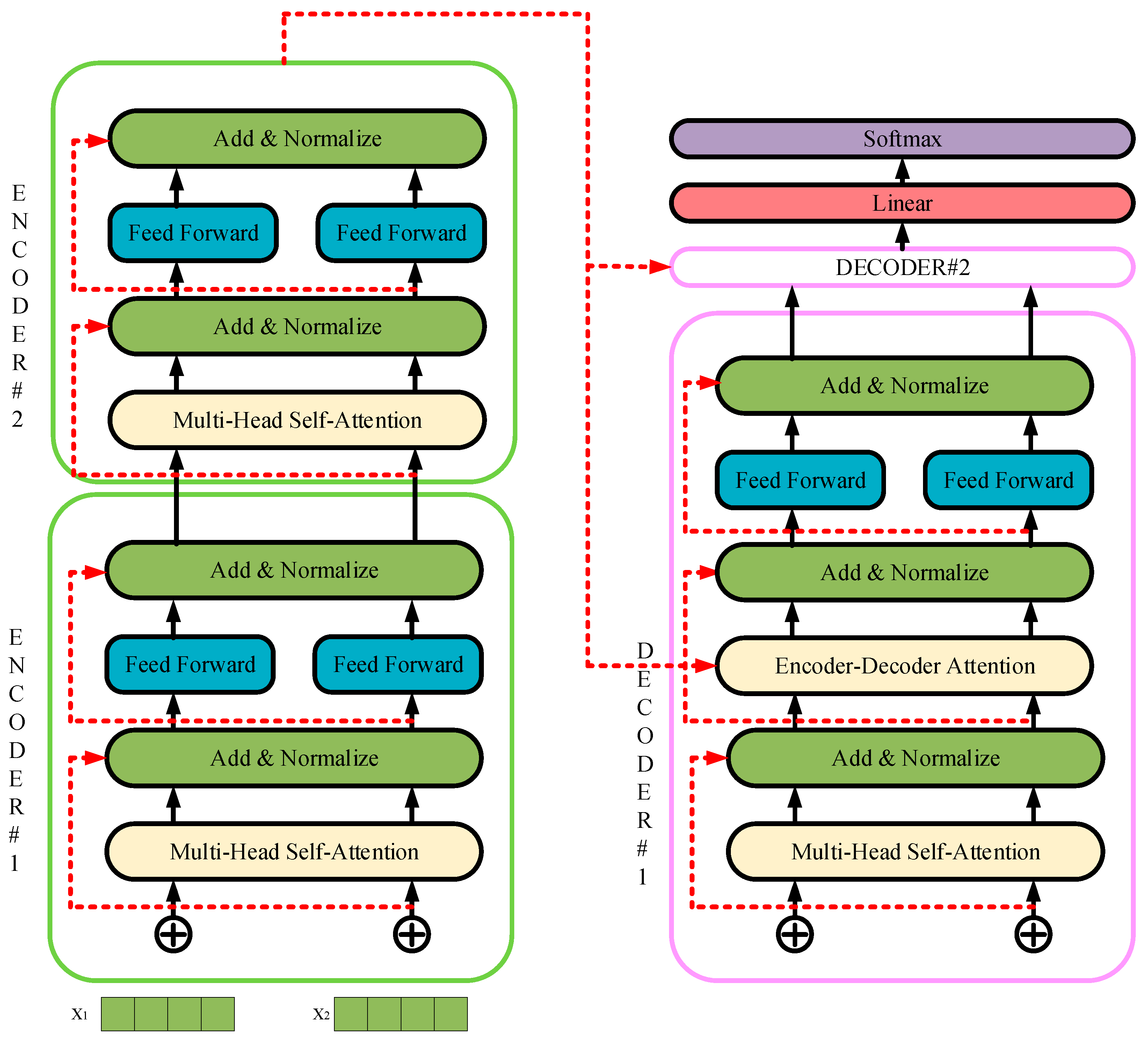
2.1. Transformer Neural Network
- (1)
- Coding stage:
- The input sequence X is transformed into a fixed-dimension vector by the embedding layer, and position encoding is added to retain position information.
- The multi-head self-attention mechanism calculates Q (query vector), K (key vector), and V (numerical vector), which are normalized by Softmax and then weighted and summed to generate global information.
- The calculation results are added to the input through residual connections, then normalized and passed to the next layer.
- Nonlinear transformation is carried out using a two-layer fully connected network to extract high-dimensional features.
- Repeat the above steps to output high-dimensional features.
- (2)
- Decoding Stage:
- The decoder receives the output from the encoder and adds position encoding.
- Global information is generated through a multi-head self-attention mechanism.
- The encoder–decoder attention mechanism calculates Q, K, and V to extract the relevant information of the target sequence.
- The calculation results are added to the input through residual connections, then normalized and passed to the next layer.
- Nonlinear transformation is carried out using a fully connected network to extract high-dimensional features.
- Repeat the above steps to output high-dimensional features.
- Generate the target sequence through linear transformation and the Softmax function.
2.2. Rail Damage Detection Method Based on the DETR Algorithm
- (1)
- Cancel the anchor frame design: The shapes and sizes of rail damage vary, ranging from minor surface cracks to extensive rail head peeling, and their morphological characteristics show significant differences. The anchor frame design of traditional neural networks usually adopts a fixed size range and length-to-width ratio. These preset parameters are difficult to fully adapt to various damage situations in rail damage, such as transverse cracks, rail waist holes, and rail bottom rust. In the actual detection process, the fixed anchor frame is prone to causing small-sized damage to be missed or large-sized damage to have positioning deviations. Especially when the damage scale exceeds the preset anchor frame range, the model detection accuracy will drop significantly. DETR innovatively eliminates the anchor box design and directly outputs the position coordinates and category probabilities of the target through a set prediction mechanism, no longer relying on the complex matching process between the preset box and the real target. This design can flexibly capture the local and global features of rail damage of different sizes and forms. Especially for the common scenarios in rail inspection where millimeter-level microcracks and centimeter-level block dropping coexist, it demonstrates stronger adaptability and robustness to rail damage detection tasks with a large scale span.
- (2)
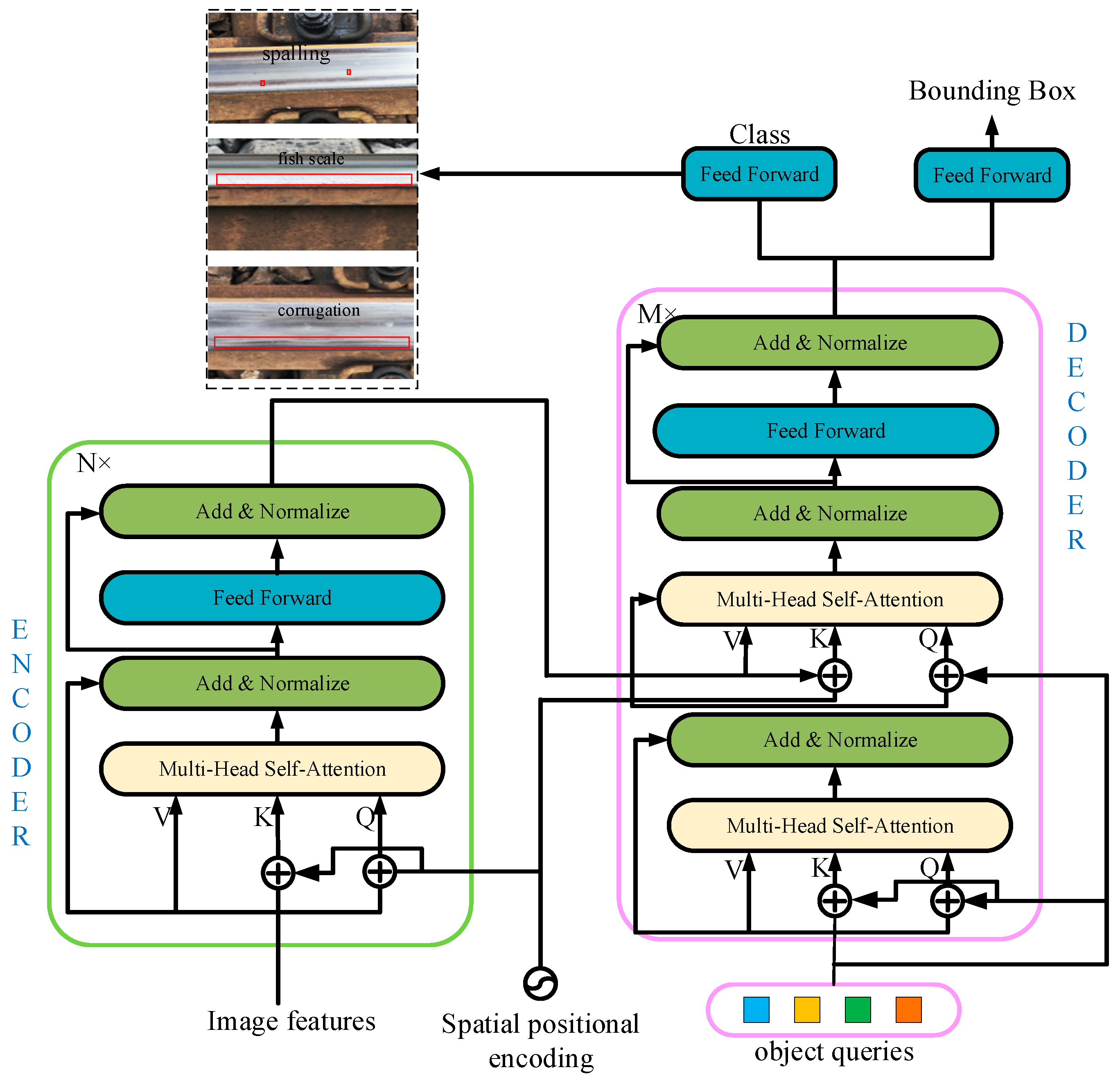
- Self-attention mechanism: In the actual detection scenarios of rail damage, the complex and variable light intensity—the direct strong light at the tunnel entrances and exits, the low-light environment at night, and the diverse interfering objects—the weeds around the rails, ballast, metal connectors, and the dynamic shadows during train operation, will have a significant impact on the detection Traditional neural networks employ a local feature extraction mechanism, capturing features by means of a fixed-sized local sensory field through convolution operations. However, when dealing with complex scenarios where fine cracks and large-scale spalling coexist on the rail surface, this mechanism is difficult to construct long-distance global correlations between the damaged area and the background area, resulting in the model being vulnerable to the influence of uneven illumination and complex background interference. There are problems of feature confusion or missed detection. DETR achieves dynamic weight allocation through a self-attention mechanism, which can adaptively adjust the feature weights based on the significant features of the rail damage area, prioritizing the allocation of computing resources to the key areas containing damage information while suppressing the feature responses of meaningless background areas. This fundamentally reduces the impact of illumination fluctuations and complex backgrounds on the model detection accuracy. It demonstrates high environmental adaptability and anti-interference robustness in the task of rail damage detection. The original DETR network framework is shown in Figure 2.
2.3. Model Evaluation Metrics of the DETR Algorithm in Rail Damage Detection
- (1)
- Recall (R)
- (2)
- Precision (P)
- (3)
- Mean Average Precision (MAP)
- (4)
- FI-score (F1)
- (5)
- FPS
3. Algorithm Improvements of DETR for Rail Damage Detection
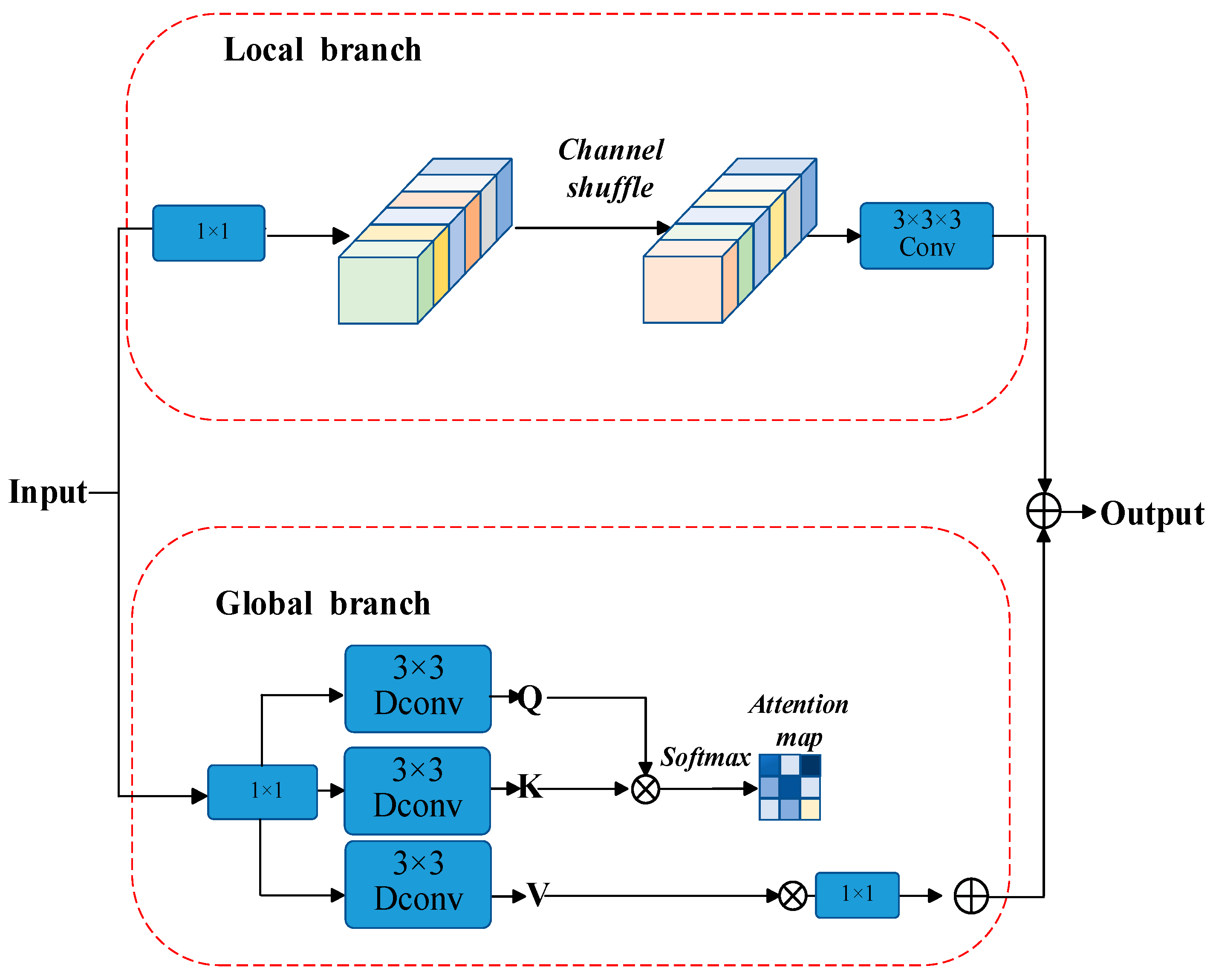
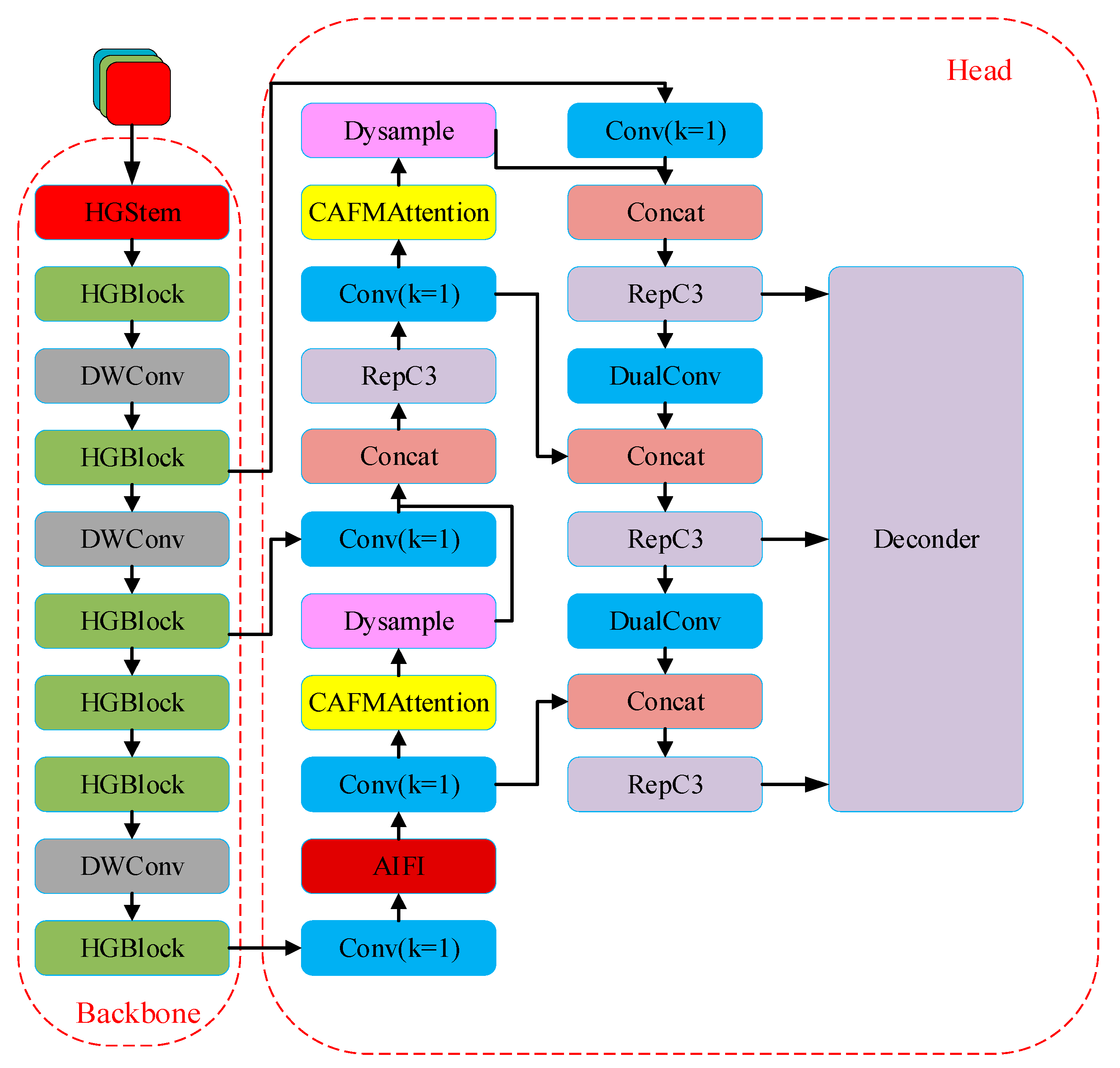
3.1. Adding a Convolution–Attention Fusion Module (CAFMAttention)
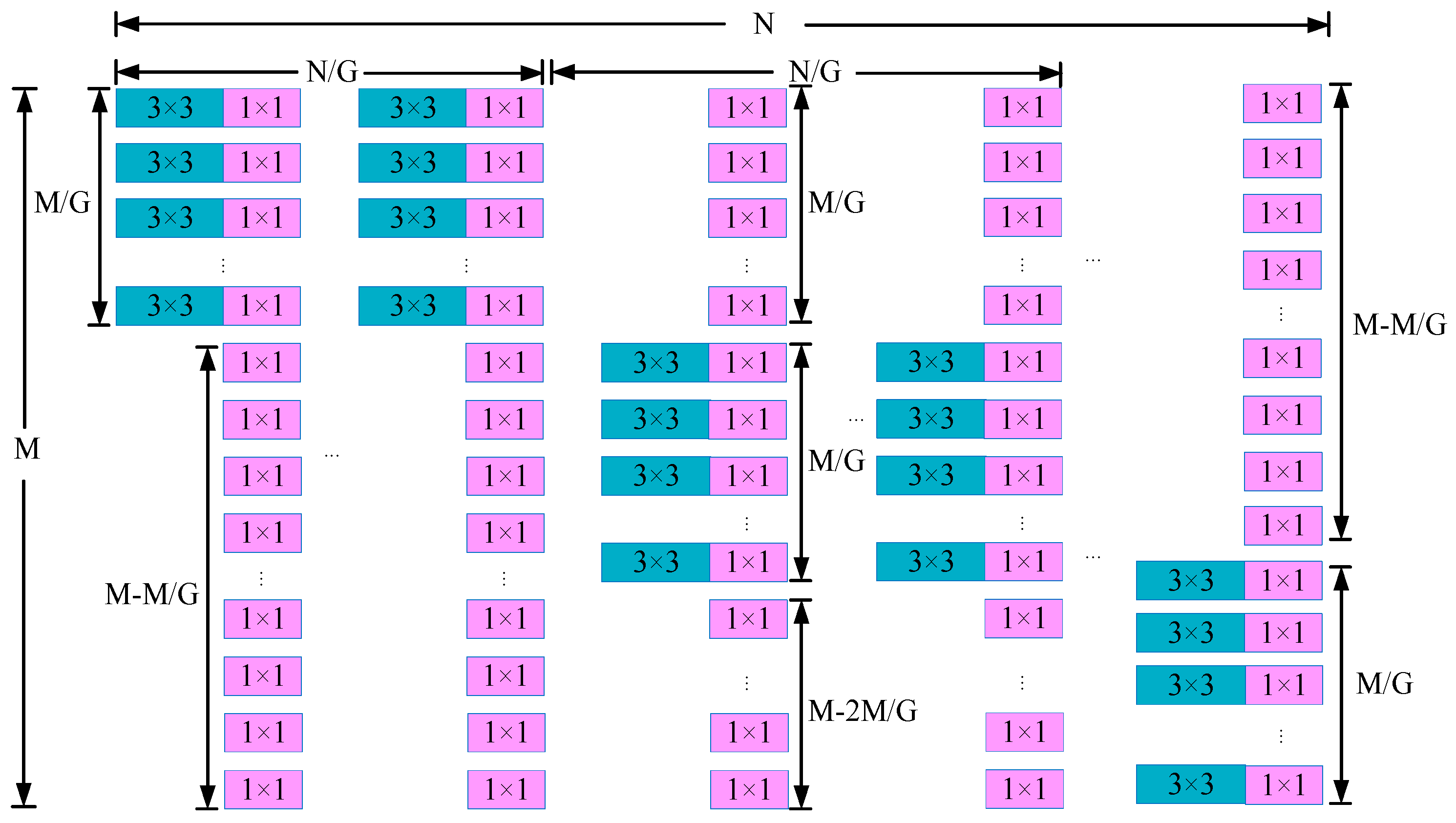
3.2. Introducing Dual Convolution (DualConv)
3.3. Adopting the Dysample Upsampler
- (1)
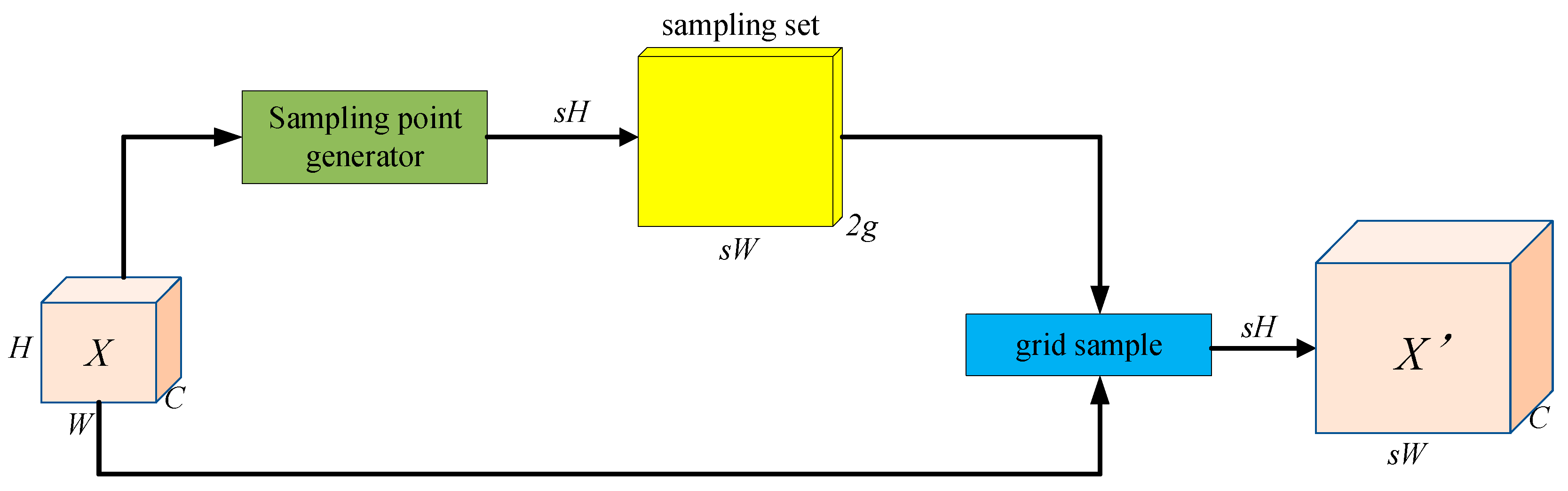
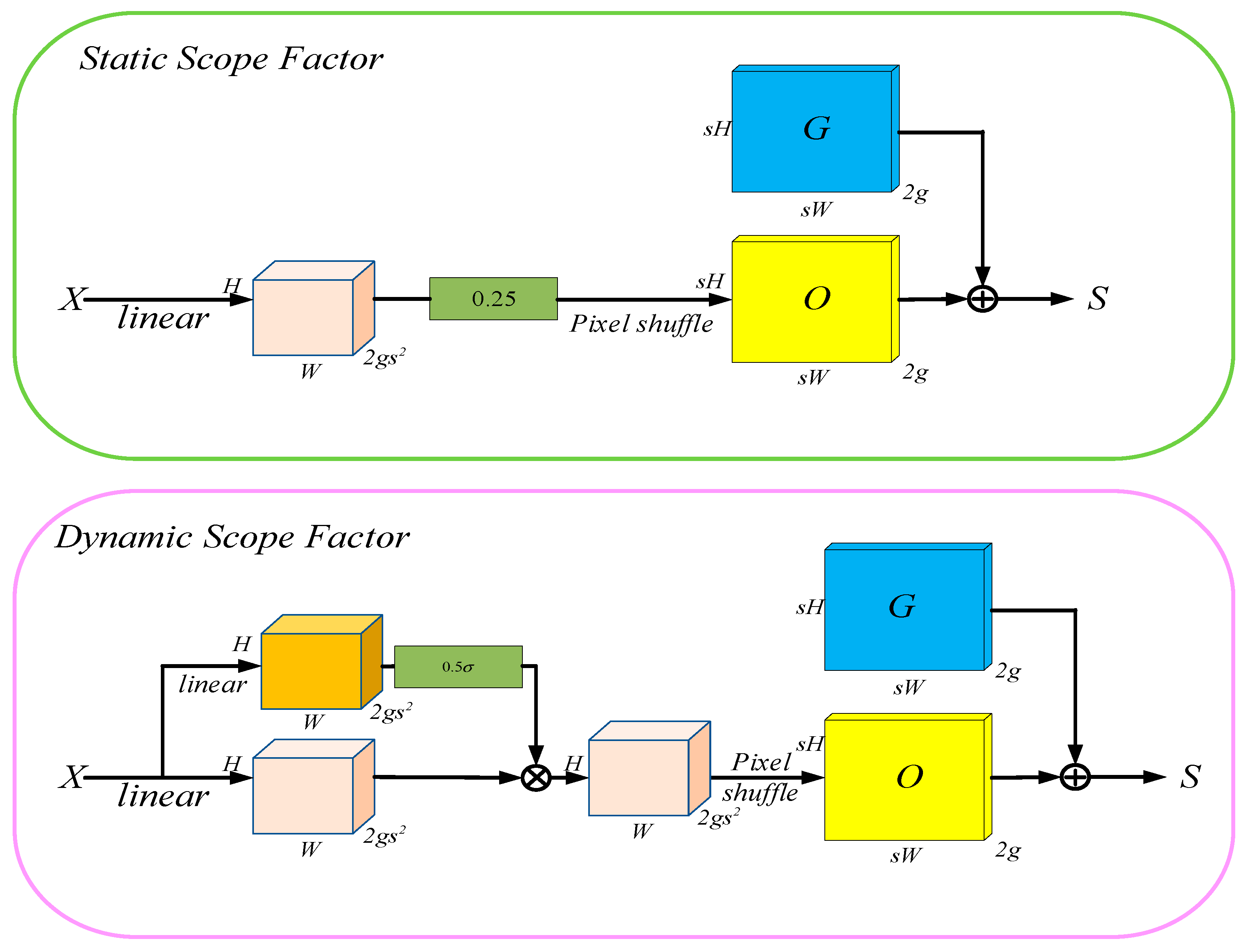
- Given the upsampling scale factor s and the input feature map X of size , an offset tensor O of dimension is first generated through a linear transformation layer composed of 1 × 1 convolution or a dynamic range factor adjustment module (including batch normalization and ReLU activation function). Subsequently, the channel dimension and spatial dimension of the offset tensor are rearranged through the Pixel Shuffling operation, reshaping it into an offset feature map of size . Finally, the original sampling network G and the offset O are added element by element. The feature map is upsampled through the bilinear interpolation algorithm to generate a sampling set containing position offset information. The corresponding formula is shown in Equations (7) and (8).
- (2)
- Input the feature map X and the sampling set S. Use the grid-sample function built into the PyTorch (v2.8.0+cu126) framework to perform bilinear interpolation operations. This function maps the two-dimensional offset coordinates of each element in the sampling set S (including the normalized coordinate values in the horizontal direction and the vertical direction ) to the input feature map X point by point. The precise calculation of feature values is achieved by using the weighted average of four neighboring pixels, and finally an upsampled feature map with a resolution of The mathematical principle of this process is based on the gradient optimization mechanism of affine transformation and backpropagation. The corresponding formula is shown in Equation (9).
3.4. Improved DETR Network Framework
4. Experiments and Results Analysis
4.1. Experimental Dataset
- (1)
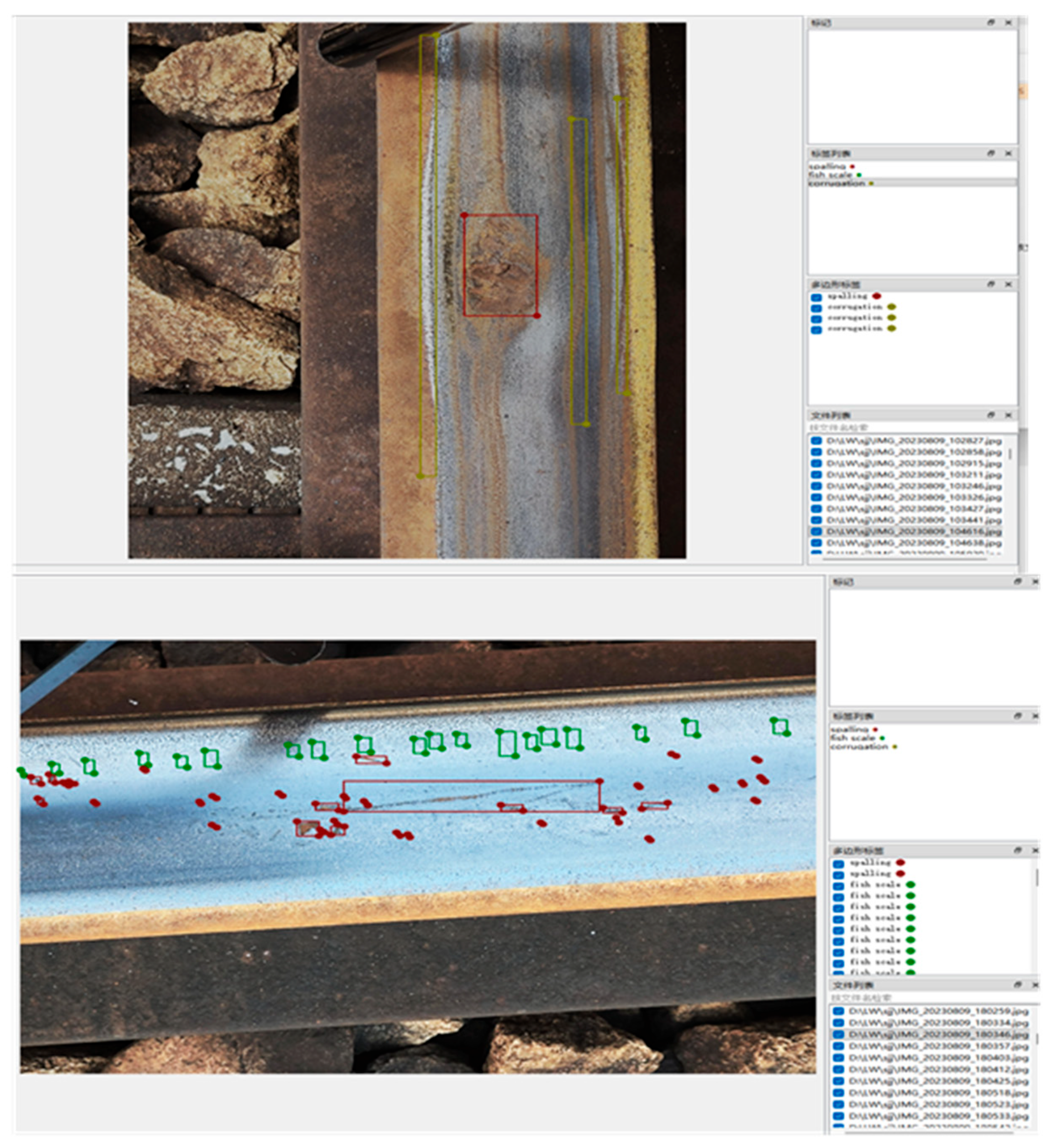
- Data annotation: Use the Labelme annotation tool to carry out data annotation work on rail damage. Among them, the spalling damage is marked as spalling(red), the fish scale damage is marked as fish scale(green), and the wave abrasion damage is marked as corrugation(yellow). The data annotation process is shown in Figure 8.
- (2)
- Data augmentation: As DETR requires a large amount of training data to fully learn the features of various types of injuries. However, in actual working conditions, it is difficult to obtain data on rail damage. In particular, the occurrence frequency of peel and flake damage is much higher than that of fish-scale pattern damage and wave abrasion damage, and there is an imbalance in the types of damage, which leads to classification difficulties. Therefore, this paper adopts the method of data augmentation to expand the dataset, thereby enabling the model to fully learn the features of various types of injuries. The data augmentation methods employed in this paper include: random scaling, flipping, luminance transformation, enhancing contrast and saturation, adding Gaussian noise, and using center clipping.
- (3)
- Dataset partitioning: After data augmentation processing, the dataset is stratified and sampled in a ratio of training set: validation set: test set = 8:1:1. To ensure that the model can fully learn the distribution patterns of various damage features, a three-dimensional hierarchical strategy of “damage type—lighting conditions—shooting Angle” is adopted in the classification process to guarantee that the training set, test set and validation set all cover all target categories such as peeling and shedding (accounting for 32%), fish-scale damage (accounting for 28%), and wave abrasion damage (accounting for 40%). Moreover, the sample distribution deviation of each subset under different lighting conditions such as low illumination (22%), normal illumination (58%), and strong illumination (20%) is controlled within 3%. After dataset partitioning, the training set contains 3751 sample images (including 423 samples with compound damage), the validation set contains 368 sample images (for hyperparameter tuning and early stop determination of the model), and the test set contains 370 sample images (independent of the model training process and used for final performance evaluation). After the division is completed, the consistency of the distribution of each subset is verified through the Kappa coefficient (K = 0.92) to ensure the reliability and generalization ability of the model evaluation results.
4.2. Experimental Platform and Key Parameter Settings of the Model
4.3. Model Performance Verification and Analysis
- Analysis of Evaluation Metrics
5. Discussion
5.1. Interpretation of Ablation Results and Module Synergy
5.2. Robustness to Noisy and Incomplete Inputs
5.3. Limitations and Future Research Directions
6. Conclusions
- (1)
- When the Convolution–Attention Fusion Module was incorporated into the DETR model, the Recall, Precision, mAP@0.5, F1-score, and FPS of the model reached 0.643, 0.744, 0.696, 0.68, and 62.11, respectively. Compared with the original model, although Precision, mAP@0.5, F1-score, and FPS decreased, the Recall, which is the most important evaluation metric in rail damage detection, increased by 3.3%. Therefore, the DETR model with the CAFMAttention module is considered more suitable for rail damage detection tasks.
- (2)
- When the Dual Convolution layers (DualConv) replaced the standard convolution layers (Conv) in the original DETR model, the Recall, Precision, mAP@0.5, F1-score, and FPS of the model reached 0.638, 0.772, 0.722, 0.69, and 54.05, respectively. Compared with the original model, Recall and mAP@0.5 improved by 2.6% and 5.9%, respectively, while the F1-score remained unchanged. Although Precision and FPS decreased, they still satisfied the requirements of detection accuracy and real-time performance in rail damage detection.
- (3)
- When the Dysample upsampler replaced the original upsampler, the Recall, Precision, mAP@0.5, F1-score, and FPS of the model reached 0.633, 0.809, 0.704, 0.72, and 65.78, respectively. Compared with the original model, Recall, Precision, mAP@0.5, F1-score, and FPS improved by 1.8%, 1.5%, 3.2%, 4.3%, and 3.9%, respectively. Therefore, it is concluded that the introduction of the Dysample upsampler can effectively improve the detection performance of the model for rail damage.
Author Contributions
Funding
Institutional Review Board Statement
Informed Consent Statement
Data Availability Statement
Conflicts of Interest
References
- Liang, B.; Lu, J.; Cao, Y. Rail Surface Damage Detection Method Based on Improved U-Net Convolutional Neural Network. Laser Optoelectron. Prog. 2021, 58, 326–332. [Google Scholar] [CrossRef]
- Luo, H.; Cai, L.; Li, C. Rail Surface Defect Detection Based on an Improved YOLOv5s. Appl. Sci. 2023, 13, 7330. [Google Scholar] [CrossRef]
- Salcher, P.; Pradlwarter, H.; Adam, C. Reliability Assessment of Railway Bridges Subjected to High-Speed Trains Considering the Effects of Seasonal Temperature Changes. Eng. Struct. 2016, 126, 712–724. [Google Scholar] [CrossRef]
- Bai, T.; Gao, J.; Yang, J.; Yao, D. A Study on Railway Surface Defects Detection Based on an Improved YOLOv4. Entropy 2021, 23, 1437. [Google Scholar] [CrossRef]
- Du, J.; Zhang, R.; Gao, R.; Nan, L.; Bao, Y. A New Multiscale Rail Surface Defect Detection Model (RSDNet) with YOLOv8n. Sensors 2024, 24, 3579. [Google Scholar] [CrossRef]
- Zhang, Y.; Liu, X.; Yang, Y.; Li, N.; Xie, X.; Chen, K. An Improved Target Network Model for Rail Surface Defect Detection Based on YOLOv7 and k-means++. Appl. Sci. 2024, 14, 6467. [Google Scholar] [CrossRef]
- Guo, F. Rail Surface Defect Detection Using a Transformer-Based Network (RailFormer). Results Eng. 2024, 22, 102281. [Google Scholar]
- Si, C.; Fan, R.; Peng, F.; Liang, H.; Chen, D. Rail-STrans: A Rail Surface Defect Segmentation Method Based on Swin Transformer. Appl. Sci. 2024, 14, 3629. [Google Scholar] [CrossRef]
- Song, W.; Liao, B.; Ning, K.; Yan, X. Improved Real-Time Detection Transformer-Based Rail Fastener Defect Detection. Mathematics 2024, 12, 3349. [Google Scholar] [CrossRef]
- Yang, H.; Liu, J.; Mei, G.; Yang, D.; Deng, X.; Duan, C. Real-Time Detection Method of Rail Corrugation Based on Machine Vision and CNN. Eng. Appl. Artif. Intell. 2023, 121, 106105. [Google Scholar]
- Min, Y.; Wang, Z.; Liu, Y.; Wang, Z. FS-RSDD: Few-Shot Rail Surface Defect Detection with Prototype Learning. Sensors 2023, 23, 7894. [Google Scholar] [CrossRef]
- Wu, Y.; Zhu, X. Rail Defect Detection Using Ultrasonic A-Scan Data and Deep Autoencoders. Transp. Res. Rec. 2023, 2677, 92–103. [Google Scholar] [CrossRef]
- Lu, X.-L.; Gao, B.; Woo, W.L.; Xiao, X.; Zhan, D.; Huang, C. Hybrid Physics–ML for Ultrasonic Field-Guided 3D Reconstruction of Rail Defects. Mech. Syst. Signal Process. 2024, 211, 111287. [Google Scholar]
- Arain, A.; Mehran, S.; Shaikh, M.Z.; Kumar, D.; Chowdhry, B.S.; Hussain, T. Railway Track Surface Faults Dataset. Data Brief 2024, 52, 110050. [Google Scholar] [CrossRef]
- Zhang, Z.; Yu, S.; Yang, S.; Zhou, Y.; Zhao, B. Rail-5k: A Real-World Dataset for Rail Surface Defects Detection. arXiv 2021, arXiv:2106.14366. [Google Scholar]
- Qian, Y.; Guo, H.; Rizos, D.; Vitzilaios, N. Autonomous Rail Surface Defect Detection (RSD_UAV Dataset; DeepLabv3+ with CBAM). In U.S. DOT/ROSA P Technical Report; U.S. DOT: Washington, DC, USA, 2024. [Google Scholar]
- Zheng, D.; Zhang, F.; Xu, H.; Guo, Y.; Wang, N.; Zhang, Y. A Defect Detection Method for Rail Surface and Fasteners Based on Deep CNN. Comput. Intell. Neurosci. 2021, 2021, 2565500. [Google Scholar] [CrossRef]
- Yan, Y.; Jia, X.; Song, K.; Cui, W.; Zhao, Y.; Liu, C.; Guo, J. Specificity Autocorrelation Integration Network (SAINet) for Surface Defect Detection of No-Service Rail. Opt. Lasers Eng. 2024, 172, 107862. [Google Scholar] [CrossRef]
- Mi, Z.; Chen, R.; Zhao, S. Research on Steel Rail Surface Defects Detection Based on Improved YOLOv4 Network. Front. Neurorobotics 2023, 17, 1119896. [Google Scholar] [CrossRef] [PubMed]
- Vaswani, A.; Shazeer, N.; Parmar, N.; Uszkoreit, J.; Jones, L.; Gomez, A.N.; Kaiser, Ł.; Polosukhin, I. Attention Is All You Need. Adv. Neural Inf. Process. Syst. (NeurIPS) 2017, 30, 5998–6008. [Google Scholar]
- Shaw, P.; Uszkoreit, J.; Vaswani, A. Self-Attention with Relative Position Representations. Proc. North Am. Chapter Assoc. Comput. Linguist. Hum. Lang. Technol. 2018, 2018, 464–468. [Google Scholar]
- Devlin, J.; Chang, M.-W.; Lee, K.; Toutanova, K. BERT: Pre-training of Deep Bidirectional Transformers for Language Understanding. Proc. North Am. Chapter Assoc. Comput. Linguist. Hum. Lang. Technol. 2019, 2019, 4171–4186. [Google Scholar]
- Radford, A.; Narasimhan, K.; Salimans, T.; Sutskever, I. Improving Language Understanding by Generative Pre-Training. OpenAI Tech. Rep. 2018, 1–12. [Google Scholar]
- Yang, Z.; Dai, Z.; Yang, Y.; Carbonell, J.; Salakhutdinov, R.; Le, Q.V. XLNet: Generalized Autoregressive Pretraining for Language Understanding. NeurIPS 2019, 32, 5753–5763. [Google Scholar]
- Raffel, C.; Shazeer, N.; Roberts, A.; Lee, K.; Narang, S.; Matena, M.; Zhou, Y.; Li, W.; Liu, P.J. Exploring the Limits of Transfer Learning with a Unified Text-to-Text Transformer. J. Mach. Learn. Res. 2020, 21, 5485–5551. [Google Scholar]
- Zaheer, M.; Guruganesh, G.; Dubey, A.; Ainslie, J.; Alberti, C.; Ontañón, S.; Pham, P.; Ravula, A.; Wang, L.; Yang, A.; et al. Big Bird: Transformers for Longer Sequences. NeurIPS 2020, 33, 17283–17297. [Google Scholar]
- Ainslie, J.; Ontañón, S.; Alberti, C.; Cvicek, V.; Fisher, Z.; Pham, P.; Ravula, A.; Sanghai, S.; Wang, Q.; Yang, L. ETC: Encoding Long and Structured Inputs in Transformers. arXiv 2020, arXiv:2004.08483. [Google Scholar] [CrossRef]
- Nawrot, P.; Tworkowski, S.; Tyrolski, M.; Kaiser, Ł.; Wu, Y.; Szegedy, C.; Michalewski, H. Hierarchical Transformers Are More Efficient Language Models. arXiv 2021, arXiv:2110.13711. [Google Scholar]
- Schneider, J. What Comes After Transformers?—A Selective Survey. arXiv 2024, arXiv:2408.00386. [Google Scholar]
- Pereira, F.; Hussain, S. Transformers in Computer Vision: A Comprehensive Survey. arXiv 2024, arXiv:2408.15178. [Google Scholar]
- Zhu, X.; Su, W.; Lu, L.; Li, B.; Wang, X.; Dai, J. Deformable DETR: Deformable Transformers for End-to-End Object Detection. In Proceedings of the International Conference on Learning Representations (ICLR), virtual, 3–7 May 2021. [Google Scholar]
- Dai, X.; Chen, Y.; Xiao, B.; Chen, D.; Liu, M.; Yuan, L.; Zhang, L. UP-DETR: Unsupervised Pre-Training for Object Detection with Transformers. In Proceedings of the Conference on Computer Vision and Pattern Recognition, virtual, 19–25 June 2021; pp. 1601–1610. [Google Scholar]
- Gao, P.; Zheng, M.; Wang, X.; Dai, J.; Li, H. Fast Convergence of DETR with Spatially Modulated Co-Attention. In Proceedings of the International Conference on Computer Vision, virtual, 11–17 October 2021; pp. 3621–3630. [Google Scholar]
- Chen, H.; Sun, K.; Tian, Z.; Shen, C.; Huang, Y.; Yan, Y. Group DETR: Fast Training of DETR with Group-wise One-to-Many Assignment. In Proceedings of the Conference on Computer Vision and Pattern Recognition, New Orleans, LA, USA, 19–24 June 2022; pp. 6619–6628. [Google Scholar]
- Li, Y.; Zhang, K.; Zhou, H.; Wang, Y.; Jiang, Z.; Sun, J. Lite DETR: An Interleaved Multi-Scale Encoder for Efficient DETR. arXiv 2023, arXiv:2303.07335. [Google Scholar]
- Lv, T.; Wang, W.; Zhang, W.; Yuan, Y.; Liu, J. RT-DETR: Real-Time Detection Transformer. arXiv 2023, arXiv:2304.08069. [Google Scholar]
- Pu, J.; Tang, L.; Chen, K.; Zhu, H.; Han, J.; Ding, E.; Zhang, Y. Rank-DETR: Rank-Oriented DETR for High-Quality Object Detection. Adv. Neural Inf. Process. Syst. 2023, 36, 16100–16113. [Google Scholar]
- He, J.; Zhang, Y.; Chen, X.; Wang, C.; Liu, J. An Improved DETR Detector for Oriented Remote Sensing Object Detection. Remote Sens. 2024, 16, 3516. [Google Scholar] [CrossRef]
- Nan, Z.; Wang, J.; Xu, Y.; Li, B.; Wang, X. MI-DETR: An Object Detection Model with Multi-Time Inquiries Mechanism. In Proceedings of the 2025 Conference on Computer Vision and Pattern Recognition, Nashville, TN, USA, 11–15 June 2025. [Google Scholar]
- Carion, N.; Massa, F.; Synnaeve, G.; Usunier, N.; Kirillov, A.; Zagoruyko, S. End-to-End Object Detection with Transformers. In Proceedings of the Computer Vision—ECCV 2020, Glasgow, UK, 23–28 August 2020; Springer: Berlin/Heidelberg, Germany, 2020; pp. 213–229. [Google Scholar]
- Hu, S.; Gao, F.; Zhou, X.; Dong, J.; Du, Q. Hybrid Convolutional and Attention Network for Hyperspectral Image Denoising. IEEE Geosci. Remote Sens. Lett. 2024, 21, 1–5. [Google Scholar] [CrossRef]
- Krizhevsky, A.; Sutskever, I.; Hinton, G.E. Imagrnent classification with deep convolutional neural networks. Adv. Neural Inf. Process. Syst. 2012, 25, 1097–1105. [Google Scholar]
- Singh, P.; Verma, V.K.; Rai, P.; Namboodiri, V.P. HetConv: Heterogeneous Kernel-Based Convolutions for Deep CNNs. In Proceedings of the Conference on Computer Vision and Pattern Recognition, Long Beach, CA, USA, 16–20 June 2019; pp. 4835–4844. [Google Scholar]
- Zhong, J.; Chen, J.; Mian, A. Dualconv: Dual convolutional kernels for lightweight deep neural networks. IEEE Trans. Neural Netw. Learn. Syst. 2023, 34, 9528–9535. [Google Scholar] [CrossRef] [PubMed]
- Liu, W.; Lu, H.; Fu, H. Learning to Upsample by Learning to Sample. In Proceedings of the 2023 International Conference on Computer Vision, Paris, France, 2–6 October 2023; pp. 6027–6037. [Google Scholar]
- Pang, Y.; Xie, J.; Khan, M.H.; Anwer, R.M.; Khan, F.S.; Shao, L. Mask-Guided Attention Network for Occluded Pedestrian Detection. In Proceedings of the 2019 International Conference on Computer Vision, Seoul, Republic of Korea, 27 October–2 November 2019; pp. 4967–4975. [Google Scholar]





| Parameters | Elastic Parameters | Parameters | Elastic Parameters |
|---|---|---|---|
| lr0 | 1 × 10⁻³ | lrf | 1.0 |
| momentum | 0.9 | epochs | 300 |
| warmup_epochs | 3.0 | batch size | 8 |
| optimizer | AdamW | workers | 8 |
| Evaluation Metric | Original DETR Model | Improved DETR Model | Improvement Value | Improvement Rate |
|---|---|---|---|---|
| Recall | 0.622 | 0.698 | 0.076 | 12.2% |
| Precision | 0.797 | 0.815 | 0.018 | 2.3% |
| Map@0.5 | 0.682 | 0.741 | 0.059 | 8.7% |
| F1-score | 0.69 | 0.75 | 0.06 | 8.7% |
| FPS | 63.29 | 64.94 | 1.65 | 2.6% |
| Basic Model | CAFMAttention | DualConv | Dysample | Recall | Precision | Map@0.5 | F1-Score | FPS |
|---|---|---|---|---|---|---|---|---|
| √ | 0.622 | 0.797 | 0.682 | 0.69 | 63.29 | |||
| √ | √ | 0.643 | 0.744 | 0.696 | 0.68 | 62.11 | ||
| √ | √ | 0.638 | 0.772 | 0.722 | 0.69 | 54.05 | ||
| √ | √ | 0.633 | 0.809 | 0.704 | 0.72 | 65.78 | ||
| √ | √ | √ | 0.655 | 0.782 | 0.723 | 0.71 | 58.14 | |
| √ | √ | √ | 0.644 | 0.794 | 0.717 | 0.72 | 65.12 | |
| √ | √ | √ | 0.642 | 0.787 | 0.721 | 0.71 | 65.23 | |
| √ | √ | √ | √ | 0.698 | 0.815 | 0.741 | 0.75 | 64.94 |
| Detection Scenario | Original DETR Model Detection | Improved DETR Model Detection | Relative Improvement |
|---|---|---|---|
| Corrugation Damage Detection Scenario |  |  | 2.6% |
| Mixed Damage Detection Scenario |  |  | 4.7% |
| Dense Damage Detection Scenario |  |  | 3.4% |
| Overexposed Damage Detection Scenario |  |  | 8.3% |
| Underexposed Damage Detection Scenario |  |  | 1.7% |
Disclaimer/Publisher’s Note: The statements, opinions and data contained in all publications are solely those of the individual author(s) and contributor(s) and not of MDPI and/or the editor(s). MDPI and/or the editor(s) disclaim responsibility for any injury to people or property resulting from any ideas, methods, instructions or products referred to in the content. |
© 2025 by the authors. Licensee MDPI, Basel, Switzerland. This article is an open access article distributed under the terms and conditions of the Creative Commons Attribution (CC BY) license (https://creativecommons.org/licenses/by/4.0/).
Share and Cite
Wu, S.; Wu, M.; Lin, F.; Yang, Y.; Tan, R. Research on Rail Damage Detection Based on Improved DETR Algorithm. Appl. Sci. 2025, 15, 13223. https://doi.org/10.3390/app152413223
Wu S, Wu M, Lin F, Yang Y, Tan R. Research on Rail Damage Detection Based on Improved DETR Algorithm. Applied Sciences. 2025; 15(24):13223. https://doi.org/10.3390/app152413223
Chicago/Turabian StyleWu, Sanxiu, Mengquan Wu, Fengtao Lin, Yang Yang, and Rongkai Tan. 2025. "Research on Rail Damage Detection Based on Improved DETR Algorithm" Applied Sciences 15, no. 24: 13223. https://doi.org/10.3390/app152413223
APA StyleWu, S., Wu, M., Lin, F., Yang, Y., & Tan, R. (2025). Research on Rail Damage Detection Based on Improved DETR Algorithm. Applied Sciences, 15(24), 13223. https://doi.org/10.3390/app152413223