1. Introduction
Energy transfer and localization in extended systems have attracted the interest of many researchers in recent decades [
1,
2,
3,
4]. The regimes of energy transfer and localization have an intimate connection with the problem of existence and the propagation of solitary waves and breathers in nonlinear lattices and chains [
5,
6]. The functioning of many systems and structures is deeply connected to the energy-targeted energy transfer in such systems and their wave features. The modern applications of this problem include the development of different devices, such as energy absorbers [
7,
8,
9], actuators and sensors [
10,
11], and acoustic lenses and waveguides [
12,
13].
Despite the fact that many different types of nonlinear wave have been studied recently in many mechanical and acoustical systems, including solitons [
14] and vector solitons [
15], breathers are the most common type of nonlinear excitation observed in lattices of various types and natures [
16,
17,
18,
19,
20,
21,
22]. The propagation and features of breathers in nonlinear chains are the subject of many experimental [
23,
24,
25] and theoretical [
26,
27,
28] studies. Recent works include new insights into well-known systems [
28,
29,
30,
31] and the exploration of breathers in new systems, including nonlinear media and metamaterials [
32,
33]. A significant portion of these studies concern the effects of dissipation, which cannot be neglected in many real systems. One of these phenomena, referred to as breather arrest (BA), which demonstrates the interplay of two factors within the system, namely, the essential nonlinearity and damping, was recently considered in several works. Breather arrest has been reported in the mass-with-mass chain [
34], in the chain with Hertzian nearest-neighbor coupling [
35], and without local resonances. BA is defined as abrupt crossover from power-law decay to hyper-exponential amplitude decay [
36] during propagation in discrete dissipative media.
In this study, we address breathers in a lattice on a linear substrate with significantly nonlinear nearest-neighbor interaction. This nonlinearity is represented as a force with different values of power in the energy-displacement law. In the limit of the infinite power value, the presented potential corresponds to the vibro-impact interaction [
37,
38]; the high values of power can serve as its smooth analogue. The nonlinearity of the softened vibro-impact type was also recently suggested to provide energy attenuation in the chain of the soft-walled billiards elements [
39]. We consider the effect of significant nonlinearity on the breather propagation and breather arrest. We exploit the simplified model to predict the main features of the breather arrest in a wide range of nonlinearity power values, including smooth-function analogues for vibro-impact contact. The breathers for the chains with vibro-impact interactions were reported by O. Gendelman and others [
40,
41,
42]. However, in these works, the onsite nonsmooth interaction was considered [
43]. In our research, we consider breathers with nonlinear smooth analogue of the vibro-impact interparticle potential of interaction, which has not been addressed before.
In our research, we examine a breather’s propagation in an undamped as well as a damped oscillatory chain with nonlinear interparticle interaction. We consider the two-stage process of breather propagation, including amplitude decay and arrest. A power decrease in the breather amplitude is a characteristic of the first stage, while extremely tiny amplitudes with hyper-exponential attenuation are typical in the second stage. A simplified model of two linear oscillators with dissipation coupled by nonlinear contact forces is used to asymptotically explain the numerical results. The form of the breathers for different nonlinearity types is considered using the complexification-averaging method for the initial full system of equations.
The paper is organized as follows. In
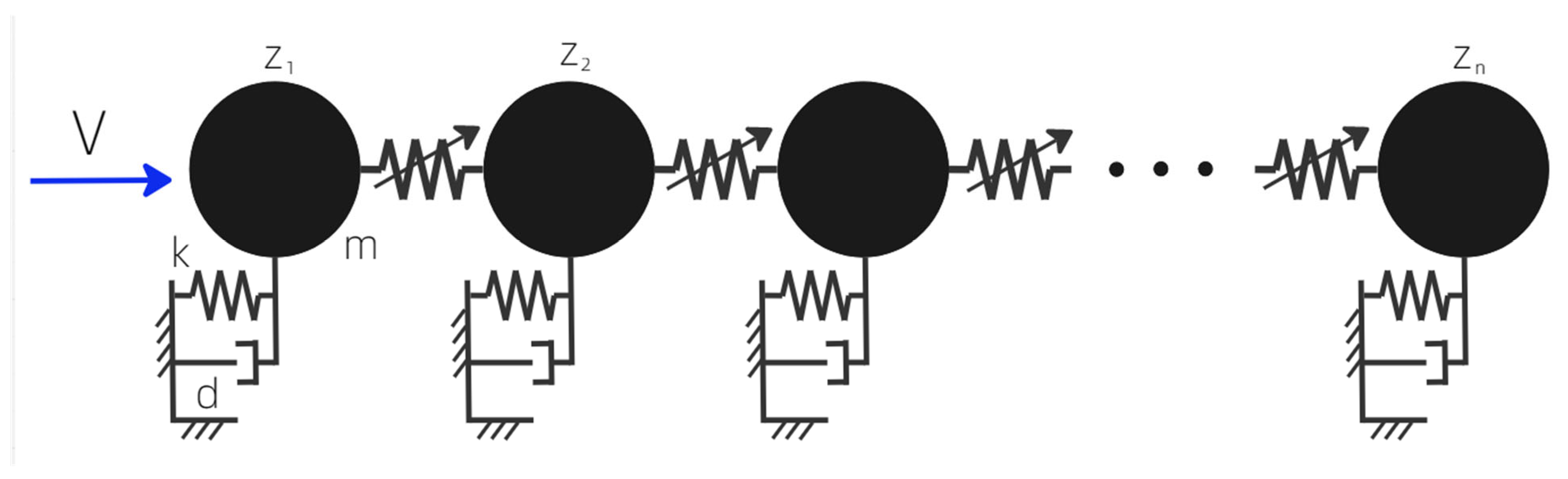
Section 2, a mathematical model of the chain with nonlinear coupling is introduced. In
Section 3, the numerical evidence of the breather propagation depending on the nonlinearity is considered.
Section 4 is devoted to the asymptotic study of the reduced system, while
Section 5 presents the analysis of the full model of the chain. These sections are followed by a discussion and concluding remarks.
3. Numerical Evidences
Nonlinear interactions between the nearest-neighbor oscillators and the presence of onsite elastic potentials inside the oscillatory chain suggest the presence of breathers [
16,
44,
45]. At the first stage, we simulate the dynamics of system (3) under initial conditions (4); we perform numerical simulations for systems with nonlinearity power
M = 3, 5, 11, and 19 using the Python 3.9.13 programming software. For the numerical solution, the iterative Runge–Kutta method of the built-in library scipy.integrate is used. The Matplotlib 3.5.2 and seaborn libraries are used to visualize the data.
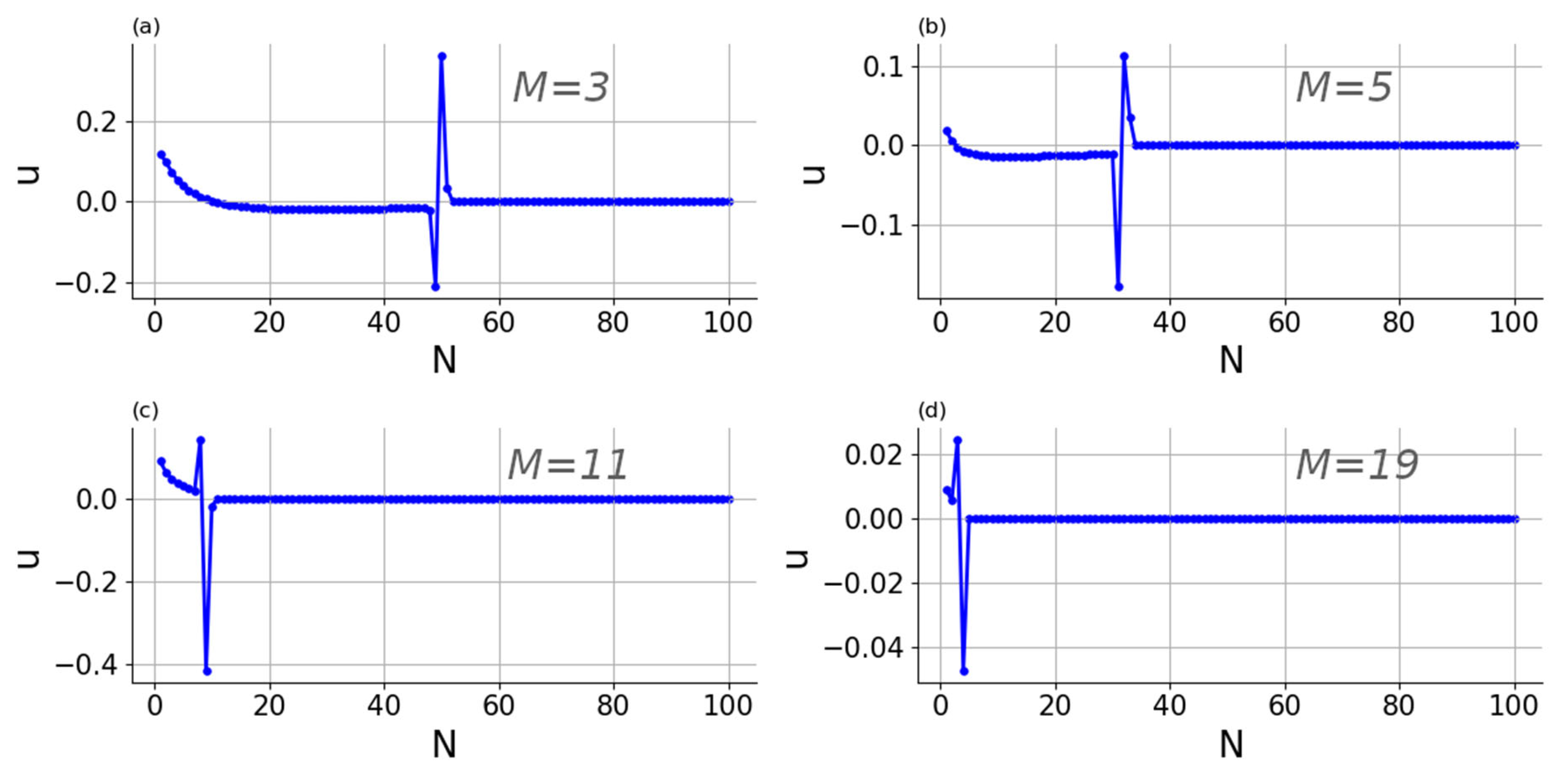
Let us start by presenting the profiles of the breathers;
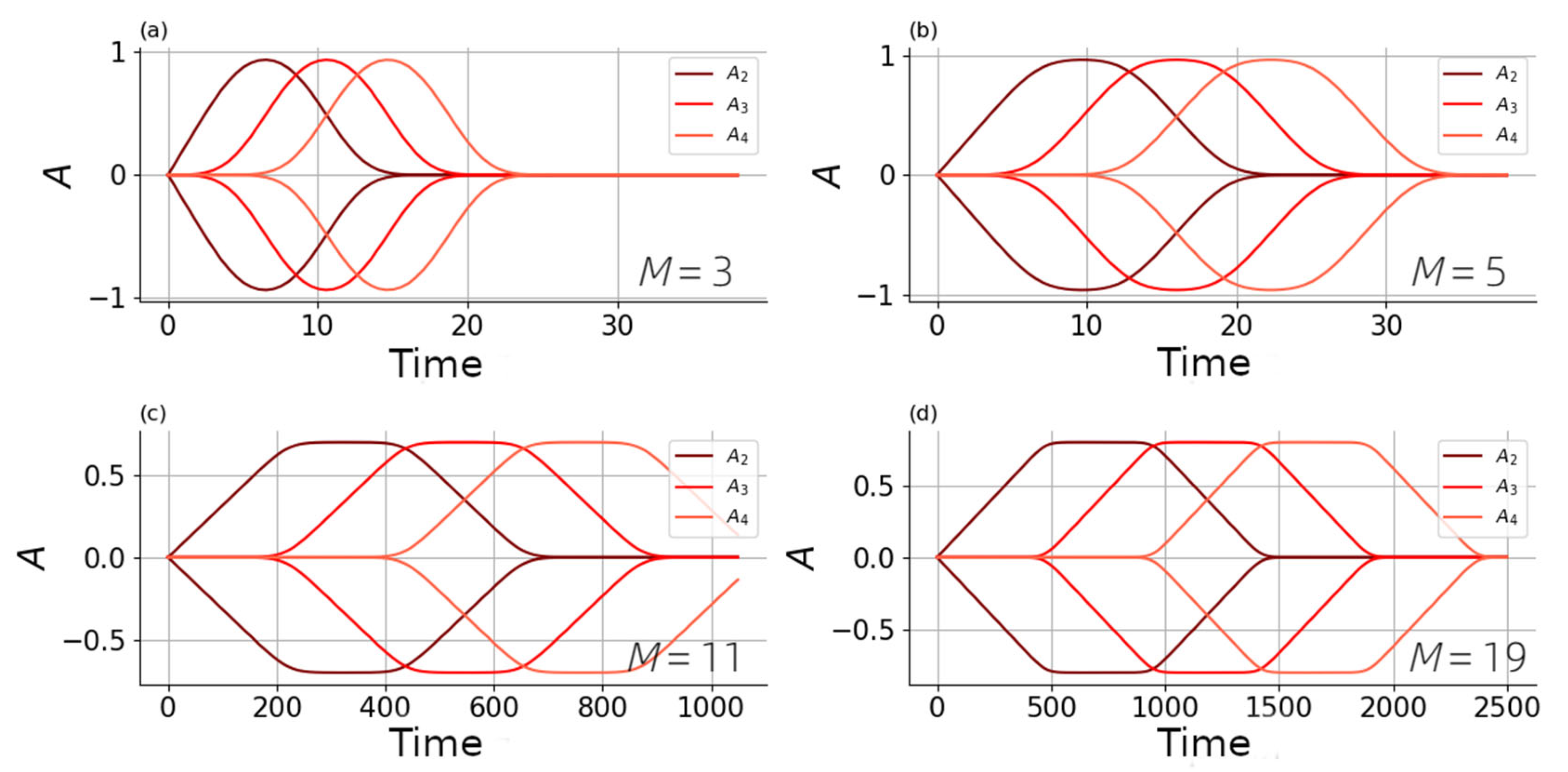
Figure 3 presents a typical response for the chain element for different power values of nonlinearity
M, while
Figure 4 shows the excitation profile along the chain after impulsive loading of its edge element.
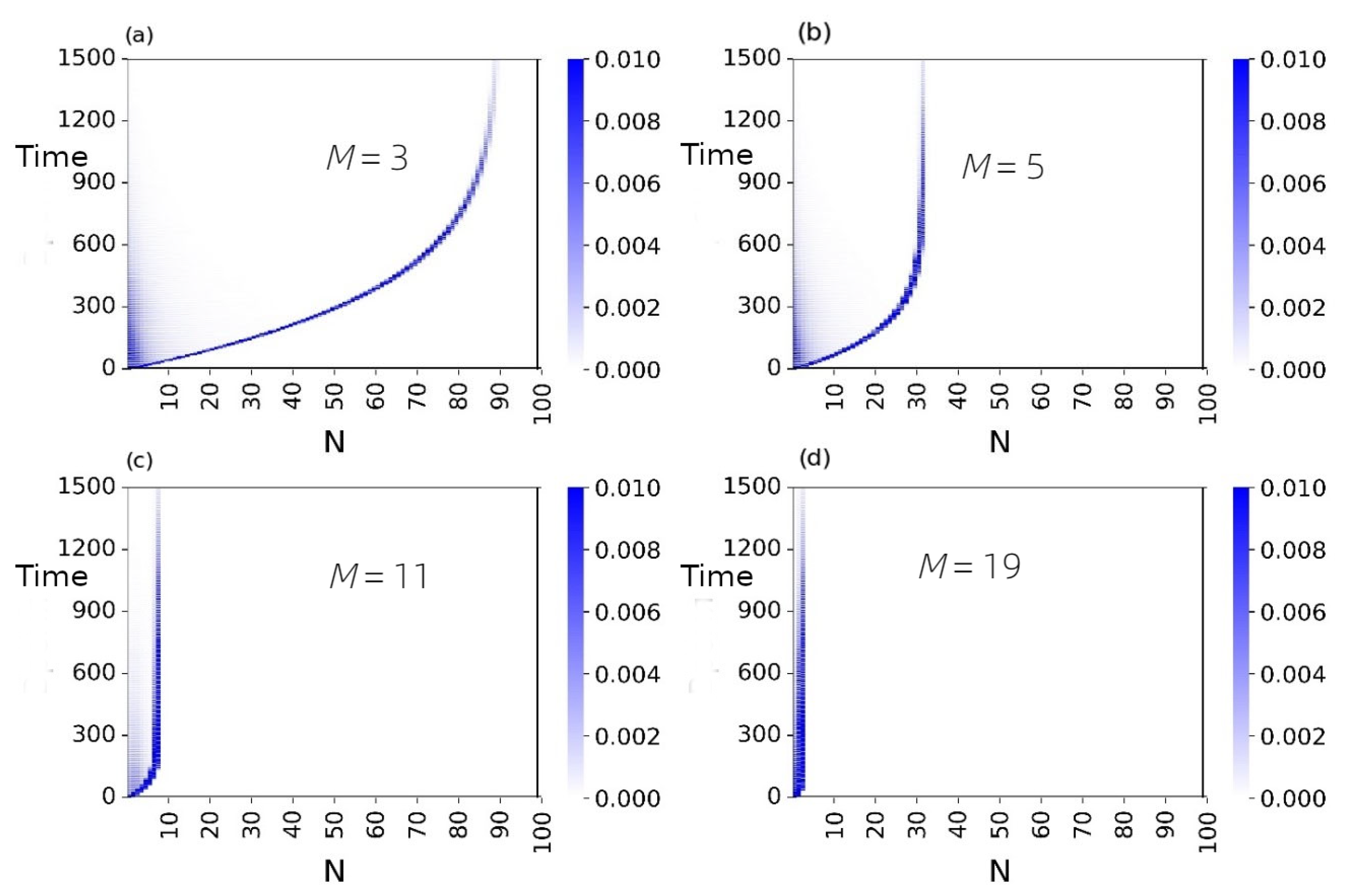
Figure 5 reports energy evolution while the process of propagation of breathers along the chain occurs. We study four chains consisting of
N = 100 oscillators with the same parameters: initial excitation amplitude
A = 0.97 and dissipation coefficient
λ = 0.0035, but with different values of the power of the nearest-neighbor interaction force nonlinearity
M = 3, 5, 11, and 19, respectively. Initially, the displacement amplitude is near to zero, then it reaches its greatest value,
Amax, and then it starts to decline. The maximum breather amplitude is an order of magnitude smaller than the initial excitation value, indicating that the breather propagation is severely hindered. Similar findings about breather propagation in nonlinear chains were documented in previous works for linear oscillators with cubic nonlinearity [
36] and for Hertzian-type interparticle interaction [
35]. It is seen that part of the energy is irradiated into the oscillatory tail; however, consideration of its role is not the subject of the present study.
Figure 5 shows the spatio-temporal diagrams of energy in the chain corresponding to the breather propagation for the described systems; the color on the diagrams indicates the energy level of each element at a given time. The diagrams show that the breather does not penetrate deep into the chain but stops. Moreover, the higher the power of nonlinearity, the faster the breather arrest appearance and the shallower the depth of penetration of the wave into the chain.
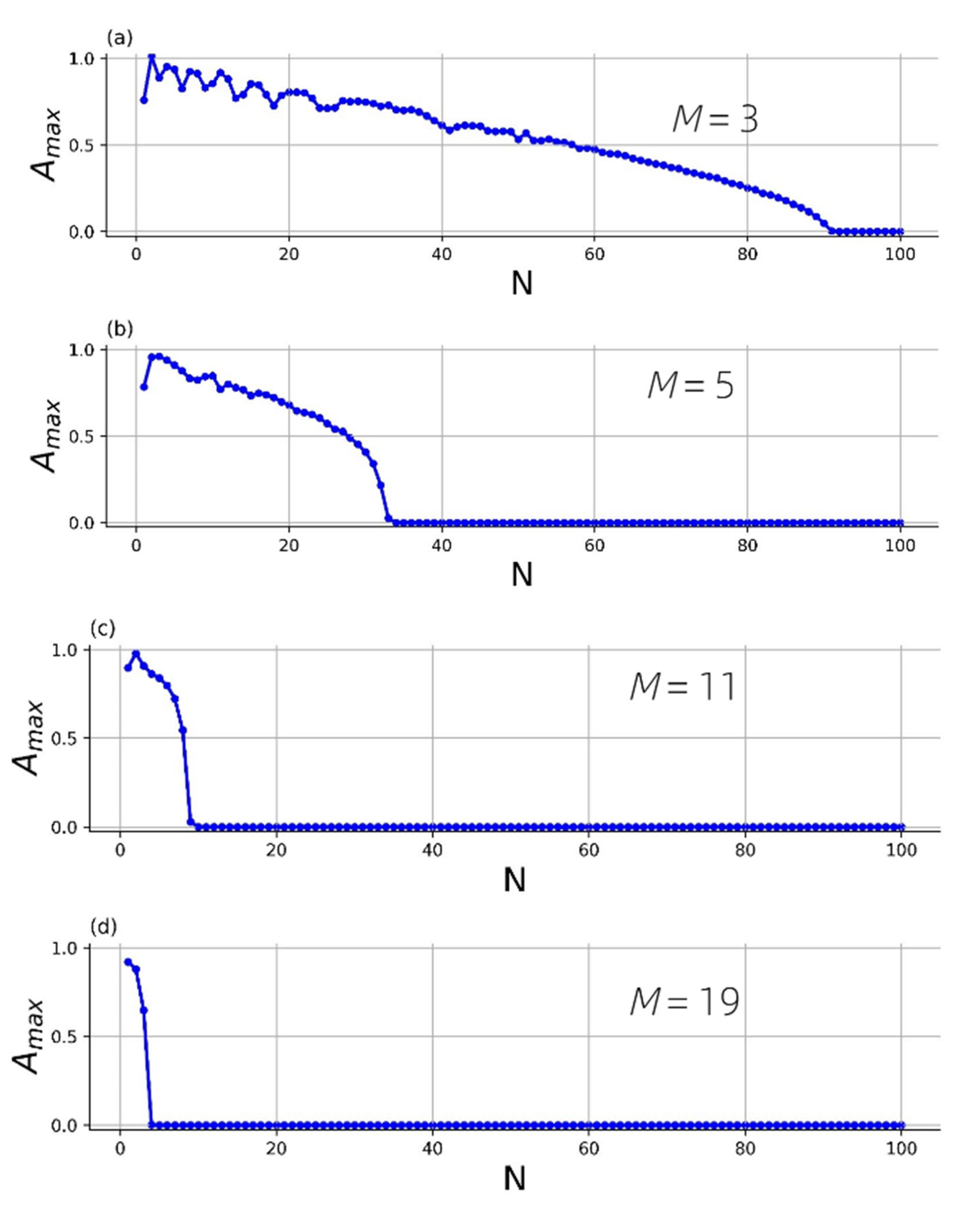
The traveling breather’s maximum amplitude
Amax decays as it moves along the chain, as seen in
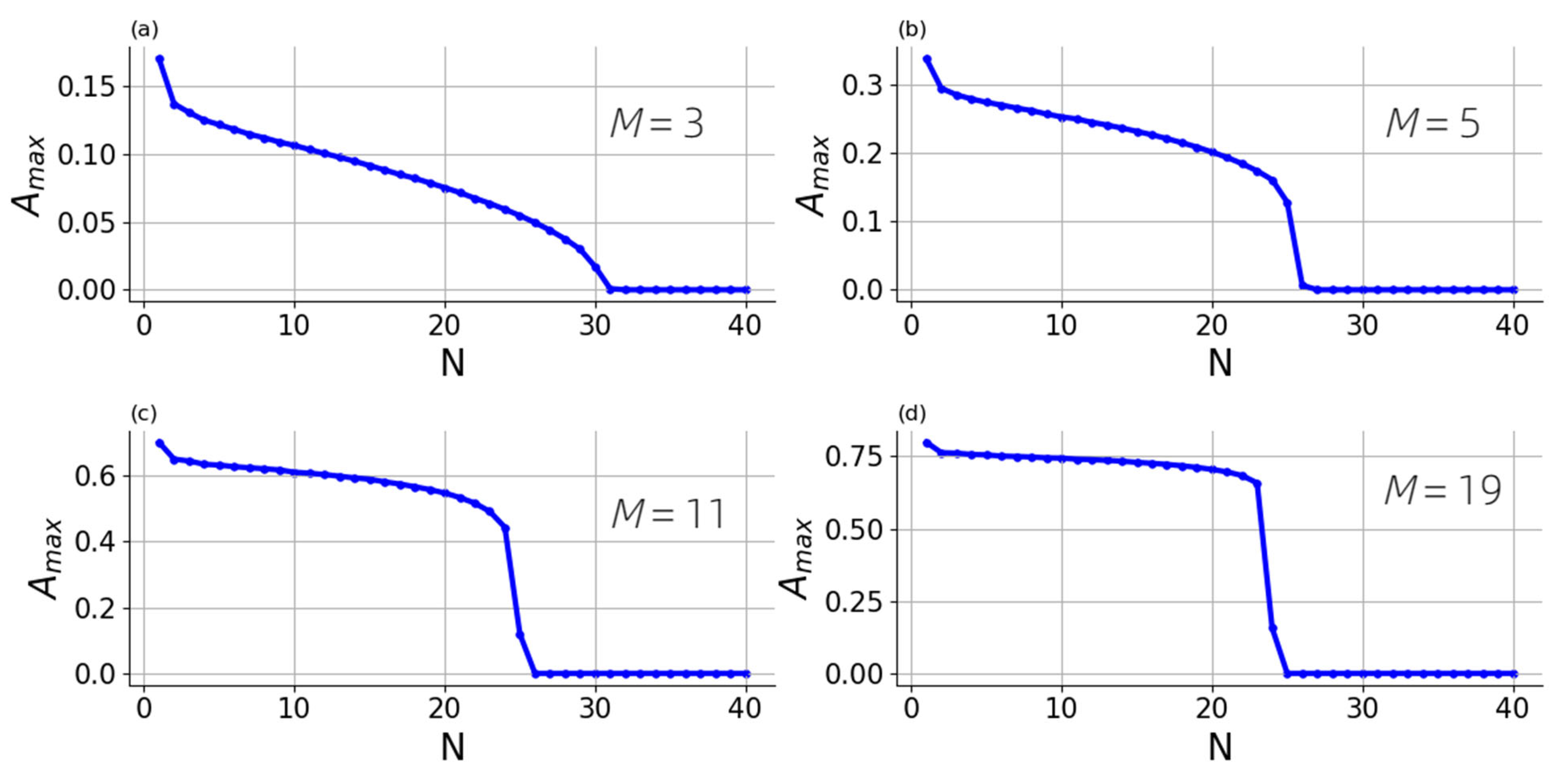
Figure 6. At a particular penetration depth, the abrupt change from steady decay to nearly zero amplitude is readily visible. The breather arrest phenomenon is demonstrated in this simulation. Typically for any crossover effect, it is difficult to pinpoint the exact value of the arrest site. To provide some initial estimate criteria, we define the breather arrest as occurring when the maximum amplitude
Amax drops below a specified threshold, which we designate as
Aarrest =
A/1000. We report from numerical simulations that breathers are only initiated when the initial excitation is relatively small; specifically, A should not be greater than unity. Furthermore, simulations indicate that the outcomes remain largely unchanged if the breather arrest threshold is modified by a factor of ten. Subsequently, we will explore a more precise method for numerically identifying the breather arrest, utilizing an asymptotic approximation for the amplitude decay of the breather.
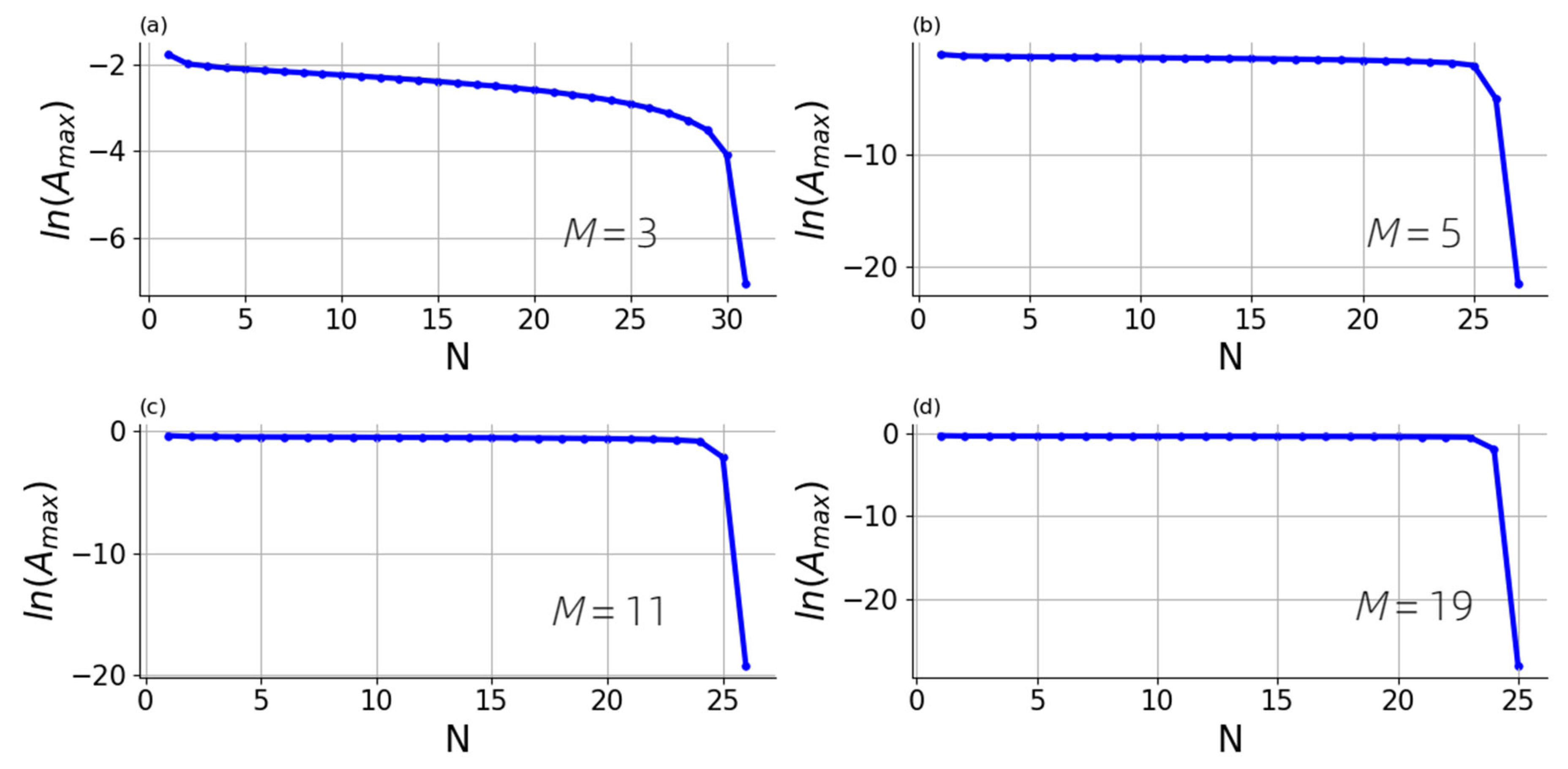
To illustrate the features of the breather evolution with different nonlinear potentials, we consider the propagation of breathers in a chain of 40 oscillators for different values of the power of nonlinearity
M = 3, 5, 11, and 19, but under different conditions. We choose such initial amplitudes and dissipation parameter values so that the breather arrest appears at approximately the same penetration depth. The figures obtained (see
Figure 7) show that the maximum amplitude of oscillators for higher powers of nonlinearity changes more sharply. Now let us represent the same figures on a logarithmic scale along the ordinate axis (see
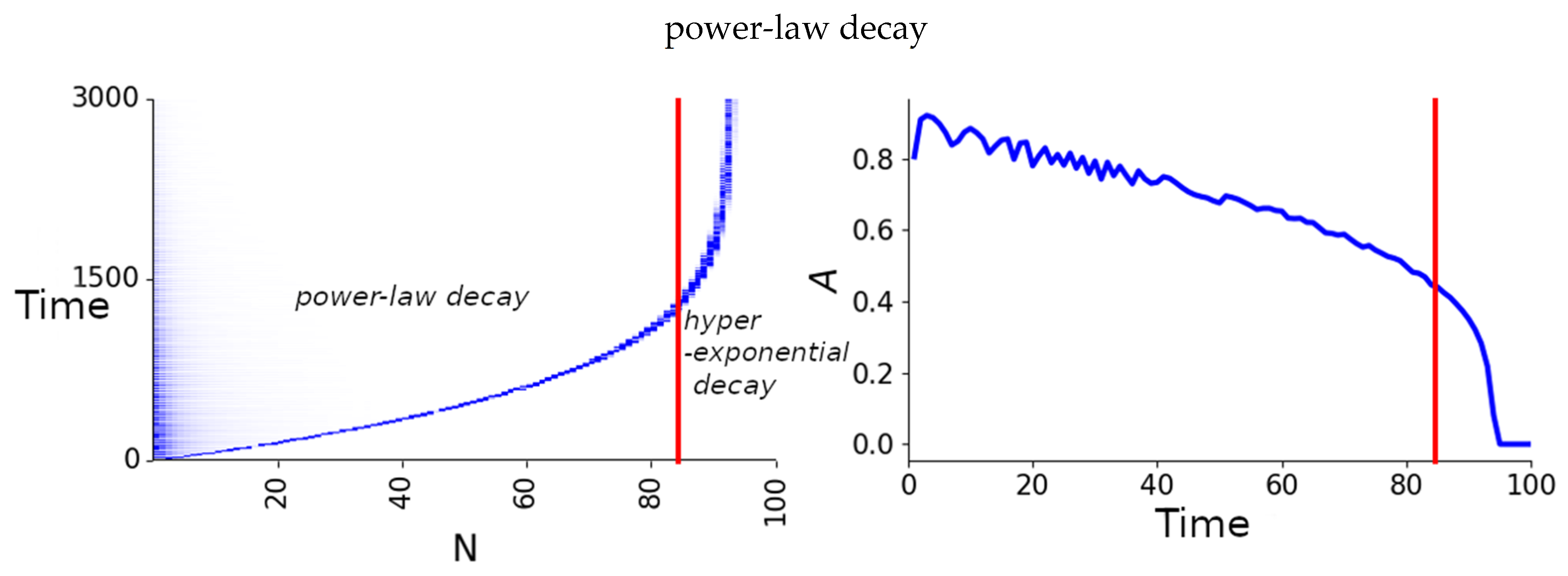
Figure 8). In the pictures, two main stages in the propagation of the breather are clearly visible; the first stage demonstrates power-law amplitude decrease, and the second corresponds to hyper-exponential decay. On a logarithmic scale, the first stage looks almost linear, and as the degree of nonlinearity of the system increases, the lines are closer to the abscissa axis, as damping occurs more sharply.
Let us illustrate a correspondence between the space–time diagram and the dependence of the maximal amplitude of the oscillator on its number, presented in
Figure 9. The evolution to the left of the red line corresponds to power-law decay; the propagation of the breather energy on the space–time diagram is almost linear. The second stage is attenuation; it is depicted in the picture to the right of the red line, and then the breather is arrested.
4. Reduced System
In order to describe the phenomenon of breather arrest from a theoretical point of view and explain numerical results, we will consider a simplified model that simulates the propagation of a breather in a chain with a strongly nonlinear coupling. In a rough approximation, it can be assumed that the propagation of a breather can be understood as a sequence of energy transfers between particles. Moreover, due to the strong localization, it can be assumed that only two neighboring particles participate in each energy transfer act. Such simplification seems to be appropriate due to the extreme localization of the breather in the chain.
Such a reduction of the system was already used by M. Strozzi and O. Gendelman [
25] in their study of the breathers in a granular chain with Hertzian interaction. They demonstrated that the chain of beads with Hertzian and cubic nonlinear asymmetric potentials of particle interactions may be effectively approximated using the sequence of interactions of consecutive pairs of particles. Because the breathers in the chain are highly localized, we also employ the same approximation. As a result, in a rough approximation, it is conceivable to assume that the breather propagation can be interpreted as a series of energy transfers between neighboring particle pairs while ignoring the impact of other particles on each of these transfers. Therefore, in a simpler model with only two oscillators, a back-and-forth energy transfer can be considered to characterize the breather propagation prior to the arrest.
In
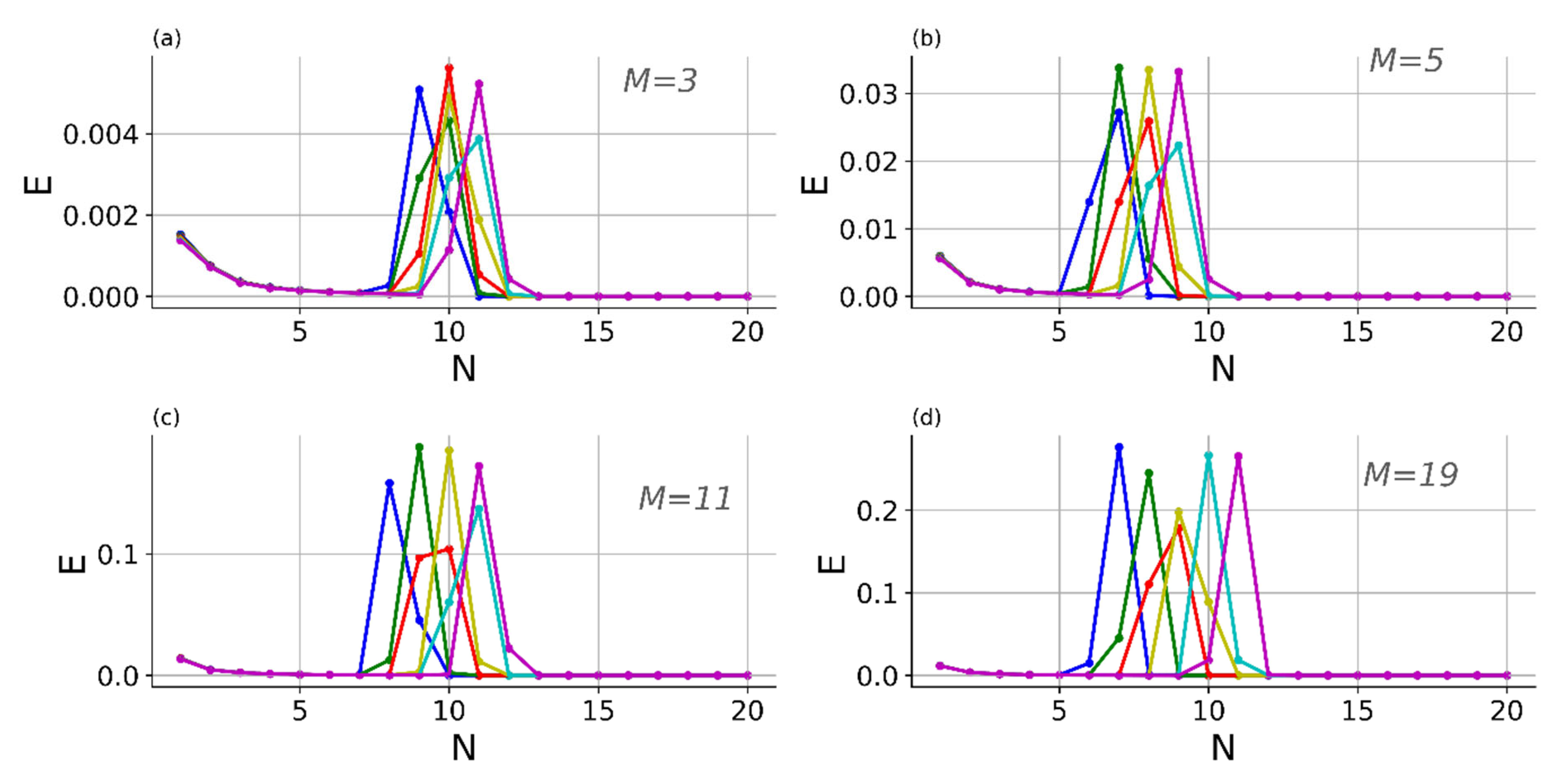
Figure 10, we consider the energy profiles of the system for different values of the power of nonlinearity
M = 3, 5, 11, and 19 for the set of parameters and initial conditions corresponding to
Figure 8. It is evident that the most of the energy is localized on the three or two sites of the chain when the rest of the chain is barely excited. The localization is increased with the growth of the nonlinearity power
M. We will approximately consider the process of the energy transfer along the chain like a process of the subsequent excitation of the unexcited element by the excited one, while the rest of the chain does not take part in the interaction.
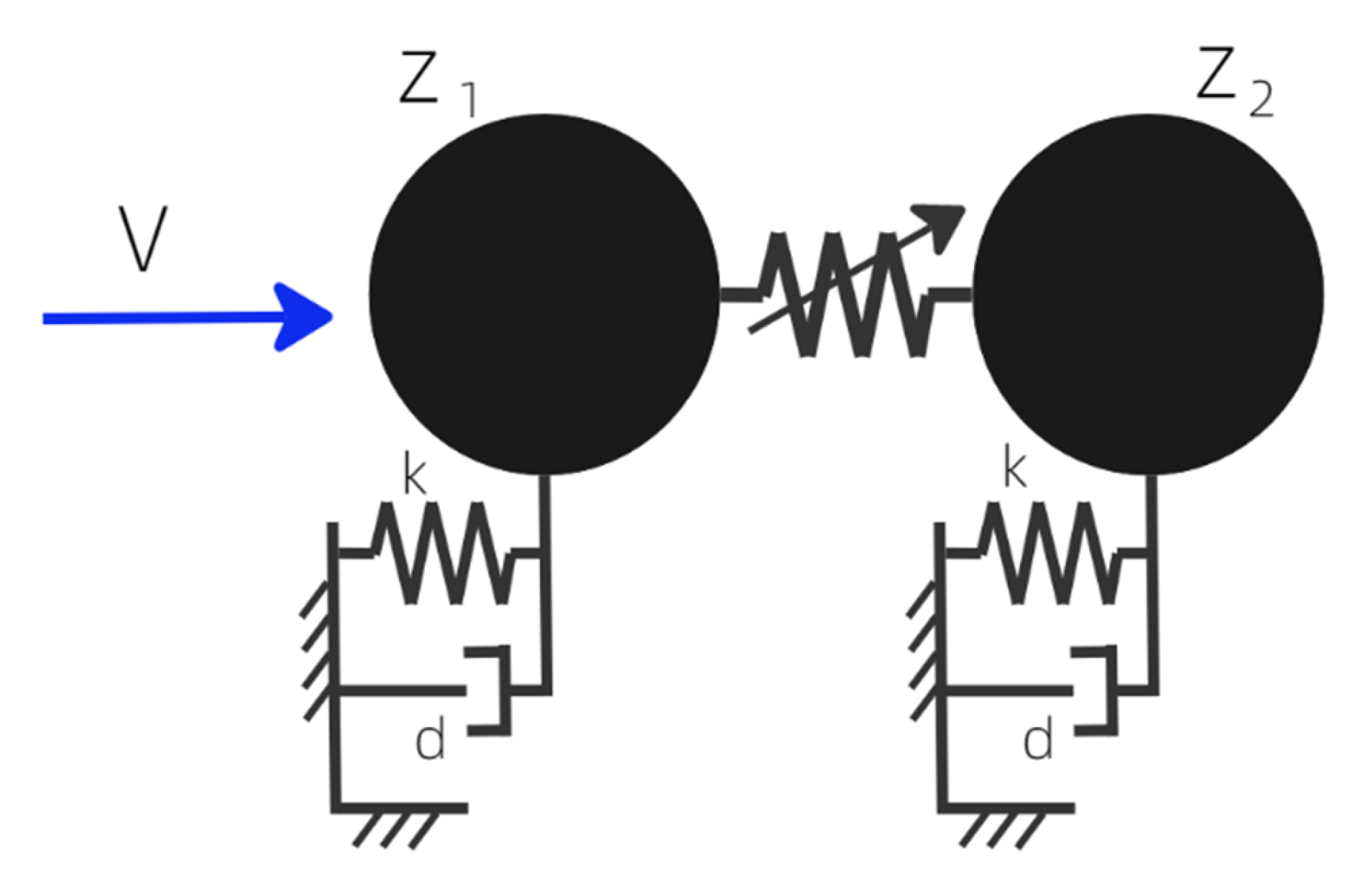
The reduced system is presented in
Figure 11. It consists of two particles of the same type as in the full model. The interaction between the two oscillators is essentially nonlinear. We study the effect of the nonlinearity power on the energy transfer from one particle to another.
One of the particles is excited with an initial velocity
V, and then the beats appear between the oscillators. Thus, each run-out is associated with the propagation of the breather on one particle. We will demonstrate that the number of such beats will be finite due to the strong nonlinearity of the coupling. The equations of motion for the simplified 2DOF model are written as follows:
Let us proceed to modal variables:
where
is the center of mass of the system, and is
the internal displacement of the system. In modal coordinates, the equations of motion and the initial conditions take the following form:
We consider the case of sufficiently weak damping to describe several interactions between the neighboring elements. The main steps of the analysis are analogous to those presented in [
35] for the Hertzian type of interaction. However, for clarity of presentation, we reproduce them below. In the main approximation up to order
O(
λ), the solution for the center of mass
R can be written as follows [
35]:
To obtain an approximate solution for the internal movement of the system
, we first perform a conversion to action-angle variables [
46]:
The dependence between the energy of continuous motion and action is determined by the following well-known relation:
where
E is the energy of continuous motion, and
and
, are the maximum and minimum values of displacement, respectively. The canonical transformation
reduces the equation on
to the form
Assuming a weak dissipation, we can perform averaging of the system (13) to obtain
The following equations can be solved:
Here, J0 is the initial value of the averaged action.
The linear stiffness is contained in the modal Equation (7) for
despite the substantially nonlinear coupling. Furthermore, in system (7), where the frequencies of
and
are almost the same, we deal with the regime of relatively low-amplitude beatings when talking about breather arrest. Consequently, it implies that the quasilinear approximation allows for the treatment of internal displacement. The well-known action-angle transformation for linear oscillators is used to perform this [
35,
46]. We proceed using the following transformations:
From the expressions (14)–(16), setting the initial phase
θ0 equal to 0, the following expression can be obtained for internal displacement in the simplified model:
To evaluate frequency,
one needs to proceed with more accurate analysis. Assuming small amplitudes in Equation (11), it is possible to obtain the following ([
24]; see also
Appendix A):
Here, H.O.T. stands for terms of a higher order,
. Equation (18) is general and is suitable for any nonlinear function, provided that the integral is not zero, and
, which means the low-energy limit. If the integral in Equation (18) turns out to be zero, then these higher-order terms should be analyzed more carefully, as they provide the main effect. However, in the case of a power function, this is not the case:
By substituting (19) into (18) and performing the integration, we obtain the following expression:
where
The expression for the instantaneous frequency is obtained by simply differentiating the following expression (20):
where
By substituting and performing a simple integration, we obtain the following approximate expression for the dependence of internal displacement
on time depending on the parameters of the system:
The expressions for the variables of the initial reduced model (
u1,
u2) can be easily obtained:
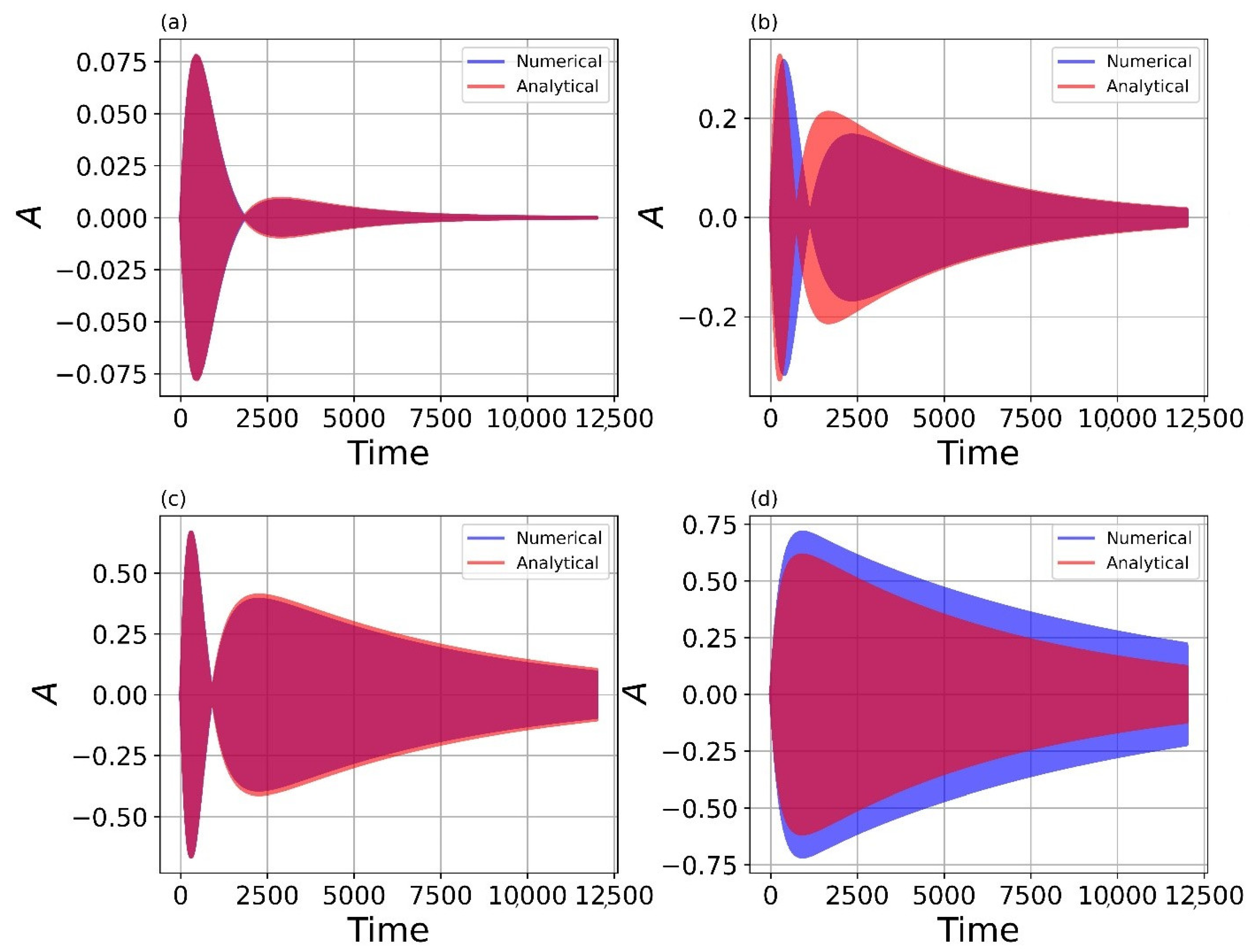
To check the applicability of the solution received, we compare the theoretical and numerical results for different potential types with nonlinearity power values
M = 3, 5, 11, and 19. For this purpose, we present the approximate solutions for the mentioned cases (see
Table 1).
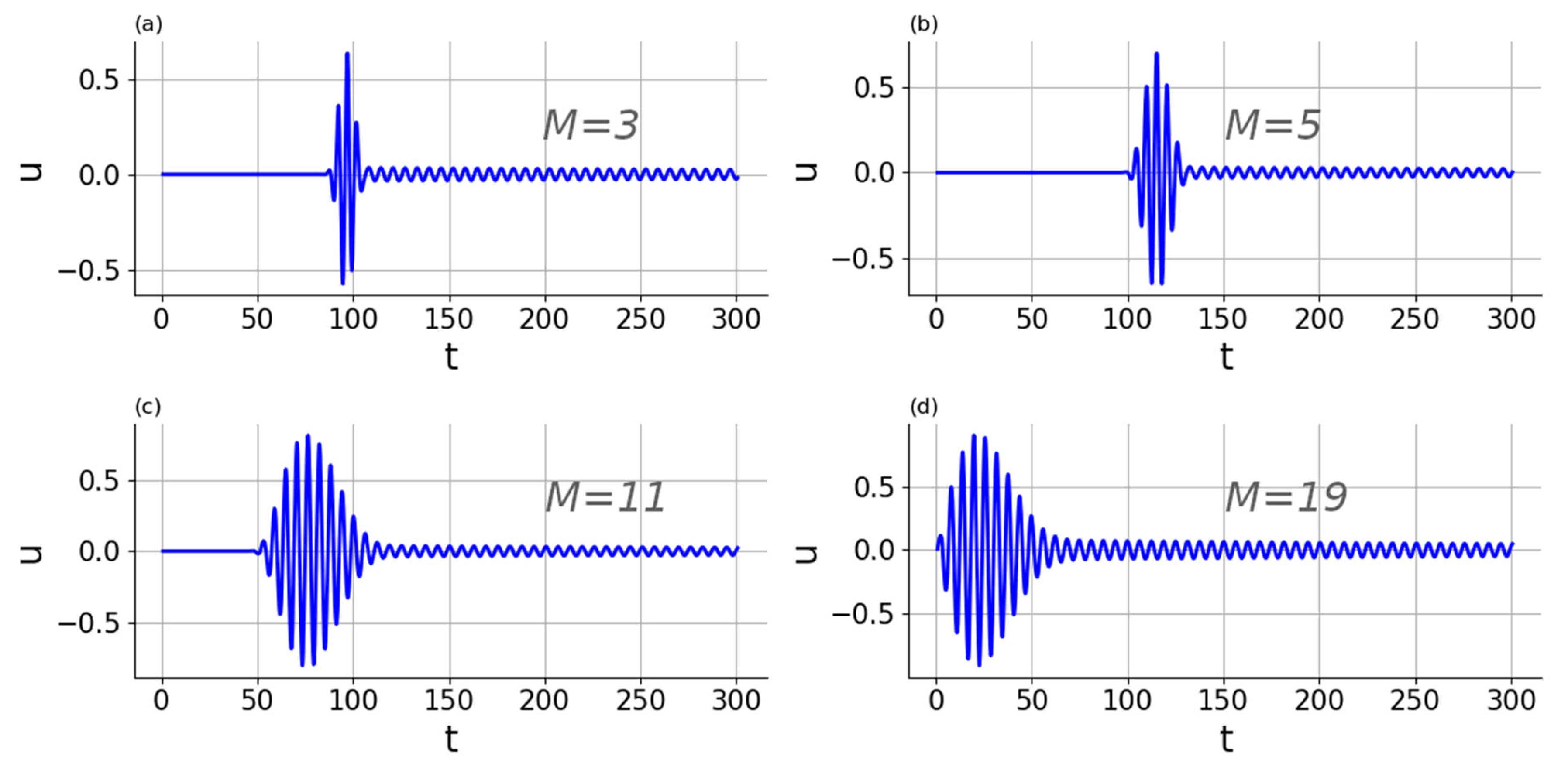
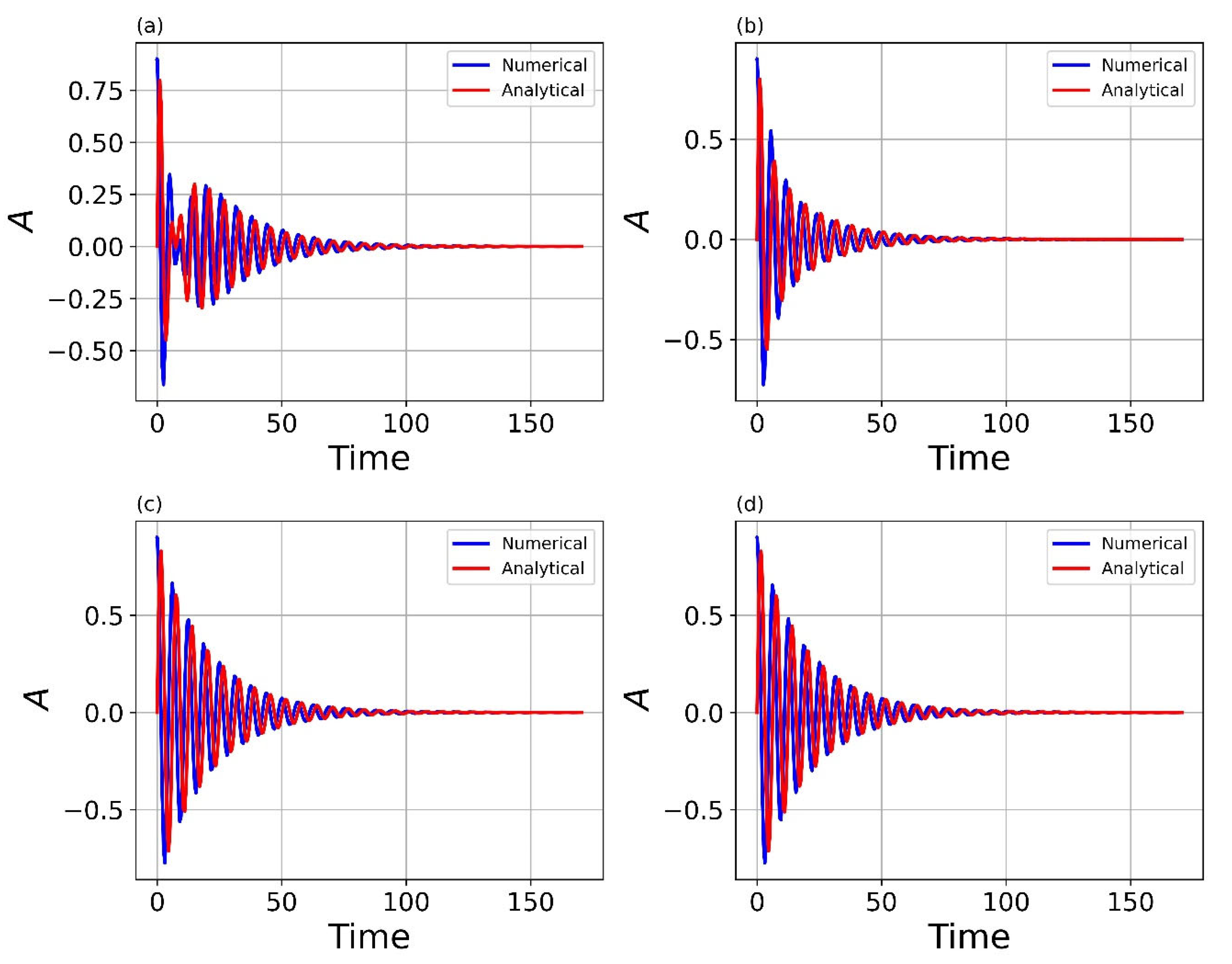
In
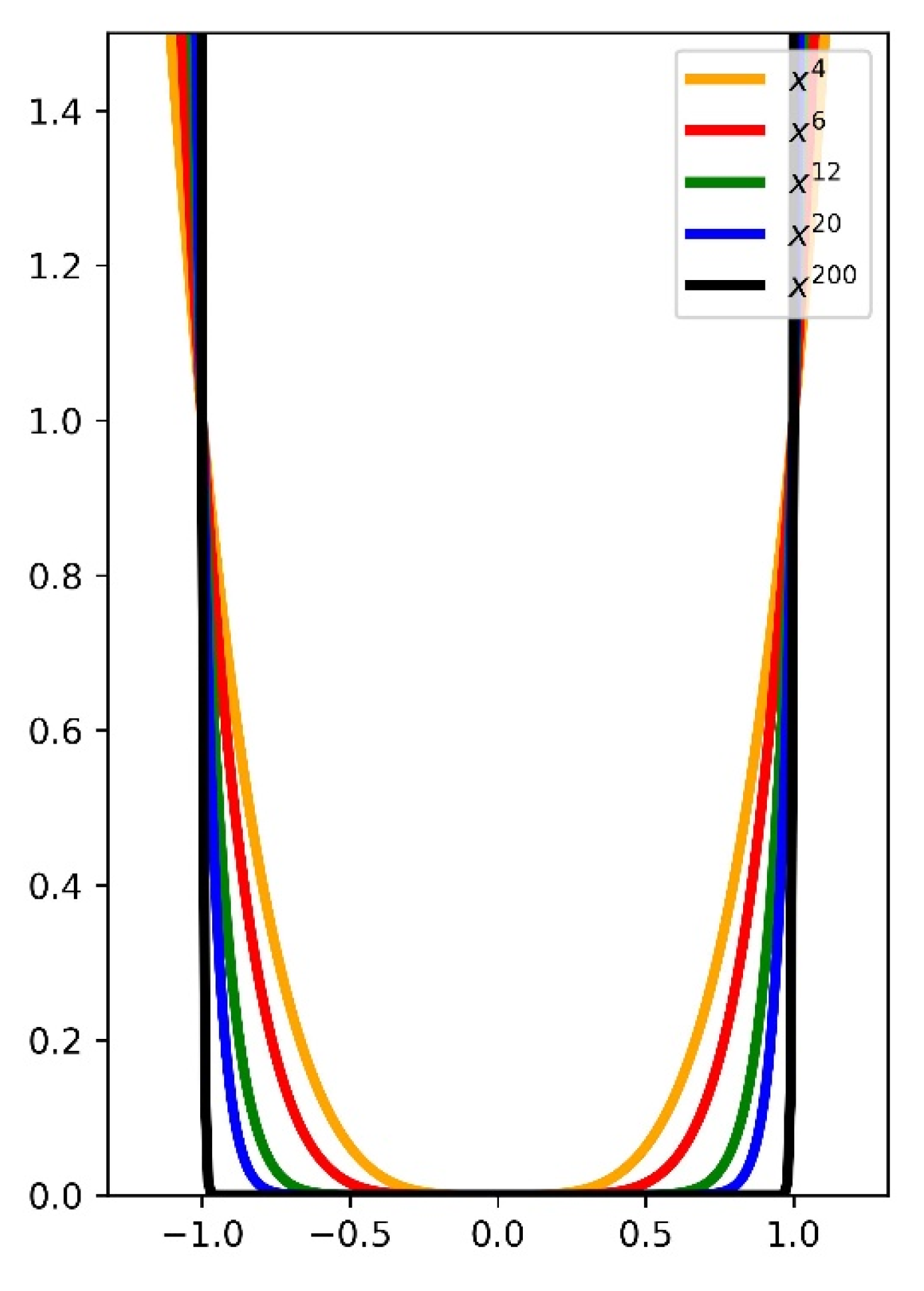
Figure 12, we show the comparison of the numerical solution and the obtained approximate solution for a simplified system. It can be seen that the higher the power of nonlinearity, the more accurate the approximate analytical solution is compared to the numerical one. This is due to the fact that we solved the problem in the approximation of small amplitudes, and, as we found out earlier, the higher the degree of nonlinearity, the faster the initial amplitude decays. The higher the degree of nonlinearity, the lower the potential value for the amplitudes approaching unity (see
Figure 2), so the approximate solution is more accurate.
The response of the 2DOF system has two characteristic timescales, the “fast” oscillations period and the “slow” evolution of the envelopes. The solution for (22) and (23) consists of two terms, the exponentially decaying term and a term with beatings, i.e., periodic energy exchanges between the two oscillators. The number of beatings is finite, as the beating term is also bounded by the exponentially decaying envelope.
The discrepancies between the numerical and analytical results are definitely visible. They can appear due to the roughness of the 2DOF approximation of the system, as the analysis ignores the excitation of the rest of the chain except the two elements in each moment of time. While the localization of the breather in the chain increases for higher powers of nonlinearity, the approximation better fits the numerical results of the full system for low amplitudes. However, to achieve the same penetration depth for different powers of nonlinearity, we have to take higher initial velocity amplitudes, as seen in
Figure 8 and
Figure 9. For the case, the higher amplitude leads to the higher discrepancies between the analytical solution and numerical one. The errors appear due to the low-amplitude limitations of approximation in our analysis.
It is now possible to discuss the optimal starting circumstances for the breather excitation. Based on Equations (21) and (22), the characteristic frequency of the beatings can be estimated as follows:
To obtain a well-formed breather, we have to assume beatings that can be featured as energy exchange in the timescale larger than the typical time of the oscillations. Therefore, the natural frequency ωn of the onsite potential should be significantly higher than the beating frequency ΩB. Consequently, it is possible to infer from (24) that breathers are only anticipated for moderate excitation amplitude values, i.e., if |A| ≤ 1. These results are consistent with the numerical simulation evidence.
The formation of the breather requires several beating cycles to appear. The number of them can be estimated from the final form of the analytical solution (23). The depth of penetration of the breather into the chain before arrest and dependence of the amplitude on the number of the element of the chain can be estimated [
35] as follows:
In [
35], the calculations were provided for the Hertzian type of interaction. However, a more general expression for nonlinear asymmetric potential was also presented. We note that (25) and (26) hold also for different values of nonlinearity power values
M.
The comparison between the analytical estimation of the
Amax(
n) and the numerical results obtained for different values of nonlinearity
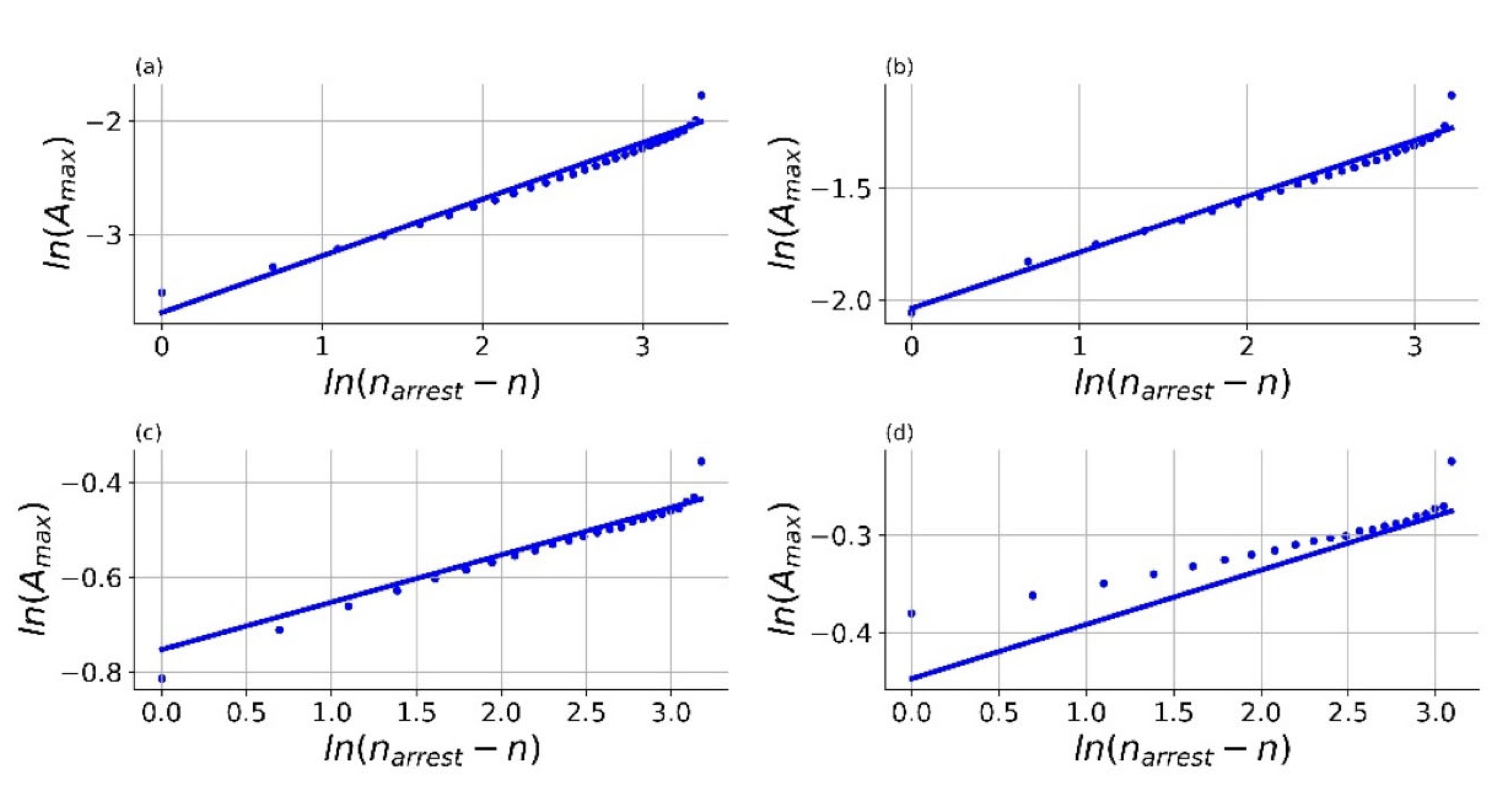
M is presented in
Figure 13 and
Figure 14. The correspondence is very sufficient up to the nonlinearity values
M = 11. However, for value
M = 19 the estimation (26) does not work very well; this is due to the accuracy limitations for higher amplitudes discussed above.
5. Complete System Analytical Solution by Complexification-Averaging Method
There are several works devoted to the problem of the breathers’ propagation in different nonlinear chains. The evolution of the breathers in conservative chains was documented in previous works for linear oscillators with cubic nonlinearity [
36] and for Hertzian-type interparticle interaction [
35]. Unfortunately, the form of the solution for different nonlinearity types was not addressed in the studies mentioned. Below, we discuss the form of the breather solution while the damping is significantly weak and does not much affect the form of the breather.
We consider the equation of the system with nonlinear coupling:
In all numerical experiments, the attenuation coefficient is of the order of
–
, while the initial amplitude is about unity. Such small parameter values allow us to make a rescaling
,
k > 1. Such a consideration makes it possible to take into account the influence of dissipation in equations of higher orders of small parameter. The
Appendix A has a more detailed description of this procedure.
To solve this problem, we will use the CX-A method, and we proceed to new complex variables:
where
.
Let us express the initial variables in terms of new complex variables:
From which it immediately follows that
Let us substitute the systems into the initial equations and obtain
To separate the dynamics into slow and fast timescales, we introduce a small parameter . This small parameter allow the scaling of dependent variables based on their responses and derivatives. Therefore, we also define a fast timescale and a slow timescale .
We represent
as a series with respect to powers of the parameter
:
It is worth noting that the terms of even degrees of
do not appear in the initial terms of the expansion due to the symmetry of nonlinearity. As we have defined a new set of timescales, the usual derivative
τ will also be perturbed as follows:
By substituting Equations (28)–(31) into Equation (2) and assembling the terms in order of
powers, we obtain the following zero-order equations (see
Appendix A for more details):
The solution of equations of first order can be written in the following form:
where
is slowly modulated amplitude, which is the envelope limiting the rapidly modulated oscillating term
, oscillating with a fast frequency
. To identify a term
, we introduce
into equations corresponding to the following order, and average the frequency terms quickly to keep our solution constrained. This step leads to the following equation for changing envelopes on a slow timescale:
where
is defined in the
Appendix A.
Let us write down the equations of slow flow in a simplified form using the relative response of neighboring generators
:
For an infinite chain, the particle number n is rewritten as follows: n = 0, ±1, ±2, … Based on our observations in the previous section, we define an analog for traveling waves as follows:
where
is a dimensionless amplitude of traveling waves,
is slow frequency associated with modulation of a traveling wave of high frequency, and
is a dimensionless wavenumber. By introducing Equation (18) into Equation (17) and performing some algebraic manipulations, we obtain
The approximate corrected nonlinear frequency of the system can be written as a combination of fast and slow frequencies:
Next, we obtain the equation for the function
:
where
T is a time shift between two breathers on adjacent oscillators. By substituting the obtained expression into the equation of slow flow in a simplified form, it is possible to obtain a system of equations for
:
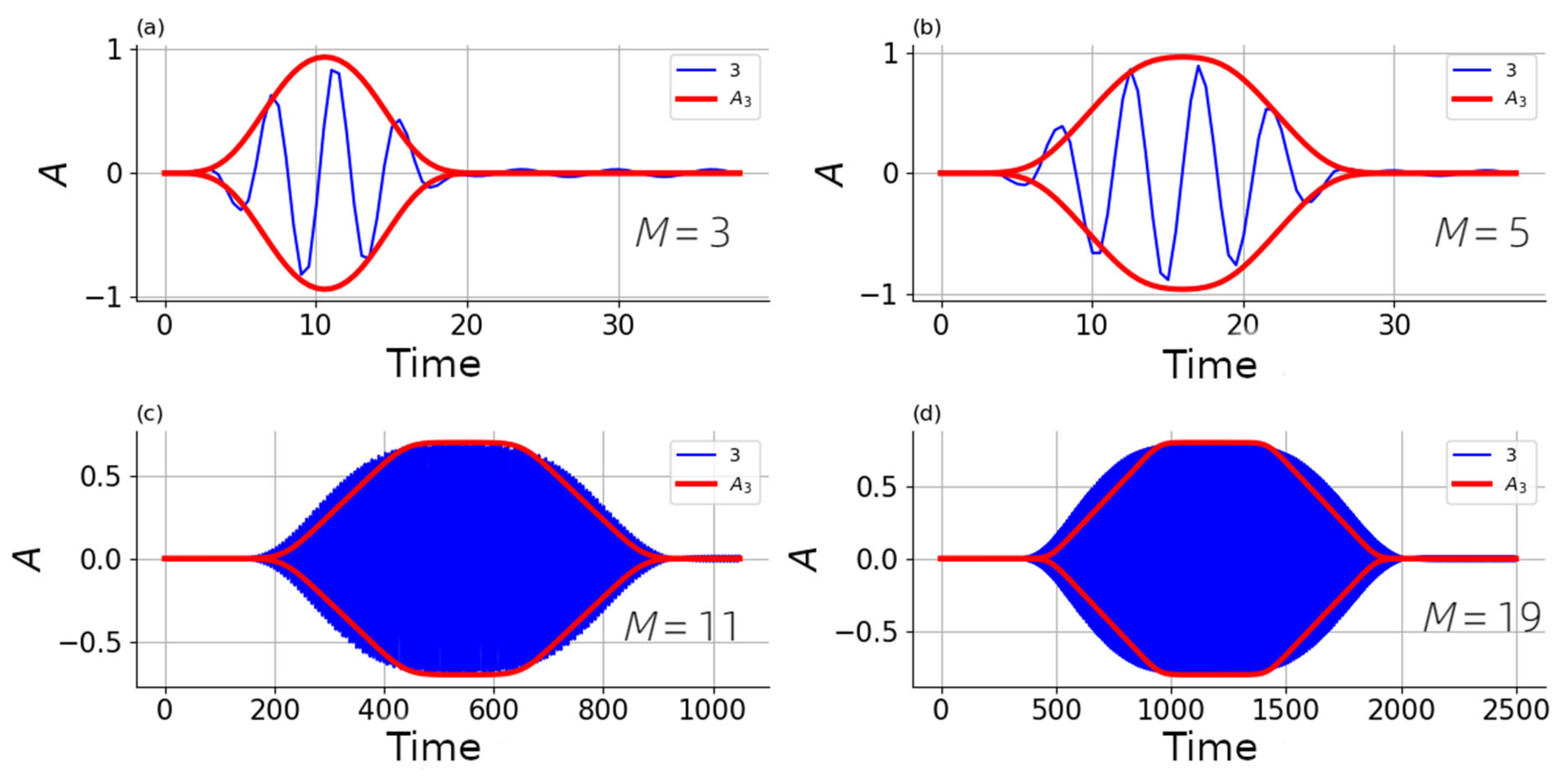
Let us compare the types of envelopes for different powers of nonlinearity (see
Figure 15). For all considered cases, the envelopes have a similar character, we consider the time shift between breathers to be constant, and the results obtained correspond to the expected assumptions. At the same time, for higher powers, the resulting envelopes have a less smooth form.
We can conclude that the main features of the envelope form can be captured by our reduced model (40) (see
Figure 16). However, the numerically realized breather envelopes look smoother. We suggest that this is due to the terms of the higher order which are not captured by our model.