Blasting Damage Control in Jointed Rock Tunnels: A Review with Numerical Validation of Water-Pressure Blasting

 ,
, 

Abstract
1. Introduction
2. Mechanisms of Joint Influence on Blasting Damage in Rock Masses
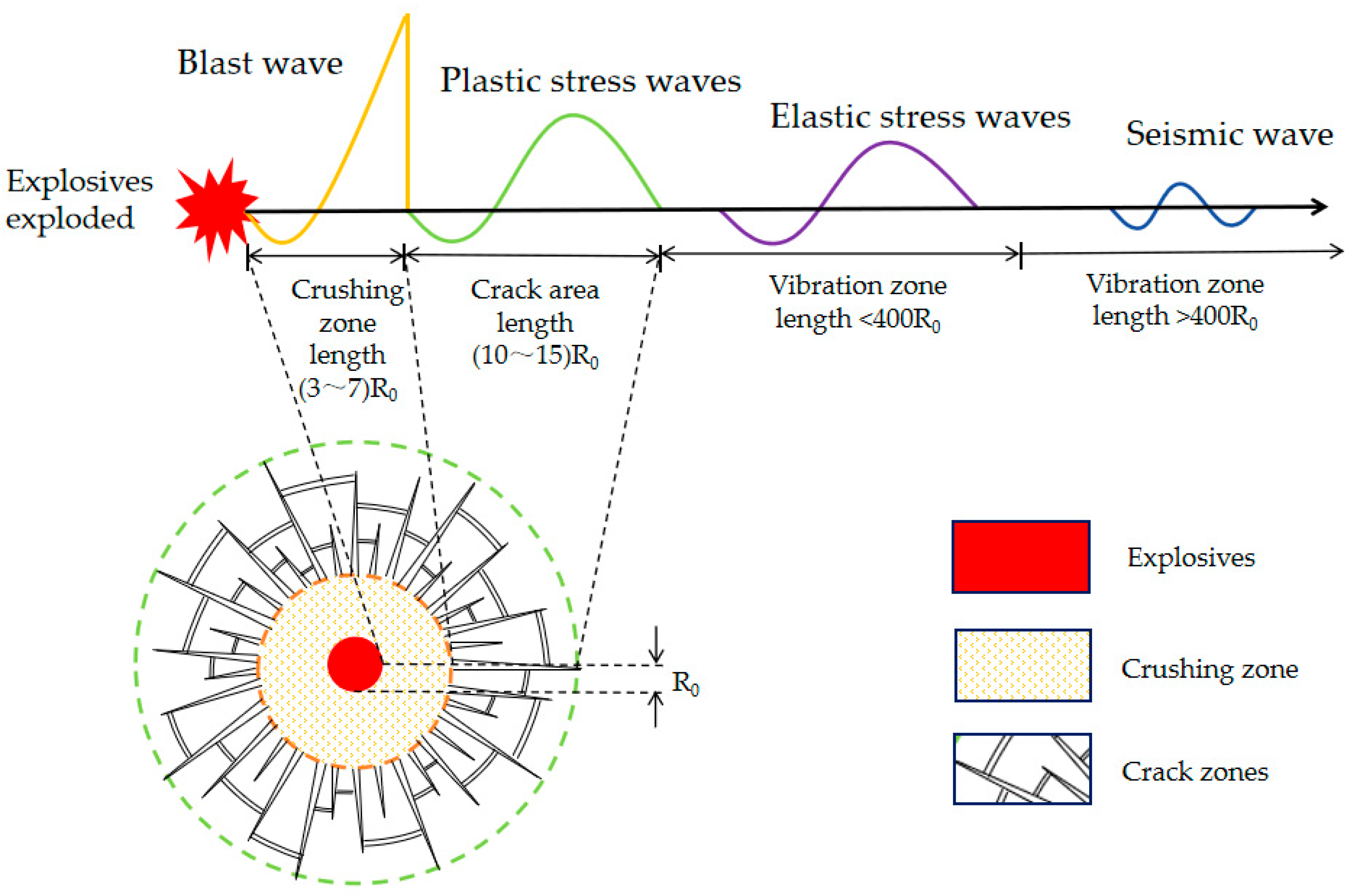
2.1. Basic Mechanisms of Rock Blasting
2.2. Microscopic Regulatory Role of Joints in Rock Blasting
2.3. Quantitative Influence of Joint Parameters on Blasting Dynamic Response
3. Damage Control Techniques for Blasting in Jointed Rock Mass Tunnels
3.1. Blast Parameter Optimization Based on Joint Characteristics
3.1.1. Joint Information Acquisition Technologies
3.1.2. Optimization Method of Blasting Parameters in Joint Rock-Mass Tunnel
3.2. Water Pressure Blasting Technology and Quantitative Verification
3.2.1. Principles of Water Pressure Blasting Technology
3.2.2. Quantitative Verification of Water Pressure Blasting Damage Control Effect
3.2.3. Other Emerging Blasting Control Technologies
3.3. Intelligent Evaluation and Dynamic Control
4. Engineering Applications and Recommendations for Technological Development
4.1. Engineering Application Recommendations Under Different Geological Conditions
4.2. Recommendations for Development of the Technical System
- Intelligent planning and control proposed that deep-learning algorithms be used to enable autonomous optimization of blasting plans. Digital-twin frameworks, by constructing validated virtual models of jointed-tunnel blasting, may be used to forecast outcomes prior to construction and reduce on-site trial costs. An intelligent, data-driven decision system could learn from historical cases and adjust parameters in real time, thereby achieving adaptive control.
- Given the complexity of deep tunnels (dense joint–fracture networks, high in situ stress, elevated pore pressure and temperature), it is recommended that Discrete Fracture Networks (DFNs) be employed to characterize joint complexity. On this basis, multi-field coupling models—incorporating stress, seepage, temperature, and damage fields—should be developed to predict the long-term stability of surrounding rocks and to support life-cycle service assessment.
- Environmentally benign explosives, low-vibration blasting, and dust-reduction strategies are likely to become increasingly important. Particular attention should be given to non-explosive rock-breaking methods, such as CO2 phase-transition fracturing, especially for urban tunnels and environmentally sensitive settings.
5. Conclusions
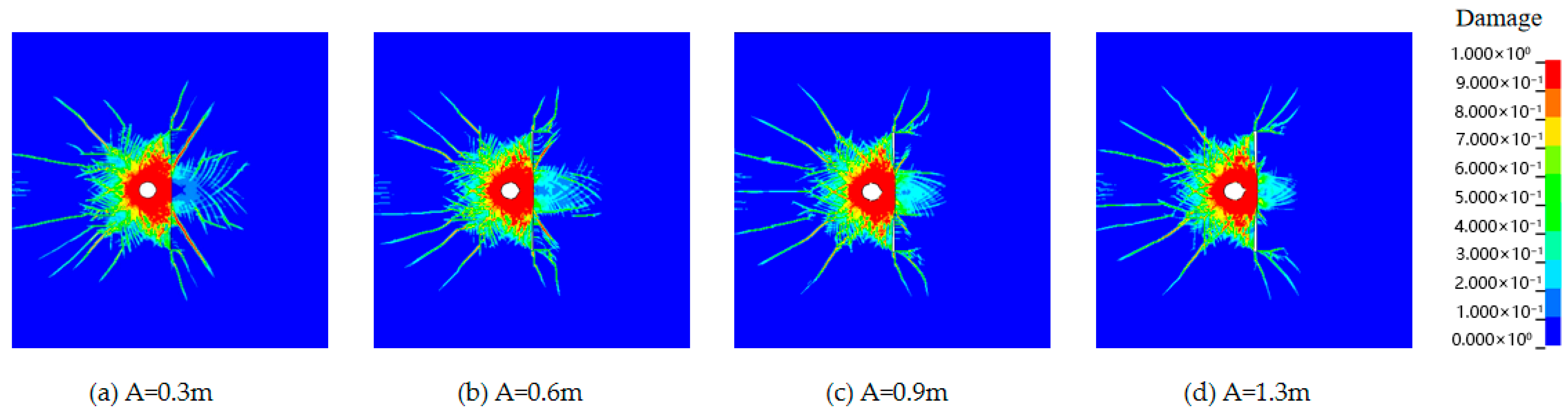
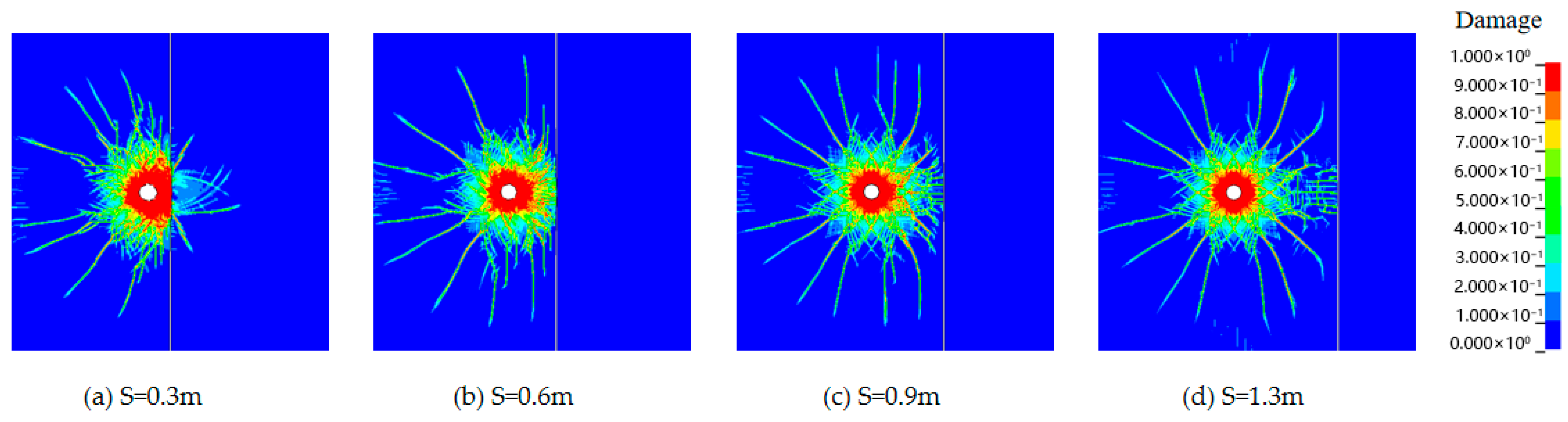
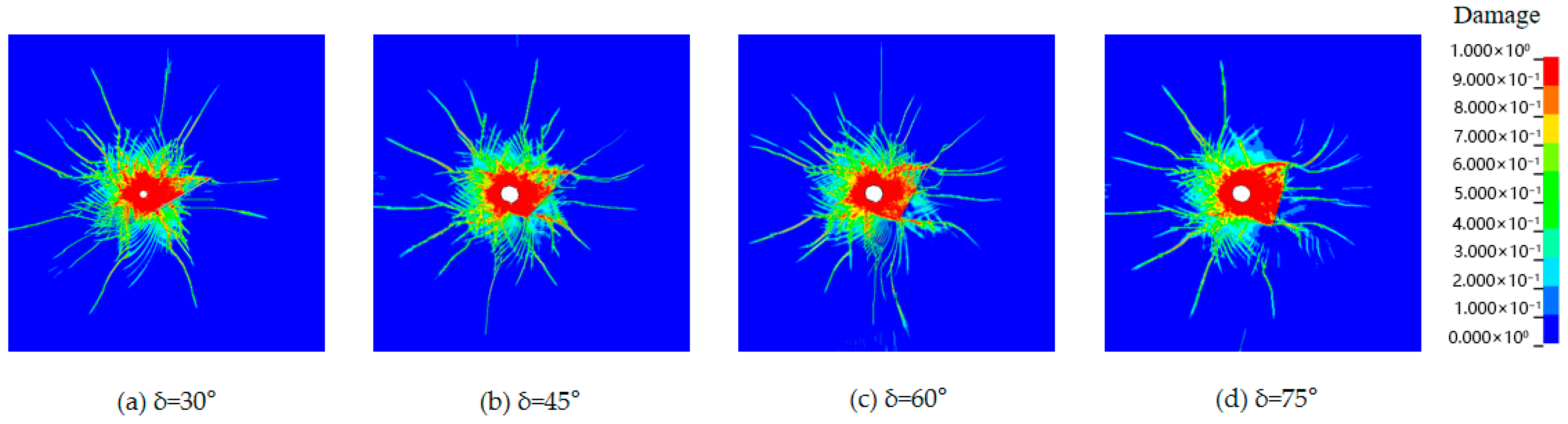
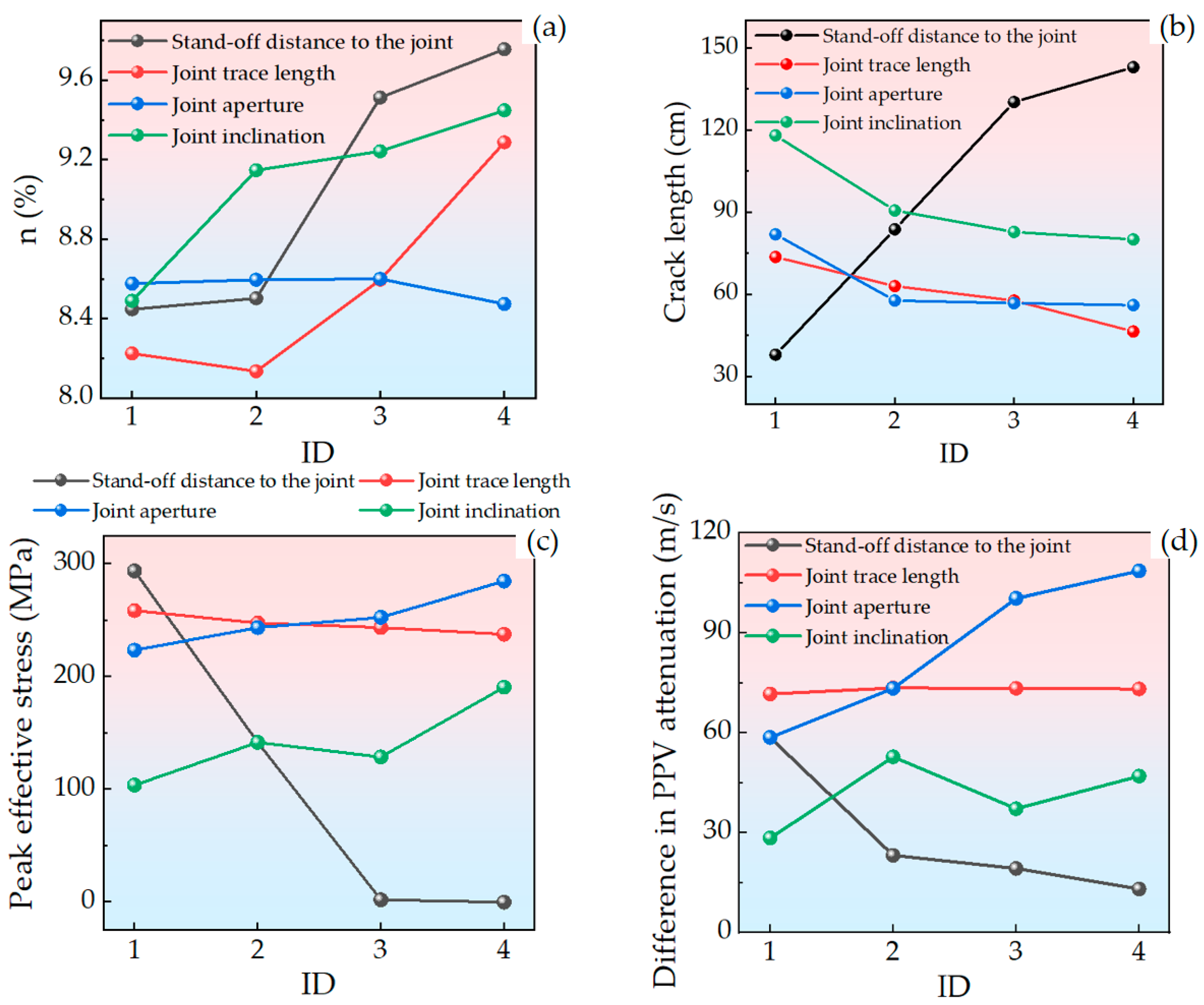
- It is shown that joints regulate blasting damage through coupled, multi-scale mechanisms, for which quantitative relations are established. At the microscale, joints modify stress-wave trajectories, redistribute energy, and guide crack growth. Numerical evidence indicates that increasing the joint-to-borehole distance from 0.3 m to 1.3 m raises the proportion of damaged elements from 8.44% to 9.75%. A joint inclination of 45° is identified as the most adverse, promoting preferential crack propagation along the joint plane and leading to pronounced damage anisotropy. Joint aperture is found to be linearly related to PPV attenuation; each 0.01 m increase in aperture produces a 10–20% increase in the PPV-attenuation difference. Taken together, these results provide a defensible basis for precision blasting design informed by joint characteristics.
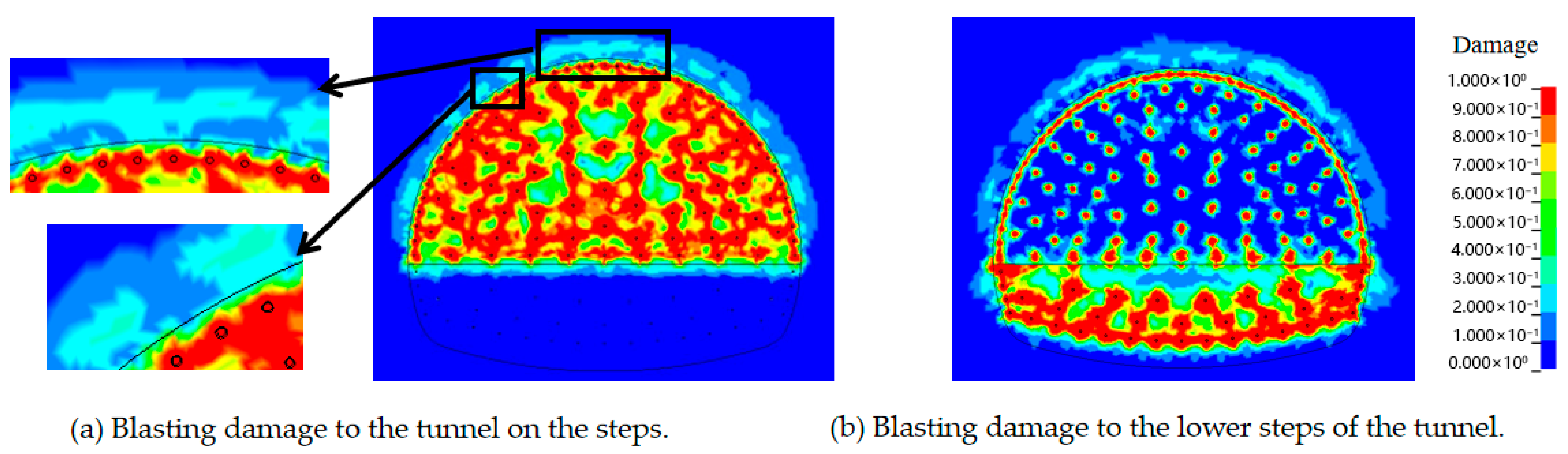
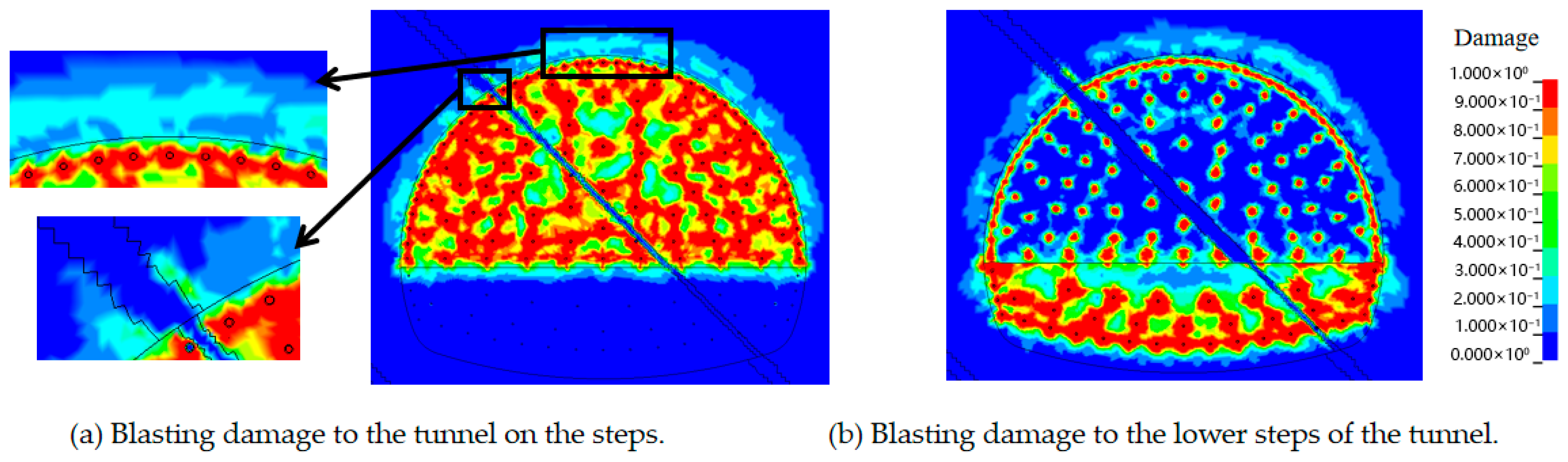
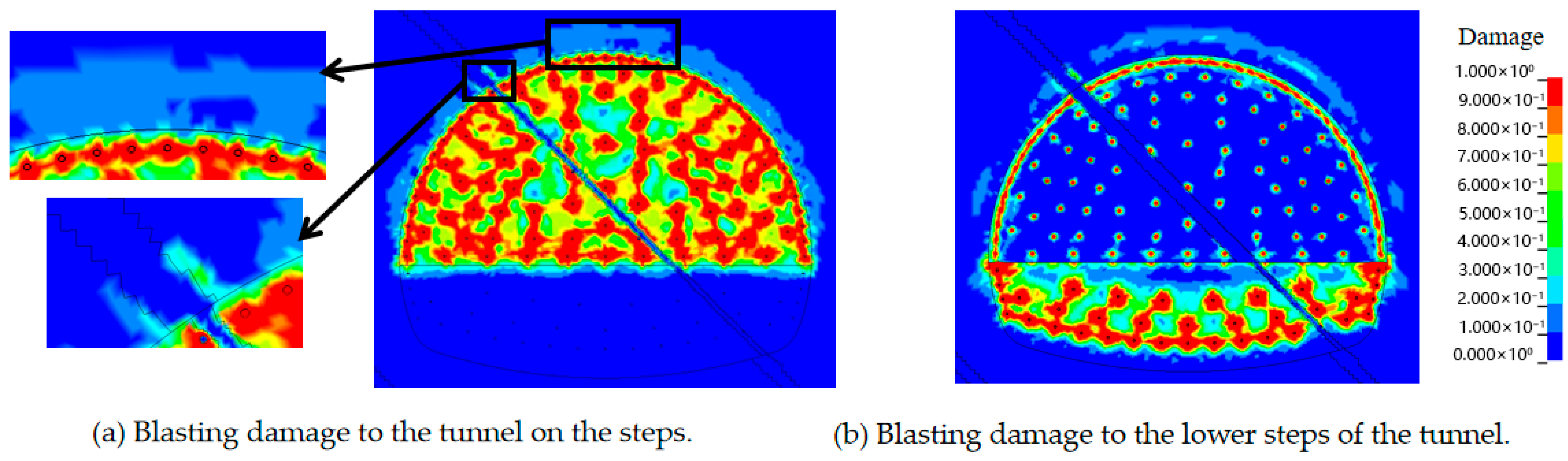
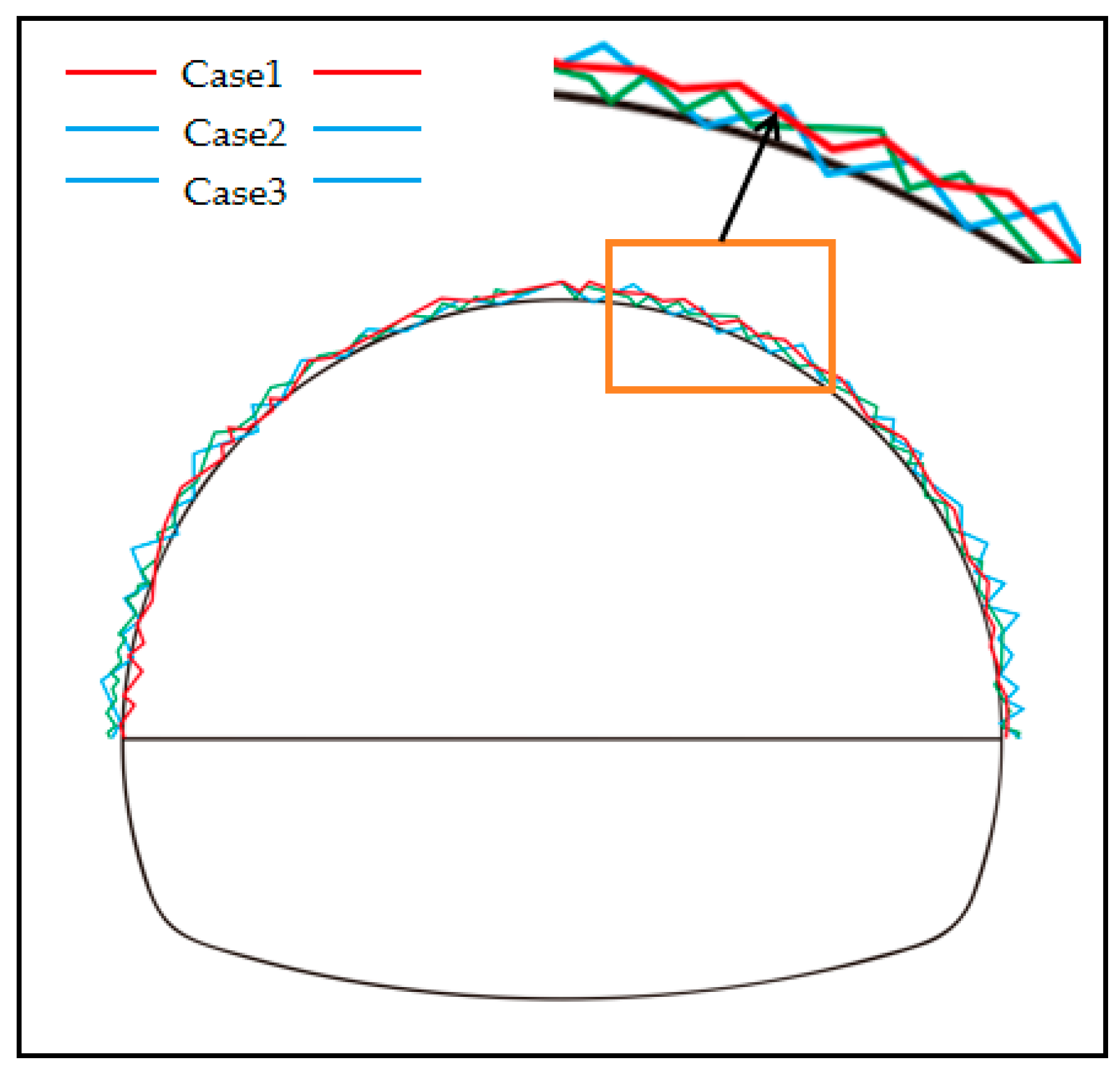
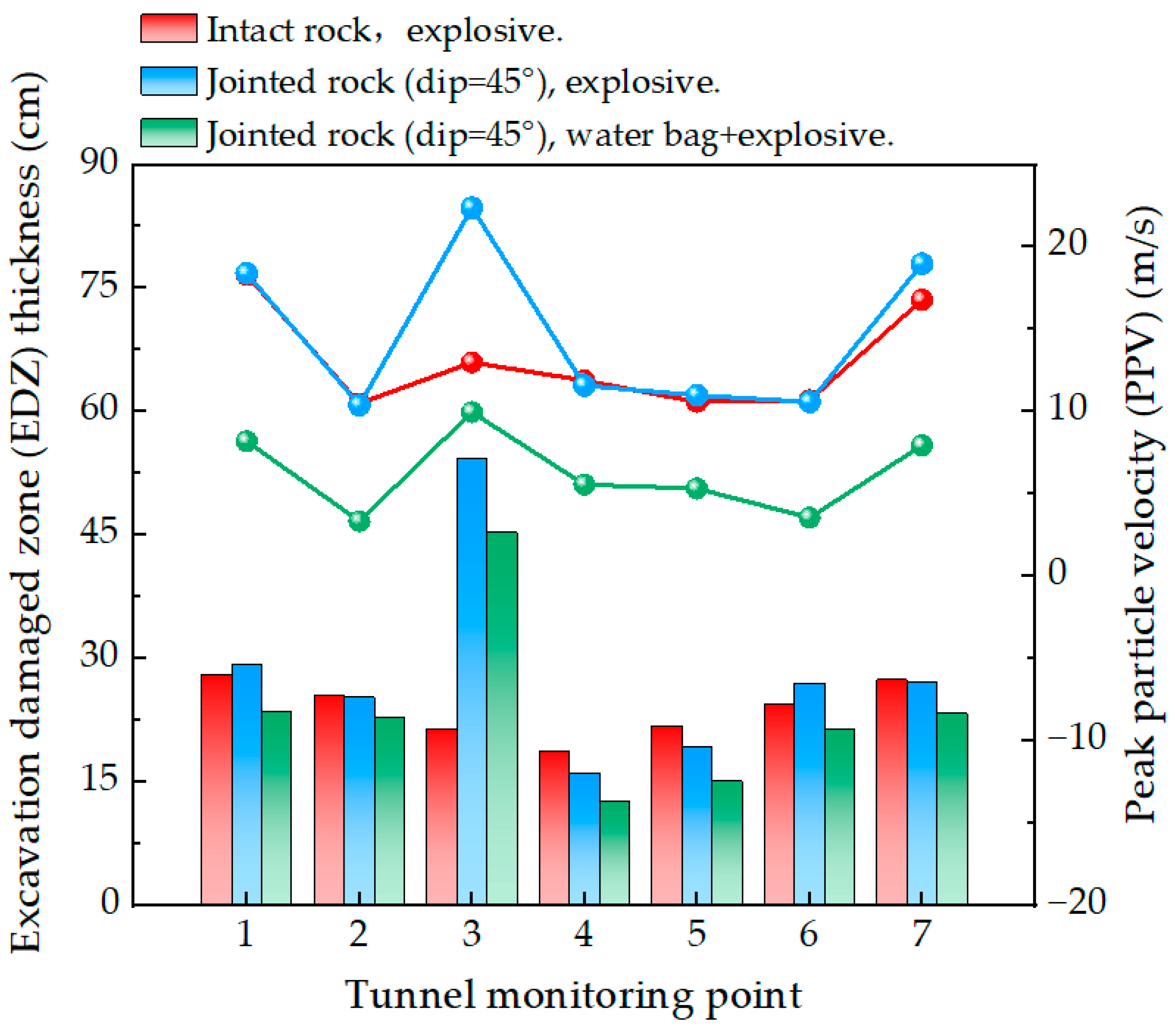
- Using three-dimensional tunnel-blasting simulations, the superiority of water-pressure blasting is quantitatively verified. Relative to conventional practice, damage depth in the jointed surrounding rock is reduced by 20.4%, and peak particle velocity (PPV) decreases by an average of 57.6%; overbreak is contained within 0.18–0.28 m. Mechanistically, the water medium acts as a buffer, transforming an impulsive shock into quasi-static pressure and thereby suppressing unfavorable damage transmission along joints. These findings support water-pressure blasting as an optimal control technique for jointed conditions.
- A technical scheme of “intelligent sensing—parameter optimization—dynamic control” is formulated. Deep-learning-based joint recognition achieves 97.6% accuracy. With the aid of intelligent algorithms and numerical simulation, blasting-parameter optimization is substantially improved in both accuracy and efficiency. The intelligent evaluation module enables rapid, quantitative assessment of key indices (e.g., fragment-size distribution, half-hole ratio). Through iterative updates across blasting cycles, dynamic control enhances contour quality and shifts practice from passively accommodating joints to actively leveraging them.
- Targeted parameter optimization should be implemented under varying geological scenarios. The deep integration of intelligence and automation is expected to enable autonomous plan optimization. Further refined research on multi-field coupling will elucidate damage evolution in deep and complex environments. Green and sustainable technologies—including non-explosive methods such as CO2 phase-transition fracturing—are likely to gain prominence. Collectively, these directions will accelerate a transition from experience-driven to data-driven practice, from rough operation to precision control, and from single-factor tuning to integrated technological application.
Author Contributions
Funding
Institutional Review Board Statement
Informed Consent Statement
Data Availability Statement
Acknowledgments
Conflicts of Interest
References
- Pei, S.; Zhao, J.; Chen, B.; Li, S.; Jiang, Q.; Xu, D.; Wang, Z. Deformation Warning and Microseismicity Assessment of Collapse in Fault Development Area of Yebatan Hydropower Station. J. Cent. South Univ. 2025, 32, 3348–3360. [Google Scholar] [CrossRef]
- Que, X.; Zhu, Z.; Niu, Z.; Zhu, S. Anisotropic Strength and Deformation of Irregular Columnar Jointed Rock Masses under Triaxial Stress. J. Cent. South Univ. 2025, 32, 643–655. [Google Scholar] [CrossRef]
- Cheng, L.; Yang, Z.; Zhao, P.; Li, F. Damage Characteristics of Blasting Surrounding Rock in Mountain Tunnel in Fault Fracture Zones Based on the Johnson–Holmquist-2 Model. Buildings 2024, 14, 3682. [Google Scholar] [CrossRef]
- Sun, Z.; Zhang, D.; Fang, Q. Technologies for Large Cross-Section Subsea Tunnel Construction Using Drilling and Blasting Method. Tunn. Undergr. Space Technol. 2023, 141, 105161. [Google Scholar] [CrossRef]
- Wang, X.; Zhang, X.; Zhang, J.; Zhou, H.; Zhang, P.; Li, D. Study on the Influence of the Joint Angle between Blast Holes on Explosion Crack Propagation and Stress Variation. Processes 2023, 11, 2805. [Google Scholar] [CrossRef]
- Xu, B.; Zhang, W.; Shi, W.; Hao, G.; Liu, X.; Mei, J. Experimental study of parameters of tunneling blasting in jointed layered rock mass. J. China Univ. Min. Technol. 2019, 48, 1248–1255. [Google Scholar] [CrossRef]
- Nath, S.; Singh, A.K.; Verma, H.K.; Chaudhary, S.; Rai, N. Coupled Effect of Joint Orientation and Blast-Induced Damage Zone on the Stability of Jointed Rock Slopes. Nat. Hazards 2025, 121, 7173–7197. [Google Scholar] [CrossRef]
- Xiao, C.; Yang, R.; Li, Q.; Zheng, C.; Kang, Y.; Li, Y. Experiment on Blasting Damage and Dynamic Caustics of Jointed Medium. Eng. Fract. Mech. 2022, 259, 108143. [Google Scholar] [CrossRef]
- Wang, Y.; Chen, Y.; Li, C.; He, Y.; Wang, Q.; Xu, J.; Fan, J.; Dai, M. Model Test Study on the Dynamic Failure Process of Tunnel Surrounding Rocks in Jointed Rock Mass under Explosive Load. Eng. Fail. Anal. 2025, 167, 108996. [Google Scholar] [CrossRef]
- Zhang, P.; Bai, R.; Sun, X.; Wang, T. Investigation of Rock Joint and Fracture Influence on Delayed Blasting Performance. Appl. Sci. 2023, 13, 10275. [Google Scholar] [CrossRef]
- Zhou, W.; Hu, C.; Bao, J.; Zheng, J.; Liang, R. Numerical study on crack propagation and stress wave propagation during blasting of jointed rock mass1. Chin. J. Theor. Appl. Mech. 2022, 54, 2501–2512. [Google Scholar]
- Huang, M.; Fan, Y.; Yang, G.; Leng, Z.; Wang, F. Study on the Stress Wave Propagation and Crack Propagation in Single-Hole Blasting of Fractured Rock Masses. J. China Three Gorges Univ. Sci. 2025, 1–8. [Google Scholar]
- Song, J.-F.; Lu, C.-P.; Zhang, X.-F.; Guo, Y.; Yang, H.-W. Damage Mechanism and Wave Attenuation Induced by Blasting in Jointed Rock. Geofluids 2022, 2022, 1–15. [Google Scholar] [CrossRef]
- Shen, Y.; Lin, B.; Liu, T.; Lin, M.; Liu, T.; Yang, W.; Lin, F.; Xia, G. Research on the Influence of Parallel Joints on the Extension Length and Morphology of Blasting Cracks. Comput. Geotech. 2024, 167, 106088. [Google Scholar] [CrossRef]
- Liang, X.; Ding, C.; Zhu, X.; Zhou, J.; Chen, C.; Guo, X. Visualization Study on Stress Evolution and Crack Propagation of Jointed Rock Mass under Blasting Load. Eng. Fract. Mech. 2024, 296, 109833. [Google Scholar] [CrossRef]
- Zuo, J.; Ma, L. The Explosive Crack Propagation Mechanism of Layered Rock Mass. Shock Vib. 2024, 2024, 5519215. [Google Scholar] [CrossRef]
- Ba, X.; Li, L.; Sun, S.; Liu, H.; Wang, J.; Fang, Z. Development Status of Digital Detection Technology for Unfavorable Geological Structures in Deep Tunnels. KSCE J. Civ. Eng. 2020, 24, 1318–1329. [Google Scholar] [CrossRef]
- Fan, H.; Li, L.; Liu, H.; Shi, S.; Hu, J.; Zhou, S. Advanced Stability Analysis of the Tunnels in Jointed Rock Mass Based on TSP and DEM. KSCE J. Civ. Eng. 2021, 25, 1491–1503. [Google Scholar] [CrossRef]
- Zheng, D.; Liu, S.; Chen, Y.; Gu, B. A Lithology Recognition Network Based on Attention and Feature Brownian Distance Covariance. Appl. Sci. 2024, 14, 1501. [Google Scholar] [CrossRef]
- Li, G.; Tao, T.; Liu, X.; Tian, X.; Xie, C.; Jian, B. Research on Blasting Hole Network Layout Method of Jointed Rock Tunnel under Ground Stress. Blasting 2023, 40, 59–67. [Google Scholar]
- Minh, N.N.; Cao, P.; Liu, Z. Contour Blasting Parameters by Using a Tunnel Blast Design Mode. J. Cent. South Univ. 2021, 28, 100–111. [Google Scholar] [CrossRef]
- Wu, X.; Gong, M.; Wu, Y.; Luo, X.; Wu, H.; Chen, X. Experimental and Numerical Study on the Cumulative-Deck Charging Structure Based on Explosive Sympathetic Detonation in Tunnel Smooth Blasting. Alex. Eng. J. 2025, 116, 561–573. [Google Scholar] [CrossRef]
- He, G. Development of hydraulic blasting technology for tunnel excavation. Eng. Blasting 2021, 27, 53–58. [Google Scholar] [CrossRef]
- Han, F.; Li, J.; Cai, Y.; Wang, Q.; Qiu, J. Application of Energy-Concentrated Hydraulic Blasting Technology in Tunnel Construction in China. Shock Vib. 2022, 2022, 1–17. [Google Scholar] [CrossRef]
- Xu, S.; Wu, B.; Zhang, H.; Qi, S.; Wang, J.; Bian, H. Study on Crack Propagation Mechanism and Charge Structure Optimization of Tunnel Shaped Charge Hydraulic Blasting. Case Stud. Constr. Mater. 2024, 21, e03805. [Google Scholar] [CrossRef]
- Xu, P.; Yang, R.; Zuo, J.; Ding, C.; Chen, C.; Guo, Y.; Fang, S.; Zhang, Y. Research Progress of the Fundamental Theory and Technology of Rock Blasting. Int. J. Miner. Metall. Mater. 2022, 29, 705–716. [Google Scholar] [CrossRef]
- Chen, L.; Zhou, Z.; Gao, S.; Cai, X.; Wang, S.; Nie, S.; Cao, H. Research status and prospects of blasting excavation of tunnel under high stress condition. J. Cent. South Univ. Sci. Technol. 2023, 54, 849–865. [Google Scholar]
- Chi, L.Y.; Zhang, Z.-X.; Aalberg, A.; Yang, J.; Li, C.C. Measurement of Shock Pressure and Shock-Wave Attenuation near a Blast Hole in Rock. Int. J. Impact Eng. 2019, 125, 27–38. [Google Scholar] [CrossRef]
- Yan, S.; Fan, Y.; Leng, Z.; Yang, G.; Zhou, T. Research Advances in Propagation Regularities and Control Technologies of Air Blast Waves Induced by Tunnel Drilling and Blasting. Chin. J. Undergr. Space Eng. 2025, 21, 1837–1850. [Google Scholar] [CrossRef]
- Yang, Y.; Lu, W.; Wang, Y.; Huang, Y.; Wang, G.; Chen, M.; Yan, P. Research on the mechanism of underwater drilling blasting to excite shock waves in water. J. Vib. Shock. 2025, 44, 269–278. [Google Scholar] [CrossRef]
- Ren, M.; Yue, Z.; Zhou, X.; Jin, Q.; Wang, P.; Xu, S. Study on the evolution patterns of detonation gas under different initiation positions in cylindrical charges. J. China Coal Soc. 2025, 50, 3441–3449. [Google Scholar] [CrossRef]
- Yang, R.; Ding, C.; Yang, L.; Lei, Z.; Zhang, Z.; Wang, Y. Visualizing the Blast-Induced Stress Wave and Blasting Gas Action Effects Using Digital Image Correlation. Int. J. Rock Mech. Min. Sci. 2018, 112, 47–54. [Google Scholar] [CrossRef]
- Yari, M.; Ghadyani, D.; Jamali, S. Development of a 3D Numerical Model for Simulating a Blast Wave Propagation System Considering the Position of the Blasting Hole and In-Situ Discontinuities. Rud.-Geol.-Naft. Zb. 2022, 37, 68–78. [Google Scholar] [CrossRef]
- Dai, J.; Yang, J.; Yao, C.; Hu, Y.; Zhang, X.; Jiang, Q.; Zhou, C. Study on the Mechanism of Displacement Mutation for Jointed Rock Slopes during Blasting Excavation. Int. J. Rock Mech. Min. Sci. 2022, 150, 105032. [Google Scholar] [CrossRef]
- Du, J.; Huang, X.; Bao, H.; Kang, W.; Zhang, Y. Distinct Element Modelling of Stress Wave Propagation in Rock Masses Considering Asymmetrical Loading/Unloading Behavior of Filled Fracture: Unique Compression-Hardening and Memory Effect. Comput. Geotech. 2025, 186, 107394. [Google Scholar] [CrossRef]
- Himanshu, V.K.; Mishra, A.K.; Roy, M.P.; Shankar, R.; Priyadarshi, V.; Vishwakarma, A.K. Influence of Joint Orientation and Spacing on Induced Rock Mass Damage Due to Blasting in Limestone Mines. Min. Metall. Explor. 2023, 40, 2349–2359. [Google Scholar] [CrossRef]
- Zhang, Y.; Xu, M.; Liu, S.; Liu, F.; Wang, Q. Rate-Dependent Constitutive Modelling Blasting Crack Initiation and Propagation in Rock Masses. Int. J. Coal Sci. Technol. 2023, 10, 83. [Google Scholar] [CrossRef]
- Fei, H.; Shan, J.; Bao, S.; Jiang, A. Numerical simulation study of joint geometric characteristics for explosion crack propagation. Eng. Gblasting 2023, 29, 12–21. [Google Scholar] [CrossRef]
- Li, Q.; Guo, Y.; Xu, W.; Peng, Y.; Lv, C.; Ma, R. Investigation on the dynamic fracture property of oblique open-joints under bunch-hole explosion. J. Vib. Shock 2019, 38, 151–158. [Google Scholar] [CrossRef]
- Shen, Y.; Lin, B.; Lin, M.; Liu, T.; Zhang, X.; Yang, W.; Zhang, C. Experiments and Discrete Element Simulations on the Influence of Symmetrical Forms of Joints on the Propagation of Blasting Cracks. Eng. Fract. Mech. 2025, 320, 111072. [Google Scholar] [CrossRef]
- Chen, S.; Zhu, Z. Numerical Study on Tunnel Damage Subject to Blast Loads in Jointed Rock Masses. Environ. Earth Sci. 2022, 81, 548. [Google Scholar] [CrossRef]
- Xie, L.; Zhang, J.; Yang, D.; Qi, Y.; Wu, L.; Chen, H. Research on Damage Evolution Mechanism of Layered Rock Mass under Blasting Load. Buildings 2024, 14, 3227. [Google Scholar] [CrossRef]
- Xu, P.; Yang, R.; Guo, Y.; Chen, C.; Yang, Y.; Zuo, J. Investigation of the Interaction Mechanism of Two Dynamic Propagating Cracks under Blast Loading. Eng. Fract. Mech. 2022, 259, 108112. [Google Scholar] [CrossRef]
- Wang, Y.; Luo, L.; Wang, Z.; Kong, W.; Yang, R. 3D Damage and Failure Patterns in Rock Due to Blasting at Different Open Joints Dig Angles. Rock Mech. Rock Eng. 2024, 57, 5801–5818. [Google Scholar] [CrossRef]
- Zhai, J.; Wang, Z.; Wang, J.; Feng, C.; Li, S. Numerical Study on Blast Dynamic Response of Jointed Rock Mass under High Geostress Field. Int. J. Geomech. 2025, 25, 04025005. [Google Scholar] [CrossRef]
- Yang, R.; Ding, C.; Yang, L.; Chen, C. Model Experiment on Dynamic Behavior of Jointed Rock Mass under Blasting at High-Stress Conditions. Tunn. Undergr. Space Technol. 2018, 74, 145–152. [Google Scholar] [CrossRef]
- Ma, S.; Jiang, H.; Zhou, C.; Wang, M.; Liu, K. Investigation on cracking behavior and influencing factors of jointed rock masses under the coupling effect of confining pressure and blasting. Explos. Shock Waves 2025, 45, 6–23. [Google Scholar]
- Gao, Q.; Wang, Z.; Ni, Y.; Wang, J. A Study on Blasting Response of Rock Mass Considering In-Situ Stress and Joint Inclination. Simul. Model. Pract. Theory 2025, 143, 103144. [Google Scholar] [CrossRef]
- Li, L.; Chen, J.; Zhao, L.; He, K.; Hu, S.; Li, H. Assessing the Range of Blasting-Induced Cracks in the Surrounding Rock of Deeply Buried Tunnels Based on the Unified Strength Theory. J. Cent. South Univ. 2024, 31, 2341–2364. [Google Scholar] [CrossRef]
- Zhang, K.; Zhang, L.; Liu, F.; Yu, Y.; Wang, S. Quantitative Investigation of Rock Dynamic Failure Using Voronoi-Based Discontinuous Deformation Analysis. Geomech. Geophys. Geo-Energy Geo-Resour. 2024, 10, 49. [Google Scholar] [CrossRef]
- Liu, H.Y.; Lv, S.R.; Zhang, L.M.; Yuan, X.P. A Dynamic Damage Constitutive Model for a Rock Mass with Persistent Joints. Int. J. Rock Mech. Min. Sci. 2015, 75, 132–139. [Google Scholar] [CrossRef]
- Dehghan Banadaki, M.M.; Mohanty, B. Numerical Simulation of Stress Wave Induced Fractures in Rock. Int. J. Impact Eng. 2012, 40–41, 16–25. [Google Scholar] [CrossRef]
- Ye, H.; Wei, W.; Zhou, H.; Yu, M.; Li, X.; Lei, T.; Wen, Y.; Wang, Q.; Shi, B.; Yu, Y.; et al. Refined Numerical Model Construction and Blasting Simulation of Fractured Rock Mass. Blasting 2023, 40, 44–51. [Google Scholar]
- Huo, X.; Jiang, Y.; Wei, W.; Qiu, X.; Yu, Z.; Nong, J.; Li, Q. Three-Dimensional Finite Element Simulation and Reconstruction of Jointed Rock Masses for Bench Blasting. Simul. Model. Pract. Theory 2024, 135, 102975. [Google Scholar] [CrossRef]
- Wang, H.; Pei, B.; Wang, S.; Zhang, P. The experimental research of smooth blasting for roadway excavation with developed joint fissure. China Min. Mag. 2019, 28, 373–376. [Google Scholar]
- Ma, C.; Hu, Y.; Yang, Z.; Liu, M. Influence Mechanism and Control Measures of Smooth Blasting Contour Formation in Jointed Rock Mass Tunnel. Adv. Civ. Eng. 2025, 2025, 6613745. [Google Scholar] [CrossRef]
- He, M.; Ding, M.; Yuan, Z.; Zhao, J.; Luo, B.; Ma, X. Numerical Simulation of Rock Bursts Triggered by Blasting Disturbance for Deep-Buried Tunnels in Jointed Rock Masses. Comput. Geotech. 2023, 161, 105609. [Google Scholar] [CrossRef]
- Li, J.; Song, Z.; Yang, P.; Pan, H.; Tian, X. Progress and Outlook of the Study on Blast Hole Optimization and Control Technologies for Tunnel Smooth Blasting. Mod. Tunn. Technol. 2024, 61, 36–47. [Google Scholar] [CrossRef]
- Meng, N.; Chen, Y.; Bai, J.; Wang, X.; Wu, W.; Wu, B. Numerical Simulation of Directional Fracturing by Shaped Charge Blasting. Energy Sci. Eng. 2020, 8, 1824–1839. [Google Scholar] [CrossRef]
- Huang, B.; Liu, C.; Fu, J.; Guan, H. Hydraulic Fracturing after Water Pressure Control Blasting for Increased Fracturing. Int. J. Rock Mech. Min. Sci. 2011, 48, 976–983. [Google Scholar] [CrossRef]
- Cai, Y.; Fu, H. Experimental study on hydraulic blasting stress wave propagation and coal broken mechanism. J. China Coal Soc. 2017, 42, 902–907. [Google Scholar] [CrossRef]
- Zhou, Z.; Wang, Z.; Cheng, R.; Cai, X.; Lan, R. Performance of water-coupled charge blasting under different in-situ stresses. J. Cent. South Univ. 2024, 31, 2300–2320. [Google Scholar] [CrossRef]
- Li, F.; Liu, H.; Xiang, G.; Ren, B.; Zou, Y.; Sun, R. The Numerical Simulation of Rapid Excavation Technologies under the Combined Form of Hydraulic Fracturing and Drill-and-Blast Method. J. Build. Eng. 2023, 73, 106757. [Google Scholar] [CrossRef]
- Zhao, L. Ground surface vibration response law of different axial charge structures in tunnel hydraulic blasting. J. Vib. Eng. 2025, 38, 172–179. [Google Scholar] [CrossRef]
- Wu, W.; Xi, B.; Shang, S. Study on the influences of the water bags distribution on blast-induced damage characteristics in hydraulic smooth blasting. Eng. Blasting 2023, 29, 72–78. [Google Scholar] [CrossRef]
- Li, Q.; Bian, Z.; Zheng, J.; Zhang, J.; Zhao, X.; Wei, X. Application of Water Pressure Blasting with a Reserved Smooth Blasting Layer in the Construction of Large-section Highway Tunnel for Mitigating Blasting Impacts. Min. Metall. Eng. 2019, 39, 1–5. [Google Scholar]
- Wang, F.; Wang, Q.; Jiao, W.; Qin, W. Experimental Study on Dust Reduction Technology for D&B Tunnelling. Mod. Tunn. Technol. 2021, 58, 196–203. [Google Scholar] [CrossRef]
- Bian, W.; Yang, J.; Zhu, C.; Wang, K.; Xu, D. Application of Excavation Compensation Method for Enhancing Stability and Efficiency in Shallow Large-Span Rock Tunnels. J. Cent. South Univ. 2024, 31, 3242–3263. [Google Scholar] [CrossRef]
- Cai, Y.; Xu, Z.; Liu, Y.; Chen, X.; Qi, W.; Liu, L. Weakly Confined Slotted Cartridge Blasting in Jointed Rock Mass. Theor. Appl. Fract. Mech. 2024, 134, 104695. [Google Scholar] [CrossRef]
- Xu, S.; Wu, B.; Zhang, H.; Qi, S.; Bian, H.; Wang, J. Directional Crack Propagation and Optimization Strategies for Multi-Hole Shaped Charge Blasting in Tunnel Construction. Structures 2025, 72, 108268. [Google Scholar] [CrossRef]
- Zhou, Z.; Chen, C.; Cai, X.; Wang, P. Blastability Evaluation for Rock Mass: Review and New Tendency. Bull. Eng. Geol. Environ. 2024, 83, 517. [Google Scholar] [CrossRef]
- Ren, C.; Sun, X.; He, M.; Tao, Z. Application of FBG Sensing Technology for Real-Time Monitoring in High-Stress Tunnel Environments. Appl. Sci. 2024, 14, 8202. [Google Scholar] [CrossRef]
- He, P.; Xu, Y.; Jiang, F.; Wang, G.; Xiao, Z.; Zheng, C. A Rapid Evaluation Method of Blasting Effect Based on Optimized Image Segmentation Algorithm and Application in Engineering. Sci. Rep. 2024, 14, 4783. [Google Scholar] [CrossRef] [PubMed]
- Qiu, Y.; Zhou, J.; He, B.; Armaghani, D.J.; Huang, S.; He, X. Evaluation and Interpretation of Blasting-Induced Tunnel Overbreak: Using Heuristic-Based Ensemble Learning and Gene Expression Programming Techniques. Rock Mech. Rock Eng. 2024, 57, 7535–7563. [Google Scholar] [CrossRef]
- Liu, L.; Hong, Z.; Zhao, G.; Liang, W. Thickness of excavation damaged zone estimation using four novel hybrid ensemble learning models: A case study of Xiangxi Gold Mine and Fankou Lead-zinc Mine in China. J. Cent. South Univ. 2024, 31, 3965–3982. [Google Scholar] [CrossRef]
- Lei, M.; Zhang, Y.; Qin, G.; Shi, Y.; Gong, C.; Zhang, Y.; Gao, H. A Study on Neural Network Evaluation Model of Blasting Effect in Mountain Tunnel and Decision-making Method for Blasting Parameter Optimization. Mod. Tunn. Technol. 2023, 60, 54–61. [Google Scholar] [CrossRef]
- Yi, H.; Wu, A.; Zhang, X. Rock Blasting Evaluation—Image Recognition Method Based on Deep Learning. Sci. Rep. 2025, 15, 23980. [Google Scholar] [CrossRef]
- Shi, J.; Wang, Y.; Yang, Z.; Shan, W.; An, H. Comprehensive Review of Tunnel Blasting Evaluation Techniques and Innovative Half Porosity Assessment Using 3D Image Reconstruction. Appl. Sci. 2024, 14, 9791. [Google Scholar] [CrossRef]
- Zhou, J.; Gao, S.; Luo, P.; Fan, J.; Zhao, C. Optimization of Blasting Parameters Considering Both Vibration Reduction and Profile Control: A Case Study in a Mountain Hard Rock Tunnel. Buildings 2024, 14, 1421. [Google Scholar] [CrossRef]
- Li, M.; Zhu, Z.; Liu, R.; Liu, B.; Zhou, L.; Dong, Y. Study of the Effect of Empty Holes on Propagating Cracks under Blasting Loads. Int. J. Rock Mech. Min. Sci. 2018, 103, 186–194. [Google Scholar] [CrossRef]
- Li, Q.; Li, H.; He, L.; Li, X. Effect of Empty-Hole on the Rock Blasting under in-Situ Stress. Comput. Geotech. 2025, 185, 107290. [Google Scholar] [CrossRef]
- Song, S.; Li, S.; Li, L.; Shi, S.; Zhou, Z.; Liu, Z.; Shang, C.; Sun, H. Model Test Study on Vibration Blasting of Large Cross-Section Tunnel with Small Clearance in Horizontal Stratified Surrounding Rock. Tunn. Undergr. Space Technol. 2019, 92, 103013. [Google Scholar] [CrossRef]
- Pei, H.; Liu, X.; Fan, D.; Tan, Y.; Li, X.; Gao, Y.; Shi, Z.; Zhang, Y. Large Deformation Mechanism and “Stress Relief-Support Reinforcement” Synergetic Control Method of Soft Rock Roadway in the Footwall of Deep Normal Fault. J. Cent. South Univ. 2025, 32, 3945–3967. [Google Scholar] [CrossRef]
- Ji, L.; Zhou, C.; Lu, S.; Jiang, N.; Gutierrez, M. Numerical Studies on the Cumulative Damage Effects and Safety Criterion of a Large Cross-Section Tunnel Induced by Single and Multiple Full-Scale Blasting. Rock Mech. Rock Eng. 2021, 54, 6393–6411. [Google Scholar] [CrossRef]
- Wei, X.; Song, K.; Luo, Y.; Huang, J.; Liu, T. The Dynamic Response and Crack Propagation Mechanism of Deep Jointed Rocks under Transient Unloading. Tunn. Undergr. Space Technol. 2025, 164, 106795. [Google Scholar] [CrossRef]
- Zhao, R.; Tao, M.; Xiang, G.; Wang, S.; Zhao, H. Blasting induced dynamic stress concentration and failure characteristics of deep-buried rock tunnel. J. Cent. South Univ. 2024, 31, 2321–2340. [Google Scholar] [CrossRef]
- Zhao, J.; Jiang, Q.; Pei, S.; Chen, B.; Xu, D.; Song, L. Microseismicity and Focal Mechanism of Blasting-Induced Block Falling of Intersecting Chamber of Large Underground Cavern under High Geostress. J. Cent. South Univ. 2023, 30, 542–554. [Google Scholar] [CrossRef]
- Li, H.; He, B.; Feng, X.; Niu, W.; Ma, T. Generation of Axial Chain Rockbursts in Deep Tunnels with Drilling and Blasting Methodology in Locked-in Stress Zone. J. Cent. South Univ. 2025, 32, 3985–3996. [Google Scholar] [CrossRef]







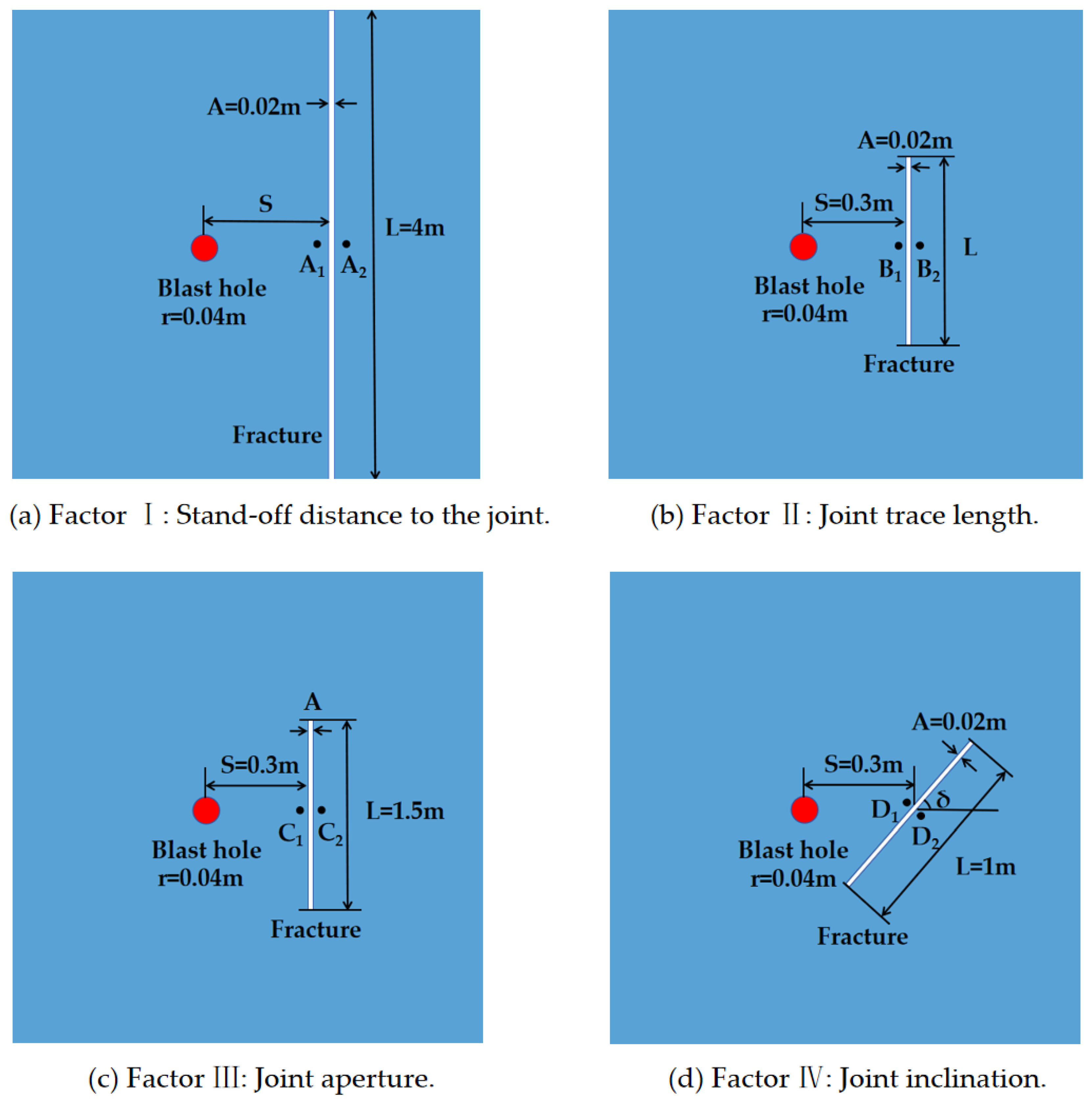
| Factor | 1 | 2 | 3 | 4 |
|---|---|---|---|---|
| I: Stand-off distance to the joint | S = 0.3 m | S = 0.6 m | S = 0.9 m | S = 1.3 m |
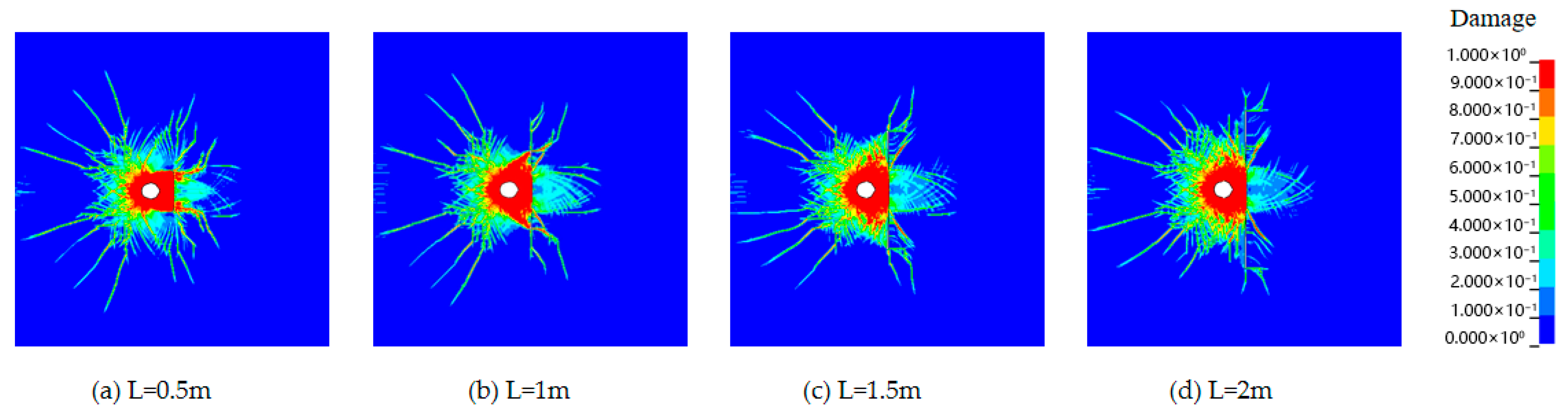
| II: Joint trace length | L = 0.5 m | L = 1 m | L = 1.5 m | L = 2 m |
| III: Joint aperture | A = 0.01 m | A = 0.02 m | A = 0.03 m | A = 0.04 m |
| IV: Joint inclination | δ = 30° | δ = 45° | δ = 60° | δ = 75° |
| ρe (kg/m3) | VOD (m/s) | PCJ (GPa) | AJWL (GPa) | BJWL (GPa) | R1 | R2 | ω | E0 (GPa) |
|---|---|---|---|---|---|---|---|---|
| 1320 | 6690 | 16 | 586 | 21.6 | 5.81 | 1.77 | 0.282 | 7.38 |
| Parameter | Value | Parameter | Value |
|---|---|---|---|
| Mass density RO kg/m3 | 2660 | Porosity exponent NP | 3.0 |
| Initial porosity ALPHA | 0 | Reference compressive strain-rate EOC | 3 × 10⁻⁵ |
| Crush pressure PEL (MPa) | 125 | Reference tensile strain rate EOT | 3 × 10⁻⁶ |
| Compaction pressure PCO (GPa) | 6.0 | Break compressive strain rate EC | 3 × 1025 |
| Hugoniot polynomial coefficient A1 (GPa) | 25.7 | Break tensile strain rate ET | 3 × 1025 |
| Hugoniot polynomial coefficient A2 (GPa) | 37.84 | Compressive strain rate dependence exponent BETAC | 0.026 |
| Hugoniot polynomial coefficient A3 (GPa) | 21.29 | Tensile strain rate dependence exponent BETAT | 0.007 |
| Parameter for polynomial EOS B0 | 1.22 | Volumetric plastic strain fraction in tension PTF | 0.001 |
| Parameter for polynomial EOS B1 | 1.22 | Compressive yield surface parameter GC * | 0.53 |
| Parameter for polynomial EOS T1 (GPa) | 25.7 | Tensile yield surface parameter GT * | 0.7 |
| Parameter for polynomial EOS T2 | 0.0 | Erosion plastic strain EPSF | 2.0 |
| Elastic shear modulus SHEAR (GPa) | 17 | Shear modulus reduction factor XI | 0.5 |
| Compressive strength FC (MPa) | 167.8 | Damage parameter D1 | 0.04 |
| Relative tensile strength FT * | 0.04 | Damage parameter D2 | 1.0 |
| Relative shear strength FS * | 0.21 | Minimum damaged residual strain EPM | 0.015 |
| Failure surface Parameter A | 2.44 | Residual surface parameter AF | 0.25 |
| Failure surface Parameter N | 0.76 | Residual surface parameter AN | 0.62 |
| Lode angle dependence factor Q0 | 0.68 | Gruneisen gamma GAMMA | 0.0 |
| Lode angle dependence factor B | 0.05 |
Disclaimer/Publisher’s Note: The statements, opinions and data contained in all publications are solely those of the individual author(s) and contributor(s) and not of MDPI and/or the editor(s). MDPI and/or the editor(s) disclaim responsibility for any injury to people or property resulting from any ideas, methods, instructions or products referred to in the content. |
© 2025 by the authors. Licensee MDPI, Basel, Switzerland. This article is an open access article distributed under the terms and conditions of the Creative Commons Attribution (CC BY) license (https://creativecommons.org/licenses/by/4.0/).
Share and Cite
Luo, X.; Yu, Q.; Yin, S.; Thanh, H.V.; Soltanian, M.R.; Liu, D.; Dai, Z. Blasting Damage Control in Jointed Rock Tunnels: A Review with Numerical Validation of Water-Pressure Blasting. Appl. Sci. 2025, 15, 13187. https://doi.org/10.3390/app152413187
Luo X, Yu Q, Yin S, Thanh HV, Soltanian MR, Liu D, Dai Z. Blasting Damage Control in Jointed Rock Tunnels: A Review with Numerical Validation of Water-Pressure Blasting. Applied Sciences. 2025; 15(24):13187. https://doi.org/10.3390/app152413187
Chicago/Turabian StyleLuo, Xinyue, Qingyang Yu, Shangxian Yin, Hung Vo Thanh, Mohamad Reza Soltanian, Dong Liu, and Zhenxue Dai. 2025. "Blasting Damage Control in Jointed Rock Tunnels: A Review with Numerical Validation of Water-Pressure Blasting" Applied Sciences 15, no. 24: 13187. https://doi.org/10.3390/app152413187
APA StyleLuo, X., Yu, Q., Yin, S., Thanh, H. V., Soltanian, M. R., Liu, D., & Dai, Z. (2025). Blasting Damage Control in Jointed Rock Tunnels: A Review with Numerical Validation of Water-Pressure Blasting. Applied Sciences, 15(24), 13187. https://doi.org/10.3390/app152413187