The Effect of Optimised Combined Turning and Diamond Burnishing Processes on the Roughness Parameters of CuZn39Pb3 Alloys



Abstract
1. Introduction
2. Experimental Information
2.1. Organisation of the Study
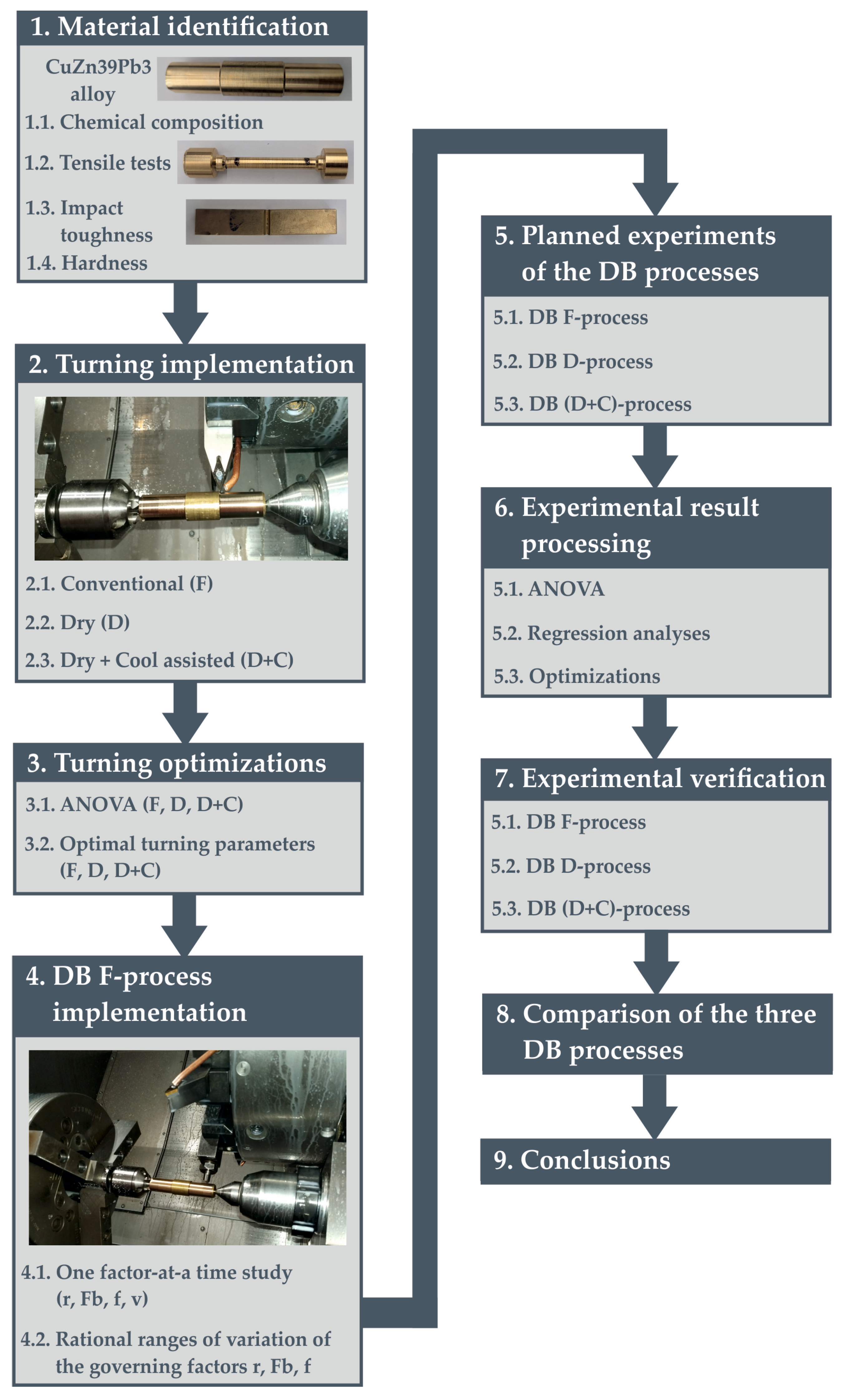
- Planned experiments and analyses of variance (ANOVA) were used to identify the optimal feed rate, cutting velocity, and cutting depth of each turning process (F, D, and D+C) by minimising the roughness parameter (Ra). All subsequent turning operations (performed before each DB process) were carried out using these optimal values.
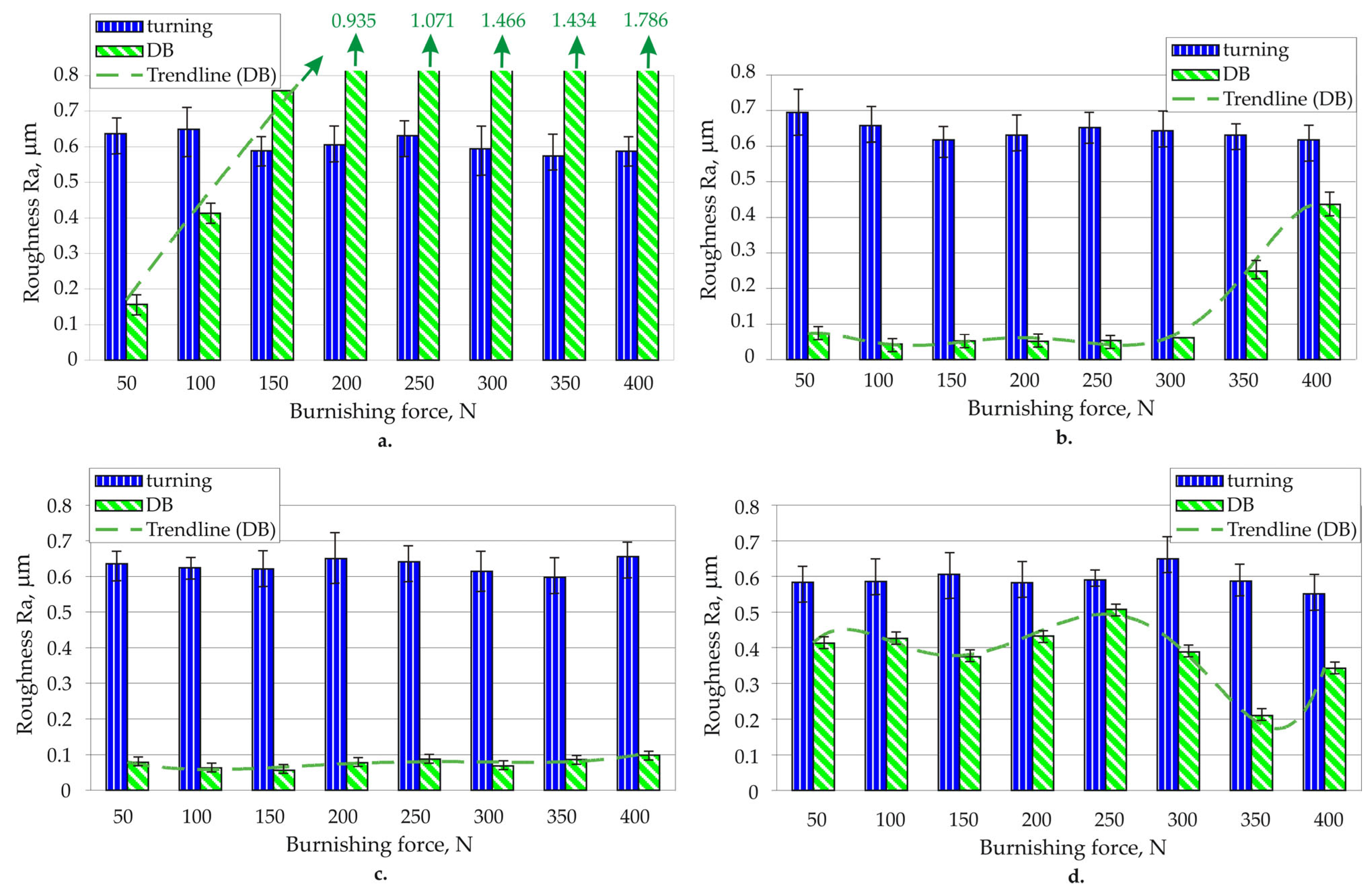
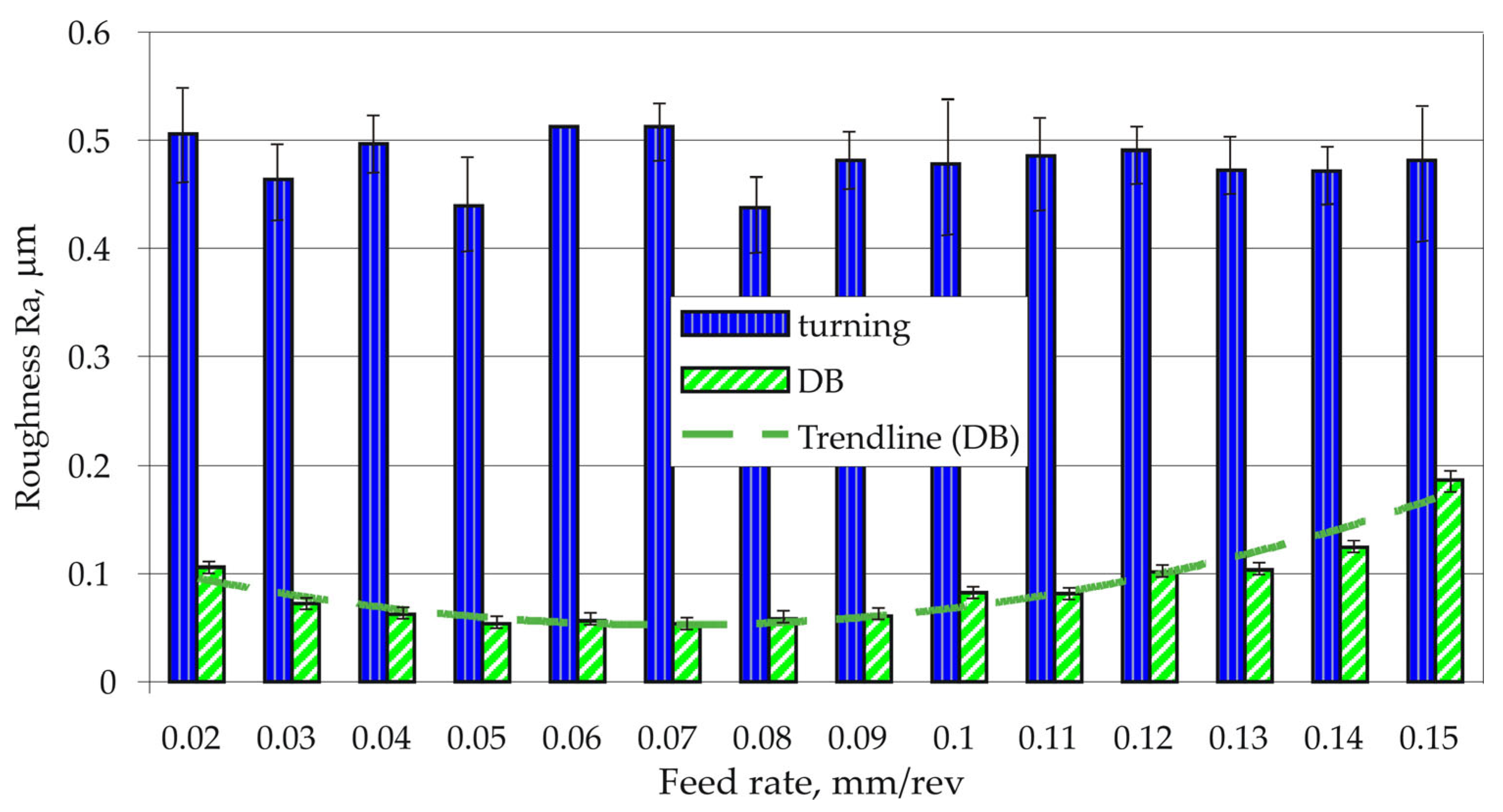
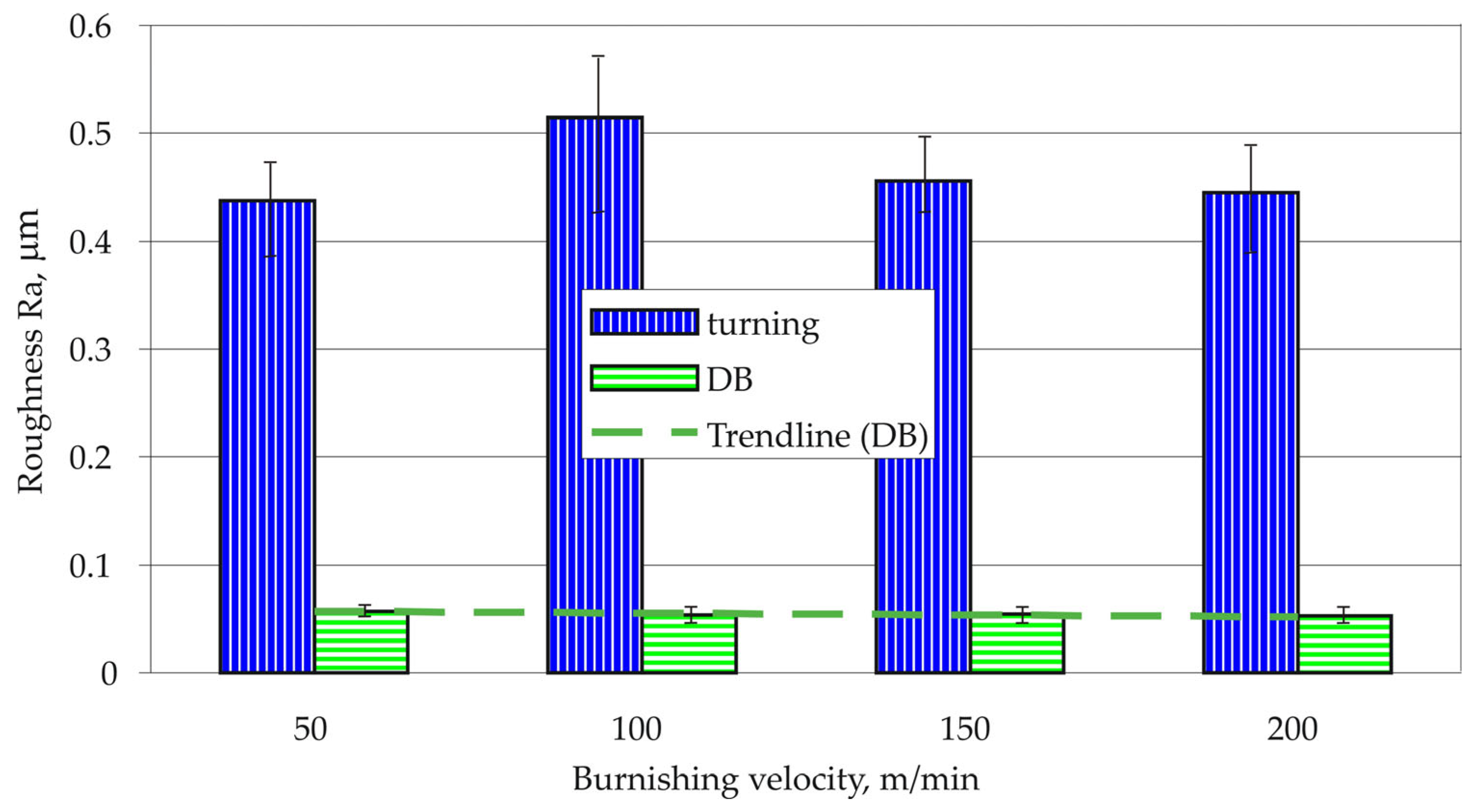
- A one-factor-at-a-time approach was used to investigate how certain DB governing factors, including diamond radius, burnishing force, and feed rate, affect Ra. DB was conducted under conventional conditions (i.e., under F conditions); the identified rational range of variations for each governing factor was used to assess the other two DB conditions (D and D+C).
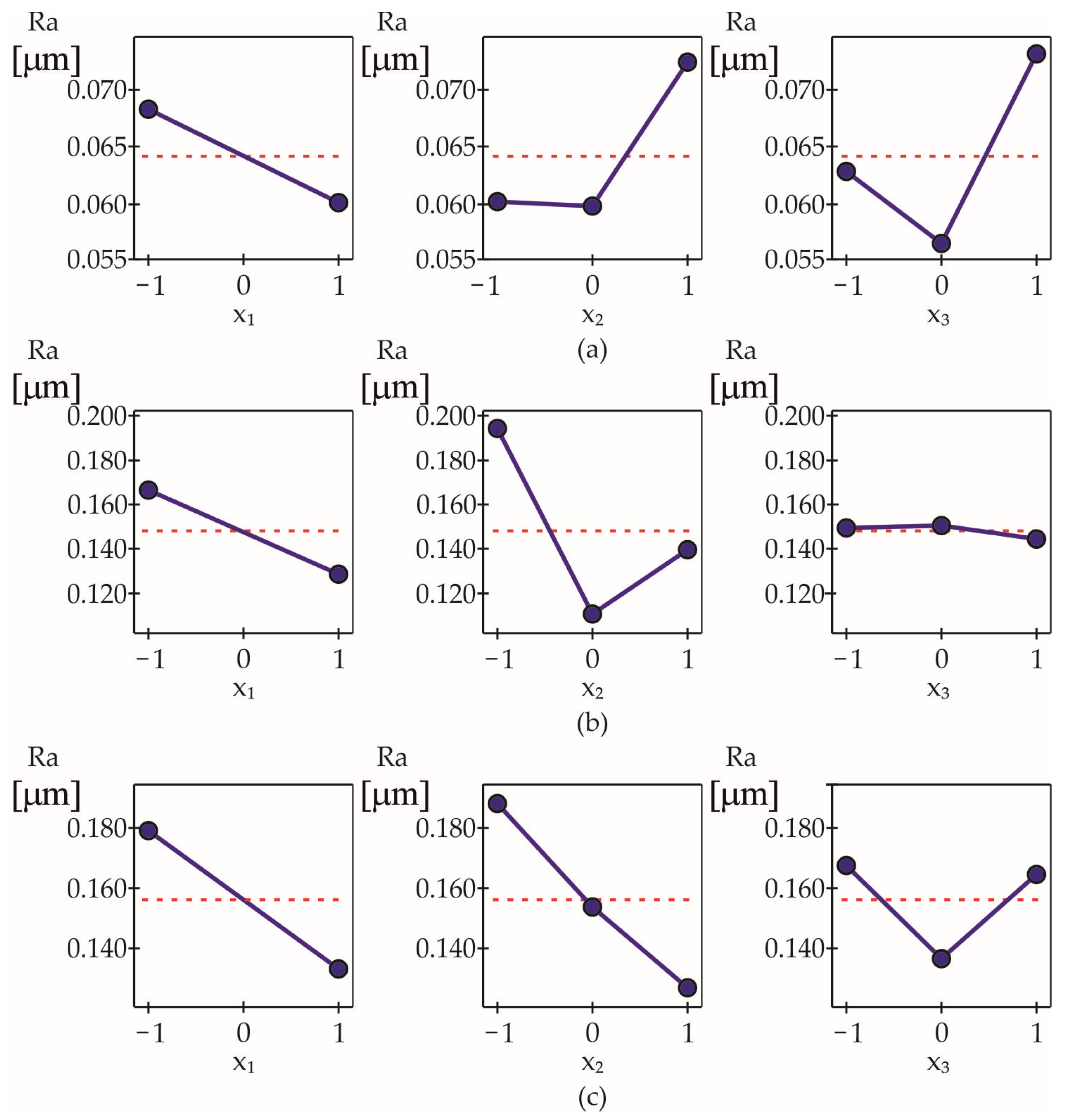
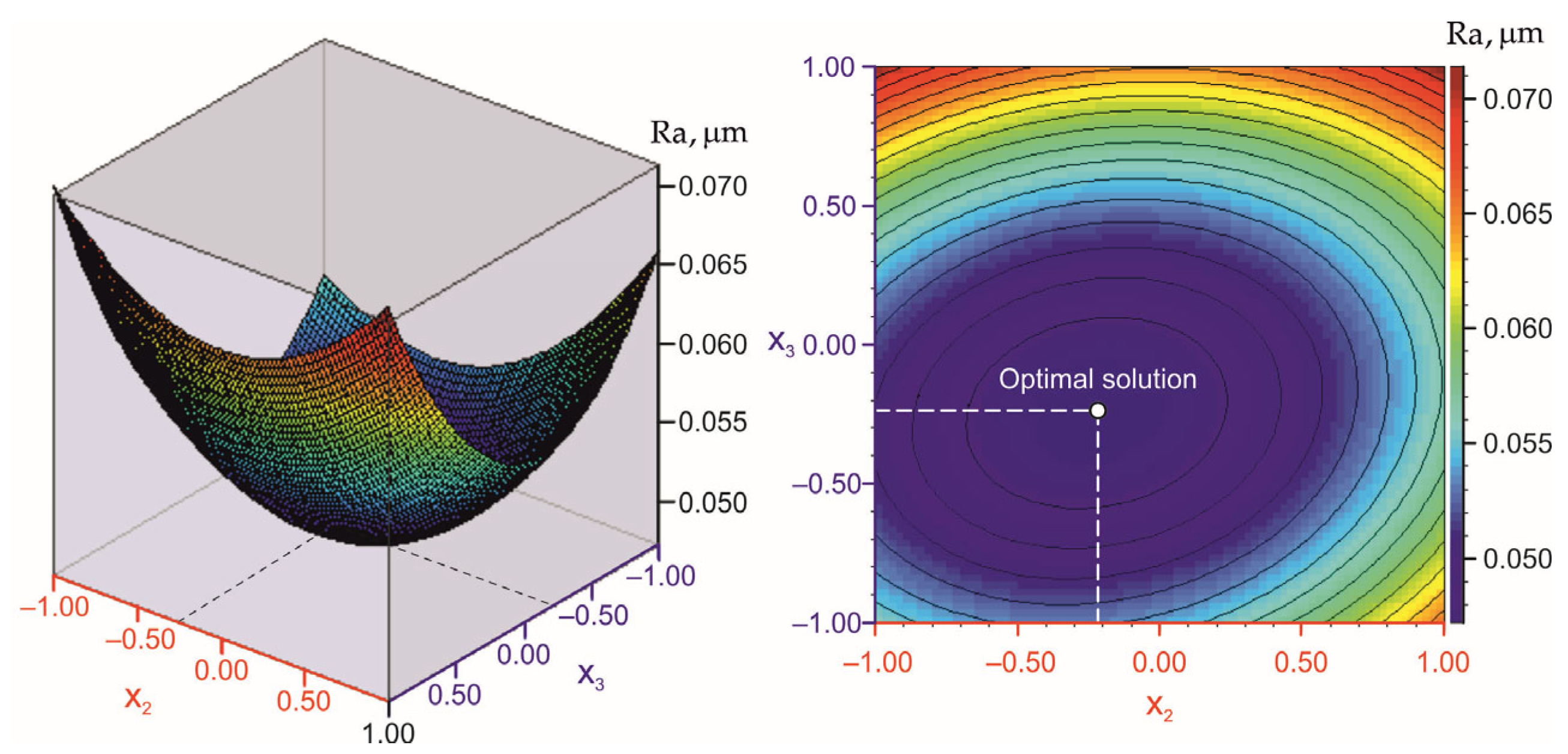
- Planned experiments and regression analyses were used to identify the optimal values of each governing factor for the three DB processes by minimising Ra.
- The optimised DB processes were compared in terms of average Ra, skewness, and kurtosis to evaluate their effectiveness as a sustainable DB method.
- The flowchart of the study is shown in Figure 1.
2.2. Materials
2.3. Turning Implementation
2.4. DB Implementation
2.5. Measurement of SI Characteristics
3. Results and Discussion
3.1. Material Characterisation
3.2. Turning Process Optimisation
3.3. DB Parametric Study
3.3.1. Effect of the Diamond Radius and Burnishing Force
3.3.2. Effect of Feed Rate
3.3.3. Effect of Burnishing Velocity
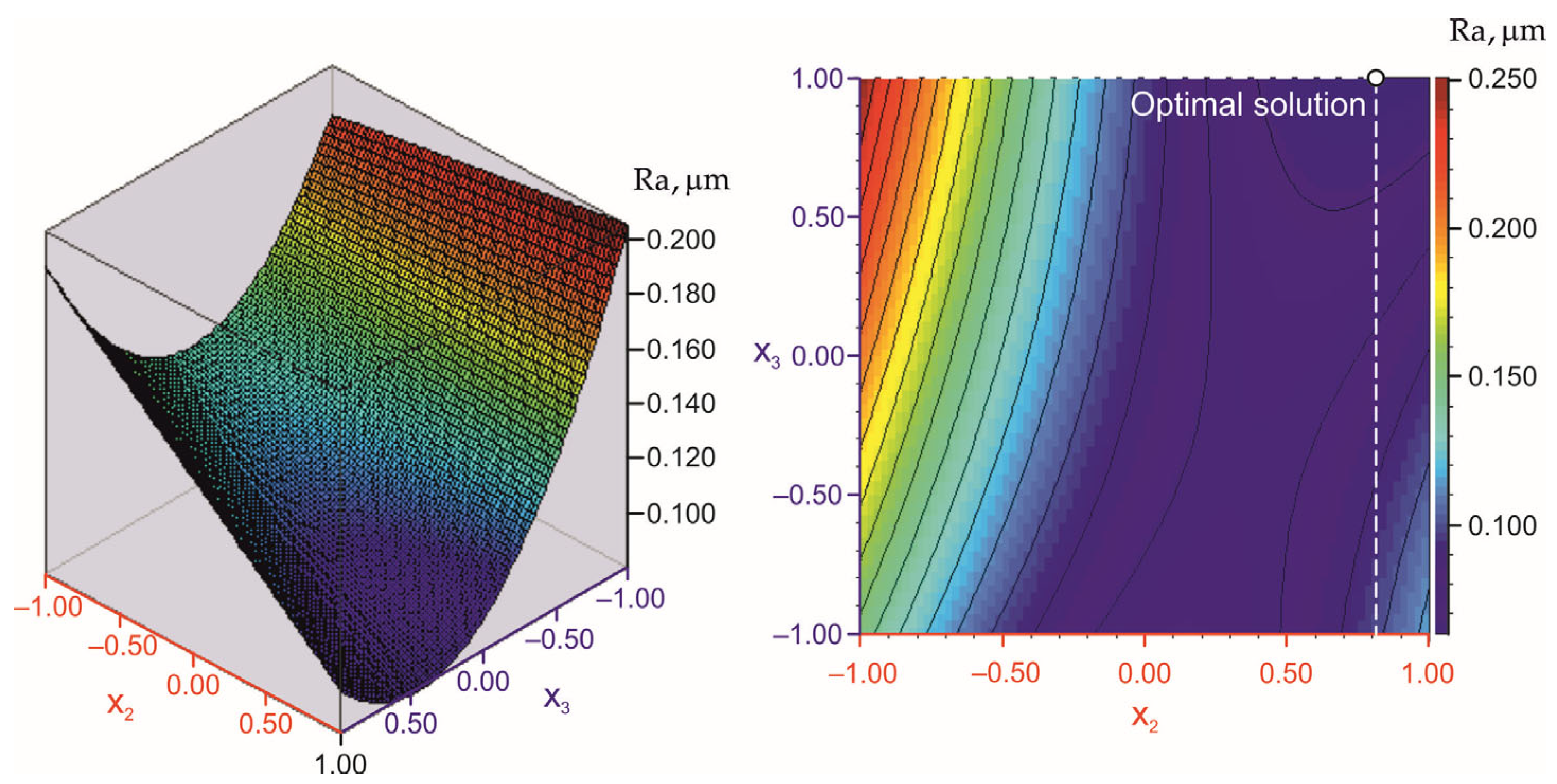
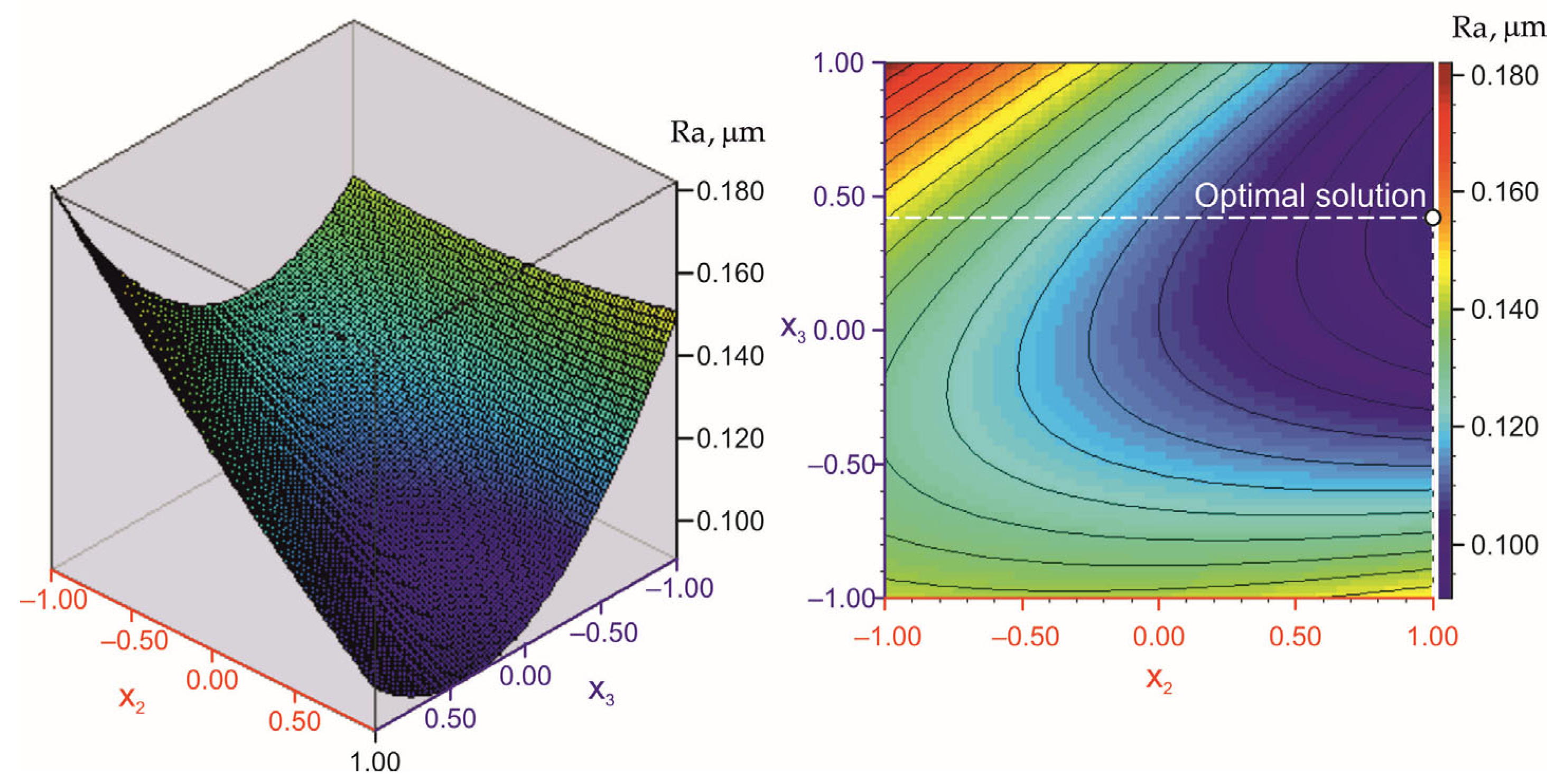
3.4. DB Optimisation
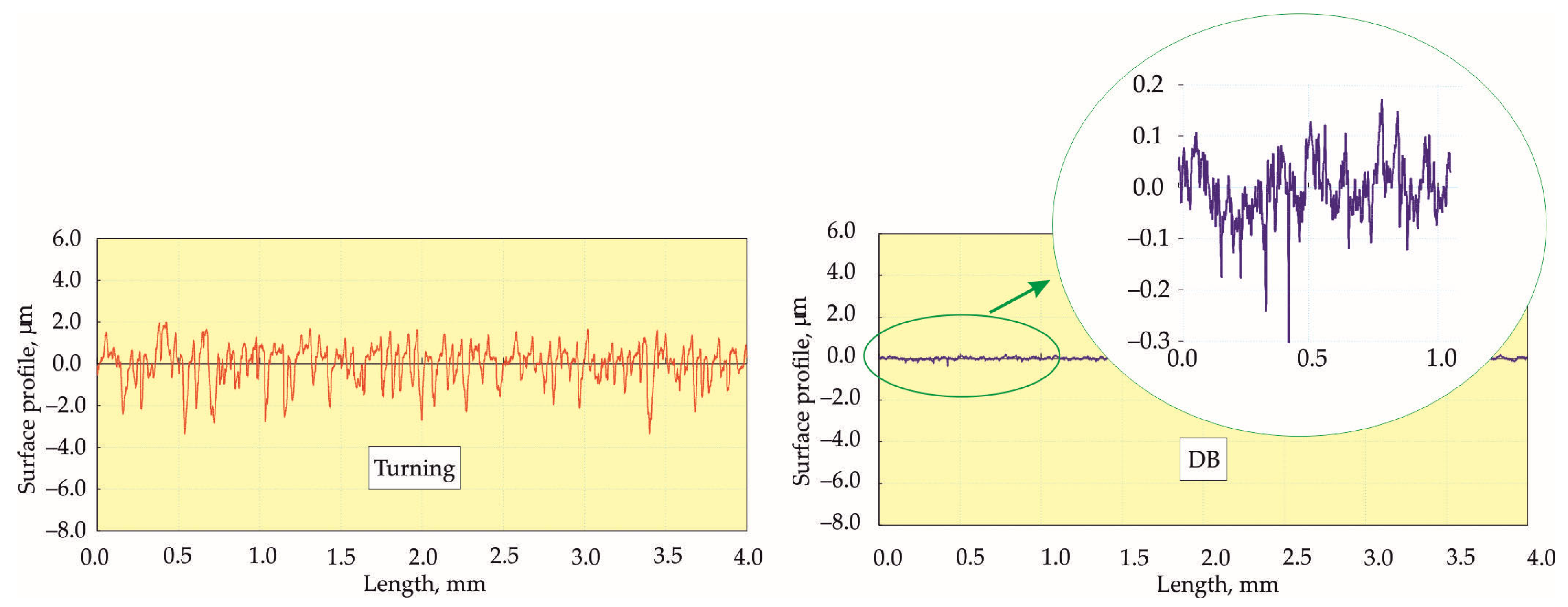
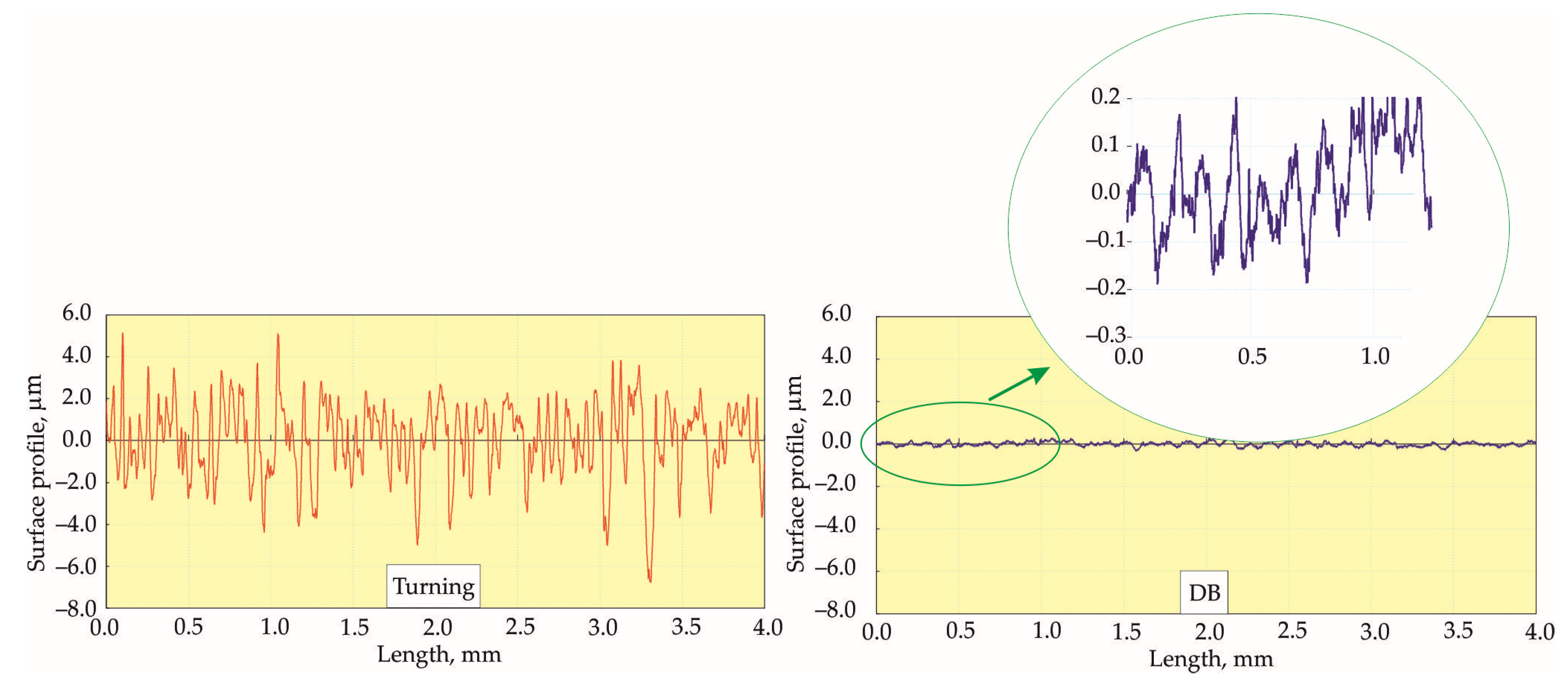
3.5. Analysis of the Roughness Parameters Obtained via Optimised DB Processes
4. Conclusions
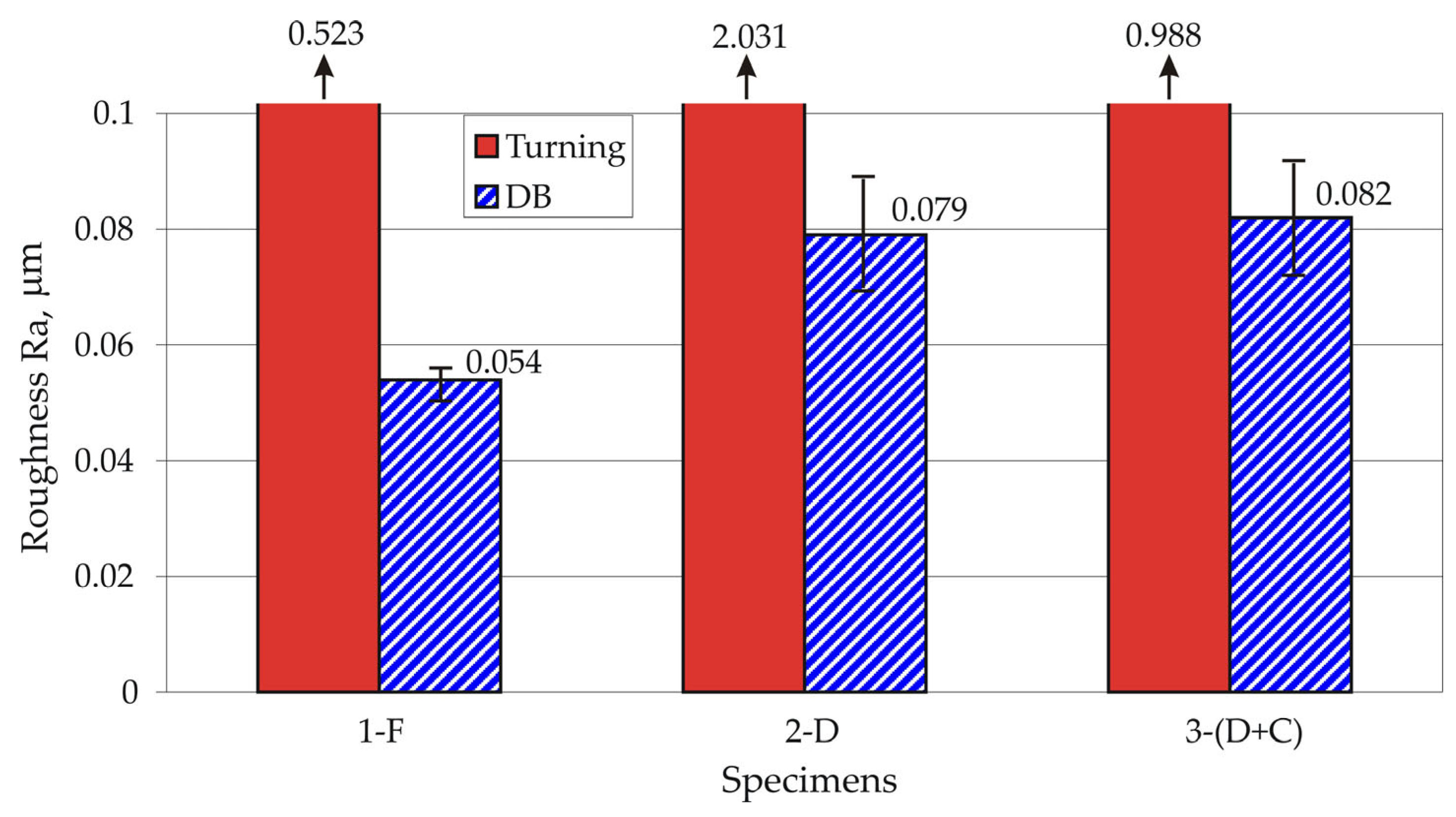
- The three processes (F, D, and D+C) achieve mirror-like surfaces with a minimum average Ra of 0.054 µm, 0.079 µm, and 0.082 µm, respectively.
- The F- and D+C-processes exhibit surface roughness profiles with negative skewness and a kurtosis greater than three, indicating improved wear resistance in boundary lubrication regimes.
- The D- and D+C-processes are far more sustainable than the F-process because they eliminate the environmental and health hazards associated with cutting fluid used in the latter process.
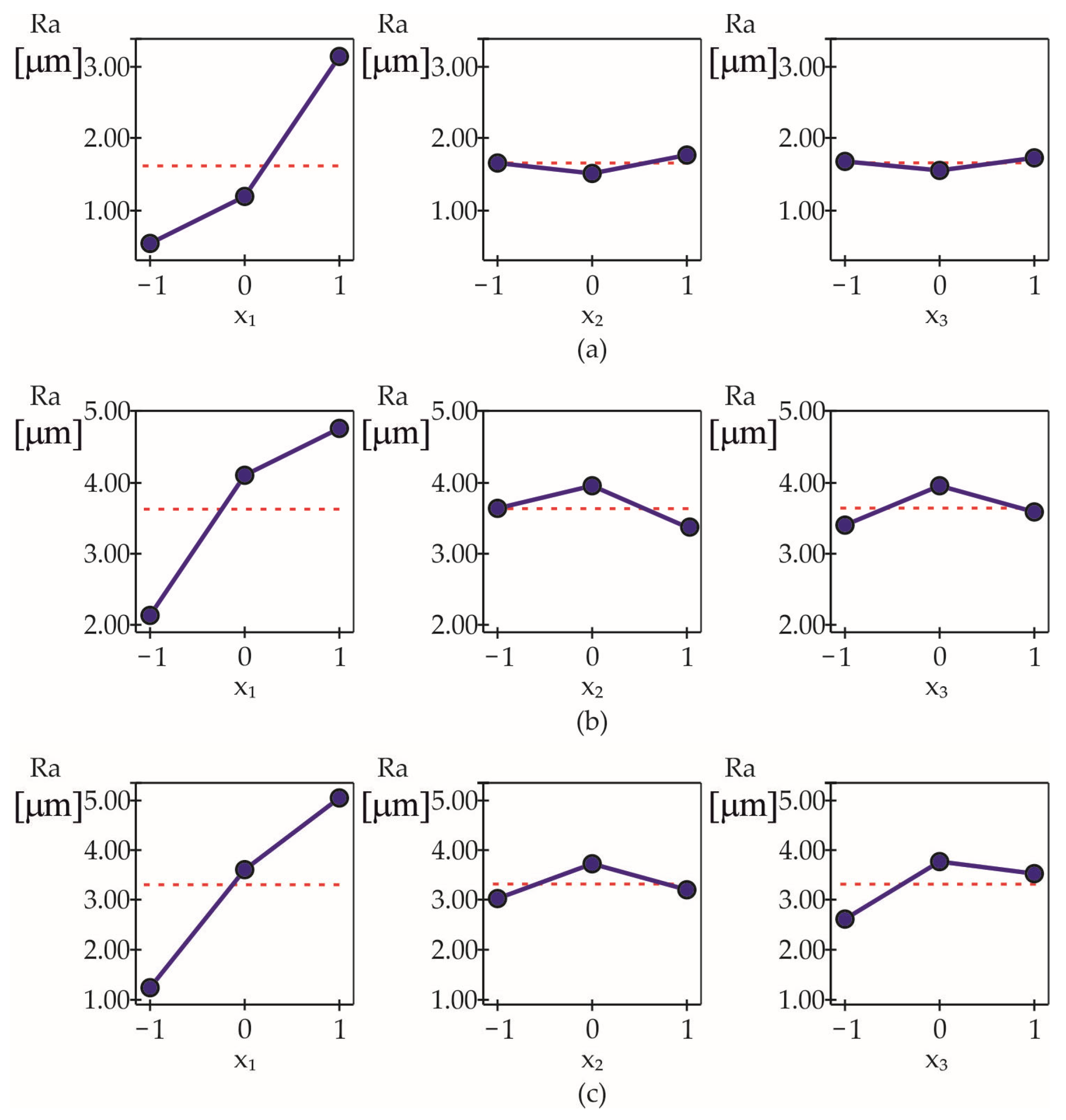
- Across all turning processes (F, D, and D+C), the feed rate was the dominant factor affecting Ra; cutting velocity and depth have comparatively minor effects. For all three turning processes, the optimal parameters that minimised Ra were a feed rate of 0.05 mm/rev, a cutting velocity of 180 m/min, and a cutting depth of 1 mm.
- In all three DB processes, a larger diamond insert radius reduced roughness; this effect was most pronounced in the D+C-process. In the DB F-process, the feed rate had the strongest influence on Ra, followed by the burnishing force. In both sustainable DB processes (D and D+C), the burnishing force had the strongest influence on roughness, followed by diamond radius. The influence of feed rate was negligible in the DB D-process.
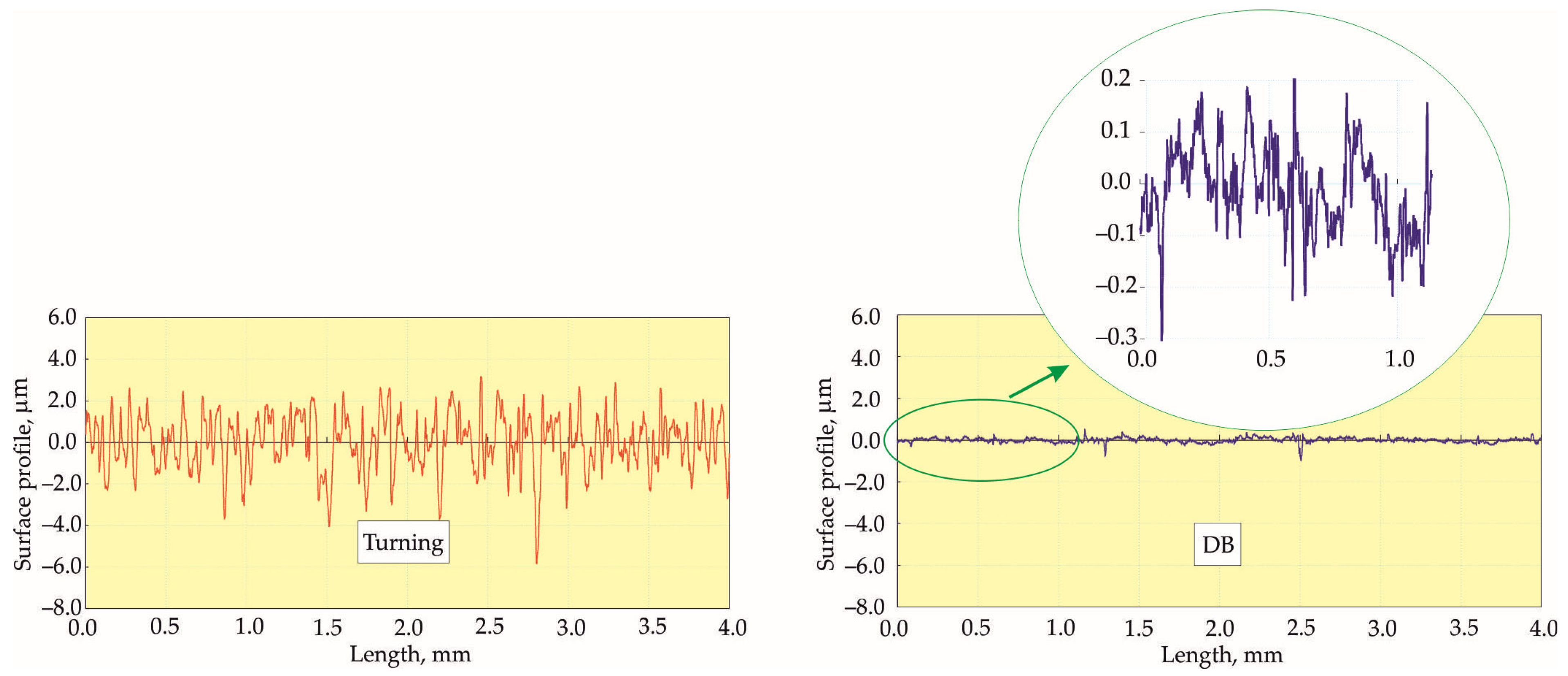
- The DB D-process achieved the greatest reduction in Ra from 2.031 μm to 0.079 μm (a 25.7-fold decrease). In contrast, the DB F- and D+C-processes reduced Ra by 9.68 and 12.05 times, respectively. The significant reduction in Ra during the DB D-process was attributed to the larger amount of heat generated, which results in a softening effect.
Author Contributions
Funding
Institutional Review Board Statement
Informed Consent Statement
Data Availability Statement
Conflicts of Interest
Abbreviations
| ANOVA | Analysis of variance |
| CF | Cutting fluid |
| D | Dry |
| D+C | Dry and cool-assisted |
| DB | Diamond burnishing |
| F | Flood lubrication |
| SCW | Surface coldworking |
| SI | Surface integrity |
References
- Vaxevanidis, N.M.; Fountas, N.A.; Koutsomichalis, A.; Kechagias, J.D. Experimental investigation of machinability parameters in turning of CuZn39Pb3 brass alloy. Procedia Struct. Integr. 2018, 10, 333–341. [Google Scholar] [CrossRef] [Scilit]
- Fountas, N.; Koutsomichalis, A.; Kechagias, J.D.; Vaxevanidis, N.M. Multi–response optimization of CuZn39Pb3 brass alloy turning by implementing Grey Wolf algorithm. Fract. Struct. Integr. 2019, 50, 584–594. [Google Scholar] [CrossRef] [Scilit]
- Karaman, A.; Marre, M. Forging of Zinc Alloys—A Feasibility Study. Eng. Proc. 2022, 26, 2. [Google Scholar]
- Jasper, S.; Subash, R.; Muthuneelakandan, K.; Vijayakumar, D.; Jhansi Ida, S. The Mechanical Properties of Brass Alloys: A Review. Eng. Proc. 2025, 93, 11. [Google Scholar]
- Consolidated Text: Directive 2011/65/EU of the European Parliament and of the Council of 8 June 2011 on the Restriction of the Use of Certain Hazardous Substances in Electrical and Electronic Equipment (Recast) (Text with EEA Relevance). Available online: https://eur-lex.europa.eu/eli/dir/2011/65/2025-01-01 (accessed on 31 July 2025).
- A Regulation of the European Union, Adopted to Improve the Protection of Human Health and the Environment from the Risks That can be Posed by Chemicals, While Enhancing the Competitiveness of the EU Chemicals Industry. Available online: https://echa.europa.eu/regulations/reach/understanding-reach (accessed on 4 August 2025).
- Jablonski, M. Examination of the force parameters in drawing process of CuZn39Pb3 cast rod using selected lubricants. Arch. Foundry Eng. 2023, 4, 99–104. [Google Scholar] [CrossRef] [Scilit]
- Hussein, R.M.; Abd, O.I. Influence of Al and Ti Additions on Microstructure and Mechanical Properties of Leaded Brass Alloys. Indian J. Mater. Sci. 2014, 2014, 909506. [Google Scholar] [CrossRef] [Scilit]
- Brinksmeier, E.; Preuss, W.; Riemer, O.; Rentsch, R. Cutting forces, tool wear and surface finish in high speed diamond machining. Precis. Eng. 2017, 49, 293–304. [Google Scholar] [CrossRef] [Scilit]
- Schultheiss, F.; Johansson, D.; Bushlya, V.; Zhou, J.; Nilsson, K.; Ståhl, J.-E. Comparative study on the machinability of lead-free brass. J. Clean. Prod. 2017, 149, 366–377. [Google Scholar] [CrossRef] [Scilit]
- Küçükömeroğlu, T.; Kara, L. The friction and wear properties of CuZn39PB3 alloys under atmospheric and vacuum conditions. Wear 2014, 309, 21–28. [Google Scholar] [CrossRef] [Scilit]
- Anagnostis, I.; Pantazopoulos, G.A.; Pairetis, A.S. Fracture behaviour and characterization of lead-free brass alloys for machining applications. J. Mater. Eng. Perform. 2014, 23, 3193–3206. [Google Scholar]
- Klocke, F.; Nobel, C.; Veselovac, D. Influence of tool coating, tool material, and cutting speed on the machinability of low-leaded brass alloys in turning. Mater. Manuf. Process. 2016, 31, 1895–1903. [Google Scholar] [CrossRef] [Scilit]
- Nobel, C.; Klocke, F.; Lung, D.; Wolf, S. Machinability enhancement of lead-free brass alloys. Proc. Cirp 2014, 14, 95–100. [Google Scholar] [CrossRef] [Scilit]
- Pantazopoulos, G.; Vazdirvanidis, A. Failure analysis of a fractured leaded-Brass (CuZn39Pb3) extruded hexagonal rod. J. Fail. Anal. Prev. 2008, 8, 218–222. [Google Scholar] [CrossRef] [Scilit]
- Maximov, J.T.; Duncheva, G.V. Effects of diamond burnishing on surface integrity, fatigue, wear, and corrosion of metal components—Review and perspectives. Int. J. Adv. Manuf. Technol. 2025, 139, 4233–4267. [Google Scholar] [CrossRef] [Scilit]
- Plaster, H.J. A tribute to Benjamin Chew Tilghman. In Proceedings of the 5th International Conference on Shot Peening, Oxford, UK, 13–17 September 1993; pp. 2–9. [Google Scholar]
- Lawerenz, M. Shot Peening and its Effect on Gearing. In SAE Technical Paper 841090; SAE International: Warrendale, PA, USA, 1984. [Google Scholar] [CrossRef] [Scilit]
- Yang, J.M.; Her, Y.C.; Han, N.; Clauer, A. Laser shock peening on fatigue behavior of 2024-T3 Al alloy with fastener holes and stopholes. Mater. Sci. Eng. A 2001, 298, 296–299. [Google Scholar] [CrossRef] [Scilit]
- Soyama, H. Cavitation peening: A review. Metals 2020, 10, 270. [Google Scholar] [CrossRef] [Scilit]
- Soyama, H. Oxidation-induced stacking faults introduced by using a cavitating jet for gettering in silicon. Electrochem. Solid-State Lett. 1999, 3, 93–94. [Google Scholar] [CrossRef] [Scilit]
- Wegener, T.; Wu, T.; Sun, F.; Wang, C.; Lu, J.; Niendorf, T. Influence of surface attrition treatment (SMAT) on microstructure, tensile and low-cycle fatigue behaviour of additively manufactured stainless steel 316L. Metals 2022, 12, 1425. [Google Scholar] [CrossRef] [Scilit]
- Galda, L.; Koszela, W.; Pawlus, P. Surface geometry of slide bearings after percussive burnishing. Tribol. Int. 2007, 40, 1516–1525. [Google Scholar] [CrossRef] [Scilit]
- Ecoroll Catalogue. Tools and Solutions for Metal Surface Improvement; Ecoroll Corporation Tool Technology: Milford, OH, USA, 2006. [Google Scholar]
- Saldana-Robles, A.; De la Pena, J.A.D.; Balvantin, A.; Aguilera-Gomez, E. Ball-burnishing process: State of the art of a technology in development. Dyna 2017, 92, 28–33. [Google Scholar]
- Klumpp, A.; Hoffmeister, J.; Schulze, V. Mechanical surface treatments. In Proceedings of the Conf proc 2014: ICSP-12 Goslar, Goslar, Germany, 15–18 September 2014; pp. 12–24. [Google Scholar]
- Duncheva, G.V.; Maximov, J.T.; Dunchev, V.P.; Anhev, A.P.; Atanasov, T.P.; Capec, J. Single toroidal roller burnishing of 2024-T3 Al alloy implemented as mixed burnishing process. Int. J. Adv. Manuf. Technol. 2020, 111, 3559–3570. [Google Scholar] [CrossRef] [Scilit]
- Korzynski, M. Slide Diamond Burnishing. In Nonconventional Finishing Technologies; Korzynski, M., Ed.; Polish Scientific Publisher: Warsaw, Poland, 2013; pp. 9–34. [Google Scholar]
- Shiou, F.J.; Chen, C.H. Determination of optimal ball-burnishing parameters for plastic injection moulding steel. Int. J. Adv. Manuf. Technol. 2003, 21, 177–185. [Google Scholar]
- Lin, Y.C.; Wang, S.W.; Lai, H.Y. The relationship between surface roughness and burnishing factor in the burnishing process. J. Adv. Manuf. Technol. 2004, 23, 666–671. [Google Scholar] [CrossRef] [Scilit]
- Maximov, J.T.; Duncheva, G.V. Finite Element Analysis and optimization of spherical motion burnishing of low-alloy steel. Proc. IMechE Part. C J. Mech. Eng. Sci. 2012, 226, 161–176. [Google Scholar] [CrossRef] [Scilit]
- Korzynski, M. Modeling and experimental validation of the force-surface roughness relation for smoothing burnishing with a spherical tool. Int. J. Mach. Tools Manuf. 2007, 47, 1956–1964. [Google Scholar] [CrossRef] [Scilit]
- Hull, E.H.; Nerad, A.J. Irregular Diamond Burnishing Tool. United States Patent 2966722, 3 January 1961. [Google Scholar]
- Skoczylas, A.; Zaleski, K.; Matuszak, J. Evaluation of the Effectiveness of Surface Defect Removal by Slide Burnishing. Appl. Sci. 2025, 15, 7398. [Google Scholar] [CrossRef] [Scilit]
- Maximov, J.T.; Duncheva, G.V.; Anchev, A.P.; Dunchev, V.P. Smoothing, deep or mixed diamond burnishing of low-alloy steel components—Optimization procedures. J. Adv. Manuf. Technol. 2020, 106, 1917–1929. [Google Scholar] [CrossRef] [Scilit]
- Dunchev, V.P. Comprehensive model of the micro-hardness of diamond burnished 41Cr4 steel specimens. J. Tech. Univ. Gabrovo 2020, 60, 25–33. [Google Scholar]
- Kebede, F.T.; Felho, C.; Sztankovics, I. Improving Surface Roughness of 42CrMo4 Low Alloy Steel Shafts by Applying Varying Feed in the Multi-Pass Slide Burnishing Process. Appl. Sci. 2025, 15, 9063. [Google Scholar] [CrossRef] [Scilit]
- Tobola, D.; Kania, B. Phase composition and stress state in the surface layers of burnished and gas nitrided Sverker 21 and Vanadis 6 tool steels. Surf. Coat. Technol. 2018, 353, 105–115. [Google Scholar] [CrossRef] [Scilit]
- Maximov, J.T.; Duncheva, G.V.; Anchev, A.P.; Dunchev, V.P.; Argirov, Y.B. Effect of Diamond Burnishing on Fatigue Behaviour of AISI 304 Chromium-Nickel Austenitic Stainless Steel. Materials 2022, 15, 4768. [Google Scholar] [CrossRef] [Scilit]
- Korzynski, M.; Dudek, K.; Kruczek, B.; Kocurek, P. Equilibrium surface texture of valve stems and burnishing method to obtain it. Tribol. Int. 2018, 124, 195–199. [Google Scholar] [CrossRef] [Scilit]
- Labanowski, J.; Ossowska, A. Influence of burnishing on stress corrosion cracking susceptibility of duplex steel. J. Achiev. Mater. Manuf. Eng. 2006, 19, 46–52. [Google Scholar]
- Maximov, J.T.; Duncheva, G.V.; Anchev, A.P.; Dunchev, V.P.; Argirov, Y.B.; Nikolova, M.P. Effects of heat treatment and diamond burnishing on fatigue behaviour and corrosion resistance of AISI 304 austenitic stainless steel. Appl. Sci. 2023, 13, 2570. [Google Scholar] [CrossRef] [Scilit]
- Smolnicki, S.; Varga, G. Analysis of Surface Roughness of Diamond-Burnished Surfaces Using Kraljic Matrices and Experimental Design. Appl. Sci. 2025, 15, 8025. [Google Scholar] [CrossRef] [Scilit]
- Toboła, D.; Morgiel, J.; Maj, Ł. TEM analysis of surface layer of Ti-6Al-4V ELI alloy after slide burnishing and low-temperature gas nitriding. Appl. Surf. Sci. 2020, 515, 145942. [Google Scholar] [CrossRef] [Scilit]
- Maximov, J.T.; Anchev, A.P.; Dunchev, V.P.; Ganev, N.; Duncheva, G.V.; Selimov, K.F. Effect of slide burnishing basic parameters on fatigue performance of 2024-T3 high-strength aluminium alloy. Fatigue Fract. Eng. Mater. Struct. 2017, 40, 1893–1904. [Google Scholar] [CrossRef] [Scilit]
- Maximov, J.T.; Anchev, A.P.; Duncheva, G.V.; Ganev, N.; Selimov, K.F.; Dunchev, V.P. Impact of slide diamond burnishing additional parameters on fatigue behaviour of 2024-T3 Al alloy. Fatigue Fract. Eng. Mater. Struct. 2019, 42, 363–373. [Google Scholar] [CrossRef] [Scilit]
- Duncheva, G.V.; Maximov, J.T.; Anchev, A.P.; Dunchev, V.P.; Argirov, Y.B. Multi-objective optimization of internal diamond burnishing process. Mater. Manuf. Process. 2022, 37, 428–436. [Google Scholar] [CrossRef] [Scilit]
- Luo, H.; Liu, J.; Wang, L.; Zhoung, Q. Investigation of the burnishing process with PCD tool on non-ferrous metals. Int. J. Adv. Manuf. Technol. 2005, 25, 454–459. [Google Scholar] [CrossRef] [Scilit]
- Maximov, J.; Duncheva, G.; Anchev, A.; Dunchev, V.; Argirov, Y. Improvement in Fatigue Strength of Chromium–Nickel Austenitic Stainless Steels via Diamond Burnishing and Subsequent Low-Temperature Gas Nitriding. Appl. Sci. 2024, 14, 1020. [Google Scholar] [CrossRef] [Scilit]
- Maximov, J.T.; Duncheva, G.V. The correlation between surface integrity and operating behaviour of slide burnished components—A review and prospects. Appl. Sci. 2023, 13, 3313. [Google Scholar] [CrossRef] [Scilit]
- Adler, D.P.; Hii, W.W.-S.; Michalek, D.J.; Sutherland, J.W. Examining the role of cutting fluids in machining and efforts to address associated environmental/health concerns. Mach. Sci. Technol. 2006, 10, 23–58. [Google Scholar] [CrossRef] [Scilit]
- Klocke, F.; Eisenblätter, G. Dry cutting. CIRP Ann. 1997, 46, 519–526. [Google Scholar] [CrossRef] [Scilit]
- Shokrani, A.; Dhokia, V.; Newman, S.T. Environmentally conscious machining of difficult-to-machine materials with regard to cutting fluids. Int. J. Mach. Tool. Manuf. 2012, 57, 83–101. [Google Scholar] [CrossRef] [Scilit]
- Debnath, S.; Reddy, M.M.; Yi, Q.S. Environmental friendly cutting fluids and cooling techniques in machining: A review. J. Clean. Prod. 2014, 83, 33–47. [Google Scholar] [CrossRef] [Scilit]
- Elsner, P.; Wilhelm, D.; Maibach, H.I. Irritant Contact Dermatitis irritant contact dermatitis and aging. Contact Dermat. 1990, 23, 275. [Google Scholar] [CrossRef] [Scilit]
- Mackerer, C.R. Health effects of oil mists: A brief review. Toxicol. Ind. Health 1989, 5, 429–440. [Google Scholar] [CrossRef] [Scilit]
- Rosen, M.A.; Kishawy, H.A. Sustainable Manufacturing and Design: Concepts, Practices and Needs. Sustainability 2012, 4, 154–174. [Google Scholar] [CrossRef] [Scilit]
- Liu, H.; Yan, Y.; Cui, J.; Geng, Y.; Sun, T.; Luo, X.; Zong, W. Recent advances in design and preparation of micro diamond cutting tools. Int. J. Extrem. Manuf. 2024, 6, 062008. [Google Scholar] [CrossRef] [Scilit]
- Huuki, J.; Laakso, S.V.A. Surface improvement of shafts by the diamond burnishing and ultrasonic burnishing techniques. Int. J. Mach. Mach. Mater. 2017, 19, 246–258. [Google Scholar] [CrossRef] [Scilit]
- Swirad, S. The surface texture analysis after slide burnishing with cylindrical elements. Wear 2011, 271, 576–581. [Google Scholar] [CrossRef] [Scilit]
- Nguyen, V.T.; Le, V.A.; Nguyen, T.T. Artificial neural network-based optimization of the cryogenic-internal diamond burnishing process in tems of surface quality. HaUI J. Sci. Technol. 2024, 60, 189–197. [Google Scholar]
- Van, A.L.; Nguyen, T.T. Machine Learning-Based Optimization of Diamond Burnishing Parameters in Terms of Energy Efficiency and Quality Indexes. Arab. J. Sci. Eng. 2025, 50, 9339–9363. [Google Scholar] [CrossRef] [Scilit]
- Sachin, B.; Narendranath, S.; Chakradhar, D. Experimental evaluation of diamond burnishing for sustainable manufacturing. Mater. Res. Express 2018, 5, 106514. [Google Scholar] [CrossRef] [Scilit]
- Sachin, B.; Narendranath, S.; Chakradhar, D. Effect of cryogenic diamond burnishing on residual stress and microhardness of 17-4 PH stainless steel. Mater. Today 2018, 5, 18393–18399. [Google Scholar] [CrossRef] [Scilit]
- Maximov, J.T.; Duncheva, G.V. Effects of Cryogenic—And Cool-Assisted Burnishing on the Surface Integrity and Operating Behaviour of Metal Components: A Review and Perspectives. Machines 2024, 12, 312. [Google Scholar] [CrossRef] [Scilit]
- Andrukovich, P.F.; Golikova, T.I.; Kostina, S.G. Second-order designs on a hypercube with properties close to D-optimal ones. In Collection: New Ideas in Experimental Planning; Nauka: Moscow, Russia, 1969. (In Russian) [Google Scholar]
- Box, G.E.P.; Wilson, K.B. On the Experimental Attainment of Optimum Conditions. In Breakthroughs in Statistics: Methodology and Distribution; Springer: Berlin/Heidelberg, Germany, 1951; Volume 13, pp. 1–38. [Google Scholar]
- Vuchkov, I.N.; Vuchkov, I.I. QStatLab Professional, version 6.1.1.3; Statistical Quality Control Software, User’s Manual; QStatLab: Sofia, Bulgaria, 2009. [Google Scholar]
- Nestler, A.; Schubert, A. Effect of machining parameters on surface properties in slide diamond burnishing of aluminium matrix composites. Mater. Today Proc. 2015, 2S, S156–S161. [Google Scholar] [CrossRef] [Scilit]
- Maximov, J.T.; Duncheva, G.V.; Anchev, A.P.; Ganev, N.; Dunchev, V.P. Effect of cyclic hardening on fatigue performance of slide burnishing components made of low-alloy medium carbon steel. Fatigue Fract. Eng. Mater. Struct. 2019, 42, 1414–1425. [Google Scholar] [CrossRef] [Scilit]
- Kuznetsov, V.; Smolin, I.; Skorobogatov, A.; Akhmetov, A. Finite element simulation and experimental investigation of nanostructuring burnishing AISI 52100 steel using an inclined flat cylindrical tool. Appl. Sci. 2023, 13, 5324. [Google Scholar] [CrossRef] [Scilit]
- Maximov, J.T.; Duncheva, G.V.; Dunchev, V.P.; Anchev, A.P. Different strategies for finite element simulations of static mechanical surface treatment processes—A comparative analysis. J. Braz. Soc. Mech. Sci. Eng. 2021, 43, 371. [Google Scholar] [CrossRef] [Scilit]
- Kuznetsov, V.P.; Smolin, I.Y.; Dmitriev, A.I.; Tarasov, S.Y.; Gorgots, V.G. Toward control of subsurface strain accumulation in nanostructuring burnishing on thermostrengthened steel. Surf. Coat. Technol. 2016, 285, 171–178. [Google Scholar] [CrossRef] [Scilit]
- Deb, K.; Pratap, A.; Agarwal, S.; Meyarivan, T. A fast and elitist multiobjective genetic algorithm: NSGA-II. IEEE Trans. Evol. Comput. 2002, 6, 182–197. [Google Scholar] [CrossRef] [Scilit]
- Maximov, J.; Duncheva, G.; Anchev, A.; Dunchev, V.; Anastasov, K.; Argirov, Y. Sustainable Diamond Burnishing of Chromium–Nickel Austenitic Stainless Steels: Effects on Surface Integrity and Fatigue Limit. Appl. Sci. 2024, 14, 9031. [Google Scholar] [CrossRef] [Scilit]
- Jawahir, I.S.; Attia, H.; Biermann, D.; Duflou, J.; Klocke, F.; Meyer, D.; Newman, S.T.; Pusavec, F.; Putz, M.; Rech, J.; et al. Cryogenic manufacturing processes. CIRP Ann.-Manuf. Technol. 2016, 65, 713–736. [Google Scholar] [CrossRef] [Scilit]
- Sedlacek, M.; Podgornik, B.; Vizintin, J. Correlation between standard roughness parameters skewness and kurtosis and tribological behaviour of contact surface. Tribol. Int. 2012, 48, 102–112. [Google Scholar] [CrossRef] [Scilit]
- Maximov, J.T.; Duncheva, G.V.; Anchev, A.P.; Dunchev, V.P. Explicit correlation between surface integrity and fatigue limit of surface cold worked chromium-nickel austenitic stainless steels. Int. J. Adv. Manuf. Technol. 2024, 133, 6041–6058. [Google Scholar] [CrossRef] [Scilit]





| Cu | Zn | Pb | Sn | P | Mn | Fe | Ni | Si | Cr | Al | Ag | Sb | Cd |
|---|---|---|---|---|---|---|---|---|---|---|---|---|---|
| 57.8 | 38.08 | 3.58 | 0.19 | 0.0037 | 0.0027 | 0.188 | 0.038 | 0.0015 | 0.0015 | 0.021 | 0.0135 | 0.019 | 0.0037 |
| No. | Governing Factors | Roughness Ra, μm | |||||||
|---|---|---|---|---|---|---|---|---|---|
| Dimensionless | Naturals | Turning Processes | |||||||
| x1 | x2 | x3 | f, mm/rev | vc m/min | ac mm | F | D | D+C | |
| 1 | −1 | −1 | −1 | 0.05 | 50 | 0.1 | 0.4340 ± 0.042 | 1.8992 ± 0.146 | 1.035 ± 0.184 |
| 2 | +1 | −1 | −1 | 0.2 | 50 | 0.1 | 3.1060 ± 0.133 | 4.4420 ± 0.260 | 2.706 ± 0.116 |
| 3 | −1 | +1 | −1 | 0.05 | 180 | 0.1 | 0.6010 ± 0.086 | 2.1224 ± 0.077 | 1.397 ± 0.111 |
| 4 | +1 | +1 | −1 | 0.2 | 180 | 0.1 | 3.1300 ± 0.126 | 4.6044 ± 0.267 | 4.866 ± 0.211 |
| 5 | −1 | −1 | +1 | 0.05 | 50 | 1 | 0.4610 ± 0.047 | 2.1794 ± 0.086 | 1.899 ± 0.155 |
| 6 | +1 | −1 | +1 | 0.2 | 50 | 1 | 3.2340 ± 0.119 | 5.6646 ± 0.237 | 5.639 ± 0.383 |
| 7 | −1 | +1 | +1 | 0.05 | 180 | 1 | 0.6420 ± 0.041 | 2.2956 ± 0.164 | 0.756 ± 0.068 |
| 8 | +1 | +1 | +1 | 0.2 | 180 | 1 | 3.1110 ± 0.097 | 3.6524 ± 0.161 | 5.457 ± 0.312 |
| 9 | −1 | 0 | 0 | 0.05 | 115 | 0.55 | 0.5570 ± 0.068 | 2.1762 ± 0.152 | 1.139 ± 0.185 |
| 10 | +1 | 0 | 0 | 0.2 | 115 | 0.55 | 3.1610 ± 0.040 | 5.3864 ± 0.276 | 6.616 ± 0.438 |
| 11 | 0 | −1 | 0 | 0.125 | 50 | 0.55 | 1.1000 ± 0.051 | 3.9698 ± 0.207 | 3.846 ± 0.089 |
| 12 | 0 | +1 | 0 | 0.125 | 180 | 0.55 | 1.4030 ± 0.059 | 4.2752 ± 0.183 | 3.470 ± 0.248 |
| 13 | 0 | 0 | −1 | 0.125 | 115 | 0.1 | 1.1370 ± 0.044 | 4.0442 ± 0.118 | 3.225 ± 0.219 |
| 14 | 0 | 0 | +1 | 0.125 | 115 | 1 | 1.2000 ± 0.026 | 4.1066 ± 0.131 | 3.891 ± 0.276 |
| Turning Processes | Source | Sum of Squares | Dispersion | F Value | p Value |
|---|---|---|---|---|---|
| F-process | 18.16978 | 9.08489 | 46.64775 | 0.00009 | |
| 0.15462 | 0.07731 | 4.25179 | 0.30567 | ||
| 0.07035 | 0.03517 | 1.93443 | 0.22456 | ||
| Residual | 0.12728 | 0.01818 | |||
| Total | 18.42203 | ||||
| Residual standard deviation = 0.24617; R-sq = 0.92134; R-sq (adj) = 0.86786 | |||||
| D-process | 18.33291 | 9.16646 | 45.45154 | 0.00010 | |
| 0.64406 | 0.32203 | 1.59676 | 0.26835 | ||
| 0.64252 | 0.32126 | 1.59297 | 0.26905 | ||
| Residual | 1.41173 | 0.20168 | |||
| Total | 21.03122 | ||||
| Residual standard deviation = 0.44908; R-sq = 0.93287; R-sq (adj) = 0.87534 | |||||
| D+C-process | 36.91745 | 18.45872 | 25.15454 | 0.00064 | |
| 1.13281 | 0.56641 | 0.77187 | 0.49782 | ||
| 3.27113 | 1.63556 | 2.22886 | 0.17824 | ||
| Residual | 5.13669 | 0.73381 | |||
| Total | 46.45808 | ||||
| Residual standard deviation = 0.85663; R-sq = 0.88943; R-sq (adj) = 0.79466 | |||||
| Governing Factors | Levels | |||||||
|---|---|---|---|---|---|---|---|---|
| Diamond radius r [mm] | 3 | NA | 4 | −1 | NA | 1 | ||
| 100 | 250 | 400 | −1 | 0 | 1 | |||
| 0.03 | 0.07 | 0.11 | −1 | 0 | 1 | |||
| No | Governing Factors | Roughness Ra, μm | |||||||
|---|---|---|---|---|---|---|---|---|---|
| DB Processes | |||||||||
| F | D | D+C | |||||||
| x1 | x2 | x3 | Exper. | Model | Exper. | Model | Exper. | Model | |
| 1 | −1 | −1 | −1 | 0.0580 ± 0.003 | 0.0568 | 0.1600 ± 0.017 | 0.1571 | 0.1980 ± 0.057 | 0.2080 |
| 2 | −1 | 0 | −1 | 0.0530 ± 0.004 | 0.0626 | 0.1130 ± 0.012 | 0.1396 | 0.1740 ± 0.014 | 0.1838 |
| 3 | −1 | 1 | −1 | 0.1170 ± 0.012 | 0.0813 | 0.2500 ± 0.027 | 0.2352 | 0.1990 ± 0.008 | 0.1671 |
| 4 | −1 | −1 | 0 | 0.0540 ± 0.005 | 0.0527 | 0.2070 ± 0.023 | 0.1871 | 0.2080 ± 0.030 | 0.2034 |
| 5 | −1 | 0 | 0 | 0.0550 ± 0.006 | 0.0562 | 0.1570 ± 0.014 | 0.1317 | 0.1680 ± 0.009 | 0.1573 |
| 6 | −1 | 1 | 0 | 0.0650 ± 0.007 | 0.0727 | 0.1790 ± 0.014 | 0.1895 | 0.0880 ± 0.006 | 0.1187 |
| 7 | −1 | −1 | 1 | 0.0780 ± 0.005 | 0.0716 | 0.1760 ± 0.014 | 0.2108 | 0.2490 ± 0.042 | 0.2577 |
| 8 | −1 | 0 | 1 | 0.0660 ± 0.007 | 0.0729 | 0.1430 ± 0.018 | 0.1176 | 0.2170 ± 0.041 | 0.1898 |
| 9 | −1 | 1 | 1 | 0.0900 ± 0.005 | 0.0871 | 0.1210 ± 0.017 | 0.1374 | 0.1140 ± 0.022 | 0.1293 |
| 10 | 1 | −1 | −1 | 0.0570 ± 0.006 | 0.0564 | 0.1510 ± 0.015 | 0.1530 | 0.1590 ± 0.023 | 0.1443 |
| 11 | 1 | 0 | −1 | 0.0550 ± 0.004 | 0.0544 | 0.0870 ± 0.008 | 0.0793 | 0.1170 ± 0.017 | 0.1436 |
| 12 | 1 | 1 | −1 | 0.0590 ± 0.011 | 0.0655 | 0.1390 ± 0.004 | 0.1188 | 0.1590 ± 0.007 | 0.1503 |
| 13 | 1 | −1 | 0 | 0.0530 ± 0.006 | 0.0523 | 0.2220 ± 0.018 | 0.2051 | 0.1610 ± 0.019 | 0.1336 |
| 14 | 1 | 0 | 0 | 0.0560 ± 0.006 | 0.0481 | 0.0630 ± 0.006 | 0.0935 | 0.1080 ± 0.010 | 0.1111 |
| 15 | 1 | 1 | 0 | 0.0560 ± 0.008 | 0.0569 | 0.0740 ± 0.007 | 0.0951 | 0.0870 ± 0.010 | 0.0960 |
| 16 | 1 | −1 | 1 | 0.0610 ± 0.004 | 0.0712 | 0.2480 ± 0.022 | 0.2508 | 0.1540 ± 0.019 | 0.1820 |
| 17 | 1 | 0 | 1 | 0.0740 ± 0.004 | 0.0648 | 0.1000 ± 0.006 | 0.1013 | 0.1390 ± 0.008 | 0.1376 |
| 18 | 1 | 1 | 1 | 0.0700 ± 0.004 | 0.0714 | 0.0780 ± 0.004 | 0.0650 | 0.1150 ± 0.005 | 0.1006 |
| DB Processes | Source | Sum of Squares | Dispersion | F Value | p Value |
|---|---|---|---|---|---|
| F-process | 0.00030 | 0.00030 | 3.72484 | 0.07758 | |
| 0.00063 | 0.00031 | 3.93383 | 0.04855 | ||
| 0.00085 | 0.00042 | 5.34296 | 0.02191 | ||
| Residual | 0.00095 | 0.00008 | |||
| Total | 0.00272 | ||||
| Residual standard deviation = 0.00892; R-sq = 0.64993; R-sq (adj) = 0.50406 | |||||
| D-process | 0.00657 | 0.00657 | 2.73796 | 0.12389 | |
| 0.02150 | 0.01075 | 4.47720 | 0.03527 | ||
| 0.00014 | 0.00007 | 0.02841 | 0.97205 | ||
| Residual | 0.02881 | 0.00240 | |||
| Total | 0.05703 | ||||
| Residual standard deviation = 0.04900; R-sq = 0.49472; R-sq (adj) = 0.28419 | |||||
| D+C-process | 0.00961 | 0.00961 | 9.82593 | 0.00862 | |
| 0.01128 | 0.00564 | 5.76437 | 0.01760 | ||
| 0.00351 | 0.00175 | 1.79262 | 0.20836 | ||
| Residual | 0.01174 | 0.00098 | |||
| Total | 0.03614 | ||||
| Residual standard deviation = 0.03614; R-sq = 0.67515; R-sq (adj) = 0.53979 | |||||
| F | 0.052166 | −0.00405 | 0.006166 | 0.005166 | 0.006500 | 0.011500 | −0.00383 | −0.00225 | 0 |
| D | 0.112611 | −0.01911 | −0.02691 | 0 | 0.056583 | −0.00317 | −0.02808 | −0.03788 | 0.011000 |
| D+C | 0.134167 | −0.02311 | −0.03058 | 0 | 0.003750 | 0.029500 | 0.011750 | −0.02187 | −0.00300 |
| DB Processes | T | F | ResStDev | R-sq | Radj-sq |
|---|---|---|---|---|---|
| F-process | 2.22814 | 3.13546 | 0.0085845 | 0.72951 | 0.54017 |
| D-process | 2.22814 | 3.13546 | 0.02553 | 0.8857 | 0.8057 |
| D+C-process | 2.22814 | 3.13546 | 0.024851 | 0.82914 | 0.70954 |
| Governing Factor Optimal Values | |||||||||||
|---|---|---|---|---|---|---|---|---|---|---|---|
| DB processes | |||||||||||
| F | D | D+C | |||||||||
| Dimensionless | , μm | Dimensionless | , μm | Dimensionless | , μm | ||||||
| 0.0472 | 0.0632 | 0.0907 | |||||||||
| 1.000 | −0.2218 | −0.2462 | 1.000 | 0.8206 | 1.000 | ||||||
| Natural | Natural | Natural | |||||||||
| r, mm | f *, mm/rev | r, mm | f *, mm/rev | r, mm | f *, mm/rev | ||||||
| 4 | 217 | 0.0602 | 4 | 373 | 0.11 | 4 mm | 400 | 0.0869 | |||
| DB Process | Roughness Parameters | ||||||||
|---|---|---|---|---|---|---|---|---|---|
| F | 0.054 | 0.068 | 0.191 | 0.234 | −0.214 | 4.190 | 0.184 | 0.067 | 0.082 |
| D | 0.079 | 0.103 | 0.323 | 0.238 | 0.252 | 3.978 | 0.255 | 0.147 | 0.093 |
| D+C | 0.082 | 0.105 | 0.354 | 0.335 | −0.036 | 4.682 | 0.261 | 0.130 | 0.124 |
Disclaimer/Publisher’s Note: The statements, opinions and data contained in all publications are solely those of the individual author(s) and contributor(s) and not of MDPI and/or the editor(s). MDPI and/or the editor(s) disclaim responsibility for any injury to people or property resulting from any ideas, methods, instructions or products referred to in the content. |
© 2025 by the authors. Licensee MDPI, Basel, Switzerland. This article is an open access article distributed under the terms and conditions of the Creative Commons Attribution (CC BY) license (https://creativecommons.org/licenses/by/4.0/).
Share and Cite
Anastasov, K.; Ichkova, M.; Todorov, V.; Daskalova, P. The Effect of Optimised Combined Turning and Diamond Burnishing Processes on the Roughness Parameters of CuZn39Pb3 Alloys. Appl. Sci. 2025, 15, 13075. https://doi.org/10.3390/app152413075
Anastasov K, Ichkova M, Todorov V, Daskalova P. The Effect of Optimised Combined Turning and Diamond Burnishing Processes on the Roughness Parameters of CuZn39Pb3 Alloys. Applied Sciences. 2025; 15(24):13075. https://doi.org/10.3390/app152413075
Chicago/Turabian StyleAnastasov, Kalin, Mariana Ichkova, Vladimir Todorov, and Petya Daskalova. 2025. "The Effect of Optimised Combined Turning and Diamond Burnishing Processes on the Roughness Parameters of CuZn39Pb3 Alloys" Applied Sciences 15, no. 24: 13075. https://doi.org/10.3390/app152413075
APA StyleAnastasov, K., Ichkova, M., Todorov, V., & Daskalova, P. (2025). The Effect of Optimised Combined Turning and Diamond Burnishing Processes on the Roughness Parameters of CuZn39Pb3 Alloys. Applied Sciences, 15(24), 13075. https://doi.org/10.3390/app152413075