Innovative Anti-Ageing Cream with Hyaluronic Acid and Silk Proteins: Formulation, Safety and Skin Tolerance Assessment



Abstract
1. Introduction
2. Results
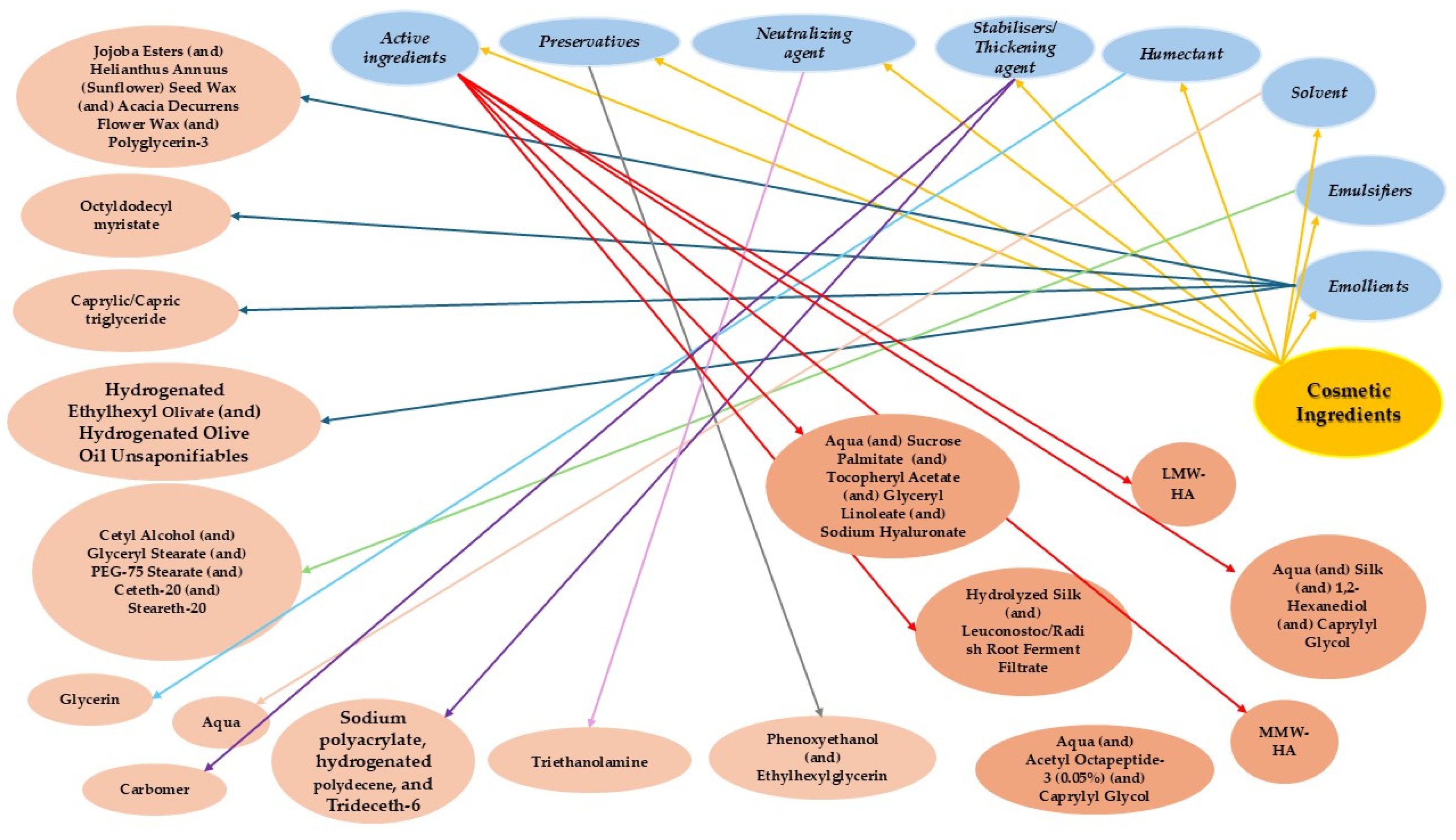
2.1. Selection of Cosmetic Ingredients and Actives for HA and Silk-Based Anti-Ageing Formulation Development
2.2. Physicochemical and Microbiological Assessment of HA- and Silk-Based Anti-Ageing Cream for Quality Control
2.2.1. Comprehensive Stability Testing and Physicochemical Profiling of the Formulated Anti-Ageing Cream
2.2.2. Microbial Safety and Challenge Test Evaluation of the Developed Formulation
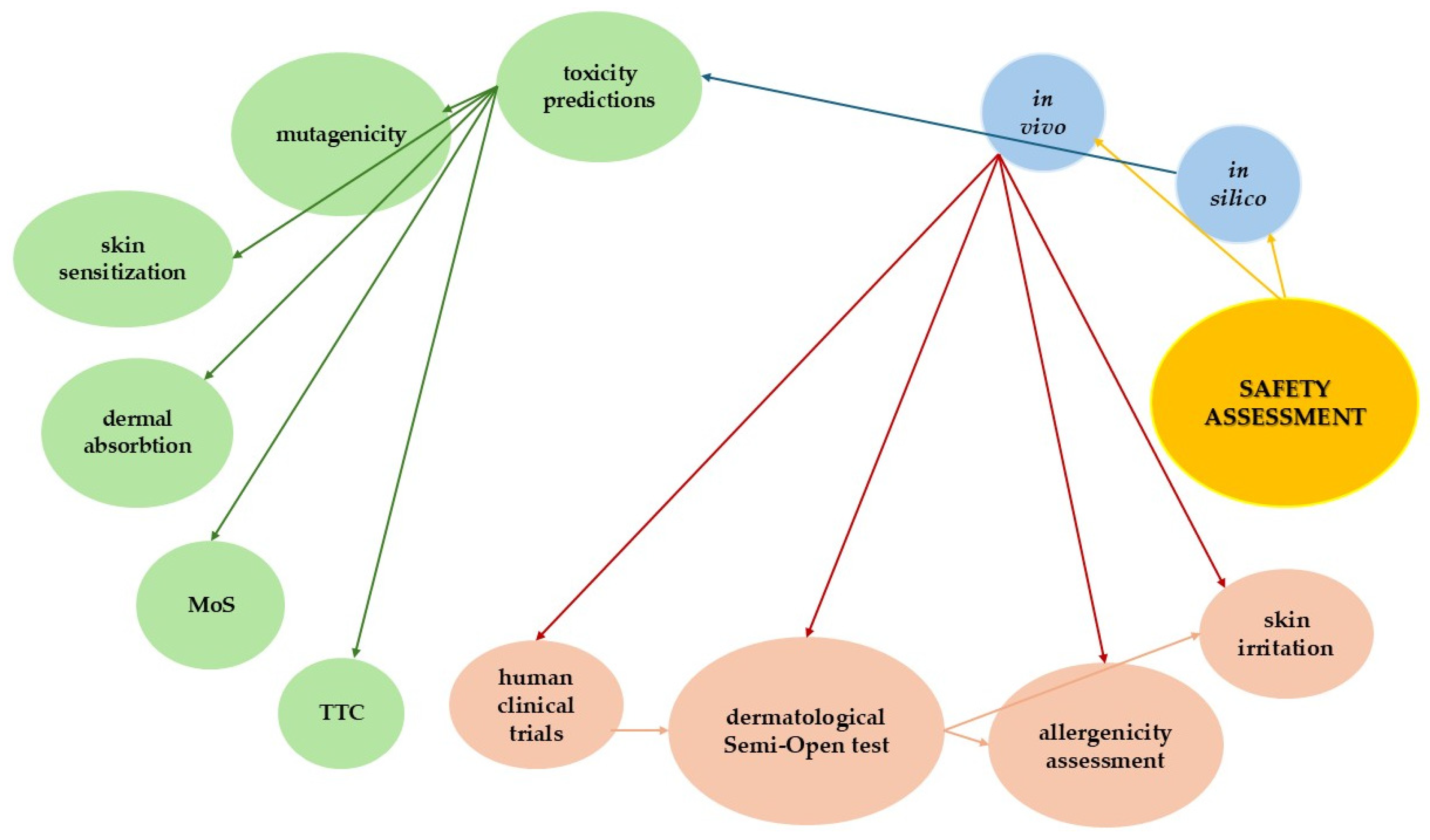
2.3. In Silico and Clinical Assessment of the Safety Profile of the Developed Anti-Ageing Cream
2.3.1. Safety Evaluation and Risk Assessment of Cosmetic Ingredients in the Novel Formulation Using In Silico Approaches
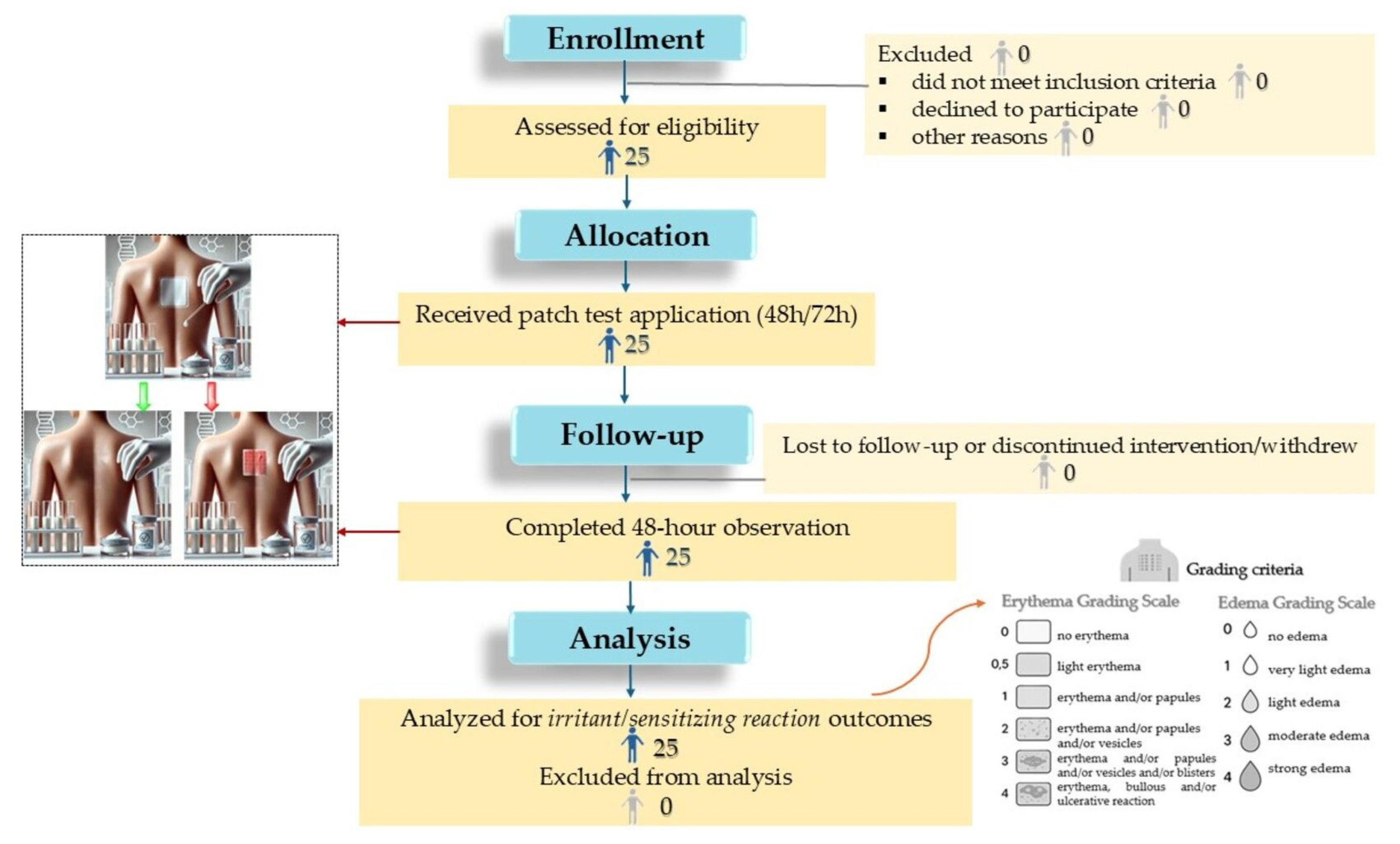
2.3.2. HA and Silk-Based Anti-Ageing Cream Skin Tolerance—Dermatological Semi-Open Test
3. Discussion
4. Materials and Methods
4.1. Selection of Cosmetic Ingredients and Actives for Anti-Aging Formulation Development
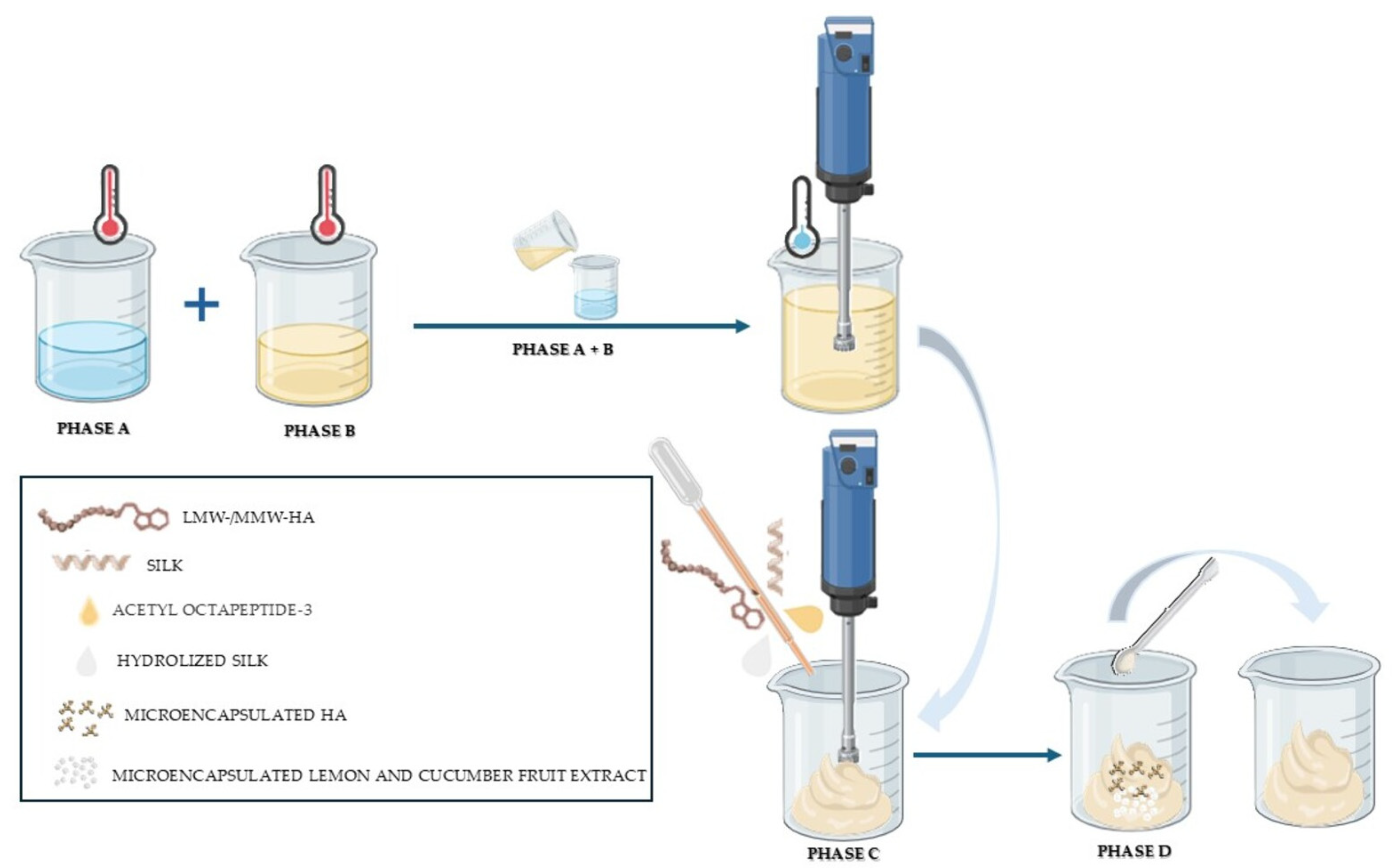
4.2. Formulation Design, Composition and Manufacturing Process of the HA and Silk-Based Anti-Ageing Cream
- (i)
- phase preparation (Phase A and Phase B):
- (ii)
- Emulsification (Phase A + Phase B):
- (iii)
- cooling and active ingredients addition (Phase C):
- (iv)
- final homogenization (Phase D):
4.3. Quality Assessment of the HA and Silk-Based Anti-Ageing Cream: Physicochemical and Microbiological Perspective
4.3.1. Evaluation of the Stability Profile of the Cosmetic Formulation
4.3.2. Assessment of Key Physicochemical Parameters of the Cosmetic Formulation
4.3.3. Evaluation of Microbiological Quality of Cosmetic Formulation and Preservative Efficacy
- (i)
- Microbiological analysis: this test was carried out according to ISO standards to determine the total aerobic mesophilic bacteria count (SR EN ISO 21149:2017 [98]), yeast and mould counts (SR EN ISO 16212:2017 [99]), and the presence of key pathogens, following microorganisms being specifically monitored: Staphylococcus aureus detection (SR EN ISO 22718:2016 [100]), Candida albicans detection (SR EN ISO 18416:2016 [101]), Escherichia coli detection (SR EN ISO 21150:2016 [102]), and Pseudomonas aeruginosa detection (SR EN ISO 22717:2016 [103]).
- (ii)
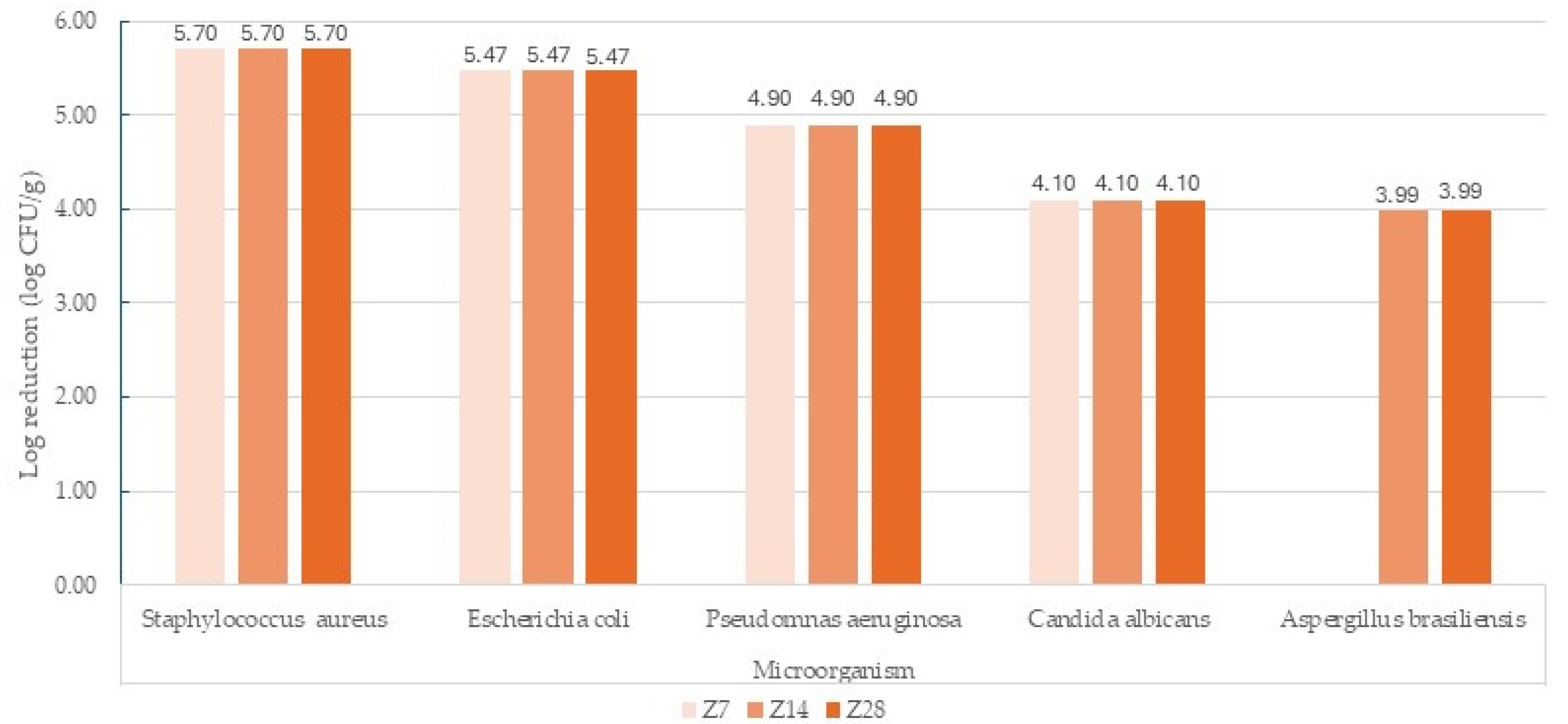
- Preservative Efficacy Test (Challenge Test): This critical test evaluated the ability of the formulation’s preservative system (Phenoxyethanol and Ethylhexylglycerin) to inhibit microbial growth during product usage and storage. Conducted per PN EN ISO 11930:2012 standards [104], this 28-day test involved intentionally contaminating the developed cream with a specific concentration of microorganisms and then monitoring microbial reduction over time [48,52].
4.4. Integrated Safety Evaluation of the Anti-Ageing Cream via In Silico and Clinical Approaches
4.4.1. Predictive In Silico Evaluation of Cosmetic Ingredient Safety and Risk Assessment in the Developed Anti-Ageing Cream
4.4.2. Dermatological Safety Evaluation of the Developed HA and Silk-Based Anti-Ageing Cream
5. Conclusions
Supplementary Materials
Author Contributions
Funding
Institutional Review Board Statement
Informed Consent Statement
Data Availability Statement
Acknowledgments
Conflicts of Interest
References
- Regulation (EC) No 1223/2009 of the European Parliament and of the Council of 30 November 2009 on Cosmetic Products. 2009. Available online: https://eur-lex.europa.eu/legal-content/EN/TXT/PDF/?uri=CELEX:32013R0655 (accessed on 17 February 2025).
- Loh, X.J.; Zheng, Y.J. Natural Rheological Modifiers for Personal Care. In Polymers for Personal Care Products and Cosmetics; Loh, X.J., Ed.; Royal Society Of Chemistry: Cambridge, UK, 2016; pp. 60–89. [Google Scholar]
- Juncan, A.M.; Fetea, F.; Socaciu, C. Application of Fourier Transform Infrared Spectroscopy for the Characterization of Sustainable Cosmetics and Ingredients with Antioxidant Potential. Environ. Eng. Manag. J. 2014, 13, 105–113. [Google Scholar] [CrossRef]
- Juncan, A.M.; Hodisan, T. Determination of Synthetic and Natural Antioxidants in Cosmetic Preparations by Solid-Phase Extraction and Subsequent Gas and High Performance Liquid Chromatographic Analysis. Rev. Chim. 2011, 62, 415–419. [Google Scholar]
- Patil, A.; Ferritto, M.S. Polymers for Personal Care and Cosmetics:Overview. In Polymers for Personal Care and Cosmetics; Patil, A., Ferritto, M.S., Eds.; ACS Symposium Series; American Chemical Society: Washington, DC, USA, 2013; Volume 1148, pp. 3–11. [Google Scholar]
- Alves, T.F.R.; Morsink, M.; Batain, F.; Chaud, M.V.; Almeida, T.; Fernandes, D.A.; da Silva, C.F.; Souto, E.B.; Severino, P. Applications of Natural, Semi-Synthetic, and Synthetic Polymers in Cosmetic Formulations. Cosmetics 2020, 7, 75. [Google Scholar] [CrossRef]
- Kouhi, M.; Prabhakaran, M.P.; Ramakrishna, S. Edible Polymers: An Insight into Its Application in Food, Biomedicine and Cosmetics. Trends Food Sci. Technol. 2020, 103, 248–263. [Google Scholar] [CrossRef]
- Mendoza-Muñoz, N.; Leyva-Gómez, G.; Piñón-Segundo, E.; Zambrano-Zaragoza, M.L.; Quintanar-Guerrero, D.; Del Prado Audelo, M.L.; Urbán-Morlán, Z. Trends in Biopolymer Science Applied to Cosmetics. Int. J. Cosmet. Sci. 2023, 45, 699–724. [Google Scholar] [CrossRef]
- Morganti, P.; Morganti, G.; Coltelli, M.B. Natural Polymers and Cosmeceuticals for a Healthy and Circular Life: The Examples of Chitin, Chitosan, and Lignin. Cosmetics 2023, 10, 42. [Google Scholar] [CrossRef]
- Tafuro, G.; Costantini, A.; Baratto, G.; Francescato, S.; Busata, L.; Semenzato, A. Characterization of Polysaccharidic Associations for Cosmetic Use: Rheology and Texture Analysis. Cosmetics 2021, 8, 60. [Google Scholar] [CrossRef]
- Gawade, R.P.; Chinke, S.L.; Alegaonkar, P.S. Polymers in Cosmetics. In Polymer Science and Innovative Applications: Materials, Techniques, and Future Developments; Elsevier: Amsterdam, The Netherlands, 2020; pp. 545–565. ISBN 9780128168080. [Google Scholar]
- Tinoco, A.; Martins, M.; Cavaco-Paulo, A.; Ribeiro, A. Biotechnology of Functional Proteins and Peptides for Hair Cosmetic Formulations. Trends Biotechnol. 2022, 40, 591–605. [Google Scholar] [CrossRef]
- Zappelli, C.; Barbulova, A.; Apone, F.; Colucci, G. Effective Active Ingredients Obtained through Biotechnology. Cosmetics 2016, 3, 39. [Google Scholar] [CrossRef]
- Goyal, N.; Jerold, F. Biocosmetics: Technological Advances and Future Outlook. Environ. Sci. Pollut. Res. 2023, 30, 25148–25169. [Google Scholar] [CrossRef]
- Gomes, C.; Silva, A.C.; Marques, A.C.; Lobo, J.S.; Amaral, M.H. Biotechnology Applied to Cosmetics and Aesthetic Medicines. Cosmetics 2020, 7, 33. [Google Scholar] [CrossRef]
- Barcelos, M.C.S.; Lupki, F.B.; Campolina, G.A.; Nelson, D.L.; Molina, G. The Colors of Biotechnology: General Overview and Developments of White, Green and Blue Areas 1. FEMS Microbiol Lett. 2018, 365, fny239. [Google Scholar] [CrossRef] [PubMed]
- Kafarski, P. Rainbow Code of Biotechnology. CHEMIK 2012, 8, 811–816. [Google Scholar]
- Sasounian, R.; Martinez, R.M.; Lopes, A.M.; Giarolla, J.; Rosado, C.; Magalhães, W.V.; Velasco, M.V.R.; Baby, A.R. Innovative Approaches to an Eco-Friendly Cosmetic Industry: A Review of Sustainable Ingredients. Clean Technol. 2024, 6, 176–198. [Google Scholar] [CrossRef]
- Villa, C. Green Cosmetic Ingredients and Processes. In Analysis of Cosmetic Products, 2nd ed.; Elsevier: Amsterdam, The Netherlands, 2018; pp. 303–330. ISBN 9780444635167. [Google Scholar]
- Nhani, G.B.B.; Di Filippo, L.D.; de Paula, G.A.; Mantovanelli, V.R.; da Fonseca, P.P.; Tashiro, F.M.; Monteiro, D.C.; Fonseca-Santos, B.; Duarte, J.L.; Chorilli, M. High-Tech Sustainable Beauty: Exploring Nanotechnology for the Development of Cosmetics Using Plant and Animal By-Products. Cosmetics 2024, 11, 112. [Google Scholar] [CrossRef]
- Aneklaphakij, C.; Chamnanpuen, P.; Bunsupa, S.; Satitpatipan, V. Recent Green Technologies in Natural Stilbenoids Production and Extraction: The Next Chapter in the Cosmetic Industry. Cosmetics 2022, 9, 91. [Google Scholar] [CrossRef]
- Bouzroud, S.; El Maaiden, E.; Sobeh, M.; Merghoub, N.; Boukcim, H.; Kouisni, L.; El Kharrassi, Y. Biotechnological Approaches to Producing Natural Antioxidants: Anti-Ageing and Skin Longevity Prospects. Int. J. Mol. Sci. 2023, 24, 1397. [Google Scholar] [CrossRef]
- Siahaan, E.A.; Agusman; Pangestuti, R.; Shin, K.H.; Kim, S.K. Potential Cosmetic Active Ingredients Derived from Marine By-Products. Mar. Drugs 2022, 20, 734. [Google Scholar] [CrossRef]
- Costa, J.P.; Custódio, L.; Reis, C.P. Exploring the Potential of Using Marine-Derived Ingredients: From the Extraction to Cutting-Edge Cosmetics. Mar. Drugs 2023, 21, 620. [Google Scholar] [CrossRef]
- Maldonado-Ruiz, K.; Pedroza-Islas, R.; Pedraza-Segura, L. Blue Biotechnology: Marine Bacteria Bioproducts. Microorganisms 2024, 12, 697. [Google Scholar] [CrossRef]
- Anestopoulos, I.; Kiousi, D.E.; Klavaris, A.; Maijo, M.; Serpico, A.; Suarez, A.; Sanchez, G.; Salek, K.; Chasapi, S.A.; Zompra, A.A.; et al. Marine--derived Surface Active Agents: Health—Promoting Properties and Blue Biotechnology--based Applications. Biomolecules 2020, 10, 885. [Google Scholar] [CrossRef]
- Sajna, K.V.; Gottumukkala, L.D.; Sukumaran, R.K.; Pandey, A. White Biotechnology in Cosmetics. In Industrial Biorefineries and White Biotechnology; Elsevier: Amsterdam, The Netherlands, 2015; pp. 607–652. ISBN 9780444634535. [Google Scholar]
- Karami, M.; Shahraky, M.K.; Ranjbar, M.; Tabandeh, F.; Morshedi, D.; Aminzade, S. Preparation, Purification, and Characterization of Low-Molecular-Weight Hyaluronic Acid. Biotechnol. Lett. 2021, 43, 133–142. [Google Scholar] [CrossRef] [PubMed]
- Ucm, R.; Aem, M.; Lhb, Z.; Kumar, V.; Taherzadeh, M.J.; Garlapati, V.K.; Chandel, A.K. Comprehensive Review on Biotechnological Production of Hyaluronic Acid: Status, Innovation, Market and Applications. Bioengineered 2022, 13, 9645–9661. [Google Scholar] [CrossRef]
- Pérez-Morales, G.; Poggi-Varaldo, H.M.; Ponce-Noyola, T.; Pérez-Valdespino, A.; Curiel-Quesada, E.; Galíndez-Mayer, J.; Ruiz-Ordaz, N.; Sotelo-Navarro, P.X. A Review of the Production of Hyaluronic Acid in the Context of Its Integration into GBAER-Type Biorefineries. Fermentation 2024, 10, 305. [Google Scholar] [CrossRef]
- Liu, L.; Liu, Y.; Li, J.; Du, G.; Chen, J. Microbial Production of Hyaluronic Acid: Current State, Challenges, and Perspectives. Microb. Cell Factories 2011, 10, 99. [Google Scholar] [CrossRef]
- PrimalHyalTM 50_Givaudan. Available online: https://www.givaudan.com/fragrance-beauty/active-beauty/products/primalhyal-50 (accessed on 18 June 2025).
- Huang, L.; Shi, J.; Zhou, W.; Zhang, Q. Advances in Preparation and Properties of Regenerated Silk Fibroin. Int. J. Mol. Sci. 2023, 24, 13153. [Google Scholar] [CrossRef] [PubMed]
- Bitar, L.; Isella, B.; Bertella, F.; Bettker Vasconcelos, C.; Harings, J.; Kopp, A.; van der Meer, Y.; Vaughan, T.J.; Bortesi, L. Sustainable Bombyx Mori’s Silk Fibroin for Biomedical Applications as a Molecular Biotechnology Challenge: A Review. Int. J. Biol. Macromol. 2024, 264, 130374. [Google Scholar] [CrossRef]
- Silkgel_Givaudan. Available online: https://www.givaudan.com/fragrance-beauty/active-beauty/products/silkgel (accessed on 18 June 2025).
- Zhang, T.; Zhang, R.; Zhang, Y.; Kannan, P.R.; Li, Y.; Lv, Y.; Zhao, R.; Kong, X. Silk-Based Biomaterials for Tissue Engineering. Adv. Colloid. Interface Sci. 2025, 338, 103413. [Google Scholar] [CrossRef]
- Pérez-Rivero, C.; López-Gómez, J.P. Unlocking the Potential of Fermentation in Cosmetics: A Review. Fermentation 2023, 9, 463. [Google Scholar] [CrossRef]
- Li, D.; Wang, Y.; Zhu, S.; Hu, X.; Liang, R. Recombinant Fibrous Protein Biomaterials Meet Skin Tissue Engineering. Front. Bioeng. Biotechnol. 2024, 12, 1411550. [Google Scholar] [CrossRef]
- Papakonstantinou, E.; Roth, M.; Karakiulakis, G. Hyaluronic Acid: A Key Molecule in Skin Aging. Dermatoendocrinol 2012, 4, 253–258. [Google Scholar] [CrossRef] [PubMed]
- Galvez-Martin, P.; Soto-Fernandez, C.; Romero-Rueda, J.; Cabañas, J.; Torrent, A.; Castells, G.; Martinez-Puig, D. A Novel Hyaluronic Acid Matrix Ingredient with Regenerative, Anti-Aging and Antioxidant Capacity. Int. J. Mol. Sci. 2023, 24, 4774. [Google Scholar] [CrossRef] [PubMed]
- Qadir, J.; Islam, T. Potential of Silk Proteins in Cosmetics. J. Sci. Agric. 2024, 8, 79–87. [Google Scholar] [CrossRef]
- Rieger, M. Introduction to Cosmetic Emulsions and Emulsification; Published on behalf of the International Federation of Societies of Cosmetic Chemists by Micelle; Micelle Press: Weymouth, UK, 2010; Vol. Monograph No. 4. [Google Scholar]
- Dănilă, E.; Moldovan, Z.; Kaya, M.G.A.; Ghica, M.V. Formulation and Characterization of Some Oil in Water Cosmetic Emulsions Based on Collagen Hydrolysate and Vegetable Oils Mixtures. Pure Appl. Chem. 2019, 91, 1493–1507. [Google Scholar] [CrossRef]
- Loretz, L.J.; Bailey, J.E. CTFA Preservative Challenge and Stability Testing Survey—Cosmetics & Toiletries; The Cosmetic Toiletry and Fragrance Association (CTFA): Washington, DC, USA, 2007. [Google Scholar]
- Berkey, C.; Kanno, D.; Mehling, A.; Koch, J.P.; Eisfeld, W.; Dierker, M.; Bhattacharya, S.; Dauskardt, R.H. Emollient Structure and Chemical Functionality Effects on the Biomechanical Function of Human Stratum Corneum. Int. J. Cosmet. Sci. 2020, 42, 605–614. [Google Scholar] [CrossRef]
- Tian, Y.; Zhou, J.; He, C.; He, L.; Li, X.; Sui, H. The Formation, Stabilization and Separation of Oil–Water Emulsions: A Review. Processes 2022, 10, 738. [Google Scholar] [CrossRef]
- Madnani, N.; Deo, J.; Dalal, K.; Benjamin, B.; Murthy, V.V.; Hegde, R.; Shetty, T. Revitalizing the Skin: Exploring the Role of Barrier Repair Moisturizers. J. Cosmet. Dermatol 2024, 23, 1533–1540. [Google Scholar] [CrossRef]
- Juncan, A.M.; Morgovan, C.; Rus, L.L.; Loghin, F. Development and Evaluation of a Novel Anti-Ageing Cream Based on Hyaluronic Acid and Other Innovative Cosmetic Actives. Polymers 2023, 15, 4134. [Google Scholar] [CrossRef]
- Juncan, A.M.; Rus, L.L. Influence of Packaging and Stability Test Assessment of an Anti-Aging Cosmetic Cream. Mater. Plast. 2018, 55, 426–430. [Google Scholar] [CrossRef]
- Alnuqaydan, A.M. The Dark Side of Beauty: An in-Depth Analysis of the Health Hazards and Toxicological Impact of Synthetic Cosmetics and Personal Care Products. Front. Public Health 2024, 12, 1439027. [Google Scholar] [CrossRef]
- Barthe, M.; Bavoux, C.; Finot, F.; Mouche, I.; Cuceu-Petrenci, C.; Forreryd, A.; Hansson, A.C.; Johansson, H.; Lemkine, G.F.; Thénot, J.P.; et al. Safety Testing of Cosmetic Products: Overview of Established Methods and New Approach Methodologies (Nams). Cosmetics 2021, 8, 50. [Google Scholar] [CrossRef]
- Juncan, A.M.; Rus, L.L.; Morgovan, C.; Loghin, F. Evaluation of the Safety of Cosmetic Ingredients and Their Skin Compatibility through In Silico and In Vivo Assessments of a Newly Developed Eye Serum. Toxics 2024, 12, 451. [Google Scholar] [CrossRef] [PubMed]
- Walker, A.P.; Basketter, D.A.; Baverel, M.; Diembeck, W.; Matthies, W.; Mougin, D.; Paye, M.; Rothlisberger, R.; Dupuis, J. Test Guidelines for Assessment of Skin Compatibility of Cosmetic Finished Products in Man. Food Chem. Toxicol. 1996, 34, 651–660. [Google Scholar] [CrossRef] [PubMed]
- Jojoba Esters (and) Helianthus Annuus (Sunflower) Seed Wax (and) Acacia Decurrens Flower Wax (and) Polyglycerin-3 ACTICIRE MB. Available online: https://www.ulprospector.com/documents/1520629.pdf?bs=3983&b=719008&st=1&sl=149104681&crit=a2V5d29yZDpbQUNUSUNJUkVd&k=ACTICIRE&r=eu&ind=personalcare (accessed on 16 February 2025).
- Octyldodecyl Myristate MOD MB. Available online: https://www.ulprospector.com/documents/1395526.pdf?bs=3983&b=588277&st=1&sl=149105263&crit=a2V5d29yZDpbTU9EIE1CXQ%3d%3d&k=MOD|MB&r=eu&ind=personalcare (accessed on 16 February 2025).
- Huber, P.; Reinau, D.; Brodard, Z.; Meier, C.R.; Surber, C. How to Choose an Emollient? Pharmaceutical and Sensory Attributes for Product Selection. Skin. Pharmacol. Physiol. 2025, 38, 1–9. [Google Scholar] [CrossRef]
- Caprylic/Capric Triglyceride LABRAFAC CC. Available online: https://www.ulprospector.com/documents/1395523.pdf?bs=3983&b=588276&st=1&sl=149105203&crit=a2V5d29yZDpbTGFicmFmYWMgQ0Nd&k=Labrafac|CC&r=eu&ind=personalcare (accessed on 16 February 2025).
- Fiume, M.M.; Bergfeld, W.F.; Belsito, D.V.; Hill, R.A.; Klaassen, C.D.; Liebler, D.C.; Marks, J.G.; Shank, R.C.; Slaga, T.J.; Snyder, P.W.; et al. Amended Safety Assessment of Triglycerides as Used in Cosmetics. Int. J. Toxicol. 2022, 41, 22–68. [Google Scholar] [CrossRef]
- Hydrogenated Ethylhexyl Olivate (and) Hydrogenated Olive Oil Unsaponifiables SOFTOLIVE. Available online: https://www.ulprospector.com/documents/1597710.pdf?bs=830&b=724179&st=1&sl=149105673&crit=a2V5d29yZDpbU29mdG9saXZlXQ%3d%3d&k=Softolive&r=eu&ind=personalcare (accessed on 16 February 2025).
- Burnett, C.L.; Fiume, M.M.; Bergfeld, W.F.; Belsito, D.V.; Hill, R.A.; Klaassen, C.D.; Liebler, D.; Marks, J.G.; Shank, R.C.; Slaga, T.J.; et al. Safety Assessment of Plant-Derived Fatty Acid Oils. Int. J. Toxicol. 2017, 36, 51S–129S. [Google Scholar] [CrossRef]
- Cetyl Alcohol (and) Glyceryl Stearate (and) PEG-75 Stearate (and) Ceteth-20 (and) Steareth-20 EMULIUM DELTA MB. Available online: https://www.ulprospector.com/documents/1520632.pdf?bs=3983&b=719010&st=1&sl=149105458&crit=a2V5d29yZDpbRW11bGl1bcKuIERlbHRhIE1CXQ%3d%3d&k=Emulium%c2%ae|Delta|MB&r=eu&ind=personalcare (accessed on 16 February 2025).
- Chen, H.J.; Lee, P.Y.; Chen, C.Y.; Huang, S.L.; Huang, B.W.; Dai, F.J.; Chau, C.F.; Chen, C.S.; Lin, Y.S. Moisture Retention of Glycerin Solutions with Various Concentrations: A Comparative Study. Sci. Rep. 2022, 12, 10232. [Google Scholar] [CrossRef]
- Becker, L.C.; Bergfeld, W.F.; Belsito, D.V.; Hill, R.A.; Klaassen, C.D.; Liebler, D.C.; Marks, J.G.; Shank, R.C.; Slaga, T.J.; Snyder, P.W.; et al. Safety Assessment of Glycerin as Used in Cosmetics. Int. J. Toxicol. 2019, 38, 6S–22S. [Google Scholar] [CrossRef]
- Carbomer Carbopol®®®®®® ETD 2050. Available online: https://www.ulprospector.com/documents/1172655.pdf?bs=77&b=3755&st=1&sl=149106076&crit=a2V5d29yZDpbQ2FyYm9wb2zCriBFVEQgMjA1MF0%3d&k=Carbopol%c2%ae|ETD|2050&r=eu&ind=personalcare (accessed on 16 February 2025).
- Bergfeld, W.F.; Donald, F.A.C.P.; Belsito, V.; Hill, R.A.; Klaassen, C.D.; Liebler, D.C.; Marks, J.G.; Shank, R.C.; Slaga, T.J.; Snyder, P.W.; et al. Amended Safety Assessment of Acrylates Copolymers as Used in Cosmetics; Cosmetic Ingredient Review; CIR: Washingtone, DC, USA, 2019. [Google Scholar]
- Castelain, F.; Kerre, S.; Carlet, C.; Goossens, A.; Girardin, P.; Pelletier, F.; Aubin, F. Allergic Contact Dermatitis from Carbomers: Two Case Report. Contact Dermat. 2020, 83, 326–328. [Google Scholar] [CrossRef]
- Rozman, U.; Kalčíková, G. The First Comprehensive Study Evaluating the Ecotoxicity and Biodegradability of Water-Soluble Polymers Used in Personal Care Products and Cosmetics. Ecotoxicol. Environ. Saf. 2021, 228, 113016. [Google Scholar] [CrossRef]
- Shin, K.O.; Lee, Y.M. Simultaneous Analysis of Mono-, Di-, and Tri-Ethanolamine in Cosmetic Products Using Liquid Chromatography Coupled Tandem Mass Spectrometry. Arch. Pharm. Res. 2016, 39, 66–72. [Google Scholar] [CrossRef] [PubMed]
- Fiume, M.M.; Heldreth, B.; Bergfeld, W.F.; Belsito, D.V.; Hill, R.A.; Klaassen, C.D.; Liebler, D.; Marks, J.G.; Shank, R.C.; Slaga, T.J.; et al. Safety Assessment of Triethanolamine and Triethanolamine-Containing Ingredients as Used in Cosmetics. Int. J. Toxicol. 2013, 32, 59S–83S. [Google Scholar] [CrossRef] [PubMed]
- Chen, T.; Chang, H. Deciphering Trends in Replacing Preservatives in Cosmetics Intended for Infants and Sensitive Population. Sci. Rep. 2024, 14, 19053. [Google Scholar] [CrossRef] [PubMed]
- Phenoxyethanol (and) Ethylhexylglycerin Euxyl PE 9010 Preservative. Available online: https://www.ulprospector.com/en/eu/PersonalCare/Detail/33934/1318586/euxyl-PE-9010?st=1&sl=359373241&crit=a2V5d29yZDpbRXV4eWwgUEUg (accessed on 19 February 2025).
- Radrezza, S.; Aiello, G.; Baron, G.; Aldini, G.; Carini, M.; D’amato, A. Integratomics of Human Dermal Fibroblasts Treated with Low Molecular Weight Hyaluronic Acid. Molecules 2021, 26, 5096. [Google Scholar] [CrossRef]
- Essendoubi, M.; Gobinet, C.; Reynaud, R.; Angiboust, J.F.; Manfait, M.; Piot, O. Human Skin Penetration of Hyaluronic Acid of Different Molecular Weights as Probed by Raman Spectroscopy. Skin. Res. Technol. 2016, 22, 55–62. [Google Scholar] [CrossRef]
- Juncan, A.M.; Moisă, D.G.; Santini, A.; Morgovan, C.; Rus, L.L.; Vonica-Țincu, A.L.; Loghin, F. Advantages of Hyaluronic Acid and Its Combination with Other Bioactive Ingredients in Cosmeceuticals. Molecules 2021, 26, 4429. [Google Scholar] [CrossRef]
- Hydrolyzed Hyaluronic Acid PRIMALHYAL 300. Available online: https://www.ulprospector.com/documents/1597712.pdf?bs=830&b=724176&st=1&sl=149148732&crit=a2V5d29yZDpbUHJpbWFsSHlhbOKEoiAzMDBd&k=PrimalHyal%e2%84%a2|300&r=eu&ind=personalcare (accessed on 19 February 2025).
- Mannitol Cellulose Calcium Sodium Borosilicate CI 77492 (US: Iron Oxides) Silica CI 77891 (US: Titanium Dioxide) CI 77480 (Gold) Tin Oxide Hydroxypropyl Methylcellulose HYALUSPHERE PF. Available online: https://www.ulprospector.com/documents/1597711.pdf?bs=830&b=724168&st=1&sl=149110383&crit=a2V5d29yZDpbSFlBTFVTUEhFUkVd&k=HYALUSPHERE&r=eu&ind=personalcare (accessed on 19 February 2025).
- Nanda, S.; Nanda, A.; Lohan, S.; Kaur, R.; Singh, B. Nanocosmetics: Performance enhancement and Safety Assurance. In Nanobiomaterials in Galenic Formulations and Cosmetics Applications of Nanobiomaterials; William Andrew: Norwich, NY, USA, 2016; pp. 47–67. ISBN 9780323428682. [Google Scholar]
- Lipotec SNAP-8TM. Available online: https://www.ulprospector.com/en/eu/PersonalCare/Detail/2316/67495/SNAP-8-peptide-solution-C?st=1&sl=500143112&crit=U05BUC044oSi&ss=2 (accessed on 5 August 2025).
- Errante, F.; Ledwoń, P.; Latajka, R.; Rovero, P.; Papini, A.M. Cosmeceutical Peptides in the Framework of Sustainable Wellness Economy. Front. Chem. 2020, 8, 572923. [Google Scholar] [CrossRef]
- Nguyen, T.T.M.; Yi, E.J.; Jin, X.; Zheng, Q.; Park, S.J.; Yi, G.S.; Yang, S.J.; Yi, T.H. Sustainable Dynamic Wrinkle Efficacy: Non-Invasive Peptides as the Future of Botox Alternatives. Cosmetics 2024, 11, 118. [Google Scholar] [CrossRef]
- Veiga, E.; Ferreira, L.; Correia, M.; Pires, P.C.; Hameed, H.; Araújo, A.R.T.S.; Cefali, L.C.; Mazzola, P.G.; Hamishehkar, H.; Veiga, F.; et al. Anti-Aging Peptides for Advanced Skincare: Focus on Nanodelivery Systems. J. Drug Deliv. Sci. Technol. 2023, 89, 105087. [Google Scholar] [CrossRef]
- Givaudan Flashwhite Unispheres®®. Available online: https://www.ulprospector.com/en/eu/PersonalCare/Detail/830/594872/Flashwhite-Unispheres?st=1&sl=500142730&crit=Rmxhc2h3aGl0ZSBVbmlzcGh (accessed on 5 August 2025).
- Klimek-szczykutowicz, M.; Szopa, A.; Ekiert, H. Citrus Limon (Lemon) Phenomenon—A Review of the Chemistry, Pharmacological Properties, Applications in the Modern Pharmaceutical, Food, and Cosmetics Industries, and Biotechnological Studies. Plants 2020, 9, 119. [Google Scholar] [CrossRef]
- Choi, H.Y.; Lee, Y.J.; Kim, C.M.; Lee, Y.M. Revolutionizing Cosmetic Ingredients: Harnessing the Power of Antioxidants, Probiotics, Plant Extracts, and Peptides in Personal and Skin Care Products. Cosmetics 2024, 11, 157. [Google Scholar] [CrossRef]
- Li, C.; Ma, H.; Li, P.; Zhang, S.; Xu, J.; Wang, L.; Sheng, W.; Xu, T.; Shen, L.; Wang, W.; et al. Cucumber (Cucumis sativus L.) with Heterologous Poly-γ-Glutamic Acid Has Skin Moisturizing, Whitening and Anti-Wrinkle Effects. Int. J. Biol. Macromol. 2024, 262, 130026. [Google Scholar] [CrossRef] [PubMed]
- CosIng-Cosmetics Ingredients. Available online: https://ec.europa.eu/growth/tools-databases/cosing/details/35851 (accessed on 5 August 2025).
- Bergfeld, F.A.C.P.; Donald, V.; Belsito, D.E.; Cohen, C.D.; Klaassen, A.E.; Rettie, D.; Ross, T.J.; Slaga, P.W.; Snyder, D.V.M.; Tilton, S.C. Expert Panel for Cosmetic Ingredient Safety. In Safety Assessment of Hyaluronates as Used in Cosmetics; Cosmetic Ingredient Review (CIR); Final Report: CIR: Washingotn, DC, USA, 2023. [Google Scholar]
- Johnson, W.; Bergfeld, W.F.; Belsito, D.V.; Hill, R.A.; Klaassen, C.D.; Liebler, D.C.; Marks, J.G.; Shank, R.C.; Slaga, T.J.; Snyder, P.W.; et al. Safety Assessment of Silk Protein Ingredients as Used in Cosmetics. Int. J. Toxicol. 2020, 39, 127S–144S. [Google Scholar] [CrossRef] [PubMed]
- Kundu, B.; Rajkhowa, R.; Kundu, S.C.; Wang, X. Silk Fibroin Biomaterials for Tissue Regenerations. Adv. Drug Deliv. Rev. 2013, 65, 457–470. [Google Scholar] [CrossRef]
- Louiselle, A.E.; Niemiec, S.; Azeltine, M.; Mundra, L.; French, B.; Zgheib, C.; Liechty, K.W. Evaluation of Skin Care Concerns and Patient’s Perception of the Effect of NanoSilk Cream on Facial Skin. J. Cosmet. Dermatol 2022, 21, 1075–1085. [Google Scholar] [CrossRef] [PubMed]
- Li, S.; Chen, H.; Dan, X.; Ju, Y.; Li, T.; Liu, B.; Li, Y.; Lei, L.; Fan, X. Silk Fibroin for Cosmetic Dermatology. Chem. Eng. J. 2025, 506, 159986. [Google Scholar] [CrossRef]
- Silva, A.S.; Costa, E.C.; Reis, S.; Spencer, C.; Calhelha, R.C.; Miguel, S.P.; Ribeiro, M.P.; Barros, L.; Vaz, J.A.; Coutinho, P. Silk Sericin: A Promising Sustainable Biomaterial for Biomedical and Pharmaceutical Applications. Polymers 2022, 14, 4931. [Google Scholar] [CrossRef]
- Cosmetics Europe. Guidelines on Stability Testing of Cosmetic Products. 2004. Available online: https://cosmeticseurope.eu/resources/guidelines-on-stability-testing-of-cosmetics-ce-ctfa-2004/ (accessed on 15 June 2025).
- ISO/TR:18811; Cosmetics-Guidelines on the Stability Testing of Cosmetic Products. ISO: Geneva, Switzerland, 2018.
- Juncan, A.M. Packaging Evaluation and Safety Assessment of a Cosmetic Product. Mater. Plast. 2018, 55, 644–647. [Google Scholar] [CrossRef]
- Eixarch, H.; Andrew, D. The Safety Assessment of Cosmetic Products. Pers. Care 2018, 4, 13–16. [Google Scholar]
- ISO 6658:2005; Sensory Analysis—Methodology—General Guidance. ISO: Geneva, Switzerland, 2005.
- ISO 21149:2017; Cosmetics—Microbiology—Enumeration and Detection of Aerobic Mesophilic Bacteria. ISO: Geneva, Switzerland, 2017.
- ISO 16212:2017; Cosmetics—Microbiology—Enumeration of Yeast and Mould. ISO: Geneva, Switzerland, 2017.
- ISO 22718:2016; Cosmetics—Microbiology—Detection of Staphylococcus Aureus. ISO: Geneva, Switzerland, 2016.
- ISO 18416:2016; Cosmetics—Microbiology—Detection of Candida Albicans. ISO: Geneva, Switzerland, 2016.
- ISO 21150:2016; Cosmetics—Microbiology—Detection of Escherichia Coli. ISO: Geneva, Switzerland, 2016.
- ISO 22717:2016; Cosmetics—Microbiology—Detection of Pseudomonas Aeruginosa. ISO: Geneva, Switzerland, 2016.
- ISO 11930:2012; Cosmetics—Microbiology—Evaluation of the Antimicrobial Protection of a Cosmetic Product. ISO: Geneva, Switzerland, 2012.
- SpheraCosmolife: New Software Specific for Risk Assessment of Cosmetic Products. Available online: https://www.vegahub.eu/portfolio-item/vermeer-cosmolife/ (accessed on 21 June 2025).
- Scientific Committee on Consumer Safety. The SCCS Notes of Guidance for the Testing of Cosmetic Ingredients and Their Safety Evaluation, 12th ed.; SCCS: Brussels, Belgium, 2023. [Google Scholar]
- Selvestrel, G.; Robino, F.; Baderna, D.; Manganelli, S.; Asturiol, D.; Manganaro, A.; Russo, M.Z.; Lavado, G.; Toma, C.; Roncaglioni, A.; et al. SpheraCosmolife: A New Tool for the Risk Assessment of Cosmetic Products. Altex 2021, 38, 565–579. [Google Scholar] [CrossRef]
- Cosmetics Europe. Product Test Guidelines for the Assessment of Human Skin Compatibility. 1997. Available online: https://cosmeticseurope.eu/resources/guidelines-for-assessment-of-skin-tolerance-of-potentially-irritant-cosmetic-ingredients-1997 (accessed on 15 June 2025).



| Commercial Name | INCI | Function | Supplier | INCI-KEY * (%) |
|---|---|---|---|---|
| Acticire MB | Jojoba Esters, Helianthus Annuus (Sunflower) Seed Wax (and) Acacia Decurrens Flower Wax, and Polyglycerin-3 | emollient | Gattefossé (Saint-Priest, France) | E |
| MOD MB | Octyldodecyl Myristate | emollient | Gattefossé (Saint-Priest, France) | E |
| Labrafac CC | Caprylic/Capric Triglyceride | emollient | Gattefossé (Saint-Priest, France) | E |
| Softolive | Hydrogenated Ethylhexyl Olivate (and) Hydrogenated Olive Oil Unsaponifiables | emollient | Givaudan Active Beauty | E |
| Emulium Delta MB | Cetyl Alcohol (and) Glyceryl Stearate (and) PEG-75 Stearate (and) Ceteth-20 (and) Steareth-2 | emulsifier | Gattefossé (Saint-Priest, France) | E |
| Aqua | Water | solvent | A | |
| Glycerol | Glycerin | denaturant/humectant/solvent | Elton (Ilfov, Romania) | E |
| TEA | Triethanolamine | buffering agent | Elton (Ilfov, Romania) | F |
| Carbopol ETD 2050 | Carbomer | emulsion stabilizing/viscosity controlling/gel forming | Lubrizol (Cleveland, OH, USA) | F |
| Euxyl PE 9010 | Phenoxyethanol and Ethylhexylglycerin | preservative | Schülke & Mayr GmbH (Norderstedt, Germany) | F |
| Rapithix A-60 | Sodium Polyacrylate, Hydrogenated Polydecene, and Trideceth-6 | viscosity controlling/binding/film forming | Ashland (Ashland, OR, USA) | F |
| Silkgel Neo | Water/Silk/1,2-Hexanediol/ Caprylyl Glycol | skin conditioning/bulking | Givaudan Active Beauty (Argenteuil, France) | D |
| PrimalHyal™ 50 | Hydrolysed Hyaluronic Acid | antistatic/humectant/skin conditioning/anti-ageing | Givaudan Active Beauty (Argenteuil, France) | F |
| PrimalHyal™ 300 | Hydrolysed Hyaluronic Acid | antistatic/humectant/skin conditioning/moisturizing | Givaudan Active Beauty (Argenteuil, France) | F |
| Hyalusphere PF | Aqua, Sucrose Palmitate, Tocopheryl Acetate, Glyceryl Linoleate, Sodium Hyaluronate, Phenoxyethanol, Potassium Sorbate, and Citric Acid | active ingredient/anti-wrinkle | Givaudan Active Beauty (Argenteuil, France) | E |
| SNAP-8 | Aqua, Acetyl Octapeptide-3 (0.05%), Caprylyl Glycol | active ingredient/skin conditioning/anti-ageing | Lipotec (Barcelona, Spain) | E |
| AC Silk Hydrolysate PF | Hydrolyzed Silk | skin conditioning/hydrating/film forming | Active Concepts (Bareggio (MI), Italy) | D |
| FLASHWHITE UNISPHERES WVRM-716SP/Unispheres F00M-508L | Mannitol/Cellulose/CI 77891 (US: Titanium Dioxide)/Propylene Glycol/Citrus Limon (Lemon) Fruit Extract/Cucumis Sativus (Cucumber) Fruit Extract/Hydrogenated Castor Oil/Glyceryl Stearate Citrate/Decyl Glucoside/Hydroxypropyl Methylcellulose | active ingredient/whitening effect | Givaudan (Kemptthal, Switzerland) | E |
| Luminating Skin Care Eco-Boost HICC MOD | Perfume | deodorant/masking | CPL (Bishop’s Stortford, UK) | G |
| Parameter | Unit | Result | ||
|---|---|---|---|---|
| Initial | After 30 Days | After 24 Month | ||
| Viscosity at 20 °C (Brookfield DV-III Ultra) | mPa·s | 4588 ± 47 | 6047 ± 65 | 7023 ± 68 |
| Density at 20 °C (PB-155 ed. I of 02.05.2012) | g/cm3 | 0.955 ± 0.003 | 0.981 ± 0.003 | 0.998 ± 0.003 |
| Organoleptic testing (ISO 6658:2005 p. 5.4.2) | ||||
| Appearance | emulsion | emulsion | emulsion | |
| Colour | white | white | white | |
| Odor | specific of the used raw materials | characteristic of the used raw materials | characteristic of the used raw materials | |
| Consistency | homogeneous emulsion without visible mechanical impurities | homogeneous emulsion without visible mechanical impurities | homogeneous emulsion without visible mechanical impurities | |
| pH (PB-234 ed. I of 03.10.2013r.) | 5.3 ± 0.2 | 5.3 ± 0.2 | 5.2 ± 0.2 | |
| Images of the cream corresponding to each time point |  |  |  | |
| Parameter | ISO Standard | Result (CFU/g) | Permissible Limits (CFU/g) | Concordance |
|---|---|---|---|---|
| Enumeration and detection of aerobic mesophilic bacteria | 21149:2017 | <10 | <100 | √ |
| Yeast and mould count | 16212:2017 | <10 | <10 | √ |
| Staphylococcus aureus detection | 22718:2016 | absent | absent | √ |
| Candida albicans detection | 18416:2016 | absent | absent | √ |
| Escherichia coli detection | 21150:2016 | absent | absent | √ |
| Pseudomonas aeruginosa detection | 22717:2016 | absent | absent | √ |
| Ingredient Id | CAS | INCI | Conc. % | Annex | Mutagenicity | Skin Sensitization | Dermal Abs. | MoS | TTC |
|---|---|---|---|---|---|---|---|---|---|
| Jojoba Esters | 68953 | Jojoba Esters | 3.75 | - | - | - | - | - | |
| Helianthus Annuus (Sunflower) Seed Wax | 8001-21-6 | Helianthus Annuus (Sunflower) Seed Wax | 0.5 | - | - | - | - | - | |
| Acacia Decurrens Flower Wax | 98903-76-5 | Acacia Decurrens Flower Wax | 0.05 | - | - | - | - | - | |
| Polyglycerin-3 | 25618-55-7 | Polyglycerin-3 | 0.05 | - | NON-Mutagen (experimental value) | NON-sensitizer (experimental value) | 80% | 26,725.35 | 0.046 mg/kg bw/day |
| Octyldodecyl Myristate | 22766-83-2 | Octyldodecyl Myristate | 2.0 | - | NON-Mutagen (good reliability) | Sensitizer (low reliability) | 80% | 672.56 | 0.046 mg/kg bw/day |
| Caprylic/Capric Triglyceride | 65381-09-1 | Caprylic/Capric Triglyceride | 4.0 | - | - | - | - | - | |
| Hydrogenated Ethylhexyl Olivate | 22047-49-0 | Hydrogenated Ethylhexyl Olivate | 1.0 | - | - | - | - | - | |
| Hydrogenated Olive Oil Unsaponifiables | 111-01-3 | Hydrogenated Olive Oil Unsaponifiables | 0.5 | - | NON-Mutagen (good reliability) | Sensitizer (low reliability) | 40% | 1303.44 | 0.046 mg/kg bw/day |
| Cetyl Alcohol | 36653-82-4 | Cetyl Alcohol | 1.5 | - | NON-Mutagen (good reliability) | Sensitizer (moderate reliability) | 40% | 6904.17 | 0.046 mg/kg bw/day |
| Glyceryl Stearate | 31566-31-1 | Glyceryl Stearate | 1.5 | - | NON-Mutagen (good reliability) | Sensitizer (good reliability) | 40% | 2994.48 | 0.046 mg/kg bw/day |
| PEG-75 Stearate | 9004-99-3 | PEG-75 Stearate | 0.75 | - | NON-Mutagen (good reliability) | Sensitizer (good reliability) | 40% | 3449.32 | 0.046 mg/kg bw/day |
| Ceteth-20/Steareth-20 | 68439-49-6 | Ceteth-20/Steareth-20 | 0.75 | - | - | - | - | - | |
| Deionized Water | 7732-18-5 | Aqua | 63.81 | - | - | - | - | - | |
| Glycerine | 56-81-5 | Glycerine | 3.0 | - | NON-Mutagen (experimental value) | NON-sensitizer (experimental value) | 80% | 445.42 | 0.046 mg/kg bw/day |
| Triethanolamine | 102-71-6 | Triethanolamine | 0.25 | III | NON-Mutagen (experimental value) | Sensitizer (low reliability) | 80% | 10,356.26 | 0.046 mg/kg bw/day |
| Carbomer | 9007-20-9 | Carbomer | 0.25 | - | NON-Mutagen (experimental value) | Sensitizer (moderate reliability) | 80% | 2236.95 | 0.0023 mg/kg bw/day |
| Phenoxyethanol | 122-99-6 | Phenoxyethanol | 0.9 | V | NON-Mutagen (experimental value) | NON-sensitizer (experimental value) | 80% | 460.28 | 0.046 mg/kg bw/day |
| Ethylhexylglycerin | 70445-33-9 | Ethylhexylglycerin | 0.1 | - | NON-Mutagen (good reliability) | NON-Sensitizer (low reliability) | 80% | 9737.47 | 0.0023 mg/kg bw/day |
| Sodium Polyacrylate | 9003-04-7 | Sodium Polyacrylate | 0.2 | - | - | - | - | - | |
| Hydrogenated Polydecene | 68037-01-4 | Hydrogenated Polydecene | 0.15 | - | NON-Mutagen (experimental value) | NON-Sensitizer (low reliability) | 40% | 2048.47 | 0.046 mg/kg bw/day |
| Trideceth-6 | 78330-21-9 | Trideceth-6 | 0.02 | - | NON-Mutagen (good reliability) | Sensitizer (moderate reliability) | 40% | 72,706.09 | 0.046 mg/kg bw/day |
| Silk | 1448438-65-0 | Silk | 0.24 | - | - | - | - | - | |
| 1,2-Hexanediol | 6920-22-5 | 1,2-Hexanediol | 0.1 | NON-Mutagen (good reliability) | NON-Sensitizer (moderate reliability) | 80% | 8623.14 | 0.0023 mg/kg bw/day | |
| Caprylyl Glycol | 1117-86-8 | Caprylyl Glycol | 0.14 | NON-Mutagen (good reliability) | Sensitizer (low reliability) | 80% | 6833.28 | 0.0023 mg/kg bw/day | |
| Hydrolysed Hyaluronic Acid | 9004-61-9 | Hydrolysed Hyaluronic Acid | 0.7 | - | NON-Mutagen (moderate reliability) | Sensitizer (low reliability) | 10% | 9,713,408.1 | 0.0023 mg/kg bw/day |
| Sucrose Palmitate | 26446-38-8 | Sucrose Palmitate | 0.75 | - | NON-Mutagen (good reliability) | Sensitizer (low reliability) | 10% | 241,475.28 | 0.0023 mg/kg bw/day |
| Tocopheryl Acetate | 7695-91-2 | Tocopheryl Acetate | 0.3 | - | NON-Mutagen (good reliability) | Sensitizer (moderate reliability) | 40% | 2746.13 | 0.0023 mg/kg bw/day |
| Glyceryl Linoleate | 2277-28-3 | Glyceryl Linoleate | 0.3 | - | NON-Mutagen (good reliability) | Sensitizer (good reliability) | 40% | 14,972.38 | 0.046 mg/kg bw/day |
| Sodium Hyaluronate | 9067-32-7 | Sodium Hyaluronate | 0.003 | - | - | - | - | - | |
| Potassium Sorbate | 24634-61-5 | Potassium Sorbate | 0.0015 | V | NON-Mutagen (experimental value) | Sensitizer (good reliability) | 40% | 3,452,085.06 | 0.046 mg/kg bw/day |
| Citric Acid | 77-92-9 | Citric Acid | 0.003 | - | NON-Mutagen (experimental value) | NON-Sensitizer (moderate reliability) | 80% | 225,838.86 | 0.046 mg/kg bw/day |
| Acetyl Octapeptide-3 | 868844-74-0 | Acetyl Octapeptide-3 | 0.0015 | - | - | - | - | - | |
| Hydrolyzed Silk | 96690-41-4 | Hydrolyzed Silk | 9.8 | - | - | - | - | - | |
| Leuconostoc/Radish Root Ferment Filtrate | 84775-94-0 | Leuconostoc/Radish Root Ferment Filtrate | 0.2 | - | - | - | - | - | |
| Mannitol | 69-65-8 | Mannitol | 1.5 | - | NON-Mutagen (experimental value) | Sensitizer (low reliability) | 40% | 9326.22 | 0.046 mg/kg bw/day |
| Microcrystalline Cellulose | 9004-34-6 | Microcrystalline Cellulose | 0.5 | - | |||||
| CI 77891(Titanium Dioxide) | 13463-67-7 | CI 77891 | 0.4 | VI | NON-Mutagen (experimental value) | Sensitizer (low reliability) | 10% | 2558 | 0.0023 mg/kg bw/day |
| Propan-1,2-diol | 57-55-6 | Propan-1,2-diol | 0.1 | - | NON-Mutagen (experimental value) | NON-sensitizer (experimental value) | 80% | 129,453.19 | 0.046 mg/kg bw/day |
| Glyceryl Stearate Citrate | 91744-39-7 | Glyceryl Stearate Citrate | 0.02 | - | - | - | - | - | |
| Hydrogenated Castor Oil | 8001-78-3 | Hydrogenated Castor Oil | 0.02 | - | - | - | - | - | |
| D-Glucopyranose, oligomeric, C8-10 glycosides | 68515-73-1 | D-Glucopyranose, oligomeric, C8-10 glycosides | 0.02 | - | - | - | - | - | |
| D-Glucopyranose, oligomeric, C10-16(even numbered) alkyl glycosides | 110615-47-9 | D-Glucopyranose, oligomeric, C10-16(even numbered) alkyl glycosides | 0.02 | - | - | - | - | - | |
| Hydroxypropyl Methylcellulose | 9004-65-3 | Hydroxypropyl Methylcellulose | 0.002 | - | NON-Mutagen (moderate reliability) | Sensitizer (low reliability) | 80% | 1,307,477.22 | 0.046 mg/kg bw/day |
| Citrus Limon (Lemon) Fruit Extract | 84929-31-7 | Citrus Limon (Lemon) Fruit Extract | 0.002 | - | - | - | - | - | |
| Cucumis Sativus (Cucumber) Fruit Extract | 89998-01-6 | Cucumis Sativus (Cucumber) Fruit Extract | 0.002 | - | - | - | - | - | |
| Parfum | Parfum | 0.1 | - | - | - | - | - |
 —ingredient with non-mutagenic profile (experimental value);
  —ingredient with non-mutagenic profile (good reliability);
  —ingredient with non-mutagenic profile (moderate reliability);
  —MoS values ≥ 100.
  —ingredient with non-sensitizing profile (experimental value);
  —ingredient with non-sensitizing profile (low reliability);
  —ingredient with sensitizing profile (good reliability);
  —ingredient with sensitizing profile (moderate reliability);
  —ingredient with sensitizing profile (low reliability).
| Parameter | T1 (48 h) | T2 (72 h) | T3 (96 h) * |
|---|---|---|---|
| Erythema | 0 | 0 | - |
| Edema | 0 | 0 | - |
| Xav | 0 | 0 | - |
| Ingredient Function | INCI (Commercial) Denomination | Cosmetic Properties | References |
|---|---|---|---|
| Emollient | Jojoba Esters (and) Helianthus Annuus (Sunflower) Seed Wax (and) Acacia Decurrens Flower Wax (and) Polyglycerin-3 (Acticire®® MB, Gattefossé, Saint-Priest, France) | functionalized wax blend serving as emollient, contributes to improved skin softness and smoothness | [54] |
| Octyldodecyl myristate (MOD MB, Gattefosse, Saint-Priest, France) | an ester of myristic acid and octyldodecanol; non-comedogenic, enhances formulation spreadability, pleasant sensory profile, supports the formation of a protective film to reinforce skin barrier function | [55,56] | |
| Caprylic/Capric triglyceride (Labrafac CC, Gattefosse, Saint-Priest, France) | an oily ester derived from coconut oil, primarily composed of caprylic and capric fatty acids, which enhances skin feel | [57,58] | |
| Hydrogenated Ethylhexyl Olivate (and) Hydrogenated Olive Oil Unsaponifiables (Softolive, Givaudan, Paris, France) | an olive-derived emollient, that serves as a natural silicone alternative; enhances skin softness and provides a distinctive sensory feel to formulations | [59,60] | |
| Emulsifier | Cetyl Alcohol (and) Glyceryl Stearate (and) PEG-75 Stearate (and) Ceteth-20 (and) Steareth-20 (Emulium®® Delta MB, Gattefosse, Saint-Priest, France) | an oil-in-water (O/W) emulsifier system that imparts a rich, velvety texture of the formulation, providing a soft skin feel | [61] |
| Humectant/Solvent | Glycerin (Elton Corporation S.A., Ilfov, Romania) | multifunctional cosmetic ingredient, serving as a humectant, skin protectant, skin and hair conditioning agent, occasionally as a denaturant and fragrance component; safe as cosmetic ingredient | [62,63] |
| Stabilizer/Thickening agent | Carbomer (Carbopol®® ETD 2050, Lubrizol Advanced Materials, Inc., Cleveland, OH, USA) | Polyacrylic acid (PAA) is a class of synthetic high-molecular-weight polymers derived from acrylic acid, commonly employed in topical pharmaceuticals and cosmetic formulations as thickening agent, emulsion stabilizer, dispersant, and suspending agent; low sensitivity potential | [64,65,66] |
| Sodium polyacrylate, hydrogenated polydecene, and Trideceth-6 (RapiThix A-60, Ashland, OR, USA) | Sodium polyacrylate-based complex, a water-soluble polymer of acrylic acid, demonstrates strong thickening, stabilizing, and water-absorbing properties | [67] | |
| Neutralizing agent(s) | Triethanolamine (Stera Chemicals, Jilava-Ilfov, Romania) | buffering agent; nonirritant; should not be used in cosmetics in which N-nitroso compounds can be formed | [68,69] |
| Preservative(s) | Phenoxyethanol (and) Ethylhexylglycerin (Euxyl PE 9010, Schülke&Mayr GmbH, Norderstedt, Germany) | multifunctional preservative with broad antimicrobial efficacy, targeting a wide range of microorganisms including bacteria, yeasts, and molds, relatively low allergenic potential; most frequently used traditional preservative in cosmetics considering its safety profile | [70,71] |
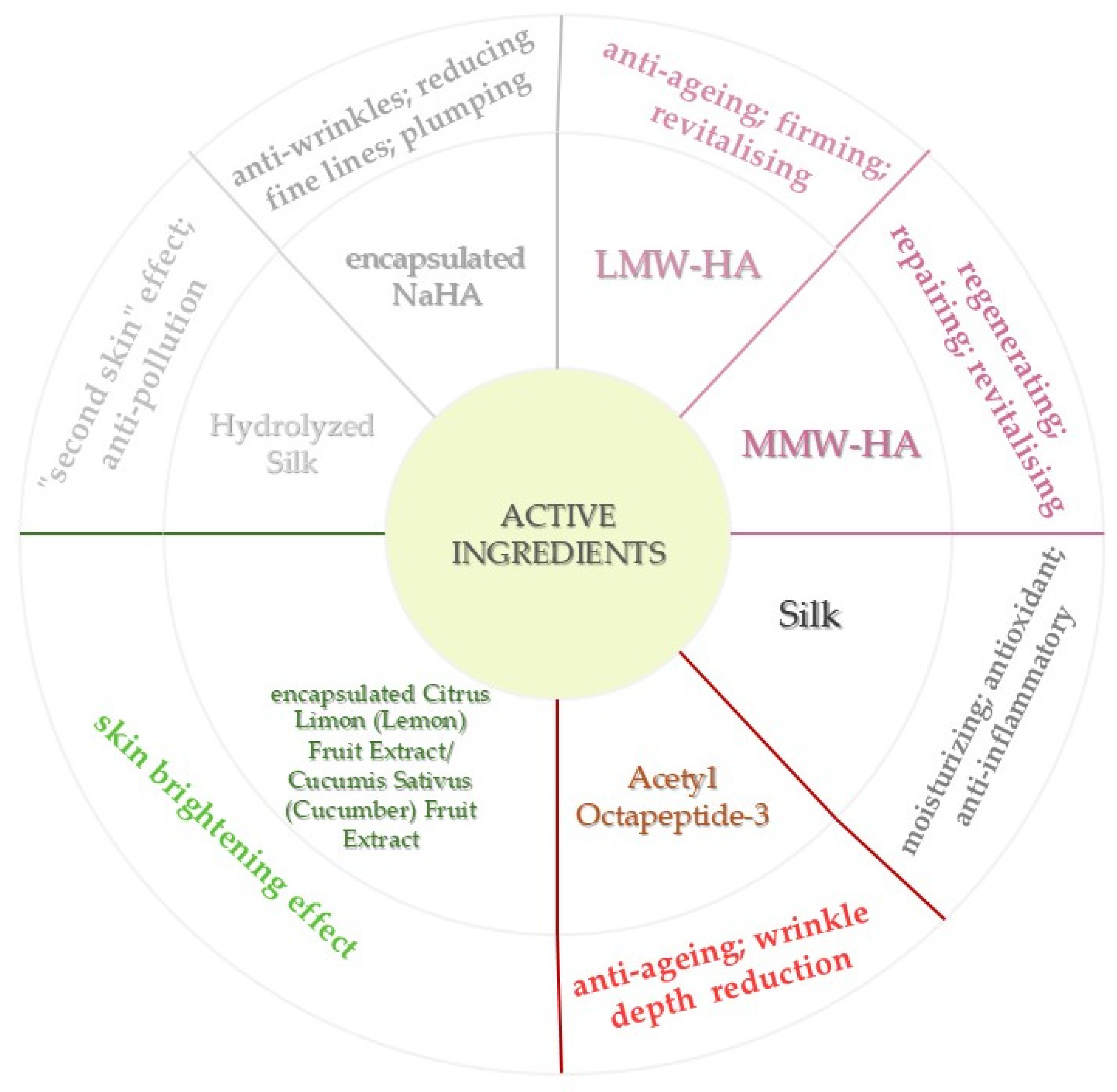
| Actives/Skin conditioning | LMW-HA (20–50 kDa) (PrimalHyal 50, Givaudan, France) | anti-ageing, skin firmness and elasticity improvement, skin roughness reduction | [32,72,73,74] |
| MMW-HA (100–300 kDa) (PrimalHyal 300, Givaudan, France) | profound skin hydration, wrinkle reduction, cellular repair and wound healing | [74,75] | |
| Aqua (and) Sucrose Palmitate (and) Tocopheryl Acetate (and) Glyceryl Linoleate (and) Sodium Hyaluronate (Hyalusphere PF, Givaudan, France) | smoothes average wrinkles, reducing fine lines, plumping | [48,76] | |
| Aqua (and) Silk (and) 1,2-Hexanediol (and) Caprylyl Glycol (Silkgel Neo, Givaudan, France) | “second skin” effect, anti-pollution | [35] | |
| Hydrolyzed Silk (and) Leuconostoc/Radish Root Ferment Filtrate (AC Silk Hydrolysate PF, Active Concepts, Barcelona, Spain) | effective moisturizing, antioxidant, and anti-inflammatory properties | [77] | |
| Aqua (and) Acetyl Octapeptide-3 (0.05%) (and) Caprylyl Glycol (SNAP-8, Lipotec S.A.U., Barcelona, Spain) | significantly reduces wrinkle depth caused by facial muscle contractions, diminishes the appearance of deep wrinkles, including forehead lines and periorbital (crow’s feet) wrinkles | [78,79,80,81] | |
| Mannitol/ Cellulose/ CI 77891 (Titanium Dioxide)/ Propylene Glycol/Citrus Limon (Lemon) Fruit Extract/Cucumis Sativus (Cucumber) Fruit Extract/Hydrogenated Castor Oil/ Glyceryl Stearate Citrate/ Decyl Glucoside/Hydroxypropyl Methylcellulose (FLASHWHITE UNISPHERES WVRM-716SP/Unispheres F00M-508L, Givaudan, France) | white microcapsules that, upon gentle massage during application, release the active ingredients, reducing skin imperfections and attenuating hyperpigmentation, imparting a skin-brightening effect | [82,83,84,85] | |
| Deodorizing ingredients | Parfum | a substance or combination of substances added to the cosmetic formulation to produce or mask a specific odor | [86] |
| Hyaluronic Acid (HA) | Silk | |
|---|---|---|
| MW distribution | 2 × 10⁵ to 107 Da (LMW-HA: 20–50 kDa MMW-HA: 100–300 kDa HMW-HA: 1.0–1.4 MDa) [73,74,87] | native Silk Fibroin (the main structural protein in silk): ~300–390 kDa; Hydrolyzed Silk (used in cosmetics): ~0.3–10 kDa [88] |
| Principal sources | microbial fermentation, animal-derived tissues: rooster combs (historically a major source); vitreous humor (bovine or porcine eyes); umbilical cord/synovial fluid [74] | silkworm (Bombyx mori) cocoons [88,89] |
| Physicochemical properties | high hygroscopicity; viscoelastic nature; biocompatibility; non-immunogenicity (native, high-purity form) [8,74] | amphiphilicity and acid-based responsiveness, attributed to the amino acid composition of sericin [8] |
| Functional properties in cosmetic formulations | moisturizing properties, improved skin firmness and elasticity, anti-wrinkle; NaHA penetrates the deeper layers of the skin, delivering moisture and supporting long-term skin barrier function [74] | moisturizing effect, antioxidant properties, enhances cellular regeneration, anti-ageing effect, improve effect on skin appearance, skin texture, and skin firmness [8,89,90] |
| Cosmetic application(s) | skin and hair care, make-up products | skin and hair care cosmetics |
| Relevant derivatives | Sodium hyaluronate | Silk fibroin, Silk sericin, Hydrolyzed Silk |
| Safety Classification and Regulatory Status | safe in cosmetics [87] | safe for use in cosmetics; classified as nonirritant [88] |
| Synergistic Use with Other Cosmetic Actives | botanical extracts, vitamins, amino acids, peptides, proteins, saccharides, probiotics, etc. [74] | botanical extracts, peptides, hydrolyzed collagen and elastin [8] |
| Technological Challenges/Economic Considerations | white biotechnology (fermentation) [29] | white biotechnology (fermentation) [91] |
| Limitations | temperature, UV radiation, oxidative agents, shear force degradation [8] | Silk fibroin is the primary component utilized in industrial applications (silk sericin is often treated as a by-product/waste material in the production process) [8,92] |
| Characteristics of subjects included in the study | ||
| Number of included subjects | 25 | |
| Gender | female | 18 |
| male | 7 | |
| Age (average) | 47 | |
| Ethnicity | Caucasians | |
| Phototype | II | |
| Inclusion criteria | ||
| intact, non-irritated skin at the test site, with no ongoing dermatological conditions or pharmacological treatments that could interfere with the evaluation | ||
| Exclusion criteria | ||
| any known history of skin disorders, hypersensitivity, or adverse reactions to cosmetic ingredients | ||
Disclaimer/Publisher’s Note: The statements, opinions and data contained in all publications are solely those of the individual author(s) and contributor(s) and not of MDPI and/or the editor(s). MDPI and/or the editor(s) disclaim responsibility for any injury to people or property resulting from any ideas, methods, instructions or products referred to in the content. |
© 2025 by the authors. Licensee MDPI, Basel, Switzerland. This article is an open access article distributed under the terms and conditions of the Creative Commons Attribution (CC BY) license (https://creativecommons.org/licenses/by/4.0/).
Share and Cite
Muntean, D.L.; Rus, L.-L.; Juncan, A.M. Innovative Anti-Ageing Cream with Hyaluronic Acid and Silk Proteins: Formulation, Safety and Skin Tolerance Assessment. Appl. Sci. 2025, 15, 12973. https://doi.org/10.3390/app152412973
Muntean DL, Rus L-L, Juncan AM. Innovative Anti-Ageing Cream with Hyaluronic Acid and Silk Proteins: Formulation, Safety and Skin Tolerance Assessment. Applied Sciences. 2025; 15(24):12973. https://doi.org/10.3390/app152412973
Chicago/Turabian StyleMuntean, Daniela Lucia, Luca-Liviu Rus, and Anca Maria Juncan. 2025. "Innovative Anti-Ageing Cream with Hyaluronic Acid and Silk Proteins: Formulation, Safety and Skin Tolerance Assessment" Applied Sciences 15, no. 24: 12973. https://doi.org/10.3390/app152412973
APA StyleMuntean, D. L., Rus, L.-L., & Juncan, A. M. (2025). Innovative Anti-Ageing Cream with Hyaluronic Acid and Silk Proteins: Formulation, Safety and Skin Tolerance Assessment. Applied Sciences, 15(24), 12973. https://doi.org/10.3390/app152412973