You are currently viewing a new version of our website. To view the old version click .
Applied Sciences
  • Article
  • Open Access

9 December 2025

Microhardness and Coalification Parameters as Sensitive Indicators of Tectonic Deformation in Coal Seams: A Case Study


Strata Mechanics Research Institute, Polish Academy of Sciences, Reymonta 27, 30-059 Kraków, Poland
This article belongs to the Section Earth Sciences

Abstract

The formation of hard coal seams is the outcome of multi-stage, complex transformations of organic matter that lead to an increase in carbon content, a decrease in volatile components, and a progressive evolution of the rock’s structure and texture. Diagenetic and metamorphic processes, which underpin coal formation, largely determine its petrographic and geochemical characteristics, but they are not the only factors controlling the final properties of coal. An equally important role is played by the tectonic history of the region in which the coal seams occur. In this study, we carried out an integrated analysis of coal rank, based on vitrinite reflectance measurements (R0), and mechanical properties, using Vickers microhardness tests (Hv). Coal samples were collected from both sides of a fault plane within a single seam. The results show that the presence of the fault is clearly reflected in the measured parameters. Vitrinite reflectance generally increases towards the fault zone, but in the immediate vicinity of the fault, it exhibits a slight decrease. Subtle yet systematic changes are also observed in microhardness, particularly in the Hv values. The results show that vitrinite reflectance (R0) and microhardness (Hv) vary in a very similar manner—both parameters decrease as the degree of structural degradation of coal increases within the fault zone. This consistent response of R0 and Hv to local structural damage suggests that they may serve as sensitive indicators of the presence and extent of influence of small-scale tectonic dislocations. Their combined application provides additional information on the potential occurrence of a fault and on the degree of structural disturbance of coal in its vicinity.

1. Introduction

The Upper Silesian Coal Basin (USCB) is an area where, over geological time, complex sedimentary, diagenetic and tectonic processes have led to the formation of some of the richest hard coal deposits in Europe. The USCB developed as a foreland basin with a synclinal structure, filled with Upper Carboniferous strata [1,2]. The hard coal occurring in its seams preserves features that are directly linked to the geological history of the basin.
To form coal with a given set of properties, the original organic matter—predominantly plant remains—must undergo a series of complex and long-lasting transformations. The type of organic remains controls the subsequent petrographic composition of the sediment, whereas the transformation processes themselves determine the quality parameters of the coal. With increasing age of the seam, successive stages of diagenetic alteration take place—from syngenesis, through metagenesis, up to metamorphism [3]. These transformations lead to an increase in coal rank, which is reflected in higher carbon content (Cdaf) and changes in other physicochemical properties of the coal. As coalification progresses, the proportion of volatile matter (Vdaf) decreases, while the petrographic, structural–textural and mechanical characteristics of the rock are progressively modified [4,5,6].

1.1. Geological Background

For millions of years, the coal seams of the USCB have been affected by large-scale orogenic movements and a variety of geological processes operating under changing environmental conditions. During the displacement of rock masses and the formation of faults, stress concentrations, elevated temperatures and increased pressures developed, all of which contributed to the present-day structural architecture of the basin [7,8,9,10,11,12,13,14,15].
The geological structure of the USCB was shaped during the Variscan orogeny, particularly during the Asturian phase, whose effects took place more than 300 Ma ago [16]. The basin is divided into three zones with distinct tectonic styles: a fold zone, a fold–block zone and a disjunctive (fault-dominated) zone [17]. The disjunctive tectonic zone covers most of the USCB and is characterized by a block-structured basement in which faults represent the principal structural elements. The later Alpine orogeny also had a significant impact on this zone, rejuvenating many Variscan faults and increasing the magnitude of displacements along them [16,18,19]. As a result, the current configuration of the basin and the present state of coal in the USCB reflect a long and complex tectonic and thermal history of the region.
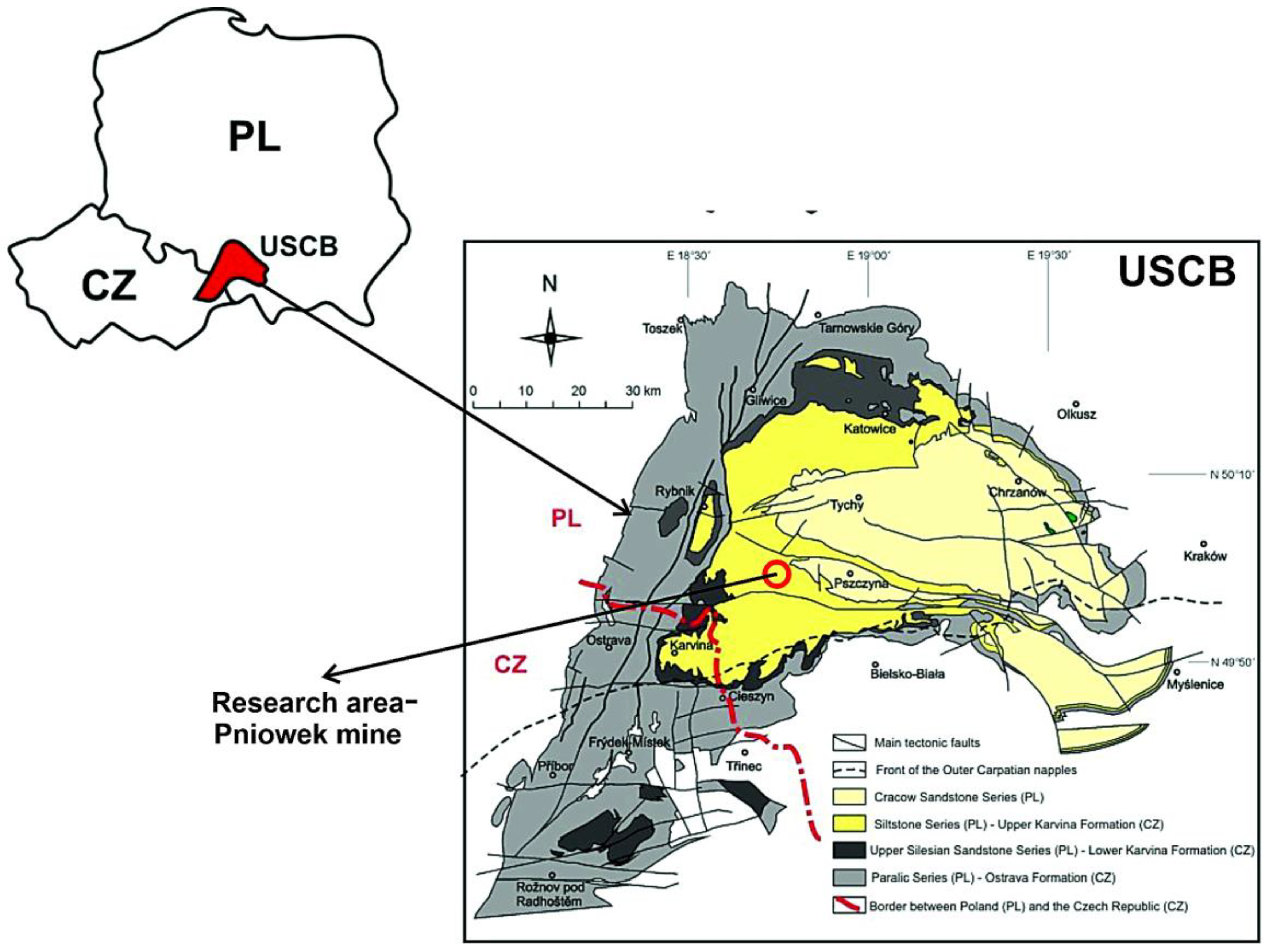
The basin is located in southern Poland and extends partially into the Czech Republic (Figure 1). The material analyzed in this study comes from the central part of the USCB, within the so-called Zofiówka monocline area [20], which is entirely located in the disjunctive zone. Tectonic movements have resulted in a complex structural pattern, in which individual tectonic blocks and the associated coal seams are separated by a network of faults differing in character and throw magnitude.
Figure 1. Map of the Upper Silesian Coal Basin (USCB) [20] showing the location of the study area.

1.2. Influence of Tectonic Deformation on Coal

The influence of faults on coal properties has been the subject of numerous studies both in Poland [7,8,9,10,11,12,13,14,15,21,22,23] and abroad [24,25,26,27,28,29]. As shown in [24,25], tectonic deformation leads to the destruction of coal structure and to changes in its elastic and gas-related properties. Studies carried out in the USCB [12,13,22,23] demonstrate that coal occurring in near-fault zones is characterized by increased porosity, reduced microhardness and higher gas capacity. Such zones are often referred to as “gas traps” due to the high methane concentration and structural weakening of the coal seam [24,25]. As emphasized in [22,23,30,31], structural and micromechanical heterogeneity of coal within disjunctive zones is one of the key factors controlling its utilization properties and gas-geodynamic hazards.
According to Kotas [17,18], the tectonic structure of the USCB is highly heterogeneous, being dominated by faults of various displacement magnitudes, which cause local changes in stress, temperature and fluid flow. These geodynamic variations drive secondary physicochemical transformations in coal, affecting its reflectance and microhardness. Studies [16,19,30] confirm that tectonic deformation—both Variscan and Alpine—has affected entire Upper Carboniferous sequences, modifying their metamorphic conditions and rank. In turn, [8,9] showed that the intensity of deformation correlates with a local increase in vitrinite reflectance, which has been interpreted as the effect of frictional heating within fault zones.
Recent mining-related research further underlines the importance of identifying locally fractured and mechanically weakened zones within coal-bearing strata. Studies on the diffusion evolution of grouting slurry in mining-induced cracks in the overlying strata indicate that the geometry and connectivity of fracture networks strongly control fluid migration and the effectiveness of sealing processes [32,33]. In parallel, investigations of coal failure under dynamic loading, including analyses of energy evolution and fractal characteristics of fragmentation, emphasize that local structural weakening plays a key role in the initiation and progression of damage [34,35]. These findings provide a broader geomechanical and engineering background for detailed, micro-scale characterization of coal in structurally disturbed zones, including those affected by small-scale faults.

1.3. Coal Rank and Microhardness

Tectonic deformation has a significant impact on the physicochemical and structural properties of coal. Some authors [13] point out that faults induce changes in coal structure and texture, leading to disintegration of the binding material and a reduction in mechanical integrity. Similar observations were reported in [14,15], where the authors emphasized that even small faults can locally increase seismic and gas-related hazards in mines. Numerous studies have underlined the importance of the “coal–fault” contact as a geological zone with distinct physicochemical properties compared to the surrounding coal [36]. As noted in [24,25], tectonic deformation promotes gas accumulation and the occurrence of dynamic phenomena, which is supported by many investigations of coals from the USCB region [37,38,39,40,41,42,43,44] and from other coal basins worldwide [45,46].
Studies [22,23,31] have shown that coal microhardness (Hv) correlates with coal rank (R0) along near-fault profiles. Tectonically deformed coal exhibits reduced microhardness, which results from microcracking and microstructural changes in the organic matter. Similar relationships have been confirmed in Chinese and Australian coals [28,47,48]. Other researchers [29,49] additionally described variations in both microhardness and density as expressions of heterogeneous deformation, while [50,51] demonstrated that even within a single seam tectonic deformation can lead to pronounced local variability in microhardness. These results indicate that microhardness testing can be a useful tool for reconstructing the tectonic deformation history of coal.
Coal rank, as one of the most sensitive petrographic parameters, depends primarily on the age of the seam and its burial depth, but is also modified by local geological factors. These include, among others, contact and regional metamorphism associated with magmatic intrusions that cause local temperature increases and accelerate organic matter transformation. One of the Polish researchers working in the USCB [52] documented coalification anomalies linked to thermal metamorphism, particularly pronounced in the Jastrzębie area. The influence of local magmatic centers on coal in the Lower Silesian Coal Basin was described in [53], while similar phenomena have been reported from Chinese coalfields [54]. Other authors [55] noted that in some parts of the USCB coal rank decreases with increasing depth and distance from the Carboniferous roof, which may indicate the presence of coalification inversion. Tectonics—the presence of faults, folds and thrusts—also exerts a strong control on coal rank. In particular, [8] demonstrated that vitrinite optical anisotropy can be treated as an indicator of tectonic stress. In the vicinity of faults, many authors observed increases in vitrinite reflectance attributed to frictional heating, a relationship confirmed for coals of the Lower Silesian Coal Basin by [56]. In later work [12], both aggradational and degradational processes in tectonically deformed coal were described, with emphasis on the fact that some faults lead to a weakening of mechanical properties and a decrease in reflectance, whereas others cause their increase.
Microhardness is a parameter as sensitive as coal rank; however, because of the heterogeneous petrographic composition and structural–textural variability of coal, microhardness measurements have been used relatively rarely [23,36]. They are much more commonly applied to metals, ceramics and composites, as well as in the study of minerals and rocks [26]. In recent years, microhardness has also become an important tool in micromechanical analysis of coal [28,29,47,48,49,50,51]. The study [57] showed that Vickers tests allow discrimination between even nearly identical vitrinite macerals, opening up possibilities for micro-scale diagnostics of metamorphic and oxidation processes. Some authors argue that oxidation increases microhardness [51], whereas others did not observe such a relationship. Nonetheless, most researchers consider microhardness to be a sensitive indicator of the state of preservation of coal [58,59]. More recent studies [29,47,49] further indicate that microhardness can be used to assess the intensity of micromechanical deformation and microstructural heterogeneity of organic matter.
Against this background, the main aim of this study is to investigate how a single small-displacement fault within seam 306/1 modifies coal rank (R0) and microhardness (Hv) along a short profile perpendicular to the fault plane, and to examine whether these parameters respond in a sufficiently systematic manner to be treated as sensitive indicators of small-scale tectonic deformation. This work is a case study limited to one profile across a single fault within one coal seam. The conclusions therefore primarily refer to this specific example and provide a starting point for further comparative research, which is currently underway and will be presented in a separate publication.

2. Materials and Methods

The USCB area is well recognized in terms of tectonics, and there is no doubt that major faults exert a significant influence not only on individual seams but also on entire stratigraphic intervals. What remains to be fully evaluated is the role of small faults, with throws of up to a few meters. According to [14], such faults fall into the category of minor dislocations, with displacement smaller than the height of underground workings. These faults may contribute to an increase in certain hazards, such as rockbursts [14] or outbursts [22,42,43,44].
In this study, the zone of a small fault in seam 306/1 of the “Pniówek” coal mine was analyzed to assess its impact on R0 and Hv parameters and their variation as a function of distance from the fault.

2.1. Sample Collection and Preparation

In the immediate vicinity of the fault, we established a profile perpendicular to the discontinuity plane. Along this line, nine representative coal samples were collected from both fault blocks (hanging wall and footwall) at different distances from the fault plane (L-10, L-3, L-1.5, L-0.7, L-0, P-0.7, P-1.5, P-3, P-10; Figure 2). The spacing between sampling points was selected to capture the zone of direct deformation as clearly as possible, while also providing a reference against more distant parts of the seam considered to represent less disturbed coal.
Figure 2. Schematic sampling layout in seam 306/1; sampling points are marked with black dots together with their distance from the fault fissure in meters.
Sampling was performed using the groove method under in situ conditions on the exposed seam face. The grooves were cut with an approximately constant width and depth, perpendicular to bedding, and the entire material from each groove was collected into labeled containers as a primary sample. All sampling activities were carried out by qualified mine personnel to ensure repeatability and representativeness of the research material.
The collected samples were then subjected to detailed petrographic analyses, including qualitative assessment and quantitative point counting. The analyses considered the three main maceral groups (vitrinite, inertinite and liptinite), the presence of mineral matter and the proportion of structurally altered coal, following the methodology in [22].

2.2. Petrographic Analysis

Quantitative petrographic measurements were conducted on polished sections in accordance with the Cavalieri–Hacquet principle [60]. A grid-based point-counting method was applied. The required number of measurement points was estimated according to [60], assuming an allowable relative error of γ = 0.1 and a probability of 1 − α = 0.8 (for α = 0.2). The normal distribution coefficient was adopted as uα= 1.281, and the least abundant component of the analyzed phase (Vv) was preliminarily estimated at approximately 6%. On this basis, the number of measurement points for each sample was calculated as follows:
Z = u α 2 ( 1 V V ) γ 2 V V = 1.28 1 2 1 0.06 0 . 1 2 0.06   2500 .
where
  • z—number of measurement points [-],
  • uα—coefficient read from the normal distribution tables [-],
  • γ—allowable relative error [-],
  • Vv—least abundant component of the analyzed phase [-].
Consequently, approximately 2500 measurement points arranged in a square grid were adopted for the analyses. The absolute error of each measurement was calculated using the following equation:
δ = u α V V ( 1 V V ) z × 100 %
where
  • δ—absolute measurement error [%].

2.3. Vitrinite Reflectance Measurements (R0)

As part of the analytical program, vitrinite (collotelinite) reflectance measurements were performed for all coal samples collected from the fault zone. Reflectance was determined on the same polished blocks that were subsequently used for microhardness testing. For each sample, the minimum (Rₘᵢₙ), maximum (Rₘₐₓ) and mean vitrinite reflectance (R0) values were established. All measurements were carried out in accordance with PN-ISO 7404-5:2002P [61].
In each sample, at least 100 individual measurements were taken on grains of pure collotelinite, avoiding fractured areas, mineral matter and other disturbances that could affect reading stability. Before each measurement session, the instrument was calibrated using certified reflectance standards. Outliers were identified using simple statistical criteria (including scatter analysis) and removed prior to calculating the mean R0 value for each sample.

2.4. Vickers Microhardness Analysis

To meet the research objectives, we then measured coal microhardness of the vitrinite maceral (collotelinite), using the Vickers method. The analyses were carried out with a CSM Instruments Micro Hardness Tester equipped with a Vickers diamond pyramidal indenter, a motorized XY stage, a Nikon optical microscope, and NIS-Elements 3.0 image-analysis software. A load of 0.5 N was applied in the coal tests. The Vickers method is described in detail in [23,62].
For each sample, a series of at least several indentations was performed (typically 15–20), distributed across several fields of view covering representative collotelinite areas. The indentation diagonal lengths were determined manually and/or using image-analysis software, and the corresponding Hv values were calculated. Extreme values—related, for example, to hitting pores or mineral inclusions—were identified and excluded. For each sample, minimum, maximum, and mean Hv values were then determined.
Petrographic analyses, including point-count quantitative analysis, were conducted in the stereological laboratory of the Strata Mechanics Research Institute of the Polish Academy of Sciences in Kraków, whereas vitrinite reflectance and microhardness measurements were performed at the Institute of Geonics of the Czech Academy of Sciences in Ostrava, within the framework of international cooperation.

3. Results

3.1. Fault Characteristics and Petrographic Analyses

In the P-3 longwall of seam 306/1 in the “Pniówek” coal mine, which belongs to the Orzesze Beds of the Carboniferous mudstone series, a small fault was identified. The right, downthrown block shows a throw of only several tens of centimeters. Nine representative coal samples were taken from the immediate vicinity of the fault. The sampling layout is shown in Figure 2.
The proportions of the individual maceral groups in all analyzed samples are presented in Table 1. On average, vitrinite content in the seam is 79%, with inertinite at about 15.5% and liptinite at roughly 5.5%. The seam is vitrinite-dominated, but the relatively high inertinite content clearly affects the physicochemical properties of the coal. Petrographic analyses also revealed a significant amount of mineral matter, ranging from <1% to 28% in the fault zone (Table 1). In samples taken farther away from the fault, no increase in mineral components was observed, whereas in the fault zone—particularly in the right block—their content is noticeably higher. This points to the presence of postsedimentary mineral matter introduced into the seam as a result of tectonic activity within the rock mass.
Table 1. Percentage share of individual maceral groups, mineral matter content and structurally altered coal (the double line indicates the schematic position of the fault, and the arrow shows the direction of throw) (see also [43]).
With decreasing distance to the fault, an increase in fractured and structurally altered coal is also observed. The highest proportion of this type of coal occurs in the left, hanging-wall block of the described tectonic deformation (up to 12.6 vol.%; Table 1; see also [43]).

3.2. Analysis of Coal Rank in Near-Fault Samples

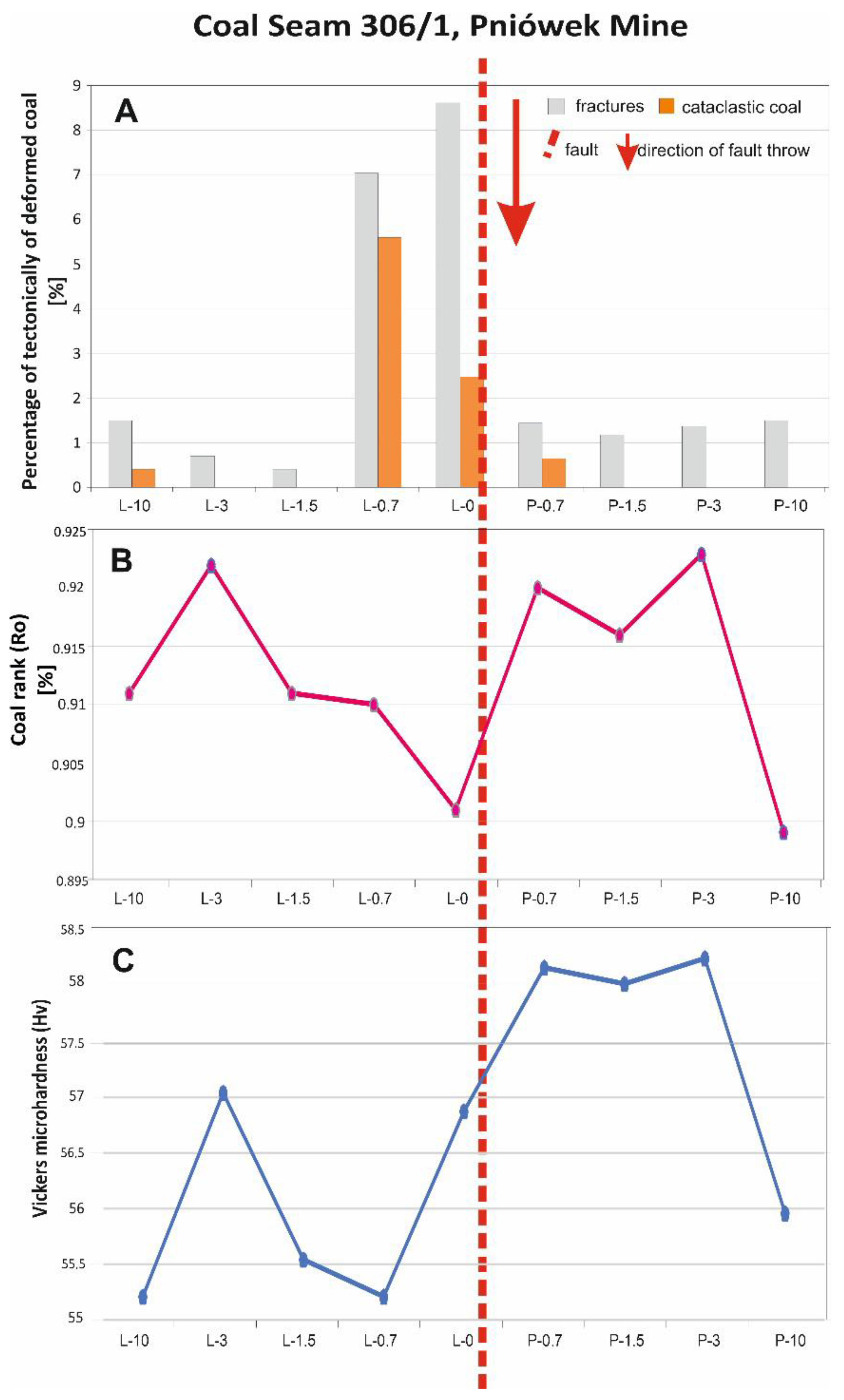
Reflectance analyses of all near-fault samples showed that the dislocation has an effect on vitrinite reflectance values. In the investigated seam, the mean reflectance is about 0.913% (Table 2). Changes in coal rank are not symmetrical with respect to the dislocation. However, a consistent pattern can be observed. The samples farthest from the fault are less coalified than those located closer to it, whereas directly at the fault a decrease in reflectance occurs again (Table 2). Sample L-10 has a reflectance of 0.911%; in sample L-3 R0 increases to 0.922%, and then in samples L-1.5 and L-0.7 it drops to 0.911%. In the fault sample, the R0 value decreases to 0.901%, followed by an increase in sample P-0.7 to 0.920%, and this trend continues up to sample P-3, while in P-10 R0 falls again to 0.899%.
Table 2. Vitrinite reflectance in near-fault coals.

3.3. Vickers Microhardness

The microhardness parameter is a sensitive indicator, but it should also be borne in mind that it varies with coal rank. In coal with a rank of around 1% R0, within the brittle-fracture range of vitrinite, microhardness is expected to change in step with coal rank [4]. As R0 increases, Hv should increase, and as R0 decreases, Hv should decrease.
The Vickers microhardness parameter (Hv), determined for the near-fault samples, behaves as expected. In all analyzed samples, Hv follows the changes in reflectance almost consistently (Table 3). In the investigated seam, Hv behaves almost identically to R0, as it is nearly symmetrical with respect to the fault, decreasing towards the discontinuity surface and then showing a slight increase at the fault itself (Figure 3). Both parameters show local minima in samples L-0.7 and L-0, i.e., within the zone of strongest cataclasis.
Table 3. Microhardness (Hv) of samples from seam 306/1.
Figure 3. Comparison of three parameters of near-fault coal: (A)—content of structurally altered coal, (B)—vitrinite reflectance and (C)—Vickers microhardness.
With regard to the content of structurally altered coal, a relationship can be observed between the decrease in quality and physicochemical parameters and those samples in which the content of degraded material, produced by tectonic activity, is increased. It has been noted that reductions in R0 and Hv are associated with samples containing a high or very high proportion of structurally altered coal (Table 1 and Table 2). In seam 306/1, as the proportion of damaged coal increases, both parameters—R0 and Hv— decrease, reaching their minimum values in the left, hanging-wall block of the fault, where a several percent content of altered material is present (Table 1 and Table 2).

4. Discussion

The presented results constitute a case study of a specific coal seam and a specific fault zone. Their aim is to capture local mechanisms that can be identified at the micro- and mesostructural scale. The sampling layout along a profile perpendicular to the discontinuity plane allows the changes observed near the fault to be directly compared with samples collected at greater distances, which facilitates interpretation of their relationship to tectonic deformation.
The results of petrographic analyses, vitrinite reflectance measurements and Vickers microhardness tests for samples taken from seam 306/1 of the “Pniówek” coal mine make it possible to trace the influence of a tectonic dislocation on coal properties in the immediate vicinity of the fault (Figure 3). The maceral composition (Table 1) indicates a relatively homogeneous, humic character of the coal. The mean vitrinite content of about 79%, accompanied by inertinite at around 15.5% and liptinite at about 5.5%, confirms the dominance of vitrinite-group macerals formed mainly from humified and partly gelified plant tissue in a peat-forming environment, with a significant contribution of inertinite-group macerals and a subordinate amount of liptinite [4,5,63]. The absence of clear, systematic changes in maceral group proportions with distance from the fault suggests that sedimentation and early diagenetic conditions were relatively uniform, and that the observed variation in coal quality is primarily the result of post-sedimentary processes linked to tectonics [43]. Quantitatively, the maceral composition does not show a clear trend with distance from the fault, suggesting that secondary processes play a dominant role in the near-fault zone.
In contrast to maceral composition, the distribution of mineral matter in the seam is different (Table 1). In samples taken farther from the fault, its content is low (typically around 1%, locally up to 5–6%). In the immediate vicinity of the dislocation, especially in the right, downthrown block, there is a sharp increase in mineral matter content—up to 28.6% in sample P-0.7. The samples with elevated mineralization are located to the right of the red dashed line marking the fault (Table 1). This indicates that the fault acted as a pathway for mineralizing fluids, which secondarily introduced mineral matter into the seam, confirming the post-sedimentary character of the mineralization [43,63].
A key aspect for interpreting the tectonic influence is the distribution of “structurally altered coal” (cataclastic coal and fractures) within the seam. Figure 3A shows the proportion of structurally altered coal in the individual samples. It is evident that the maximum (up to about 12.6 vol.%) occurs in samples L-0.7 and L-0, located in the left, hanging-wall block of the fault. This distribution is not symmetrical with respect to the discontinuity surface (red dashed line), which means that the hanging-wall block was subjected to stronger shear and compression, leading to fragmentation of the coal mass and the development of fractured and cataclastic coal. In the right, downthrown block, the proportion of altered coal is small, and the dominant effect of deformation there is increased mineralization. Such asymmetry in the deformation field and fluid flow is consistent with observations from other deposits, where near-fault zones contain bands of tectonic coal with elevated proportions of cataclastic coal and modified physicochemical properties [22,23,42,64,65]. It should be emphasized that the proposed interpretation appears to be the most plausible in light of the consistent distribution of the three analyzed parameters. However, we do not exclude that other local factors may also have contributed to the observed pattern, including lithotype-related microvariability and heterogeneity of the stress field within the studied part of the seam. Therefore, the identified asymmetry is treated as a working hypothesis that best fits the available data, rather than as the only possible explanation.
Vitrinite reflectance (Table 2 and Figure 3B) varies within a relatively narrow range of 0.899–0.923%, with a mean R0 ≈ 0.913%. This range corresponds to bituminous coals of similar rank and does not indicate a strong, basin-scale thermal overprint affecting the entire seam [5]. Nevertheless, the distribution of R0 with respect to the fault is clearly differentiated: on the left side, the highest R0 value (0.922%) is recorded in sample L-3, after which reflectance decreases toward the fault, reaching a minimum in sample L-0 (0.901%). After crossing the fault (sample P-0.7), R0 increases again (up to 0.920–0.923% in P-0.7 and P-3), and then drops in sample P-10. This pattern of the curve in Figure 3B shows that tectonic deformation modifies the local distribution of vitrinite reflectance—in the zone of strongest cataclasis (L-0.7 and L-0) there is a marked decrease in R0, correlating with the maximum proportion of structurally altered coal. This can be interpreted as an effect of mixing fragments of coal with slightly different reflectance values and/or microstructural changes that affect the way light is reflected and thus the measurement result. Similar local disturbances in the reflectance distribution within strongly deformed zones have been reported from other coal basins as well [64,66,67,68].
Although the observed differences in R0 values have a relatively small amplitude, their significance lies in their spatial coherence and consistency with the distribution of structurally altered coal. From this perspective, even “minor” deviations may represent a reliable signal of local deformational effects rather than random scatter in the results.
It should be emphasized that in this study the variability of R0 values was described mainly using dispersion measures (including the standard deviation presented in Table 2), without applying formal significance tests. This approach was considered sufficient for the purpose of interpreting local trends within the near-fault zone.
The reflectance-based picture of local coalification changes is meaningfully complemented by the micromechanical data. Figure 3C shows the variation in Vickers microhardness (Hv). This parameter behaves broadly in line with relationships described in the literature for coals with a rank (R0) close to 1%—at non-tectonic scales Hv increases with increasing R0 [4,5]. In the seam under study, it can be seen that, within the structurally altered zone, the lowest Hv values (~55 Hv) are found on the left side of the fault (L-10 and L-0.7, with similarly low values in L-1.5), and the lowest values coincide with reduced R0 and the highest proportion of structurally altered coal (L-0.7, L-0). After crossing the fault, microhardness increases (P-0.7, P-1.5, P-3), reaching the highest values (>58 Hv) in the right block, which appears as a distinct “bulge” of the curve in Figure 3. This indicates that tectonic deformation mechanically weakens the coal in the zone of intense cataclasis, whereas in the less damaged but more strongly mineralized right block Hv remains high.
In the context of international research, studies [22,23,31] are of particular importance because they combine vitrinite reflectance and microhardness measurements with analyses of disjunctive tectonics in the USCB, and they also point to possible implications for local geomechanical and gas conditions in disturbed zones.
These works have shown that local decreases in microhardness, accompanied by only minor changes or even an increase in R0, may be an expression of so-called mechanical micrometamorphism—changes in the ordering of the organic matter structure resulting from shear and compaction, without the need for a significant temperature rise [22,23,31,36]. The results for seam 306/1 fit this picture well: in the zone with the highest content of cataclastic and fault-related fractured coal (L-0.7 and L-0), a clear micromechanical degradation (decrease in Hv) is observed, coinciding with reduced R0 and maximum proportions of structurally altered coal.
In light of more recent studies on tectonically deformed coals in Asian basins and other regions—covering microstructure, micromechanics, sorption properties and reservoir heterogeneity [29,50,66,68,69,70,71,72,73]—the results from seam 306/1 confirm that even relatively small dislocations can generate distinct, measurable changes in coal microstructure, optical parameters and micromechanical properties, and thus influence its utilization behavior and performance under mining conditions. However, it should be emphasized that the presented conclusions refer to the local geometry of a relatively stabilized fault zone within a single seam and a single mine. Extrapolating the observed relationships to other structures requires consideration of differences in seam thickness, lithotypes, deformation history and the intensity of mineralization.
In summary, the investigated seam does not show a pronounced regional increase in coal reflectance in the sense of a classic thermal history. Instead, the tectonic dislocation clearly modifies the local properties of the coal. This is best illustrated in Figure 3. In the left, hanging-wall block, a band of strongly structurally degraded coal develops (high proportion of altered coal, reduced R0 and Hv), whereas in the right, downthrown block, a zone of enhanced mineralization and higher microhardness is observed. This picture is consistent with the concept of tectonically deformed coals, in which the combined effects of mechanical deformation and fluid migration lead to significant changes in microstructure, mechanical parameters and—indirectly—the gas-related properties of coal [22,23,31,43,64,65,66,70].
This case study shows that the key aspect is the spatial coherence of the three analyzed indicators (structurally altered coal, R0 and Hv). This pattern points to local, near-fault modifications of coal properties, even in the absence of a clear regional trend.

5. Conclusions

Seam 306/1 in the “Pniówek” coal mine is characterized by a homogeneous maceral composition, dominated by vitrinite (approx. 79%) with a significant proportion of inertinite (approx. 15.5%) and liptinite (approx. 5.5%). The lateral variation in coal properties across the profile intersecting the fault results mainly from tectonic processes and post-sedimentary mineralization, rather than from primary differences in the depositional environment. No clear trend in the proportions of the main maceral groups was observed with increasing distance from the fault. This suggests that the variability of coal properties along the profile is secondary in nature and related to the effects of tectonic activity and post-sedimentary processes.
The fault played an important role in the migration of mineralizing fluids, as indicated by the locally very high proportion of mineral matter (up to 28.6%) in the immediate vicinity of the discontinuity, particularly in the right, downthrown block. The mineralization is clearly secondary in character and is related to tectonic activity within the rock mass.
Mechanical deformation of the coal is distinctly asymmetrical with respect to the fault. The highest content of structurally altered coal and fractures (up to approx. 12.6 vol.%; Figure 3) occurs in the left, hanging-wall block, which indicates stronger shear and compaction in this part of the seam and leads to the development of a band of tectonic coal with downgraded quality parameters. Based on the distribution of the analyzed indicators, we assume that the proposed approach best explains the observed changes within the fault zone. Nevertheless, local lithotype-related factors and heterogeneity of the stress field may also have contributed to shaping the observed pattern.
Coal rank, expressed by vitrinite reflectance, is similar across the seam (R0 ≈ 0.9%) and does not indicate a strong, basin-scale thermal effect of the fault. However, tectonic deformation clearly modifies the local distribution of R0, particularly in zones with an elevated content of cataclastic coal, where a decrease in reflectance is observed (samples L-0.7 and L-0; Figure 3). In zones with an increased proportion of structurally altered coal, a simultaneous decrease in vitrinite reflectance (R0) and Vickers microhardness (Hv) is recorded, which points to optical and mechanical degradation of the coal caused by tectonic processes; deformation not only changes the texture and structure of the coal, but also significantly deteriorates its mechanical properties at the microscale. Minor variations in R0 gain interpretative significance due to their spatial consistency with the distribution of structurally altered coal and the accompanying decrease in Hv, which indicates a local effect of tectonic deformation.
The Hv microhardness parameter in the examined seam generally follows changes in coal rank, in agreement with literature data [4,5]. However, in the zone of intense cataclasis there is a concurrent decrease in both parameters (R0 and Hv). This confirms that microhardness can serve as a sensitive indicator of tectonic deformation and so-called mechanical micrometamorphism, especially where changes in coal rank are small and difficult to detect using classical methods [23,31,47,51].
The fault in seam 306/1 generates two contrasting zones:
  • A zone of reduced coal quality on the hanging-wall side (high content of structurally altered coal, reduced R0 and Hv—left part of Figure 3),
  • A zone of enhanced mineralization on the downthrown side (increased mineral matter content and relatively high Hv—right block of the section.
Identification and characterization of near-fault zones have practical value for assessing deposit quality and planning extraction, as well as for analyzing local geomechanical conditions and potential gas-related factors associated with the presence of faults.
Against the background of Polish studies [22,23,31,36,42,43] and international research on tectonically deformed coals [29,50,51,66,68,70,71,72], the results obtained for seam 306/1 confirm that coal microhardness is a sensitive indicator of deformation. Its variations—in combination with coal rank (R0) and the proportion of structurally altered coal—can be an effective tool for identifying tectonically deformed zones.
Although sorption parameters were not measured in this study, the results are consistent with observations on the influence of deformation on sorption capacity and methane accumulation. Ref. [73] showed that, with increasing depth and deformation, sorption capacity decreases in coals prone to gas and rock outbursts, which can be linked to the microstructural changes described by [31] and to the decrease in Hv and disturbed R0 distribution observed in seam 306/1 within the zone of cataclastic and fractured coal.
Integration of structural data (disjunctive tectonics), petrographic parameters (R0) and micromechanical characteristics (Hv), illustrated, for example, in Figure 3, makes it possible to move from a qualitative description to a quantitative assessment of the impact of tectonic deformation on the state and behavior of the coal in strongly disturbed areas.
The presented conclusions constitute a case study of a specific coal seam and a specific dislocation. The obtained results broaden the current understanding of how disjunctive tectonics affects the physical properties of coals in the USCB and may be useful in geological and mining practice, particularly in assessing coal quality and local geomechanical conditions within disturbed zones. This highlights the need for broader analyses that integrate structural parameters, coal rank and microhardness.

Funding

This research received no external funding.

Institutional Review Board Statement

Not applicable.

Data Availability Statement

The data supporting the findings of this study are contained within the article. Additional raw data are available from the author on reasonable request.

Acknowledgments

The presented work was supported through a statutory research fund by the Polish Academy of Sciences. I would like to thank Alena Kožušníková and Lucie Nemcova of the Institute of Geonics in Ostrava for their help in microhardness and reflectance analyses.

Conflicts of Interest

The author declares no conflicts of interest.

References

  1. Osika, R. (Ed.) Budowa Geologiczna Polski. Tom VI: Złoża Surowców Mineralnych; Wydawnictwa Geologiczne: Warszawa, Poland, 1987. [Google Scholar]
  2. Gabzdyl, W. Geologia Złóż Węgla: Złoża Świata; Polska Agencja Ekologiczna: Warszawa, Poland, 1994. [Google Scholar]
  3. Manecki, A.; Muszyński, M. (Eds.) Przewodnik do Petrografii; Wydawnictwa AGH: Kraków, Poland, 2008. [Google Scholar]
  4. Stach, E.; Mackowsky, M.-T.; Teichmüller, M.; Taylor, G.H.; Chandra, D.; Teichmüller, R. Stach’s Textbook of Coal Petrology, 3rd ed.; Gebrüder Borntraeger: Stuttgart, Germany, 1982. [Google Scholar]
  5. Taylor, G.H.; Teichmüller, M.; Davis, A.; Diessel, C.F.K.; Littke, R.; Robert, P. Organic Petrology; Gebrüder Borntraeger: Stuttgart, Germany, 1998. [Google Scholar]
  6. Gabzdyl, W. Petrograficzne Zróżnicowanie Węgli w USCB; Wydawnictwo Uniwersytetu Śląskiego: Katowice, Poland, 1999. [Google Scholar]
  7. Chudzicka, B. Próba klasyfikacji stopnia zuskokowania złóż węgla kamiennego Górnośląskiego Zagłębia Węglowego. Prz. Gór 1980, 11, 544–547. [Google Scholar]
  8. Pozzi, M.; Lewandowski, T. Komputerowy program do określenia stopnia zuskokowania złoża. In Prace Naukowe GIG, Proceedings of the VI Konferencja “Problemy Geologii w Ekologii i Górnictwie Podziemnym”, Ustroń, Poland, 9–11 October 1996; Głównego Instytutu Górnictwa: Katowice, Poland, 1996. [Google Scholar]
  9. Ćmiel, S.R.; Idziak, A.F. Some geomechanical properties of Carboniferous rocks near the fault. In Documenta Geonica, Proceedings of the 2nd Czech-Polish Geomechanical Symposium; Academy of Sciences of Geonics, Prague–Ostrava; DERES Publishers: Prague–Ostrava, Czech Republic, 1999; pp. 263–268. [Google Scholar]
  10. Jura, D. Morfotektonika i Ewolucja Różnowiekowych Niezgodności w Stropie Utworów Karbonu Górnośląskiego Zagłębia Węglowego; Wydawnictwo Uniwersytetu Śląskiego: Katowice, Poland, 2001. [Google Scholar]
  11. Ćmiel, S.R.; Jura, D.; Misz, M. Petrografia i jakość węgla oraz metan pokładu 404/4–405/1 przy uskokach w KWK Pniówek (GZW). In 6. Czesko–Polska Konferencja “Geologia Zagłębia Górnośląskiego”; Kožušníková, A., Ed.; Documenta Geonica: Ostrava, Czech Republic, 2006; p. 33. [Google Scholar]
  12. Ćmiel, S. Charakterystyka Epigenetycznych Zmian Węgla w Pokładach w Strefach Uskokowych Górnośląskiego Zagłębia Węglowego; Wydawnictwo Uniwersytetu Śląskiego: Katowice, Poland, 2009. [Google Scholar]
  13. Bukowska, M.; Ćmiel, S. Charakterystyka zmian właściwości skał karbońskich w strefach tektoniki nieciągłej w Górnośląskim Zagłębiu Węglowym. Gór. Geoinż 2011, 35, 111–119. [Google Scholar]
  14. Drzewiecki, J. Wpływ parametrów uskoku na zasięg jego oddziaływania. Gór. Geoinż 2011, 35, 183–190. [Google Scholar]
  15. Marcisz, M. Stopień zuskokowania złóż węgla kamiennego Górnośląskiego Zagłębia Węglowego. Miner. Resour. Manag. 2017, 33, 97–112. [Google Scholar]
  16. Botor, D. Burial and thermal history of the Upper Silesian Coal Basin (Poland) constrained by maturity modelling—Implications for coalification and natural gas generation. Ann. Soc. Geol. Pol. 2020, 90, 99–123. [Google Scholar] [CrossRef]
  17. Kotas, A. Ważniejsze cechy budowy geologicznej GZW na tle pozycji tektonicznej i budowy głębokiego podłoża utworów produktywnych. In Problemy Geodynamiki i Tąpań; Komitet Górnictwa PAN: Kraków, Poland, 1972; Volume 1, pp. 5–55. [Google Scholar]
  18. Kotas, A. Budowa geologiczna podłoża utworów produktywnych GZW. Kwart. Geol. 1968, 12, 1088–1090. [Google Scholar]
  19. Jaroszewski, W. Uskoki i zjawiska pokrewne. In Tektonika; Dadlez, R., Jaroszewski, W., Eds.; PWN: Warszawa, Poland, 1994; pp. 88–162. [Google Scholar]
  20. Probierz, K.; Marcisz, M.; Sobolewski, A. Rozpoznanie warunków geologicznych występowania węgla koksowego w rejonie Jastrzębia dla potrzeb projektu “Inteligentna koksownia”. Biul. Państwowego Inst. Geol. 2012, 452, 245–256. [Google Scholar]
  21. Kędzior, S.; Jelonek, I. Reservoir parameters and maceral composition of coal in different Carboniferous lithostratigraphical series of the Upper Silesian Coal Basin, Poland. Int. J. Coal Geol. 2013, 111, 98–105. [Google Scholar] [CrossRef]
  22. Godyń, K. Structurally altered hard coal in the areas of tectonic disturbances—An initial attempt at classification. Arch. Min. Sci. 2016, 61, 677–694. [Google Scholar] [CrossRef]
  23. Godyń, K.; Kožušníková, A. Microhardness of coal from near-fault zones in coal seams threatened with gas-geodynamic phenomena, Upper Silesian Coal Basin, Poland. Energies 2019, 12, 1756. [Google Scholar] [CrossRef]
  24. Shepherd, J.; Rixon, L.K.; Griffiths, L. Outbursts and geological structures in coal mines: A review. Int. J. Rock Mech. Min. Sci. Geomech. Abstr. 1981, 18, 267–283. [Google Scholar] [CrossRef]
  25. Beamish, B.; Crosdale, P. Instantaneous outbursts in underground coal mines: An overview and some new insights. Int. J. Coal Geol. 1998, 35, 27–55. [Google Scholar] [CrossRef]
  26. Suchý, V.; Frey, M.; Wolf, M. Vitrinite reflectance and shear-induced graphitization in orogenic belts: A case study from the Kandersteg area, Helvetic Alps, Switzerland. Int. J. Coal Geol. 1997, 34, 1–20. [Google Scholar] [CrossRef]
  27. Opletal, V.; Geršlová, E.; Nehyba, S.; Sýkorová, I.; Řez, J. Geology and thermal maturity of Namurian deposits in the Němčičky Sub-basin as the South-eastern continuation of the Upper Silesian Coal Basin (Czech Republic). Int. J. Coal Geol. 2019, 216, 103323. [Google Scholar] [CrossRef]
  28. Song, X.; Chen, T.; Zhang, D. The acoustic characteristics of tectonically deformed coal in Huaibei Coalfield. Energies 2023, 16, 5179. [Google Scholar] [CrossRef]
  29. Wen, Z. Evaluation of heterogeneity in tectonically deformed coal reservoirs based on the Analytic Hierarchy Process–Entropy Weight Method coupling model: A case study. ACS Omega 2023, 8, 36700–36709. [Google Scholar] [CrossRef]
  30. Herbich, E. Analiza tektoniczna sieci uskokowej GZW. Ann. Soc. Geol. Pol. 1981, 51, 383–434. [Google Scholar]
  31. Godyń, K.; Dutka, B. Sorption and micro-scale strength properties of coals susceptible to outburst caused by changes in degree of coalification. Materials 2021, 14, 5807. [Google Scholar] [CrossRef]
  32. Cao, Z.; Xiong, Y.; Xue, Y.; Du, F.; Li, Z.; Huang, C.; Wang, S.; Yu, Y.; Wang, W.; Zhai, M.; et al. Diffusion Evolution Rules of Grouting Slurry in Mining-induced Cracks in Overlying Strata. Rock Mech. Rock Eng. 2025, 58, 6493–6512. [Google Scholar] [CrossRef]
  33. Lin, H.; Zhang, W.; Guo, S.; Zhang, X.; Wang, L.; Zhang, J. Study on the Energy Evolution Mechanism and Fractal Characteristics of Coal Failure under Dynamic Loading. ACS Omega 2025, 10, 54710–54719. [Google Scholar] [CrossRef]
  34. Yin, S.; Li, Z.; Song, D.; Mu, H.; Niu, Y.; Wang, X. Study on the Energy Evolution Law and Bursting Liability of Coal Failure with Different Joint Inclination Angles. Appl. Sci. 2024, 14, 1120. [Google Scholar] [CrossRef]
  35. Ma, J.; Liu, F.; Song, L. Experimental Study on the Dynamic Characteristics of Fractured Coal Under Cumulative Impact. Appl. Sci. 2025, 15, 6469. [Google Scholar] [CrossRef]
  36. Godyń, K.; Králová, L. Wykorzystanie pomiarów mikrotwardości Vickersa do analiz węgla kamiennego pochodzącego z partii F kopalni “Borynia-Zofiówka-Jastrzębie”, Ruch Zofiówka. Pr. Inst. Mech. Górotworu PAN 2017, 19, 25–33. [Google Scholar]
  37. Krause, E. Wpływ uwarunkowań geologicznych i gazowych na kształtowanie się zagrożenia wyrzutami gazów i skał w Górnośląskim Zagłębiu Węglowym. Pr. Nauk. GIG—Górnictwo Sr. 2007, 2, 65–76. [Google Scholar]
  38. Pluta, I.; Ślaski, R.; Orawski, K. Uwarunkowania silnych zjawisk gazogeodynamicznych zaistniałych w kopalniach “Pniówek” i “Zofiówka”. Pr. Nauk. GIG—Górnictwo Sr. 2006, 4, 17–27. [Google Scholar]
  39. Kędzior, S. Potencjał zasobowy metanu pokładów węgla w Polsce w kontekście uwarunkowań geologicznych. Gospod. Surowcami Miner. 2008, 24, 5–27. [Google Scholar]
  40. Kędzior, S. Możliwości zagospodarowania metanu występującego w stropowych partiach złóż węgla kamiennego: Przykład rejonu Bzie-Dębina 1 i Gołkowice (GZW). Polit. Energ. 2011, 14, 197–206. [Google Scholar]
  41. Bukowska, M. Właściwości fizyczne węgli GZW w aspekcie zagrożenia wyrzutami metanu i skał. Gór. Geoinż 2010, 34, 27–40. [Google Scholar]
  42. Godyń, K. Advancement of structural changes of near-fault coals as a parameter useful in predicting the possibility of gas-geodynamic phenomena. In Proceedings of the 8th Czech-Polish Conference “Geologia Zagłębi Węglonośnych”, Ostrava, Czech Republic, 19–21 October 2011; pp. 67–74. [Google Scholar]
  43. Godyń, K. Wpływ nieciągłości tektonicznych na strukturę wewnętrzną węgla kamiennego pochodzącego z wybranych pokładów KWK “Pniówek”, “Borynia-Zofiówka” i “Brzeszcze” GZW. Biul. Państwowego Inst. Geol. 2012, 448, 215–228. [Google Scholar]
  44. Godyń, K. Charakterystyka węgla kamiennego występującego w strefach przyuskokowych. Prz. Gór 2013, 69, 45–53. [Google Scholar]
  45. Yin, S.; Ding, W. Evaluation indexes of coalbed methane accumulation in the strong-deformed strike-slip fault zone considering tectonics and fractures: A 3D geomechanical simulation study. Geol. Mag. 2019, 156, 1052–1068. [Google Scholar] [CrossRef]
  46. Li, W.; Jiang, B.; Zhu, Y.-M. Impact of tectonic deformation on coal methane adsorption capacity. Adsorpt. Sci. Technol. 2019, 37, 698–708. [Google Scholar] [CrossRef]
  47. Hou, C.; Jiang, B.; Liu, H.; Song, Y.; Xu, S. The differences of nanoscale mechanical properties and their effects on deformation of tectonically deformed coals. J. Rock Mech. Geotech. Eng. 2020, 12, 1200–1211. [Google Scholar]
  48. Wang, A.; Li, J.; Cao, D.; Wei, Y.; Ding, L.; Zhao, M. Comparison of nanopore structure evolution in vitrinite and inertinite of tectonically deformed coals: A case study in the Wutongzhuang Coal Mine (North China). Front. Earth Sci. 2022, 10, 822338. [Google Scholar] [CrossRef]
  49. Qin, R.; Wang, L.; Cao, D.; Wang, A.; Wei, Y.; Li, J. Thermal simulation experimental study on the difference of macromolecular structures of tectonically deformed coals. Front. Earth Sci. 2022, 10, 992017. [Google Scholar] [CrossRef]
  50. Zhang, J.; Huang, H.; Zhou, W.; Sun, L.; Huang, Z. Study on pore structure of tectonically deformed coals by carbon dioxide adsorption and nitrogen adsorption methods. Energies 2025, 18, 887. [Google Scholar] [CrossRef]
  51. Chelgani, S.C.; Hower, J.C.; Mastalerz, M.; Rimmer, S.M. Anomalies in Vickers microhardness of subbituminous and high-volatile bituminous coals. Int. J. Coal Geol. 2024, 296, 104659. [Google Scholar] [CrossRef]
  52. Probierz, K. Wpływ metamorfizmu termalnego na stopień uwęglenia i skład petrograficzny pokładów węgla w obszarze Jastrzębia (GZW). Zesz. Nauk. Politech. Śląskiej Ser. Górnictwo 1989, 176, 126. [Google Scholar]
  53. Kułakowski, T. Wpływ warunków geologicznych na stopień metamorfozy węgli warstw żaclerskich w Dolnośląskim Zagłębiu Węglowym. Geol. Sudet 1979, 14, 103–139. [Google Scholar]
  54. Liu, H.; Jiang, B. Differentiated evolution of coal macromolecules in localized igneous intrusion zone: A case study of Zhuxianzhuang colliery, Huaibei coalfield, China. Fuel 2019, 254, 115692. [Google Scholar] [CrossRef]
  55. Adamczyk, Z.; Komorek, J.; Lewandowska, M. Specific types of coal macerals from Orzesze and Ruda Beds from ”Pniówek” Coal Mine (Upper Silesian Coal Basin—Poland) as a manifestation of thermal metamorphism. Arch. Min. Sci. 2014, 59, 77–91. [Google Scholar] [CrossRef]
  56. Nowak, G.J. Dojrzałość termiczna węgli Dolnośląskiego Zagłębia Węglowego na tle ich petrografii i genezy. Biul. Państwowego Inst. Geol. 2000, 391, 89–146. [Google Scholar]
  57. Mukherjee, A.K.; Alam, M.M.; Ghose, S. Microhardness characteristics of Indian coal and lignite. Fuel 1989, 68, 670–674. [Google Scholar] [CrossRef]
  58. Kuś, J.; Misz-Kennan, J. Coal weathering and laboratory (artificial) coal oxidation. Int. J. Coal Geol. 2017, 171, 12–36. [Google Scholar] [CrossRef]
  59. Nandi, B.N.; Ciavaglia, L.A.; Montgomery, D.S. The variation of the microhardness and reflectance of coal under conditions of oxidation simulating weathering. J. Microsc. 1977, 109, 93–103. [Google Scholar] [CrossRef]
  60. Ryś, J. Stereologia Materiałów; Fotobit Design: Kraków, Poland, 1995. [Google Scholar]
  61. PN-ISO 7404-5:2002P; Metody Analizy Petrograficznej Węgla Kamiennego (Bitumicznego) i Antracytu—Część 5: Metoda Mikroskopowa Oznaczania Refleksyjności Witrynitu. PKN: Warsaw, Poland, 2002.
  62. Kožušníková, A. Determination of microhardness and elastic modulus of coal components by using indentation method. Geolines 2009, 22, 40–43. [Google Scholar]
  63. Applied Coal Petrology. In The Role of Petrology in Coal Utilization; Suárez-Ruiz, I., Crelling, J.C., Eds.; Elsevier: Amsterdam, The Netherlands, 2008. [Google Scholar]
  64. Cao, Y.; Mitchell, G.D.; Davis, A.; Wang, D. Deformation metamorphism of bituminous and anthracite coals from China. Int. J. Coal Geol. 2000, 43, 227–242. [Google Scholar] [CrossRef]
  65. Młynarczuk, M.; Skiba, M. An approach to detect local tectonic dislocations in coal seams based on roughness analysis. Arch. Min. Sci. 2022, 67, 743–756. [Google Scholar]
  66. Hou, Q.; Li, H.; Fan, J.; Ju, Y.; Wang, T.; Li, X.; Wu, Y. Structure and coalbed methane occurrence in tectonically deformed coals. Sci. China Earth Sci. 2012, 55, 1755–1763. [Google Scholar] [CrossRef]
  67. Wang, A.; Cao, D.; Wei, Y.; Liu, Z. Macromolecular structure controlling micro mechanical properties of vitrinite and inertinite in tectonically deformed coals—A case study in Fengfeng Coal Mine of Taihangshan Fault Zone (North China). Energies 2020, 13, 6618. [Google Scholar] [CrossRef]
  68. Zhang, N.; Yao, S.; Wang, Y. Nanopore structure and mechanical properties in brittle tectonically deformed coals explored by atomic force microscopy. Front. Earth Sci. 2022, 10, 844120. [Google Scholar] [CrossRef]
  69. Pan, J.; Zhu, H.; Hou, Q.; Wang, H.; Wang, S. Macromolecular and pore structures of Chinese tectonically deformed coal studied by atomic force microscopy. Fuel 2015, 139, 94–101. [Google Scholar] [CrossRef]
  70. Song, Y.; Jiang, B.; Qu, M. Macromolecular evolution and structural defects in tectonically deformed coals. Fuel 2019, 236, 1432–1445. [Google Scholar] [CrossRef]
  71. Ren, J.; Weng, H.; Li, B.; Chen, F.; Liu, J.; Song, Z. The influence mechanism of pore structure of tectonically deformed coal on the adsorption and desorption hysteresis. Front. Earth Sci. 2022, 10, 841353. [Google Scholar] [CrossRef]
  72. Huan, X.; Guo, X.; Chen, X.; Guo, X. Influence of tectonically deformed coal-based activated carbon and its surface modification on methane adsorption. ACS Omega 2024, 9, 33510–33521. [Google Scholar] [CrossRef]
  73. Dutka, B. Effect of depth on the sorption capacity of coals affected by outburst hazard. Fuel 2021, 306, 121611. [Google Scholar] [CrossRef]
Disclaimer/Publisher’s Note: The statements, opinions and data contained in all publications are solely those of the individual author(s) and contributor(s) and not of MDPI and/or the editor(s). MDPI and/or the editor(s) disclaim responsibility for any injury to people or property resulting from any ideas, methods, instructions or products referred to in the content.

Article Metrics

Citations

Article Access Statistics

Multiple requests from the same IP address are counted as one view.