Comparison of Occupant Risk Indices in Rear-End Collisions with RIG and TMA

Featured Application
Abstract
1. Introduction
2. Current Status and Performance Test Criteria
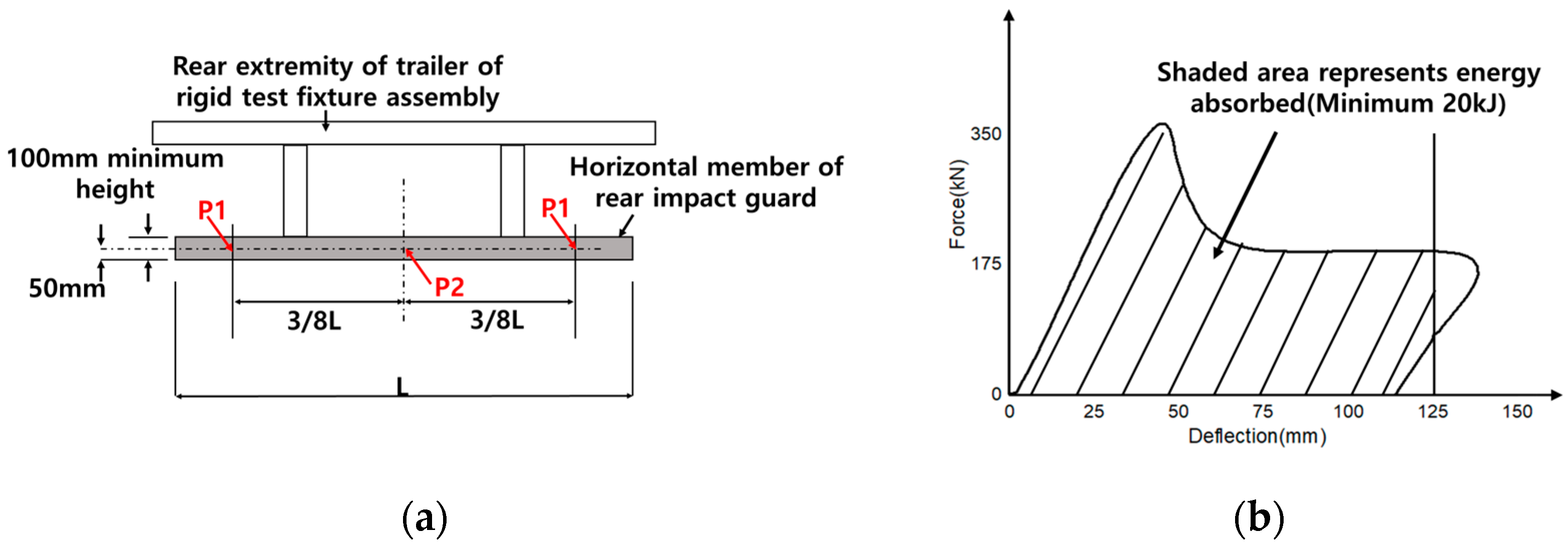
2.1. Rear-End Collision Characteristics and RIG Standards
2.2. TMA Performance Evaluation Standards
2.3. Existing Occupant Risk and Injury Indices
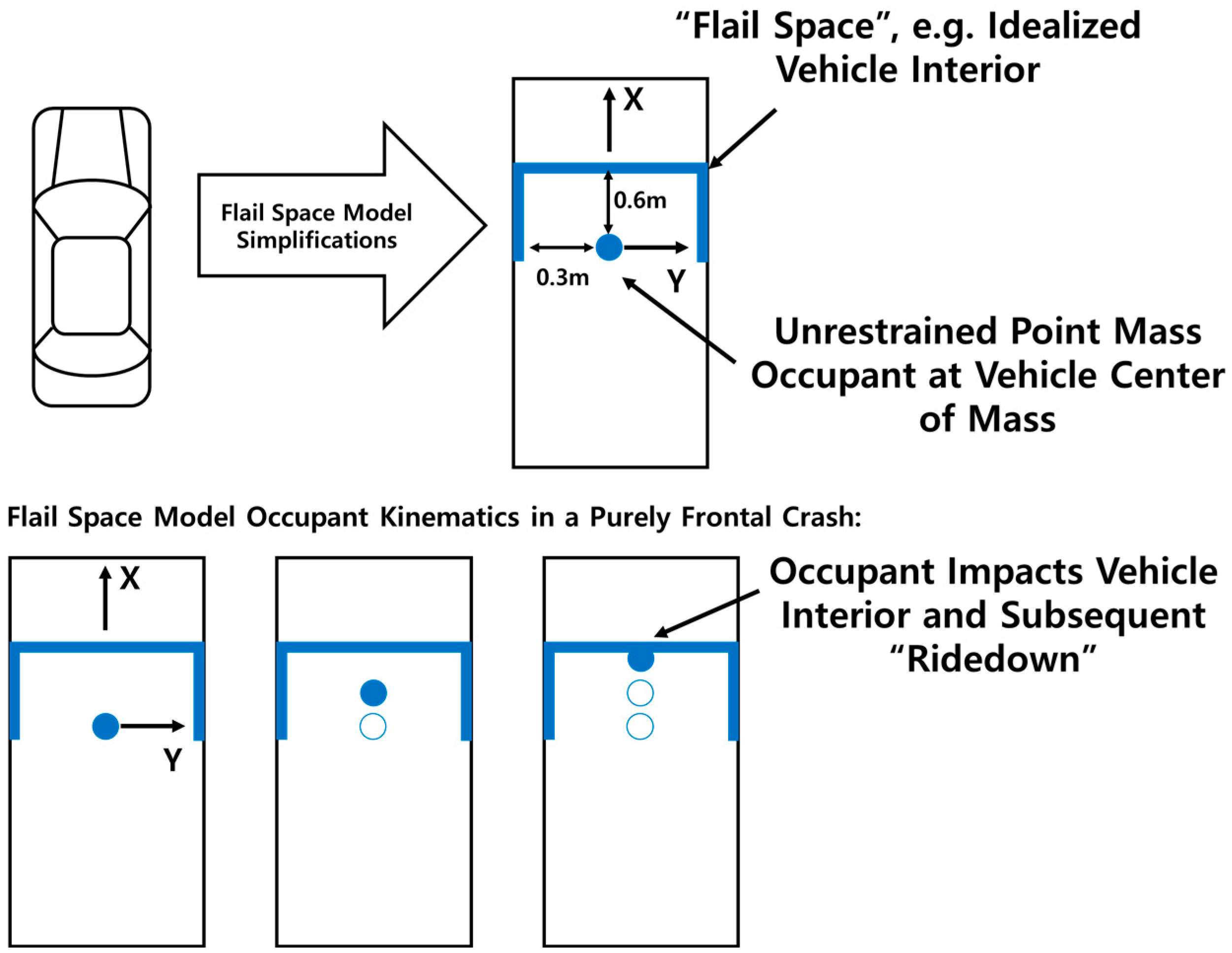
2.3.1. Flail Space Model (FSM)
- The occupant is assumed to be an unrestrained point mass positioned at the vehicle center of mass.
- Distances that the occupant is allowed to “flail” prior to impacting the vehicle interior are assumed to be 0.6 m (2 feet) longitudinally (i.e., parallel with the typical vehicle travel direction) and 0.3 m (1 foot) in the lateral direction.
- Occupant impact with the vehicle interior is completely inelastic (i.e., the occupant subsequently remains in contact with the vehicle interior and does not rebound).
- Vertical accelerations of the vehicle, as well as vehicle roll, pitch, and yaw motions, are ignored. This implies that the longitudinal/lateral motions of the occupant are independent.
2.3.2. OIV (Occupant Impact Velocity) and THIV (Theoretical Head Impact Velocity)
2.3.3. ORA (Occupant Ridedown Acceleration) and PHD (Post-Impact Head Deceleration)
2.3.4. ASI (Acceleration Severity Index)
2.3.5. HIC (Head Injury Criteria)
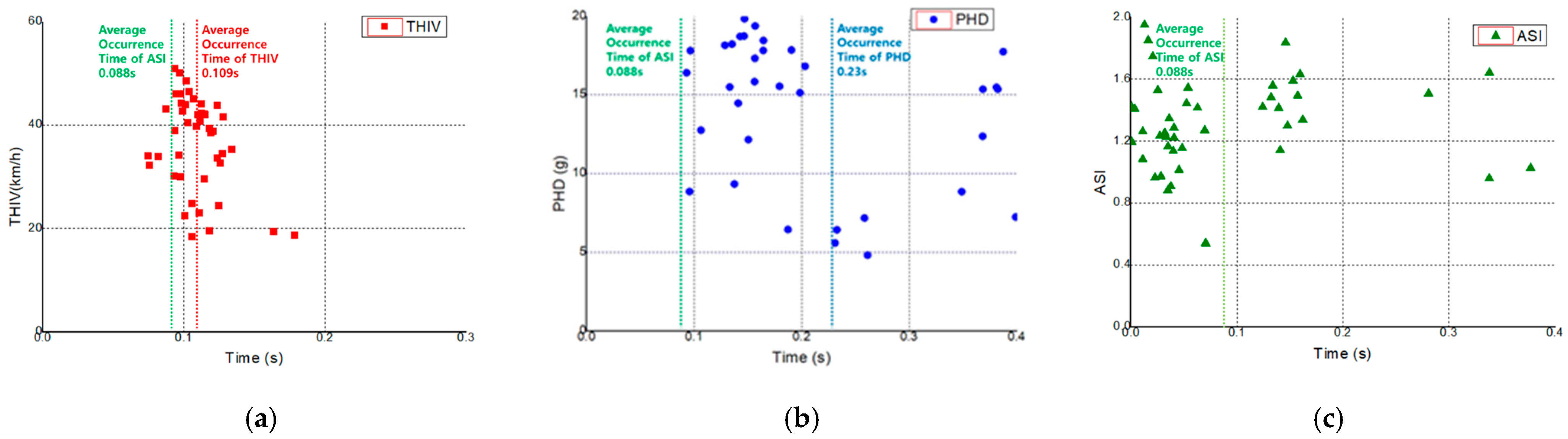
2.3.6. Limit Values and Occurrence Time
3. Full-Scale Crash Test
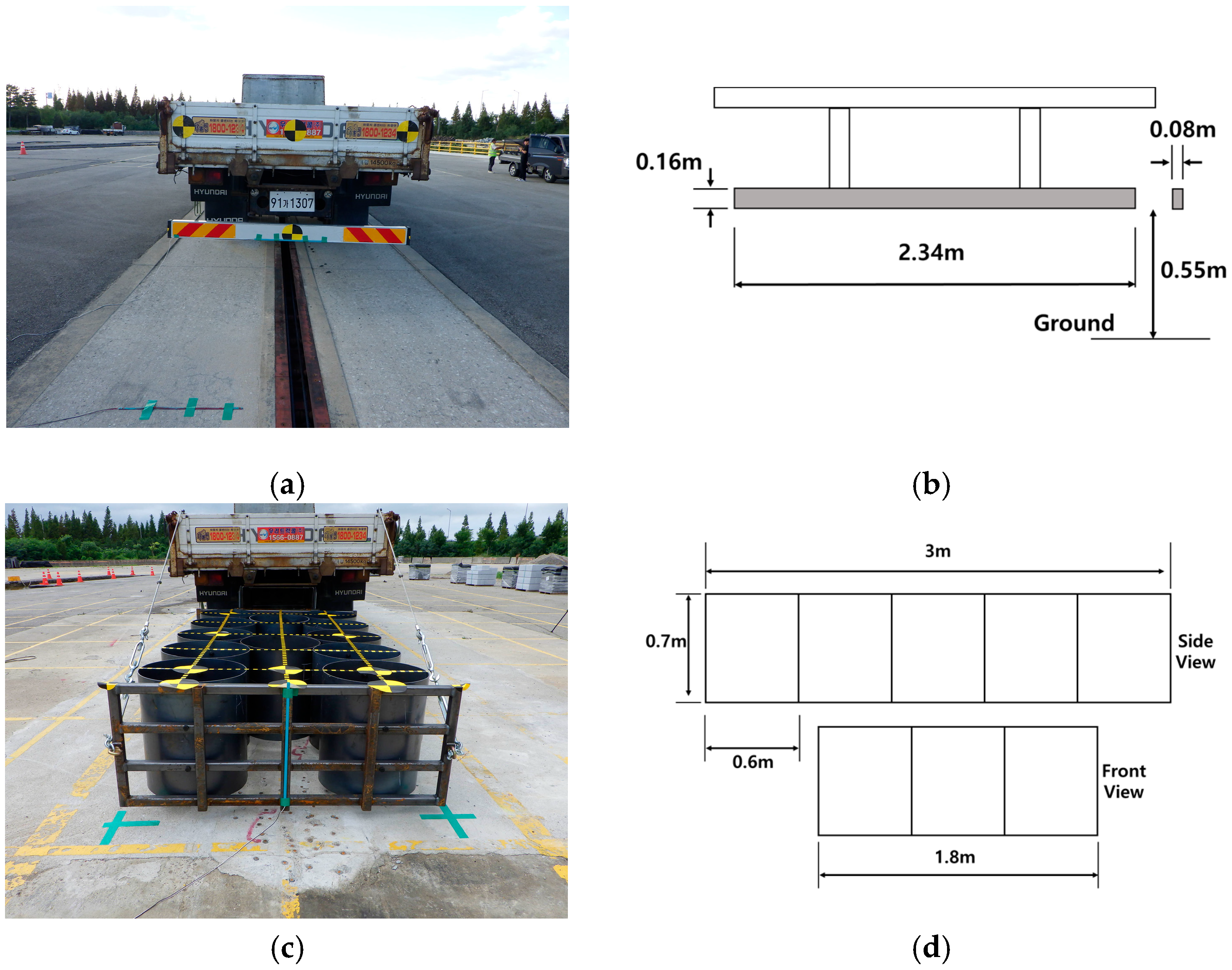
3.1. Full-Scale Test Conditions
3.2. Data Acquisition
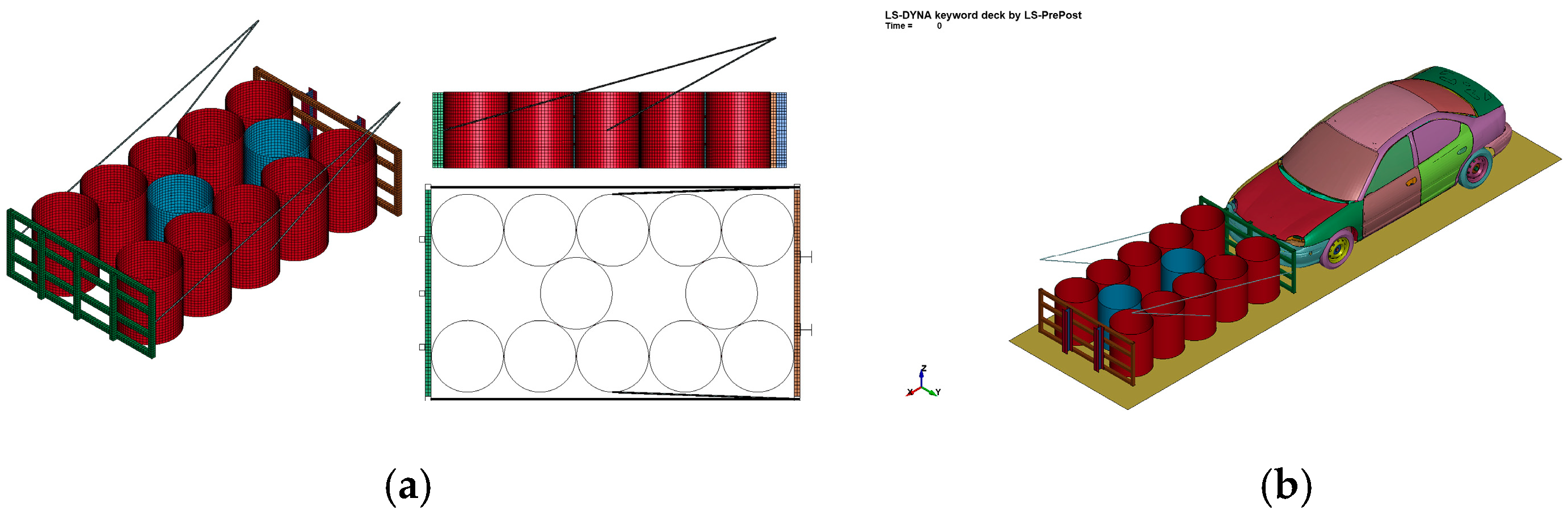
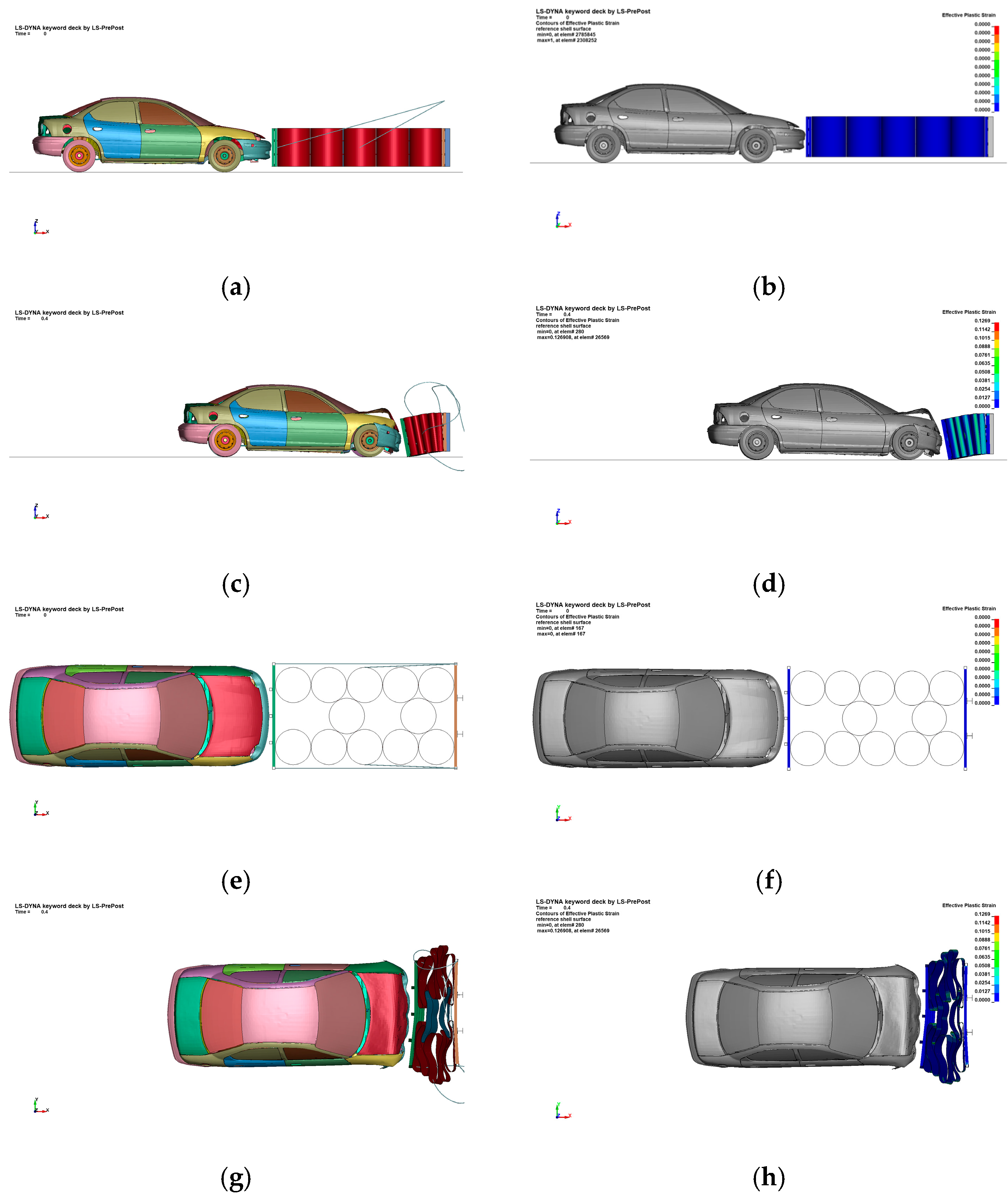
3.3. TMA Simulation
3.4. Test Results
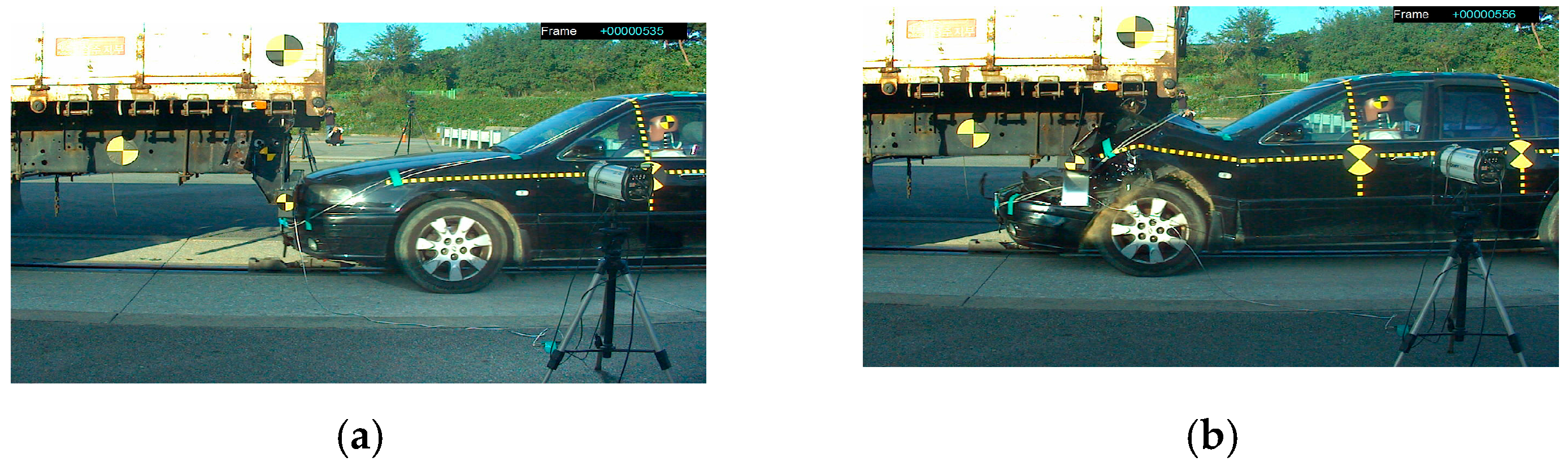
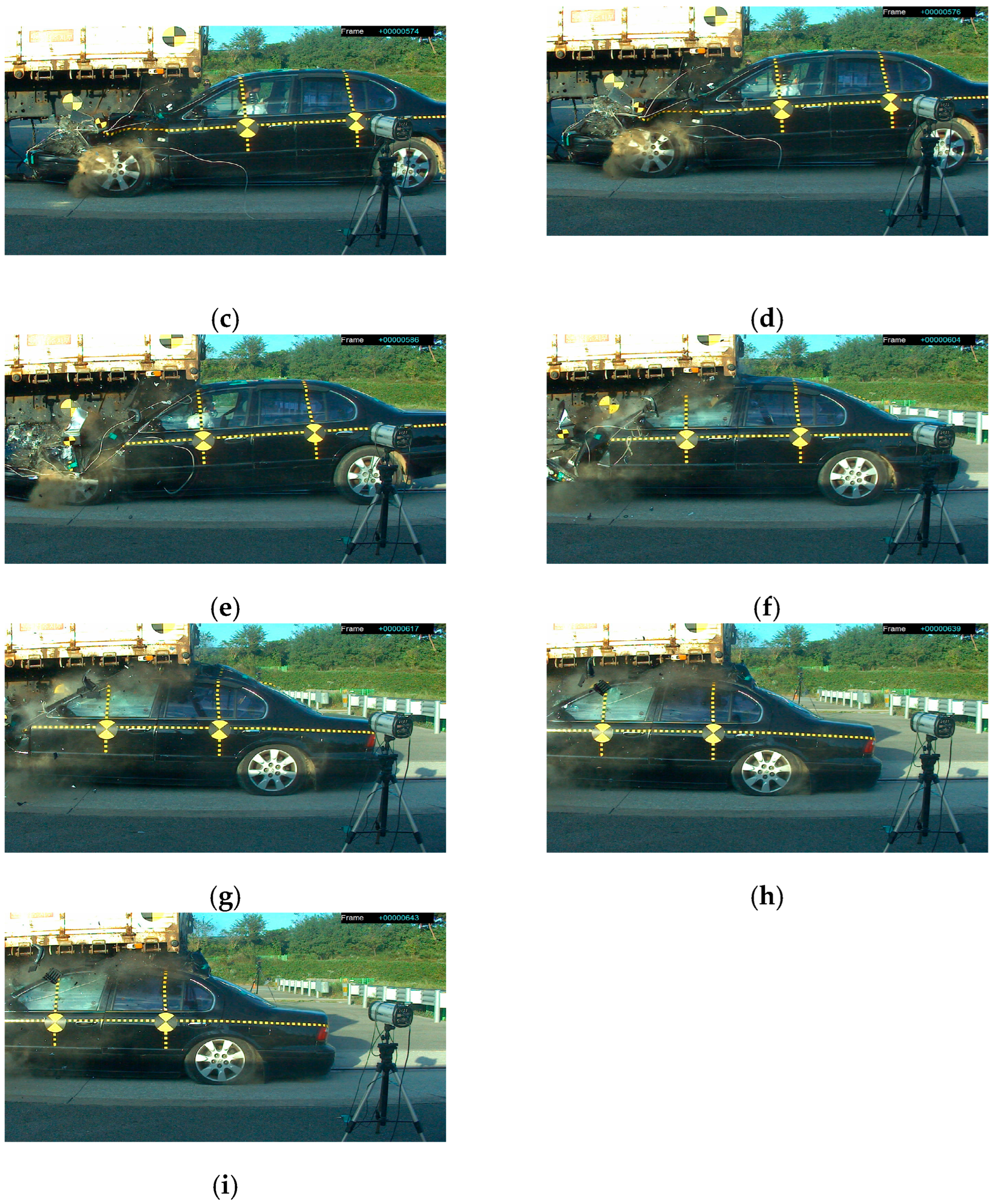
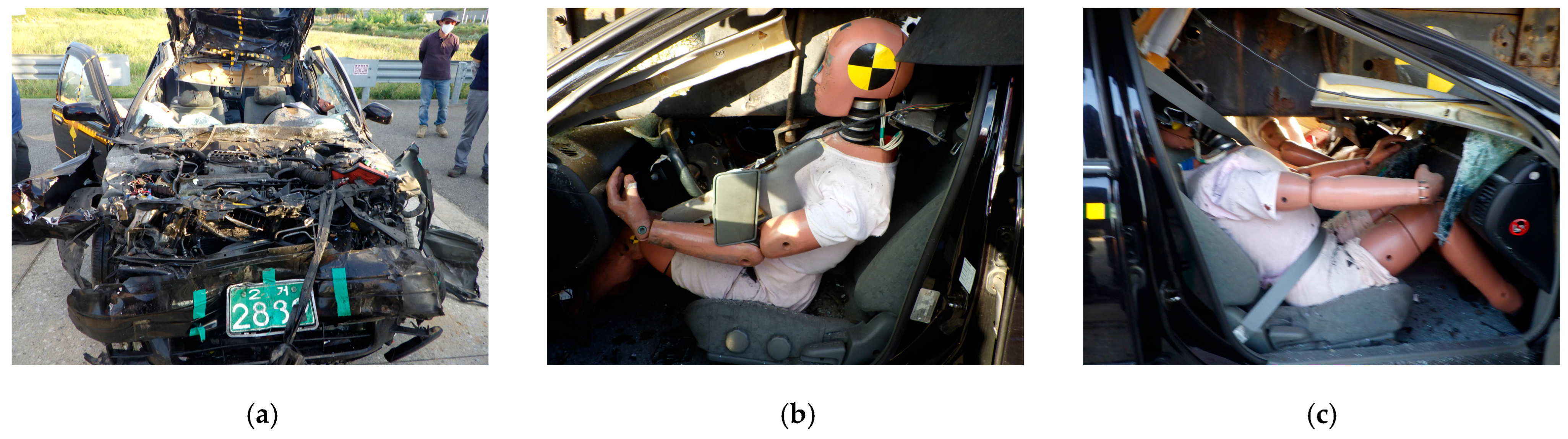
3.4.1. RIG Crash Analysis
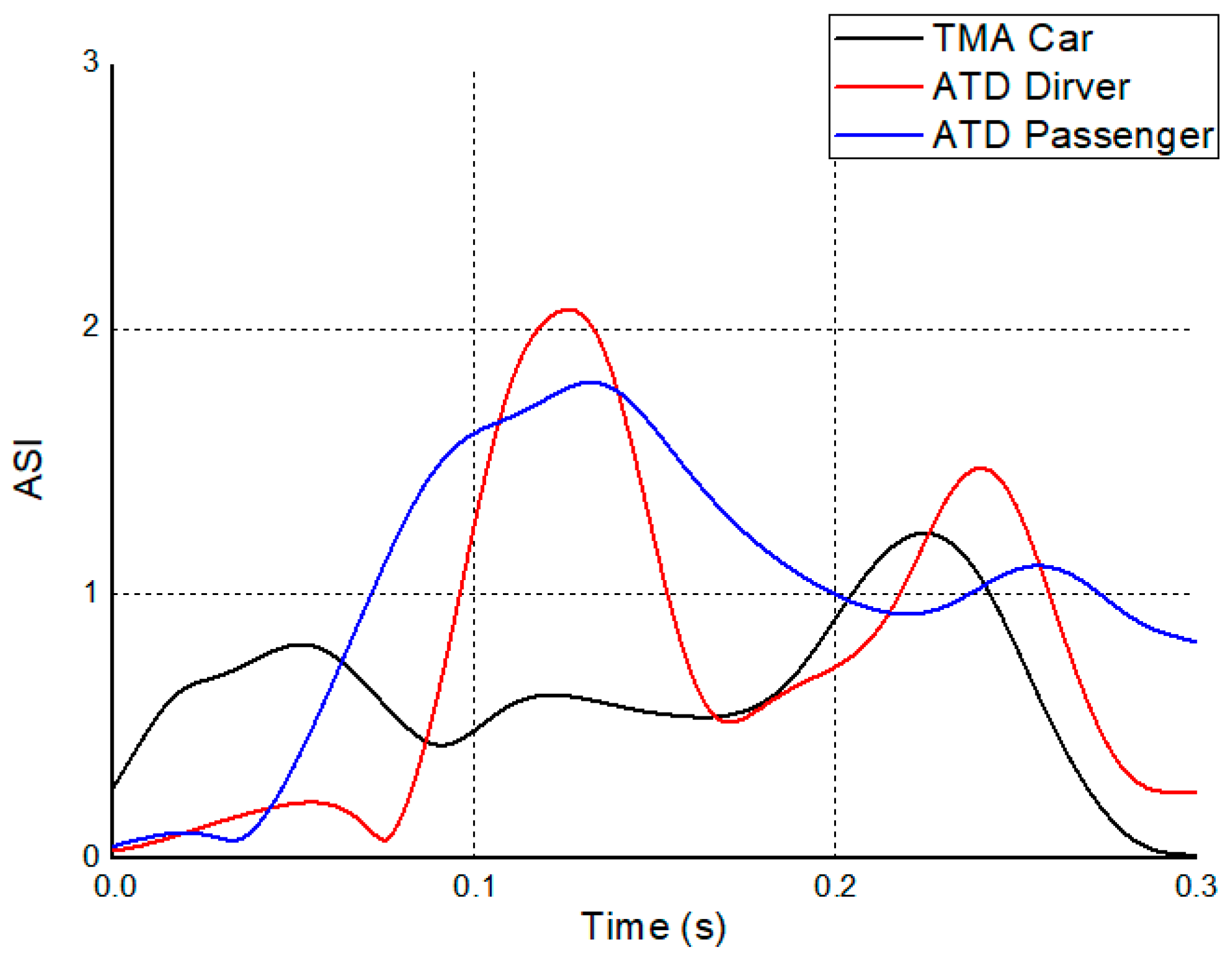
3.4.2. TMA Crash Analysis
3.5. Comparative Analysis of RIG and TMA
4. Discussion
5. Limitations
6. Conclusions
6.1. Key Regularities Identified in This Study
6.2. Scientific and Practical Implications
6.3. Future Work
Author Contributions
Funding
Institutional Review Board Statement
Informed Consent Statement
Data Availability Statement
Acknowledgments
Conflicts of Interest
Abbreviations
| RIG | Rear Impact Guard |
| TMA | Truck Mounted Attenuator |
| FSM | Flail Space Model |
| THIV | Theoretical Head Impact Velocity |
| OIV | Occupant Impact Velocity |
| PHD | Post-impact Head Deceleration |
| ORA | Occupant Ridedown Acceleration |
| ASI | Acceleration Severity Index |
| HIC | Head Injury Criterion |
| ATD | Anthropomorphic Test Device |
| FMVSS | Federal Motor Vehicle Safety Standard |
| MASH | Manual for Assessing Safety Hardware |
| CEN | European Committee for Standardization |
| EN | European Norm (Standard) |
| NCAP | New Car Assessment Program |
| NHTSA | National Highway Traffic Safety Administration |
| NCAC | National Crash Analysis Center |
| FHWA | Federal Highway Administration |
| GAO | Government Accountability Office |
| UNECE | United Nations Economic Commission for Europe |
References
- National Highway Traffic Safety Administration (NHTSA). Fatality Analysis Reporting System (FARS) File Downloads. Available online: https://www.nhtsa.gov/file-downloads?p=nhtsa/downloads/FARS/ (accessed on 5 April 2025).
- Federal Highway Administration (FHWA). Work Zone Facts and Statistics; U.S. Department of Transportation: Washington, DC, USA, 2023. Available online: https://ops.fhwa.dot.gov/wz/resources/facts_stats.htm (accessed on 24 April 2025).
- National Highway Traffic Safety Administration (NHTSA). Federal Motor Vehicle Safety Standards; Rear Impact Guards, Rear Impact Protection. Final Rule; U.S. Department of Transportation: Washington, DC, USA, 2022; Docket No. NHTSA-2022-0053; RIN 2127-AL58. Available online: https://www.federalregister.gov/documents/2022/07/15/2022-14330/federal-motor-vehicle-safety-standards-rear-impact-guards-rear-impact-protection (accessed on 25 April 2025).
- U.S. Government Accountability Office (GAO). Highway Safety: More Robust DOT Leadership Needed to Address America’s Roadway Death Crisis; Report No. GAO-19-264; U.S. Government Accountability Office: Washington, DC, USA, 2019. Available online: https://www.gao.gov/products/gao-19-264 (accessed on 5 April 2025).
- National Highway Traffic Safety Administration (NHTSA). Analysis of Rear Underride in Fatal Truck Crashes, 2008; U.S. Department of Transportation: Washington, DC, USA, 2013. Available online: https://www.nhtsa.gov/document/analysis-rear-underride-fatal-truck-crashes-2008 (accessed on 5 April 2025).
- United Nations Economic Commission for Europe (UNECE). Regulation No. 58—Uniform Provisions Concerning the Approval of Rear Underrun Protective Devices (RUPDs), Vehicles with Regard to the Installation of RUPDs of an Approved Type, and Vehicles with Regard to Their Rear Underrun Protection (RUP); UNECE: Geneva, Switzerland, 2016. [Google Scholar]
- CMVSS 224; Rear Impact Protection. Transport Canada: Ottawa, ON, Canada, 2023.
- Brumbelow, M.L. Crash Test Performance of Large Truck Rear Underride Guards; Report, No. 11.0074; Insurance Institute for Highway Safety: Arlington, VA, USA, 2011; pp. 1–5. [Google Scholar]
- American Association of State Highway and Transportation Officials (AASHTO). Manual for Assessing Safety Hardware (MASH); AASHTO: Washington, DC, USA, 2016. [Google Scholar]
- Committee for European Norms (CEN). Road Restraint Systems—Truck Mounted Attenuators—Performance Classes, Impact Test Acceptance Criteria and Test Performance (CEN/TS 16786:2018); CEN: Brussels, Belgium, 2018. [Google Scholar]
- British Standards Institution (BSI). Design Manual for Roads and Bridges: CD 378, Impact Test and Assessment Criteria for Truck Mounted Attenuators; BSI: London, UK, 2020. [Google Scholar]
- Michie, J.D. Collision Risk Assessment Based on Occupant Flail-Space Model. Transp. Res. Rec. 1981, 796, 1–9. [Google Scholar]
- Michie, J.D. Recommended Procedures for the Safety Performance Evaluation of Highway Appurtenances; NCHRP Report 230; Transportation Research Board, National Research Council: Washington, DC, USA, 1981. [Google Scholar]
- Ross, H.E.; Sicking, D.L.; Zimmer, R.A.; Michie, J.D. Recommended Procedures for the Safety Performance Evaluation of Highway Features; NCHRP Report 350; Transportation Research Board, National Research Council: Washington, DC, USA, 1993. [Google Scholar]
- National Academies of Sciences, Engineering, and Medicine. Evaluation and Comparison of Roadside Crash Injury Metrics; NCHRP Research Report; National Academies of Sciences, Engineering, and Medicine: Washington, DC, USA, 2023; p. 1095. [Google Scholar] [CrossRef]
- EN 1317-1; Road Restraint Systems—Part 1: Terminology and General Criteria for Test Methods. European Committee for Standardization (CEN): Brussels, Belgium, 2010.
- National Highway Traffic Safety Administration (NHTSA). Federal Motor Vehicle Safety Standard No. 208: Occupant Crash Protection; U.S. Department of Transportation: Washington, DC, USA, 2025. [Google Scholar]
- Korea Transportation Safety Authority, Vehicle Performance Test Research Center. Research Report on Crash Tests for New Car Assessment; Korea Transportation Safety Authority: Anyang, Republic of Korea, 2000. [Google Scholar]
- Korea Transportation Safety Authority, Korea Automobile Testing & Research Institute. 2012 New Car Assessment Program (NCAP) Research Report; Korea Transportation Safety Authority: Hwaseong, Republic of Korea, 2012. [Google Scholar]



| Trailer | Impact Conditions | Underride | Max. Longitudinal A-Pillar Deformation (cm) | HIC | ||
|---|---|---|---|---|---|---|
| Drivers | Passengers | |||||
| 2007 Hyundai | 56 km/h | full-width | Catastrophic | 80 | 754 | 557 |
| 2011 Wabash | 56 km/h | full-width | None | 0 | 328 | 329 |
| 2007 Vanguard | 40 km/h | 50% overlap | Moderate | 0 | 24 | |
| 2007 Vanguard | 56 km/h | 50% overlap | Severe | 27 | 109 | |
| 2011 Wabash | 56 km/h | 50% overlap | None | 6 | 160 | |
| 2011 Wabash | 56 km/h, | 30% overlap | Catastrophic | 87 | 880 | |
| Regulation | THIV km/h | OIV m/s | ORA g | ASI | HIC |
|---|---|---|---|---|---|
| MASH [9] | 12.2/4.9 | 20.49 | |||
| CEN/TS 16786 [10] | 44 | 1.9 | |||
| CD378 [11] | 44 | 1.9 | |||
| FMVSS 208 [17] | 1000 |
| Location | Parameter | Channel | Manufacturer | Model | Number |
|---|---|---|---|---|---|
| Vehicle center of gravity | Acceleration | Ax, Ay, Az | Endevco Corporation (Irvine, CA, USA) | 7264-500 | 3 |
| Angular velocity | Az | DTS (Diversified Technical Systems, Inc., Seal Beach, CA, USA) | ARS PRO-8K | 1 | |
| Head | Acceleration | Ax, Ay, Az | TE Connectivity (Hampton, VA, USA) | 64C-2000 | 3 |
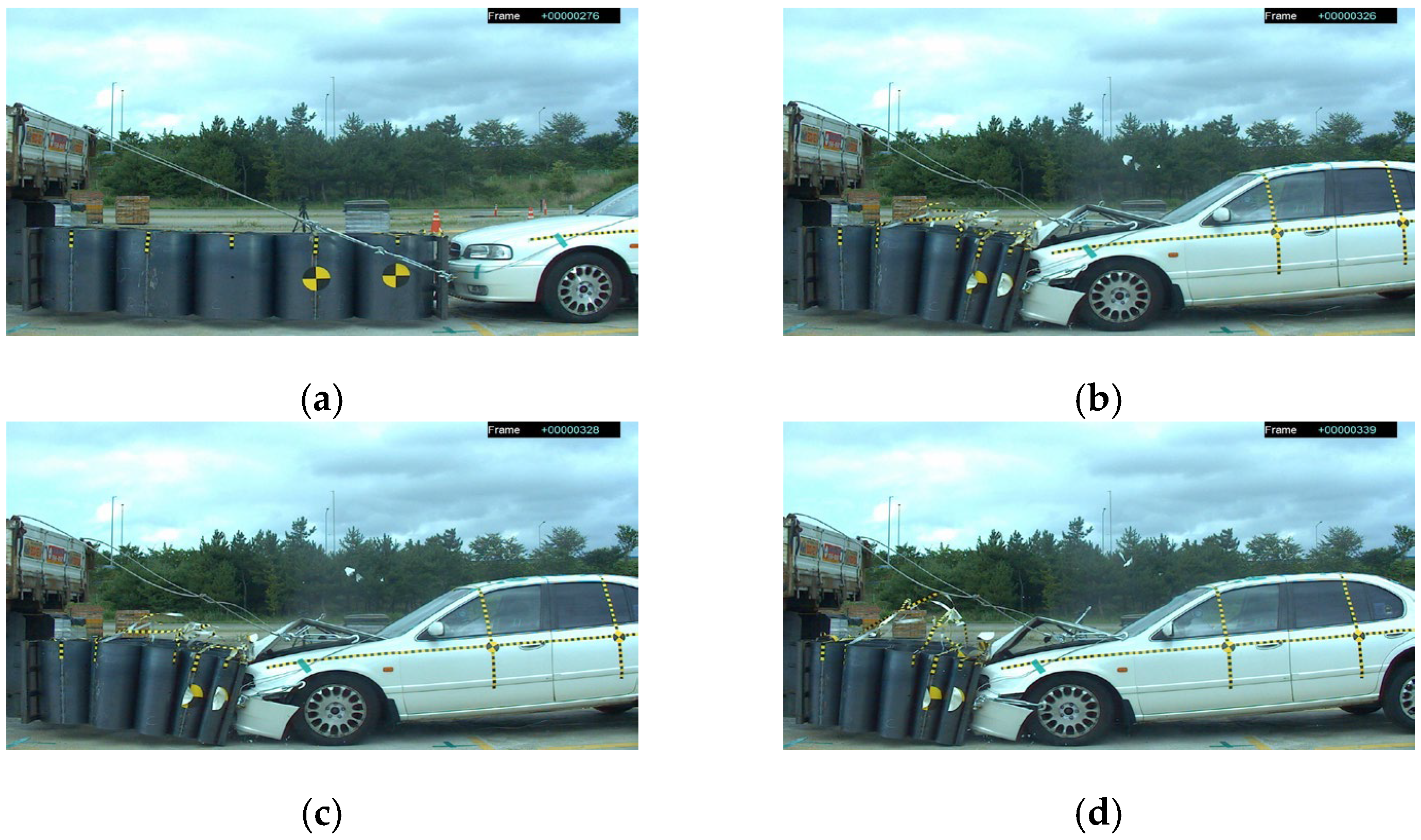
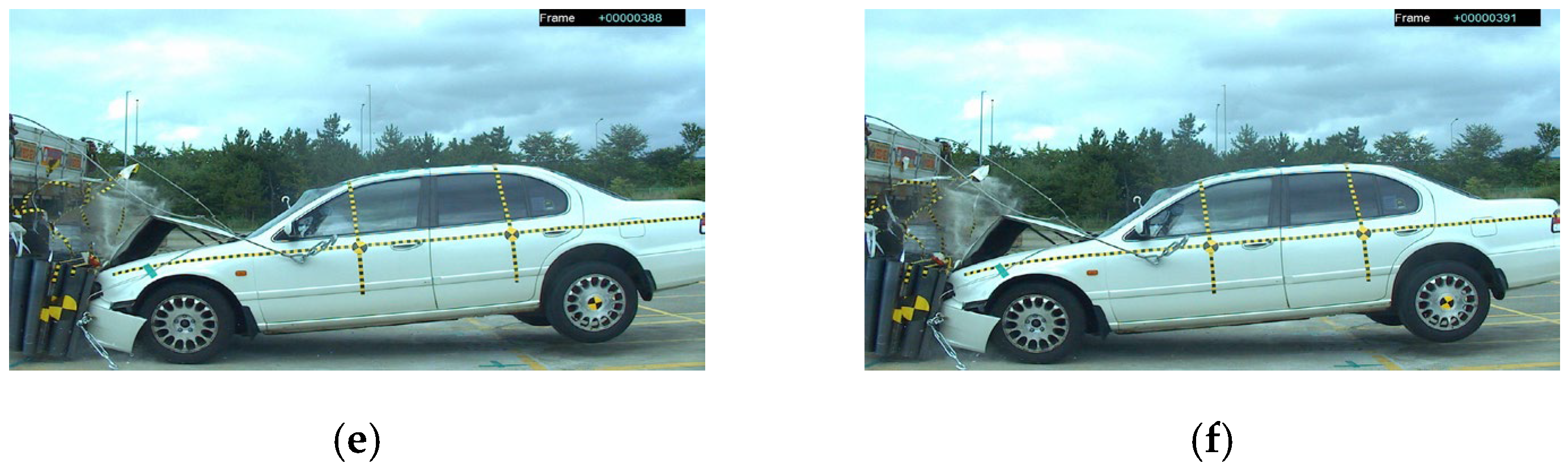
| Symbol | Time (s) | State |
|---|---|---|
| (a) | 0 | Before Collision |
| (b) | 0.0420 | End of RIG deformation |
| (c) | 0.0780 | Intrusion into A pillar |
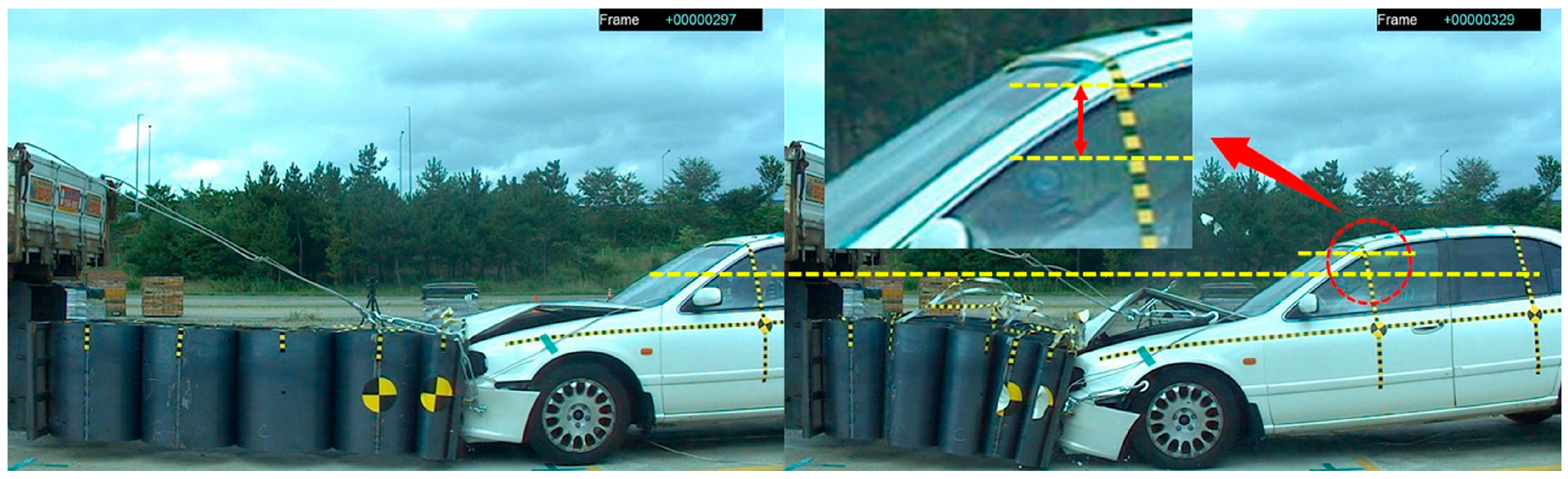
| (d) | 0.0828 | Occurrence of HIC |
| (e) | 0.1020 | ATD head contact with the windshield |
| (f) | 0.1383 | Occurrence of THIV (OIV) and Intrusion into Upper A pillar |
| (g) | 0.1640 | Intrusion into B pillar |
| (h) | 0.2098 | Occurrence of ASI |
| (i) | 0.2172 | Occurrence of PHD (ORA) Continued Movement in Underride Condition |
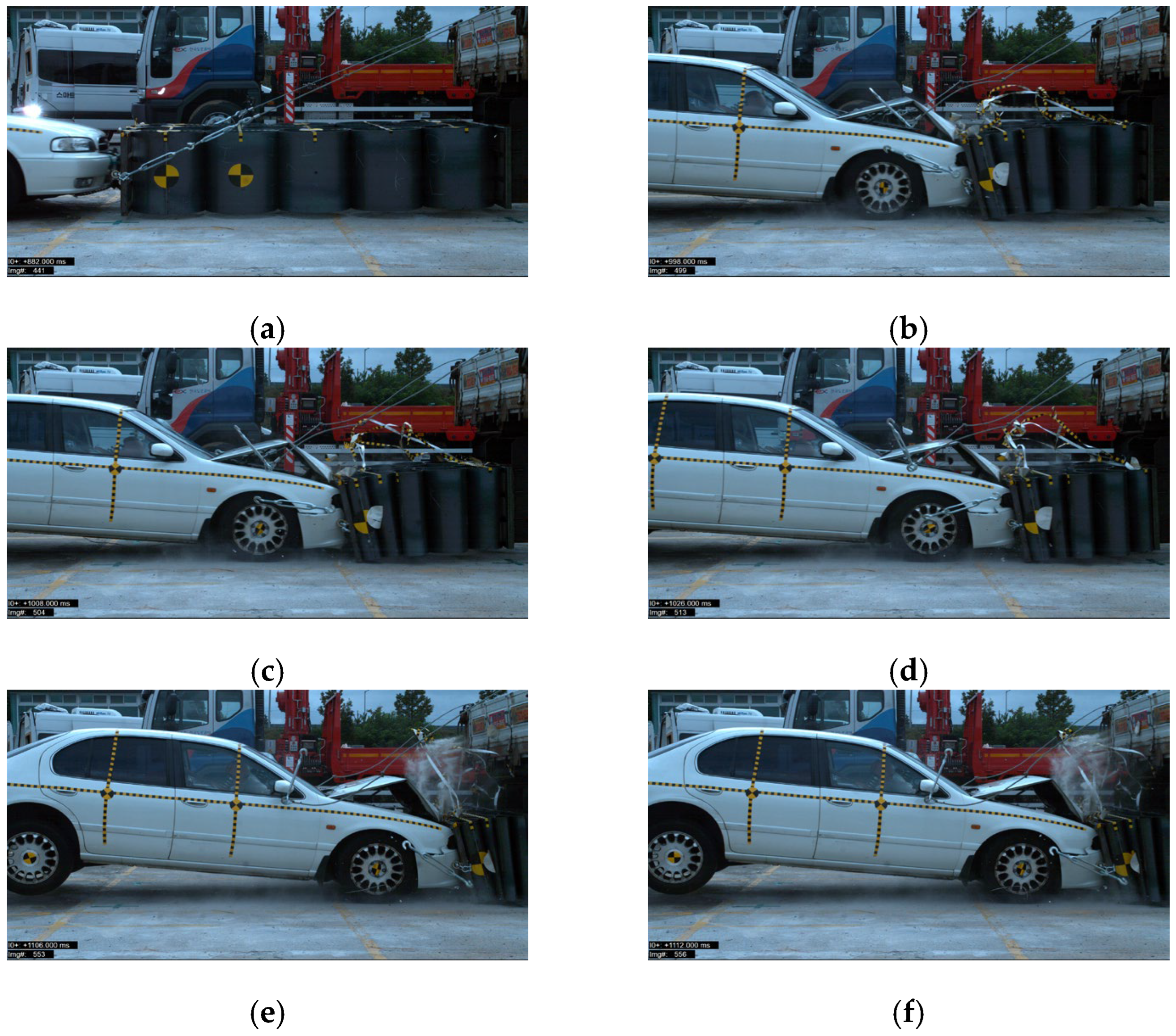
| Symbol | Driver | Passenger | ||
|---|---|---|---|---|
| Time (s) | State | Time (s) | State | |
| (a) | 0 | Before Collision | 0 | Before Collision |
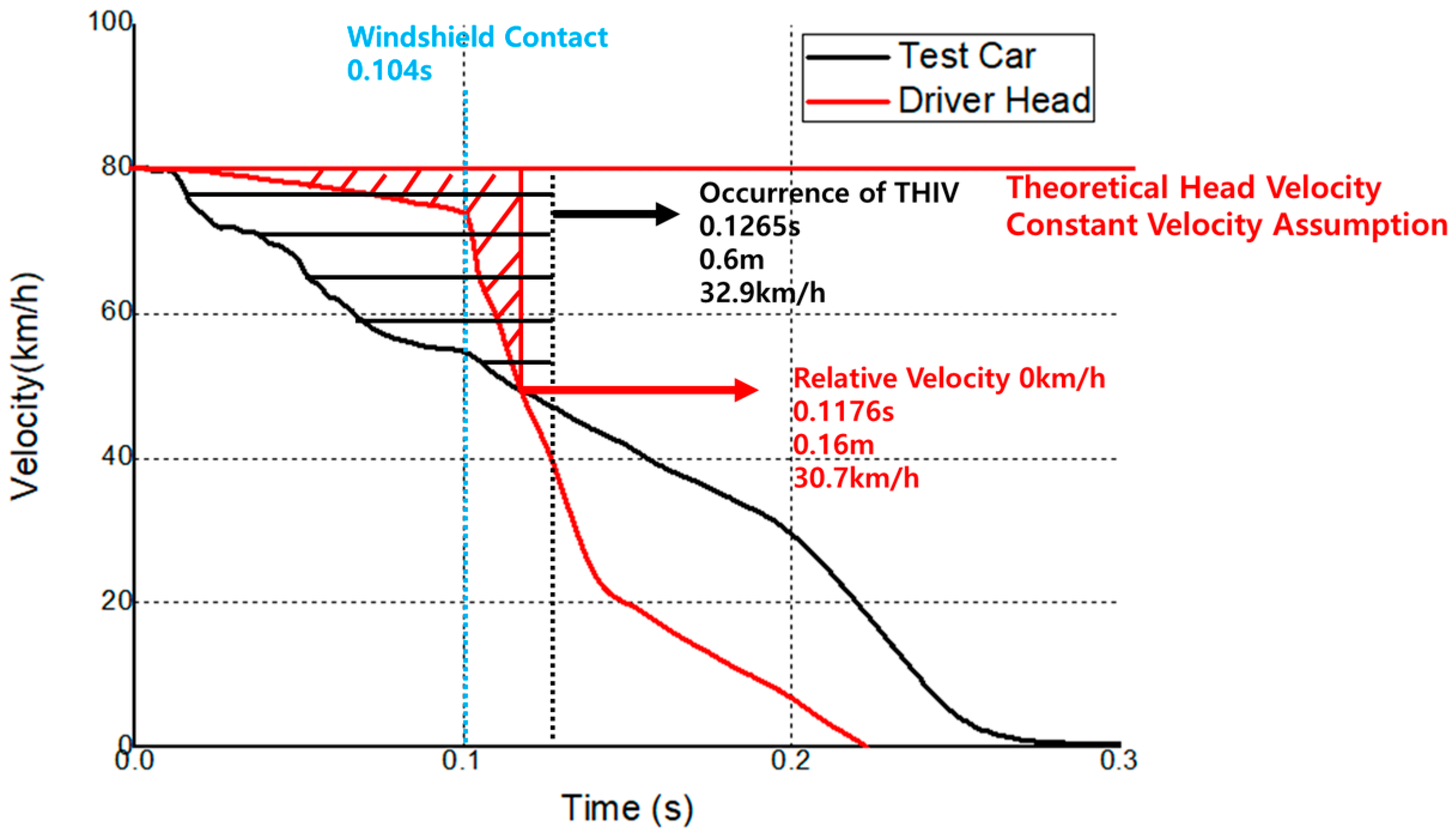
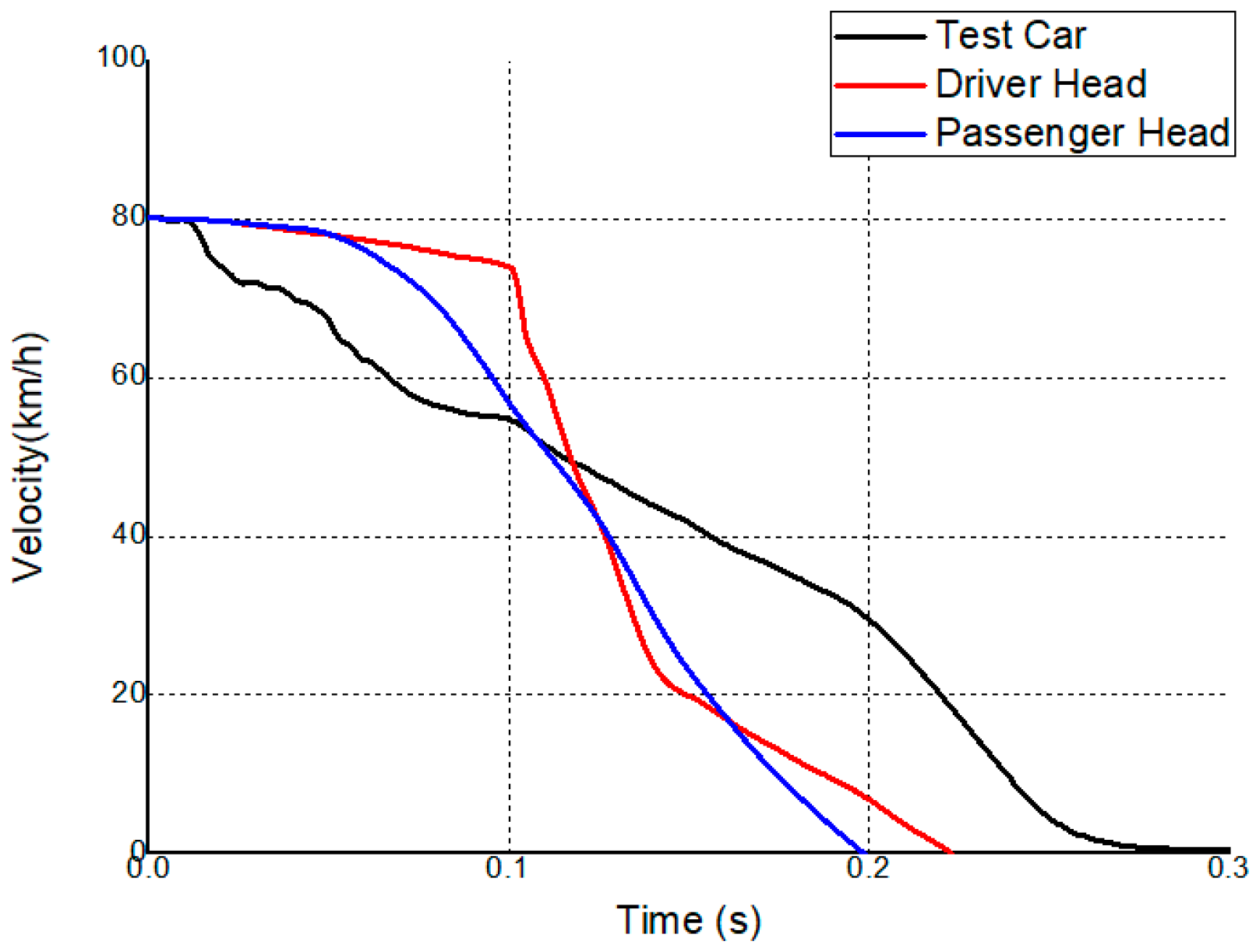
| (b) | 0.1010 | Occurrence of HIC | 0.1160 | Occurrence of HIC |
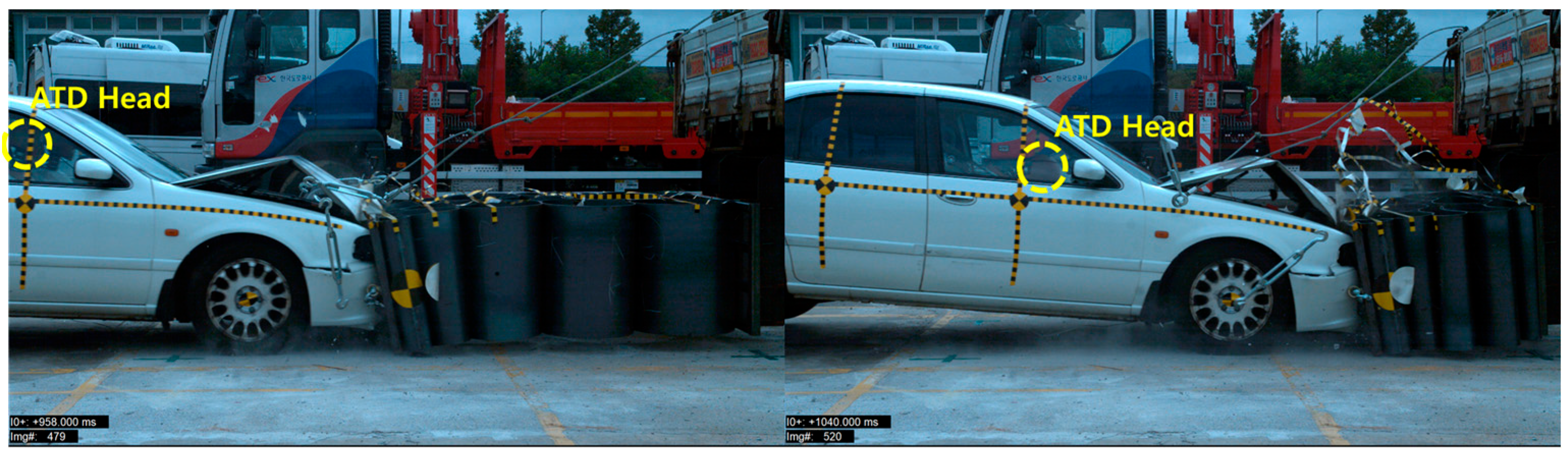
| (c) | 0.1040 | ATD head contact with the windshield | 0.1265 | Occurrence of THIV (ORA) |
| (d) | 0.1265 | Occurrence of THIV (OIV) | 0.1440 | ATD Head rebound |
| (e) | 0.2250 | Occurrence of AIS | 0.2250 | Occurrence of AIS |
| (f) | 0.2311 | Occurrence of PHD (ORA) | 0.2311 | Occurrence of PHD (ORA) |
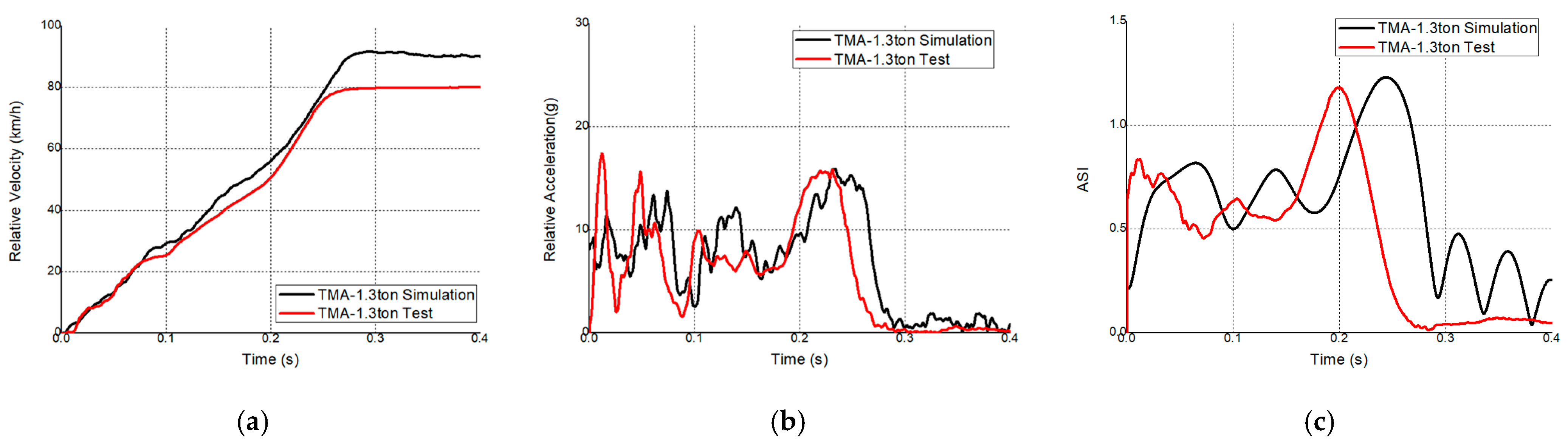
| Condition | THIV km/h | PHD g | ASI |
|---|---|---|---|
| Simulation | 33.4 | 15.9 | 1.23 |
| Test | 32.9 | 15.8 | 1.2 |
| Condition | Test Car | THIV km/h | OIV m/s | PHD g | ORA g | ASI | Impact Velocity km/h | HIC | |
|---|---|---|---|---|---|---|---|---|---|
| HIC36 Driver | HIC36 Passenger | ||||||||
| RIG | 2002 SM520 | 27.7 | 7.7 | 21.2 | 21.2 | 1.4 | 80.5 | 1810 | - |
| TMA | 2002 SM520 | 32.9 | 9.1 | 15.8 | 15.8 | 1.2 | 80.1 | 298 | 67 |
| Condition | Test Car | Impact Velocity km/h | HIC36 | |
|---|---|---|---|---|
| Driver | Passenger | |||
| RIG | 2002 SM520 | 80.5 | 1810 | |
| TMA | 2002 SM520 | 80.1 | 298 | 67 |
| Rigid Wall [18] | 2000 SM520 | 56.1 | 562 | 1143 |
| 2007 Hyundai RIG [8] | 2010 Malibu | 56 | 754 | 557 |
| 2011 Wabash RIG [8] | 2010 Malibu | 56 | 328 | 319 |
| Rigid Wall [19] | 2012 Malibu | 55.8 | 338 | 424 |
| Category | Total | ASI Appears Before the Occurrence of THIV | ASI Appears After the Occurrence of THIV |
|---|---|---|---|
| Road Side Barrier | 13 | 13 | |
| Crash Cushion | 8 | 7 | 1 |
| TMA | 23 | 10 | 13 |
Disclaimer/Publisher’s Note: The statements, opinions and data contained in all publications are solely those of the individual author(s) and contributor(s) and not of MDPI and/or the editor(s). MDPI and/or the editor(s) disclaim responsibility for any injury to people or property resulting from any ideas, methods, instructions or products referred to in the content. |
© 2025 by the authors. Licensee MDPI, Basel, Switzerland. This article is an open access article distributed under the terms and conditions of the Creative Commons Attribution (CC BY) license (https://creativecommons.org/licenses/by/4.0/).
Share and Cite
Moon, B.-K.; Kim, K.-J.; Kim, J.-C.; Cho, D. Comparison of Occupant Risk Indices in Rear-End Collisions with RIG and TMA. Appl. Sci. 2025, 15, 12849. https://doi.org/10.3390/app152312849
Moon B-K, Kim K-J, Kim J-C, Cho D. Comparison of Occupant Risk Indices in Rear-End Collisions with RIG and TMA. Applied Sciences. 2025; 15(23):12849. https://doi.org/10.3390/app152312849
Chicago/Turabian StyleMoon, Byung-Kab, Kyoung-Ju Kim, Jong-Chan Kim, and Dooyong Cho. 2025. "Comparison of Occupant Risk Indices in Rear-End Collisions with RIG and TMA" Applied Sciences 15, no. 23: 12849. https://doi.org/10.3390/app152312849
APA StyleMoon, B.-K., Kim, K.-J., Kim, J.-C., & Cho, D. (2025). Comparison of Occupant Risk Indices in Rear-End Collisions with RIG and TMA. Applied Sciences, 15(23), 12849. https://doi.org/10.3390/app152312849