Cytokine Signatures Induced by Epstein-Barr Virus Antigens in Multiple Sclerosis: Elucidating the Role of B-Cell and T-Cell Hyperactivation in Disease Relapse

 ,
, 
Abstract
1. Introduction
1.1. Molecular Mimicry: The Bridge Between Viral Infection and Autoimmunity
1.2. EBV-Infected B-Cells: Viral Reservoirs and Antigen-Presenting Accomplices
1.3. Study Rationale
2. Materials and Methods
2.1. Study Population
2.2. Ethical Statement
2.3. PBMC Isolation and In Vitro Stimulation
2.4. Cytokine Quantification
2.5. Statistical Analysis
3. Results
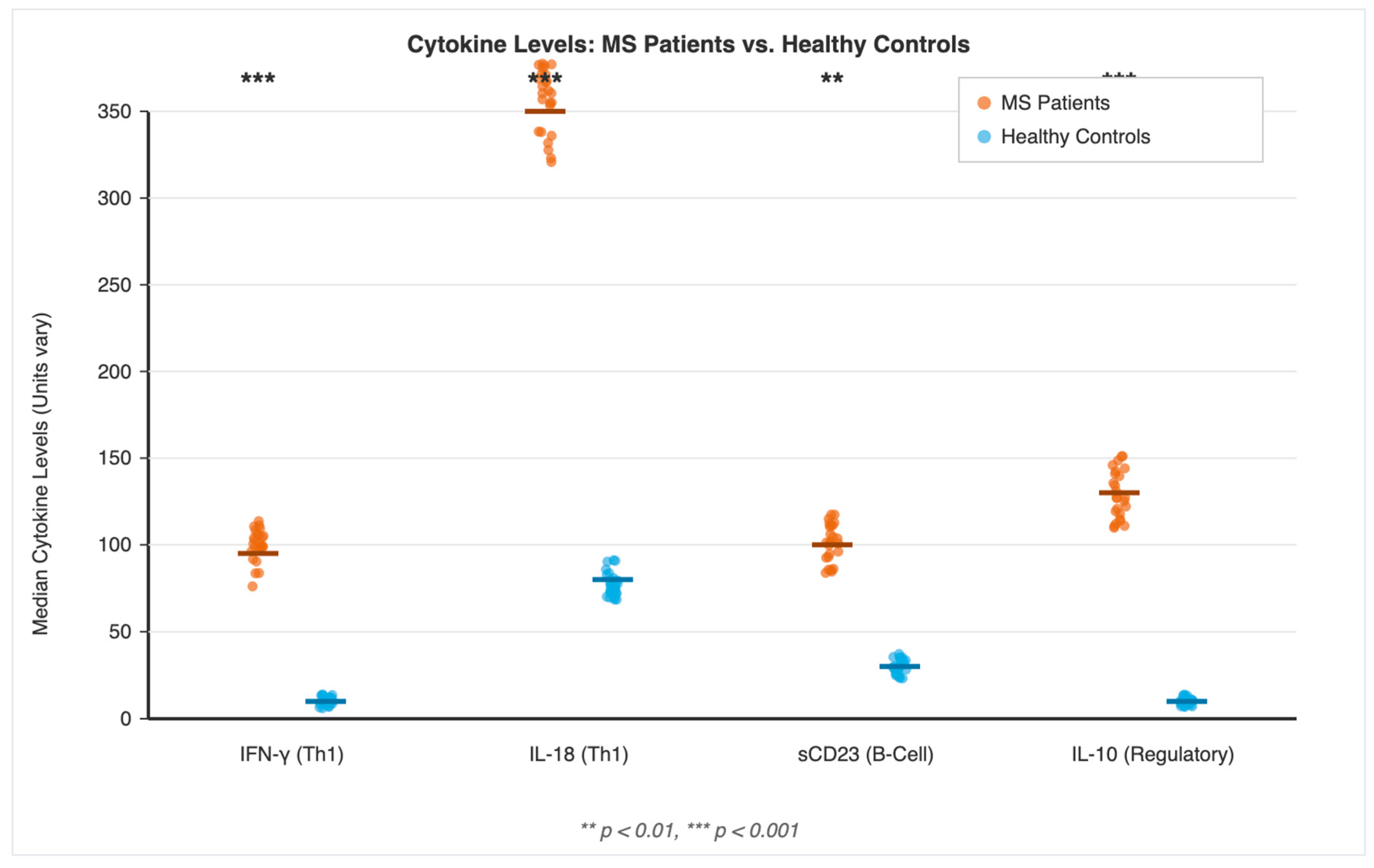
3.1. Heightened Cytokine Response to EBV Antigens in MS Patients
3.2. B-Cell Activation and Regulatory Cytokines Strongly Correlate with Clinical Disability
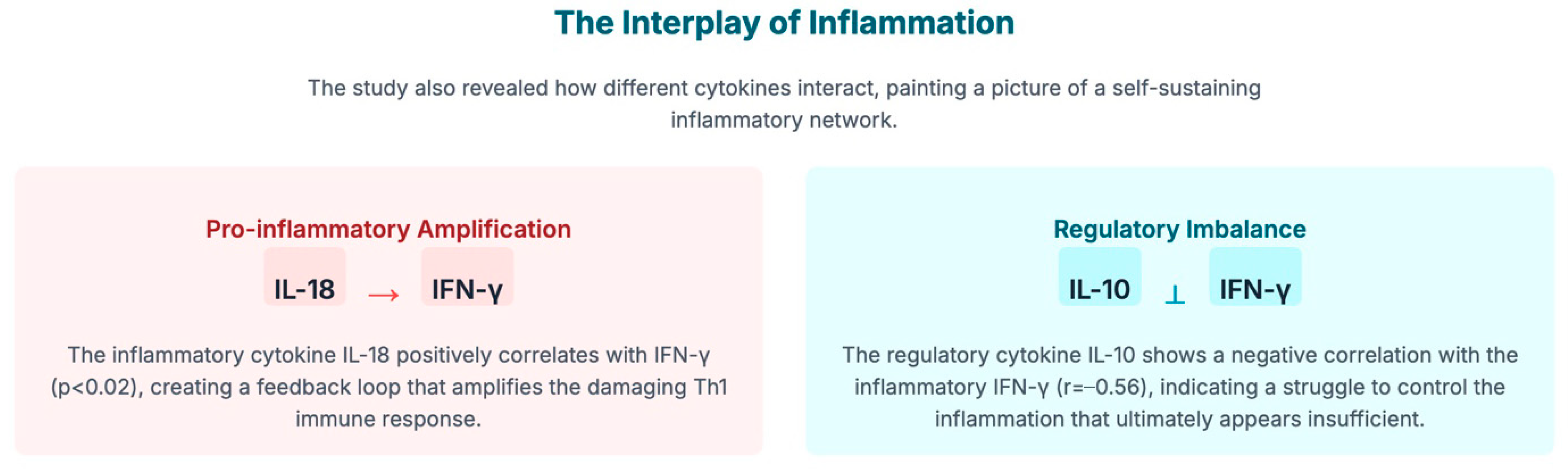
3.3. An Imbalanced Cytokine Network in MS
4. Discussion
4.1. Th1 Inflammation and Molecular Mimicry
4.2. B-Cell Dysregulation: Beyond Antibody Production
4.3. The Paradox of Regulatory Responses
4.4. Broader Mechanisms Linking Viral Infection to Autoimmunity
- Bystander Activation: Local inflammation and tissue damage resulting from the immune response to EBV can lead to the release of sequestered CNS self-antigens and the upregulation of co-stimulatory molecules on APCs. This inflammatory milieu can non-specifically activate autoreactive T-cells that are normally held in check by peripheral tolerance mechanisms.
- Epitope Spreading: Chronic inflammation caused by the primary immune response against EBV antigens can lead to secondary tissue damage that exposes previously cryptic self-antigens. This results in diversification and amplification of the autoimmune response to include multiple myelin and neuronal targets, a phenomenon well-documented in MS and demonstrated by the presence of antibodies and T-cells reactive against numerous CNS antigens in established disease [20].
- Chronic Antigenic Stimulation: The lifelong latent infection established by EBV in B-cells provides continuous antigenic stimulation. Periodic viral reactivation and the constant presence of latently infected B-cells may foster a state of chronic immune activation that, over time, erodes tolerance mechanisms and facilitates the emergence or expansion of autoreactive lymphocyte clones.
4.5. Clinical and Therapeutic Implications
4.6. Study Limitations
5. Conclusions
Author Contributions
Funding
Institutional Review Board Statement
Informed Consent Statement
Data Availability Statement
Acknowledgments
Conflicts of Interest
References
- Bjornevik, K.; Cortese, M.; Healy, B.C.; Kuhle, J.; Mina, M.J.; Leng, Y.; Elledge, S.J.; Niebuhr, D.W.; Scher, A.I.; Munger, K.L.; et al. Longitudinal analysis reveals high prevalence of Epstein-Barr virus associated with multiple sclerosis. Science 2022, 375, 296–301. [Google Scholar] [CrossRef]
- Hedström, A.K. Risk factors for multiple sclerosis in the context of Epstein-Barr virus infection. Front. Immunol. 2023, 14, 1212676. [Google Scholar] [CrossRef]
- Serafini, B.; Rosicarelli, B.; Franciotta, D.; Magliozzi, R.; Reynolds, R.; Cinque, P.; Andreoni, L.; Trivedi, P.; Salvetti, M.; Faggioni, A.; et al. Dysregulated Epstein-Barr virus infection in the multiple sclerosis brain. J. Exp. Med. 2007, 204, 2899–2912. [Google Scholar] [CrossRef] [PubMed]
- Lanz, T.V.; Brewer, R.C.; Ho, P.P.; Moon, J.-S.; Jude, K.M.; Fernandez, D.; Fernandes, R.A.; Gomez, A.M.; Nadj, G.-S.; Bartley, C.M.; et al. Clonally expanded B cells in multiple sclerosis bind EBV EBNA1 and GlialCAM. Nature 2022, 603, 321–327. [Google Scholar] [CrossRef] [PubMed]
- Bar-Or, A.; Pender, M.P.; Khanna, R.; Steinman, L.; Hartung, H.-P.; Maniar, T.; Croze, E.; Aftab, B.T.; Giovannoni, G.; Joshi, M.A. Epstein-Barr virus in multiple sclerosis: Theory and emerging immunotherapies. Trends Mol. Med. 2020, 26, 296–310. [Google Scholar] [CrossRef] [PubMed]
- Schneider-Hohendorf, T.; Wünsch, C.; Falk, S.; Raposo, C.; Rubelt, F.; Mirebrahim, H.; Asgharian, H.; Schlecht, U.; Mattox, D.; Zhou, W.; et al. Broader anti-EBV TCR repertoire in multiple sclerosis: Disease specificity and treatment modulation. Brain 2025, 148, 933–940. [Google Scholar] [CrossRef]
- Pender, M.P.; Csurhes, P.A.; Burrows, J.M.; Burrows, S.R. Defective T-cell control of Epstein-Barr virus infection in multiple sclerosis. Clin. Transl. Immunol. 2017, 6, e126. [Google Scholar] [CrossRef]
- Tzartos, J.S.; Khan, G.; Vossenkamper, A.; Cruz-Sadaba, M.; Lonardi, S.; Sefia, E.; Meager, A.; Elia, A.; Middeldorp, J.; Clemens, M.; et al. Association of innate immune activation with latent Epstein-Barr virus in active MS lesions. Neurology 2012, 78, 15–23. [Google Scholar] [CrossRef]
- Hauser, S.L.; Bar-Or, A.; Comi, G.; Giovannoni, G.; Hartung, H.-P.; Hemmer, B.; Lublin, F.; Montalban, X.; Rammohan, K.W.; Selmaj, K.; et al. Ocrelizumab versus Interferon Beta-1a in Relapsing Multiple Sclerosis. N. Engl. J. Med. 2017, 376, 221–234. [Google Scholar] [CrossRef]
- Perrella, O.; Sbreglia, C.; Perrella, M.; Spetrini, G.; Gorga, F.; Pezzella, M.; Perrella, A.; Atripaldi, L.; Carrieri, P. Interleukin-10 and tumor necrosis factor-alpha: Mode of immunomodulation in multiple sclerosis. Neurol. Res. 2006, 28, 193–195. [Google Scholar] [CrossRef]
- Carrieri, P.B.; Ladogana, P.; Di Spigna, G.; de Leva, M.F.; Petracca, M.; Montella, S.; Buonavolontà, L.; Florio, C.; Postiglione, L. Interleukin-10 and Interleukin-12 Modulation in Patients with Relapsing-Remitting Multiple Sclerosis on Therapy with Interferon-beta 1a. Immunopharmacol. Immunotoxicol. 2008, 30, 915–923. [Google Scholar] [CrossRef]
- Carrieri, P.B.; Carbone, F.; Perna, F.; Bruzzese, D.; La Rocca, C.; Galgani, M.; Montella, S.; Petracca, M.; Florio, C.; Maniscalco, G.T.; et al. Longitudinal assessment of immuno-metabolic parameters in multiple sclerosis patients during treatment with glatiramer acetate. Metabolism 2015, 64, 946–956. [Google Scholar] [CrossRef]
- Kallaur, A.P.; Lopes, J.; Oliveira, S.R.; Simão, A.N.C.; Reiche, E.M.V.; de Almeida, E.R.D.; Morimoto, H.K.; de Pereira, W.L.C.J.; Alfieri, D.F.; Borelli, S.D.; et al. Immune-inflammatory and oxidative and nitrosative stress biomarkers of depression symptoms in subjects with multiple sclerosis: Increased peripheral inflammation but less acute neuroinflammation. Mol. Neurobiol. 2015, 53, 5191–5202. [Google Scholar] [CrossRef]
- Li, R.; Patterson, K.R.; Bar-Or, A. Reassessing B cell contributions in multiple sclerosis. Nat. Immunol. 2018, 19, 696–707. [Google Scholar] [CrossRef]
- Montalban, X.; Hauser, S.L.; Kappos, L.; Arnold, D.L.; Bar-Or, A.; Comi, G.; de Seze, J.; Giovannoni, G.; Hartung, H.-P.; Hemmer, B.; et al. Ocrelizumab versus Placebo in Primary Progressive Multiple Sclerosis. N. Engl. J. Med. 2017, 376, 209–220. [Google Scholar] [CrossRef]
- Dominguez-Villar, M.; Hafler, D.A. Regulatory T cells in autoimmune disease. Nat. Immunol. 2018, 19, 665–673. [Google Scholar] [CrossRef] [PubMed]
- Rosser, E.C.; Mauri, C. Regulatory B cells: Origin, phenotype, and function. Immunity 2015, 42, 607–612. [Google Scholar] [CrossRef] [PubMed]
- Smatti, M.K.; Cyprian, F.S.; Nasrallah, G.K.; Al Thani, A.A.; Almishal, R.O.; Yassine, H.M. Viruses and Autoimmunity: A Review on the Potential Interaction and Molecular Mechanisms. Viruses 2019, 11, 762. [Google Scholar] [CrossRef]
- Rojas, M.; Restrepo-Jiménez, P.; Monsalve, D.M.; Pacheco, Y.; Acosta-Ampudia, Y.; Ramírez-Santana, C.; Leung, P.S.C.; Ansari, A.A.; Gershwin, M.E.; Anaya, J.M. Molecular mimicry and autoimmunity. J. Autoimmun. 2018, 95, 100–123. [Google Scholar] [CrossRef] [PubMed]
- Tuohy, V.K.; Yu, M.; Weinstock-Guttman, B.; Kinkel, R.P. Diversity and plasticity of self recognition during the development of multiple sclerosis. J. Clin. Investig. 1997, 99, 1682–1690. [Google Scholar] [CrossRef]
- Pender, M.P.; Csurhes, P.A.; Smith, C.; Douglas, N.L.; Neller, M.A.; Matthews, K.K.; Beagley, L.; Rehan, S.; Crooks, P.; Hopkins, T.J.; et al. Epstein-Barr virus-specific T cell therapy for progressive multiple sclerosis. JCI Insight 2018, 3, e124714. [Google Scholar] [CrossRef] [PubMed]
- Soldan, S.S.; Lieberman, P.M. Epstein-Barr virus and multiple sclerosis. Nat. Rev. Microbiol. 2023, 21, 51–64. [Google Scholar] [CrossRef] [PubMed]



| Correlated Variables | Correlation Coefficient (r) | 95% Confidence Interval | p-Value |
|---|---|---|---|
| EDSS Score/IL-10 | 0.65 | 0.38 to 0.82 | 0.0003 |
| EDSS Score/sCD23 | 0.72 | 0.49 to 0.86 | 0.0001 |
| sCD23/IL-10 | 0.45 | 0.10 to 0.70 | 0.03 |
| IL-18/IFN-γ | 0.51 | 0.17 to 0.74 | 0.02 |
| IL-10/IFN-γ | −0.56 | −0.77 to −0.23 | <0.01 |
Disclaimer/Publisher’s Note: The statements, opinions and data contained in all publications are solely those of the individual author(s) and contributor(s) and not of MDPI and/or the editor(s). MDPI and/or the editor(s) disclaim responsibility for any injury to people or property resulting from any ideas, methods, instructions or products referred to in the content. |
© 2025 by the authors. Licensee MDPI, Basel, Switzerland. This article is an open access article distributed under the terms and conditions of the Creative Commons Attribution (CC BY) license (https://creativecommons.org/licenses/by/4.0/).
Share and Cite
Perrella, A.; Bellopede, P.; D’Antonio, A.; Di Spirito, A.; Sbreglia, C.; Carrieri, P.B.; Perrella, O. Cytokine Signatures Induced by Epstein-Barr Virus Antigens in Multiple Sclerosis: Elucidating the Role of B-Cell and T-Cell Hyperactivation in Disease Relapse. Appl. Sci. 2025, 15, 12835. https://doi.org/10.3390/app152312835
Perrella A, Bellopede P, D’Antonio A, Di Spirito A, Sbreglia C, Carrieri PB, Perrella O. Cytokine Signatures Induced by Epstein-Barr Virus Antigens in Multiple Sclerosis: Elucidating the Role of B-Cell and T-Cell Hyperactivation in Disease Relapse. Applied Sciences. 2025; 15(23):12835. https://doi.org/10.3390/app152312835
Chicago/Turabian StylePerrella, Alessandro, Pasquale Bellopede, Anna D’Antonio, Antimo Di Spirito, Costanza Sbreglia, Pietro Biagio Carrieri, and Oreste Perrella. 2025. "Cytokine Signatures Induced by Epstein-Barr Virus Antigens in Multiple Sclerosis: Elucidating the Role of B-Cell and T-Cell Hyperactivation in Disease Relapse" Applied Sciences 15, no. 23: 12835. https://doi.org/10.3390/app152312835
APA StylePerrella, A., Bellopede, P., D’Antonio, A., Di Spirito, A., Sbreglia, C., Carrieri, P. B., & Perrella, O. (2025). Cytokine Signatures Induced by Epstein-Barr Virus Antigens in Multiple Sclerosis: Elucidating the Role of B-Cell and T-Cell Hyperactivation in Disease Relapse. Applied Sciences, 15(23), 12835. https://doi.org/10.3390/app152312835