Forensic Analysis of Manipulated Images and Videos



Abstract
1. Introduction
- Categorize detection methods into general-purpose and Deepfake-specific groups.
- Create a dataset using publicly available generation tools.
- Evaluate the effectiveness and robustness of each method across manipulation types.
- Bridge the gap between theoretical comparisons and real-world applicability.
- Design and proposal of a reference detection model, organized into four categories: Blind Forensic methods, Handcrafted Feature-based Machine Learning (ML) methods, Deep Learning-based methods, and Toolkits. This model provides a unified framework to categorize and evaluate existing detection approaches.
- Creation of a realistic Deepfake dataset, composed of manipulated images and videos generated using diverse and publicly available generation tools.
- Empirical evaluation of Deepfake detection tools, assessing their accuracy and robustness through standard metrics such as confusion matrix, precision, recall, -score, and accuracy.
- Comparative analysis of general-purpose vs. Deepfake-specific methods, identifying their respective strengths and limitations when applied to different media types and manipulation techniques.
2. Objectives
3. State of the Art (SOTA)
3.1. Detection Methods
3.1.1. Blind Forensic Methods
3.1.2. Handcrafted Feature-Based Machine Learning Methods
3.1.3. Deep Learning-Based Methods
3.1.4. Summary and Identified Gaps
3.2. Detection Tools
4. Materials and Methods
4.1. Research Methodology
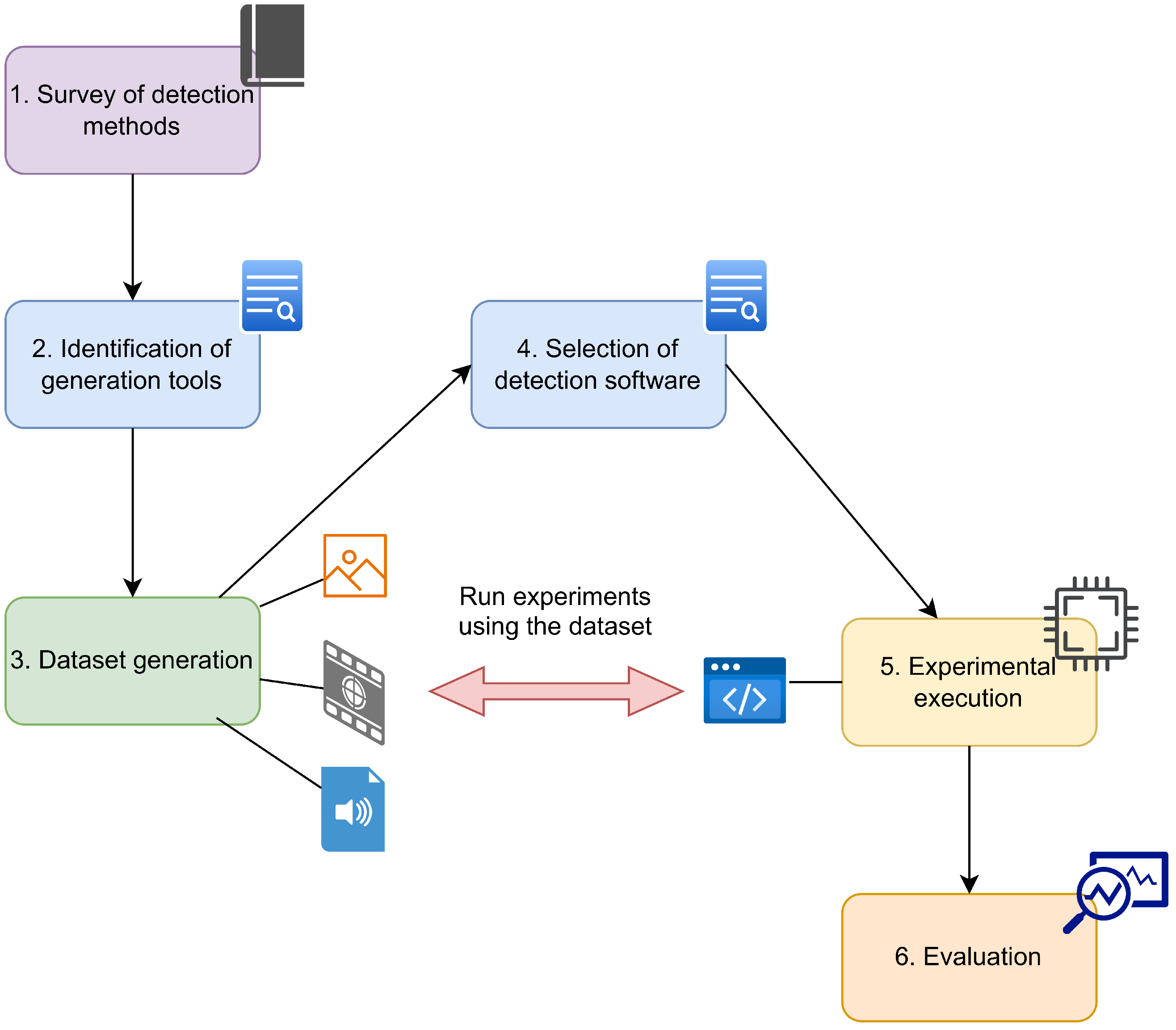
- Survey of detection methods. Existing forensic literature on detection techniques capable of spotting visual anomalies in images and videos was reviewed, including both general-purpose and Deepfake-specific approaches.
- Identification of generation tools. The landscape of Deepfake generation tools was mapped, encompassing face-swap software (DeepFaceLab 11.20.2021) [8], mobile applications (FaceApp) [7], text-to-image and synthetic face generators (DALL-E [28], ThisPersonDoesNotExist) [29,30], and video reenactment tools (Avatarify Desktop) [31].
- Dataset generation. A dataset was constructed using a representative tool from each generation category to create mock samples, which were then combined with real examples to form a balanced evaluation set.
- Selection of detection software. An exhaustive search was conducted to identify tools capable of detecting manipulations in images and videos. General-purpose detection methods were applied to individual multimedia samples without the use of reference models. Additionally, specific Deepfake detection techniques were considered, as introduced in the above section.
- Experimental execution. All the selected detection tools were run on the generated dataset. Appropriate modifications were made between tools to ensure consistency and allow for meaningful comparisons.
- Evaluation. The output formats were harmonized, the standard evaluation metrics were computed, and the results were compared to identify the most effective detection techniques.
4.2. Dataset Justification
4.3. Dataset Generation
4.4. Dataset Description
- /images. It contains two subdirectories: one with the generated Deepfakes and the other with real images.
- /videos. It contains two subdirectories: one with the generated Deepfakes and the other with real videos.
- /audios. It contains two subdirectories: one with the generated Deepfakes and the other with real audio files.
- /src. Some scripts have been developed to test some of our tools, including Image Forgery Detection, MantraNet, and MesoNet. These scripts can be found here.
4.5. Experimental Setup
- Image Forgery Detection with CNN. Results were obtained with the pre-trained model CASIA2_WithRot_LR001_b128_nodrop.pt. Details of the hyperparameters can be found in the tool’s repository [15]. The authors also provide a report [51] indicating that this model was trained on the Casia V2.0 dataset with data augmentation based on image rotations, a batch size of 128, and a learning rate of 0.001. Furthermore, no dropout was applied in this model.
- Autopsy plugin (image and video Deepfake detection). This plugin is distributed as a final tool that uses a trained model, whose parameters are described in [13]. The model is based on a SVM with an RBF (Radial Basis Function) kernel and a regularization parameter of 6.37.
- MesoNet. The pre-trained model used in the experiment, Meso4_DF, is the one distributed with the original implementation. The architectural details of this model are specified in [52], although the corresponding hyperparameters are not documented.
5. Our Proposed Reference Model
6. Performance Evaluation
6.1. Goodness Metrics
- True Positive (TP). This metric refers to the samples that are correctly classified as Deepfakes.
- False Negative (FN). This metric refers to the Deepfake samples that are falsely classified as real images and videos.
- False Positive (FP). This metric refers to the real samples that are misclassified as Deepfakes.
- True Negative (TN). This metric refers to the samples that are correctly classified as real images and videos.
6.2. Results
6.3. Discussion
7. Conclusions
Author Contributions
Funding
Institutional Review Board Statement
Informed Consent Statement
Data Availability Statement
Acknowledgments
Conflicts of Interest
Abbreviations
| AI | Artificial Intelligence |
| CFA | Color Filter Array |
| CNN | Convolutional Neural Network |
| CQCC | Constant Q Cepstral Coefficients |
| DFDC | DeepFake Detection Challenge |
| DL | Deep Learning |
| ELA | Error Level Analysis |
| GAN | Generative Adversarial Network |
| INCIBE | National Cybersecurity Institute of Spain |
| ML | Machine Learning |
| MFCC | Mel-Frequency Cepstral Coefficients |
| MTCNN | Multitask Cascaded Convolutional Networks |
| PRNU | Photo Response Non-Uniformity |
| RPLP | Revised Perceptual Linear Prediction |
| RBF | Radial Basis Function |
| SVM | Support Vector Machine |
| TTS | Text-to-Speech |
| SAFL | Synthetic Audio and Forensic Lab dataset |
References
- INCIBE. Deepfakes. 2020. Available online: https://www.incibe.es/aprendeciberseguridad/deepfakes (accessed on 22 November 2025). (In Spanish).
- Wu, Y.; Ngai, E.W.T.; Wu, P.; Wu, C. Fake News on the Internet: A Literature Review, Synthesis and Directions for Future Research. Internet Res. 2022, 32, 1662–1699. [Google Scholar] [CrossRef]
- Wang, T.; Liao, X.; Chow, K.P.; Lin, X.; Wang, Y. Deepfake Detection: A Comprehensive Survey from the Reliability Perspective. ACM Comput. Surv. 2025, 57, 1–35. [Google Scholar] [CrossRef]
- Tan, F.; Zhai, M.; Zhai, C. Foreign object detection in urban rail transit based on deep differentiation segmentation neural network. Heliyon 2024, 10, e37072. [Google Scholar] [CrossRef]
- Elías, C.; Montoro, P.; Osuna, S.; Fernádez-Roldán, A.; Robles-Gómez, A.; Gálvez, T. Fake News. La fábrica de Mentiras. TVE2 and UNED Canal. 2023. Available online: https://www.rtve.es/play/videos/uned/03-11-23/7003458/ (accessed on 22 November 2025). (In Spanish).
- Verdoliva, L. Media Forensics and DeepFakes: An Overview. IEEE J. Sel. Top. Signal Process. 2020, 14, 910–932. [Google Scholar] [CrossRef]
- FaceApp. FaceApp. 2025. Available online: https://www.faceapp.com/ (accessed on 22 November 2025).
- Perov, I.; Gao, D.; Chervoniy, N.; Liu, K.; Marangonda, S.; Umé, C.; Dpfks, M.; Facenheim, C.S.; RP, L.; Jiang, J.; et al. DeepFaceLab: Integrated, flexible and extensible face-swapping framework. arXiv 2021, arXiv:2005.05535. [Google Scholar]
- Shukla, D.K.; Bansal, A.; Singh, P. A Survey on Digital Image Forensic Methods Based on Blind Forgery Detection. Multimed. Tools Appl. 2024, 83, 67871–67902. [Google Scholar] [CrossRef]
- Wagner, J. Forensically. 2025. Available online: https://29a.ch/photo-forensics (accessed on 22 November 2025).
- Tanasi, A.; Buoncristiano, M. Ghiro: Automated Digital Image Forensics Tool. Available online: https://github.com/Ghirensics/ghiro (accessed on 22 November 2025).
- Kingra, S.; Aggarwal, N.; Kaur, N. Emergence of Deepfakes and Video Tampering Detection Approaches: A Survey. Multimed. Tools Appl. 2023, 82, 10165–10209. [Google Scholar] [CrossRef]
- Ferreira, S.; Antunes, M.J.G.; Correia, M.E. Exposing Manipulated Photos and Videos in Digital Forensics Analysis. J. Imaging 2021, 7, 102. [Google Scholar] [CrossRef]
- Bammey, Q. Analysis and Experimentation on the ManTraNet Image Forgery Detector. Image Process. Line 2022, 12, 457–468. [Google Scholar] [CrossRef]
- kPsarakis. Image Forgery Detection with CNN. 2021. Available online: https://github.com/kPsarakis/Image-Forgery-Detection-CNN (accessed on 22 November 2025).
- Shanmuganathan, C.; Thamizharasi, M.; Anish, T.P.; Sivasankari, K. Enhancing DeepFake Detection: Leveraging MesoNet for Video Fraud Identification. SN Comput. Sci. 2024, 5, 301. [Google Scholar] [CrossRef]
- Deepware. Deepware Scanner. 2025. Available online: https://deepware.ai/ (accessed on 22 November 2025).
- Verma, V.; Singh, D.; Khanna, N. Block-Level Double JPEG Compression Detection for Image Forgery Localization. Multimed. Tools Appl. 2024, 83, 9949–9971. [Google Scholar] [CrossRef]
- Li, Y.; Gardella, M.; Bammey, Q.; Nikoukhah, T.; Morel, J.M.; Colom, M.; Von Gioi, R.G. A Contrario Detection of H.264 Video Double Compression. In Proceedings of the International Conference on Image Processing (ICIP), Kuala Lumpur, Malaysia, 8–11 October 2023; IEEE: Piscataway, NJ, USA, 2023; pp. 1765–1769. [Google Scholar]
- Zhong, J.L.; Pun, C.M. An End-to-End Dense-InceptionNet for Image Copy-Move Forgery Detection. IEEE Trans. Inf. Forensics Secur. 2020, 15, 2134–2146. [Google Scholar] [CrossRef]
- Rana, K.; Singh, G.; Goyal, P. MSRD-CNN: Multi-Scale Residual Deep CNN for General-Purpose Image Manipulation Detection. IEEE Access 2022, 10, 41267–41275. [Google Scholar] [CrossRef]
- INCIBE. 2025. Available online: https://www.incibe.es (accessed on 22 November 2025). (In Spanish).
- Hass, C. JPEGsnoop: JPEG Image Decoder and Analysis Tool. Available online: https://github.com/ImpulseAdventure/JPEGsnoop (accessed on 22 November 2025).
- Harvey, P. ExifTool by Phil Harvey. Available online: https://exiftool.org (accessed on 22 November 2025).
- Autopsy. Available online: https://www.autopsy.com/ (accessed on 22 November 2025).
- Liu, H.; Toubal, I.; Bonilla, H. Deepfake-Detection. Available online: https://github.com/HongguLiu/Deepfake-Detection (accessed on 22 November 2025).
- Rössler, A.; Cozzolino, D.; Verdoliva, L.; Riess, C.; Thies, J.; Nießner, M. FaceForensics++: Learning to Detect Manipulated Facial Images. In Proceedings of the International Conference on Computer Vision (ICCV), Seoul, Republic of Korea, 27 October–2 November 2019. [Google Scholar]
- OPENAI. Dall-E 3. 2025. Available online: https://openai.com/dall-e-3/ (accessed on 22 November 2025).
- TPDNE. This Person Does Not Exist. 2025. Available online: https://this-person-does-not-exist.com/ (accessed on 22 November 2025).
- Karras, T.; Laine, S.; Aittala, M.; Hellsten, J.; Lehtinen, J.; Aila, T. Analyzing and Improving the Image Quality of StyleGAN. In Proceedings of the 2020 IEEE/CVF Conference on Computer Vision and Pattern Recognition (CVPR), Seattle, WA, USA, 13–19 June 2020; IEEE: Piscataway, NJ, USA, 2020; pp. 8107–8116. [Google Scholar]
- ALIEVK. Avatarify. 2025. Available online: https://github.com/alievk/avatarify-desktop, (accessed on 22 November 2025).
- Altuncu, E.; Franqueira, V.N.L.; Li, S. Deepfake: Definitions, Performance Metrics and Standards, Datasets, and a Meta-Review. Front. Big Data 2024, 7, 1400024. [Google Scholar] [CrossRef]
- Korshunov, P.; Marcel, S. Vulnerability Assessment and Detection of Deepfake Videos. In Proceedings of the 2019 International Conference on Biometrics (ICB), Crete, Greece, 4–7 June 2019; pp. 1–6. [Google Scholar] [CrossRef]
- Li, Y.; Chang, M.C.; Lyu, S. In Ictu Oculi: Exposing AI Created Fake Videos by Detecting Eye Blinking. In Proceedings of the 2018 IEEE International Workshop on Information Forensics and Security (WIFS), Hong Kong, China, 11–13 December 2018; pp. 1–7. [Google Scholar] [CrossRef]
- Rössler, A.; Cozzolino, D.; Verdoliva, L.; Riess, C.; Thies, J.; Nießner, M. FaceForensics: A Large-Scale Video Dataset for Forgery Detection in Human Faces. arXiv 2018, arXiv:1803.09179. [Google Scholar]
- Li, Y.; Yang, X.; Sun, P.; Qi, H.; Lyu, S. Celeb-DF: A Large-Scale Challenging Dataset for DeepFake Forensics. In Proceedings of the 2020 IEEE/CVF Conference on Computer Vision and Pattern Recognition (CVPR), Seattle, WA, USA, 13–19 June 2020; IEEE: Piscataway, NJ, USA, 2020; pp. 3204–3213. [Google Scholar]
- Dolhansky, B.; Bitton, J.; Pflaum, B.; Lu, J.; Howes, R.; Wang, M.; Canton Ferrer, C. The DeepFake Detection Challenge (DFDC) Dataset. arXiv 2020, arXiv:2006.07397. [Google Scholar] [CrossRef]
- Zi, B.; Chang, M.; Chen, J.; Ma, X.; Jiang, Y.G. WildDeepfake: A Challenging Real-World Dataset for Deepfake Detection. arXiv 2024, arXiv:2101.01456. [Google Scholar]
- Cai, Z.; Ghosh, S.; Adatia, A.P.; Hayat, M.; Dhall, A.; Gedeon, T.; Stefanov, K. AV-Deepfake1M: A Large-Scale LLM-Driven Audio-Visual Deepfake Dataset. In Proceedings of the 32nd ACM International Conference on Multimedia, Melbourne, Australia, 28 October–1 November 2024; MM ’24. pp. 7414–7423. [Google Scholar] [CrossRef]
- Zhou, P.; Han, X.; Morariu, V.I.; Davis, L.S. Two-Stream Neural Networks for Tampered Face Detection. In Proceedings of the 2017 IEEE Conference on Computer Vision and Pattern Recognition Workshops (CVPRW), Honolulu, HI, USA, 21–26 July 2017; pp. 1831–1839. [Google Scholar] [CrossRef]
- Zhang, Y.; Yin, Z.; Li, Y.; Yin, G.; Yan, J.; Shao, J.; Liu, Z. CelebA-Spoof: Large-Scale Face Anti-Spoofing Dataset with Rich Annotations. In Proceedings of the Computer Vision—ECCV 2020, Virtually, 23–28 August 2020; Vedaldi, A., Bischof, H., Brox, T., Frahm, J.M., Eds.; Springer: Cham, Switzerland, 2020; pp. 70–85. [Google Scholar]
- Dang, H.; Liu, F.; Stehouwer, J.; Liu, X.; Jain, A.K. On the Detection of Digital Face Manipulation. In Proceedings of the 2020 IEEE/CVF Conference on Computer Vision and Pattern Recognition (CVPR), Seattle, WA, USA, 13–19 June 2020; pp. 5780–5789. [Google Scholar] [CrossRef]
- Wang, Z.; Bao, J.; Zhou, W.; Wang, W.; Hu, H.; Chen, H.; Li, H. DIRE for Diffusion-Generated Image Detection. In Proceedings of the 2023 IEEE/CVF International Conference on Computer Vision (ICCV), Paris, France, 1–6 October 2023; pp. 22388–22398. [Google Scholar] [CrossRef]
- Song, H.; Huang, S.; Dong, Y.; Tu, W.W. Robustness and Generalizability of Deepfake Detection: A Study with Diffusion Models. arXiv 2023, arXiv:2309.02218. [Google Scholar] [CrossRef]
- Falcón-López, S.A. Synthetic and Authentic Forensic Lab. 2025. Available online: https://github.com/oigres5/SAFL (accessed on 22 November 2025).
- Tolosana, R.; Vera-Rodriguez, R.; Fierrez, J.; Morales, A.; Ortega-Garcia, J. Deepfakes and beyond: A Survey of face manipulation and fake detection. Inf. Fusion 2020, 64, 131–148. [Google Scholar] [CrossRef]
- Akhtar, Z. Deepfakes Generation and Detection: A Short Survey. J. Imaging 2023, 9, 18. [Google Scholar] [CrossRef] [PubMed]
- Yauri-Lozano, E.; Castillo-Cara, M.; Orozco-Barbosa, L.; García-Castro, R. Generative Adversarial Networks for Text-to-Face Synthesis & Generation: A Quantitative–Qualitative Analysis of Natural Language Processing Encoders for Spanish. Inf. Process. Manag. 2024, 61, 103667. [Google Scholar] [CrossRef]
- Thies, J.; Zollhöfer, M.; Stamminger, M.; Theobalt, C.; Nießner, M. Face2Face: Real-time Face Capture and Reenactment of RGB Videos. arXiv 2020, arXiv:2007.14808. [Google Scholar] [CrossRef]
- Studio, O. OBS Studio. 2025. Available online: https://obsproject.com/ (accessed on 22 November 2025).
- kPsarakis. Image Forgery Detection with CNN—Report. 2021. Available online: https://github.com/kPsarakis/Image-Forgery-Detection-CNN/blob/master/reports/Group_10-Image_Forgery_Detection_report.pdf (accessed on 22 November 2025).
- DariusAf. MesoNet. 2021. Available online: https://github.com/DariusAf/MesoNet (accessed on 22 November 2025).
- Ferreira, S.; Antunes, M.J.G.; Correia, M.E. Photo and Video Manipulations Detector. 2025. Available online: https://github.com/saraferreirascf/Photo-and-video-manipulations-detector (accessed on 22 November 2025).
- UNED. Analysis of Mobile Applications from the Perspective of Data Protection. Available online: https://srise.informatica.uned.es/proyecto/ (accessed on 22 November 2025).
- UNED. Smart Rural IoT and Secured Environments. Available online: https://srise.informatica.uned.es/ (accessed on 22 November 2025).
- NextGenerationEU. Available online: https://next-generation-eu.europa.eu/ (accessed on 22 November 2025).
- CiberCSI. Available online: https://blogs.uned.es/cibercsi/ (accessed on 22 November 2025).
- CiberGID. Available online: https://blogs.uned.es/cibergid/ (accessed on 22 November 2025).
- In4Labs. Available online: https://open.ieec.uned.es/in4labs/ (accessed on 22 November 2025).



| Type of Techniques | Previous Knowledge Required | Description | General-Purpose Tools | Deepfake Tools |
|---|---|---|---|---|
| Blind methods [9] | Honest camera, image and edition software characteristics | Anomaly detection | Forensically [10], Ghiro [11] | - |
| Supervised methods with handcrafted features [12] | Image/videos datasets | Supervised machine learning algorithms | - | Autopsy plugins [13] |
| Detection methods based on Deep Learning [3] | Image/videos datasets | CNNs/Related approaches | MantraNet [14], Image Forgery Detection with CNNs [15] | MesoNet [16], Deepware Scanner [17] |
| Dataset | Resource | Samples | Generation Method | Year |
|---|---|---|---|---|
| DeepfakeTIMIT [33] | Video | 620 fake | Face manipulation | 2018 |
| UADFV [34] | Video | 49 real 49 fake | Multiple GANs | 2018 |
| FaceForensics++ [35] | Video | 1000 real 4000 fake | Multiple Face manipulation methods | 2019 |
| Celeb-DF v2 [36] | Video | 590 real 5639 fake | FaceSwap | 2020 |
| DFDC [37] | Video | 23,654 real 104,500 fake | FaceSwap/AudioSwap | 2020 |
| WildDeepfake [38] | Video | 707 fake | Online collection | 2020 |
| AV-Deepfake1M [39] | Video | 286,721 real 860,039 fake | Face reenactment + Text-to-speech | 2023 |
| SwapMe & FaceSwap [40] | Images | 2300 real 2010 fake | FaceSwap | 2017 |
| CelebA-Spoof [41] | Images | 202,599 real 625,537 fake | Face spoofing | 2020 |
| DFFD [42] | Images | 58,703 real 240,336 fake | Face manipulation | 2020 |
| DiffusionForensics [43] | Images | 615,200 fake | Pretrained diffusion models | 2023 |
| DFF [44] | Images | 30,000 real 90,000 fake | Diffusion models, Face manipulation | 2023 |
| Our Proposed SAFL [45] | Images | 2102 real 2095 fake | FaceSwap, Entire Face Synthesis, Attribute Manipulation, Expression Swap | 2025 |
| Videos | 202 real 204 fake | |||
| Audios | 2000 real 2000 fake |
| Tool | License/Terms of Use | Notes on Allowed Usage | Watermarks or Automatic Markers |
|---|---|---|---|
| DALL-E 2/DALL-E 3 [28] | OpenAI Terms of Use | Output media may be used and redistributed; authors retain rights to generated content. | No watermarks in downloaded images. |
| FaceApp [7] | Proprietary (FaceApp Terms) | Permits transformation and use of processed images; redistribution allowed under app terms. | Adds a visible “FaceApp” text label at the bottom of the image. |
| DeepFaceLab [8] | GPL-3.0 License | Fully open-source; allowed for modification, redistribution, and academic use. | No watermarks added. |
| Avatarify [31] | MIT License | Open-source; free use for research and publication. | No watermarks added. |
| ThisPersonDoesNotExist [29] | Website Terms of Use | Synthetic faces are freely usable; no attribution required. | No watermarks applied. |
| Prefix | Tool | Description | Samples |
|---|---|---|---|
| TPNE | Thispersondoesnotexist | Images generated with this web application. | 1009 |
| FARC FA | FaceApp | Updated images from the CelebA dataset and Images from the own application. | 613 |
| DFL | DeepFaceLab | images taken from Deepfake videos generated with face swapping. | 453 |
| D | Dall-E | Images generated by Dall-E. | 20 |
| Prefix | Tool | Description | Samples |
|---|---|---|---|
| DFL | DeepFaceLab | Videos from the Celeb-DF repository and generated from DeepFaceLab demo videos. | 100 |
| AV | Avatarify | Videos based on real images from the CelebA dataset. | 104 |
| Prefix | Tool | Description | Samples |
|---|---|---|---|
| RC | CelebA | Images from the “img_align_celeba.zip” in the CelebA repository. | 420 |
| RCV | Celeb-DF | Images obtained from videos of the Celeb-DF repository: Celeb-real directory in“Celeb-DF.zip”. | 6 |
| RDFL | DeepFaceLab | A total of 4: Images obtained from DeepFaceLab. | 4 |
| Prefix | Tool | Description | Samples |
|---|---|---|---|
| C | Celeb-DF | Videos of the Celeb-DF repository: Celeb-real directory in “Celeb-DF.zip”. | 212 |
| Type of Resource | Method | Selected Tool |
|---|---|---|
| Images | Blind Forensic | Forensically [10] |
| JPEGsnoop [23] | ||
| ExifTool [24] | ||
| Handcrafted ML | Autopsy plugin (SVM) [53] | |
| Deep Learning-based | Image Forgery Detection CNN [15] | |
| MantraNet [14] | ||
| MesoNet [16] | ||
| Deepfake-Detection [26] | ||
| Toolkit | Ghiro [11] | |
| Videos | Blind Forensic | Forensically * |
| JPEGsnoop * | ||
| ExifTool | ||
| Handcrafted ML | Autopsy plugin (SVM) | |
| Deep Learning-based | Image Forgery Detection CNN * | |
| MesoNet | ||
| Deepfake-Detection | ||
| Toolkit | Deepware-Scanner [17] |
| Real Value/Prediction | Positive | Negative |
|---|---|---|
| Positive (2095) | 1843 | 252 |
| Negative (2102) | 300 | 1802 |
| Real Value/Prediction | Positive | Negative |
|---|---|---|
| Positive (2095) | 34 | 2061 |
| Negative (2102) | 3 | 2099 |
| Real Value/Prediction | Positive | Negative |
|---|---|---|
| Positive (2077) | 1583 | 494 |
| Negative (2100) | 781 | 1319 |
| Real Value/Prediction | Positive | Negative |
|---|---|---|
| Positive (2095) | 63 | 2032 |
| Negative (2102) | 38 | 2064 |
| Real Value/Prediction | Positive | Negative |
|---|---|---|
| Positive (2077) | 772 | 1305 |
| Negative (2100) | 607 | 1493 |
| Method | Tool | Precision | Recall | -Score | Accuracy |
|---|---|---|---|---|---|
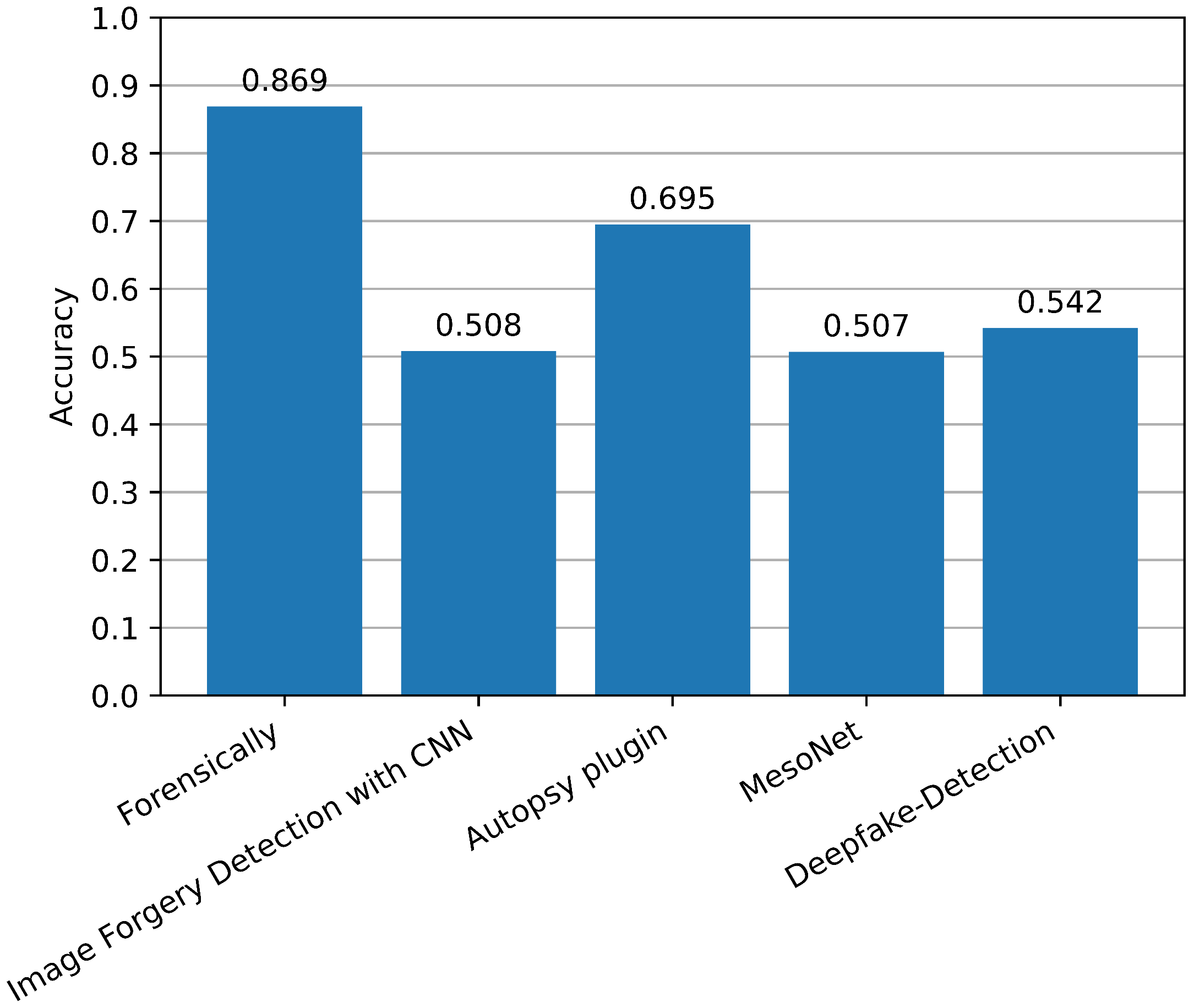
| General-purpose | Forensically | 86.0% | 88.0% | 87.0% | 86.9% |
| Image Forgery Detection CNN | 91.9% | 1.6% | 3.2% | 50.8% | |
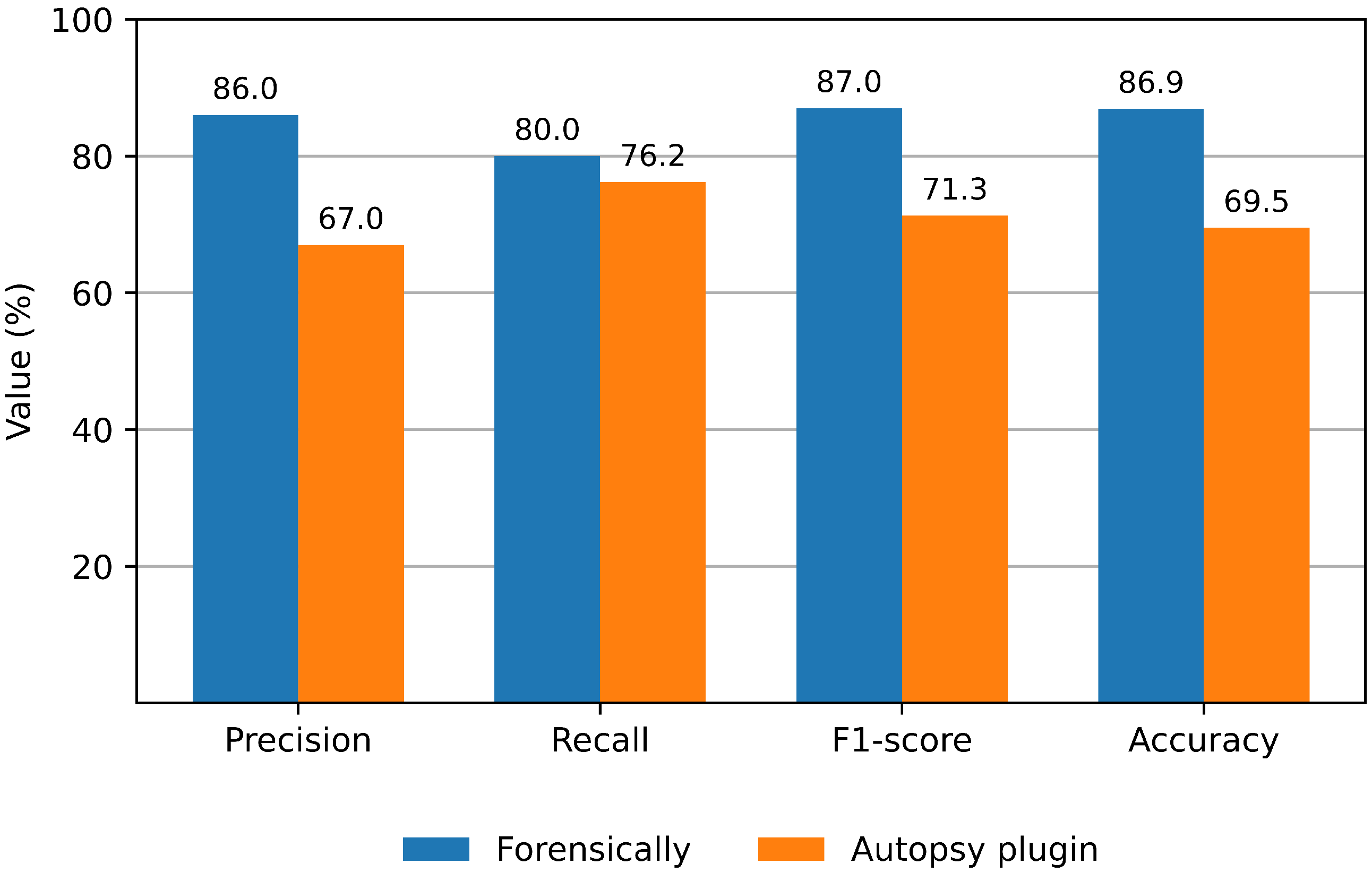
| Deepfake-specific | Autopsy plugin (SVM) | 67.0% | 76.2% | 71.3% | 69.5% |
| MesoNet | 62.4% | 3.0% | 5.7% | 50.7% | |
| Deepfake-Detection | 55.9% | 37.2% | 44.7% | 54.2% |
| Method | Tool | Precision | Recall | -Score | Accuracy |
|---|---|---|---|---|---|
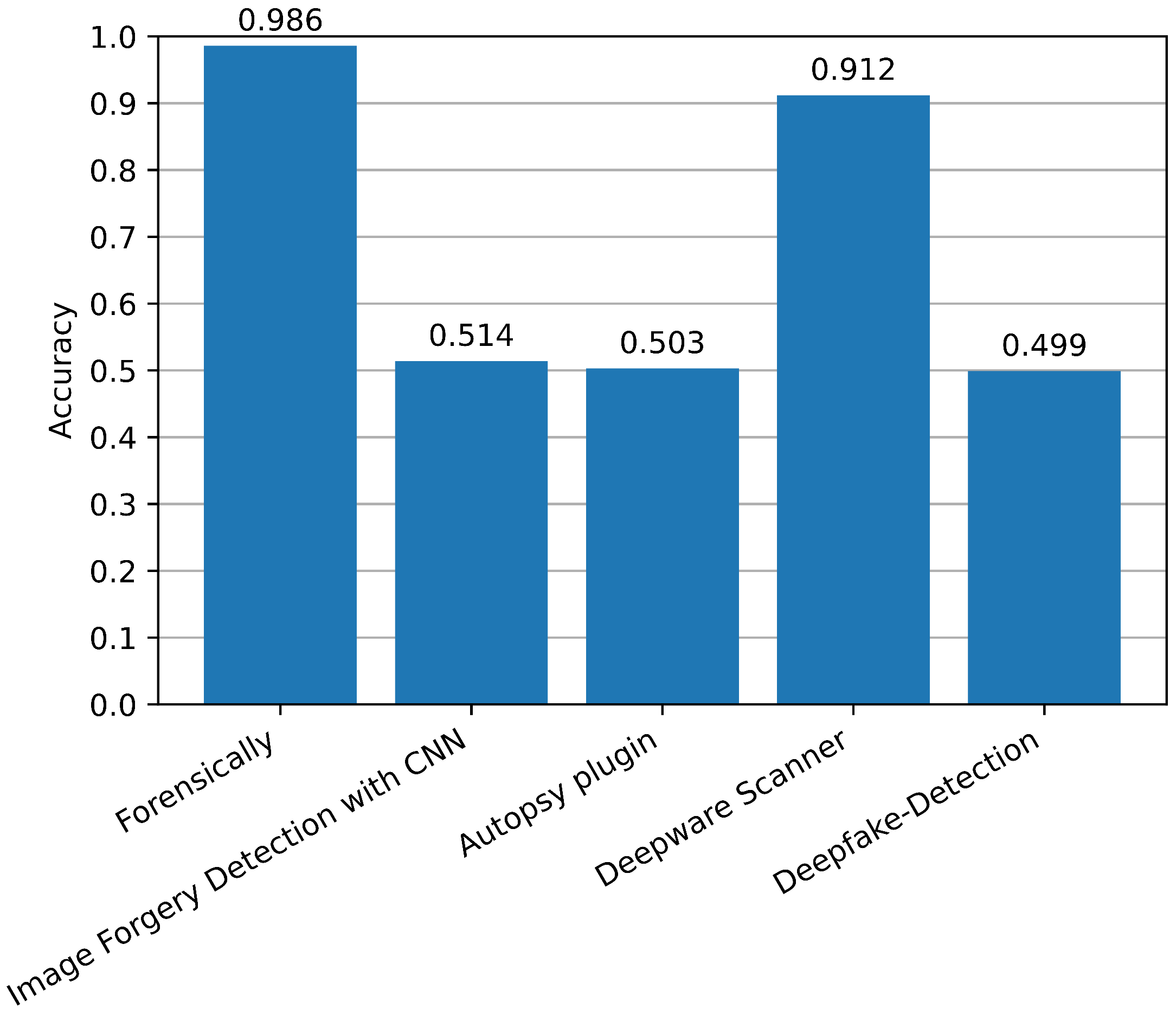
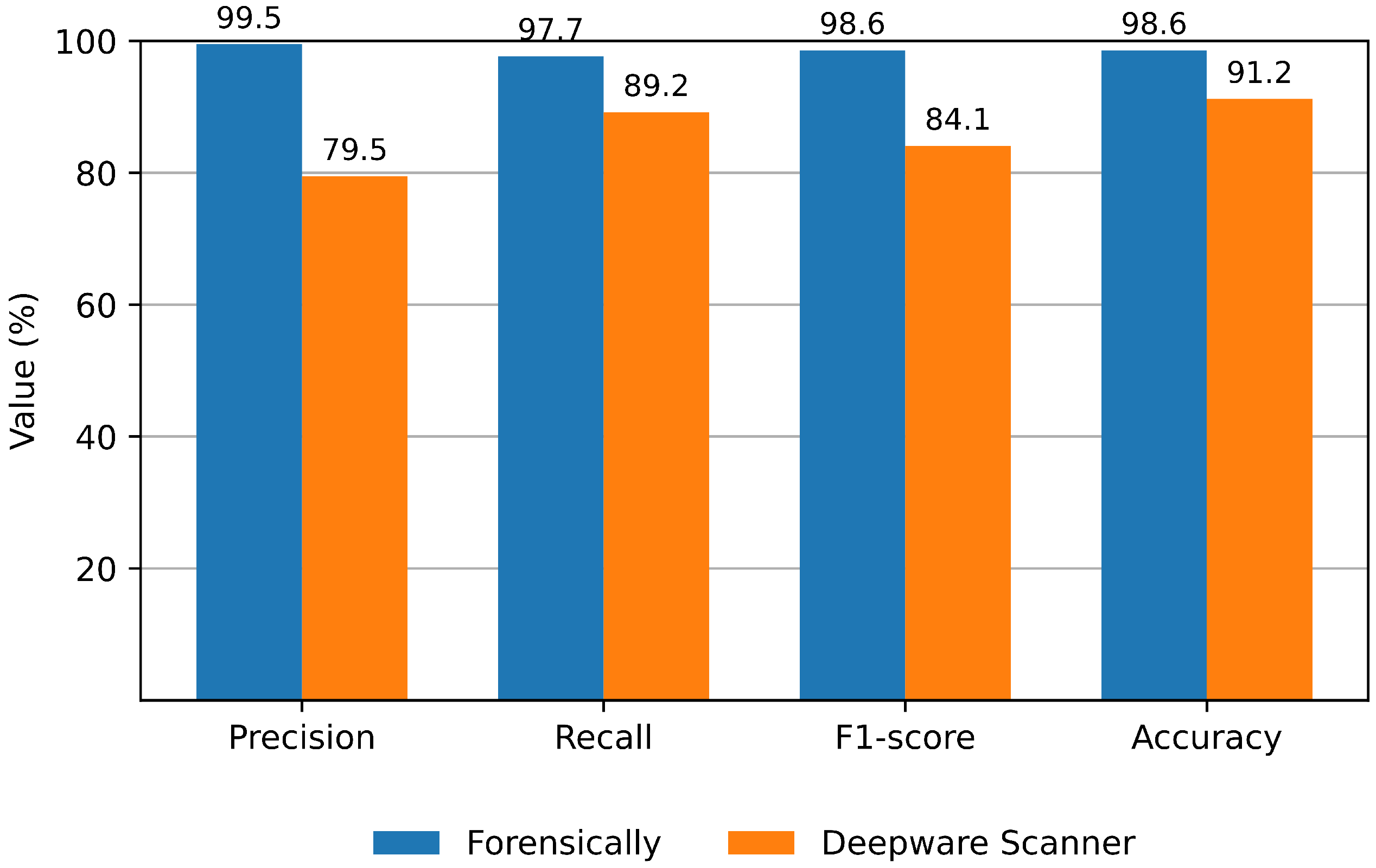
| General-purpose | Forensically | 99.5% | 97.7% | 98.6% | 98.6% |
| Image Forgery Detection CNN | 100.0% | 1.0% | 1.9% | 51.4% | |
| Deepfake-specific | Autopsy plugin (SVM) | 49.7% | 75.6% | 60.0% | 50.3% |
| Deepware Scanner | 79.5 % | 89.2% | 84.1% | 91.2% | |
| Deepfake-Detection | 49.4% | 100.0% | 66.1% | 49.9% |
Disclaimer/Publisher’s Note: The statements, opinions and data contained in all publications are solely those of the individual author(s) and contributor(s) and not of MDPI and/or the editor(s). MDPI and/or the editor(s) disclaim responsibility for any injury to people or property resulting from any ideas, methods, instructions or products referred to in the content. |
© 2025 by the authors. Licensee MDPI, Basel, Switzerland. This article is an open access article distributed under the terms and conditions of the Creative Commons Attribution (CC BY) license (https://creativecommons.org/licenses/by/4.0/).
Share and Cite
Falcón-López, S.A.; Tobarra, L.; Robles-Gómez, A.; Pastor-Vargas, R. Forensic Analysis of Manipulated Images and Videos. Appl. Sci. 2025, 15, 12664. https://doi.org/10.3390/app152312664
Falcón-López SA, Tobarra L, Robles-Gómez A, Pastor-Vargas R. Forensic Analysis of Manipulated Images and Videos. Applied Sciences. 2025; 15(23):12664. https://doi.org/10.3390/app152312664
Chicago/Turabian StyleFalcón-López, Sergio A., Llanos Tobarra, Antonio Robles-Gómez, and Rafael Pastor-Vargas. 2025. "Forensic Analysis of Manipulated Images and Videos" Applied Sciences 15, no. 23: 12664. https://doi.org/10.3390/app152312664
APA StyleFalcón-López, S. A., Tobarra, L., Robles-Gómez, A., & Pastor-Vargas, R. (2025). Forensic Analysis of Manipulated Images and Videos. Applied Sciences, 15(23), 12664. https://doi.org/10.3390/app152312664