Hybrid Boustrophedon and Direction-Biased Region Transitions for Mobile Robot Coverage Path Planning: A Region-Based Multi-Cost Framework


Abstract
1. Introduction
2. Related Work
2.1. Full Coverage Path Planning Approaches
2.2. Region-Based Partitioning and Transition Optimization
2.3. Contribution of This Study
- A systematic and overlap-free creation of rectangular regions that expand maximally on grid-based maps featuring obstacles.
- The generation of internal paths for full coverage with the least turns, utilizing a boustrophedon pattern CPP approach for each area.
- Derivation of the shortest total transition path using Multi-Weighted Transition Cost Model.
- An integrated optimization of both intra-region and inter-region paths using a unified cost function. This integration allows the study to address local and global path planning comprehensively, diverging from traditional CPP methods, and providing a balance between feasibility and efficiency within complex map structures.
3. Problem Definition and Optimization Model
3.1. Problem Statement
- Region Growing Segmentation: Development of overlap-free and connected rectangular regions with maximum expansion potential in free areas, considering obstacle information.
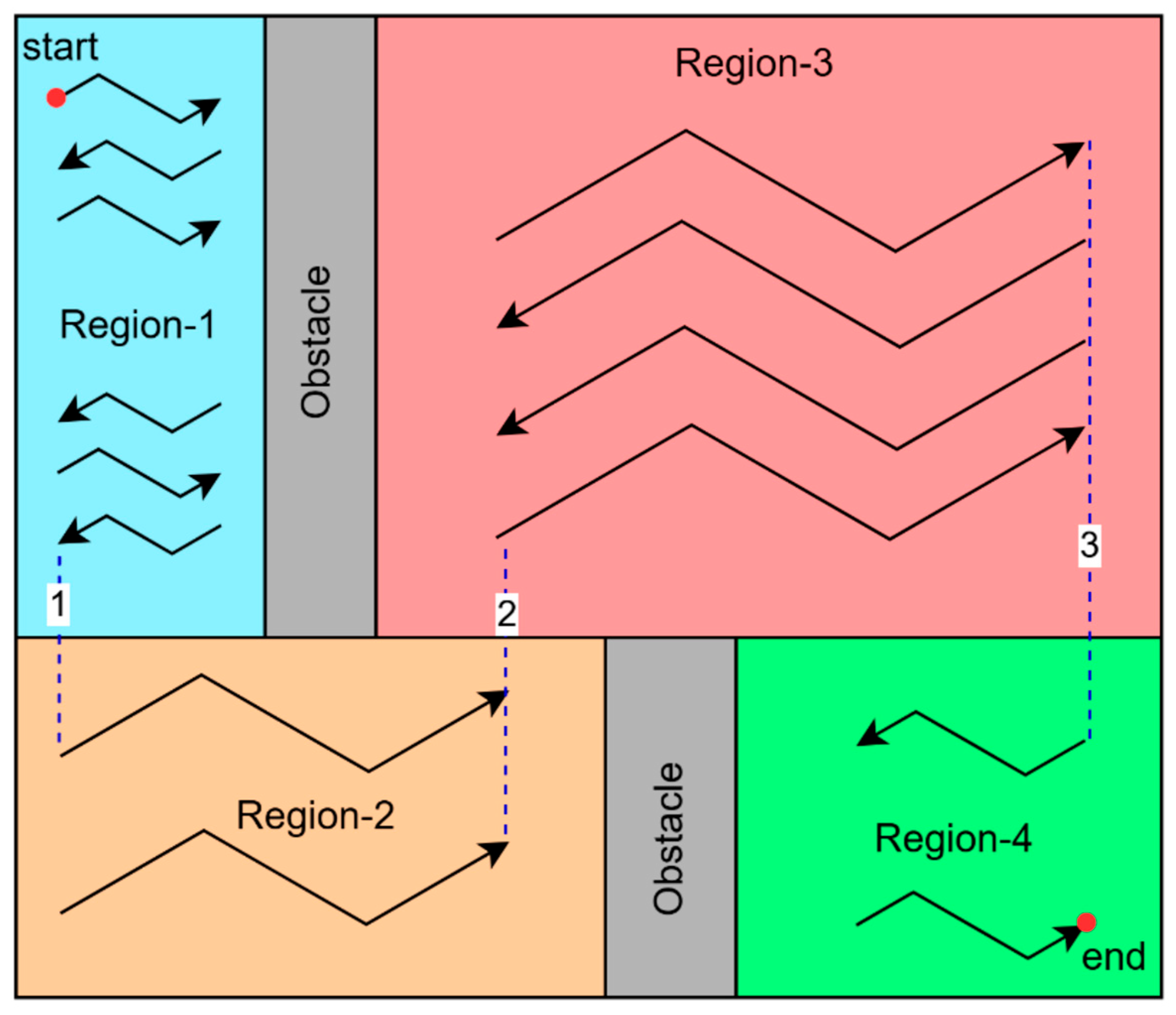
- Intra-Region Coverage: Implementation of a Boustrophedon style method for directional and complete coverage within each rectangular area.
- Inter-Region Transition: Reduction of the overall transition cost among regions through TSP-like route optimization centered around each region. The structure introduced adds to the existing literature by offering a distinct coverage strategy capable of decreasing both overall coverage duration and energy expenses in dynamic settings that traditional fixed-grid methods struggle to address.
3.2. Optimization Framework
- The full free area of the map must be comprehensively covered: .
- Each rectangular section must achieve complete coverage using a Boustrophedon-style path.
- Transitions between different regions need to be optimized to reduce the total distance.
- : Rectangular coverage areas formed in unblocked sections
- : Center coordinates for every region
- : TSP cycle that determines the order of visits
- : Boustrophedon coverage path generated within region
- : Path length necessary for the intra-region Boustrophedon coverage
- : Euclidean distance between two successive region centers
- Full Coverage: Each unblocked cell must be covered exactly once; overlaps or gaps are prohibited (Equation (2)).
- Transition Compatibility: Each region in the TSP sequence must be visited exactly once (Equation (3)).
- Transition Path Validity: Paths for inter-region transitions must not interfere with obstacles. In this study, transition paths are enhanced to navigate around impediments between region segments employing the Multi-Weighted Transition Cost Model.
4. Proposed Methodology
4.1. Methodological Overview
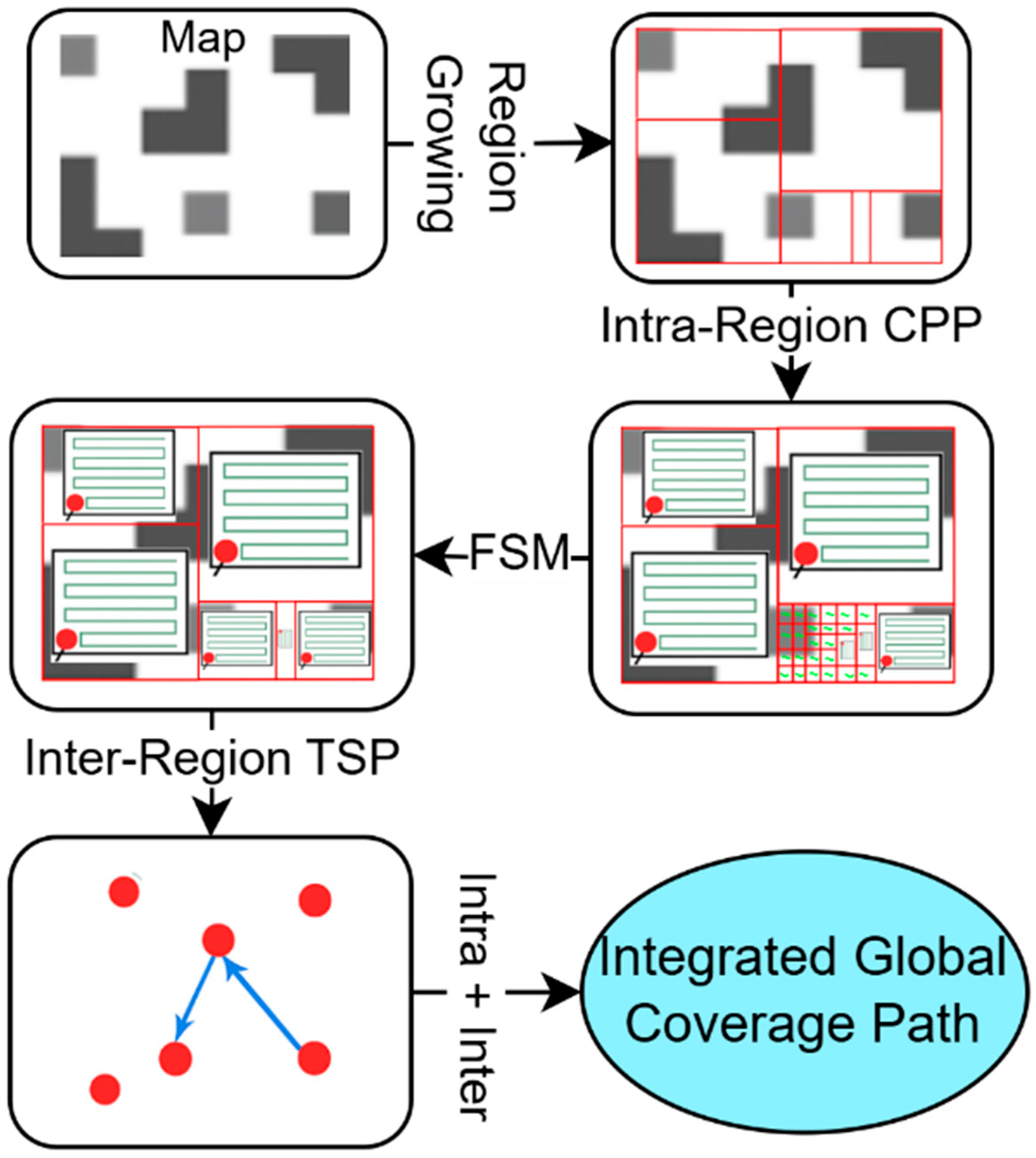
- Geometric Obstacle-Aware Region Growing Segmentation: Division of obstacle-free areas into contiguous and uniform rectangular regions optimized for maximum expansion.
- Directional Boustrophedon Based Coverage: Ensuring full coverage with a path generated in a regular zig-zag manner for each rectangular sub-region.
- TSP-Solution for Minimum Transition Route between Regions: Optimizing the transitions between the centers of each region using a Nearest Neighbor-based solution to the Traveling Salesman Problem (TSP) to minimize the overall path length.
4.2. Grid-Based Obstacle-Aware Region Growing
- Expansion Condition:
- and : The target cell must be unoccupied and not utilized previously.
- Expansion proceeds as long as there are gaps in all four directions (north, south, east, and west).
- Region Definition:
- Each region is represented by a coordinate box.
- All cells within belong to region (Equation (4)).
4.3. Coverage Path Planning (Boustrophedon Scanning) and Inter-Region Path Planning (TSP)
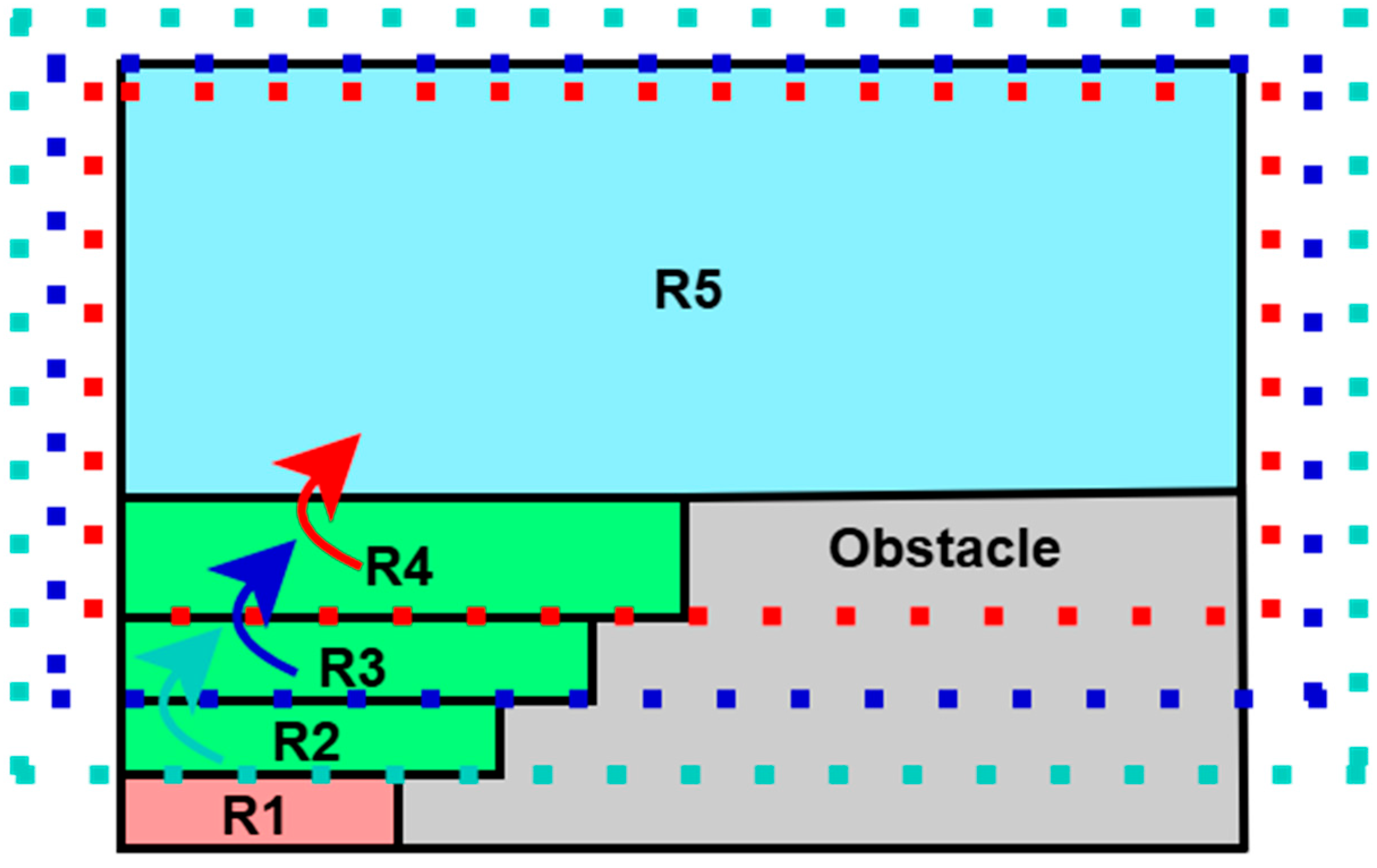
4.4. Region Merging via Fill-Similarity Measure (FSM)
- : Area of region (measured in pixels or number of cells)
- : The least common rectangle enclosing the boundaries of both regions
- Detection of small regions: Regions with an area less than are classified as small.
- Searching for the optimal match: For each small region, the large neighboring region with the highest FSM ratio is determined.
- Greedy merge: is executed on the first match whose FSM ratio surpasses the defined threshold.
- Reassignment of temporary regions: Small regions that cannot be merged are “shadowed” to the nearest large region.
4.5. Obstacle-Aware and Directionally Biased Transition Planning
4.5.1. Limitations of A*-Based Inter-Region Transition
- (i)
- Dominance of Euclidean Proximity: In the A*-based method, the main criterion for decision-making is the Euclidean distance between the endpoints of segments. This distance-focused approach overlooks important semantic factors such as risk levels, passage width, and the closeness to obstacles.
- (ii)
- Insensitivity to Obstacle Density: While A* effectively avoids collisions, it fails to differentiate between narrow passageways and wide corridors, nor does it impose penalties on paths that traverse areas with high densities of obstacles. This can lead to transitions that are technically valid but not feasible in practice.
- (iii)
- Ignorance of Heading Variation: The traditional A* planning cost function does not consider the angular discrepancy between the robot’s orientation and the direction of the transition. This oversight increases energy expenditure for differential or nonholonomic robots.
- (iv)
- Short-Sighted Optimization: Greedy sequencing of segments aims to minimize local costs without considering the overall optimality of the entire tour. This drawback becomes more pronounced in larger maps, where the effects of inefficient transitions accumulate over time.
4.5.2. Proposed Multi-Weighted Transition Cost Model
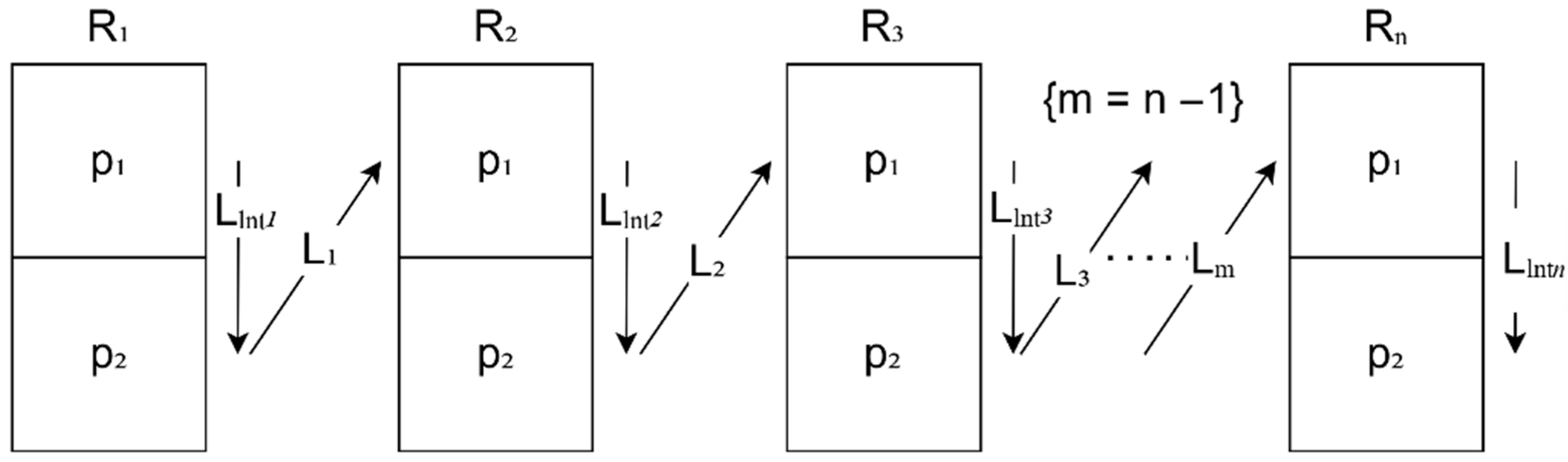
- : The Euclidean distance from the exit of region to the entry of region .
- : The normalized density of obstacles along the transition route identified by A*.
- : The absolute difference in angle regarding heading direction.
- : Adjustable scalar weights.
4.5.3. Incorporation into the Global Planner
- Begin with any chosen starting segment .
- At each iteration, assess all possible transitions to unvisited segments by employing .
- Choose the segment that has the lowest weighted cost.
- Continue this process until every segment has been visited.
- Enhanced alignment with nonholonomic constraints,
- Flexible for cluttered or semi-structured settings,
- Works well with real-time grid-based systems,
- Scalable to medium-scale maps (approximately 50 × 50 grids) with planning times under 1000 ms.
- : Sum of boustrophedon path lengths across all rectangular areas.
- : Total length of the transit route between centers of regions.
- : User-definable scale factor that modifies the weight of the transition cost.
| Algorithm 1. Obstacle-Aware Inter-Region Transition Planner. |
| Input: R = {R1, R2, …, Rn} //Set of rectangular regions p_i, θ_i //Exit point and heading of each region map_data //Binary occupancy grid α, β, γ //Weight parameters Output: P_global //Ordered list of region visits 1: Initialize S ← {1, …, n}, P_global ← [ ] 2: current ← SelectInitialRegion(S) 3: Remove current from S 4: while S ≠ Ø do 5: min_cost ← ∞ 6: for each j ϵ S do 7: path_astar ← AStar(p_current, p_j, map_data) 8: d ← EuclideanDistance(p_current, p_j) 9: ρ ← MeanOccupancy(path_astar) 10: δ ← |θ_current − atan2(Δy, Δx)| 11: C ← α·d + β·ρ + γ·δ 12: if C < min_cost then 13: min_cost ← C 14: next ← j 15: best_path ← path_astar 16: end if 17: end for 18: Append next to P_global 19: current ← next 20: Remove next from S 21: end while 22: Return P_global |
5. Results
- Number of Regions (Nr): Total number of non-overlapping rectangular sub-regions generated from the Region growing algorithm.
- Intra-Region Coverage Path Length (Lα): The cumulative length of coverage paths produced by the Boustrophedon scanning method in each rectangular region.
- Inter-Region Transition Cost (Lint): The total length of transition paths determined by the Traveling Salesman Problem (TSP) approach, solved via the nearest neighbor method, through the center point of each region.
- Total Path Cost (Ltotal): The overall cost of coverage and transition paths (Equation (15)):
- The proportion of the total area covered by the robot compared to the accessible (obstacle-free) zones on the map.
- Running Time (s): The duration required to execute the entire algorithm (including segmentation, coverage, and transition planning).
5.1. Test Maps and Setup
- Global Boustrophedon Path Planning (G-BPP): A classical technique that examines the obstacle-free area as a unified whole.
- Cell-by-Cell Spiral Decomposition (Spiral CPP): A pattern that traverses all map cells in a spiral fashion and alters direction in localized areas.
- Coverage: In the proposed method, the ratio of unskipped areas remains high due to segment-based coverage. The Global Boustrophedon and Spiral methods tend to omit certain regions in narrow passages characterized by complex obstacle arrangements.
- Total Cost (Ltotal): The transitions in the suggested approach are optimized using the Obstacle-Aware Inter-Region Transition algorithm, resulting in a more balanced sum of the internal and external paths. In contrast, the Spiral method has a longer inner coverage, but its overall cost may be lower due to the absence of transitions.
- Duration: The proposed method achieves a time advantage as its path planning is more localized, attributed to its segment-based structure.
5.2. Comparative Evaluation with Standard A* Planner
5.3. Complexity Analysis of the Algorithm
- Rectangular segmentation through Region Growing,
- Row-wise Boustrophedon coverage path generation for each segment,
- Solution for transition paths between segment centers utilizing the proposed algorithm.
- Input: n × n dimensional grid map
- Process: Rectangular expansion into surrounding empty space by visiting each cell no more than once
- Complexity:
- For an average segment size of hi × wi: per segment.
- Total for all segments: .
- The nearest connection point is determined each step.
- Transition complexity: (assuming it operates on a grid in an obstacle-rich environment)
- For transition sequence total:
- n2: Maximum burden from grid size
- Nr: Number of segments ()
- d: Average number of valid cells between segments (relatively small in sparse grids)
6. Discussions
- : denotes the initial and final coordinates of the intra-regional path.
- Total length for each segment:
- : Length of the passageway identified by A*
- : Internal path length of the newly incorporated segment
- : A permutation that indicates the order of connecting segments
- : A collection of all valid segment arrangements
- Decision-Making Based on Geometric Distance: Even though the A* algorithm enhances passage routes between segment endpoints while accounting for obstacles, the overall route planning is predominantly influenced by geometric distances. This can result in a preference for routes that are shorter in distance but have a high density of obstacles.
- Non-Directional Heuristic Strategy: The heuristic values used in the passage decisions do not consider the robot’s current heading, which can lead to unnecessary turns and zigzag maneuvers for robots that are less maneuverable. This can increase both energy usage and the total time required for the task.
- Possibility of Getting Trapped in Temporary Optima: A greedy selection method might favor the least expensive local passage at each decision point, even if it results in more expensive choices later on. This raises the likelihood of straying from the global optimum.
- Neglect of Obstacle Density: Although the A* algorithm avoids traversing obstacles, it does not incorporate the environmental impact of obstacle density (such as narrow pathways within a constricted corridor) into its cost function. This may result in risky or confined areas being overlooked.
- Scalability Issues: In extensive maps with an increasing number of segments, the computation of each passageway using A* incurs a greater computational cost. This cost can become significant, particularly during the selection of directions and the assessment of passage alternatives.
7. Conclusions
8. Future Work
Author Contributions
Funding
Data Availability Statement
Acknowledgments
Conflicts of Interest
References
- Jensen-Nau, K.R.; Hermans, T.; Leang, K.K. Near-Optimal Area-Coverage Path Planning of Energy-Constrained Aerial Robots with Application in Autonomous Environmental Monitoring. IEEE Trans. Autom. Sci. Eng. 2021, 18, 1453–1468. [Google Scholar] [CrossRef]
- Vadapalli, A.; Peravali, S.; Dadi, V.R. Smart agricultural system using IoT. Int. J. Adv. Res. Sci. Eng. 2020, 9, 5807–5819. [Google Scholar]
- Carvalho, A.E.; Ferreira, J.F.; Portugal, D. 3D traversability analysis and path planning based on mechanical effort for UGVs in forest environments. Robot. Auton. Syst. 2024, 171, 104560. [Google Scholar] [CrossRef]
- Han, L.; Zhao, Y.; Lv, H.; Zhang, Y.; Liu, H.; Bi, G.; Han, Q. Enhancing Remote Sensing Image Super-Resolution with Efficient Hybrid Conditional Diffusion Model. Remote Sens. 2023, 15, 3452. [Google Scholar] [CrossRef]
- Lyu, M.; Zhao, Y.; Huang, C.; Huang, H. Unmanned Aerial Vehicles for Search and Rescue: A Survey. Remote Sens. 2023, 15, 3266. [Google Scholar] [CrossRef]
- Sier, H.; Li, Q.; Yu, X.; Peña Queralta, J.; Zou, Z.; Westerlund, T. A Benchmark for Multi-Modal LiDAR SLAM with Ground Truth in GNSS-Denied Environments. Remote Sens. 2023, 15, 3314. [Google Scholar] [CrossRef]
- Galceran, E.; Carreras, M. A survey on coverage path planning for robotics. Robot. Auton. Syst. 2013, 61, 1258–1276. [Google Scholar] [CrossRef]
- Coombes, M.; Fletcher, T.; Chen, W.-H.; Liu, C. Optimal Polygon Decomposition for UAV Survey Coverage Path Planning in Wind. Sensors 2018, 18, 2132. [Google Scholar] [CrossRef]
- Zhu, D.; Latombe, J.-C. New heuristic algorithms for efficient hierarchical path planning. IEEE Trans. Robot. Autom. 1991, 7, 9–20. [Google Scholar] [CrossRef]
- Choset, H. Coverage for robotics—A survey of recent results. Ann. Math. Artif. Intell. 2001, 31, 113–126. [Google Scholar] [CrossRef]
- Yamauchi, B. A frontier-based approach for autonomous exploration. In Proceedings of the IEEE International Symposium on Computational Intelligence in Robotics and Automation, Monterey, CA, USA, 10–11 July 1997; pp. 146–151. [Google Scholar]
- Choset, H.; Pignon, P.A. Coverage path planning: The boustrophedon cellular decomposition. In Field and Service Robotics; Springer: London, UK, 1998; pp. 203–209. [Google Scholar]
- Acar, E.U.; Choset, H. Sensor-based coverage of unknown environments: Incremental construction of morse decompositions. Int. J. Robot. Res. 2002, 21, 345–366. [Google Scholar] [CrossRef]
- Gabriely, Y.; Rimon, E. Spanning-tree based coverage of continuous areas by a mobile robot. Ann. Math. Artif. Intell. 2001, 31, 77–98. [Google Scholar] [CrossRef]
- Acar, E.U.; Choset, H. Complete sensor-based coverage with extended-decomposition. In Proceedings of the IEEE/RSJ International Conference on Intelligent Robots and Systems, Maui, HI, USA, 29 October–3 November 2000; Volume 3, pp. 2828–2834. [Google Scholar]
- Latombe, J.-C. Robot Motion Planning; Springer: Boston, MA, USA, 1991; pp. 154–196. [Google Scholar]
- Hert, S.; Tiwari, S.; Lumelsky, V. A terrain-covering algorithm for an AUV. Auton. Robot. 1996, 3, 91–119. [Google Scholar] [CrossRef]
- Howard, A.; Mataric, M.J.; Sukhatme, G.S. Mobile sensor network deployment using potential fields. In Proceedings of the IEEE/RSJ International Conference on Intelligent Robots and Systems, Lausanne, Switzerland, 30 September–4 October 2002; Volume 2, pp. 1292–1298. [Google Scholar]
- Hazon, N.; Kaminka, G.A. Redundancy, efficiency, and robustness in multi-robot coverage. In Proceedings of the 2008 IEEE International Conference on Robotics and Automation, Pasadena, CA, USA, 19–23 May 2008; pp. 735–741. [Google Scholar]
- Koenig, S.; Liu, Y. Terrain coverage with ant robots: A simulation study. In Proceedings of the 5th International Conference on Autonomous Agents, Montreal, QC, Canada, 28 May–1 June 2001; pp. 600–607. [Google Scholar]
- Tiwari, S.; Sukhatme, G.S. Coverage planning with energy and time constraints. In Field and Service Robotics; Springer: Berlin/Heidelberg, Germany, 2002; pp. 349–360. [Google Scholar]
- Rekleitis, I.; New, A.P.; Rankin, E.; Dudek, G. Efficient boustrophedon multi-robot coverage: An algorithmic approach. Ann. Math. Artif. Intell. 2008, 52, 109–142. [Google Scholar] [CrossRef]
- Zelinsky, A.; Jarvis, R.A.; Byrne, J.; Yuta, S. Planning paths of complete coverage of an unstructured environment by a mobile robot. In Proceedings of the 1993 IEEE International Conference on Robotics and Automation, Atlanta, GA, USA, 2–6 May 1993; pp. 533–538. [Google Scholar]
- Choset, H.; Lynch, K.M.; Hutchinson, S.; Kantor, G.; Burgard, W.; Kavraki, L.E.; Thrun, S. Principles of Robot Motion: Theory, Algorithms, and Implementation; MIT Press: Cambridge, MA, USA, 2005. [Google Scholar]
- Gonzalez-Banos, H.H.; Latombe, J.-C. Navigation strategies for exploring indoor environments. Int. J. Robot. Res. 2002, 21, 829–848. [Google Scholar] [CrossRef]
- Gabriely, Y.; Rimon, E. Competitive on-line coverage of grid environments by a mobile robot. Comput. Geom. 2002, 24, 197–224. [Google Scholar] [CrossRef]
- Yoon, S.; Fern, A.; Givan, R. FF-Replan: A baseline for probabilistic planning. In Proceedings of the 18h International Conference on Automated Planning and Scheduling, Sydney, Australia, 14–18 September 2008; pp. 352–359. [Google Scholar]
- Cabreira, T.M.; Brisolara, L.B.; Ferreira, P.R. Survey on coverage path planning with unmanned aerial vehicles. Drones 2019, 3, 4. [Google Scholar] [CrossRef]
- Ayanian, N.; Kumar, V. Decentralized feedback controllers for multiagent teams in environments with obstacles. IEEE Trans. Robot. 2012, 28, 1197–1209. [Google Scholar] [CrossRef]
- Shivgan, R.; Dong, Z. Energy-Efficient Drone Coverage Path Planning using Genetic Algorithm. In Proceedings of the 2020 IEEE 21st International Conference on High Performance Switching and Routing (HPSR), Newark, NJ, USA, 11–14 May 2020; pp. 1–6. [Google Scholar] [CrossRef]
- Chen, X.; Diao, W.; Zhang, S.; Wei, Z.; Liu, C. SA-SatMVS: Slope Feature-Aware and Across-Scale Information Integration for Large-Scale Earth Terrain Multi-View Stereo. Remote Sens. 2024, 16, 3474. [Google Scholar] [CrossRef]
- Acar, E.U.; Choset, H. Robust sensor-based coverage of unstructured environments. In Proceedings of the 2001 IEEE/RSJ International Conference on Intelligent Robots and Systems, Maui, HI, USA, 29 October–3 November 2001; Volume 3, pp. 1705–1711. [Google Scholar]
- Zelinsky, A. Decentralized coverage control for multiple robots. In Proceedings of the International Symposium Robot Research, Atlanta, GA, USA, 2–6 May 1993; pp. 70–83. [Google Scholar]
- Yang, S.; Huang, J.; Li, W.; Xiang, X. A Novel Discrete Group Teaching Optimization Algorithm for TSP Path Planning with Unmanned Surface Vehicles. J. Mar. Sci. Eng. 2022, 10, 1305. [Google Scholar] [CrossRef]
- Wu, C.; Fu, X. An agglomerative greedy brain storm optimization algorithm for solving the tsp. IEEE Access 2020, 8, 201606–201621. [Google Scholar] [CrossRef]
- Zhao, L.; Bai, Y. Energy efficient coverage path planning for USV-assisted inland bathymetry under current effects: An analysis on sweep direction. Ocean Eng. 2024, 305, 117910. [Google Scholar] [CrossRef]
- Muñoz, J.; López, B.; Quevedo, F.; Monje, C.A.; Garrido, S.; Moreno, L.E. Multi UAV Coverage Path Planning in Urban Environments. Sensors 2021, 21, 7365. [Google Scholar] [CrossRef] [PubMed]
- Champagne Gareau, J.; Beaudry, É.; Makarenkov, V. Fast and optimal branch-and-bound planner for the grid-based coverage path planning problem based on an admissible heuristic function. Front. Robot. AI 2023, 9, 1076897. [Google Scholar] [CrossRef] [PubMed]
- Jayalakshmi, K.P.; Nair, V.G.; Sathish, D. A Comprehensive Survey on Coverage Path Planning for Mobile Robots in Dynamic Environments. IEEE Access 2025, 13, 60158–60185. [Google Scholar] [CrossRef]
- Li, L.; Shi, D.; Jin, S.; Yang, S.; Lian, Y.; Liu, H. SP2E: Online Spiral Coverage with Proactive Prevention Extremum for Unknown Environments. J. Intell. Robot. Syst. 2023, 108, 30. [Google Scholar] [CrossRef]
- Fevgas, G.; Lagkas, T.; Argyriou, V.; Sarigiannidis, P. Coverage Path Planning Methods Focusing on Energy Efficient and Cooperative Strategies for Unmanned Aerial Vehicles. Sensors 2022, 22, 1235. [Google Scholar] [CrossRef]



| Stage | Merging Regions | FSM Rate | Decision |
|---|---|---|---|
| FSM45 | R5 + R4 | 0.92 | Merged |
| FSM345 | R45 + R3 | 0.89 | Merged |
| FSM2345 | R345 + R2 | 0.86 | Merged |
| FSM12345 | R2345 + R1 | 0.78 | Excluded |
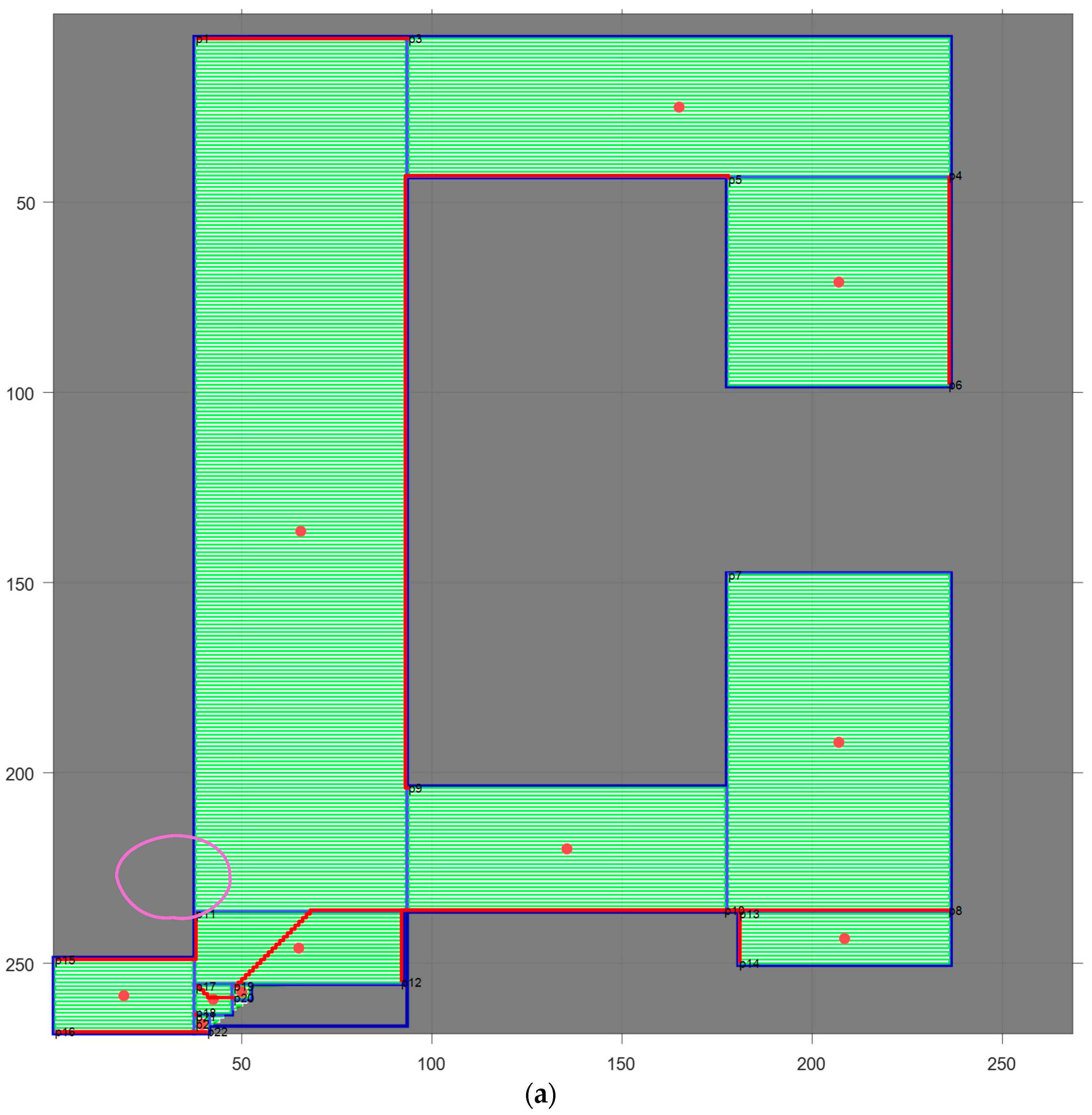
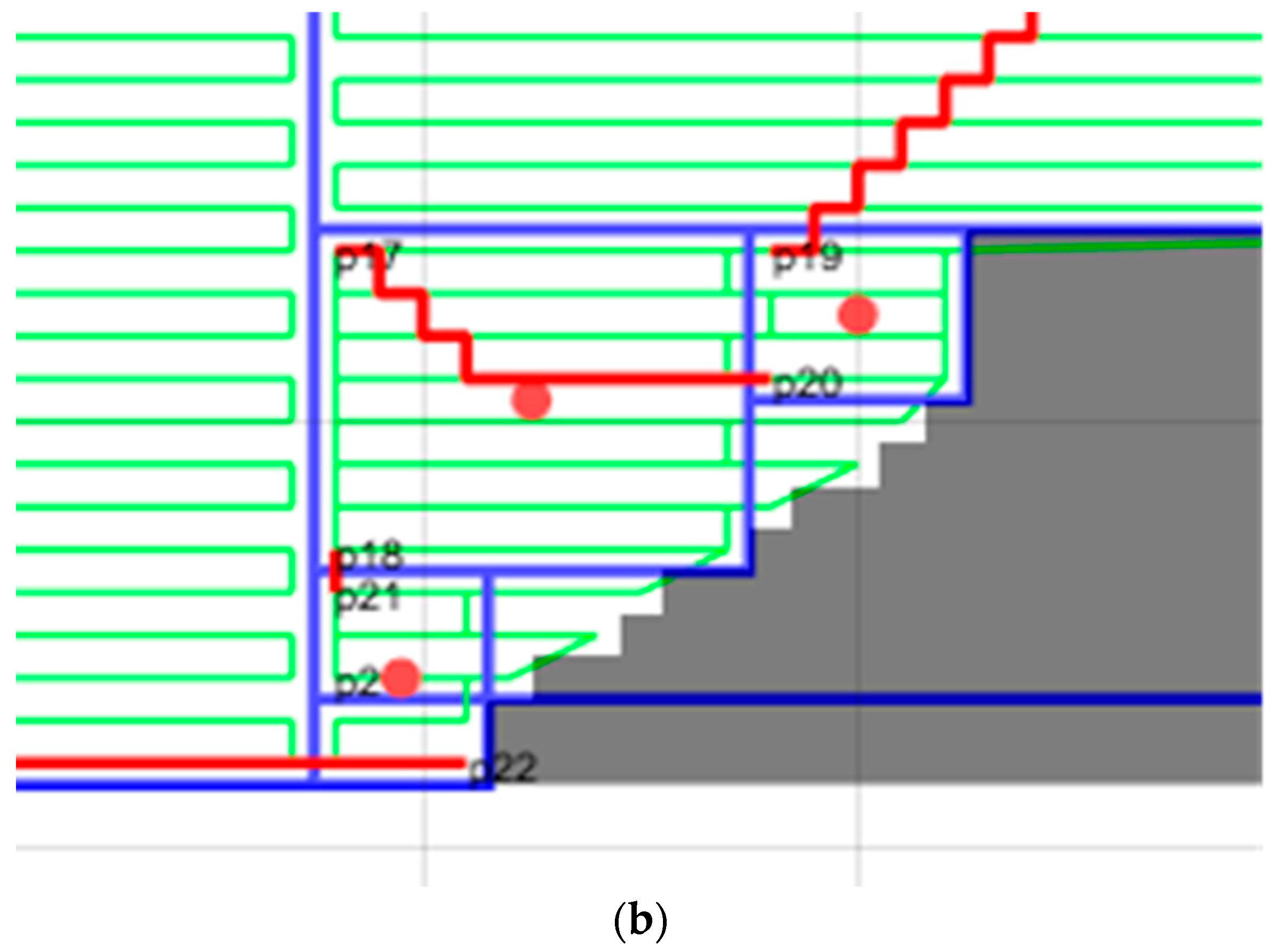
| Symbol | Definition | |
|---|---|---|
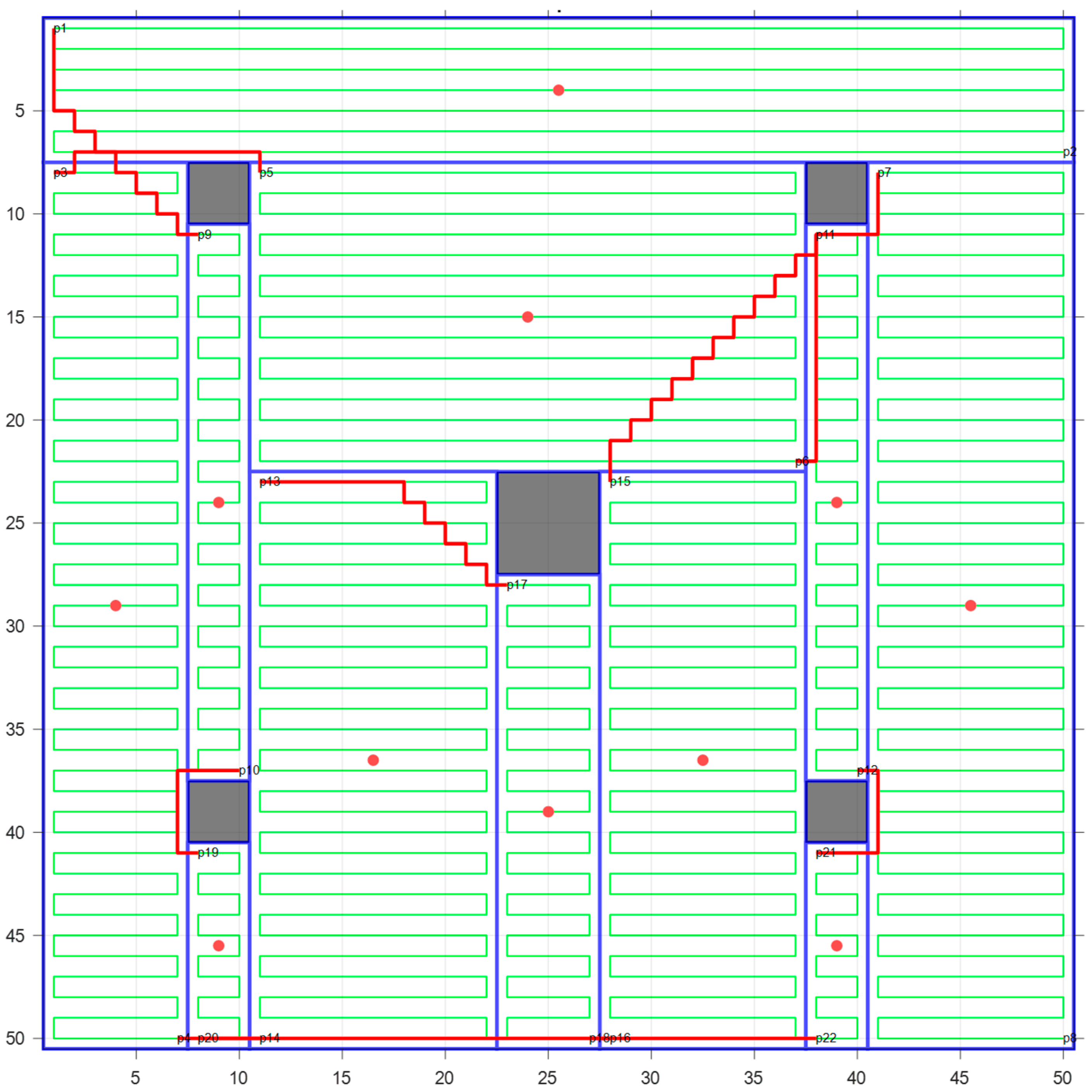
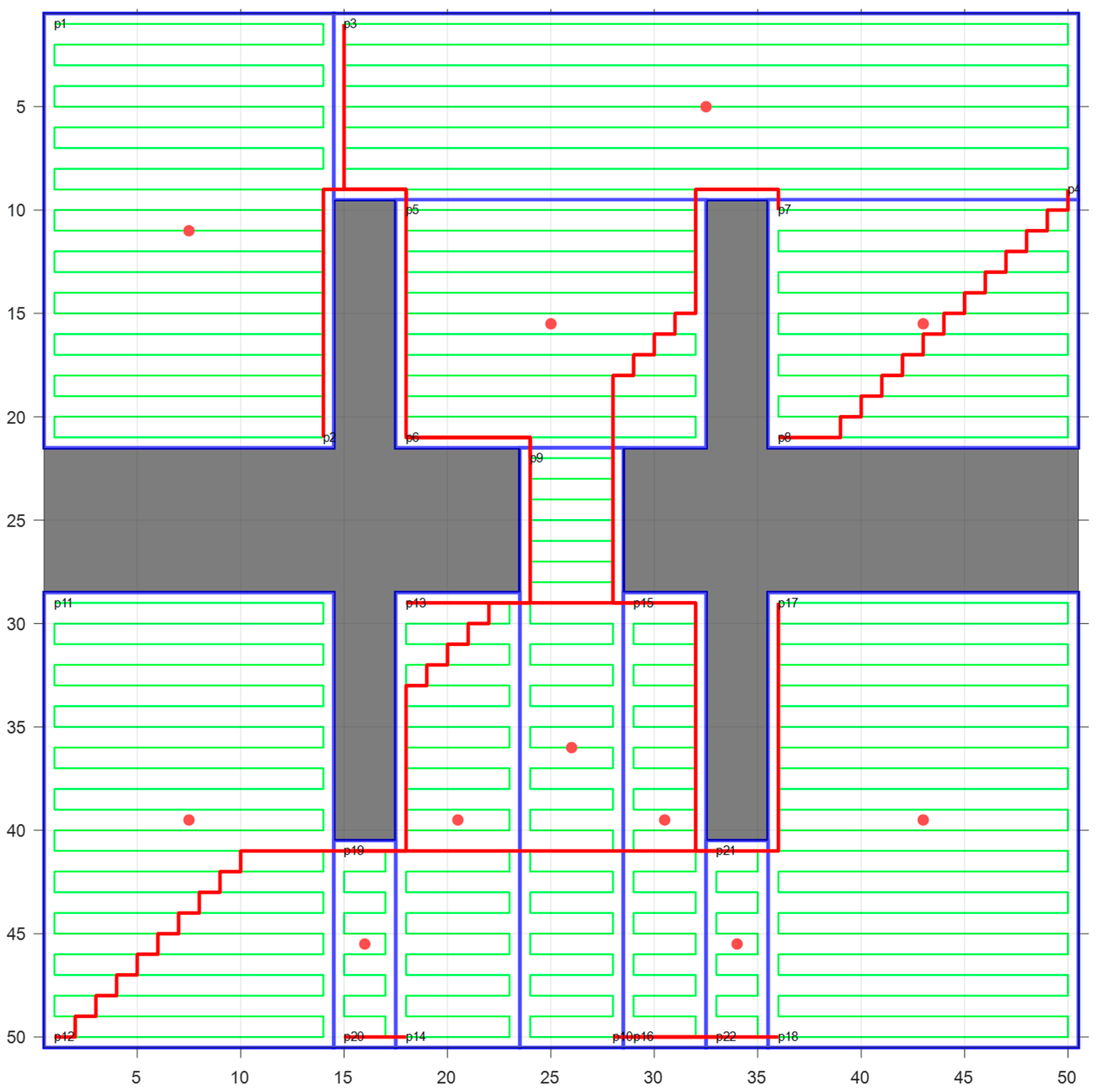
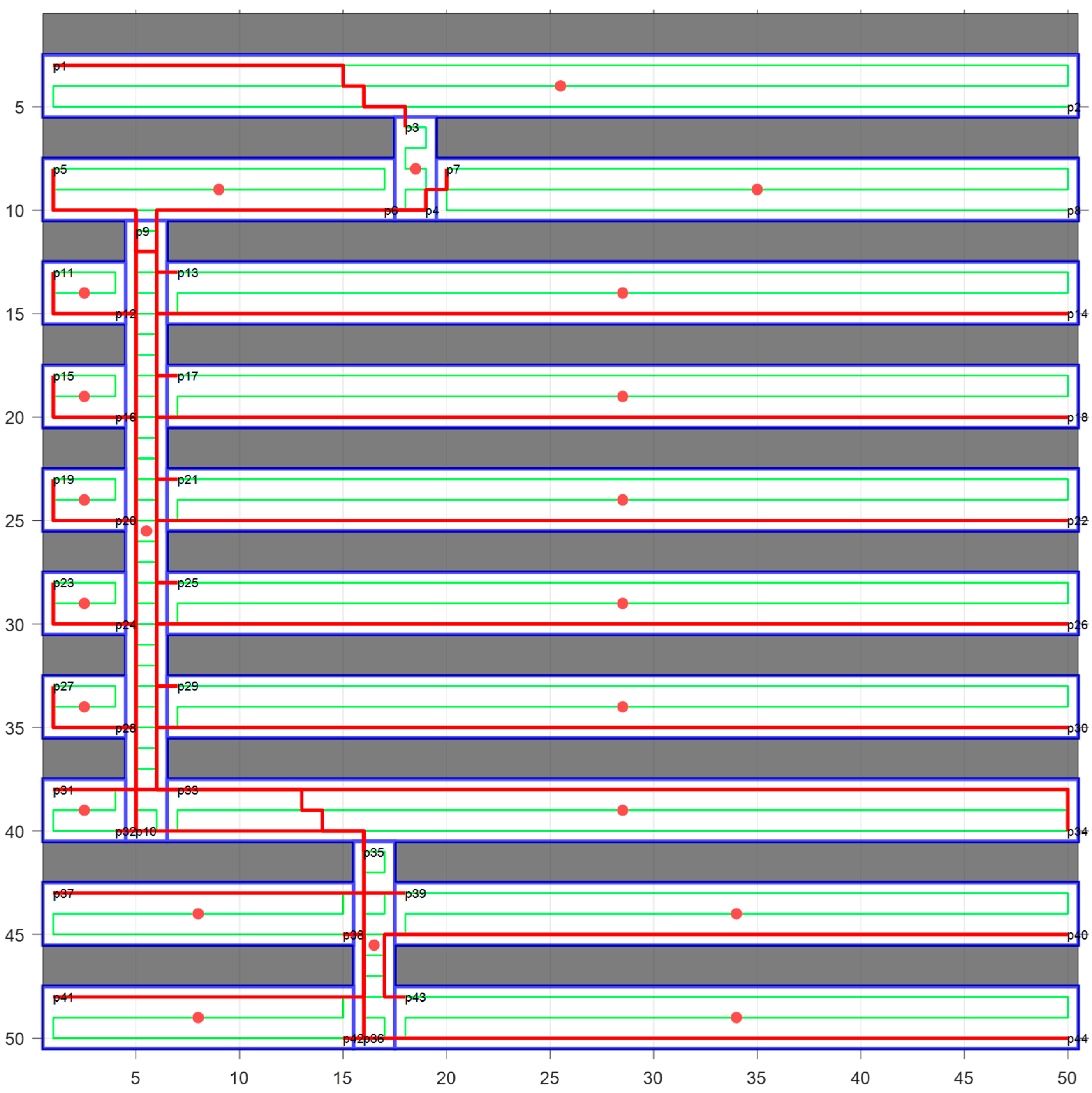
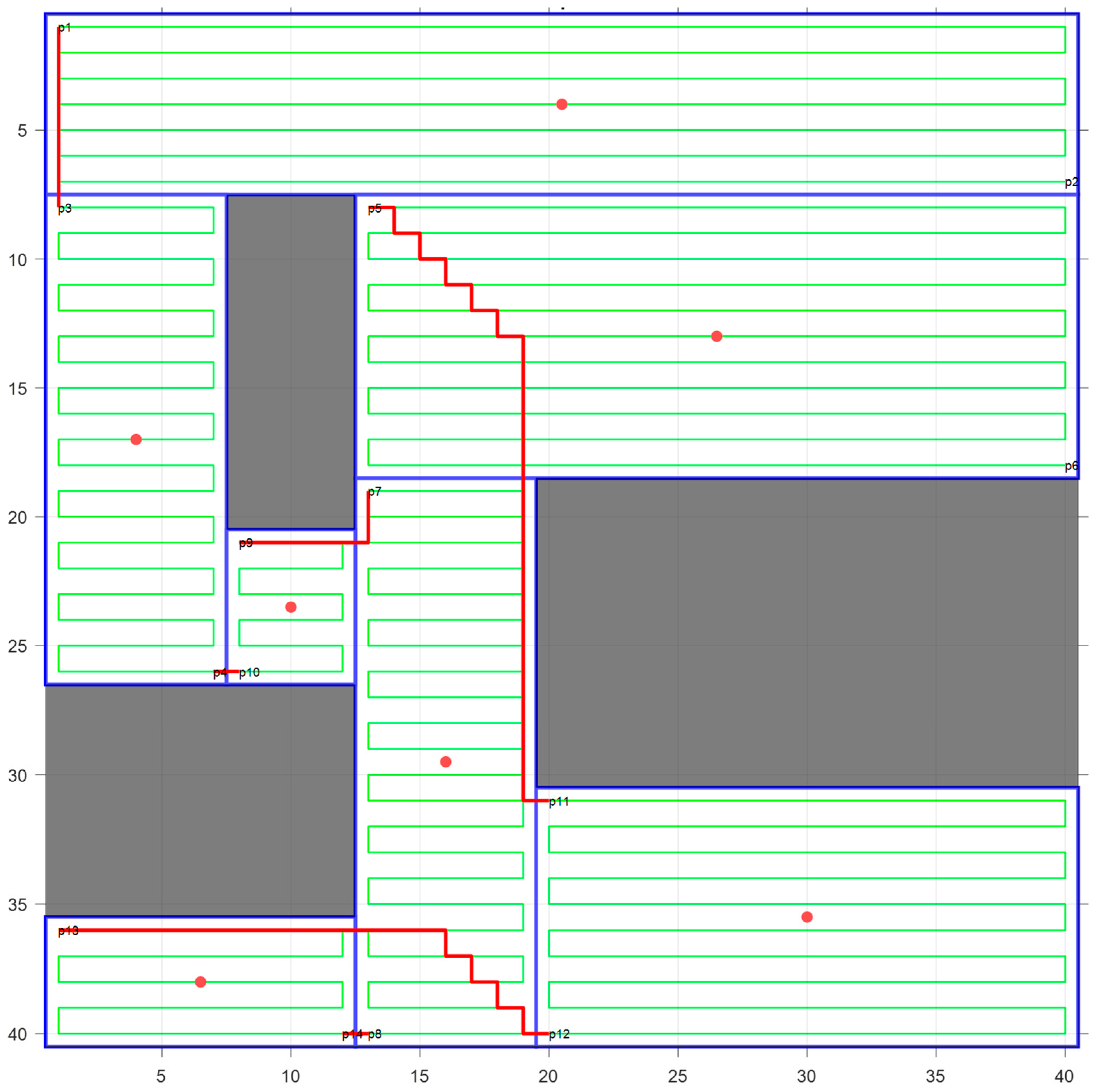
 | Light Green Line | Coverage path (Boustrophedon sweep) |
 | Red Line | Inter-region path |
 | Red Dot over Green-Hatched Box | Region center |
 | Blue Line | Region boundary |
| Map | # Segments | La | Lint | Ltotal | % Coverage | Duration (ms) |
|---|---|---|---|---|---|---|
| Map-1 | (17 → 11) | 797 | 33,333 | 34,130 | 98.6 | 842 |
| Map-2 | 11 | 137 | 2428 | 2565 | 96.8 | 412 |
| Map-3 | 11 | 236 | 2030 | 2266 | 97.3 | 389 |
| Map-4 | 22 | 575 | 1514 | 2089 | 96.1 | 561 |
| Map-5 | 7 | 69 | 1168 | 1237 | 98.1 | 316 |
| Method | Segment Structure | La | Lint | Ltotal | % Coverage | Duration (ms) |
|---|---|---|---|---|---|---|
| Proposed Method | Partial | 236 | 2030 | 2266 | 97.3 | 389 |
| Global Boustrophedon (G-BPP) [36] | Single part | 1986 | - | 1980 | 87.5 | 645 |
| Spiral CPP | Single part | 2145 | - | 2145 | 92.1 | 568 |
| Metric | Proposed Method | A* | Unit |
|---|---|---|---|
| La (Intra-segment) | 1418 | 2445 | grid |
| Ltotal (Total Path) | 1646 | 2445 | grid |
| POR | 2.7% | 18.1% | % |
| Duration | 486 | 705 | ms |
| Dir. Changes | 42 | 111 | count |
| Mem. Usage | 9.7 | 17.3 | MB |
| Scalability (100 × 100) | 1.92 | 3.66 | sec |
| Aspect | Advantage | Limitation |
|---|---|---|
| Map Decomposition [7,10,12,13] | Region Growing facilitates adaptive rectangular partitioning, enhancing the suitability for boustrophedon approaches. | It may generate numerous small regions in cluttered settings if merging is not applied. |
| Intra-Region Coverage [31] | Boustrophedon traversal ensures comprehensive coverage with minimal changes in direction. | It assumes the presence of static and flat surfaces; variations in slope or height have not been accounted for yet. |
| Inter-Region Planning [35] | Utilizes a multi-cost TSP approach that considers directional bias and hurdle proximity. | The TSP-derived route may not be ideal in highly dynamic or chaotic settings. |
| Region Merging (FSM) [13,14,22] | Combines less effective smaller areas based on fill-efficiency, minimizing coverage fragmentation. | Adjustments to the threshold setting (τ) may be necessary based on map density and dimensions. |
| Computational Cost [36,38] | Demonstrates efficiency (e.g., an average runtime of 486 ms) and is scalable for real-time applications. | Currently, it is implemented in MATLAB; deploying in real-time might require adapting to embedded systems. |
| Modularity [7,8,28] | Each phase (segmentation, CPP, transitions) can be upgraded separately. | Dependencies between modules might create integration challenges in customized platforms. |
| Comparison with Baselines [7,38,40] | Surpasses Spiral and A*-based CPP in terms of path length, coverage, and execution speed. | The benchmarking is confined to structured and semi-structured indoor environments. |
Disclaimer/Publisher’s Note: The statements, opinions and data contained in all publications are solely those of the individual author(s) and contributor(s) and not of MDPI and/or the editor(s). MDPI and/or the editor(s) disclaim responsibility for any injury to people or property resulting from any ideas, methods, instructions or products referred to in the content. |
© 2025 by the authors. Licensee MDPI, Basel, Switzerland. This article is an open access article distributed under the terms and conditions of the Creative Commons Attribution (CC BY) license (https://creativecommons.org/licenses/by/4.0/).
Share and Cite
Karakaya, S.; Konyar, M.Z. Hybrid Boustrophedon and Direction-Biased Region Transitions for Mobile Robot Coverage Path Planning: A Region-Based Multi-Cost Framework. Appl. Sci. 2025, 15, 12666. https://doi.org/10.3390/app152312666
Karakaya S, Konyar MZ. Hybrid Boustrophedon and Direction-Biased Region Transitions for Mobile Robot Coverage Path Planning: A Region-Based Multi-Cost Framework. Applied Sciences. 2025; 15(23):12666. https://doi.org/10.3390/app152312666
Chicago/Turabian StyleKarakaya, Suat, and Mehmet Zeki Konyar. 2025. "Hybrid Boustrophedon and Direction-Biased Region Transitions for Mobile Robot Coverage Path Planning: A Region-Based Multi-Cost Framework" Applied Sciences 15, no. 23: 12666. https://doi.org/10.3390/app152312666
APA StyleKarakaya, S., & Konyar, M. Z. (2025). Hybrid Boustrophedon and Direction-Biased Region Transitions for Mobile Robot Coverage Path Planning: A Region-Based Multi-Cost Framework. Applied Sciences, 15(23), 12666. https://doi.org/10.3390/app152312666