Abstract
Metamaterials show perfect physics characteristics for controlling elastic wave propagation. Their potential offers a lot of useful applications in low-frequency sound absorption and vibration reduction systems. However, traditional materials have inherent deficiencies in terms of functionality. There are a few designs in both acoustic and solid-mechanics domains that simultaneously exhibit sound attenuation bands and vibration bandgaps. The question poses new challenges for metamaterial development. To address this, we propose a gradient-symmetric multilayered metamaterial. The structure is capable of concurrent sound and vibration absorption. First, we established an acoustic model based on Helmholtz resonators and a vibration model by spring-mass systems. This model can predict the sound attenuation frequencies and natural frequency positions accurately. Second, through a combined simulation and experimental approach, we investigated how variations in the number of structural layers affect sound attenuation bandwidth. In addition, we analyzed the mechanisms of sound pressure distribution inside and outside the bandgaps. Finally, we elucidated the influence of lattice constants on vibration bandgap positions, demonstrating possibilities for passive control of metamaterials. This research provides robust support for the dynamic design of acoustic and mechanical metamaterials, structural modeling methodologies, bandwidth regulation strategies, and the development of sound-absorbing and vibration-damping devices.
1. Introduction
The control of low-frequency noise and vibration remains a significant challenge across various engineering fields. For example, transportation, building acoustics, and precision manufacturing [1,2,3,4]. Traditional porous materials and microperforated panels [5,6,7] are often ineffective at these frequencies. The reason is the inherent mass-density law, which causes impractical thicknesses and weights for substantial performance. Nowadays, the emergence of artificial metamaterials has opened new avenues for tackling this problem. They can control sound or mechanical waves beyond the capabilities of natural materials. Among these, acoustic metamaterials [8,9,10] and phononic crystals [11,12,13] have demonstrated exceptional potential for generating bandgaps, where wave propagation is prohibited.
Acoustic metamaterials offer valuable applications across many fields. They can reduce low-frequency noise in many systems, such as the automotive and aircraft industries. In addition, they can improve sound insulation in architecture. For industrial equipment, these materials provide effective vibration reduction that enhances operational precision. In addition, their unique wave control capabilities enable approaches to structural health monitoring and damage detection. These applications show the broader impact and technological relevance of acoustic metamaterial research.
Phononic crystals achieve bandgaps through Bragg scattering or local resonance mechanisms. While Bragg-type [14,15] are scale-dependent and mainly occur at wavelengths, locally resonant [16,17] can attenuate waves at frequencies much lower than this limit. This advantage makes them more useful for low-frequency applications. Since the work by Liu [18] on local resonance, studies have been conducted to find the bandgap characteristics of PCs through design and material parameters. On the other hand, acoustic metamaterials often rely on subwavelength resonators like Helmholtz resonators. Their mass-spring systems exhibit negative effective properties, which lead to strong wave attenuation [19,20]. These structures can achieve remarkable sound absorption or insulation within small dimensions [21,22,23].
Despite these advances, a limitation of many acoustic metamaterials is their narrow bandwidth, which is linked to the high-quality factor of the local resonators. This restricts their practical application in broadband attenuation. Furthermore, the simultaneous reduction in vibration and noise is seldom addressed by a single design. Recent methods to broaden the effective bandwidth have included the use of multiple systems, complex structures [24,25,26], and designs with graded parameters [27,28,29]. The concept of “gradient” or “asymmetric” metamaterials has shown particular promise for creating broadband or multi-band gaps by adjacent absorption frequency [30,31,32,33,34].
Inspired by these developments, this study introduces and investigates a gradient-symmetric metamaterial structure. The metamaterial shows broadband sound absorption and vibration reduction. Unlike previous designs focusing on specific combinations, our proposed materials employ a systematic gradient to achieve wideband performance. We conclude that this graded symmetry can effectively adjust stopbands in both the elastic and acoustic domains, causing continuous and wide attenuation zones, respectively.
Although this study employs a conventional design method, artificial intelligence (AI) is now fundamentally reshaping the design for acoustic metamaterials. The study offers promising directions for future research. Its core advantage lies in transcending the limitations of traditional numerical simulations. Moreover, it can enable automated performance optimization. Specifically, future research in our work could focus on the following directions: Inverse design and performance breakthroughs, multi-objective and multi-physics co-optimization, and deep integration with smart materials:
In this paper, Section 2 describes the design of the gradient-symmetric metamaterials and establishes simulation models for their vibration and acoustic behavior. Section 3 presents numerical simulations and corresponding experiments to validate the structure’s performance. The results show the transmission loss for acoustic waves and the vibration transmissibility for elastic waves. This metamaterial demonstrates a significant broadband attenuation effect. Finally, Section 4 summarizes the principal findings and discusses the potential applications. Future research directions for this class of gradient-symmetric metamaterials. The main contributions of this article are as follows:
- A four-layer metamaterial is designed, and the structure is gradient-symmetric. We derived the analytical formulas for its underlying physical mechanisms by using the name Helmholtz resonance and the spring-mass equivalent model.
- The sound absorption characteristics were verified both numerically and experimentally. The findings demonstrate an absorption bandwidth of 216.25 Hz for coefficients greater than 0.8. The results represent an almost 20-fold increase compared to a single unit cell. Additionally, the average absorption coefficient was around 0.9 within this broad band.
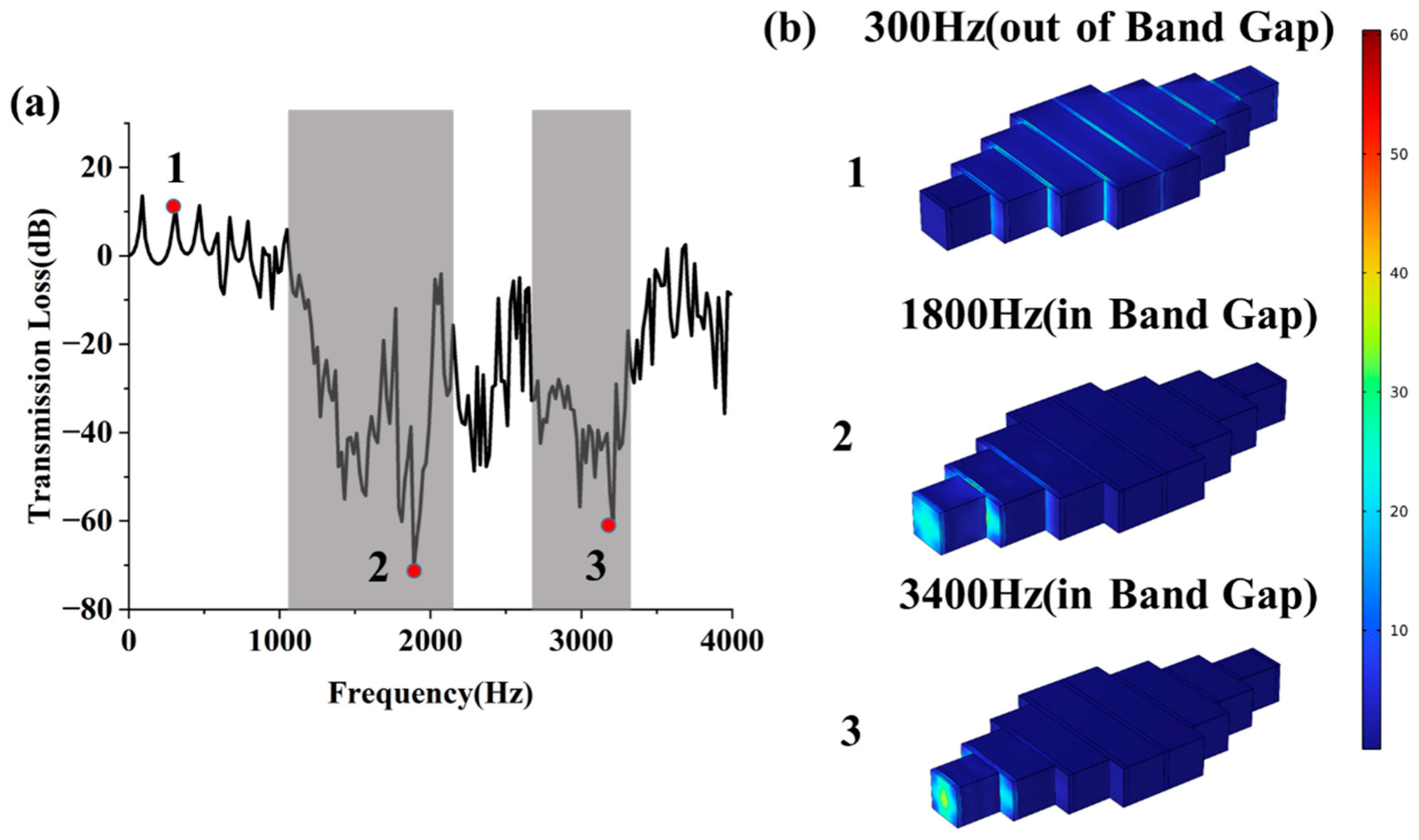
- Numerical simulations confirmed its vibration reduction capabilities in the solid mechanics domain. The results reveal two distinct effective bandgaps with an average transmission loss below −20 dB, located approximately within 1100–2200 Hz and 2700–3400 Hz. As the lattice constant increases, both bandgaps shift toward lower frequencies, while their bandwidths remain largely unchanged.
2. Theory and Model
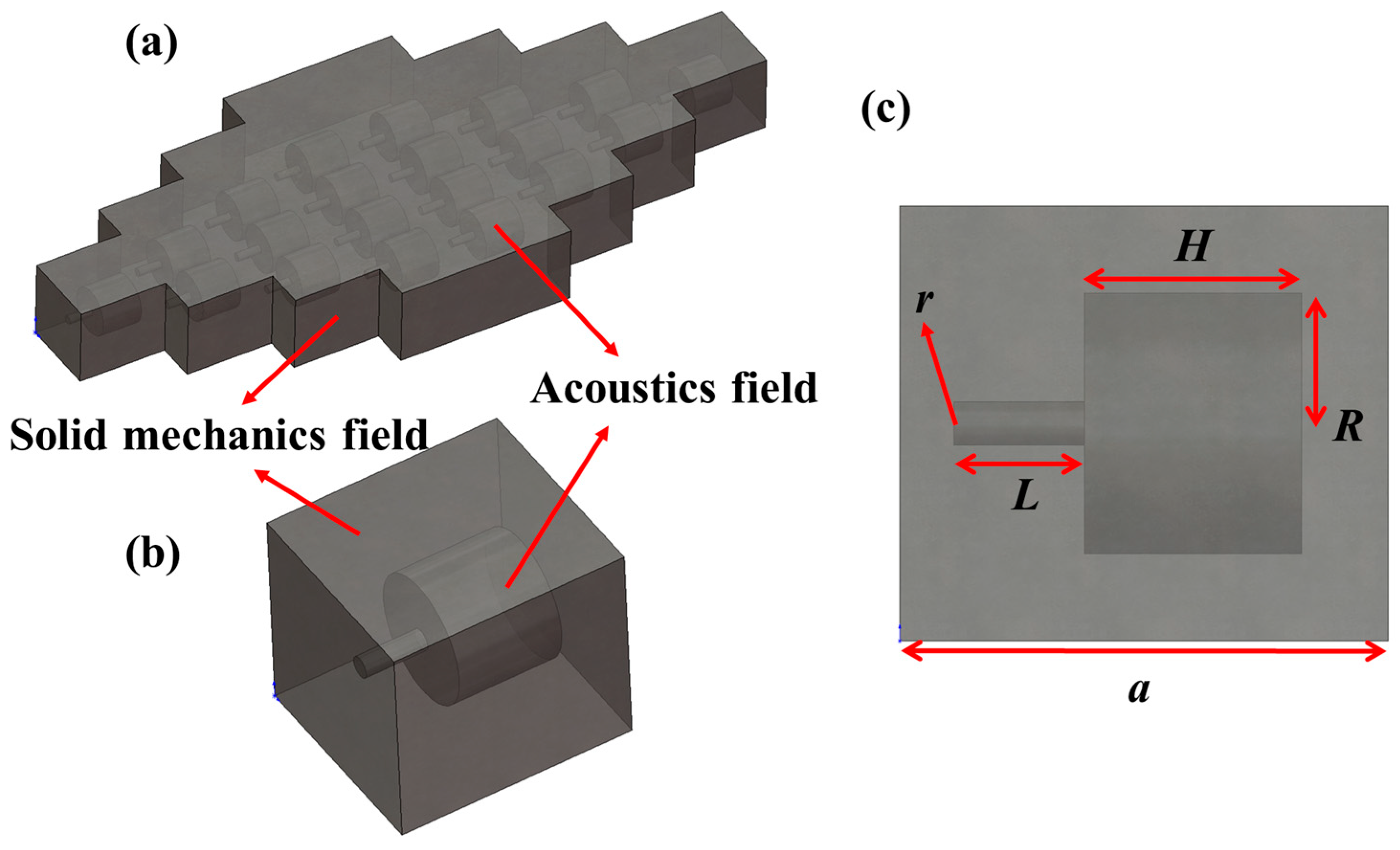
To simultaneously verify the suppression capabilities of the metamaterial, it is necessary to model and analyze the structure separately in the pressure acoustics and solid mechanics physics fields. The model in our paper is shown in Figure 1; the lattice constant, thickness, internal dimensions of Helmholtz resonators, and overall configuration are all labeled in the figures. As validated in this work, the gradient array configuration effectively broadens the sound absorption bandwidth in acoustic fields. Moreover, the graded arrangement mitigates manufacturing challenges in 3D printing, such as sealing requirements. The specific rationale is based on the following two perspectives:
Figure 1.
Gradient-symmetric multilayer metamaterial made by SolidWorks. (a) Four-layer sample; the Helmholtz cavity structures are arrayed along the direction of sound wave propagation, with their sizes sequentially increasing in the direction perpendicular to the sound waves. (b) Unit structure; the solid mechanics and acoustics field are marked by a red arrow. (c) Side view of the unit structure; the geometric parameters of the Helmholtz cavity structures, and the lattice constant are labeled in the figure.
- Acoustics Domain: This domain consists of a gradient array of Helmholtz resonators. The specific frequencies for sound attenuation can be theoretically derived using Euler’s fluid equations.
- Solid Mechanics Domain: This domain is equivalent to a spring-mass system. The corresponding natural frequency range can then be calculated numerically using the finite element method.
2.1. Acoustic Model Analysis
We consider a typical Helmholtz resonator system [35]. As is well known, a Helmholtz resonator consists of a cavity and a neck. The gas in the neck can be assumed to be stationary; the Euler fluid equation is
By performing a line integration of Equation (1) over the entire neck domain, the following is obtained:
Within the entire Helmholtz resonator, according to the plane wave approximation theory, the following conditions must be satisfied: . Thus, Equation (2) can be shown as the following expression:
It readily follows that:
In the air cavity, since the gas is fluid, the mass equation and the equation of state can be combined, yielding the following expression [36]:
Integrating Equation (5) over the volume domain gives
Performing a surface integral and linearization on Equation (6) yields
Consequently, the acoustic impedance in the metamaterials can be further derived as:
Combining the effects of the slender neck and the cavity volume, the final impedance is:
We set ; the reduction frequency can be obtained:
where c is the speed of sound. are the area and length of the neck and the volume of the cavity, respectively.
2.2. Solid Mechanics Model Analysis
The solid domain is composed of resin components with different elastic moduli, interconnected by rubber. Given that the elastic modulus of the resin is significantly higher than that of the rubber, it can be assumed that the rubber is compressible while the resin is effectively incompressible. This allows for an equivalent analysis of the solid domain, where the resin components are represented as mass blocks, and the rubber layers are modeled as equivalent springs. The natural frequency is calculated using the finite element method. During the simulation, the coupling between the solid mechanics and acoustic domains is neglected, meaning the acoustic modes and vibration modes are computed independently. Based on this approach, the equation of motion for a unit cell is shown as follows:
where K and M are stiffness and mass matrices, respectively.
is the displacement matrix, which comprises the displacements at the nodal points of its constituent elements . In accordance with Bloch’s theorem, the displacement vector U can be expressed in the form:
Here, is the wave vector. correspond to the periodic function, respectively. Applying Bloch’s theorem leads to the following periodic boundary condition:
where is the lattice constant of the unit cell.
For the evaluation of vibration transmission in the solid domain, a uniform acceleration with a magnitude of ‘1’ is applied to the left boundary, aligned with the direction of the structure’s periodicity. Similarly, to assess acoustic performance, a plane wave radiation condition is imposed to calculate the transmission loss in the acoustic domain. The numerical results are obtained by the software COMSOL Multiphysics 6.2, and the results are compared with the band structure.
The transmission characteristic is quantified by the following equation:
In this equation, and refer to the transmitted and incident physical quantities, respectively. Specifically, the parameters and are the areas of the outside and inside boundaries. All the variables mentioned in the paper and their physical meanings are listed in Table 1.
Table 1.
Variables mentioned in the paper and their physical meanings.
3. Simulation and Experiment Results
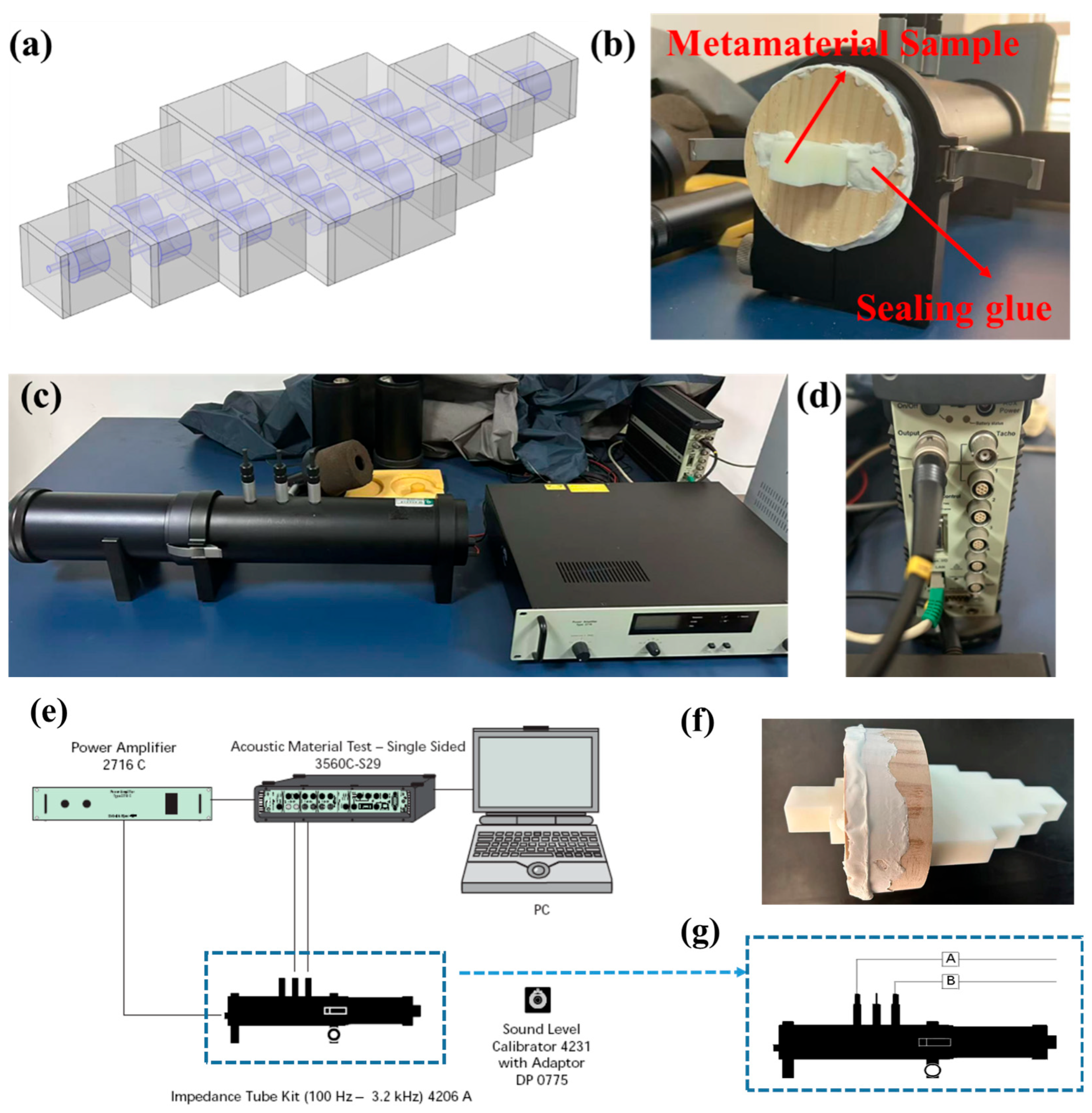
We first studied the sound absorption performance. The sample was fabricated via 3D printing using Somos GP Plus resin. Its mechanical properties are as follows: tensile modulus of 2649–2711 MPa, tensile strength of 41–60 MPa, and flexural strength of 69–79 MPa. The elongation at break ranges from 8% to 13%, and the notched impact strength is 36–50 J/m. These strength parameters meet the requirements for processing and experimental applications. The geometric parameters of the unit cell are as follows: lattice constant a = 20 mm, neck length L = 6 mm, neck radius r = 1 cm, cavity depth H = 10 mm, cavity radius R = 6 mm, and rubber thickness h = a/8 = 2.5 mm. The physical parameters of the material properties are listed in Table 2. A schematic of the simulation model and the experimental setup is shown in Figure 2.
Table 2.
The parameters of the acoustic metamaterials.
Figure 2.
Simulation model and the experimental setup. (a) Simulation model created by the software COMSOL. (b) Schematic diagram of the sample sealed inside the impedance tube. (c) The impedance tube model is SW422. (d) Sensors output terminal. (e) Schematic diagram of the experimental setup with equipment models and specifications. (f) Sample fixation method and sealing treatment. (g) Relative positions of microphones.
For the corresponding experiments, an SW422 impedance tube was employed. The manufacturer is Brüel & Kjær (B & K) from Denmark, model 4206A, with a frequency range of 100 Hz to 3200 Hz. Regarding sensitivity, multiple measurements confirm sufficient accuracy within the 50–100 Hz range; however, significant measurement error occurs below 50 Hz. Therefore, this study only analyzes experimental results from 100 Hz to 1600 Hz. A VA-LAB4 system was used for data acquisition and excitation control. The models of each component are as follows: Sensor: 4187, Data Acquisition Card: 3590c-s29, Power Amplifier: 2716C. Sealant was applied to ensure air tightness, thereby effectively simulating the intended sound absorption environment. The sound absorption coefficient was derived using the following equation:
The experimental procedure was conducted as follows: First, the impedance tube sensors were connected to the data acquisition system using the configuration shown in Figure 2. Second, channel calibration was performed within the same PULSE project by selecting microphones with identical serial numbers and conducting routine amplitude gain calibration with a Type 4231 calibrator. Third, signal-to-noise ratio measurements were carried out by sequentially performing background noise measurements and signal measurements, allowing the system to automatically calculate the SNR. Proceeding to the next step required the absence of warnings. Fourth, transfer function correction was implemented through swapped and normal microphone position measurements. Absence of warnings permitted continuation (for frequency analyses up to 6.4 kHz, while amplitude errors generally remained within tolerance, phase errors could exceed limits, requiring return to Step 1 settings to adjust phase error tolerance). During measurements, Autorange was typically selected for automatic ranging. Fifth, sample measurements were conducted by adding measurement repetitions and sample names in the Add New Measurement section, clicking Add to confirm, then initiating measurements via Start in the Measurement Control section. Finally, post-processing and report storage involved entering the desired averaged name in the Average section, selecting specific measurements, and executing averaging. The Combine section enabled merging of large and small tube measurement data through the Combine function. The Extract section allowed synthesis of 1/n-octave band results from FFT frequency response measurements according to tube type. Ultimately, functional selections were checked in the Result section for graphical display.
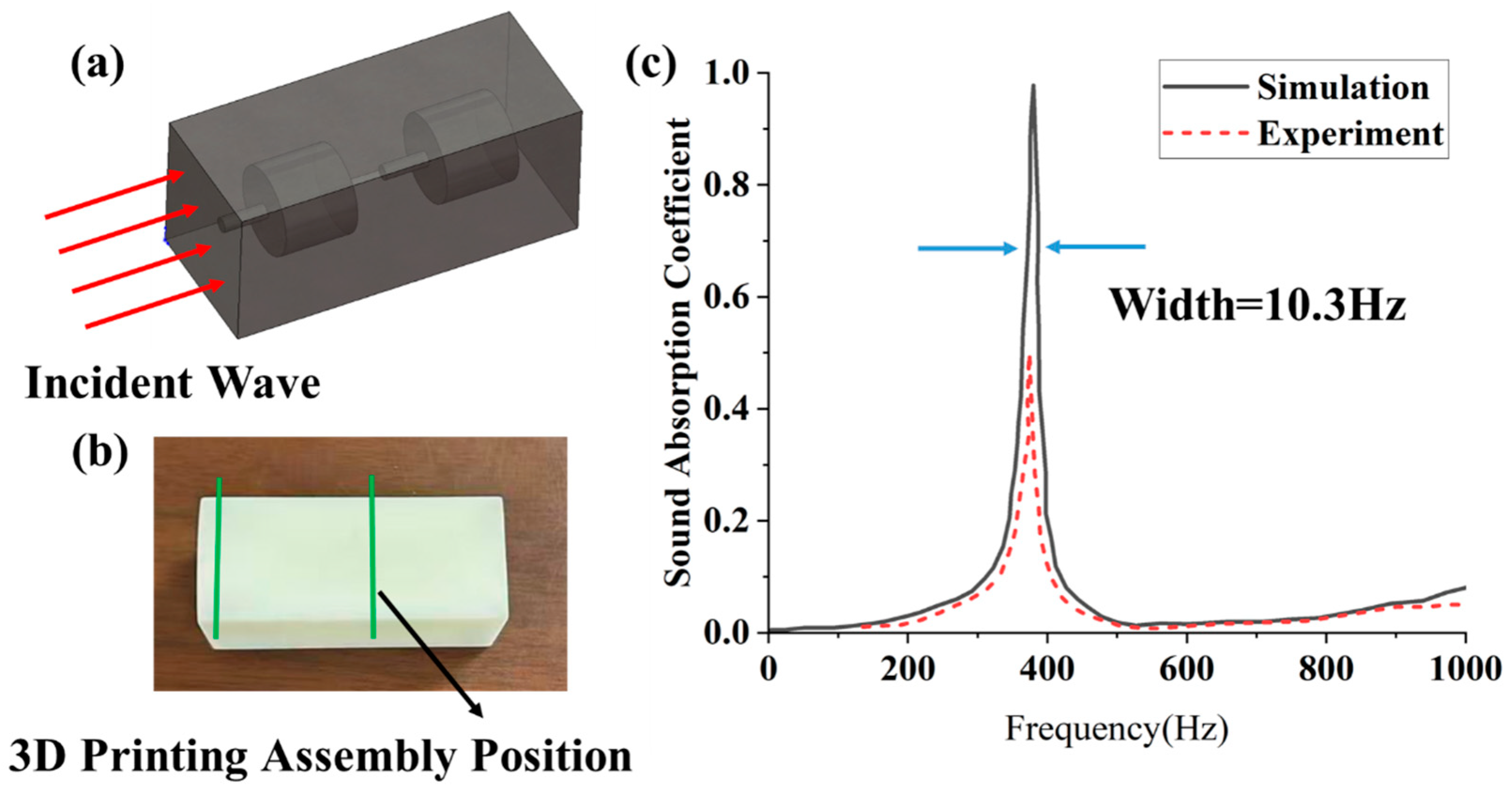
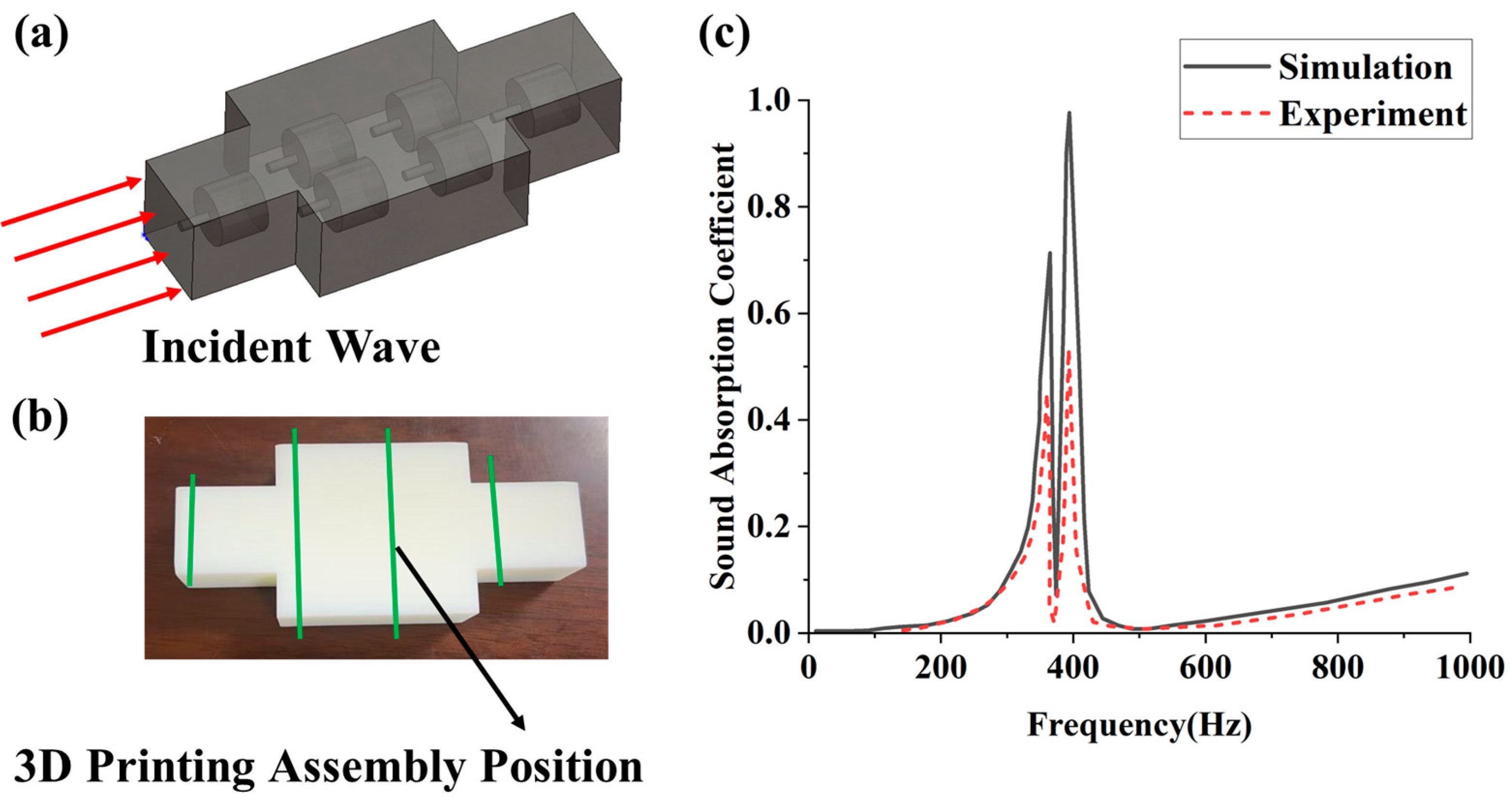
The SW (SolidWorks software 2023) model of the single Helmholtz resonator (one-layer) structure is shown in Figure 3a, where the direction of sound wave propagation is indicated by the red arrow. Since simulating the hard sound field boundary is sufficient for calculating the sound absorption coefficient. It is not necessary to consider the solid mechanics domain; the rubber section was also replaced with resin, which does not affect the results. Since 3D printing cannot produce sealed cavities, we customized the test prototype by printing it in sections and assembling them. The assembly positions and the sample are shown in Figure 3b, Figure 4b, Figure 5b, and Figure 6b. The green lines indicate the assembly positions.
Figure 3.
The one-layer sample and results. (a) SW model (red arrows indicate the direction of the incident wave); (b) 3D printing sample, which is assembled by two green lines marked in the picture; and (c) the simulation and experiment results. Considering a sound absorption coefficient above 0.7, the bandwidth of the simulation result is 10.3 Hz.
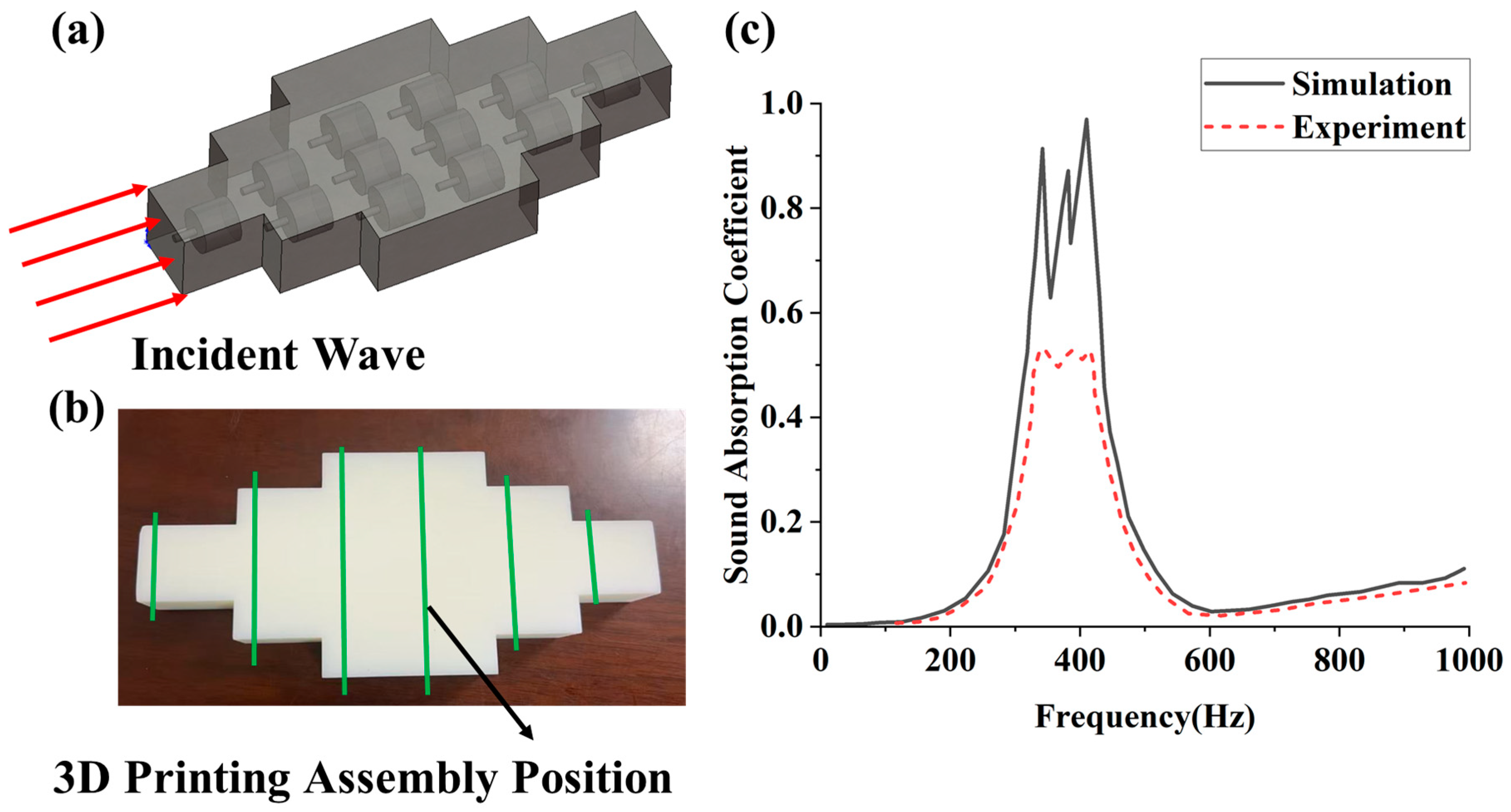
Figure 4.
The double-layer sample and results. (a) SW model (red arrows indicate the direction of the incident wave); (b) 3D printing sample, which is assembled by four green lines marked in the picture; and (c) the simulation and experiment results. An additional resonance peak appears at 380 Hz, and an absorption dip emerges between 380 Hz and 400 Hz. The effective bandwidth with an absorption coefficient above 0.7 is still narrow.
Figure 5.
The three-layer sample and results. (a) SW model (red arrows indicate the direction of the incident wave); (b) 3D printing sample, which is assembled by six green lines marked in the picture; (c) the simulation and experiment results. The sound attenuation bandwidth is also noticeably widened. Its average sound absorption coefficient within the effective frequency range remains only about 0.6.
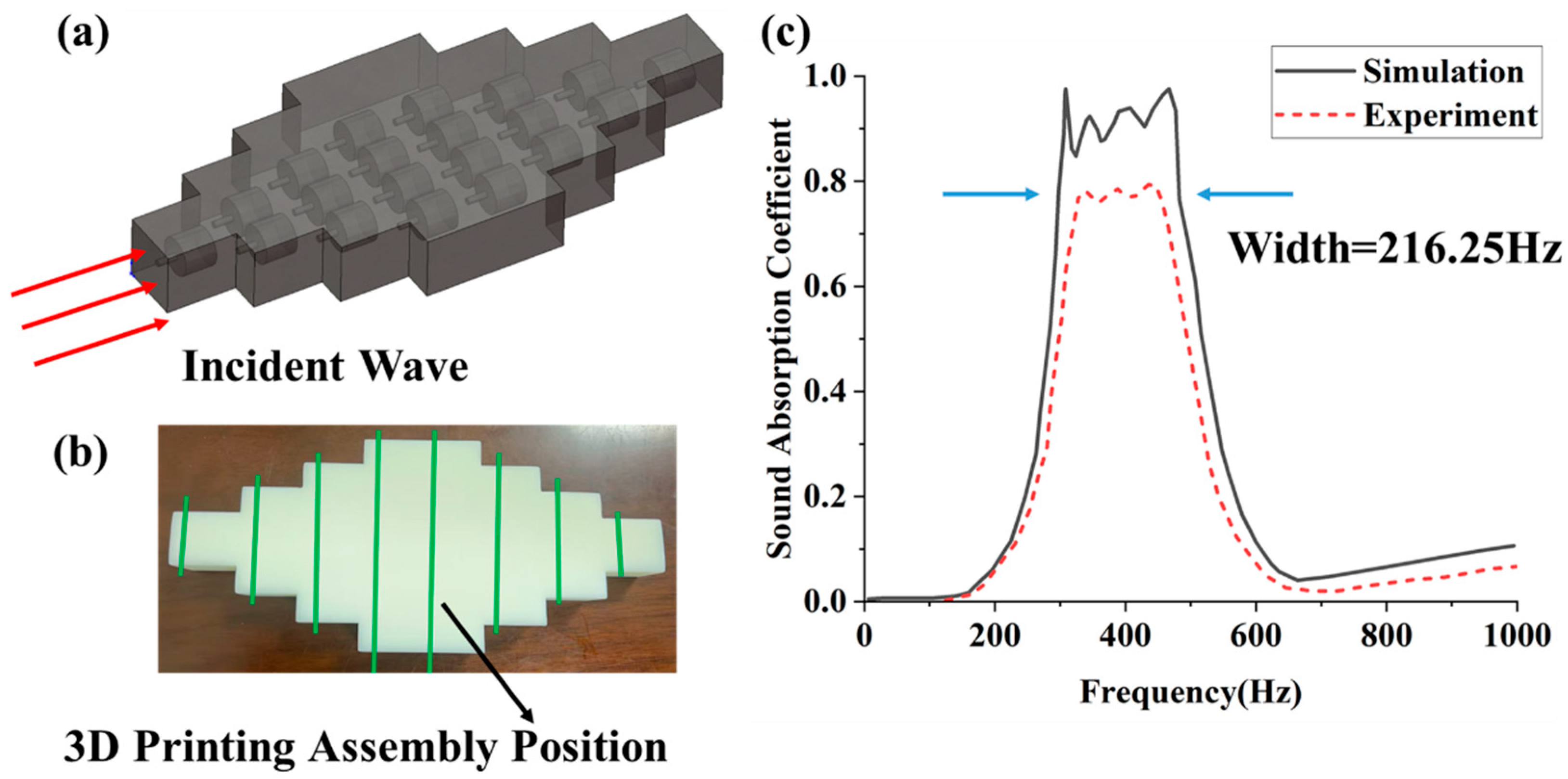
Figure 6.
The four-layer sample and results. (a) SW model (red arrows indicate the direction of the incident wave), which is assembled by eight green lines marked in the picture; (b) 3D printing sample; and (c) the simulation and experiment results. Considering the frequency band where the sound absorption coefficient exceeds 0.8, the absorption bandwidth reaches 216.25 Hz—nearly 20 times that of the single unit cell.
Figure 3c presents the simulated and experimentally measured sound absorption coefficients of the one-layer sample. It can be observed that an absorption peak appears near 400 Hz, which is determined by the geometric dimensions of the Helmholtz resonator, with the resonant frequency given by Equation (10). However, the effective bandwidth of this absorption peak is very narrow. Considering a sound absorption coefficient above 0.7, the bandwidth is only 10.3 Hz. This poses a significant limitation in practical applications, as minor changes in the external environment or structural parameters can substantially compromise the metamaterial’s absorption performance.
To address this drawback, it is necessary to broaden the absorption bandwidth without altering the peak absorption frequency. Therefore, instead of modifying the dimensions of the Helmholtz resonator, we increased the number of resonators within a unit cell, aiming to achieve this goal through the coupling effects between adjacent Helmholtz resonators.
The double-layer Helmholtz resonator structure is shown in Figure 4a,b. Without altering the direction of sound wave propagation or the manufacturing method, the simulation and experimental results are presented in Figure 4c. It can be observed that, compared to the single-layer Helmholtz resonator, an additional resonance peak appears at 380 Hz, and an absorption dip emerges between 380 Hz and 400 Hz. This phenomenon results from the coupled sound absorption effect between the two Helmholtz resonators. Although the overall absorption bandwidth is slightly wider than that of the single-layer structure, two drawbacks remain: first, the effective bandwidth with an absorption coefficient above 0.7 is still narrow and is primarily determined by the resonance peak near 400 Hz, second, the absorption dip between the two peaks does not broaden the overall absorption range but may instead compromise the effectiveness of the original sound-absorbing structure. Further structural adjustments are required to address these issues.
The three-layer Helmholtz resonator structure is depicted in Figure 5a,b, with corresponding simulation and experimental results presented in Figure 5c. As shown in the figure, the increased number of Helmholtz resonators generates three distinct resonant peaks, without producing significant absorption dips. The sound attenuation bandwidth is also noticeably widened. Overall, while the three-layer configuration addresses the issues observed in the two previous structures, its average sound absorption coefficient within the effective frequency range remains only about 0.6, with experimental results being even lower.
As shown in Figure 6a,b, we further increased the number of Helmholtz resonators. The simulation and experimental results are presented in Figure 6c. This configuration exhibits four resonant peaks. Considering the frequency band where the sound absorption coefficient exceeds 0.8, the absorption bandwidth reaches 216.25 Hz—nearly 20 times that of the single unit cell. Furthermore, the average absorption coefficient achieves approximately 0.9. This optimization successfully resolves the previous issues of poor absorption performance and narrow bandwidth. The experimental results align well with the simulations, though slightly lower, which can be attributed to minor sound energy leakage despite the use of sealant, as well as the inability of the wooden partition to perfectly simulate rigid acoustic boundary conditions.
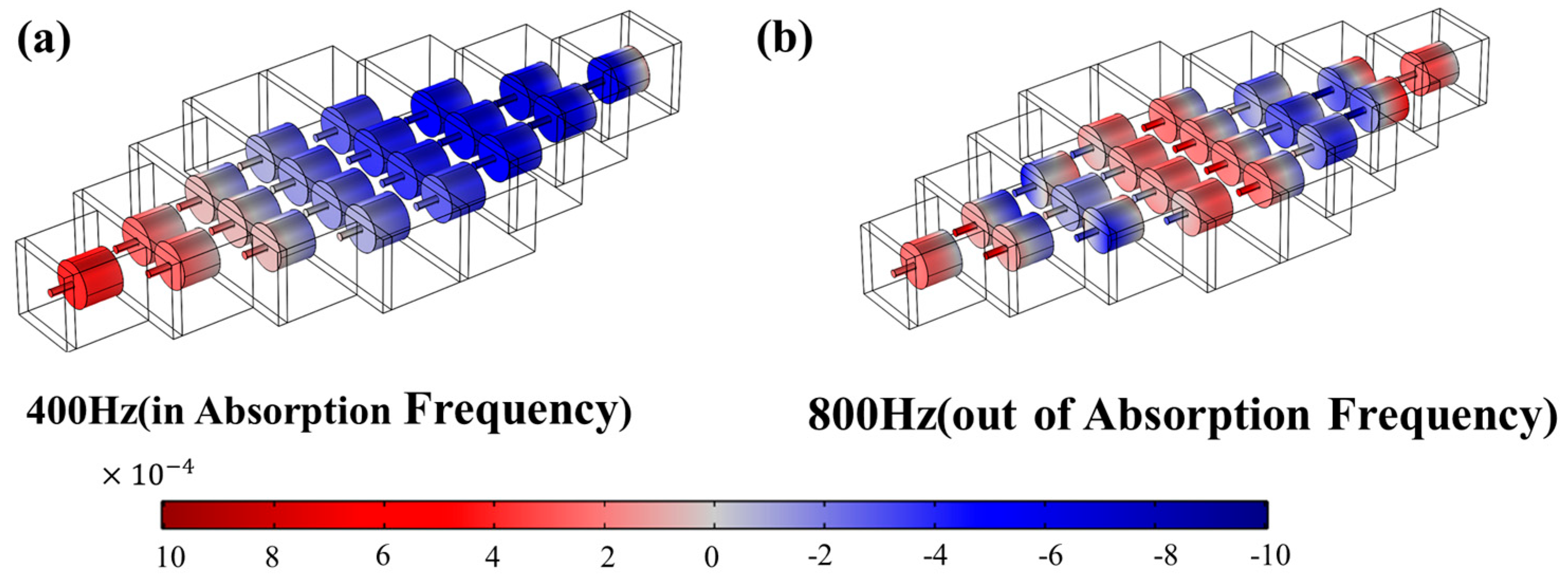
Based on the results in Figure 6c, two frequencies were selected to further investigate the sound absorption performance of the metamaterial: one is in the sound attenuation range (400 Hz), and another is outside it (800 Hz). The sound pressure distribution calculated solely in the acoustic domain is shown in Figure 7a,b. It is clearly observed that at 400 Hz, the sound pressure is predominantly concentrated within the cavities of the first three layers, with almost no sound pressure in the subsequent Helmholtz resonators. This indicates excellent sound attenuation by the metamaterial at 400 Hz. In contrast, at 800 Hz, the sound pressure exhibits a modal distribution throughout the entire metamaterial, with significant pressure still present even in the last Helmholtz resonator. Under this condition, the acoustic metamaterial does not provide effective sound attenuation.
Figure 7.
Sound pressure in the acoustic domain; the intensity of the red is directly proportional to the local sound pressure amplitude. (a) The acoustic pressure in the frequency = 400 Hz (in sound attenuation range), (b) The acoustic pressure in the frequency = 800 Hz (out of sound attenuation range).
Subsequently, the vibration reduction performance of the metamaterial was analyzed. Simulations conducted for the one, two, and three-layer acoustic metamaterials did not reveal significant vibration reduction effects. However, for the four-layer acoustic metamaterial, two vibration bandgaps were identified—one approximately between 1100 and 2200 Hz and another between 2700 and 3400 Hz. The corresponding transmission loss plot is shown in Figure 8a, where the average transmission loss in these bands exceeds 20 dB. The stress contour plots in the solid domain at two frequencies within the bandgaps and one outside are presented in Figure 8b. For the frequency of 300 Hz, which lies outside the bandgap, stress is distributed across various locations of the metamaterial in a modal pattern. In contrast, at 1800 Hz and 3400 Hz (frequencies within the bandgaps), stress remains confined to the left end where excitation is applied and does not propagate through the structure.
Figure 8.
The transmission loss and stress contour plots in the solid domain. (a) Simulation result of transmission loss from 0 to 4000 Hz. Labels 1, 2, and 3 denote the three different regimes inside and outside the bandgap. (b) Stress contour plots in the solid domain at 300 Hz (outside the bandgap), 1800 Hz, and 3400 Hz (inside the bandgap).
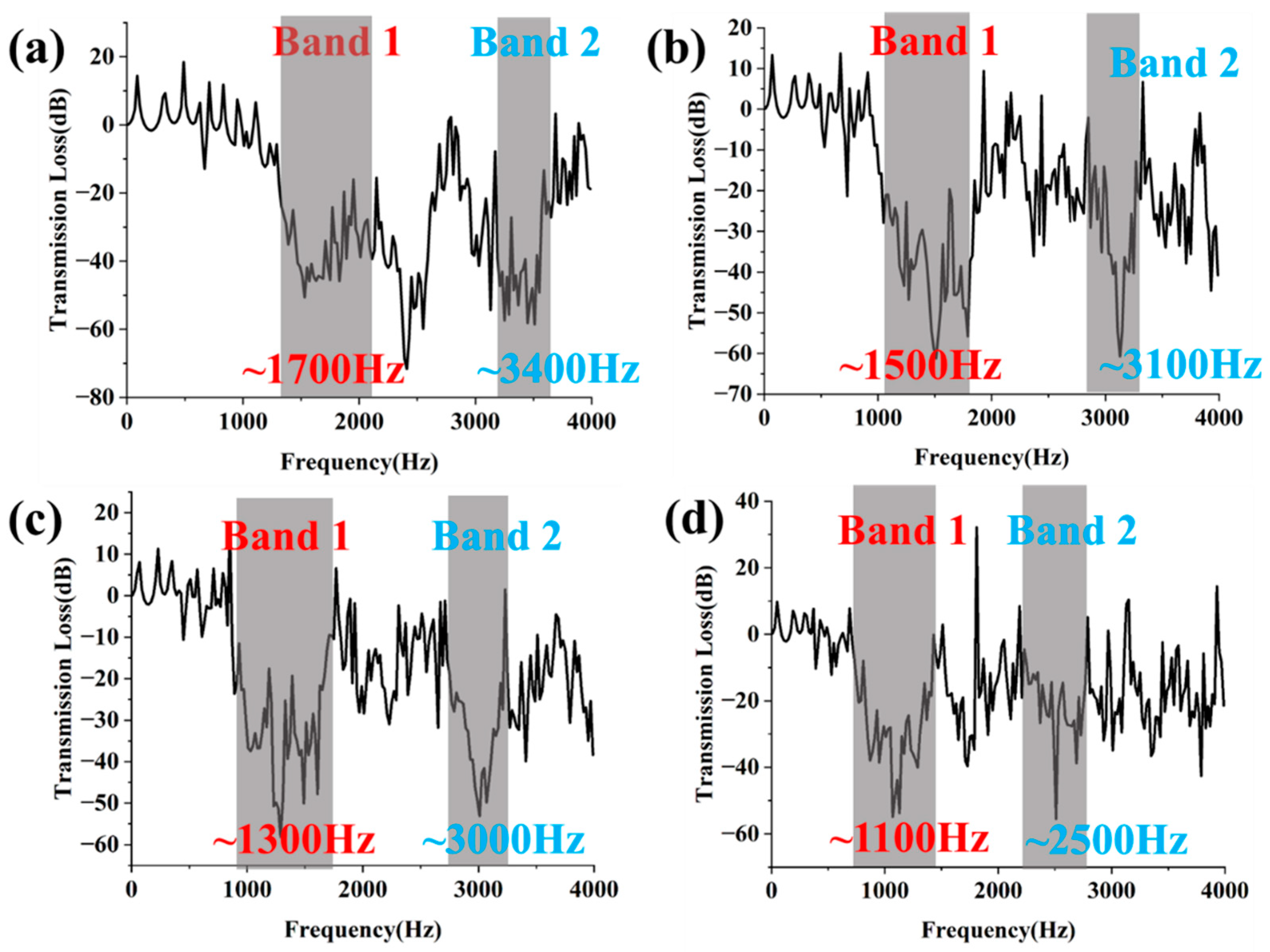
To further investigate the influence of lattice constant on the bandgap positions of metamaterials for vibration reduction, we adjusted the lattice constant a while keeping all other physical parameters unchanged. The simulation results are illustrated in Figure 9a–d, which display the transmission loss plots for a values of a = 18 mm, 25 mm, 30 mm, and 35 mm, respectively. It is evident that the metamaterial maintains two distinct bandgaps with comparable bandwidths across all lattice constants. As the lattice constant increases, both bandgaps shift toward lower frequencies. Specifically, the central frequency of the first bandgap shifts from approximately 1700 Hz to 1100 Hz, while the second bandgap shifts from around 3400 Hz to 2500 Hz. These observations demonstrate the feasibility of passive control over the band structure of metamaterials.
Figure 9.
Transmission loss of different lattice constant a, (a) a = 18 mm, (b) a = 25 mm, (c) a = 30 mm, (d) a = 35 mm. Both bandgaps shift toward lower frequencies. Specifically, the central frequency of the first bandgap shifts from approximately 1700 Hz to 1100 Hz, while the second bandgap shifts from around 3400 Hz to 2500 Hz.
We compared our results with those reported by Li [37] and our previous work [38]. The noise reduction frequency band described in the literature corresponds to the absorption mode of a single Helmholtz resonator, which exhibits a relatively narrow absorption bandwidth with an average width of less than 100 Hz. In contrast, our study employs a 4 × 4 array configuration of Helmholtz resonators, transforming the single resonance mode into multiple coupled modes. This approach achieves an absorption bandwidth of 216.25 Hz, demonstrating significantly improved applicability compared to the structures reported in the literature. Furthermore, this work systematically investigates the influence of lattice constant on vibration modes, providing potential pathways for passive control of acoustic metamaterial frequencies [39,40].
4. Conclusions
In this work, we developed a gradient-symmetric metamaterial composed of resin, rubber, and Helmholtz resonators. The physical properties of this structure were systematically investigated through theoretical modeling, simulation analysis, and experimental validation. We have summarized the findings in the conclusion, as detailed in Table 3 and Table 4:
Table 3.
The acoustic performance of the metamaterial.
Table 4.
The mechanical performance of the metamaterial.
Based on the data from Table 3 and Table 4, it can be concluded that the 4 × 4 configuration of acoustic metamaterial exhibits superior sound absorption performance. Furthermore, larger lattice constants demonstrate enhanced low-frequency vibration-damping capabilities. Results demonstrate that the four-layer metamaterial exhibits excellent sound absorption and vibration reduction capabilities simultaneously in both acoustic and solid mechanics domains. The main conclusions are summarized as follows:
- 1.
- By designing the geometric parameters of a single-layer Helmholtz resonator, near-perfect sound absorption (approaching unity) can be achieved around 400 Hz. However, this configuration suffers from an extremely narrow absorption bandwidth. Increasing the number of Helmholtz resonator layers effectively broadens the absorption frequency range, though it may introduce absorption dips that partially reduce the absorption coefficient.
- 2.
- Through structural optimization, a highly symmetric four-layer Helmholtz resonator configuration was designed. Both experimental and simulation results confirm that for absorption coefficients above 0.8, the achieved bandwidth reaches 216.25 Hz—approximately 20 times wider than that of the single-unit structure. Furthermore, the average absorption coefficient within this broad band reaches approximately 0.9.
- 3.
- The four-layer Helmholtz resonator metamaterial also demonstrates excellent vibration suppression performance within two frequency ranges: approximately 1100–2200 Hz and 2700–3400 Hz, with an average transmission loss exceeding −20 dB.
- 4.
- The influence of lattice constant a on vibration bandgaps was investigated. Results show that as the lattice constant increases, both the first and second bandgaps shift toward lower frequencies, while their bandwidths remain largely unchanged.
The metamaterial presented in this study exhibits superior noise attenuation and vibration reduction characteristics in both acoustic and structural domains. The comprehensive methodology—integrating theoretical analysis, numerical simulation, and experimental validation—provides valuable insights and establishes an effective framework for designing novel acoustic and mechanical metamaterials.
Author Contributions
Writing—original draft preparation, H.S.; software, Y.Y. and W.D.; formal analysis, H.Z.; supervision, D.J. All authors have read and agreed to the published version of the manuscript.
Funding
This work was supported by the Natural Science of Jiangsu Province (Grant No. BK20240658).
Data Availability Statement
The raw data supporting the conclusions of this article will be made available by the authors on request.
Conflicts of Interest
The authors declare no conflicts of interest.
References
- Zhang, J.; Yao, D.; Peng, W.; Wang, R.; Li, J.; Guo, S. Optimal design of lightweight acoustic metamaterials for low-frequency noise and vibration control of high-speed train composite floor. Appl. Acoust. 2022, 199, 109041. [Google Scholar] [CrossRef]
- Tombolato, A.; Bonomini, F.; Di Bella, A. Methodology for the evaluation of low-frequency environmental noise: A case-study. Appl. Acoust. 2022, 187, 108517. [Google Scholar] [CrossRef]
- Li, J.; Zuo, H.; Shen, C.; Leung, R.C. Low frequency noise control in duct based on locally resonant membrane with attached resonators. J. Vib. Control 2023, 29, 2817–2828. [Google Scholar] [CrossRef]
- Gu, T.; Wen, Z.; He, L.; Yu, M.; Li, Y.; Li, Y.; Jin, Y. A lightweight metastructure for simultaneous low-frequency broadband sound absorption and vibration isolation. J. Acoust. Soc. Am. 2023, 153, 96–104. [Google Scholar] [CrossRef]
- Göransson, P. Acoustic and vibrational damping in porous solids. Philos. Trans. R. Soc. A Math. Phys. Eng. Sci. 2006, 364, 89–108. [Google Scholar] [CrossRef] [PubMed]
- Henriques, I.; Rouleau, L.; Castello, D.; Borges, L.; Deü, J.F. Damping performance of porous materials through dynamic analysis. In Proceedings of the 49th International Congress and Exhibition on Noise Control Engineering, Madrid, Spain, 30 June 2019; Institute of Noise Control Engineering: Wakefield, MA, USA, 2019; Volume 259, pp. 6158–6167. [Google Scholar]
- Liu, Q.; Zhang, C. Broadband and low-frequency sound absorption by a slit-perforated multi-layered porous metamaterial. Eng. Struct. 2023, 281, 115743. [Google Scholar] [CrossRef]
- Gao, N.; Zhang, Z.; Deng, J.; Guo, X.; Cheng, B.; Hou, H. Acoustic metamaterials for noise reduction: A review. Adv. Mater. Technol. 2022, 7, 2100698. [Google Scholar] [CrossRef]
- Muhammad Lim, C.W. From photonic crystals to seismic metamaterials: A review via phononic crystals and acoustic metamaterials. Arch. Comput. Methods Eng. 2022, 29, 1137–1198. [Google Scholar] [CrossRef]
- Ji, G.; Huber, J. Recent progress in acoustic metamaterials and active piezoelectric acoustic metamaterials-a review. Appl. Mater. Today 2022, 26, 101260. [Google Scholar] [CrossRef]
- Jia, Z.; Bao, Y.; Luo, Y.; Wang, D.; Zhang, X.; Kang, Z. Maximizing acoustic band gap in phononic crystals via topology optimization. Int. J. Mech. Sci. 2024, 270, 109107. [Google Scholar] [CrossRef]
- Jing, J.; Sun, P.; Wu, Z.; Li, F. Investigation on enhanced band-gap properties of 2D hierarchical phononic crystals. Mech. Syst. Signal Process. 2025, 223, 111827. [Google Scholar] [CrossRef]
- Yang, S.; Chang, H.; Wang, Y.; Yang, M.; Sun, T. A phononic crystal suspension for vibration isolation of acoustic loads in underwater gliders. Appl. Acoust. 2024, 216, 109731. [Google Scholar]
- Huo, T.; Wu, Z.; Li, F. Bandgap properties for the folded S-type periodic structure: Numerical simulation and experiment. Acta Mech. Solida Sin. 2023, 36, 624–632. [Google Scholar] [CrossRef]
- Zhang, J.; Han, T.; Ma, W.; Liu, C. Adaptive Vibration Control and Band Gap Tuning of Piezoelectric Metamaterials Beams. In Proceedings of the 2024 18th Symposium on Piezoelectricity, Acoustic Waves, and Device Applications (SPAWDA), IEEE, Dongguan, China, 8–11 November 2024; pp. 250–254. [Google Scholar]
- Xiao, P.; Miao, L.; Zheng, H.; Lei, L. Band gap characteristics of new composite multiple locally resonant phononic crystal metamaterial. J. Phys. Condens. Matter 2024, 36, 195702. [Google Scholar]
- Sun, X.W.; Tan, M.T.; Xu, G.G.; Cao, Y.; Wen, X.-D.; Liu, Z.-J. Sub-wavelength topological boundary states and rainbow trapping of local-resonance phononic crystal plate. J. Phys. D Appl. Phys. 2024, 57, 225302. [Google Scholar]
- Sheng, P.; Zhang, X.; Liu, Z.; Chan, C.T. Locally resonant sonic materials. Science 2000, 338, 201–205. [Google Scholar]
- Paulsen, R.; Kastka, J. Effects of combined noise and vibration on annoyance. J. Sound Vib. 1995, 181, 295–314. [Google Scholar] [CrossRef]
- Patt, D.; Liu, L.; Friedmann, P.P. Simultaneous vibration and noise reduction in rotorcraft using aeroelastic simulation. J. Am. Helicopter Soc. 2006, 51, 127–140. [Google Scholar] [CrossRef]
- Zhang, W.; Xin, F. Broadband low-frequency sound absorption via Helmholtz resonators with porous material lining. J. Sound Vib. 2024, 578, 118330. [Google Scholar] [CrossRef]
- Li, Y.; Lin, Y.; Yao, S.; Shi, C. Low-frequency broadband sound absorption of the metastructure with extended tube resonators and porous materials. Appl. Acoust. 2024, 217, 109827. [Google Scholar] [CrossRef]
- Kong, W.; Fu, T.; Rabczuk, T. Improvement of broadband low-frequency sound absorption and energy absorbing of arched curve Helmholtz resonator with negative Poisson’s ratio. Appl. Acoust. 2024, 221, 110011. [Google Scholar] [CrossRef]
- Mei, Z.; Lyu, Y.; Li, X.; Cheng, X.; Yang, J. Parallel-coupled hierarchical and reconfigurable structure for broadband sound absorption. Appl. Acoust. 2024, 221, 109990. [Google Scholar] [CrossRef]
- Zhao, X.; Ruan, K.; Qiu, H.; Zhong, X.; Gu, J. Fatigue-resistant polyimide aerogels with hierarchical cellular structure for broadband frequency sound absorption and thermal insulation. Adv. Compos. Hybrid Mater. 2023, 6, 171. [Google Scholar] [CrossRef]
- Li, Z.; Wang, Z.; Guo, Z.; Wang, X.; Liang, X. Ultra-broadband sound absorption of a hierarchical acoustic metamaterial at high temperatures. Appl. Phys. Lett. 2021, 118, 161903. [Google Scholar] [CrossRef]
- Shi, K.; Hu, D.; Li, D.; Jin, G. Sound absorption behaviors of composite functionally graded acoustic structure under hydrostatic pressure. Appl. Acoust. 2023, 211, 109474. [Google Scholar] [CrossRef]
- Chua, J.W.; Li, X.; Li, T.; Chua, B.W.; Yu, X.; Zhai, W. Customisable sound absorption properties of functionally graded metallic foams. J. Mater. Sci. Technol. 2022, 108, 196–207. [Google Scholar] [CrossRef]
- Zhang, X.H.; Qu, Z.G. Viscous and thermal dissipation during the sound propagation in the continuously graded phononic crystals. Appl. Acoust. 2022, 189, 108606. [Google Scholar] [CrossRef]
- Ryoo, H.; Jeon, W. Broadband sound absorption using multiple hybrid resonances of acoustic metasurfaces. Int. J. Mech. Sci. 2022, 229, 107508. [Google Scholar] [CrossRef]
- Xue, M.L.; Zhang, Y.; Teng, X.C.; Jiang, W.Z.; Xue, T.; Qu, Y.C.; Ji, X.; Shen, C.; Ren, X. Multifunctional auxetic re-entrant metastructure for low-frequency broadband sound absorption and energy absorption. Thin-Walled Struct. 2025, 212, 113206. [Google Scholar] [CrossRef]
- Yuan, T.; Song, X.; Xu, J.; Pan, B.; Sui, D.; Xiao, H.; Zhou, J. Tunable acoustic composite metasurface based porous material for broadband sound absorption. Compos. Struct. 2022, 298, 116014. [Google Scholar] [CrossRef]
- Ma, X.; Yurchenko, D.; Chen, K.; Wang, L.; Liu, Y.; Yang, K. Structural acoustic controlled active micro-perforated panel absorber for improving wide-band low frequency sound absorption. Mech. Syst. Signal Process. 2022, 178, 109295. [Google Scholar] [CrossRef]
- Yu, C.; Chen, X.; Duan, M.; Li, M.; Wang, X.; Mao, Y.; Zhao, L.; Xin, F.; Lu, T.J. Adjustable sound absorbing metastructures for low-frequency variable discrete sources. Int. J. Mech. Sci. 2024, 267, 108965. [Google Scholar] [CrossRef]
- Paiva, R.C.D.; Valimaki, V. The Helmholtz Resonator Tree. In Proceedings of the 15th International Conference on Digital Audio Effects Conference (DAFx-12), York, UK, 17–21 September 2012. [Google Scholar]
- Popov, Y.N. Numerical simulation of acoustic device (Helmholz resonator). Trans. Krylov State Res. Cent. 2024, 3, 117–127. (In Russian) [Google Scholar]
- Li, G.; Chen, Y.; Chen, W.; Liu, J.; He, H. Local resonance–Helmholtz lattices with simultaneous solid-borne elastic waves and air-borne sound waves attenuation performance. Appl. Acoust. 2022, 186, 108450. [Google Scholar] [CrossRef]
- Shao, H.; Hang, X.C. A novel gradient phononic crystal-Helmholtz cavity structure for simultaneous noise and vibration reduction. MRS Commun. 2023, 13, 283–289. [Google Scholar] [CrossRef]
- Hajidavalloo, M.R.; Cosner, J.; Li, Z.; Tai, W.-C.; Song, Z. Simultaneous suspension control and energy harvesting through novel design and control of a new nonlinear energy harvesting shock absorber. IEEE Trans. Veh. Technol. 2022, 71, 6073–6087. [Google Scholar] [CrossRef]
- Mir, F.; Mandal, D.; Banerjee, S. Metamaterials for acoustic noise filtering and energy harvesting. Sensors 2023, 23, 4227. [Google Scholar] [CrossRef]
Disclaimer/Publisher’s Note: The statements, opinions and data contained in all publications are solely those of the individual author(s) and contributor(s) and not of MDPI and/or the editor(s). MDPI and/or the editor(s) disclaim responsibility for any injury to people or property resulting from any ideas, methods, instructions or products referred to in the content. |
© 2025 by the authors. Licensee MDPI, Basel, Switzerland. This article is an open access article distributed under the terms and conditions of the Creative Commons Attribution (CC BY) license (https://creativecommons.org/licenses/by/4.0/).